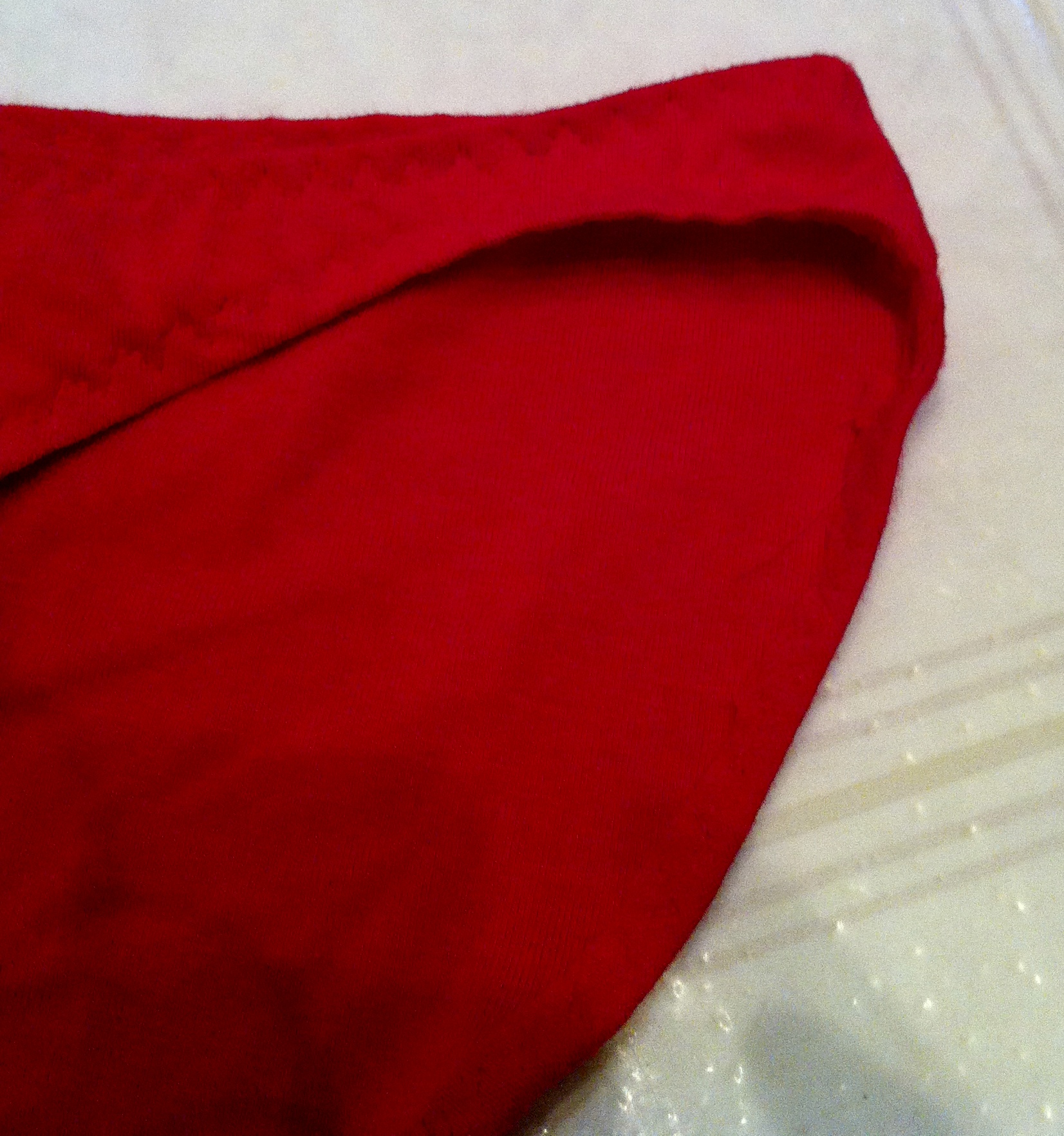
Tag Archives: finished projects

Butterflied

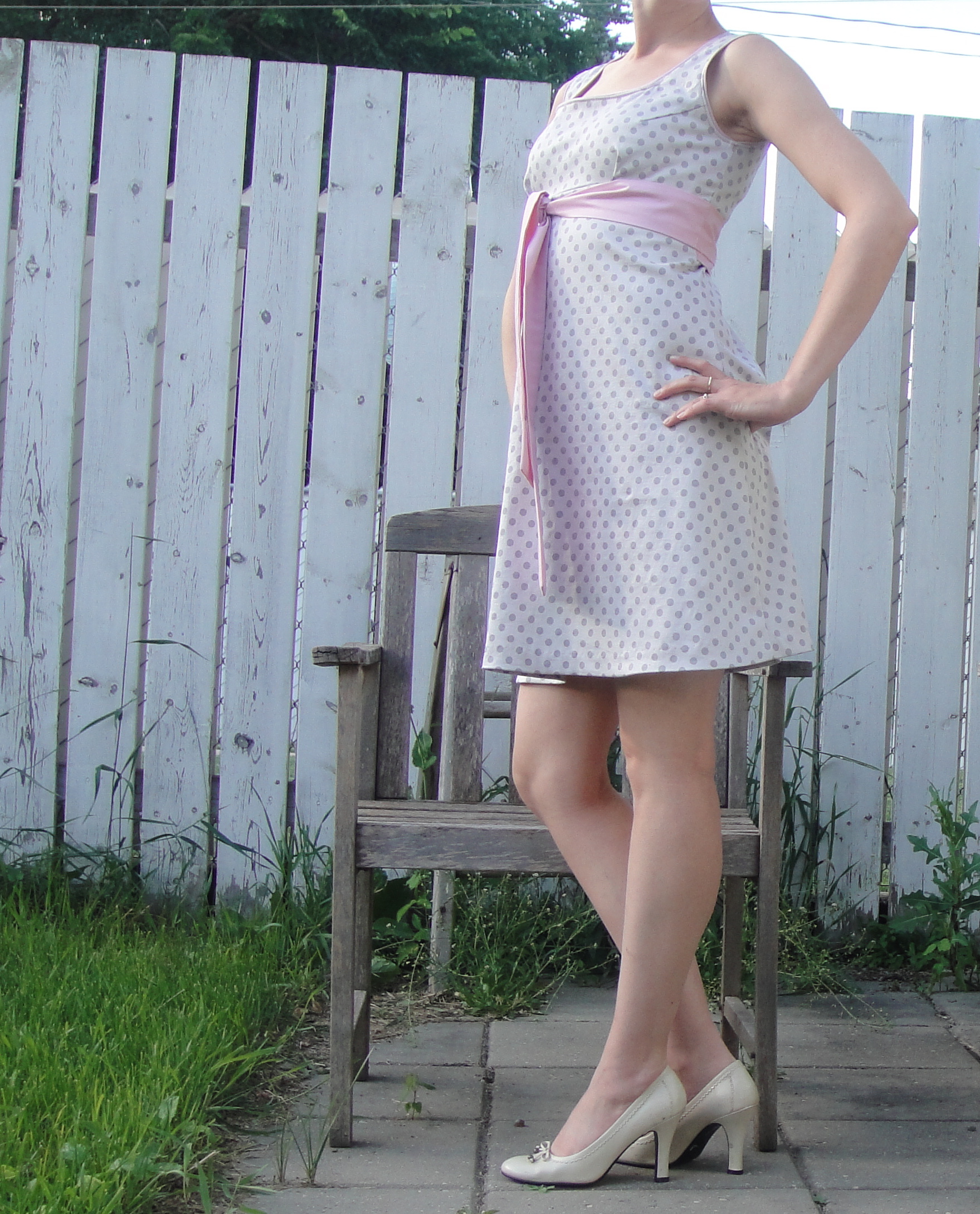
Side view. Spot the tummy poof!

I shouldn’t really have made this dress. In a world where my sewing time is numbered in hours per month, where every precious drop of needle-time needs to count, this was not really the right choice. It’s impractical, non-seasonal, and doesn’t even have charming geeky pop-culture references. Sigh.* When I sewed this last weekend, we were suffering through wind-chills into the -40s. It’ll be weeks, more likely months, before this dress sees action. And I could have been sewing zebra print fleece! But, the choice was made, so let’s try to blog it, shall we?

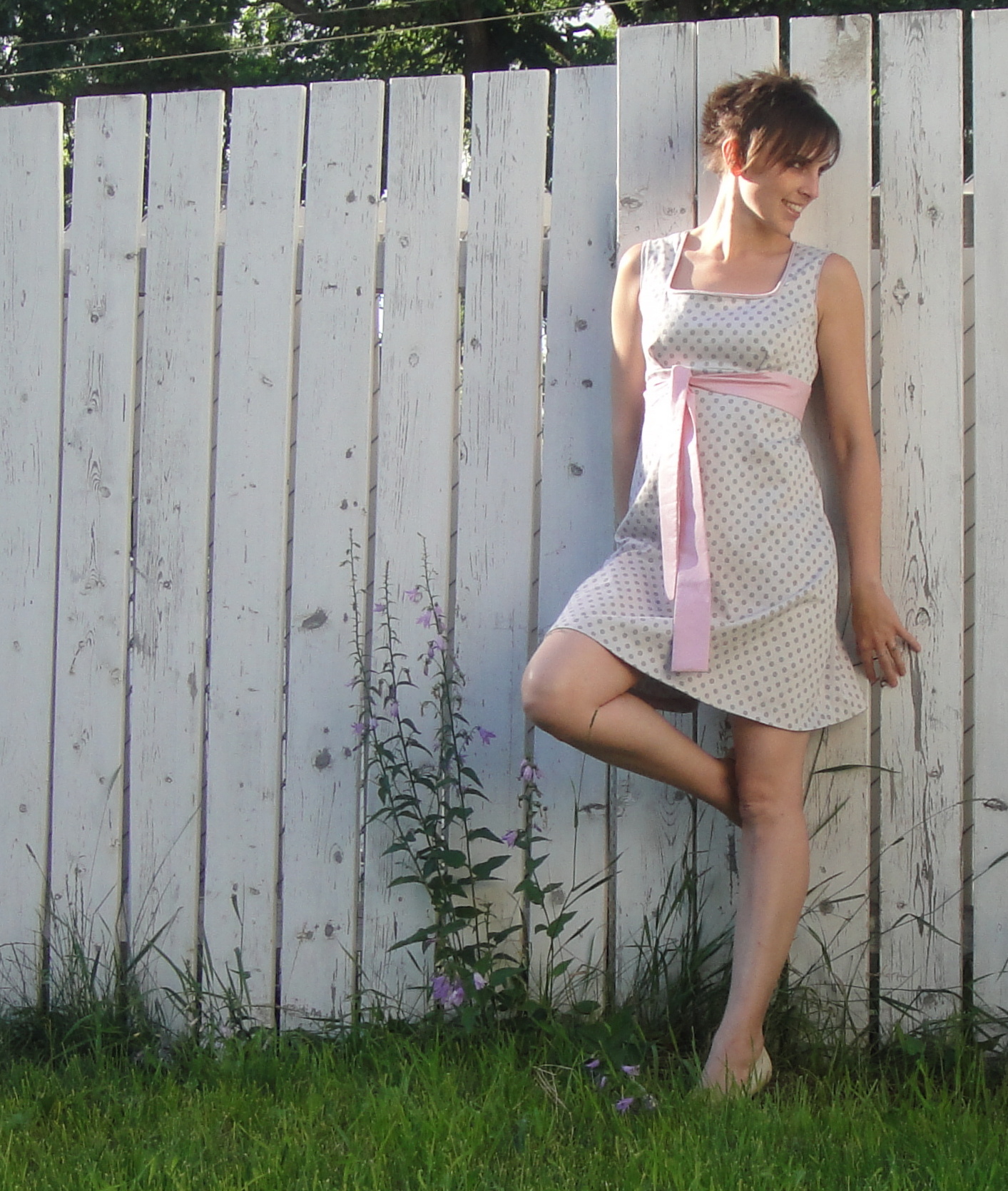
So, I made Vogue 8916. Why? Well, I think I mostly felt challenged by the sheer butt-ugliness of the envelope photos, frankly. The model looks about as thrilled with the shapeless potato-sac outfits masquerading as Chanel chic as I would be, frankly. And yet, there’s this possibly-really-cute-dress-with-neat-seaming in there at the same time. So I made it. In this really neat abstract-butterfly-wings print whose cuteness almost makes up for its %100 polyester composition and the part where the (slightly glittery) black print melts when you iron it (all over my new-last-summer iron with the spanky extra-slidy sole, I’ll add. The press-cloth was my friend).

I’m almost as over apologizing for bad photos as I am over winter, so, they are what they are, which is grainy and not-very-in-focus. My “good” camera did not do a whole lot better than the iPhone (we tried both)—the culprit is simply inadequate lighting. Which, given my husband’s abhorrence of light in most forms, isn’t likely to change until I can go outside to take photos. In, y’know, a month or three. And I do better with a tripod than a photographer, just because I find it easier to let loose and be goofy. Although Tyo, my photographer, thought I was being plenty goofy enough.

Bodice details

Anyway, so the dress. I like the idea. I like the silhouette. I like the details. I did a decent job on the execution. But there’s a couple of things in the fit that I think are going to, well, irk me.

Front view, with tummy pooch

I haven’t made many straight skirts. Ok, I made one, a long time ago, when I was a baby stitcher, and I’ve only worn it about three times. More because I tend to destroy the back-slit every time I’ve tried to wear it than anything else, but the fact remains. I do have a couple of storebought (hand-me-down) pencil skirts of some kind of stretch fabric that are cute and I wear them a bit now that I have this staid little office job (though they still annoy me when going up and down stairs.) Anyway, the skirt features the very typical-of-straight-skirts front darts.

So I can kinda, if I squint right, see how these darts are right for most people. I mean, I’ve got some tummy pooch, especially the last couple of years (hello, mid-thirties!). But, for the most part, my stomach goes out in a smooth curve, sticking out furthest at my bellybutton, unless I’m carefully sucking things in for, oh, blog photos and whatnot. Anyway, it’s not so much the fit at the tummy that bugs me, as right below. My hips go back, and the skirt does not. Those storebought skirts just kinda suck in in this area—this non-stretch one doesn’t. If I’m standing straight, it’s not bad, but from certain angles it just looks poochy. Which I guess is cute. Also, while the curve of the hip isn’t as off as I was afraid it might be (my hips don’t curve out quite the “normal” amount, or so the vast majority of pencil skirts I’ve ever tried on have informed me) it’s not in quite the right place. It hits much higher than my widest part, like a good three inches higher. So yeah, I guess I’m short in the waist and long in the hips. I guess if I made more high-waisted stuff I would know this by now. This excess width at the high-hip also contributes to the pooch, I think. And then it’s quite snug over the widest part of my hips, which falls in the part where the pegged skirt is starting to taper in toward the hem. /sigh. So note to self—in future, add whatever length you take off above the waist on below the waist. Or maybe some more—I only shortened the bodice by about 1 cm (and yet, it does hit at my waist, at least when I stand straight.), and I think the “widest part of hip” needs to come down at least a couple of inches.

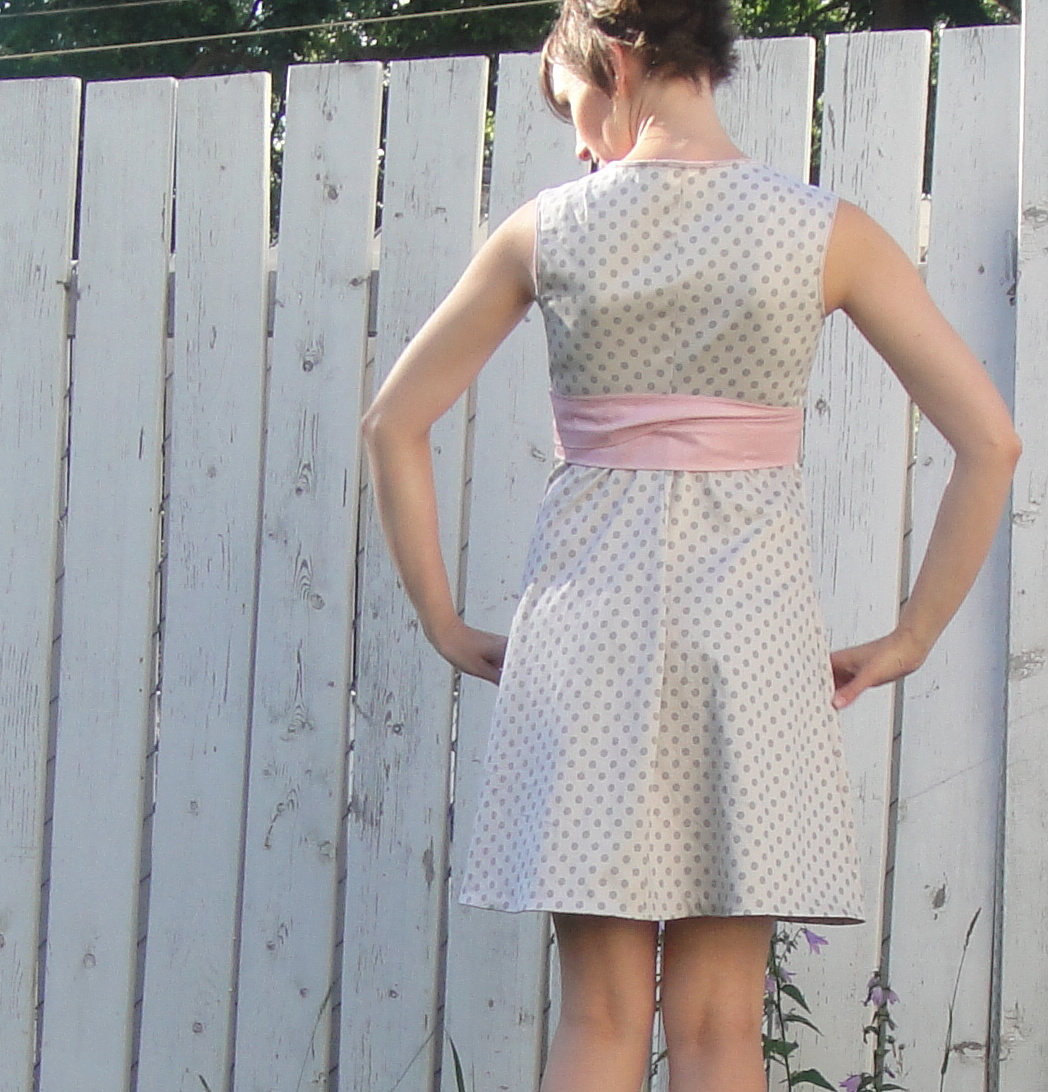
Back view, with blur.

All the back photos came out blurry. Which is too bad, because I really like the back view. My swayback adjustment worked quite nicely, here. I may not need it in things with flared skirts, but I definitely do in something like this.

Piping intersection

I spent a lot of time agonizing over how and where I was going to do the piping. I knew I wanted to highlight the interesting front seams, but just how? In the end, I went for minimal—just the front princess seams, and that under-bust cross-seam. Part of me wishes I’d done the waist, but I don’t like highlighting my natural waist, so I am content with how I did it. I’m a little disappointed that the under-bust seam is only in the front of the bodice, though—if I’d had more time/ambition I would’ve added it to the back and piped all the way around. In the past I’ve usually made my own piping, but this time I tried out this squishy-braided-flexible stuff from the store. I think the shininess works well with the fabric, more than, say, a broadcloth piping would’ve, and it was certainly less fussy than homemade satin bias piping. Anyway, it worked nicely, and I like the look and texture with this fabric. Incidentally, look at my piping intersection there! That was probably the most nerve-wracking moment of sewing the whole thing, so I definitely did a happy dance to the sewing gods when I got it just right. Also, this is the only photo where you can see the more subtle jaquard swirls in the fabric, as well as the black butterfly-wing bits. Cool fabric, no?

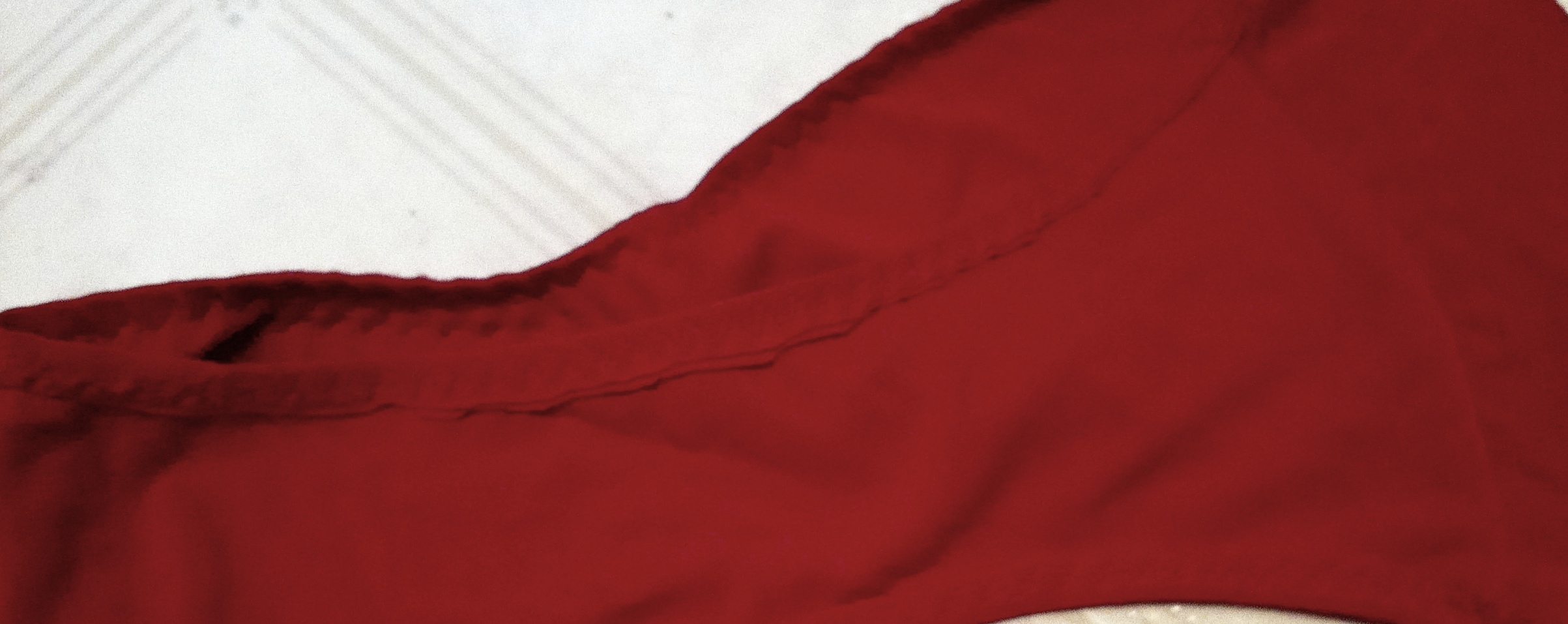
Hem, with grosgrain ribbon finish. You can see the underlining above the hem.

Other construction details? I underlined my fashion fabric, which was fairly floppy, with broadcloth. I also used broadcloth for lining, so this is really a fairly substantial-feeling dress. Unfortunately, the broadcloth lining doesn’t work with tights (especially lacy tights) so the photographed combination won’t work in real life. *pout* (I may pull off the skirt lining and replace it with a proper, slippery lining. I think the skirt-fit-issues would bug me less if the dress skimmed more anyway.) I finished the hem with some saddle-stitched grosgrain ribbon (off a spool from the dollar store—man, those don’t have much on them!) I love how easy underlining makes invisible hemming. I’m now officially terrified to wash this dress, though—red piping and red dollar-store ribbon on a white dress? I’d say disaster waiting to happen, wouldn’t you?

Really blurry pic of the bust padding

I added bust padding a la Tasia’s tutorial, much as I did with the picnic dress. Unfortunately, my only pic came out really blurry, but they do the job, which is basically just to add a bit of smoothness and structure to the bustical area if I don’t wear a bra. My bras are all padded in varying amounts, so my “size” without them is, um, a bit smaller. I made a size 12 for this, and it’s a bit roomy in the top, so maybe I really should be making a 10 in the bust for Vogues. I should also have done more stay-stitching or something around the top of the bodice, as it gapes a bit (and that’s after taking a bit off from the top of the princess seams.)

So, overall, I don’t really know about this dress. From some angles it’s great, from others the little things bug me to all hell. I probably do need to bite the bullet and play with the skirt side-seams, and replace the broadcloth skirt lining with a slippery one. In, y’know, a couple of months. On the other hand, I can see myself wearing it to work with a shrug or something to dress it down a bit (and to keep me from freezing!). I don’t have any glam-requiring events in the foreseeable future, so dressing it down will be a necessity. I suspect it’ll all come down to how it feels to wear it—and I won’t know until I try.

In a few months.

Instagram makes everything better.

*I know there are plenty of people who love to sew nothing but the fun and frivolous, preferring to buy (or just ignore) the mundane and everyday. And I get it. But personally, I find it frustrating and disappointing when I can’t wear something I make. Like, right away. Preferably to death.

28 Comments

Filed under Sewing

Camo & Lace

The Coat

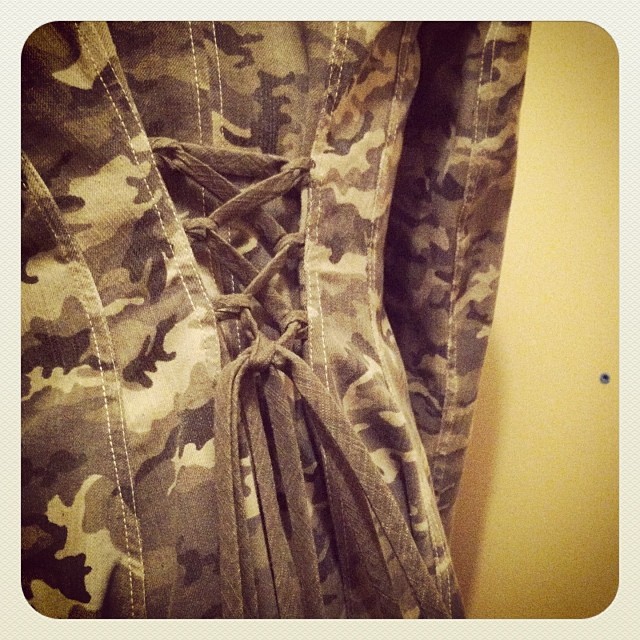
The Coat. Yes, I added lacing at the back.

I’m kinda torn. I almost don’t want to post about this at all, and wait until spring when I can get better photos. But I’m also afraid if I do that it just won’t happen. And I’m impatient. And I really, really like this jacket.

Coat.

Thingy.

Ralph Lauren Duster

Inspiration: Ralph Lauren Duster. Don’t see the resemblance?

So, way back in the day, Lady Katza of Peanut Butter Macrame posted about this (already-not-news) “duster” coat-dress-thingy. It’s apparently Ralph Lauren. I don’t know. All I know is I agreed with her about its general fabulosity. Anyway, memory morphs, as it does, so what I remembered was a long, swingy denim coat trimmed in lace. And somehow when this drab camo twill showed up at my local Fabricland (which has been a pathetic, camo-less wasteland for over a year, I will point out), well, it seemed like the perfect riff on this idea. Especially matched with McCall’s 6800, which I have had a crush on since it came out.

McCall's 6800

McCall’s 6800

In fact, it’s pretty much everything you could want in a swishy coat pattern. Princess seams (two sets). Two-piece sleeve. Lapelled or standing collar options. Detachable hood. Detachable fur collar, if that’s your style. It even had the high-low hem option ready-made! And I will make a real wintery-coat-version someday, but it was a great starting-place for the image in my head.

DSC08117

Front view. Ok, I’m a little surprised at how short it ended up. The pattern photos made me think it would go from just above the knee in the front to mid-calf in the back.

Curiously, the really ugly greige-colour of cluney lace at Fabricland looked perfect with this fabric. Unfortunately, they don’t have much selection in that colour, and and this was the only one that was the right kind of edge and scale. And all they had was four metres. Which seemed like plenty at the time, but as it turned out, was just enough to go around the hem once. My dreams of lace frothing at throat and cuffs were dashed. Maybe I’ll add it in later.

back lacing

back lacing

After checking the finished measurements, I figured I’d be safe to go down a size, with the possible exception of the waist—so I made part of my usual petite alteration right at the waist, figuring that would shave off the narrowest part. Then, I figured I’d add lacing in the back, for some extra fit insurance. Because who doesn’t love lacing? And it turns out I’m glad it’s there, so I probably didn’t need to worry about the waist being too narrow. I’m glad I made my usual petite alterations, though I could’ve skipped the swayback. I think I don’t need it in full-skirted things like this, hard as that is to wrap my head around. I added 4cm length to the sleeves, divided between upper and lower (and there was a lengthen-shorten line in each! This was enough added length, but definitely not excessive. 5 cm (2″) would probably be perfect, especially in a bulkier fabric. I did find the sleeves quite full when I first tried it on. Of course, I had already topstitched the outseam, but I was able to take it in fairly satisfactorily at the under seam. By 1/2″, so a total of a full inch per sleeve. Of course, if I were making a winter-coat version, I would probably want that fullness. While I’m talking about the sleeves, I shaved down the sleeve-heads by about 1/4″ and could probably have taken off more, considering cotton doesn’t ease well. In wool, I think the amount of ease would work. The shoulders are nice and narrow, maybe because I went with the size 10. They’re perfect for this, but I wonder if they wouldn’t be a little narrow for a winter-coat version with shoulder pads (yes, you do need shoulder pads for a tailored coat. Not thick ones, but *something*)

Innards

Innards

I showed you my bound seams before, but here you can see (however blurrily) the pockets. I made a little support running between the pocket bag and the facing, so it doesn’t flap around. Speaking of the facing, that’s one of the two (maybe three?) things I didn’t like about this pattern. There is no separate piece for the facing—they just tell you to cut four of the CF pieces. Well, I did that in my Winter Coat and I can’t help but suspect that it was a contributor to the mysterious front-flaring-out that almost killed the coat at the final stages—only major hand-stitching (basically padstitching the two layers together) saved it. Anyway, when I went to cut my second pair, I skipped the flare. For this topstitched design, I wasn’t concerned about turn-of-cloth allowance on the lapels, but if/when I make a proper version, I’ll be over at the RTW Tailoring Sewalong posts, where Sherry went over all the necessary changes for drafting a lining and facing properly. Such a good sewalong.

DSC08121

Buttons and buttonholes. If you look close, you can see where I ran out of topstitching thread SIX INCHES FROM BEING DONE!

Of course I had to use jeans buttons. Of course, I couldn’t find ANY of my handy-dandy little thingies that hold the two bits in place while you hammer, nor could I find my awl. Let me just say, those two gadgets make life a lot easier. I made the buttonholes with a vintage Singer buttonholer.

Buttonholer. First use.

Buttonholer. First use.

I should perhaps mention it was the first time using this particular buttonholer; in the past I’ve used my Greist one. I did not notice a measurable difference between the two (and they both use the same templates, which means my little extra kit that has the short keyhole template works in either). I did NOT try to use the topstitching thread for the buttonholes—I have come to the conclusion that this is just asking for trouble. They look just fine in regular, matching thread.

measury-gadget

measury-gadget

I used 8 buttons, which felt like quite a lot, but I like the closely-spaced look. Also, less gaping if when I lace things up really tight. And my nifty-measury-gadget only does 8 holes. Probably that’s enough for most things.

DSC08120

Neck yoke, with hanging loops. Also, I love binding.

There was no rear neck facing piece (another boo—basically there were no proper lining pieces, though there was a proper undercollar). So, I made my own. I’d go into my process, but a) Sherry covers it really well, and b) I totally didn’t follow her advice and just kinda laid some tracing paper over the half-finished jacket and traced out the shape. I am glad I remembered a hanging-loop, even if I didn’t think to add it until after.

Chillin

Chillin

So, I’m pretty happy with the outcome. And even Osiris approves, which is pretty rare, although he wondered why I didn’t use more lace. Sadly, the weather being what it is, this jacket won’t get much wear for a couple of months. What can I say? I was, ah, inspired. Which is a great feeling to follow, isn’t it?

Now I had better go be a good girl and make a onesie for Syo next…

63 Comments

Filed under Sewing

Little leggings, legion

20131004-193251.jpg

A small selection

Last weekend, as often happens, we went to my Stylish sister-in-law’s. Certain television premieres may have been airing that, since we gave up cable, wouldn’t be watchable chez Isis. But before the stories were watched, we sewed. I’ve had a leggings itch ever since working on the Espresso leggings for Cake Patterns, especially with the weather turning. And this purple polkadot Michael Miller knit was kinda burning a hole in the stash ever since I caved and bought it last month.

20131004-193311.jpg

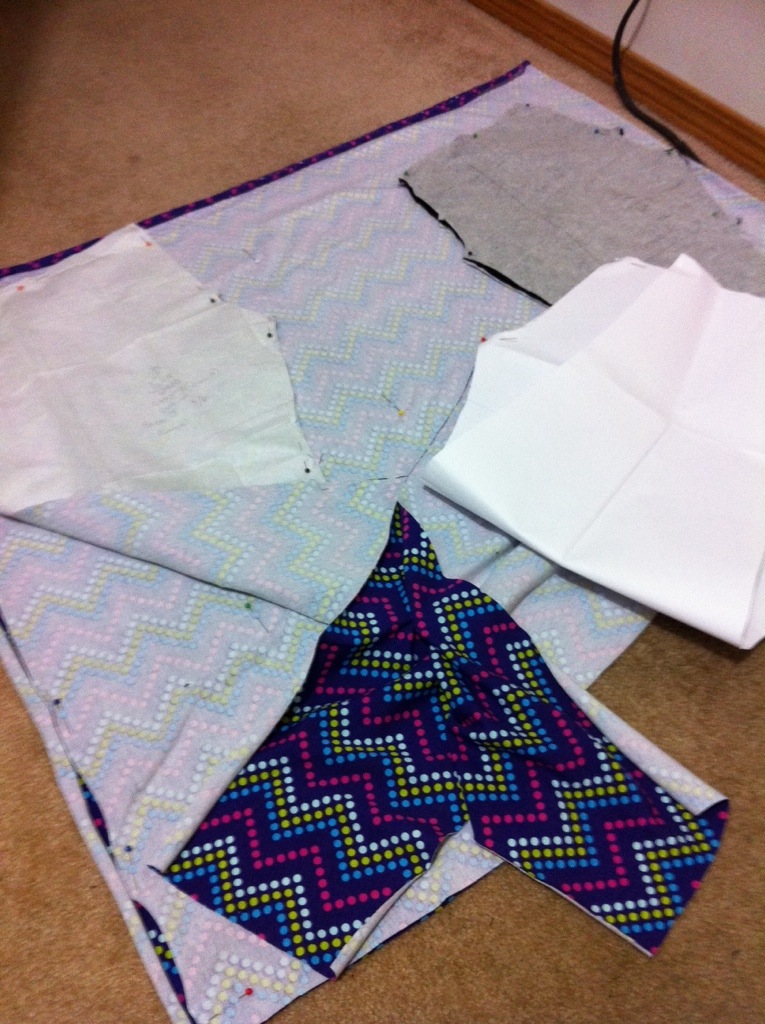
Laying out little leggings

The purple was never meant for me; I handily got three little leggings out of it, for Syo, Fyon, and Waif, and there’s enough left for two more leggings or any number of pairs of underwear, depending. Stylish worked on tracing her pattern for Coat Club, but she is easily distracted by frivolities like cleaning her house and making supper, so she didn’t get much done. I, on the other hand, made five pairs of leggings, mainly by dint of ignoring everyone else.

20131004-200059.jpg

Trying on.

I spent, by far, the most time laying out and matching up zig-zags.  The purple knit isn’t as substantial as I’d originally thought and I’m really not sure how well it’ll wear—although it is CUTE. The zig-zags actually ran lengthwise on this fabric, which didn’t seem right, so I cut them on the cross-grain, which means the maximum stretch isn’t quite right. As a result the leggings are a bit snug, even on the Waif, who isn’t at all used to anything being tight.

I think the cuteness has made up for it, though—I made the leggings on Sunday, it’s now the following Sunday, and I’m not actually sure they’ve been taken off.*

20131004-193228.jpg

Tags

My fave bit was using Stylish’s embroidery machine to make little tags with the first letters of their names to help the girls distinguish between their pairs. And tell front from back. The only problem with this scheme is that Syo and Fyon have names that begin with the same letter, but they don’t live in the same house so I’m hoping it won’t be a huge issue.

20131004-193211.jpg

All mine!

And my pair? Plain black, just below knee length. I wanted them mostly for sleeping, and they have been serving that purpose nicely.
*okay, they probably have. Stylish is pretty firm about things like pjs and baths…

20131006-190006.jpg

… and more…

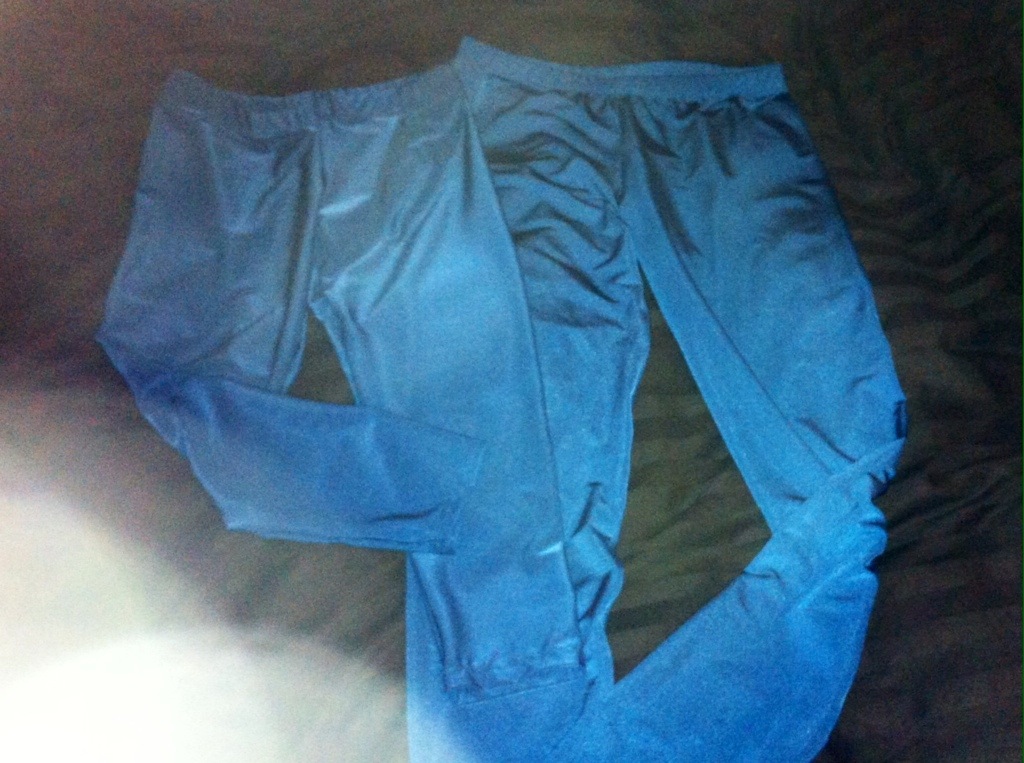
Ok, so in the time it’s taken me to write up this (painfully poorly photographed) post, I made up two more leggings, from this slippery nasty spandexy stuff Syo talked me into buying ages ago. I had a metre, which turned out to be just enough for a pair of leggings for me and another for Syo. It actually wasn’t bad to sew (slippery but not rolly and it doesn’t run), but I did have to sew just about everything twice, because the narrow zig-zag I used the first time around didn’t have enough stretch. So I switched to a bulkier, but stretchier, mock-overlock stitch on the White. Incidentally, Stylish’s Memorycraft has a mock-overlock stitch and an over-edge foot that works REALLY nicely with it. Since my serger a) doesn’t make strong enough seams for stuff like this, and b) has decided not to cut anything, this kind of thing has been kinda important. They’re all really slow compared to a serger, though. *pout*

Hopefully at some point this week I’ll manage to write up the underwear I’ve been making, the Hallowe’en outfit, or even the Darth Vader dress…. but next weekend is Canadian Thanksgiving, so I’m not holding my breath for too much sewing time…

5 Comments

Filed under Sewing

Sexy lingerie…

This is not. I assume adding a corset will make it better, but I am currently unconvinced. No wonder Victorians were so sexually unenthused (although they did invent the vibrator…)

So, here, only a few weeks late, are some final finished photos of my drawers. I had been holding off, hoping to get comparison shots with an actual pair in my mother’s collection, but I had a few free moments this morning while Osiris was still in bed (and so not around to laugh at me) so I figured I’d better seize them and get some photos. However, my cameria is AWOL (actually, probably somewhere in the bedroom with Osiris, and if I bang around in there I’ll wake him up and lose my opportunity), so you still get iPhone photos. Sorry. 😦

20130929-082742.jpg

Front View

The drawers fit, for a given level of “fit”. The length is about right, or maybe it’s a bit too long. Apparently they should be just below the knee—anything longer is slovenly. And the saggy-baggy-puffy-crotch thing seems to be part of the charm. Or, y’know, something.

Speaking of which, my main source of instruction have been threefold: “The Home Course in Dressmaking and Ladies Tailoring” (copyright 1908), which I actually have in paper copy, whence came the actual draft for these drawers, an ebook, “The Home Needle,” from 1882, by Ella Rodman Church, and the pair of antique drawers in my mom’s collection (hereafter referred to as “the extant pair.”). I love the 1882 book because a) it’s just about my time period (mid 1880s), b), it’s mercifully brief, and c) it’s delightfully opinionated. Mrs. Church starts right in by excoriating the sewing-machine (by the time of my 1908 book, the sewing machine was much more accepted and there is much less emphasis on hand sewing of things like basic seams.), and the state of sewing generally, and she’s full of important tips like the one above about the appropriate length of drawers. Whenever I find myself lacking, seamstresslywise, I remind myself that I keep company with all the half-ass, slipshod Victorian girls just plugging away making shoddy, poorly sewn items purely to annoy mavens of excellence like Mrs. Church. And if she finds my drawers slovenly… well, she’ll never have to see them. 😉

20130929-082757.jpg

Side view. Note puffy butt and tapering waist-band.

Although I based the draft for my drawers on the later Home Course, I did take a couple of details for them from Mrs. Church.

Drawers draft from The Home Needle (1882)

Mrs. Church’s drawers draft has a curved front crotch, and no rear crotch curve at all. This is actually the same as the drawers in Simplicity 9769. I assume this creates an extra-puffy bum, which would be desirable in the bustle era. (I wonder if the front curve has to do with the pattern being designed to have the crotch closed in the front.)

Drawers draft

Drawers draft from Home Course In Dressmaking (1908)

The 1908 draft I used, by contrast, has no curve at either front or back, but both lines angle back in pants-fashion, rather than one angling and one not.  And I departed from both drafts on one thing—when I compared my pattern with my mother’s extant pair (which, of course, I don’t know the precise dating of), I found the leg of the extant pair to be WAY, WAY narrower than my draft. So I narrowed that. Actualy, a lot of the details I wound up picking—the tucks, the lace, the ruffle, even the band finishing the crotch edges—kind of go back to that original pair.

20130929-082812.jpg

Rear view. The “chemise” is a slip left over from a 90s sheer-floral-rayon dress (you remember the ones). It actually kinda works, although the neckline is all wrong.

Although I initially drafted a curved waist-band pattern based on on the 1908 book, by the time I got around to this part of the sewing I had misplaced it and figured I would go with Mrs. Church’s instructions, which are more my proper period, anyway.  She says that although most people make a straight waistband, about an inch folded over, it’s better to make one wider at the back, that tapers to the front, and closes with two buttons rather than one. So I did. It would probably sit better at my actual waist, but despite all the fussing and futzing it turned out a bit large. I could, of course, move my buttons over, but I’m thinking the less bulk at my waist the better, once all the layers start coming together.

20130929-082848.jpg

Phew. OK, let’s stick with hanger shots.

I added a few more small tucks around my rather-ugly lace. I’m more or less okay with it now, although of course I’ve since found several laces in stash that would’ve been better. I did not remove the fabric behind the lace—there’s top-stitched lace exactly like this on the extant pair of drawers. I suppose see-through panels on your drawers might not be quite the thing, or maybe that seamstress was just a bit lazy. Either way, I have precedent.

20130929-082905.jpg

I added a few more small tucks around the wider lace. I like it better now.

I finished my inseam with a French seam, as per the 1908 instructions, contra Mrs. Church and the extant pair, both of which use a felled seam here. I can see why—the fell would be flatter and less likely to, ah, chafe delicate parts, since the low crotch sits pretty much right between your thighs. Since I don’t plan to be wearing these for days on end, well, I’ll live.

20130929-082920.jpg

Inseam, finished with a French seam.

I also finished the crotch with a straight band, as per the 1908 book and the extant pair, contra Mrs. Church, who advises some kind of a shaped facing, wider at the crotch point and narrowing toward the waistband—I couldn’t really make heads or tails of what she was describing, frankly. Which is the downside of the Victorian sewing books, but anyway.

20130929-082935.jpg

Two medium buttons

A few weeks ago my mother handed me two baggies of mixed buttons she had picked up at a garage sale. Ah, the joy. Anyway, I went through these looking for the perfect buttons, and found quite a few plain, smooth white glass buttons that seem just perfect. Medium size buttons, not small, in accordance with Mrs. Church’s instructions.

20130929-082949.jpg

Unbuttoned to show my terrible-ass buttonhole.

I remain impressively terrible at making hand-worked buttonholes (especially when I compare myself to actual examples). For something different this time I used a darning yarn that was in the sewing stuff I recently got with my Grandmother’s machine. I used it doubled and single would’ve been better, and it turns out after the fact that I was using a blanket stitch rather than a buttonhole stitch (they’re much the same except for the directly of the needle), which explains why my knots never end up in the right place. However, they are sturdy. Mrs. Church is rolling over in her grave as we speak.

20130929-083022.jpg

Now you can REALLY see the difference between the front and back waistband width.

These were pretty fun to make, although I must say finishing something and not being able (or even inclined) to immediately wear it out and about is pretty frustrating (and why I have resisted the siren-song of historical costuming in general, the last few years). Next in line: chemise, corset, petticoats, bustle. Not necessarily in that order. At my current rate that should only take, oh, another two years?

29 Comments

Filed under Sewing

Jeans at last.

Jeans!

Jeans!

I’ve needed new jeans for a while. Like, a really long while. The last pair was these skinnies, a year and a half ago. Which, I’ll add, wound up twisting annoyingly in the one leg, so I don’t wear them much. I think I definitely need to embrace the single-layer cutting for jeans. /sigh.

Jeans

Jeans

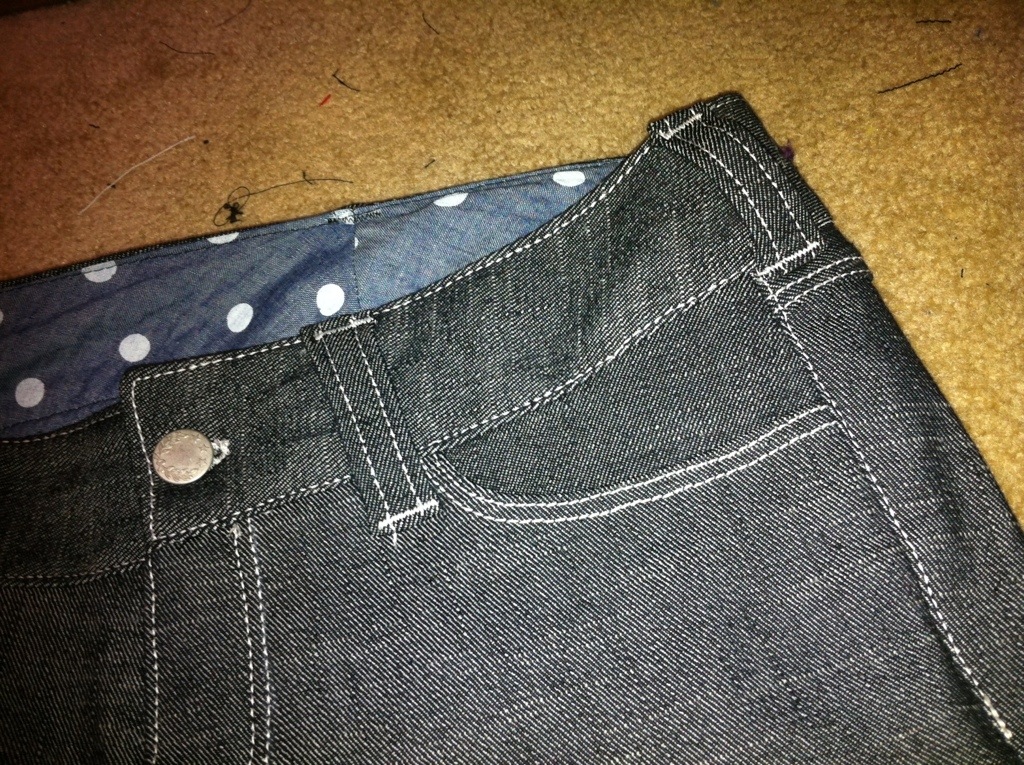
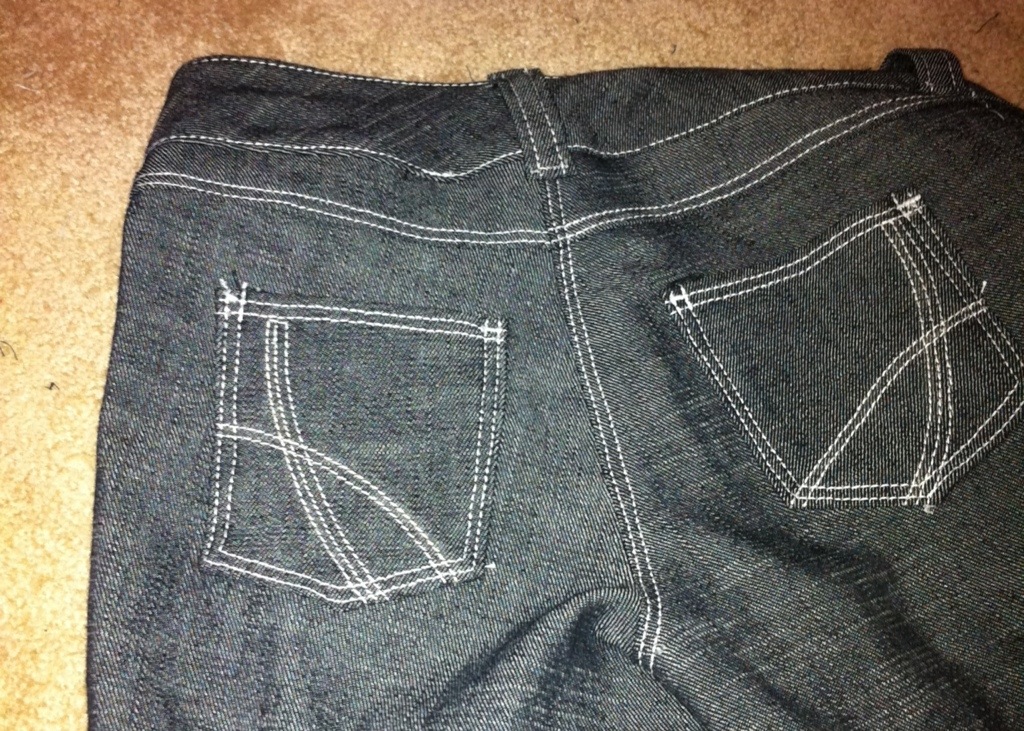
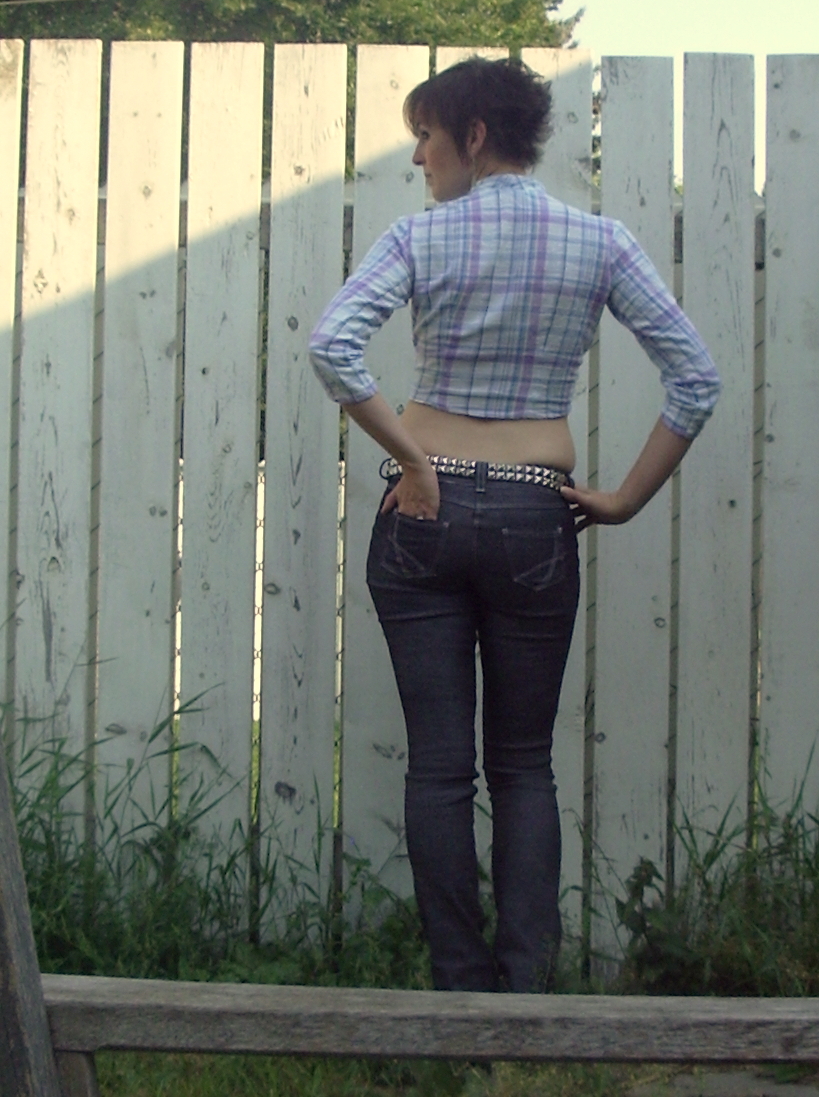
There’s not much to say about these. It’s the same pattern as ever, the same techniques, even the same frickin’ pockets. I’ll repeat the detail shots from the last post just for the sake of completeness. I did spend some time tweaking my contour waistband pattern, which began life as the waistband from the Burdastyle Ellen pants (which are no longer free, WTF?) but has since gone through several iterations. This version is wide, curved in the back and straight(er) in the front, and doesn’t gape over my butt even a little bit. More importantly, it didn’t gape over Stylish’s butt, which I am really frickin’ proud of, but I guess that’s another post (assuming I can pin her down for blog photos. These non-bloggers, /sigh.)


Front details

Front details

I used this polkadot (?)chambray for the pocket lining and inside waistband. It’s nice, but a bit lighter than I’d like for this purpose, I think, even interfaced. The waistband is fairly wide, and it ended up being a bit floppy, even with my adding a CB seam so the front could be on the grain. Also, I should’ve added two buttons for the width, not just the one. Hopefully we’ll get around to the rivets sooner rather than later.

Back details

Back details

I did not put a whole lot of work or thought into the pocket design. Just something simple I could copy fairly easily. I was busy overseeing Stylish’s pair.

Back view

Back view

Oh, yeah, and I’ve recently discovered the one up-side of having a child large enough to steal your clothes. You can steal hers back.

Side view

Side view

And, while I normally wouldn’t show this much tummy these days (never mind on the internet), Osiris’s reaction to this ensemble was, shall we say, sufficiently positive that I’m gonna put it out there anyway.

Ma butt

Ma butt


Hmph. Done.

Hmph. Done.

Of course, just as I finished these, summer’s last gasp really set in and we’ve had nothing but hot, sunny days completely unsuited to jeans. Ah, well. Winter’s just around the corner and I’ll have plenty of chance to wear them soon enough…

19 Comments

Filed under Sewing

The (not so) pretty

20130812-065415.jpg

If you garden, you’ll know that there are lots of perfectly edible foods grown that end up just, well, not being terribly attractive. The carrot with two points. The lopsided apple. We eat them from the garden because, well, food is food and the taste matters more, but we’d probably never buy such an oddity in the grocery store (which wouldn’t sell it to us anyway.)

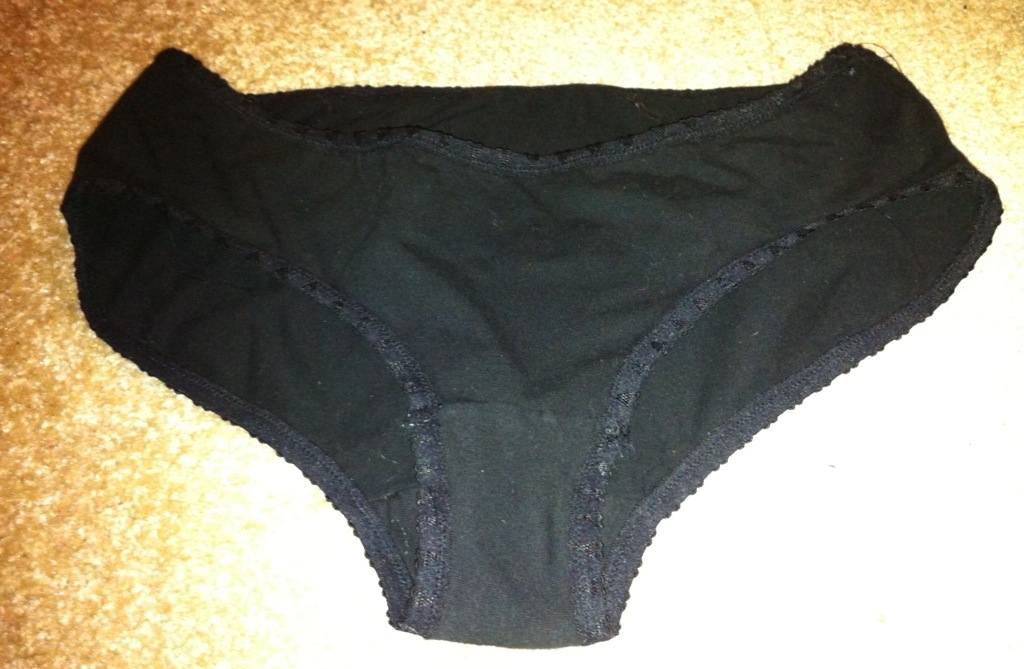
Well, this is kinda how I felt about my first “successful” set of undies made last fall. Sure, they were comfy. The fit was fine, or at least no more annoying than most of the storebought ones. But DAMN they were ugly, especially in the drawer. And who wants to reach for ugly panties, I ask you? My butt has standards!

So eventually I caved and hacked off the old elastic and bought some black fold over elastic and then the whole kit ‘n kaboodle kicked around, never in the same place at the same time, for ages.

20130812-065425.jpg

It was the perfect size of project for my wedding-sewing-recovery phase, though, so sometime last week I settled in with a zig-zag stitch and a determination to stretch the elastic as little as necessary without getting weird, wavy, stretched out panties.

They still won’t win any beauty prizes, (especially with my crappy overexposed photos) but they’re at least pleasantly functional. They are comfy, though I won’t claim I’ve reached any particular pinnacle of high fitting. More importantly, I’m feeling happy to reach for them in the underwear drawer. And that is important, right?

In other news, we’re visiting Cowtown this week, so enjoy a photo from the (not quite) Rockies.

20130813-064917.jpg

4 Comments

Filed under Sewing

How to Sew A Wedding Dress

Dresses

OK, so I’m kinda tempted to answer that in one word. “Don’t.” Which is not actually how I’m feeling, but close enough that it seems pretty hilarious. I might not be entirely sane at the moment, though, so probably best to disregard that.

So, right now, there’s so much to say I don’t even know where to begin.

Butterick 3441

The pattern, as you know, was Butterick 3441, a pattern lurking in that vapid no man’s land between contemporary and vintage, complete with really awkward pattern photo. It had most of the features the bride wanted, however, barring a few minor tweaks—more so than anything else we looked at. We settled on the pattern back in the winter, made up a practice dress in the spring, and then dawdled over ordering the fabric until pretty much the last possible second. Such is life. Did I mention the bride (Epona) got pregnant a few months after we’d picked the pattern? Which kind of killed my inclination to finish early, anyway.

Yaaaaah! Scary!

Yaaaaah! Scary!

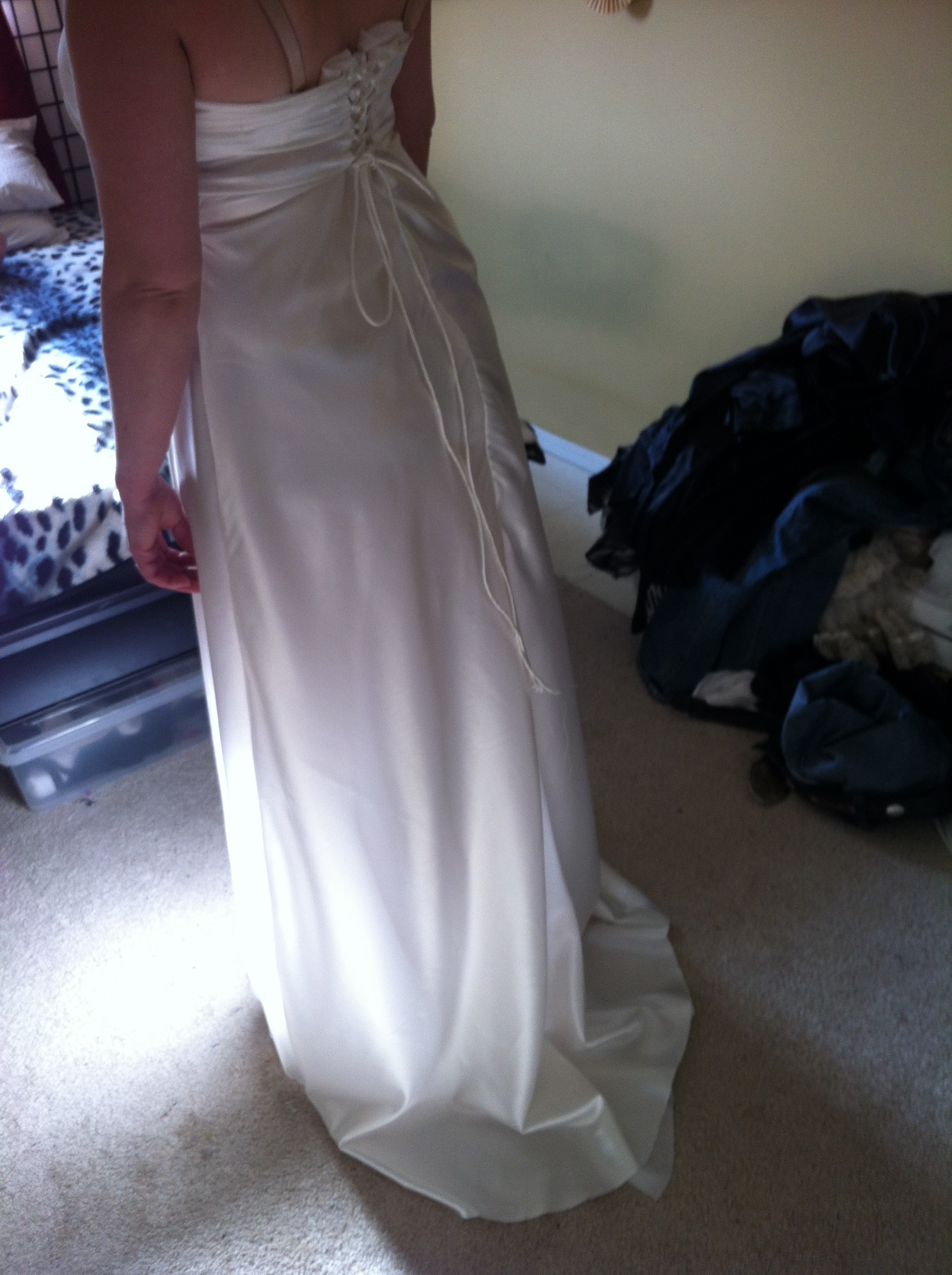
So, the pattern itself is pretty basic. Epona was not into a fussy, restrictive dress. She did want a lace overlay over the skirt, and lacing in the back. The lacing seemed like a REALLY good idea after the pregnancy happened. And I was both excited and terrified when I managed to talk her into using REAL silk and PRECIOUS lace. Yikes.

So, I don’t know how much to go into fitting details. Epona is not tall and she is rather curvy. I was pretty sure a small full-bust adjustment would be in order, and absolutely certain that some serious shortening was required. I was correct on both counts, although I still wonder if a larger FBA might’ve been helpful. I still can’t quite figure out where the underbust seam of this pattern is supposed to fall—it seems like it isn’t meant to come all the way in under the bust. At least, it didn’t on Epona, and it didn’t on Stylish either (since Stylish’s Maid of Honour dress was made from the same pattern, albeit in a different size.) Weird. Anyway, I kind of wish I had split Epona’s larger post-FBA dart into two smaller darts, but, well, that idea scared me even more than shaping one big dart, although maybe it shouldn’t’ve.

Wedding Dress Trial #1

Wedding Dress Trial #1. With train. Pretty little train.

I wanted to cut the skirt on the bias, too, which led to some more playing around with the pattern, and trying to figure out how to make it accommodate a six-months-pregnant belly gracefully. After we had determined that she could wriggle into and out of the practice dress without the zipper, I decided to omit it from the final dress, since I learned from Thread Cult that zippers in bias-cut garments are generally asking for trouble. Though in this particular style, I think it wouldn’t’ve been a big issue since the zipper would be hidden behind lacing and lace draping. Anyway, I left it out.

The fashion fabric was a delicate (very expensive) silk charmeuse ordered locally; I ordered silk habotai and organza from Dharma Trading for the lining and interfacing. I hadn’t originally been planning to interface the bodice—the pattern called for it, but I certainly didn’t see the need on the practice dress. When it arrived, the silk charmeuse was both thinner and softer than its polyester cousin—and when the lace arrived, heavy with all that beading, I knew interfacing was going to be a thing.

In an attempt to organize my thoughts coherently, have a heading:

Cutting:

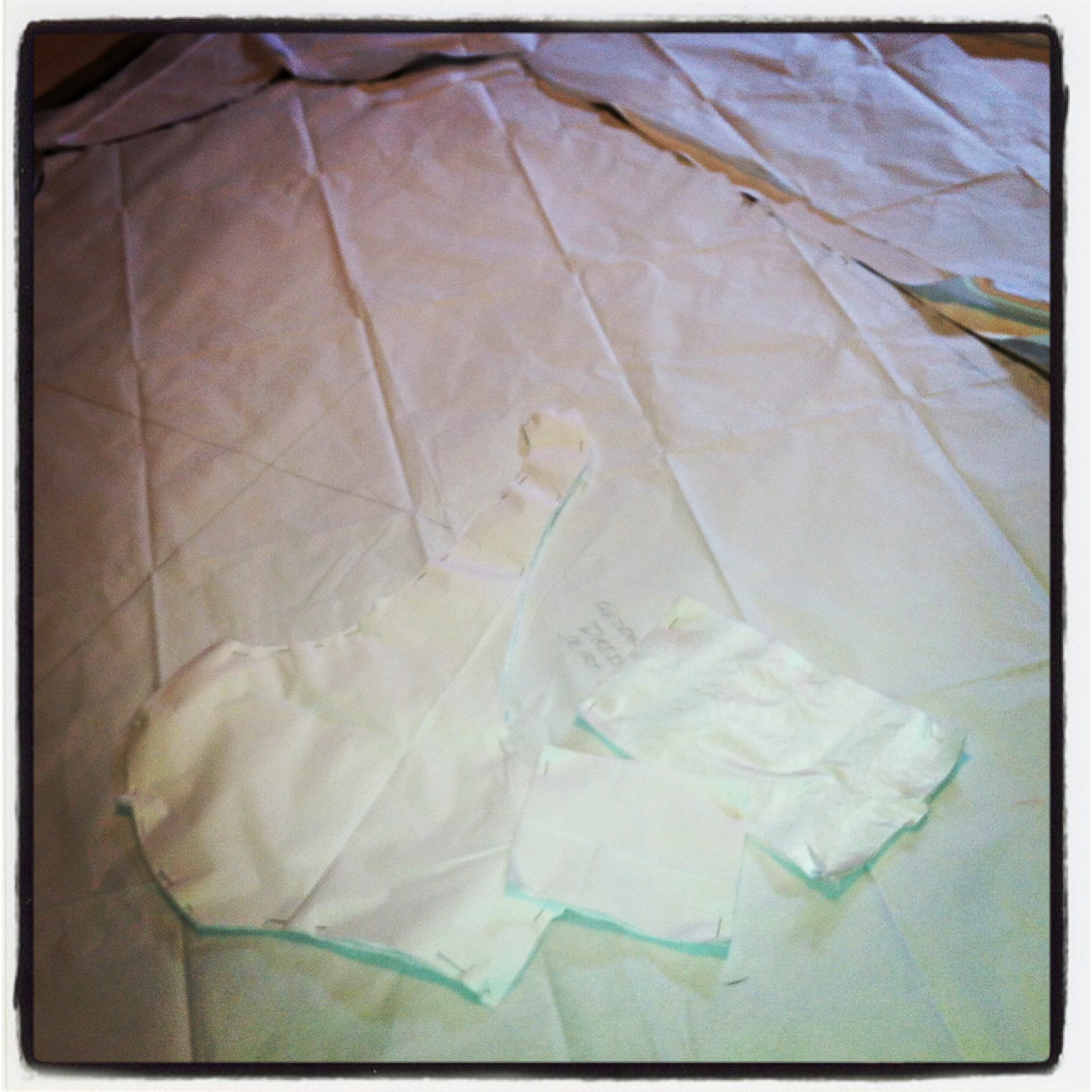
Cutting layers

Cutting layers

I used tissue paper layered above and below the fabric to help stabilize it when I cut everything out. This worked fairly well, although I then proceeded to layer both fashion fabric, lining, and silk organza interfacing and cut all at once. This wasn’t hard—even layered, these are ridiculously thin fabrics—but may have led to less-than-optimal grain placement on some pieces. On the other hand, once everything was basted together it seemed to keep the proper shape just fine.

Cutting shapes

Cutting shapes

On the practice dress I used almost exactly three metres of 150cm wide fabric. The silk was only 140 cm, and sold in yards. I was figuring 3.5 yards would do it, but the fabric store lady talked Epona into ordering four. Which turned out to be just about exactly right, so Fabric Store Lady 1, Tanit-Isis 0. I had only ordered three yards of the lining, however, which turned out to be not enough to cut the skirt on the bias even without the small train. Oopsie. So the lining skirt was on grain. Again, with the lace overlay in place, I don’t think it made much of a difference to how the dress looked or moved, but oh well.

Bodice construction:

Hand-basting with silk thread.  Mmmm, yummy silk thread.

Hand-basting with silk thread. Mmmm, yummy silk thread.

I didn’t start out planning to go all couture on the bodice, but sometimes these things happen. First, since I had to add the organza interfacing (which added the perfect amount of body to the bodice, and yes, that sentence does make me snicker), I was hand-basting like crazy. While I was at it, I added some on-grain and selvedge stabilizing strips of organza around most of the edges on the back pieces, where the lace would weigh most heavily. It took forever, (ok, most of a day) and I do not regret any of it.

Seam-allowance casing and boning piece

Seam-allowance casing and boning piece

Although Epona didn’t really want any boning, the combination of heavy lace and halter dress and corset-style lacing scared the pants off of me, so I added some light-weight, zip-tie boning along the sides and side-back seams of the bodice (where the lacing loops inserted.) I just added a second row of stitching in the seam allowance (fortunately I thought of this before I went and graded my seam allowances) to make the casing. I cut the zip ties to the right length, cut the ends rounded, and then smoothed by melting in a lighter flame. I may have been a little overzealous in the smoothing department, hence the brownish ends. Oh, well. So far, anyway, no harm has come to the dress.) I don’t think Epona would even have noticed the little bones if I hadn’t mentioned them, and while I can’t be absolutely sure they helped, I’m sure they didn’t hurt.

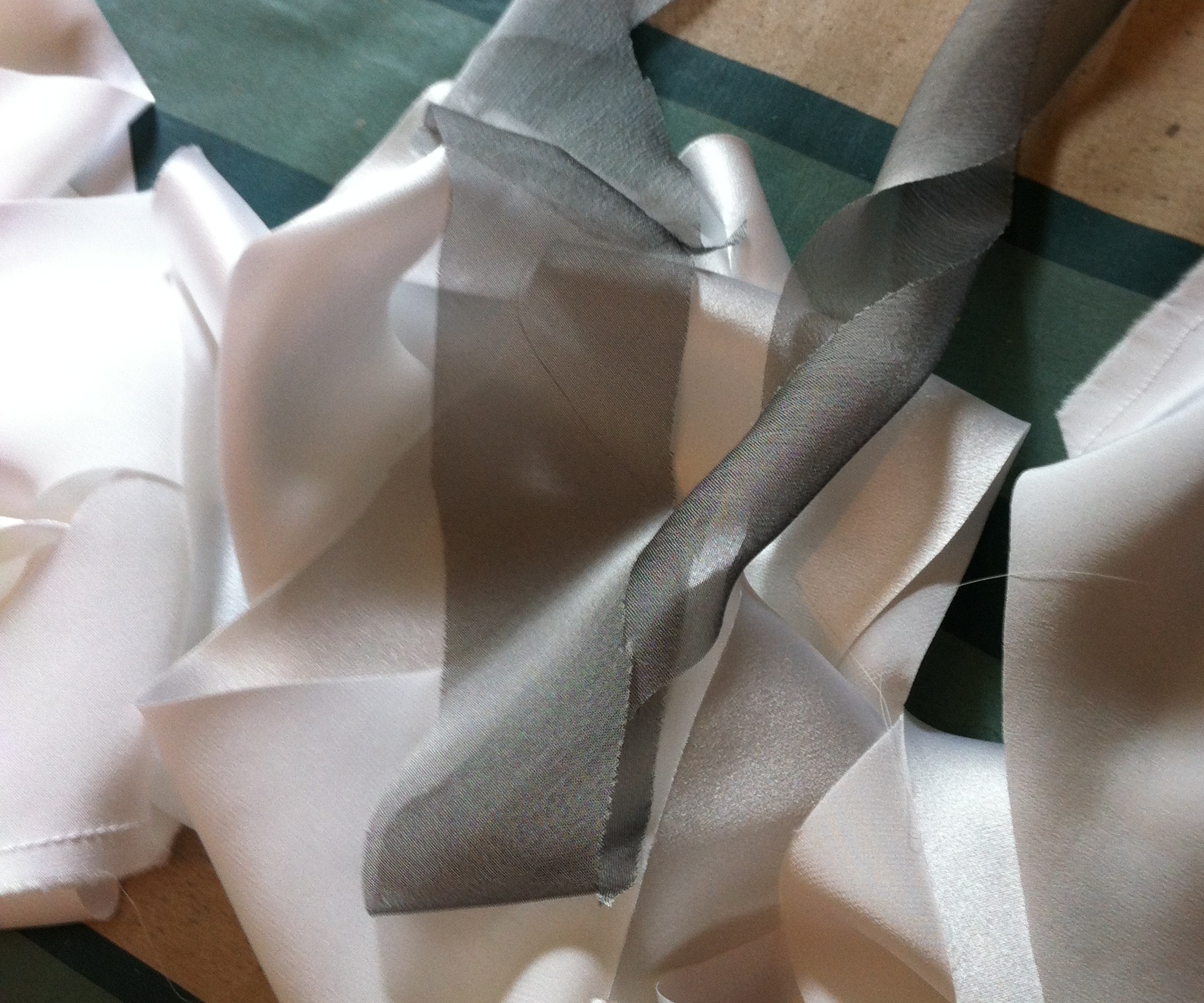
Making continuous silk bias tape. Mmmm, silk bias tape.

Making continuous silk bias tape. Mmmm, silk bias tape.

I knew from the practice dress that I wanted to pipe the upper edges of the bodice, but I had decided I wanted a silver piping rather than just the white on white. I had silver chiffon left over from the skirt overlay for the Maid of Honour’s dress, but experimentation determined that it needed a solid silk under-layer to look really good.

White silk bias tape and polyester chiffon bias tape. A match made in hell.

White silk bias tape and polyester chiffon bias tape. A match made in hell.

Yes, I layered poly chiffon bias tape over silk charmeuse bias tape to make my piping. Did you know you could do that? I didn’t, either. I started (after make shitloads of bias tape… I always make way too much) by stitching the two layers together about one seam-allowance away from one edge. Once this was done, I wrapped the two stitched layers around my piping core (a slender wool yarn in this case) and basted them into place. This was not without a few ripply mishaps, but once all was in place it looked pretty darn fine. I lived dangerously and applied the piping by machine, no hand basting! CRAZY!

Bodice, constructed.

Bodice, constructed. Oh, yeah, I added hanger loops. I hate hanger loops, but they were absolutely necessary in this case.

I also hand-basted the darts and the loops for the back lacing. Did I mention I was using SILK THREAD for all of this? Aside from the fact that it’s like five dollars for a teeny little 100m spool, man that stuff is dreamy. It’s so soft. My White machine didn’t like sewing with it (the tension would go intermittently weird) but the Featherweight didn’t even blink. Yay, Featherweight. And the silk thread was very nice for hand-basting.

You can see the bust weirdness on Stylish’s dress here. (on the left), which is cut from the same pattern as the wedding dress.

The main thing I’m NOT satisfied with about this dress (and don’t tell the bride because I don’t think she noticed) is the darts. Maybe it’s the way I was trying to shape them, but they seem a little baggy and draggy and angled funny on this pattern. I dunno. Me and the darts, we have never really gotten along so well, y’know? Gimme a good ol’ princess seam any day. The problem was the same for both Epona and Stylish, who have very different busts, so I’m inclined to blame it on the pattern…

The Dress

Skirt

After the cray-cray that was the bodice, the skirt was almost an afterthought. I used French seams. They work okay. I still wish they were narrower, but they may actually have approached the actual seam allowance width, which I always feel is pretty hit-or-miss with French seams. I didn’t have any problems with puckering along the seams, possibly because of the silk thread (another episode of Thread Cult, the guest mentioned that polyester thread can sometimes cause puckering because it has a certain amount of elasticity, something which gives it extra strength but can make really light-weight fabrics pull up on themselves. I did not sample a poly seam to compare, but anyway. This was my observation—the silk thread worked really well. Well, on the Featherweight.

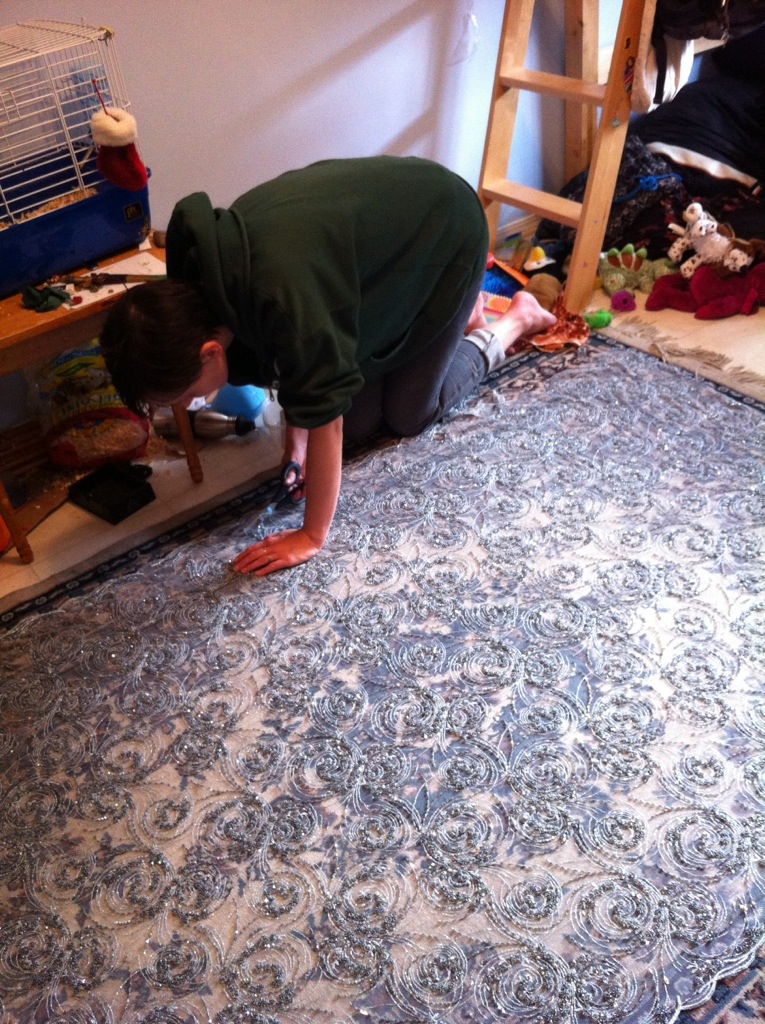
Lace. Cutting. Yikes.

Lace. Cutting. Yikes.

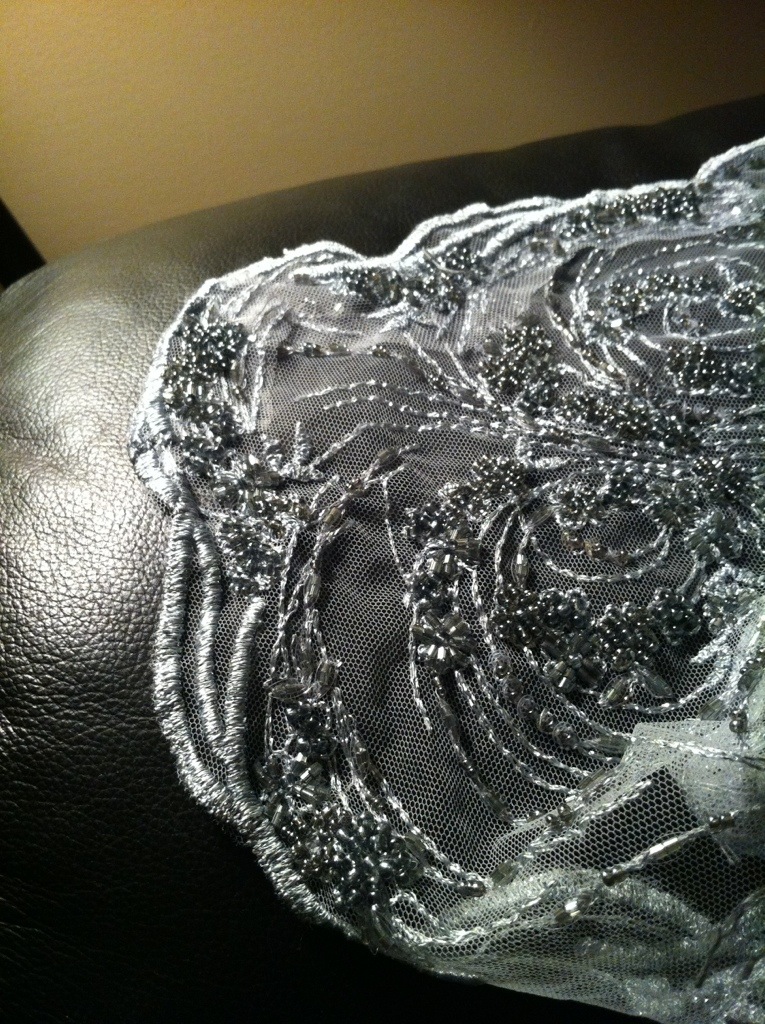
Lace

And then there was the lace. I spent a full day, basically, on the lace. My goal was to cut it as little as possible. But one thing I did have to do, was cut the scalloped edging off of one edge and piece it on to the cut ends, to form the edges of the front opening in the overlay. The length of the overlay at the front was decided by how much scallop I had to piece in there. Because of the heavy beading on the lace, there was no chance of machine stitching any of this. Hand stitching it was—up one side, down the other, knotting frequently, and then trimming the mesh close against the stitchings so nothing was flopping around.

Can you see where the pieced part still needs to be stitched down?

Lace corner, one edge pieces, waiting to be trimmed.

Actually, working with the lace was much less nerve-wracking than working with the satin—knots and sloppy stitches all disappear into the texture of the lace and nothing showed once the edges were trimmed. I think it looks pretty darn good, if I do say so myself. I didn’t want to do a back-seam in the lace, so elected to just let the excess drape down the back of the dress. I think it worked, anyway, although the weight of the lace completely collapsed the delicate train that looked so sweet in the practice dress. So the final dress had no train. C’est la vie.

Lace.

Lace.

And did I mention that my iron died at 10:30 at night the day before the wedding, just as I was pressing the hem? Which I hand-rolled, by the way. That was a lot of hand-rolled hem. I was able to borrow an iron the next day out at the farm, and really the creases from travelling  (the garment bag wasn’t quite as long as the dress) were worse than the un-pressed hem, but anyway. As inevitable mishaps go, this is a pretty minor one, except that now have no iron.

And now, random bridal photos.

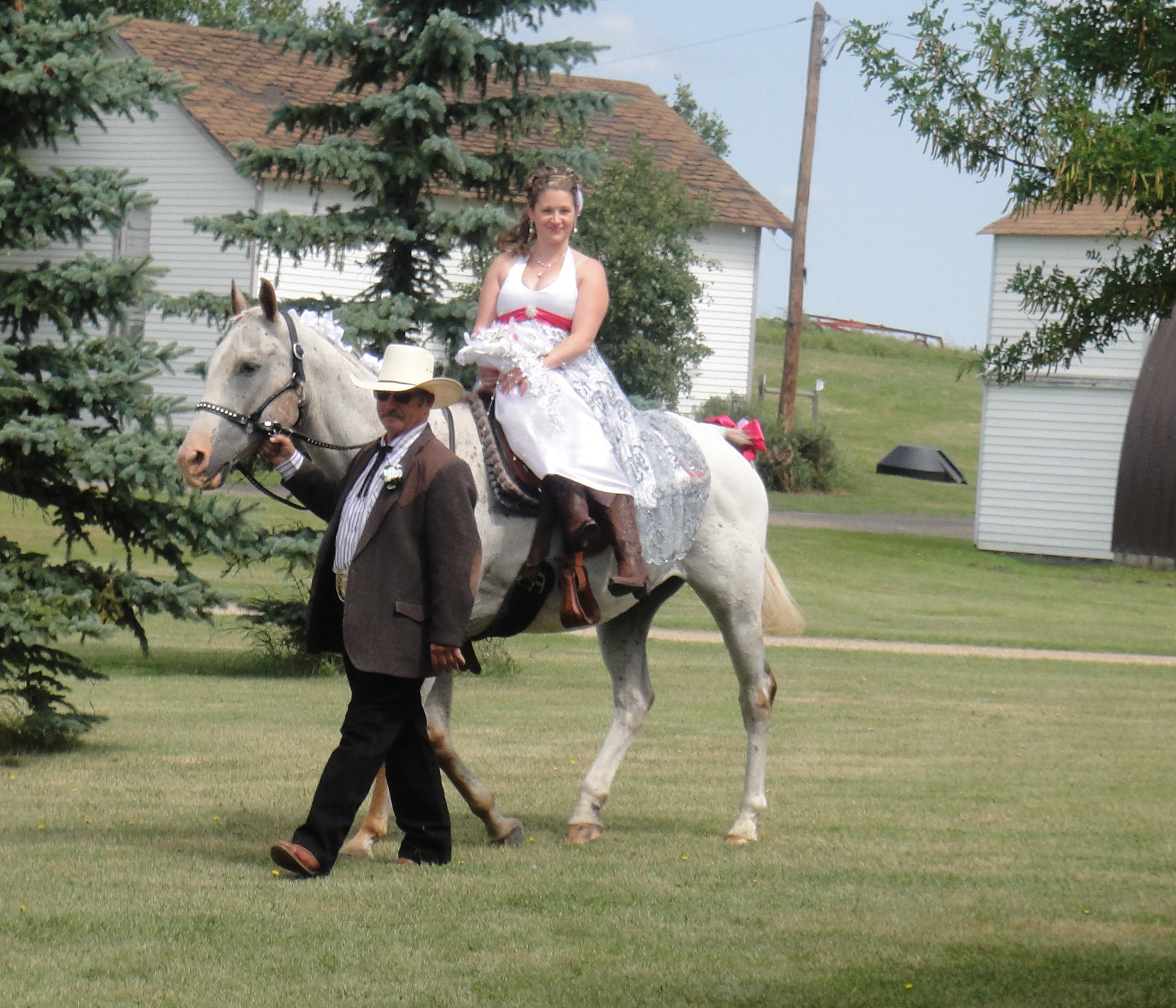
The bride’s entrance.

Yes, she rode in on a horse. It was That Kind of wedding. Don’t get me started on the music at the dance.

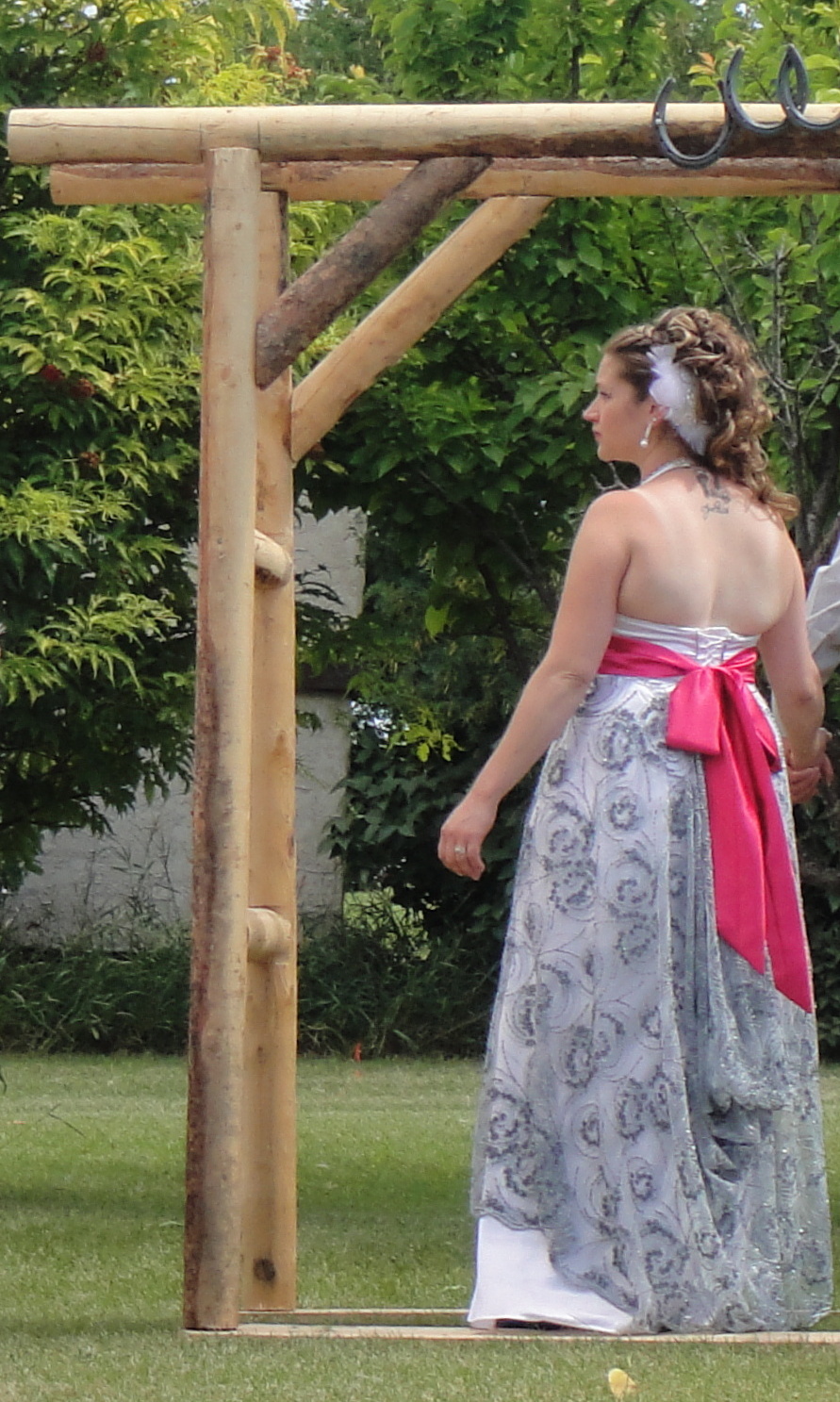
Back view

You can kinda see the draping at the back of the lace, where I refused to cut the damn stuff any more than I absolutely had to.

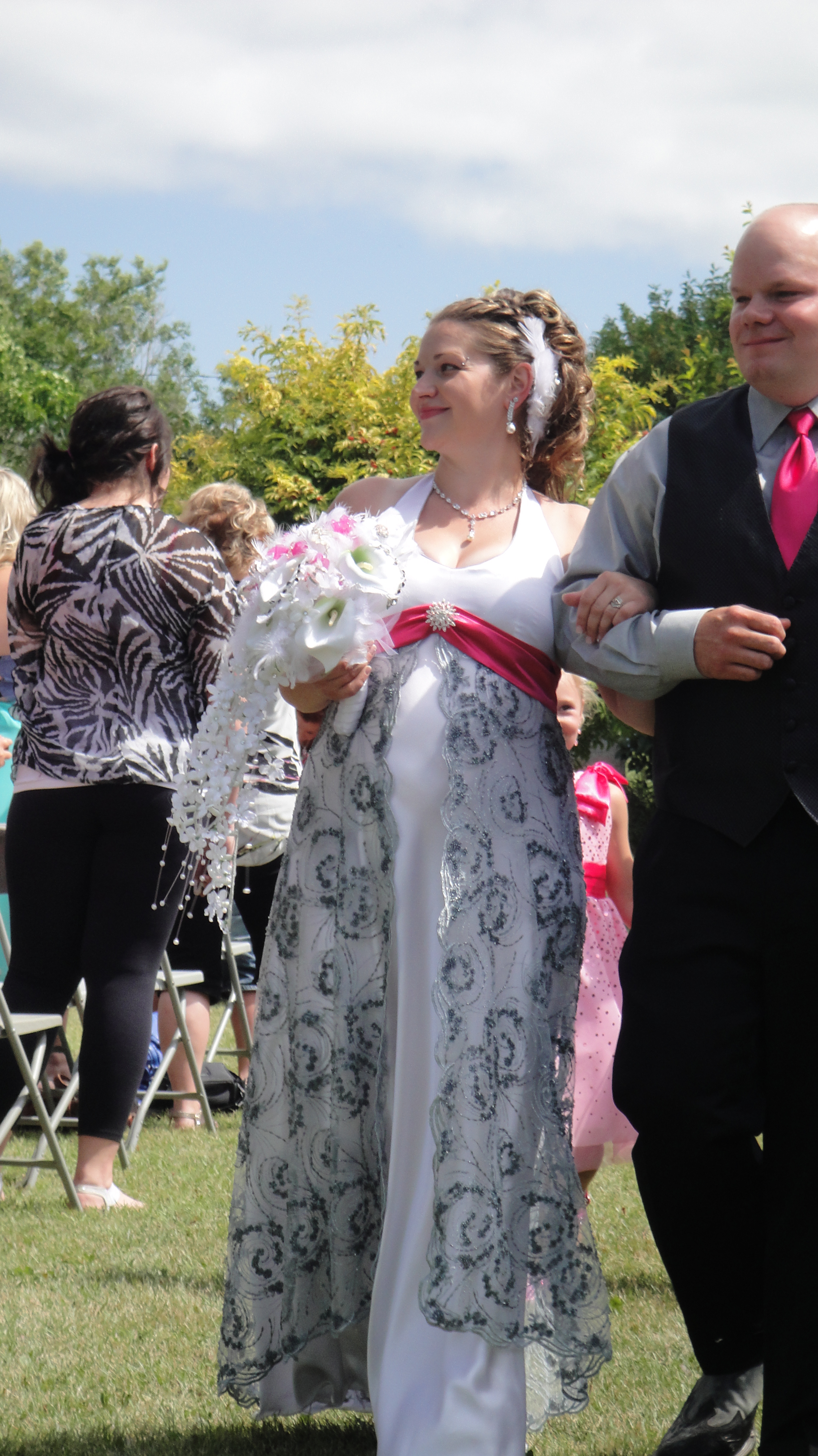
Front view.

This is probably the best view of the dress as a whole. You can’t see where I hand-pieced in the scalloped edge all along the front “slit” of the lace. Neither could Epona, even when I pointed it out to her. Also, I haven’t talked about the sash, which was ridiculously simple compared to the rest of the dress, but I really, really love how it brings the dress, and the whole wedding party together, frankly.

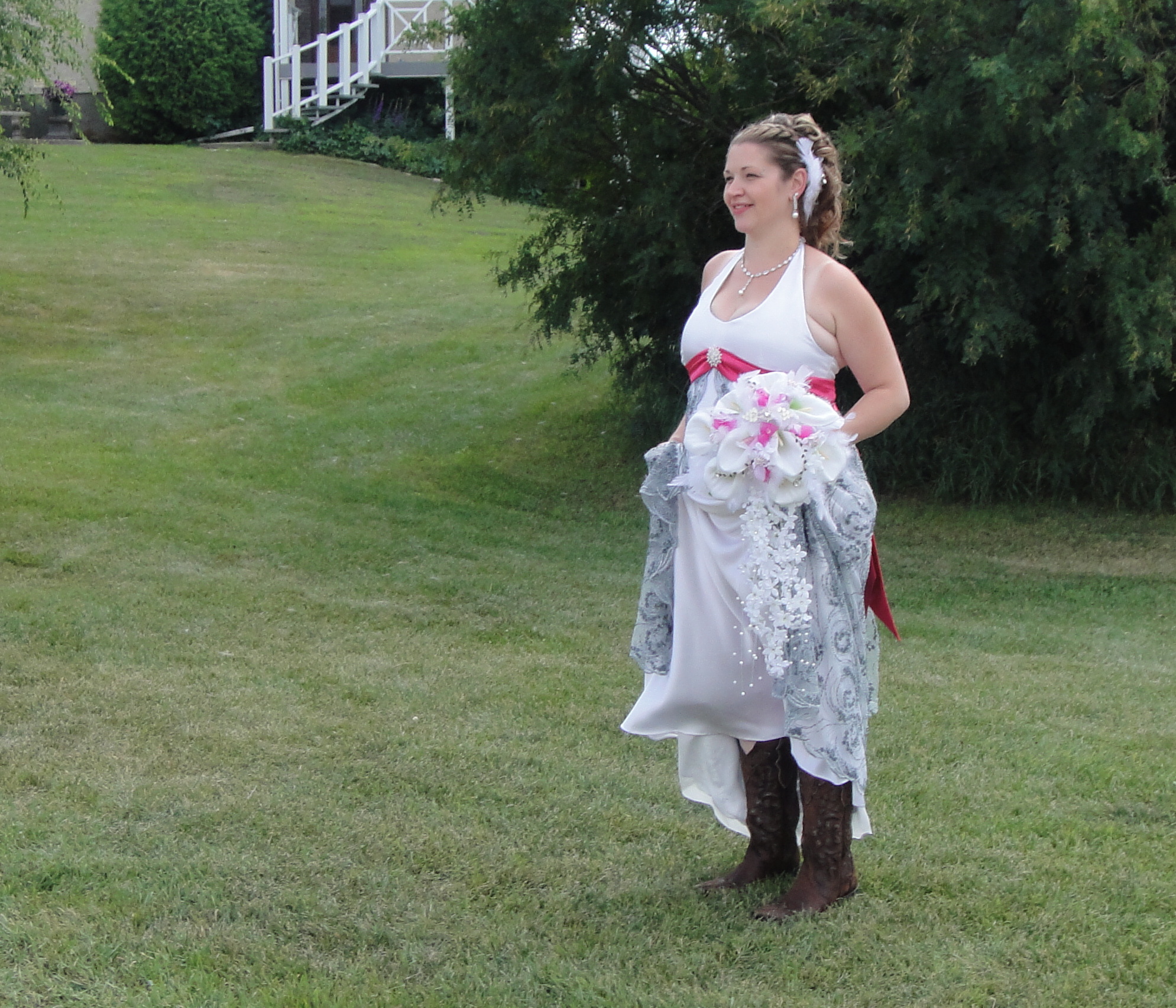
The wedding footwear.

Ok, I don’t know that you can see much here, but it’s a great picture anyway.

The whole shebang. Well, the part of it that I was responsible for, anyway.

I did NOT sew the flower-girl dresses, modeled by Fyon and the Waif, who you’ve met previously. Their mother, my Stylish sister-in-law, is the maid of honour (closest to the bride). I will talk more about the bridesmaid’s dresses later, because this is already an insanely epic post—they’re not nearly as involved as the wedding dress, mind you.

I’ve mostly stuck to photos of the bride here, but you can see more of the wedding photos (mostly taken by my Crafty sister-in-law—yeah, we were keeping it in the family) on my Flickr set. I can’t wait to see the official photos, though.

Resources used:
Bridal Couture (Susan Khalje)
Couture Sewing Techniques (Claire Schaeffer)
Fabric Savvy and More Fabric Savvy (Sandra Betzina)
Sewing for Special Occasions (Singer Sewing Reference Library)

35 Comments

Filed under Sewing

Interlude

20130729-225819.jpg

While I grapple with the enormity that is wedding sewing and try to put together something resembling a coherent post (hah!), let me entertain you, however fleetingly, with a top Syo made herself.

20130729-225832.jpg

It is drapy and cute and I just might want one. It comes from the “tying knots in fabric until it fits” school of fashion design, which I suspect is the oldest such school. We then replaced the knots with a few serged seams, because that was easier than threading the sewing machine.

20130729-225842.jpg

I think I could use a few of these projects myself…

8 Comments

Filed under Sewing

The Home Alone Dress

What's that?

What’s that?

I have fifty million things I’m supposed to be doing (like, um, sewing a wedding dress!). So what did I do when my husband and kids left me behind while they went to the lake for the weekend?

Why, I made something that was barely on the queue!

Butterick 6890 is cute and has been marinating for a while, but there are plenty of patterns ahead of it in the queue. But when I found myself with a house to myself and the itch to sew something selfish, I did something a bit unusual—I started from the fabric.

20130714-011430.jpg

Butterick 6890

My typical MO is to move from pattern to fabric to project. This is mostly because I have my patterns catalogued electronically and it’s easy to paw through them and pick one, whereas I’ve been far more lax about my fabric. The problem with this approach, of course, is that it’s not an optimal way to use up stash fabric, and tends to result in me just buying more fabric for the new project. Anyway, this wasn’t an option on a precious solo Saturday night.

I had a lot of constraining criteria. I wanted a pattern that was pre-cut, one I could use with minimal alterations, and not have to trace. It had to be a pattern I could ACTUALLY find in the flesh. Once I pulled out this piece of glorious polkadot stretch denim, which I picked up just after Christmas and thoughtfully pre-washed at some point (thank you, past Tanit!,) I had only just over a metre of my chosen fabric, so it had to be a SMALL pattern.

Butterick

Butterick 6890

Butterick 6890 fit the bill in a lot of ways. It was short. It was pre-cut. It’s a Junior Teen size which means I didn’t have to petite the bodice. It was a size 11/12, which has a 32″ bust—a bit small for me, but I was pretty sure the stretch would more than make up for that. I did a small square-shoulders adjustment, and a somewhat bigger swayback adjustment, and got cutting. It became obvious almost immediately that while I can sew up a Junior Petite pattern almost without alterations to the bodice, the Junior Teen size-range is pushing it a bit more. I wound up sewing the shoulder-seams and underbust seam with 1/4″ seam allowances to get as much height as I possibly could. It worked, but barely. I am also, ah, rather bustier than the Junior Teen draft. While this is a nice problem to have for once, I had to add some hasty tucks under the bust (perhaps making proper darts would’ve been better, but I was in a hurry), and correspondingly narrow the front skirt. I also added some more shaping to the back seam, which helped a lot. Oh, and the stretch meant I could leave off the zipper, too!

Back

Back

I still didn’t have enough fabric for the sleeves or facings, and the bodice back includes a good chunk of the selvedge. I considered alternative fabrics for the sleeves, but the only colour I liked enough with the grey, a pale pink, I had barely enough to make the sash ties out of. I really, really wanted to do a piped finish on the neckline and arms anyway. I was SO relieved when a scour of my notions stash turned up the bias tape left over from my Last Sundress of last year (which is totally my fave thing to wear when it’s super hot*, and also the perfect dress to wear to the outdoor pool. ) It was the perfect greyish-pink shade, and even not too different from my sash fabric!

20130715-070837.jpg

Piped finish

I made one major booboo early on—when trying on the bodice I didn’t stabilize the neckline first—oops! So it’s a bit stretched out and tends to gape if I don’t stand perfectly straight, especially after the disaster that was my first attempt at finishing the edge (which involved attempting to bind it with straight-grain fabric pieces from the scraps from the sash.)  But once I found the bias tape and did a REAL piped edge, it worked really well. To get a clean (if not couture) finish, I serged the raw edges of neckline + piping, pressed them to thei nside, and topstitched. Voila!

20130715-070855.jpg

Bias-faced hem, hand-stitched

A topstitched hem would probably have been appropriate for denim, but, well, I was in love with the way the pink bias tape worked with the grey. And I’m kinda in love with bias-faced hems… anyway. this is what my finished hem looks like, with a fun peep of pink on the inside.

Lounging

You can see the underbust tucks in this photo.

I don’t think I can describe how much happier and more relaxed I feel, having accomplished a wee bit of selfish sewing. And I’m so glad I got this finished, even if I did stay up rather past my bedtime to get it done.

Posing

Posing. You can see the neckline gape here.

*Super hot by Canadian standards. Which is low 30s C, so far this year. I know this falls short of truly brutal tropical heat. It’s scrumptious.

23 Comments

Filed under Sewing

In which I make underwear, and ramble

2013-06-007

A plethora of (underwear and swimwear) patterns

So it’s no secret that making my own underwear has been a bit of an elusive unicorn for me. The most recent attempt got worn only a couple of times before I chopped off that horrendous elastic and tossed it in a corner to think about what it had done… if when it resurfaces I’ll give it another shot at elastication, because that was really the main problem with that pair. Really, the biggest problem in all these attempts has been me, usually because I wasn’t trying terribly hard to get the elastic binding right.

Purple-flowered swim suit fabric

Purple-flowered swim suit fabric

Yesterday, on a whim and in need of a quick me-project as I languish in an unending doldrum of sewing-for-others, I pulled out every swim-suit and underwear pattern I own, this being a somewhat overlapping group. It felt really nice to dive through my physical patterns, and I even made a few, very paltry, efforts in the direction of organizing them again.  Although I don’t need a new swimsuit particularly, the Swimalong seems to have gotten into my brain at a subconscious level, since I’ve been doing things like buy swimsuit fabric (and elastic, and hooks) and petting my swimsuit patterns, well, since April, really.

I could, of course, always use some underwear…

McCall's

McCall’s 4471

So I settled, finally, on one I’ve been wanting to make up for quite a while now: McCall’s 4471. I’m not particularly into any of the tops, but view E, the low-rise bottom, looked very much like what I usually look for in underwear. (Or, at least, what I looked for before I became enamoured of boy-cut shorts, but we won’t get into that, yet.) So I pulled it out, exulted that the pattern was uncut and complete (I don’t usually actually check my thrift-store patterns for this until I’m  trying to make something, which is occasionally a source of heartbreak), and traced out the size 12.

Voila

Voila*

My next big advantage, over the last few pairs I’ve tried, is that I am sewing on my White. Seriously, if I can get the motor fixed so it doesn’t stall on startup, that $10 thrift-store machine would be hands-down my favourite machine at the moment. The adjustable presser-foot pressure is SO helpful with knits, especially think and slinky ones. Because, oh yeah, in my hunt through the exceedingly-disorganized fabric pile, which scrap of fabric did I select? Why, none other than the culprit of my last-summer wadders!

Indifferent finishing

Indifferent finishing

Considering what this fabric put me through last time I looked at it, I wasn’t going to attempt anything too fancy for the finishing. Since I didn’t have any matching lingerie elastic, I elected to go with clear elastic in the classic and ever-tacky fold-under-and-topstitch method. Cheesy, you say? Bite me. We’ll call it a (‘nother) muslin. A couple of test-runs suggested that the fabric and elastic slid smoothly together, needling almost no tension on the elastic to make a smooth, yet sturdy, edge.

Very high cut and skinny over the leg

Very high cut and skinny over the leg

So, the construction. This pattern has a single-seam crotch insert, a la storebought underwear but not as nice a finish as if you have a seam at both ends of the crotch lining. I’m not sure how they wanted you to finish the edges, but there’s no binding pieces so I presume they  expect you to do some variant of fold-over-and-topstitch. It’s possible I folded over a little more than was intended, but anyway—the main thing that surprised me was the height of the cut over the leg, and the narrowness of the front right over the leg. I’m more into a lower-cut, 70s style leg these days (or even a boy-short. Yes, the Rosy Ladyshorts are on the to-make list.)

The one thing that was perfect, however, was the rise. Front and back. And this is the first, of all the patterns I’ve tried, that had that right off the bat. So if nothing else, I’m feeling like I can use this pattern as a reference for how other patterns might fit.

In the meantime, I’ll have to give them a wear or three to see how they work out. The elastic that looks so nice and almost-smooth may actually be too loose and ride all over the place. But I’m kinda insanely excited to have red underwear to go with my red T-shirt bra…

*These are some really frickin’ terrible photos. Ugh. However, I wore the undies today, so no more photos will be taken until laundry is done, and possibly not even then, because, well, because.

ETA: they go smashingly with my red T-shirt bra, but may need some little knit ruffles to match properly. They look a little plain. Also, while I think a little more tension on the elastic in the derriere region would have not been a bad thing, they are no worse for sliding around than my storebought undies of a similar cut, and didn’t grow unduly during the day. I will just say, it feels really good to get something at least semi-wearable out of this evil knit. I don’t know that it’s the best for underwear—I suspect it will wear out quite quickly—but it was adequate for testing purposes, anyway. And I’m sufficiently chuffed that I felt comfortable comparing the pieces to this vintage independent pattern from the Stylish Haul and tracing out its largest size. 🙂

Kandel Knits # 73

Kandel Knits # 73

10 Comments

Filed under Sewing