Sweet n’ skanky

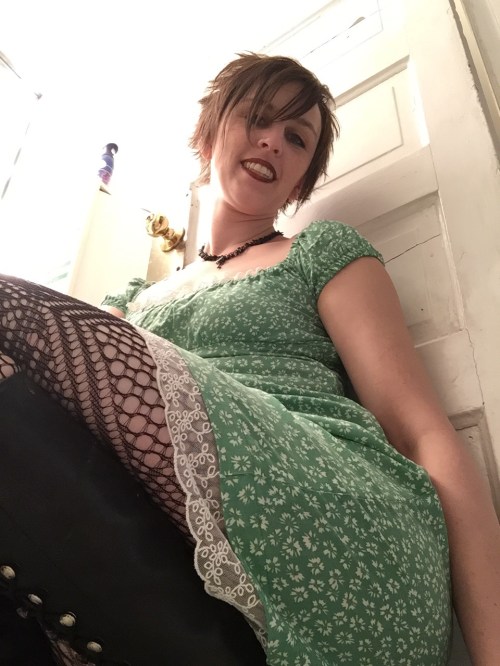
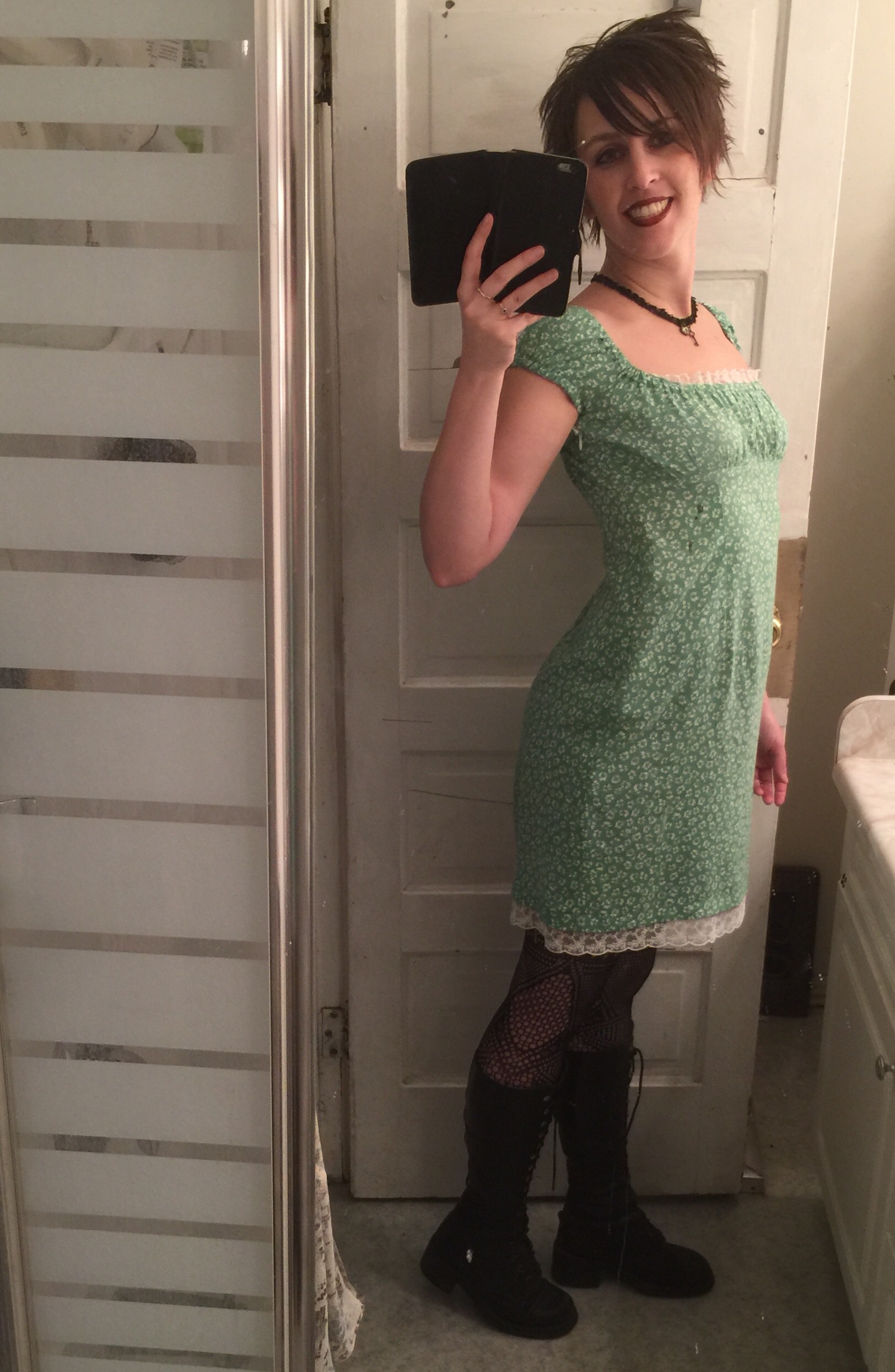
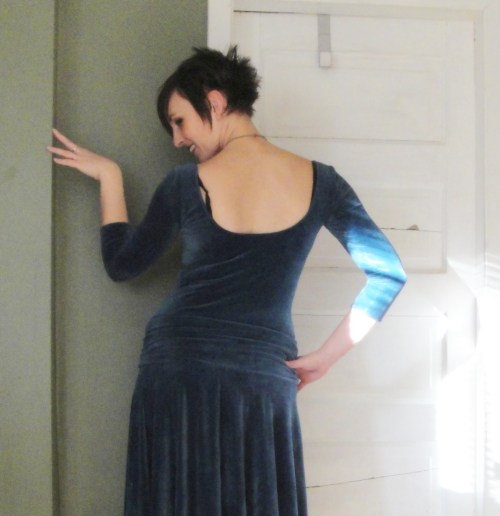
img_3424So a little while ago, I fell in love with a fabric at work. Because that doesn’t happen like every two seconds. This was a sweet rayon with a print that felt very vintage, in a soft green that is not at all my usual palette. And then we got this adorable embroidered net lace, and the pairing raised the delicate sweetness to soaring heights. Completely in love. But a little worried about making something from it that I actually want to wear. I generally like a wee bit of an edge to my sweetness, and lately I’ve been feeling that a bit more keenly. This rayon seemed like it wanted to be a drapey 30s or 40s style dress, which are sweet but not really edgy. 
Which got me thinking about how to take such a dress and make it feel like me. Which led to some quality Pinterest trawling featuring loads of classic Courtney Love. /sigh. Sometimes you just never escape your inner fourteen year old. 

  After a little more browsing, the fabric and I compromised on Burda 6686, which appears to be the current incarnation of Burda 8071, which Handmade By Carolyn has made about a billion lovely versions of. 

    There isn’t a whole lot to say about the dress otherwise. Construction is pretty simple. I shortened just above the waist, and added a bit of a swayback adjustment, which was largely successful. I cut a size 38 in the skirt, 36 in the bodice, very easy since they’re just gathered together.  Mid-construction, I  shortened the skirt by about 5″ and lowered the front neckline about 2″. Unfortunately I’d already stitched the neckline all down so I had to unpick, lower, and re-sew the elastic casing. Blerg. I’m glad I did, though. 

The dress has a side zipper, which I don’t love, but hate less than I usually do. And this style really wouldn’t work with a back zipper. 

 img_3386
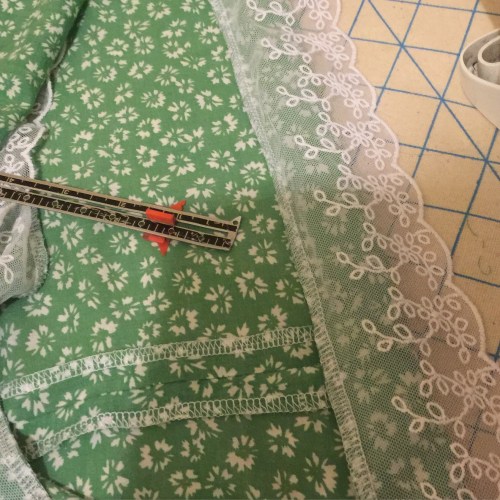
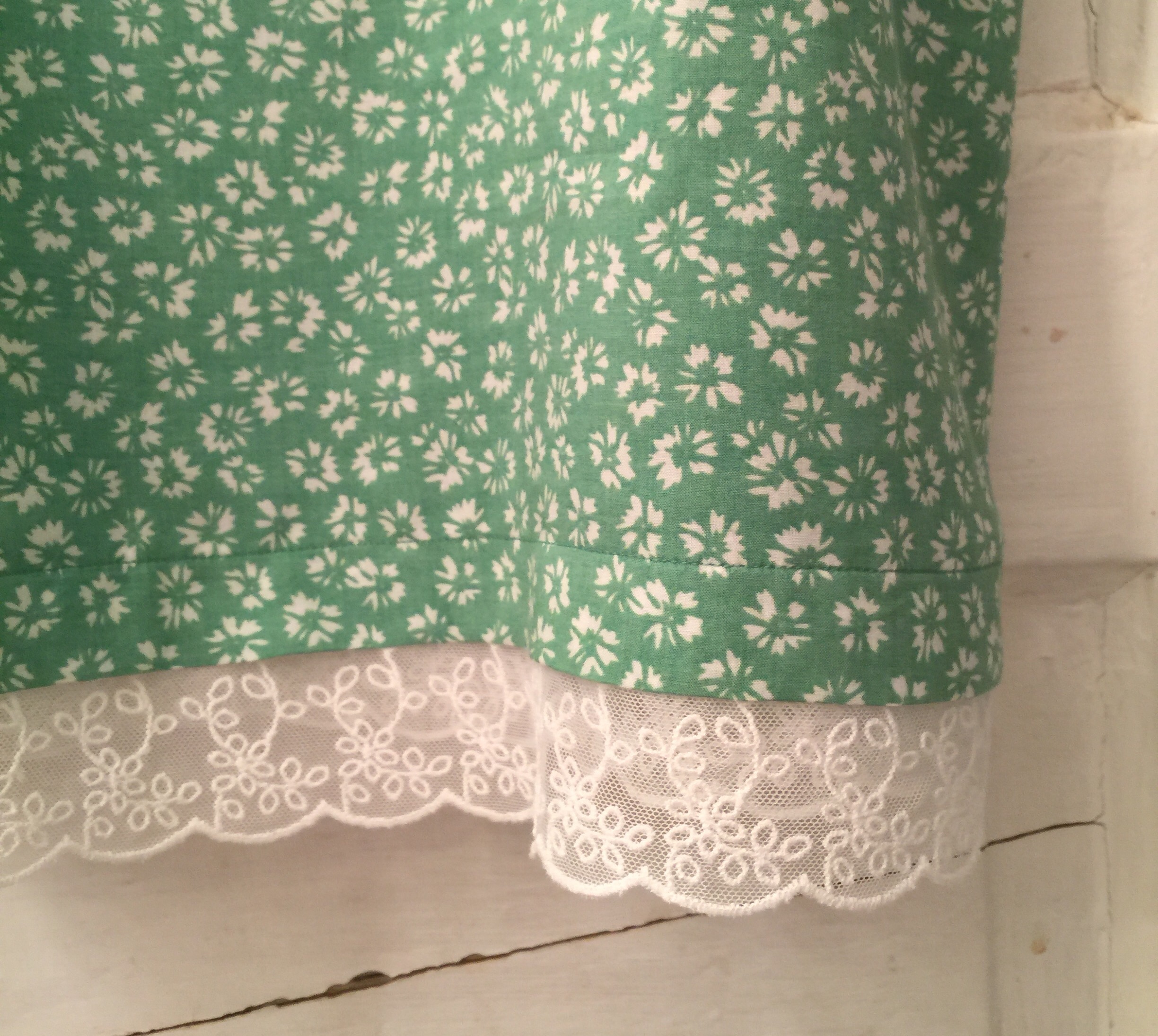
 I added the lace at the hem and a wee little bit at the bust. I cut my lace to match the hem length, made it into a loop, and serged upside down to the bottom edge, so that when I put in the 1″ hem it would hang free from the lace a bit, if that makes any sense. I had originally wanted the lace to hang free from a lining, but the lining was too bulky and the green print wasn’t as sheer as I originally feared. 

   
 I should probably have taken the elastic out before I stitched in the lace at the bust as I caught the elastic in, which kinda defeats the purpose of a casing. Oh, well. I’ll worry about it when/if the time comes to replace the elastic.  

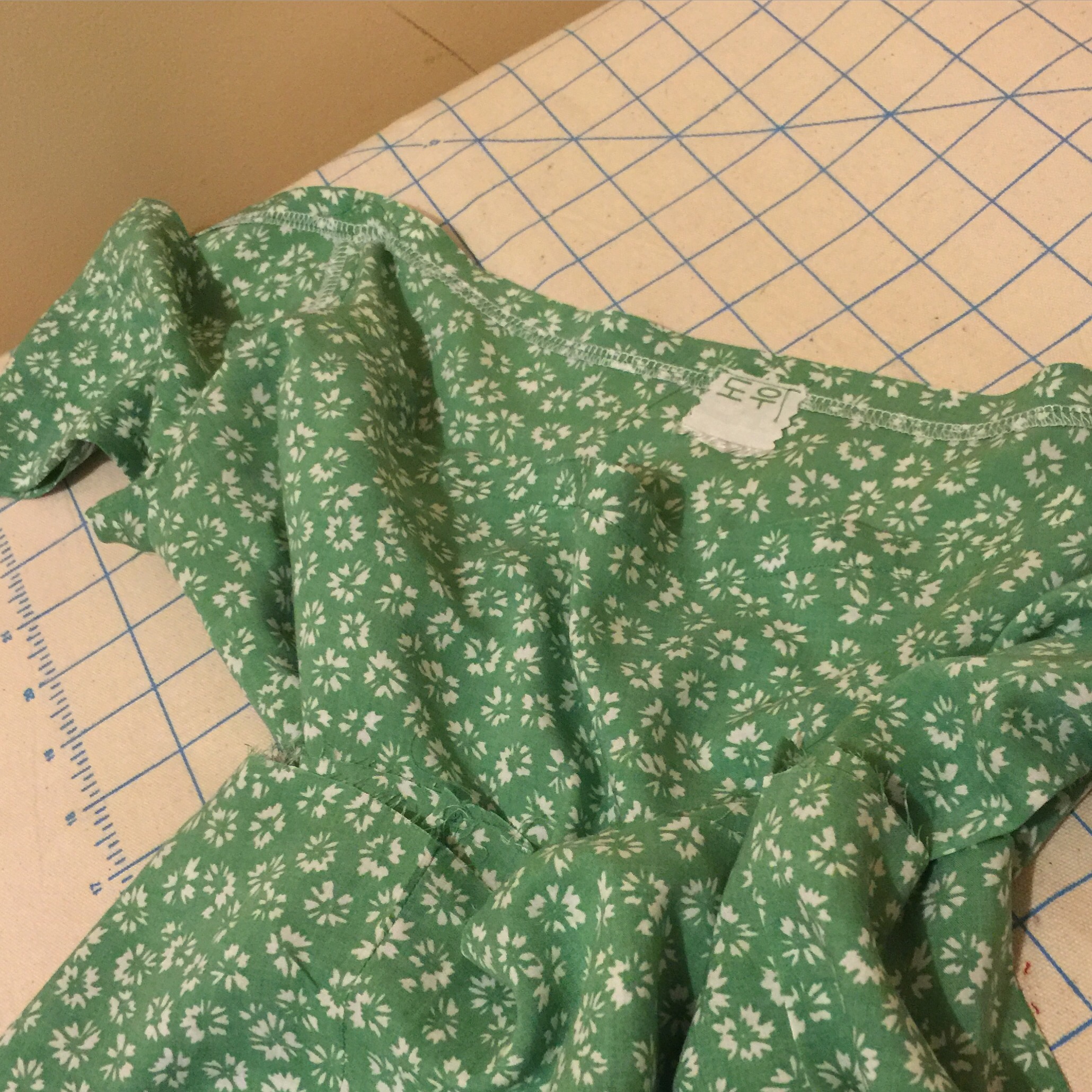
  I added a tag made from selvedge to the back neck since I kept losing track of which was which during construction. The lace will fix that, too, I guess. 

 All that remained was to spike up the hair, throw on some ripped tights and chunky boots, and some dark lipstick. 

  I love how this dress feels barely there. And even the crappy bathroom mirror photos seem perfect for the grungy look. 😉

   
 Perfect for pouty selfies. 

  By the time I get this back from display it may even be warm enough to wear it!

27 Comments

Filed under Sewing

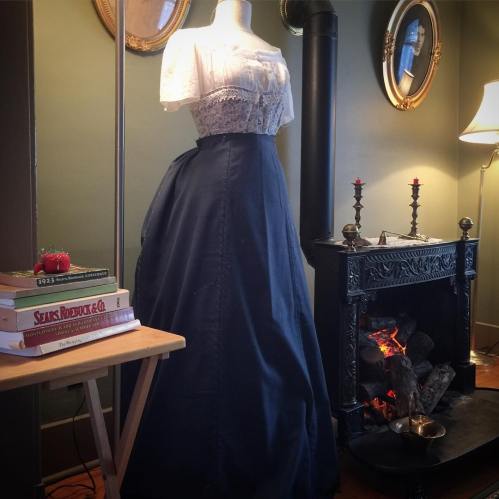
A draped overskirt

Last weekend I continued to futz with the Victorian outfit. The waistband is still a mess, but I hemmed the skirt. And hemmed. And cried. And hemmed. And it’s not perfect but it’s hemmed (not pinned!) and doesn’t look too terrible from a safe distance, so we’ll go with that.

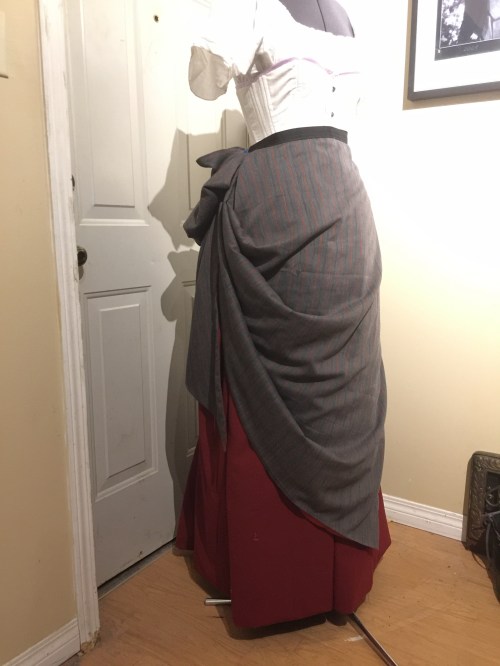
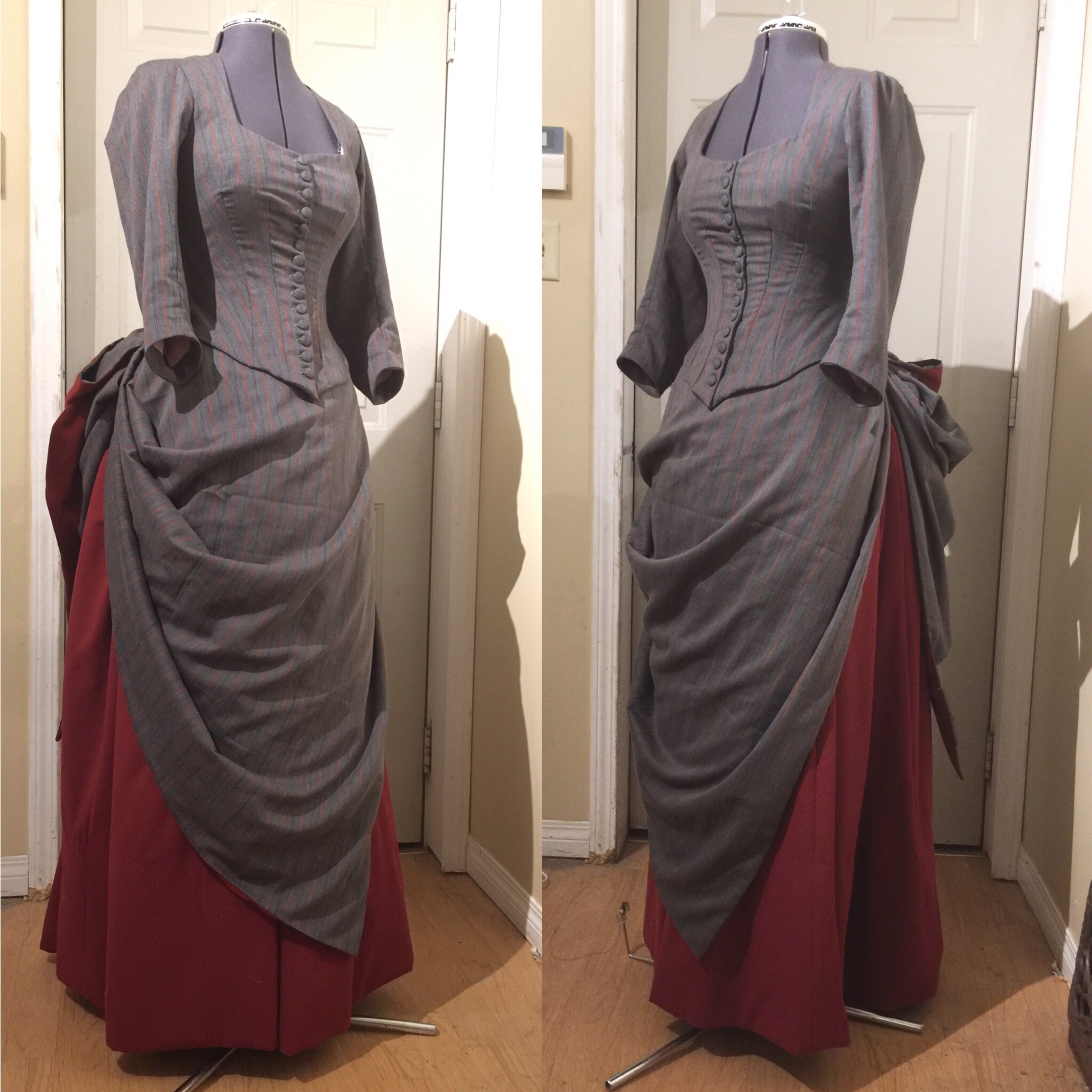
 The next (almost final?) phase of the half-assed Victorian outfit is the draped overskirt. They’re not quite mandatory for 1880s outfits, but pretty darn close. My texts say either “these things are crazy, go get a pattern” or “use about this much fabric and go to town.”

And of course, “But be tasteful.” The Victorians were big on taste, apparently. But also sure that basically no one had it. Personally I’m pretty sure I will fail at taste, so I’m not going to sweat it.


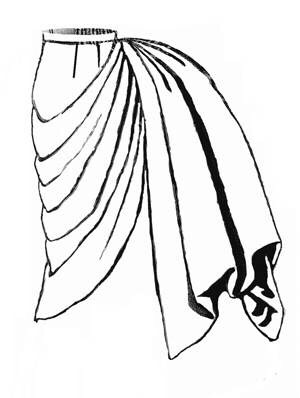
I did, in fact, buy myself a pattern, last summer, Truly Victorian 368, the “Waterfall Overskirt”. I wanted to see a basic idea of how they went together. It was very interesting, and also very simple, once you had it it laid out for you.

I’m planning on using the waterfall version for my blue dress, so I wanted this one to be different.  I had a vague mental image of the overskirts that leave one side ungathered so there is kinda a point at the bottom. 

To start, I eyeballed what I had left of my grey suiting (around 2m) and estimated what I wanted to drape over the front, and cut that much off.

After some experimenting, I took my general shape (a rectangle with a bit more length on one side—mostly to do with the shape of the fabric I had remaining) and added the lining and an interlining of some random stash drapery sheer that was thin and a little crisp, on the theory that it would give my thin and drapey suiting a bit more body.

img_3279-1
I was all set to put in darts when I decided I didn’t want the disruption in the stripes, so I cut a curve out of the top instead to go around the waist. There followed a lot of futzing with pins and playing with pleats until I had it arranged to my liking. I’m very glad I took the time to adjust the dress form for wearing my corset—it took a fair bit of wriggling and padding but with the corset it actually approximates my corseted shape quite well—kind of like those skin-tight covers they talk about making when you pad out a custom dress form. Unlike anything it has ever done for my un-corseted shape.
But doing this kind of draping without a form would be tricky.

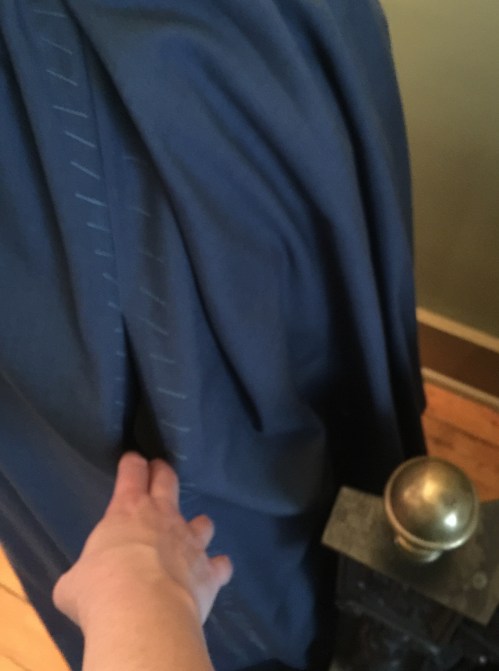
 The back drape I cut into some shallow points at the bottom, finished the edges (it’s just lined and turned, with the same interlining as the front), and then started pleating and pinching and messing around.

 I ran a piece of grosgrain ribbon down the inside of the back to anchor the central tucks onto. On its own I actually liked it better without it being all tucked up in the middle, but once I layered the bodice tails over I added some more tucking.

 I had messed around with pinning up the tails before, but I think I have a much better arrangement now.

 And I like the button. I think I need to move my waist stay down a bit in the back, so the bodice hugs the back a little better.

2016-02-16 06.02.37And then I need to bite the bullet about trim. I have a ton of 5/8″ satin ribbon in the right red, some pleated, some not… But what, where, and how much is enough? Or too much. Is it possible to have too much of anything on a Victorian getup? I think we’re straying into “taste” territory again…

10 Comments

Filed under Sewing

A Half Ass Victorian

tv462-01

Truly Victorian 462 – 1880s tail bodice

Since the next Victorian Sewing Circle was coming up, last weekend I decided to muslin the bodice for Truly Victorian 462. In my memory, back in the fall I had calculated my size via their weird-ass method (basically you select your back size based on on the width across your back and your front size based on the difference between your back size and your full bust, and then twiddle the shoulders to fit. It’s meant to help you skip the FBA, I guess, not that I’m usually an FBA candidate…) and traced out the pieces. Well, it turned out on inspection that I had picked my size, traced out about half the pieces, and then completely not written down what size I was tracing. >_< Thanks, Past Tanit.

Comparison of my traced pieces with the original pattern and some cryptic notation I had left on the instructions eventually led me to conclude that I had been tracing size C for both front and back. Great! I finished tracing it out, made my most basic adjustment (removing 2cm total length, 1cm above the bust and 1 cm below) and cut my first muslin out of some old curtain last seen in a pair of Ellen pants, if anyone remembers what those are. Um, that was over five years ago. Wow. Blog is turning six pretty darn soon. Who knew?

ANYWAY.
12728470_1680000438917642_506480939_n

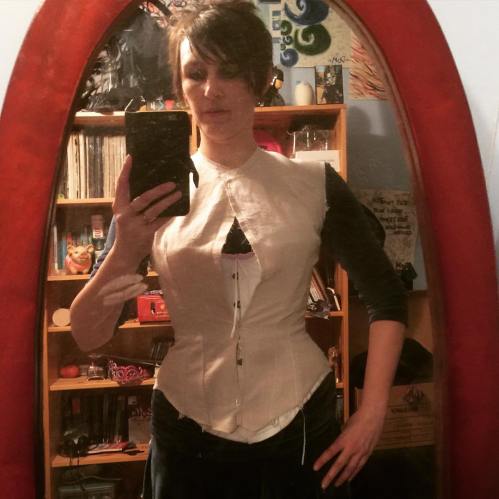
Version # 1

Muslin version 1 revealed some problems. Um, TOO SMALL, much? I re-took my measurements. Apparently, with the combo of corset and bra, my bust is closer to 38″ than its actual 34.” And for the Victorian silhouette I do want the boob paddage. ALL THE BOOBS. However, everything else seemed really good—back size was great, shoulders maybe needed just a little tweak for squareness—I just needed a little more room in the front. Perfect candidate for an FBA, thought I. Never mind I’ve never done one before. How hard can it be?

Hmm.

Yeah, you can stop snickering now.

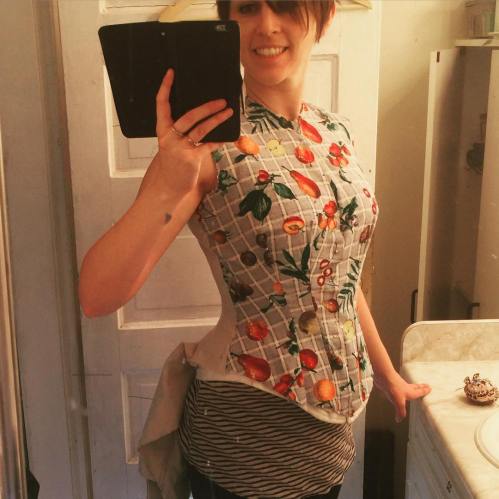
So I slashed and spread and ended up actually with quite an improvement, except that there was a bunch of extra fabric right along the CF line—like enough to take out an almost 1″ dart. So I did, and rotated that fullness into the two waist darts.
12751078_727498647386336_1294718553_n

Version 3

This seemed like it did the trick. V. 3 fit basically like a second skin. Although looking at them now, I think the darts could maybe be spread out a little more evenly across the bodice front—they are both very close to the CF after all my futzing.

But. I wasn’t ready, after all that messing around, to jump right into my good fabric. So I went deep-stash-diving, looking for a suitable fabric that I had enough of that wasn’t otherwise earmarked.

Eventually I settled on this striped suiting. The fabric is some completely non-historical, soft and drapey thin suiting, mainly rayon by the feel. I have absolutely no memory of where it came from except that it must have been a gift. If it was from you, thank you! Anyway, it looked good and felt nice and there was plenty of it.

The deep stash also provided an underlining, in the form of this bublegum pink almost-light-canvas-type fabric (much less drapy) that I was quite happy to find a use for.

12729550_1003650139696488_884951134_nEspecially once I discovered the fabric tag. Yup, this fabric was received at Fabricland on 06/05/85. Over thirty years in stash, people.

I wasn’t overly concerned about authenticity at this point—just going for a fit test here. I didn’t bother with seam finishings (in hindsight I should’ve just serged my underlining to my fabric as the inside is fraying like crazy.) But despite that I was still going for as much “authenticity” in my construction methods as I could handle—so there’s boning, and the edges are faced with bias tape, and I generally tried to follow the method described in Plain Needlework and Amateur Dressmaking. To the best of my limited comprehension and/or patience, anyway.
2016-01-29 19.23.58It felt like it took basically forever, though really I got it done in a week so that’s actually pretty fast.
2016-02-21 18.51.53

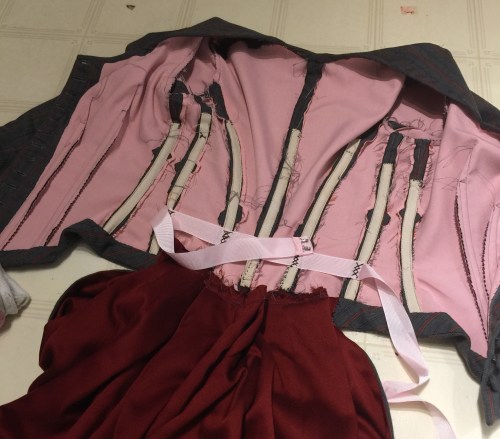
Guts

The guts aren’t pretty but they are complete—boning in channels, plus a waist stay. I think that’s a good idea with the long tails on this pattern. My materials range from vaguely plausible (cotton twill tape for the bone channels) to completely inappropriate (poly grosgrain ribbon for the waist stay. Rayon suiting)

2016-02-13 21.05.18

Bodice interior from Plain Needlework and Amateur Sewing

And then there were the buttons. Plain Needlework suggested 1″ between buttons. In hindsight (funny how perfect it is) this was a bit much for the size of button I ended up with—I think 1 1/2″ between them would’ve been adequate.

2016-02-15 22.01.37-1

Fabric-covered buttons!

Still determinedly stash-busting, I settled on some smallish coverable buttons that I had three packs of for some reason. I’ve never had much luck with covered buttons before. These went really well, in that I could easily pop them on to their bases once they were fabric-covered, but less well in that they tend to pop back off again quite readily.
2016-02-20 21.58.59

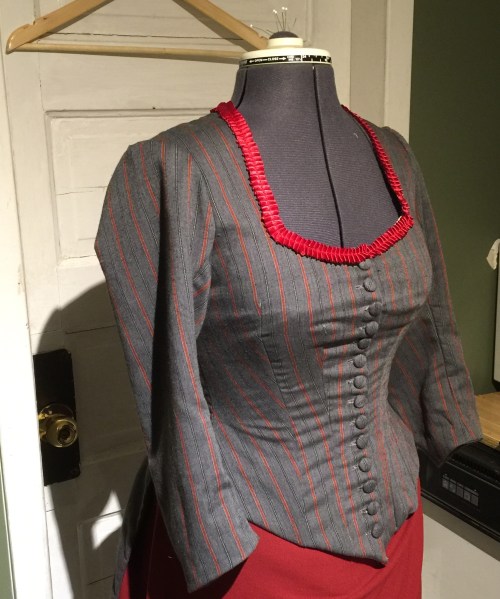
Lots of buttons. Also, a possible neckline trim.

They look nice, though. I did have all the stripes lined up, but as the tops kept popping off it was too annoying to try and get them back on straight. I made the buttonholes on the machine. I’ll drive myself nuts with the hand ones on the Good Copy.

(Oh, the pattern itself has a curve out at the CF bust area. This is a bit of an odd feature, but I gather is period. I had reduced it a wee bit with all my dart-moving, but I wound up making it completely straight for this version due to the stripes. Will I keep that for my “good copy”? If I don’t, my whole test fitting idea becomes kinda useless… if I do, my authenticity quotient goes down (not that I am expecting this to be overly high, mind you…)
2016-02-20 21.33.25

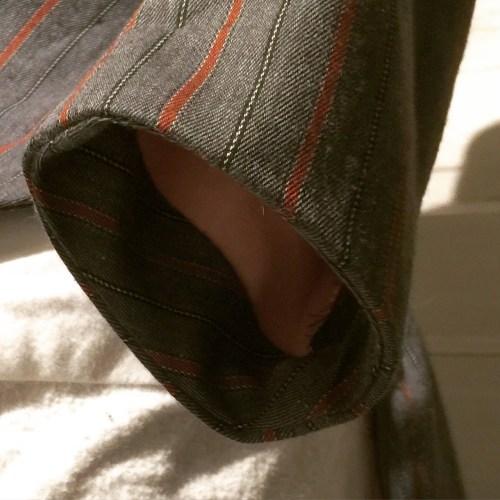
Sleeve with bias facing.

I muslined with long sleeves and (gasp) didn’t even add any length. I did take some width out of the sleeve, especially around the elbow curve, and tweaked the hell out of the sleeve-cap/armscye. It’s still not exactly perfect, but I have a pretty decent range of motion. The sleeve as drafted came just above my wristbone—which, actually, looking at my pinterest boards, seems to be accurate for the period, but would drive me absolutely batty. So I cut back to 3/4″ sleeves. Those I can handle. As per Amateur Dressmaking instructions, I faced both sleeves and bodice with bias tape made from the fashion fabric.

2016-02-16 06.02.37Back in the fall I was playing with some satin ribbon and my ruffler and made this pleated trim. The slightly rusty red colour is perfect—I’m a bit torn about whether to use it or not. I actually like the simplicity of the plain bodice with the menswear-type fabric, but the lower neckline I chose is more of an evening style (which does not go with the menswear fabric at all, by the way, but it’s my party and I’ll show off my upper chest if I want to) and should probably be adorned. We’ll see how I feel once the skirt is gussied up a bit more.
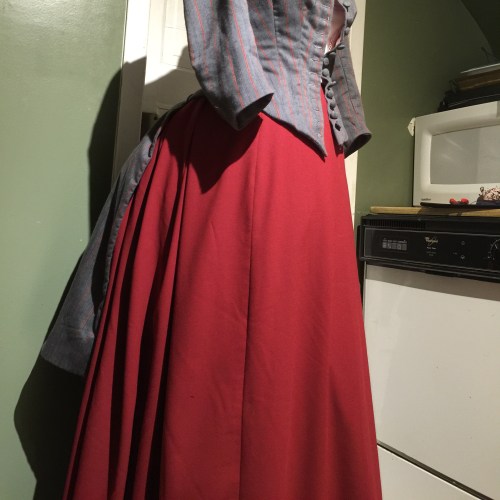
2016-02-21 00.09.06Which brings me to the skirt. Um, yeah. I didn’t have quite enough of the striped suiting for the skirt, or at least not for the skirt plus whatever overskirt draping I might eventually want to do. So I ended up breaking my stashbusting streak and picking up a few metres of this rusy red “wool crepe” (allgedly 65% wool… I am dubious). It was cheap, though, so it’s ok? Anyway, right down to the wire I managed to get it cut into gored panels, mounted on some black broadcloth underlining (salvaged from the same curtain as the cuffs for my blazer, so the walk through Deep Stash was not entirely finished). At 10:30 am Sunday morning, I had to admit, even as I finished pressing the hem facing, that it wasn’t going to be stitched in the hour I had left before I had to leave the house (and be showered and costumed), so I reluctantly but effectively broke out the safety pins. And I won’t even show you the joke of the waistband (more safety pins), but it covered my bottom half adequately, at least once I managed to half-ass a bustle for it.

12568249_927885433970011_304858319_n

Bustle, otherwise occupied.

(I made a perfectly good bustle already, but it’s adorning the mannequin that is holding my half-constructed blue skirt at the Marr Residence, so not actually accessible for wearing to said residence. I never said I had good planning skills. (Incidentally, yes, this does mean that I got further on my red skirt in approximately three hours of work than I have on the skirt I’ve been working on since October.)

2016-02-21 11.00.35I did have a teeny little bum pad I made last spring, fairly softly stuffed—probably perfect for an 1890s “figure enhancer,” but not what I was looking for here. I decided to amp it up with a bigger cousin to get something a little more satisfactory; I stuffed it with fabric scraps (serger offcuts work well as they’re so teeny) from the sewing room garbage bag and had to largely hand-stitch it to the other as I couldn’t get the seam allowances anywhere near the sewing machine’s presser foot. This is a much heavier and less convenient option than the collapsible wired bustle I made before (especially for driving) but it was definitely functional, and didn’t collapse much, which I’m a bit worried the wired one will.
2016-02-21 17.04.12

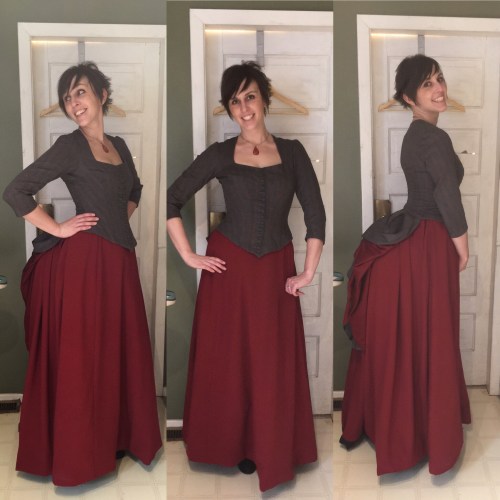
1880s outfit!

It made for a very plain ensemble, but at least the silhouette is there! Well, as close as I am likely to get to it, anyway. I meant to get some pics while at the Marr because DUH, but of course completely forgot. So rather than a beautifully restored period setting, you get narrow-cropped kitchen shots of my bathroom door. Which is probably close to period (well, early 1900s, anyway, and the only original door in our old wreck of a house), but not exactly gorgeously restored.

2016-02-21 16.38.19

Back view. 

I thought the plain tails of the waist (aka bodice) were a little, well, plain, so I tried pinning them up. I think the general principal is sound, but should probably be done by someone who can actually see what they’re doing, and not by me just randomly grabbing bits and pinning them blindly behind me while already dressed.

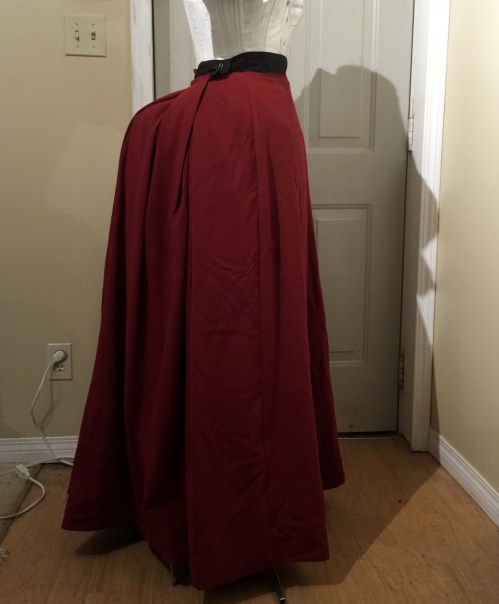
And just in case you aren’t thoroughly sick of this half-ass outfit yet have some mannequin shots of the half-finished skirt!

2016-02-23 19.07.00

Skirt, front

Why did I let it sit wadded up on the ironing board for two days before I took these?
2016-02-23 19.12.11

Side view. I think my other bustle definitely has a nicer shape (the fluffy petticoats would help, too.)

Pleats in the back. Also, the half-ass waistband. It’s just the black broadcloth (thin yet strong) basted quickly to the inside, and held closed with safety pins. I’ll do something better for next time.

I 2016-02-23 19.11.54Why yes, there’s a dress form beside my front door in half-Victorian costume.

2016-02-23 19.12.29I’m kinda tempted to leave it there all month.

20 Comments

Filed under Sewing

Lacy

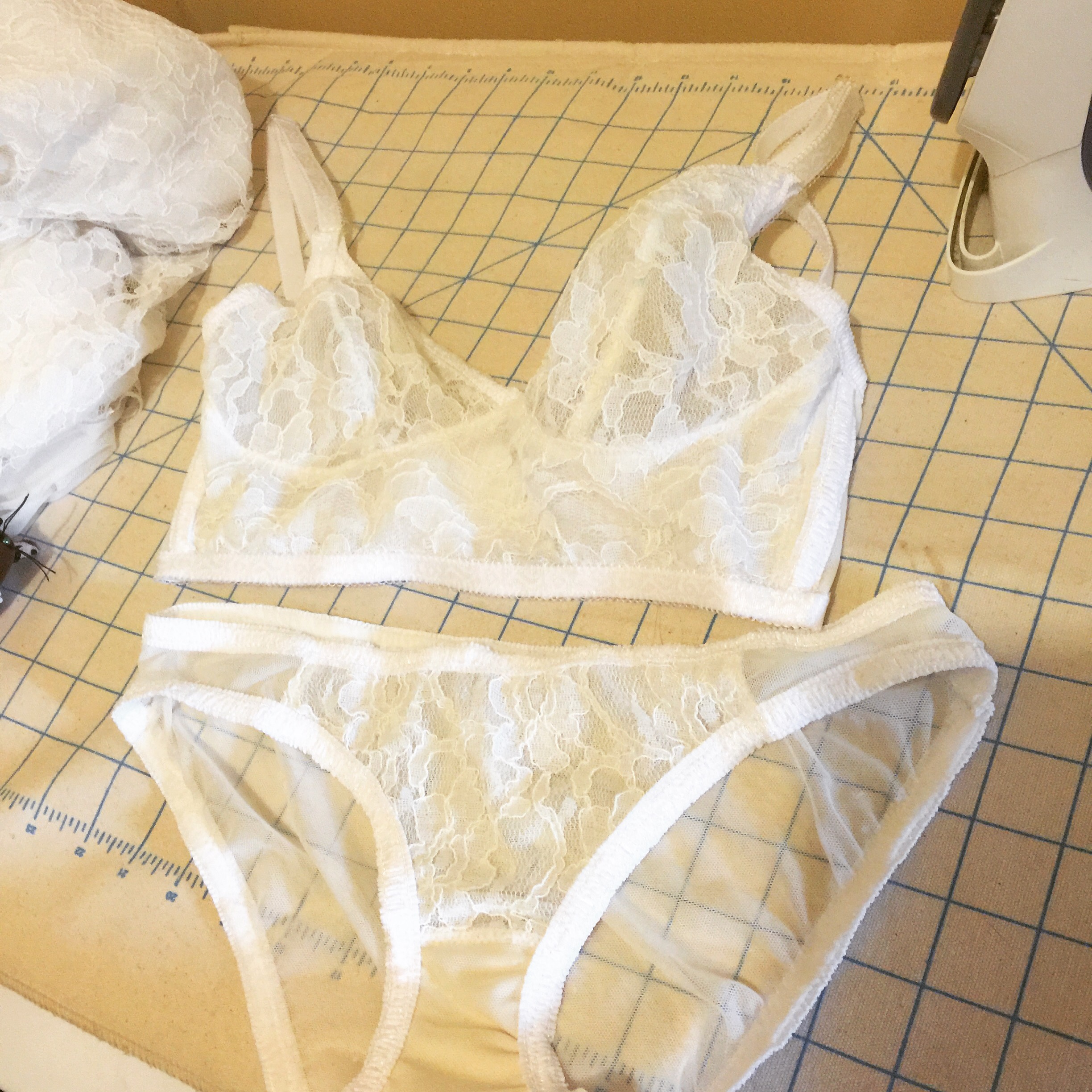
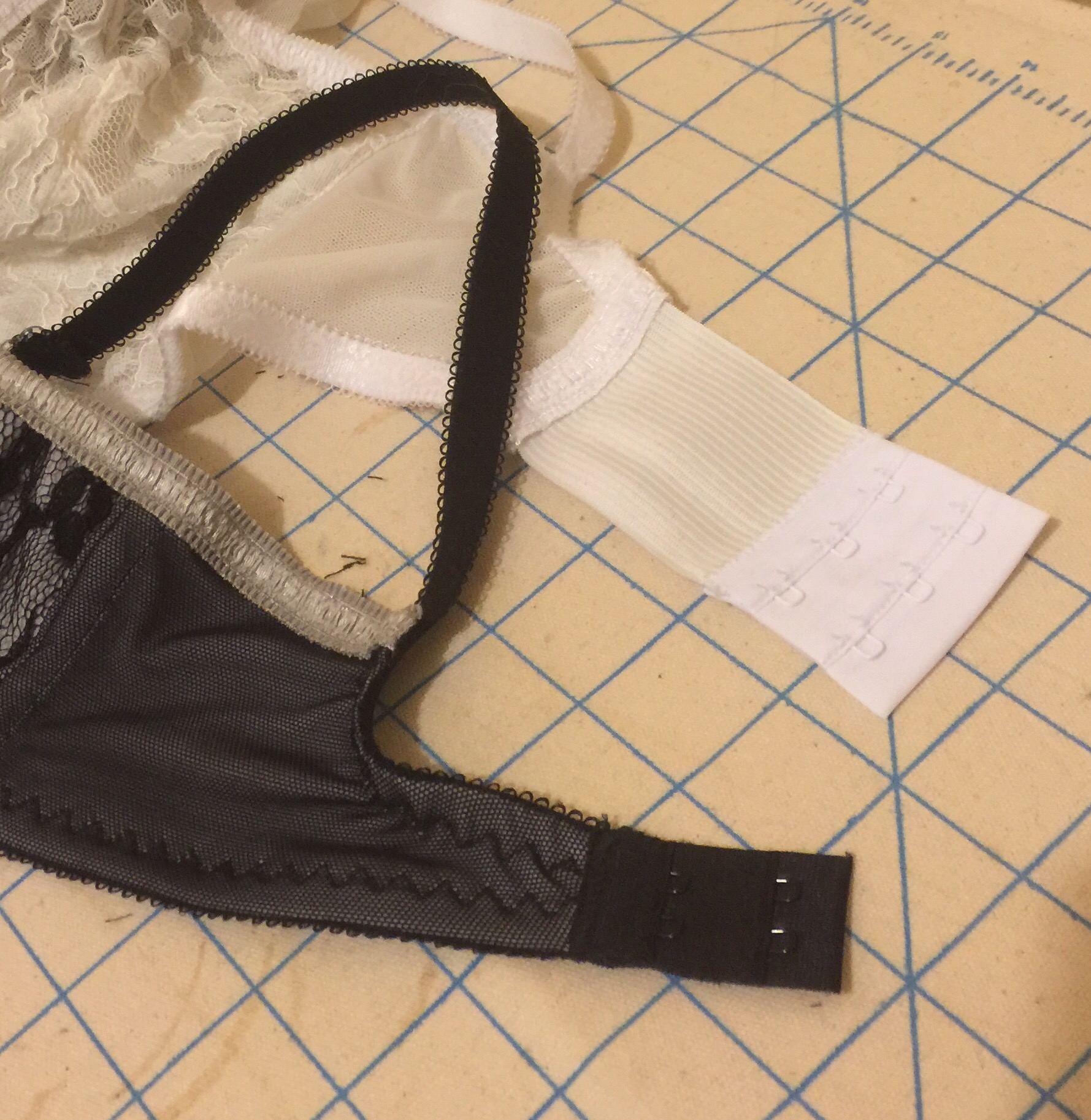
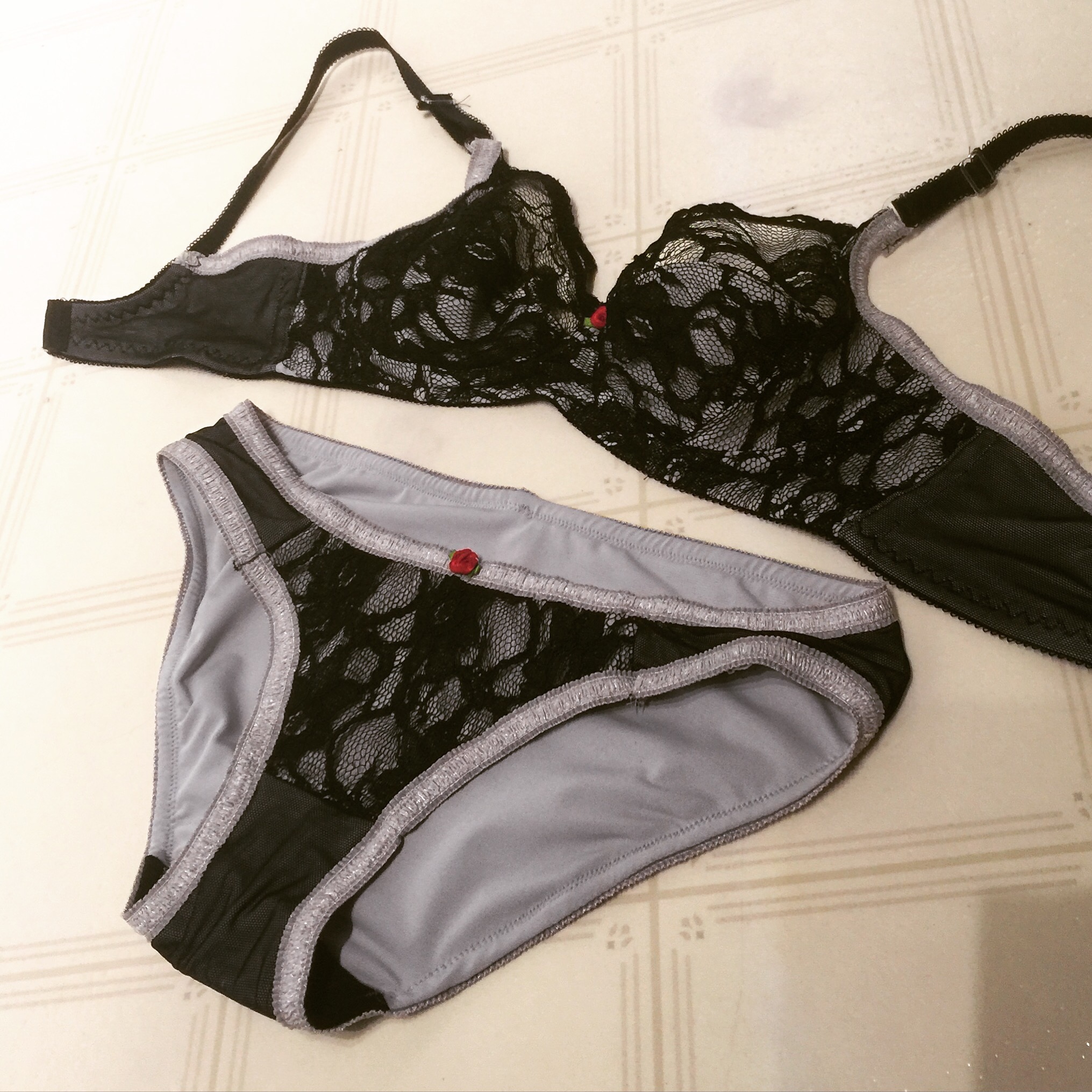
  For my February project at Fabricland I took out a double project of lingerie: the plan was for one Watson set and one Marlborough (ulp!) + underwear to be determined set (ended up being another Watson bikini, because why mess with perfection? 😉 ).  

This was prompted mainly by timing—it’s a season where they don’t really want you to take out projects in last fall’s fabrics, but we didn’t have much in for the spring fabrics yet—so the selection is limited to the “regular”, non-seasonal stock. This lack of options made me finally buckle down and get around to doing something I’ve been procrastinating at for years now. A lingerie project. 

My fabrics of choice were from the bridal section, stretch mesh and non-stretch lace, and the main inspiration: some really gorgeous ruched elastic they carry at a ridiculously inflated price, that only comes in these stupid little one-yard packages.  Way too annoying to spend my own money on—perfect for a project. Part of the problem with sewing bras based on Fabricland stock is that things are a little hit and miss—the strap elastic doesn’t match the band elastic, there’s underwires but only one style and there’s no actual power mesh. So in many ways these projects feel very ad hoc. However, having done this I’m feeling a bit more comfortable with that—it’s not like I have significant support needs requiring industrial materials. 

   
I started with the familiar; I’ve made the Watson set before, so you’d think it would’ve been a breeze. Well, blame passing time or being still sick, but I managed some pretty good stuff ups, despite the previous experience. The stretch mesh I was using for the back band has a LOT of stretch, so I downsized the band. And the first version of the cradle I cut out, I didn’t realize that apparently a large corner had torn off the pattern piece. So I had to recut all that (in three layers), after I had basted everything together and then realized my cradle didn’t match up with my band piece. D’oh. 

  Then, when applying the elastic to the panties, I used too much elastic on the first leg, leaving me short for the second leg (remembering my elastic all came in 1 yard packages)—so the elastic for the second leg is significantly tighter. Either looks fine, though I suspect they will feel a bit weird on, but the bikinis look rather weirdly lop-sided. Bleh. The project must hang. 😉 one thing that did work out was adding a panel of my lace to the front of the bikini—this turned out super cute. I basically just traced off the front pattern piece, sliced where I wanted my panel to end, and added seam allowances. 

Once I recut the cradle, the construction of the bralet wasn’t bad, but a couple of things bit me in the ass. First was my decision to downsize the band. BAD idea.  Especially when I had also decided to double the mesh in the band. Too tight. Way too tight. 

  Fortunately (?) the bra backs Fabricland sells come with this weird chunk of elastic attached to one side, which I was able to use to extend the back. So it will go around, even if it’s a bit fugly. 

  My biggest problem with my first two Watson bralets is that the wide long-line bands don’t stay in place. My ribcage flares at the bottom, and they just wriggle their way up. So to try to ameliorate that for this one, I added boning channels (with some scraps of my fancy elastic) over the side-seams. This seems a bit overkill for what’s supposed to be a soft bra, but if it works, it works, right? Mind you the jury is still out on it working. Because:

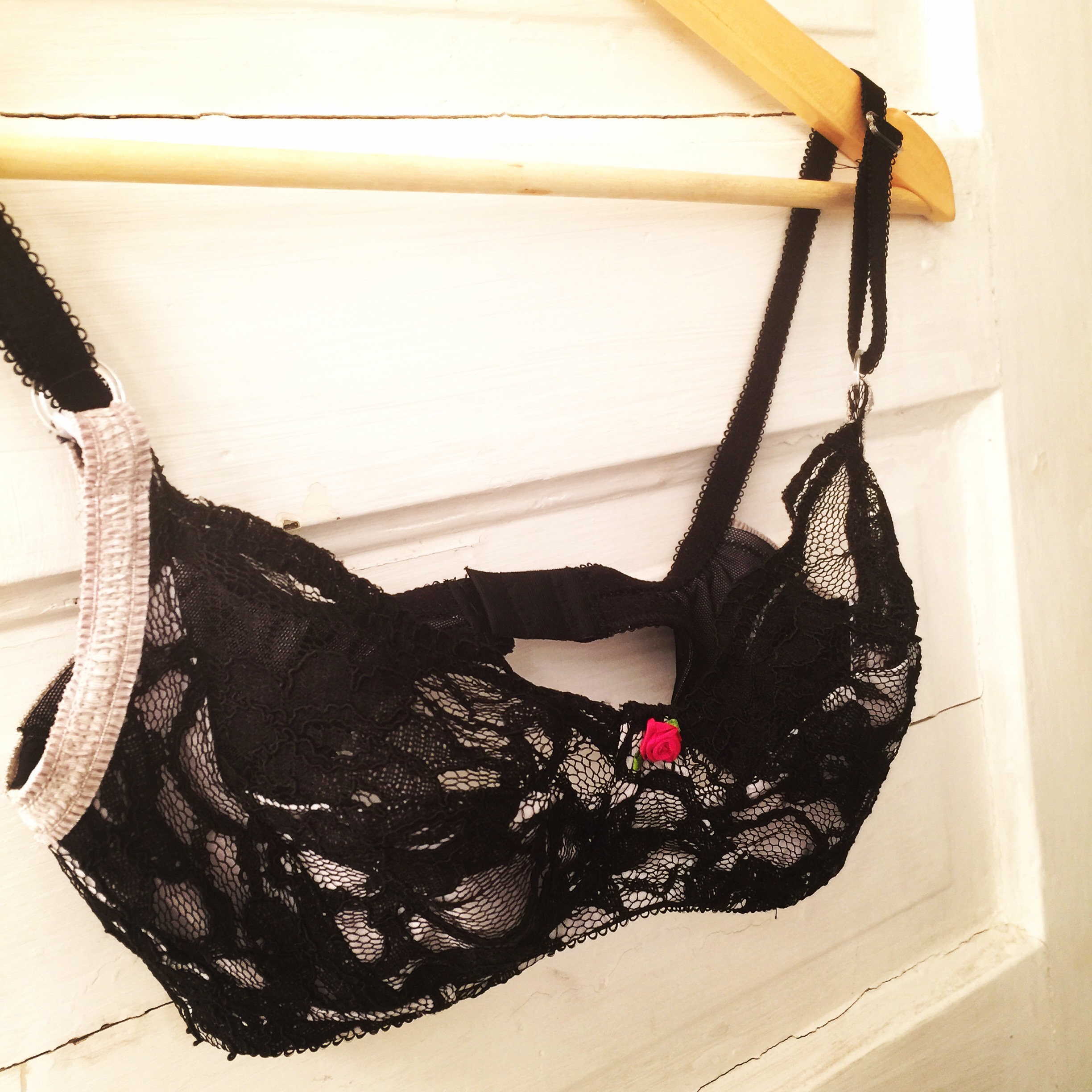
When the great try-on moment came, it became clear that the cup size that fits me in a cotton spandex jersey, does not fit me very well in a non-stretch lace. Lots of cutting in. Pouting, I got Tyo to try it on, since her bra size is about one cup letter smaller than mine these days. Yup, great fit. But, it’s a sweet off-white lacy bralet with rosettes… Not really her style. At all. Syo, on the other hand, seems to like it. Oh, and it fits her, too. So I think it will have a home. Maybe. Both my kids, like me, are foam cup types, so I’m actually not sure anything else will get worn. 

  And then, with the warmup done, it was time. Marlborough time. A scroll back through Instagram informs me that I muslined this pattern a mere 76 weeks ago! Yikes. At that time I was pretty impressed with the fit, which seemed to need only a minor tweak to the side seam. But in the meantime plenty of sewing anxiety had set in, and I stalled and faffed over not having the right notions and wrang my hands about what colour my first bra should be and generally just avoided the problem. So really, taking this out as a project with a deadline, was pretty much perfect for cutting through all that avoidance. 

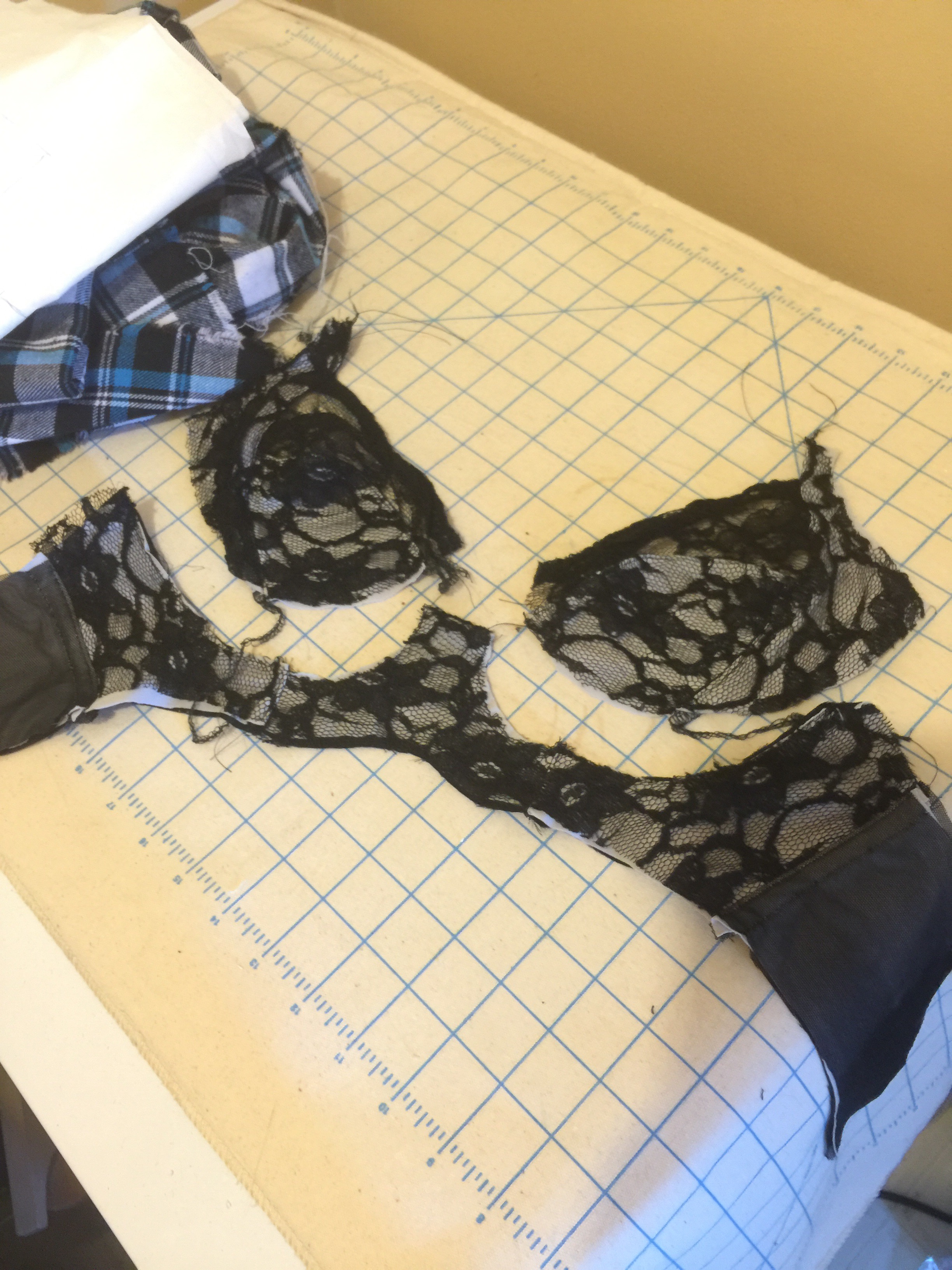
  And now, having done it up, I’m not quite sure what I was so nervous about. Yeah, there are lots of little pieces and I wish there were maybe a few more notches to help keep track of which way the pieces fit together, but I love sewing with 1/4″ seam allowances, and by hopping back and forth between my 1/4″ foot and my edge stitch/stitch in the ditch foot the sewing itself was pretty slick. And the Instagram peeps were there to hold my hand while I panicked over my half-ass channeling, arguably the scariest part of the whole process. 

For this set I layered the stretch mesh and non-stretch lace over a thin grey poly spandex knit. I kinda wish the grey showed more, actually, and maybe that I had used mesh over the power bar rather than lace, so it would show more. And maybe stretch more. 

  Because the biggest problem, again, is that the non-stretch lace is less forgiving than the stable-but-with-some-give earlier version. The power bar—the vertical piece at the side of the bra—actually kinda cuts in at the seam to the other pieces, not a nice look, though also not evident in the pictures, so it probably isn’t as bad as I think it is. And the shape is more pointed in the lace than it was in my scuba first version. Not a bad shape, but a little different. 

 For my own information, I’m going to add that the underwire I’m using is about two sizes larger than the “right” underwire for this size. This means it’s wide enough not to cut in at the side of my breast, which is one of my biggest complaints with store bought bras. I also had to shorten them significantly on the cleavage side to fit this pattern, which is fine if you have the tools for that but less fine otherwise. 


At the end of the day, though, the biggest issue, which has nothing to do with the pattern or fit itself. This is a soft cup bra. I’m a foam padding & push-up girl, if I’m going to actually wear a bra. The last time I wore a soft cup bra was over a decade ago. In particular, the right padded bras mean I don’t need to worry about small bust adjustments in my sewing. So that, more than anything else, might be what keeps me from using this bra much. But I am curious. It wouldn’t be the first time sewing has coaxed me to experiment outside my comfort zone. 


6 Comments

Filed under Sewing

A Victorian Skirt Pocket

12568249_927885433970011_304858319_n

Almost skirt!

I haven’t blogged it much, as there hasn’t been much progress, but the skirt for my 1880s ensemble is coming along, finally
. I kinda stalled out before Christmas as I needed to put in the placket and pocket, and I was skeered. But this past session at the Victorian Sewing Circle, I tied on my big-girl apron, did the research (two whole paragraphs of it, as it turns out), and put the pieces in.

I found a quick description of what I was looking for in “Studies in Plain Needlework and Amateur Dressmaking” by Mrs. H. A. Ross. (Published 1887)


 Here’s my source documentation. P. 11 from the above.. It does seem to require a little bit of decoding, however.

“Skirt pockets are cut from. the lining”-ok, check.

“And are heart-shaped when opened flat. Twelve inches long by six wide is a medium size, leaving one side double and straight on the fold; the other wise rounded to a point on the top.”

There are definitely times when a picture is worth a thousand words, and the downside of the old sewing texts is the further back you get, the more scant the illustrations become. It sounds like what she is describing how you would cut out a paper heart for a valentine, but upside down…


Victorian pocket diagram

Pocket, cut on fold

“Sew around the bottom and five inches of the rounding side, leaving the remaining space to be sewed in the skirt seam. Unless covered by the drapery the pocket should be faced. Leave three inches of the pocket at the top, above the place for the hand.


She does like to leave the important bits for last. So the opening for the hand is on the curved side of the half-heart, towards the point, but at least 3″ down from it so the pocket isn’t too narrow for your hand to get into. Also, the pocket opening is sewn into a gap in the side seam, after it’s all complete.

“A tape must be sewn to the point and jointed to the belt (waistband). There is danger of the pocket being so narrow at the top that the hand cannot be inserted, though the pocket was cut plenty large enough.”

pocket and facing

Pocket, unfolded to show facing

“All pockets are sewed in double seam. first sew the seam very narrow upon the right side, the pocket turned and stitched again on the wrong side in an ordinary seam, without taking in the seam first sewed. This makes a strong seam and required no overcasting.” (AKA French seamed. Got it. Except that it’s the last bit and I didn’t read it before I sewed the actual pocket. Oh, well. Overcasting edge it is.)

2016-01-17 16.48.05

Pocket in seam.

Unfortunately I didn’t actually think to get any photos during construction, and I’m a smidgeon too lazy to make another one for demo purposes. 

As implied by the rather terse instructions, I left a gap in my skirt side-seam the length of the pocket opening (and hopefully in about the right place) and stitched the pocket to it after the fact. This wasn’t as slick as a modern inseam pocket but wasn’t as cumbersome as I originally feared it might be.  I think as a method it makes more sense for something hand-stitched, where the fold would decrease the time it took to sew while the stitching it in afterwards wouldn’t be nearly as cumbersome by hand as it could be by machine. (Though as I said it wasn’t as bad as I thought it might be.)

I also did the placket for the skirt opening, which I was also kinda dreading for no good reason. The page above describes about four different methods in about 20 words each; I used the instructions for making the slit version for this petticoat, but for the skirt I planned to have the opening in a seam. In the end I just cut a rectangle of my cloth and used it to face/lap the opening in one piece, down one side and up the other. Not quite what was described, but simple and it will function just fine. It needs hooks, and of course the whole thing needs the waistband, and then I’ve got to start thinking about trim. 

This is where shit gets exciting. Or intimidating. Oh, hell.

  I’m thinking about using the middle skirt for my inspiration, though I also really like the one on the left. This is a picture from a reproduction of an 1886 Bloomingdales catalogue, belonging to my mom. I love the online resources but it’s so amazing to flip through the catalogue. Anyway,  I definitely want an overskirt reminiscent of the two In the picture—I have TV368 (below) for a pattern. 

  Getting mighty ambitious, aren’t I? 😀

And then I will have to start muslining the bodice, I mean waist. O_o somehow compared to that decorating the skirt doesn’t seem so intimidating…


5 Comments

Filed under Sewing

Slinky


  Because I’m a glutton for punishment ambitious, I decided at the last moment to take out a Valentines project from the shop. A slinky, sexy slip. Or two, since the fabric wasn’t expensive and there was room in the project budget.


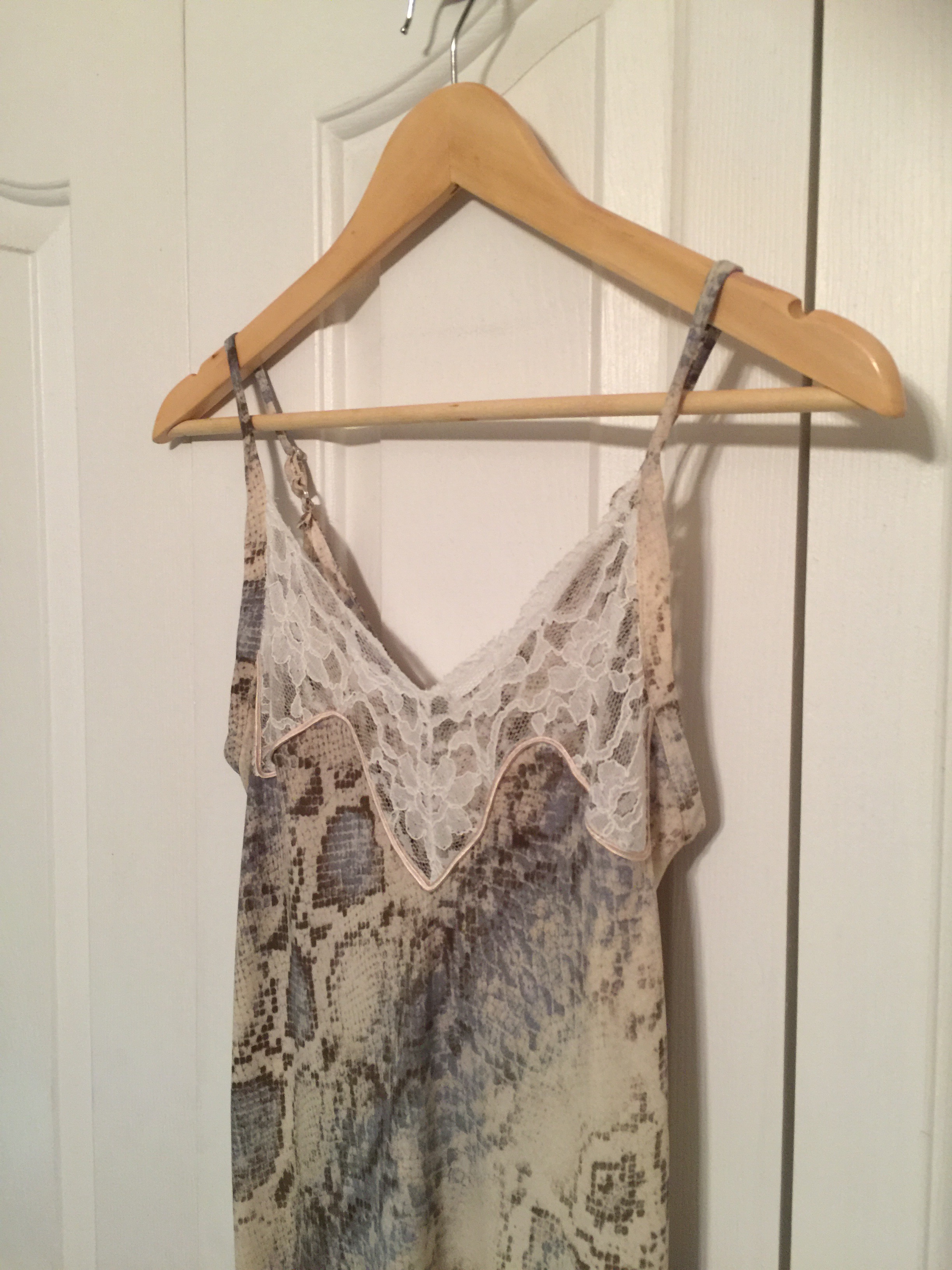
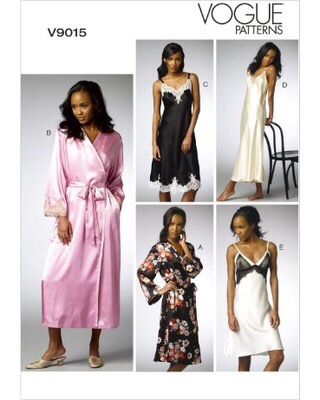
Vogue 9015

The pattern is Vogue 9015. There aren’t a lot of slip options in the ButtMcVogue line (and I’ve already made Gertie’s slip and love it and wear it to death.) Now, Vogue 9015 is an absolutely gorgeous pattern, but a lot of that hangs on the lace being used. Fabricland’s lace is, um, a little underwhelming. I mean, the stuff I used was far and away the best in the store for this purpose… But it ain’t a patch on what the envelope is using. And having had the odd chance to play with really incredible lace, it’s hard to go back.

View E might be my favourite, but for project purposes I stuck to the simpler views C and D.


View D

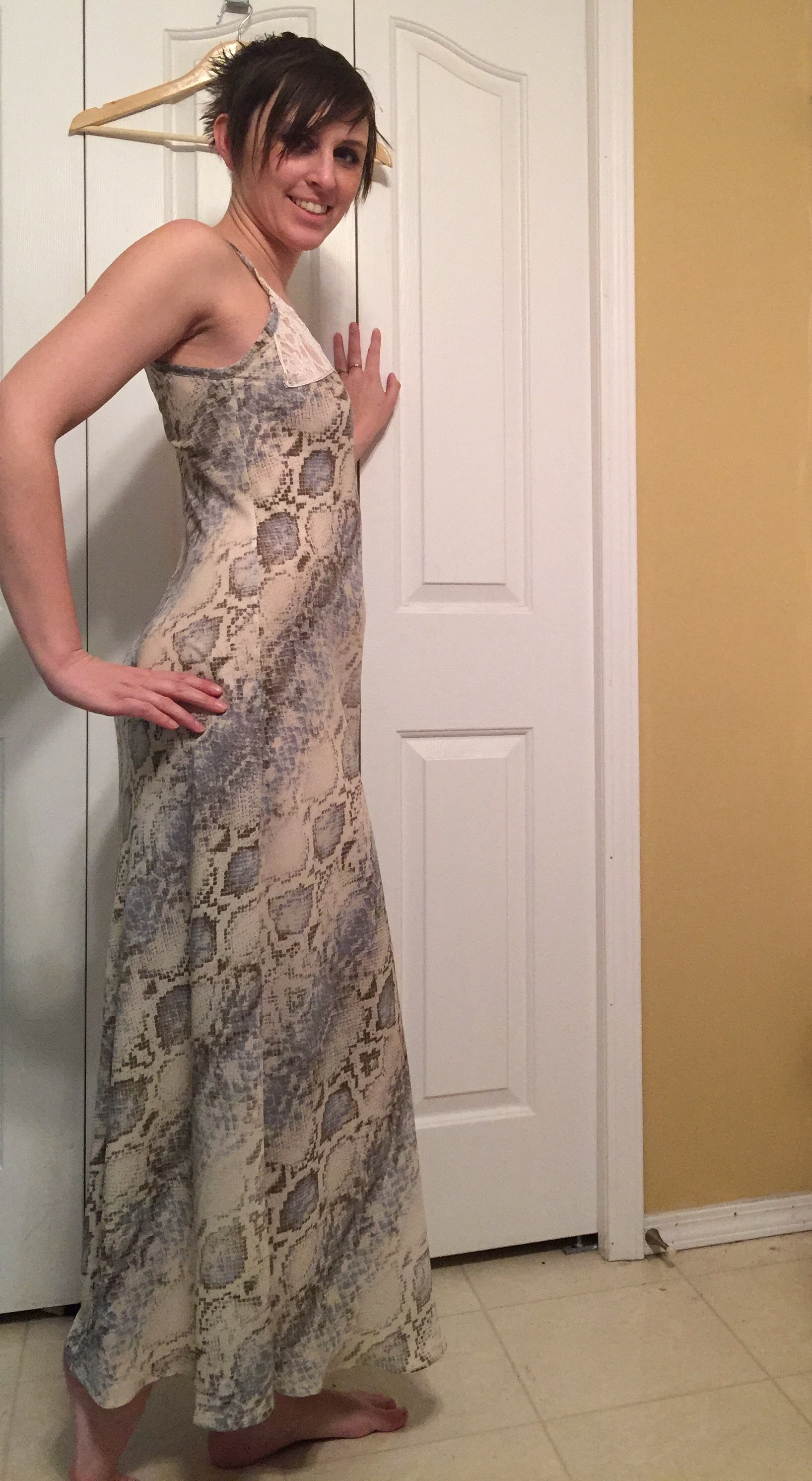
Well, this is one of those things that seemed like a good idea (and maybe will turn out to be a good idea…) but I really hate working with slinky fabric. Neither of my versions is anything like as well finished as I would like, and my attempts to try out different methods of applying the bias binding/”facings” were not stellar.


Front Detail

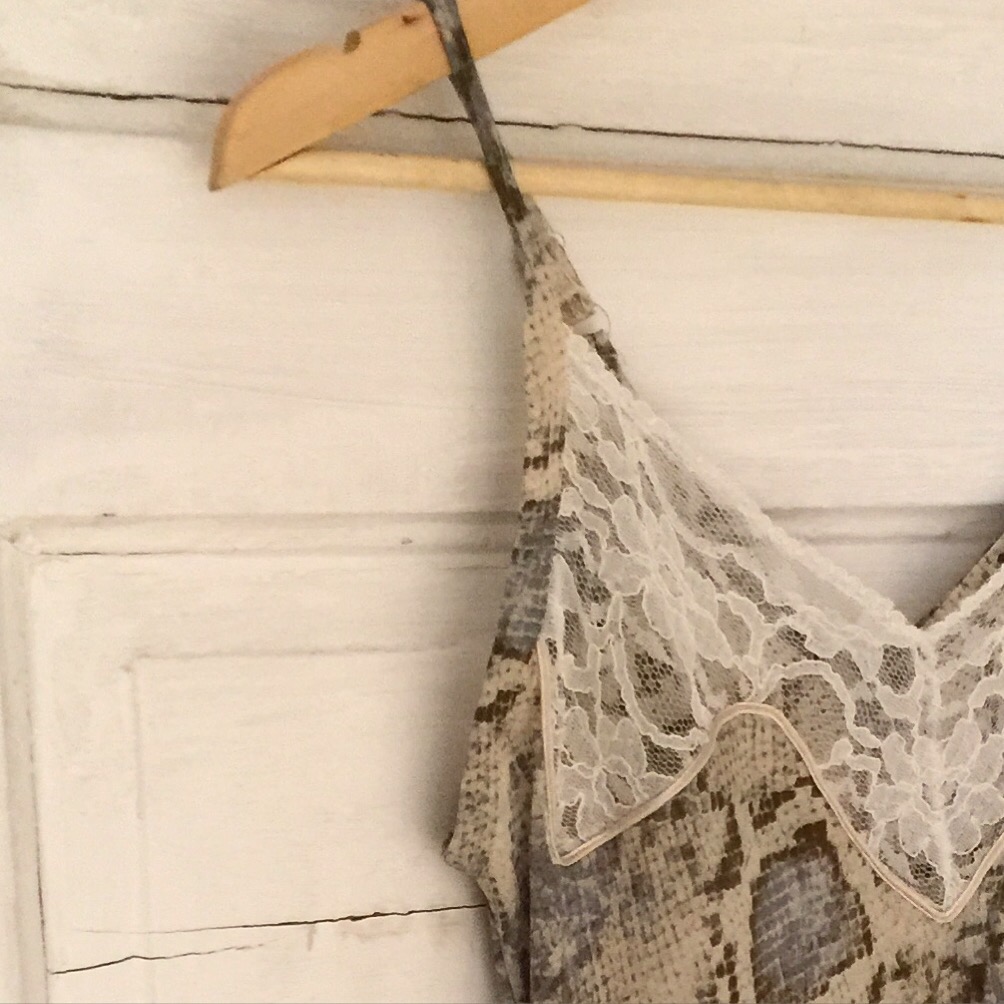
For my first version, I followed the pattern instructions for shaping the neckline inset and while it’s not terrible I would’ve preferred, in hindsight, to “listen to the lace” more and curve my seams around the lace elements to avoid that seam down the middle. Frankly, I’d much rather have been working with the gorgeous scalloped-edge lace on the pattern envelope. 😉


Side stripes… kinda matched at the top, not at all at the bottom.

Because my lace was fabric and I cut it to shape to match the shape given on the pattern  (as per instructions) the shaped seam along the lower edge wasn’t terribly nicely finished, so I added the ivory rayon soutache to cover it, which it does nicely. I actually only had stark white soutache on hand, but fortunately I had just brewed a fresh pot of tea, so a quick tea dye and my soutache was just the right colour.


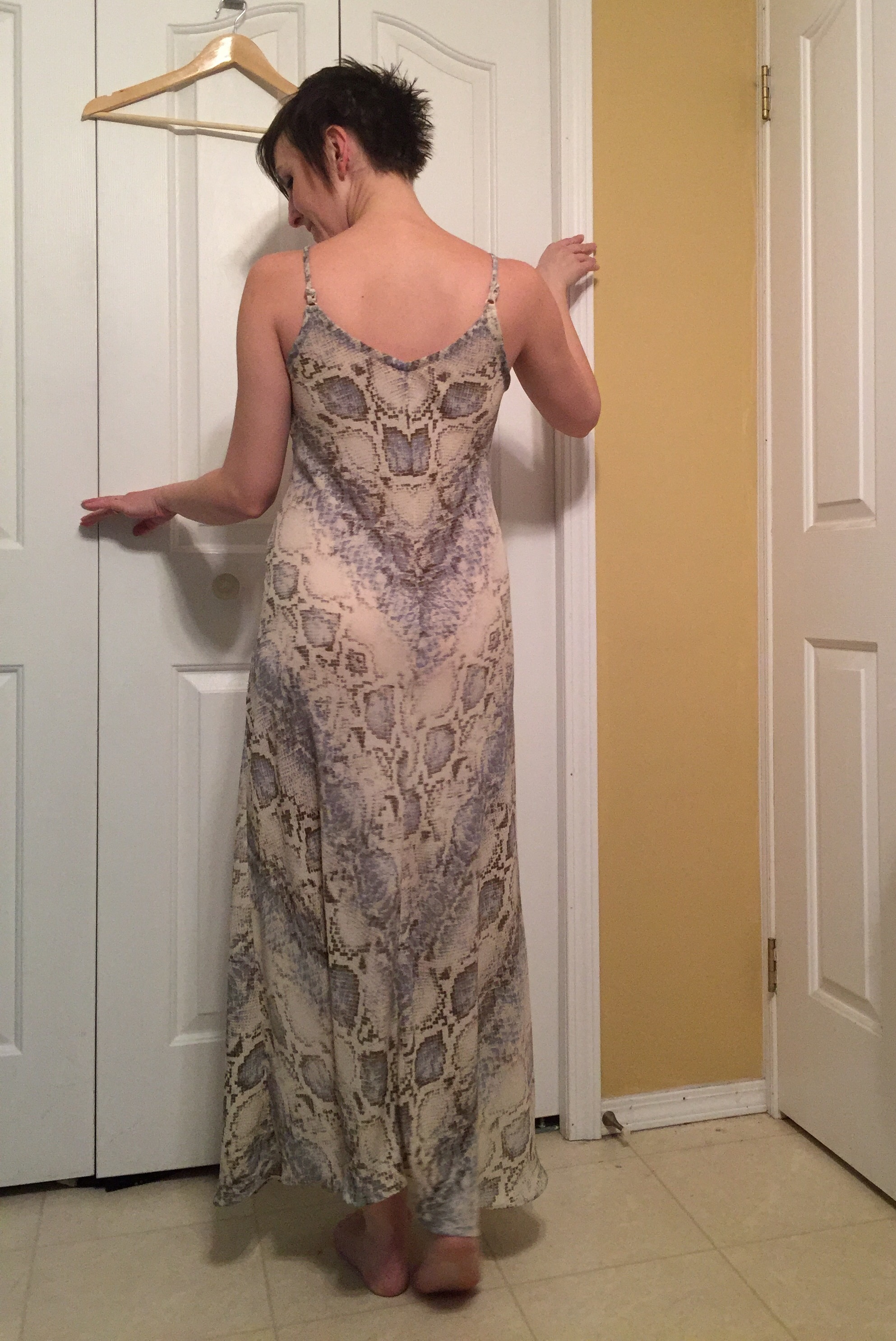
Back chevron: SUCCESS!

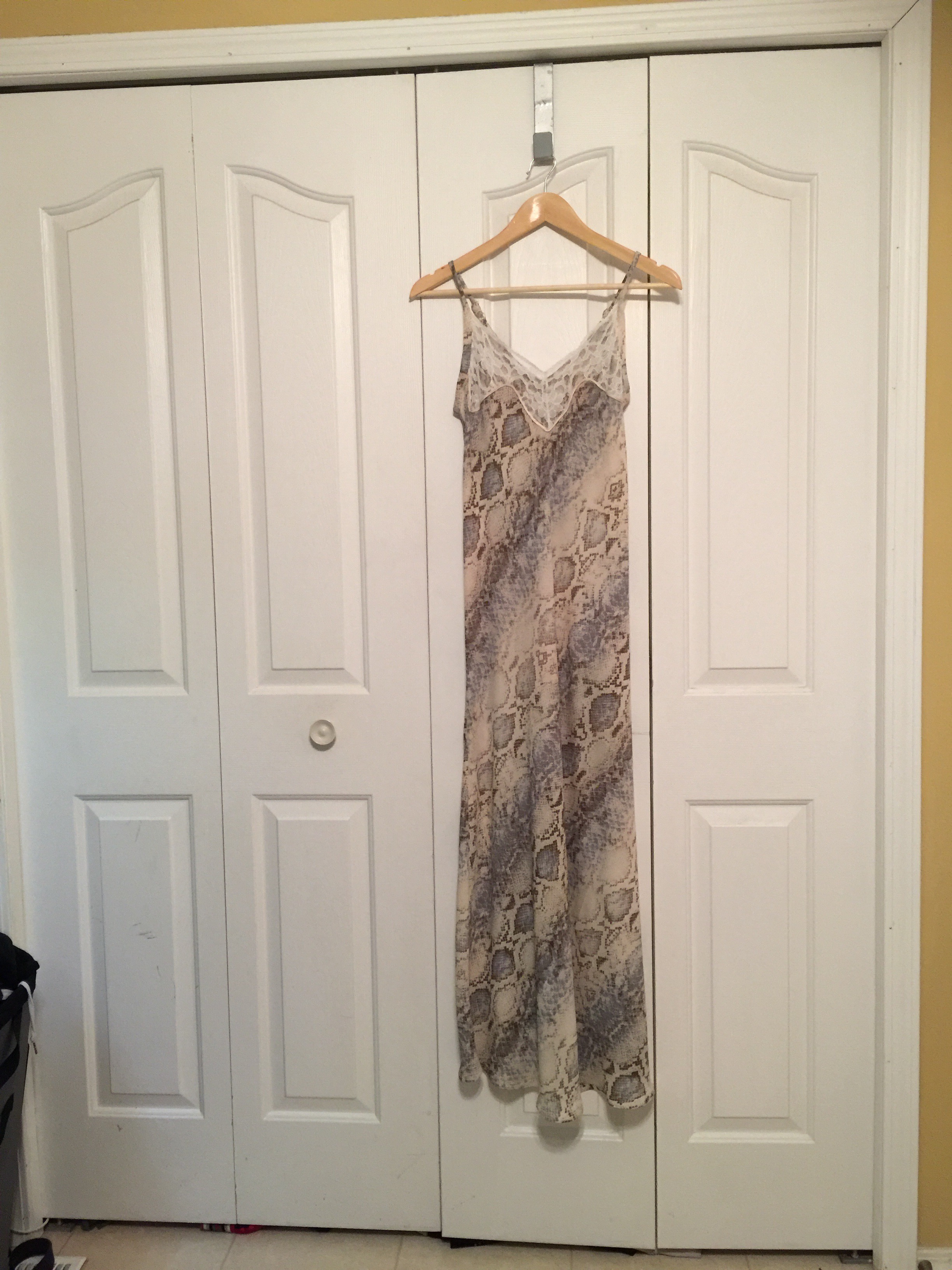
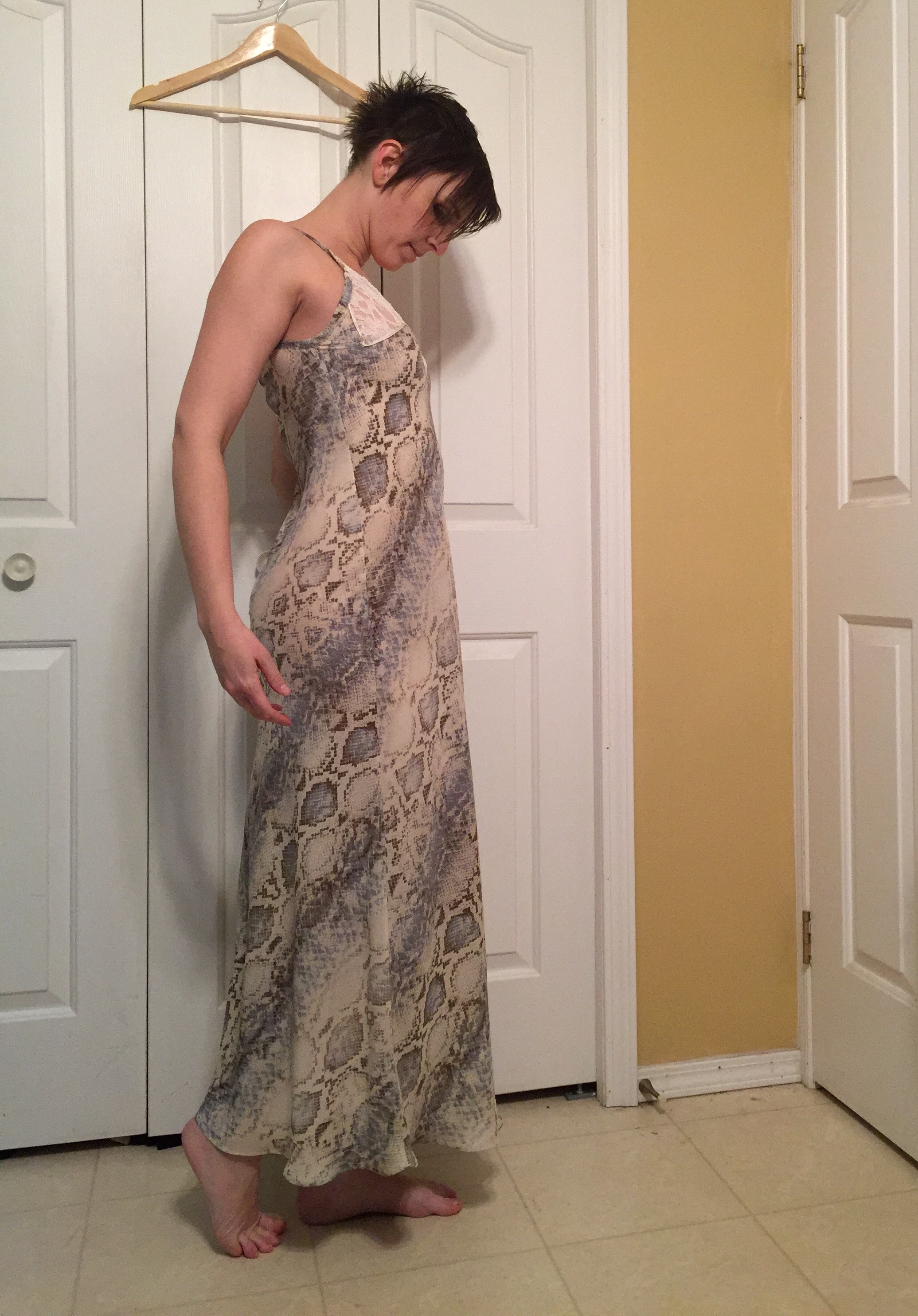
I cut a size 10 and made no alterations whatsoever; I did try to match  the broad repeat of the snakeskin stripes, although I didn’t have much luck at the sides. I love the chevroning in the back, though. I’m not sure if the length is perfect or if an inch or two more would have been better (or at least more romantic. 😉 )

I had just about forgotten what a nightmare trying to sew all the binding pieces in place was, but looking at the photos it’s all coming back. The pattern actually has eighty million binding pattern pieces (they call them facings) but they were all basically bias cut rectangles with the odd notch here and there, so I ignored them and just cut some long bias pieces to what seemed like a good width.


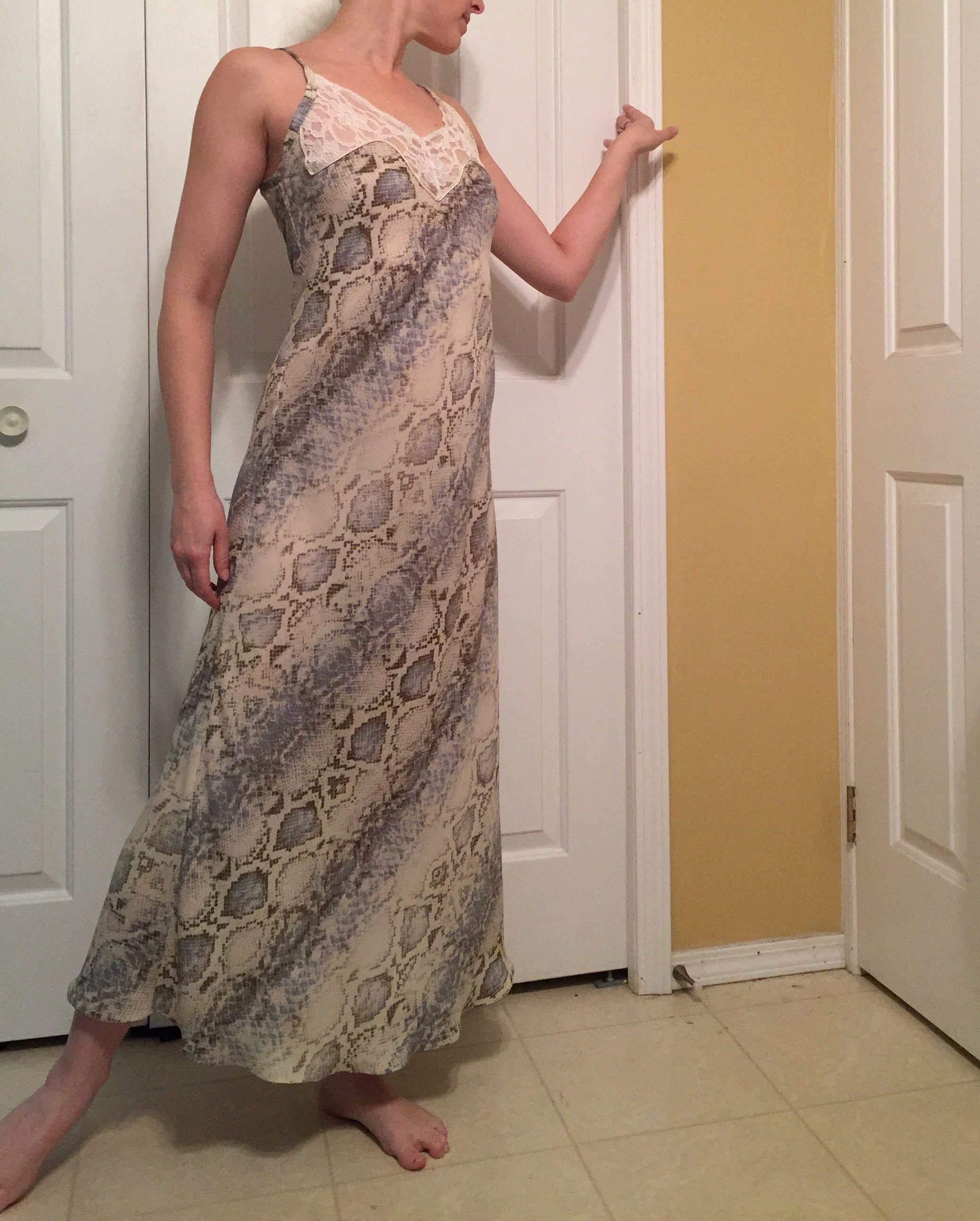
Romantic pose.

At the last moment I decided to add strap sliders to the straps to make them adjustable. This was a great idea except that my round spaghetti straps don’t really fit the rectangular sliders very well; and to start I had made the straps too long, and then I shortened them and now I basically wear it with them fully lengthened. And I am short through the upper body.

It’s quite high cut in front (at least at the strap length I ended up with), which doesn’t matter for nightie purposes but could throw a wrench into any actually-wearing-as-a-slip possibilities. The pattern calls for a “front facing” (aka bias binding) that turns into the straps, but I didn’t want to put a solid strip of fabric behind my sheer lace, so I ran my straps from the side binding and just backed the front edge with a wee bit of clear elastic zig-zagged in place, to keep them from sagging.


Lace piecing in progress


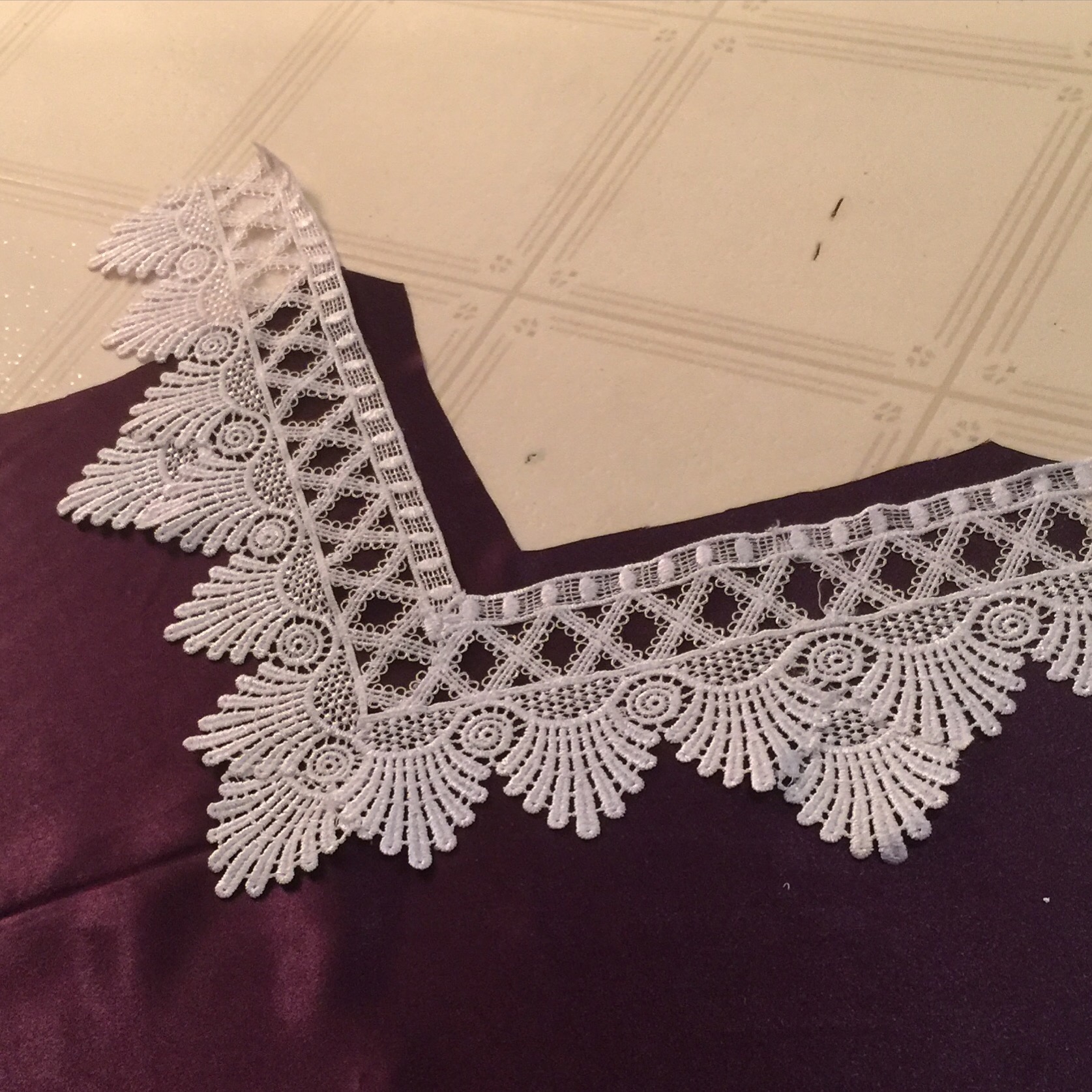
For the purple, luxe version I resolved to let the lace lead, and had great fun matching the motifs to make the corner at the neckline, and adding some extra motifs partway along to give the lace more of a scalloped shape at the neckline. Alas that was pretty much where the fun ended.

In the snakeskin version, I attached my straps/binding basically as double-fold bias binding. Not the easiest in a slinky polyester. For the second version, I resolved to try the method suggested by the pattern, which is basically the same pieces but instead of the binding wrapping around, it’s stitched on the outside and folded to the inside and top stitched down. Which I’ve seen many a blogger do beautifully, I will add, to the point where maybe I assumed it wouldn’t be hard. Well, doing it on bias poly charmeuse was very hard indeed, and only partly because the seam allowance widths change so dramatically depending on your tension.


Lace, attached.

The pattern calls for having the ends of the binding transition seamlessly into the straps in a technique that looked beautifully clever on paper and turned out to be a bit fiendish in practice, since I didn’t have the snip-to-the-seam-line that this requires in quite the right place. I ended up cutting them off and just stitching the straps in place, distinctly not the best look

After attaching the bodice lace, I had a serious crisis of conscience with the purple version, convinced that this guipure lace was way too heavy for my soft satin and even for the pattern in general. Trying it on told me two things—firstly, the length was perfect, so I didn’t want the lace to add to it, and secondly, egads, the static cling! I was basically sure the damn thing would never be wearable. Anyway, this was a store project, and The Project Must Hang, so I soldiered on. I was concerned that my wide lace would both stiffen the hem and sit awkwardly since it wouldn’t curve or flare around the curved hem. So I attempted to gently gather it in along the top edge, first with a gathering foot and then, when that failed, just by cranking up the tension on my machine. On the heavy lace, this worked really well, and gave it just enough ease (I hoped) to follow the curve nicely. I used a single length of lace around the hem, fudging the length slightly to get the motifs to line up perfectly. Fortunately the bias fabric was forgiving and happily stretched half an inch or so to accommodate this. The top of the lace looks a bit irregular in places from the gathering, but it’s not obviously ruffled and it seems to flow with the curve of the hem, so I’ll take it.

 Unfortunately, I got no modeled snapshots of the second slip before it had to go hang. I don’t think I even tried it on. I was just happy the lace at the bottom didn’t stick out like a hula-hoop when I was done. So instead I’ll leave you with one last view of the snakeskin version, just in time for Jungle January. The slips are hanging now, and looking gorgeous on the mannequins, so maybe by the time I get them back I will have forgiven their flaws. Maybe.


A slip for Jungle January

PS, I can’t believe this is my fourth post this month! Thanks mostly to drafts written over the Christmas holidays, but anyway, I’ll take it. Even better, I still have a couple more in the drafts bin. 😀

3 Comments

Filed under Sewing

Plushy

IMG_2583

Inspiration in the middle.

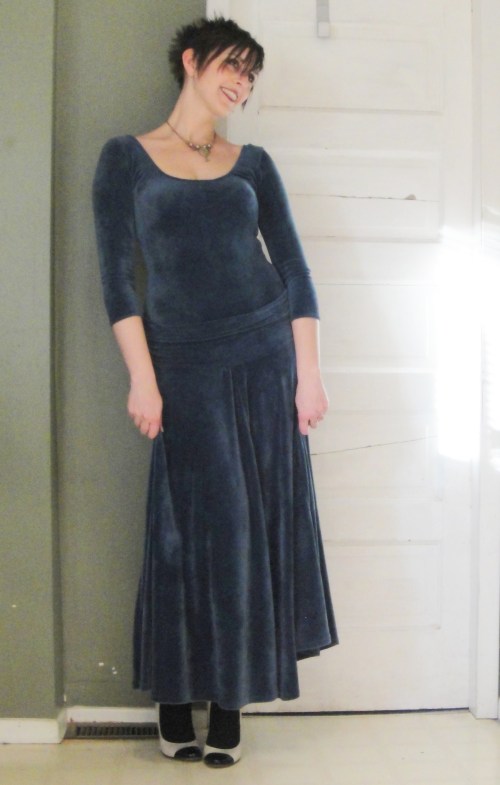
Long ago I bought  (as I often did in those days*) a 70s pattern, Simplicity 8272. It was a pattern for a bunnyhug** with skirt and pants option, and the cover featured a gorgeous, muted blue velour version, styled with boots—effortless and chic and totally comfy. Yes, I did just use “chic” and “velour” in the same sentence… that probably means that there is something wrong with me.

Anyway, when this extra-stretchy luxe velour showed up at my Fabricland this past fall, I commenced petting it immediately. It has a thick, dense pile, lots of stretch, and gorgeous weight, and is super-duper soft. And came in the perfect shade of muted blue. It would be perfect for Simplicity 8272.
Except.
1) It’s freakin’ expensive,
2) it’s super stretchy, and the 70s pattern is designed for “wovens and stable knits.” No lycra required.
Both problems seemed to be solved by deciding to make it a store project using contemporary patterns to get something with the same feel.
For the skirt, I picked Burda 7143, figuring I would use one of the McCall’s in-print patterns that I had (McCall’s XXXX and XXXX were the main contenders, though neither was quite right.)
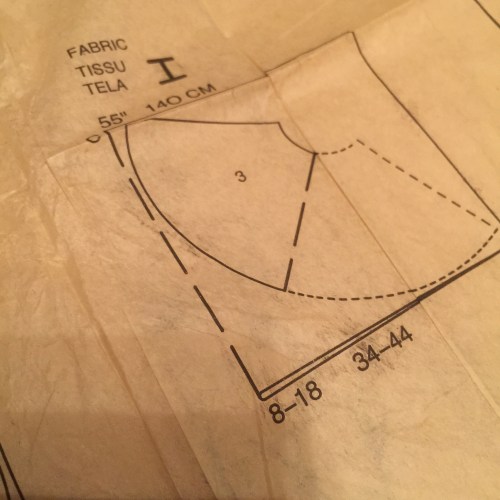
DSC08413OK, so I’m gonna say right off, this is a weird pattern. It’s simple, or at least it should be. It’s designed for wovens with a stretchy knit waistband—using the stretchy velour for the skirt part didn’t seem to be a problem. It’s not a full circle skirt, though it’s close. Here’s where the weirdness kicks in: the pattern piece is meant to be cut on the fold (or rather, mirrored) twice—but the fold/mirror line is not the grain line (nor is it a simple 45 degrees to it or anything else that would make sense).
2015-11-29 08.48.09

Weird layout.

This broke my sewing brain into eighty million little pieces, and I spent way more time staring at the pattern layout (which in Burda envelope patterns is printed right on a corner of the tissue) than I should have to for a pattern clearly labeled “easy.” My GUESS is that this has something to do with a) the size of the pattern piece, and b) how they want the print to fall if you’re using something like a plaid, as in the envelope  picture.

I ignored it and cut four pieces, on grain, not on fold. I think I ran the nap of the velour up, for that “extra rich” look.
Once I had decided what I was doing, it was ridiculously quick to whip up. The “waistband” piece, as drafted, is REALLY tall—I shortened it a bit since my fabric was super thick and I didn’t want to fold it over. I also added elastic to the inside of the sides to keep it nicely scrunched up. I like a bunchy, scrunchy waistband on a knit skirt, to sit right in the hollow at my hips.
But, having completed the skirt and being quite, quite happy with it, I realized that the bunnyhug** I had been envisioning wasn’t quite right. It would end right where the skirt waistband bunched, and I just wasn’t digging it. Although I think a matching, very cropped version would be adorbs at some point.
Anyway, I jumped ship and made a Nettie for the top.
DSC08412OK, so despite several attempts and quite a few successful crop-top versions, I haven’t actually had a Nettie that I was willing to wear out of the house yet. Mainly due to fabric that was either not stretchy enough or not thick enough—finding the two in combination seems to be tricky. And this fabric is both in spades—win! I also made sure to take the time to do the snap crotch; I always want to skip that step and just have it done!!!! but really I won’t actually wear the result if it doesn’t have the snaps. Note to self. Anyway, I made the one alteration that I ACTUALLY need with this pattern (shortening the armscye a teeny bit), and the result is basically perfect (although because I insist on both low back and low front it does tend to spread a bit and expose my bra straps. Meh.
I am really, really happy with how this turned out. It’s warm and comfy and PJ-like and still stylish and I actually like wearing the matching pieces together for a “dress” effect.
I definitely need a black Nettie…
*A habit I am trying to curtail lately purely for space reasons, plus I don’t find myself at the thrift store on a weekly basis anymore…
**Hoodie

12 Comments

Filed under Sewing

Skirtles

DSC08402

The Teacher Skirt

After the craziness of Christmas I was determined to get my January Fabricland project in. This is kinda the last chance, as we have to use fabrics from the current season, and the spring stuff is already starting to come in. And I really wanted to do something with this gorgeous, heavy brushed cotton that came in too late for Tyo’s shirt. Ok, it’s still not actually heavy, but it feels more like garment fabric and less like something intended for PJ pants. I was seriously considering a Deer & Doe Bruyère, but while I loved the mental image, I wasn’t sure if I would actually wear a plaid shirt myself (I’m not really a button-up kind of gal). I’m noticing that I often make something (especially shop projects) less because I want that item to wear than because I think it would be a great idea for a particular fabric. Fun process, but not really a practical way of wardrobe building. I mean, my wardrobe is pretty built at this stage, but you know what I mean.

DSC08396

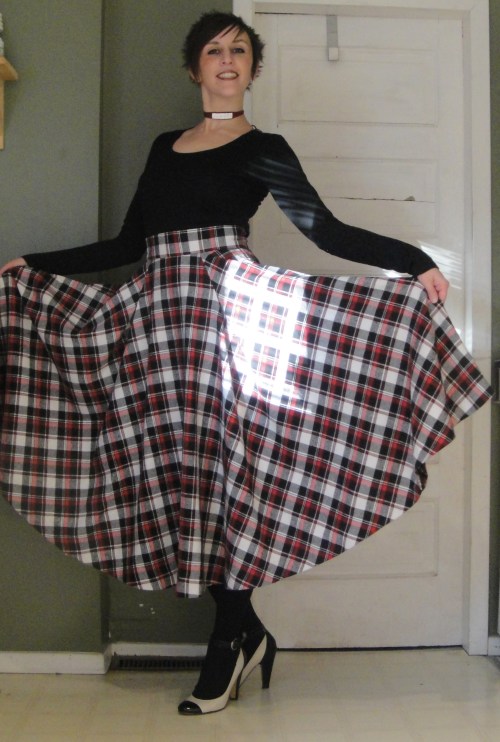
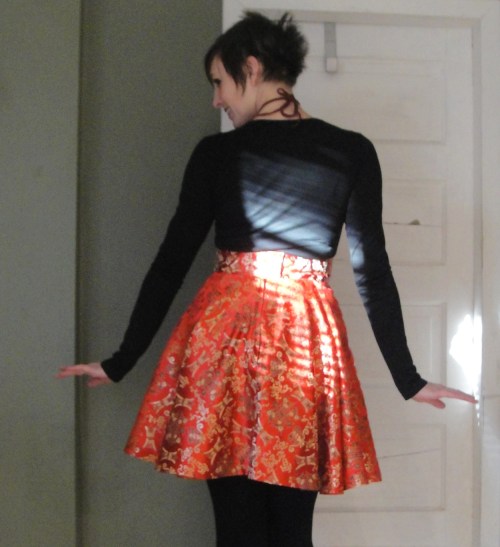
Swishy!

Then it hit, rather like a lightning bolt. I love it when that happens. Vogue 8882, which I’ve been ogling since I first noticed it. A long, plaid version. Boo yeah.

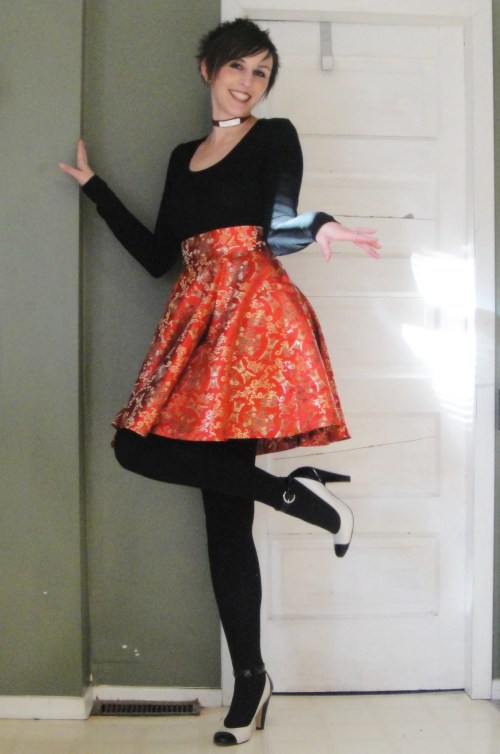
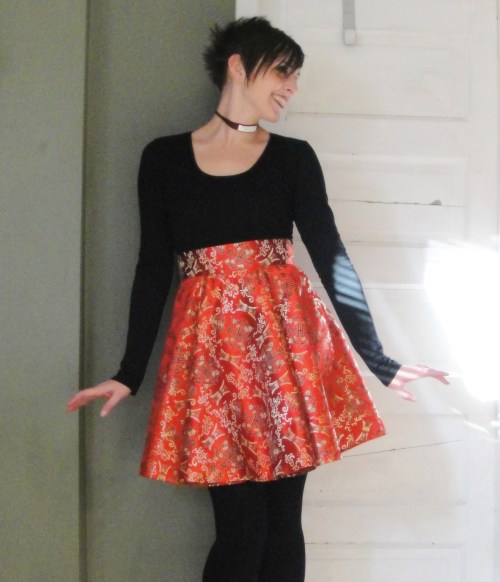
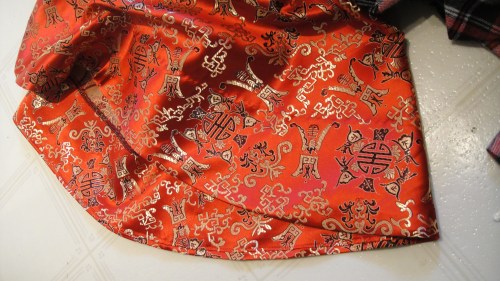
Best part? The plaid was not overly expensive and so ate  up only about half of my project budget. Which sent me on the prowl for part 2 of the project—how about a fun short fancy version, more in keeping with the luxe look on the fashion envelope. Bring on the Chinese brocade!

DSC08404

Blurry, but so cute!

Ok, so let’s back up a bit. This is a circle skirt pattern. There are no pattern pieces that you couldn’t draw out with your grade four geometry kit. The only added detail is the pleats, which are arguably the selling point, but they are every bit as fun as you would think. I don’t know if I would actually have paid the full Vogue $$$ for this pattern, pretty as I think it is, because it is so extremely basic. But getting it with the project—perfect, and it is a cinch not having to calculate anything. It comes down to which you have more of, I guess—time or money.  The rectangular waistband is really wide, which could be a problem if you are quite curvy in the waist, but it works ok for my rather columnar build.

I made the size 12 based on the waist measurement, which is fine. I was a bit dismayed, though, when I got the pattern tissue open and realized that the longest version was still only 27 1/2″ long! I mean, I know I’m not short and I have a lot of leg, but the drawing of this version made me think of something between calf and ankle—27 1/2″ is upper calf on me, barely longer than “just below the knee.”

DSC08398

LOTS of skirt. 😀 Also, stupid spot of sunlight throwing everything off.

So I added 4″ to the plaid version (10 cm for those who use sane measuring systems). I was a little worried this would end up too long, but I have to say I am extremely happy with the finished length. Exactly what I was going for.

My daughter says it looks like a teacher skirt. I said that that had better be a good thing.

DSC08422

I worked disturbingly hard to get those lines to match up across the lapped zipper.

The construction was very basic for this one. I painstakingly matched the plaids horizontally along the side-seams, but completely forgot to think about vertical matching. My CB seam matching is not bad, though, and the walking foot really does help with not having the stripes crawl around on you between pins. The hardest part (actually for both skirts) was getting the overlapping parts of the waistband to be the exact same width. I actually unpicked the brocade three times, which is perilous indeed with brocade. And very unlike me. 😛

DSC08421

Hem by machine.

I hemmed by serging the lower edge with my differential feed turned all the way up. This produced enough gathering to give a nice 2″ hem at the bottom. I’ve been making friends (very slowly) with the blind-hemming function on my new machine, but this time it definitely did the trick. I use the blind-hem stitch with my stitch-in-the-ditch foot.

Also I added pockets, since this was supposed to be the “practical” version. You can see them in the second image. They turned out a little small, but still better than nothing (I can fit my hands in fine but not my monstrous phone.)

DSC08406

THE CUTE, IT BURNS!!!!

Version two is much less practical, both in length and fabric. I have no idea where I will wear it. (OK, I’ll wear it to work, since being ridiculously overdressed is kinda my baseline at both my jobs. But not until it warms up a tiny bit. No colder than -10C) I wish I went to plays or the symphony or things like that, so I could wear it there, but that would require being Cultured.

DSC08405

Front

The shortest two versions of this pattern include pattern pieces for a faced hem. Now, I love a faced hem on a circle skirt but I hate the part where it basically takes as much fabric for the hem facings as for the skirt itself. YIKES. So I’ve always used bias facings in the past, carefully ironed into shape. But I didn’t think that the poly-whatever brocade would bias all that well, plus I figured if I’m not willing to do hem facings when someone else is paying for the fabric, when will I ever?

DSC08424

Faced hem

So I sucked it up and did it and I love it to bits. You really can’t correct for bias drag with this kind of a finish, but I doubt it’ll be a problem on this short skirt in this crisp fabric. And if it is, well, it won’t be the first wonky circle skirt I’ve worn happily. I love the weight it gives to the skirt (and I didn’t even interface the facing, as the pattern suggested.)

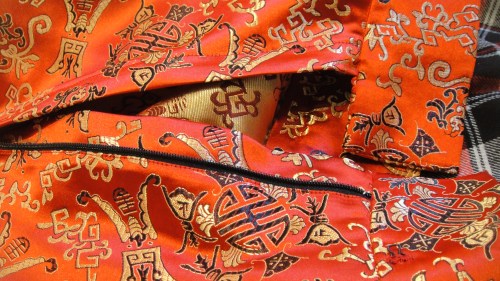
DSC08426

Zipper

I’m kinda absurdly proud of my lapped zipper on this one, too.

DSC08403

Back view

Here’s a back view, since I think sewing blogs should include things like that. And apparently I didn’t get one of the plaid skirt. 😛

DSC08407Of course, it’s a project, so now I have to go and hang it and I won’t get to wear either of them for a month. /cry. The best projects are the hardest to hang…

28 Comments

Filed under Sewing

Kibbles and bits and bits and bits

In the post-Christmas exhaustion I have been cleaning (a little bit) and sewing—a lot of small, quick things, often using scraps.

 Back during the Xmas sewing, I was cutting a bunch of Jalie raglans and had a lot of awkward, diamond-shaped scraps that were, it turned out, perfect for underwear. I cut out two Cloth Habit Watson bikini bottoms, but didn’t have time to finish them. Now, I do. I used a mixture of FOE (I have a massive stash of black, narrow FOE) and clear elastic. We shall see which is better to wear.

 A month or so ago I nabbed another remnant of this waffle-weave cotton. It’s the perfect tea towel fabric, but at regular price it’s still a bit expensive for tea towels I don’t really need. At remnant price, though, it’s irresistible. I cut the 1m remnant in four and hemmed and, voila, four new tea towels. The waffle weave makes it super easy to fold the narrow hems, too.

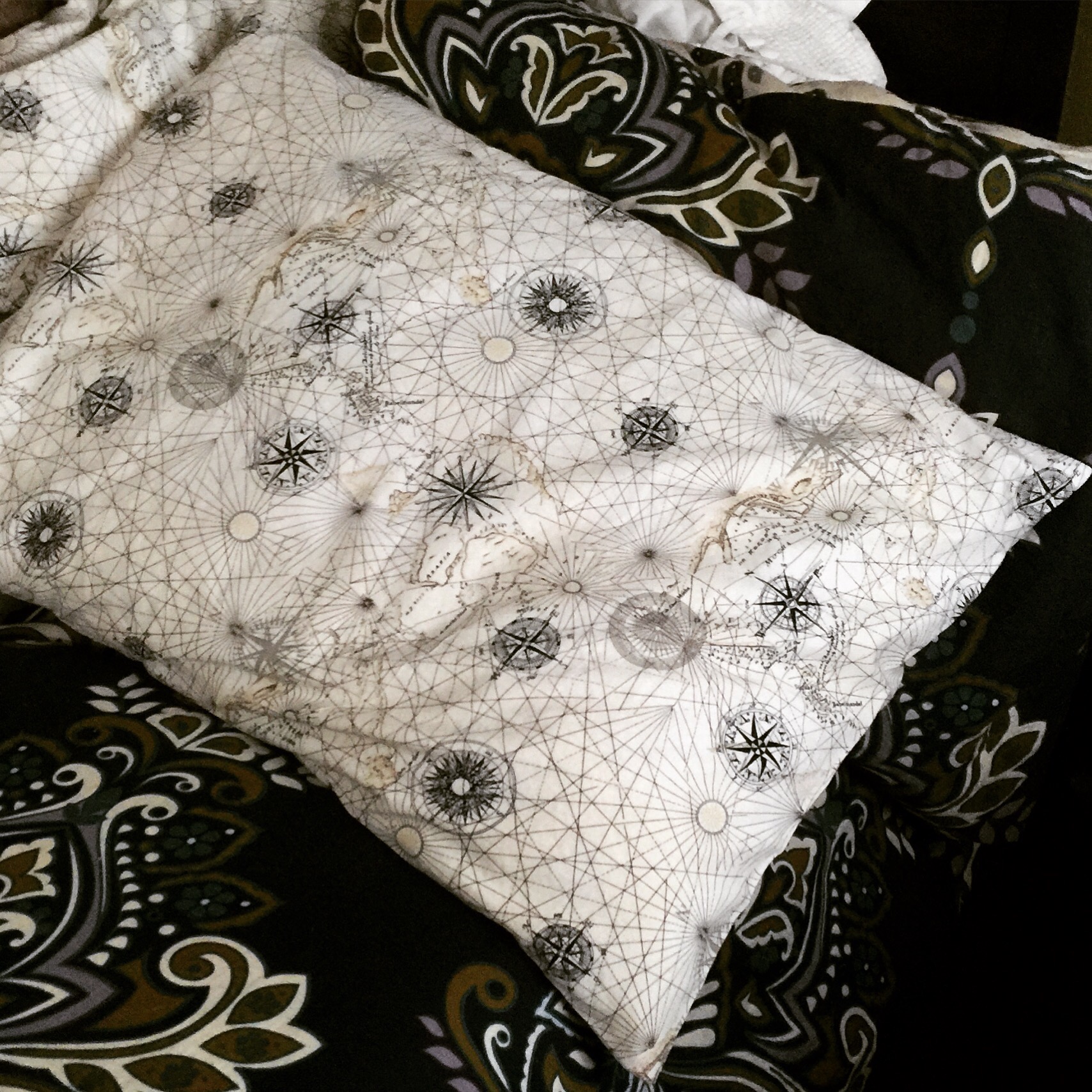
 I was trying to be good and resist this map themed fabric ( I love maps), even when it went on sale, but when there was just 1.5m (maybe 1.7?) left on the bolt, I caved. I was thinking sundress, but that’s not much 45″ fabric, and when I got it home I realized it would go really well with my bedding as pillowcases. There was just enough to do two, envelope style with the opening in the middle back, as per my husband’s preference. Only downside—matchy matcherton that he is, he’d now like a full duvet set of the same. See above about how I took the last on the bolt. >_<

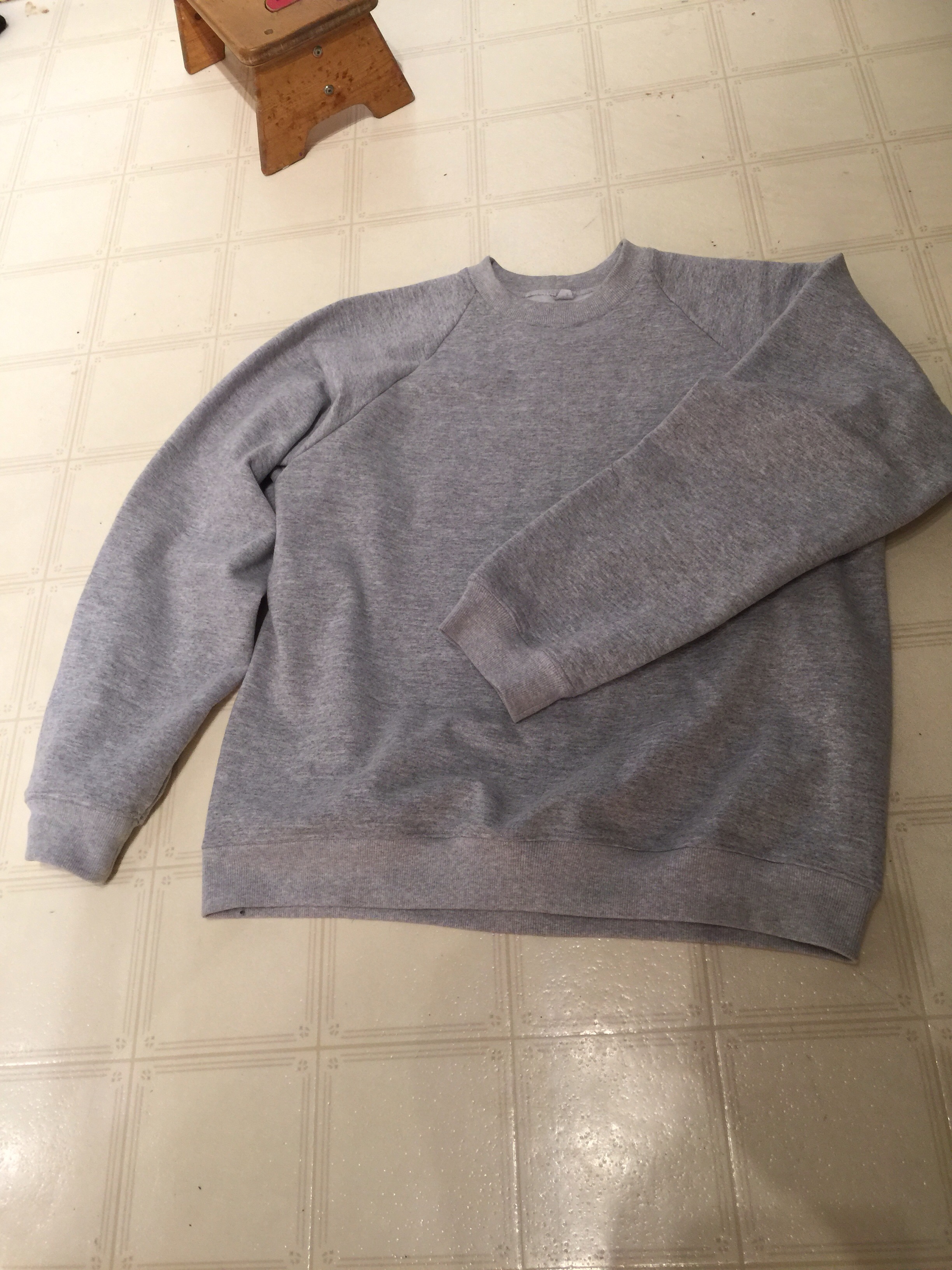
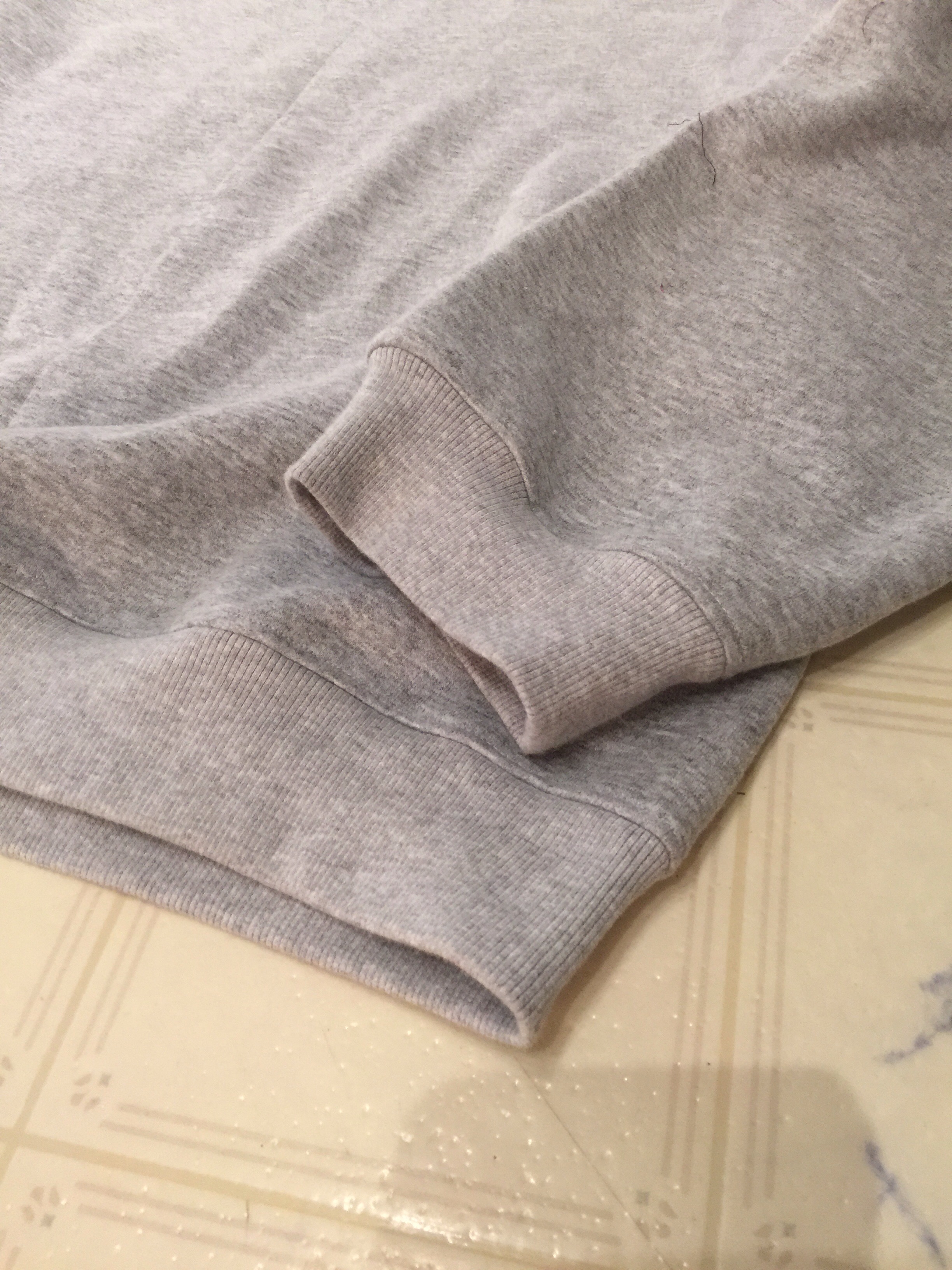
  Then Osiris was getting whiny about all the sewing for other people, so I made him a sweatshirt. I used the same Kwik Sew pattern, 2133, I did for his sweater last year, which I can’t find a blog post for? WTF? How did I miss that? I need to blog that. Anyway, this one is much less intricate, and really took about 3 hours all told. Maybe less. The only request he had was that it be a bit roomier than the last version. Well, it turned out that my grey sweater knit was tubular, and that the total width was only about 1/2″ more than the sweatshirt pattern. So I added a similar amount of width to the sleeves and didn’t have to sew side-seams. (This makes sewing in the raglan sleeves a bit weird, but it worked fine.) 

  
The biggest change was that I made the wrist and bottom bands a lot looser—apparently the snug ones that came with the pattern are not to his taste. He says he is much happier with the result. 

And I made a Jasper Dress for me, finally! But that needs its own post…

5 Comments

Filed under Sewing

Little elves…

… Would have been desperately welcome.

PJ-Palooza

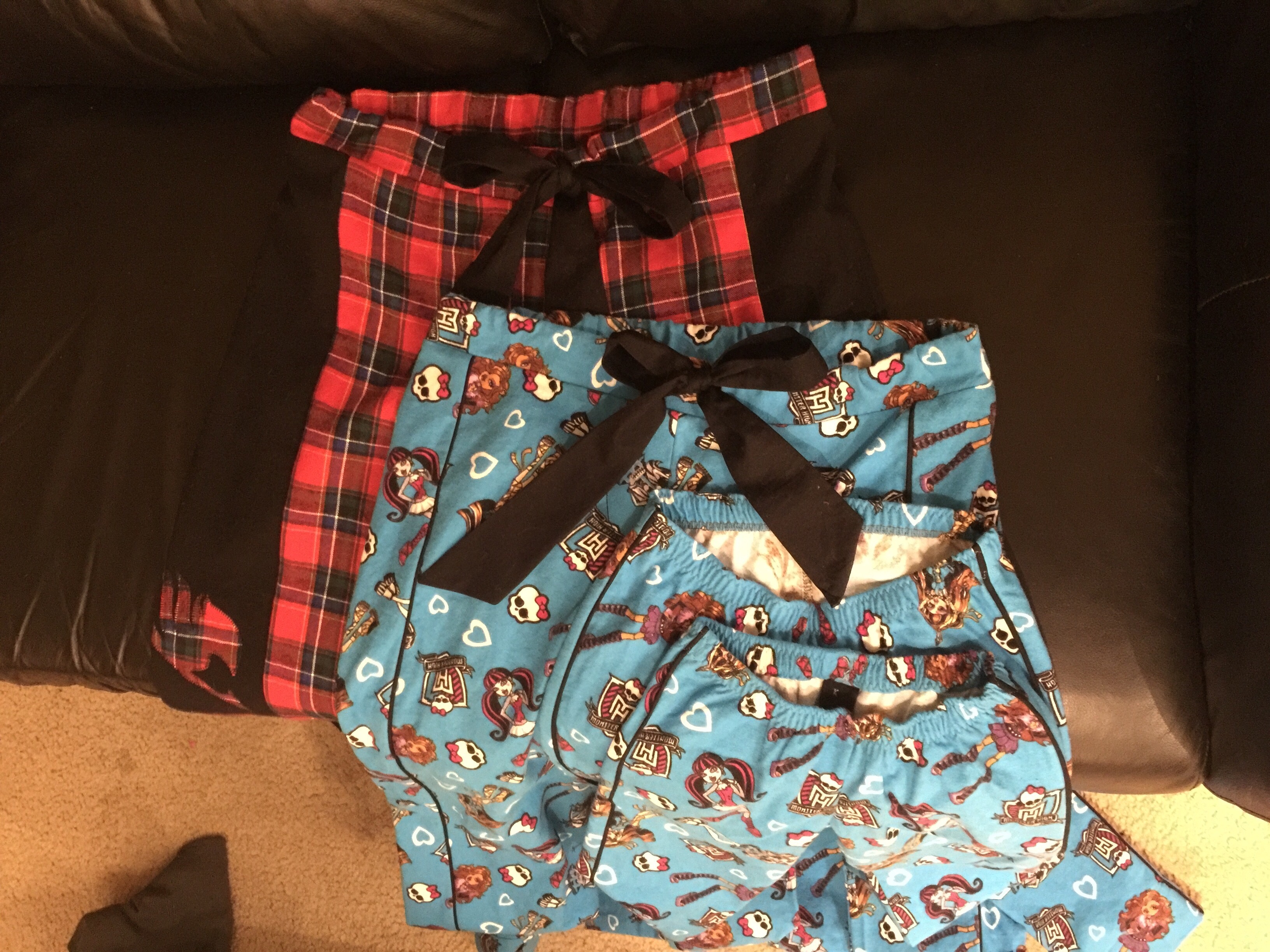
In the end, I did pull it off. Despite having as much No Time as usual, I made more Xmas presents than I think I ever have before. Four pairs of PJ pants, above.

Chemo-Raglan

Two Jalie raglans, one for my husband’s grandmother and one for my cousin

Jalie Raglan Tunic Dress. So hard not to keep this.

A couple of Jalie shrugs, and a Star Wars pillowcase.

Shrug + Pillowcase. Both have been gifted and no better photos were taken.

Whew!

The only ones I have any energy to cover in depth are the PJ pants. I used some random Kwik Sew patterns for skinny sweats for my very skinny nieces, aiming for extra length and WAY overshooting.

Long enough?


For my own kids, I used the Sewaholic Tofino PJ pants, which I’ve had in stash for an aeon or two.

I cut the size 0 in both cases, because it was easier and the reviews seemed to suggest that Tofino was fairly ro0my (Tyo’s butt size would have put her in a size 2. I think either would have been fine.)

I took advantage of the part where these are pull on pants and DIDN’T grade up to a larger size at the waist (even Tyo, who is much more pear shaped than either Syo or I, would be at least a size larger in the waist.) This means not so much gathering at the waist, I guess, but I think it makes for pretty sleek looking pants. Other than taking off some length in Syo’s version, I MADE NO ALTERATIONS! No raising the rear waist or dropping the front, no round-butt alteration… partly because they’re PJ pants and partly because Sewaholic’s pants-draft is the bomb. Well, for those who are generous in the deriere*. Love it.

They are quite wide-legged pants. I wasn’t going for skinnies, so that was fine, but if you’re looking for sleek PJs this might not be the pattern for you. Personally, I’m in love with the side panel, especially in a contrasting colour. It just makes them so much more special than plain PJ pants.

Tyo's Pair

Tyo’s Pair

The whole PJ-Palooza actually started when this Monster High flannel came in at a REALLY good price. You see, Monster High came out (at least around here) a year or so after Tyo had officially “outgrown” dolls (Yes, Kid MD, I know… kids!) and Tyo was all like “where where those when I was little?” and will totally secretly watch the TV show and stuff if no one is looking. So it just had to be. And Monster High pants for my nieces were a no-brainer as well. I could have just included Syo in the theme, too, but I really wanted something that would bring about that inner squee…

Fairy Tail Logo

I may or may not have mentioned before that she’s all about the Fairy Tail these days.


Seriously, fan-fic-reading-ly obsessed.

Sadly, as far as I can tell, Fairy Tail fabric is non-existant outside prepared items (not to mention virtually impossible to Google since Google assumes you’re good with anything “Fairy Tale”.

However, it does have a fairly stylized and easy-to-trace recognizable logo. And that outer panel on the Tofino pants leg is just begging to be applique’d on. As always when applique’ing I used Steam-A-Seam to stabilize and stick everything together. What can I say—I’m a one-trick pony.

New Sewing Machine has fancy applique stitches!

I had almost enough fortitude to face three appliques—so I opted for the asymmetrical thing and put them all on one leg.

Fairy Tail Applique

Since she declared this the Best Christmas Ever on the basis of these pants (as well as some Fairy Tail jewelry from my brother and some more of the mangas from my Dad), I will deem my efforts successful.

Buttonholes for waist ties

One other cute feature of the Tofinos is the tie in the waistband. Now, the way I consructed it is NOT the way the pattern directs (I was kinda confused about the pattern directions, but I wasn`t reading very closely.) I added about a 5″ length of non-roll elastic between the two halves of the tie, so it’s both adjustable and elastic. The kids seem to be a bit mixed in reaction to this feature—I think they would’ve probably liked a built-in elastic, maybe with the tie as well, but that seemed like a lot of work. We’ll see—it can be modified at any point, after all. This was the fist time I’d done buttonholes (for the ties to run through) using my new sewing machine, and it did them very nicely indeed, although doing buttonholes on a single layer of waistband (plus a bit of interfacing behind that section) is pretty much the ideal conditions, so it doesn’t prove much.


 In any case, I’ll call that Christmas Managed. 🙂

*I do not have a generous derriere at all, but a well-developed swayback mimics some of the bubble-butt issues, namely the unequal lengths in front and back rise and the gaping-above-the-butt issue.

6 Comments

Filed under Sewing