Category Archives: Sewing

The Very Boring Corset

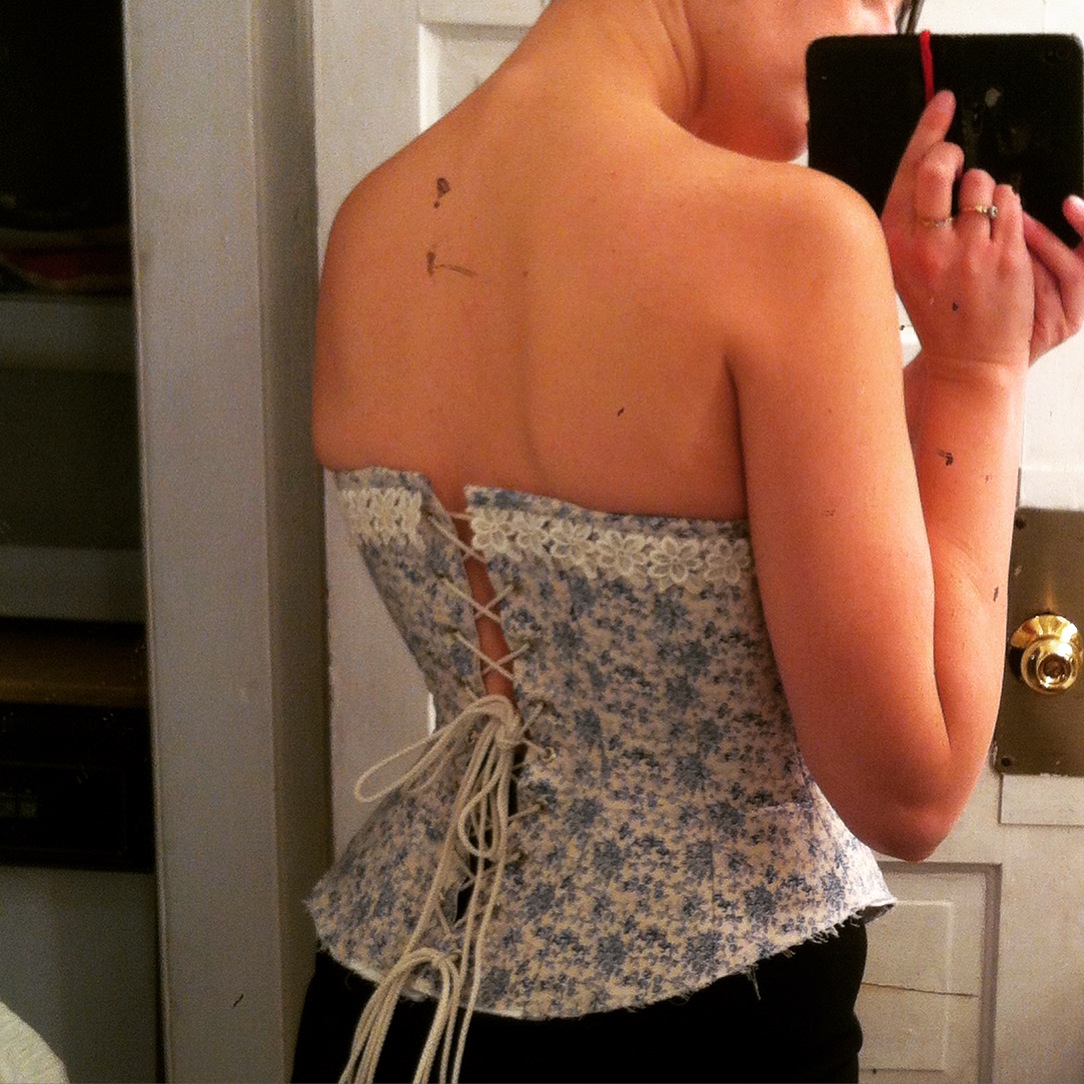
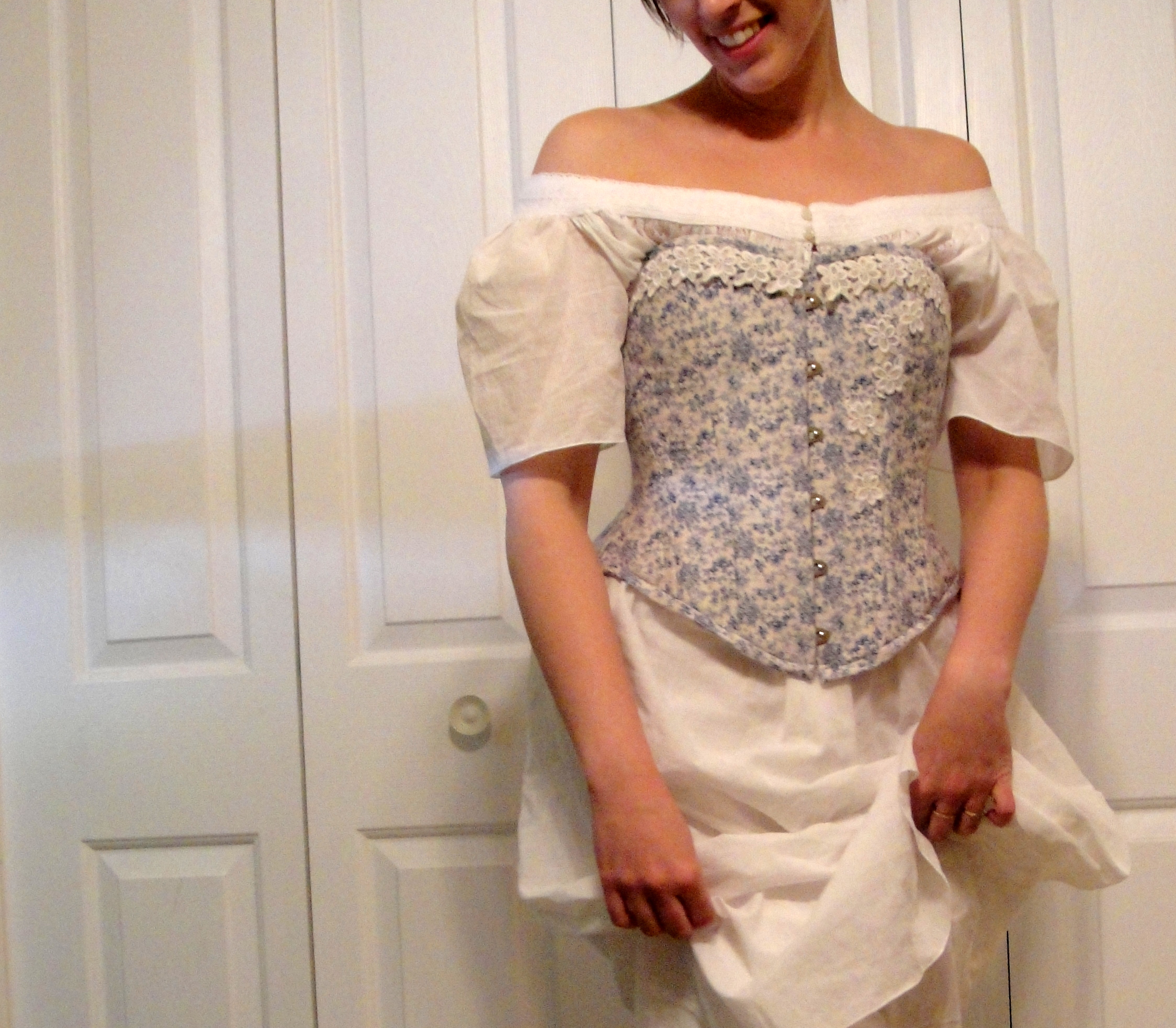
A very boring corset

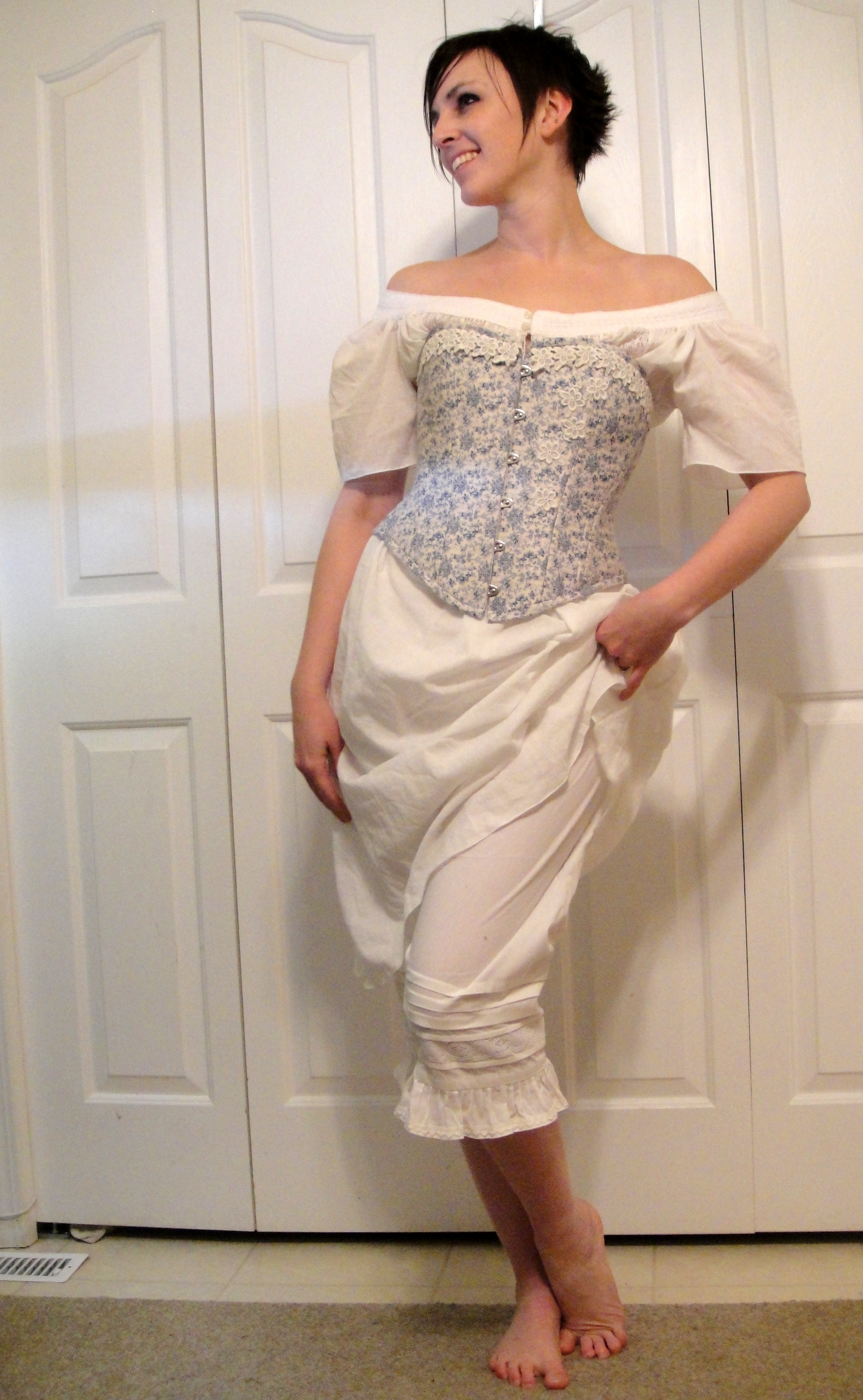
A very boring corset (and some not-so-authentic underpinnings)

I promised my husband I’d make him a shirt, so of course I had to whip up another corset.

Rather than reinvent the wheel, I went back to my Butterick 4254. First I re-traced all the pattern pieces 1/4″ narrower than before, then I made a few tweaks around the bust and waist. (Basically, more bust, less waist! Woohoo!) I decided I’m pretty happy with the overall length and shaping, I just wanted to refine the shape a bit more. Then, as I was sewing a quick mockup, I realized that my original pattern pieces seemed to be calling for 3/4″ seam allowances—and I’m pretty sure I sewed both my earlier mock ups and my blue corset with regular 5/8th seam allowances. Which explains where that extra 1/4″ on each piece came from. (I’m still glad I removed it, though, as I don’t need 3/4″ SAs to make channels for 1/4″ boning., and they cause issues like puckering, and or need clipping and things.)

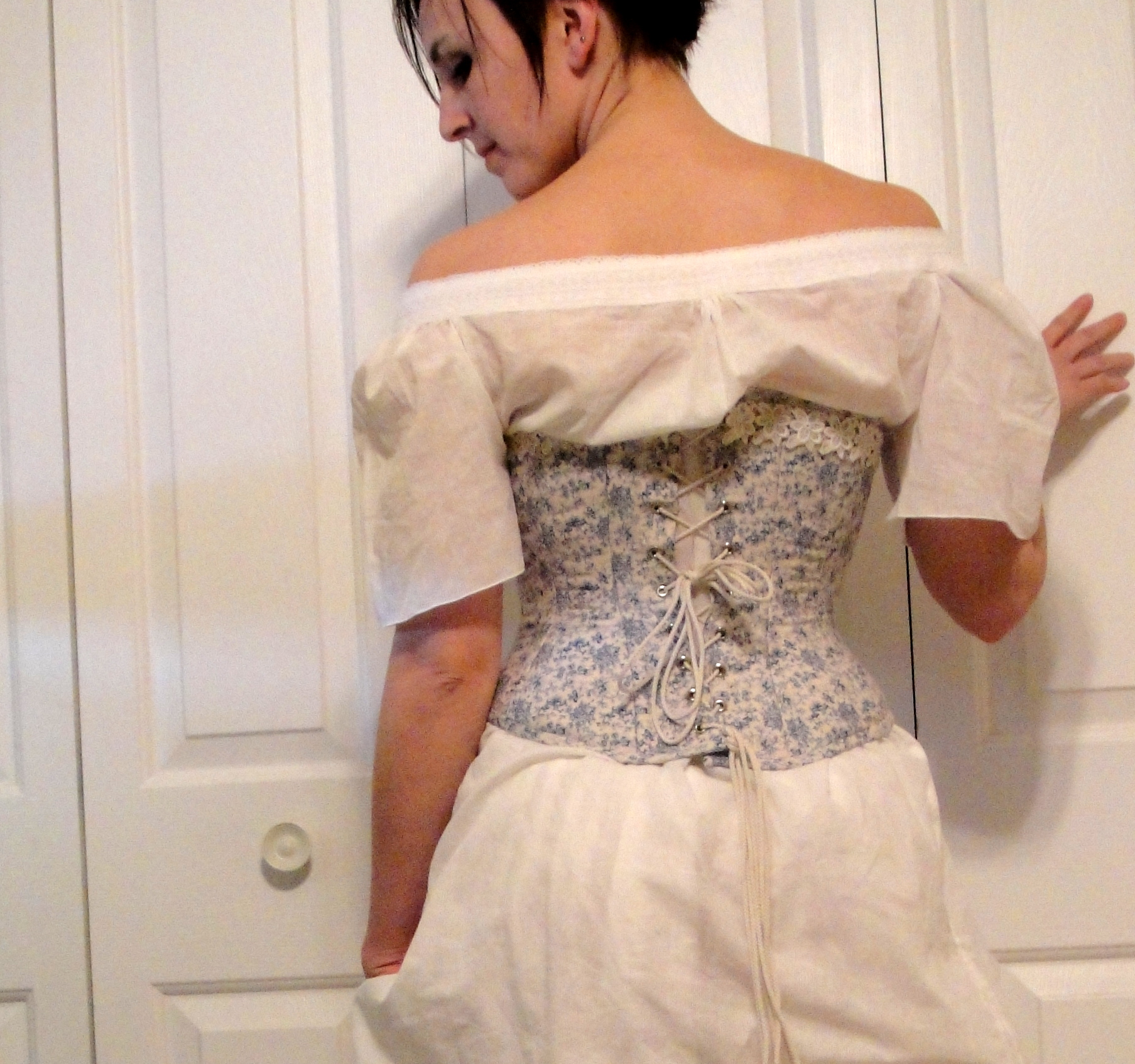
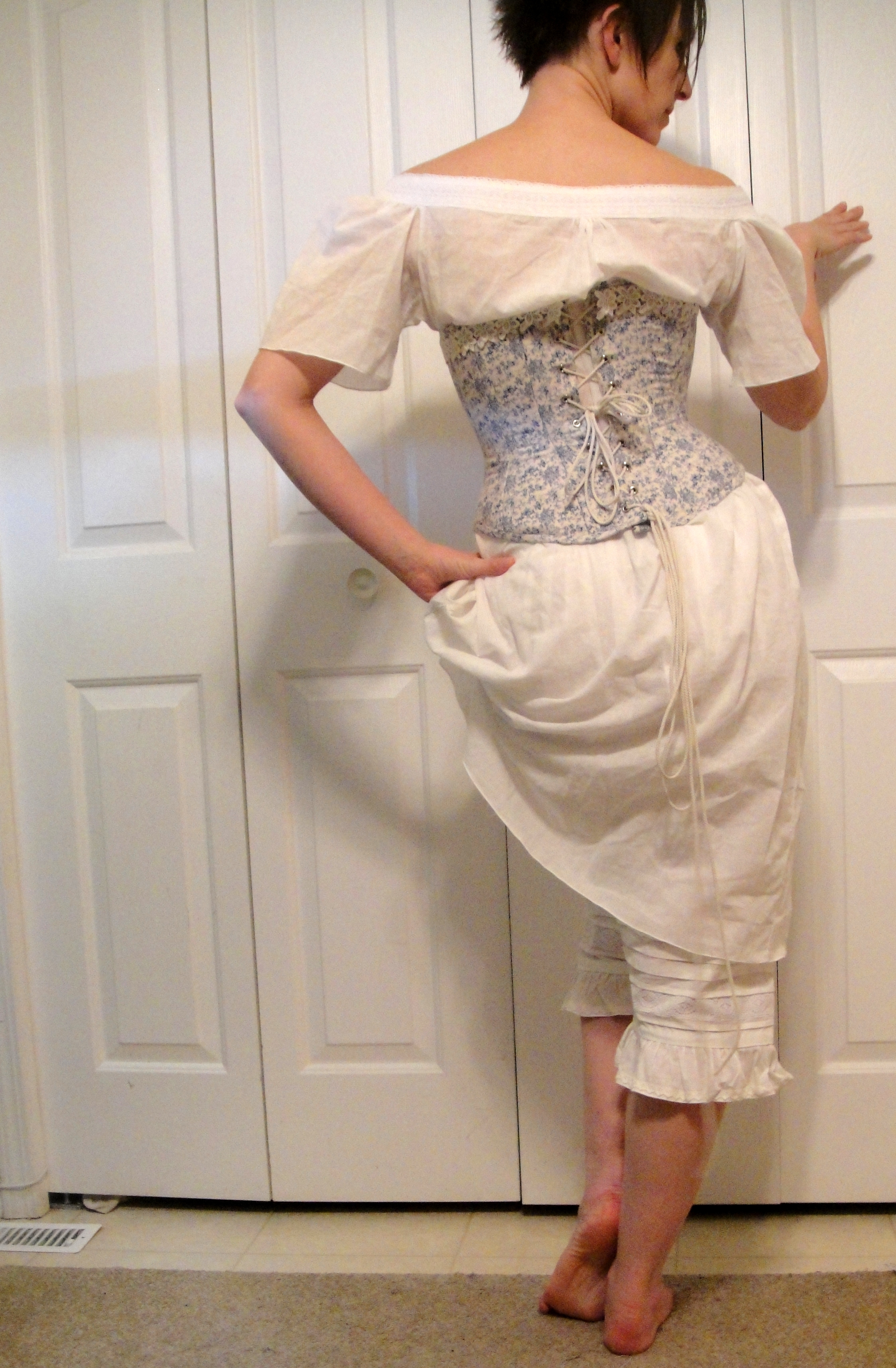
Back view.

Back view.

Although I was tempted by the siren-song of some of my other fancy materials, I resisted, as I really needed this to be a quick sew that I could bang out of the way and move on to other projects. Like shirts for my husband. I did dare to cut into my precious coutil, though (I used about half of the 1m I have, so I still have another corset’s worth. 😉 ). This is it, plain and un-covered, in a single layer, with serged seam allowances (so non-historical!) and hardly a lick of ornamentation.

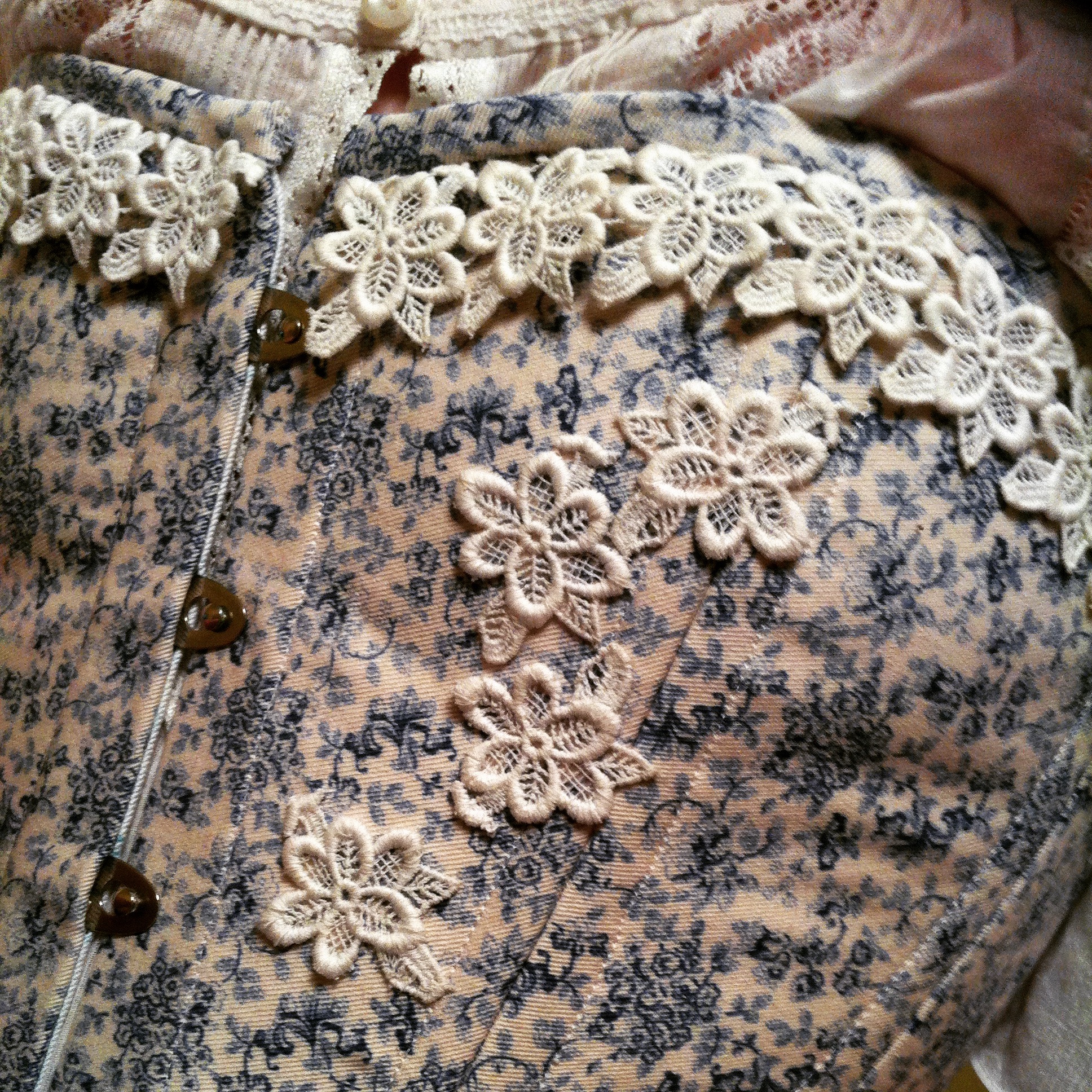
Closeup!

Closeup!

The only reason the pretty purple ribbon is there as opposed to boring old twill tape like the bottom is my friend Steph gave it to me to use. I enclosed some narrow ribbon within it for a drawstring, and I do like being able to pull it in at the bust (especially as there’s a bit of extra room up there, as I said.)

Silhouette comparison

Silhouette comparison

I think the size is much better this time around—still roomy in hips and bust (arguably the bust is a little too roomy but I really don’t want compression in this region 😉 ), with a smidge (or more than a smidge) more waist definition than before. And a perfectly reasonable, roughly parrallel lacing gap. By the way, I get a whole 2″ of waist compression out of this thing (unlike the other one, which actually doesn’t change my waist measurement at all once you add in the bulk of the corset itself.) I think that’s pretty much my limit, barring serious waist-training that just isn’t going to happen. I wasn’t really expecting more—there isn’t a lot of space between my hips and ribcage to squish in, and I’m a pretty rectangular shape to start.
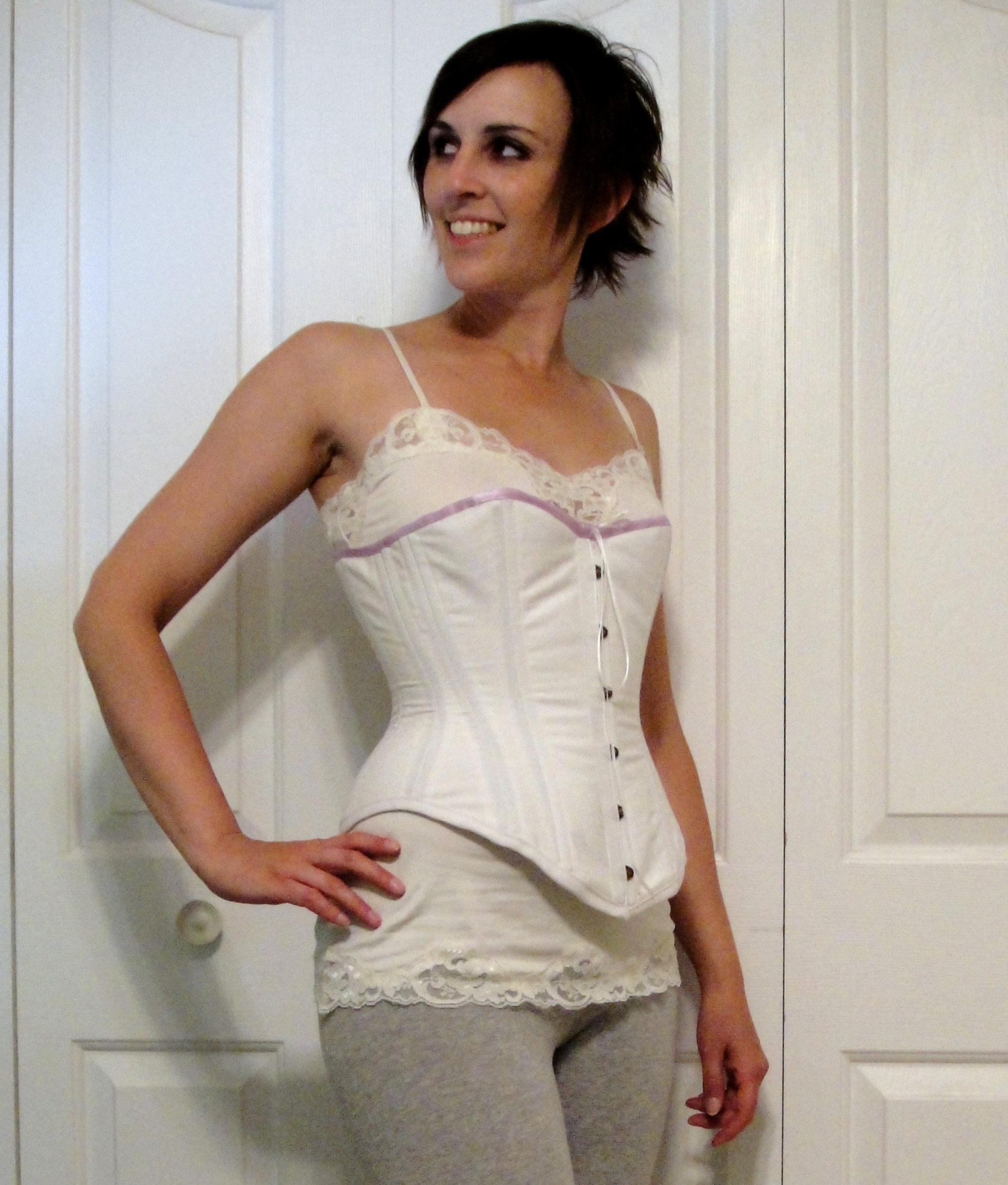
Have another corset view

Have another corset view

One thing that really stands out is the difference the busk makes. For the first corset, I used a spoon busk, and while I did have to straighten a fair bit of the spooning as it wasn’t hitting at the right spot on my body (it would’ve needed to sit about 2″ lower to work properly) it still does help “hug in” the bottom front—there’s a very distinct gap (shadow) you can see in the newest corset at the bottom front. Not a big deal under petticoats, but something to tweak a bit if I want to make “fashion” versions. (Not sure where I’ll wear a “fashion” corset yet, but then again I’m not really sure where I’ll wear this full Victorian getup either.)

Lobster tail

Lobster tail

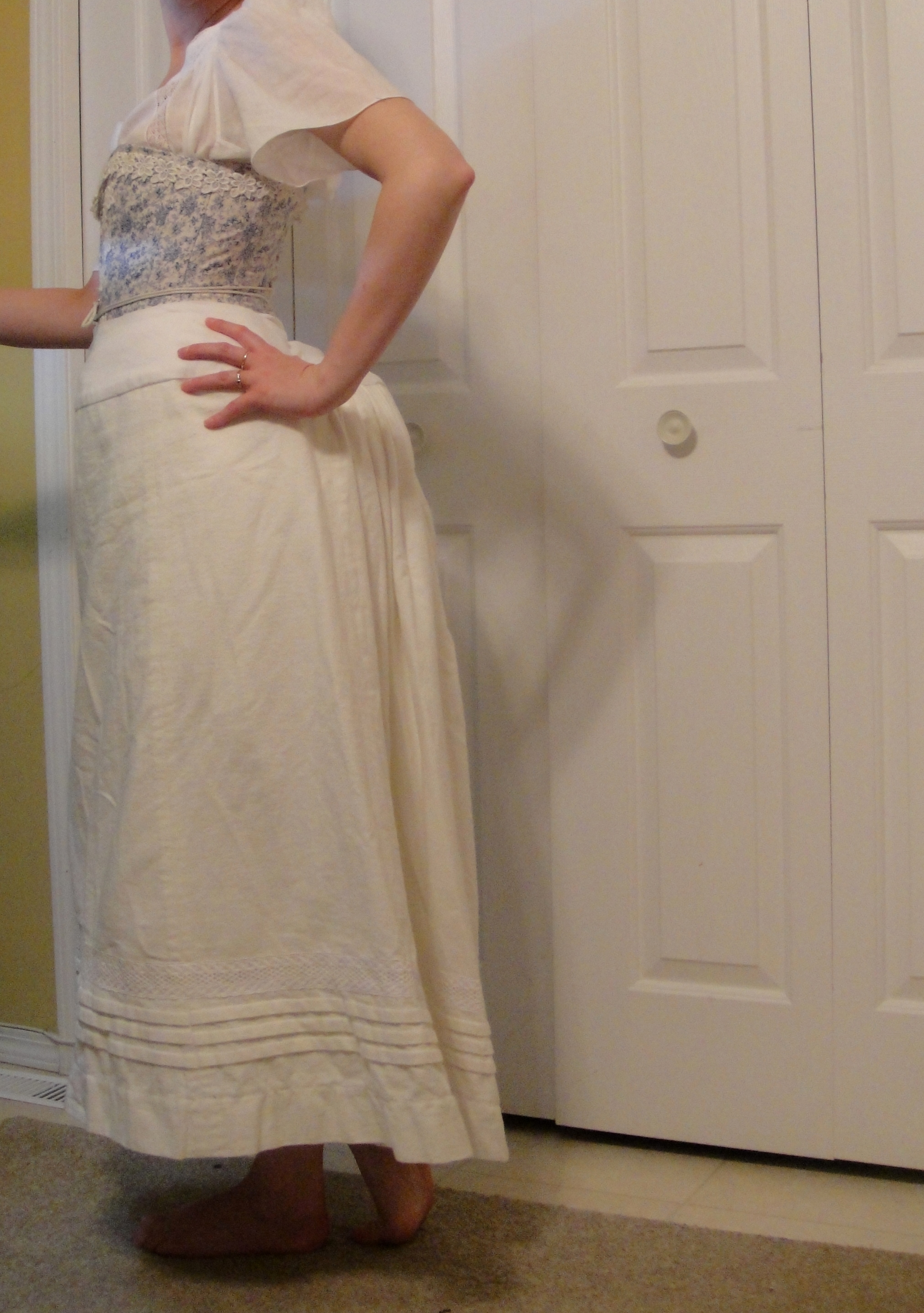
And here’s a shot of my American Duchess-style lobster-tail bustle, because I haven’t really done it justice on the blog (nor probably will get around to it, sadly) For this dress-up I experimented with fastening it a bit lower on my hips (rather than right at the waist). My theory is that it elongates my waist and gives me more room between butt and waist to build up the layers of bustled stuff in the back, though I couldn’t really say it makes much of a difference.

Steph in my corset!

One bit of fun I did have was stuffing a couple of my sewing friends (yes, real-life people I get together with and we MAKE STUFF! Slightly more than once in a blue moon) into the corset to see how it looked on different bodies. I think the answer is “better than on me”—but anyway, that was super fun.
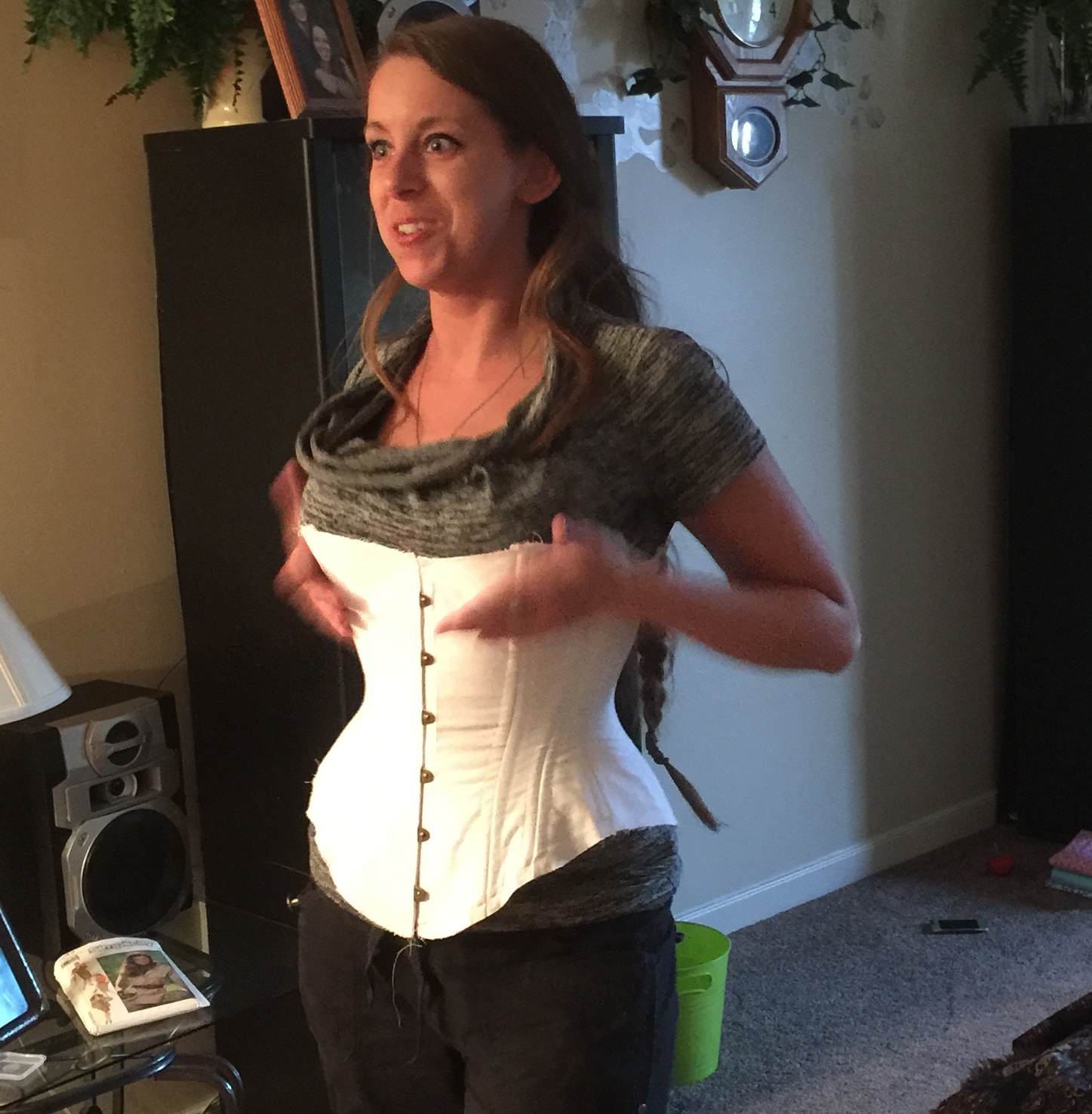
 

Chrissy. She's probably going to kill me for picking this picture, but I love her face! ;)

Chrissy. She’s probably going to kill me for picking this picture, but I love her face! 😉

It was really interesting to see it on different bodies, but even more fun to see their reactions to “corset shape” for the first time! 🙂
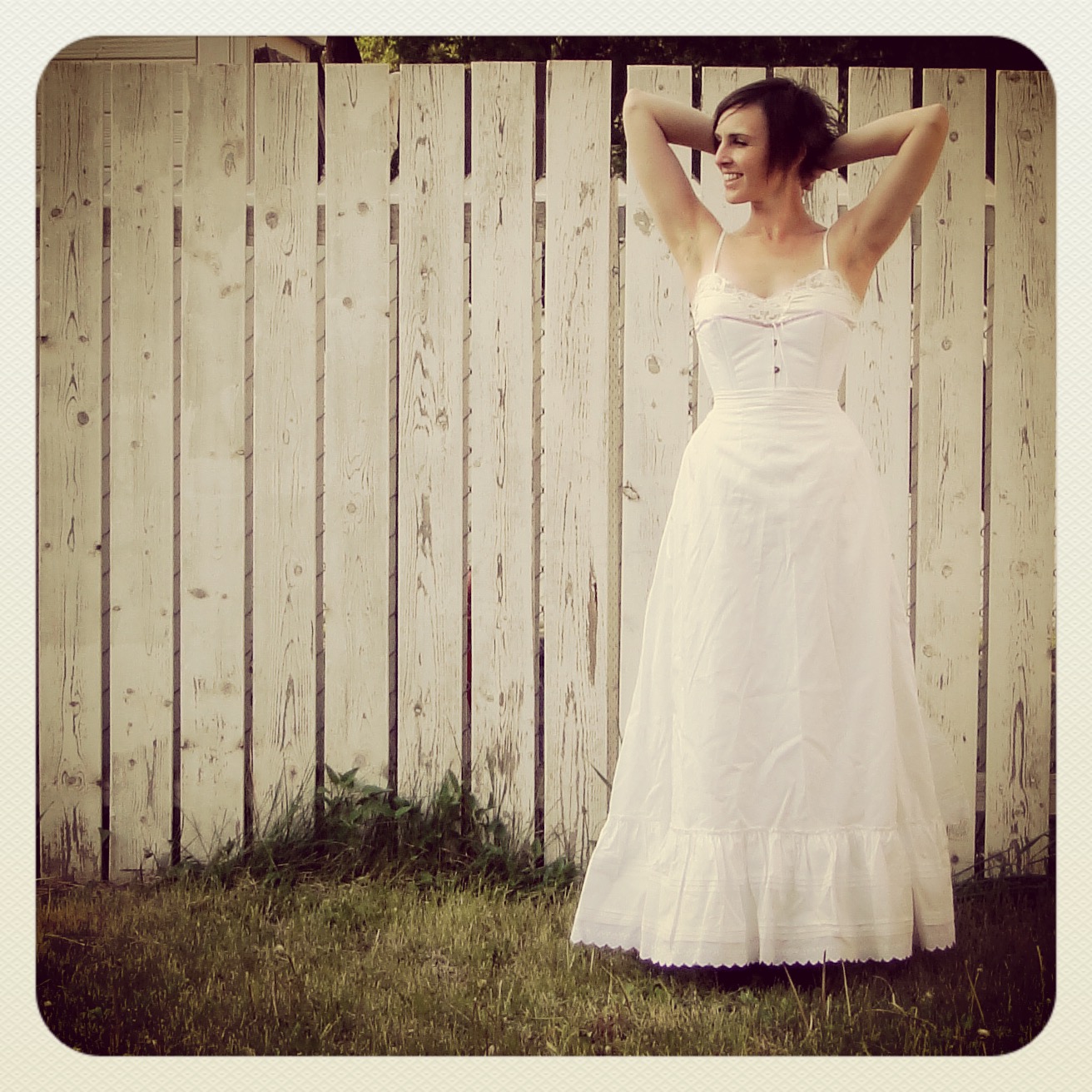
With Authentic Vintage Photo Filters (TM)

With Authentic Vintage Photo Filters (TM)

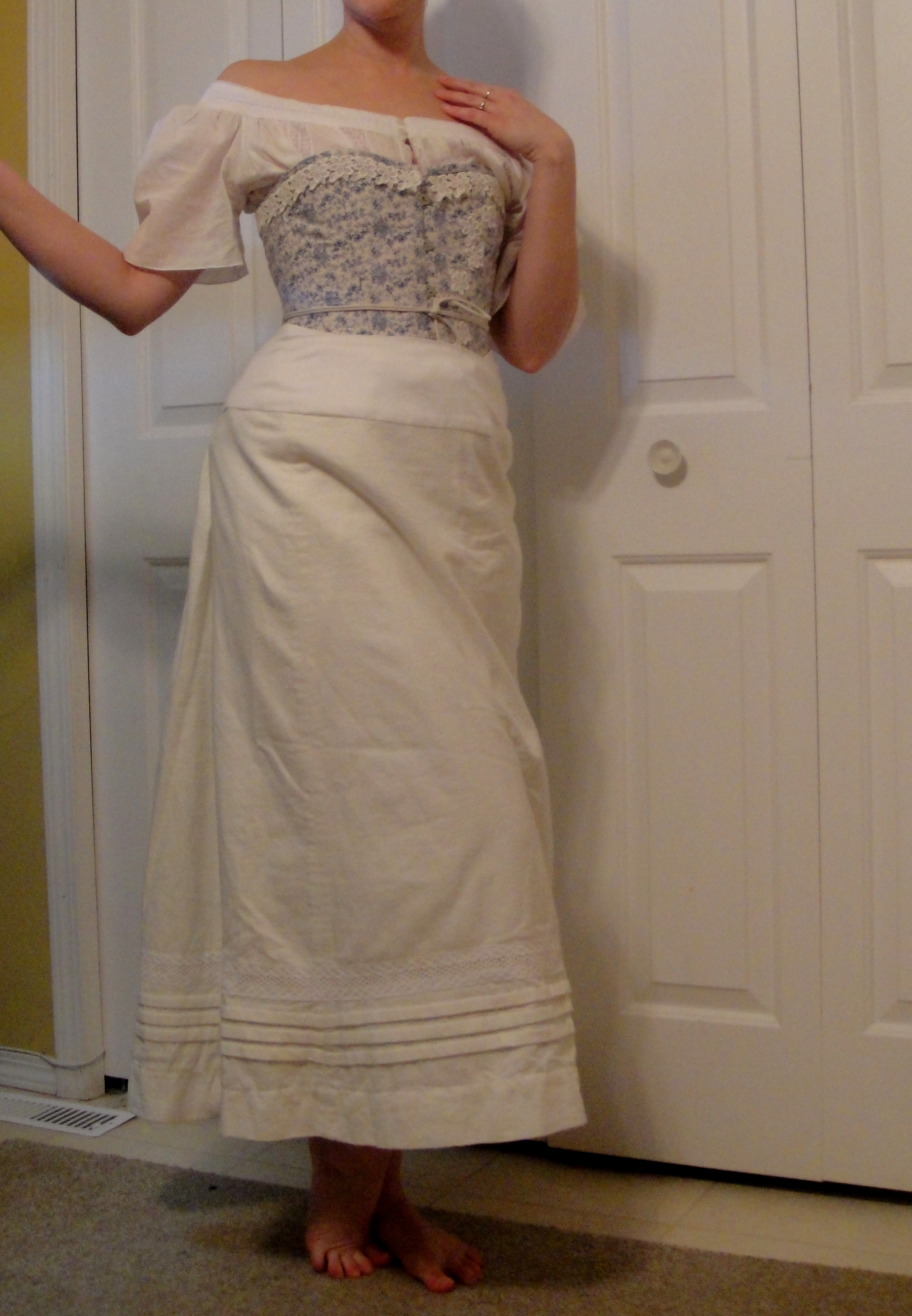
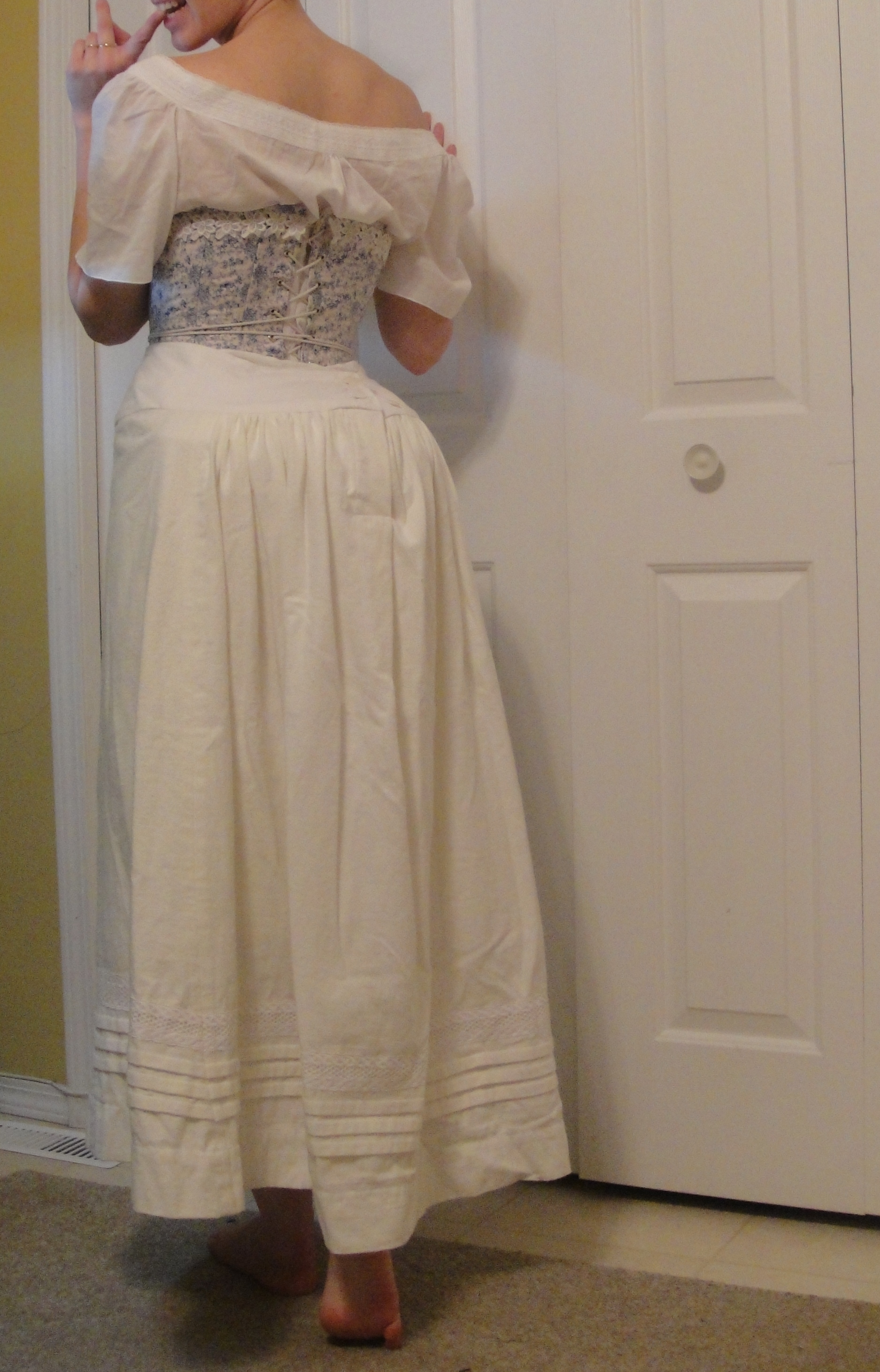
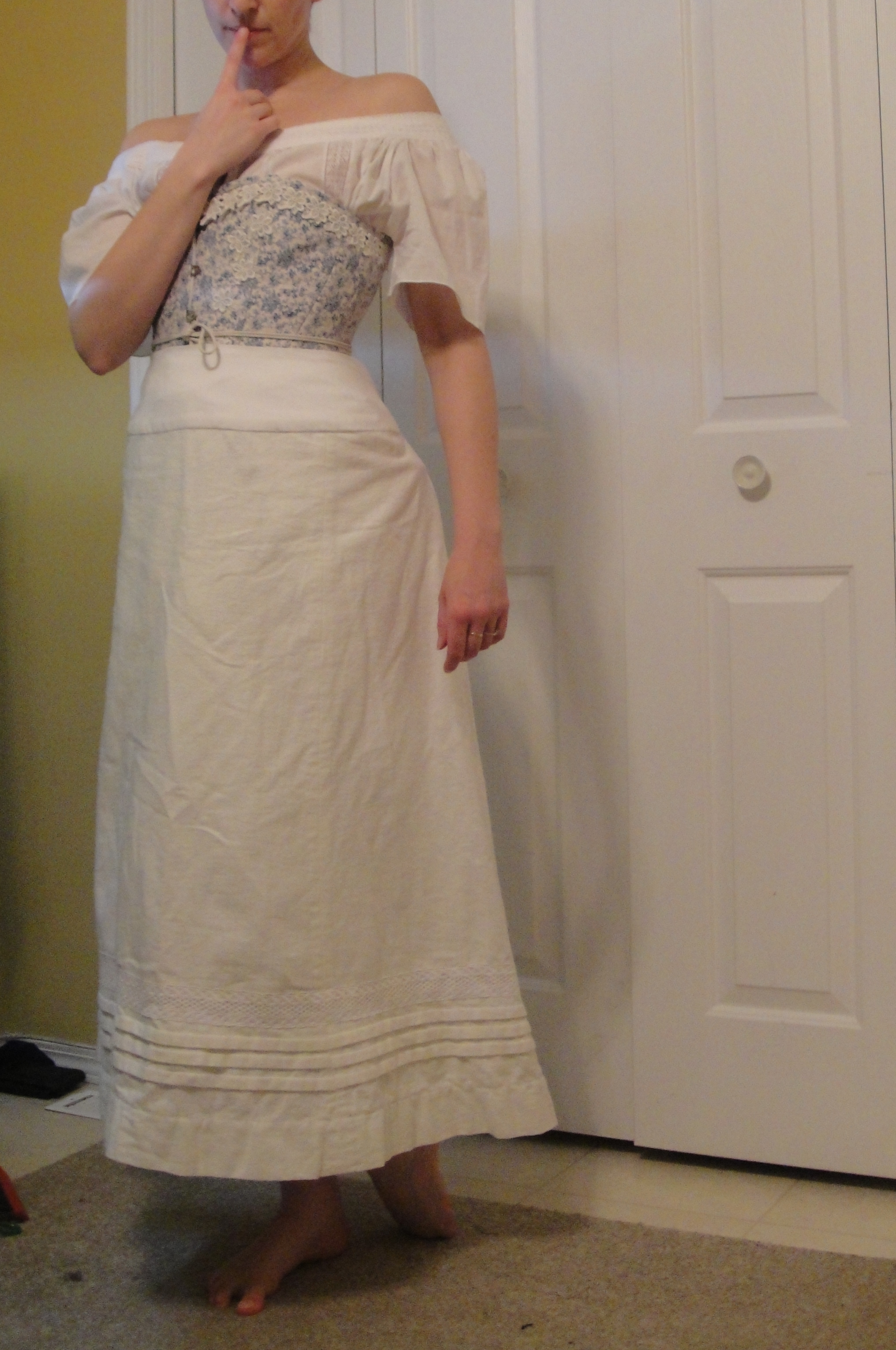
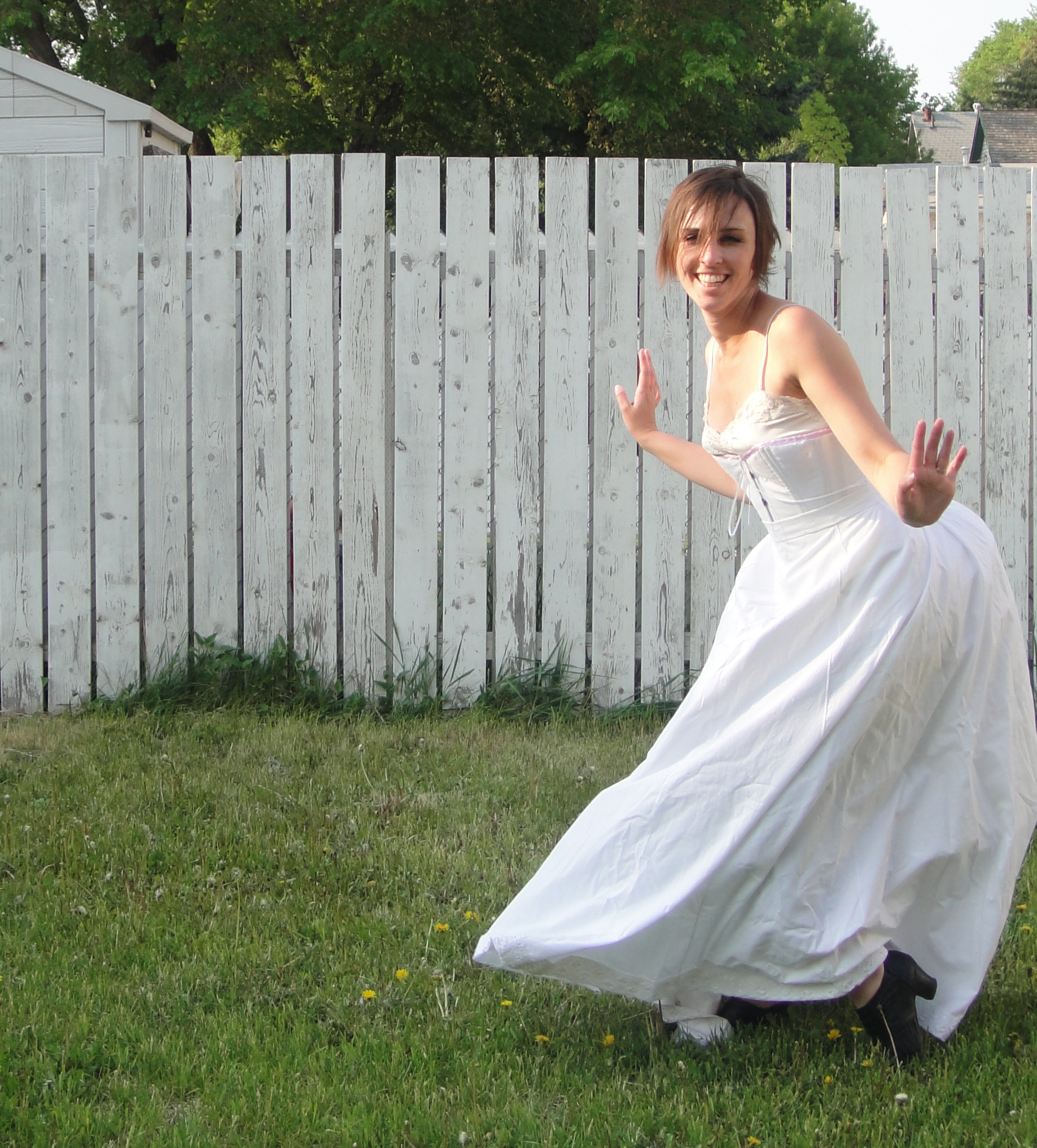
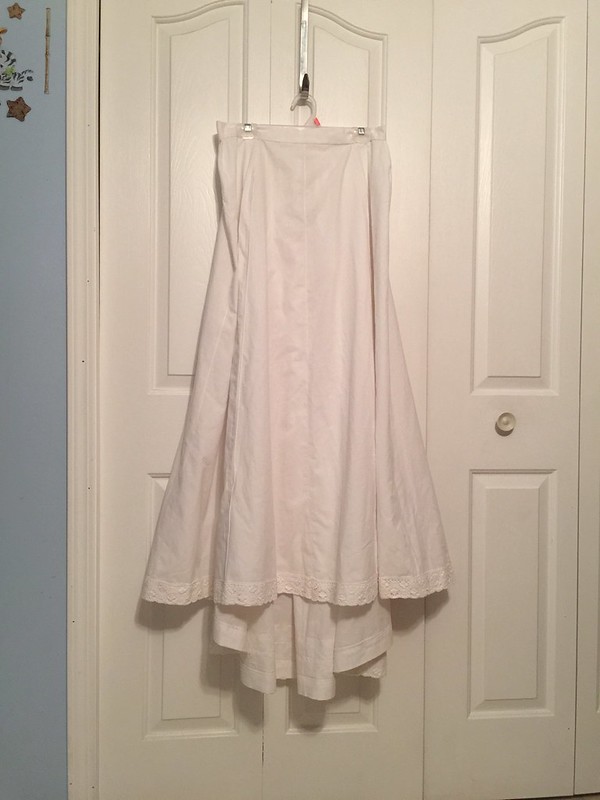
And, well, just for fun, here’s the full ensemble again. Sorry for the cami under the corset—my chemise was awol and I was on a tight time-frame for taking the photos.

In other news, my last “Historical Clothing” workshop is this weekend at the Marr Residence. I’m nervous (cuz I always am) and a little sad that it’s the last, and wondering where to go from here… after all, I’m just about ready to start planning the outer dress!
24 Comments

Filed under Sewing

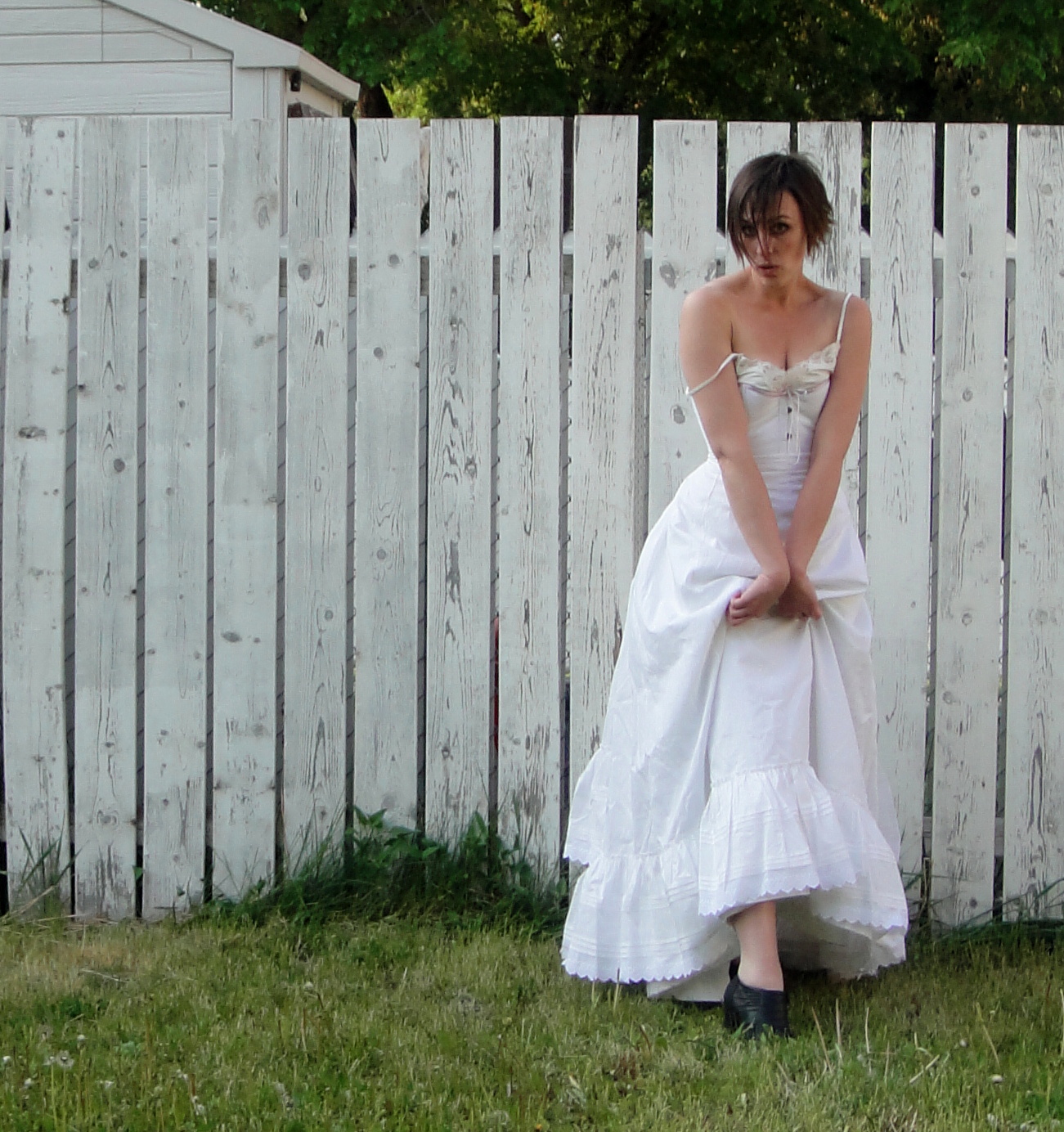
The Very Boring Petticoat

Petticoat!

Petticoat!

I made a third petticoat. This was always the plan, though I wasn’t quite expecting to do it, um, this weekend, since there’s about four other higher-priotity projects in the queue… But, I had a couple of metres of muslin lying around after another project, and when I got home from work Friday night it was whispering and, well, that was that.*

A Very Boring Petticoat

It was pretty obvious when I finished my fancy, flouncy petticoat that it needed another layer underneath, to smooth over the ridges and lines of the bustle and corset. Possibly my flannel petticoat would serve that purpose as well, but certainly not in the summer (which is what we are gearing up to here, at long last.)

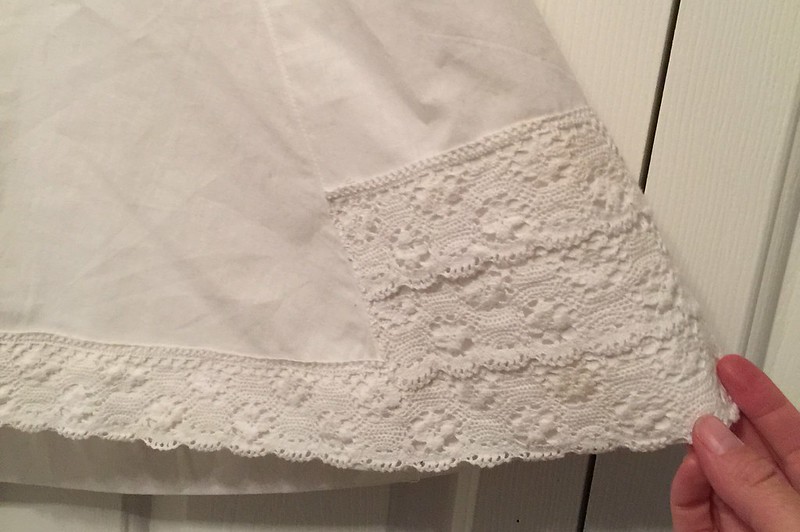
Lace on Hem

When I first started cutting the muslin, I meant to make it a completely plain white skirt, but, in true Victorian fashion, I couldn’t leave well enough alone, and several metres of lace found their way onto the hem. Still, after all the tucking and gathering and more gathering of the last one, it was a pretty quick and dirty affair.

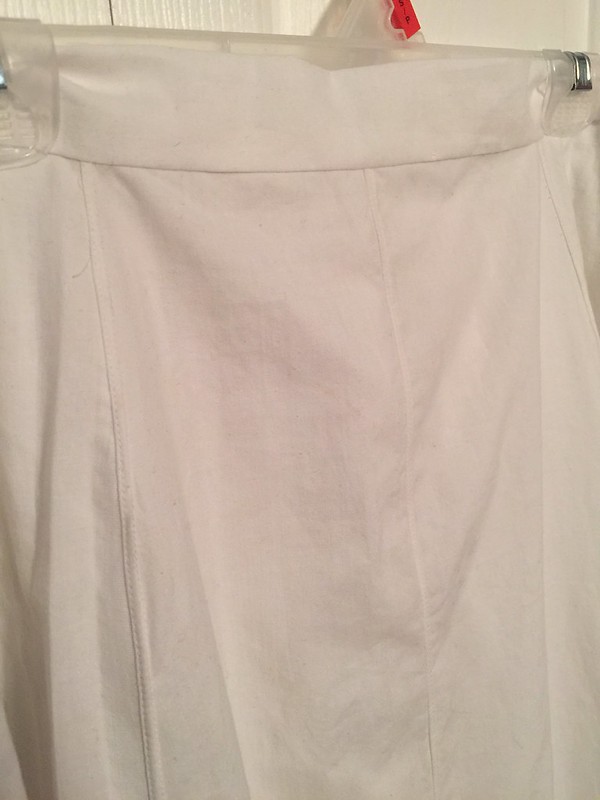
Felled seams

I used my flat-fell foot to fell the vertical seams, and I felt a lot more successful this time, if only because the muslin is like the best-behaved fabric in the universe. The main thing (aside from actually reading up on how to use the foot) is to use the right seam-allowances—1/4″ on the bottom 1/8″ on the top. Still not flawless, but mostly good, and no one’ll see the booboos anyway. 😉 Half my fells are on the inside, however, and half on the outside—after I screwed it up on the second seam I decided I didn’t care and just did whichever side was most convenient. Not the tidiest ever. BUT NO ONE WILL SEE. (Except everyone I show it to because I’m all like LOOK I MADE A PETTICOAT!) I used a total of three skirt-lengths of 44″ wide muslin. To reduce fabric waste, I added a centre front seam to the front gore. Initially I was going to use only two skirt lengths, but it would’ve been a really scrawny petticoat, so I scrounged around and turned up another piece of the same fabric, just long enough for another set of gores.

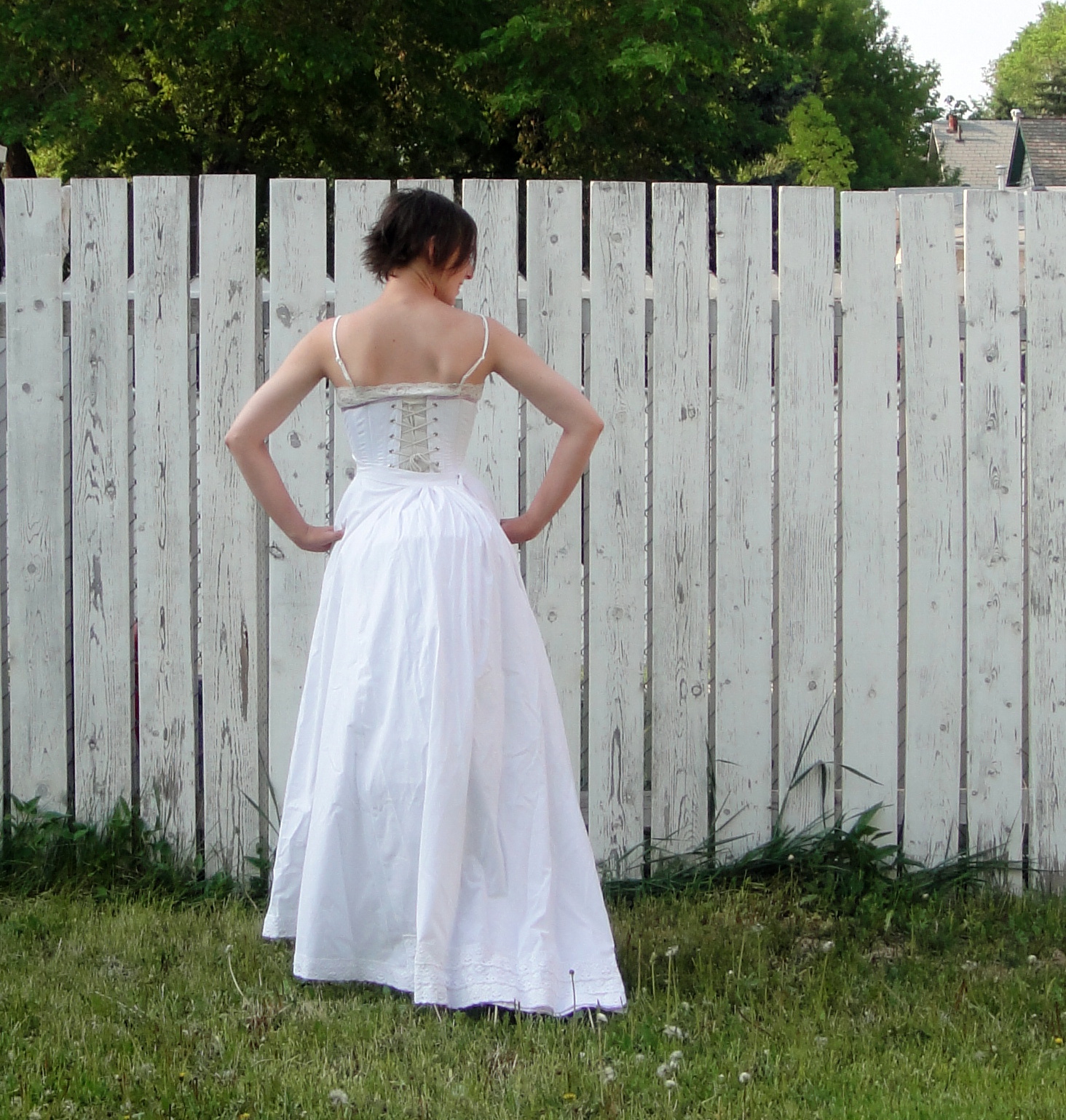
Long back.

Long back.

It’s more trained (long in back)  than my previous petticoats, because one of the sets of gores I made was cut from a full 44″ width of fabric, not a half-width. This was not my best idea ever since I don’t particularly want a trained petticoat. Oops. I also cut the waistband little large, thinking it could sit a bit lower on my waist (and also not wanting another overly-tight waistband), but this doesn’t seem to work overly well for these skirts—the bustle gets in the way, I suppose. It looks kinda like one of those “look at my old pants!” weight-loss commercials. https://instagram.com/p/2zyEWwr0Mu/?taken-by=tanitisis   Like the flannel petticoat, I made a folded placket in the CB. This time I put the narrow edge of the placket on top and the wide one beneath—this seems to work much better with all the gathering that is going on in a sort like this, although it’s pretty much opposite of the instructions. Untitled As I was trying to throw this together quickly, I was in no mood to try some stroked gathers (pity because I think I might’ve done better counting threads and things on the muslin)—I went with two well-spaced rows of machine gathering, although I tried a little extra-hard to make sure the stitches were as synchronized between the two rows as I could manage. I’m not too bothered, anyway.

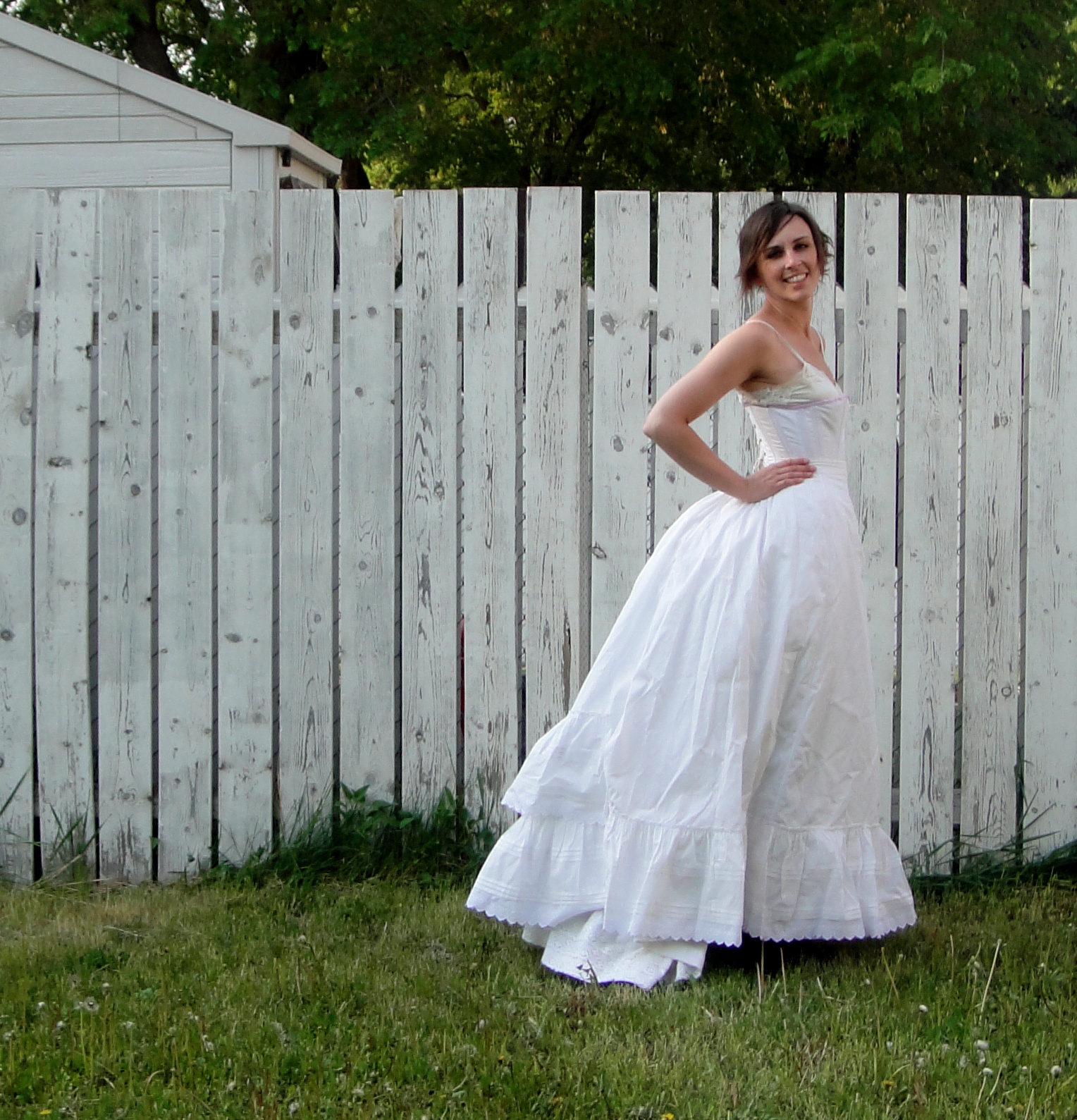
Two petticoats!

Two petticoats!

Aside from the waistband, I’m pretty happy with it, and it serves its purpose admirably.

One petticoat vs. 2

One petticoat vs. 2

The hard bustle bone ridges you could see with just one petticoat are much better hidden this time.

Skirts appears a little more full, I think.

Skirts appears a little more full, I think.

Although I’m noticing more “skirt spread” now, angling out of the front part of the skirt. Not quite the 1880s fashion-plate look, although pretty common in actual period photographs. The solution, according to Mrs Church and others, is ties or elastics that run across the inside of the skirt, from one side to the other behind the knees, pulling everything in. This would require adding little slit-type openings to all the petticoat layers for the ties to pass through… We’ll see.

Teehee!

Teehee!

It then occurred to me that I’m taking photos in my back yard in my underwear. Teehee! Alas, my attempts to vamp it up Victorian-style mostly came out looking more “axe murderer” than “come hither” (a problem I often have…), so you’ll have to settle for a peek of ankle. *Yes, as you may have noticed, I have also made another corset. It, like the petticoat, is very boring. I will blog it as soon as I get the chance, I promise.

6 Comments

Filed under Sewing

The Second Petticoat

I finished my second petticoat! FINALLY. If I thought the first one took forever… (though, I did NOT hand-stitch the hem this time.)

Petticoat # 2

Petticoat # 2

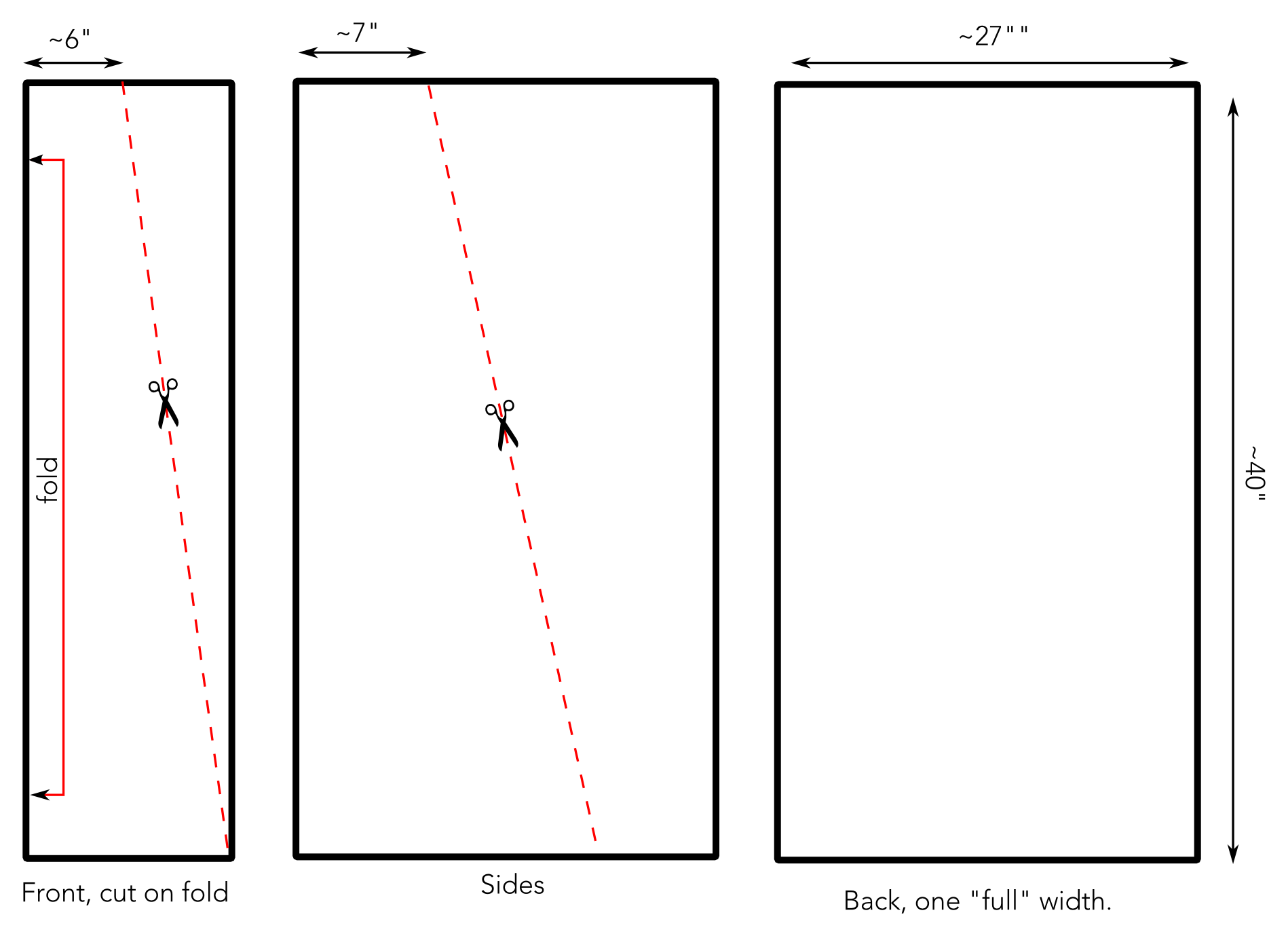
Anyway, as with the flannel petticoat, I largely followed the directions from The Home Needle, with a bit of supplementation from the various diagrams of Patterns of Fashion 2, which really drive home that yes, they are describing what you think they’re describing to make those “gores” and yes, it is as weird as it seems, sewing off-grain bias edges to on-grain straight edges, in violation of all guidelines for good drape.

Skirt diagram

Skirt diagram (for this pattern, I used two “side” gores per side.)

I guess when you have that much fabric going on drape is kinda irrelevant? Hard to say. On the other hand, it’s a very, very low-waste method—I used probably about six metres of fabric, mind you (it’s a pretty full petticoat, also, RUFFLES), and the only waste was the narrow triangles cut off the sides of the symmetrical front gore. If you wanted to add a front seam, even that could be eliminated. Because I wasn’t using a yoke this time, I did add a bit more shaping to the top of the front gore, plus eyeballed in some narrow darts to give it a wee bit of tummy room, since Mrs. Church commented that one of the chief problems with the hang of skirts came of them being put in too tightly at the front. Or something like that.

As per Mrs. Church’s instructions, I made my vertical seams flat-felled, but really I would’ve been better off using French seams—either way, though, I was struggling with a lot of puckering on my really freakin’ light-weight cotton (voile or batiste or something of that sort.) So I switched the cotton thread. Upside: no puckering, presses like a dream. Downside: not nearly so strong. So if this petticoat is disintegrating in a year, you’ll know why. Also, right in the middle of the process, Jennifer Rossbrugh of Historical Sewing posted about starching your petticoats. I had been dreading the idea of pintucks in my soft fabric, so I had to jump on the bandwagon. This was a ridiculously-simple process involving mixing a small amount of cornstarch with a slightly larger amount of water, heating until the mixture went clear, adding more water, and then dropping in the petticoat until all was soaked in starchy water, and hanging dry. Then ironing, lots and lots of ironing, but ironing starched stuff is actually pretty darn pleasant as it looks so great. And it made sewing all the 1/4″ tucks in the ruffle far less hellish than it would’ve been otherwise.

Perusal of the page of petticoats (“White Skirts” in both the Home Needle and my mother’s 1886 Bloomingdales Catalogue reprint) suggested that ALL the petticoats seemed to be largely plain but with a deep ruffle along the bottom. Or at least, if they had anything else, the advertisers weren’t advertising it.

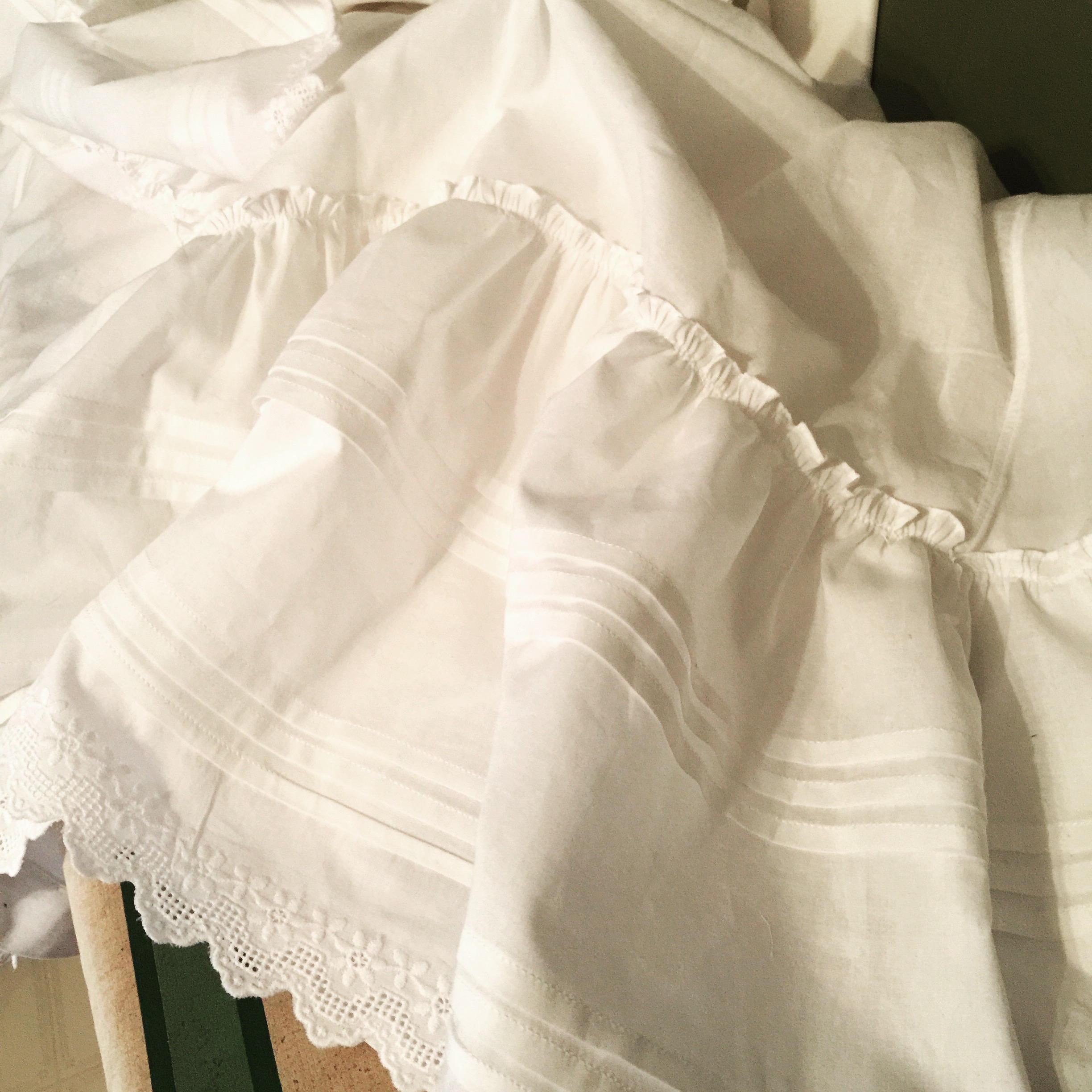
The ruffle (pre-ruffling)

The ruffle (pre-ruffling)

So, I cried a little and resigned myself to a ruffle. I still wish I had pleated it, but, meh. I picked my ruffle depth by the highly scientific method of tearing my leftover fabric after making the main portion of the petticoat into eight equal strips. I had already decided I wanted 1/4″ tucks, so then I added those in, three in each panel, starting with a fold right at the middle. Once I had those tucks made, I joined seven of the eight panels (measuring my lace having determined that I wouldn’t have enough to go along the eight panel anyway.) I attached the lace at the bottom using a tuck—basically, sewing a french seam on the outside surface. I thought it looked lonely, though, so I added two more 1/4″ tucks above it. I like the overall look, but I was definitely more precise (which is still a long way from perfect) on the first set of tucks. Eh. I finished the top edge with my narrowest-of-narrow-hemmers, and ran the whole mess through the ruffler on what was supposed to be a roughly 2:1 gathering ratio.

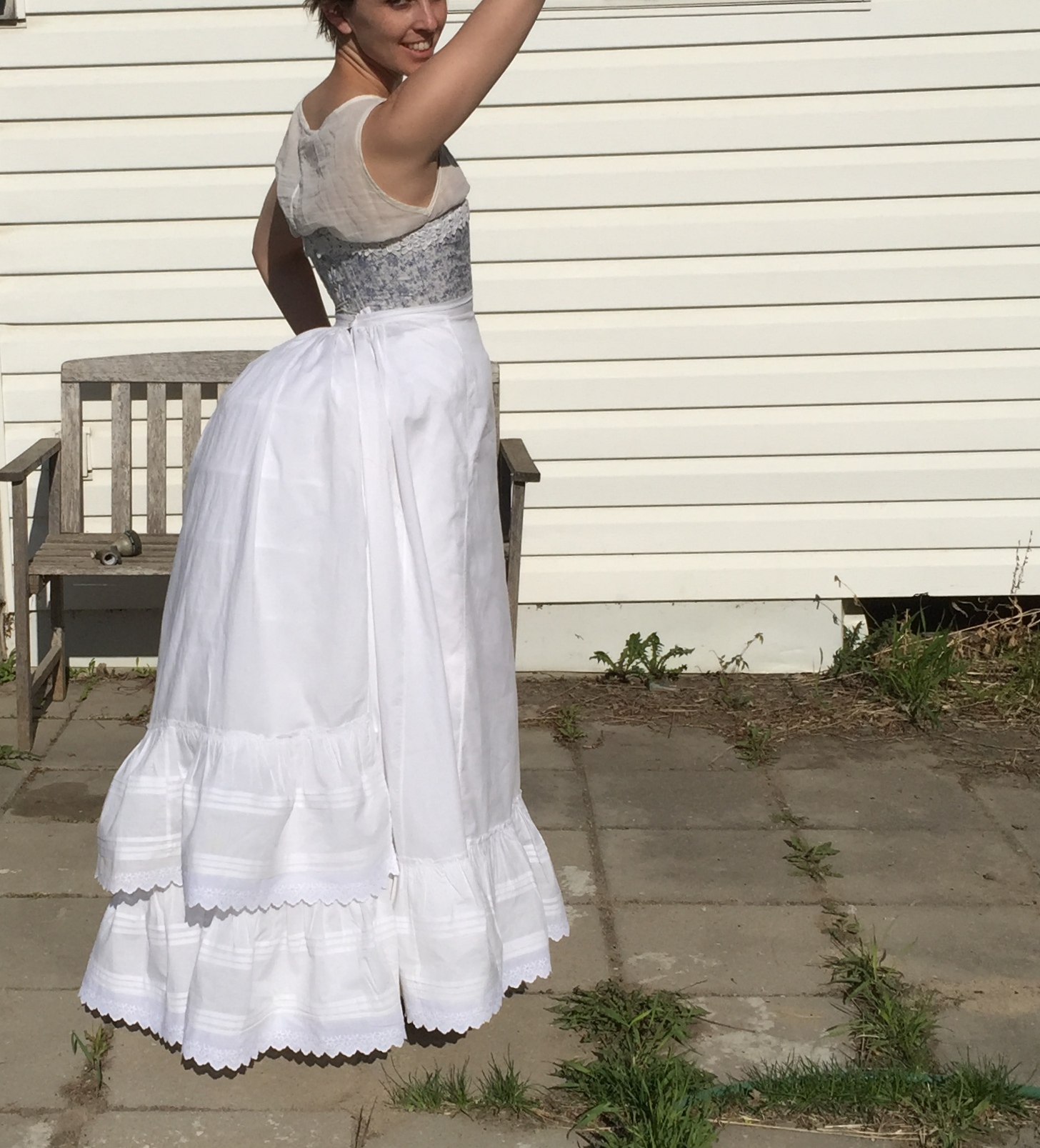
Two ruffles in the back

Two ruffles in the back

Whether due to the weight of the fabric, or my ruffler being loose at times, or me just being a tool, what I wound up with was rather more gathered length than I expected, so I added the second ruffle across just the bustle/back of the skirt. Except that it goes up one gore seam further on one side than the other. HEADDESK. I am not going to change it. Quit looking!

Buttonhole and stroked gathering.

Buttonhole and stroked gathering.

My other big booboo (as opposed to the myriad little booboos in the seams and the tucks and whatnot) came when gathering the waistband. I had measured my waist plus and inch or two for overlap, but I couldn’t quite wrap my head around the side-back opening as it related to the necessary gathering. Basically, my waistband wound up lop-sided, and I was extremely loathe to unpick the whole thing and re-arrange my painstakingly stroked hand-gathering. Instead, I unpicked the other end, where I didn’t have enough gathering, and tightened that way up, essentially shortening my waistband by about three inches.

It is, um, snug. Maybe my next corset with be more waist-reducing, though.

That hand-worked buttonhole isn’t particularly pretty, now, (and it is worked on the wrong side, oopsie.) But it’s entirely serviceable and only took about ten minutes to put in. So there’s that.

Closeup.

Closeup.

The whole thing is pretty delightfully frothy, once you wriggle into it.

Ruffle.

Ruffle.

The fabric is pretty thin, and you can see the under-structure pretty clearly. Obviously another petticoat is required, maybe a more plain one, to go under this.

Happy bum

Happy bum

The under-structure, by the way, is my lobster-tail bustle, based pretty much exactly on the American Duchess tutorial, though I did vary the angle of my boning at the top a bit, and I added lacing to hold it closed on the inside, not just ties. This wasn’t quite as brilliant as I had thought it might be, as the lacing tends to pull the whole thing up a little bit, but it works just fine and I think if I added a ruffle to the bottom the pull up would largely be neutralized. Although now that I’ve seen it under the petticoat, and worn it a bit, I don’t actually think I care.

My American Duchess Bustle

My American Duchess Bustle

It’s boned entirely with 1/4″ spring steel from Farthingales Corset Making, which is my favourite corset-supply site, at least partly because it’s Canadian so the shipping is fast and the prices don’t mysteriously skyrocket between my cart and my bank account. Frick I hate having the dollar low again. No complaints, though, about Farthingales. Reasonable prices, quick shipping, arrives promptly. A lot of people seem to use 10mm steels or even wider on these support garments, and while I’m sure that’s strong, I feel like most of the originals I look at had more bones of a narrower width… anyway. The 1/4″ seems more than sufficient for the bustle. I took it with me to my last Marr Residence Historical Clothing thingy, and lots of people had fun trying it on and then practicing sitting down. 😀

Side view

Side view

Of course, now it’s finished and I’m struck by the crushing dissatisfaction that I find accompanies most costume sewing—it’s finished and it’s awesome and I DON”T GET TO WEAR IT ANYWHERE. I mean, I’m already known for pushing the wardrobe bounds at work with my fluffy dresses. I don’t think even I’m going to move into full Victorian mode, though. Even for my final wardrobe workshop,* coming at the end of the month, I probably won’t actually wear it as I will want to have it out for people to look at. /sigh.

Anyway, it’s done and it was a fun process, so we’ll call that a win! Edging ever closer towards… uh oh… OUTER GARMENTS!!!!!)

*Must blog those. They were awesome. To the cool people I met (I know at least one or two of you have buzzed the blog), THANK YOU!!!!!

20 Comments

Filed under Sewing

Again!

Again!

Again!

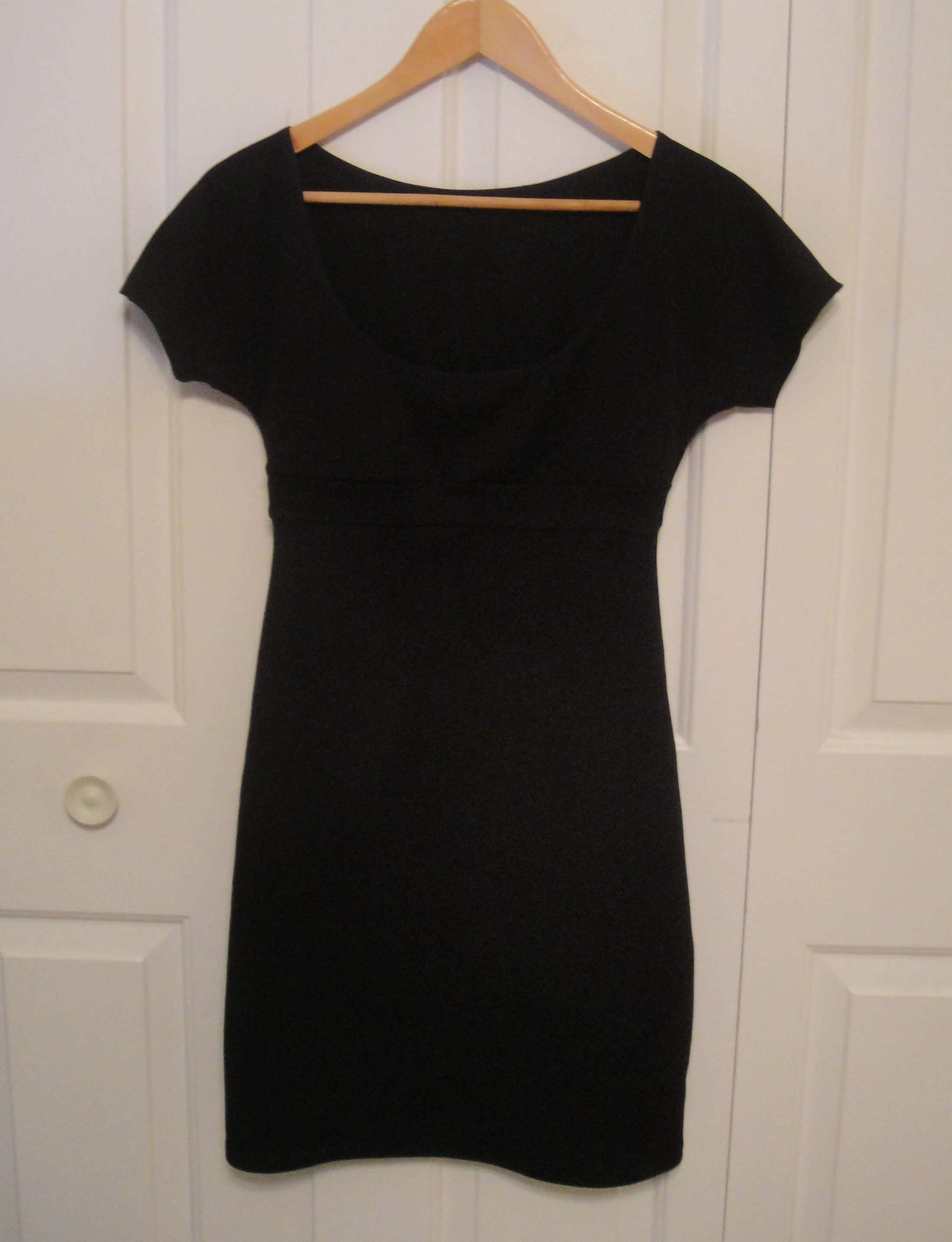
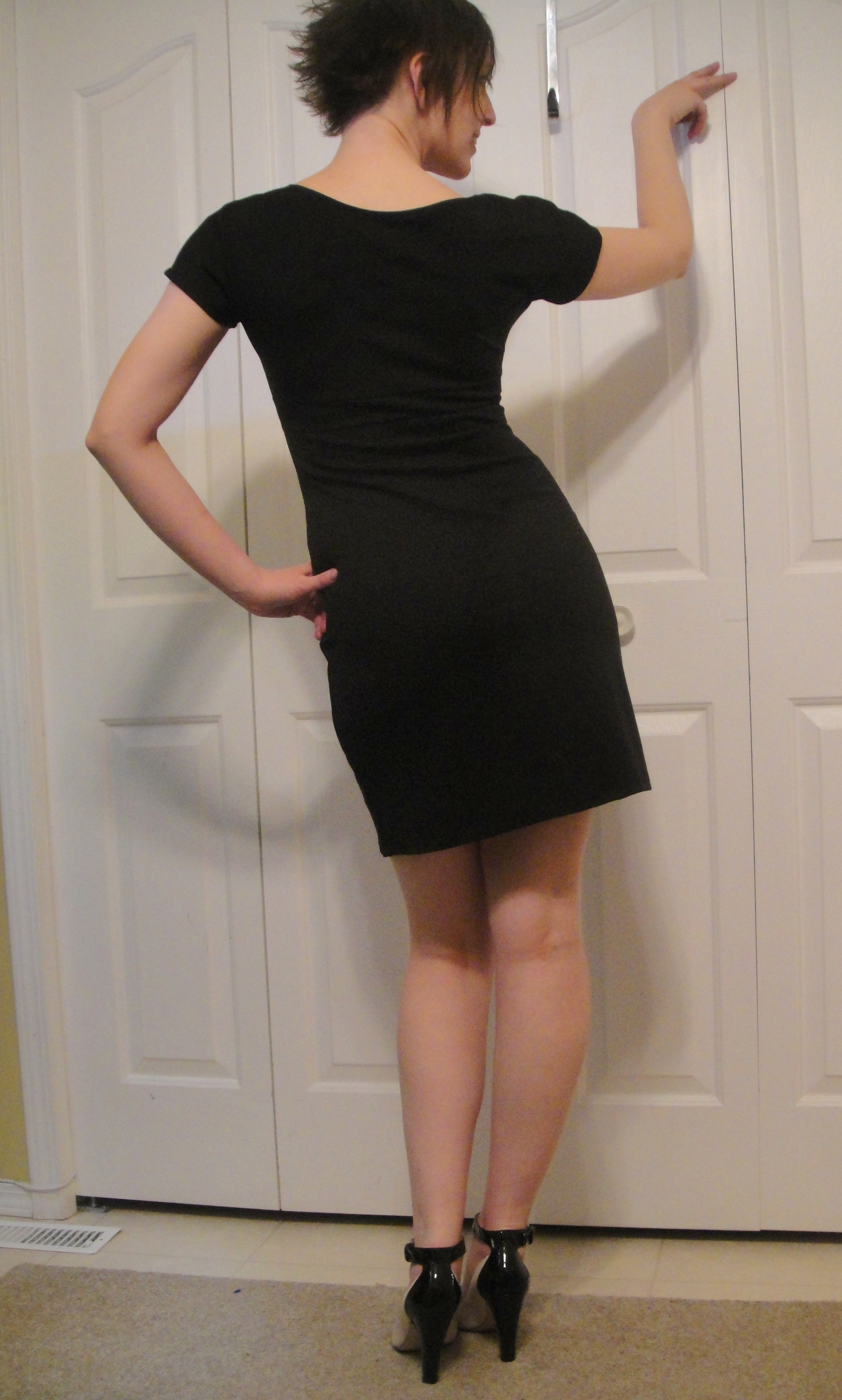
I couldn’t stop myself. I made another Jalie 3024.

Cute with shoes. Black photographs for shit.

Cute with shoes. Black photographs for shit.

The part where it only takes about two hours from first cut to hemming helps. This version is made of a heavy ponte, which I managed to nab a remnant of the other day. (It being prohibitively expensive otherwise.) I love that I can make this dress from a 1m remnant with room to spare. I made the neckline scoop a little lower this time (I think I overshot a wee bit… Maybe 1/2″ higher next time?).

Light!

Light!

Here’s an overexposed view of the front so you can maybe kinda sorta see the detail, not that it’s a surprise.

I finished it with some more of the narrow fold over elastic Mary of Hey Beautiful picked up for me in one of those rare and perfect moments of internet/real world synchronicity. It’s perfect. Thank you!!! Of course, it’s also black, so all of my attempts to photograph a closeup failed miserably.

Back view. Of which you can see absolutely nothing!

Back view. Of which you can see absolutely nothing!

No back-seam on the skirt this time, just swayback wedges removed from the skirt and bodice pieces in the back.  It’s not overly smooth in the back, but tolerable. I also took it in under the arms a wee bit, as it was sticking out in the heavier fabric. It’s an easy dress to alter. My husband has been mourning the absence of a little black dress from my wardrobe for over a decade now, so he’s actually quite approving of the make. 🙂

And again!

And again!

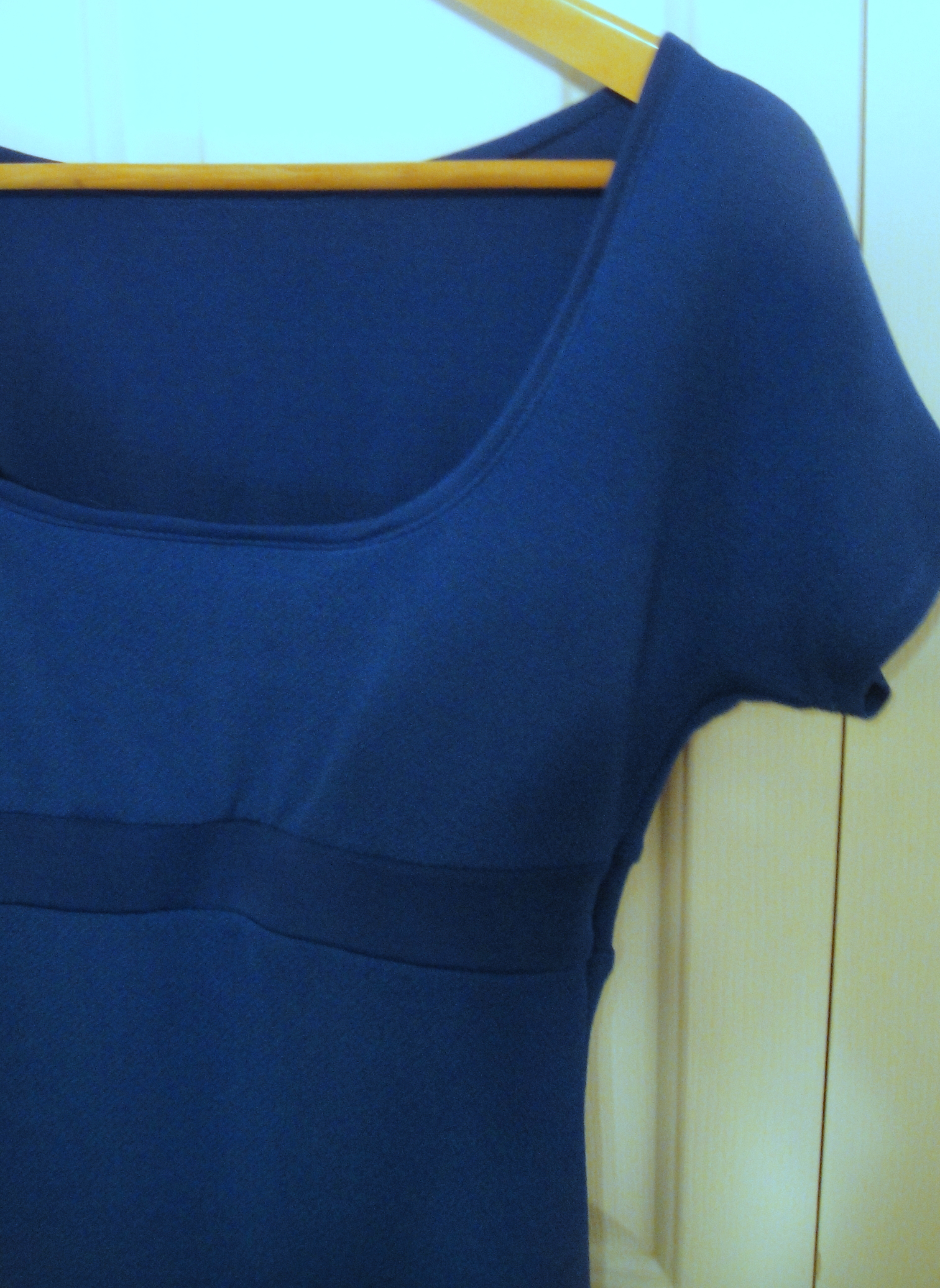
And then I made another. This one in a blue knit advertised as “crepe,” although it’s really a heavier knit with one side that’s textured to vaguely resemble crepe.

Playing with textures.

Playing with textures, which you can’t really see. (Tweaked to show the actual, royal blue colour. I HATE INDOOR LIGHT.)

The other side is quite shiny and spandexy. I used the shiny side for the waistband and the neck binding on this version. I like the contrast, subtle as it is. To reduce bulk, after I put the first pass of the binding on, I trimmed the binding’s seam-allowance close to the stitching line. This definitely reduced the bulk—here’s hoping that it doesn’t result in a binding failure later on. This knit is stretchier (especially lengthwise) than the pontes I’ve been using, so I made it up more-or-less as the pattern dictates, aside from my scoop neck (I had a wild moment where I thought about hacking a cowl neck, but those can be pretty hit-or-miss and I love a nice, wide scoop of pretty much any flavour. Maybe next time.)

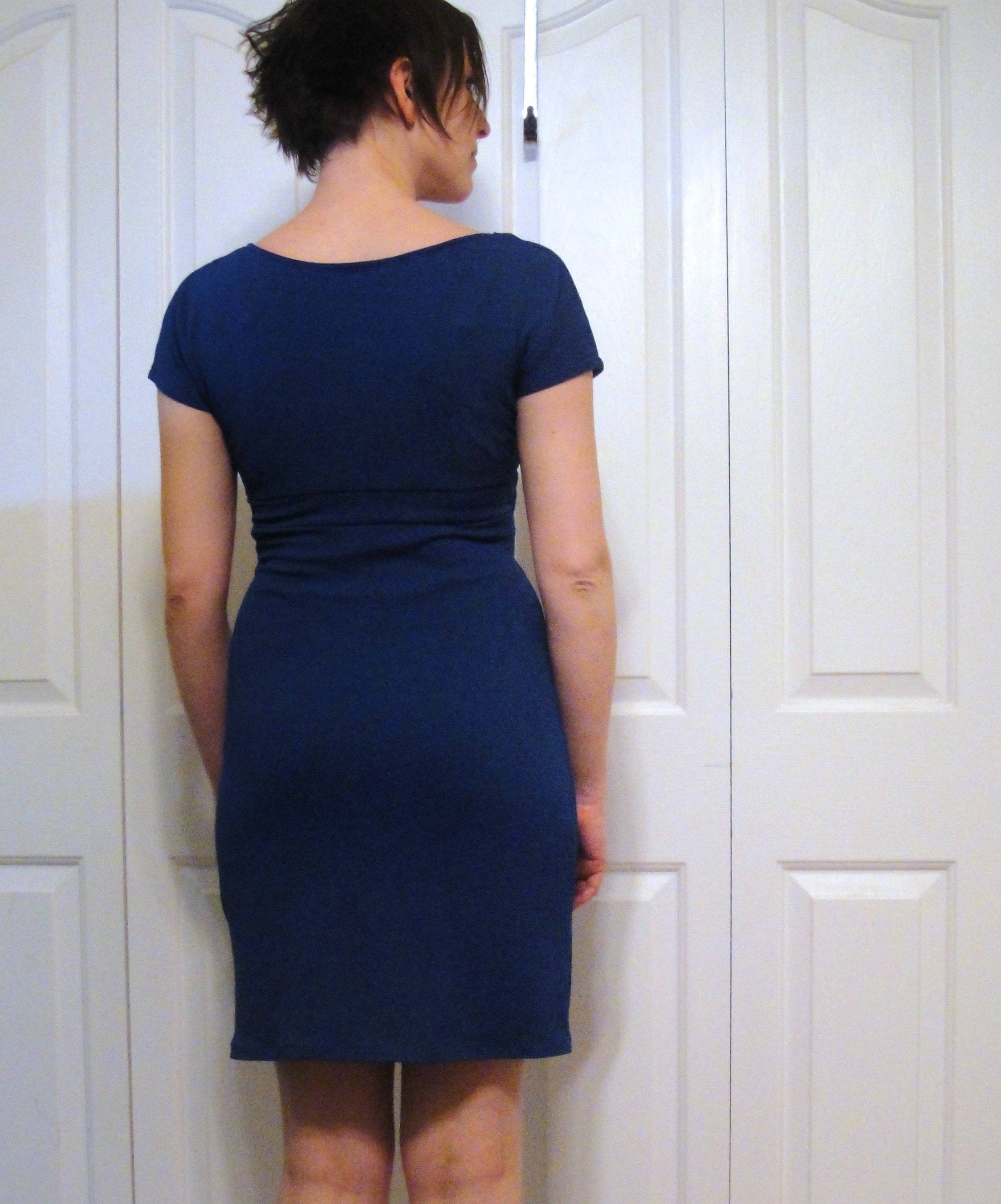
Back. Remains bunchy.

Back. Remains bunchy.

I thought I made my swayback adjustments even more extreme, but it’s still kinda bunchy. Doesn’t bother me in the actual wearing, mind you, since I can’t see it. 😉 Because this is a clingier knit than the others (even though it’s still quite heavy), I had a bad moment while trying it on where it was clinging to every lump and bump in a way that was not a good look at all. Then I threw my Gertie slip on underneath, and all of a sudden everything was just fine. YAY! Which reminds me, man I love that slip.

Ciao!

Ciao!

I still want a red one, and there are some scuba prints at Fabricland that would be absolutely to die for in one of these and why didn’t I scoop some up last month when they were 60% off?!?!?! But I think I may be close to being satisfied… maybe… 🙂

6 Comments

Filed under Sewing

Cream Lace Ensemble

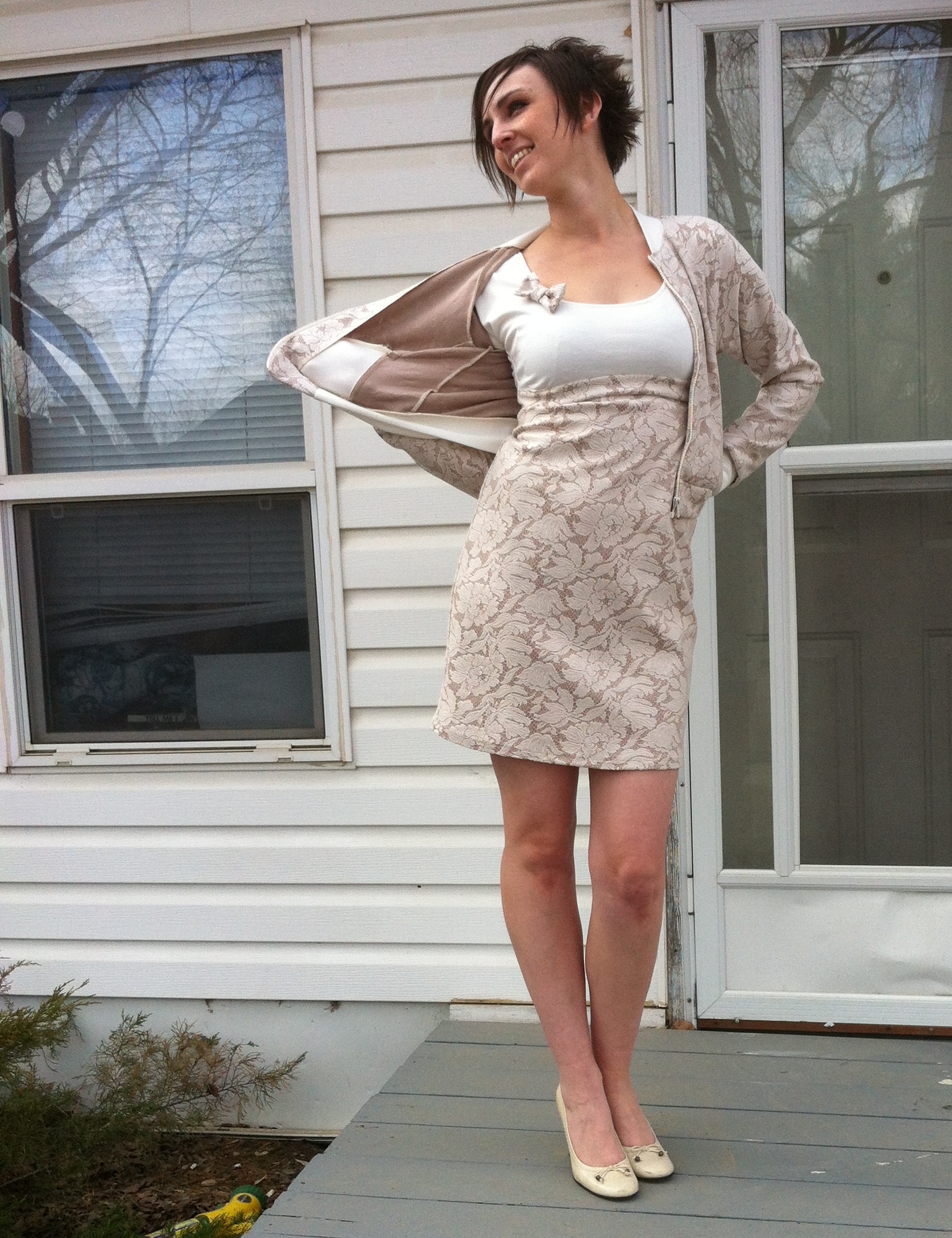
Ensemble.


Wrenching myself forcefully away from historical costuming (who knew petticoats could be so riveting)…I do like cream, and I do like lace. As the whole blog theme may suggest.

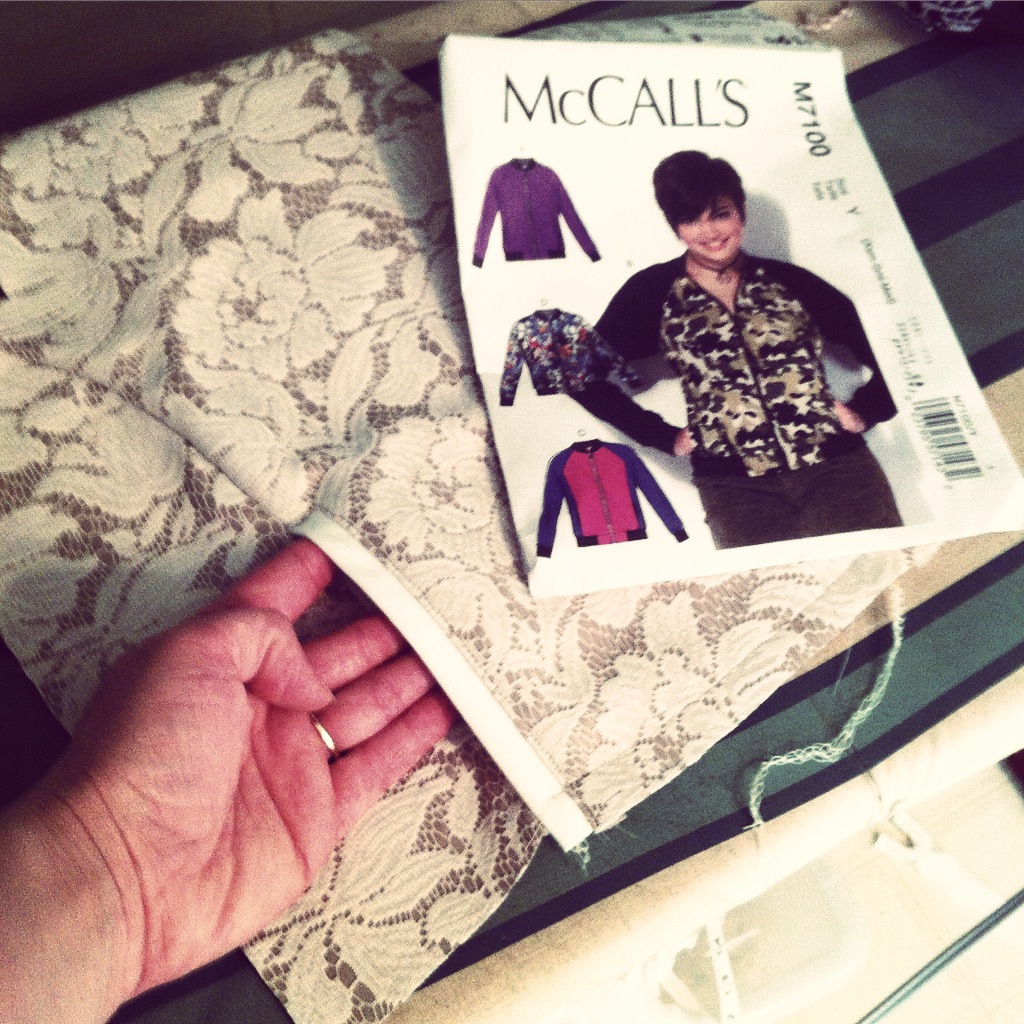
I’m not quite sure what to say about my inspiration here. Bombers have been bouncing around the blogs for, well, awhile now, even if the cool kids are sewing the Papercut Patterns Rigel and not the boring old McCall’s 7100. And I totally missed Rigel Bomber January, anyway. I’m not a bomber girl, mind you. Boxy has never been one of my favourite looks. But, well, even I can be swayed by a trend… and I was curious about modifying the usual bomber into a cropped look, because I love me a cropped jacket. I made it as short as I thought I could get away with and still have (semi) functional pockets, but it’s still an inch or so longer than my “prime” cropped zone—but I actually think it may be pretty fun, and a practical throw-on-over-cute-whatever layer, which as an office-dweller I am often sorely in need of.

McCall's 7100

McCall’s 7100

As for nuts and bolts—the pattern is McCall’s 7100. The fabric is a beige scuba-knit bonded to a lace, which has the effect of nearly nullifying the stretch in both fabrics. For my bands, I picked an ivory Ponte di Roma which is stretchier than the base fabric, but also not really stretchy enough for what it is supposed to do (although the pattern calls for “moderate stretch knits” for the bands, not psychotically stretchy ribbing. I checked.) I made the size 10, since I wanted a fairly close-fitting jacket. I shortened all the bodice pieces by about 3.5″, mostly at the hem except for the side-front panel which has a wee bit more shaping than the other pieces, so I took a tuck from the lower part of it. I also lengthened the sleeves about 5″, though I did take 1″ off afterwards. Though I kinda wish I hadn’t.


Jacket.

Jacket.

I didn’t particularly like the way the McCall’s pattern has you construct the pocket welts—it’s simple but not the cleanest look. I wanted my welts inset into the seam, which I’ve done before… but not since I made Jalie 2795 for Tyo. Um, that was a while ago (like, it’s been handed down twice since). And I should really have re-read the instructions for that rather than just bumbling along. I feel like I’m doing a lot of bumbling along lately, mostly due to not having the time/energy/focus to actually think through, research, and practice a technique. Not the best for personal growth as a stitcher, /sigh. But I did manage it, give or take a bit of seam-ripping and  rippling and a few seams finished in the wrong order (or not at all).

Ugly inside band attachment. Closeup declined. ;)

Ugly inside band attachment. Closeup declined. 😉

Where i mostly fell apart was actually in attaching the bottom band. I love the little panel of the main fabric at the zipper, and they have a pretty neat method of attaching it, but I couldn’t quite wrap my head around how to mesh that with the stretch band around the rest of the bottom. I mean, it’s together, but the join is ugly as hell inside, and this is an unlined jacket. Blerg. Need to re-read/rethink that a bit. A lot. Before I try it again.

Pockets!

Pockets!

But otherwise, it went together quite easily and I’m quite happy with the fit. The pockets (after all my shortening) are pretty teeny but just barely large enough to put hands in, at least. It’s funny, I don’t really love the shape when I look at it in the mirror, but I feel like it’s better “in motion.” I think I like it.

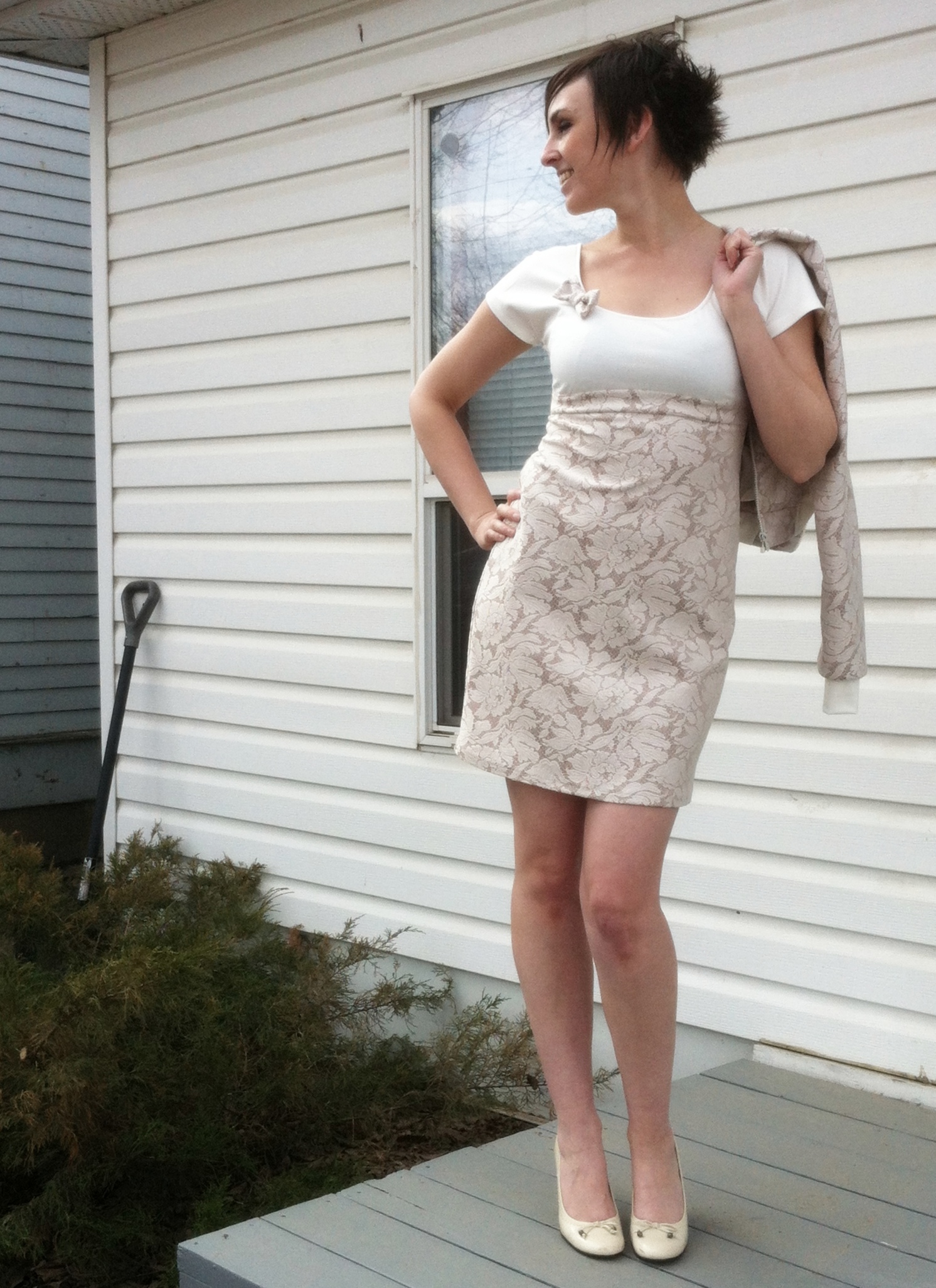
Jalie Dress


Now, I’m pretty sure in actual wardrobe rotation the bomber will be pretty much a standalone piece, but I still had fabric left over, and a hankering for a matching little dress. Tis the season (or almost the season) for cute little dresses, after all. After wrangling bomber most of the day, I didn’t have much energy left, though—all I really wanted was a T-shirt type dress. (Speaking of which, I wonder where my lacy T-shirt-dress is…). After paging through my patterns, I really was feeling Jalie 3024, a cute pullover knit dress I haven’t gotten around to before.

Cute dress.

Cute dress.

The only problem? Jalie 3024 is designed for four-way stretch knits with rather more stretch than either of my fabrics.

After some thinking, though, I settled on some fairly simple alterations.

Tyo catches some good "transition" shots. ;)

Tyo catches some good “transition” shots. 😉

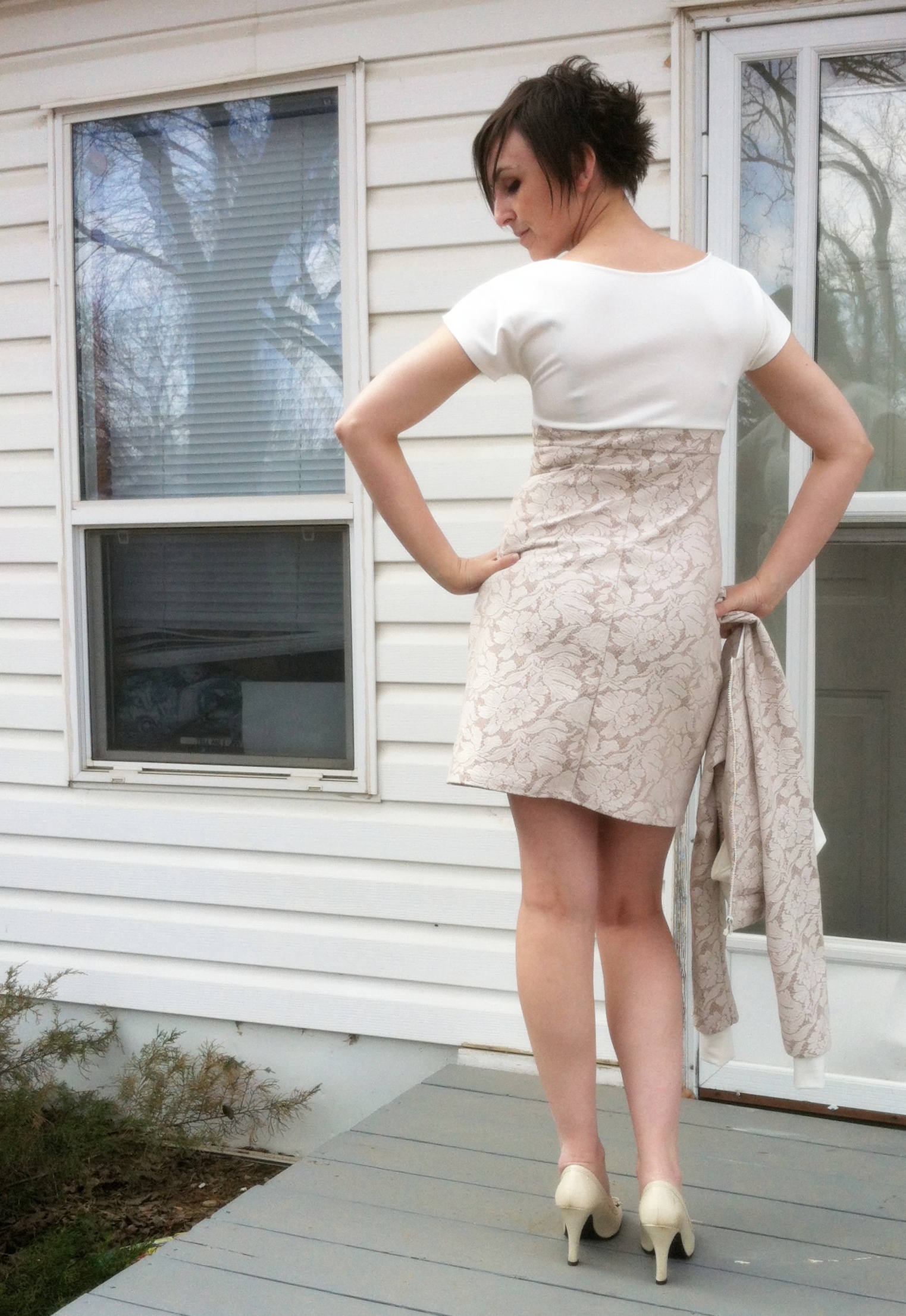
I cut the skirt and waistband pieces (out of the bonded lace) with about an inch extra ease both front and back, and added seam allowance for a seam at the CB skirt so I could add some swayback/butt shaping. I didn’t make any changes at all to the back bodice, but for the front bodice I lengthened about an inch and added a dip below the bust, basically a big fat FBA. (Muahahahah!) I used the ponte for the top as it has a bit more stretch than the bonded lace. I also gave it a scoop neckline because I like them so much better. All of these alterations played hell with the seam lines, but ponte is a forgiving knit and I was able to ease everything together quite nicely.

Back view. Centre seam added for butt shaping.

Back view. Centre seam added for butt shaping.

I’m not usually a big fan of the “dress that looks like skirt and top” but I’m kinda liking it in this case. It needed a bow, though. I’m not quite 100% sure on the location, but it definitely needed it.

As with most Jalie patterns, I’m now feeling the urge to make five more…

PS: First outdoor photo shoot of the year!!!! Hooray for crappy cell-phone-pics with actual good lighting. (I fully intended to use the “good” camera, and pulled the battery out to charge it… then couldn’t remember where I’d actually put the camera when the time came. /headdesk) Also, miraculously the beige colour of the skirt makes my legs look pink rather than fish-belly-white, so I’ll call that a major win. 🙂

7 Comments

Filed under Sewing

The Never-Ending Petticoat

A flannel petticoat

A flannel petticoat

This petticoat felt like it took forever. Really, I guess it was only a couple of weeks, and much of that was the hem. God, the hem. >_< We’ll get to that.

So in a bid to bring our brutal winter* to an early end, I started work on a flannel petticoat. Maybe it was the delirious speed at which the corset came together, but I was not feeling patient. That was probably a big part of the problem.

Anyway, this petticoat is based pretty much entirely on the instructions in The Home Needle, (p. 37-38). She is mostly describing a regular muslin petticoat (Er, “white skirt,”), but does give a nod to flannel petticoats:

“A flannel skirt is made shorter and scanter, and has a muslin yoke. For this, three yards, or even less, will suffice. The seams, after being run evenly together, are pressed open on the wrong side, and fastened down with the stitch known as herring-bone or cat-stitch. The bottom of the skirt is often finished with elaborate embroidery in silk ; but a neat hem, headed with a row of chain stitching, either in silk or linen floss, is sufficient for ordinary purposes.” (The Home Needle, p. 38)

I managed the shorter, I think not so much the “scanter,” since I pretty much followed her instructions (later in the book) for cutting out a regular skirt, and didn’t down-scale my fullness much/at all. Though I only did one set of side-gores for the skirt, not two. This petticoat will pretty much work over a bustle, whereas I get the impression that most flannel petticoats were for wearing under the bustle, to keep the legs warm. Not 100% sure, though.

A yoke. (rear view.)

A yoke. (rear view.)

So, phase one: I winged a yoke. According to Mrs. Church, a yoke should have the straight grain at the front and be cut in a single piece with the bias at the back—I, however, added a side-seam, because cutting a curved yoke in a single piece like that seems like it wastes a lot of fabric. My yoke still wound up rather over-size, so I wound up taking it in a lot at the back opening. I stabilized the waist seam with some ratty old rayon stay-tape from stash—not period, but non-bulky and thrifty, so I’ll take a half point for that. 😉

My flannel was 54″, and Mrs. Church’s instructions mostly assume a fabric around 27″ wide, so I basically cut it into skirt-lengths and then sliced those in half lengthwise. Maybe not the best way to maximize my fabric usage, but anyway. 😉

Skirt diagram

Skirt diagram

The skirt consists of three gored panels plus a rectangle for the back; the front I cut on the fold, angling from what seemed like a good width at the top out to the full width at the bottom. As per Mrs. Church’s instructions, I cut the side pieces from one length, with an angled line to make two identical pieces, wider a one end, narrow at the other.  The back is just a long rectangle of my fabric “width” (artificially narrowed) x skirt length.

Tucks & lace

Tucks & lace

Since I was going for a shorter petticoat, I didn’t add to the length to accommodate my tucks. I measured, marked the folds, and stitched them in place on the individual lengths before sewing (or should I say, running) the lengths together. Incidentally, just in case I forget this, the formula for the distance between tuck folds is y=3x+b, where y is the distance between folds on the flat fabric, x=the width of the finished tucks, and b=the space you want between tucks. (Tyo is doing linear equations in math right now. 😉 )

Cat-stitched seams

Cat-stitched seams

Once I had the skirt panels run together, I catch-stitched (which I am assuming is the same as cat-stitched) all the seam allowances open. This was the first part that seemed to take FOREVER. They do look nice now, however.

According to Mrs. Church, petticoats which have yoke & buttons (which are better than drawstrings as there is less bulk at the waist) invariably fasten at the back. The only problem with this is that there isn’t any back seam in my petticoat (since I used a single back width). Now, maybe Mrs. Church didn’t mean at the centre back exactly, but I don’t know. However, while Mrs. Church doesn’t cover it, Plain Sewing and Amateur Dressmaking (1887, p. 11) has a brief passage covering how to make a slash placket, which basically involves adding a pleat at the bottom to give you the overlap. I think. It’s possible I am completely not understanding what they described; I did my best to follow along, anyway. I turned one edge of the slash under twice, narrowly, and then make a big pleat at the other edge to cover the gap. It feels pretty much like a cheater’s solution, but it works.

Buttons & placket

Buttons & placket

I put the front of the petticoat onto the yoke smoothly (no gathering), relying on the back gathering to get everything to fit. I kinda really like this method of skirt fitting. One of these days I will work on those crazy Victorian gathering techniques that all seem to involve making multiple lines of perfectly-even stitches and then stroking each of the resulting pleats to maximum perfection before meticulously stitching each one down. For now, though, I just gathered.

Back View

Back View

Because my yoke is pretty wide, I went with three buttons on the back. The buttonholes are hand-worked, not that my hand-worked buttonholes have any degree of grace or beauty; I also worked them backwards, so the edge that the buttons pull against is probably the wrong one. Oops. They are functional, however. They, also, took forever, as did digging through my massive garage-sale-button-stash (thank you, Mom) for the perfect plain white glass buttons.

And now, we come to the albatross, the Waterloo—the hem. Ugh. Scroll up a bit and re-read Mrs. Church’s words: “… a neat hem, headed with a row of chain stitching, either in silk or linen floss, is suficient for ordinary purposes.”

Chain-stitched hem. Started bad, got only slightly better.

Chain-stitched hem. Started bad, got only slightly better.

So, of course, I had to look up chain-stitching, Fortunately, she had a diagram. OK, I can do this. It’s pretty simple. It also pretty much only looks good if the stitches are teeny-tiny short (the fact that I was using cotton thread, not linen or silk floss, might be a part of this), and teeny-tiny-short-stitches were really hard to get through all the thick layers of my flannel. Not to mention proceeding at even more of a snail’s pace. I also (eventually) figured out that the only way I could keep the chainstitch even was to mark its position with wash-away pen… there is some meandering before I hit that desperate point. No, I’m not going back to fix it.

The hardest part, mentally, aside from the not-terribly-decorative nature of my “decorative hem”, was that it’s not an invisible hem. I hand stitch my hems invisibly all the freaking time, and it’s not a problem, but doing this visible hem (and having it not look AWESOME) made me want to stab my eyes out with the needle. Or just run over to the sewing machine and SEW THE FRICKING THING BY MACHINE. Because then it would be done, in five seconds, and LOOK BETTER.

Ahem. But this is supposed to be about the process, right? If I just want to whip up a costume that’s a whole different beast… this is trying to reproduce, or at least experiment with, period techniques.

It's hard to get a good picture of bustle-bum.

It’s hard to get a good picture of bustle-bum.

Anyway, I did eventually get it finished. And I like how it looks, although it doesn’t look particularly like what comes up when I google “Victorian flannel petticoat.” Two more minor things remain: I would like to add an elastic across the inside to pull in the back (as Mrs. Church recommends), and/or some slits in the side so the ties for pulling in the outer skirts in the same way can pass through.

I’m excited, though, to make a light-weight version next, with ruffles on the butt. And a proper bustle, of course. And after that… (ulp!) after that, I have to begin thinking about the dress! O_o

Petticoat!

Petticoat!

*OK, February and the first week of March were brutal. Before and after, the weather has been lovely.

10 Comments

Filed under Sewing

Historical Clothing of the Late Nineteenth Century

… is the slightly ostentatious name they came up with for a program (actually, a series of programs, or workshops, or afternoons of hanging out) I am coordinating at the Marr Residence, a local history site, this spring. The first one is tomorrow afternoon (Sunday, May 22, 2015), the other two are the first and last Sundays in May.

I wanted to call it a "Victorian Sewing Bee."

I wanted to call it a “Victorian Sewing Circle.” This way sounds more educational, I guess. 😉

Like my poster?

I probably should have posted this sooner, although if I have five local readers who might even potentially drop by I’ll actually be a bit surprised. And frankly, I feel like a bit of a poser since I’m a long, long way from an expert on historical clothing or costuming. I’m justifying it to myself as a way to network and meet other people locally who might have an interest in historical sewing & costuming (and who may well know more than me.) And it’s my little way of “creating an event” to explore my interest in historical sewing and costuming, since I really don’t want to just make costumes that have no other function but to hang in my closet.

I do have a few hidden resources… like the Victorian Dress, and the rest of my mom’s antique clothing collection (plus a few lovely pieces in the Marr Residence collections) and reproduction catalogue collection. (I haven’t seen as much of the catalogue stuff around the webs, which is interesting… I feel like it gives a more day-to-day view of fashion than the fashion plates or even the period photographs.), and I’ll be there with my own project (I think it’s BUSTLE TIME), and some sewing basics should anyone else want to drop by and do some sewing, or just some hanging out and talking.

So yeah, um, those five of you who are in town (or is that three who’ll actually read this on a Saturday night, or one who might maybe have nothing better to do on a Sunday afternoon…) anyway, yeah, stop by!

I think it's cute, anyway.

12 Comments

Filed under Sewing

Remedial Corsetology II

Victorian Underoos

Victorian Underoos

I probably don’t need to say a lot here.

Back, with lacing.

First try-on.

I got lacing. (poly cord from Fabricland. Historically accurate? no. Functional? Absolutely.)

As Laurianna noticed in my last post, I forgot to allow space for boning outside of the back grommets. This is what I get for leapfrogging between different instructions, and not paying attention to details. I added some cording to the area for a bit of reinforcement (better than nothing?), but there is definitely some buckling along the lacing that could have been avoided. Lesson learned, hopefully to be applied next time. (Honestly, this is the kind of lesson I learn best from making mistakes. >_<)

Lacing grommets, cording, and bottom binding.

Lacing grommets, cording, and bottom binding.

I added self-bias binding along top and bottom, pulling it fairly tight to bring in the looseness along the bottom. I was a little worried halfway through that this would backfire and just look bunchy or lumpy, but it seems to be fine.

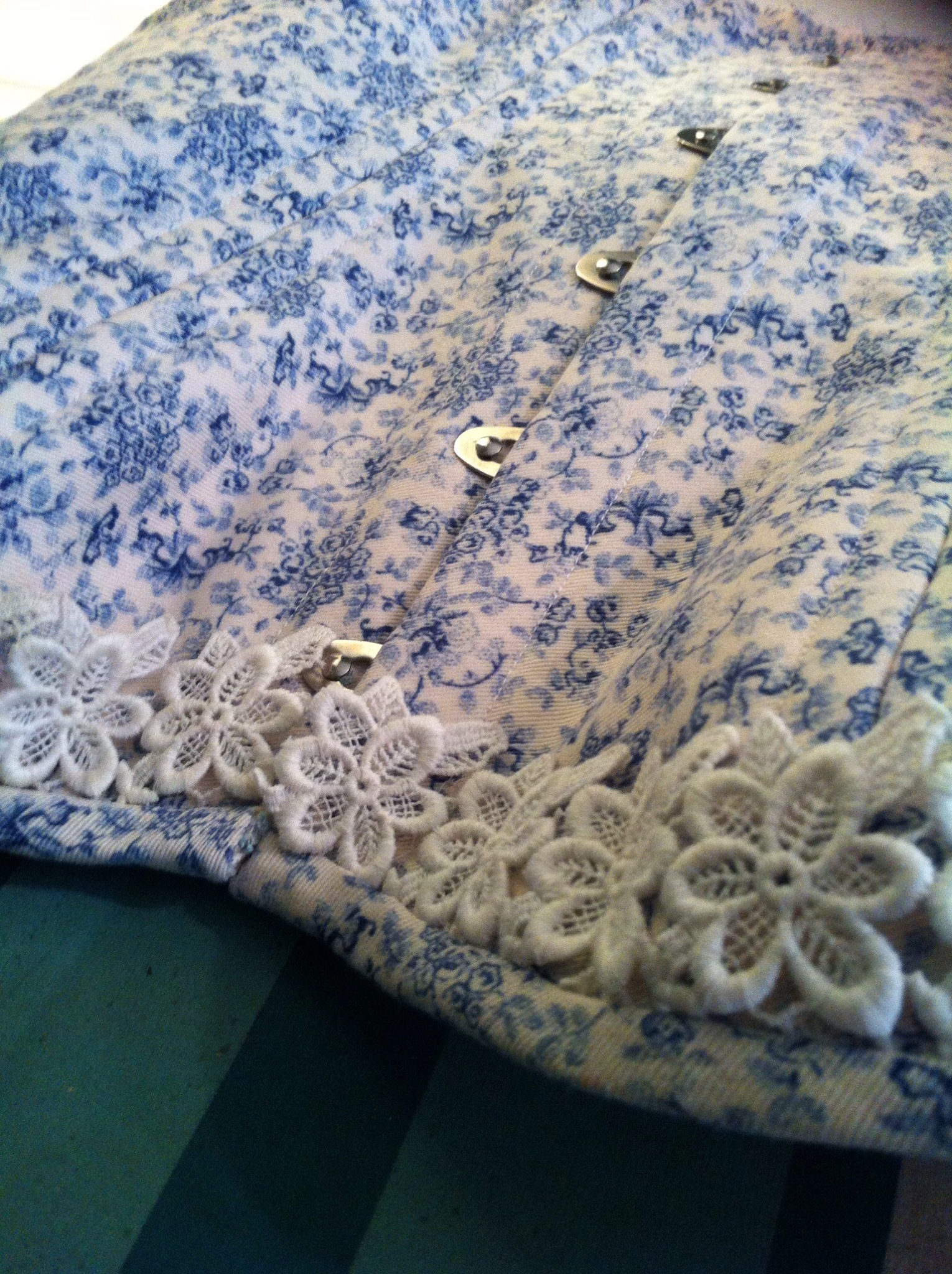
Lace flowers.

Lace flowers.

Since I had exactly five little lace flowers left over, I opted to add them to the front of the corset. I just cut them apart and  hand-tacked them down. I think they’re cute (though maybe not very Victorian with that random asymmetrical design. Ah, well. At this point I’m going for impression, not detail.)

Corset back. Lace job by the fourteen-year-old.

Corset back. Lace job by the fourteen-year-old.

The corset is, technically, a little bit big. The two-inch lacing gap I used in my try-ons disappears pretty much entirely without too much difficulty, and I think I could stand tighter lacing at the waist. (Despite the above photo. However, if I wait to take new photos with the lacing done a bit better, you may never get this post, so, wonky lacing it is.) I love how it flares out over my hips, though, and I love the shape it has around the bottom, even though it isn’t, strictly speaking, really long enough over the hips.

The bust isn’t exactly too small, but I think if it were a bit larger, and shaped a bit differently (i.e. more defined), it would look better. It is technically alterable, should I choose to unpick and re-stitch the seams and boning-channels, but I’m going to leave it for the moment, partly because I hate alteration and partly because I want to test how it feels when worn for more than a few minutes of trying-on.

Full view

Full view

I haven’t really talked much about the chemise, have I? (I covered the drawers here.)

Closeup, with chemise.

Closeup, with chemise.

I used the yoke piece from Simplicity 9769 (If I’d had this pattern when I first started the corset-testing I would probably have used it rather than Butterick 4254, as it seems to have somewhat better reviews, but anyway….) This is more of an 1860s pattern than 1880s but, well, I like it , so there. 😉 The rest I kinda offroaded, based on the instructions in The Home Needle and a fair bit of poetic license. I sewed up the yoke, with lace, fairly conventionally, but then I wound up taking the project with me to my mom’s family farm for a few family events over the winter, and while I can’t really run off to play with a sewing machine while I’m out there, I can definitely sit in the kitchen and hand-stitch and visit while everyone else around me cooks and cleans and does actual useful work. So the flat-felled seams of the main garment were all done by hand, as were the teeny little pin-tucks (facilitated by the woven-in stripe of the fabric, though they still aren’t perfect, which is fairly unforgivable given the stripe) and the lace-insertion.

A photo posted by Tanit-Isis (@tanitisis) on Dec 27, 2014 at 5:31pm PST

(Hmm. This attempt to embed from Instagram does not seem to be displaying on my browser. I will attempt to fix it when I get home. Sorry all!)

Full back.

Full back.

Then I got home and impatiently finished the hems using the teeniest rolled hem foot on my Pfaff. I love the teensyness of it, but kinda wish I’d stuck with the hand stitching just for, oh, I dunno, excessive old-fashioned-y-ness.

I think it's cute, anyway.

I think it’s cute, anyway.

I was pretty pleasantly surprised by how the look works all together. (OK, I think it’s cute, anyway.) I like the three together better than any of the individual pieces (well, except maybe the corset.)

Next up: the petticoat(s)! (OMG I might actually have to start thinking about the actual dress. (But not before I tackle bustles. Ooooh, scary!)

8 Comments

Filed under Sewing

Remedial Corsetology

IMG_0810.JPG

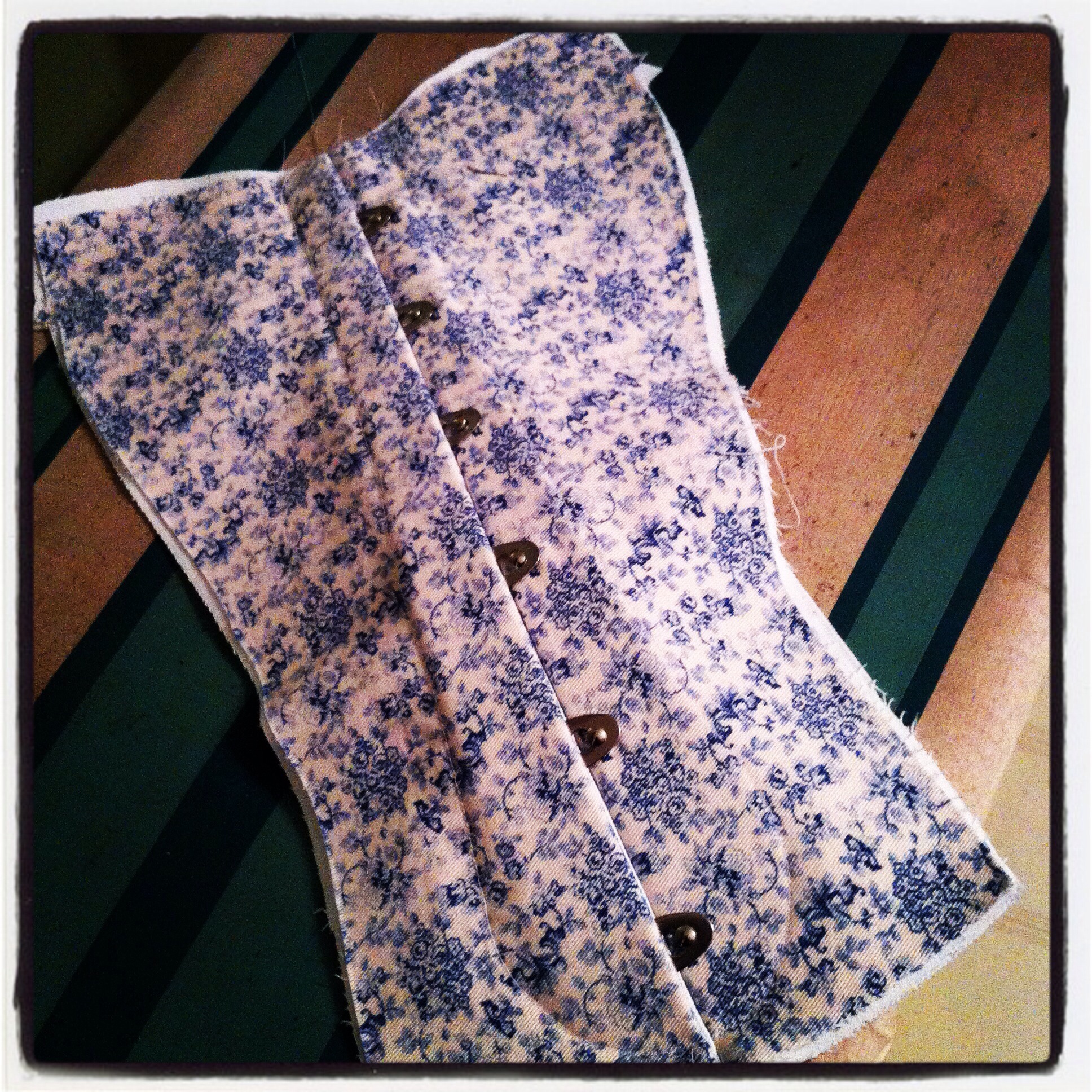
Almost a corset.


Remember when I did a mock-up for a corset? Yeah, me neither (well, barely.) I think it was last spring sometime? Anyway, finally this past weekend I had—wait for it—leisure time! Nothing that needed to be made with an instant deadline! (And my husband wasn’t playing Final Fantasy 14, which is also sapping the sewing time these days. I’m not gonna apologize for that, though, down-time is down-time and I love back-seat gaming.)

So, after spending most of my Saturday puttering around tidying the perpetual mess that is the sewputer room and finishing the odd UFO and repair, I finally got the itch to pull out the altered pattern for Butterick 4254 and bash out a second toile. (swayback adjustment and a variety of take-a-bit-out-here, add-a-bit-there-type alterations.) And then made some alterations to that, and then finally bit the bullet and started in.

IMG_0804.JPG

Pretty details.


The fashion fabric is a lightweight twill with a toile-ish print that I spent ages ogling at my local Fabricland about two years ago. It was 70% off, but I was dead broke and couldn’t justify a random purchase, especially since I didn’t have any idea what I would make with it. Then it sold out, and I was sad. Then, one day, I happened to be at the *other* Fabricland in town (which never happens), and guess what I found… in the bargain centre for $2.00/m.

At that price, even stone-broke me could justify it. The last 2m came home with me… and have sat taking up space in my basement ever since, although I did hit on the idea of using some for a corset a year or so ago.

I chickened out on using my precious coutil (ordered along with spiral steel boning and grommets from Farthingales corset in Ontario) for this first run, instead using a sturdy white twill I got as a hand-me-down from a friend’s de-stash. We’ll see if I regret this later on.

IMG_0807.JPG

Guts.


For my instructions, I pretty much followed “The Basics of Corset Making,” for a double-layer, alterable corset. As per the pattern, all the bone casings are on the seams of the panels, and I just serged the edges before topstitching them down, so historical this is not (even though I’m going for a fairly traditional sort of look. I think. >_<) The only other place I added a casting channel was beside the grommets in the back, as I thought it would need a bit more support in that area. Having a channel on each side of each seam makes for what seems like a LOT of bones, but I guess that’s not a bad thing?

IMG_0814.JPG

Grommets & setting tools


I think my least favourite part of the whole construction was setting the grommets for the back lacing. I ordered grommets, as I said, from Farthingales, just to see how they compare to the ones available at Fabricland. The Farthingales ones have a much wider rim compared to the hole size, which makes them look larger and seem much more substantial, so that’s nice. The setter that came with them (and I don’t recall if it was separate or included), though, was identical to the Unique-brand one I have from Fabricland… that I’ve always used for grommets the next size up. The cupped base fit the wider rim of these grommets nicely, but I found the upper part, that you hammer on, was just too wide to fit in the small hole—I wound up using the upper part of a grommet-setter I already have, for the smaller size grommets. This worked quite well, but if all I’d had was the one that came with, I would’ve been unhappy. It’s not even the hammering that I dislike, (I can say this because I only hammered my fingers once this time.), it’s the poking-hole-and-then-working-grommet

IMG_0812.JPG

Set grommets. (Baggie to the left is Unique-brand eyelets with the same hole-size, but much narrower rings so they look smaller.)


I haven’t been able to do a proper try on, since I’m still lacking a real lacing cord (I thought I had ordered one when I ordered the grommets and coutil but, um, apparently I forgot to change the “1” metre measurement to the 8 I was intending to order, so, um, one metre of lacing does not do me a hell of a lot of good.) and none of my piddly little wire-cutters are really up to cutting the spiral steel. I did manage to pick up a more robust wire-cutter after work yesterday, and spent the evening merrily cutting and tipping bones, but I won’t be able to get lacing cord before tomorrow at the earliest.

ANYWAY, I was startled how much waist reduction I did get just as a quick, bone-free try on (before my cotton string “lacing cord” broke)… well, reduction for me, anyway. I have very little space between my ribcage and hips, and my ribcage is tubular, or maybe just barrel-shaped. As in, doesn’t taper towards the bottom. Let’s just say I’m not expecting dramatic results.

IMG_0815.JPG

Corset front with spoon busk.


I did have to un-bend the curve of the spoon busk, as it doesn’t fall in the right place for this style (it was that or replace the busk. >_<) I’m a little disconcerted how hard that wasn’t. And I may yet have to take apart the front bustline seams as I’m not convinced the bust curve is in the right place, but I don’t want to make that call until I can do a proper try-on, which won’t happen until I can get some approximation of lacing cord, maybe later this week.


IMG_0806.JPG

Looking curvy! (by my standards.)

I kind of got ahead of myself in the finishing department, adding lace and binding to the top of the corset. I will probably regret that when/if I do have to re-shape the bust seams. Oh, well. The lace was one of those random remnants that floats about a stash, but there was just enough to do the top of the corset—perfect. (OK, with five flowers left over. I’ll call that perfect.)

IMG_0802.JPG

More pretty details.

I hope I can make it work once I get to try it on, because I think it’s really pretty right now…

13 Comments

Filed under Sewing

Jammie Pants

McCall's 6641

McCall’s 6681

Over Christmas, I was wanting to do a wee bit of sewing for my children, but by wee I do mean wee since I had about as much free time as I ever do lately, which is on the order of a few hours ever other week. For Tyo, stretchy cozy PJ pants seemed to fit the bill, but they needed to be as simple as possible. Even the Sewaholic Tofino pattern, which has to be one of the cutest PJ-pants patterns out there, and is sitting patiently in my stash, seemed too complicated.

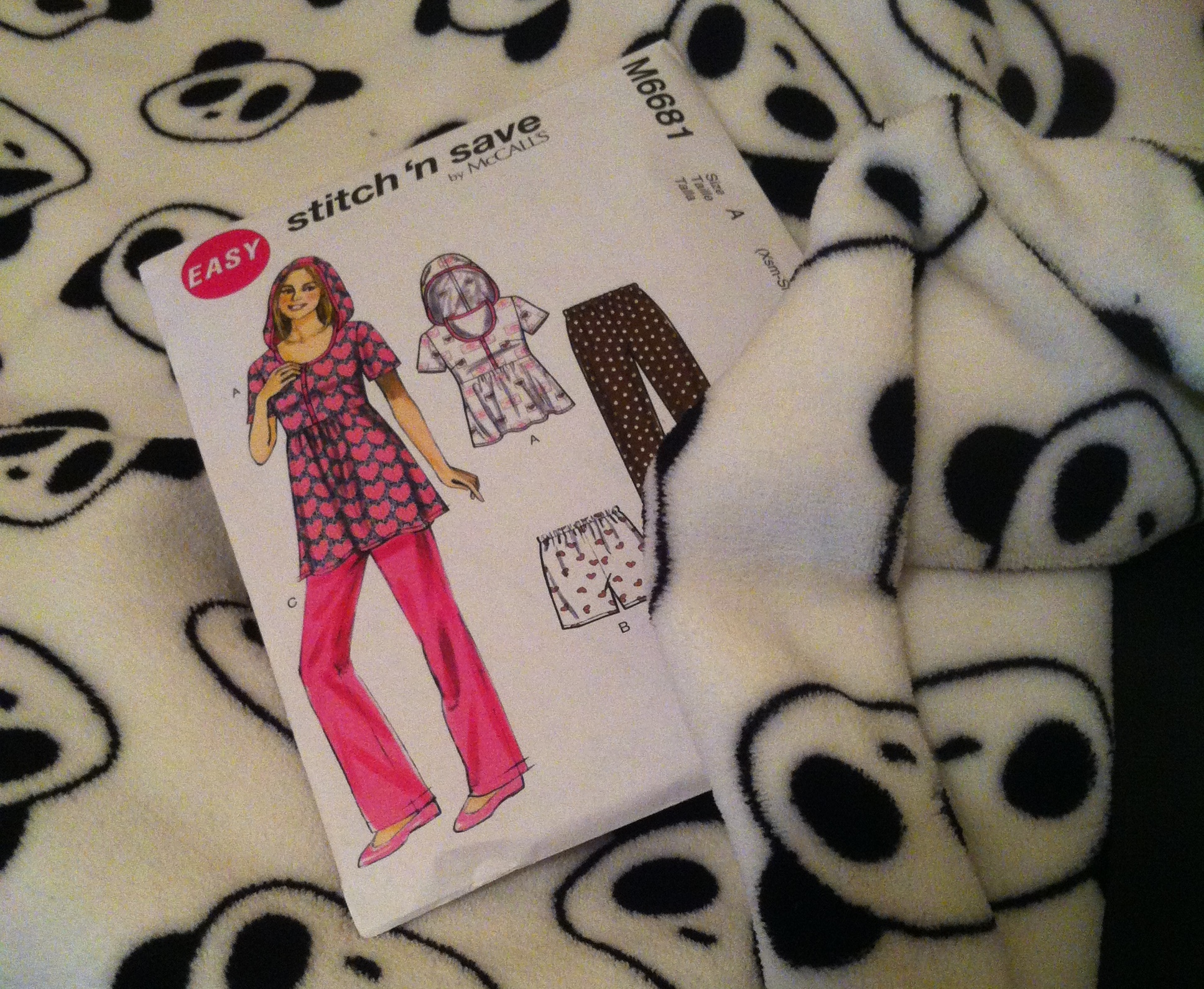
So, after a bit of stash rummaging, I settled on McCall’s 6681, a Stitch ‘n Save pattern that I can’t quite decide if it’s cute, or just dated and butt-ugly. Anyway, the bottoms were a completely basic PJ trouser, which is what I was looking for. As it turned out they’re a teeny bit tapered, which I thought might suit the kids these days.

Batpants!

Batpants!

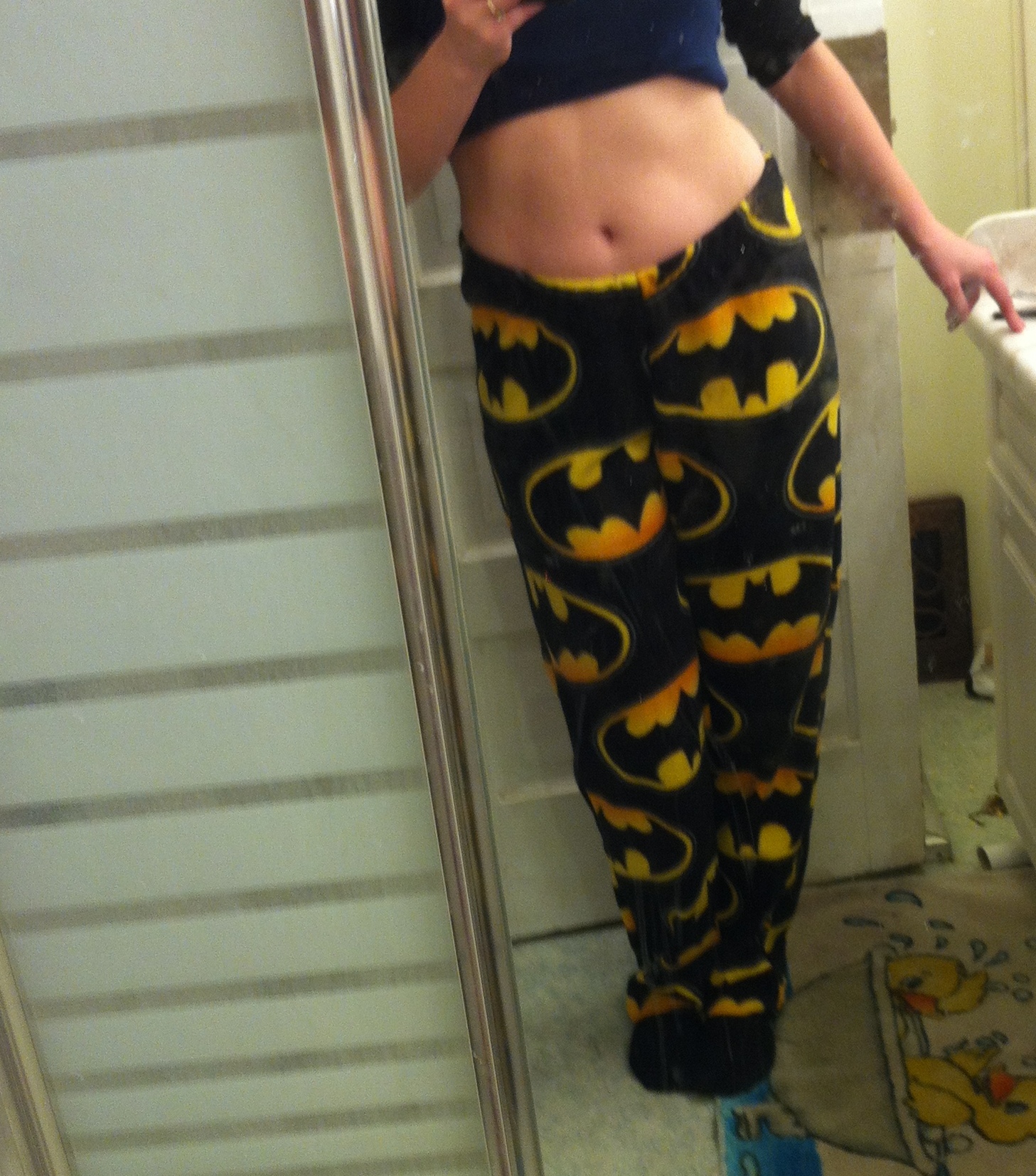
Despite the deliciously-soft panda fabric featured throughout this post, the first Christmas pair was made with Batman fleece. This was a rare score, indeed, since Fabricland has had mostly bugger all for licensed anything the last couple of years, so I had to snaffle it up when I saw it, since this year Tyo is All Batman All The Time. I’m not terribly into taking on pop-culture as totem or mascot, myself, but, well, I suppose there are worse mascots she could adopt than Batman. And this was a LOT easier than the Pikachu onesie.

Now, while one of the major downsides of having a teenage daughter is her ability to steal your clothes, in making these as a present, it became a bit of a boon—I made them to fit me, just a little bit shorter. It worked fairly well, though I should’ve made the waist a bit more snug—not sure if that’s to be blamed on my comparatively-larger waist (do you see the hips on that kid?), or the way the elastic stretches out a bit in sewing. Anyway, they aren’t going to fall off. And she was very, very happy with them.

So, when I finally dug out this panda fleece (purchased a year ago last fall, originally for Tyo before she came down with a bade case of Pikachuitis) to make a pair of comfy pants for Fyon’s birthday (who is eight now, by the way, how the hell did that happen?), I figured I should make Tyo a pair too, for old time’s sake, even if pandas are so year-before-last. Since I had the pattern all ready to go ‘n everything.

The pandas will get you if you don't watch out!

The pandas will get you if you don’t watch out!

So I did.

Tyo-fitting pattern changes

Tyo-fitting pattern changes

Being the second make, I tweaked the pattern a bit, finalizing the changes I’d made to the rise the first time. I make these changes kinda preemptively to a lot of pants patterns, especially when I know they were designed for a higher rise in the front than I like. (I’ve become comfortable with a very uneven rise, nice and high for lots of coverage in the back, dipping low in the front to sit under the belly. Tyo seems to like it too, but it makes it really hard to wear most storebought pants and leggings. For this pair, I added a bit of length (depth? I always forget which it is) to the back crotch, as well, just for good measure.

The front.

The front. I forgot to get her to hike her shirt so you could actually see the rise.

Now, I’m certainly not going to be a fit-Nazi about some baggy PJ pants, but I am pretty pleased with how they turned out, anyway. No smiles and straining, but not so huge she’s swimming in them. How much can be credited to my alterations and how much to the fact that these are loose PJ pants, I don’t really know (I suspect mostly the latter, though.) And no, I didn’t even try to pattern-match panda-faces across her butt.

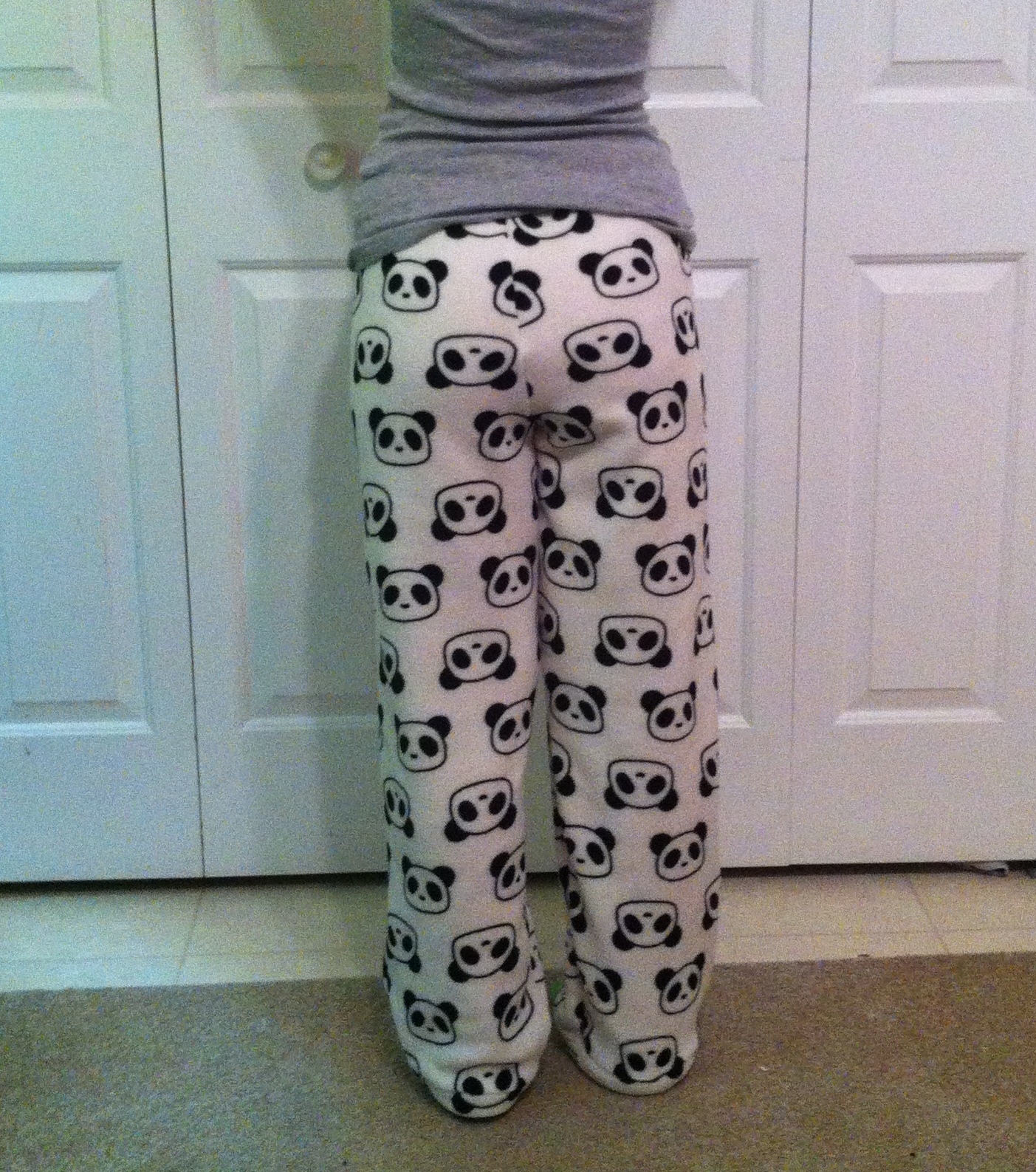
The back.

The back. Also, why can’t I have hips like that? /momsulk

The back hangs almost straight, and the rise is nice and high.

The side.

The side. You can kinda see the angle of the waistband under her shirt.

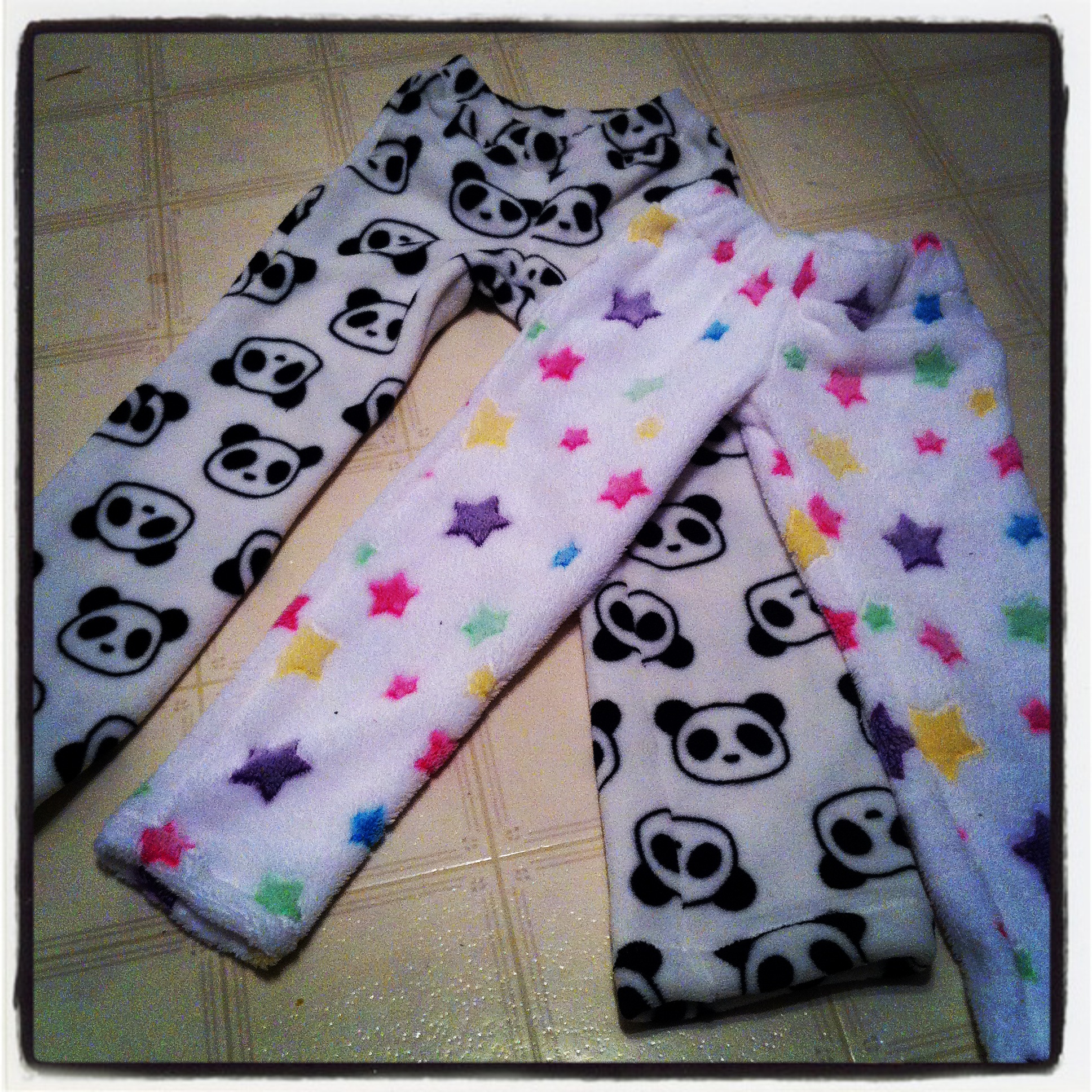
The best thing about PJ pants like these is how damn fast they are to put together. These didn’t take more than an hour all told (it helped that the pattern was ready to go, mind you), and I also managed to churn out a couple of fuzzy pants for Fyon and the Waif. And I think I have just enough panda fabric left to make some 3/4-length comfies for Syo.

Small fuzzy pants

Small fuzzy pants

There’s only one problem: Osiris is now wondering where his panda pants are.

4 Comments

Filed under Sewing