Tag Archives: finished projects

Skinny cargoes: a tale of obsession

We won’t go into the state of my house or how neglected my children are, all right? I promise I’ll stop. Ok, slow down. Real soon. Really, really, soon.

But in the meantime, while I was only planning to show you this:

A good start on the skinny cargoes

it turns out that I couldn’t tear myself away, and now I can show you this:

Skinny cargoes

Yup, they are finished. Pretty much. I’m still debating opening up the inseam again and adding topstitching all around the big cargo pockets. And there’s some issues with the topstitching around the top of the zippers having to do with me picking a crappy construction order and not noticing I grabbed separating, not regular, zippers.
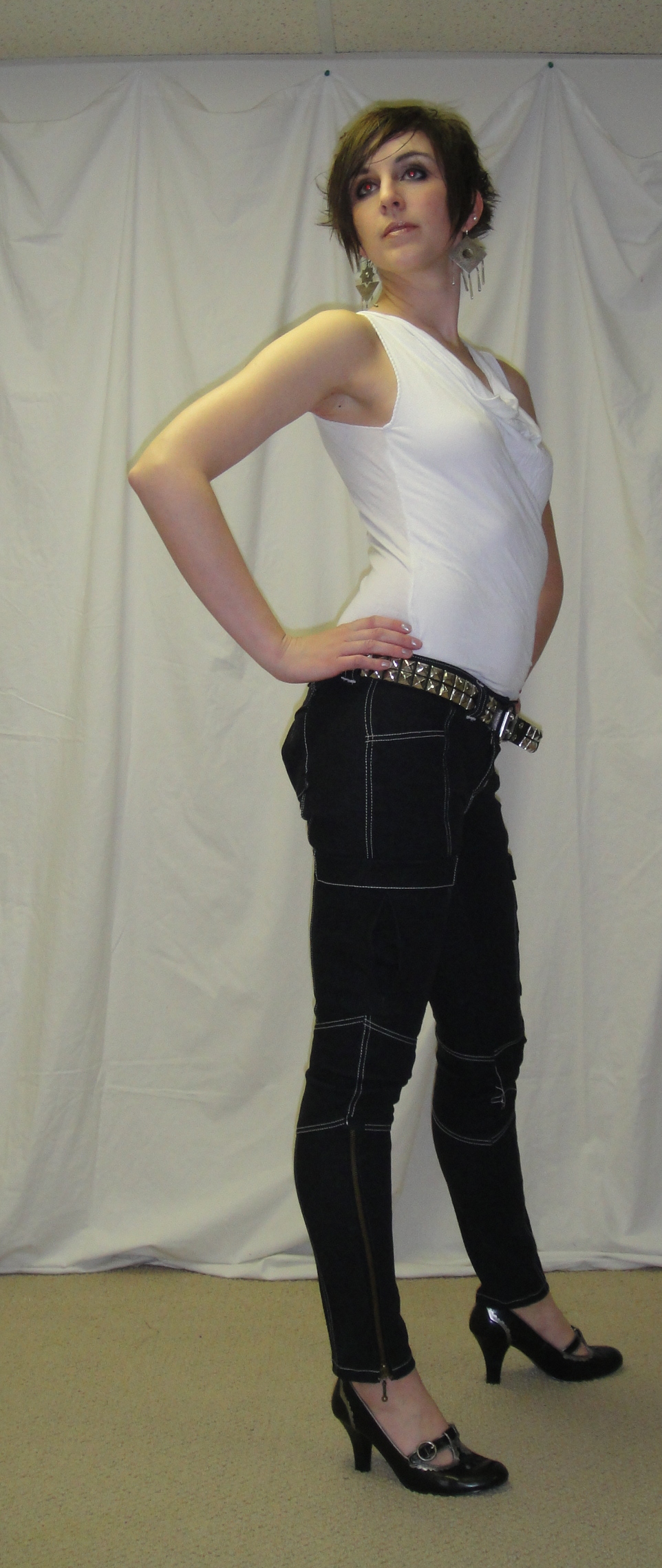
Very, very skinny cargoes

Anyway, process, right?

As you may recall these pants were inspired by both Yoshimi and Amber’s recent takes on the skinny cargo. Amber, in particular, went into great detail on the construction of her knock-offs, and mine are essentially knock-offs of her knock offs.

I started, natch, with my particular version of the Jalie 2908 stretch jean pattern. Now, I feel a bit bad pimping this pattern (not that it’s a bad pattern, or doesn’t deserve pimping) because my version is distinctly altered. In particular, I went down a size, lowered the rise, darted the yoke, narrowed the leg to straight below the knee, and replaced the straight waistband with a contour one originally cribbed off the Ellen pants. Also added five inches or so of length, but that sorta goes without saying. So if you see my jeans and decide to order the pattern, well, you’ll have a bit of work ahead of you.

Anyway, I have previously produced at least four versions (for me) from this pattern, all of which are staples of my wardrobe (except for the capris, which I can’t wear right now due to weather, and the red-topstitched ones, which were out of commission after I pulled the pull of the zipper a month or so ago. I hate mending, but finally got to it earlier this week.)

Now, turning this jeans pattern into a skinny-cargo pattern required a bit of work. First
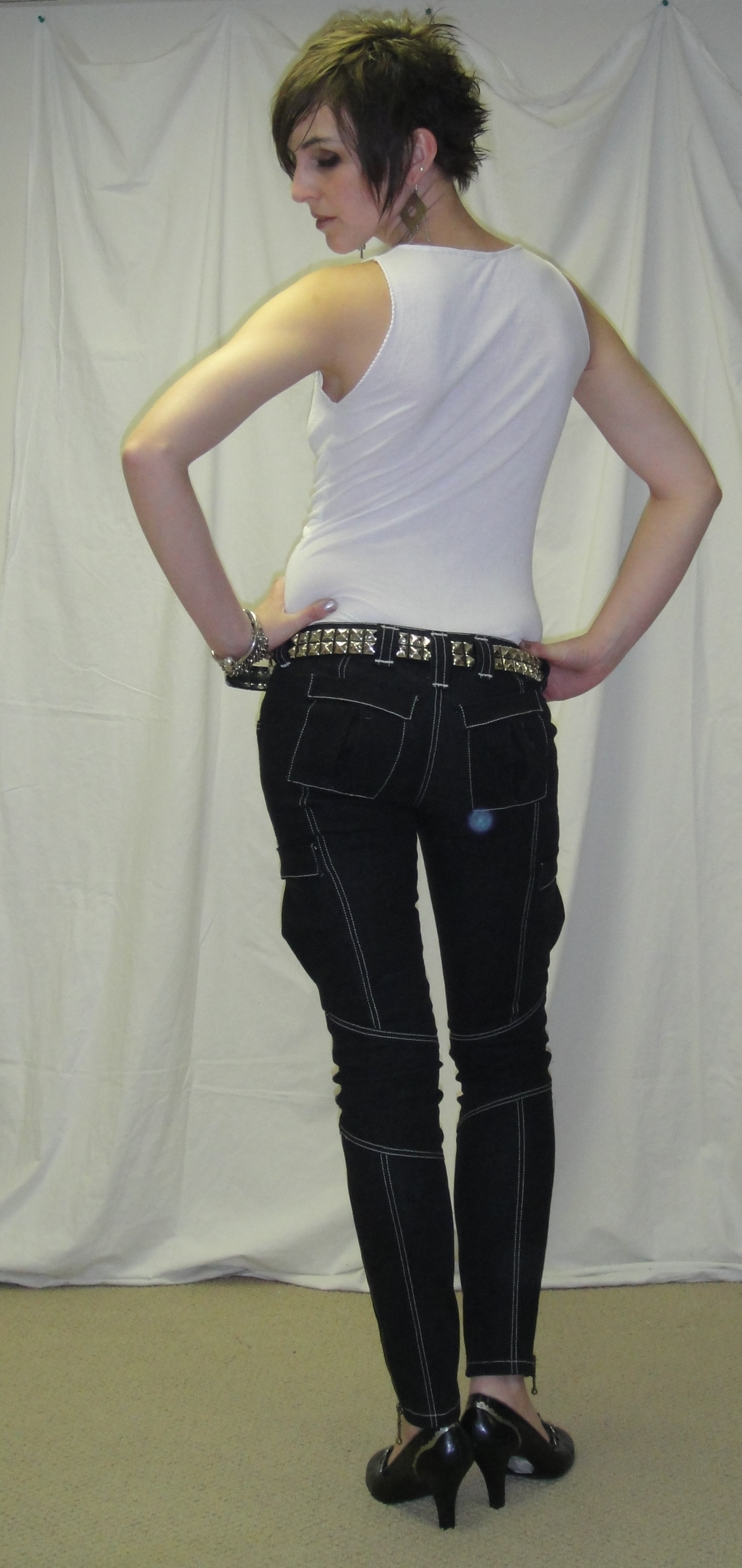
Skinny cargoes: rear view

off, as I traced out a version of my Jalie pattern, I had to figure out how to replace the yoke with a regular back with darts. I sorta winged this, and thanks to the mercy of stretch denim it seems to have worked. I also had to figure out how to reconstruct the front pocket area, but that was pretty straightforward. Then it was a matter of deciding where I wanted my seams to run (much referring to Amber’s post on the matter), hacking up this version of the pattern, labelling where I needed to add seam-allowances (not to mention up, down, inseam, and outseam), and re-tracing all my pieces with their proper seam allowances. Whew! I took the opportunity to incorporate my rear darts into the back seam, as well as adding a bit more butt-shaping, although I can’t really tell if that was successful as it is covered by the back pockets. I removed one cm off each side of each seam at the ankle, for a total of 8cm around the whole ankle, which made it pretty narrow, although I suspect I could still get my foot through without the zippers. The zippers make them VERY easy to put on and take off, though.

I can’t decide if having the pattern in so many itty bitty pieces saves fabric or not. Jeans are pretty economical at the best of times, so with the added fabric required for seam-allowances, maybe not.  Plus there’s those big pockets eating up fabric.

Because there were so many pieces and in particular the lower leg pieces are almost identical, I opted to cut and assemble the entire front and then the entire back. This is fine, except that I should’ve incorporated the side zipper in the lower leg into the original construction of the front instead of ripping out topstitching to fit it in later. But, we live and learn. Seeing as it’s only been a few days since I last installed a fly front zipper, I didn’t even need to look up the tutorial on it! It helps when you’re wearing jeans while sewing… I find I look down a lot to reference which side the stitching should be on ;). I opted to make the fly angular to echo the slanted hip pockets. Nothing to do with it being easier than a curve. Nothing at all.

Side-seam zipper

Once I had the front and backs assembled and topstitched, I had to do a bit of thinking. I couldn’t find a good reference on how to insert exposed zippers into a seam (though I didn’t look terribly hard). I decided for simplicity’s sake I wanted the zipper to fall in the front part of the pants, not straddling the seam evenly. Then I discovered that the cute little zippers with the nice little bauble at the end I picked up last weekend were, in fact, separating zippers.

I toyed with the idea of going back and getting different zippers, but I really like that bauble. I do wish these zippers came in silver (to go with my topstitching thread), but the selection at Fabricland is a bit limited. /sigh. Maybe I should’ve topstitched along the edges of the zippers, too? I think I was having topstitching fatigue by this point.

Because of the cargo pockets, I figured I needed to construct the outseam before the inseam. This is not as good for fitting as the reverse, but I was reasonably confident these would fit, due to the TNT pattern, so I went for it. The pockets were rather terrifying, I will say, especially getting them positioned and topstitched. Which is part of why I chickened out on most of the topstitching on the thigh pockets. We’ll see how much that irritates me in the days to come.

I almost always hit a point right before I’m able to try on a garment where I’m

You know black cargoes need biker boots and chain mail.

absolutely convinced it’s failed. It’ll be too big, too small, or just wonky looking. These were no exception—it was with immense relief that I wriggled into them the first time, discovered that the narrowed legs did indeed fit and that I could, in fact, zip up the zipper. Phew! This anxiety repeats again once I’ve attached the waistband. I tried a lighter waistband interfacing this time around, which was nice if only because it means I could make the buttonhole on the machine. On the upside, this iteration of the waistband is a nice width (some of my previous version were a little narrow) and doesn’t gape at the back. Yay!

Styling these is… interesting. My first effort, with the white cowl-neck top and the heels, is fine but a little, ah, mainstream? Doesn’t really feel like me. Nothing some biker boots and a little goth gear won’t fix. Ah, yes. Much better.

Stylin'

And I mustn’t forget to credit my delightful photographer:
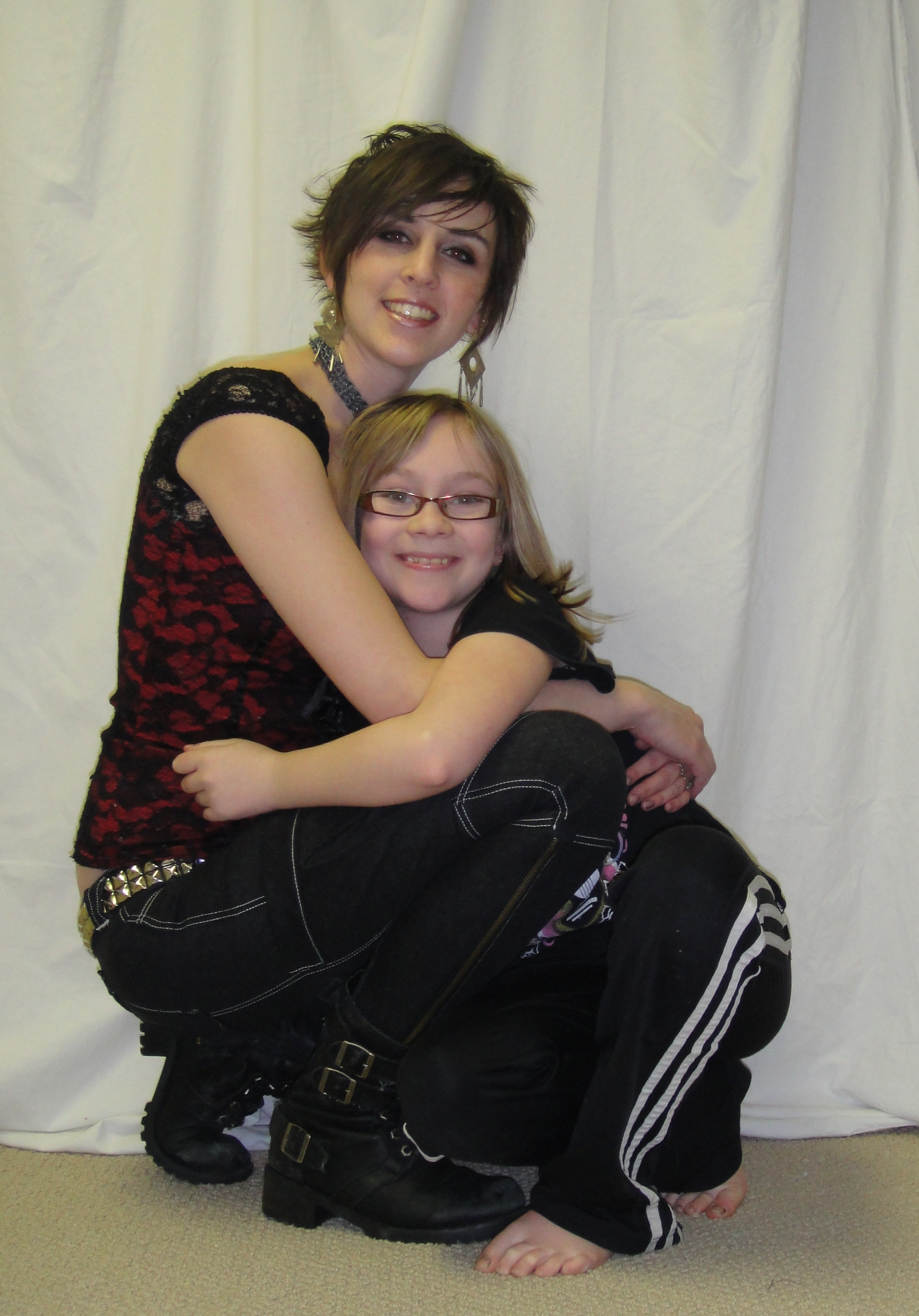
Me and my photographer

In exciting men’s sewing news, my hubby has consented to having the shirt muslin finished for a comfy wear-around-the-house shirt, now that I’ve enlarged the collar. Which means I might actually get photos of it at some point… though probably not for a few weeks as he leaves tomorrow.

25 Comments

Filed under Sewing

The jeans of many sizes

Possibly subtitled “the best laid plans…”

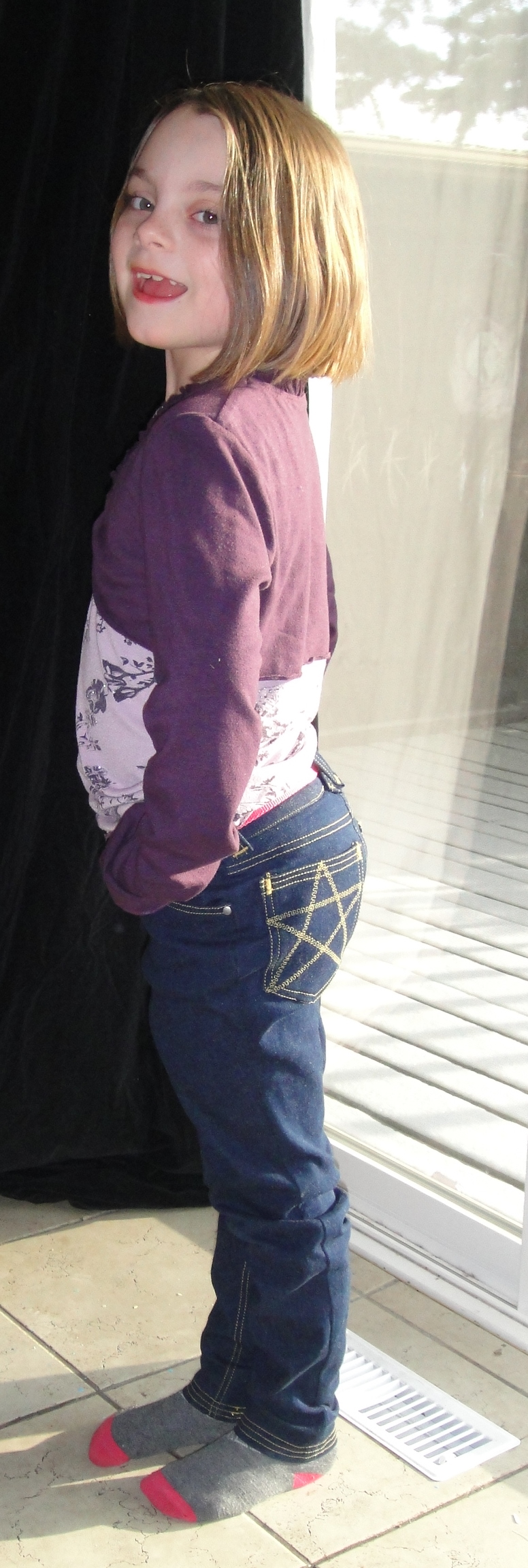
Instructions: "Look cute."

In a fit of obsession yesterday afternoon, Syo and I decided to tackle her jeans. The project was simple; all the materials were on hand: one traced version of Jalie 2908, size K (aka 7); one metre of dark blue stretch denim; gold jeans topstitching thread, and a little metal zipper.

The pattern is the same size I traced out for Tyo’s jeans last spring, which she had outgrown by August. Syo is now wearing these jeans, quite comfortably, so I was feeling pretty confident about the fit. They would probably be a bit long, but otherwise shouldn’t be problematic.

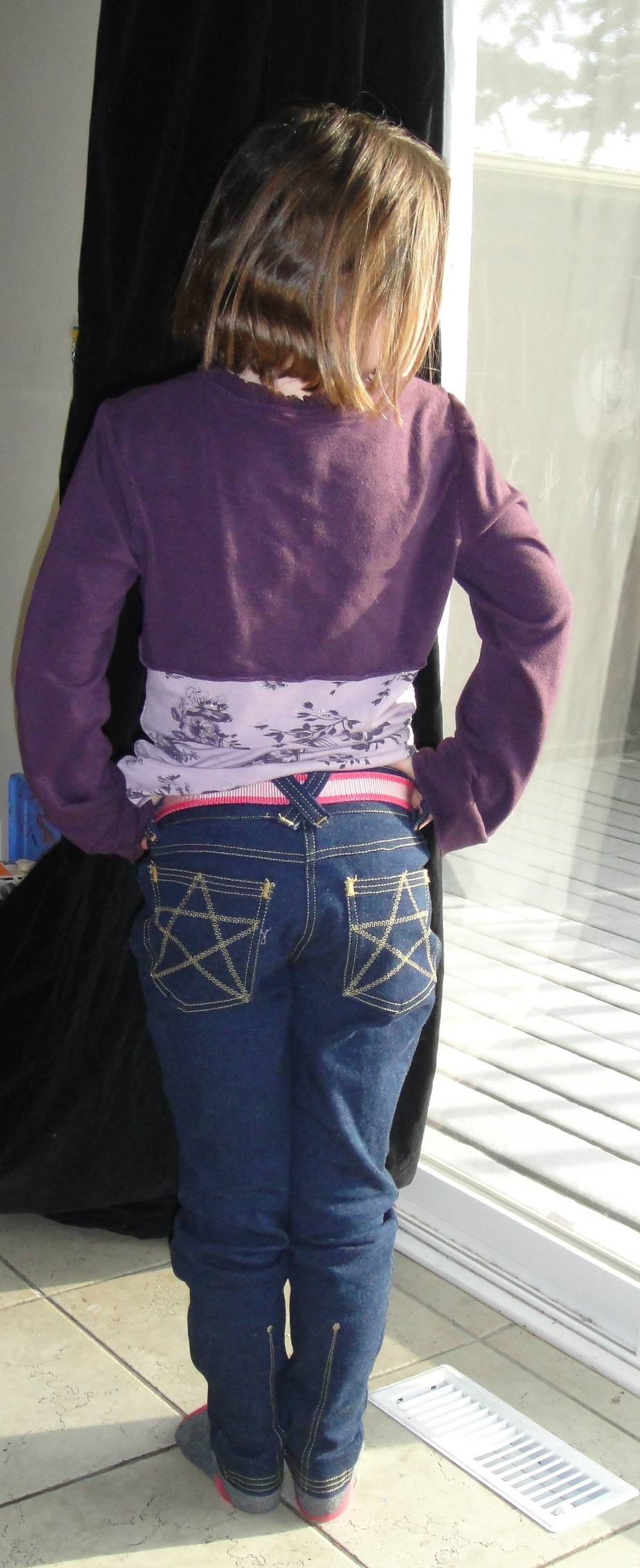
Syo required only one, simple alteration. Tyo’s jeans had been flares, the pattern’s basic shape. Syo’s must be skinny. Yes, my seven-year-old is much more on-trend than my ten-year-old. Which probably says everything you need to know about their respective personalities. So I measured what seemed like a reasonable distance out from the midline of each ankle, drew a line that angled out to the knee, and we folded the pattern in along that line. Just in case Syo wants a pair of flares in the future (not likely, but this is how I roll). Oh, yeah, I double-checked my reduced width with the circumference of her pointed foot, to make sure she could still get her feet through. All seemed good, so we set to cutting it out.

Syo really wants to be able to sew. And cut out fabric. Unfortunately, the fabric shears

The back

are still too big for her little hands. This didn’t stop her from doing her best with the embroidery scissors on the pocket lining, and she actually did an excellent job, but man, it took forever.

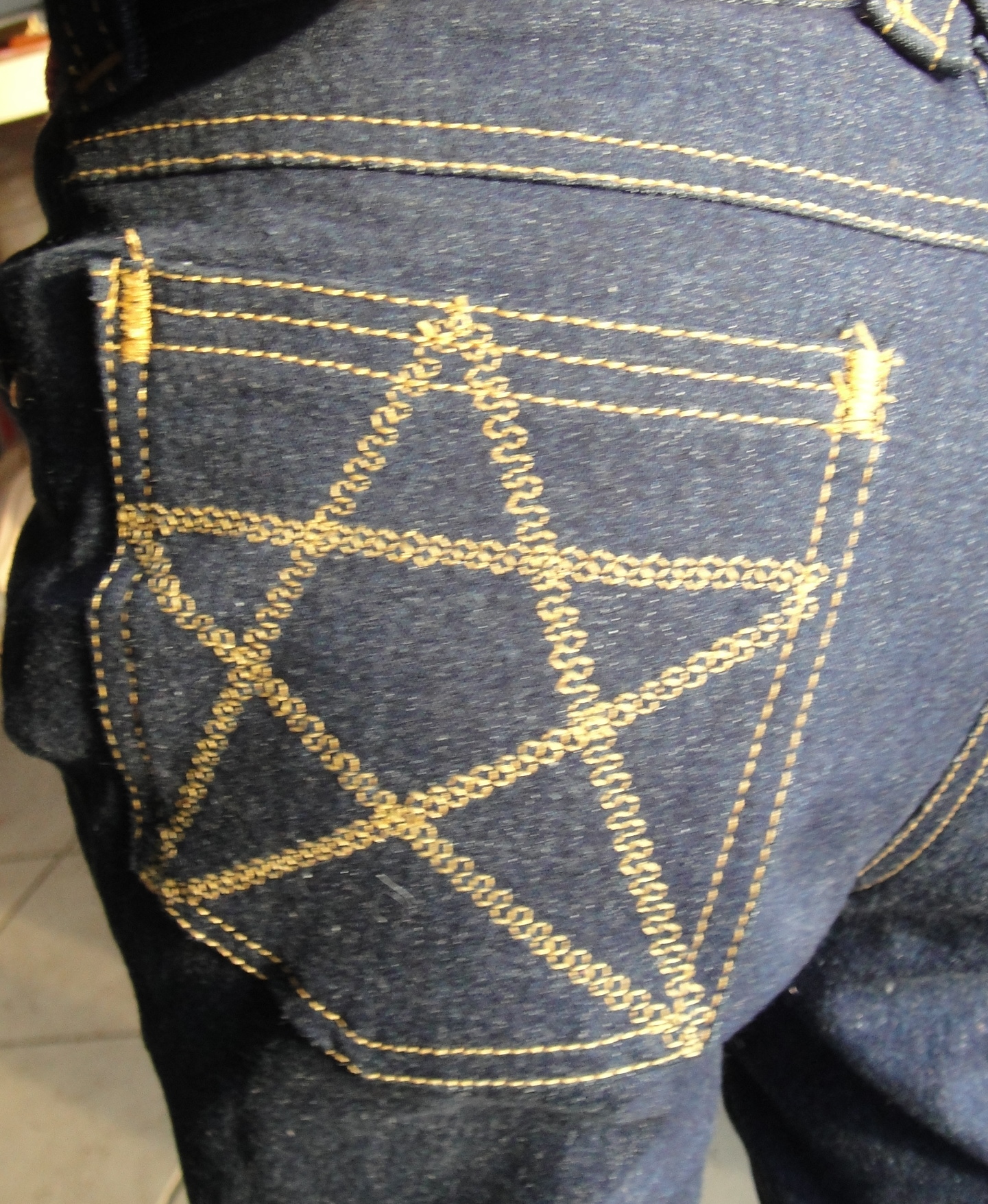
Pocket closeup, with fancy stitching.

After much discussion, we settled on stars for the back pockets. The first pair I made Tyo has stars on the back pockets (stars are nice and easy to embroider on stretchy denim when you don’t have an embroidery machine and are too lazy to stabilize your fabric).

This is the first pair of jeans I’ve made since I got my serger back in order, so it was my first chance to remember to serge seams after sewing, but before  topstitching. I mostly managed this. (Note: this pattern only has 1 cm seam-allowances, so you need to serge without cutting anything off or your second row of topstitching may not catch the seam-allowance.)

I like the Guterman jeans thread; it’s not as heavy as their topstitching thread, so

Side view

doesn’t require dirty tricks to get the upper tension high enough on my machine. Still, I can tell that my newish Janome doesn’t quite have the balls of the Grand Old Dame when it comes to stuff like this. The Dame would eat projects like this for breakfast—the Janome I have to baby along here and there. And this is with really thin denim.

I only hit one hitch in the construction, when I realized I’d cut the size Q back yoke (my size) rather than the size K. I think the size K yoke piece may have evaporated… oops. Another reason why I love tracing my patterns. However, I was pretty sure the outer width of the yoke was pretty close, so I just trimmed the wide, inner portion to fit. If there is any actual difference in the size, it’s well within my usual cutting-inexactitude; the side pieces went together just fine.

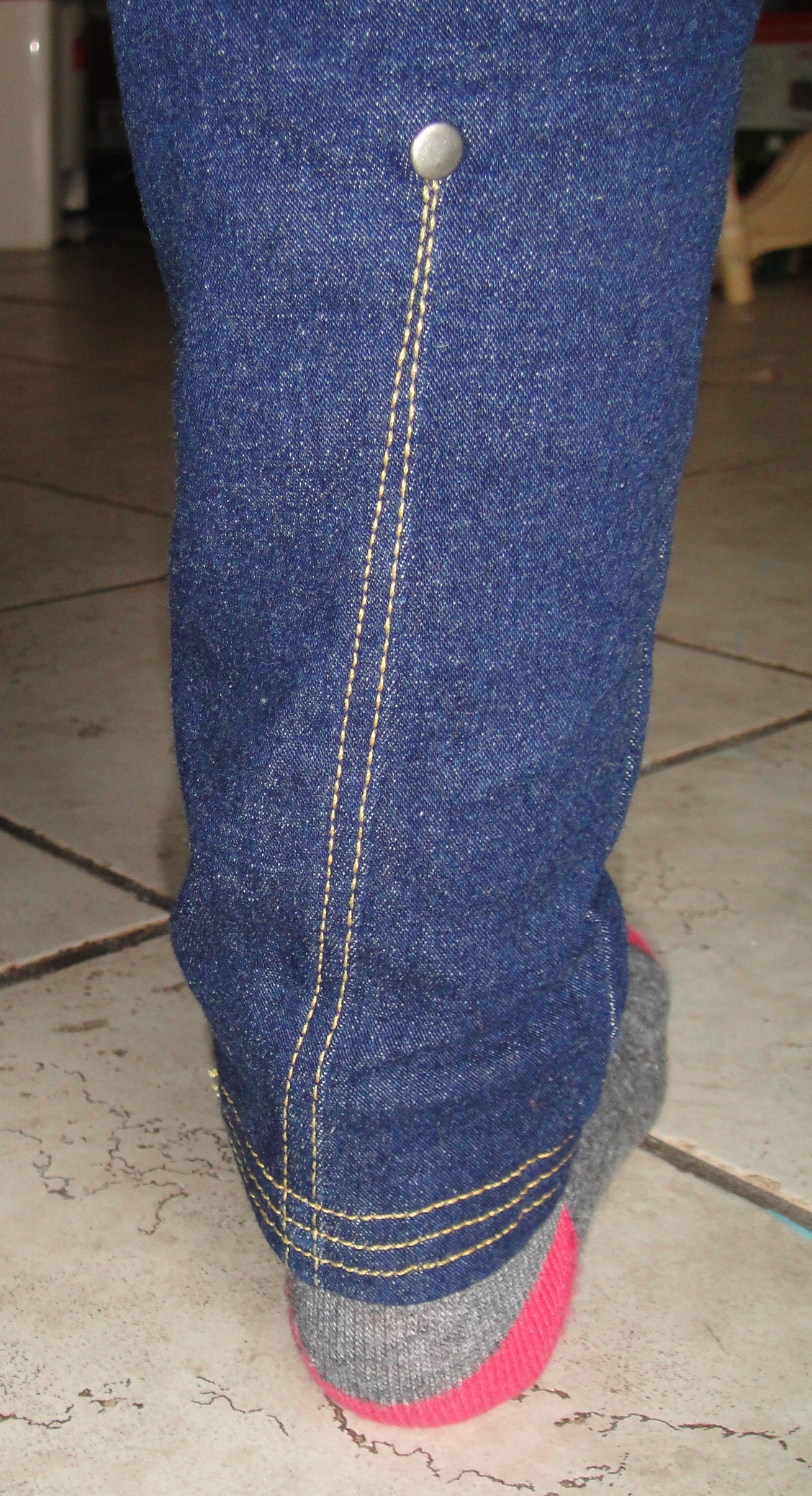
Calf detail

Oh, yes, and I added in a detail on the back lower legs ripped off from some RTW skinny jeans owned by one of Tyo’s trendier friends: basically a long, thin topstitched dart with a stud at the top of it, forming a very small amount of shaping below the calf. I keep meaning to do this on jeans for myself, but forgetting as it has to be done quite early in the process. It wasn’t as hard as I thought it might be, though, though I suspect my studs are not perfectly aligned.

With the aid of Debbie Cook’s tutorial, I once again achieved near-perfect fly insertion. I actually had double-sided wonder-tape to use to stick the zipper down this time, and it was very nice indeed, although using pins instead really isn’t that terrible either. I did manage to put it in backwards (so girl-version, as opposed to boy/jeans version), but in my defense this is because I was matching the topstitching direction of the crotch to the one I’d already done on the rear of the pants, and I find it pretty much impossible to think that far ahead. The moral of this story is that I should probably construct the jeans front and fly before the back.

My straight-stitch topstitching is getting so good!

Fly... almost perfect.

My around-pocket and around-fly stitching… not so much. Perhaps I am sloppy because they’re for the kid… I’d like to think I wouldn’t wear such shoddy work.

I can’t promise anything, though. I’m pretty lazy about un-picking.

I sewed up the outer sideseams, and Syo came to try them on…

and they were HUGE.

Now, I don’t want to repeat my mistake with Tyo and make pants she’ll outgrow in three months. But these are supposed to be skinny jeans, not tapered-but-baggy jeans. I took in the side-seams by a cm on each side (so 2cm off each leg).

Better, but not perfect. Take another cm off. Hrrm. Well, maybe that’ll do. Keep in mind this is the same pattern as the other pair she’s wearing that are actually getting a wee bit tight. The only thing I can think of is that the first pair shrunk, which isn’t impossible, but I have a pair of my own out of the exact same “denim” that I’m still wearing just fine, and I promise you I definitely haven’t shrunk.

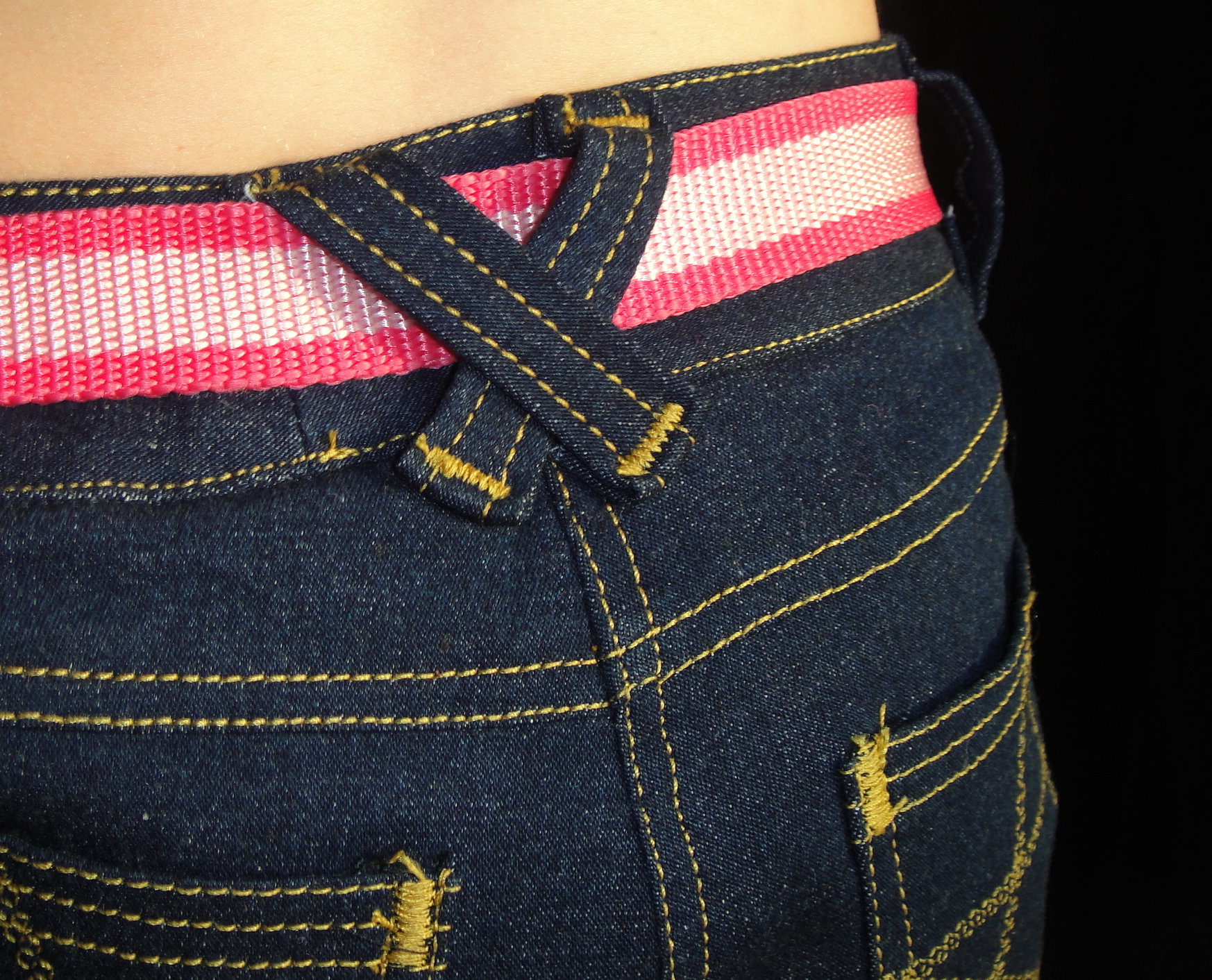
CB belt loops. Can you spot the booboo?

Putting waistbands on kids jeans is so much more relaxing than putting the waistband on a pair for me. For one thing, I use the pattern’s straight waistband piece, instead of my own contour band (coopted from the Ellen pants, if you must know). I also didn’t bother with interfacing. The only thing to remember was to put in buttons and buttonholes for the attaching of the buttonhole elastic. I did have one problem with the sizing, as my waistband wound up being too short to centre the CB seam on the back and cover the fly-extension. Maybe I’m doing something wrong with the fly extension, although what I end up with seems to be the same as what I see on my storebought jeans, so I don’t know what. Rather than fuss around, I gave in and put the CB seam of the waistband about an inch off of the true CB seam. It’s a problem, but it’s mostly covered by the belt-loops anyway.

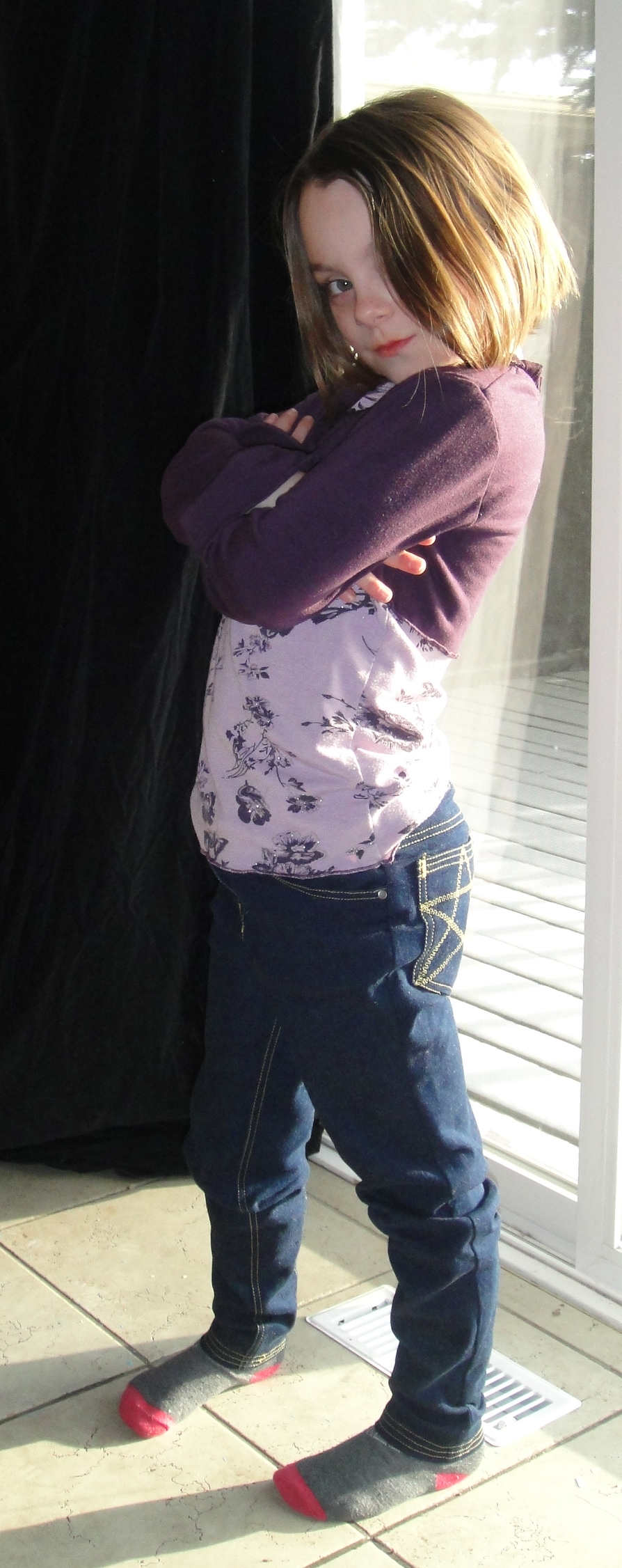
Her coolest pose.

Finally, all that was left was to hem them to an appropriate length. This is always dicey with children, and skinny jeans are even worse than flares in this department. In the end I opted for a length that would be floor-brushing in socks if they weren’t being pulled up by the front of her feet, and just folded the excess 2″ of fabric under, topstitching three times to make sure it’s well in place (this mimics the three rows of topstitching on the top of the pockets, so it’s a design feature, right?). In theory this means that when she hits her next growth spurt and grows three inches by summer, I can let out the excess length. In practice, we know this’ll never happen, but hey, allow me my fantasies, all right?

Also, Syo was very helpful in the hammering of rivets, and only hit my thumb once. And Steph, the awl from your sharp and pointy giveaway kit is divine. How on earth did I live without it?

So that’s one more project down on the “madly off” list. Which leaves, mainly, shirts for my hubby and those skinny cargoes! If I can get the neck alteration figured out for the hubby’s shirt before he abandons me, I can putter away at that until he gets back. And I think I’ll take a stab at the drafting for the cargoes this weekend, if I can find paper I like for it. I’d rather use craft paper than tissue paper for stuff like this.

14 Comments

Filed under Sewing

Oops…

Circle skirt, take two

I did it again.

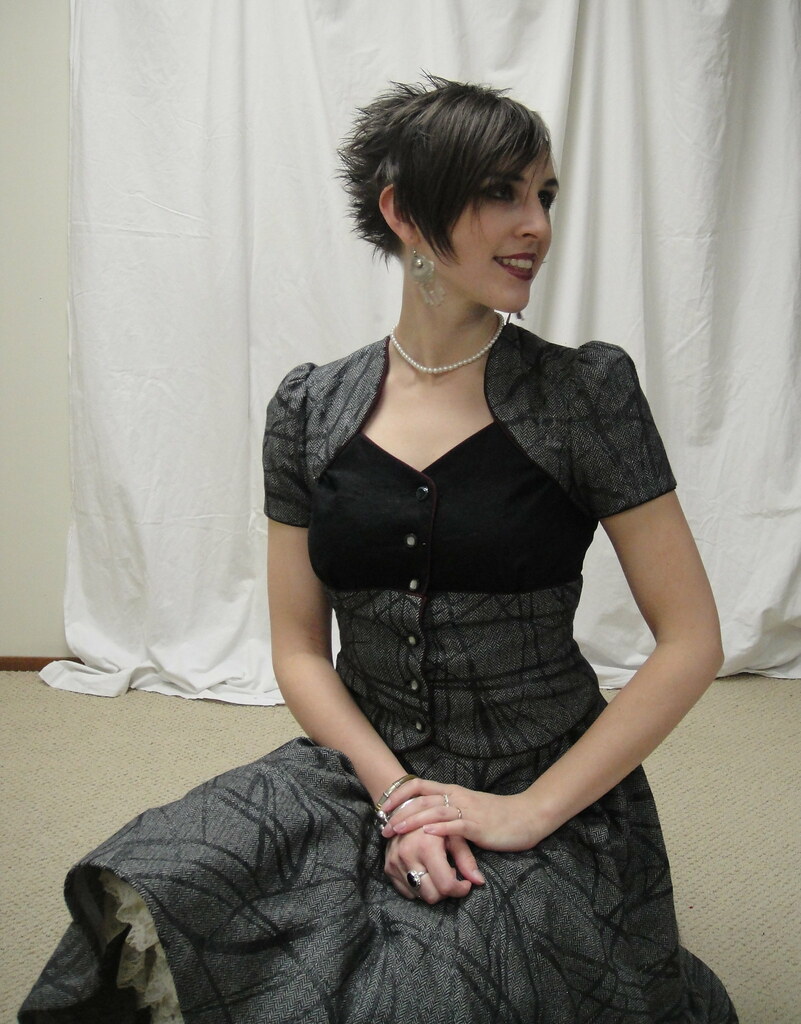
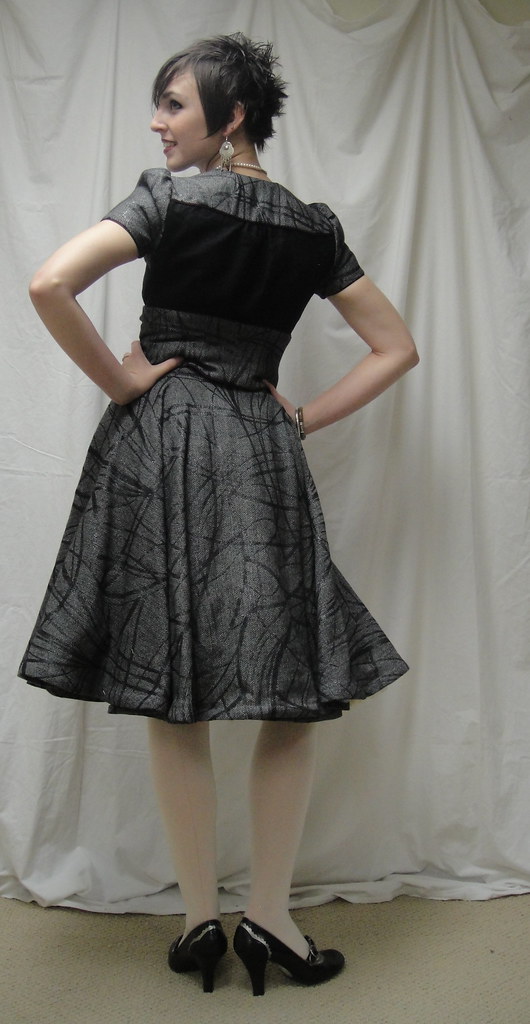
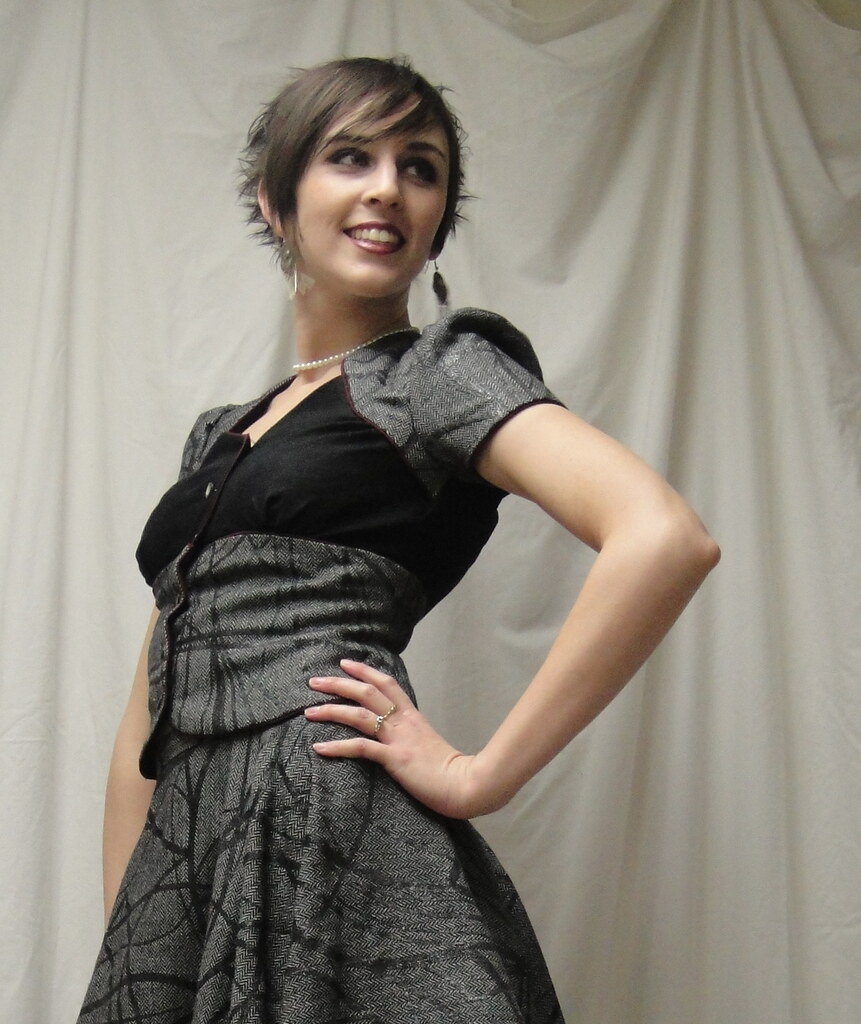
Yup, despite deadlines and a myriad of other things I should be working on, I finished the corset-waist circle skirt. (Sorry, Liza-Jane… I promise I’ll get to those skinny cargoes soon!)

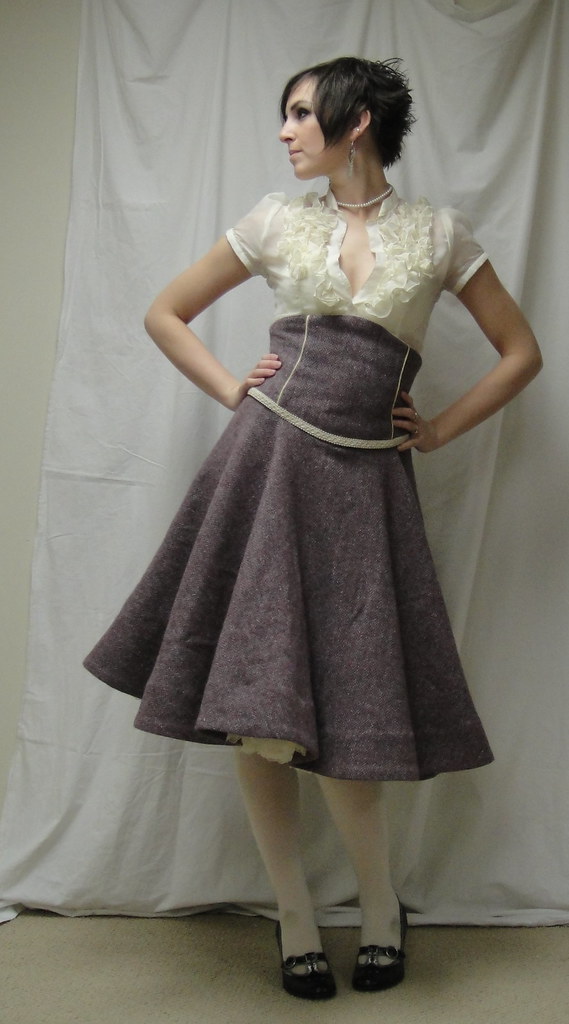
I used the Ceylon midriff pieces as my basis for the “corset” portion, with, obviously, a fair bit of alteration: I put the centre-front on a fold, added a sinuous side-front seam, and completely forgot to allow for overlap in the back, which is now the opening portion. Fortunately, the amount of ease you need in a blouse is considerably more than what works for corset-style waist panels, so there was plenty of room for overlap. I made my lining piece first, out of a sturdy cotton ex-curtain also used here, adjusted the fit on that, and went from there. I added notches to all the tops of pieces, which made it much easier to keep track of how they should go together.

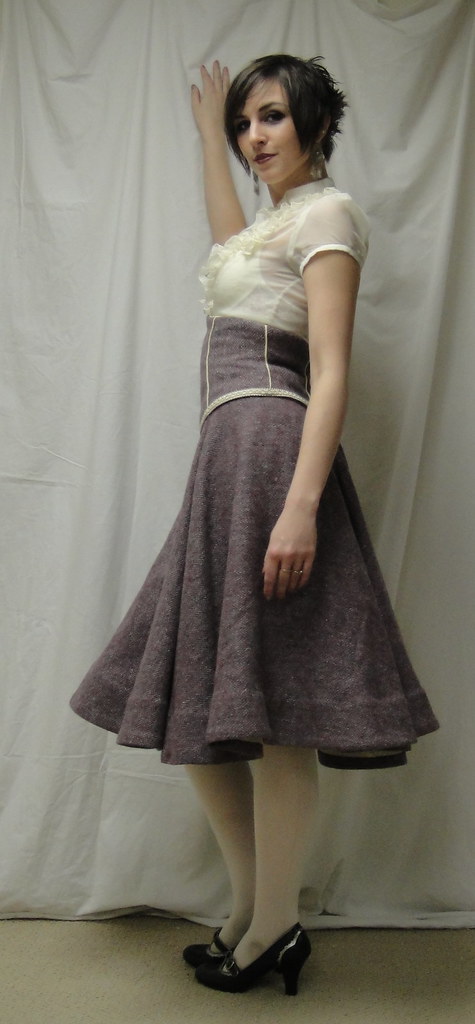
Side view

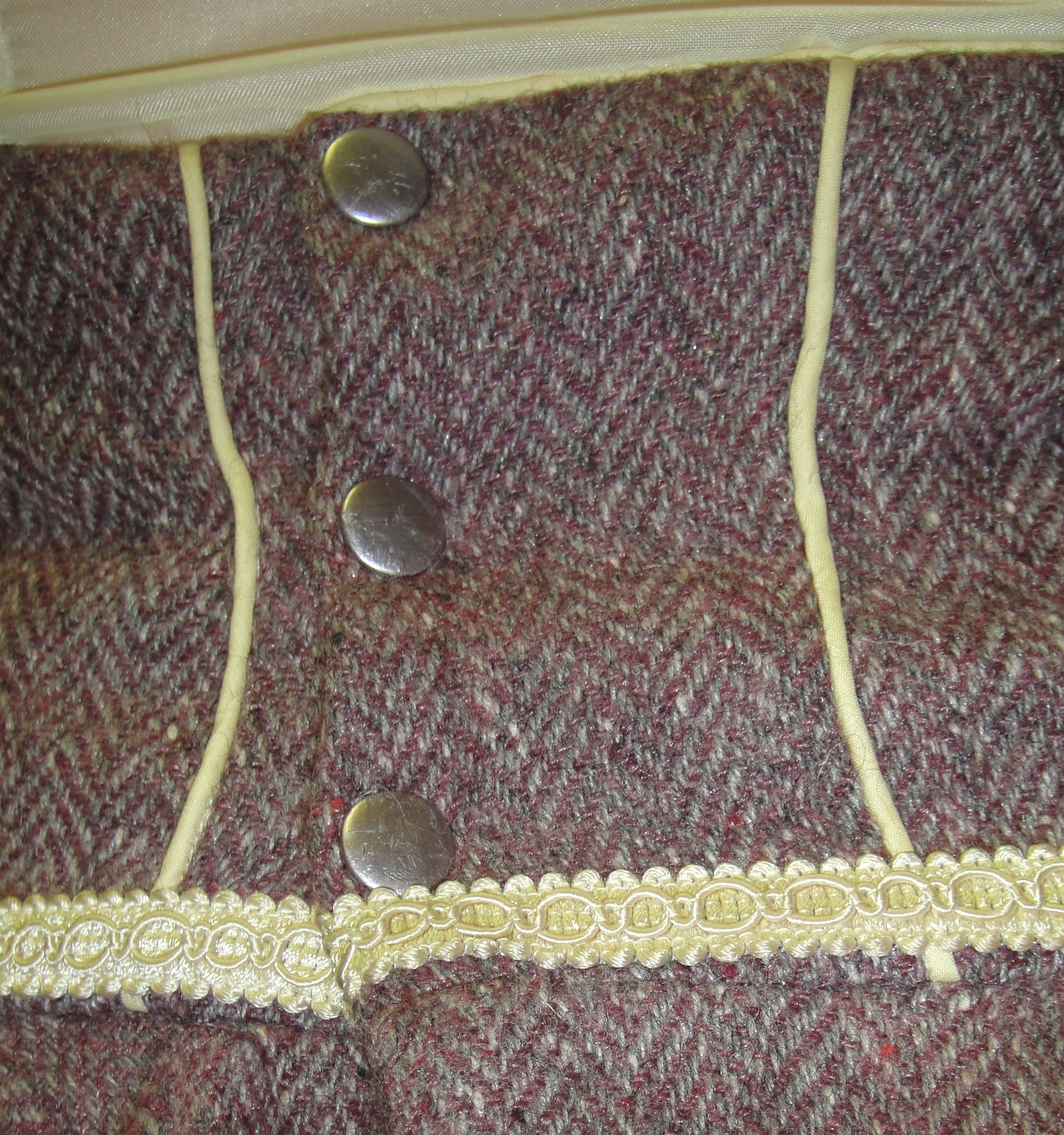
I piped the seams on the corset portion, using a narrow off-white piping from one of my thrift store scores. Unfortunately, I only had the one packet of this and, although I measured my seams first, apparently I screwed that up royally because I didn’t have enough left for the bottom seam. So I waffled a bit and ended up adding this home-dec trim from my stash. In the past I’ve always stitched this trim on by hand, but I was lazy and machined it this time. I can’t say that I notice a difference, even from up pretty close, except perhaps that my positioning isn’t quite as exact as it might have been.

I mentioned before, I elected to use snaps as the closure here. Time will tell as to the wisdom (or folly) of this decision. Way back when I was sewing the original circle skirt, I had posted a question on PatternReview about how to insert the zipper. I got great answers, but also the suggestion of a snap-placket as a vintage-style alternative. So I determined I would give it a try on my next circle skirt.

Now, I will say, the snap-placket would have worked better in a thinner fabric. This wool is quite heavy, more of a coat weight than a suit weight, and getting even the most heavy-duty snaps through multiple layers of it was a pain in the ass. And a double-fold bias strip of the wool (so that’s like five layers!) is really, really bulky. That being said, I really like the idea, and will try it again in a more summery fabric. On the up-side, because I was using snaps, when I discovered on first try-on that there was way too much ease in the “corset” portion to hold it in place properly, it was easy to run another row of snaps up further in, instead of having to pick out and adjust piped seams or, worse, a zipper.

Snap placket (top portion). I painted the snaps with matching nail polish.

I don’t know that the snaps are ideal for the “corset” style either, though, as due to the small amount of ease they’re under a lot of strain. For now they seem to be holding—they are heavy duty, after all—but I’m not convinced they’ll make it in the long run. We’ll see. Converting it to a laced closure or something at some point would be a pain in the butt, but not impossible, I guess. (Note to self… hang on to some of those scraps in case you need a modesty panel for behind the lacing…)

As I mentioned before, I opted to pass on boning mostly as I’m too lazy/disorganized to procure any (or cable ties, either, as Ms. Slapdash so smartly pointed out). I used hair-canvas interfacing, hand-basted in place, with the “hairs” running vertically in at least some of the pieces (read: the ones where I remembered). This makes the waist nice and firm, but I can see that I might keep a smoother line longer with boning. Again, not impossible to add later if I feel the need…

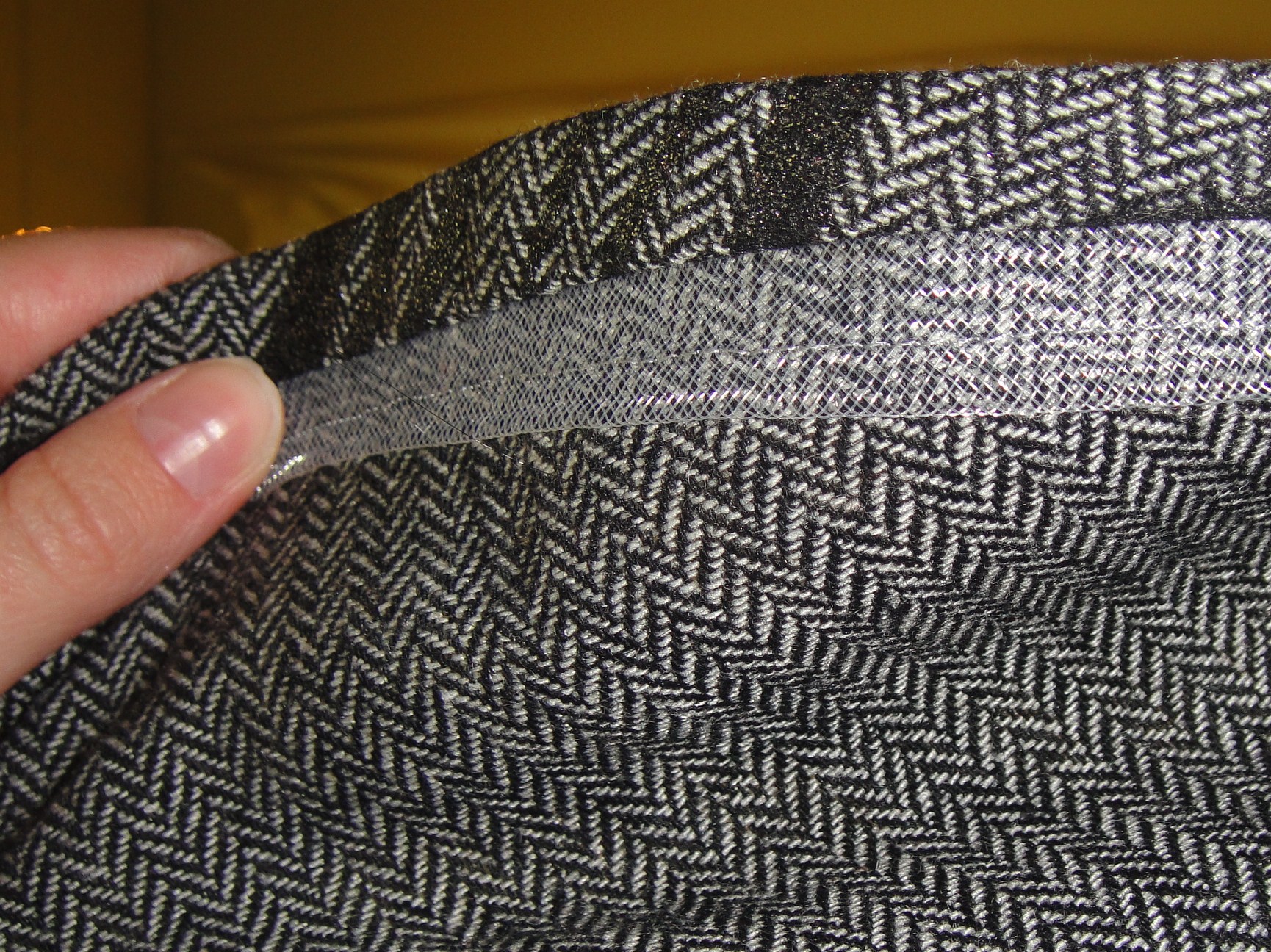
So now we come to the hem. I was quite happy with my experiment with horsehair

Hem interfacing... bound and circled

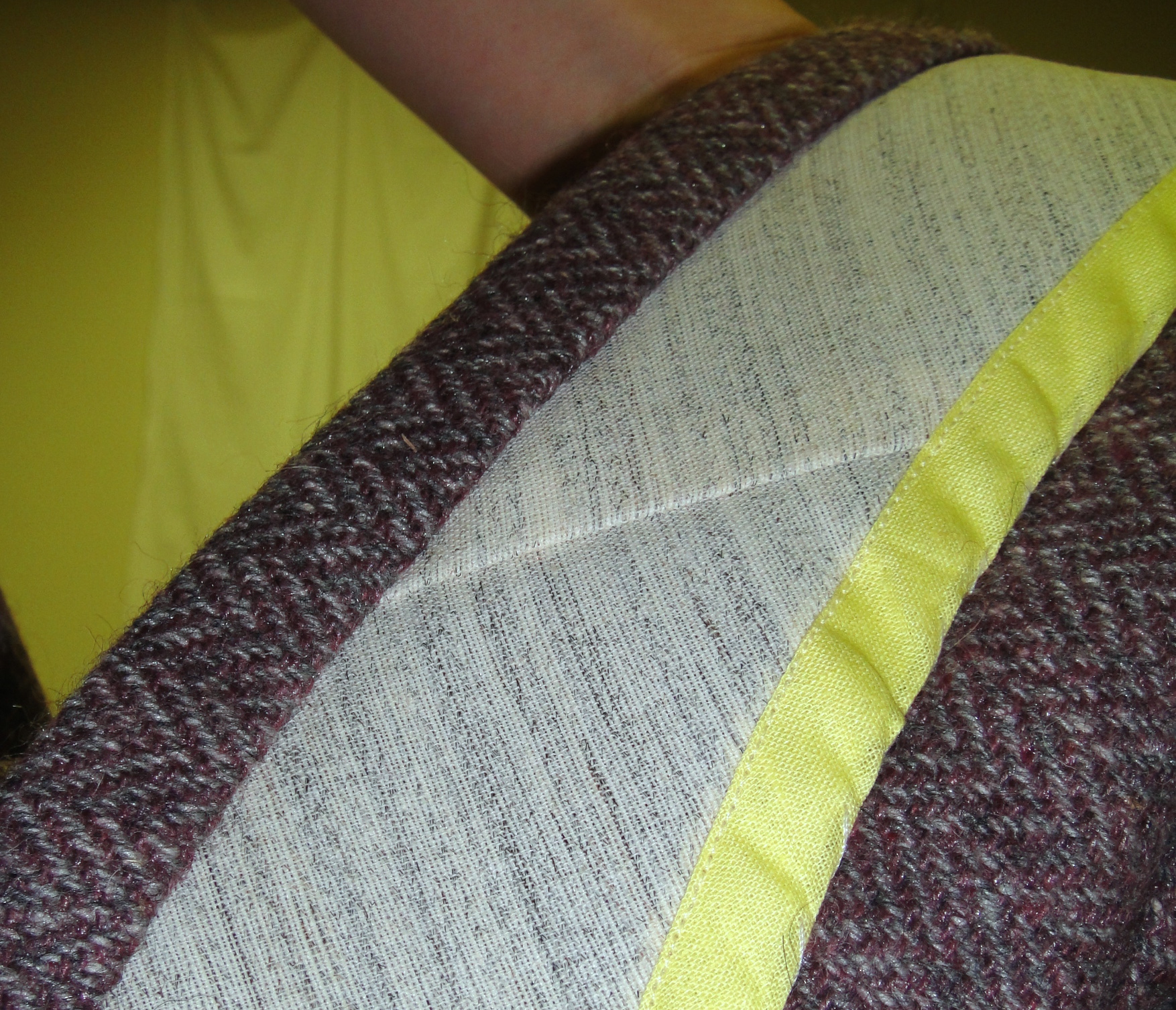
braid last time, but as I mentioned before it’s a bit tricky to source locally and I’m (again) too impatient/disorganized to order online. Not saying I never will, but not for this project. So, since I still have plenty of hair-canvas kicking around, I decided to give bias interfacing a try. I measured and cut three-inch bias strips of the hair canvas. I will say, cutting bias strips out of hair canvas is much less annoying than out of regular fabric—it’s nice and stable and hardly skids around under your pencil at all. I then sewed the pieces together into a long strip (and managed to only sew two pieces on wrong-way round 😉 ) and ironed to “circle” it—just pulled it into a curve while ironing. The stuff goes incredibly soft under the seam-iron, but firms up again perfectly when it cools, which is mostly nice but can be a little tricky. I then stitched some ready-made bias-tape along the inside edge of the “circle”, stretching the bias as I went. I picked this yellow because it was the only colour I had enough of other than red. I love red, but it wouldn’t really go with this project. Cream would’ve been perfect, but I didn’t have any. (if I had, I would’ve turned it into piping for that last corset seam, anyway). And where else am I going to use six yards of yellow bias tape, anyway? (this is another of those thrift-store “scores”)

Finished hem

So now I had my interfacing ready, I basically followed the rest of Gertie’s tutorial for applying horsehair braid. The only trick was to make sure to remember to start with the seams in my bias interfacing facing up, so that when flipped to the inside they’d be hidden. Ironing the hem down once it was flipped was in some ways easier than with the horsehair braid—the hair canvas won’t melt under the iron—but in other ways harder, as the hair canvas gets really soft when ironed and I had to be careful that the seam allowances weren’t getting folded and crunched. Still, with a bit of care and pinning, I got it all folded over and steamed so that the upper and lower seams were about the right circumference.

I opted to hand-stitch the hem this time, rather than topstitching, which worked

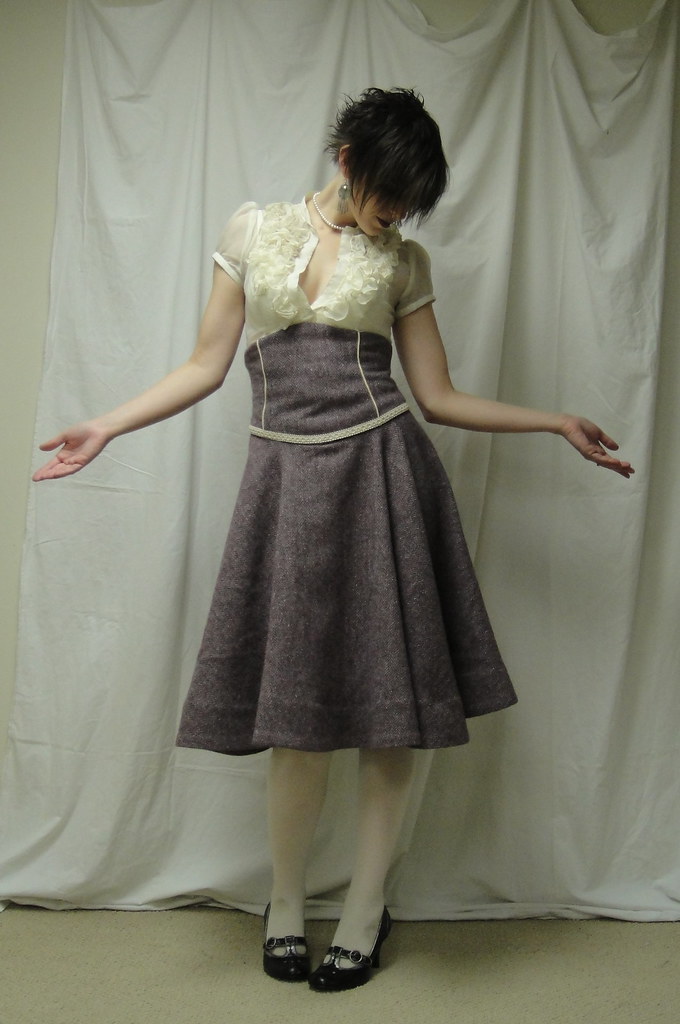
Full skirt!

reasonably well and only took two TV shows. I’m sorely tempted to run a band or three of the same trim from the waist around the edge, but that might be a bit over the top and would take a lot more of the trim than I have kicking around. We’ll see, I suppose. 😉

So this project fits with my “spring palette,” which isn’t a formal part of the Colette Spring Palette Challenge, but is in line with a palette that I’ve been playing around with intermittently for a while now. As is demonstrated by the colour scheme of this entire website ;). The main colours are cream or ivory and a muted, dusty blue (sometimes veering towards a pale aqua), but this light, dusty purple fits right in as well. It’s not far off Sunni’s palette of choice, either, although I don’t know that I’ll be incorporating her caterpillar green ;).

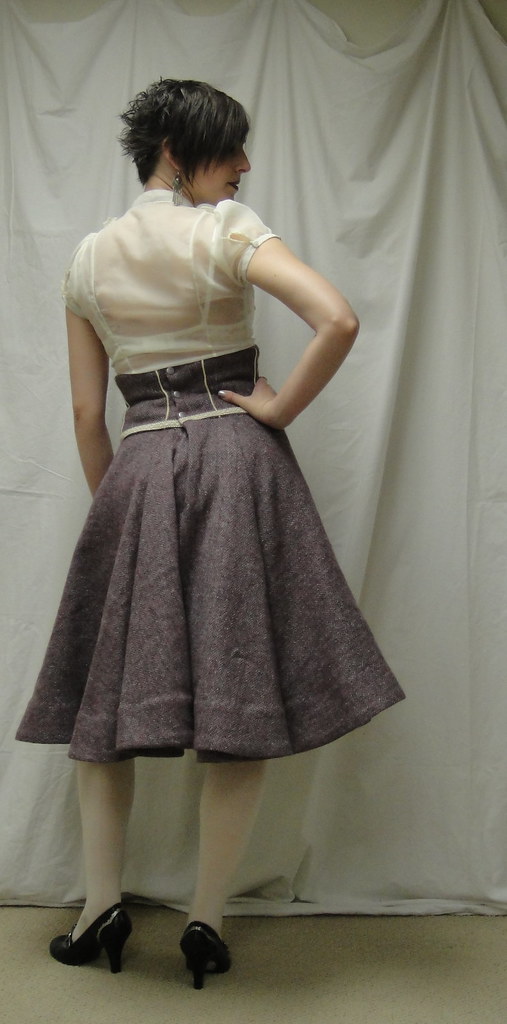
Back view

I absolutely love the skirt with this blouse, though I’m thinking I’m a little old for the sheer-blouse-over-bra look. Still, fun for a photo shoot, anyway. I’ve been keeping my eyes open at the thrift store for a perfect pair of ivory shoes to go with this palette, but nothing’s really thrown itself at me yet. Light-colour shoes get banged up and turn drab so quicky, I may need to hunt around new-shoe stores… though I hate to buy new a pair of shoes just for taking photos in… /sigh.

The back closure wound up a bit bunchy, partly because of the incredible thickness of the snap placket in the skirt part, and partly because of the overlap where I readjusted the size (which i why the snaps are closer to the left-hand line of piping, not centred between the two). As I don’t have to look at it, I’m not bothered by it ;).

As to whether heavy wool belongs in a “spring” palette… well, as far as I’m concerned skirts of any kind are spring wear. Heck, anything that isn’t quilted down is spring wear. So there. 😉

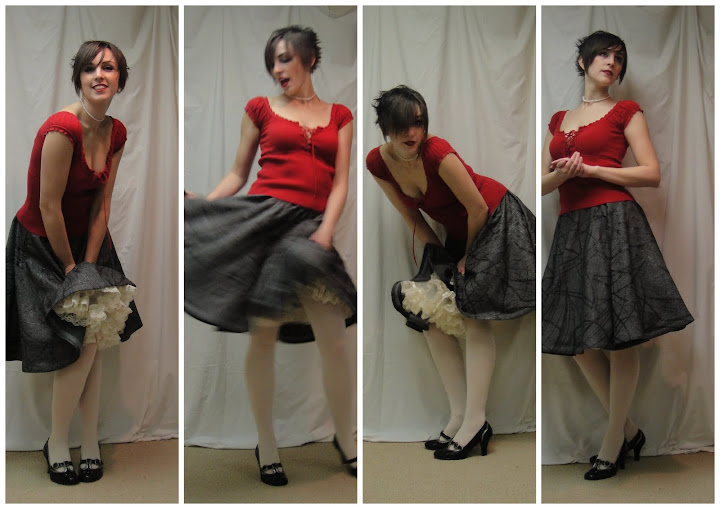
Oh, yes, and since some people like to see what they look like without the fluffy petticoat underneath:


Sans petticoat

Here you go. In this particular (heavy) fabric, with the interfaced hem, it’s actually not a striking difference. I have noticed one thing about wearing the petticoat, however—it makes a skirt much warmer, as its fluffiness fills in that air-space between legs and skirt remarkably effectively. Still not as warm as pants, but much better than a skirt without petticoat.

Next up: probably Syo’s skinny jeans. Poor kid seems to have the virus Tyo had last week, although her symptoms are totally different. Those of you with children, do you ever find that? Even when we had swine flu last year, Tyo and their dad had one distinct set of symptoms, while Syo and I had another. Yet I’m sure it was the same virus—their entire school was decimated for about two weeks. Although it would be nice if I could get the alterations figured out on my sweetie’s shirt this weekend, before he goes away… I could then present him with a completed shirt or two when he gets back. (Yes, I’m going to be single-parenting for a full two weeks! Wish me well… I’ve never had to do this before. Usually it’s me bopping off and leaving him with the kids…). Also I should really make another pair of jeans (or those cargoes 😉 ) before March kicks in…

23 Comments

Filed under Sewing

Skully Pants and Sleevy Plackets

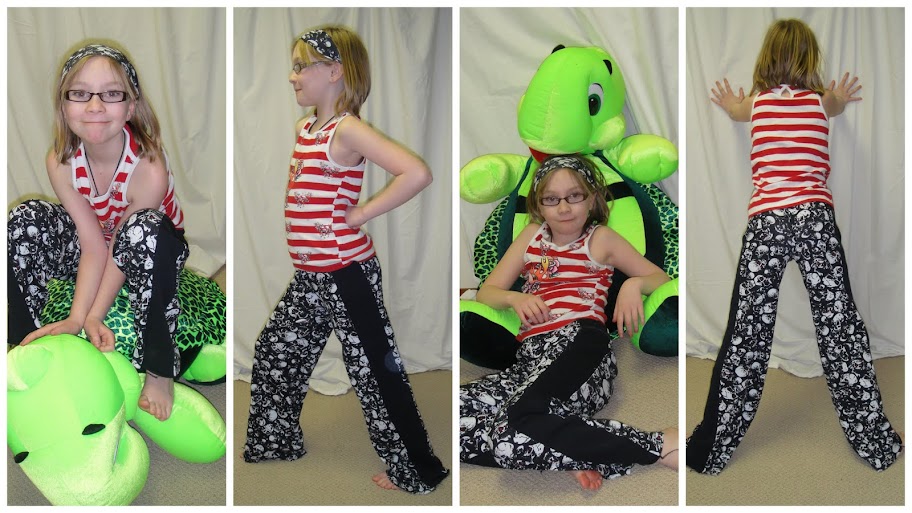
Tyo’s pants may now be unveiled! They still need hemming, but taking photos before hemming is practically a tradition around here…

Tyo's Skuly Pants. Poses by Tyo. Guest appearance by Slimer the Turtle.

And, y’know, they turned out ok. Especially considering my various screw ups (the original drafting, and then pinning the two edges of the fronts together instead of front-to-back and not noticing until Tyo had it all sewn up…)

Tyo did all the sewing, on the serger, except for the elastic casing, which I sewed in a stretch stitch on the regular machine. She was really unsure and irregular to begin with but by the last few seams she was getting much more consistent and steady. She threaded the elastic into the casing, too.

May I just say I detest this skull-printed fabric? It’s a thin, stretchy cotton rib-knit with no recovery, and the printed pattern is not as stretchy as the fabric, so it’s already looking worn and crappy anywhere that gets a bit of stretch.

In MPB Sewalong News

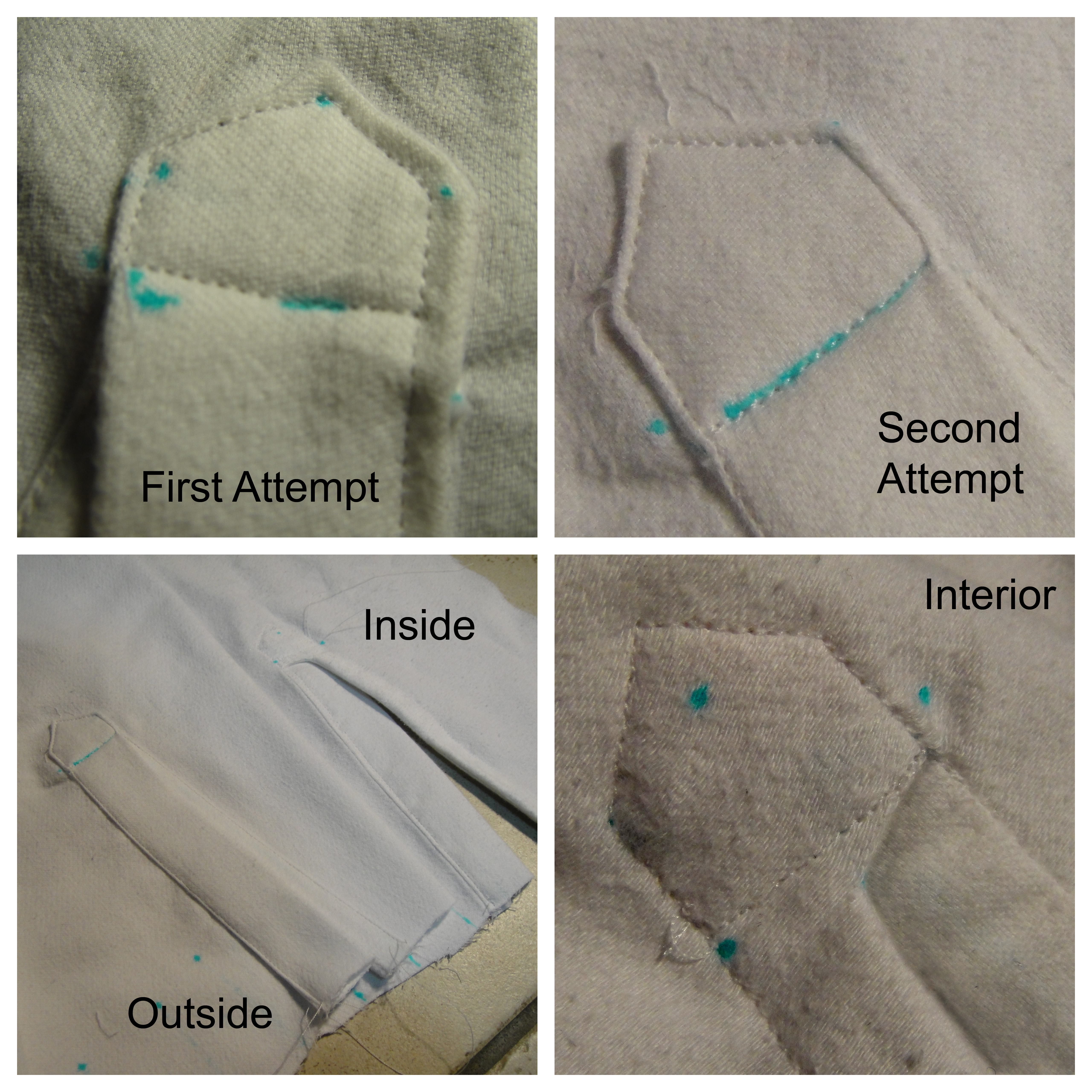
Shirt plackets: the ugly truth

I sewed my plackets! Urg. This is the kind of precision sewing I normally resort to hand-sewing to deal with, but obviously that’s not quite appropriate here. I tried using my blind-stitch foot for the topstitching the first time, as it has a keel that theoretically should help guide the stitching. I say theoretically because it’s mounted on a screw and doesn’t stay in place. Ever. Second attempt, I reverted to using my rolled hem foot, of all things. Something about the way the toes of the foot are positioned (not the roll part) works really nicely for guiding the fabric for perfect edgestitching.

Er.

This is me we’re talking about. Perfection and precision are not my strong suits.

I used washable glue-stick to try to hold the triangles in place, which worked better than pins, and might’ve worked better still if I had the patience to let it dry for a few minutes before sewing. I wonder if making a template to press the triangle top around would be worth it…

I made the row of stitches crossing the placket run just above the funny folded part on the inside (bottom right picture), but a quick inspection of my hubby’s RTW shirts shows that they run the stitch about 1/4″ below this. Will keep this in mind for the next version.

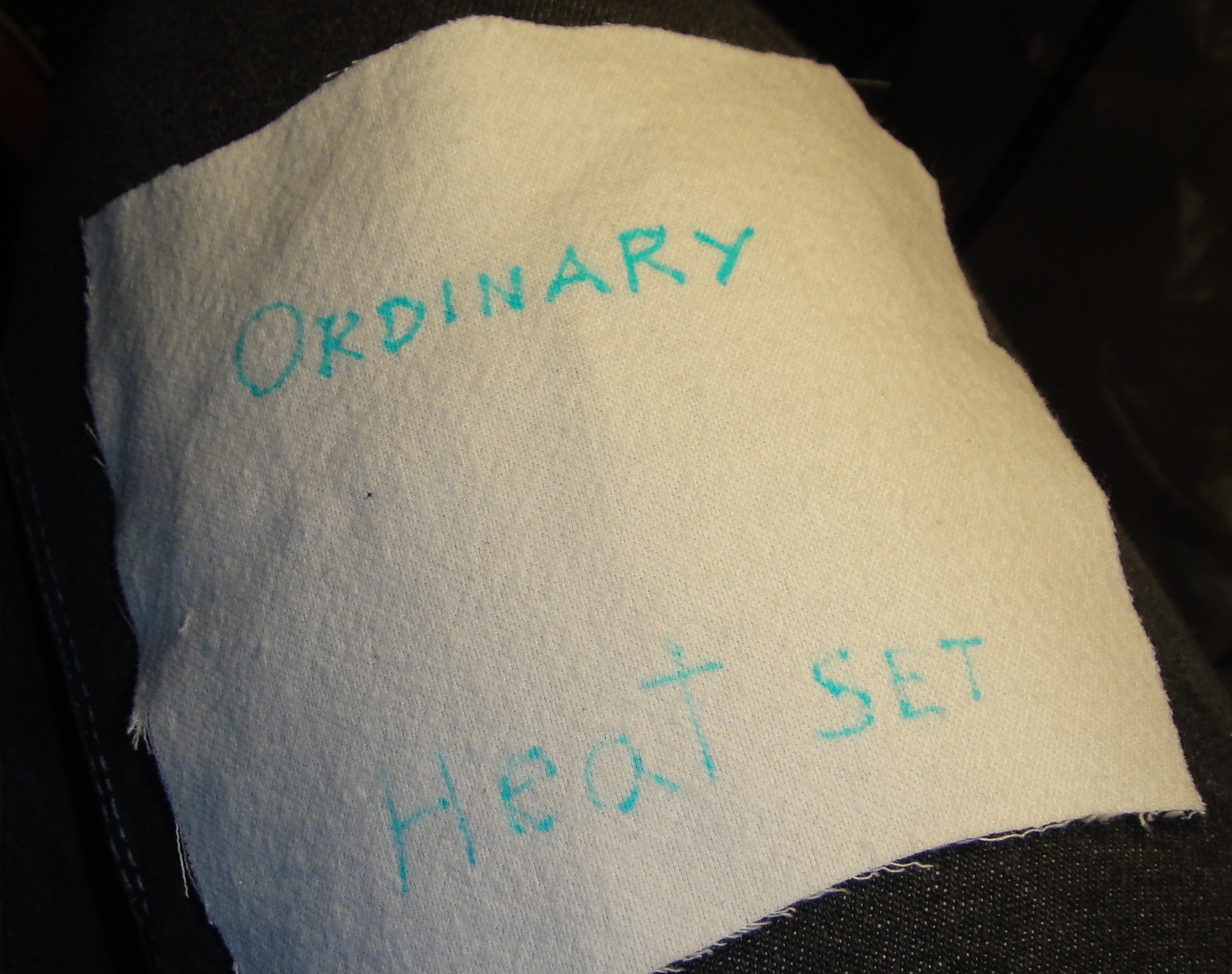
Testing my fabric marker

Also, I decided to test out my blue disappears-in-water marker. I’ve heard horror-stories about these before (especially if you press the ink), so I’ve been pretty skeptical about it and haven’t actually used it until now. Well, the fact that it’s a fine-tip and doesn’t really mark most of my fabrics well didn’t help.

Anyway, here you can see on the top, the plain marker, and the bottom which I wrote and then ironed over (with heavy steam on maximum heat, my typical MO as long as the fabric will take it.) Interestingly, even the steam seemed to start to lighten the markings, which could be annoying.

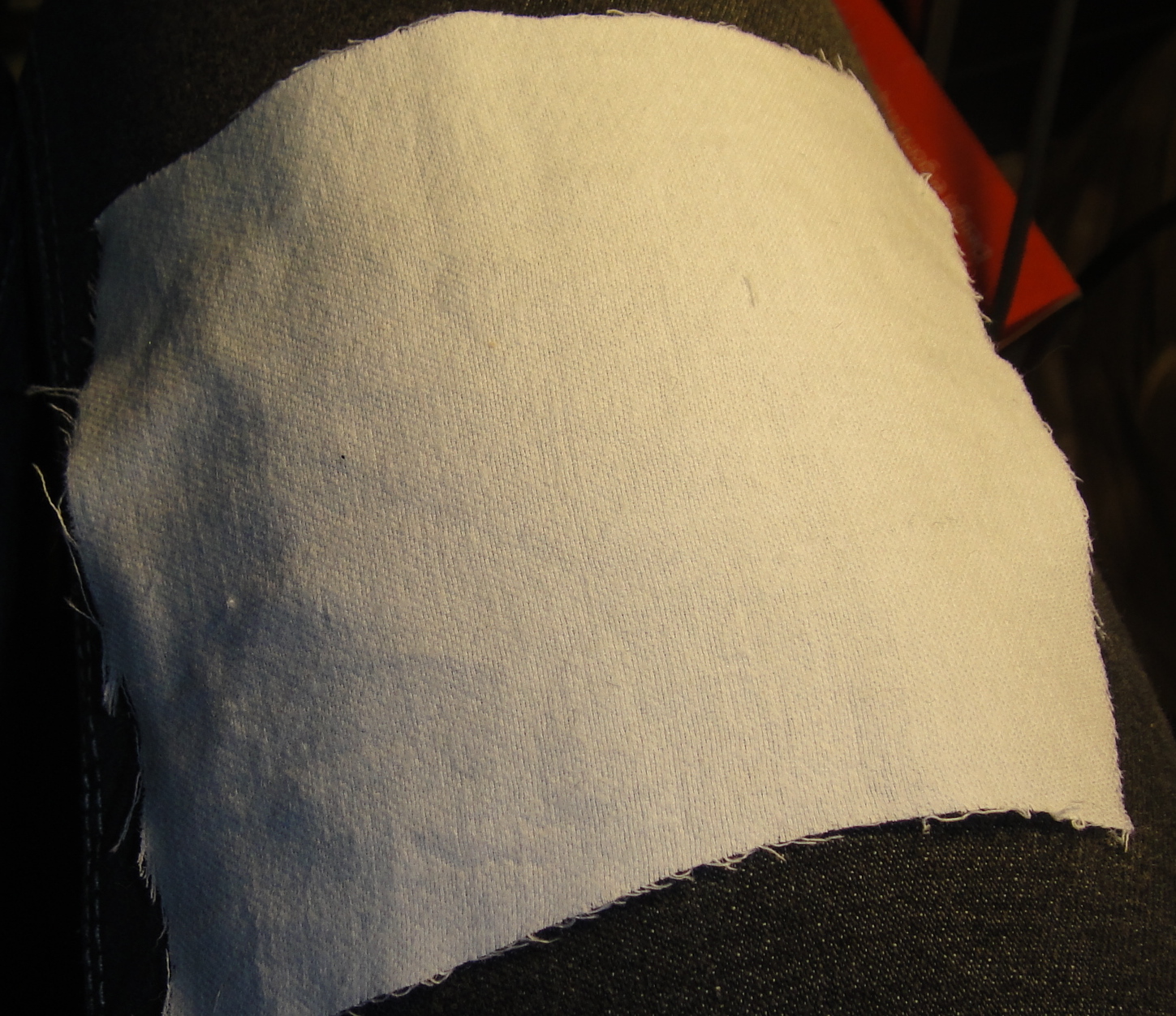
Took the piece to the sink, add water, and—voila!

Just add water!

Anyway, that’s enough for tonight. Tomorrow I will get the yoke sewn up and maybe even rope my hubby into a fitting if I’m extremely-extra-lucky. And Syo is agitating for a project she can help with, so if I’m extra ambitious maybe we’ll start on some skinny jeans for her, as she’s been begging for a pair of those since last summer.

Speaking of Syo, we must keep the post balanced, so I will leave you with:

Syo---yes, she knows exactly how cute she is.

15 Comments

Filed under Sewing

The Ceylon Blouse

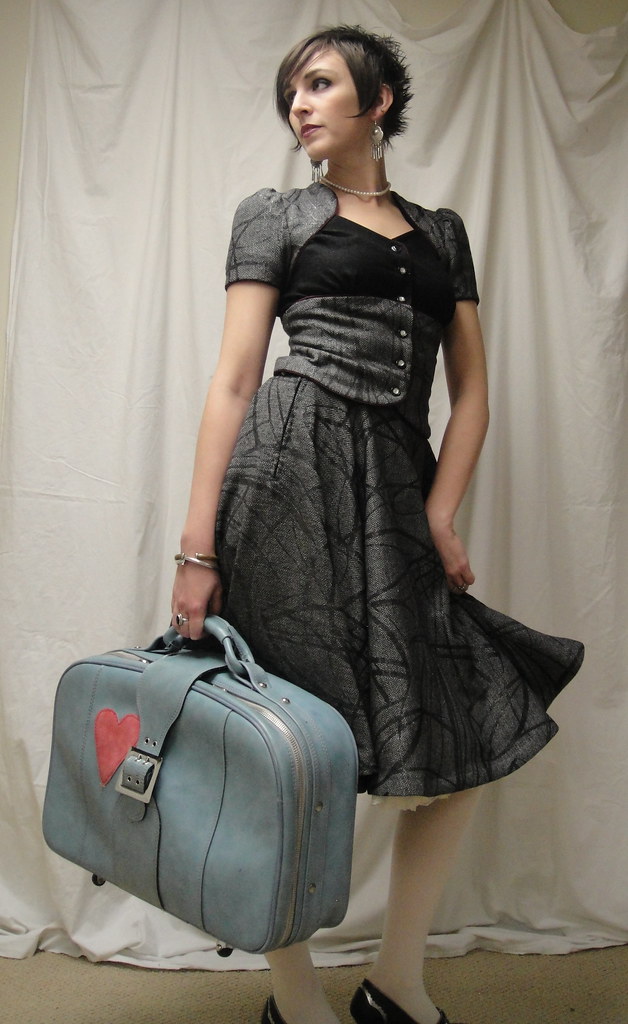
The Ceylon Blouse

So, before committing to the entire Ceylon dress, I figured I would try and squeeze just the bodice out of various scraps I have lying around. The nice thing about this bodice is it’s in so many little pieces, almost any little scraps will do. I wound up using (some of) the rest of the swirly-print herringbone wool and a bit of black linen I picked up at the thrift store ages ago that was really too small for almost anything. Well, obviously not since I managed to line the entire blouse with it.

Now, I have a bit of a propensity for colour-blocking, and when you combine that with

Ceylon with suitcase. Why? Cuz.

the almost bolero-looking cut of of the Ceylon yoke, well, it was bound to happen. I opted to do the sleeves, yokes, and midriff pieces out of the wool, with the “blousy” pieces in between just out of the black linen. Since I didn’t particularly want the wool against my skin, I decided to line those segments with more of the linen. And, since something about Ceylon almost demands it, I opted to pipe, as well. It adds a nice touch of colour to an otherwise grey-and-black garment.

On the upside, this gave me lots of new techniques to try. Making my own piping (I used dark-red bias binding and some dense wool yarn, both from stash*), and using piping period  (I followed this lovely tutorial). I got to try the “burrito technique” of attaching a double-layered back yoke so the shoulder and bottom yoke seams are all nicely enclosed. Worked like a charm :). I also tried a technique for clean-finishing facings I just read about from Beth of Sunny Gal Studios. which was nifty and makes a super-nice finish; then this morning I get up and discover a recent post by Pam Erny for a very similar finish, but with less bulk at the seam (although hers leaves some of the interfacing showing on the visible side of the facing—which could be undesirable depending on how attractive your interfacing is.) Oh, yes, and a massive, massive amount of seam-grading.

My construction order was a bit haphazard and very different from that given in the pattern, but between the piping and the lining (everything but the mid-back and bust pieces) it’s possibly the most nicely-finished garment I’ve made yet. The piping was actually fun, and a wee bit more forgiving of minor variations in my stitching than I had feared it might be. I did end up hand-stitching the lining of the sleeves to the bodice and the upper seam of the midriff-pieces lining, making for absolutely  ever seam in the piece being enclosed.

I took a crapload of construction pics, but really I think the posts I linked to above cover most of the techniques, so I will just give you a gallery of them to browse through at your leisure. Feel free to ask questions, tell me I’m on crack, etc.

Ceylon Blouse

Buttons are funny things. As construction proceeded to the point where I could start to try on the shirt, I became convinced that it was way too small, that I had completely misled myself into selecting the size 0, abetted by the give of my flannel muslin fabric. The linen, by contrast, had no give at all, and I was sure the resulting blouse was going to be, if not outright ridiculous, at least far too constricting for comfort.

It wasn’t until I had the buttons attached and could try it on normally that I felt at all relieved. It is very snug, and more restrictive than I’d like for everyday, but for an “occasion” dress it’s fine. The sleeves are about as narrow as my arms could comfortably take, but don’t make my hands go numb or anything, and the shoulder width looks good. I’m very glad I tweaked the shape of the front yoke right beside the neck, and lowered the neckline 1/2″.

Ceylon blouse, back

I did manage to remove the wrinkling at the back midriff by flaring out the upper portion of the midriff a bit more (at both CB and side seams). Curving the bottom of the main back piece so it is shorter in the middle worked perfectly to reduce the excess blouseiness (doubtless I took off a bit too much, again, for my different fabric). As to those diagonal wrinkles, well, we’ll see. I think I begin to understand the fix Sherry was suggesting for them, but I’ll have to give it a go on another project.

The bust doesn’t sit particularly nicely, partly because there isn’t enough ease and partly because of the fairly crisp fabric. I would venture to say it fits about as well as in most of the other versions I’ve seen of it, though, which I suppose is good enough. There’s still some gaping on the left side top, which I suspect is the result of my left breast being smaller. It’s not such a big difference that I usually notice, but this style seems to emphasize it. Fortunately I was mostly able to compensate for it by clever positioning of my buttons—the topmost is considerably to the left of the rest of the row but you can’t see that when it’s closed.

And one more time...

So all in all, it was a great learning experience—lots of new techniques and construction to think through. Next version I make I will have to do some serious considering about sizing and my fabric and where I want to wear it—if it’s a crisp, firm fabric and I want to wear the dress every day, I should go up to the size 2 (possibly with SBA, probably with shortening in the upper torso). If it’s a soft fabric with some give, or a stretch woven, I could probably make the 0 again.

I do feel like I should apologize to Sarai, Colette’s designer, though. Everyone raves about her instructions, and they are lovely—I just haven’t ever followed them yet.

More photos in the Flickr Gallery

Whew! That was a lot of sewing for one weekend! And I still have to finish tracing off my pattern for the men’s shirt sewalong…

* Yes, despite the fact that my knitting education was highly truncated and I have never so much as learned to cast on, I have a yarn stash. I have even, as I think I once confessed to Sigrid though I can’t find the comment now, been known to buy souvenir yarn while travelling. In my defense, it’s not a large yarn stash, and some of it has proven useful in dance costuming over the years… but, er, yeah.

47 Comments

Filed under Sewing

Swirly girly

Oops, I made it instead

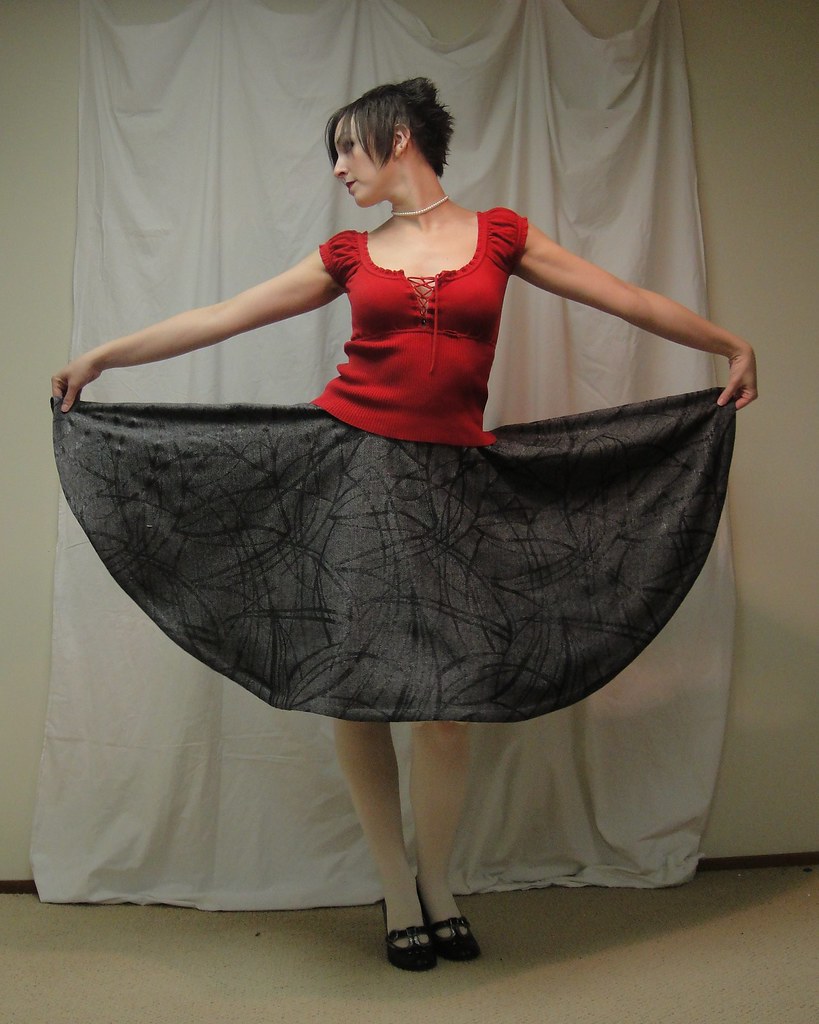
Erm, yeah, so that’s a circle skirt.

You may, ah, notice that it’s not that yummy purple fabric I showed earlier in the week. I chickened out. This doesn’t logically add up—2 meters of that purple stuff cost me $4 at the thrift store, whereas this stuff I originally bought for my Lady Grey muslin was at least $5/m. I still like the purple stuff more. Also I can’t get more of the purple, whereas every single Fabricland I’ve visited in the last six months (in two provinces) has bolts of this grey stuff in their clearance section. Apparently it did not sell well. At any rate, it seemed like a good vehicle on which to practice my circle-skirting techniques. It’s actually a really nice herringbone wool, suit weight, with this weird, sparkly black swishy pattern printed over top in what feels like latex paint.

Actually, it seems perfect for a circle skirt. Sedate but with a bit of fun—just like the skirt.

As per expectations, the waistband at the waist

Tucked in shirt: meh

looks terrible. You will not see how bad it is because I’m only going to show you  the “Pamela Anderson” pose: shoulders straight on, pelvis twisted to the side. Really I should call it the Egyptian pose, as I think they had it figured out a few thousand years earlier, but anyway. It emphasizes bust, minimizes the waist, and shows off your butt. Check out the magazine rack next time you’re at the grocery store, I’m pretty sure you can find an example or three.

Note the interesting hang of the folds

However, it does look pretty cute with a hip-length top over it, so I can style it that way. And I’m thinking a Franzi vest might complete the ensemble. Actually, I can envision a bit of a capsule wardrobe happening (that’ll be a first!) involving this fabric and the grey pinstripe I made my Businesswoman Pants out of. It might require me to buy more of this weird fabric if I want to both make the vest and finish the Lady Grey muslin. We’ll have to think on that.

As to the skirt itself—easy peasy. My fabric was 60″ wide (just shy after I steam-shrunk it), just enough to cut the entire thing in one piece. I used Casey’s 50s circle skirt tutorial, which provides you with a lovely pattern for the different waist sizes that runs quite true, though I’ll note that my size, 28″, is the second-largest. Oh, those 50s wasp-waists. The waist pattern is slightly squared off, which changes the hang of the circle skirt slightly: it hangs more straight at front and back (and sides, I suppose), with somewhat more folding at the front and back hips. This looks nice, and might even help minimize the bias-stretch since if you cut an even circle those bias areas will be a smidge shorter.

Using a single piece for the skirt is lovely and simple, but

Don'tcha love the full circle?

does complicate inserting the zipper. The tutorial is not particularly helpful in this case—it simply says “follow the instructions that come with your zipper.”

The outside of my hand-picked zipper. Not perfect but reasonable.

Which would’ve been fine if I’d, y’know, remembered I was using a vintage zipper—probably not quite as old as the skirt, but still—that actually *came* with packaging and instructions. Duh. Once I opened it up and looked through them (and posted piteously on Pattern Review—thanks for the helpful responses!), it became clear that I should do a facing around a narrow slit, and then attach the zipper as usual. Well, as usual as zippers ever get for me, anyway. I also LOVE the suggestion of doing a snap-placket, similar to the continuous-lap placket in a blouse sleeve. I’ll try that on the next one. I machine-stitched the ziper to the facing but hand-picked to the outside. It seems to have worked reasonably well. I still need to stitch a hook and bar onto the waistband, but we needn’t dwell on such trivialities here. 😉

Oh, and I should probably show you a back view:

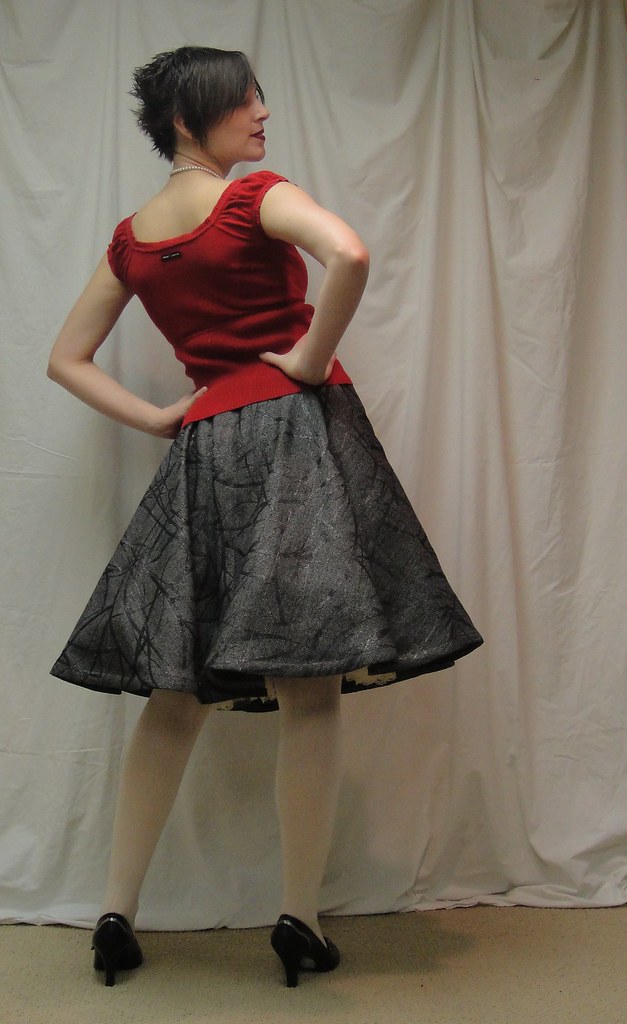
Back view

When I went to measure to hem it today, I trimmed down the length of the front but not the back. It doesn’t seem to have stretched much on the bias at all, although the sides were for some reason distinctly shorter than the front and back. I trimmed down the front half of the circle to match the side length, but left the back, as even I have enough booty to make it appear shorter at the back. Probably it doesn’t look as perfectly even as it could (still a bit short at the back, actually) but, y’know, whatever.

The horsehair braid was fun, despite the fact that I couldn’t find any as yummy and wide as Gertie’s (as it was it took me two different Fabriclands to find the 1″ width). I followed her tutorial quite closely anyway, and managed not to singe off my fingers or melt the nylon braid, so life is good—but I I would still have preferred wider braid. Ah, well. Time to start hunting for an online source, I guess.

Horsehair braid---sadly I could only find up to 1" thick

Oh, and I recently splurged on a point-presser/clapper, urged on by MPB’s list of “tools you won’t want to be without” (relatively few of which I actually own). And, y’know, it’s awesome. I used the clapper-part like crazy in the making of this skirt and I am truly impressed by how much it improves the edge of the press. Who knew? (Okay, I know the rest of you knew already… these things I tend to have to figure out for myself.)

So now I am working on a vest to go with this, assuming that will work out and not just look funny, and I may nibble on that mini-wardrobe-capsule (that’ll be a first!) as well, assuming I can find the stamina to tackle another Lady Grey. I tried the skirt with my grey blazer, though, and it looks like crap—it needs something with a flared peplum, or at least a much shorter one. You can see all the photos here.

For the next circle skirt (the purple), I want to do a yoke of some kind, maybe princess seamed, so I don’t have that awful waistband right at my waist. But that requires a bit more fitting and I haven’t quite gotten that far yet…

26 Comments

Filed under Sewing

That 70s Dress

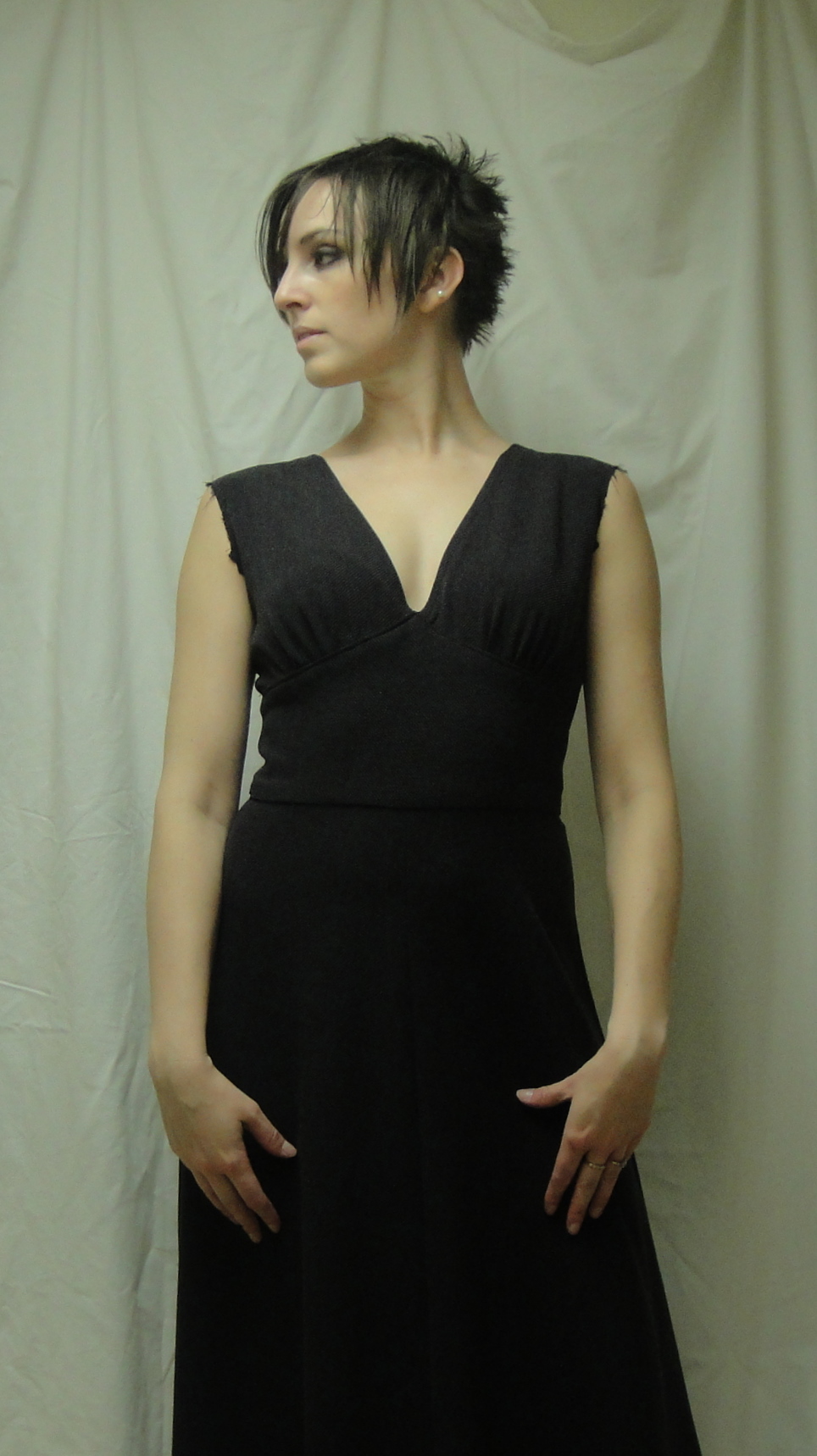
Simplicity 5728

A(nother) 70s dress

Now there’s a way to begin a post, by referencing a TV show I never even watched…

Anyway, despite my complete disinclination to do anything yesterday other than read through one of the novels I picked up at VV a couple of days ago, I did manage to get the sleeves on and hem the Simplicity dress. Raising the armscye worked like a charm—it’s lovely, high, and mobile.

As you can see, I opted (after the debate between long and short) for 3/4 length sleeves. This was initially inspired by the fact that as I was cutting there was a perfect spot to cut the sleeve out—but one side was a couple of inches too short due to the uneven cut end of the fabric.  But I’m really glad I went for it—warmer than a short sleeve*, but (I think) dodging the school-marmish/little-house-on-the-prairie potential of a full length sleeve with a full-length skirt.

Simplicity 5728

Curse that indoor light...

Since this blog is the closest I get to taking notes on my pattern alterations, I’m going to point out a few things about the sleeve again. I lengthened the full-length sleeve 2″ total, one inch above the elbow, one inch below. After doing this, I’d like to add, the elbow dart is in exactly the right position. Hooray! When I converted it to the 3/4 length, I cut off at the upper edge of the forearm “add length here” section. I felt like the sleeve was quite roomy in the muslin, even for a non-stretch sleeve (which obviously can’t be as snug as the knits I’m used to wearing), and when I decided on my stretch fabric I decided to narrow it: 5mm off each side, mirroring the 1/4″** I took off the sides of the bodice, and then I took a tuck of about 1/2″ out of the middle of the sleeve, all the way down. I figured there was more than enough ease in the sleeve cap to do this without messing with the length of the sleeve-cap, and there certainly still seemed to be plenty of gathers to go around. So in total the finished sleeves are about 1″ narrower than the muslined ones. This is perfect for my fabric, but might be a little too narrow for a non-stretch sleeve.

Simplicity 5728

Lots of sleeve mobility!

I do feel like the sleeves sit a little far out on my shoulders (possibly exacerbated by my alteration to the back neckline), although if I tug them up higher on my shoulder it seems to push out the sleeve oddly, so I’m not sure which is preferable.

I made the front midriff piece double-layered, to give it a bit more stability and make for a nicer finish inside. It is a nice finish, but it makes for a lot of layers of this fairly thick fabric, especially right under the bust where it encases the gathers. Possibly I should’ve graded the seams in this area. I’m also debating the merits of a waist-stay.

I decided to try a machine blind-hem on the grounds that a) this fabric is quite thick, and b) it hides the thread so well that it would be unlikely to show even if I did a whack job, which I basically did, and c) it just seems odd to hand-hem a stretchy. And it worked out pretty well, so long as you don’t look too close. The nice thing about such a long skirt is that the hem is a long way from anyone’s eyes, too ;). Well, except for the under-2-years age set, but presumably they won’t tell on me. The hem is the 2 1/4″ specified in the pattern, which brings it up to a length which is just shy of floor-skimming when I’m in bare-feet, which seems about right looking at the pattern illustration. Again, this is after I lengthened the entire skirt 5″. Which tells you everything you need to know about how my height is distributed (I know, cry me a river, right?)

Simplicity 5728

Finally, a smile!

I feel like it may be important to highlight a few lessons learnt from this pattern:

1) I really am short in the body. It’s not just in my head. Junior Petite, people, and the only bit of lengthening I did in the bodice I kinda wish I’d skipped out on.

2) especially in the armscye.

3) apparently I like 70s fashion, or at least the dresses. The only vintage patterns I’ve sewn for me this past year have been 70s dresses, and I have another one in stash, too. This is a little hard to wrap my mind around given that I grew up in the 80s and couldn’t even stomach the sight of bell-bottoms until well after their return to popularity in the late 90s.

4) I have neither the right hair nor the right shoes to go with this dress. Well, technically I have the right hair, but not the right hair-cut (nor am I likely to have it again. I love long, straight hair. Just not my long straight hair.). The shoes thing is unforgivable. How can I have no cute, delicate platform shoes? All I have for thick soles is my kick-ass boots, which would be fun but are not exactly period.

Simplicity 5728

Nice dress!

All in all? pretty happy camper! Though I’m still not convinced the dress will become part of my everyday wardrobe.

… now to fight down the urge to start working on a fluffy petticoat…

Oh, yes and a few more photos in the Flickr Gallery

*yay! The weather, which has been relatively clement since before Christmas, is reminding us that this is still Canada and winter still has a good two months to mess with us before spring will even begin to get a finger in the door. Today was  a virtual blizzard.

** very glad to hear that I’m not the only sewist who flits randomly between measuring systems. Canada officially went metric in the 70s, but somehow it’s never completely taken hold. For the longest time I did outdoor temperatures in Celsius, but indoor temperatures in Fahrenheit, for example.

36 Comments

Filed under Sewing

SFOs (Semi-Finished Objects)

Zena of Blood, Sweatshop, & Tears once commented that “wearable is climax. Done is denouement.”

She is so right.

Lekala twist-top, v. 2

In that spirit, I give you my second take on the Lekala 5675, a.k.a. the twist top. The hems are serged but not completely finished, and it’s been like this most of the week. I am disinclined to fuss with trying to stabilize them for topstitching. Bleh. This red knit is wiggly, super-stretchy, and much more like the kind of fabric I imagine the shirt was designed for than my last attempt. It’s also an amazing example of the difference fabric choice can make for the exact same pattern (only difference is I added perhaps an inch more extra length to the red version, just in case, bringing the total increase to about 3-4″ in the sleeves and 4-5″ at the hem. The first version was roomy and sweater-like, with a surprisingly perfect fit in the shoulders. This version is second-skin tight and the shoulders look really narrow. Although about the same as they look in the pattern illustration, actually.. The twist still doesn’t pull naturally into the kind of tight twist the illustration suggested. This might be a drafting problem (maybe they should just have widened the upper front piece a bit so that a full twist was required), or it might just be that my doubling of the front (makes the finishing easier and never a bad idea in a thin knit) gives it a bit too much body. I think in my head the slit below the twist should be wider, but again it’s actually quite comparable to the illustration. Some day I shall use Sherry’s post to attempt to reduce a swayback in a knit. Someday.

Simplicity 5728

Simplicity 5728

In a similar vein, my (wearable muslin?) version of Simplicity 5728 is at a try-on-able phase in construction. Yay!

This is such a peculiar fabric. I would’ve sworn it

Simplicity 5728, side view

was a diagonally-ribbed knit, but it frays like a woven. It’s stretchy, very slightly in length, significantly in cross-grain, but fairly stable. It does have that cling-to-every-lump-and-bump quality of a knit.

In the stretchy (whatever the heck it is), I should probably have used the original bust-length, as the extra length doesn’t seem to be necessary. I had narrowed the bodice sides 1/4″ on the pattern, since it seemed a bit roomy under the arm,

Back (lightened to show lack of swayback wrinkles!)

tapering to nothing at the waist, and I took it in another 1/4″ here after trying it on (adding up to a substantial 2″ reduction in the total bodice width). I did a swayback alteration as per Sherry’s instructions (sooo easy when you have both waist and CB seams), taking off about 1/2″ (12mm) both above and below the waist seam. I gave the CB seam of the skirt a bit of an S-curve to it as my swayback seems to be rather below my waist in this area. And then I cut, inserted zipper, and hoped. And—well, look!

Can we say, happy customer?

Also, like what I did with the back neck? I did a brutal job of finishing the top of

Simplicity 5728, full back

the zipper, but otherwise it’s snazzy! Er, and yeah, the zipper’s pink. I thought it coordinated/contrasted nicely with the muted purple of the fabric, but probably it’s just too light. But the only other zipper I had of suitable length was white, and an invisible one, which I don’t actually know how to install. It’s vintage and metal, though, so it’s cute enough to deserve to be looked at.

Simplicity 5728, front closeup

You will recall that I received excellent advice from Kay and others on my sleeved muslin to raise the bottom of the armscye to improve my sleeve mobility. So I raised it a full 2cm, on the principle that it’s easy enough to lower it after the fact if I need to.

(It occurs to me that I probably annoy nearly everyone with my flitting back and forth between metric and imperial measurements. Can I call it a Canadian thing? I prefer to do my seam-allowances in metric because the metric markings are at the front of my sewing-machine face-place, making them easier to see than the imperial markings, which are at the back. On the other hand the width of the regular foot is definitely 1/4″, so I tend to do things like small alterations in this increment. It also depends on which ruler or measuring tape comes to hand first…)

I should also mention that I added 5″ (and we’re back to the imperial) to the hem of the skirt to get it to this luxuriously long length. That’s supposed to include 2 1/4″ of hem, which would bring it to a perfectly respectable heel-length, I think, although I’m not convinced a 2″ hem will be desirable in this fabric. I’m wearing a 3″ heel in the photos. I love these crazy-long 70s skirts.

Coming soon: the great sleeve adventure!

19 Comments

Filed under Sewing

The Christmas Coat

The Christmas Lady

Day-Glo Red

It’s (mostly) done!

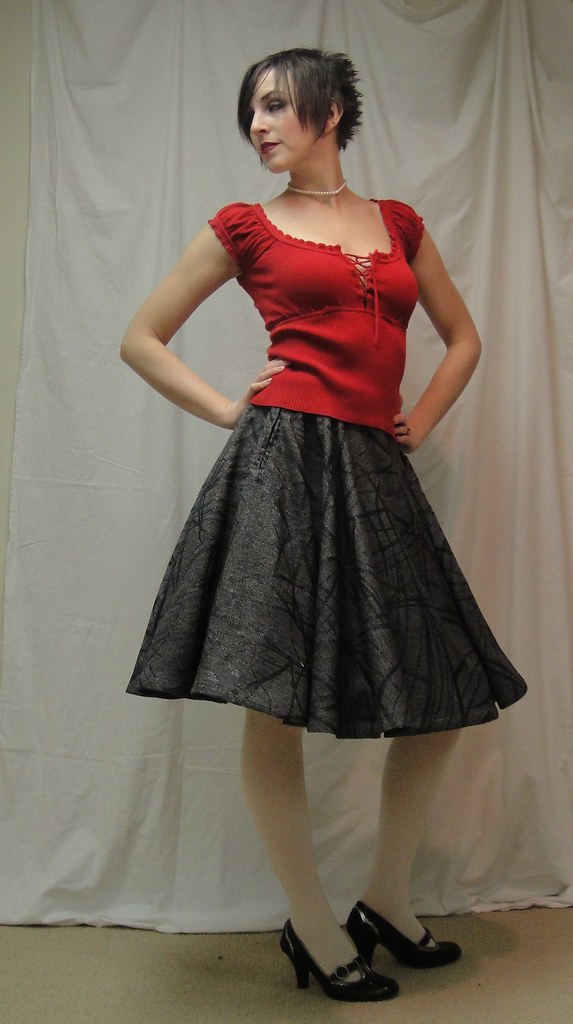
This was technically my Hudson’s Bay Blanket Homage Coat, but given the timing and the colour, I’m probably wishing if I think I can make it something other than the Christmas Coat.

The Christmas Lady

Holy peplum, Batman!

Tyo pried herself away from her new PSP long enough to take these photos for me, saving me the hassle of trying to set up the tripod in the snow. Although as you can see, it’s not quite the winter wonderland it was a month or so ago when I finished Tyo’s Coat. We actually had wonderful weather for Christmas—it was +6 C on Christmas day! My dad and I took the girls to the local playground and they ran around without their coats on. Amazing what feels like tank-top weather once you’re inured to -20 ;).
The Christmas Lady

Lining---needs letting out

I think nearly everything that needs to be said about this coat has been already. One of the buttons is missing in action, having disappeared prior to being sewn on somewhere in the dozens of rounds of “clean up” that have swept through my house more or less continually since last weekend (without creating a notable overall improvement, I’ll add). If it doesn’t show up in a day or two I’ll have to go buy another. Also, the two inch hem I took in the lining wound up being a bit too much, so I should really let it out a wee bit. At least I have that luxury, having cut my lining to the full length of the shell.

The Christmas Lady

Coat front

I only took a 1″ hem, but as you can see my fabric has plenty of body.

Christmas itself was lovely but hectic. We hosted my father, my hubby’s father, and my hubby’s father’s girlfriend. I was pretty spoiled my first seven or so years of marriage—I never once had to make a turkey on my own (or even in my own kitchen). It really is much more fun doing all the culinary craziness with three or four or five other people helping out. Fortunately my Dad, of all people, came to my rescue, peeling potatoes, washing innumerable dishes, and helping stuff the turkey. I fear I was a touch crabby, but hopefully it wasn’t too bad. I really was happy to have everyone there.

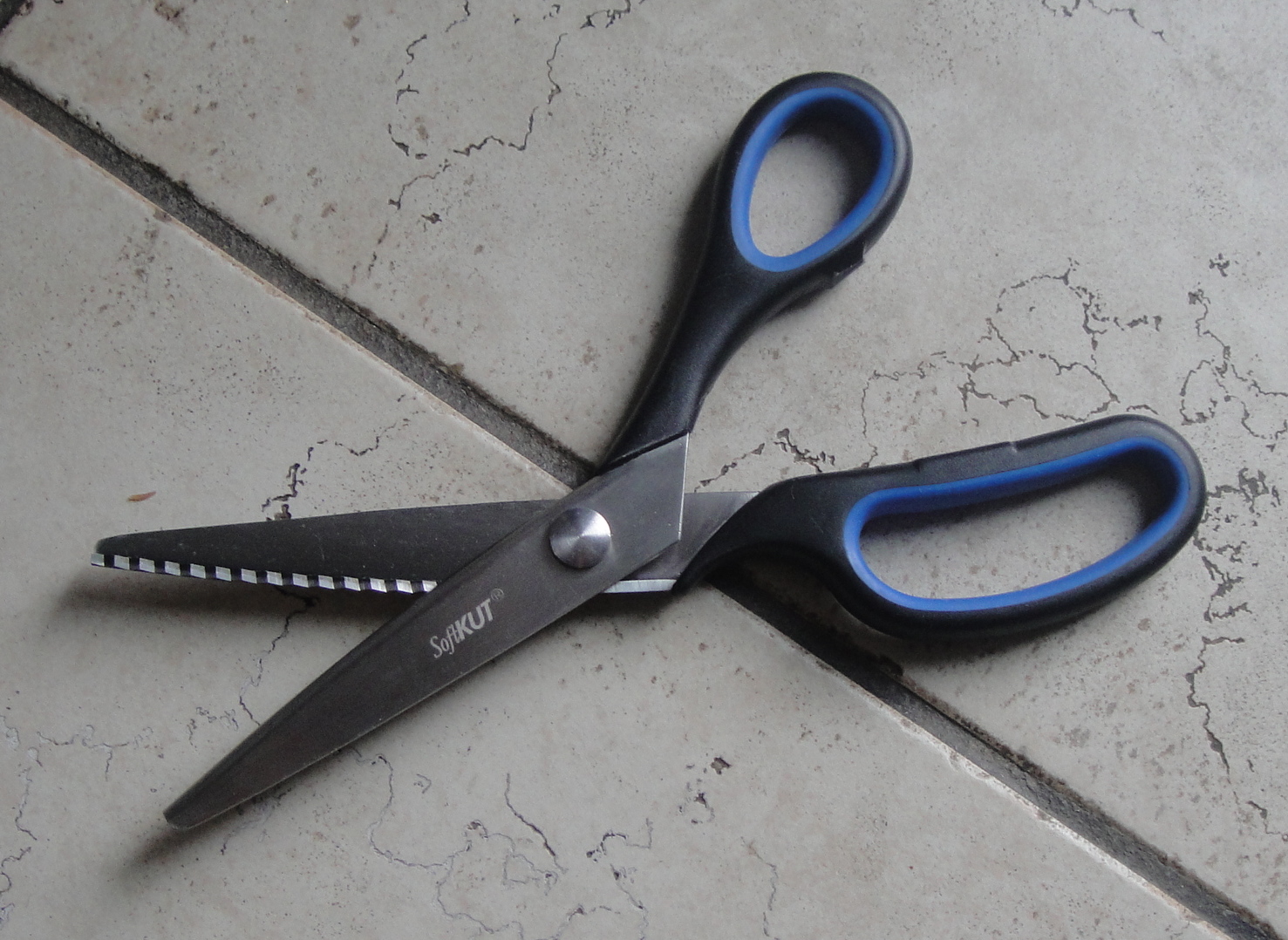
I did get one bit of sewing paraphernalia for Christmas, from my mommy. Look: pinking shears! My mind is racing about what I can pink. Or it would be, if I weren’t thoroughly sluggish from chocolate overdose.

Pinking Shears!

At any rate, I hope your Christmas (or seasonal equivalent 😉 ) was as merry as mine. I expect I’ll start thinking about sewing again in a day or two. For now, I’m going to go read one of the books I got for Christmas (The latest Terry Pratchett—oh, the joy!) and listen to my husband and children murder things on their various video game systems.

You can see all these photos and more on the Flickr Slideshow

All the posts on this coat can be found here. And this has been a (very belated) contribution to Gertie’s Lady Grey Sewalong.

29 Comments

Filed under Sewing

More fun with Lekala Patterns

Or, The Unfortunate Effects of Poor Fabric Selection

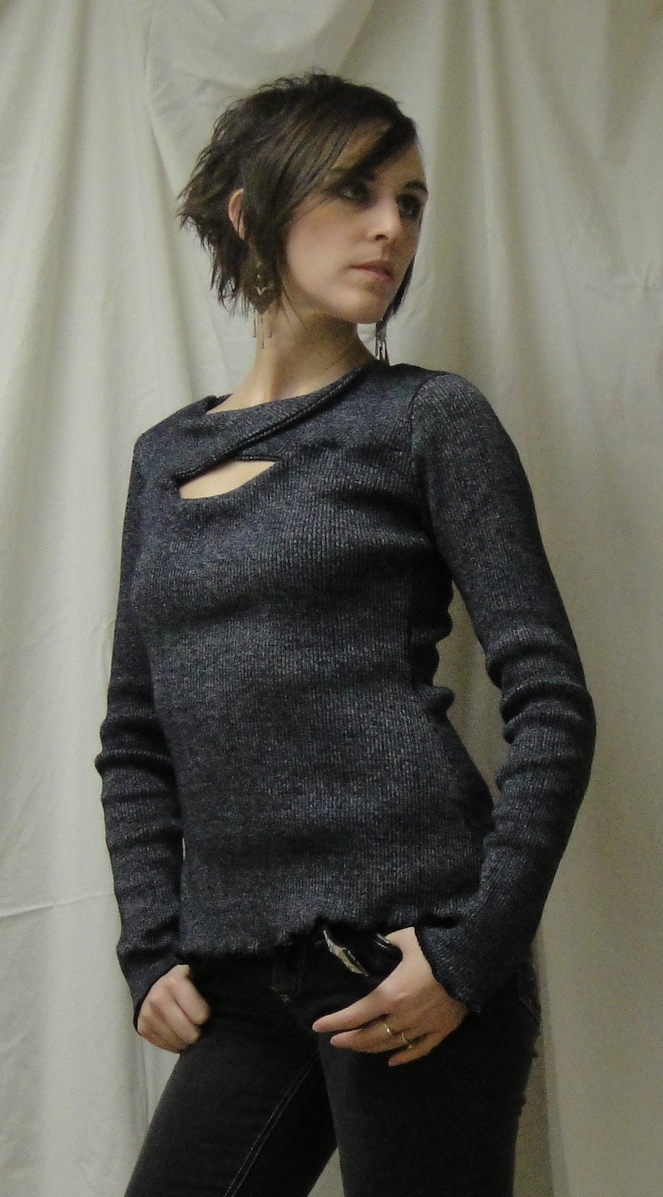
Lekala knit top 5675

I got this fabric (bottom right in the photo) from the thrift store a month or two ago. It’s a light sweater-weight rib knit, very stretchy but not very drapey. I thought it would be ok for a cardigan-type top, a more fitted one rather than something drapey like the Simplicity one.

So why on earth did I think it would be good for taking a shot at this Lekala pattern? Can I plead temporary insanity?

I don’t know if I’ve mentioned before, but I’m a sucker for peekaboo clothing. Peekaboo backs in dresses, peekaboo shoulders; slit skirts… so yes, this top (scroll down) tickled my fancy right off the back: cute peekaboo detail, not too much skin showing since I’m attempting to be more demure in my old age, still warm for winter.

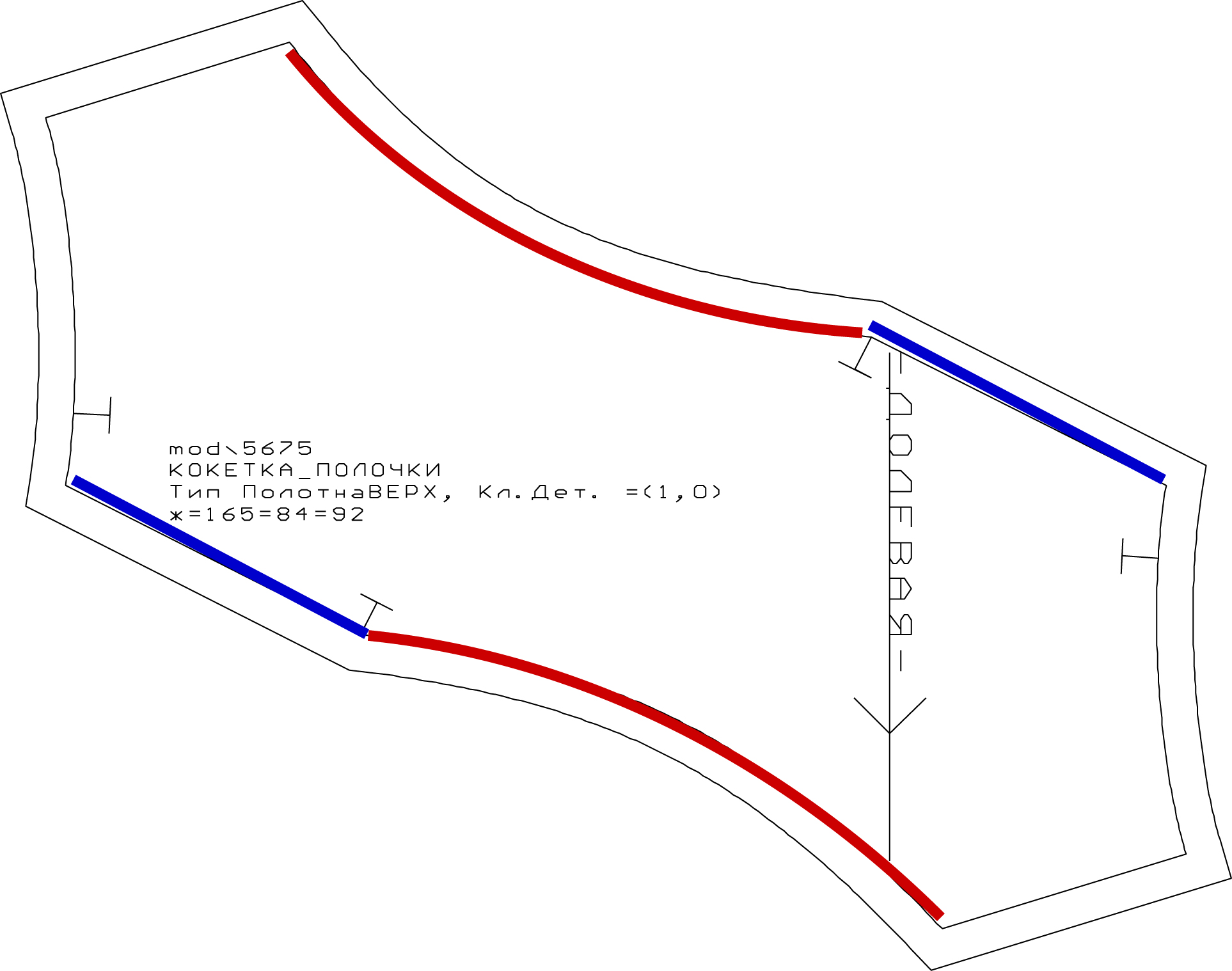
Twisty pattern piece

I printed it out, compared with my Lydia pattern, and again the only modifications I made were lengthening the bodice and the sleeves. The shoulders are more square than on the Lydia and the armscye and waist are much shorter (shorter even than my altered Lydia, where I shortened the armscye and raised the waist). Of course if you actually ordered the pattern it would be to your own length measurements, so probably most of this won’t be helpful. I added to the bodice only at the hem, and likewise to the sleeves.

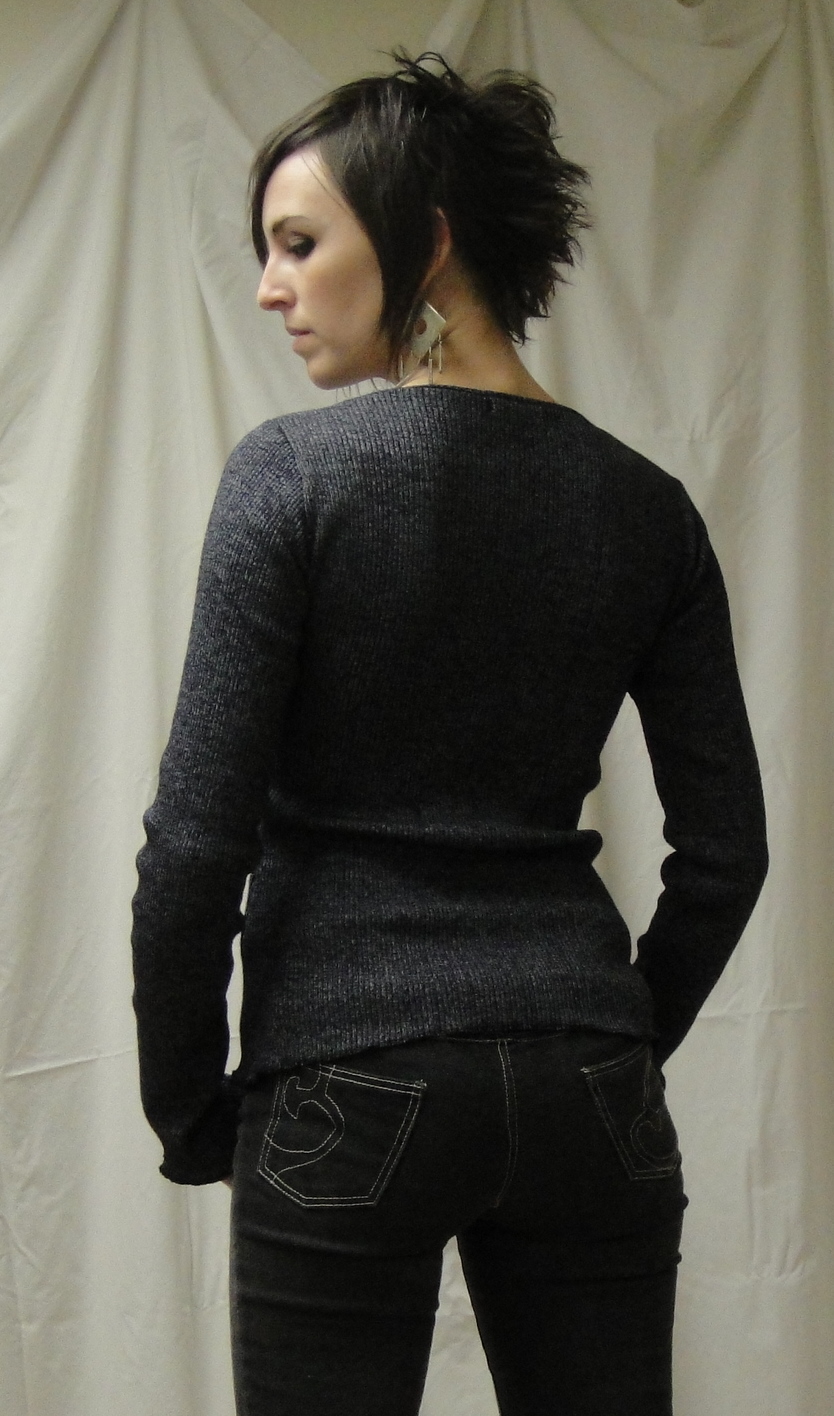
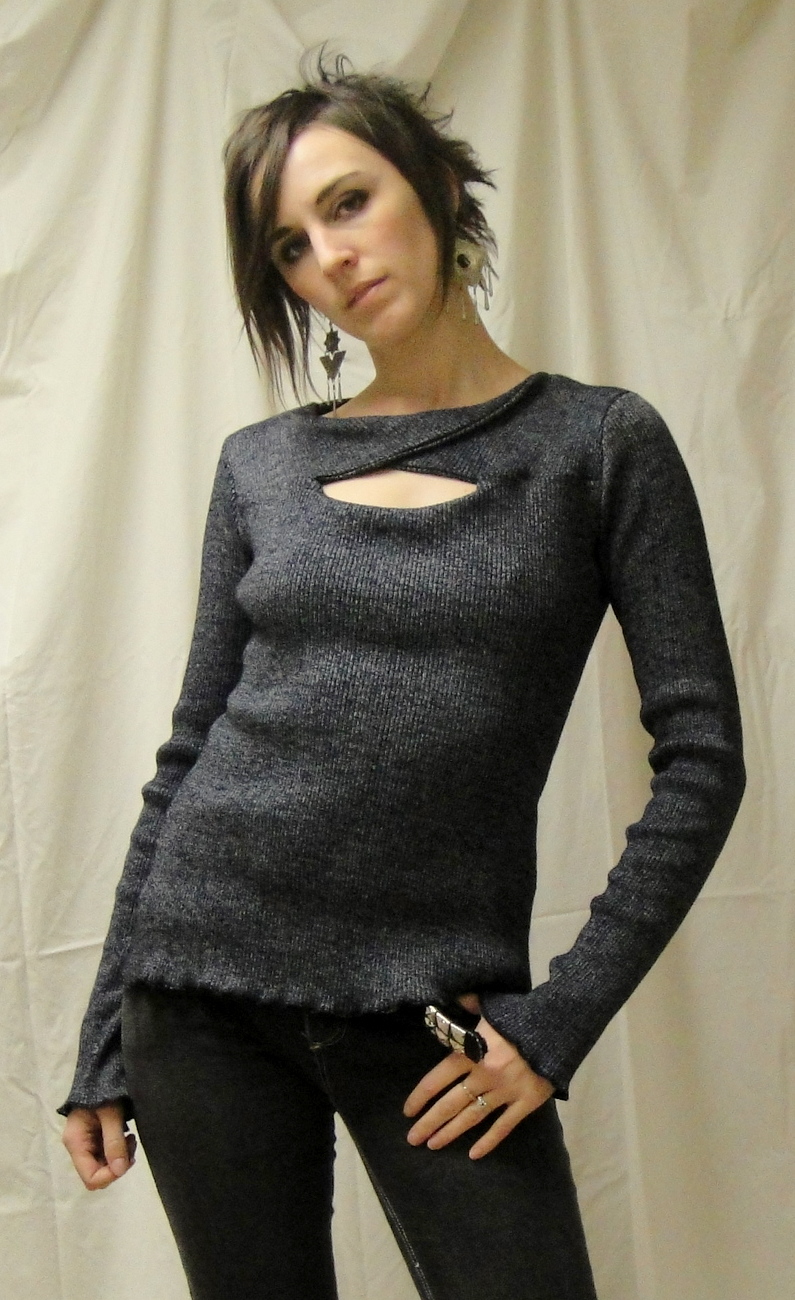
It took me a couple of tries to figure out how I

Twist top... sweater version

wanted to finish the front; I double-layered it to simplify the finishing. If you look at the picture of the pattern piece, I sewed the two layers of the piece together along the red lines; I did the same with the middle portion of the lower bodice. Then I sewed the blue lines to the outer portions of the top of the lower bodice, so that all the seams are enclosed.  Despite my best efforts (and liberal use of clear elastic) it wound up quite stretched out, but that reflects on my fabric choice rather than the pattern, I think. I had to turn the bottom of the peekaboo-opening under and tack it on the inside, creating a bit of a “U”, because it was stretched out too badly. It looks okay, but not ideal.

I had to take in the shoulders a bit, again I think due to the spreading tendency of this fabric. I could probably take a bit more width in in front of the armscye, but again more due to the fabric than the pattern.

Oooh, the swayback!

After the trouble I had with the fabric spreading in the upper bodice and shoulders, I didn’t even want to contemplate doing a hem. So I did a rough ‘n ready lettuce hem on the serger on both bodice and sleeves (basically I just ran it through as usual but stretched while I did it). This means that the sleeves are extra-

Front view

gooey-long (which I love). Oddly, I didn’t have to take them in for width, which I’ve had to do before when using “growing” fabric.

I put the shoulders in flat, and they went in very nicely, which is always a plus.

I also took in the side seams after construction, curving in by a good 3/4″ at the waist. Again, due to the growing fabric.

On the plus side, after its initial sagging it doesn’t seem to be growing too much more, and it is quite warm. In the photos it doesn’t look half bad (if I do say so myself), though I feel like the fairly stiff fabric folds oddly as I move. I will definitely have to give this pattern a try in something a little more slinky in the future.

16 Comments

Filed under Sewing