Tag Archives: finished projects

Yet another knockoff…

Jacket!

Someday I’ll make something original. Sooner or later the universe is bound to get tired of throwing other peoples’ really cool ideas at me, right?

Hmm.

So, I feel a teensy bit guilty about this knockoff, because it’s inspired by this EvaDress pattern, and I really feel like I ought to support her and buy the pattern. But, I’m also a starving student… and I wanted to try some kind of jacket with my new basic princess-seam pattern… and, well, here I am. I’ll buy it someday, I promise. In my own defense, the actual construction of my jacket is almost completely different—the original is a cut-on kimono sleeve, as far as I can tell, while mine is a standard princess-seam jacket, cropped to underbust length, with a set-in sleeve.
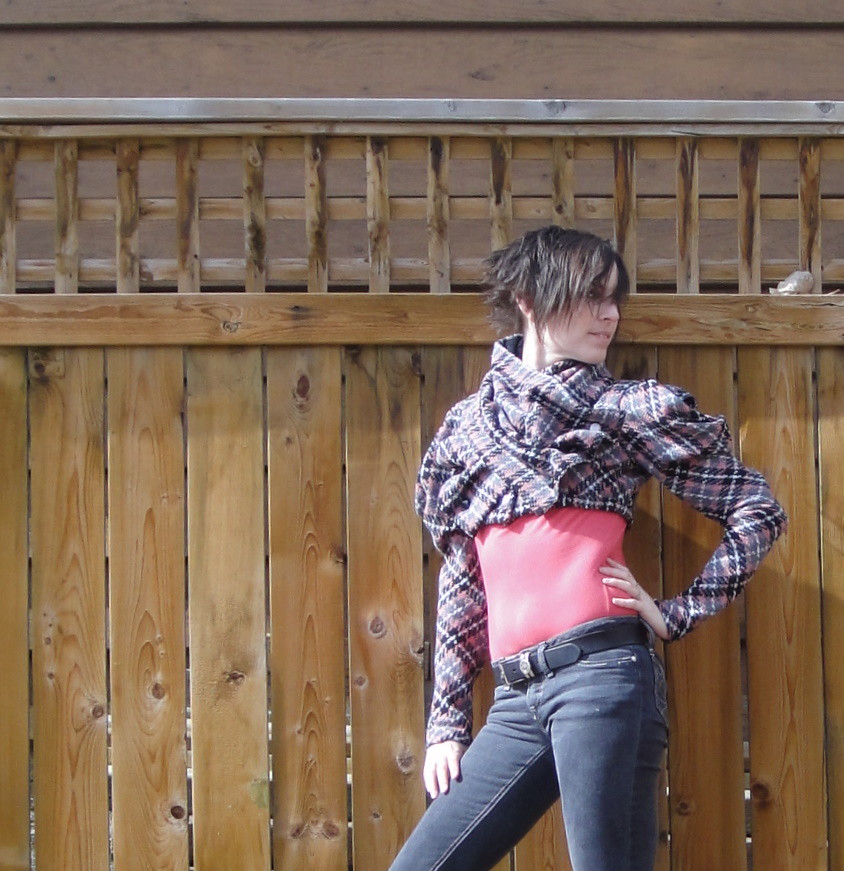
Drapey 30s jacket

Drapey 30s jacket

Debi’s made a great version of this jacket. (And here she shows more of the construction, which highlights the many differences between the “real” version and mine). If I’m not mistaken, it’s also the one pictured on this Threads article, which I’ve been lusting after since this time last year. Can we say, yum?

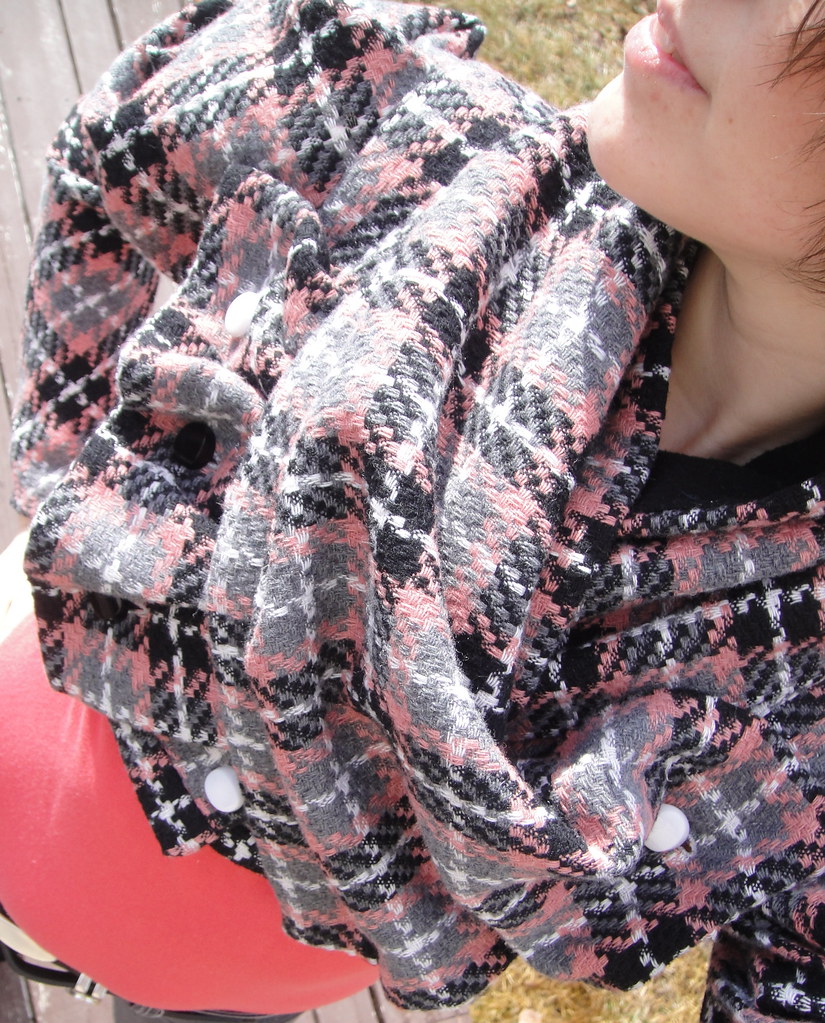
It’s really a very basic idea—a scrunched, buttoned-on scarf over a basic cropped jacket, with cowl sleeves. Lauriana featured a version of the sleeves here, and there’s a description in Modern Pattern Drafting of how to draft it—really simple, actually. I kept my cowl fairly small, partly because I like the close-fitted sleeve and partly because I didn’t have a lot of fabric.

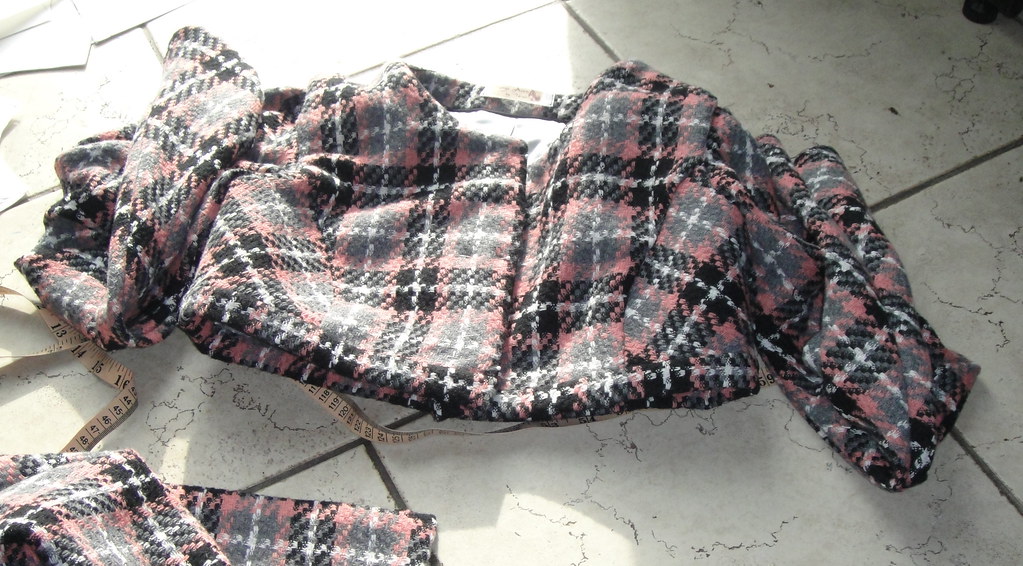
Really, hardly any fabric, barely a metre. I had wanted to make a circle skirt out of this fabric (I’ve been cherishing it, waiting for the perfect project, since last summer some time) but didn’t have enough.

Without scarf

To avoid trying to match plaids (across princess seams, no less!), I cut the side pieces on the bias, then interfaced. The interfacing is probably a bit heavier than would have been ideal on this very light, soft, loosely-woven plaid, but hopefully it won’t be a problem in this location. I do wish I’d been a little more precise matching up the plaid across my CF, as it’s a hair off, but ah well. Not visible behind the scarf anyway.

The jacket has no collar (just the scarf), which was fortunate given the fabric shortage and the need to reserve a fair bit for the scarf. The underside of the scarf is made of flannel, as well.

The Built by Wendy book suggests using 1/2″ seam allowances on straighter seams and 1/4″ on highly curved ones (like the princess seams and the neckline and armscye). I followed the advice, and I like it, but I wonder if for this fabric I shouldn’t’ve used wider ones, as it’s pretty loosely-woven and ravelly. Time will tell, I suppose.
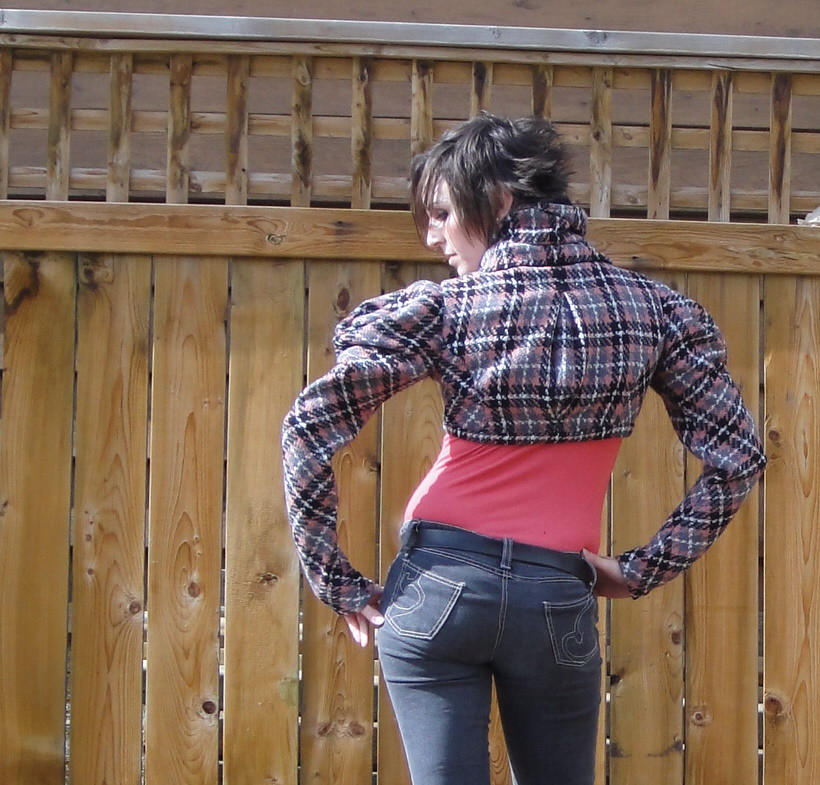
Back view, with pleat

The bias sleeves are interesting. They tend to stretch and narrow, which works well with the style but could make getting a long-sleeved shirt on under them tricky. I also didn’t line the sleeves, as I was concerned with messing up the drape. The bodice is lined with some more bits of leftover silver Kasha from my Winter Coat. Someday I’ll run out of that… I’ve still got nearly a metre left, though!

I’m not 100% sure I handled the back pleat the best way possible. I made similar pleats in the lining and fashion fabric, meaning they’re both kind of occupying the same space. I wonder if it wouldn’t’ve been better to try to wrap the interior box pleat “around” the exterior one so they were folding the same way… anyway, it’s not too terrible, I think.

Scarf, lining, really bad buttonholes.

Nitty gritty details: the scarf is lined in black flannelette, as I didn’t have enough to make a wide enough scarf just out of the fashion fabric. As it is, I could’ve made it a bit narrower, and probably an inch or two longer… ah well. It’s pretty hard to get more than a general sense of this until the buttonholes are already in place, so such is life.

I piped both the inside of the facings and the neckline and front openings of the jacket. I like the piping around the facings, but perhaps a softer cord would be better next time… anyway, as is typical with coats and my sewing machine, the facings were too thick to work automatic buttonholes in, so the resulting buttonholes are as attrocious as you might expect. Ugh. The buttonholes on the scarf, on the other hand, worked out just fine… so look at those ones instead 😉
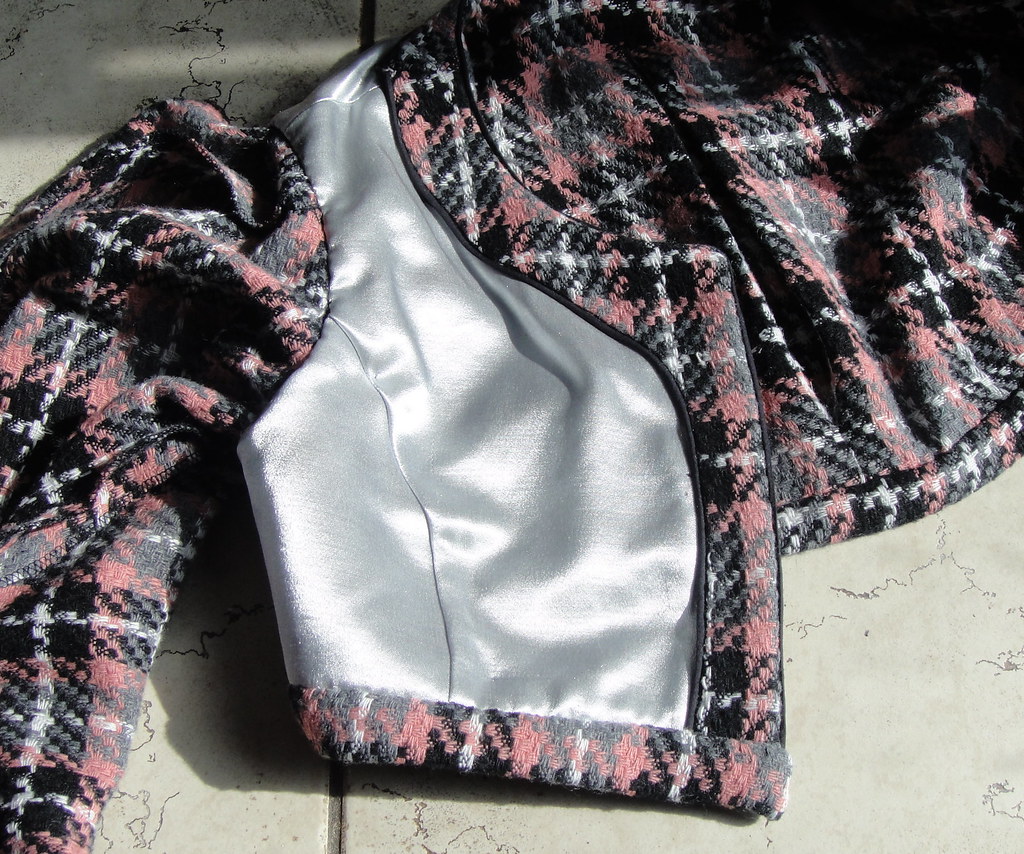
Piped facings

The facings were squeezed out of scraps (I didn’t actually think I’d have enough fabric for them) so are pretty narrow but worked out well enough. Note to self: remember to remove the back pleat when drafting the facings. And here I was trying to figure out how my neckline had stretched out so much…

Cowl sleeves: Bias sleeves are, well, interesting. They tend to grow (which is a good thing from my point of view) but also shrink width-wise. I will admit I took a couple of loose, surreptitious stitches inside the drape part to keep the folds in place. The cowl edge is finished with a fold-back facing, and the seams in the sleeves are finished with serging. I’m glad I didn’t try to line the sleeves, as it would’ve messed with the drape thoroughly, I think (at least with my lining and this particular fabric)
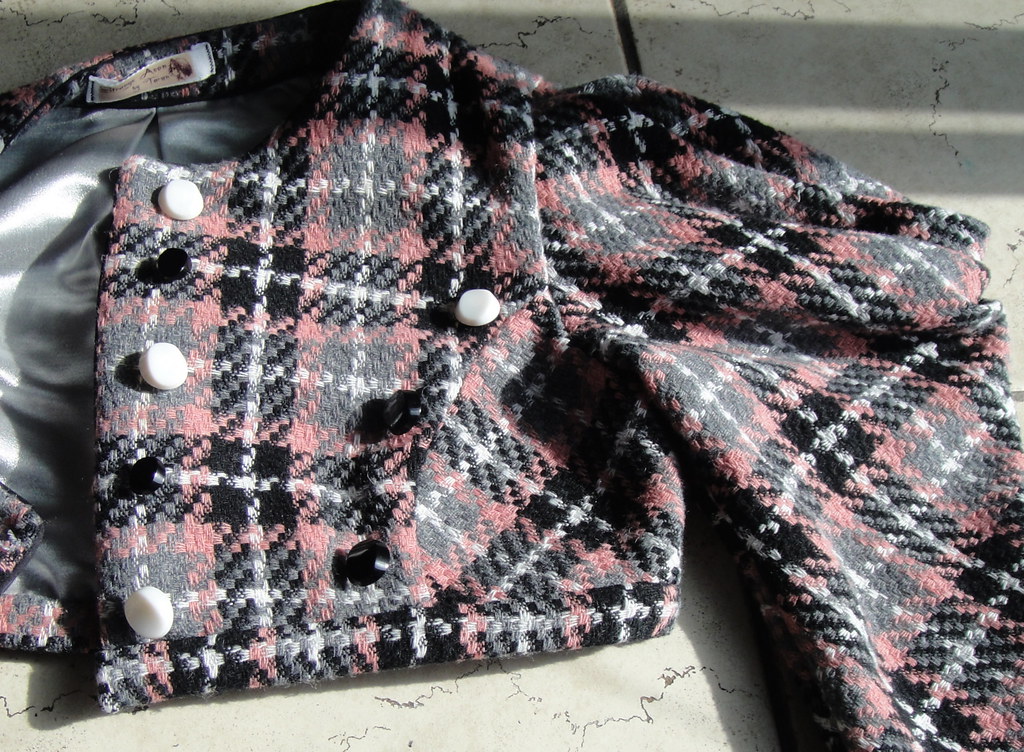
Button front

There are a LOT of buttons on this jacket. Well, eleven, in fact, and I have some extra little ones I might put on the sleeves, just for decoration. I had an assortment of black, white, and grey buttons of this same shape, in a couple of different sizes, from a thrift-store button baggie picked up a while back.  The arrangement I went with colour and size-wise is probably not optimal, but it was the best I could come up with given the limitations I had. They’re not overly visible when it’s worn, anyway. I’m actually really glad I was able to use them all together, and I like their shape—plain but distinctive—with this style.
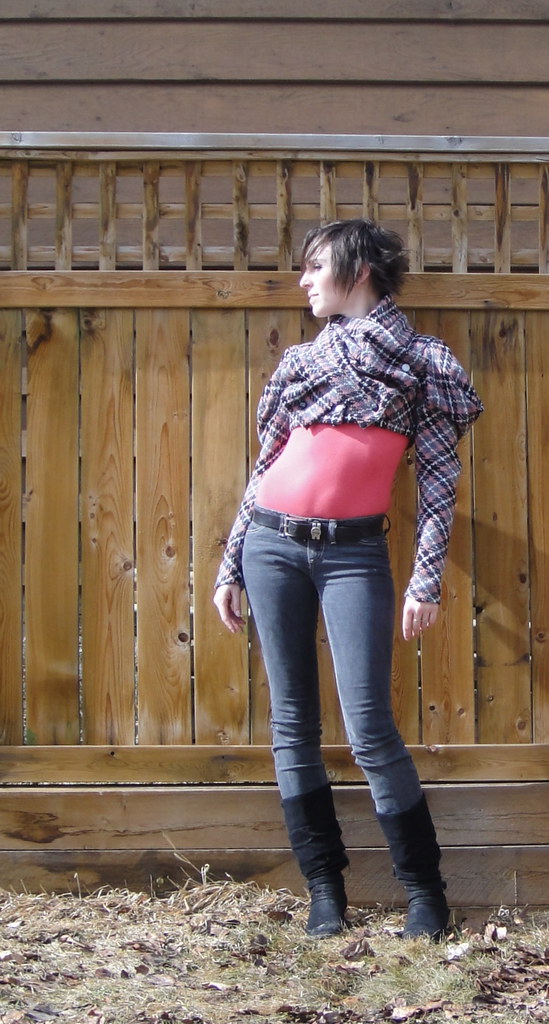
Semi-glamour

This jacket really deserves a much more glamorous photo shoot, but this is the best I was able to muster up today, as I’m still sick (have been all weekend). It looks killer with the 70s dress, actually. I had been hoping it would work with my circle skirts, but I’m not loving the combination—too much going on both top and bottom; instead of the hourglass look I was hoping for, it just looks busy. This jacket really seems to stand out with a slim, sleek bottom half—coincidentally just like the dress it was originally paired with.

I think I am officially satisfied with my fitting of the cropped bodice version of the “Built By Wendy Fitted Jacket”. Next up—sleeves and collar :). I’m thinking I might try a little cropped jean-jacket to test out a two-piece sleeve.

Warning: I have a deep and long-suppressed passion for boleros and severely cropped jackets. You may get sick of this look… soon.

I don’t know if I’ll ever actually do any of the particular projects in the Built by Wendy Coats & Jackets book (well, maybe one or two…), but I am loving having the basic pattern blocks to play with. So many possibilities! I may not be quite up to drafting my own patterns from scratch, but I love messing the heck out of  an existing one :).

Oh, and you can see the full Flickr set, with even more photos, here.

In Me-Made March news,

I did actually manage a picture today! (I promise I’ve been wearing my usual me-mades, but being sick just drains me of the energy to run around, get cute pictures, and then do the little followups like making links for the construction posts. Bleh.

At least the inch of snow that was covering the deck this morning is gone…
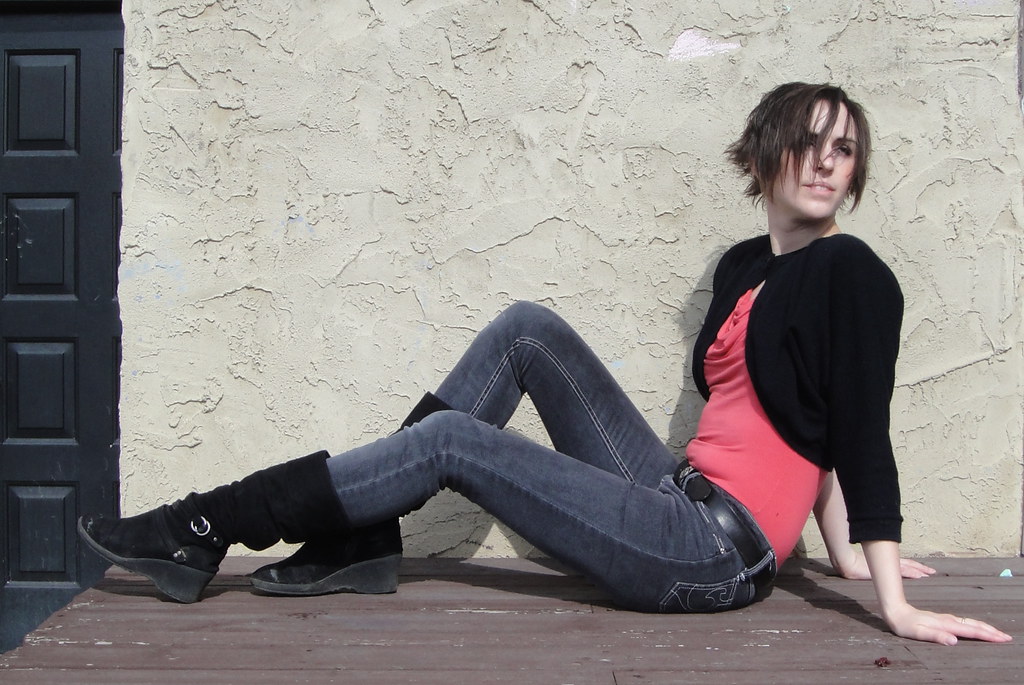
Me-Made March, day 20

Is the equinox today or tomorrow? Either way, the days will soon be longer than the nights! Hooray!
 

28 Comments

Filed under Sewing

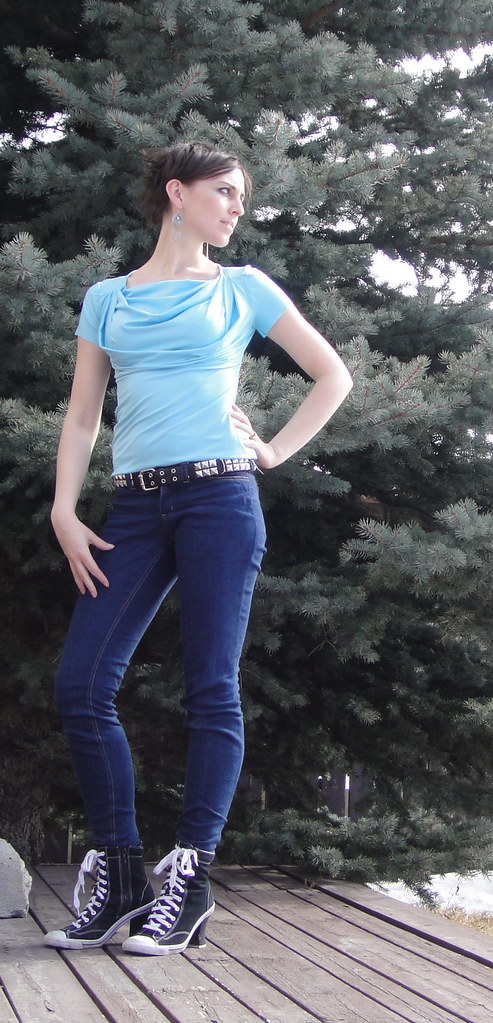
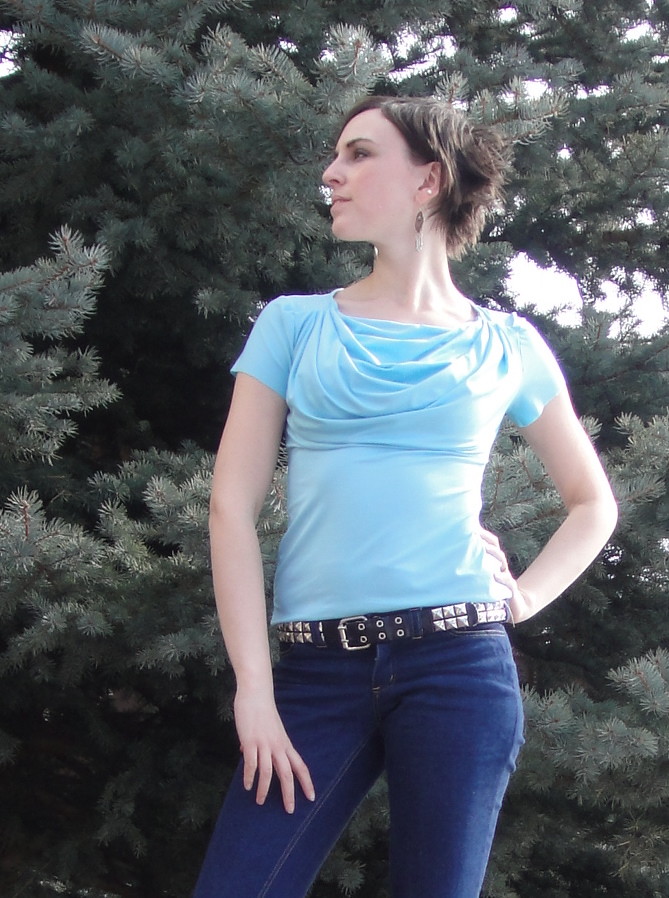
A cute model…

…Makes up for many shortfalls.

Some people can just wear anything...

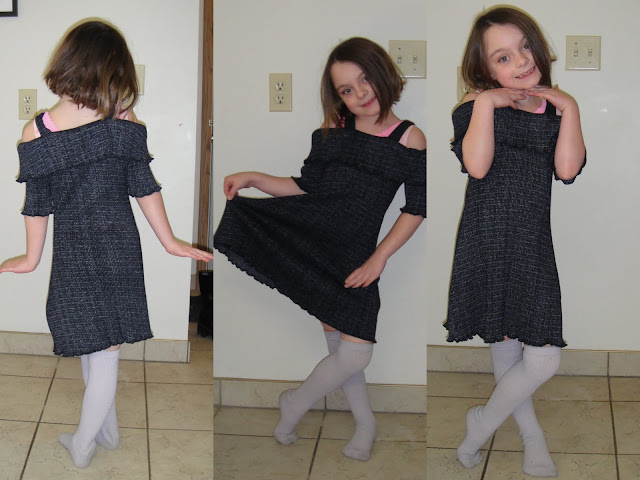
Should I feel guilt about convincing Syo that this totally crappy fabric was a good choice for the sweater-dress she wanted, based on the same pattern as this shirt? It’s (finally) almost all gone. Aside from my distaste for the fabric (and sewing it—it grows under the needle) the dress was really simple. The only tricky part was sewing an elastic into the neckline to keep it from becoming absolutely jumbo-esque. I had to pick out my first try because I hadn’t pulled the elastic taut enough. Argh. As with my sweater in this fabric, I ducked the aggravation of hemming by doing a half-ass lettuce hem, which is just a standard serged edge with the fabric pulled taut as it feeds through. Don’t look too closely at the strap placement or the straightness of the side-seams, but the sprout is happy, which is the main thing, right?

What I've been working on

My efforts towards drafting the Springy Coat pattern have led me astray. Or rather, I figured I should try a full jacket using my fitted pattern, so I’m in the process of working on this. I’d been hoping to have it finished today but that doesn’t seem likely at this point. I’m excited, though… 😉

3 Comments

Filed under Sewing

Cowl Finale

Cowlneck the fourth

Well, for the moment. Like Steph, I think I’m done with this project. I’ve made four knit cowly tops this week, all but one of which are wearable. (And I have hopes of salvaging the fourth, possibly by stitching down the folds or something…)

This one was supposed to be the ultimate. And, to be honest, I think it looks kick-ass in the pictures. That is pretty much what I was going for.

The devil, as always, is in the details.

The biggest one, I think, is the most inevitable—the large cowl which permits those lovely underbust folds doesn’t, in fact, stay in place particularly well; any time I raise my arms or lean over, it comes untucked, creating a front that just looks, well, poofy. I have a feeling the original top would’ve had the same problem unless (as I half-suspect) the “underbust” folds in the photo are created by tugging down on the cowl, rather than falling naturally that way—in which case in the shirt as worn they wouldn’t even be there at all…

Completely my fault, on the other hand, are the hole I

A bit of a closer look

accidentally snipped in the front neckline while trimming the binding, the cowl facing that doesn’t fall nicely to the inside (I sewed it down a hair or two wrong on the inside), and the fact that the sleeves are sewed on with the wrong side of the fabric facing out. Fortunately the last is virtually undetectable—anyone looking that close is going to be much more struck by my wonky stitching. /sigh. I was trying to take my time with this last version, but I think my subconscious was against me.

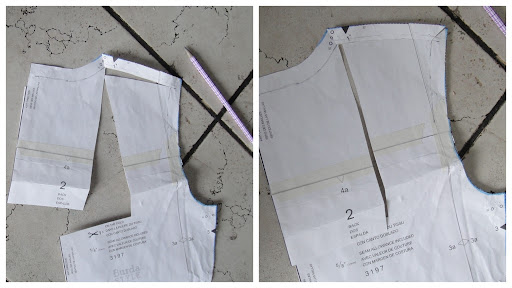
For those of you who’ve been thoroughly confused with what I’ve been doing (and who’ve stuck with me despite it 😉 ) I made up a quick little diagram of the steps I took. The tricky part, again, is the details—how long and wide of a drape, how much to curl back the front pattern piece.

Pattern alteration---click image to see full size

And I think that’s enough of messing with cowls for, well, at least a couple of weeks…

After all, Sherry’s tailoring sewalong begins in just a few weeks, and I need to have a pattern of some kind ready for that. I think I’m going to try to create my own based on the Built By Wendy jacket book (which Ali just did a great overview of). I’m thinking princess-seamed bodice, empire waist with A-line below, thigh-length, maybe an inverted box pleat or two in the skirt portion… still haven’t decided on a collar or single- or double-breasted… anyway, I’m sure I’ll have a post on that in a day or two, anyway. But I will still have to muslin etc., and decide if I can make the sleeves two piece etc.

So much to sew, so little time… 😉

23 Comments

Filed under Sewing

A qualified “meh”

Anthropologie knockoff v. 3

For this third iteration (see 1 and 2), I didn’t change much from the last; re-narrowed the neckline a wee bit, and lengthened the cowl portion so there would be more drape higher up.

This fabric is meh. The colour is drab,  it’s very, very thin, and worst of all it has very poor recovery; to get it to fit like anything other than a sack I took both sideseams in by over an inch. But it’s got great drape and cost about $1.50/m, which is about as good as it gets, at least around here.

For those of you who are insanely interested in the exact alterations, I think I’ve “curled back” the side seams/armscye too much. I needed to do it a bit more than in my first iteration to get the cowling to drape a little deeper, but not as much as I did. As usual, I overshot. I think there’s a sweet-spot somewhere between my pattern the first time and this iteration; mostly it looks good except that there’s some oddness in the folding of the pleats at the armpit; basically the first pleat is turning into a dart, which isn’t what I want. Solution? probably rotate the armscye back by the amount of that dart, and make up for the extra distance in cowl height.

Like my accessory?

Which sounds like gibberish typed out, but will hopefully remind me of what I’m trying to do… so I apologize to the rest of you for my opacity.

The other upside—this colour goes really well with my corset-waist circle skirt, which almost nothing else in my wardrobe does, and the corset-waist covers up the somewhat-more-meh lower portions of the top. Yay!

For honesty’s sake, I’ll include a shot of what I was wearing earlier in the day before I “finished” (for that unhemmed, threads hanging everwhere, value of finished)  the top. See? Not a good combo.

Previous outfit.

16 Comments

Filed under Sewing

Using up the Blue

Blue raglan-sleeve top. See below for the reason I look so irate.

After the stegosaurus shirt, I had just under 90 cm (one yard) of fabric left. Possibly I should’ve made it into something for one of the kids, since it’s a bit of a distinctive colour, but for whatever reason, I was determined to get one more long-sleeved shirt for me out of it. Wiggle as I might, I couldn’t quite get the Pattern Formerly Known as Lydia onto the available amount of fabric. I didn’t want to cop out and go with short sleeves, as this is a warm, wintry knit.

Fortunately, Lekala patterns came to my rescue once again; the raglan top pattern that I made before just fit, helped out by the fact that the pattern pieces are full-width, not to be cut on the fold. This was annoying when it was eating up all my printer paper, but with careful jiggling I was able to get it all in place.

So, I have another raglan top. As this is a much more stable knit (though without any redeeming factors like cotton, as far as I can tell), it fits considerably more, ah, sleekly, than the white version. Thus far I haven’t bothered with the ruching on the front; I kinda like the round neck (though it is pretty similar to the stegosaurus neckline, isn’t it?). We’ll see how boring I find the top after wearing it today.

Aww... no back ruffle. Plenty of wrinkles, though, as usual...

Really nothing to say about the construction. I did the seams all on the serger, which is really easy for the raglan construction, and twin-needled the sleeve and bottom hems. The top edge is just folded under around a narrow clear elastic and twin-needled as well. I have a Schmetz twin needle right now and I can’t tell if it’s just in my head but it really seems to me like the Schmetz needles (especially the twins) break a lot less readily than the Klasse (the other brand I have ready access to…) Oh, and you may have noticed you’re getting a glimpse of something other than my usual, draped-sheet photo background. This is the brightest corner of my kitchen (at least at 8:00 in the morning), and you are being “treated” to it because my darling children trashed the basement yesterday and my sheet is now in a limp little pile on the carpet, buried under an avalanche of… not even toys. Just stuff. Urg. I love my children. I love my children. I love my children. I…

Versatile Blogger Award

oh, yes, and before I forget, the amazing Magda passed on this “Versatile Blogger” award to me, and then the equally mind-blowing Oona Baloona did as well. And I want to thank them both very much, but I think I’m running out of interesting things to reveal, so I’m going to bail on spreading the meme and just point y’all to my previous exposees: Stylish Blogger and Beautiful Blogger.

8 Comments

Filed under Sewing

The Stegosaurus Ruffle strikes again.

Blue long-sleeve top

Nothing like a me-made month to get me off the fluffies and back on track making practical clothing. Today’s version being rather more successful than yesterday’s.

I made a couple more tweaks to my ever-evolving “Pattern formerly known as Lydia“. Since at this point I’ve altered the waist curve, the shoulder angle, the sleeve-cap, sleeve length, sleeve shape, and the neckline, I should probably give up on calling it a “Lydia“, and just call it my “Knit top TNT” or something equally generic. This time, I tweaked the sleeve-cap again, removing a bit more height, and attempted a seam-free swayback alteration, which creates much the same change in the angle of the back shoulders as Sherry’s method, except that… well, I dunno, I like the funky pivot-and-slide stuff. I then decided, on a whim (actually to optimize my pattern layout) to cut the back on a seam, so I took the opportunity there to add a teeny bit of shaping as well. If I decide to make the CB seam a regular feature, I can do a much more thorough swayback fix in the future.

No-seam swayback alteration. Yes, it affects only the shoulder.

Anyway.

My previous Lydias have been scoop-necked and plain. I didn’t want to just make another version in blue, so I decided to try a boatneck and a back ruffle, a nifty little feature I am blatantly stealing from Heather of Feathertysews. Thanks! I was a little hesitant about trying it in such a heavy fabric, but it actually worked out really well. Yay!

Flatlocked seam (open)

So, back to that CB seam. I didn’t really have enough room to add a seam-allowance, so I decided to try flatlocking the seam. This is a trick you can do with a serger, where you basically turn the needle thread tension way down. That way, after you serge the seam, you can basically pull it open so the ends of the fabric butt up right against each other. One side looks “serged,” the other side has these horizontal loops of thread—actually quite decorative; I have a RTW tee that features it (and I thought it was a super-cool feature when I bought it). It works best with a fairly beefy fabric, and I gather is used a lot in active wear, for butting fleeces and things like that. Here’s a better overview than mine… Since my knit is a fairly sturdy athletic/winter knit, I thought it would work, and after a certain amount of messing around (my serger’s tension settings are wonky at the best of times) I got it to work. I wasn’t too concerned with it being super-even, as my next step was to cover it with my little stegosaurus ruffle.

Ruffle closeup

I cut a piece of clear elastic just a little bit longer than my shirt back, and a strip of

my fabric about twice as long. I was originally planning to be quite scientific and match my ends, halves, quarters, etc., but it seemed like that would require too much stretching of the elastic, not to mention require more precision than I’m truly capable of. So I just held the elastic as taut as was comfortable, and slowly let it out as I stitched (a narrow zigzag) along the middle of the fabric strip, though both elastic and fabric. The result is that the strip isn’t gathered as evenly as it could be, but it doesn’t really show (and even if it does, I can’t see it 😉 ). Then, using the same narrow zig-zag, I stitched the ruffle overtop of my flat-locked seam.

Stegosaurus ruffle!

I used Sherry’s binding method here for the neck, which I attached in a C (that is , after sewing one shoulder but with the other one still open). It’s a wee bit gapy but I’m hoping that will go away in the wash. I didn’t include any clear elastic this time as the fabric is already fairly bulky… we’ll see if I regret that in the long run.

You can see that, although an improvement, my swayback alteration attempt was not enough to remove folding at the small of my back (the fact that the shirt is riding up on my belt isn’t helping, but I promise even when tugged down the problem persists). I’m happy to say the change in shoulder-angle doesn’t seem to create a problem, which I was worried about. If I try a CB seam again, I’ll do a real swayback tuck.

The further reduction of the sleeve cap seems to have hit a sweet spot (finally!); it went in (flat) essentially flawlessly, even on the serger.

I have to say, beefy, stable knits are such a dream to work with. I twin-needled the hems without needing to stabilize, with no problem at all.

Whew, I needed that after yesterday’s fiasco.

These posts will also double as my Me-Made March day 6 🙂

23 Comments

Filed under Sewing

I meant to do that…

Mini-cowl

Bleh.

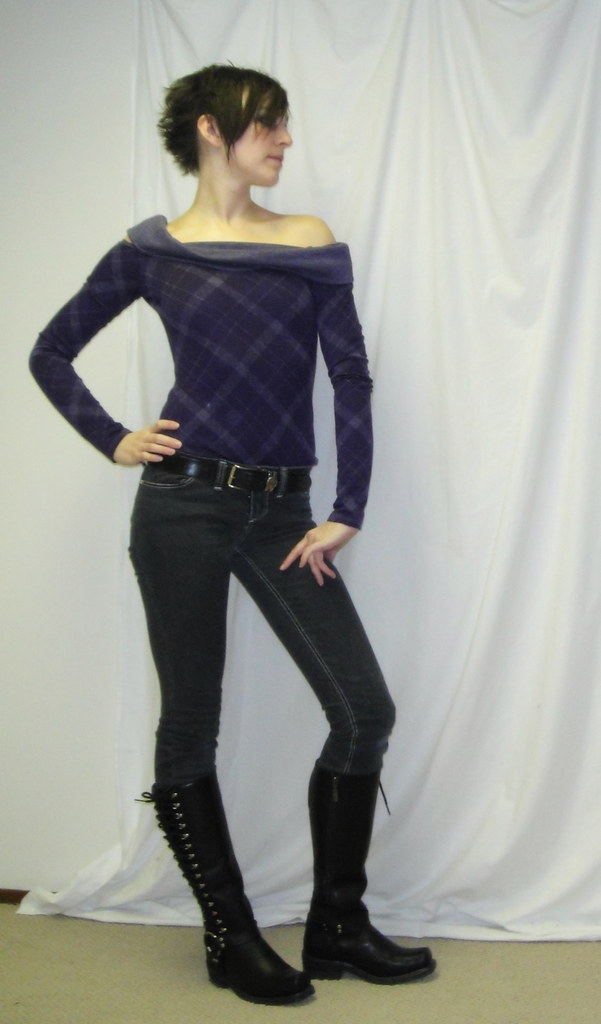
I’ve been saving the rest of the fabric from this top, trying to find just the right project. I love this fabric so much. Eventually, I decided that it needed to be a drapy pattern—a cowl neck, maybe.

Last night, I decided that a reprise of this super-quick cowl neck top by Ichigogirl on Burdastyle would be perfect.

But. It’s still about -20C around here. I wanted to add sleeves.

I pulled out the pattern-pieces for Ichigogirl’s cowl-neck, and my “trusty” (aka much altered) Lydia pattern to compare. Armscyes were about the same size, as far as I could tell, but a radically different shape. I thought it seemed simpler to try to draft a cowl neck onto the Lydia than to try to fit sleeves to the odd-shaped armscyes of the sleeveless cowl pattern.

Of course, it was 8:00 at night and I was far too impatient to read up on cowl

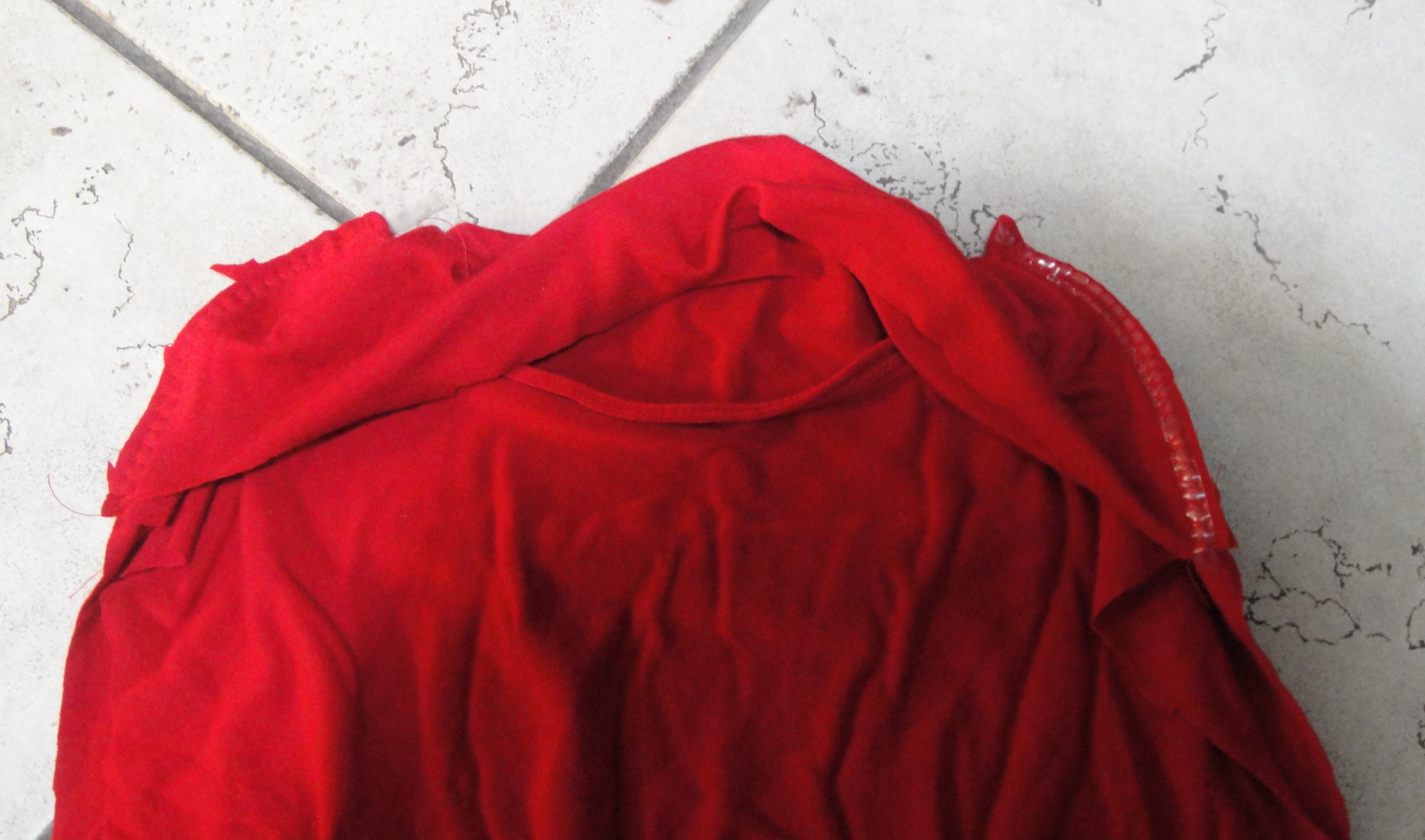
Inner folded facing of cowl neck sewn over rear of shoulders, to enclose the shoulder seam.

drafting… I had the pattern pieces right in front of me. It’s not like I’m a stranger to frankenpatterning.

Ehm. I had actually wanted a little bit shallower of a cowl than on the original pattern, which is a bit, ah, risque if you bend over.

But, not quite this shallow. Urgh.

Rear view. Meh.

I was very proud of myself for figuring out a neat way to attach the inner fold of the cowl-neck to the shoulder so it neatly encloses the shoulder seam. I’m not sure if the picture will make any sense at all, but you’re looking at the back of the shirt, inside-out. I folded the facing portion of the shoulder-seam around to the back, enclosing the entire shoulder-seam between shirt front and facing. This makes for a lovely finish on the inside.

I then proceeded to do an impatient bodge-job of setting in the shoulders (I think I

still need to remove a bit of ease from the Lydia sleeve-cap, and add a shoulder-point notch). Didn’t do such a good job on the back-neck binding, either.

Bleh. Can I just pretend I meant for it to be this way?

In Me-Made March news:

Here’s today’s outfit, which is my first one this week not to feature some (or entirely) items I didn’t have last September. It feels a little boring because of that, but on the other hand these are some of my absolute FAVE pieces so far, so… yeah!

Classic pose

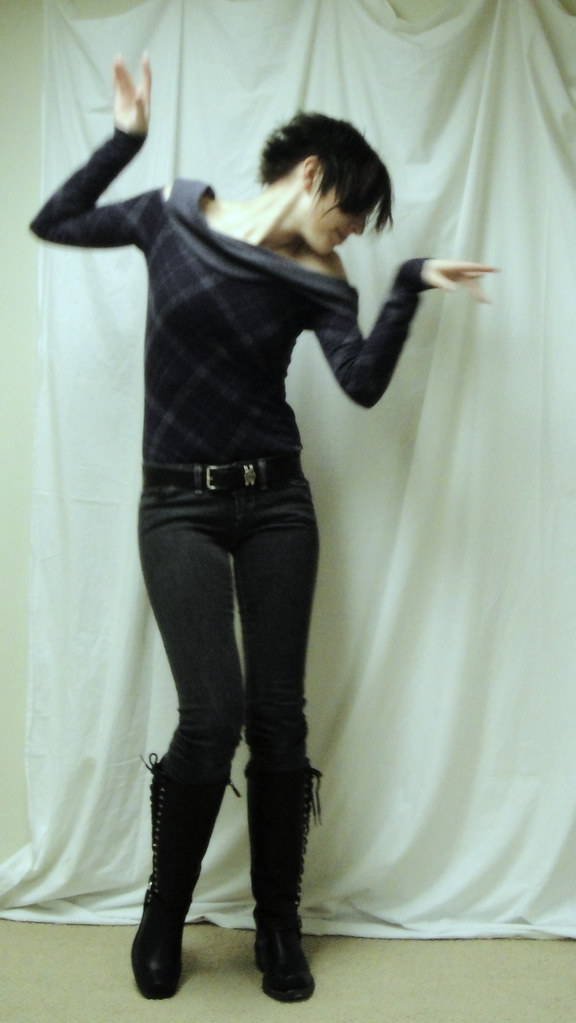
Funky dancing pose

Frankenpatterned top
More self-stitched jeans

Also my new, awesome, but hyper-uncomfortable boots. They will be great once they’re broken in.

I was wondering how long it would take me to break out the goofy poses this time around…

10 Comments

Filed under Sewing

To Do, To Don’t, and What do I know?

The latest jeans

So after my great Skinny Cargoes affair, Claire of Sew Incidentally asked if I would consider putting together a do’s and don’ts post for jeans. Since I’m such a master at them, and all that.

Erm.

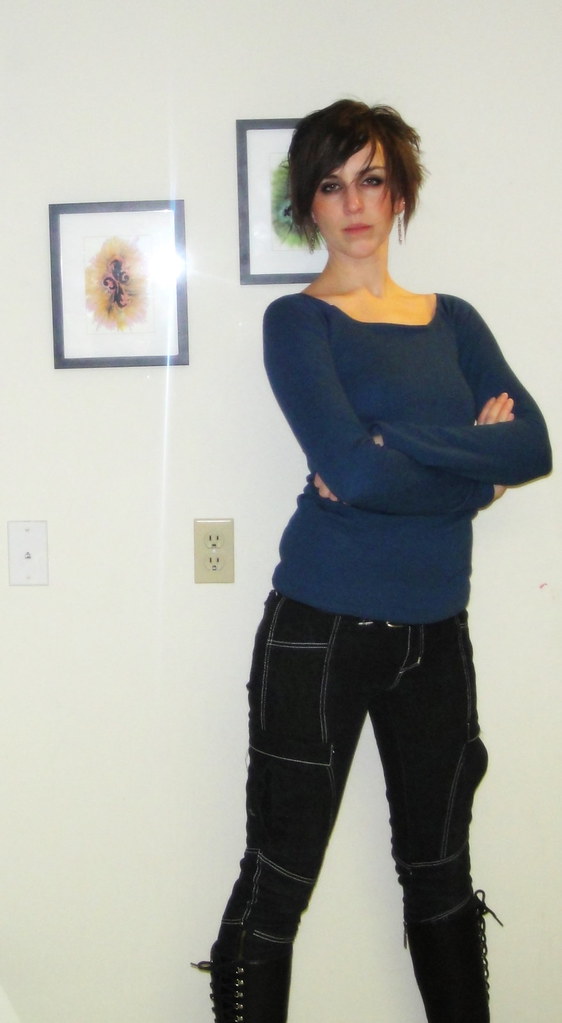
So, aside from the fact that she must be confusing me with some other blogger, I thought I’d give it a shot. Especially as I decided to crank out one last pair of denim to get me through Me-Made March.

Now, it didn’t take me long after deciding to “take my sewing to the next level” last spring, to decide that I wanted to tackle jeans. Yeah, I’d successfully managed to make my first blouse, what horrors could denim possibly hold?

This was spurred on by a number of factors. The biggest one was probably stumbling on the Jeans sewalong thread and summary thread on Pattern Review. I read literally every post of that 85-page thread. The idea of making my own jeans really appealed to me. First of all, I live in my jeans. Second of all, I’m picky about my jeans and how they fit. Third of all, I have pretty darn long legs. All of those factors combined means that I have spent a LOT of money over the years on jeans. Buffalo. Guess. Rarely under $100 for a pair. You get the idea. And always with that terror—will the fit I like go out of style? Will they be long enough? Even if they seem to fit when I try them on, will I wear them for a day and realize that they’re too short and too loose? Will I tear through the “artfully worn” knee within the first half-hour of putting them on (that pair was Guess, I returned them)? Speaking of which, when is that pre-tattered look going to go out of style? It was in style when I was in high-school (mid nineties). It was in style five years ago when the hubby and I went to NYC (and shopped at Gap. I know, we should be shot.) And it was EVERYWHERE last time I was tying to buy commercial jeans, which was one year ago. I haven’t really looked since, maybe it’s gone away?

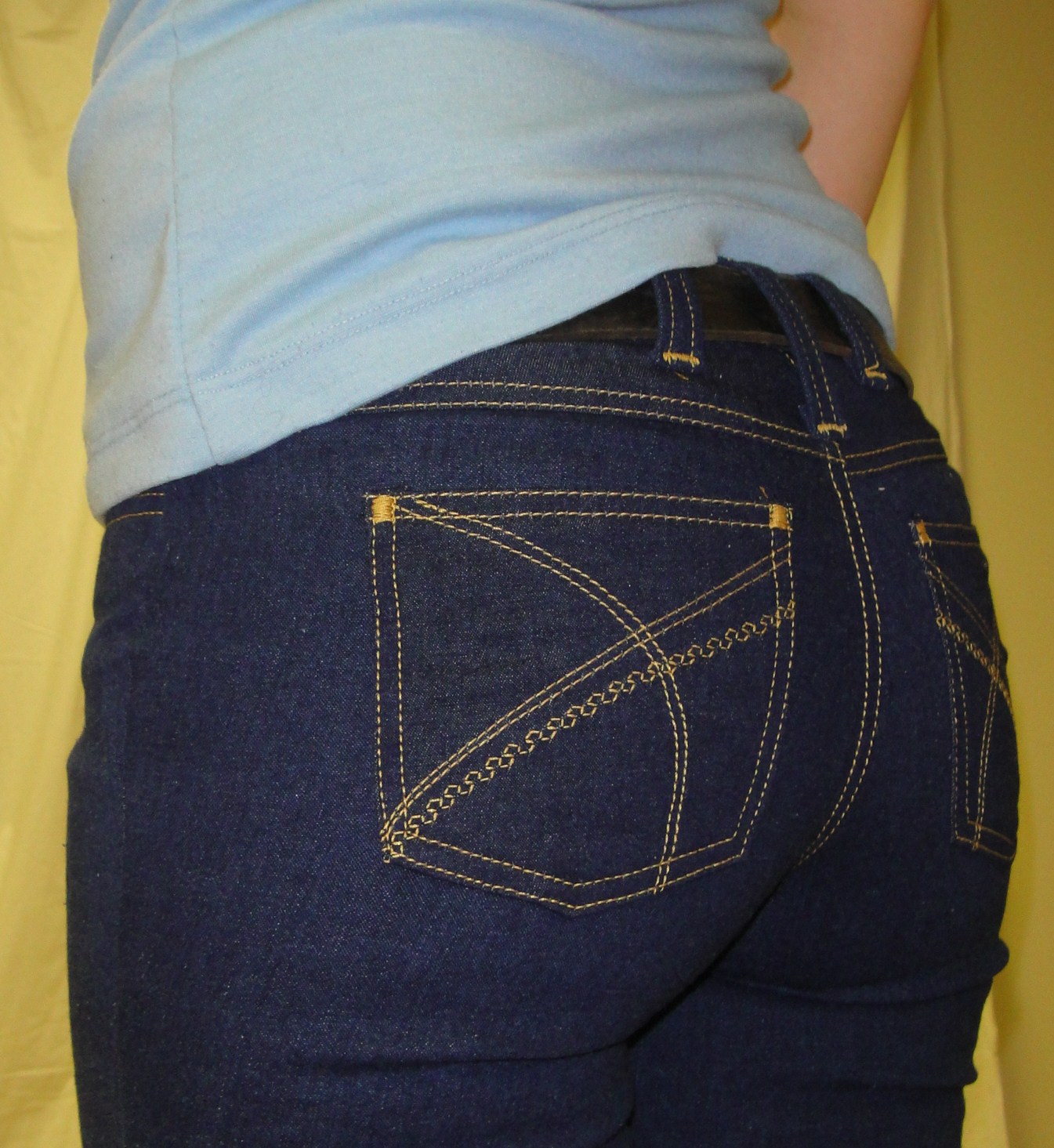
Despite the wonky stitching on the pockets (I suck at free-motion embroidery), these are probably still my favourite self-made jeans.

Now, I have a very clear list of things I’m looking for in my jeans. As far as I’m concerned, stretch-denim is the greatest invention of the 20th century (ok, after the birth-control pill). I like them low-rise, with a very fitted leg. I’m flexible on the degree of flare, although for preference I’ll go with what I tend to call a “stovepipe” leg, which is fitted in the thigh but absolutely straight below the knee; I’ve only ever once found this style in RTW.

If your list is different (as it doubtless is—few people are as fond of I am of the low rise, for perfectly good reason), some of my methods won’t apply, especially if you’re not looking for snug-fitted stretch-denim. (What, not everyone wants their jeans to look like they were sprayed on?!?) But I do hope you’ll be able to glean some nuggets from the dross, or at least be encouraged to tackle your own.

Incidentally, based on the PR thread, I used the Jalie 2908 pattern, with an assortment of modifications to make it suit my taste that are mostly detailed here. I like this pattern, but then I’ve only ever sewn two pants patterns, the Jalie one and the Burdastyle Ellen pant. Both were pretty painless, doubtless due to my minimal curvatures in this area. So I wouldn’t consider my endorsement to be the be-all-end-all in this area.

Anyway, without further ado,

DO:

  1. pay attention to the % stretch, not the % lycra; expect to resize slightly depending on the individual stretch of your fabric.
  2. buy enough fabric for two pairs of jeans—the first one can be a hopefully-wearable muslin, and you’ll know what to expect from the remaining fabric stretch-wise.
  3. wash and dry your fabric on hot at least once; then let it sit or hang (“relax”) for at least a day or two, as the heat can bunch up the lycra fibres, creating fabric that will stretch too much after wearing.
  4. My foot for topstitching. Not necessarily the best, just the best from my limited selection.

  5. do figure out which sewing-machine foot works best for topstitching. A lot of people prefer a straight-stitch foot as the sides are narrower and you can see right up to the needle. I don’t have one, but I find my rolled hem foot (of all things) works the best. An edgestitch or possibly even blind-hem foot are also good options.
  6. play around with your topstitching options. There’s jeans

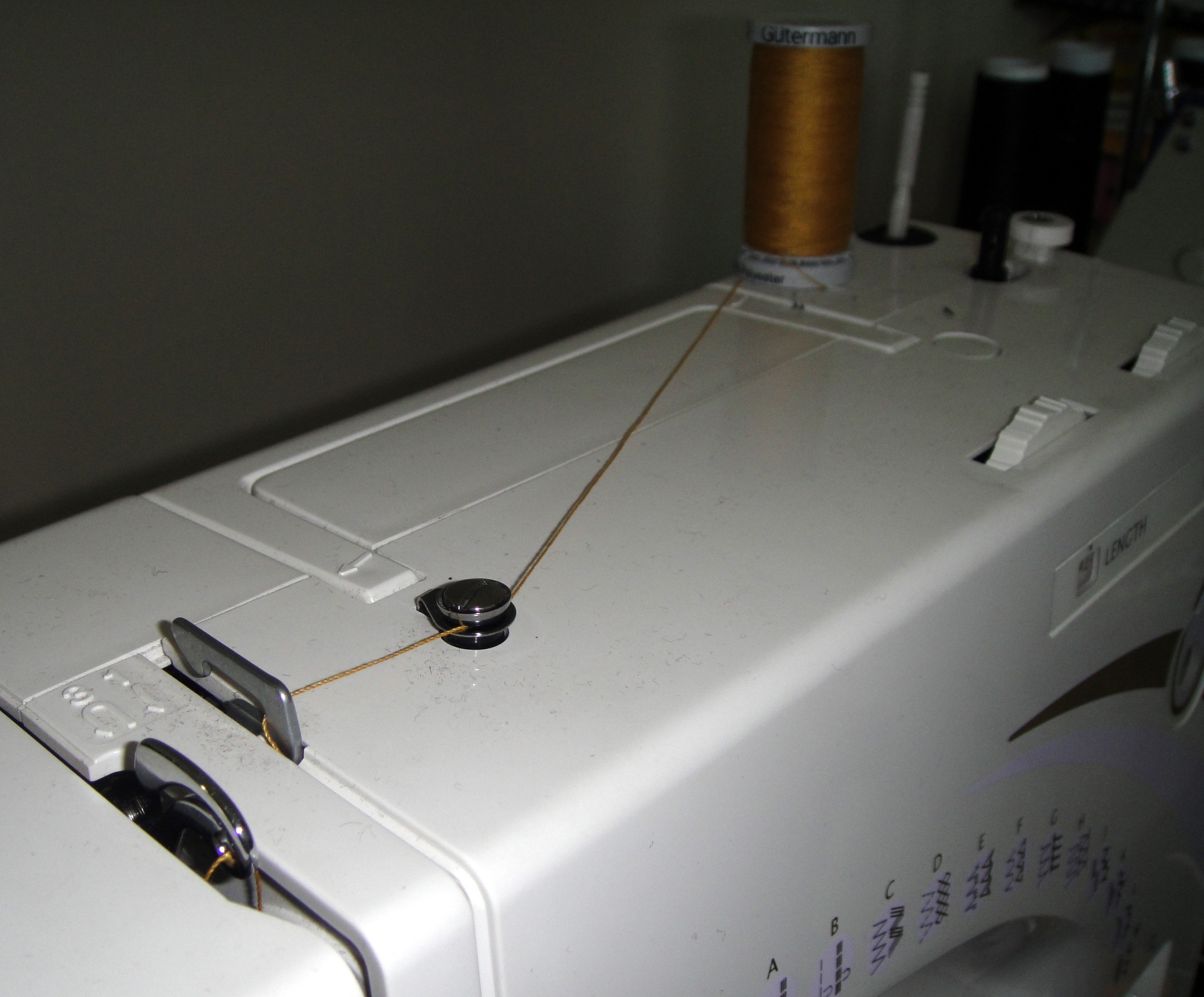
    I wrap my topstitching thread around the bobbin-winding doohicky to increase the tension (AKA cheat)

    thread, topstitching thread (really heavy), upholstry thread, or even regular thread in a stretch straight stitch (triple stitch) if your machine does it. You will probably need to raise your top tension if you’re topstitching with a heavy thread, and may even need to cheat.
  7. be prepared to baby your machine over the thick parts (at least if you, like me, have a wussy modern machine. Sometimes I need to just turn the hand-wheel for several stitches. Or hammer the crap out of the seams (preferably with a rubber mallet. I use a regular hammer or even my rock hammer and if I’m not careful the edges will cut the fabric)
  8. construct the front first, then the back. Have another pair of jeans around for reference. Attach the pockets after sewing the two sides of the back together, and centre them relative to the topstitching, rather than the true CB.
  9. If you’re doing anything other than the simplest of pocket-embroidery, you will want to stabilize the pockets, either with wash-away or tear-away stabilizer or even interfacing. I recommend the removable stabilizer, though; permanent interfacing interferes with the pocket’s ability to stretch and causes butt-flattening. (Ask me how I know 😉 ). Use a cardboard template to press your pockets’ seam-allowance under. Speaking of pockets, I use a size-K pocket on my size-Q pants. My derriere is compact, and I don’t like the bottom of the pockets to go below my actual bottom. YMMV.
  10. Look up your favourite fly-insertion method EVERY SINGLE TIME. My

    What passes for a successful fly around here.

    favourite is Debbie Cook’s; a lot of other people recommend Sandra Betzina’s video. (I have a hard time following video instructions, for some reason.) Also take a long, hard look at some RTW flies while you’re doing it. It will help. Oh, and interface the fly, too. (The fly isn’t actually hard. It’s just really easy to do the wrong way around, which is mildly annoying. The topstitching is a bit tricky, too, but you can manage.)

  11. once you have your jeans stitched up the side, before applying the waistband, do put them on and wear them around the house a bit (preferably for a few hours). This will give you an impression of how much the denim will relax with wear. You may also want to do a trial wash (serge the top edge first) at this stage, as washing and drying are another wild-card for stretch fit.

DON’T:

  1. be afraid. You can totally do this. Denim is heavy, but lovely to sew.
  2. use a pattern or fabric you don’t like. Remember that *perfect* pair of jeans you’ve been mourning since the day went to that great warehouse in the sky? Those are the ones you’re trying to re-create. You won’t, of course, but with any luck you’ll make it into the right ballpark.
  3. cut your waistband on the bias. I use a contour waistband on mine, stabilized with a light-weight interfacing. If I had to go with a straight waistband, I’d cut it on the lengthwise grain, to reduce stretch. My RTW jeans often have about 50% stretch in the fabric, but only about 10% stretch in the waistband (how do they do it?)
  4. sew over the bottom of the zipper when you’re topstitching your fly. Instant recipe for broken needles flying into eyes.
  5. add or remove length at the hem. Unless your jeans are drafted perfectly straight, there’s shaping between hip and knee, and knee and ankle; you need to measure your length to the knee and add (or remove) both above and below to keep the proportions right.
  6. add a wedge to the side back rather than the centre back because you weren’t paying attention. (yes, I did this once.)
  7. if you’re making skinnies, don’t narrow the leg so much you can’t get your foot through (unless you’re adding zippers!)
  8. freak out about wrinkles below your butt. These are not trousers that are supposed to fall straight down from the widest point. There will be wrinkles.
  9. try to finesse the slightly-too-tight waistband fit by putting your button too far over. You’ll just end up with a gapy fly.
  10. feel self-conscious about your wonky-topstitching, or those almost-invisible darts in the yoke. No one is looking. Seriously, they aren’t.

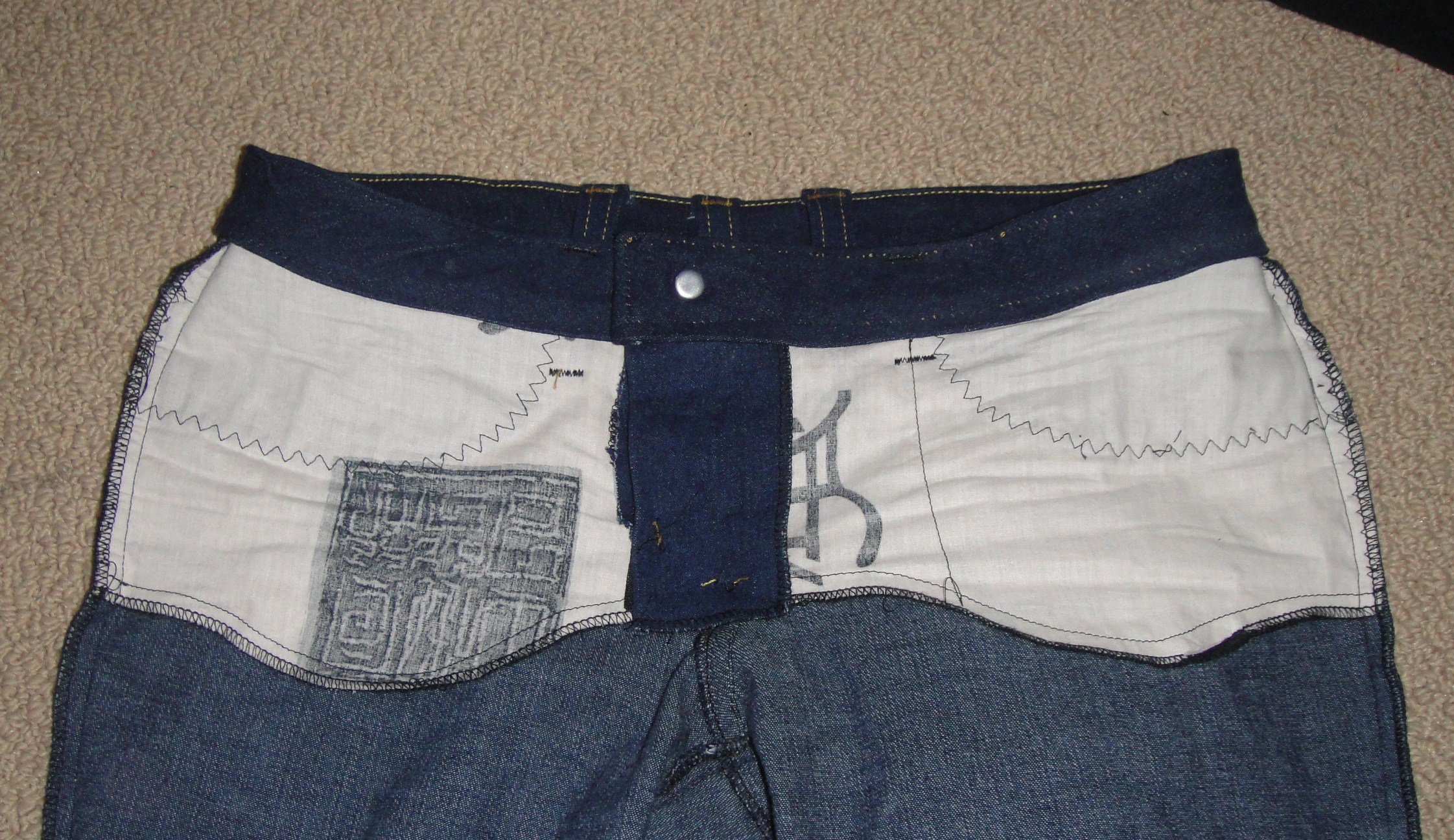
I extend my pocket-linings all the way to the front fly. This interfaces the fly while stabilizing (i.e. slimming) the front, and is super-easy to draft.

I have to admit I feel a bit bad about these lists. They’re tailored so specifically to my “jeans ideal”, which I know is not everyone’s cup of tea. I don’t have much to say about fitting—other than curving the back yoke and taking in the outseams a little bit, and of course the inevitable length adjustment, I haven’t done any (stretch-denim is fairly forgiving). Certainly no messing around with crotch-curves as the intrepid Patty does on a regular basis these days. While I’ve made a crapload of adjustments to the pattern, the majority have been for style or personal preference (pocket linings that reach all the way to the fly to interface it, contour waistband, smaller pockets, etc.)

Coming up with the top 10 was hard (as you can see since so many of them are actually two or three suggestions!). There’s lots of other little points that I could’ve thrown in there.  I didn’t even mention the buttonhole, which has been my waterloo. Mostly, I resort to doing them by hand—not too bad since there’s only one—but on this most recent pair I eased up on the waistband interfacing and was able to work it by machine. My machine can’t do a nice keyhole shape, sadly, but no one else is going to notice anyway.

New skinnies---rear

And I still haven’t really showed you photos of the new pair! So I’ll be quick: this is my first “truly skinny” pair of jeans (the other ones all have stovepipe legs). I made them to replace this pair of RTW jeans that are beginning to bite the dust, and are verboten this month anyway. As you can see (You might have to click through to the full-size photo), I included the same cute little top-stitched dart on the lower leg as in Syo’s pair.

As I doodled out my pocket detail, I

A subtly naughty pocket

realized I’d created an homage to Mary-Nanna’s white knicker jeans (and Steph’s tribute… and of course this alleged Japanese fashion trend which I’m happy to learn is indeed a hoax. I thought it was a bit fishy when I first saw the pictures a few years back, but you never can tell with the Japanese. 😉 ) Mine is a bit subtle, but those of you in the know… well, now you know! ;). If I ever find some white stretch denim, I promise I’ll do full out undies-pockets. The nice thing about making my own skinnies is I can keep the calf-width where I like it and just narrow below; so many skinnies are made for those toothpick-legged adolescents with no calves.

New skinnies, front view

Beyond that there’s not too much to say about them. I used much the same procedure to narrow the bottoms as I did with the skinny cargoes (except I only had two seams to work with, not four). I kept the full length this time, to get that “legwarmer” bunchy look around the ankle that I crave so badly (yes, I like my pants and my sleeves to look extra long. It’s such a rarity for me). Since there’s no zippers in this pair, I had better hope they don’t shrink at all in the wash or I may not get my feet through them next time ;).

So, this is officially my first pair of truly skinny (self-made) jeans… and I hear that apparently the bootleg cut is coming back. If it ever actually left. /sigh. I’m so non-trendy. Oh, wait. That’s a good thing.

I still think I like the stovepipe leg the best, though…

Oh, and this would be my first outfit for Me-Made March. Not terribly innovative, I know, but it’s far too cold out right now for the frillies and the pretties. Hopefully that will change over the course of the month…

34 Comments

Filed under Sewing

Meh.

A little "mad scientist"?

While attempting to unearth my kitchen yesterday, I uncovered one of my (mercifully few) UFOs. Right after I finished the first circle-skirt, I had a vision of mini-wardrobe bliss and promptly printed and sewed up the lining for a Franzi vest. Which has been kicking around my computer/sewing desk ever since.

In hindsight I’m not sure why I did it, as I have a hard time styling vests at the best of times and while I’ve nothing against the menswear look, it’s not really what I was going for in my mini-wardrobe-headspace.

Anyway, since I was looking for a quick weekend project, I figured I’d finish it off and at least get it out of the kitchen. So I hunted down the pattern-pieces (hooray, cleanup!) and cut out the shell. I even took the time to mess around with a piped pocket, which is like a double-welt pocket but narrower. It worked, though the ends aren’t

Piped pocket

especially pretty. I remembered to face the back of the inside with my fashion fabric, though, so there won’t be a big gap of pocket-lining showing through. I used the last of the red piping (left over from the Ceylon blouse) around the neckline, too. I opted not to fold down the little lapel bit, as I didn’t really like the bright silver lining with this fabric. Black would’ve been better.

And the result is… well, a little meh.

The fit’s not horrible but it’s not perfect. The larger sizes of this vest have a

Burdastyle Franzi vest

dart in addition to the princess seam, but my size doesn’t; the additional shaping would’ve been a good idea. It’s a bit gapy at the armhole above the bust. I could’ve shortened a wee bit above the waist, too—I can tell from the way it feels, although it doesn’t show too much, I think. Of course I don’t have a buckle for the back belt, so I’ll have to hunt one down. I did a small swayback adjustment, basically just taking in the bottom of the CB seam a wee bit, which worked well.

It really needs a high-necked shirt underneath it, which basically means one of

Back view

my JJ blouses, and since the ruffles don’t really do any favours for anything you wear over top, that limits it to one of the non-front-ruffle versions. And the red in the piping doesn’t match the red in my red JJ, so it really only looks even half-ass good with the white-with-black spots JJ.

So, I dunno. Not awful but not great. In theory a vest would be nice to spice up an otherwise generic outfit, but since this vest really only works with one top in my wardrobe, it’s not going to be that versatile. And I don’t really like it with the matching circle skirt. Still, I suspect it’ll crop up in Me-Made March, at least once or twice.

9 Comments

Filed under Sewing

An edgy little vest

Vest---closeups

One cool kid.

Tyo wanted to make her Patrones vest out of the same fabric as her lounge-pants. This was not ideal, but when has an inappropriate fabric choice stopped us? 😉 So I interfaced the skull print pieces with an iron-on knit interfacing, used scraps of sweatshirt-knit left over from the Kimono Lady Grey for the rest, and went to town. Tyo did much of the cutting out, but I did all the sewing. Mostly because I haven’t done many shawl-collars and was kinda winging it and didn’t want to confuse her and screw her up. It was also my first time making a lined vest since learning about the trick where you sew the neckline and the arm-hole edges before the side-seams so you can pull them right side out without hand-finishing. So I wanted to try it myself. I did manage to sew one of the side-seams with the front twisted around the first time… have I mentioned how much I hate picking out serger seams? And I managed to pick out half the front princess seam first, by mistake. *head-desk*

I did a particularly poor job on the little belt at the back, which I really should have interfaced, too, but fortunately it really doesn’t show (it does need a buckle still, but anyway). I wish I’d had enough of the skull stuff left over to do the front side panels in it, too, but it was touch-and-go as it was.

A stylin' girl

Her one request (besides the fabric) was the little pocket inside the front. Just the right size for her MP3 player.

Other than the little belt, I think it turned out really cute!

Also, nothing like a quick before-bedtime photo-shoot to bring out the silliness:

Stylin' Syo

But the Badass Badguy takes her down!

Even bad guys like to chill with their tiger.

Just for the record, I’m pretty sure that’s the only toy gun we have in the house. Toy swords… plenty. Guns… not so much. We are not really gun people.

12 Comments

Filed under Sewing