
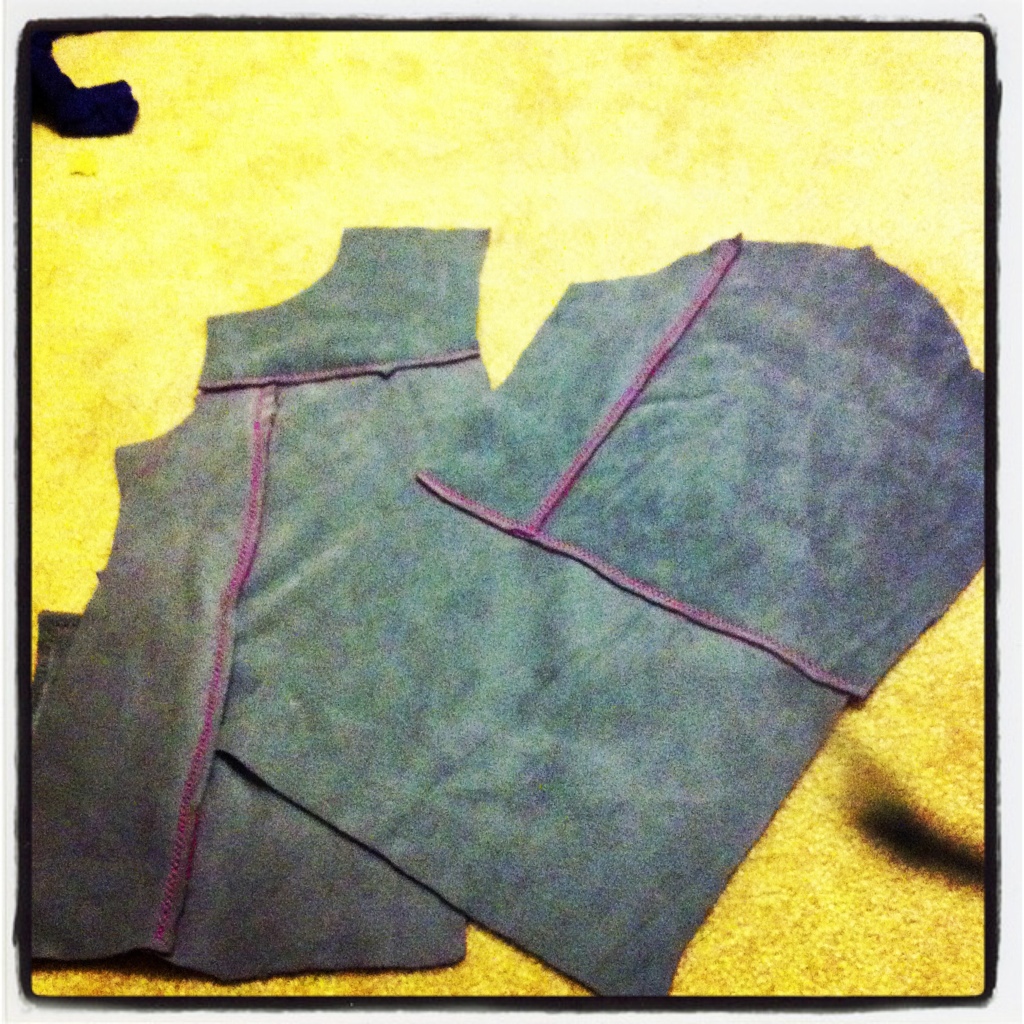
Spot my booboo? Fantasy sewing is so much easier.
And I managed to lose BOTH my seam rippers in the move.
Spot my booboo? Fantasy sewing is so much easier.
And I managed to lose BOTH my seam rippers in the move.

So I’m not sure if this counts as enabling or enablement. But the other day, after a month and a half of subtle (and not so subtle) hints being dropped on both sides, my Stylish sister-in-law finally pulled out my mother-in-law’s old sewing machine, a Janome Memory Craft 6000 (c. 1986) for us to play with.
Now, as background here, my mother-in-law has assured us for years that, while her machine was the pinnacle of its breed back when it was new, it no longer worked well. In particular, the bobbin thread tangles. And a year or two ago, when we were visiting home, Stylish and I had poked gingerly at it (rather like poking a tiger in a cage, I think), and gotten absolutely nowhere. It’s a computerized machine with a drop-in bobbin and a sideways-lying spool for the thread—completely beyond my experience.
Well, whatever dark stars were in ascendance before, apparently the other day the planets were in conjunction in the constellation Janome, because the machine worked. Initially, (after painfully perusing the manual to make sure we had it threaded just right), I was just happy it was forming stitches, but the feed dogs (although moving) didn’t seem to be feeding the fabric. We pushed the buttons for a few more different settings, read some arcane incantations from the manual, and all of a sudden they started working. (And yes, there is a feed-dog-dropping mechanism but it wasn’t engaged and we didn’t start messing with it until after they’d started working)
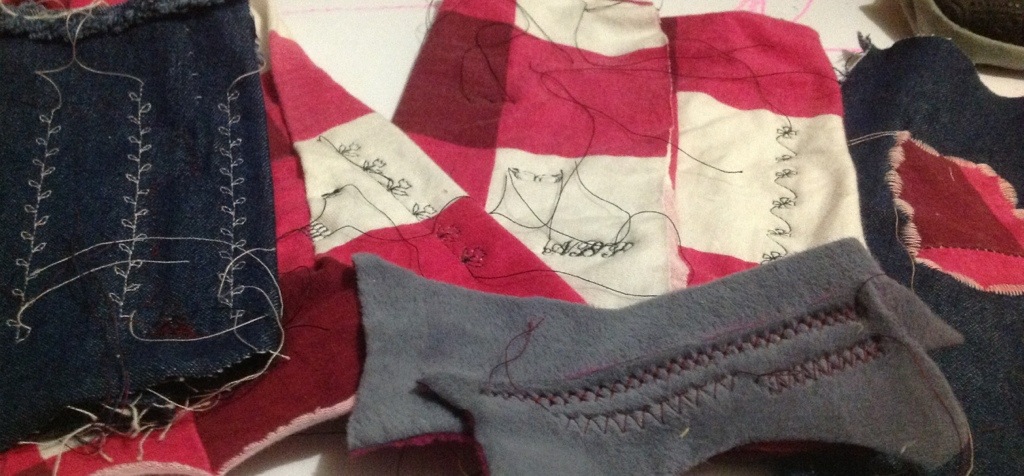
The first few decorative stitches I tried were less than perfect, but the more of a workout we gave the machine, the better it behaved, and by the time I had finished stitching out series of letters and kitschy little penguins and alligators over pretty much every scrap of cloth Stylish could locate around her house (it turns out normal people don’t just have stuff like that lying around), it was humming along happily, even when I mashed five or six layers of denim under the foot to see what it would do.
Now, there are people who love modern computerized machines for their wide range of functions. And there are people who love vintage machines for their sturdy reliability (I’ve long considered myself one of the latter). But I don’t know that there’s anyone who loves elderly computerized machines. (As with 80s patterns, I’m not sure it’s quite appropriate to apply the term “vintage” just yet.) That being said, Stylish and I had an almost unseemly amount of fun. Or rather, I had a ton of fun and she sat and looked on in bemused wonder (I’m going with wonder. Horror might have been a possibility). We swapped out feet (it has a wide array, all of which live in their own neat little slots in the top of the machine, almost none of which I recognized), played with the disgusting variety of programmed stitches, and I even managed to program it to make a keyhole buttonhole. And while I know there may well be no hope for it when the circuits do decide to finally go, they haven’t gone yet, so why not enjoy it while it lasts? I should mention, there was nary a hint of bobbin-tangling either.

I thanked the sewing gods, repeatedly, for the small miracle that my mother-in-law actually kept the manuals to this machine (unlike for my, formerly her, serger) because we would’ve been flailing helplessly without them. For example, they revealed that to engage the manual control of the stitch length and width dials, you have to push them down like a button, first, lighting up a light, and then you can adjust as you see fit. Otherwise, it’s pre-programed, baby.
Also, it always finishes with the needle in the “needle up” position. And then there’s a button to hit right on the harp arm if you want the needle down (say to pivot around a corner). I had heard of these things, but always scoffed at their usefulness. Especially since my hand automatically goes out to adjust the handwheel to make sure the needle’s in the right place, regardless. But, if you were lacking such reflexes, I can see how it would be kinda awesome. One of those things you could get used to. I am thinking I had better not sew too much with this machine…
Our first “project” (once I had finished messing around with fancy stitches) was to sew little covers for Stylish’s two little Christmas-themed couch pillows, so she doesn’t have to look at Frosty and Santa in July. I stitched the first one while Stylish watched, and then made her do the second one (although I stitched them both shut, which involved the zipper foot and a fair bit of swearing.)

In fact, we were sufficiently pleased with ourselves that by the time we had to go actually do grown-up responsible things, we set ourselves to clearing out the lone under-utilized space in Stylish’s (not large) house, unearthing her Papa’s old treadle* for a sewing table, and setting up a teeny little sewing space. It’s not fully functional yet—she has an ironing board (I think left by the previous homeowner) but no iron—but it’s something. And she spent a good chunk of the evening sorting through all the patterns on my phone app, and making a list of her favourites.
I’m still not sure if I’m spreading the sewing bug or just getting suckered into Sewing For Others, but I had a lot of fun, Stylish had at least a little fun, and I’m not sure but I think the Memory Craft had fun, too.
*Papa was, in fact, Stylish and Osiris’s great-grandfather, who lived to be 94 and used the treadle, a handsome old Singer, for stitching harness and various other manly things. It probably deserves its own post, so I won’t talk too much about it here.
Filed under Sewing

That Damn Treadle
Y’know how when forensic specialists are matching finger-prints (or dental records), and they go through the whorls (and fillings) and things looking for points of concordance and discordance between the different images? No? Obviously you should’ve paid more attention in your Forensic Anthropology classes… Well, this is what’ I’ve been doing.
I know all y’all are just as obsessed as I am about my new treadle. 😉 No? Well, I imagine I’ll have an actual sewing post up one of these days. I still haven’t actually had the chance to work on the treadle; my Mom unexpectedly got a full-time contract (YAY, MOM!) and then Thanksgiving happened, which involved four turkeys, four days, and absolutely no energy for anything but digesting. In the meantime, I spent some quality time hunting down old Eaton’s catalogues, of which there is a surprising abundance on teh marvelous internets. Thank you, internets. Also, Library and Archives Canada and Archive.org. You rock my world. Anyway, I think I have located my machine!
I think I’ll pause here to allow you to imagine the scene as my perplexed family got to witness the peculiar dance of the exultant researcher.
My machine appears to match a model shown in the 1915/16 Winter catalogue through the 1917 spring/summer catalogue (but not in the 1917/18 winter catalogue). Woot! I’m not sure about before 1915 as there’s a gap in the archives before that until 1908, at which point the models are distinctly different.

ZOMG there it is! Also, source.
Yes, that appears to be my machine.

Compare.
Ok, really there’s only the foot pedal, which is distinctly different, and, frankly, doesn’t look like any of the Eaton’s foot-pedals I’ve looked at in the last few days. Which is a lot. It makes me wonder if that part might’ve been replaced, or if it just happened to be a different factory lot from the illustration.
Oh, yeah, along the edge of the board on the illustration, just in front of the sewing machine, you can see a series of regular ticks. It’s actually a measuring-tape decaled onto the surface of the wood. It’s pretty beaten up on my machine, but parts of it are still visible.
Oh, and I finished the Kwik Sew underwear. I’ll tell you all about it next time… 😉
EDIT: A bit more digging turned up a Fall/Winter 1913/14 catalogue, which has a six-drawer model that is different from mine. So that’s an upper age limit. One interesting detail: most of the machines in the 1913/14 catalogue have a foot pedal identical to the one on my machine (but different from the one in the later catalogues). So maybe my machine is an earlier version of its model, fitted with the older pedal style—or maybe it was just some variant from the factory. Anyway, at this point there’s only three catalogues “missing”, Spring/Summer 1914, Fall/Winter 1914/15, and Spring/Summer 1915. And, frankly, a date to within a year or two seems like pretty good accuracy considering a few days ago I wasn’t even positive about decade. So I’m still pretty satisfied, although of course there’s one or two more avenues I could pursue…
EDIT #2: I found the serial number, underneath the slide plate of the shuttle compartment. 2330993. Not sure if there’s anywhere I can look this up to get a date or location of manufacture, but that’s what it is. There’s also a faint letter “A” above it on the left.
Filed under Sewing
So, I’m pretty much due for a new pair of jeans. It’s been over a year, believe it or not, since I last made myself a pair, and not because I’ve stopped wearing my me-made jeans or anything. But apparently when you have more than two or three pairs in rotation, jeans last a lot longer. Who knew. But there’s some red denim in stash that’s getting louder and louder…
Anyway, as my me-made jeans age and acquire that broken-in appearance that’s so much a part of the jeans look (to the point where we pay hundreds of dollars for a good worn finish), I’ve noticed one subtle, yet nagging difference between my me-mades and storebought jeans.
It’s the ripple.

The Ripple
You know what I mean. The way the fabric between the two lines of topstitching makes this little repeating wave, which wears into bands of light and dark. It also happens along the non-topstitched edge of the outseam, wherever the seam allowance habitually falls.
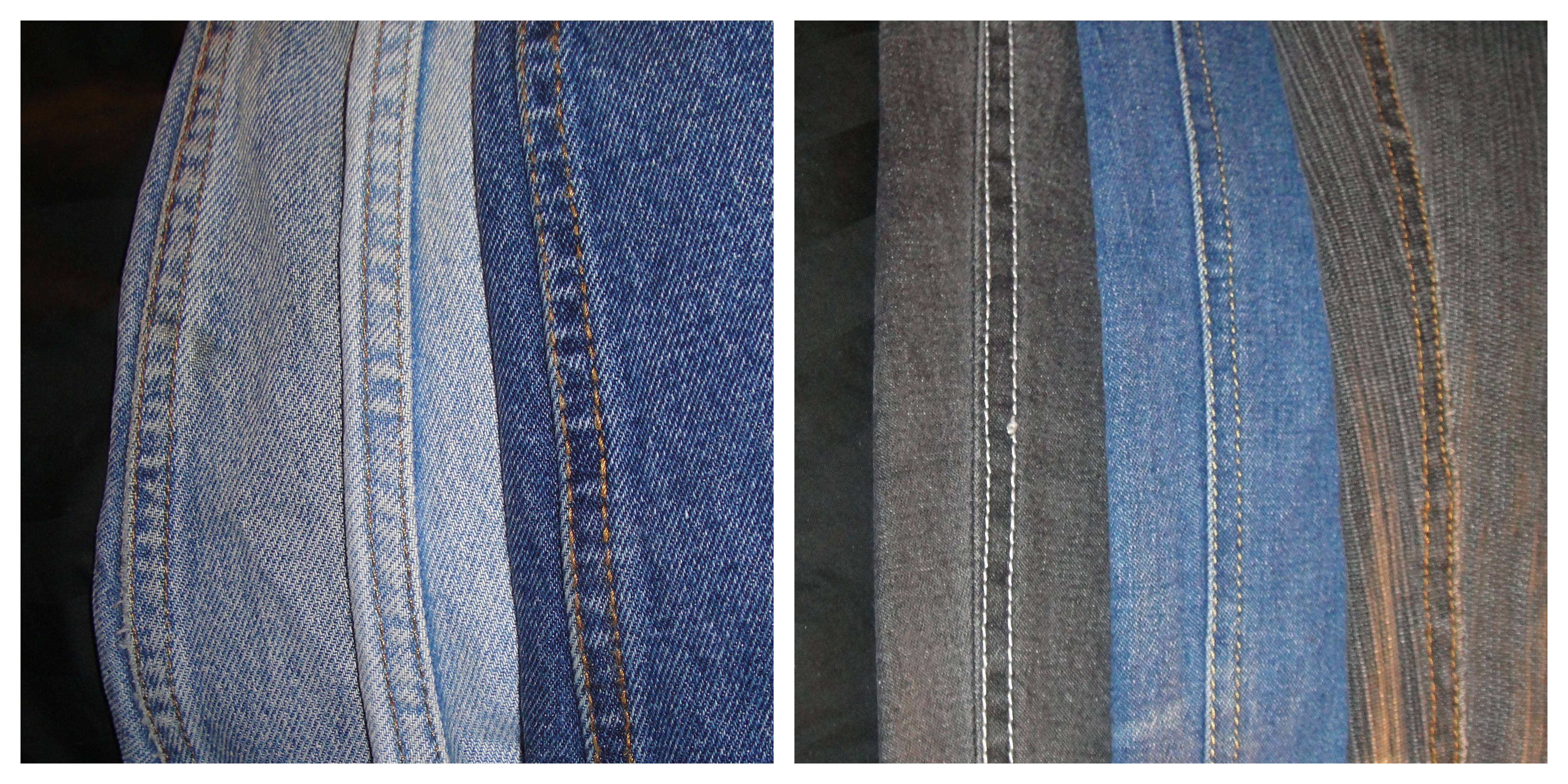
Left: storebought; right: me-made
And it doesn’t happen, (or barely, barely happens) even after years of wear, on my me-made jeans. Now my first thought, of course, was “what sophisticated little wear-roller are they running along all the seams in their big jeans factories?!?” Then, of course, my brain kicked in—this feature is far too universal (especially on my husband’s sturdy work-wear, no-fancy-finish jeans) to not be inherent in something about the jeans-making process.
And then it hit me. (Hush, I can be slow if I want to.)
Shrinking. Because, like a good little sewist, I pre-shrink my fabric and then construct my pants, whereas commercial jeans, from what I understand, are shrunk after construction. (Can you imagine trying to launder huge industrial rolls of denim?) So that characteristic ripple is probably the result of post-stitching shrinkage. Which is why my jeans have comparatively little ripple (and if I was really good and pre-washed my denim multiple times, as is often recommended, they probably wouldn’t have any ripple at all), and even brand-new dark-washes from the store, like the ones above on the right in the left picture above (how’s that for confusing), have a well-developed ripple.
Now, I’m not so concerned about this for the red jeans, but in general it’s bugging me. And it’s bugging me more the more I think about it. It’s one of those legitimacy issues. Jeans are supposed to have it. If my jeans don’t, they’re not “real jeans”. Which, yes, is all in my head. But it’s still one of those things, y’know.
So yeah, I’m seriously considering, when I run through my current set of denims (most of which have been pre-washed already), trying to enlarge my pattern so I can shrink my jeans after construction.
Bad idea? Probably. Even with doing test-swatches. I mean, from what I understand it took jeans companies ages to figure out how to wash their jeans and still get consistent sizing, which is why, at least in North America, they didn’t usually sell pre-washed jeans until the 80s (or sometime thereabouts.) My mom talks about how you always bought so many inches larger in the waist and longer in the leg than you needed, and just hoped that it would work out when it came out of the wash.
But I want the ripple, dammit. And I don’t want to have to sit there and sandpaper each individual fold by hand. 😉
So what do you think? Is the ripple worth it?
Filed under Sewing

Another city, another birthday party, another monster made (loosely) from the Closet Monster book.

This one is not really as cool as the first. It’s ok, though. Its chief claim to fame is its super long limbs, which were harvested from an old octopus costume I may have worn for a school play a quarter century or so ago. Yes, my mom has stuff like that lying around.

It enjoyed playing in the back yard for a few minutes before being wrapped up and sent away.

Tyo sewed on the limbs, button eyes, and stuffed it. I made the belt, including a salvaged buckle, and did the big final seam around the rectangular body, which was pretty tricky since all the limbs were stuffed inside by the end. The purple embroidery on the face doesn’t show up as much as one might have wished… I should maybe have insisted on white.
In any case, it’s one more on the list of projects down. In enabling news, my crafty sister-in-law stopped by to show me the plaid coating she picked up at the thrift store the other day. So we’ll be going through my multisize coat patterns soon…
Filed under Sewing

The Coat.
Okay, I’m no good with suspense. I need to get this over quickly. I finished Osiris’s frock coat. This is what it looked like Friday evening, as we headed out for a night on the town.

Closeup.
Here’s a slightly-clearer closeup.
And this is what it looked like Sunday afternoon…
Filed under Sewing
Remember those doodads I posted about last week? My research suggested they would fit a machine produced by the National Sewing Machine Company. My mother’s research uncovered two such machines in our immediate area, one in the collection of a local mini-museum my mom’s involved with, and another at a local thrift store.

The latter came home (or at least to my Mom’s house) as my belated birthday present.
It’s an “Improved Seamstress”, which was the house brand of the old Canadian Department store, Eaton’s, manufactured by National.
The exterior isn’t in great shape, but it runs, albeit in desperate need of a can or three of oil. Unfortunately, I haven’t been able to track down anything resembling a manual for it, and I haven’t the faintest clue how to wind and insert the shuttle, never mind thread it. Hopefully it’s a sufficiently generic model that I’ll be able to figure it out.

Perusal of my mother’s reproduction Eaton’s catalogues (what, your mother doesn’t have those?) suggests that it’s maybe younger than the 1901 catalogue but older than the 1921 catalogue, and that the “Improved Seamstress” was a bit less expensive than the actual “Seamstress”.
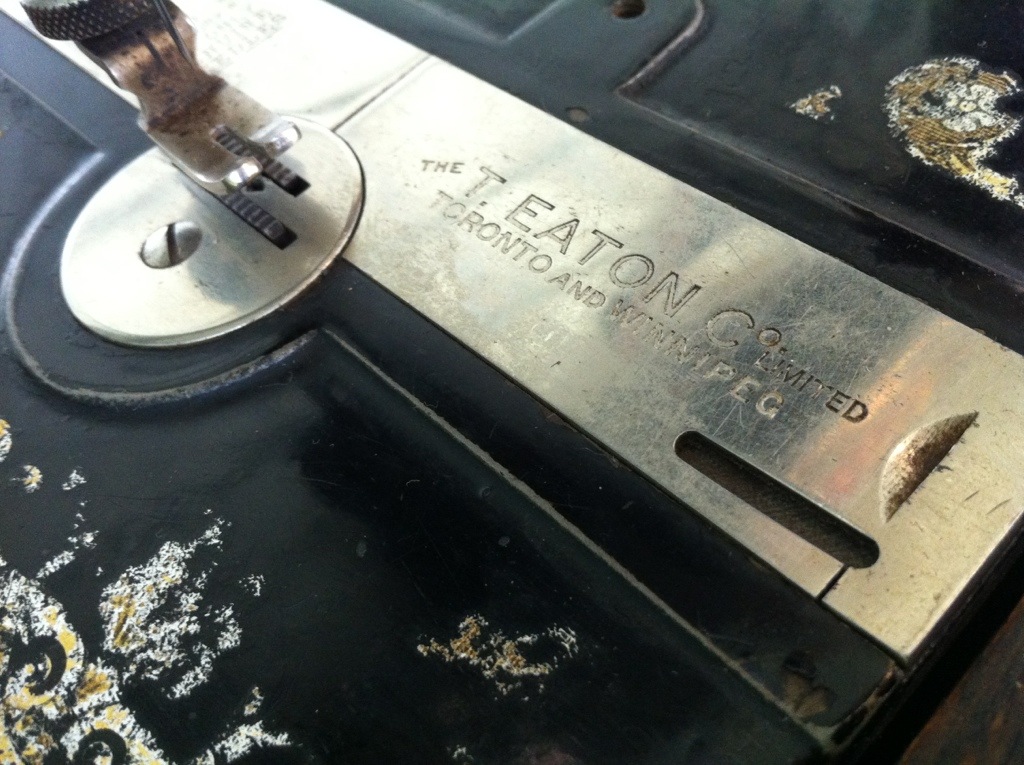
It has a set of Greist attachments, similar in style to my mom’s doodads, but not quite so well-built (or perhaps that’s just ridiculously over engineered), but lacking the ruffler, though I think one was there originally. It has the shuttle and four bobbins, and an assortment of distinctly non-standard needles.
Filed under Sewing

Leggings. Also motorcycle.
I made Syo leggings.
Possibly there is no less glamourous or discussion-worthy thing I could sew; hopefully the photos (Syo’s idea) make up for that. The pattern is Kwik Sew 1670, which I’ve made up several times now, and I didn’t even up the size. (I did actually take a 2cm vertical tuck in the pattern, as the last pair was too wide.) I did not use my serger at all, as it doesn’t make as strong of a seam. And it’s threaded with cream and I’m lazy. I used a black cotton-Lycra bought at the last major Fabricland sale I went to, and while it curls rather annoyingly, it’s otherwise a nice sturdy, stable knit. Syo is currently in rebellion against real pants, so I think these will be a really useful wardrobe addition, especially as the weather continues its inevitable slide towards the Canadian winter. (Though the last few days have been gorgeous, so no whining from me yet.)

A slightly more stretched out (and grubby) view.
They are still a little loose in the thigh, especially after wearing them all day, but pretty decent. The length is supposed to be 3/4.

Closeup
I used Steam-a-Seam Lite in the hems and stitched in the elastic at the waist with two rows of topstitching. Not quite RTW, but it’s nicely finished inside and functional.
At the same time I cut these out, I cut out a pair of Kwik Sew 2100 with the bikini-rise, in a size 4. I am, according to the measurement chart, a size 5 or 6 but the reviews are universal in the pattern running large by at least two sizes, and 4 is the smallest in the envelope. I also narrowed the middle of the crotch gusset by 1cm off each side, as it is apparently quite large. Then I turned around and lost the crotch gusset pieces, so I have not been able to stitch them. >_< if they don’t show up soon, I will cut new ones. So I can’t really report anything else. Sarai made herself a pair of these recently—it’s almost like celebrity sewing.
Or, y’know, not.
Ok, one more thing.

Motorcycle.
Filed under Sewing
I have had the blerg. That is, the the-kids-have-been-back-at-school-just-long-enough-to-incubate-new-strains-of-plague annual fall cold. Blerg.
On the up-side, I have an excuse to do nothing but hunker down, drink tea, and catch up on some of the blog-reading I’ve missed over the last three weeks. And think about my fantasy sewing in a bit more focused way. On the minus side, I haven’t been coherent enough to do anything useful, never mind anything fun.
The kids have decided, and we (most especially Osiris) have agreed, to being a Steampunk family for Hallowe’en. I’m all kinds of conflicted over this.
I really sort of loathe Hallowe’en costumes. I mean, I love a really cool costume. love love love. But. There are few things I hate more than making something that will only be worn once. If we could have Steampunk Club every week, I’d be all over the costuming. But for once a year? Erk. On the other hand, the idea of shelling out money (of which we have very little right now) for the godawful atrocities that pass for storebought costumes fills me with shame and horror.
So, sewing costumes it is. /sigh.
Osiris will be easy. In fact, all he really needs is some goggles (please nominate your favourite goggle tutorial 😉 ) and maybe some other accessories—everything else he pretty much already has, although if I were motivated to finish his frock coat I’m sure he’d happily wear that.
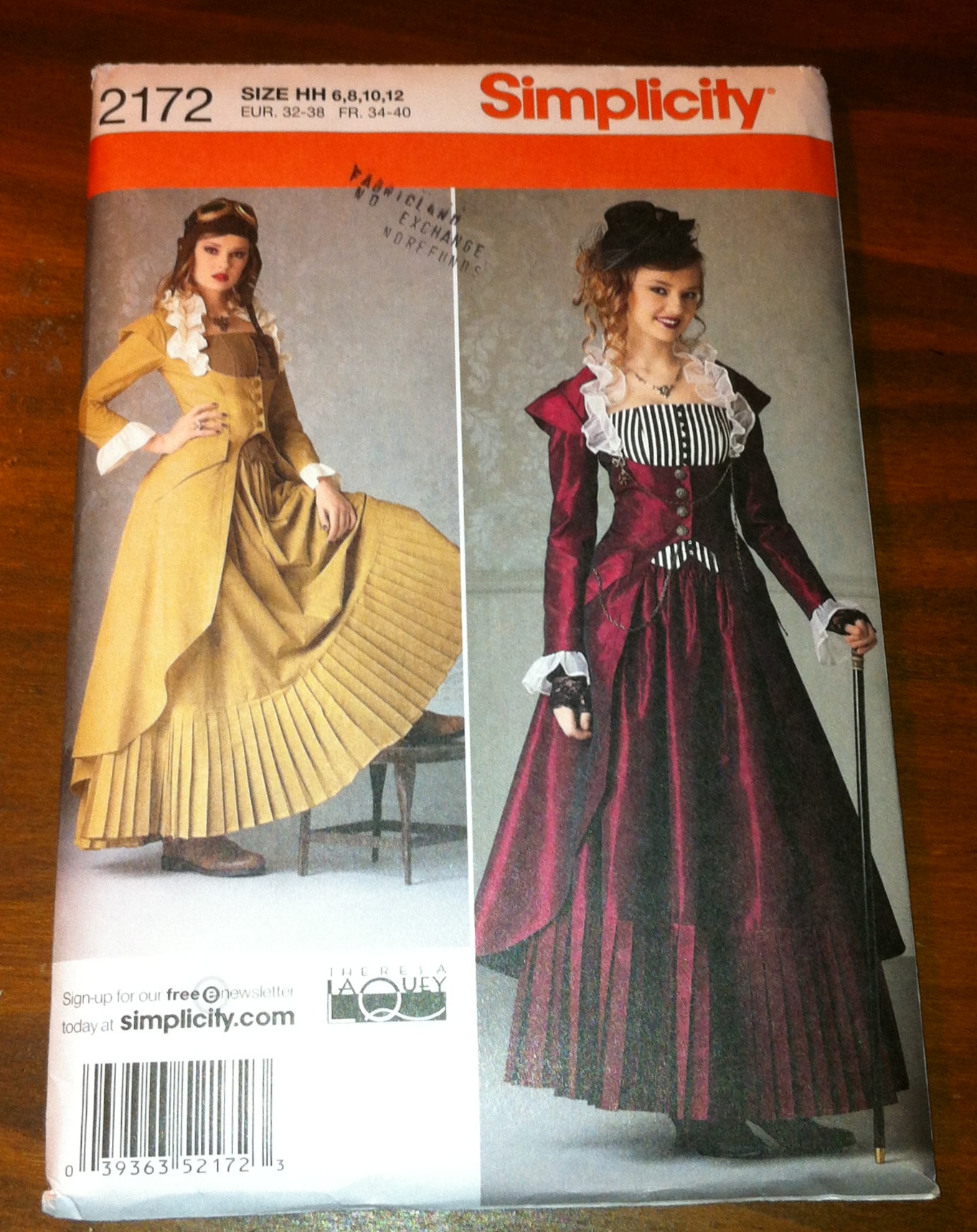
ZOMG I bought a brand-new pattern.
I’m less clear for myself, although I did pick up this Simplicity pattern at the $2 sale last weekend. I love the coat, although my deep suspicion of costume patterns makes me assume that it will be poorly-drafted and lacking sufficient internal structure to look right. I should probably at least read some reviews before I come to that conclusion, though. There was another pattern with a bustled overskirt thing that I also like, but it was featured in the Fabricland flyer and so long sold out by the time I got there. /sigh. Of course it’s the sort of thing I can figure out on my own, but for two dollars, not having to make it up might’ve been worth it. And I have (or rather my mother has) a perfect hat already.) Although my make-life-harder reflex is yammering something about “Steampunk Seamstress” that involves an antique-sewing-machine-looking-backpack…

Sketchies—Tyo’s costume.
Which brings us to the kids. We spent some time sketching on the weekend, although this was a bit frustrating since every time one girl came up with a good idea the other decided she wanted it, too—but they don’t at all want the same costume. >_<
Anyway, Tyo seems to have settled on some high-waisted shorts (over stripey stockings and the boots that started this whole thing) with braces, a corset/bodice thing, and a jacket with short coat-tails. After some wibbling and sorting through my patterns, I decided to try drafting the shorts based on Pepin’s instructions from Modern Pattern Design (1942). I drafted it on Inkscape, which isn’t perfect but is decent for computer drafting. This wasn’t too hard, at least when tackled in twenty-minute stretches as I zoned in and out of blergishness (this was one of those colds where it’s too uncomfortable to sleep, or really do much of anything, for very long), but I have yet to print the pattern and try drafting it, so I won’t declare any kind of victory yet. I have a feeling the hip curve is going to be off and the rear-dart-shaping is going to require work (and probably a swayback adjustment). On the other hand, they have the longer-back/shorter front crotch length like the Burda pants-draft, which seems to be a generally good feature.
Syo is all about the lacing. She wants lacing on her shorts (not high-waisted, though, preferably leather) and lace-up arm covers. This doesn’t strike me as overly Steampunk, but I imagine we can manage. She wants a corset but she’s not going to get one. Maybe a corset-seamed bodice. I’m hoping I can talk her into a cute little vest. They both want tiny top-hats… we’ll see.
Of course, with Steampunk a lot comes down to the accessories. Vaguely Victorian clothing, I can come up with fairly easily (although the number of individual pieces is slightly terrifying at the moment, considering I’ve scarcely stitched in a month). Accessories will require more work. Obviously, some googling is in order. Or, y’know, if any of you care to share your favourite steampunk costume or accessory or tutorial, I’d love to check them out! 😉
Also, it appears there will be corsets. (or things having a generally corset-like appearance) For Tyo certainly, and quite possibly for me. I have plenty of patterns, although not in Tyo’s size. Which brings on the debate—grade or draft? I’ve never made a corset before, but having read obsessively about them for several years I’m reasonably comfortable with the basic ideas, at least for costume purposes. But I’m pretty sure that the patterns I have, which are all Misses-size, are not going to be anything like the right proportions, even if I graded down to her size (which is about a Misses’ size 4). Decisions, decisions.
Obviously I need to sign myself up for Peter’s Hallowe’en Sewalong, stat.
Filed under Sewing

The Army Machine
I recently had the opportunity to show off my Army Machine (aka the Domestic Special) to my mother. This is kind of like putting together chocolate and peanut butter. My mom may not exactly get my sewing obsession (though she enables it just fine), but antiques of any kind are her bag, baby. She’s the first person (other than possibly Tyo) I’ve gotten to show that machine to who I don’t suspect is secretly thinking “And you bought this why?”

A mysterious little box.
And then she pulled out a little antique tin box she bought years and years and years (and years ago), mostly because she thought it was exquisite. I have vague memories of it kicking around when I was a kid, and maybe even of opening it from time to time, but the contents not ever making much sense.
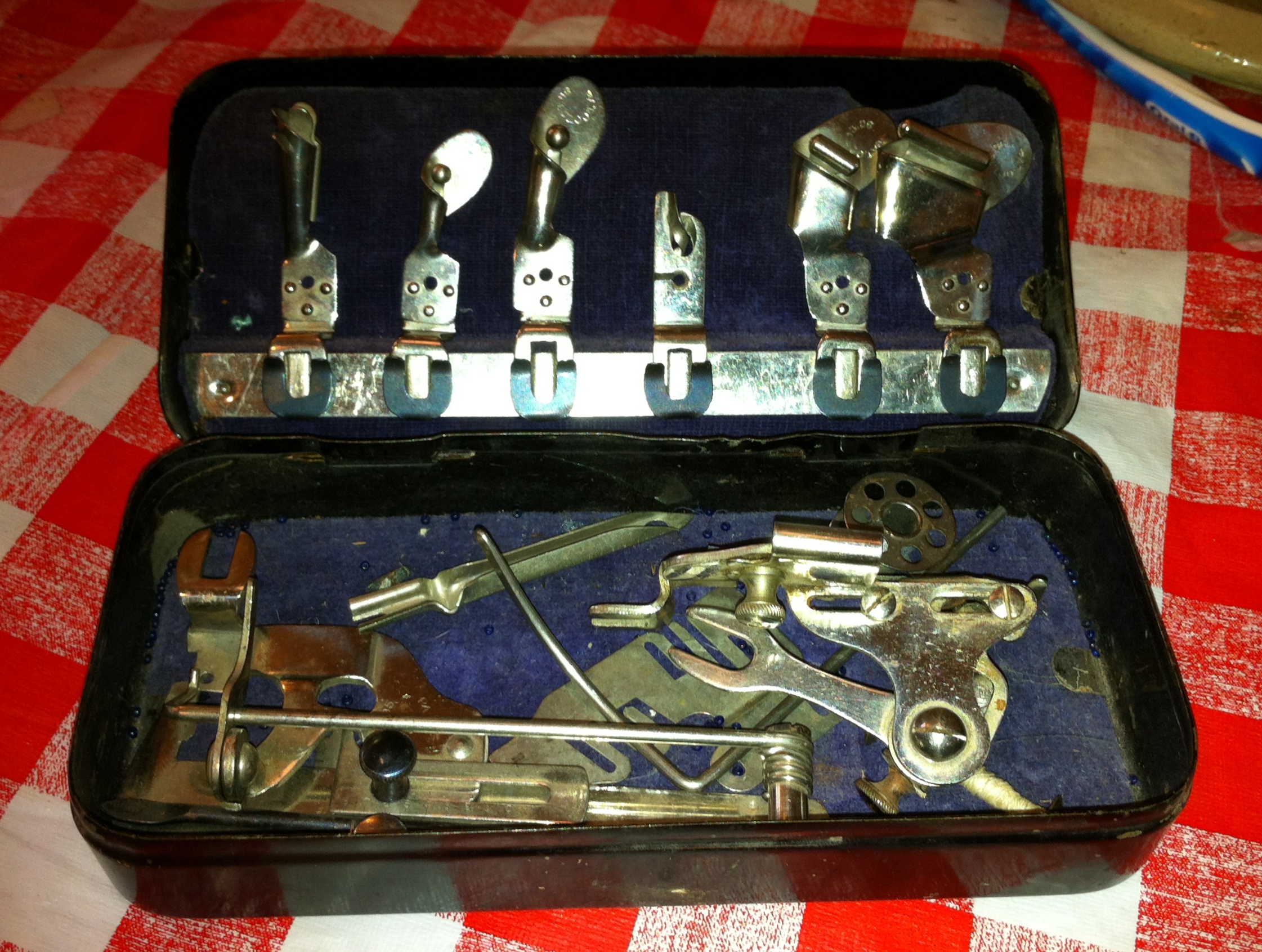
Contents.
Well, this time they make sense.
Lots and lots of sense.
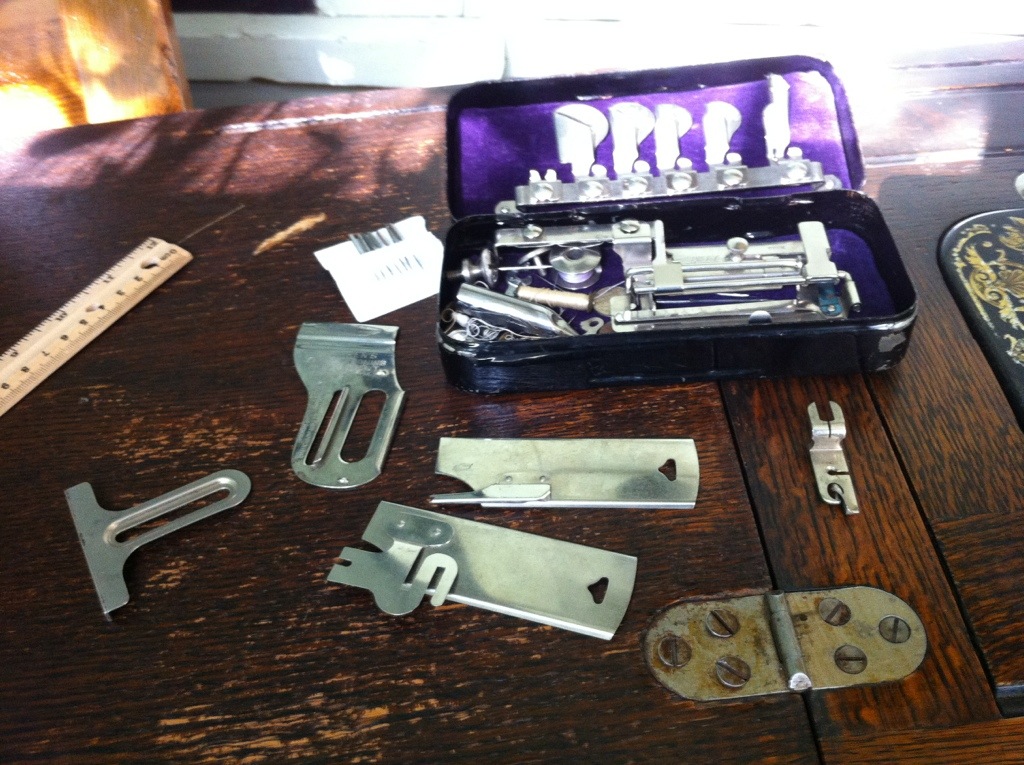
It’s a complete, exquisite set of sewing-machine attachments, for a machine with a top-clamping presser foot.
Like my Domestic.
Tragically (or perhaps inevitably) the feet don’t quite fit—the height is right but the distance between the clamp and the needle isn’t, and while you can fudge by not inserting them all the way, I’m not sure they’d be stable enough to actually sew with. I’ll probably try at some point, because I’m crazy like that, but I didn’t today.
Have you ever seen such an insane selection of rolled hem feet? I wonder what that big ball in the middle of each is like to hem around.
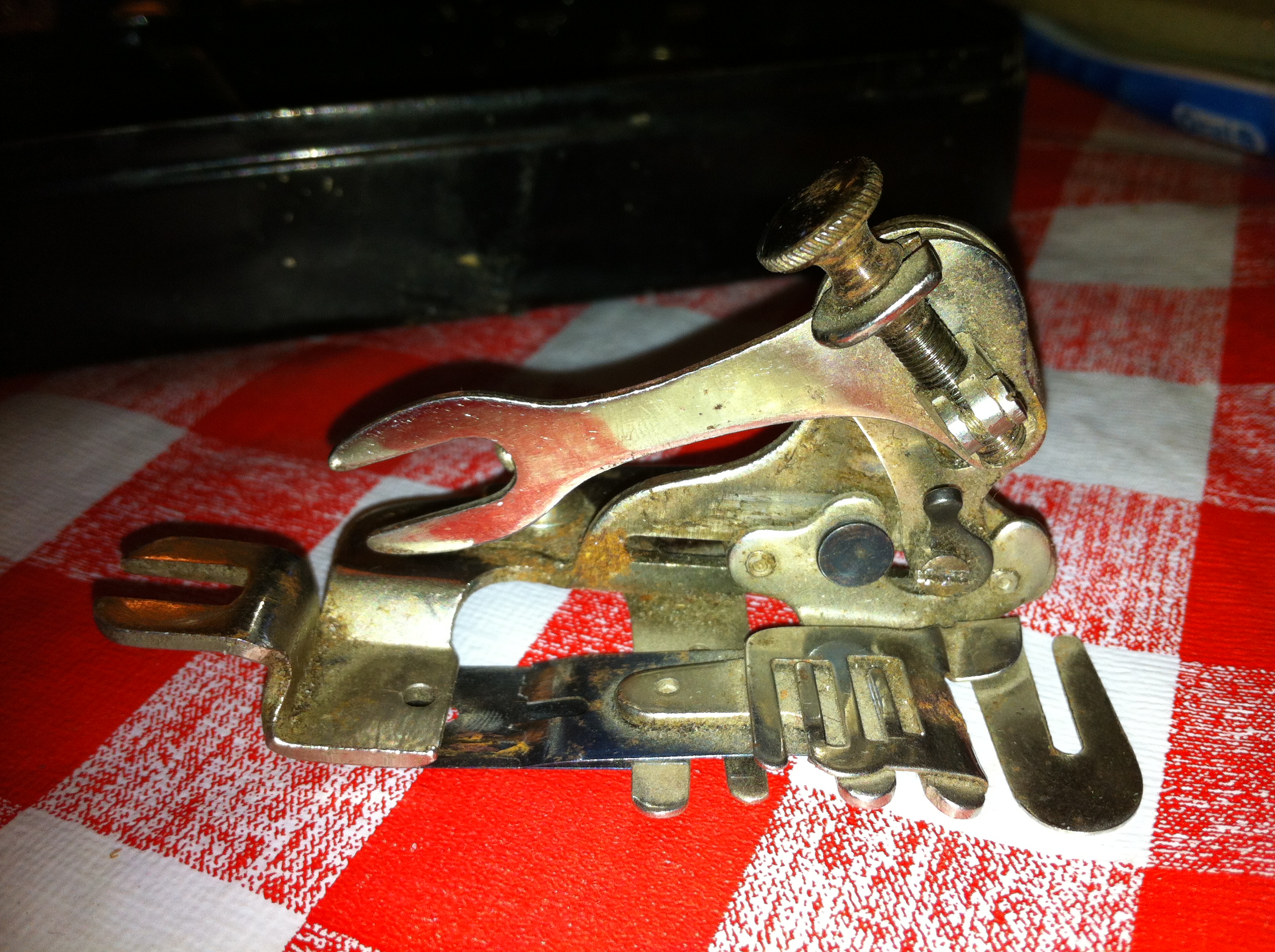
Ruffler foot.
This is the ruffler. It’s simpler than the others I’ve seen—there’s no control for gathering on alternate stitches, so it only does ruffling, not pleats. I initially thought it might be broken, it’s so stripped down, but some wiggling and adjustment of the main screw (which controls how much of the fabric is shoved forward) and it works, although it’s badly in need of oiling and de-rusting before it goes anywhere near an actual garment.

Tucker foot
I think this is the tucker foot. I think this based on a repro antique Sears catalogue my mom has that figures a variety of sewing machine attachments, including a similar-looking “tucker foot”, but I really haven’t got a clue how it works. And my Handbook of Sewing Machine Attachments is in a box somewhere.
All the pieces bear a stamp: Pat. Oct. 13 96.
Since I’m pretty sure they don’t date to 1996, that would presumably be 1896. A bit older than even my mom thought the box was, frankly.
Random bits
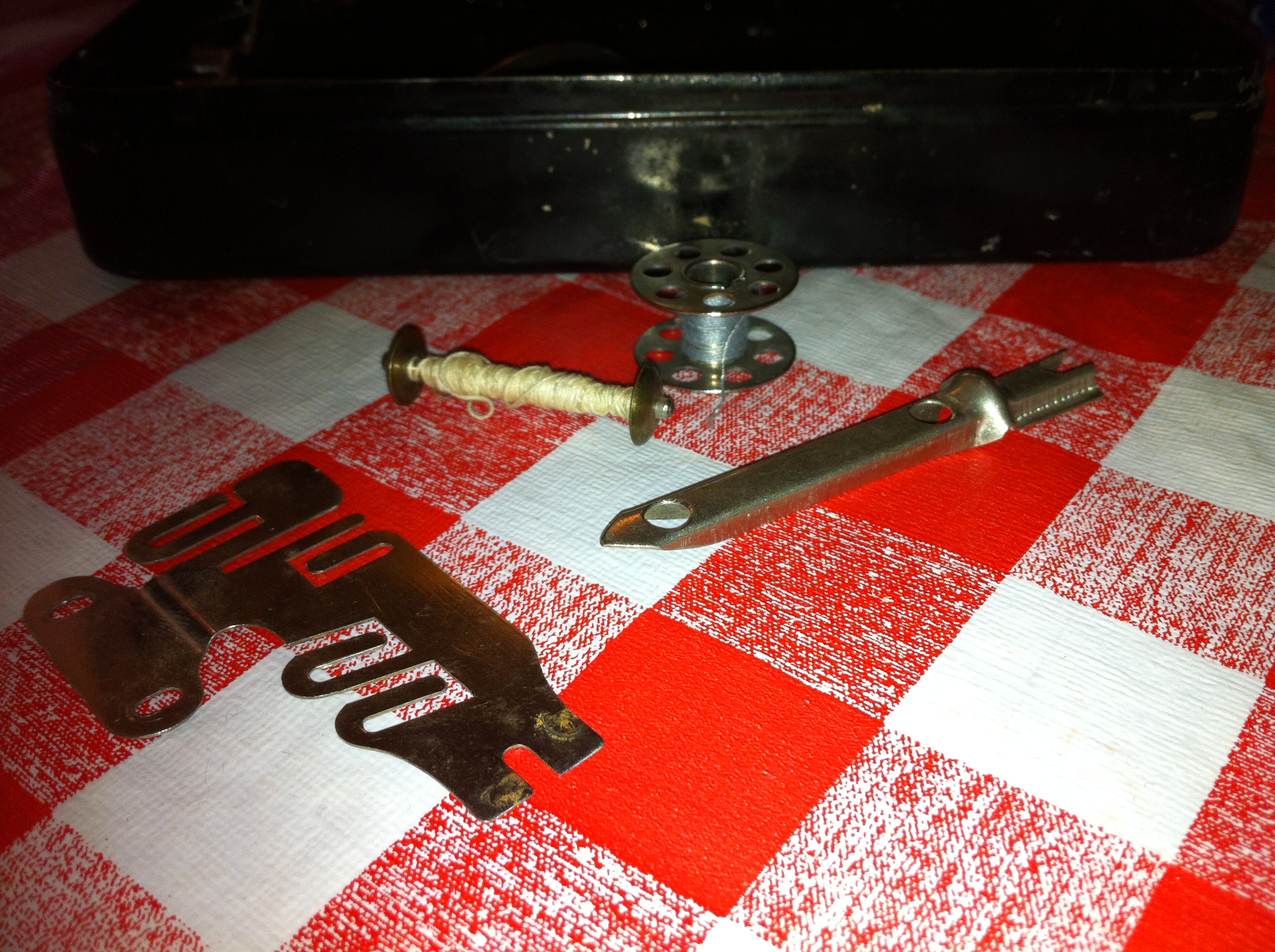
There are a couple of other random bits in the bottom, bobbins for two different machines (one I think an old shuttle treadle), a plate that would have attached to the bed of the sewing machine for lapping seams and positioning lace and ribbons and the like, and that long thin thing that I have no idea at all about.
Although I didn’t recognize the name on the box, Eldredge Manufacturing Company, out of Illinois, one second’s worth of googling turned up this article about the Eldredge/National Sewing Machine company. Which, yes, was based in Belvidere, Illinois, in the period around 1896. And here’s an ad, albeit of rather older vintage, for the company’s machines. And the shuttle bobbin looks like it could well be for an Eldredge machine as well. I do kinda love the ISMACS site.
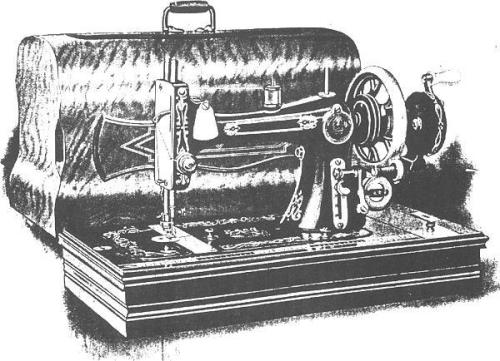
The machine might have looked something like this… (source)
Also, my messings and musings provoked my mother to comment that at this point I know rather more about sewing-machine attachments than she does. After I’d picked my jaw up off the floor, I had to demand what she was talking about—after all, it was her machine’s ruffler-foot that first got me started on this whole attachments obsession business.

Pfaff Ruffler Foot
People, apparently in the thirty-odd years my mom’s machine belonged to her before I pulled out the scariest foot in the attachment box and set about figuring out a) if it was a ruffler, and b) if I could figure out how it worked (the answer, by the way, was yes to both), my mom never knew what that foot was, never mind how you made it go. I had always assumed that if my bull-headed fumbling didn’t yield results, I would just ask her. I feel kind of like one of those Enlightenment mathematicians who assumed the calculus they were inventing had all been known to the ancient Greeks… Only I just got to talk with Pythagoras and he was all “WTF are you talking about, dude?”
Or, y’know, not. But anyway. Fun. I love it when something I didn’t know how to place before suddenly makes sense…
Now if only I could sew with them…
Filed under Sewing
Sewing is what I do when I'm cheating on all my other hobbies...


 Tanit-Isis Sews
