
Tag Archives: finished projects

Cream Spice Capris

Cream Capris

I love that I was able to take these photos at 10:00 pm at night, outside, without a flash. Now if that doesn’t scream summer, what does? (This is where someone who’s from the real “up north” chimes in with a comment about the midnight sun. /envy.)

Superfluous shot

So, the capris are done. And they are fun, although as usual there are a couple of issues (beyond my indifferent topstitching). The biggest one is simply the fabric—although a lovely and stretchy cream denim colour, and heavier than some of the jeans I’ve made, the fabric is a bit thin for jeans. Meaning while it stretches nicely to fit, it, ah, hugs all the lumps and bumps rather than smoothing them. When you add portions like the pocket and the rear yoke, that don’t stretch nearly as much, it also creates a few lumps and bumps that wouldn’t be there all on their own. Tucking in tops CAREFULLY and choosing the right pair of underwear are also going to be important (VPL in jeans, who knew?)

Other than that and the Featherweight Tragedy, I’m pretty happy. The piping is nice, the wonky topstitching is fading from memory (fortunately it’s on the butt where I don’t need to look at it), and I finally remembered to make my belt-loops wide enough for all my belts (although it’s the narrow one I’m wearing in the photos).

Rear View

If I were to do it again I would place the pockets higher or make them a little taller. The dip between the petals in the top eats up a surprising amount of space, both visually and practically.
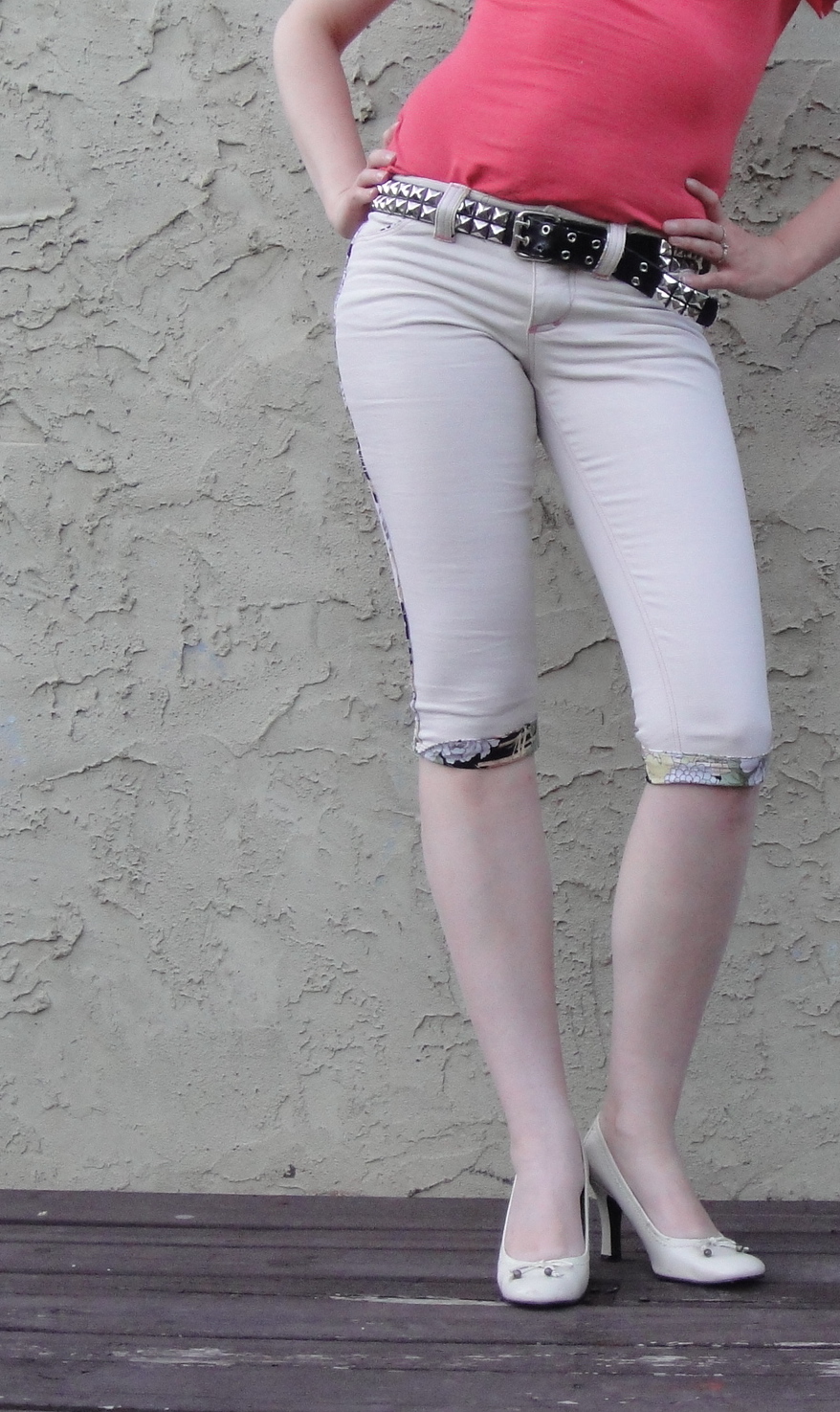
Front view

I like it with the cuffs turned up. Although, the non-stretch lining of the cuffs doesn’t interact especially well with the stretch denim when putting these on. we’ll see how that goes.
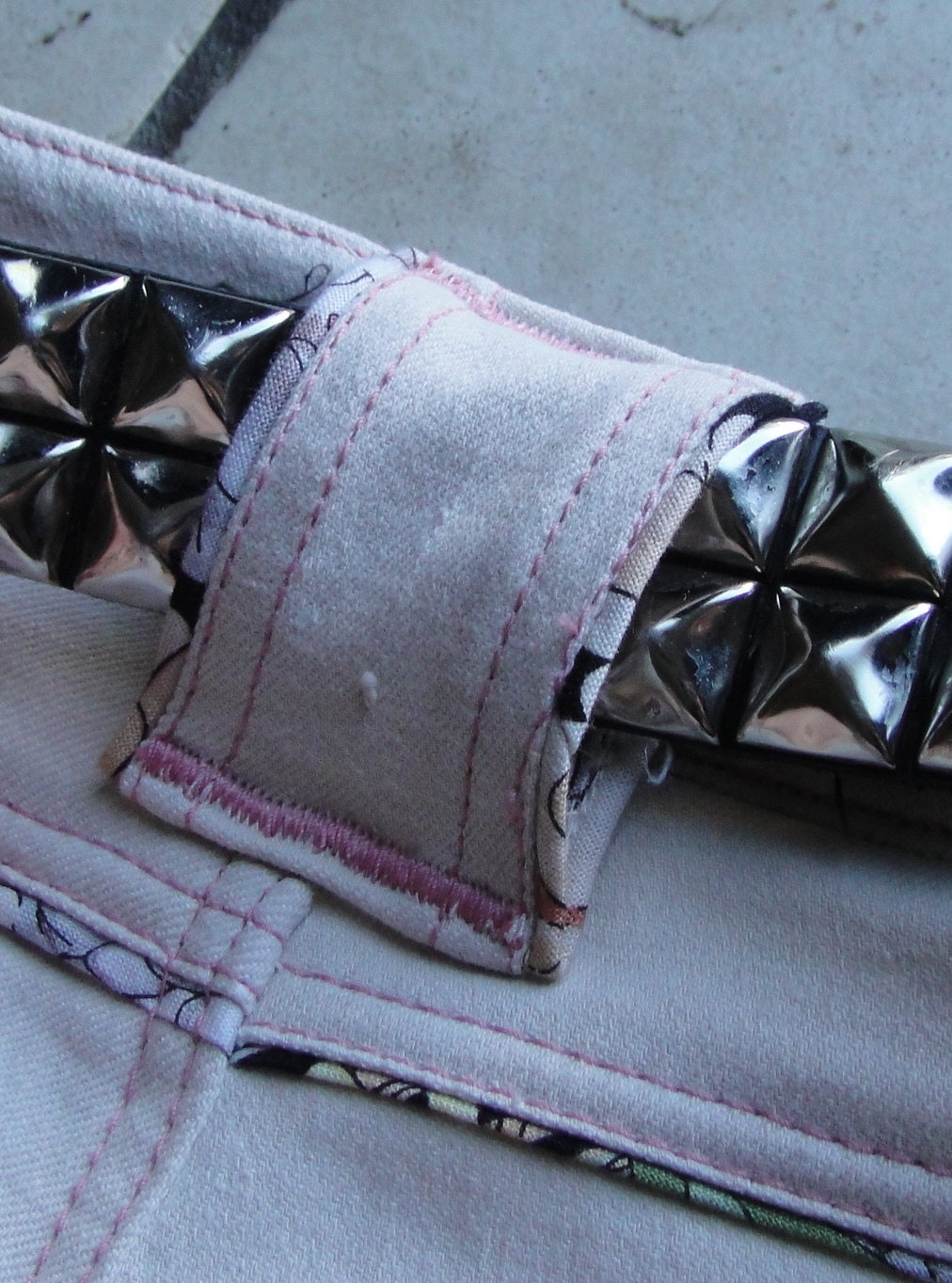
Centre-Back belt loop

I put a lot of strain on my belt loops, especially at the centre back, so I like to elaborate them in some way. Often I use three instead of just one at the CB. This time, I made one giant one with piping on both sides. I just piped both edges and topstitched to keep the bias on the inside. Super easy, and a nice finish to boot.

Belt-loop and button

For the other belt-loops, I wanted them more narrow, so I put piping on only one side and just folded the other side under and topstitched.
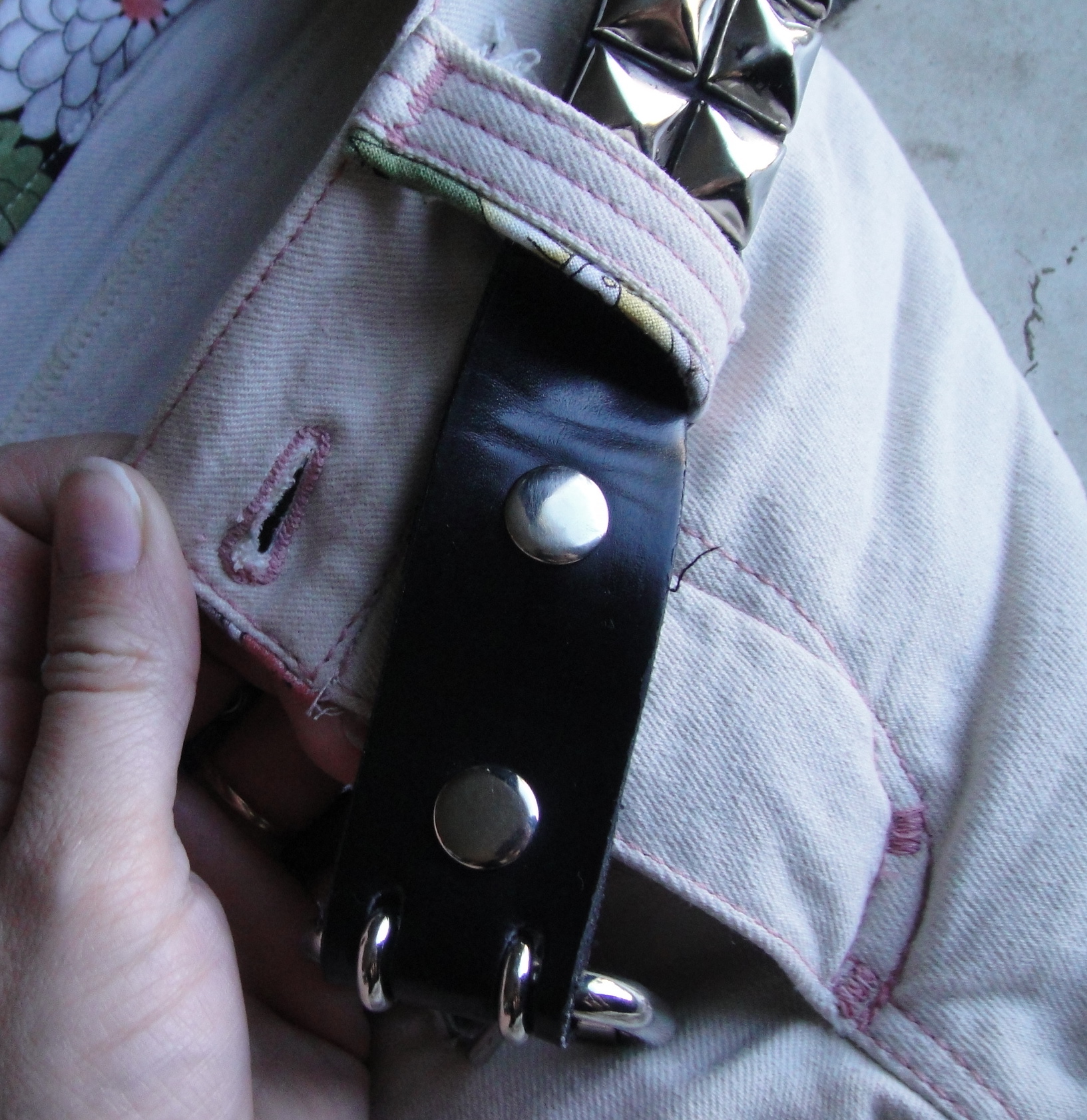
Vintage buttonholer buttonhole!

This is the first truly successful jeans buttonhole I’ve done—made with the vintage buttonholer and one of my new templates, the short keyhole. It’s the perfect size for the jeans buttons I have (which are admittedly a little wimpy. One of these days I’ll order some genuine good all-metal ones. /sigh.) I will note I find it quite odd that when sewing straight lines on the Janome with heavier thread, I have to turn the tension way up (and often do some other jiggery pokery) but then when zig-zagging I have to turn the tension way down.

You can just about see my neat feature on the fly where I had the two lines of topstitching criss-cross halfway down. This has nothing to do with the fact that my zipper was placed a little too far out from the centre front and couldn’t make the stitch line right where I wanted. Nothing at all… (I find it interesting that some people, who are following the exact same tutorials I do for fly zipper insertion, find that their zipper is still too close to the CF line and tends to gape. I have the opposite problem, with my zippers ending up tucked too far under the fly and often interfering with my ideal topstitching line (the Jalie pattern doesn’t leave you much room for error in this, either, as there’s not a huge fly extension).

Fun pants!

This pink thread is Coats & Clack Heavy Duty XP Dual Duty, or something like that, not the super-fat Guterman topstitching thread. Janome actually likes it fairly well, meaning all I have to do it turn the tension way up, not some of the other finnicky workarounds I’ve come up with for the topstitching thread. But for some reason it all goes whack when zig-zagging—whether with the buttonholer (in which the machine is still set on straight) or the zig-zag stitch. Featherweight handled either flawlessly, although she needed a bit of a tension boost too.

Featherweight afficionados, I have a question: I have generally been advised to use regular thread in the bobbin with my topstitching thread up top. Despite the annoyance of winding extra bobbins, there are times when it would be nice to have topstitching thread on both sides (turn up cuffs, come to the front of the class). Also I can’t help but think it might be sturdier (I have had a fair bit of topstitching failure on some of my earlier jeans where the bottom thread has broken). Can the Featherweight handle this? Any particular pros and cons?

My favourite feature is the piping, I think. I may have to add that to more jeans in the future. But then, piping is kinda addictive at the best of times…

Other things to try in the future:

  • change up the front pockets. The Jalie pocket line manages to be both distinctive and boring. I love the double pockets on Patty’s pair (pattythesnugbug.com is transitioning platforms while I write this so I can’t do a direct link, but looks up her pants posts, she has lots of great musing on fitting and styling)
  • something with lots of rivets. Lots and lots of rivets. I love hardware as much as the next crypto-Goth.
  • distressing. I generally like my jeans fairly crisp and dark wash (obviously these are not dark, but you know what I mean). I lost my taste for buying pre-worn-looking denim right around the time I had to start paying for my own clothing. When you have a $90/pair jeans habit and are on welfare home with a small baby*, you need your jeans to LAST, because you’re probably not getting another pair for a long time. That being said, since I’m making my own, it would be ok to have some more casual pairs with a more RTW look. Just no pre-made holes and paint splatters, please.
  • I have had fun messing with the back pockets on these last few pairs, too. It’s the little details that really make (and distinguish) jeans.
  • draft and make a pair for my husband. Yes, I’m a sucker for punishment. I’m also seriously considering using a women’s draft for him (don’t tell him) as he really fits the women’s measurements considerably better than I do (don’t tell him that either). Boy got back. Which is where Tyo gets it, of course.
*This situation lasted precisely one year. I am profoundly grateful for the social safety net, even gutted as it was after the 90s, as my hubby and I would not have been able to make it through the transition from goofy teenagers to responsible parents without this government aid.** And I would rather shoot myself in the foot than go on welfare again. It SUCKED.
**and considerable support from both our families. I don’t once regret having my children when I did (especially as my field, like most academic ones, doesn’t really put you in a good position to have a family often until your late thirties), but it was HARD. I suspect it’s always hard, but I know we couldn’t have done it—certainly not nearly as well—without our extended families. So on the off chance of any of them reading this

34 Comments

Filed under Sewing

The Red Polkadot Dress

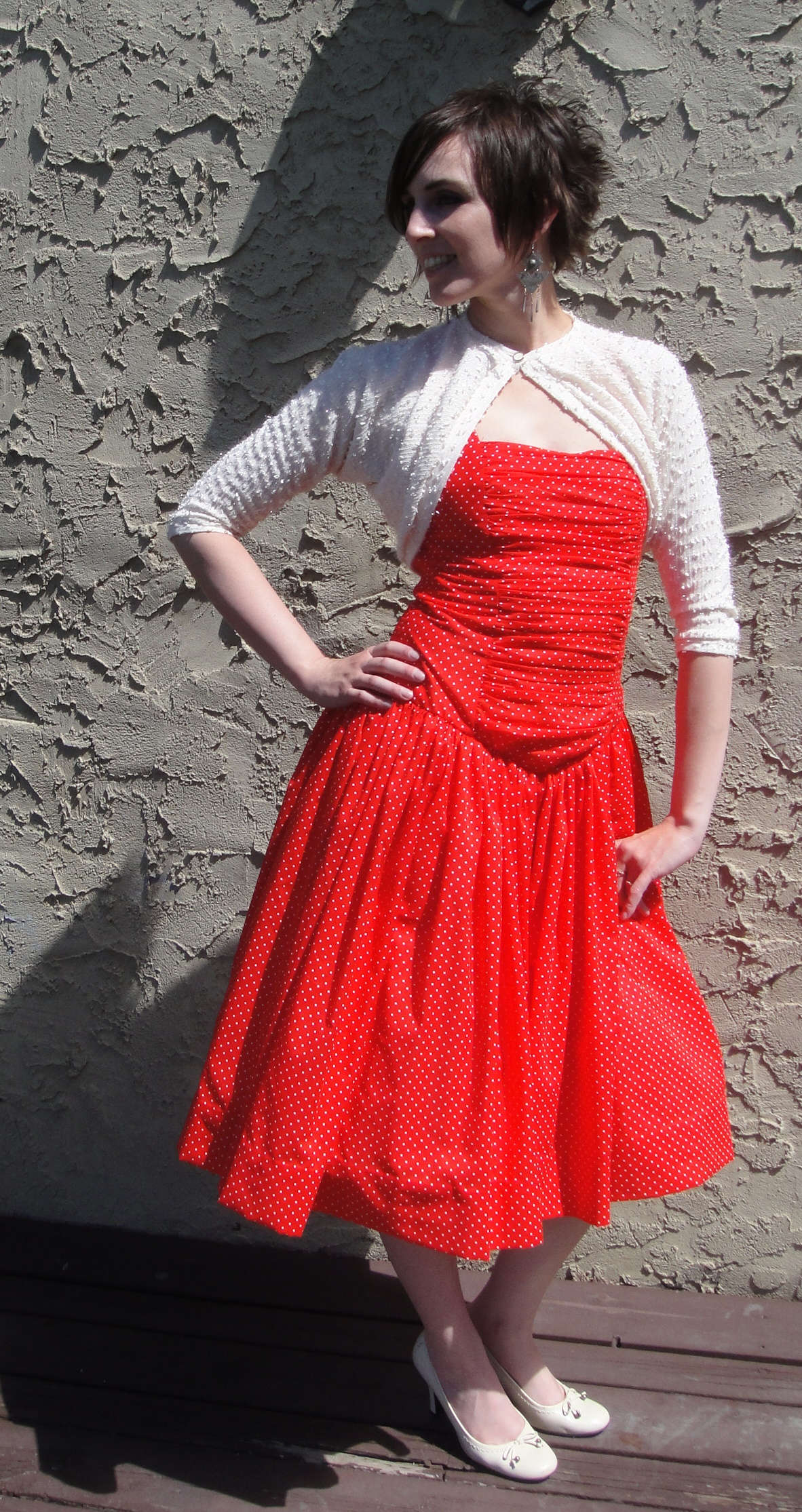
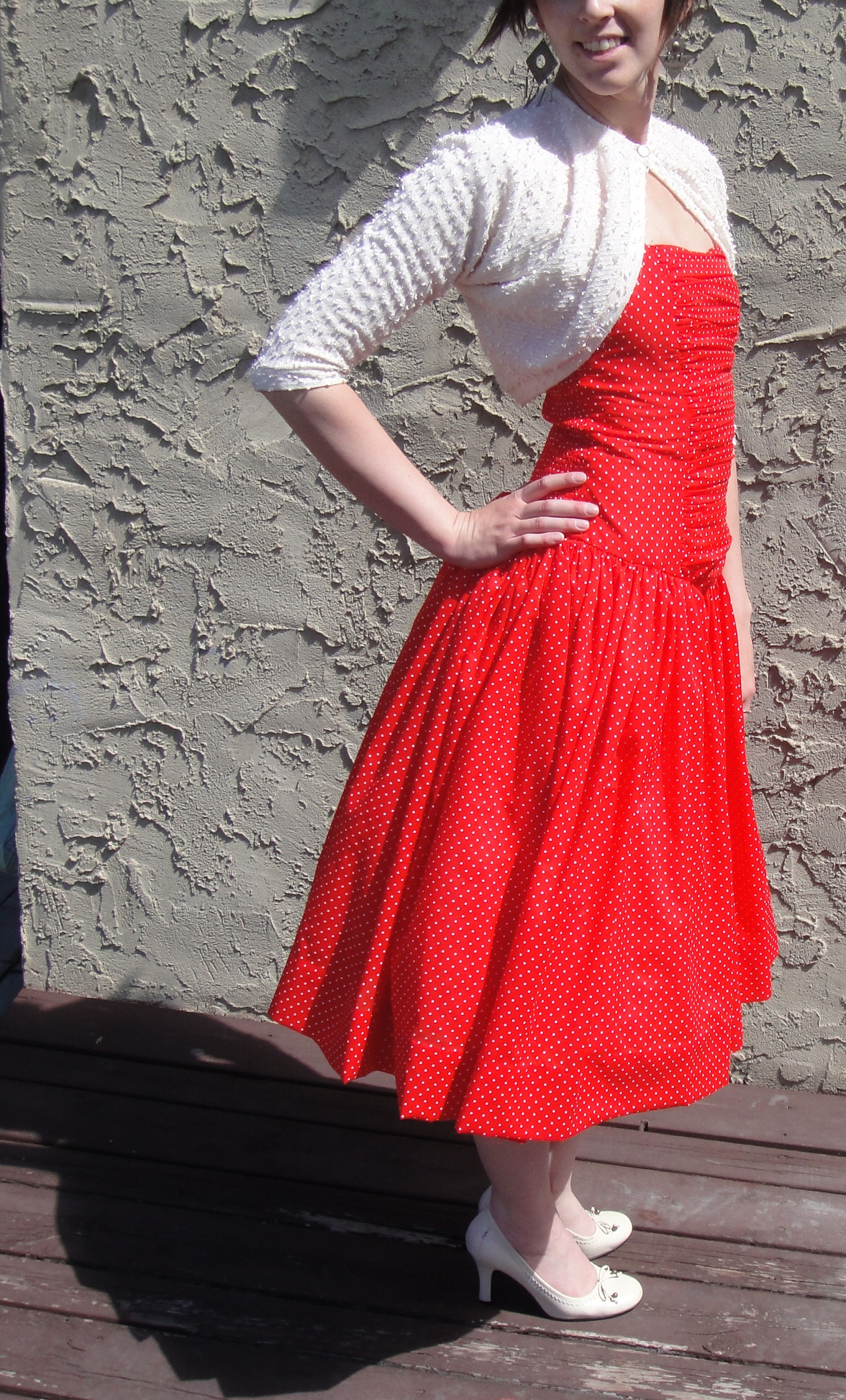
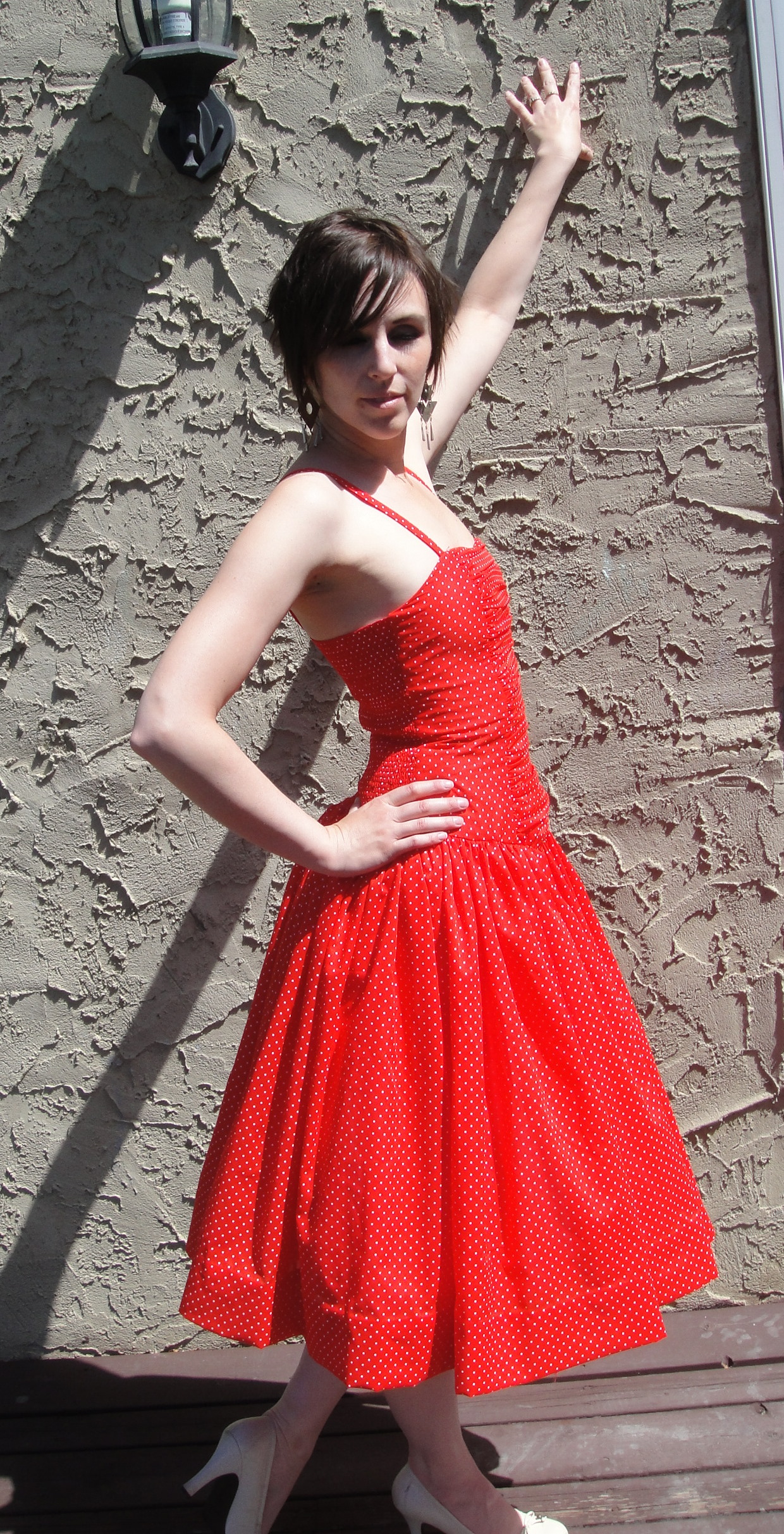
Lady in a Red Dress

Some people can wear cinched waistbands. Some people can wear big shoulder-puffs. Some people can wear dirndl skirts.

Generally speaking, these people are not me. This is really too bad, as I like many of these looks on other people. And I’ve tried them on myself time and again over the years, only to go “ah, yes, that’s why I don’t wear this.” (with the possible exception of pouffy shoulders, which I like enough that I tend to ignore the linebacker effect.)

I really like the idea of dirndl skirts. They’re both ridiculously simple (gathered rectangle—can’t get any more basic than that) and economical of fabric, unlike my preferred circle skirts. But they generally sit right at the waist (not a good spot for me) and add a lot of visual bulk in that area.

With the shrug. There’s a bit of pooching out of the ruching at the bottom of the front panel, where the outer fabric is looser than the lining. Presumably I goofed my seam allowances slightly or something.

However, as I’ve observed before, something magical happens when I slide the “waist” of my garment up or down a few inches. I can wear empire waists or dropped waists until the cows come home. Now, I believe another term for “empire-waist dirndl” is “maternity wear”, but what about a dropped waist dirndl?

Well, apparently that’s just fine.

I wrote a bit here about the bodice construction and my fitting challenges process. Having largely taken care of that, I came to the next stage in construction. The skirt.

Easy, right?

I had initially planned to do a gathered circle-skirt, like the original Katjusha pattern that was my inspiration. But on examining the amount of fabric I had left after I finished the bodice, it seemed like to get the gathering I wanted at the waist (er, hip) I was going to end up with an extremely SHORT skirt.  Whereas if I went with a dirndl style, there would be plenty of fabric for whatever length I opted for. Some quick and dirty measuring (aka holding the fabric up to my hips), and I was happily ripping away. Four panels of full-width (45″) fabric, a little below knee length plus a bit for hemming.

Red Dress

Confessions of a lazy seamstress: I didn’t even trim off the selvedges. I just tucked them inside the french seams I used to join the four widths. When they pucker up and throw the whole skirt off after the first washing, you can all laugh and point.So, I had settled on my width for the outer skirt, but my voile (or whatever this fabric is) definitely needed a lining. Back to my white cotton (yes, the stuff with the laceworked panel. Don’t worry, I’m moving from the opposite end of the length and there’s a ton of it.For my lining width, I used the width of the shirred back-panel, stretched out. It would’ve been smarter to determine this width before I did all the shirring, but I wasn’t sure it was going to shirr up the right amount at that point. Shirrly* you understand my quandary? Anyway, I decided to use this width for both the front and the back of the lining. I would gather the front to the bodice front, and sew the back flat to the stretched-out bodice back. But, you really want something underneath to give a dirndl (or any full skirt, really, IMO) a little oomph. I decided to make my lining skirt tiered. So I cut it approximately half the length I wanted, and then cut four more pieces of similar length for the bottom tier, and broke out the gathering foot.

Now, this is not my ruffler, with whom I have a passionate love-hate relationship. I wasn’t willing to deal with his idiosyncracies for four measly widths of lining. (If that sounds like a lot of gathering to you, please understand that I got the ruffler foot in the first place to make tiered skirts for tribal bellydance. The first such I made had 32 fabric widths in the bottom tier. And nine tiers, although I think only seven of them ended up being ruffled. So from my rather warped perspective, this is hardly any gathering at all

Red Dress

So I decided to play with my new, inexpensive, and untested gathering foot (Here’s a post contrasting the two). I popped it on, measured some 10″ lengths on scraps of the cotton, played with my stitch-length and tension settings, and after about three tries managed to get a gathering ratio approximating 2:1. Good enough. I began gathering.

I think I’m not going to become a huge fan of the gathering foot. It’s not awful. In fact, compared to some of the shit fits my ruffler has thrown, it was possitively easy to use. But the resulting gathering is not particularly even; it’s highly susceptible to the slightest difference in how I hold the fabric in front of the foot (crowding the needle vs. letting the fabric lie flat). The main thing I like about mechanical gathering with the ruffler over my preferred semi-manual technique (where you zig-zag over a supplementary thread… the zig-zag acts as a casing for the thread drawstring which you can pull up later) is that you don’t have to futz over the gathering being even, even if it may not be the exact ratio you wanted it to be. The gathering foot didn’t seem to have this evenness, and even worse it was pretty tricky to try to re-distribute the gathers after the fact. For the lining, I didn’t care, but I wasn’t enthused about using it for something that will actually be seen. It did turn out about the right length overall, so that’s good anyway, and it was quite fast.

I did give myself one further complication, which is that I had designed the bottom front of the bodice to dip down to a V. I love this feature a ridiculous amount, but it takes a bit of mental gymnastics to figure out how to reflect this on the gathered side of the skirt. At least, without sitting down and making an actual pattern and spreading it the required amount, which sounds suspiciously too much like work. Instead, I roughly measured the depth of the “V” (minus seam allowance) down from the top of skirt centre front, and free-handed an arch going from the skirt CF to side-seam. Good enough for government work, as my mother says.

For the outer skirt, I used my preferred semi-manual gathering method, mentioned above. I use this for “moderate” amounts of gathering, or larger amounts (like this) where I value precision of the resulting dimension over precision of every little gather. I gathered the over-skirt to match the width of the underskirt, and stitched them together. Really, fairly easy peasy.

Twirling

Then, I did something I haven’t done since Tyo was a baby. I hand gathered the entire skirt front (both layers, and hand-basted it to the bodice. WTF? you are asking. I agree. But we were watching Sucker Punch with the kids last night and I could do the gathering and basting by hand without totally ditching the rest of the family. Normally I’d prefer to be hemming in such a situation, but I wasn’t quite sure of the finished length so I didn’t want to get ahead of myself and hand-hem four widths of fabric to the wrong length. I wound up shortening it by several inches, so it’s just as well I didn’t try this.

Possibly I should also have hand-basted the back to the shirring, as that was a beast to do accurately and took a couple of goes. But, water under the bridge. Man, I’m just full of platitudes today. If I can throw “a stitch in time saves nine,” in before the end of the post, I’ll be flying. Well, except that that’s one I rarely follow. It’s still good advice, though.

Red Dress

I am a little concerned that the combination of the front ruching with the full skirt have pushed this past “sundress” territory into the hinterlands of “something to wear to a summer wedding.” Since I don’t expect to be attending any weddings this summer, this would be unfortunate. I may just have to suck it up and be ridiculously overdressed (after all, it wouldn’t be the first time).I wasn’t actively going for a “vintage” look when I made this dress. Although maybe that’s an inevitable reference for any full-skirted, tight-bodiced dress these days. Anyway, pairing it with the shrug just turns the “vintage” look up to eleven. It goes, though, doesn’t it? This shrug is ridiculously versatile. Seriously, I wear it with EVERYTHING. I need about five more.All that gathering in the skirt interacts a bit oddly with the back bodice, despite my best efforts to reinforce the bottom of the shirring with some sturdier elastic, but it’s probably not something most people would notice (dazzled as they will be by the swishy, full skirt, right?)Incidentally, the length is only sightly below my knee. Tyo was standing on the picnic table to take the photos, so they’re from more of a downward angle than usual. I’m wearing the fluffy petticoat as well as the tiered lining.And obviously I need some red heels.

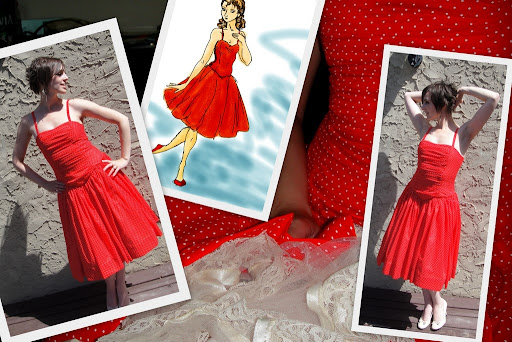
Final project and inspiration. I think I need a fluffier petticoat.

*I normally try very hard to resist the obvious sewing puns. I have never intentionally substitued “sew” for “so”. This one slipped through. I humbly apologize.

48 Comments

Filed under Sewing

Happy Birthday to Syo!

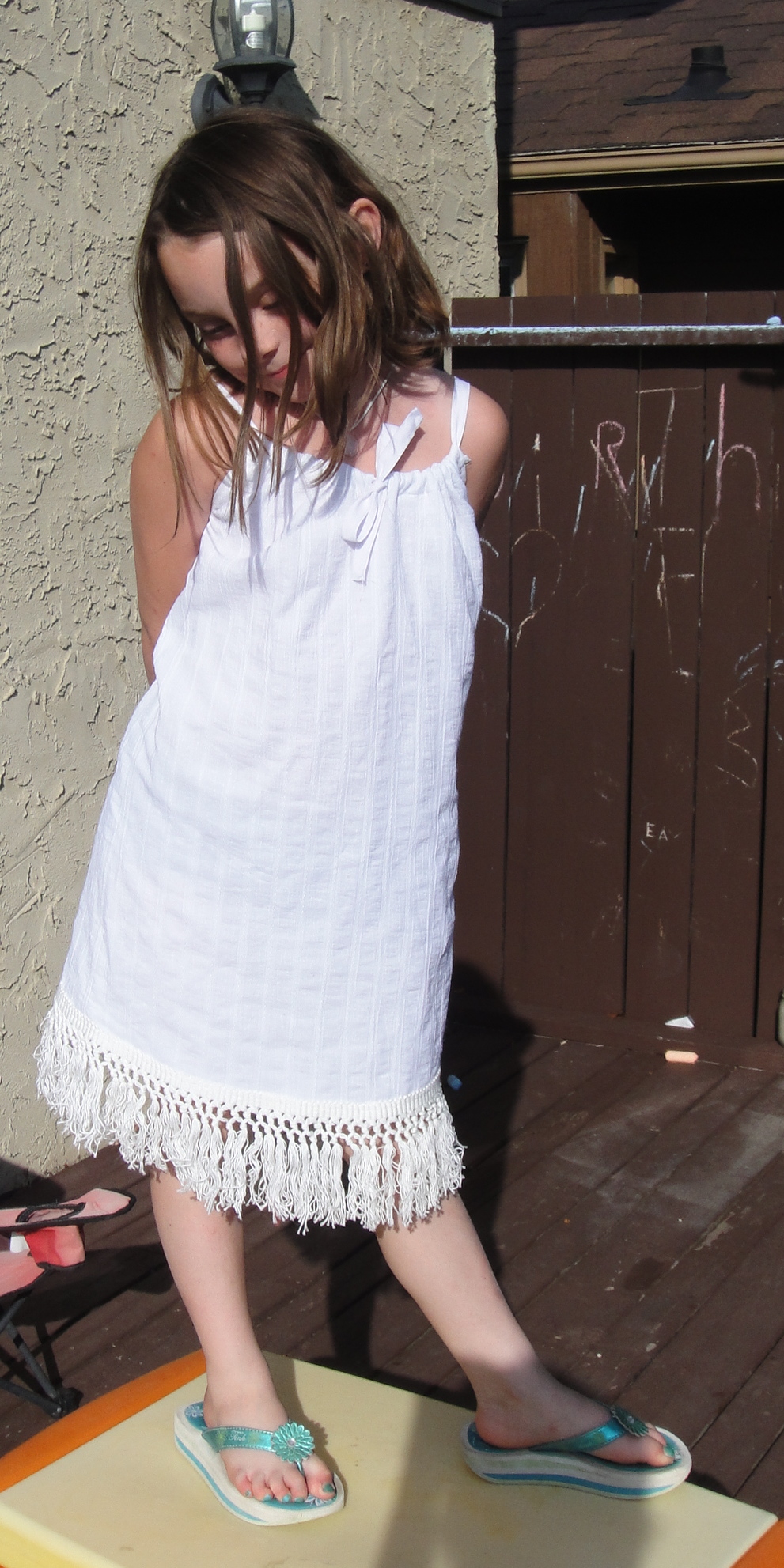
Syo's dress, by Tyo.

Technically, I guess today she should become Eyo (the Eight-Year-Old). But for the sake of continuity, not to mention because Tyo will become the Eleven-Year-Old in another month, I’m going to stick with the nicknames as is.

Relatively little has been cleaned up from the birthdays (to my husband’s dismay), but sewing has happened! Tyo put the final touches on Syo’s present and we wrapped it up.

The kids have also been stitching madly away at these:

Pouches!

They are almost done. Whew! It would’ve been so much simpler to do them all on my own. But that would be defeating the point, etc. etc. Syo decided she wanted the blue and pink flannel fabric (top left) for the outside of hers; it’s lining the others.

What, Syo modelling her dress? Well, if you insist!

A well-dressed child

The fringe along the bottom is a length that appeared in one of the Value Village baggies. I stitched it on for Tyo… it was just less of a headache that way.

I am disappointed to report that she is less than thrilled with the dress. The reason? “It’s not tight enough. Tight is cute.”

Ah, yes. I had forgotten that.

Erm, she may have picked up that perception from me. Ooops.

Anyway, I think the dress is adorable.

In Me-Made June news:

June 27

Yup. Still lounging amid the remnants of the kids’ birthday party on the weekend.

I was (perhaps overly) excited about the weather forecast today and dressed for SUMMER. Of course, I spent most of the day in the chilly indoors freezing my legs off. My bad.

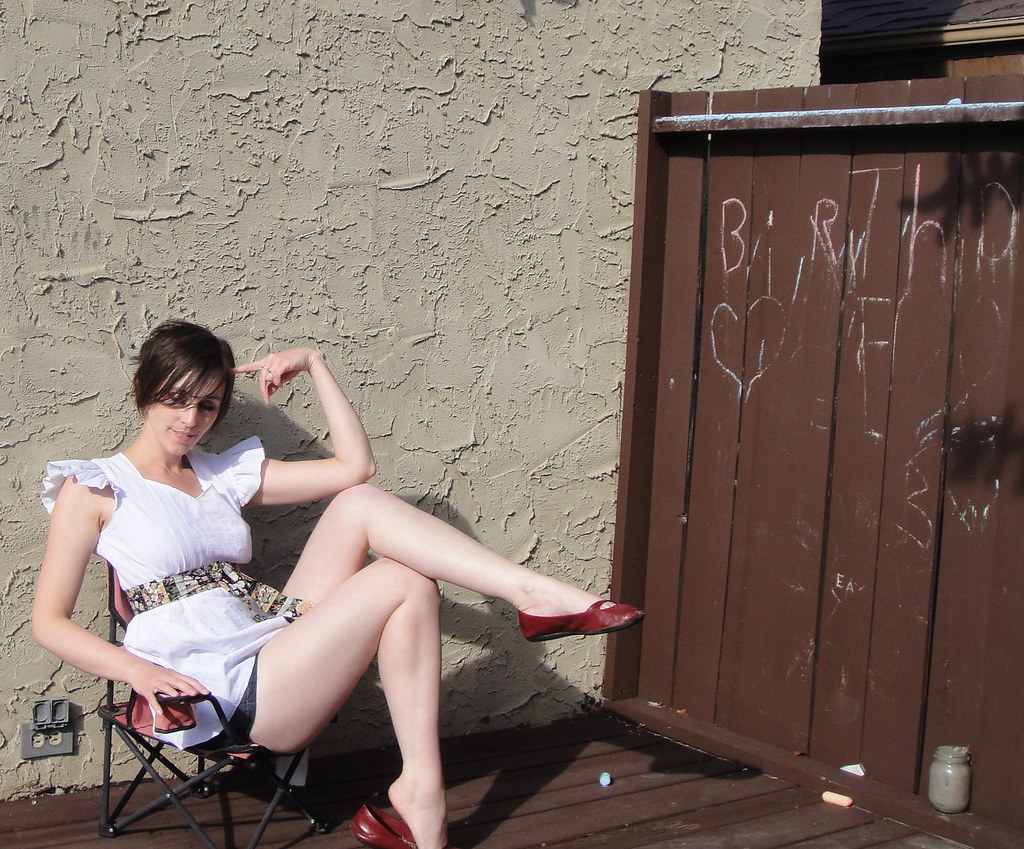
70s Tunic
Lekala sailor shorts Which you can’t actually see, but I promise you they’re there.

6 Comments

Filed under Sewing

Who wears short shorts?

Shorts! ...ulp.

Um, I do. For a very long time a 1″ inseam was my standard. And while I’ve gotten considerably more shy about my midriff over the past decade, my legs have stood the test of time up much better. They remain one of my favourite physical features. (Not to toot my own horn)

Of course, the last few years I haven’t had much opportunity to wear shorts, period. The summers here are, well, chilly by my standards (blame elevation or proximity to the mountains or just a run of bad luck); it only broke 30C once last summer. Add that to spending my days in an air-conditioned lab and, well, shorts just kinda got left for weekends and visits home. (The two or possibly three people reading this from my home town can protest all you like that your summers have been beastly the last couple of years. They were still better than the summers here.)

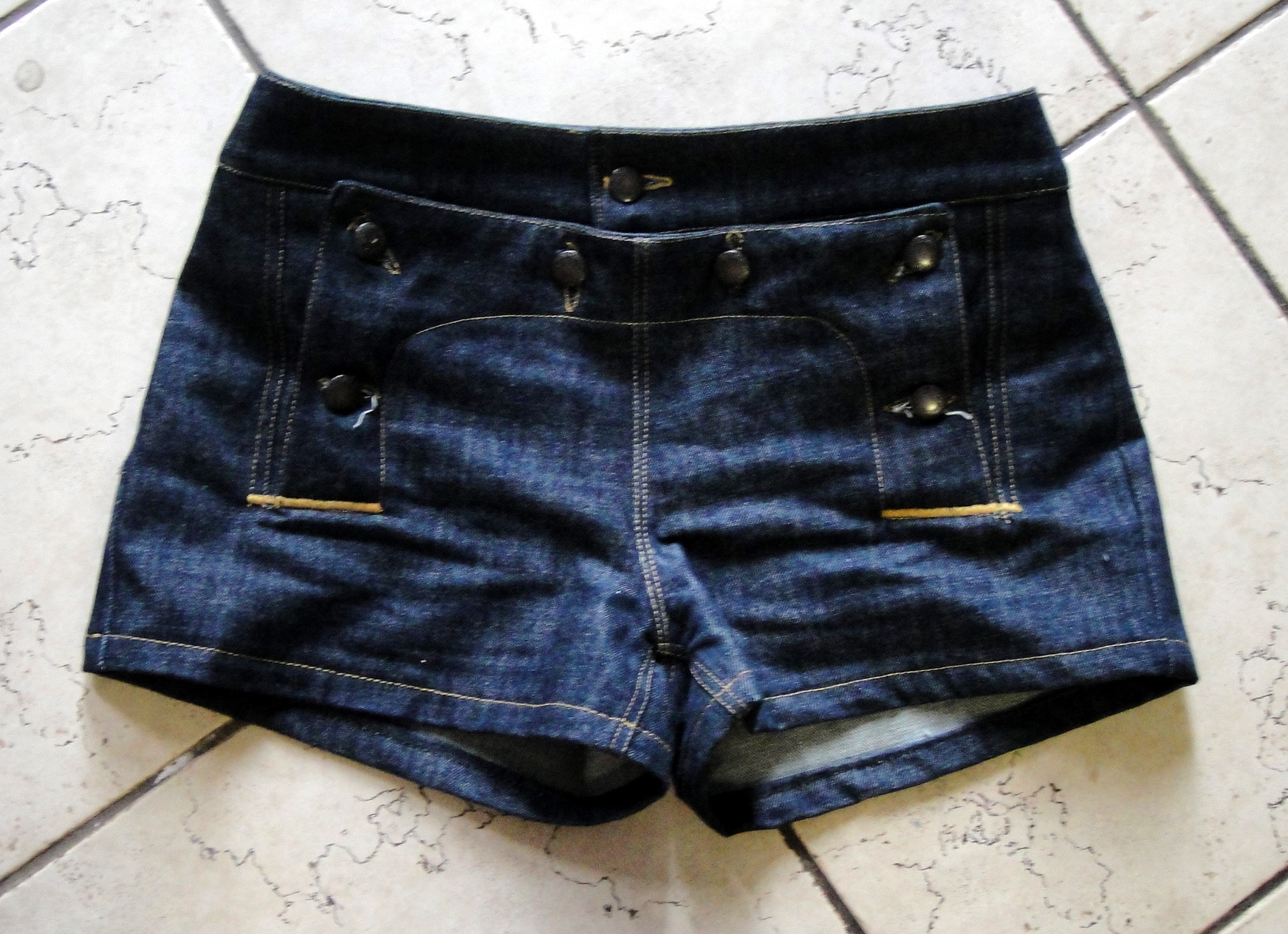
Lekala 5465 Sailor Shorts, pattern here.

Anyway, my shorts history aside, this seemed like a good way to tackle the fit of the Lekala pants block without sacrificing a huge amount of fabric (obviously I was not thinking in terms of topstitching- and machine-rethreading-time). I may also have been feeling kid-project-ed-out. Or possibly crack smoking was involved*. Anyway. For whatever reason (reason really played no role in this decision), the other day I found myself printing out the pattern (only nine pages!) and laying out the pieces on the denim remnant left over from my bellbottoms.

One bonus to this particular set of pants is that the directions on the Lekala website have, in fact, been translated to English. Now, I think translating sewing directions has to be one of the hardest things in the world, as the technical terms are both a) highly specialized and b) unique to each language (translating scientific stuff, on the other hand, is much easier, since most of the important words come from Latin anyway. I don’t speak a word of German but can still often pull the major details I need out of a German research paper. Not so a German issue of Burda.) All that being said, I made it to about halfway through step 6 before my brain blew out. I had no idea what they were trying to get me to do.

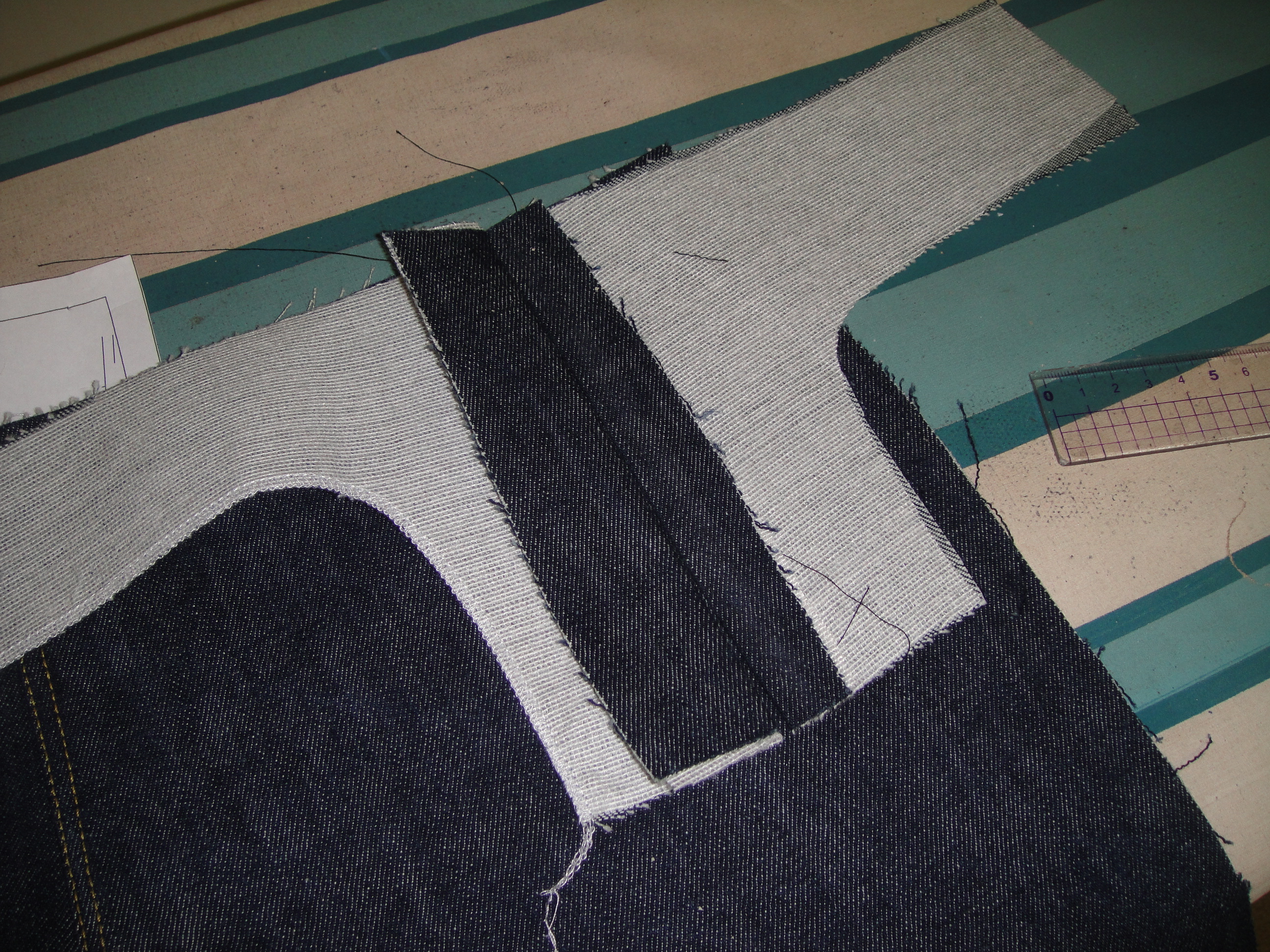
What exactly are you telling me to do?

So I stood there with my pieces, laying one on top of the other, this way up, that way up, trying to figure out what to do.

There was a slit involved. I knew that much.

In the end I didn’t do it exactly right—the piece which they call the “Fly Panel Facing” (this would’ve been more helpful if the names of the pieces on the pattern hadn’t still been written in Cyrillic) is supposed to lap out and make a little overlap on the front, which I didn’t get. I’m still not sure how you would make the bottom of that neat, by the way, without adding a crapload of bulk, anyway). But I did manage to get the fly panel and the four “inner front parts” together. I am too lazy to actually put together a tutorial for how I did it—if you really feel the need to make this pattern, I can do one, but I’d really recommend you make the 5742 pants into shorts instead. Or use this tutorial for creating a sailor-button look with a continuous lap placket. Or even pay for the Hot Patterns pattern (which I haven’t used but have seen some very nice pairs made up). Or, y’know, email me and I’ll do my best.

WTF?

What it basically came down to, though, is that you end up with a slash down the middle of each front piece, with the “Fly Panel Facing” making a facing for the inner side of the pants and the “Inner front parts” sandwiching the edge of the slit, some frighteningly narrow seam allowances (I had to re-stitch several of mine), and nothing but a bit of fusible interfacing reinforcing the bottom of the slit. And I’m not convinced there’s anything at all you can do about this with this kind of pattern, unless you incorporate a front seam (as they did in the 5742 pants) or add a seam from the bottom of the slash over to the side, maybe with a pocket in it. Maybe I’ll try something like that next time.

So that’s my issue with the pattern itself. On to my own failings.

Crappy topstitching AND buttonholing!

Partly because I was really unhappy with the slit feature, and partly because I was trying to slug away at the piece and get it done before I had to reathread the machine for a kajllion kids’ projects, I sorta gave up trying hard. My topstitching around the inner part of the front fly panel isn’t symmetrical. I didn’t place my buttonholes properly, AT ALL (at least the topstitching I can fix if I come to my senses). My machine really doesn’t like zig-zagging with the top-stitching thread, so the buttonholes themselves are pretty dodgy as well (I tried buttonholer attachment, machine’s proper attachment, and manual—it just really doesn’t like to zig-zag with heavy thread). I added patch pockets to the rear, mostly on the principle that my butt needs as much decoration as it can get. Those are actually all right, although I forgot to do any topstitching designs before I sewed them on, so they look a little plain.

So those are my issues, purely self-inflicted. I should’ve taken more time, been more careful, not expected to bang out a pair of jean-shorts in a couple of hours. One thing the instructions do emphasize is topstitching carefully and evenly.

On me: front

And in the end, I don’t really like the shorts at all, for a reason that has nothing to do with the design features, the construction quality, or the instructions.

I don’t like the rise.

Now, the pattern illustration shows a moderately low rise. It’s hard to gauge things like this from illustrations (or even other peoples’ bodies, rise being a fairly individual thing). And I like low rise. The problem is, I like low rise.

These are more like mid-rise. They fall just below my navel. This is at least an inch or two above where I like my waistbands to fall, as it hits right in the middle of my jubbly bits. I’d rather have my waistband lower, where my hip gets bony. I realize that this isn’t most people’s preference, but it works for me, with my particular narrow-hipped, short-waisted body.

On me: side view

The bright spot of light in this is that the fit itself is more-or-less perfect. I didn’t even have to make any kind of gaposis adjustment to the back, which I had to in both the Ellen pants and the Jalie 2908 jeans (granted I think the Jalie pattern is drafted to the flattest common denominator, possibly because they figured this was an easier adjustment to make than the flat-butt adjustment). The only alteration I made upon trying them on was to take in the outseam of the leg a little bit below the hip, so they are not quite so loose around the thigh.  Which is more of a style issue, again, than a fit issue. The illustration shows quite loose, slouchy shorts, rather than my sturdy denim version (and the fabric they call for is “sheer flax”, by which I assume they mean a lightweight linen. They use the word “linen” for fabric.)

I also used a smaller number of buttons than called for, because it “looked right” and I thought it would be okay on the denim. So there’s a bit of gaping that shouldn’t be there. Lesson learned.

Oh, and in case you were wondering, the finished inseam wound up being about 2.5″.

Finished interior, with bonus threads. I'll snip those some time when I give a shit.

I don’t even know for sure that the rise will be an actual wearability problem, since I wouldn’t normally tuck a shirt into these anyway.

Oh, yeah… the pattern also calls for a zipper. I have no idea where this is supposed to go or why it would even be necessary.

In Me-Made June news, here’s yesterday’s outfit.

Me-Made June 23

This photo was taken in the glorious sunshine about five seconds before the clouds rolled in and the winds picked up. I was expecting one of our June thunderstorms, but it never quite materialized. Maybe today (if not tomorrow in the midst of the kids’ birthday party).

70s Tunic
Jalie 2908 CaprisHmm, tired of these yet? Obviously I need some other pairs… (and it just so happens I got some summery cream stretch twill at the Fabricland Canada Day sale yesterday…)

Oh, the earrings are a pair my mother and I put together back when we were making jewelry when I was in high-school. The bottom is a little malachine elephant a friend brought back from Zaire.
*Disclaimer: I do not now, nor have I at any point, smoked actual crack. Or been been in a room where crack was being smoked. Or seen crack, except on a movie. I didn’t even smoke pot in high school, which is practically a rite of passage.**

**largely because my friends all smoked pipes and I was too embarrassed to admit I didn’t know how to use a lighter. Yes, those cheap Bic lighters. It wasn’t until I had been married to a smoker for several years that I learned how to use one. Mostly by practicing when he wasn’t around.

29 Comments

Filed under Sewing

California dreaming…

New tunic!

… on such a winter’s day…

Ok, not really winter. It was raining (again), which in these parts denotes NOT winter about as strongly as anything. Yay, liquid water!

But definitely not as summery as I’d like.

Still, I continue to sew hopefully, so today I plugged away with my gauze 70s tunic, trying not to mutter about how much I prefer nice, heavy coating fabrics. Cotton gauze and voile don’t rate too high on the scale of difficult fabrics, but you have to be so careful about the finishing, especially in white. Things I usually ignore, like how evenly I grade my seam allowances or whether my tail threads are getting eaten by the feed-dogs, stick out like a sore thumb.

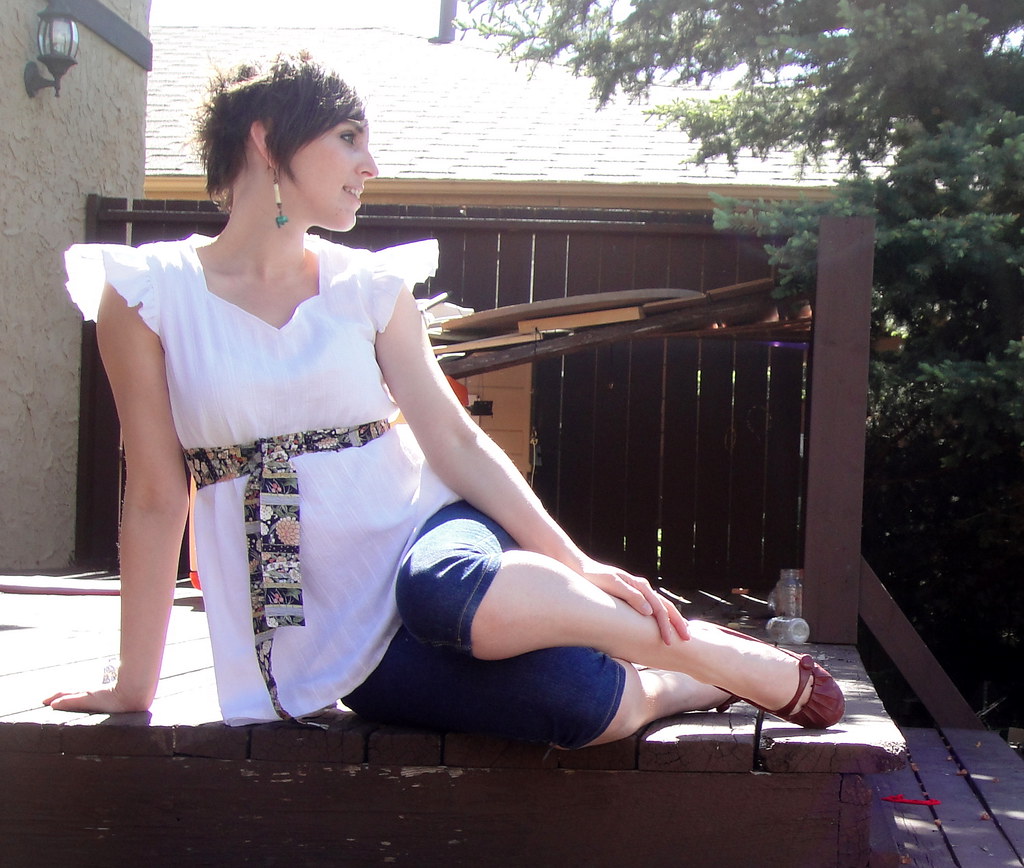
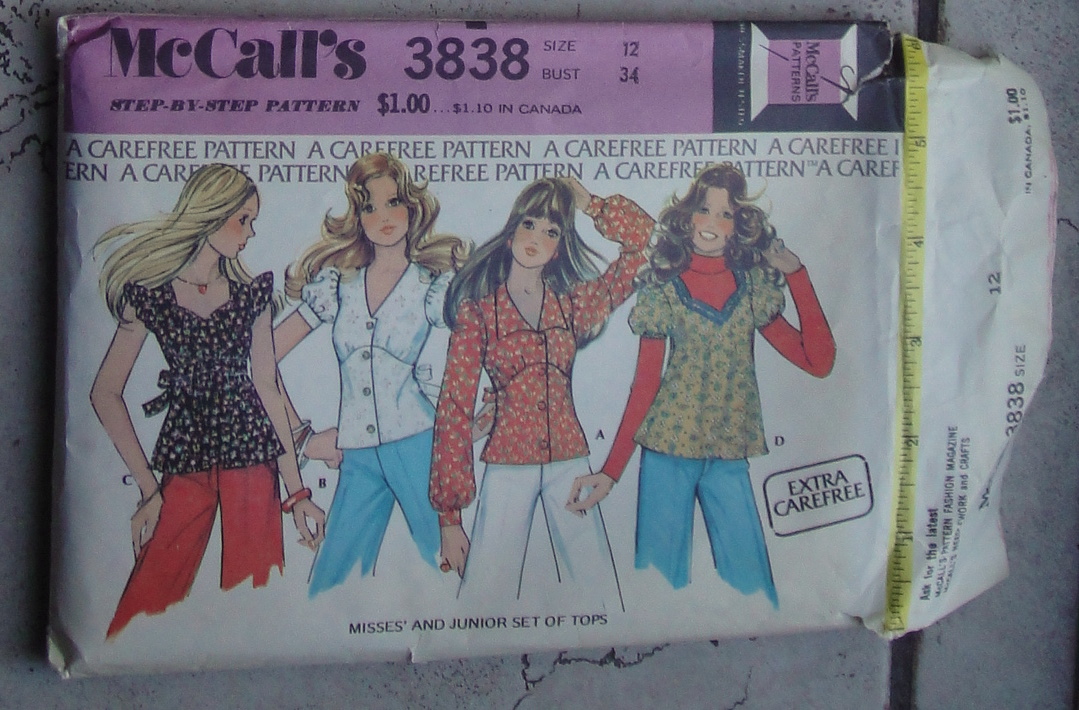
McCall's 3838

Now, I was aiming for view C, the left-most on the pattern envelope. Since it was a sleeveless (essentially), un-fitted pattern (and I don’t know how McCall’s patterns fit me yet anyway), I omitted my usual swayback and petiting alterations. Instead, I opted for a square shoulder alteration, which I’ve been pondering on my last few tops.

Front view

And I’m quite happy with the results, although I should probably have lowered the neckline the same 1.5 cm I lowered the centre edge of the shoulders. I did that for the back neckline, but didn’t think to do it for the front. If I make this view again (which isn’t certain, as there’s lots of options) I’ll lower the whole neckline at least an inch, anyway.

After some consultation with mommy dearest, I did some seam-finishing experimentation and settled on the lazy stitcher’s French seams, which is where you serge the edge on your first pass, then press and encase the serged edge within the French seam for the second pass. Basically it adds the serger thread, but saves you the trimming stage. I pretty much blow at trimming seams evenly, so this let me get a much narrower French seam than otherwise, so despite the extra thread I end up with less bulk. Although my serger, despite being serviced just at Christmas, has tension issues when dealing with light-weight fabrics; there doesn’t seem to be any middle ground between ultra-loose and loopy and too-tight-and-ruffling. I’ve discovered that if I leave extra-long tails I can usually work the thread in so the thing lies evenly afterwards, but it’s a bit of a pain nonetheless.

Back view

Yes, it’s time for a new serger. One with all the bells and whistles.

Anyway.

I was really, really scared of the sweetheart neckline. Mostly because I felt the fabrics were too light to interface or reinforce, other than stay-stitching. So I stay-stitched, and handled as little (and as carefully) as I could. It did wind out a smidge stretched out, but… decent. And mostly symmetrical, my other fear. Although I used the lining as my facing for the neckline, for the armscyes I bound with bias-tape made out of the voile, and pressed to the inside. I used my machine’s lone decorative topstitch (OK, the only one I like) to topstitch around the neck and the armscyes. Patty is making me very jealous with her decorative topstitching.

Aside from the shoulder alteration, the only other change I made was to add 13 cm (aka 5 inches, but I’m trying to be a good metric girl these days. The search for a metric gridded ruler continues, and I am consciously teaching my kids to sew in metric.), to the hem, bringing it from a blouse length to a tunic length. Somehow when I was thinking about this pattern, the outfit I conceived of was this tunic-almost-dress worn over cutoffs you almost can’t see are there. Voila. Although maybe for the full illusion I should’ve made the top a couple of inches longer still.

Side view

I’m quite satisfied with the fit—none of that bunching up behind my neck that I often get, so I presume the square-shoulder thing did its work. Other than that there’s not much to fit or not fit ;). Side-bust darts might improve the shape a bit, but aren’t actually necessary.

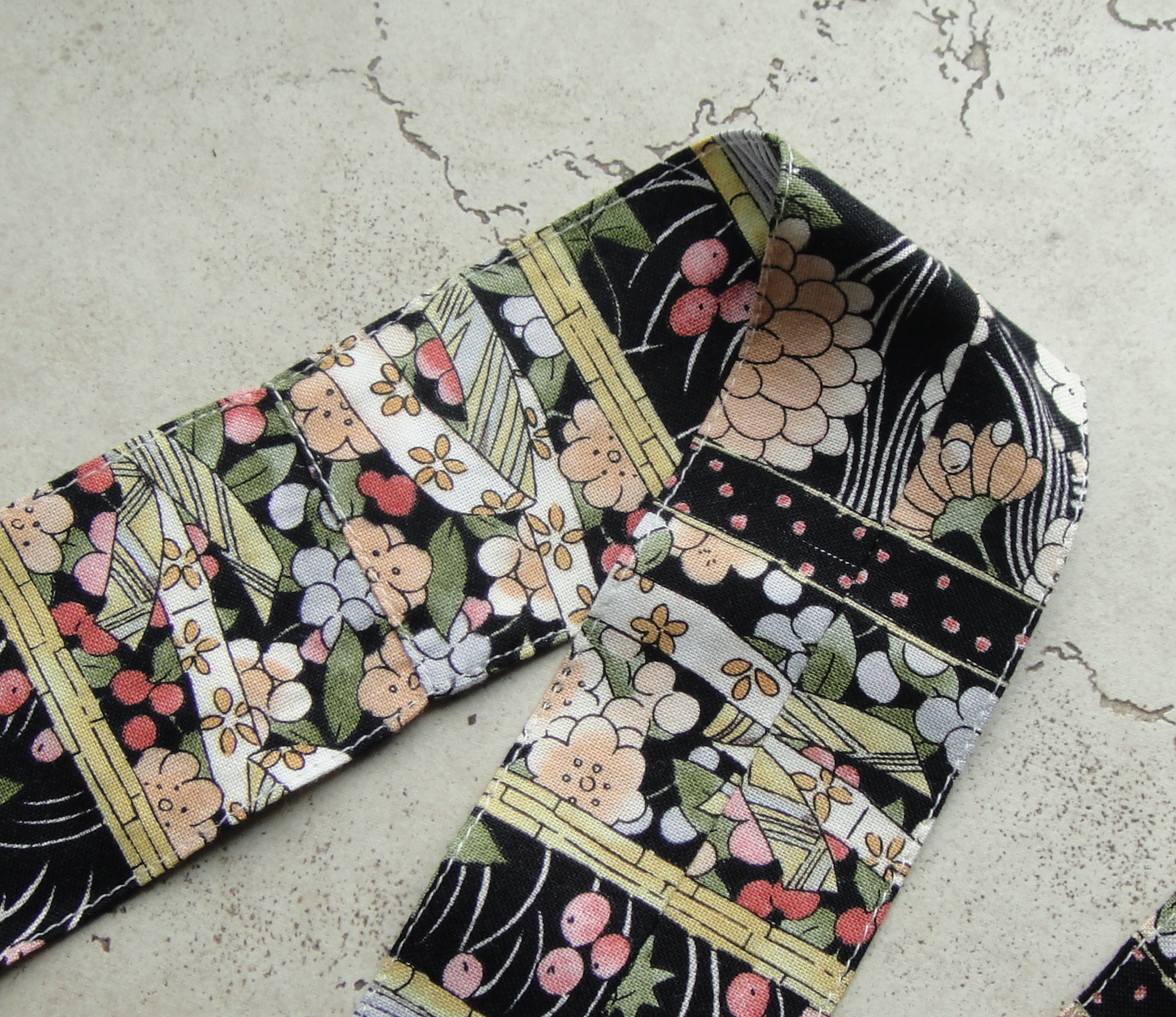
View C has a self-sash stitched in place at the centre front, and I even cut one out, but then I couldn’t resist trying it with my Japonesque fabric sash, and I love it, so I’m going to leave it changeable for now. We’ll see how it stays in place when I ever get a chance to actually wear it.

But all in all, super happy fun!

There’s a bit of the inevitable pregnant pouf that is going to accompany pretty much any take on this style, but this is a look I’m resigned to, as it’s pretty much my natural figure anyway.

This is “officially” my second piece for the Summer Essentials Sewalong. Now, excuse me while I go fantasize about hot, hot sun…*

*I think I should apologize about the amount I whine about the weather. I’m not sure if it’s human nature or a Canadian specialty, or just that I’m a wimp (I am a major weather wimp, especially about the cold). The weather we are getting right now is a kajillion times better than what I was complaining about in, say, March. So really I should STFU.

32 Comments

Filed under Sewing

Syo’s Sewing

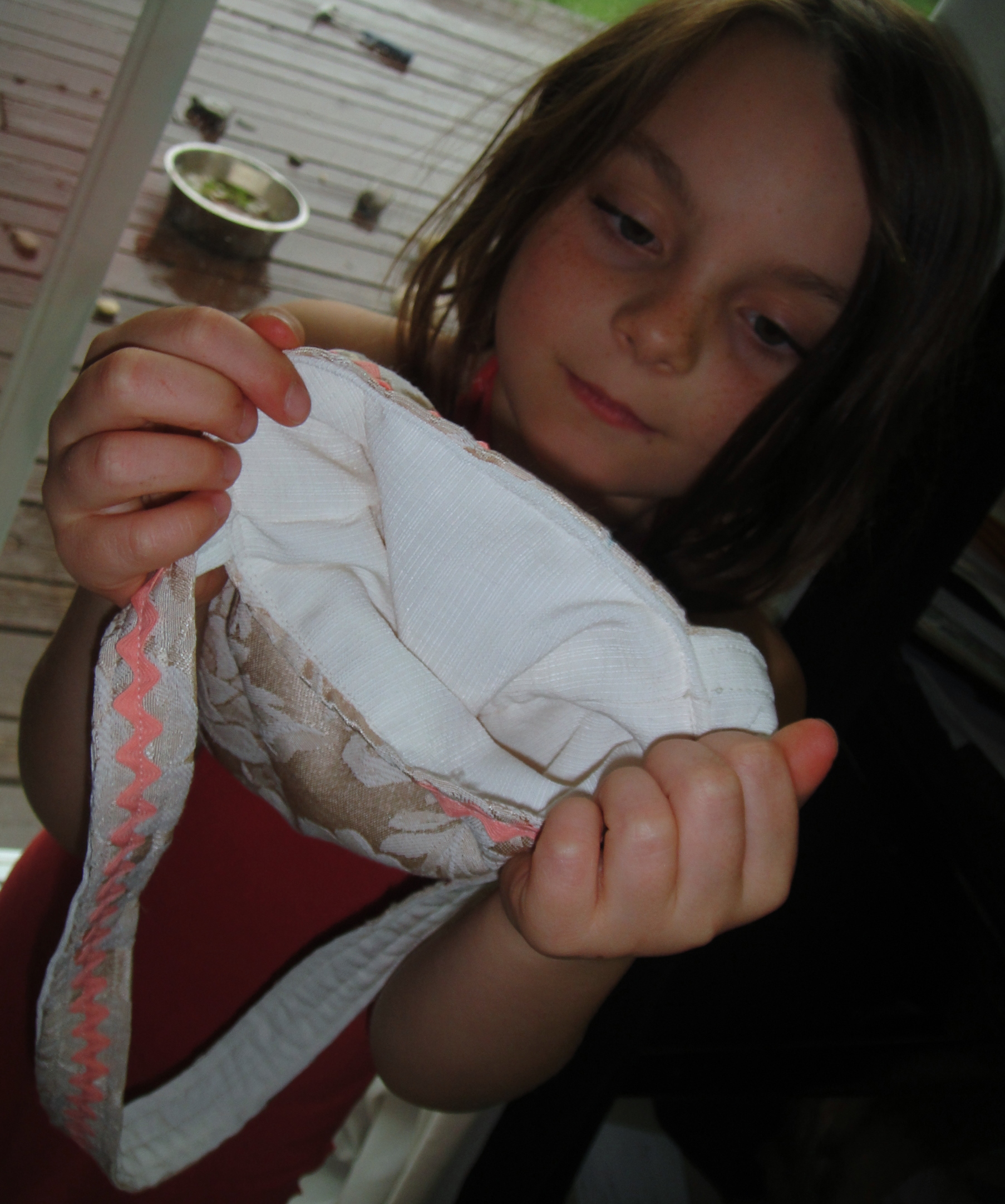
Syo's First Project

No sewing today—I am moving sewing spaces! Yes, the found table has been wrangled down the stairs (my poor walls) to the basement, and installed in my “sewing room”, so my excuse for keeping my machines on the computer desk in the kitchen—that I had no sewing-room furniture—has evaporated. My long-suffering neat-freak of a husband has issued an ultimatum—all sewing paraphernalia is to be removed from the kitchen before nightfall. The entire process is really highlighting just how MUCH sewing stuff there was crammed in the kitchen… I guess I really can’t blame him for wanting it out.

Pooh.

Ah, well. It’ll be all right for the summer. I may have to invest in another space heater come winter, though.

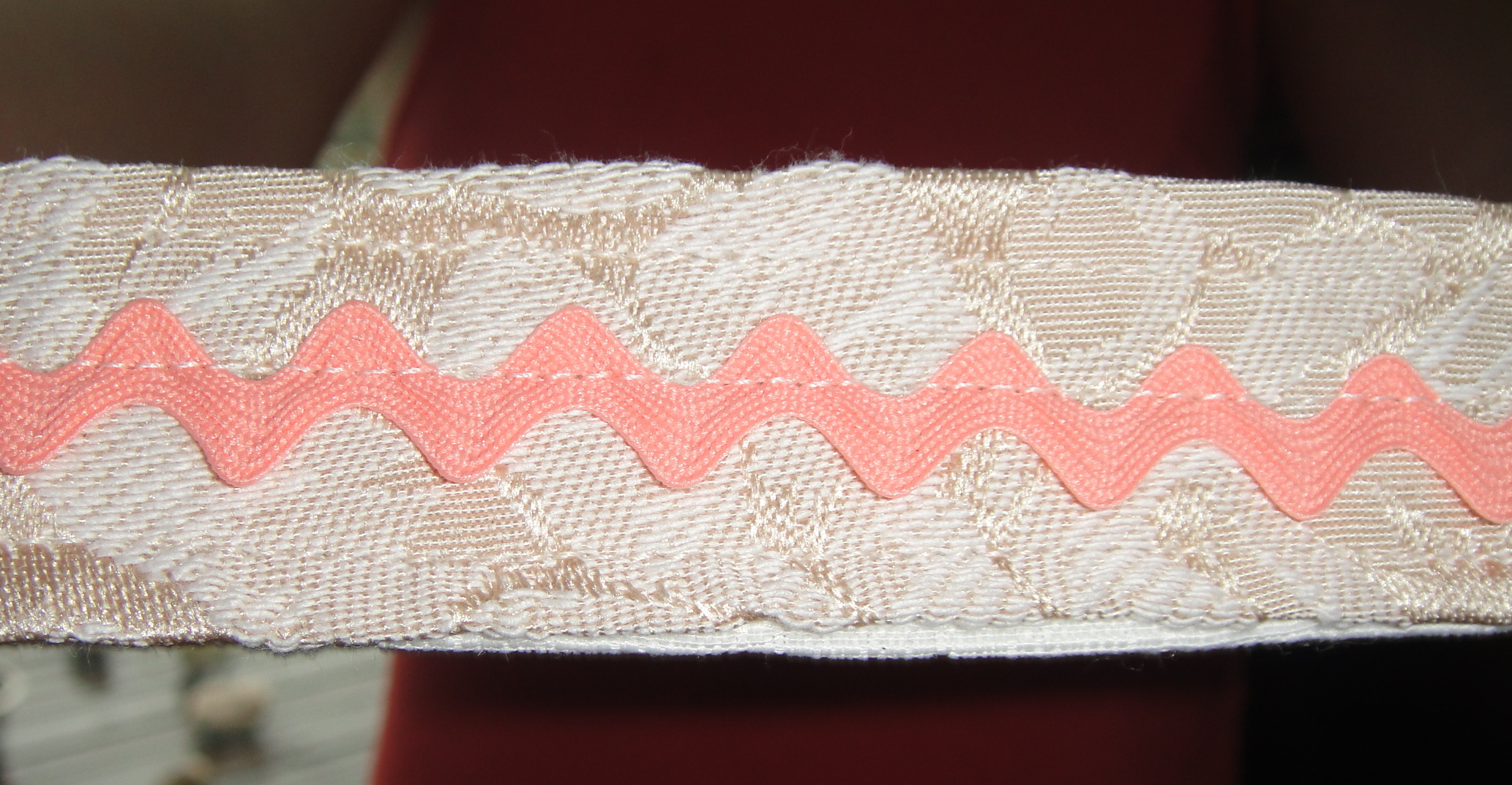
Strap, with rick-rack and topstitching

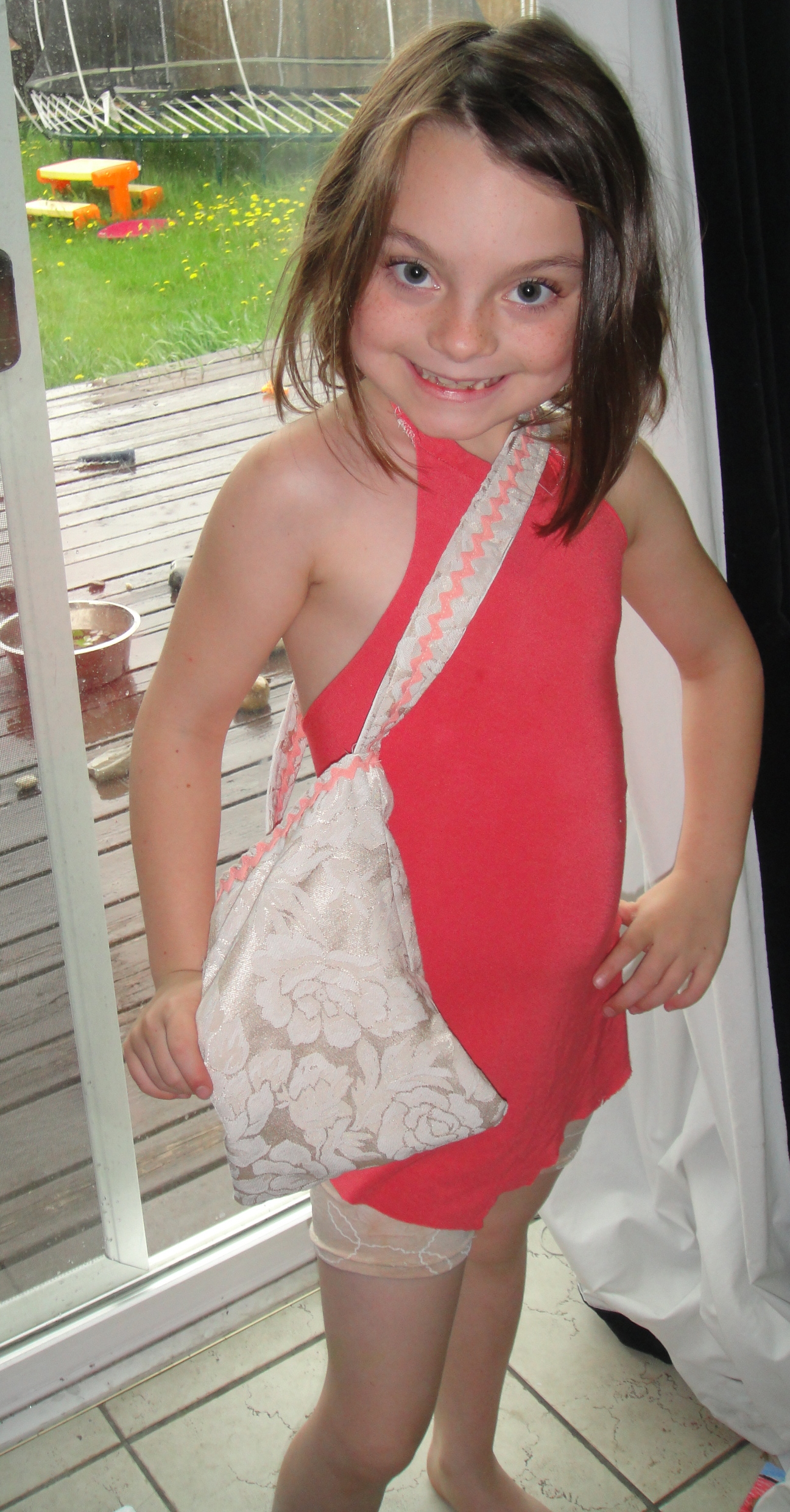
Anyway, with the absence of sewing on my part, I thought I’d show off Syo’s “first machine-sewn project”, made up last week. This isn’t her first sewing project—she’s been hand-sewing little cushions and things (although she was not very good at knots), and the shirt/dress/thing she’s wearing in the top photo is actually her own creation, too, although I did the actual (minimal) serging at her direction.

Lined interior

But this little purse was several steps up. We measured out the length and breadth of the strap. We used a pattern for the purse body (actually a sheet of standard paper). I helped with the pinning but she did all the cutting herself. She also chose the fabrics. The exterior is a cream cotton damask, a remnant from this pair of bellydance pantaloons I made a couple of years pre-blog. The interior is a remnant of cream synthetic something that I had at one point started making a shirt for the hubby out of  (the vastly inferior prototype to this shirt, frankly). It was a costume pattern, not full and blousy enough for the look it was trying for, the lace-up front placket instructions thoroughly defeated me at the time, and to put the icing on the cake, I melted the back of the neck ironing just as the shirt was almost finished. Anyway, I was a little hesitant when Syo selected it… while it’s not the worst to work with, it ain’t no cotton, shall we say. But it was the right colour and this project would pretty much take care of the last shreds of that painful memory, so I agreed.

I won’t say I didn’t hover nervously. I also helped with some tugging where the layers required taut sewing (a walking foot would be great for a project like this). Syo has a particularly alarming habit of accidentally pressing down on the foot pedal while attempting to re-position or maneuver the fabric with the presser foot up. But she distinctly improved over the course of the project, and managed not to puncture either of our fingers.

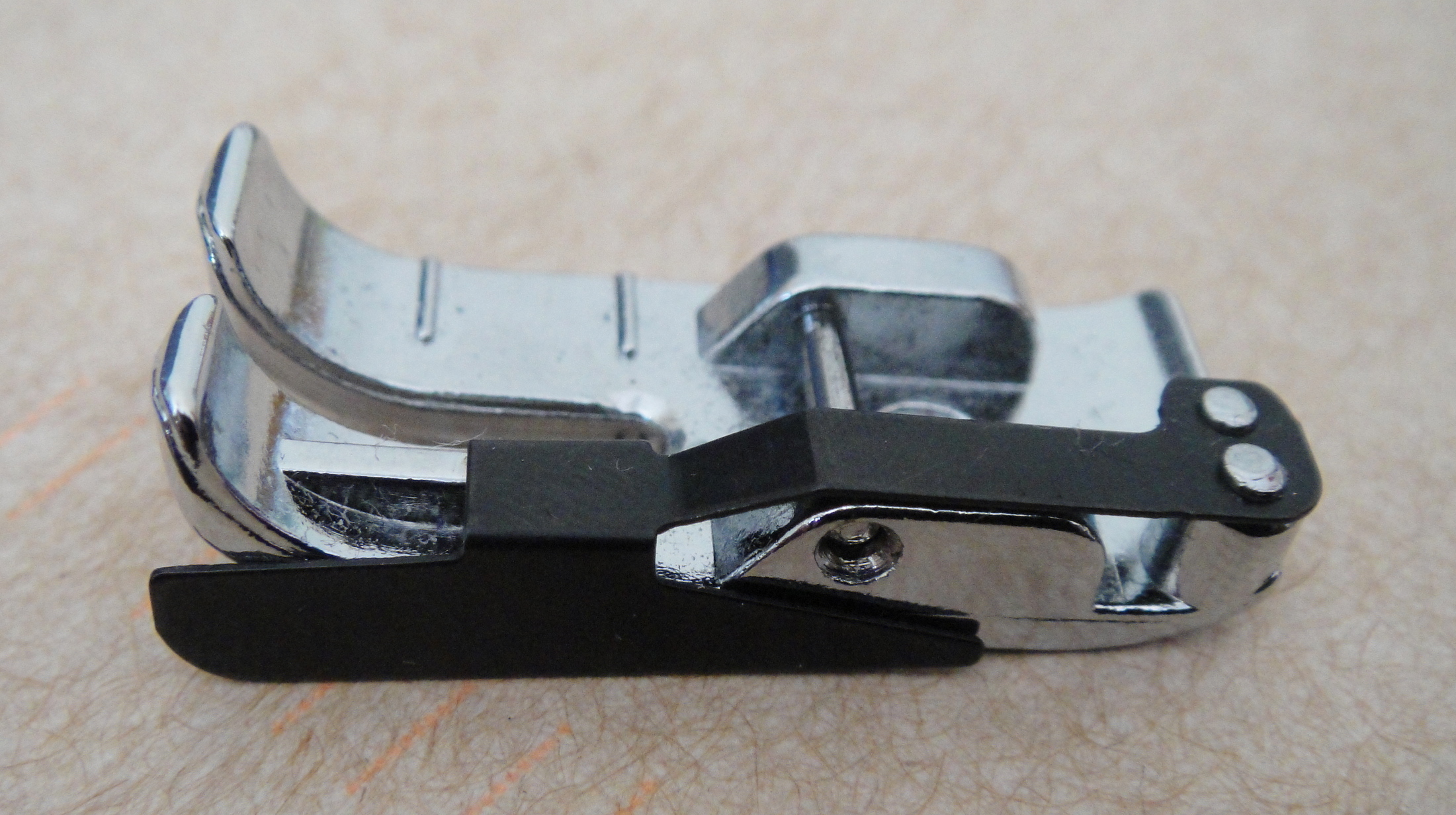
1/4" Edge-Stitching Foot

Also, I think it was Marie-Christine who made the comment once that technology will trump skill in most cases. I must (again) concede th truth of this. This little fellow is a 1/4″ edge-stitching foot that I bought on a whim when I got my marvelous new zipper foot. It set me back a whole five dollars or so. I won’t say it’s revolutionized my topstitching—I’ve gotten halfway decent over the last year—but it certainly makes some things that took a bit of concentration before almost effortless. More importantly, it made it possible for Syo, who can barely sew a straight line, to do almost-perfect topstitching. She also did a really darn good job sewing down her rick-rack, even in the centre of the strap, so it’s not all the little gadget, but anyway. All in all I’m a pretty proud Mama, and Syo is excited to try many future projects…

In Me-Made June News…

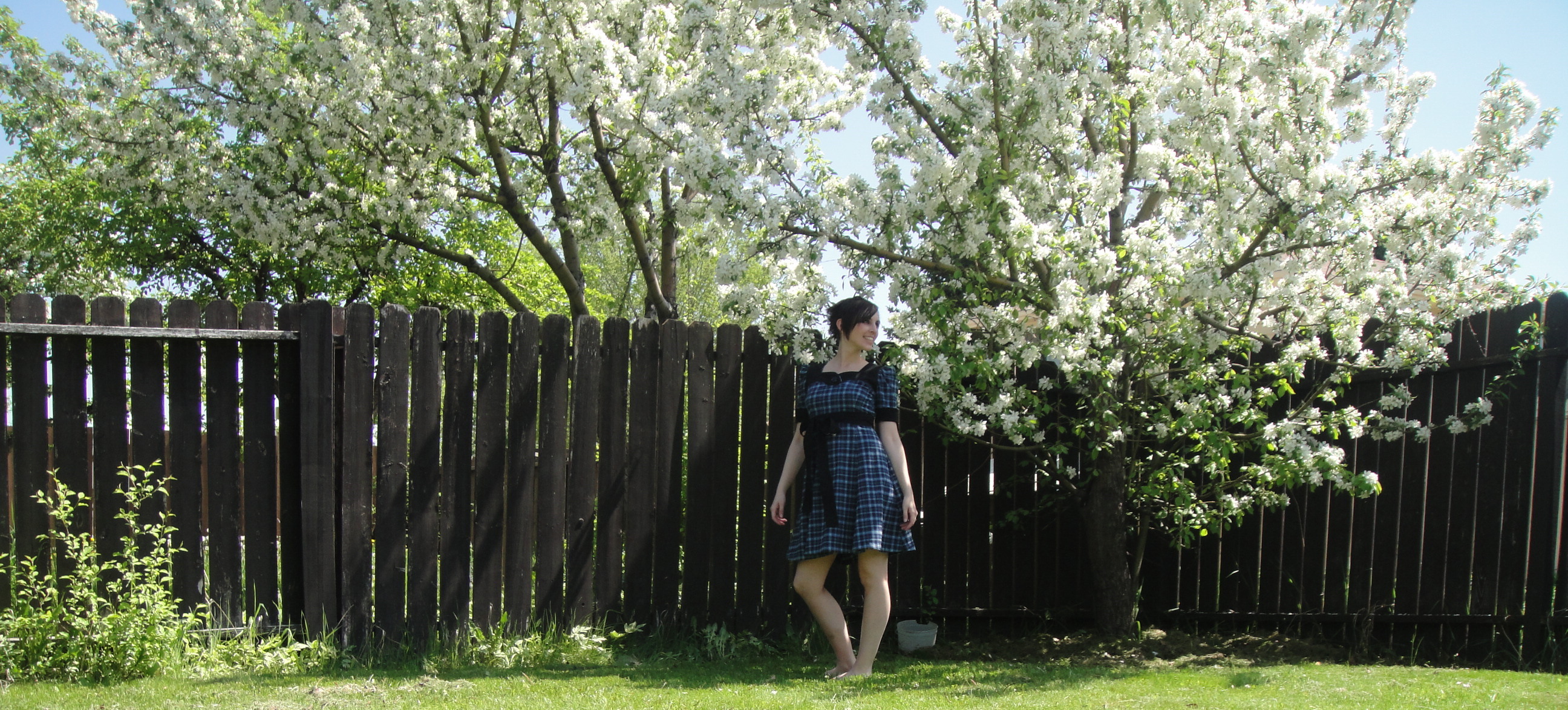
My back yard. Oh, and my outfit for June 5

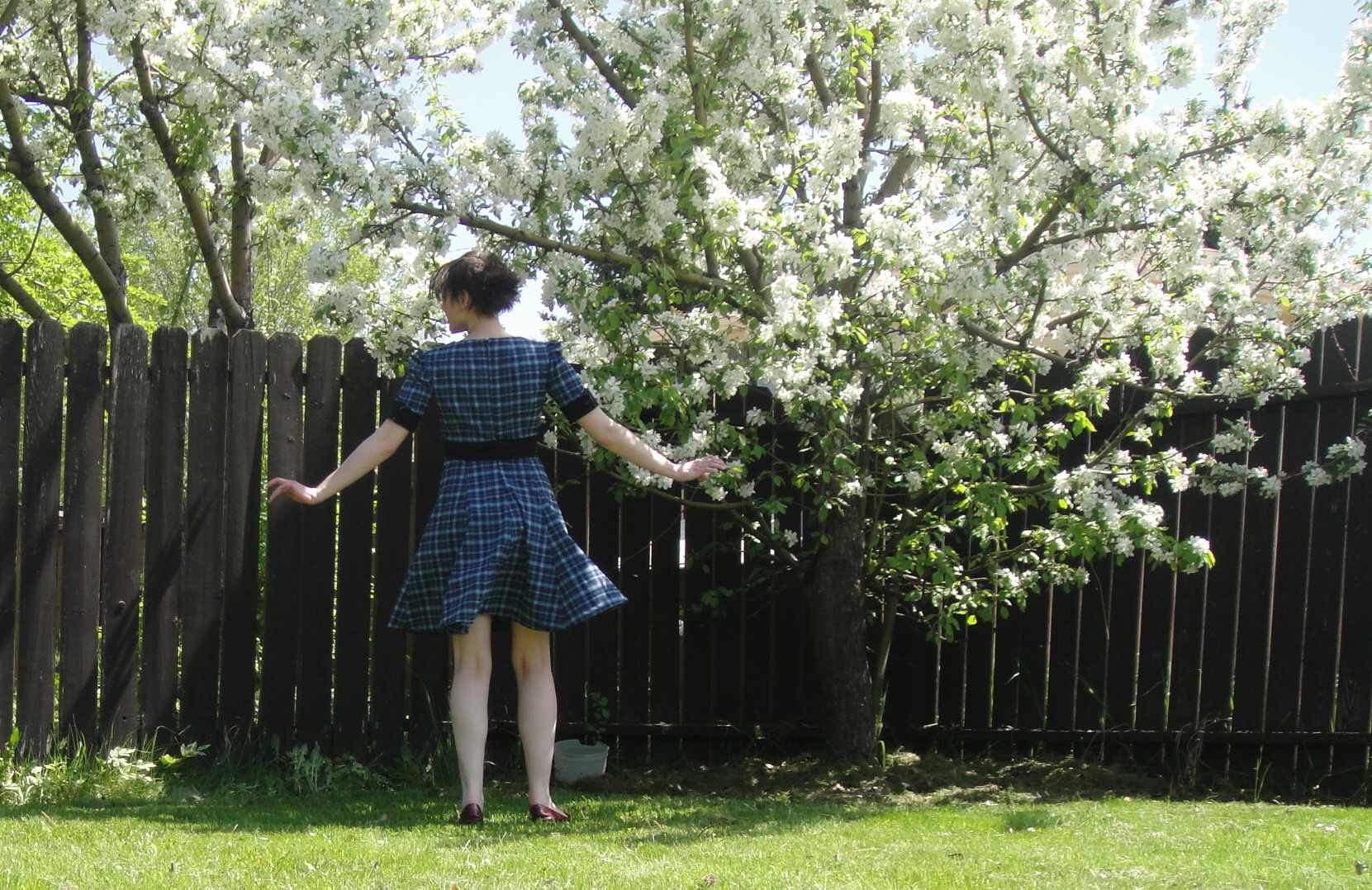
Here’s a slightly more panoramic shot of my back yard than usual, just because we finally mowed the jungle lawn, and the crab-apple trees are absolutely gorgeous right now. This is, of course, Simplicity  6023, the 70s dress pattern I won off MPB. Possibly I shouldn’t’ve worn such a nice dress on a day that included a fair bit of sweating and yard work (yay, heat!), but ah well. It’s washable.

Also, I was a little sad that I missed the twirling on Friday, so I decided to twirl today.

Twirling

It’s supposed to be rainy and cool again tomorrow, but at least we had one truly glorious day! Now, back to the sewing-room-moving…

14 Comments

Filed under Sewing

The Grecian Goddess Dress

Grecian Goddess Dress

I will admit I considered various alternative titles for this dress. The KISS (keep it simple, stupid) Dress. The Shirring Saves (Almost) Everything Dress. I commented in my inspiration post that I could just use a rectangle. I probably should’ve. Instead, I painstakingly drafted a short kimono sleeve, then added fullness for gathering both top and bottom. Even that would’ve been all right, though, if I’d just had this top flow straight into the skirt. But no, I had to fool with an underbust seam. Which of course (because I didn’t muslin anything) was about two inches too low in the front, and not particularly even all around.

In desperation a flash of brilliance, I decided to shir. I stitched up the front and back openings a couple of inches, pulled out my elastic-thread-wound bobbin, and started shirring a long spiral around the dress, beginning at my approximate underbust and continuing down across the bloody “waist” seam.

Front view

This created a vast improvement—instead of a mumu I now had something much closer to the elegant, drapey concoction I had envisioned. By a miracle, the neckline didn’t gape OR fall off my shoulders, and the bra straps are completely covered both at shoulders and at the back.

Back view

But all the shirring in the world couldn’t save that lumpy, uneven waist seam from being lumpy and uneven. No worries, though, I had always envisioned this dress with a sash across the offending area. I had planned to do a self-sash, but found myself desperately short of fabric. My Japonais Mum to the rescue! I cut off a pair of narrow widths ( it was too narrow to do just one), joined them in the centre, and made a simple tube sash.

Because having a seam at one edge and not the other annoys me, I hit on the idea of rolling the seam to the centre of the back-side of the sash. Quite satisfied with how that turned out. Yay me.

Sash closeup

Obviously I need to shorten the dress a fair bit… it’s dragging even in the heels I’m wearing for these photos (and the odds of me actually wearing heels like that out and about in the summer are pretty minimal).

I might try the general idea again, without an underbust seam and with a bit less gathering at the shoulder.

In Me-Made June news,

MMJ 4

This is an older ensemble, meaning everything in it was made last summer and fall. It’s not terribly glamorous and I have a few issues with the fit of the blouse that I didn’t notice when I first made it (too bad since I made like four different versions). Still, it’s warm and comfy on a rainy, chilly day. These remain my single favourite pair of me-made jeans, despite a number of material failures (the pockets have disintegrated and much of the topstitching is failing).

JJ blouse
Knit top formerly known as Lydia
Jalie 2908 Jeans

29 Comments

Filed under Sewing

Trial Tunic

Tunic and apple tree

Before I get into the tunic, I just wanted to say thank you for all the wonderful comments on yesterday’s anniversary post. I’m proud of my husband and our family, and of the way we’ve dealdt with the struggles we’ve gone through to get where we are now (not that we are done with struggling, by any means). My favourite quote about love (though I couldn’t name the source) is that “Love isn’t something you feel, it’s something you do.”

Anyway. Tunics.

I have a bit of an ambivalent relationship with tunics. You may not know this, except, perhaps, by their total absence from my sewing so far. Basically, I have what can charitably be called a “boyish” figure, and I have generally figured that the purpose of clothing should be to emphasize what little I have in the way of curves, rather than skim over them. Also, I’m still recovering from a long-time perception that the tighter, shorter, and skankier an outfit was, the better it looked. So I’ve always tended to give tunics a pass.

But, in their massive popularity over the last few years (possibly in abatement now, but the trends can kiss my ass), I did wind up trying on a few here and there and, to my surprise, discovered that I really liked at least some of them. Who knew?

Anyway, one of my favourites has been a specimen with a wide hip-band, scooped, gathered neckline, flutter sleeves, and a keyhole opening in the upper back. And ever since I worked out my knit sloper over the course of last fall, I’ve been wanting to attempt to immitate it. How hard, after all, could it be?

Closeup

This is not the ultimate version, by any means. Most egregiously, this version is about three inches too short, so that the hip band falls above my hips rather than at my widest point, especially after several minutes of wearing. I can blame this on nothing but myself, though, as I took the existing length of my knit sloper rather than actually measuring the original tunic. My keyhole opening in the back is quite a bit smaller than the original, too, for much the same reason, although this is less upsetting.

Neckline. Meh.

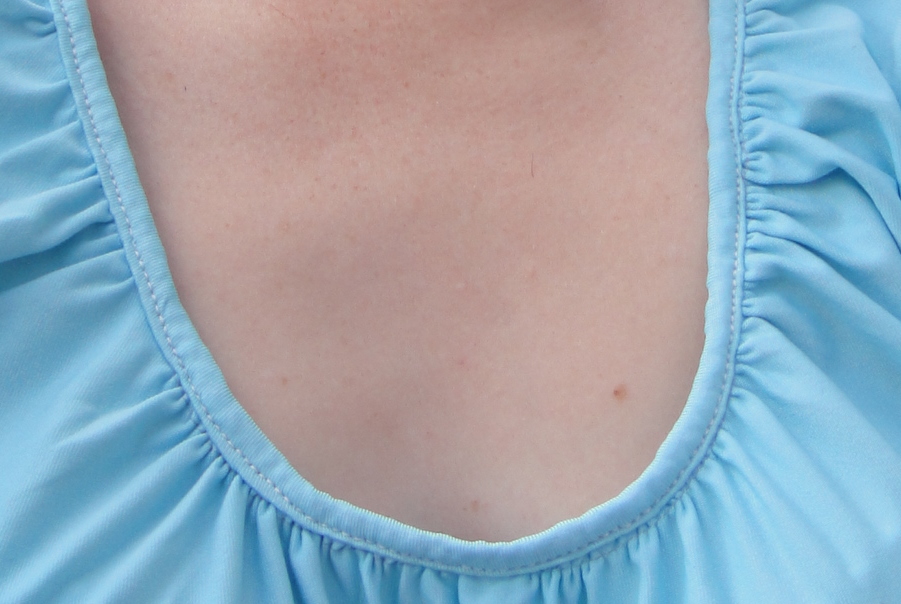
The hardest part of this entire project was binding the neckline. I have a really hard time producing nice bindings in thin, wriggly knits. I’ve sidestepped (or at least minimized) the issue in the past by using a lot of cowl-necked patterns or other alternative neck finishings for the thinner knits I’ve sewn up, but for this pattern I really needed to bind the gathered neckline. I achieved it, by dint of much fussing, cussing, and the flagrant application of both Steam-a-Seam and Wonder Tape, but it’s not especially pretty or professional-looking. Also keeping my gathering from squooshing under the machine foot was nearly impossible. It’s not perfectly even, but at this point I’m not going to complain. Sadly, I’m not sure I can do a lot better with the equipment at hand.

Back view

Other than that, and a bit of futzing with the back closure (between the neckline and the keyhole), I’d say it’s a reasonably successful first attempt, though. V. 2 should be much more satisfactory, or at least longer. The downside of taking your own photos with the timer is there’s no one to tell you your shirt is hiked up at the back. On the other hand there’s a pretty good chance this is the way it’d look most of the time when worn, anyway.

In Me-Made June news,

MMJ 2

today I am wearing the 50s shrug (pattern here), blog post here

Cowl-neck shirt

skinny jeans.


As you may have guessed, it still isn’t really warm, although at least we’re in no (immediate) danger of snow. Still, I shan’t complain—sun and mid to upper teens (C) is decent enough.

It does appear that someone’s been working some arcane rituals in the back yard, however. Maybe that will be more effective in bringing on the nice weather than all my hopeful sewing.

Someone's up to something...

20 Comments

Filed under Sewing

The Bell-bottoms

Vintage wranglers (with accessories)

In about 1997, I stumbled upon two pairs of bell-bottom Wranglers, presumably vintage but more or less pristine, at a garage sale. They were a little big, but at least that meant they sat a bit low on my hips. In those days, stretch denim and low-rise pants had not yet penetrated to my little backwater… I was still wearing my Levi 501s and trying to figure out why anything that fit at the waist had huge flaps at the hips.  At seventeen you don’t really have a clear sense of your body… all I knew was that the look I was seeing wasn’t quite right. I was also still wrestling with my 80s-bred distaste for any pants that flared at all. The wranglers hung off my hips at the perfect level, though, and if they didn’t hug or skim anything, well, as long as I could show off my tummy, at that point I didn’t much care. I wore them with boho shirts and a metal-link belt that had belonged to my mother in the 70s, if not the 60s. I didn’t realize it at the time, but I would be wearing bell-bottoms more-or-less exclusively for the next decade.

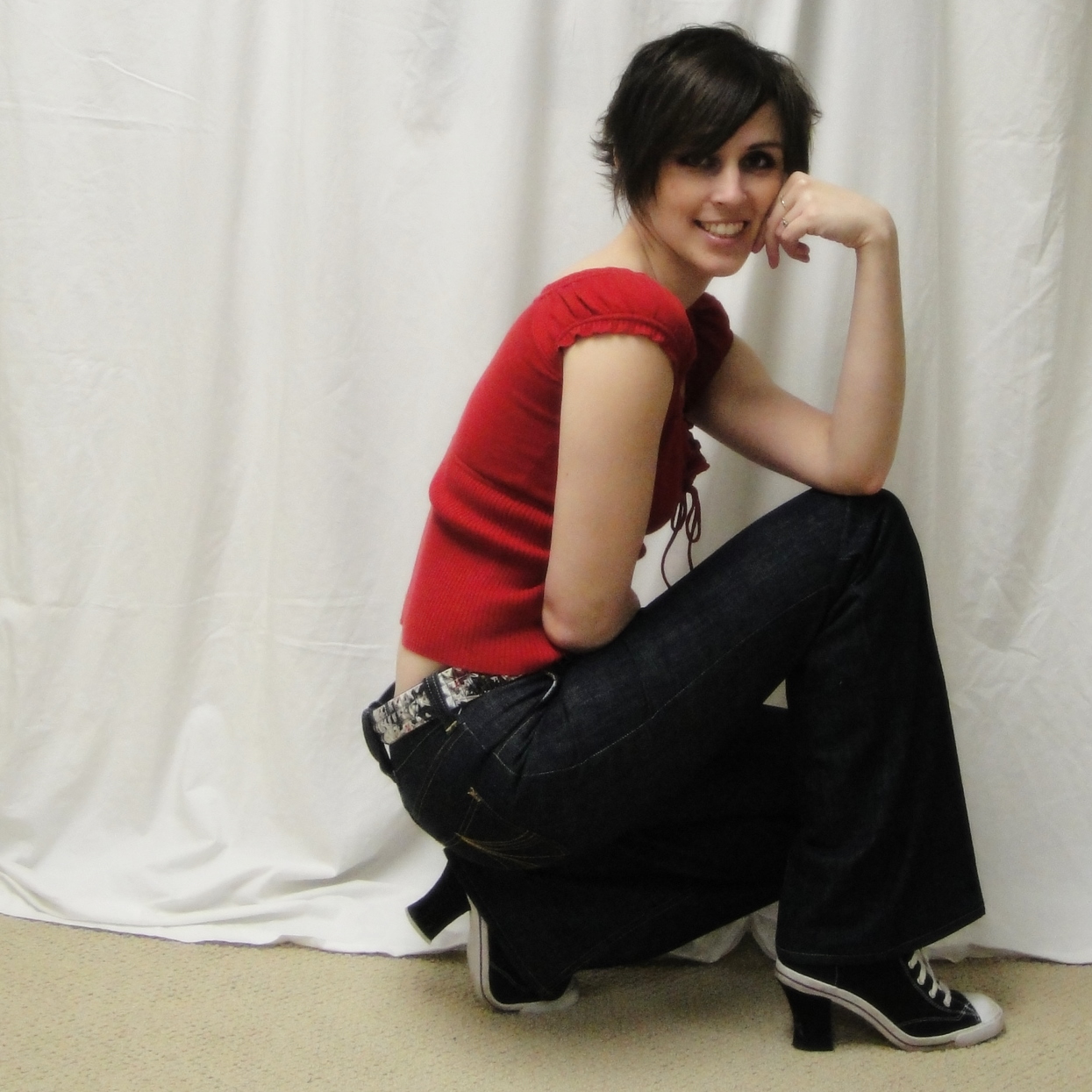
Ellen Bellbottom Jeans

Although I was never a serious devotee of the flare (I don’t have the hips for wide ones), I was a late adopter of the skinny jean, as well—I got my first only a little over a year ago.  But I haven’t had non-stretch, old-school flares since I ousted those Wranglers, round about the birth of my first child.

Then, Joy’s Bellbottom Challenge cropped up and, coincidentally, I wound up with two metres of absolutely gorgeous dark-indigo non-stretch denim. Obviously the two would have to combine into some seriously retro bellbottoms.

Not, however, as huge and sloppy as my old wranglers, however. So, I went to my handy-dandy Ellen pants pattern, which is my only non-stretch pants pattern (that I know fits, anyway…), traced it off, made the adaptations for jeans (back yoke, front pockets), brainstormed a couple of different ideas for the closure and the pockets, and got to work. Ellen is a great pattern for mods like this because it’s completely free of style details if you leave off the pockets.

I opted to have the legs flare from about mid-thigh. I probably could’ve gone a bit lower, but I wanted, for whatever reason, more of a wide-legged look than a hip-hugger look. I added what seemed like it would be a modest, but definite, flare.

Front lace-up fly

I decided, for no particular reason, to make a corset-closing front rather than a traditional fly… I had a pair like this shortly after Tyo was born, and I always loved the feature (I have a bit of a weakness for things that lace up.). I haven’t decided whether to add grommets to the waistband itself, or buttons with a tab stretching between them. We’ll see. Although inserting grommets is always a little nerve-wracking, this was still simpler than a fly, for those of you who are chicken of flies and not afraid to look a little out there ;).

Bound waistband interior and flat-felled seams

Bound waistband interior and flat-felled seams

I did my new favourite waistband-finishing technique, binding the inside with bias tape (this time the blue satin left over from my springy coat facing), and, since the Ellen has 1.5 cm seam allowances rather than the 1cm of the Jalie pattern, I decided to try my hand at (ulp) felled seams.

They were… ok. Definitely not perfect. In particular, although my yoke seams lined up at the seam-line, the way the seam-allowances interact in a flat-felled seam means that after they were folded over, the yokes look offset. Boo. On the up-side each seam is only stitched twice, instead of three times, and there’s less swapping back and forth of threads. The trimming and pressing takes a lot longer, though, and I think I get more even topstitching with the “cheater” method. Hmm. We’ll see. A big part of me is still convinced I’m not making proper jeans if they don’t have felled seams. Hmm.

Bellbottoms

Bell-bottoms: back

I hemmed them LONG. If they don’t shrink up in length, I may have to shorten them. That’s ok. I’ve been traumatized by too many too-short pants over the years to mind a bit of extra length. And it’s fun to put on heels and still have only my toes peek out.

So... much... leg...

Click through to the full-size rear photo to get a better view of my back pockets… I made them shield-shaped to echo the corset-fly.
My hubby, a diehard child of the 80s, has already expressed his dislike of them. I explained that I think I’m allowed to own one pair of jeans that he doesn’t like. He countered that he doesn’t own any jeans that I don’t like. I pointed out that’s only because he won’t go shopping without me. I think this means I win, don’t you?

It really doesn’t show in the pictures, but I also did one vintage thing that I’ve never before attempted on jeans.

I pressed creases front and back in them. I think they look very smart.

Now all I need is a 70s blouse to go with them… 😀

(I think I’ll have to do a 70s week in Me-Made June, what do you think?)

51 Comments

Filed under Sewing

Capri-cious Camo

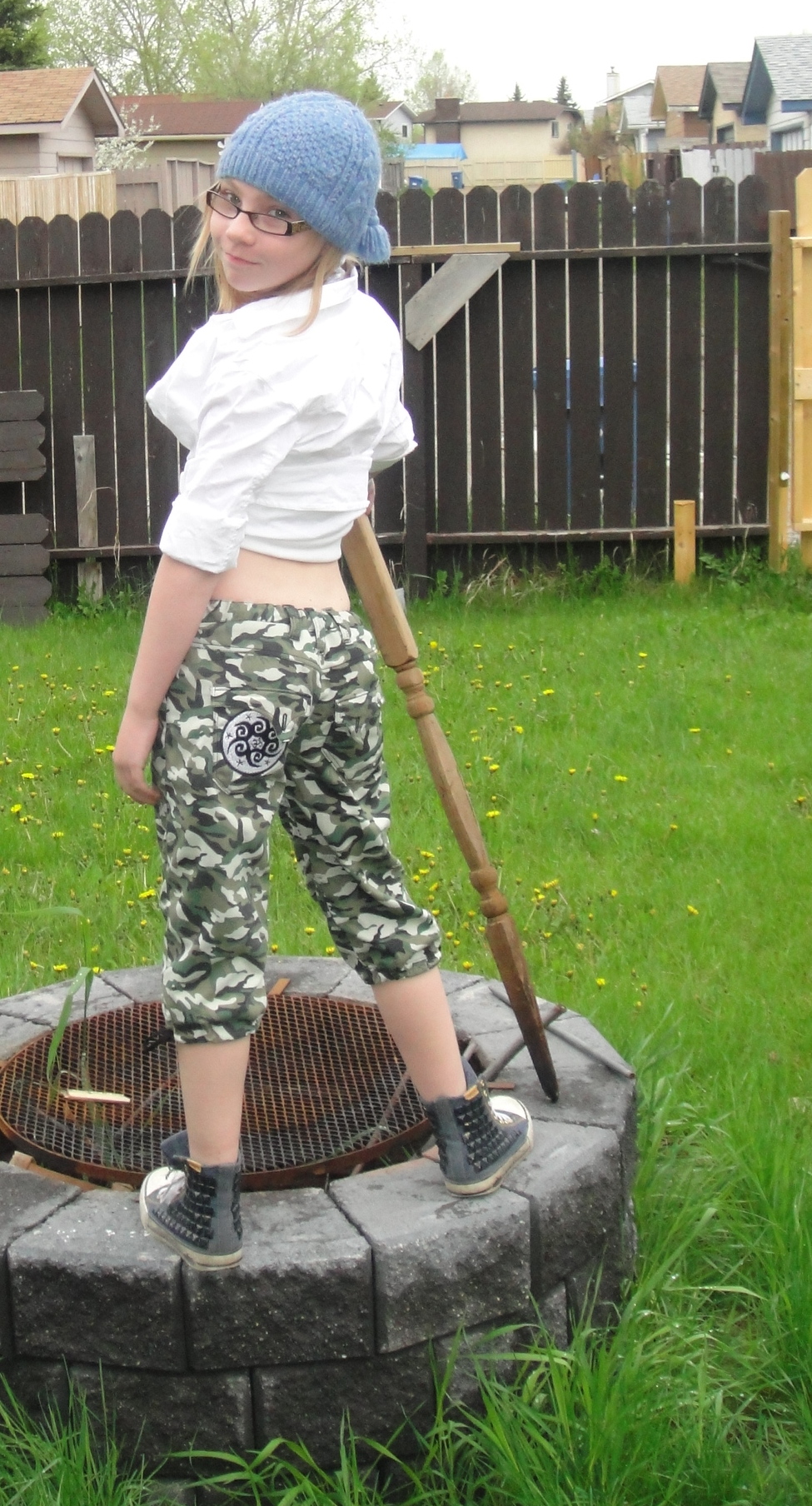
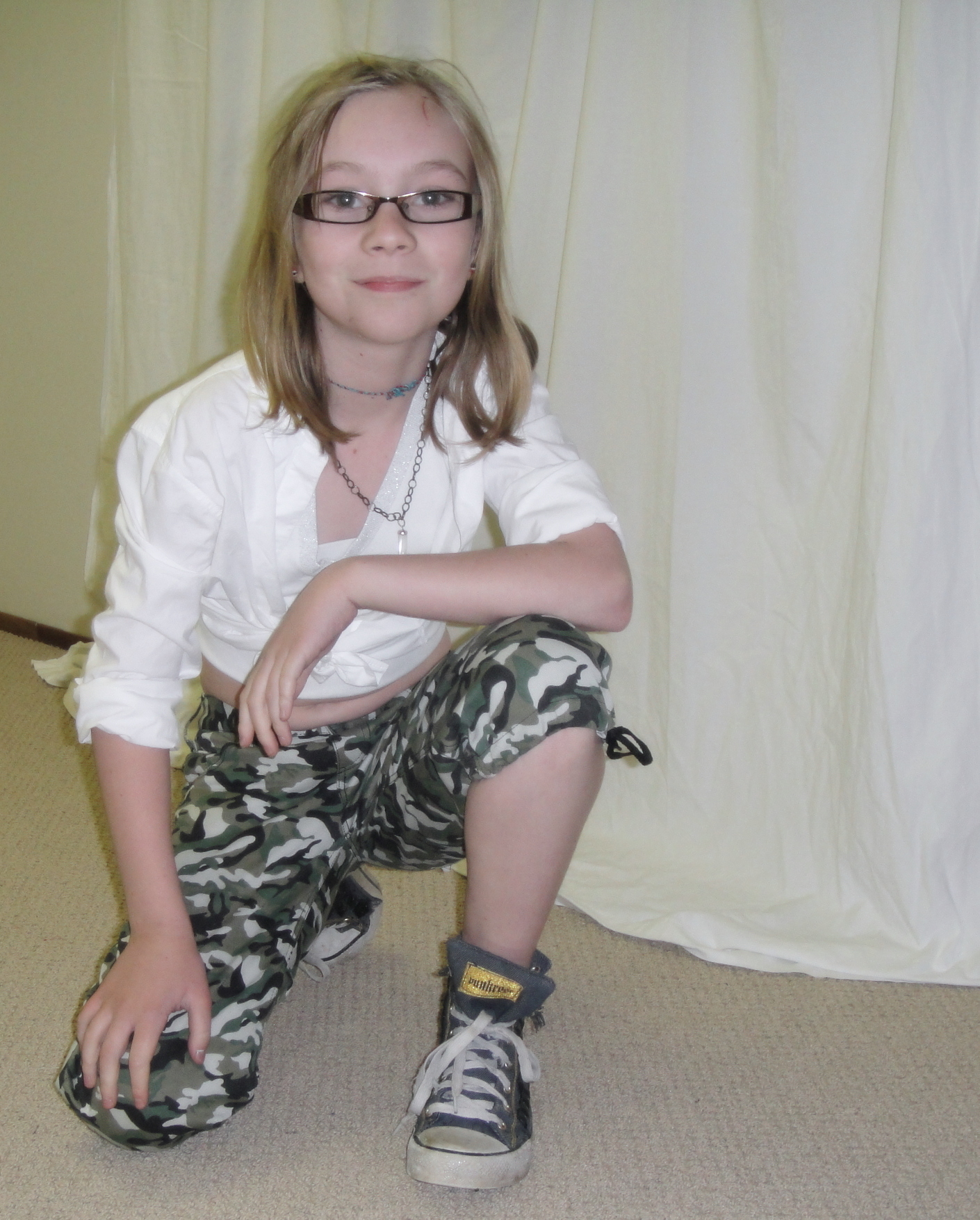
The Capri Girl

Tyo’s camo capris are finished. It’s been rainy so I’ve been carless* and hence unable to make it to the fabric store for the finishing touches (buttonhole elastic for the waistband and twill-tape for the leg drawstrings), so I had to improvise. I found the missing black thread under the couch, bought shoelaces at the grocery store for the drawstrings, and liberated the buttonhole elastic from the fishtank, where it has been holding down our improvised fish-tank-cover** for the last several months.

I must say, these were really fun to make. The fabric was cooperative, and just the right weight—heavy enough to feel sturdy, without being so bulky as to give my machine fits.

The pattern, as I mentioned before, is from a 2009 Patrones children’s issue. It features five pocket styling (I made six by putting a change pocket on each side… oops!), funky-shaped rear pockets with nifty-shaped flaps, and a waistband designed for buttonhole elastic.

Elastic back waistband

Now, adding buttonhole elastic to a kids’ waistband is easy as pie, but it’s kinda nice to have it marked on the pieces so I don’t forget, since you have to work the buttonholes and ideally attach the buttons before putting the waistband on.

Look, ma! Rivets!

I used my triple-stitch (aka straight stretch stitch) for the topstitching. This is nice because it doesn’t upset my machine the way topstitching thread often does, but it can be a little feisty and you have to pay attention to where you are in the three-stitch cycle when turning corners. It worked quite well on this fabric, though. If you click through to the full size photo, you will also see that in addition to double-topstitching the inseam, I did a single row of topstitching along the outseam! This is much trickier, as you have to do it once the pantlegs are already tubes, and involves sewing down the inside of the inside-out leg, bunching the fabric up around the needle as you go. Slow and fiddly, but I figured these were short and loose enough that I had better try it here, as I might not ever try it again. 😉

Interior waistband finish

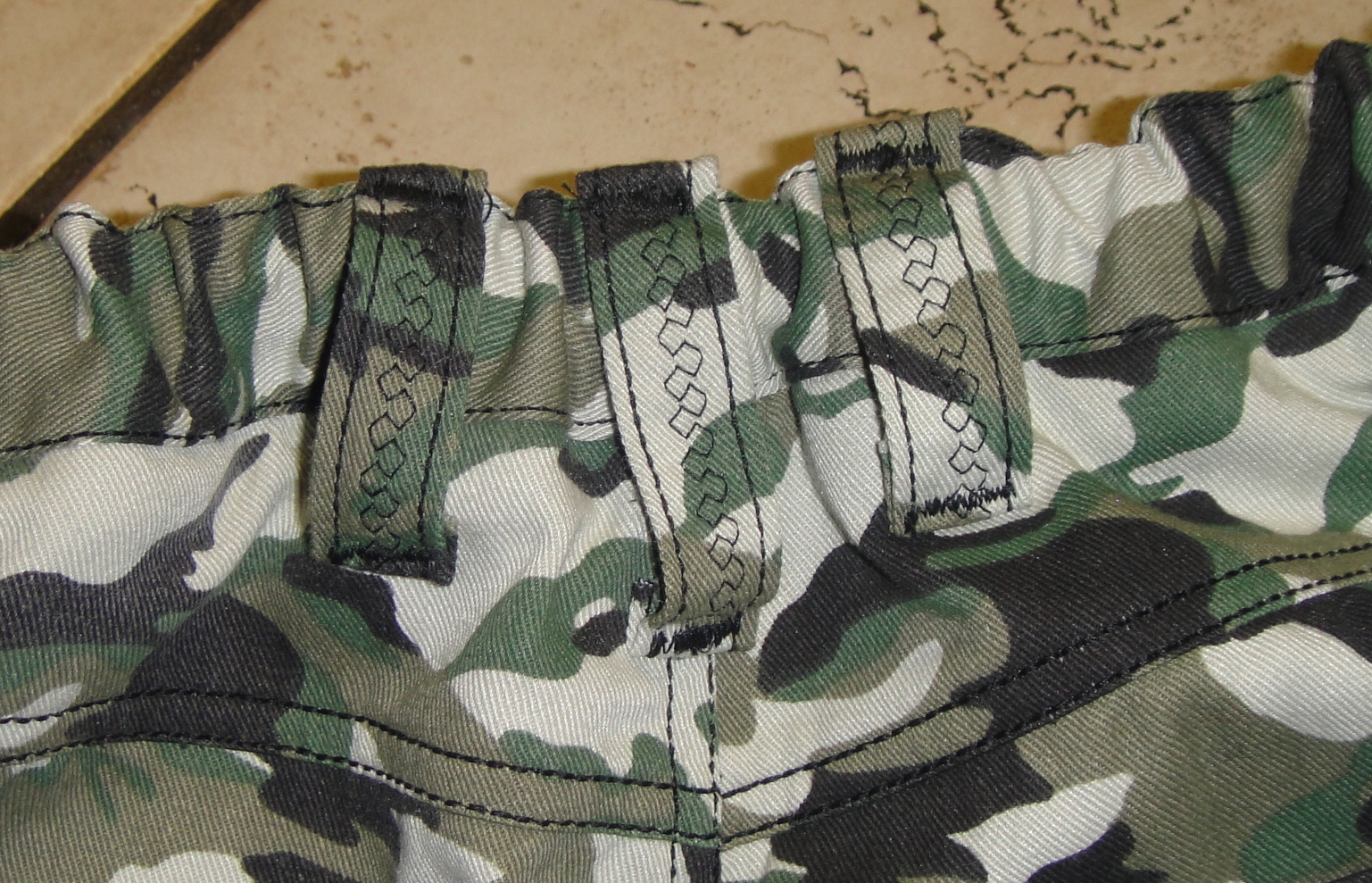
Another touch I tried is a bit of a cheater finish—I used some of the bias left over from my 70s jacket to bind the inside of the waistband. I feel justified in this finish because I recently got a pair of (thrifted) RTW jeans that have the same finish. It makes for a super-easy waistband; you just topstitch from the right side, not worrying about catching the underside at all because there’s plenty to catch. Also this is the same fabric I used for the pocket-lining and the underside of the flaps.

Of course, it's all about the shoes.

I cut a Patrones size 10, the smallest the pattern came in. According to her measurements Tyo is a Patrones size 8 on the bottom and six on the top, but with the wonders of  buttonhole elastic, they fit fine. The pattern is cut very wide and flat on the backside, relying on the elastic for any fitting. I took it in a couple of cm at the CB seam, to give Tyo a bit of extra shaping in this area.  My only complaint is that the rise is quite low. Really low, for a kids’ pattern. Especially considering Tyo, ah, needs a bit more coverage in the rear. If I make this again, I’ll add a generous wedge to the CB.

Back pocket with patch

Although I made buttonholes in the rear pocket flaps, I haven’t cut them or attached buttons. We’ll see if I bother or not. I did decorate one rear pocket with an embroidered patch Tyo had purchased at a street fair last summer. It was originally intended for her jean-jacket, but since that’s still sporting its punk/zombie patches from last Hallowe’en, we decided to use it here. I like contrast of camo fabric with hippie/Buddhist patch.

Have I ever mentioned my daughter is way cooler than I ever was?

I can’t wait until these have been washed about a dozen times and get that worn-in-faded-camo look. In fact, I like them so much I might have to think about making myself some. I haven’t worn camo regularly since my feminazi/survivalist-lookalike phase back in Uni.

Tyo's Toque

Also you may have noticed one other hand-made item in these photos. The blue tasseled toque Tyo is wearing was knitted by my mother, for me, when I was about kneehigh to a grasshopper. Isn’t it cute? It has a matching sweater somewhere, too, although that was only finished in time for my little brother to wear it.

All righty, I think that’s more than enough sewing for the house apes (thanks, Katie, for that one!). Time for something for me!

*Our second vehicle is a motorcycle. This is not nearly as practical as a second car (especially in our climate) but is definitely WAY more fun. Except when it rains.

** Instituted after the tragic leap of the much lamented One-Eyed Jack. (scroll down)

18 Comments

Filed under Sewing