Tag Archives: finished projects

Maxi Mania

Jalie 3246

Jalie 3246

Maybe it was Carolyn’s recent binge on maxi dresses, or maybe it was that EVERY stylish lady in my office (and frankly, I think that’s all of the ladies in my office) has been wearing one at least three days a week for the last month, but I finally made time to make up Jalie 3245.

Jalie 3246

Jalie 3246

I meant to make this up last summer, but time slipped by me, as it often does.

The Black Version

The Black Version

As with most Jalie patterns, once you make one, it’s hard to stop. I made the first once in about two hours on a Saturday morning before I had to go to work, and that includes tracing out the pattern. I made it from a fairly heavy black knit (a doubleknit, I think) with a crep-like texture on one side—it’s got great drape and more stretch than a ponte, but is still a fairly firm and potentially sweaty fabric. Maybe not the best choice for a summer dress.

Front, black.

Front, black.

But it sure looks classy. I made this one up pretty much exactly as per pattern, only grading form size R at the bust to S at the waist and hips and adding a bit of length on the bottom. Since I recently ordered a million miles of narrow black fold-over-elastic off Etsy, I used it for the neckline and arm-bindings, which is super fast and would have looked great if I’d taken three more minutes to test my tension on a scrap or two.

FOE, slightly wavy.

FOE, slightly wavy.

As it is, it looks fine on but is a bit wavy off—limits the hanger appeal. Boo. Fortunately, handmade clothes aren’t really about the hanger appeal. 😉

Skirt: Narrow.

Skirt: Narrow.

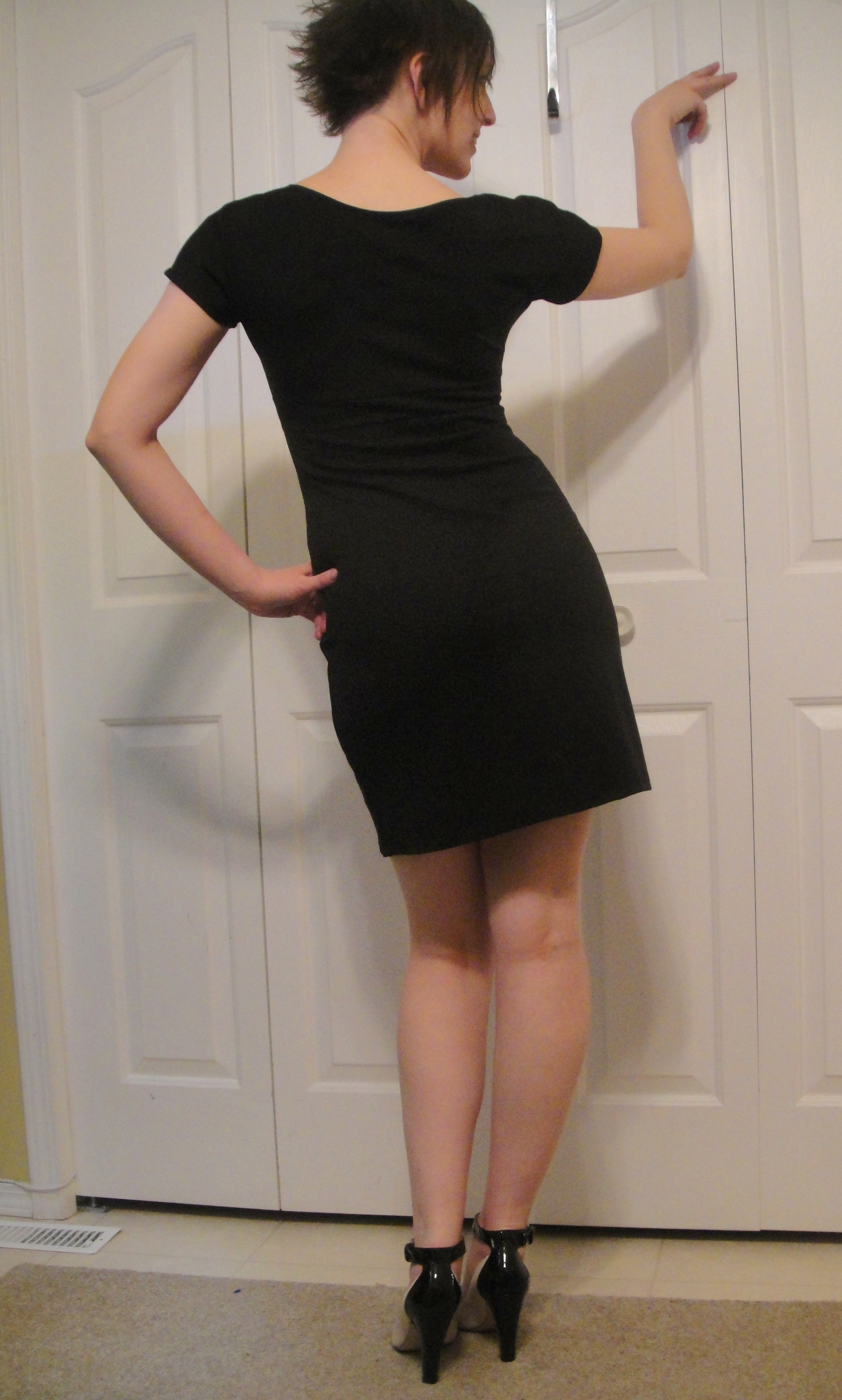
The only major problem I had was that the skirt is VERY narrow. This means you can easily get the dress out of a pretty teeny amount of fabric, but it’s not great for walking in, especially in my rather firm fabric. There is also something slightly off about how the hips fit, which goes away when I hike it up about 1.5 cm—so for the other versions I made a small tuck between bust and waist and they sit very nicely. I’m glad I didn’t try to shorten the bodice at the shoulders, which is what I often have to do, because the armscyes are NOT deep at all, and in fact could probably be lowered a wee bit.
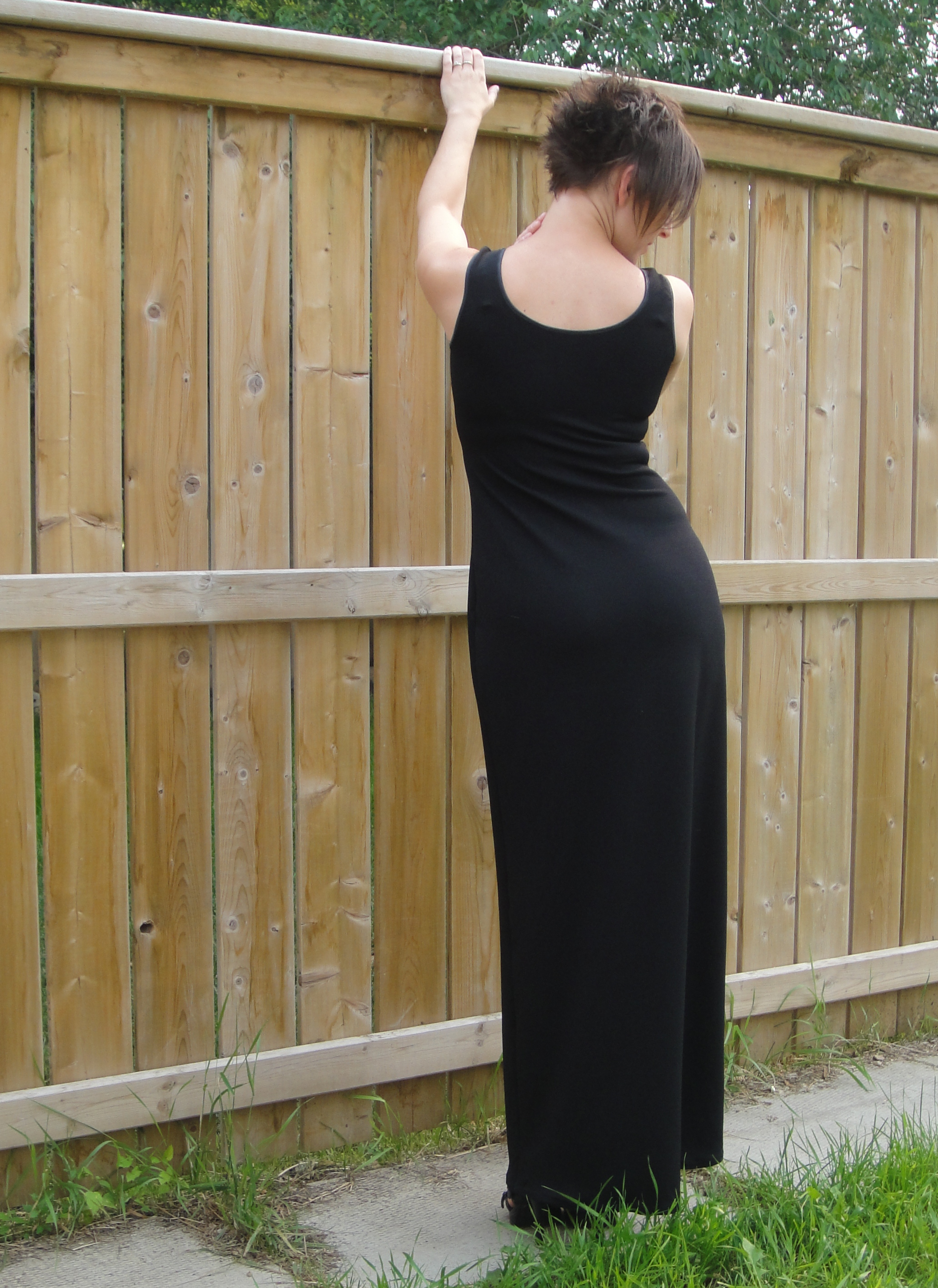
Back, black.

Back, black.

After the fact, I took a bit off the sides to get a closer fit in the back. It’s hard to get dresses like this to cling to the extreme back-curve I have there. The back is pretty wrinkly even when I’m not standing with my hips off to the side, but that’s life with a swayback.

How to walk in a narrow skirt.

How to walk in a narrow skirt.

The main problem with the narrow skirt is that I wind up walking around with it hiked up to my knees so I can take a decent-sized step.

Version 2 (or is it three?)

Version 2 (or is it three?)

I cut out the other two versions together a couple of days later. Both are rayon jerseys of some variety, although very different in terms of their overall stretch and feel. This dark, processed-photo-looking floral (with blue roses!) is super-stretchy and very drapy, with lots of weight, but a hard, almost scratchy feel.
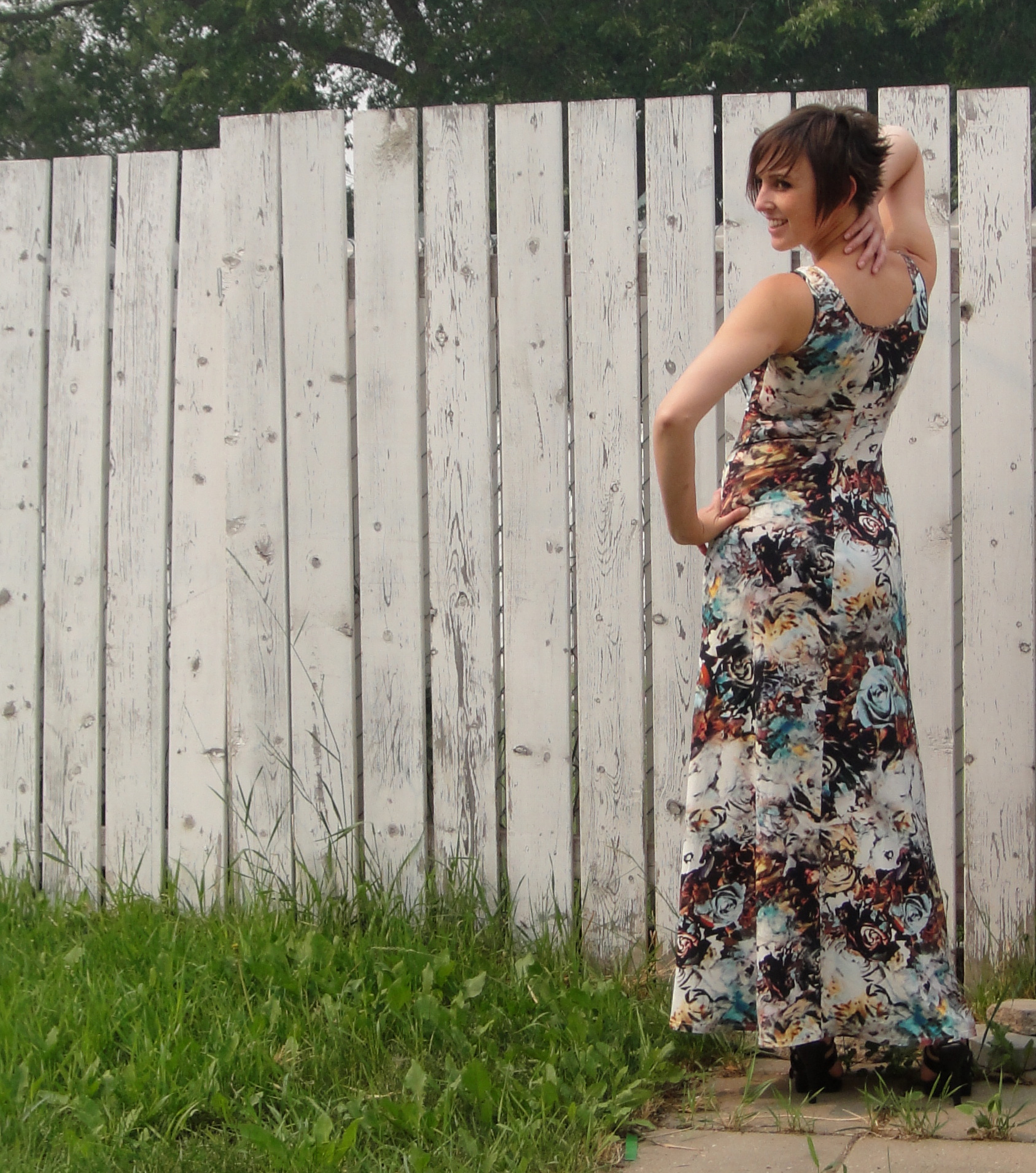
Back view, with seam.

Back view, with seam.

In an effort to maximize my skirt width, I cut the second and third dresses with a back-seam and a non-directional layout. This also let me add a swayback adjustment and some shaping to the back seam, so really no downside here—and, I figured if the skirt was still too narrow for walking, I could add a slit at the back seam as well. (I know I could’ve left side slits on the original version of the pattern, but I just don’t like that look as much.

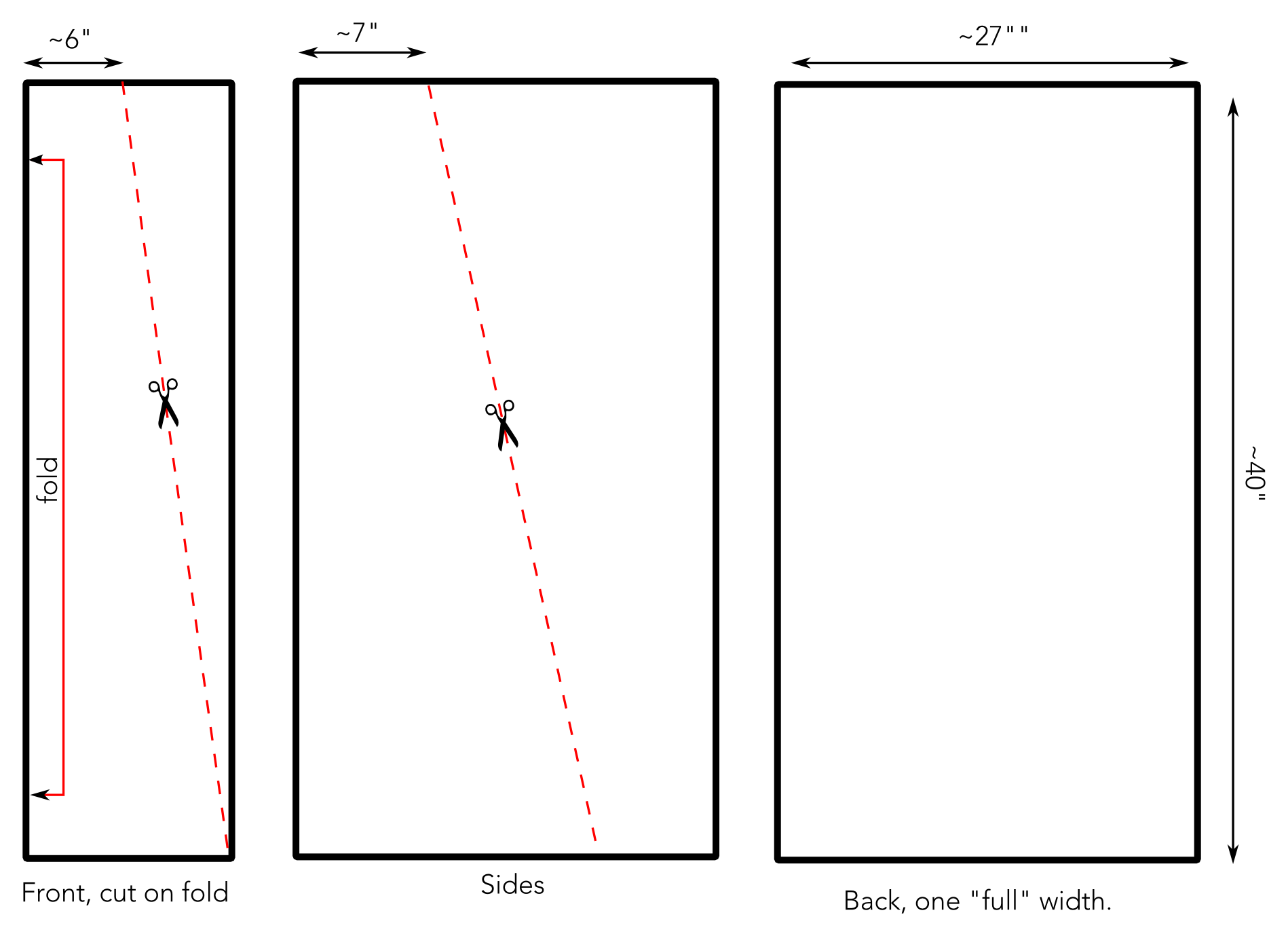
Flared skirt cutting diagram

Flared skirt cutting diagram

This may not have been the best choice since technically both my prints are directional, but I’m hoping they are big and crazy enough that nobody will pay attention.

Crazy Paisley

Crazy Paisley

Incidentally, I wasn’t paying attention to print placement at all… for the third maxi, there’s a distinct repeat to those giant paisleys that wanders from almost dead centre at the hem to distinctly over to the left side at the bust. Oops. In my defense, what I was paying attention to while ignoring the print was the grain of the knit, so I’m pretty sure that the print is not at all square to that. And maybe this is better than direct boob paisley?

Butt paisley

Butt paisley

For the non-black versions, I didn’t have a fabulous matching fold-over-elastic to speed me on my way, so I opted to bind the edges.

Step one: overlock.

Step one: overlock.

I pretty much always use the same method, only varying whether I include a bit of clear elastic in the mix or not: cut a band across the greatest stretch of the fabric, 1.5″ wide or so (I am not overly precise in this, and for the roses maxi I actually used the rather off-grain strip that was left from between the two pattern pieces—plenty stretchy in this fabric but it led to some rippling that was much less of a problem when using cross-grain pieces.) These days, I typically layer fashion fabric (right side up) – knit band (right side down) – clear elastic on top, and serge away. If I’m being good, I test to see how much tension I need on both knit band and clear elastic… if I’m not, hopefully I started somewhere like the bottom of the arm-hole so no one will really see how messed up the first few inches are. I don’t pre-measure and I don’t apply it in the round, more because I am lazy than because I think it’s a better way to do things.

Serged!

Overlocked!

Once I have this firm base attached, I wrap the binding around so that the loose edge is to the back and snug it up—having plenty of width makes it easy to pull it gently snug.

Wrap binding around to back and topstitch.

Wrap binding around to back and topstitch.

Typically, I actually just use a narrow zig-zag to topstitch—I have kinda developed a hate for twin needles, mostly to do with their cost vs. the teeny amount of sewing I’ve ever managed to do with one—I don’t think I’ve ever had one last through a second project (arguably, I am hard on my needles.) However, for this project I decided to try out a feature of my Grandma’s Rocketeer that I read about in the manual but hadn’t tested yet—it can actually hold two needles in its needle slot, side by side. How? You just keep opening the screw until they both fit. They do sit side by side, so it’s a narrow spread between, about 2mm, but that was perfect for the narrow bindings on these dresses. I’m pretty darn happy with how it worked, actually, and if I bust one, all I’m out is a regular stretch needle, not some fancy expensive twin.
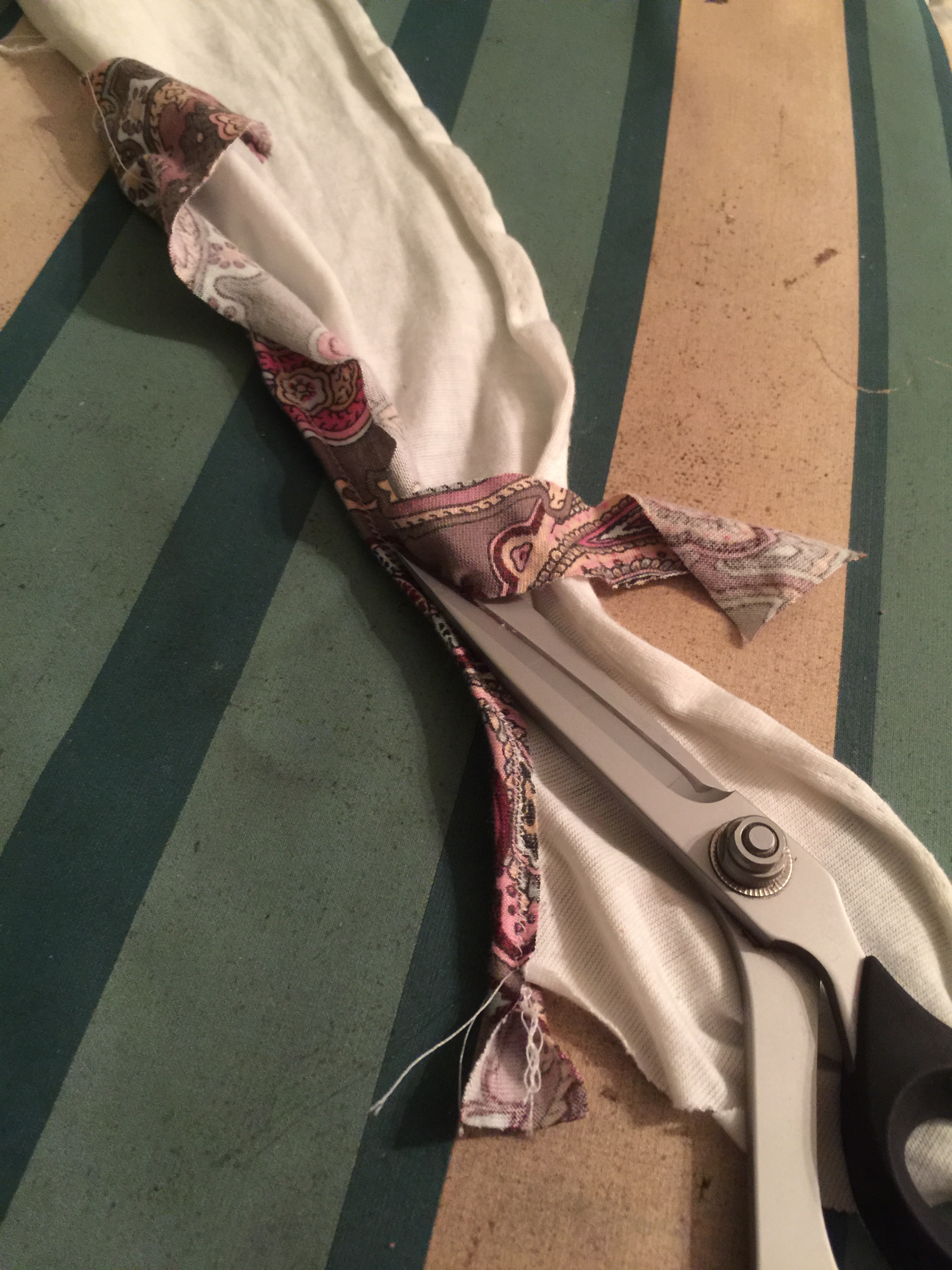
Trim the excess off the back.

Trim the excess off the back.

After topstitching, I trim off the extra from the back—hooray for non-fraying knits! (I wouldn’t want to use this on a knit that runs, but then those are like sewing with the devil anyway.

A little press and, voila!

A little press and, voila!

I’m pretty sure I originally got this technique off of Pattern, Scissors, Cloth, which is no longer available, a fact which makes me cry on an almost weekly basis because Sherry had SUCH great info. Everytime I go to think about making a jacket now I want to go check up on her RTW Tailoring Sewalong, and then I can’t and the sadness just wells up.
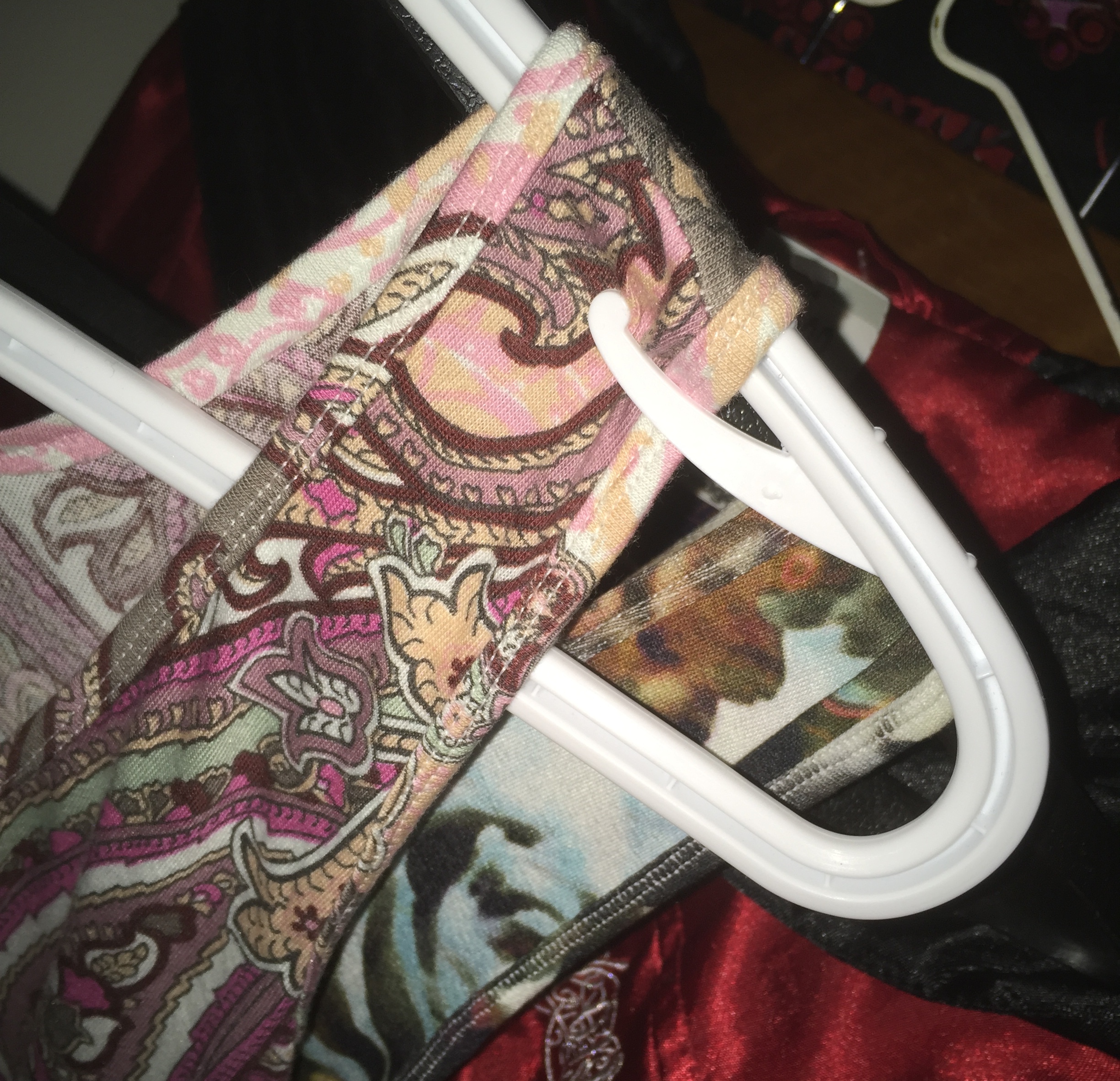
Voila!

Bindings!

I’m sure there are a million other tutorials on this way, and I know there’s lots of other ways to attach a binding, too, but this one is the one I keep going back to.

Side paisley

Side paisley


It seems kinda dumb that I just spent so much time going over the neck and arm bindings on this pattern, but really, that’s 3/4 of the sewing time—everything else is just a quick zip over with the serger. And the hem, of course—Steam-a-Seam is my go-to in that department.

50 Comments

Filed under Sewing

A long time coming.

Simplicity XXXX

Simplicity 5691

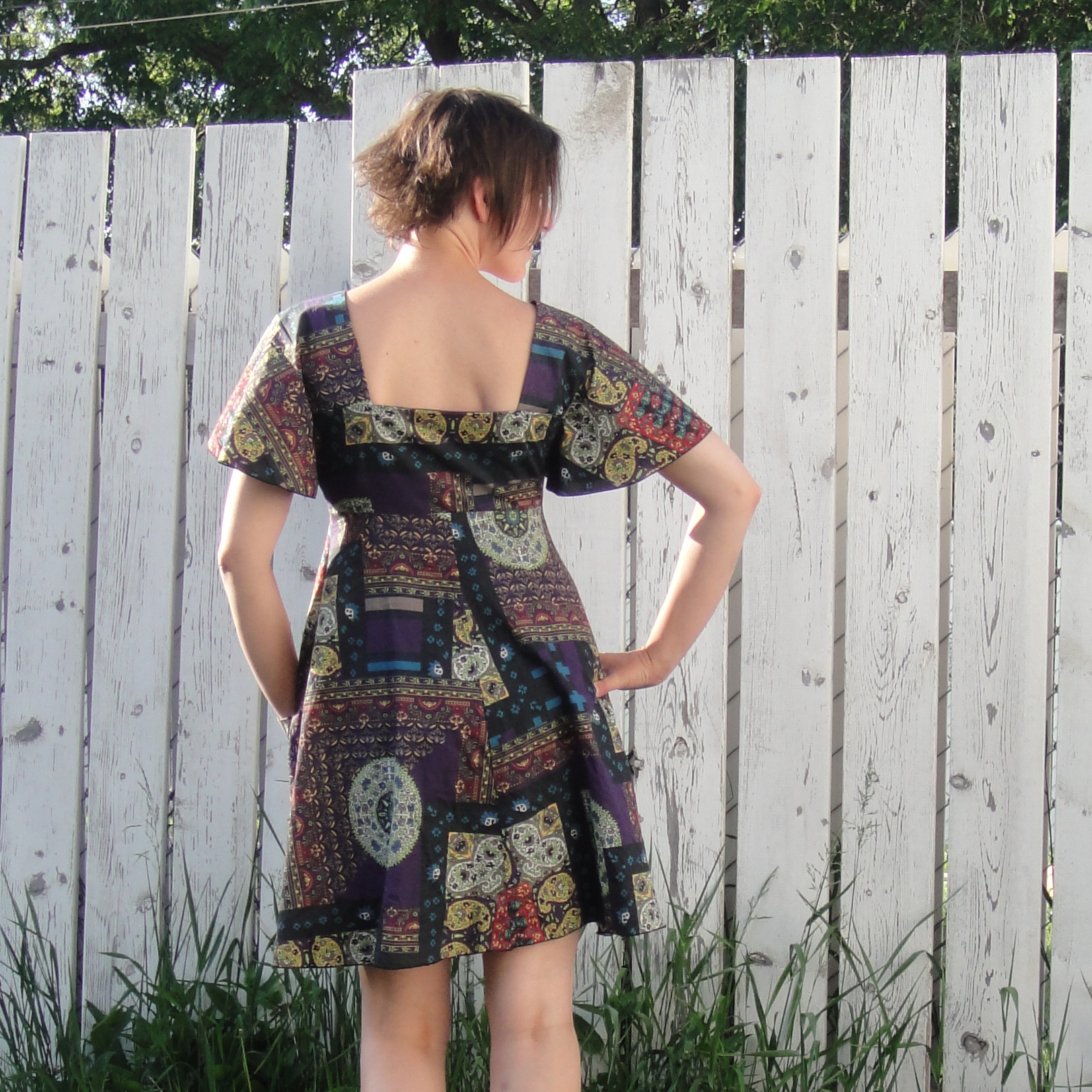
It’s been a while since I made a 70s pattern, and this one was a LONG time coming—but I’m so happy it’s finally done. I can’t even remember when I picked up this pattern, though I think I could probably find it in the blog archives since it dates back to the days when I would proudly show off all my new purchases here (as opposed to shamefacedly stuffing them out of sight before my husband finds them, like I tend to these days. The pattern collection is, um, excessive.)

Worst Women’s Pattern Ever?

70s Simplicity patterns are hard to beat for their cuteness, and in my opinion this is one of the cutest. Although, here it is on in Peter’s “Worst Women’s Patterns Ever” Pinterest board. 😉 possibly the tunic version with the wide-legged bell bottoms hasn’t aged as well as the dress version? 😉 I confess this is not the only pattern on that board that I own, and paid real actual money for, too.

I found the perfect fabric amidst a mess of different things at Fabricland labeled “European Fashion Designer Prints”… It’s what I would call a lawn, lovely, close woven cotton, crisp but not at all hard, and surprisingly wrinkle-resistant. The mock-patchwork print is just about my favourite thing ever. And ever so 70s, too. It has all the intricate, geometric/paisley details that make me go all squee over a print, plus that mock-patchwork look. Serious love.

Back View

Back View

Unfortunately, I started this project a little too late last summer—I got the dress nearly complete just in time for the weather to go cold, and then  when I got it to the try on stage, the square shoulder adjustment I didn’t do bit me in the butt and I needed to unpick around some of the unusual sleeve-to-bodice structure. I stalled, and the dress got wadded up and stuffed in a ziplock UFO baggie for the winter.

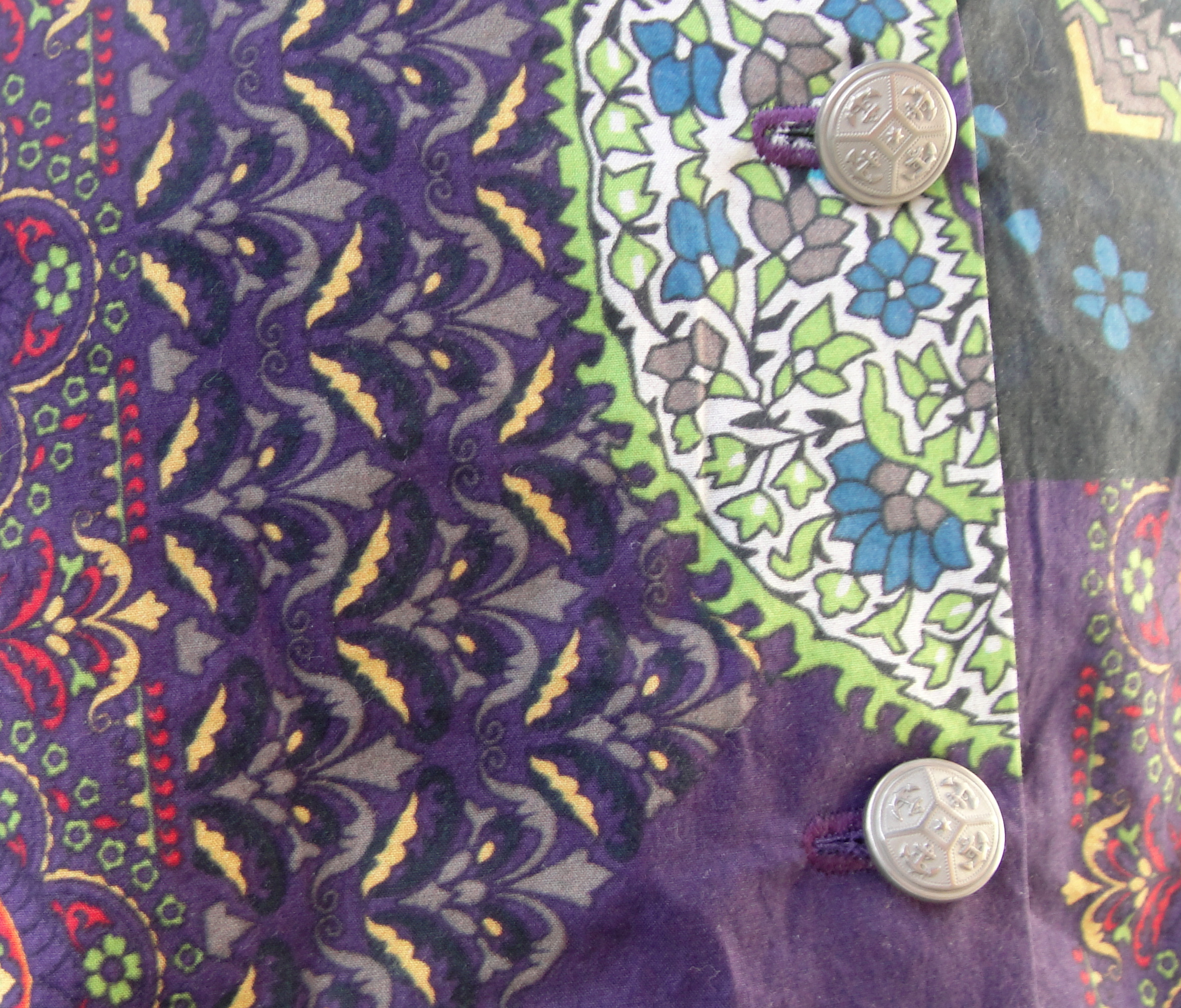
Buttons closeup!

Buttons closeup!

Finally, a few weeks ago, my craving for a new spring dress with minimal effort finally outweighed my distaste for unpicking and on the fly fit-fudging. I unpicked and cut down the inside-shoulder piece. The visible, fluttery sleeve is no problem, of course, but there was this full-shoulder-covering lining that just wasn’t working. I cut it down to about an inch wide (along the neckline side) and it works much better now. Then I procrastinated for a couple more weeks until I finally put on my big girl panties and did the buttonholes.


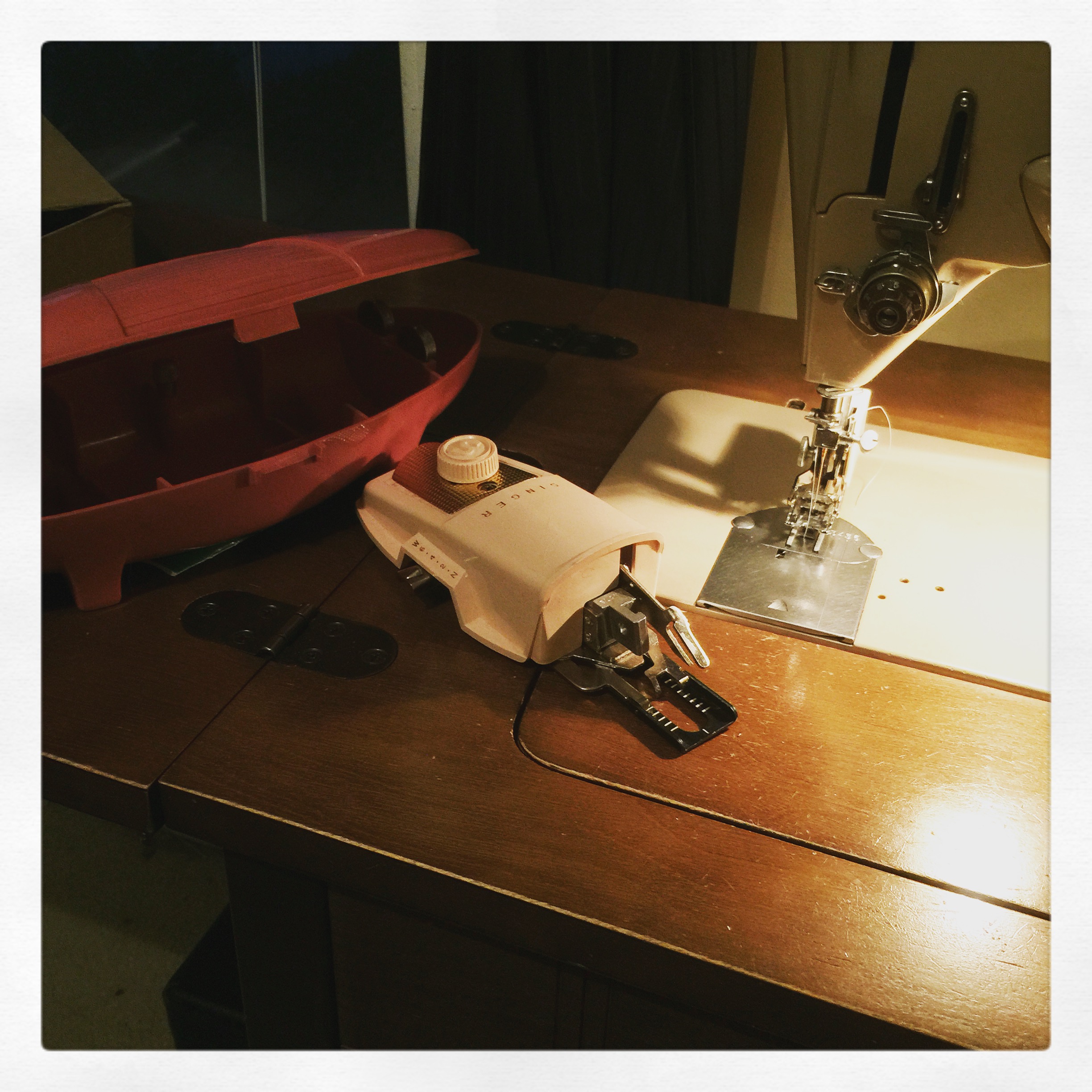
Slant-Shank Buttonholer

Slant-Shank Buttonholer

I dug up the Rocketeer to try out my new slant-shank Singer buttonholer, which my crafty sister-in-law found at a big neighbourhood garage-sale this spring. It worked beautifully.  Though that might’ve been the glorious fabric.


Wash-away stabilizer behind buttoholes

Wash-away stabilizer behind buttoholes

Or the wash-away stabilizer I added, because that stuff is my new fave notion. It’s much sturdier than the thin film stuff I’ve used before. Anyway, flawless, even the one over the “waist” seam which was a bit touch and go. My button-attachment is less flawless, and horizontal buttonholes are not very forgiving, so there is a little bit of bunching here and there where my button placement ended up a trifle off. It’s not bothering me enough to actually fix. Oh, and the hems on the sleeves and the bottom are rolled with my serger. Which, while not really a period finish, works really well for this look, I think.

So glad I didn't skip the giant patch pockets!

So glad I didn’t skip the giant patch pockets!

Confession: I still need to hand-stitch down the bottom of the bodice lining, which is a soft, lighter purple voile. And I’ve already worn this more times than I want to admit. It’s great, easy to throw on for work or at home, and perfect since the weather seems to think its July already.

One down from the Dresses list.

Back at the beginning of last summer, I had pulled a trio of summery dress patterns from stash that I wanted to make up—this was going to be the only one in the group that I actually accomplished last summer. Yikes. I wonder what the odds of me getting to another one are? I’m leaning towards the one on the right for summer, and then the middle as we creep up on fall.

I’ll doubtless be distracted by something else along the way, mind you.

30 Comments

Filed under Sewing

The Very Boring Corset

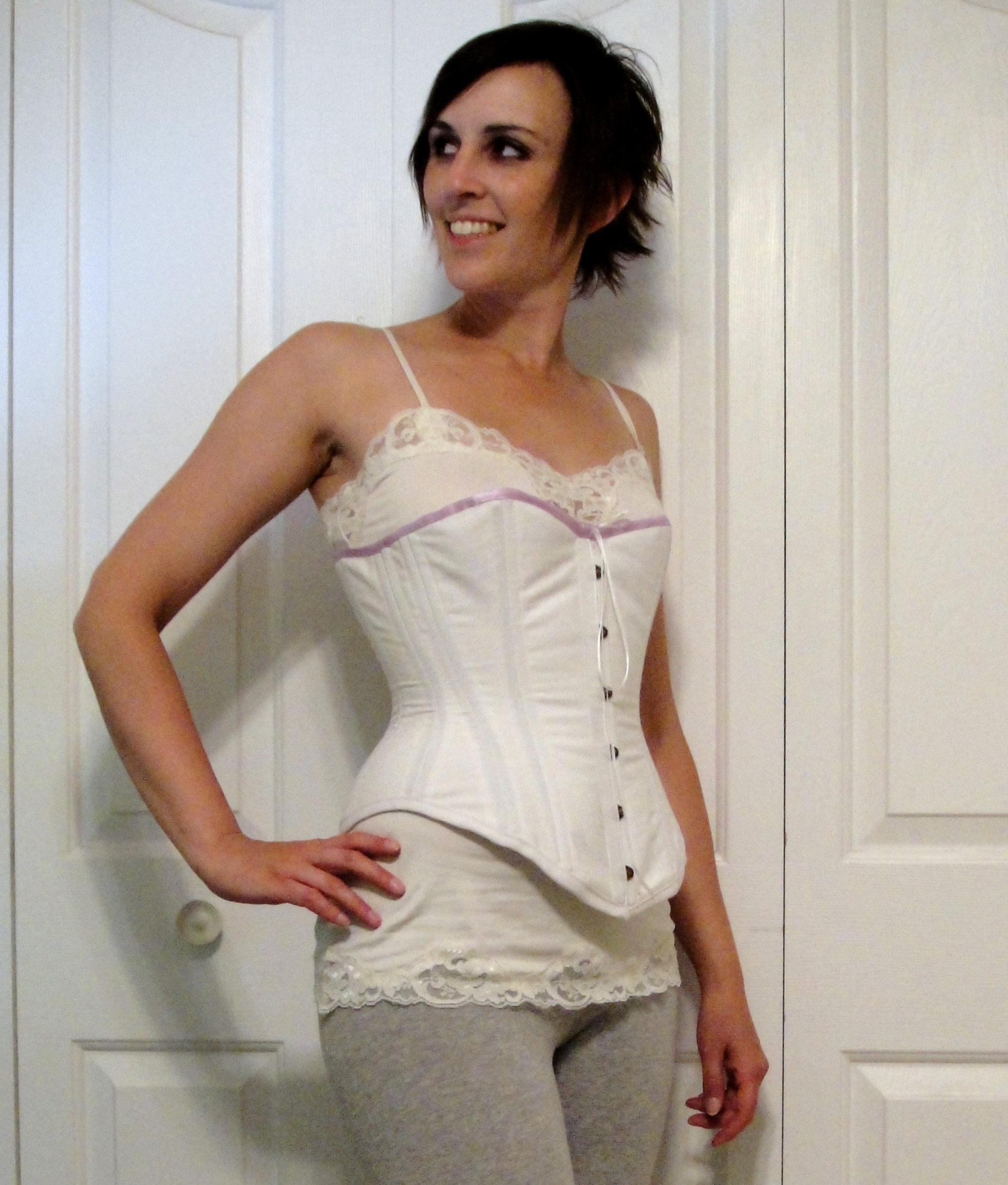
A very boring corset

A very boring corset (and some not-so-authentic underpinnings)

I promised my husband I’d make him a shirt, so of course I had to whip up another corset.

Rather than reinvent the wheel, I went back to my Butterick 4254. First I re-traced all the pattern pieces 1/4″ narrower than before, then I made a few tweaks around the bust and waist. (Basically, more bust, less waist! Woohoo!) I decided I’m pretty happy with the overall length and shaping, I just wanted to refine the shape a bit more. Then, as I was sewing a quick mockup, I realized that my original pattern pieces seemed to be calling for 3/4″ seam allowances—and I’m pretty sure I sewed both my earlier mock ups and my blue corset with regular 5/8th seam allowances. Which explains where that extra 1/4″ on each piece came from. (I’m still glad I removed it, though, as I don’t need 3/4″ SAs to make channels for 1/4″ boning., and they cause issues like puckering, and or need clipping and things.)

Back view.

Back view.

Although I was tempted by the siren-song of some of my other fancy materials, I resisted, as I really needed this to be a quick sew that I could bang out of the way and move on to other projects. Like shirts for my husband. I did dare to cut into my precious coutil, though (I used about half of the 1m I have, so I still have another corset’s worth. 😉 ). This is it, plain and un-covered, in a single layer, with serged seam allowances (so non-historical!) and hardly a lick of ornamentation.

Closeup!

Closeup!

The only reason the pretty purple ribbon is there as opposed to boring old twill tape like the bottom is my friend Steph gave it to me to use. I enclosed some narrow ribbon within it for a drawstring, and I do like being able to pull it in at the bust (especially as there’s a bit of extra room up there, as I said.)

Silhouette comparison

Silhouette comparison

I think the size is much better this time around—still roomy in hips and bust (arguably the bust is a little too roomy but I really don’t want compression in this region 😉 ), with a smidge (or more than a smidge) more waist definition than before. And a perfectly reasonable, roughly parrallel lacing gap. By the way, I get a whole 2″ of waist compression out of this thing (unlike the other one, which actually doesn’t change my waist measurement at all once you add in the bulk of the corset itself.) I think that’s pretty much my limit, barring serious waist-training that just isn’t going to happen. I wasn’t really expecting more—there isn’t a lot of space between my hips and ribcage to squish in, and I’m a pretty rectangular shape to start.

Have another corset view

Have another corset view

One thing that really stands out is the difference the busk makes. For the first corset, I used a spoon busk, and while I did have to straighten a fair bit of the spooning as it wasn’t hitting at the right spot on my body (it would’ve needed to sit about 2″ lower to work properly) it still does help “hug in” the bottom front—there’s a very distinct gap (shadow) you can see in the newest corset at the bottom front. Not a big deal under petticoats, but something to tweak a bit if I want to make “fashion” versions. (Not sure where I’ll wear a “fashion” corset yet, but then again I’m not really sure where I’ll wear this full Victorian getup either.)

Lobster tail

Lobster tail

And here’s a shot of my American Duchess-style lobster-tail bustle, because I haven’t really done it justice on the blog (nor probably will get around to it, sadly) For this dress-up I experimented with fastening it a bit lower on my hips (rather than right at the waist). My theory is that it elongates my waist and gives me more room between butt and waist to build up the layers of bustled stuff in the back, though I couldn’t really say it makes much of a difference.

Steph in my corset!

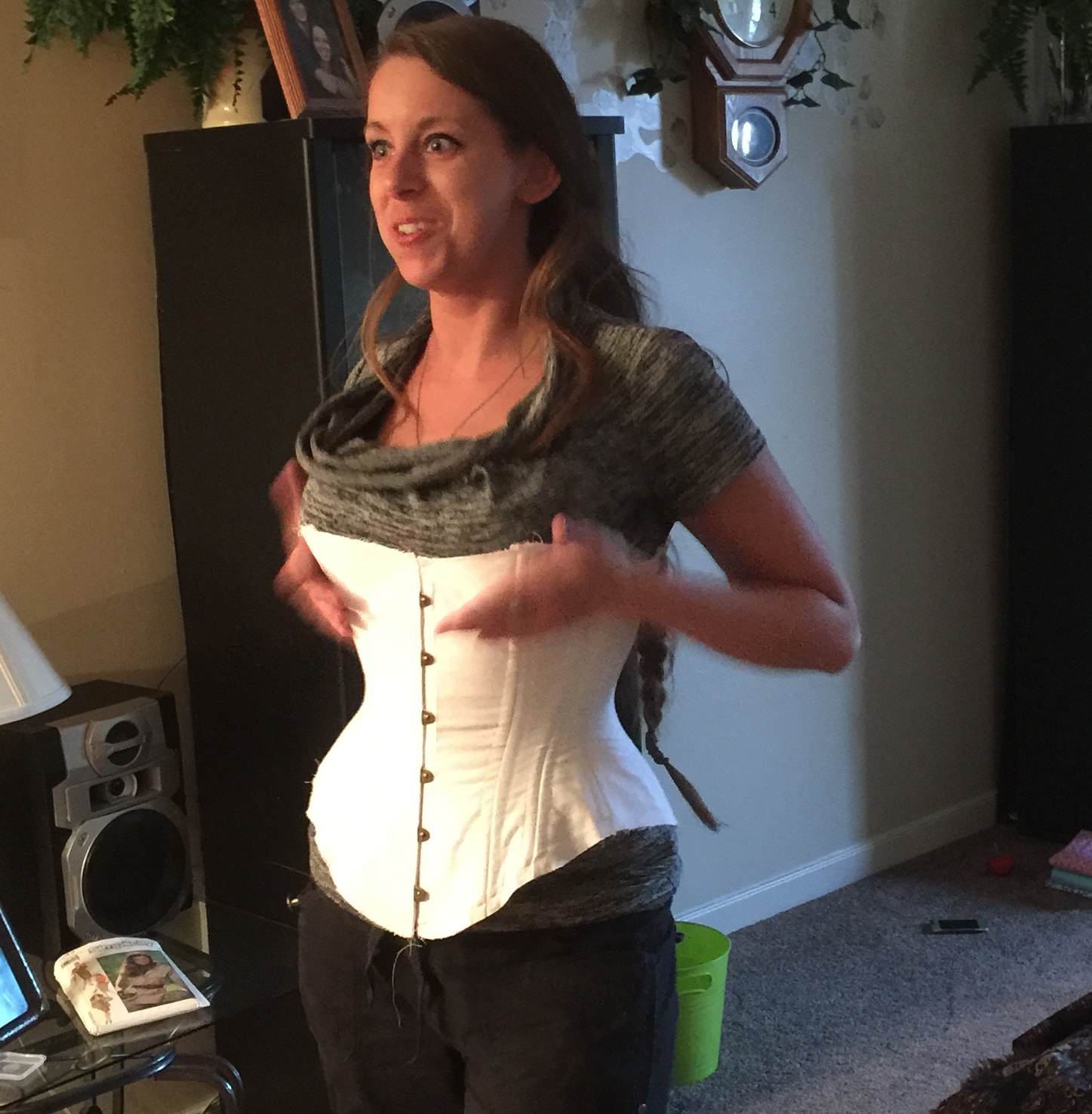
One bit of fun I did have was stuffing a couple of my sewing friends (yes, real-life people I get together with and we MAKE STUFF! Slightly more than once in a blue moon) into the corset to see how it looked on different bodies. I think the answer is “better than on me”—but anyway, that was super fun.


Chrissy. She's probably going to kill me for picking this picture, but I love her face! ;)

Chrissy. She’s probably going to kill me for picking this picture, but I love her face! 😉

It was really interesting to see it on different bodies, but even more fun to see their reactions to “corset shape” for the first time! 🙂

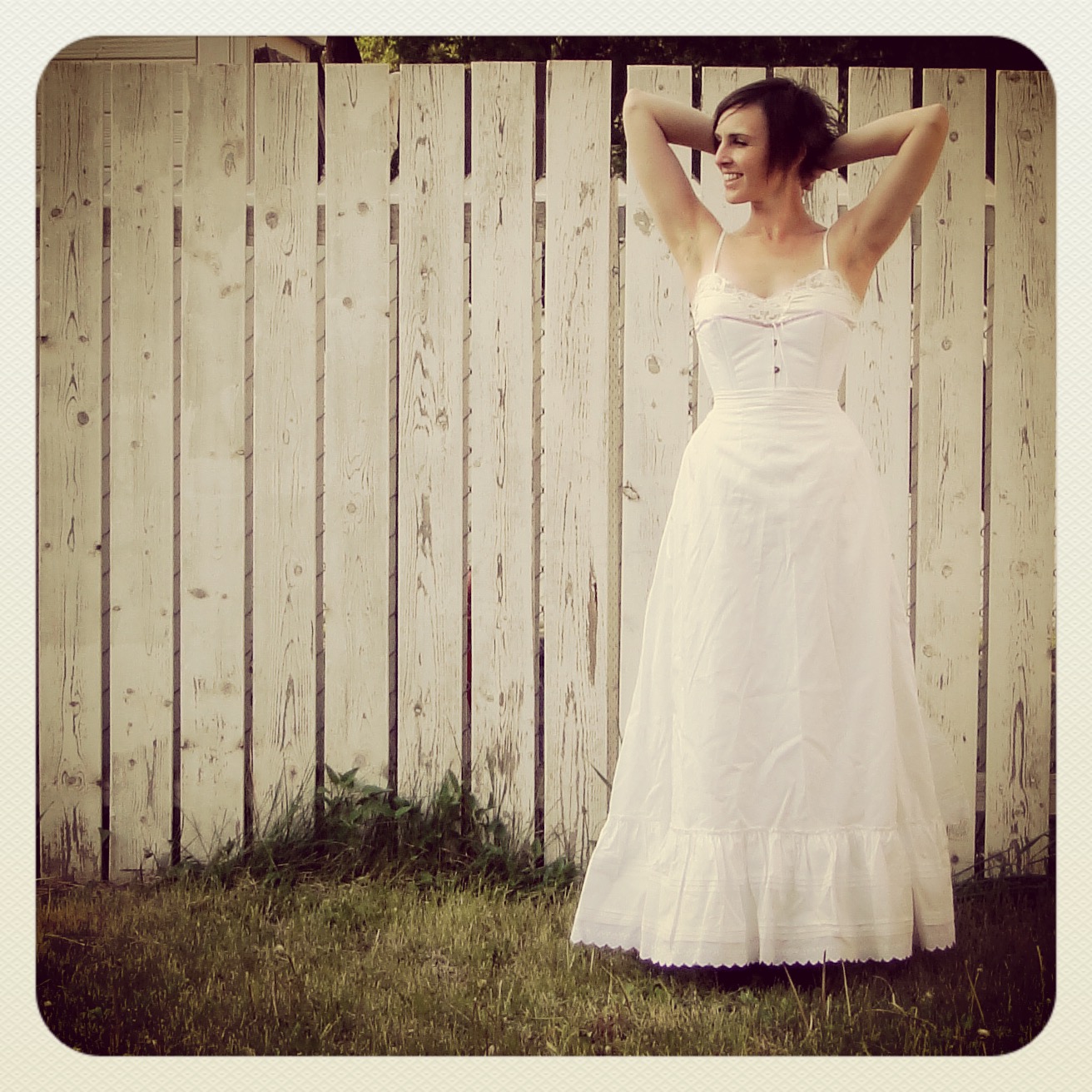
With Authentic Vintage Photo Filters (TM)

With Authentic Vintage Photo Filters (TM)

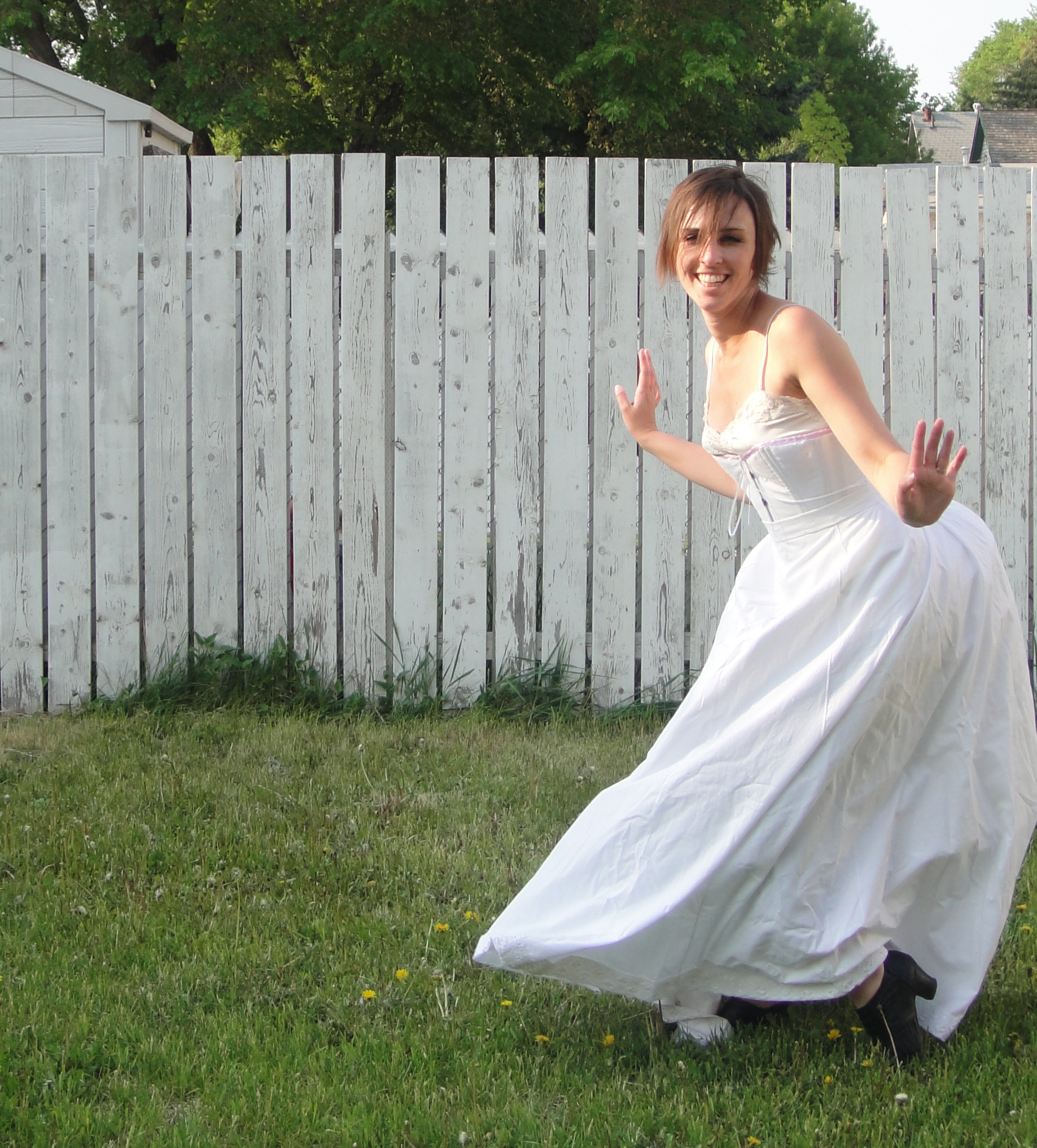
And, well, just for fun, here’s the full ensemble again. Sorry for the cami under the corset—my chemise was awol and I was on a tight time-frame for taking the photos.

In other news, my last “Historical Clothing” workshop is this weekend at the Marr Residence. I’m nervous (cuz I always am) and a little sad that it’s the last, and wondering where to go from here… after all, I’m just about ready to start planning the outer dress!

24 Comments

Filed under Sewing

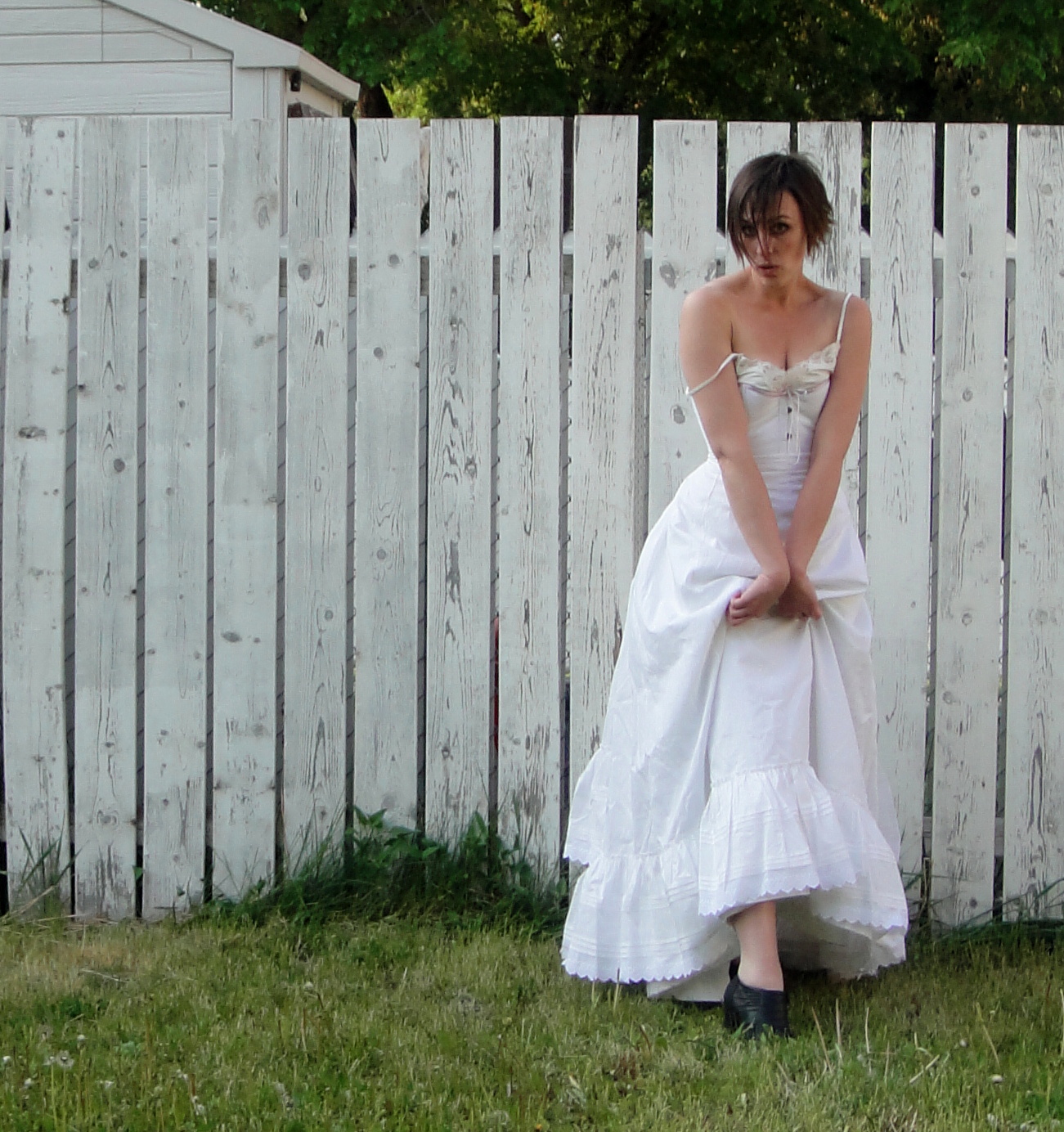
The Very Boring Petticoat

Petticoat!

Petticoat!

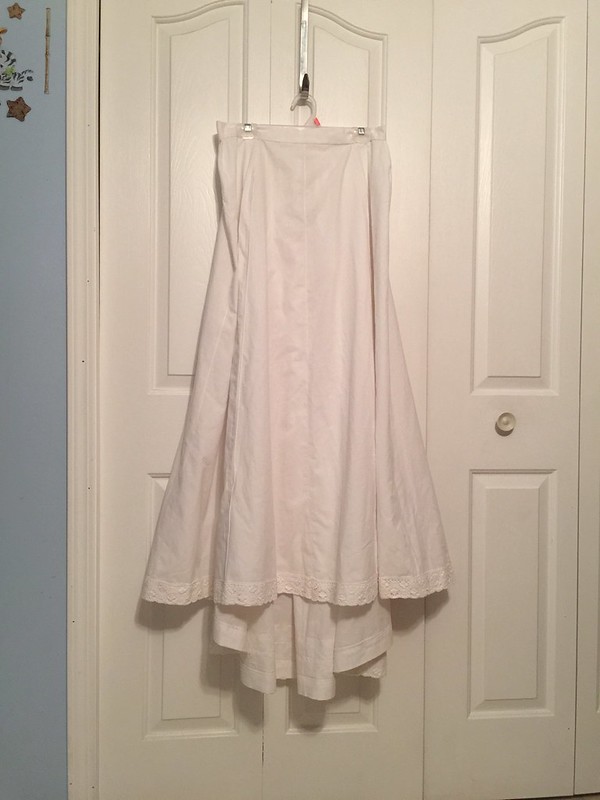
I made a third petticoat. This was always the plan, though I wasn’t quite expecting to do it, um, this weekend, since there’s about four other higher-priotity projects in the queue… But, I had a couple of metres of muslin lying around after another project, and when I got home from work Friday night it was whispering and, well, that was that.*

A Very Boring Petticoat

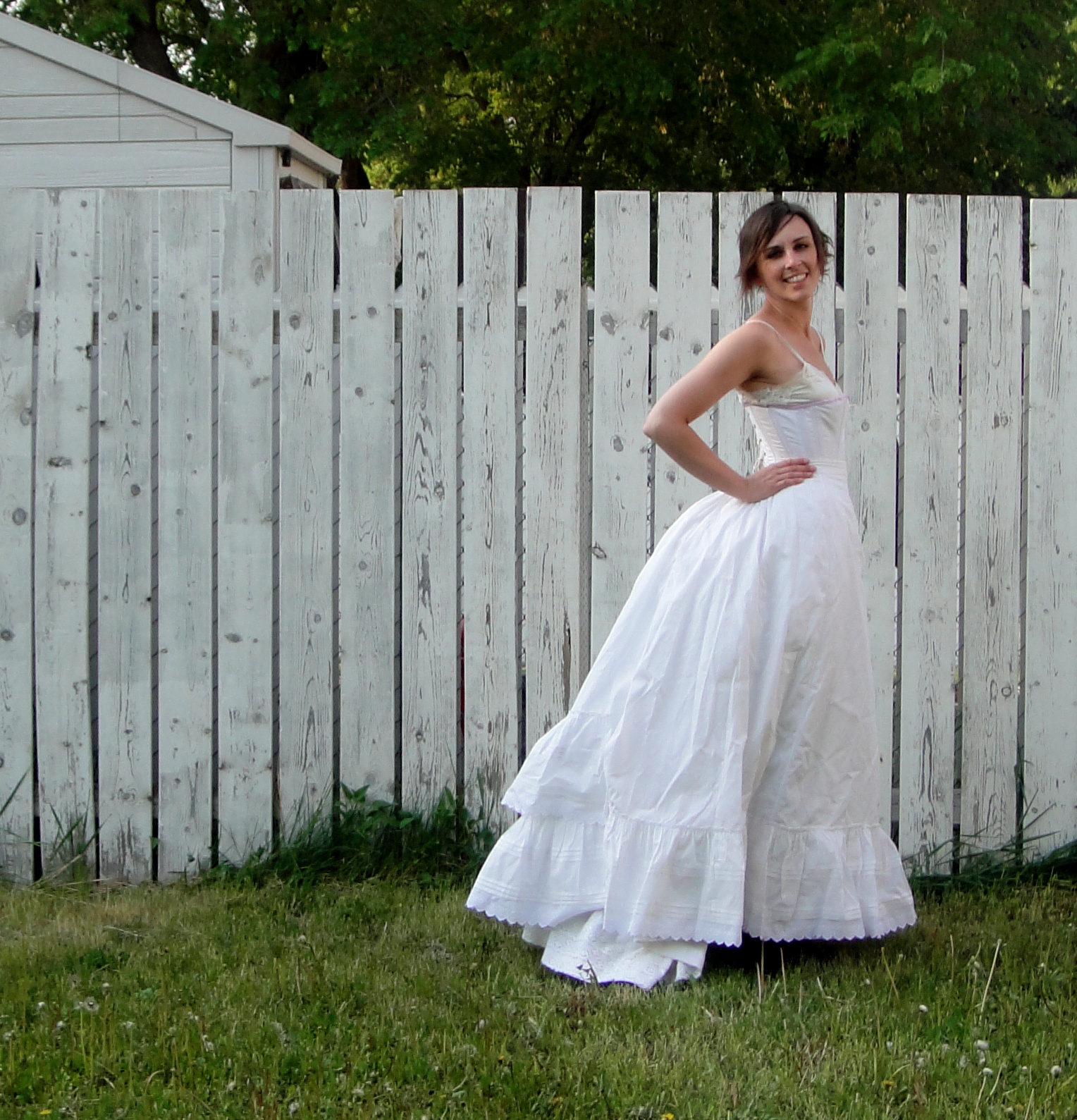
It was pretty obvious when I finished my fancy, flouncy petticoat that it needed another layer underneath, to smooth over the ridges and lines of the bustle and corset. Possibly my flannel petticoat would serve that purpose as well, but certainly not in the summer (which is what we are gearing up to here, at long last.)

Lace on Hem

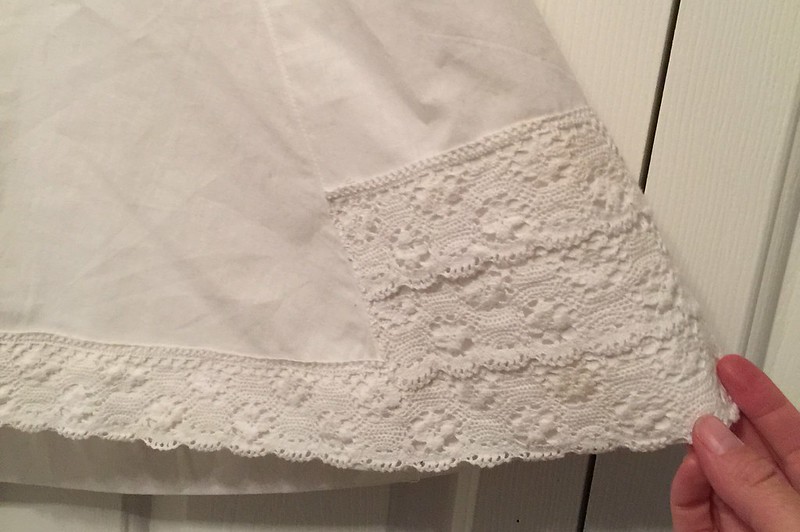
When I first started cutting the muslin, I meant to make it a completely plain white skirt, but, in true Victorian fashion, I couldn’t leave well enough alone, and several metres of lace found their way onto the hem. Still, after all the tucking and gathering and more gathering of the last one, it was a pretty quick and dirty affair.

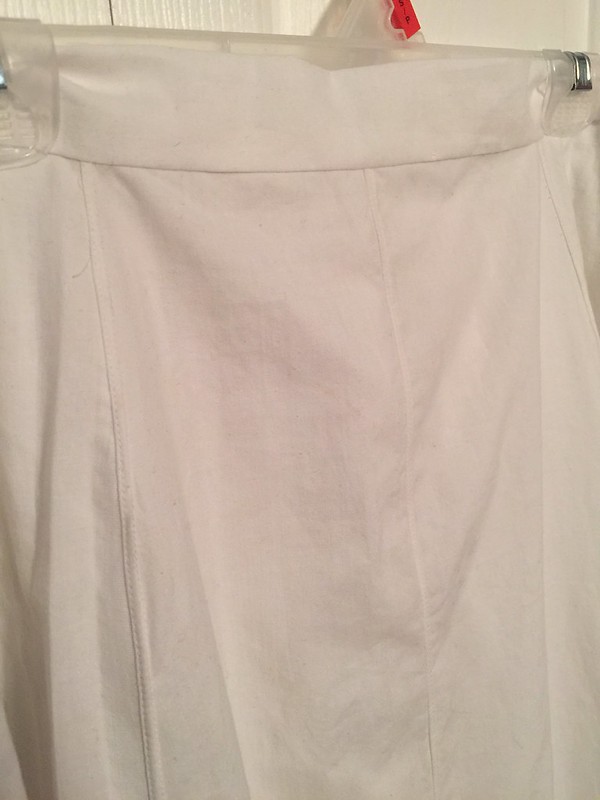
Felled seams

I used my flat-fell foot to fell the vertical seams, and I felt a lot more successful this time, if only because the muslin is like the best-behaved fabric in the universe. The main thing (aside from actually reading up on how to use the foot) is to use the right seam-allowances—1/4″ on the bottom 1/8″ on the top. Still not flawless, but mostly good, and no one’ll see the booboos anyway. 😉 Half my fells are on the inside, however, and half on the outside—after I screwed it up on the second seam I decided I didn’t care and just did whichever side was most convenient. Not the tidiest ever. BUT NO ONE WILL SEE. (Except everyone I show it to because I’m all like LOOK I MADE A PETTICOAT!) I used a total of three skirt-lengths of 44″ wide muslin. To reduce fabric waste, I added a centre front seam to the front gore. Initially I was going to use only two skirt lengths, but it would’ve been a really scrawny petticoat, so I scrounged around and turned up another piece of the same fabric, just long enough for another set of gores.

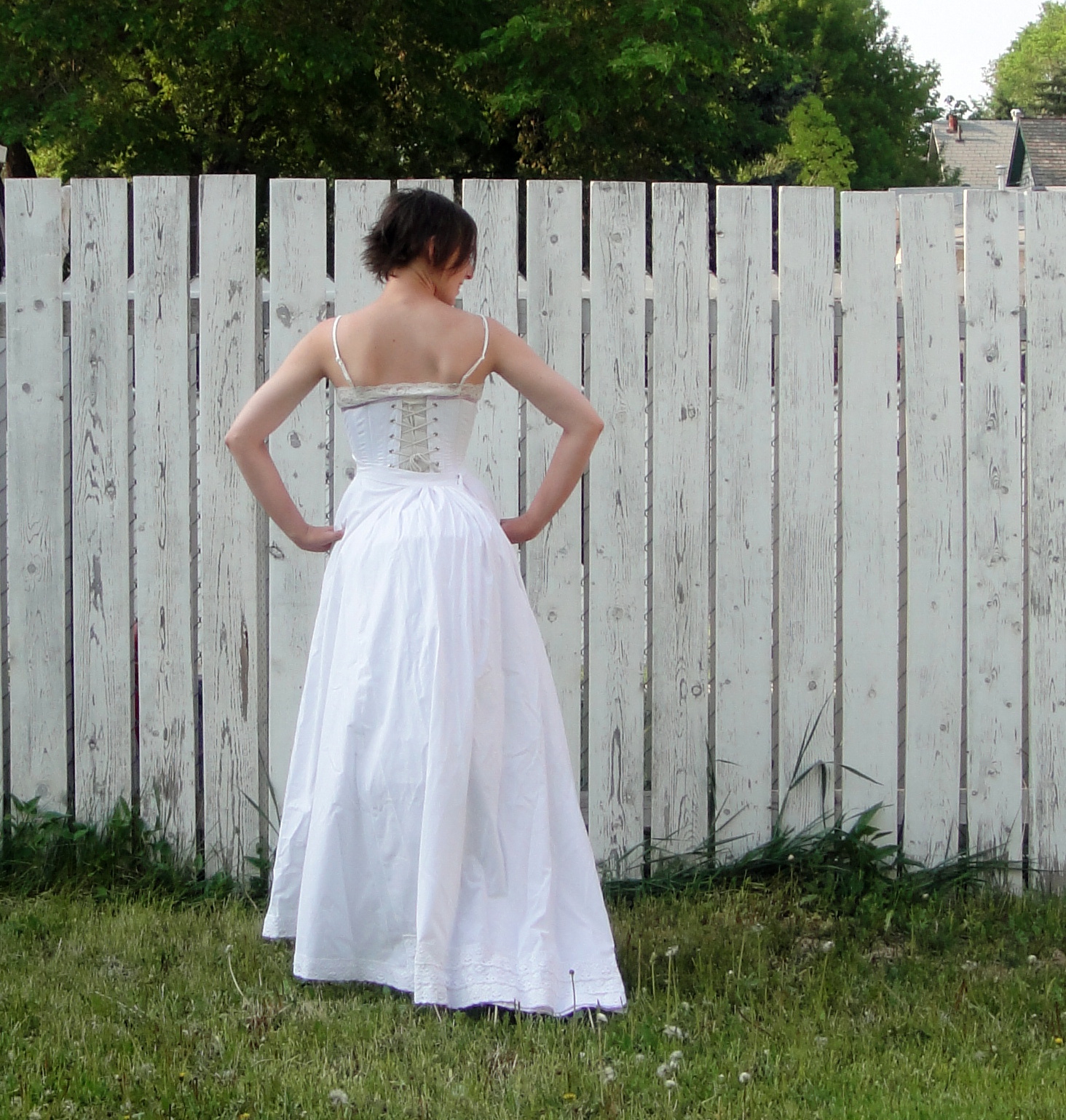
Long back.

Long back.

It’s more trained (long in back)  than my previous petticoats, because one of the sets of gores I made was cut from a full 44″ width of fabric, not a half-width. This was not my best idea ever since I don’t particularly want a trained petticoat. Oops. I also cut the waistband little large, thinking it could sit a bit lower on my waist (and also not wanting another overly-tight waistband), but this doesn’t seem to work overly well for these skirts—the bustle gets in the way, I suppose. It looks kinda like one of those “look at my old pants!” weight-loss commercials. https://instagram.com/p/2zyEWwr0Mu/?taken-by=tanitisis   Like the flannel petticoat, I made a folded placket in the CB. This time I put the narrow edge of the placket on top and the wide one beneath—this seems to work much better with all the gathering that is going on in a sort like this, although it’s pretty much opposite of the instructions. Untitled As I was trying to throw this together quickly, I was in no mood to try some stroked gathers (pity because I think I might’ve done better counting threads and things on the muslin)—I went with two well-spaced rows of machine gathering, although I tried a little extra-hard to make sure the stitches were as synchronized between the two rows as I could manage. I’m not too bothered, anyway.

Two petticoats!

Two petticoats!

Aside from the waistband, I’m pretty happy with it, and it serves its purpose admirably.

One petticoat vs. 2

One petticoat vs. 2

The hard bustle bone ridges you could see with just one petticoat are much better hidden this time.

Skirts appears a little more full, I think.

Skirts appears a little more full, I think.

Although I’m noticing more “skirt spread” now, angling out of the front part of the skirt. Not quite the 1880s fashion-plate look, although pretty common in actual period photographs. The solution, according to Mrs Church and others, is ties or elastics that run across the inside of the skirt, from one side to the other behind the knees, pulling everything in. This would require adding little slit-type openings to all the petticoat layers for the ties to pass through… We’ll see.

Teehee!

Teehee!

It then occurred to me that I’m taking photos in my back yard in my underwear. Teehee! Alas, my attempts to vamp it up Victorian-style mostly came out looking more “axe murderer” than “come hither” (a problem I often have…), so you’ll have to settle for a peek of ankle. *Yes, as you may have noticed, I have also made another corset. It, like the petticoat, is very boring. I will blog it as soon as I get the chance, I promise.

6 Comments

Filed under Sewing

The Second Petticoat

I finished my second petticoat! FINALLY. If I thought the first one took forever… (though, I did NOT hand-stitch the hem this time.)

Petticoat # 2

Petticoat # 2

Anyway, as with the flannel petticoat, I largely followed the directions from The Home Needle, with a bit of supplementation from the various diagrams of Patterns of Fashion 2, which really drive home that yes, they are describing what you think they’re describing to make those “gores” and yes, it is as weird as it seems, sewing off-grain bias edges to on-grain straight edges, in violation of all guidelines for good drape.

Skirt diagram

Skirt diagram (for this pattern, I used two “side” gores per side.)

I guess when you have that much fabric going on drape is kinda irrelevant? Hard to say. On the other hand, it’s a very, very low-waste method—I used probably about six metres of fabric, mind you (it’s a pretty full petticoat, also, RUFFLES), and the only waste was the narrow triangles cut off the sides of the symmetrical front gore. If you wanted to add a front seam, even that could be eliminated. Because I wasn’t using a yoke this time, I did add a bit more shaping to the top of the front gore, plus eyeballed in some narrow darts to give it a wee bit of tummy room, since Mrs. Church commented that one of the chief problems with the hang of skirts came of them being put in too tightly at the front. Or something like that.

As per Mrs. Church’s instructions, I made my vertical seams flat-felled, but really I would’ve been better off using French seams—either way, though, I was struggling with a lot of puckering on my really freakin’ light-weight cotton (voile or batiste or something of that sort.) So I switched the cotton thread. Upside: no puckering, presses like a dream. Downside: not nearly so strong. So if this petticoat is disintegrating in a year, you’ll know why. Also, right in the middle of the process, Jennifer Rossbrugh of Historical Sewing posted about starching your petticoats. I had been dreading the idea of pintucks in my soft fabric, so I had to jump on the bandwagon. This was a ridiculously-simple process involving mixing a small amount of cornstarch with a slightly larger amount of water, heating until the mixture went clear, adding more water, and then dropping in the petticoat until all was soaked in starchy water, and hanging dry. Then ironing, lots and lots of ironing, but ironing starched stuff is actually pretty darn pleasant as it looks so great. And it made sewing all the 1/4″ tucks in the ruffle far less hellish than it would’ve been otherwise.

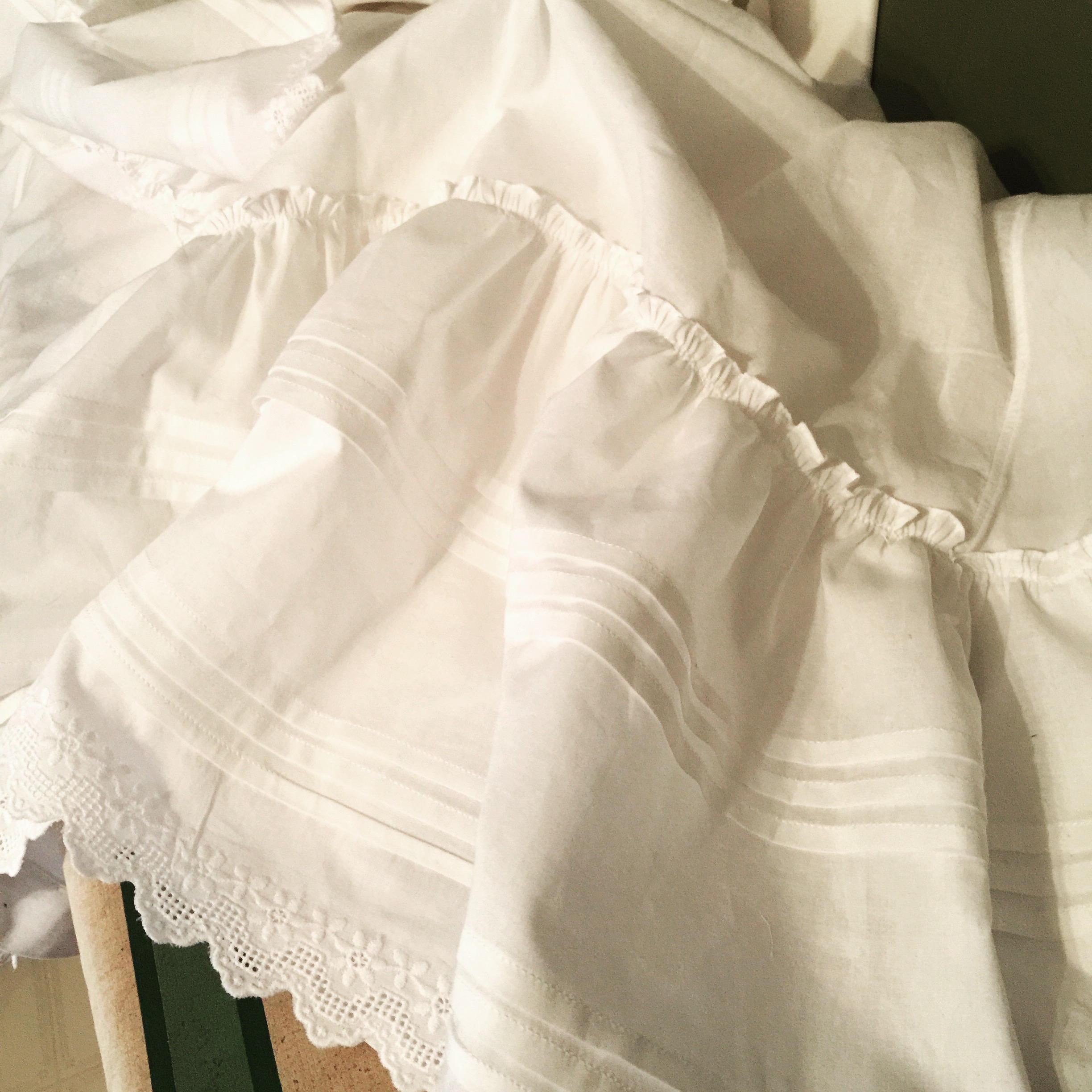
Perusal of the page of petticoats (“White Skirts” in both the Home Needle and my mother’s 1886 Bloomingdales Catalogue reprint) suggested that ALL the petticoats seemed to be largely plain but with a deep ruffle along the bottom. Or at least, if they had anything else, the advertisers weren’t advertising it.

The ruffle (pre-ruffling)

The ruffle (pre-ruffling)

So, I cried a little and resigned myself to a ruffle. I still wish I had pleated it, but, meh. I picked my ruffle depth by the highly scientific method of tearing my leftover fabric after making the main portion of the petticoat into eight equal strips. I had already decided I wanted 1/4″ tucks, so then I added those in, three in each panel, starting with a fold right at the middle. Once I had those tucks made, I joined seven of the eight panels (measuring my lace having determined that I wouldn’t have enough to go along the eight panel anyway.) I attached the lace at the bottom using a tuck—basically, sewing a french seam on the outside surface. I thought it looked lonely, though, so I added two more 1/4″ tucks above it. I like the overall look, but I was definitely more precise (which is still a long way from perfect) on the first set of tucks. Eh. I finished the top edge with my narrowest-of-narrow-hemmers, and ran the whole mess through the ruffler on what was supposed to be a roughly 2:1 gathering ratio.

Two ruffles in the back

Two ruffles in the back

Whether due to the weight of the fabric, or my ruffler being loose at times, or me just being a tool, what I wound up with was rather more gathered length than I expected, so I added the second ruffle across just the bustle/back of the skirt. Except that it goes up one gore seam further on one side than the other. HEADDESK. I am not going to change it. Quit looking!

Buttonhole and stroked gathering.

Buttonhole and stroked gathering.

My other big booboo (as opposed to the myriad little booboos in the seams and the tucks and whatnot) came when gathering the waistband. I had measured my waist plus and inch or two for overlap, but I couldn’t quite wrap my head around the side-back opening as it related to the necessary gathering. Basically, my waistband wound up lop-sided, and I was extremely loathe to unpick the whole thing and re-arrange my painstakingly stroked hand-gathering. Instead, I unpicked the other end, where I didn’t have enough gathering, and tightened that way up, essentially shortening my waistband by about three inches.

It is, um, snug. Maybe my next corset with be more waist-reducing, though.

That hand-worked buttonhole isn’t particularly pretty, now, (and it is worked on the wrong side, oopsie.) But it’s entirely serviceable and only took about ten minutes to put in. So there’s that.

Closeup.

Closeup.

The whole thing is pretty delightfully frothy, once you wriggle into it.

Ruffle.

Ruffle.

The fabric is pretty thin, and you can see the under-structure pretty clearly. Obviously another petticoat is required, maybe a more plain one, to go under this.

Happy bum

Happy bum

The under-structure, by the way, is my lobster-tail bustle, based pretty much exactly on the American Duchess tutorial, though I did vary the angle of my boning at the top a bit, and I added lacing to hold it closed on the inside, not just ties. This wasn’t quite as brilliant as I had thought it might be, as the lacing tends to pull the whole thing up a little bit, but it works just fine and I think if I added a ruffle to the bottom the pull up would largely be neutralized. Although now that I’ve seen it under the petticoat, and worn it a bit, I don’t actually think I care.

My American Duchess Bustle

My American Duchess Bustle

It’s boned entirely with 1/4″ spring steel from Farthingales Corset Making, which is my favourite corset-supply site, at least partly because it’s Canadian so the shipping is fast and the prices don’t mysteriously skyrocket between my cart and my bank account. Frick I hate having the dollar low again. No complaints, though, about Farthingales. Reasonable prices, quick shipping, arrives promptly. A lot of people seem to use 10mm steels or even wider on these support garments, and while I’m sure that’s strong, I feel like most of the originals I look at had more bones of a narrower width… anyway. The 1/4″ seems more than sufficient for the bustle. I took it with me to my last Marr Residence Historical Clothing thingy, and lots of people had fun trying it on and then practicing sitting down. 😀

Side view

Side view

Of course, now it’s finished and I’m struck by the crushing dissatisfaction that I find accompanies most costume sewing—it’s finished and it’s awesome and I DON”T GET TO WEAR IT ANYWHERE. I mean, I’m already known for pushing the wardrobe bounds at work with my fluffy dresses. I don’t think even I’m going to move into full Victorian mode, though. Even for my final wardrobe workshop,* coming at the end of the month, I probably won’t actually wear it as I will want to have it out for people to look at. /sigh.

Anyway, it’s done and it was a fun process, so we’ll call that a win! Edging ever closer towards… uh oh… OUTER GARMENTS!!!!!)

*Must blog those. They were awesome. To the cool people I met (I know at least one or two of you have buzzed the blog), THANK YOU!!!!!

20 Comments

Filed under Sewing

Again!

Again!

Again!

I couldn’t stop myself. I made another Jalie 3024.

Cute with shoes. Black photographs for shit.

Cute with shoes. Black photographs for shit.

The part where it only takes about two hours from first cut to hemming helps. This version is made of a heavy ponte, which I managed to nab a remnant of the other day. (It being prohibitively expensive otherwise.) I love that I can make this dress from a 1m remnant with room to spare. I made the neckline scoop a little lower this time (I think I overshot a wee bit… Maybe 1/2″ higher next time?).

Light!

Light!

Here’s an overexposed view of the front so you can maybe kinda sorta see the detail, not that it’s a surprise.

I finished it with some more of the narrow fold over elastic Mary of Hey Beautiful picked up for me in one of those rare and perfect moments of internet/real world synchronicity. It’s perfect. Thank you!!! Of course, it’s also black, so all of my attempts to photograph a closeup failed miserably.

Back view. Of which you can see absolutely nothing!

Back view. Of which you can see absolutely nothing!

No back-seam on the skirt this time, just swayback wedges removed from the skirt and bodice pieces in the back.  It’s not overly smooth in the back, but tolerable. I also took it in under the arms a wee bit, as it was sticking out in the heavier fabric. It’s an easy dress to alter. My husband has been mourning the absence of a little black dress from my wardrobe for over a decade now, so he’s actually quite approving of the make. 🙂

And again!

And again!

And then I made another. This one in a blue knit advertised as “crepe,” although it’s really a heavier knit with one side that’s textured to vaguely resemble crepe.

Playing with textures.

Playing with textures, which you can’t really see. (Tweaked to show the actual, royal blue colour. I HATE INDOOR LIGHT.)

The other side is quite shiny and spandexy. I used the shiny side for the waistband and the neck binding on this version. I like the contrast, subtle as it is. To reduce bulk, after I put the first pass of the binding on, I trimmed the binding’s seam-allowance close to the stitching line. This definitely reduced the bulk—here’s hoping that it doesn’t result in a binding failure later on. This knit is stretchier (especially lengthwise) than the pontes I’ve been using, so I made it up more-or-less as the pattern dictates, aside from my scoop neck (I had a wild moment where I thought about hacking a cowl neck, but those can be pretty hit-or-miss and I love a nice, wide scoop of pretty much any flavour. Maybe next time.)

Back. Remains bunchy.

Back. Remains bunchy.

I thought I made my swayback adjustments even more extreme, but it’s still kinda bunchy. Doesn’t bother me in the actual wearing, mind you, since I can’t see it. 😉 Because this is a clingier knit than the others (even though it’s still quite heavy), I had a bad moment while trying it on where it was clinging to every lump and bump in a way that was not a good look at all. Then I threw my Gertie slip on underneath, and all of a sudden everything was just fine. YAY! Which reminds me, man I love that slip.

Ciao!

Ciao!

I still want a red one, and there are some scuba prints at Fabricland that would be absolutely to die for in one of these and why didn’t I scoop some up last month when they were 60% off?!?!?! But I think I may be close to being satisfied… maybe… 🙂

6 Comments

Filed under Sewing

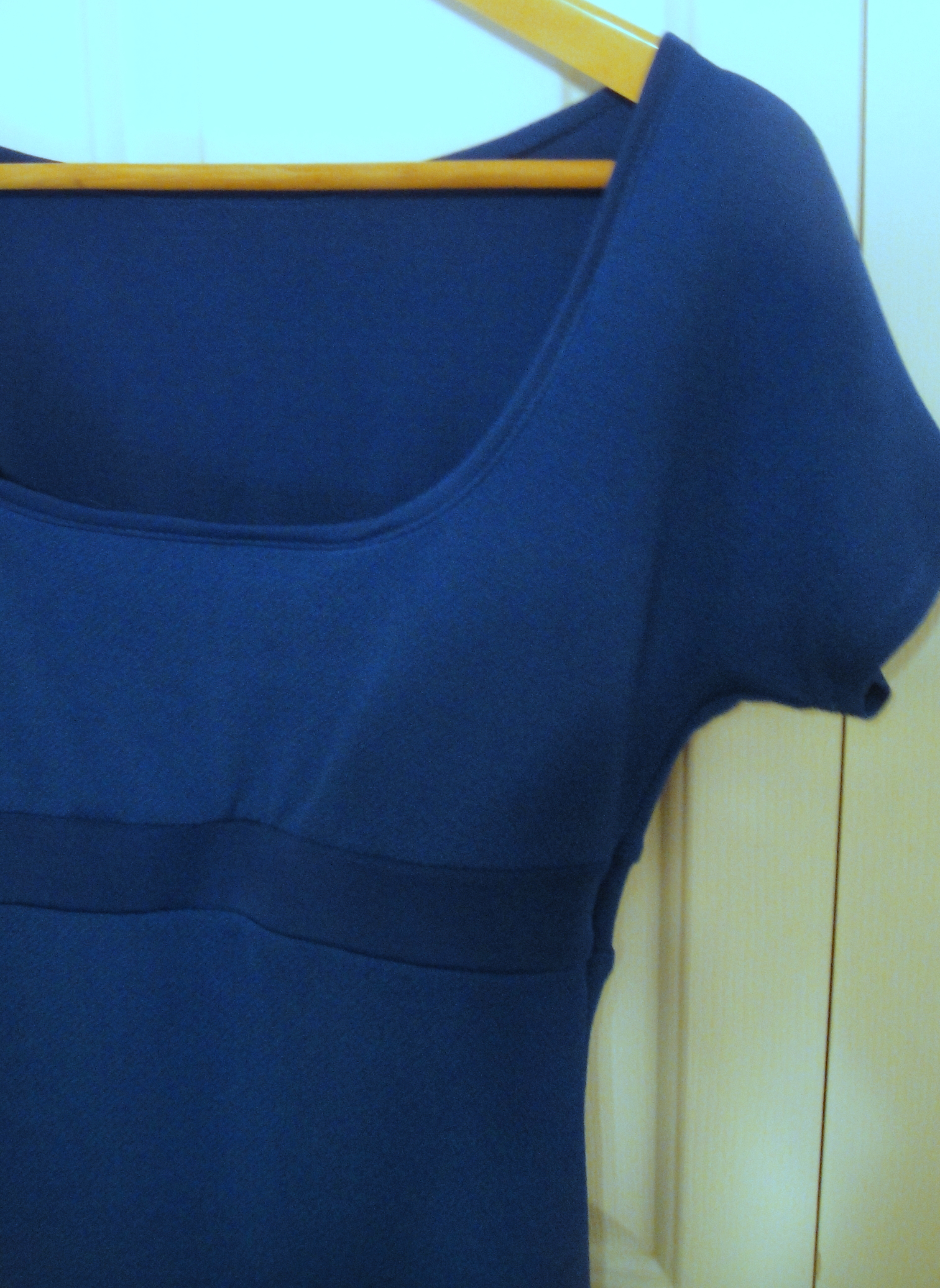
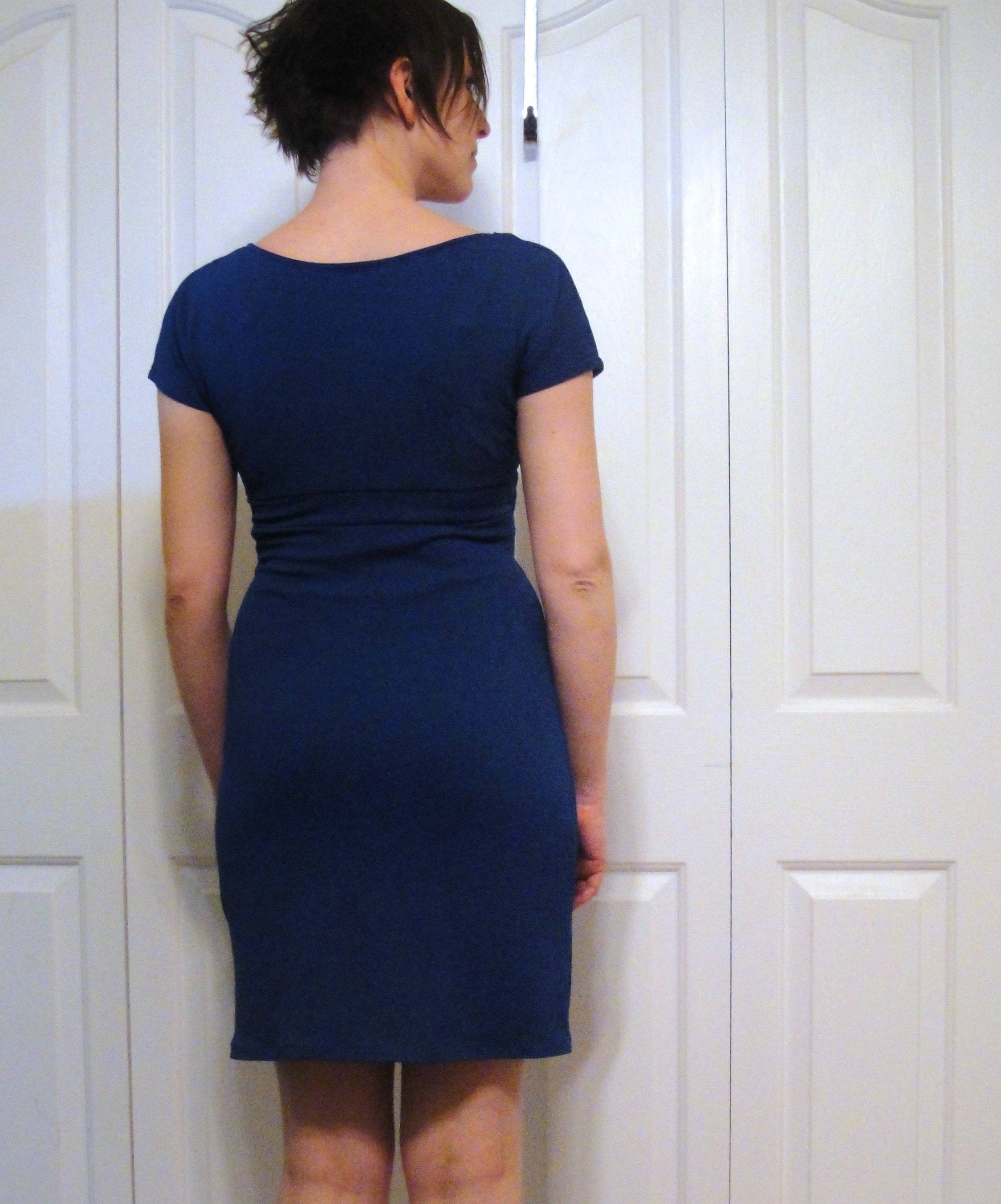
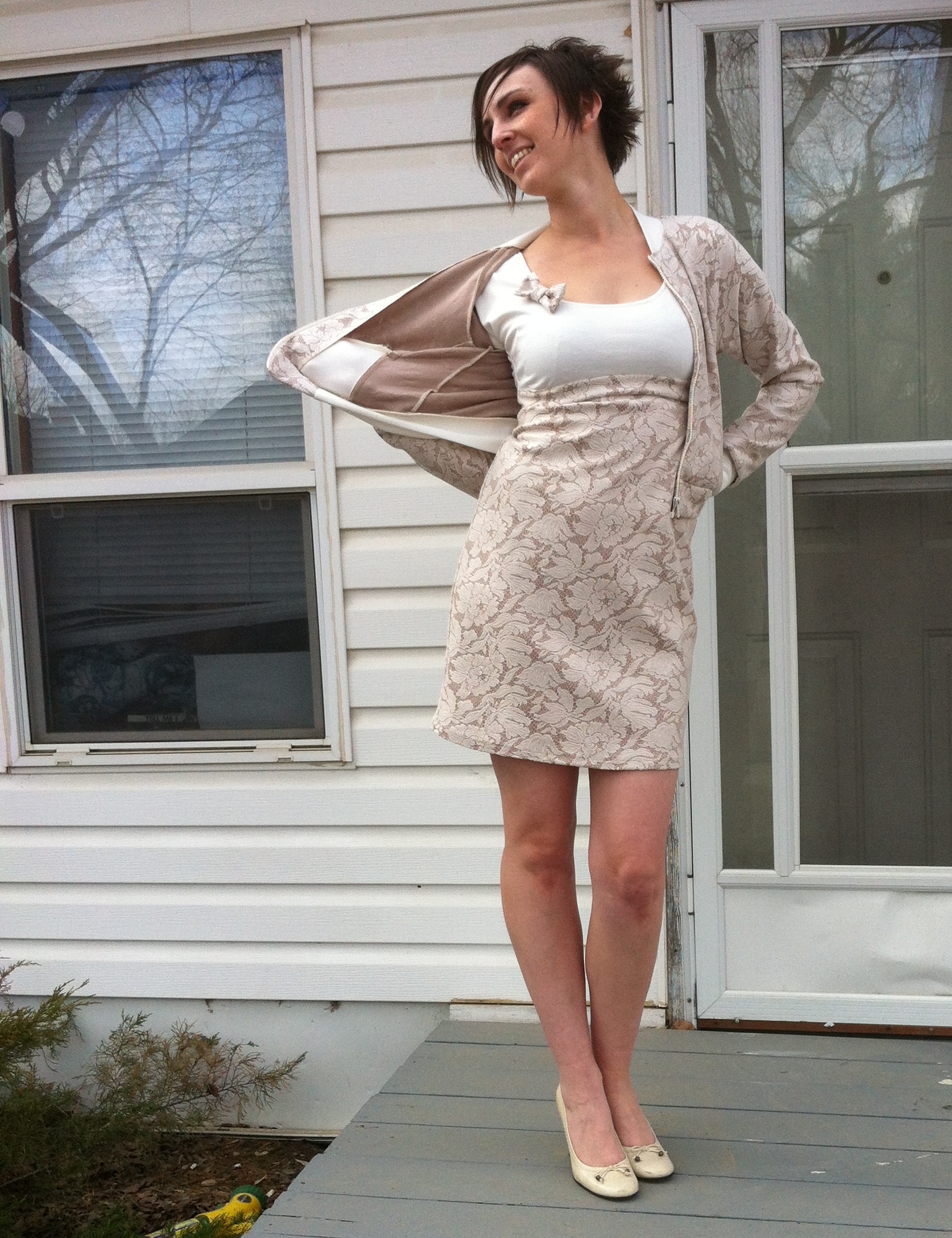
Cream Lace Ensemble

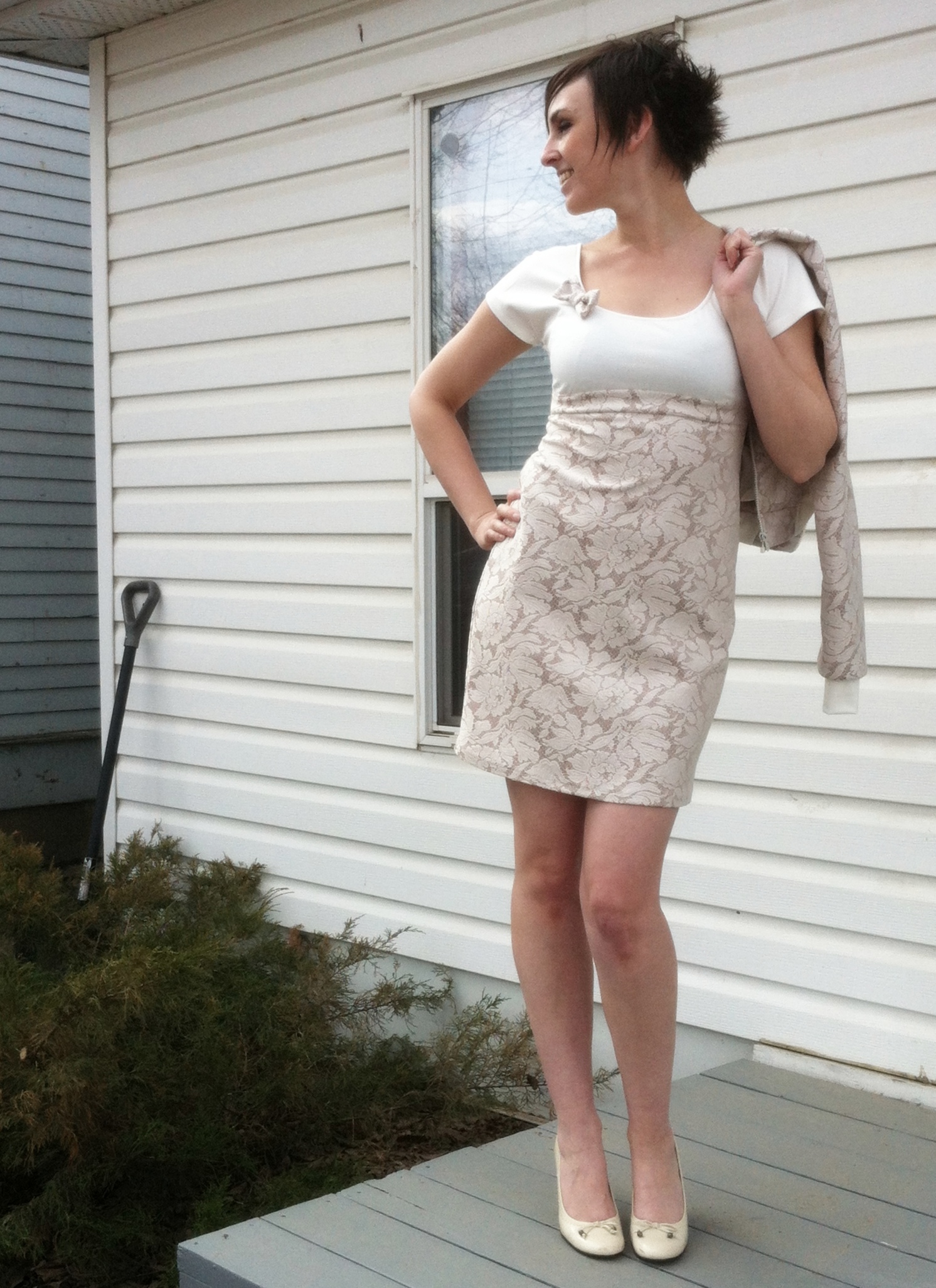
Ensemble.


Wrenching myself forcefully away from historical costuming (who knew petticoats could be so riveting)…I do like cream, and I do like lace. As the whole blog theme may suggest.

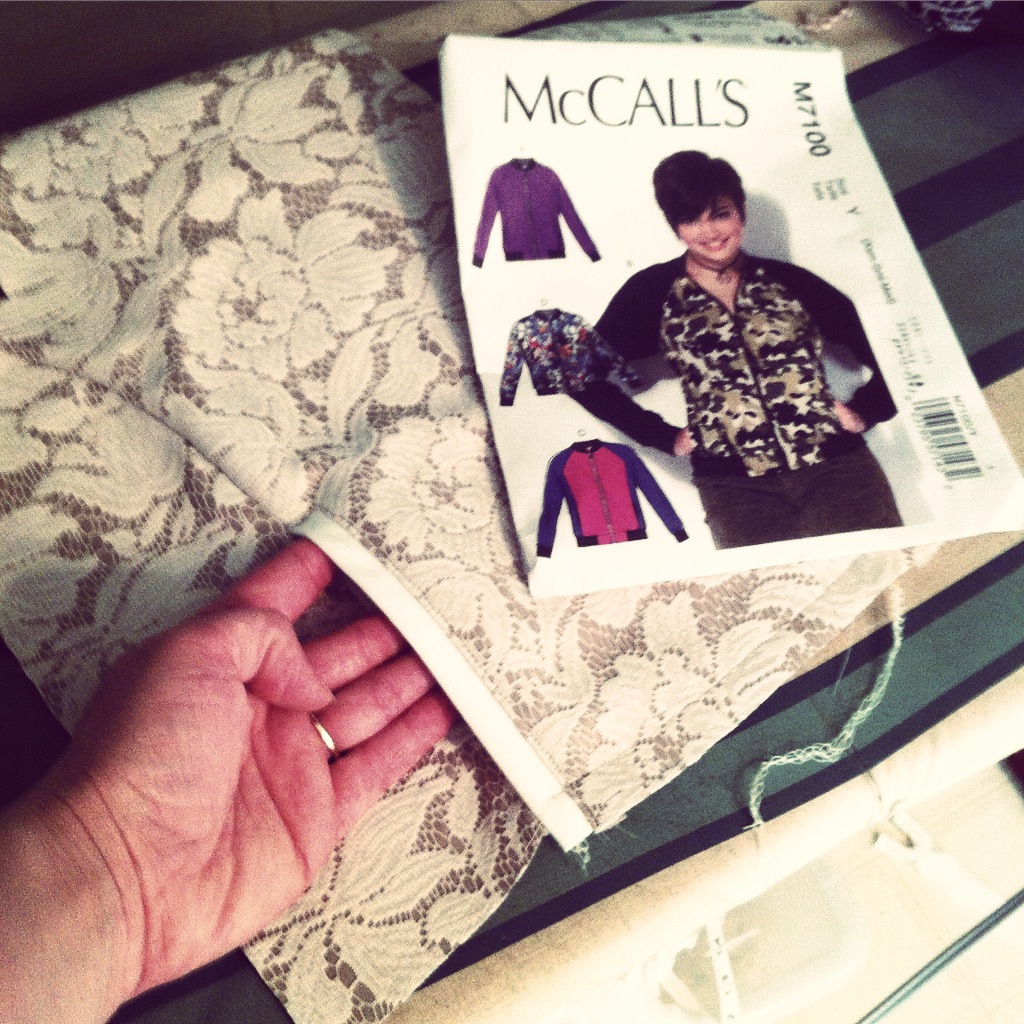
I’m not quite sure what to say about my inspiration here. Bombers have been bouncing around the blogs for, well, awhile now, even if the cool kids are sewing the Papercut Patterns Rigel and not the boring old McCall’s 7100. And I totally missed Rigel Bomber January, anyway. I’m not a bomber girl, mind you. Boxy has never been one of my favourite looks. But, well, even I can be swayed by a trend… and I was curious about modifying the usual bomber into a cropped look, because I love me a cropped jacket. I made it as short as I thought I could get away with and still have (semi) functional pockets, but it’s still an inch or so longer than my “prime” cropped zone—but I actually think it may be pretty fun, and a practical throw-on-over-cute-whatever layer, which as an office-dweller I am often sorely in need of.

McCall's 7100

McCall’s 7100

As for nuts and bolts—the pattern is McCall’s 7100. The fabric is a beige scuba-knit bonded to a lace, which has the effect of nearly nullifying the stretch in both fabrics. For my bands, I picked an ivory Ponte di Roma which is stretchier than the base fabric, but also not really stretchy enough for what it is supposed to do (although the pattern calls for “moderate stretch knits” for the bands, not psychotically stretchy ribbing. I checked.) I made the size 10, since I wanted a fairly close-fitting jacket. I shortened all the bodice pieces by about 3.5″, mostly at the hem except for the side-front panel which has a wee bit more shaping than the other pieces, so I took a tuck from the lower part of it. I also lengthened the sleeves about 5″, though I did take 1″ off afterwards. Though I kinda wish I hadn’t.


Jacket.

Jacket.

I didn’t particularly like the way the McCall’s pattern has you construct the pocket welts—it’s simple but not the cleanest look. I wanted my welts inset into the seam, which I’ve done before… but not since I made Jalie 2795 for Tyo. Um, that was a while ago (like, it’s been handed down twice since). And I should really have re-read the instructions for that rather than just bumbling along. I feel like I’m doing a lot of bumbling along lately, mostly due to not having the time/energy/focus to actually think through, research, and practice a technique. Not the best for personal growth as a stitcher, /sigh. But I did manage it, give or take a bit of seam-ripping and  rippling and a few seams finished in the wrong order (or not at all).

Ugly inside band attachment. Closeup declined. ;)

Ugly inside band attachment. Closeup declined. 😉
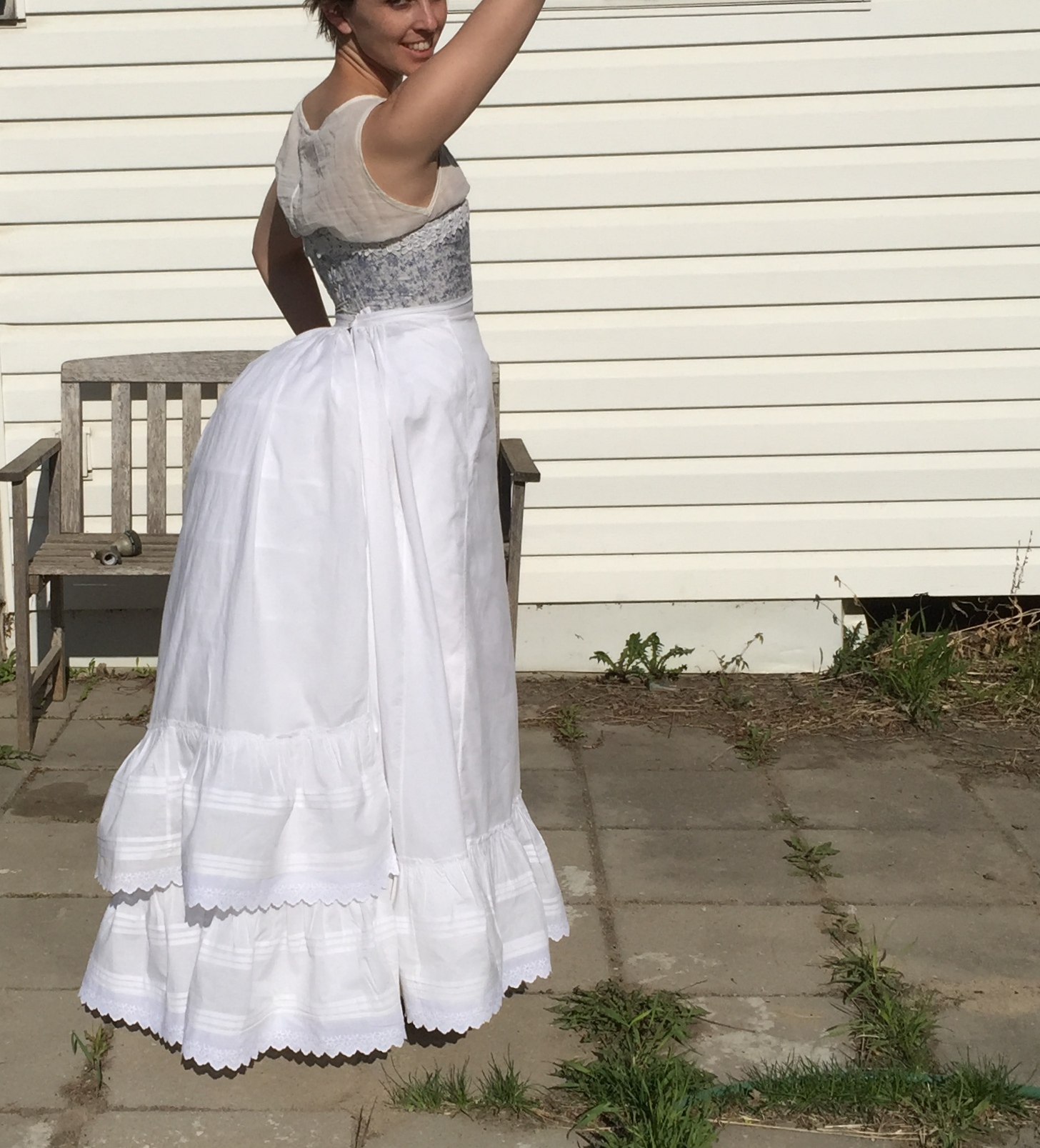
Where i mostly fell apart was actually in attaching the bottom band. I love the little panel of the main fabric at the zipper, and they have a pretty neat method of attaching it, but I couldn’t quite wrap my head around how to mesh that with the stretch band around the rest of the bottom. I mean, it’s together, but the join is ugly as hell inside, and this is an unlined jacket. Blerg. Need to re-read/rethink that a bit. A lot. Before I try it again.

Pockets!

Pockets!

But otherwise, it went together quite easily and I’m quite happy with the fit. The pockets (after all my shortening) are pretty teeny but just barely large enough to put hands in, at least. It’s funny, I don’t really love the shape when I look at it in the mirror, but I feel like it’s better “in motion.” I think I like it.

Jalie Dress


Now, I’m pretty sure in actual wardrobe rotation the bomber will be pretty much a standalone piece, but I still had fabric left over, and a hankering for a matching little dress. Tis the season (or almost the season) for cute little dresses, after all. After wrangling bomber most of the day, I didn’t have much energy left, though—all I really wanted was a T-shirt type dress. (Speaking of which, I wonder where my lacy T-shirt-dress is…). After paging through my patterns, I really was feeling Jalie 3024, a cute pullover knit dress I haven’t gotten around to before.

Cute dress.

Cute dress.

The only problem? Jalie 3024 is designed for four-way stretch knits with rather more stretch than either of my fabrics.

After some thinking, though, I settled on some fairly simple alterations.

Tyo catches some good "transition" shots. ;)

Tyo catches some good “transition” shots. 😉

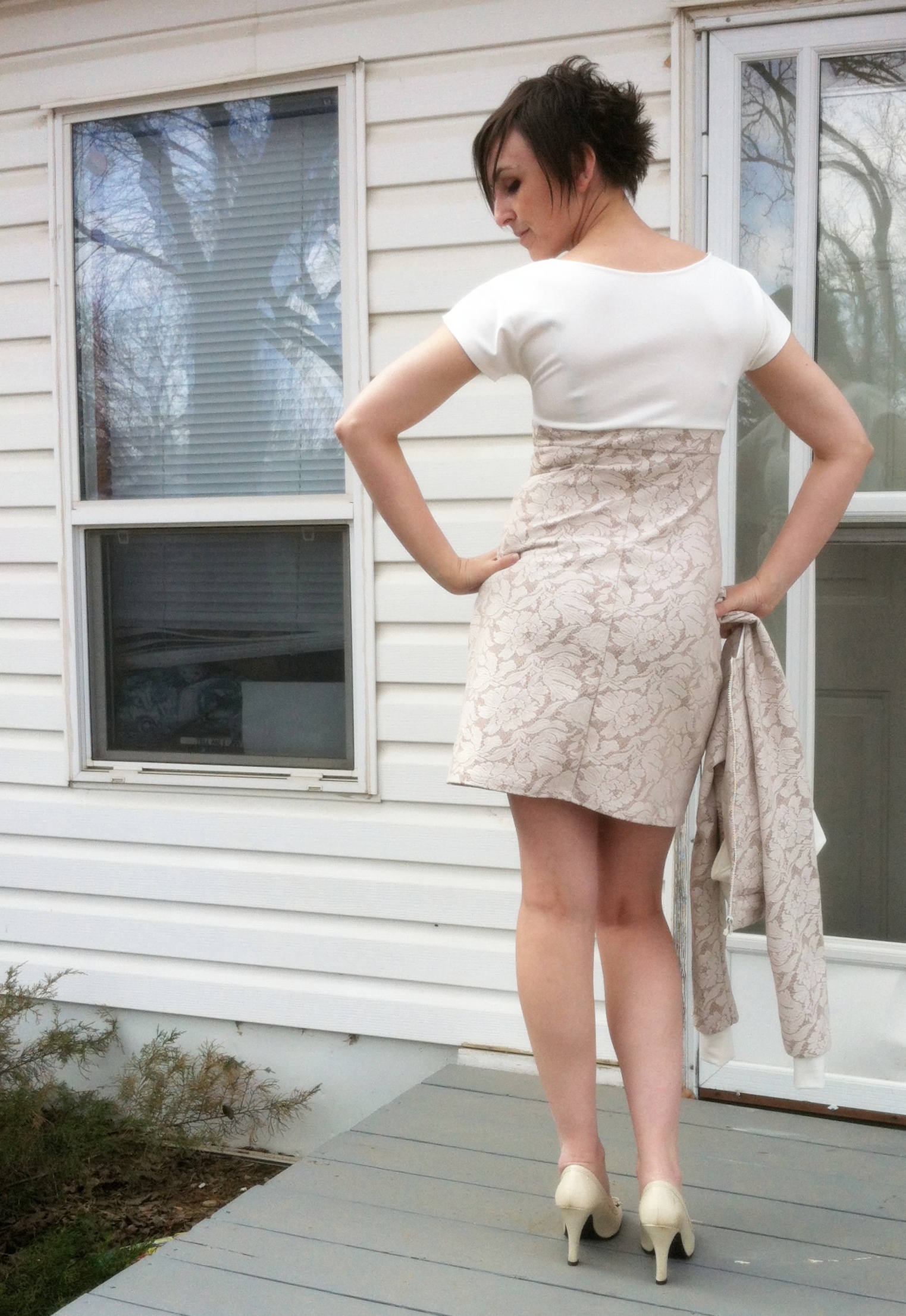
I cut the skirt and waistband pieces (out of the bonded lace) with about an inch extra ease both front and back, and added seam allowance for a seam at the CB skirt so I could add some swayback/butt shaping. I didn’t make any changes at all to the back bodice, but for the front bodice I lengthened about an inch and added a dip below the bust, basically a big fat FBA. (Muahahahah!) I used the ponte for the top as it has a bit more stretch than the bonded lace. I also gave it a scoop neckline because I like them so much better. All of these alterations played hell with the seam lines, but ponte is a forgiving knit and I was able to ease everything together quite nicely.

Back view. Centre seam added for butt shaping.

Back view. Centre seam added for butt shaping.

I’m not usually a big fan of the “dress that looks like skirt and top” but I’m kinda liking it in this case. It needed a bow, though. I’m not quite 100% sure on the location, but it definitely needed it.

As with most Jalie patterns, I’m now feeling the urge to make five more…

PS: First outdoor photo shoot of the year!!!! Hooray for crappy cell-phone-pics with actual good lighting. (I fully intended to use the “good” camera, and pulled the battery out to charge it… then couldn’t remember where I’d actually put the camera when the time came. /headdesk) Also, miraculously the beige colour of the skirt makes my legs look pink rather than fish-belly-white, so I’ll call that a major win. 🙂

7 Comments

Filed under Sewing

Remedial Corsetology II

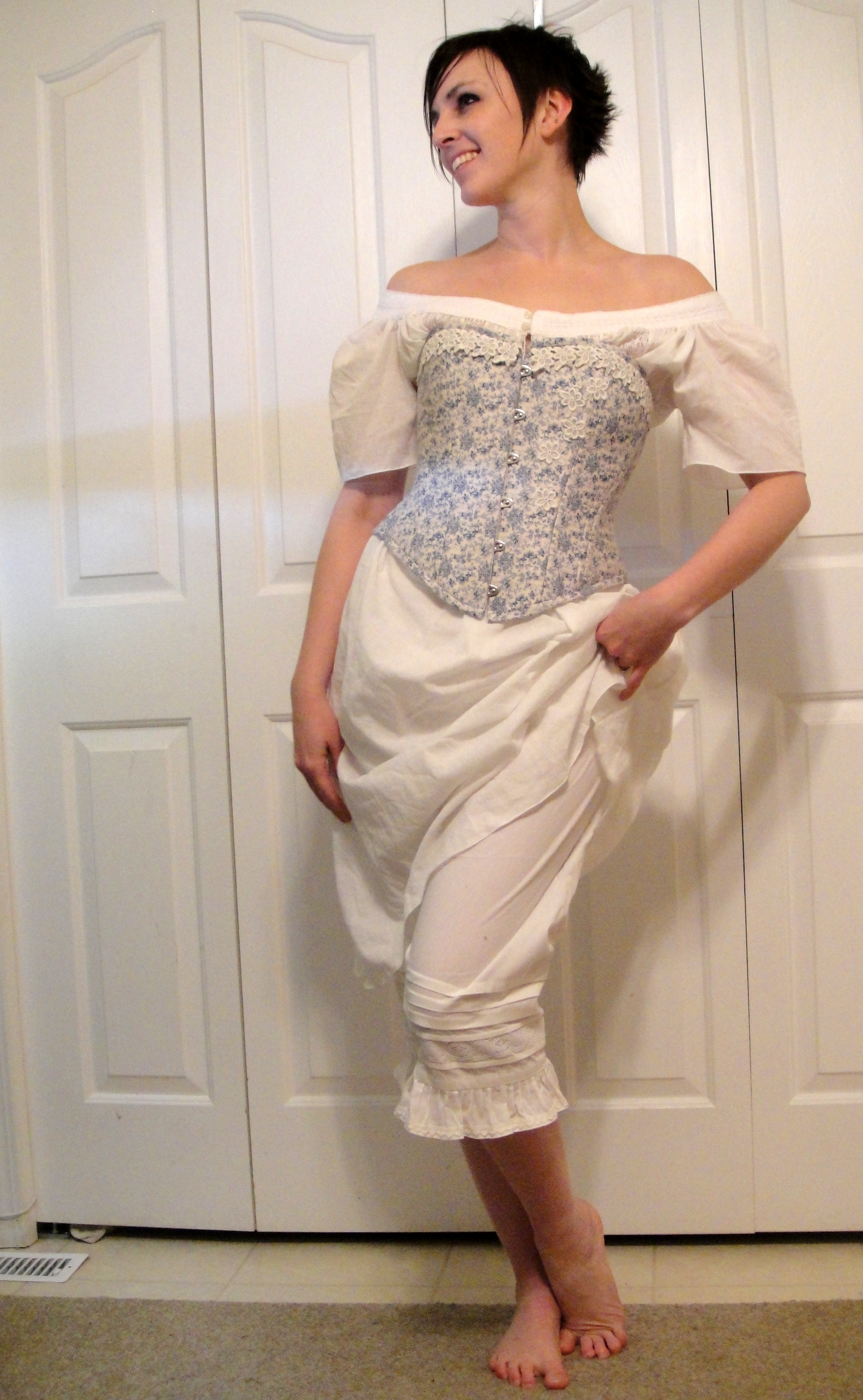
Victorian Underoos

Victorian Underoos

I probably don’t need to say a lot here.

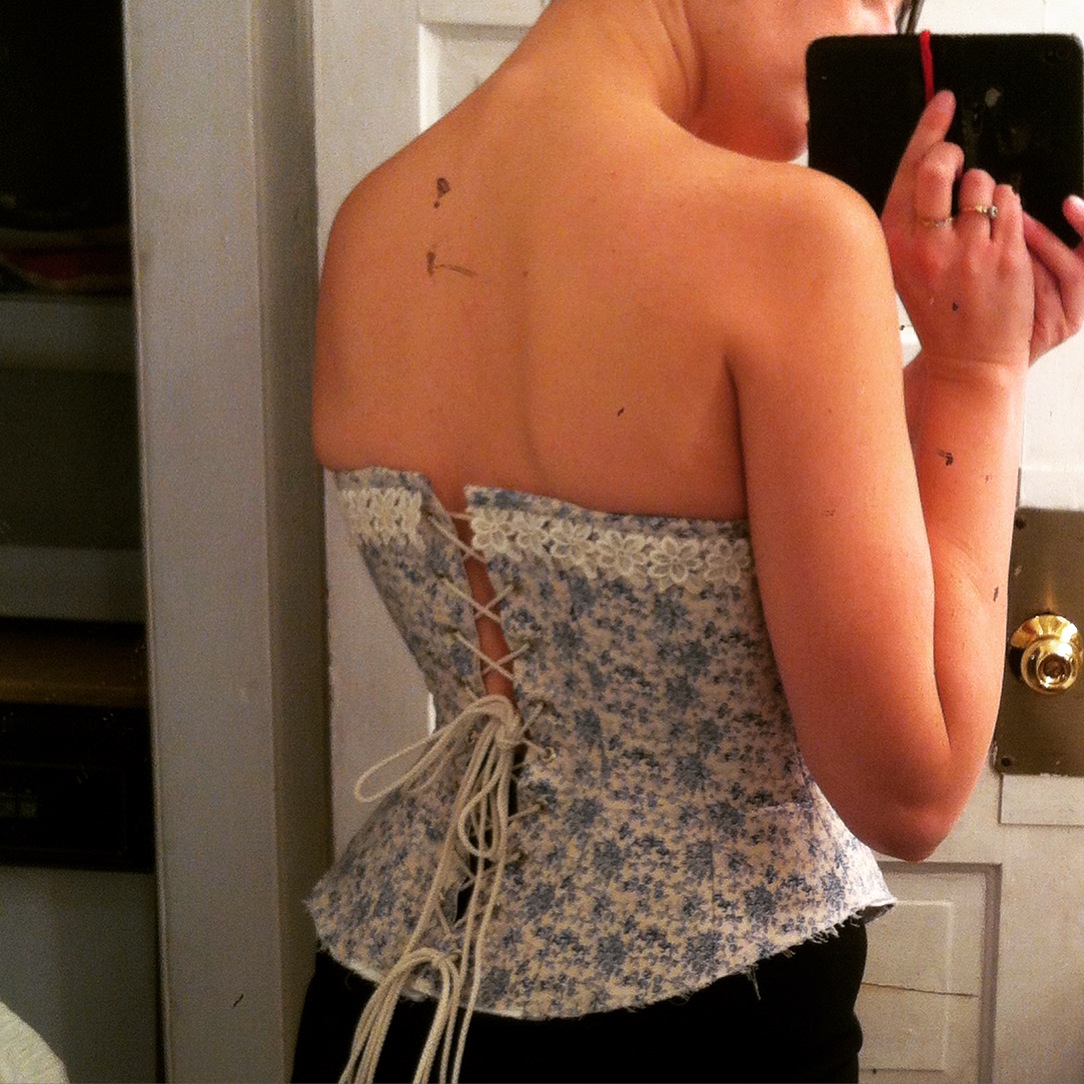
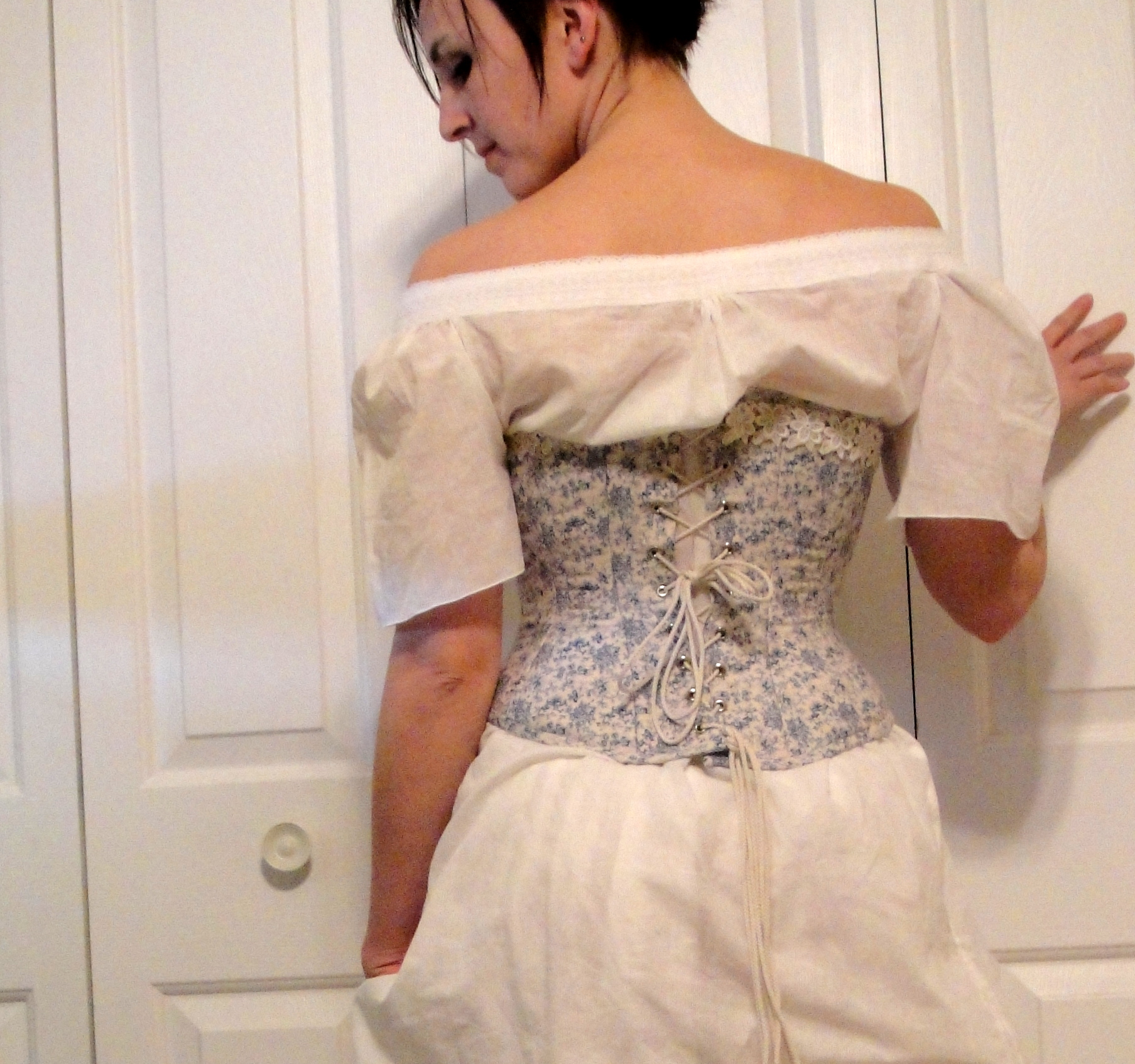
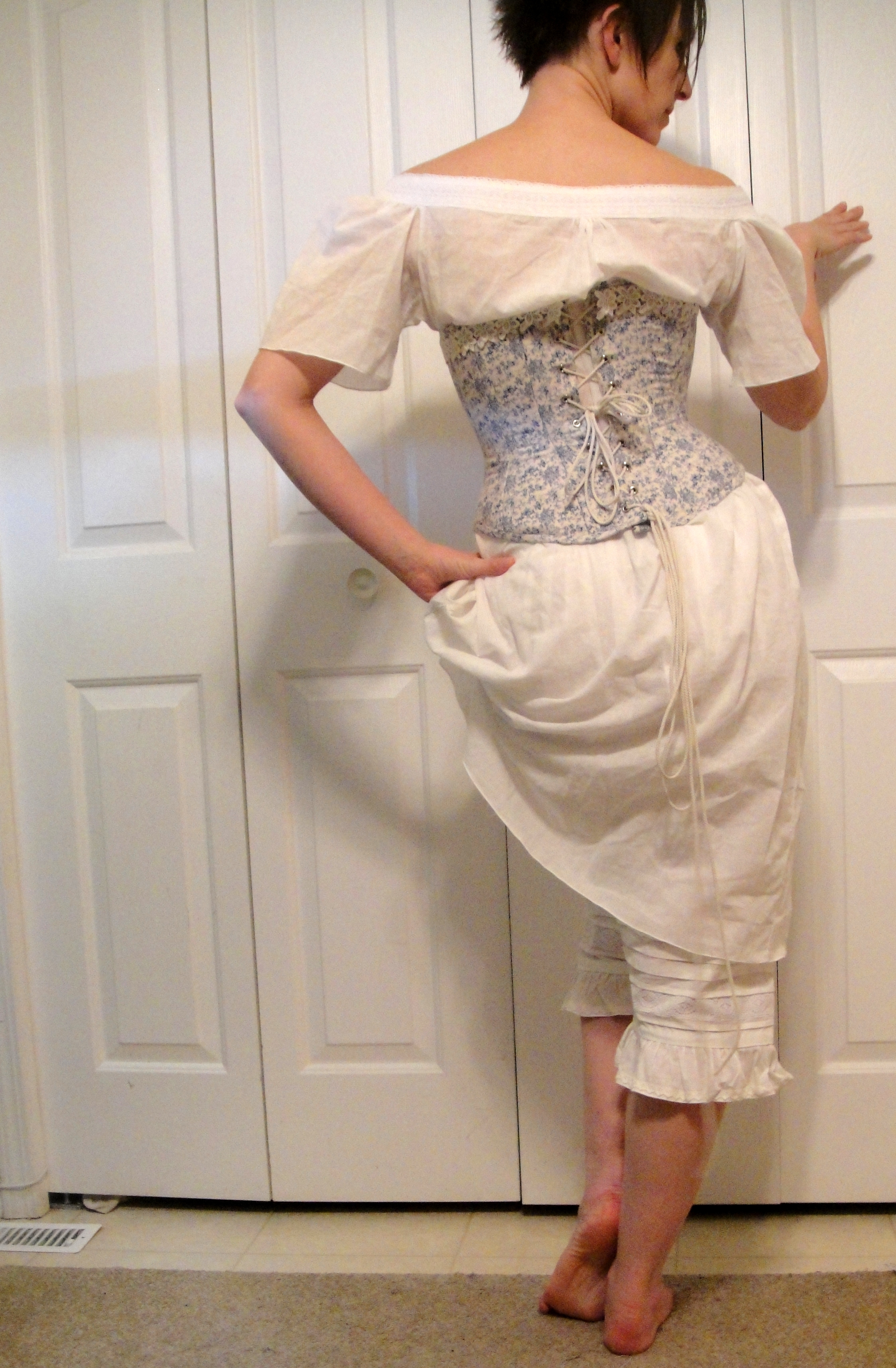
Back, with lacing.

First try-on.

I got lacing. (poly cord from Fabricland. Historically accurate? no. Functional? Absolutely.)

As Laurianna noticed in my last post, I forgot to allow space for boning outside of the back grommets. This is what I get for leapfrogging between different instructions, and not paying attention to details. I added some cording to the area for a bit of reinforcement (better than nothing?), but there is definitely some buckling along the lacing that could have been avoided. Lesson learned, hopefully to be applied next time. (Honestly, this is the kind of lesson I learn best from making mistakes. >_<)

Lacing grommets, cording, and bottom binding.

Lacing grommets, cording, and bottom binding.

I added self-bias binding along top and bottom, pulling it fairly tight to bring in the looseness along the bottom. I was a little worried halfway through that this would backfire and just look bunchy or lumpy, but it seems to be fine.

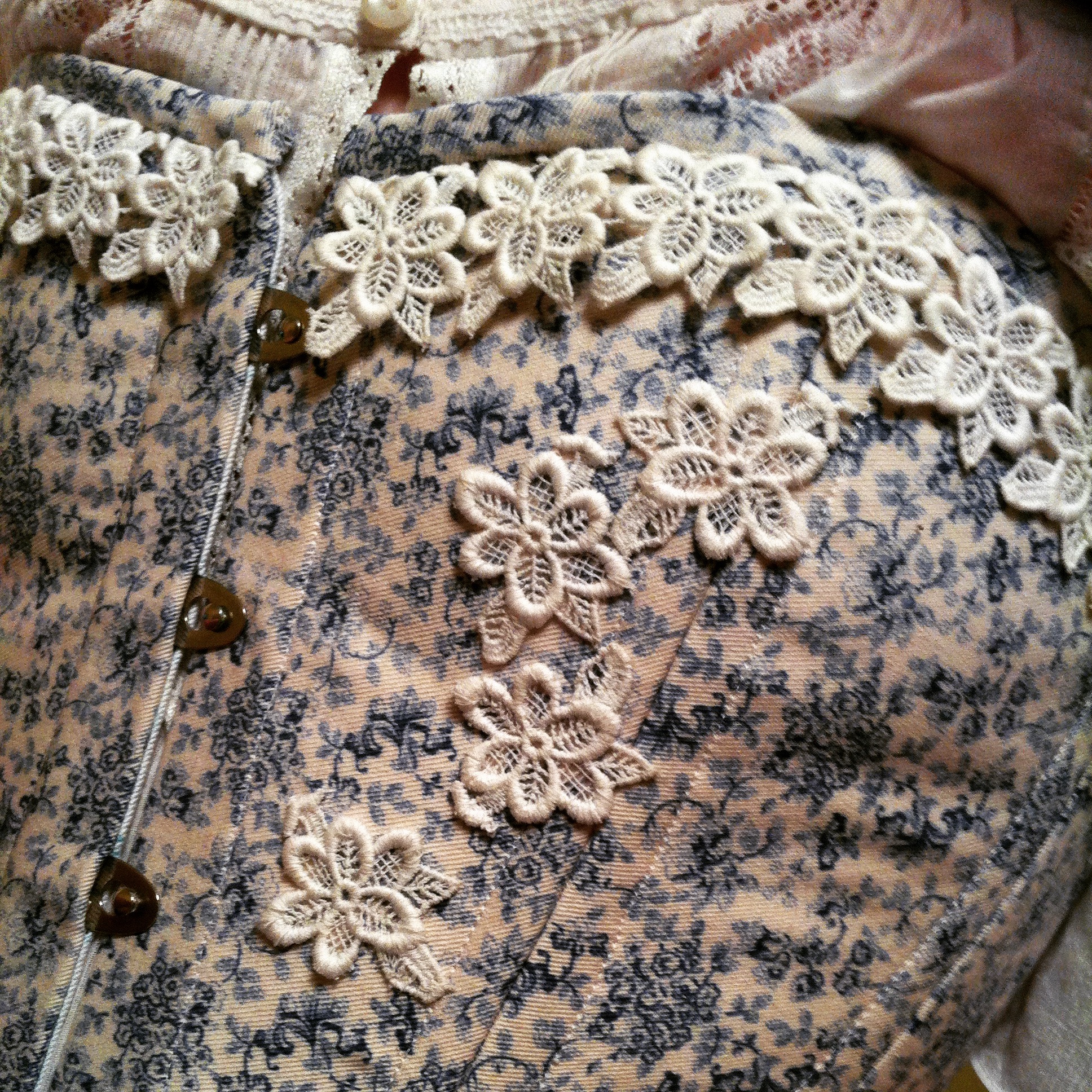
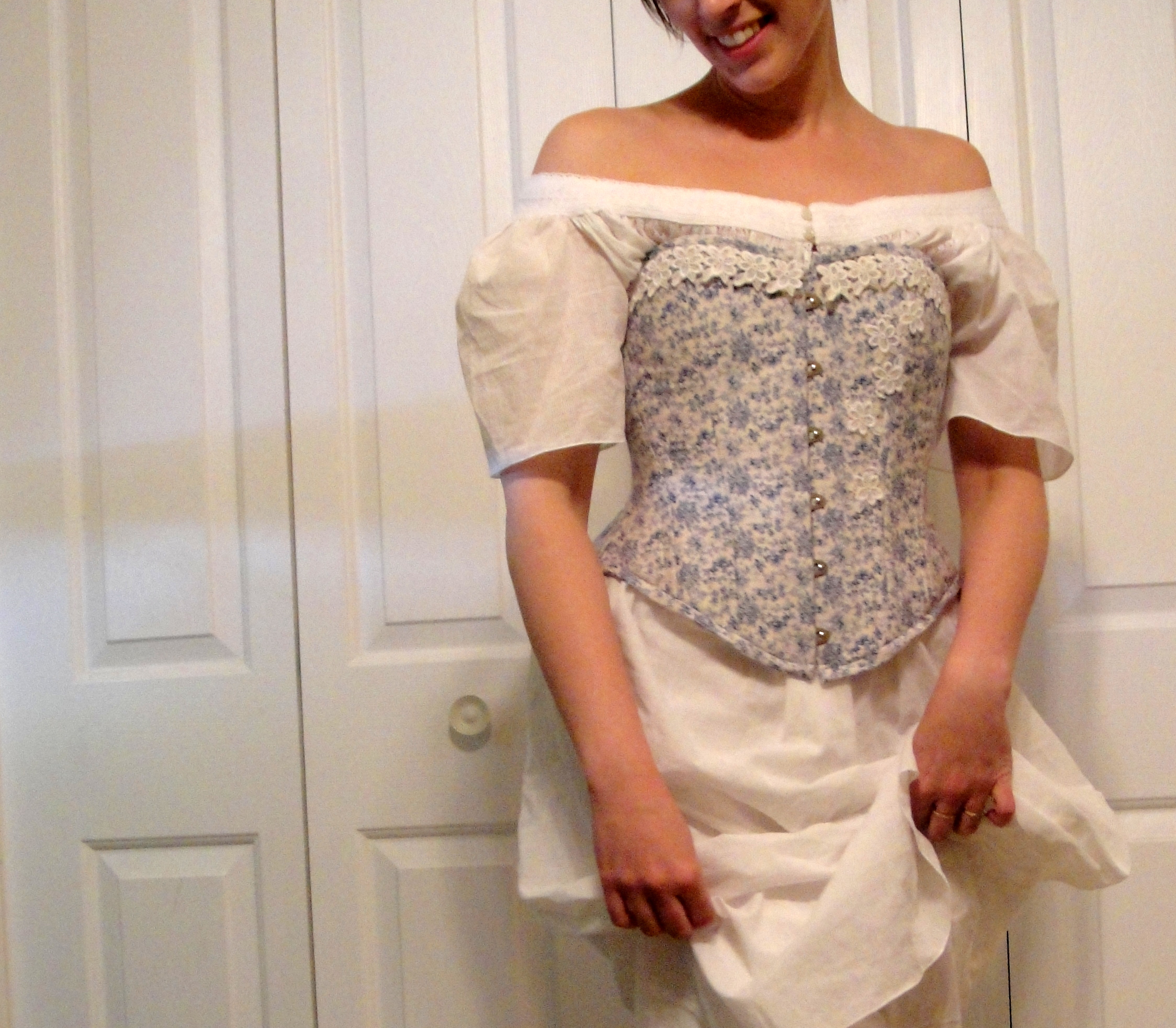
Lace flowers.

Lace flowers.

Since I had exactly five little lace flowers left over, I opted to add them to the front of the corset. I just cut them apart and  hand-tacked them down. I think they’re cute (though maybe not very Victorian with that random asymmetrical design. Ah, well. At this point I’m going for impression, not detail.)

Corset back. Lace job by the fourteen-year-old.

Corset back. Lace job by the fourteen-year-old.

The corset is, technically, a little bit big. The two-inch lacing gap I used in my try-ons disappears pretty much entirely without too much difficulty, and I think I could stand tighter lacing at the waist. (Despite the above photo. However, if I wait to take new photos with the lacing done a bit better, you may never get this post, so, wonky lacing it is.) I love how it flares out over my hips, though, and I love the shape it has around the bottom, even though it isn’t, strictly speaking, really long enough over the hips.

The bust isn’t exactly too small, but I think if it were a bit larger, and shaped a bit differently (i.e. more defined), it would look better. It is technically alterable, should I choose to unpick and re-stitch the seams and boning-channels, but I’m going to leave it for the moment, partly because I hate alteration and partly because I want to test how it feels when worn for more than a few minutes of trying-on.

Full view

Full view

I haven’t really talked much about the chemise, have I? (I covered the drawers here.)

Closeup, with chemise.

Closeup, with chemise.

I used the yoke piece from Simplicity 9769 (If I’d had this pattern when I first started the corset-testing I would probably have used it rather than Butterick 4254, as it seems to have somewhat better reviews, but anyway….) This is more of an 1860s pattern than 1880s but, well, I like it , so there. 😉 The rest I kinda offroaded, based on the instructions in The Home Needle and a fair bit of poetic license. I sewed up the yoke, with lace, fairly conventionally, but then I wound up taking the project with me to my mom’s family farm for a few family events over the winter, and while I can’t really run off to play with a sewing machine while I’m out there, I can definitely sit in the kitchen and hand-stitch and visit while everyone else around me cooks and cleans and does actual useful work. So the flat-felled seams of the main garment were all done by hand, as were the teeny little pin-tucks (facilitated by the woven-in stripe of the fabric, though they still aren’t perfect, which is fairly unforgivable given the stripe) and the lace-insertion.

A photo posted by Tanit-Isis (@tanitisis) on Dec 27, 2014 at 5:31pm PST

(Hmm. This attempt to embed from Instagram does not seem to be displaying on my browser. I will attempt to fix it when I get home. Sorry all!)

Full back.

Full back.

Then I got home and impatiently finished the hems using the teeniest rolled hem foot on my Pfaff. I love the teensyness of it, but kinda wish I’d stuck with the hand stitching just for, oh, I dunno, excessive old-fashioned-y-ness.

I think it's cute, anyway.

I think it’s cute, anyway.

I was pretty pleasantly surprised by how the look works all together. (OK, I think it’s cute, anyway.) I like the three together better than any of the individual pieces (well, except maybe the corset.)

Next up: the petticoat(s)! (OMG I might actually have to start thinking about the actual dress. (But not before I tackle bustles. Ooooh, scary!)

8 Comments

Filed under Sewing

Jammie Pants

McCall's 6641

McCall’s 6681

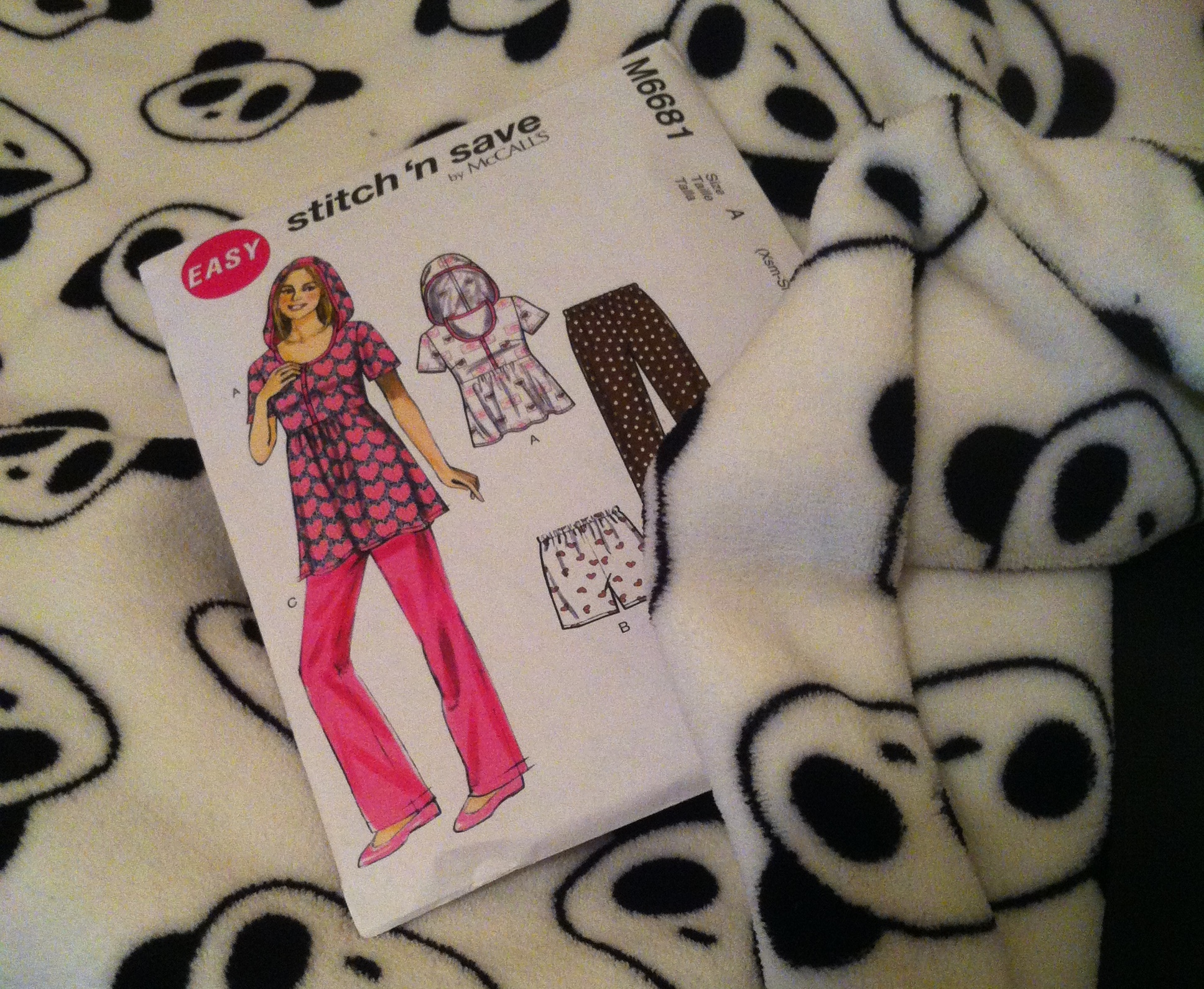
Over Christmas, I was wanting to do a wee bit of sewing for my children, but by wee I do mean wee since I had about as much free time as I ever do lately, which is on the order of a few hours ever other week. For Tyo, stretchy cozy PJ pants seemed to fit the bill, but they needed to be as simple as possible. Even the Sewaholic Tofino pattern, which has to be one of the cutest PJ-pants patterns out there, and is sitting patiently in my stash, seemed too complicated.

So, after a bit of stash rummaging, I settled on McCall’s 6681, a Stitch ‘n Save pattern that I can’t quite decide if it’s cute, or just dated and butt-ugly. Anyway, the bottoms were a completely basic PJ trouser, which is what I was looking for. As it turned out they’re a teeny bit tapered, which I thought might suit the kids these days.

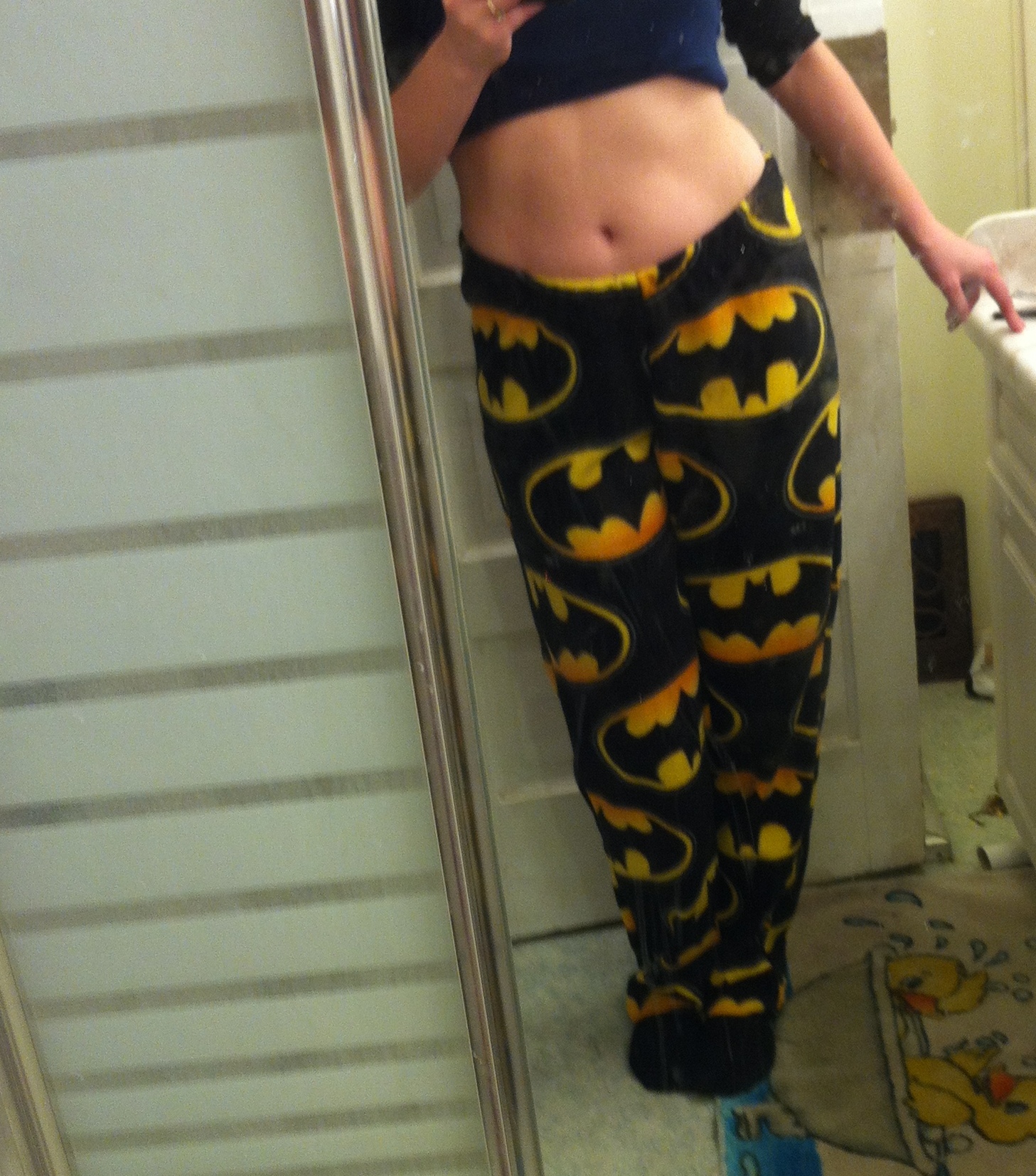
Batpants!

Batpants!

Despite the deliciously-soft panda fabric featured throughout this post, the first Christmas pair was made with Batman fleece. This was a rare score, indeed, since Fabricland has had mostly bugger all for licensed anything the last couple of years, so I had to snaffle it up when I saw it, since this year Tyo is All Batman All The Time. I’m not terribly into taking on pop-culture as totem or mascot, myself, but, well, I suppose there are worse mascots she could adopt than Batman. And this was a LOT easier than the Pikachu onesie.

Now, while one of the major downsides of having a teenage daughter is her ability to steal your clothes, in making these as a present, it became a bit of a boon—I made them to fit me, just a little bit shorter. It worked fairly well, though I should’ve made the waist a bit more snug—not sure if that’s to be blamed on my comparatively-larger waist (do you see the hips on that kid?), or the way the elastic stretches out a bit in sewing. Anyway, they aren’t going to fall off. And she was very, very happy with them.

So, when I finally dug out this panda fleece (purchased a year ago last fall, originally for Tyo before she came down with a bade case of Pikachuitis) to make a pair of comfy pants for Fyon’s birthday (who is eight now, by the way, how the hell did that happen?), I figured I should make Tyo a pair too, for old time’s sake, even if pandas are so year-before-last. Since I had the pattern all ready to go ‘n everything.

The pandas will get you if you don't watch out!

The pandas will get you if you don’t watch out!

So I did.

Tyo-fitting pattern changes

Tyo-fitting pattern changes

Being the second make, I tweaked the pattern a bit, finalizing the changes I’d made to the rise the first time. I make these changes kinda preemptively to a lot of pants patterns, especially when I know they were designed for a higher rise in the front than I like. (I’ve become comfortable with a very uneven rise, nice and high for lots of coverage in the back, dipping low in the front to sit under the belly. Tyo seems to like it too, but it makes it really hard to wear most storebought pants and leggings. For this pair, I added a bit of length (depth? I always forget which it is) to the back crotch, as well, just for good measure.

The front.
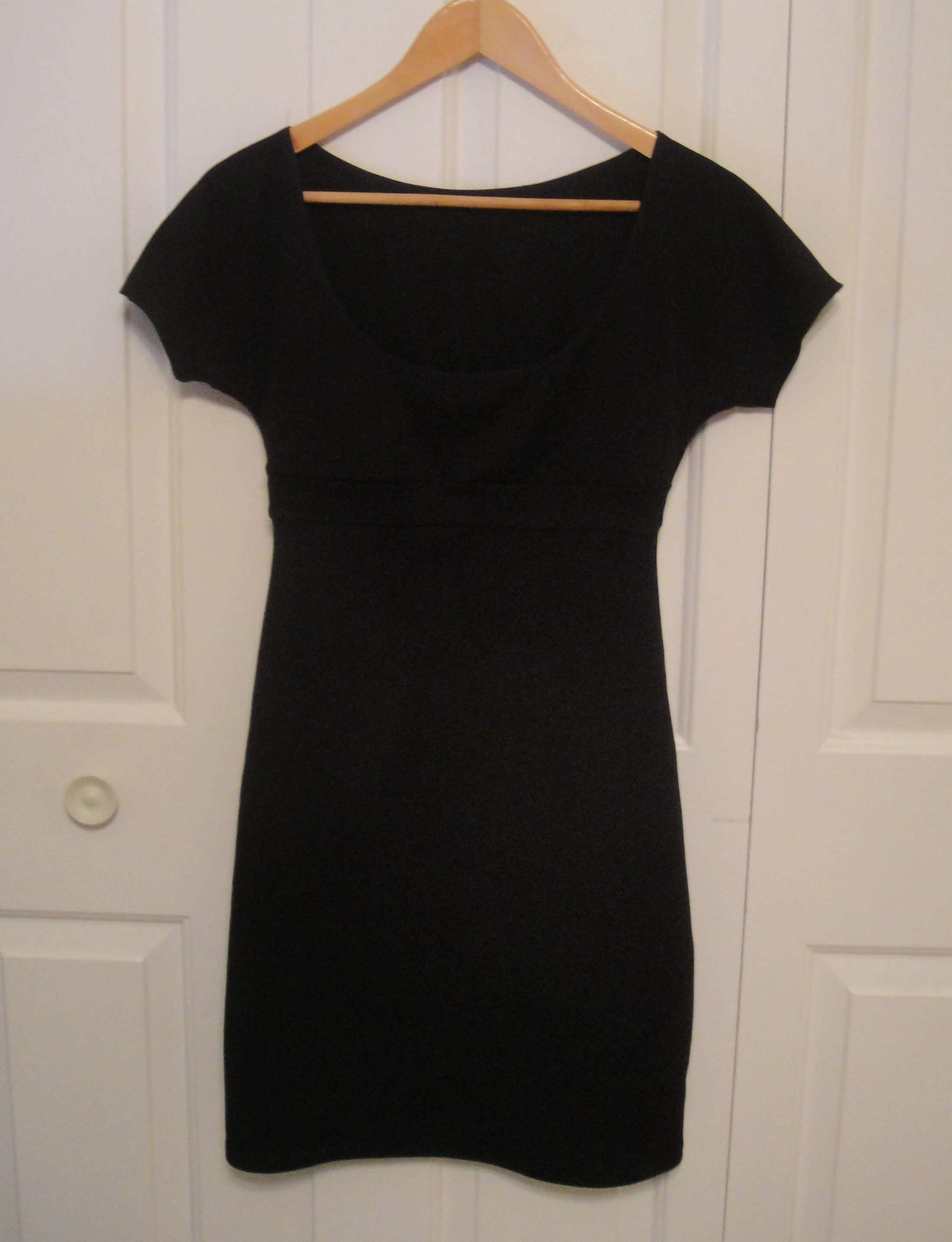
The front. I forgot to get her to hike her shirt so you could actually see the rise.

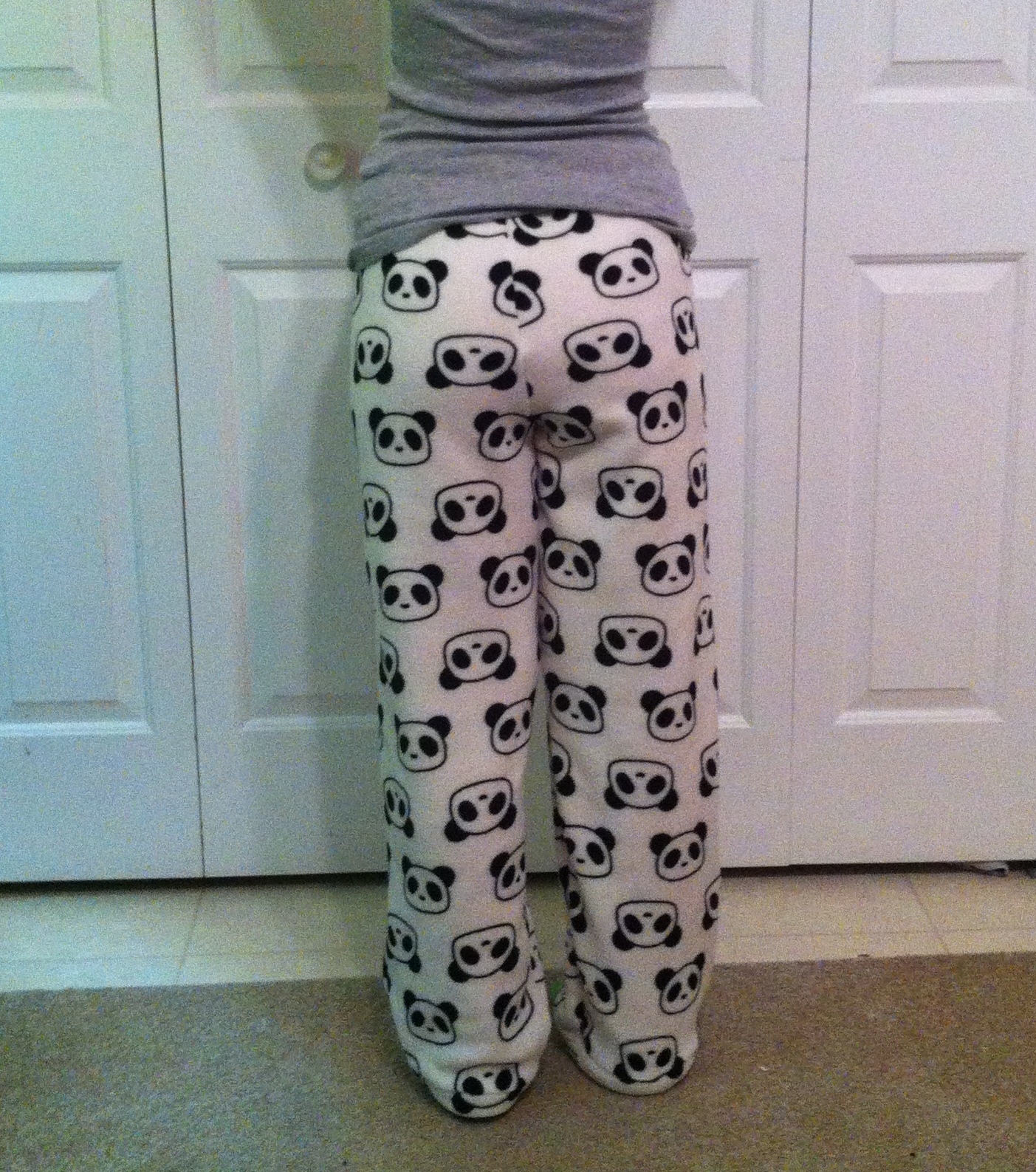
Now, I’m certainly not going to be a fit-Nazi about some baggy PJ pants, but I am pretty pleased with how they turned out, anyway. No smiles and straining, but not so huge she’s swimming in them. How much can be credited to my alterations and how much to the fact that these are loose PJ pants, I don’t really know (I suspect mostly the latter, though.) And no, I didn’t even try to pattern-match panda-faces across her butt.

The back.

The back. Also, why can’t I have hips like that? /momsulk

The back hangs almost straight, and the rise is nice and high.

The side.

The side. You can kinda see the angle of the waistband under her shirt.

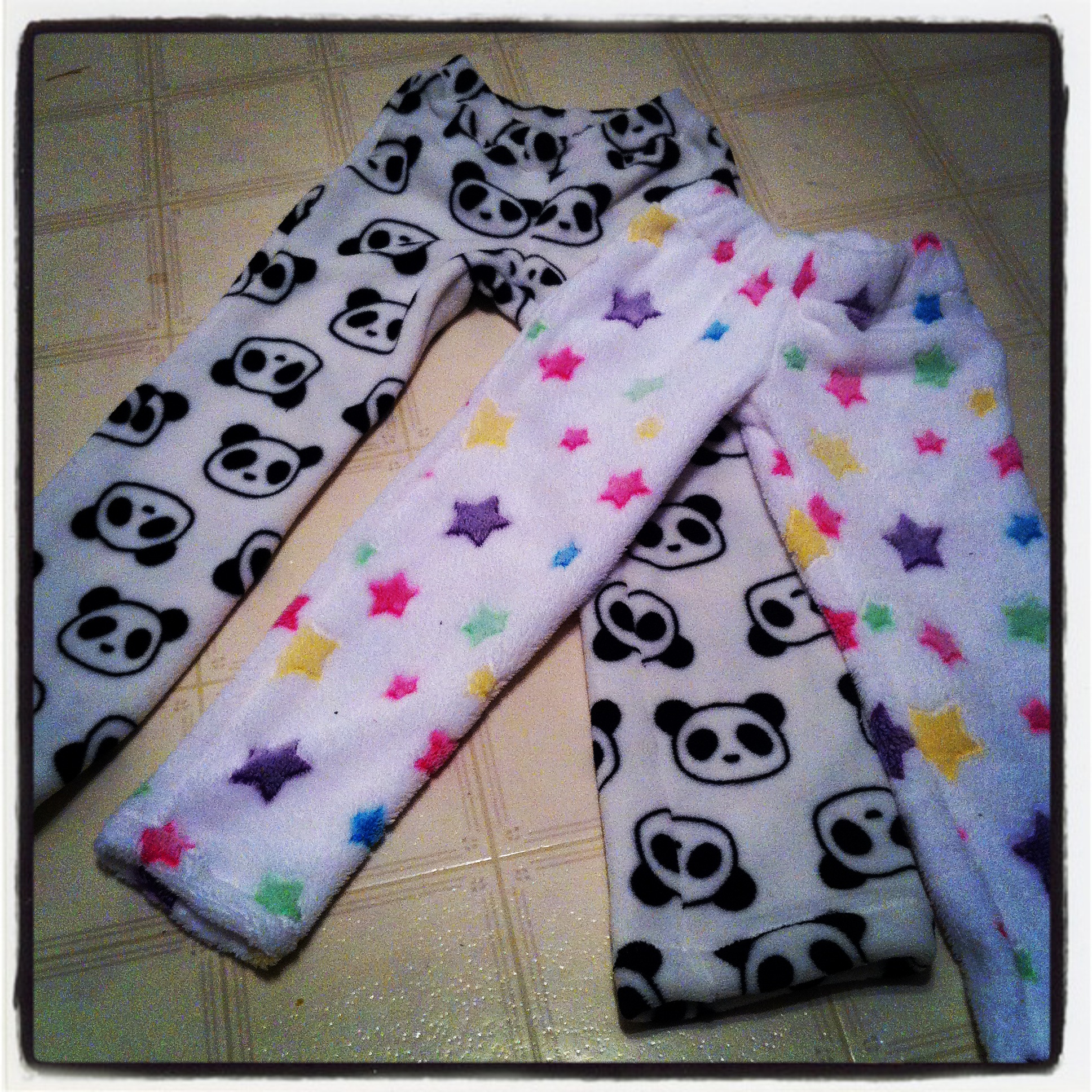
The best thing about PJ pants like these is how damn fast they are to put together. These didn’t take more than an hour all told (it helped that the pattern was ready to go, mind you), and I also managed to churn out a couple of fuzzy pants for Fyon and the Waif. And I think I have just enough panda fabric left to make some 3/4-length comfies for Syo.

Small fuzzy pants

Small fuzzy pants

There’s only one problem: Osiris is now wondering where his panda pants are.

4 Comments

Filed under Sewing

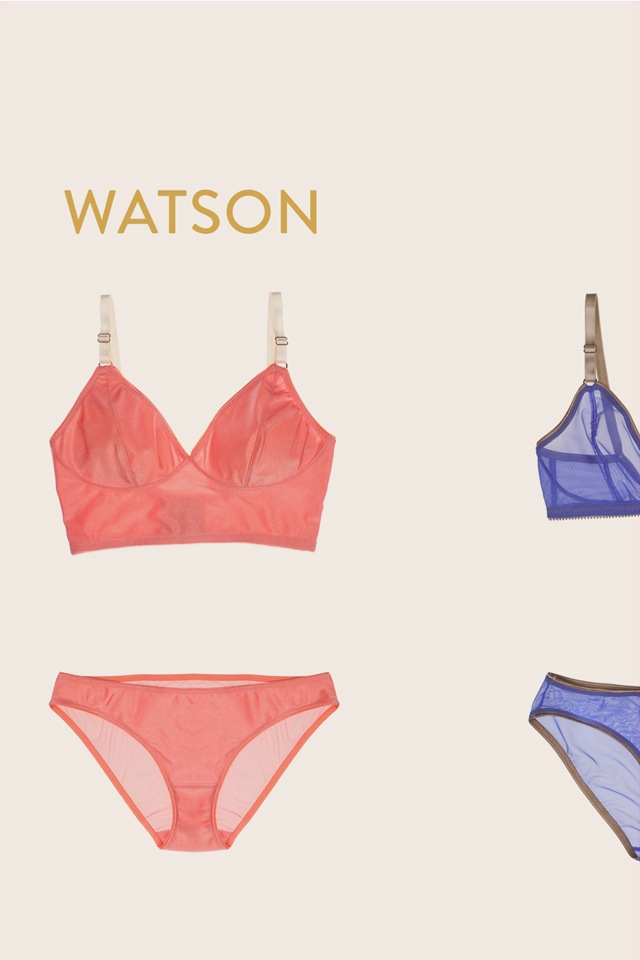
Watson!

IMG_0784.JPG

Watson!


Sometimes ya just gotta jump on the bandwagon, right?

I bought Cloth Habit’s Watson pattern shortly after it came out. Then, of course, realized that my home printer was dead out of ink, so actually making it up had to wait. (Although at one point I was seriously considering tracing the pieces off the computer screen. It’s a small pattern, you could totally do it.)

Once I did get ink, I promptly made up the bikini (panties! Yes, I come from a pantie-saying family.)

My first pair isn’t overly pretty (due entirely to my choice of elastic), but the fit was bang-on; it might be the first pair of home-made undies I haven’t wanted to lower the front on after my first go round*. The only thing I wasn’t over the moon about was the three-piece exterior construction. I know some people love this because it lets you get a really neat finish on the crotch, but I don’t love the look of the front crotch seam. Purely a matter of taste. I would have photos but my kids made fun of me for taking pictures of my underwear so I didn’t take any. Darned kids. As I said, they don’t look terribly pretty anyway, but the fit and feel is great. (Actually, they look fine on, but are kind of scrunchy when not being worn, and I don’t have a chic underwear-modelling-mannequin to demo on.)

IMG_0781.JPG

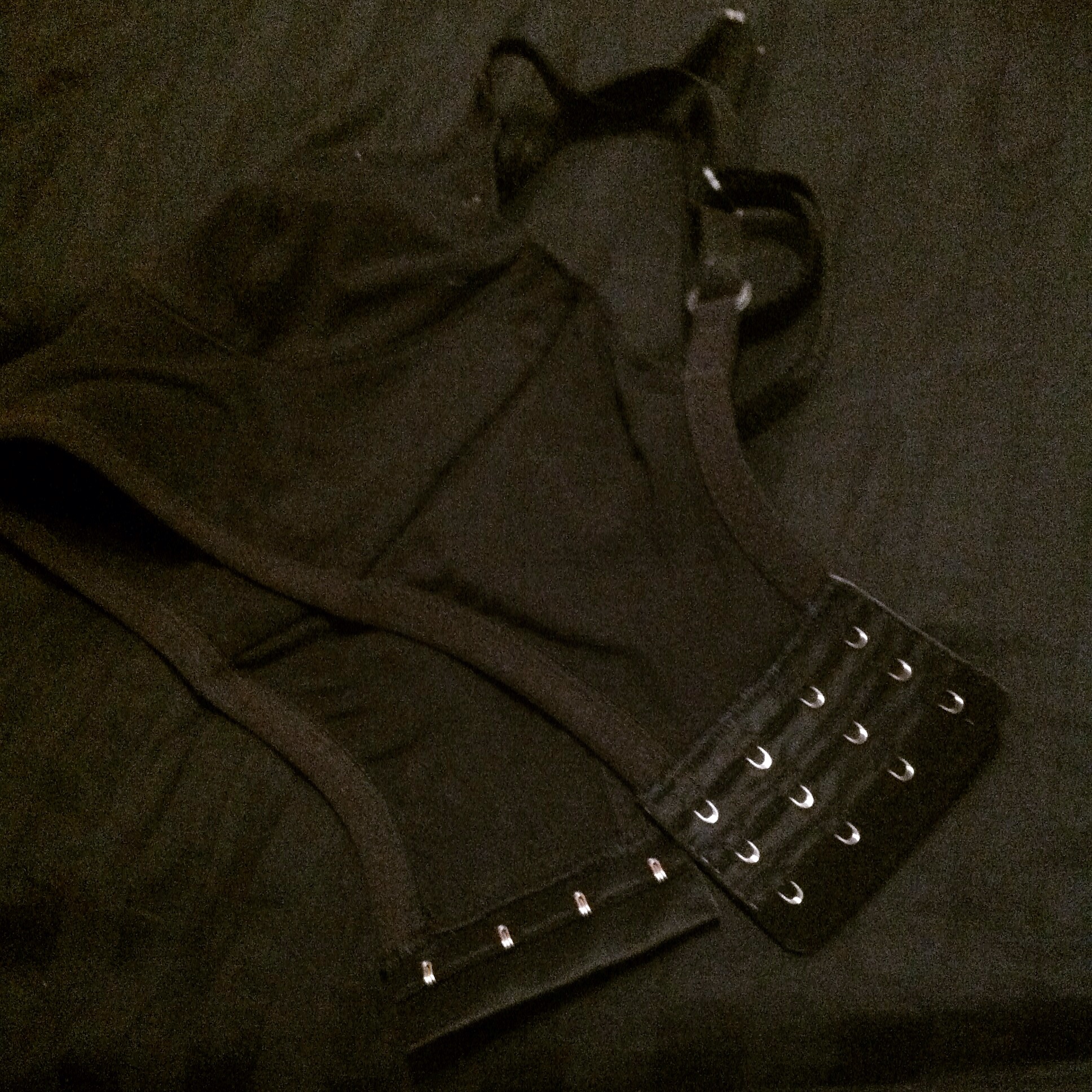
Watson bra: closeup with elastic and cup seams.


Next up was the bra. Bralette. Softie. Whatever you call those things that look like bras but don’t have underwires. I should confess that I’m not a huge fan of this type of bra; OK, I am not a fan of bras in general, really; as a teen I refused to try one on until I could reasonably fit something that didn’t say “A” for the cup size (that was the end of high school), and then after I had kids I got annoyed again and really didn’t wear them until, well, I started sewing and discovered that a nice, padded foam-cup could shift me from needing small-bust adjustments to being bang-on in pattern-bust-sizing. So basically it was sewing that got me wearing bras again. And of course, if I have to wear it, probably sooner or later I’m going to want to try to sew it, although the bras you can easily sew are, of course, not the kind of hard-cup I usually go for. The first bra pattern I bought was the Marlborough, back in the summer, but though my trial was pretty successful, it keeps getting back-burnered. Watson, not having underwires, was a lot less scary for my first “bra” type experiment.

I will pause to voice one small complaint about sizing. Both the Watson and the Orange Lingerie Marlborough suggest that you find your cup size by taking your full-bust measurement and then subtracting your high bust measurement. I gather this works for many people.

It does not work for shit for me. My high-bust is the same or (at most) 1/2″ smaller than my full bust. Blame it on broad shoulders or well-developed pectorals or who-knows-what, but according to this method I am an AA cup. (I did, however, go with Amy’s recommended band-size based on my ribcage measurement. That worked fine.) For the cup size, I went with the one that corresponds to my “cup volume” for pretty much every storebought bra I’ve ever owned—the one that corresponds with 34B/32C/30D. Now, cup size on this bra is pretty forgiving so maybe I would’ve been just fine in a the 32AA cup, but… I’m kinda doubting it. Anyway, /endrant. If you know your cup volume, just go with that.


IMG_0783.JPG

Emergency mail rescue!

So I made up almost the entire bra, in the long-line view, then realized what I already knew, which was that trying to fit the long-line onto any bra hook sets that I had on hand was not going to even remotely work; with the elastic finishing I had used, my back was a full 3″ (which is about 3/4″ longer than drafted for—I was using foldover elastic to finish the band top and bottom rather than folding it behind, so I wasn’t getting rid of my seam-allowance. It’s not that I was unaware of this so much as that I liked the wider band, until I actually had to think practically about how I was going to finish it off.) So, I got me to the Bra Maker’s Supply website to order some wider bra hooks (and some other doodads while I was at it). (Also, hooray for in-Canada shipping—it got here regular mail from Ontario in three business days! I couldn’t drive the distance in much less than that.)

Why do I keep making stuff in black?

Why do I keep making stuff in black?

Happily, the 4-hook bra-back fit PERFECTLY on my band. I used Tasia’s trick of hand-basting the back bits in place before bar-tacking—genius! Flawless attachment the first time. (Yes, this is my first time attaching any kind of bra back, really.

IMG_0782.JPG

Ermagerdbra!


Since materials are such a big deal when it comes to bra-making, I should probably go over them: I used a standard, fairly heavy and very stretchy cotton-lycra knit, a single layer everywhere except the front band (“cradle.” I’ll figure this bra terminology out one of these days. 😉 ). I had just enough strap elastic left from my Gertie Slip to make the straps, and as mentioned above I used a wide plushy fold-over elastic (1/2″ when finished) to finish the bottom and back of the band. For the top and cups, I used my crappy-but-quick-and-easy method: serge clear elastic on to the inside, fold over, and zig-zag. Not the prettiest, but it works and doesn’t show. For the cradle, I used a double-layer of my cotton knit, and interfaced one side with fusible knit interfacing. I made this side the inside, but in hind-sight I kinda wish I’d made it the outside; since the interfaced side has no vertical stretch, but the un-interfaced side does, the un-interfaced side tends to bubble a little bit. Something to think about next time. 🙂 I didn’t line the cups in any way and I’m a bit torn—I feel like the stretch helps the fit, but on the other hand there isn’t a lot of support or shape. Not that I need much of either, really, so perhaps that’s just me being used to hard-cup bras. But the band feels very solid with the elastic and interfacing and the industrial-grade four-hook back, while the cups feel much softer and lighter. Maybe a double-layer for the cups would’ve been the way to go.

Still, quibbling aside, it was fun to make and is pretty fun to wear. I also made Tyo try it on, and it fit her pretty well on a tighter hook—I’m actually kinda liking the idea of making her bras (especially if I can sell her on simple soft ones like this), since finding storebought ones in her (itty bitty) band-size is either tricky or very expensive.

And now, back to those men’s jeans… >_<

*I like the front low on my underwear—your mileage may vary.

19 Comments

Filed under Sewing