Author Archives: Tanit-Isis

Tanit-Isis's avatar

About Tanit-Isis

I sew, I draw, I write, I dance, I learn.

The Littlest Coin Bra

20121207-164629.jpg
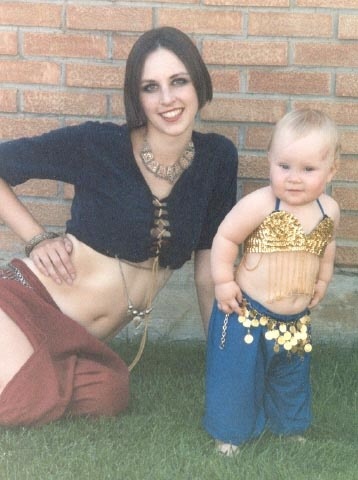
Ok, technically this bra, worn by Tyo around her first birthday, was smaller. (Also, those red marks on her face are lipstick kisses. Tell me you could resist kissing that cuteness. Also, a rare pic of me with long-ish hair.)

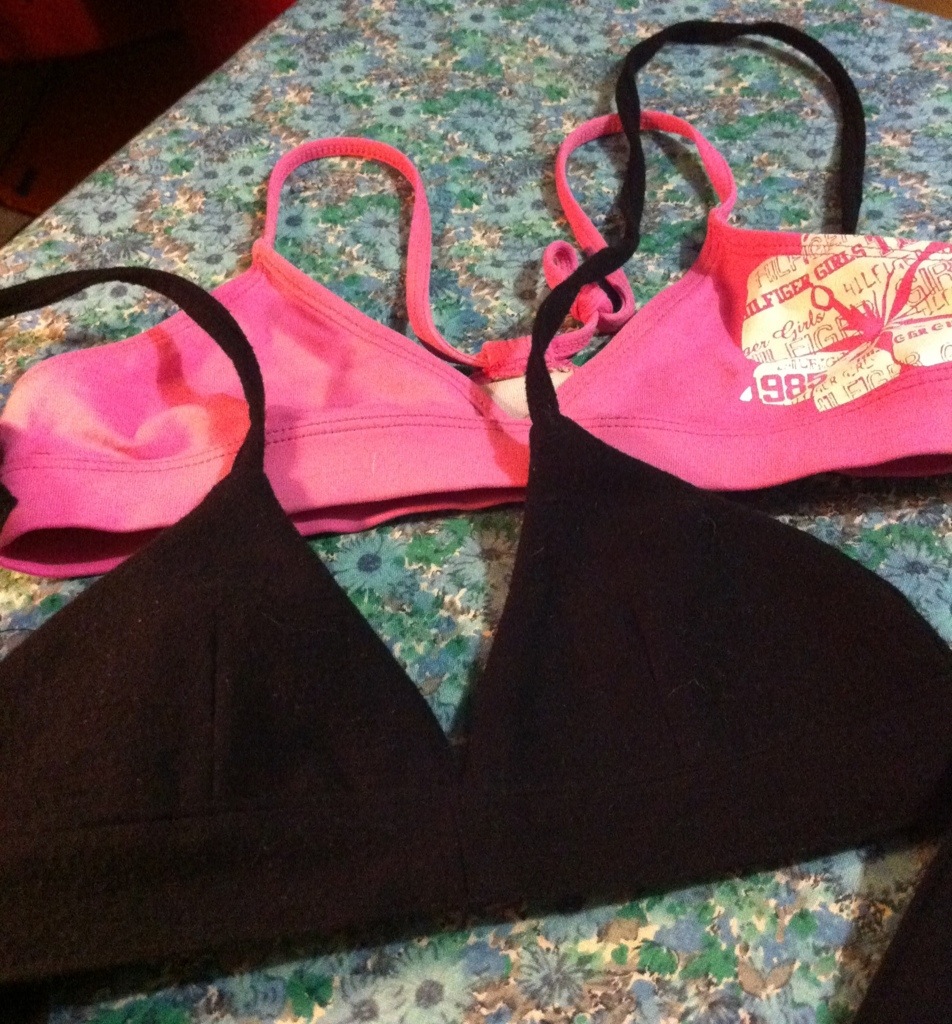
But, this one’s still pretty darn small.

20121207-164257.jpg

Syo needed a coin bra for her ATS costume. You really need a coin bra for tribal, to the point where you almost can’t wear one without looking “Tribal” any more.

Now, for a “grown up” coin bra, you typically use a storebought bra and replace the straps. Since that really wasn’t going to work in this case, I decided to wing it. After consultation with Syo, we settled on some black flannel (her input: soft and comfy. My input: not stretchy. Stretch and coins do not play well together.)

20121207-164242.jpg

I copied the basic shape/scale from a bikini top she has, including a few accomodations. The triangles “slant” a bit towards the centre (to avoid gaping with the halter-ties). I added the world’s teensiest darts. And I interfaced one layer of fleece, and fusetaped the edges of the other, so none of that pesky diagonal stretching. Oh, I do love interfacing. It used to scare the bejeezus out of me, now I can’t live without it.

20121207-164228.jpg

Syo and Tyo added the decorations themselves, mostly leftovers from my own coin-bra making years ago. Although it’s really still rather bare, it was what we could come up with in a limited time-frame. I expect continuing improvements to be made. (Whenever I find the materials. I think they’re at my mom’s.)

20121207-170058.jpg

I have one more “tribal costume” installment, on the little top she’s wearing under the coin bra in the top picture, but I am hoping some photos of the performance will surface for me to share—it looks pretty cool all together, if I do say so myself. /sigh. Also, there were swords involved.

In other project news, I’ve got batting and fabric for my Uncle’s vest, but still have to hunt down a coordinating lining fabric for the pockets, back, etc. Preferably one that won’t make me want to stab myself in the eye while sewing it. My local Fabricland doesn’t have any Kasha, my favourite lining brand, in the right colour. And I am hoping to get some further jeans cut out, sooner rather than later.

4 Comments

Filed under Sewing

Uncle!

This year, for the first time, Osiris and I put our names in with the older generation for my mom’s family’s Christmas draw*. Yep, apparently we are officially All Grown Up. My favourite uncle said (before the draw even happened) that he’d very much like me to make him a kilt, in the event that I should draw his name.**

So naturally, when I did draw his name a few moments later, I figured I knew exactly what to make him. I even picked up a kilt “pattern”*** at the thrift store just before Hallowe’en.

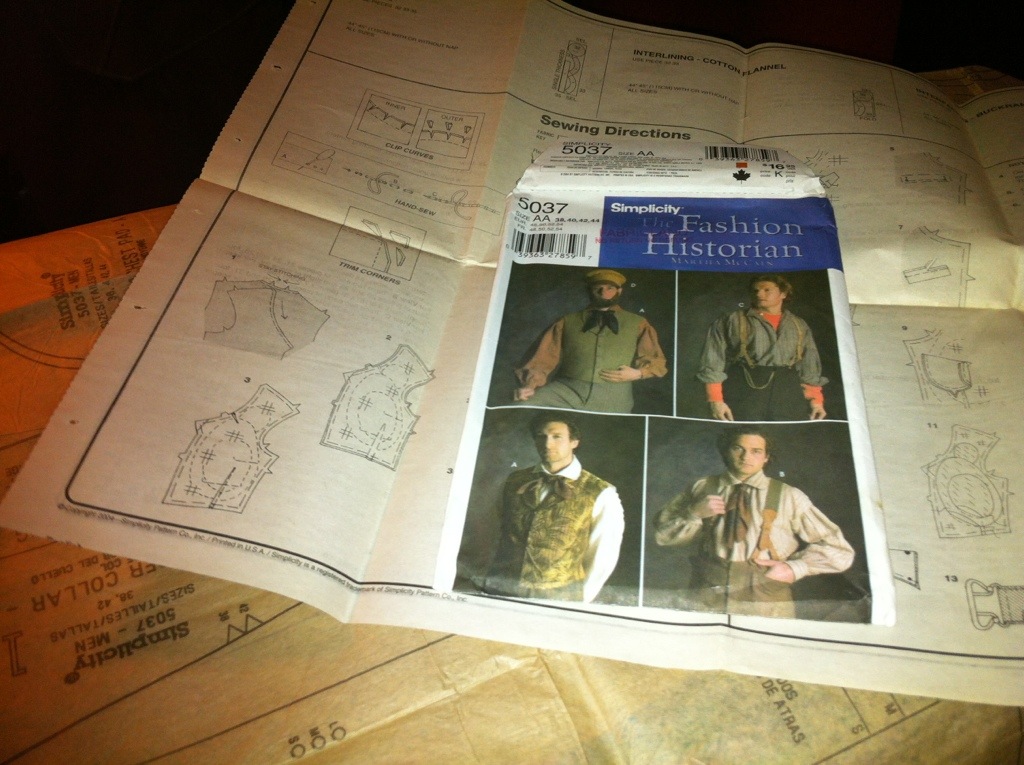
Then I checked the fabric requirements and, um, there’s no way I’m getting five yards of any halfway decent wool tartan for under the spending limit. So I decided I’d make him a vest instead. Possibly a tartan vest. It just so happens that at the same time as I’d picked up the kilt pattern, I’d also gotten a rather intriguing “Fashion Historian” pattern, Simplicity 5037, for an old-fashioned vest and braces. A vest seemed about the right amount of work/cost of materials for a family gift, and I’m pretty sure Uncle will love it anyway. He’s gone out of his way to praise my sewing every time I’ve talked to him in the last couple of years.

20121203-204825.jpg

Well, today I pulled out the pattern, picked a size, and started tracing. I had been secretly a) wondering why the heck a vest and braces constituted an entire pattern, and b) worried that this would be another lame costume pattern. B) was quickly allayed, though—this appeared to be a sophisticated pattern after all, with neat little details like a dart under the front lapel and more welt pockets than you can shake a pocketwatch at.

Vest front, Piece 1. Perfect. Vest Back, piece… 12?

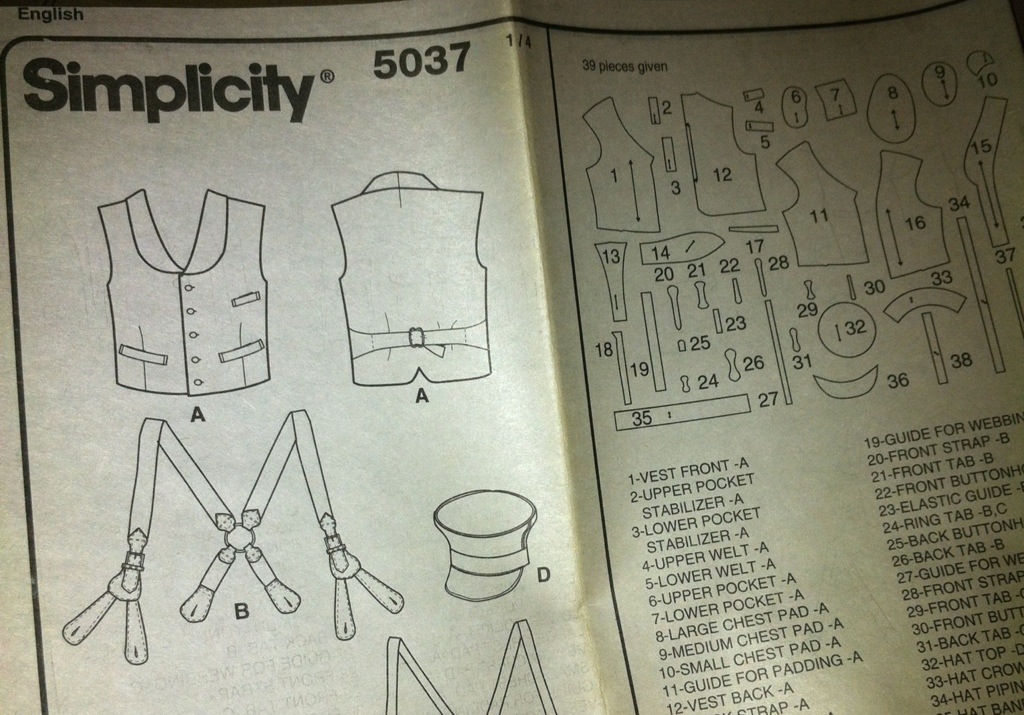
Really? Twelve pieces in the vest alone? I guess that answers why it has its own pattern, practically…

So I went and did what I hadn’t actually done yet, looked up the pattern information.

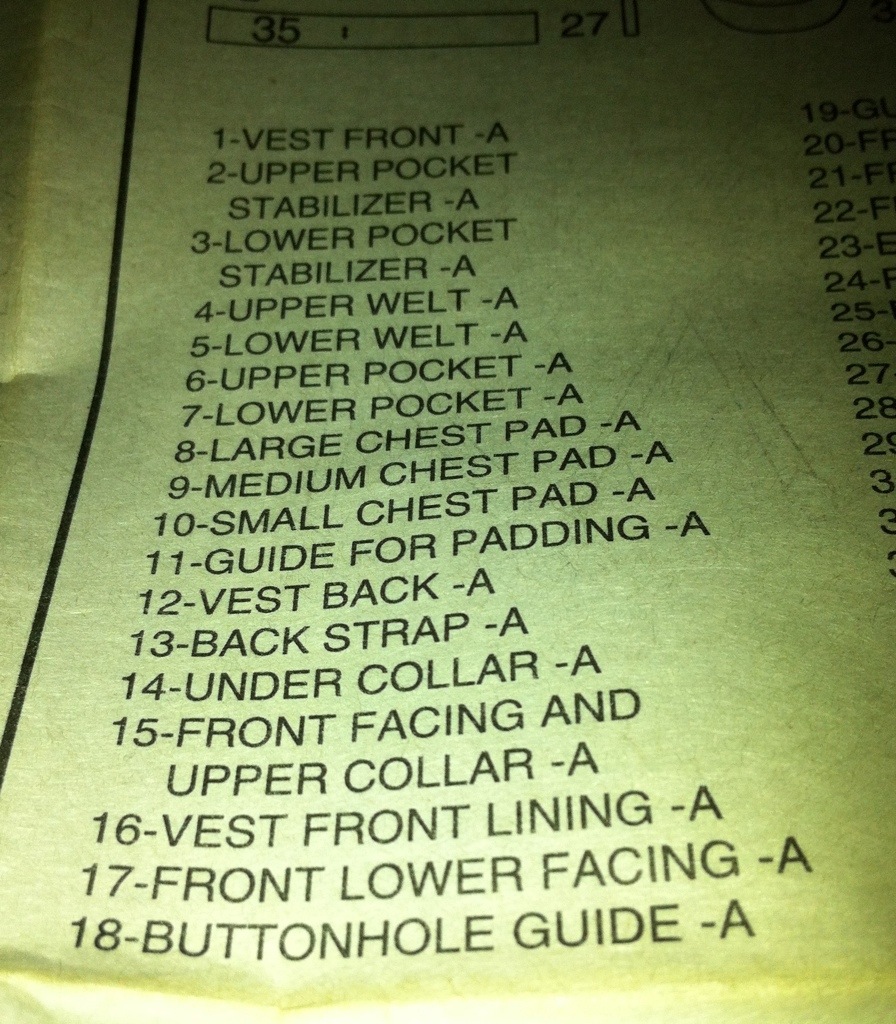
20121203-204832.jpg

I mean, it’s a handsome vest with some neat details, but really, twelve pieces? OK, there is a separate, bias-cut under-collar piece. That’s a good feature. And I suppose those welt pockets have a few extra pattern pieces too. Now what are those oval things?

20121203-204839.jpg

Oh, my, lord.

Eighteen pattern pieces. Including three separate “padding” pieces. There’s actual tailoring on this vest. I’m still kind of in shock. (Also, apparently I need to buy batting.)

And I’m strangely excited. A tailored vest.

But I may have to re-adjust my Christmas sewing timeline. >_<

*Where we all put our names in a hat and draw out the person we'll get a present for. Just in case that's not a widespread phenomenon.
** This is not the Scottish side of the family (although if you want to get all genealogical, I'm like a quarter Scottish). But Robbie Burns Day has become a big thing in their rural municipality in the last few years and, well, in a small town you take your amusements where you find them, I guess.
***I'm not sure which I loathe more, "costume" patterns or paper patterns for things that consist entirely of rectangles. I'm pretty sure this particular "Scottish attire" pattern hit both categories, however.

17 Comments

Filed under Sewing

An accidental sewalong

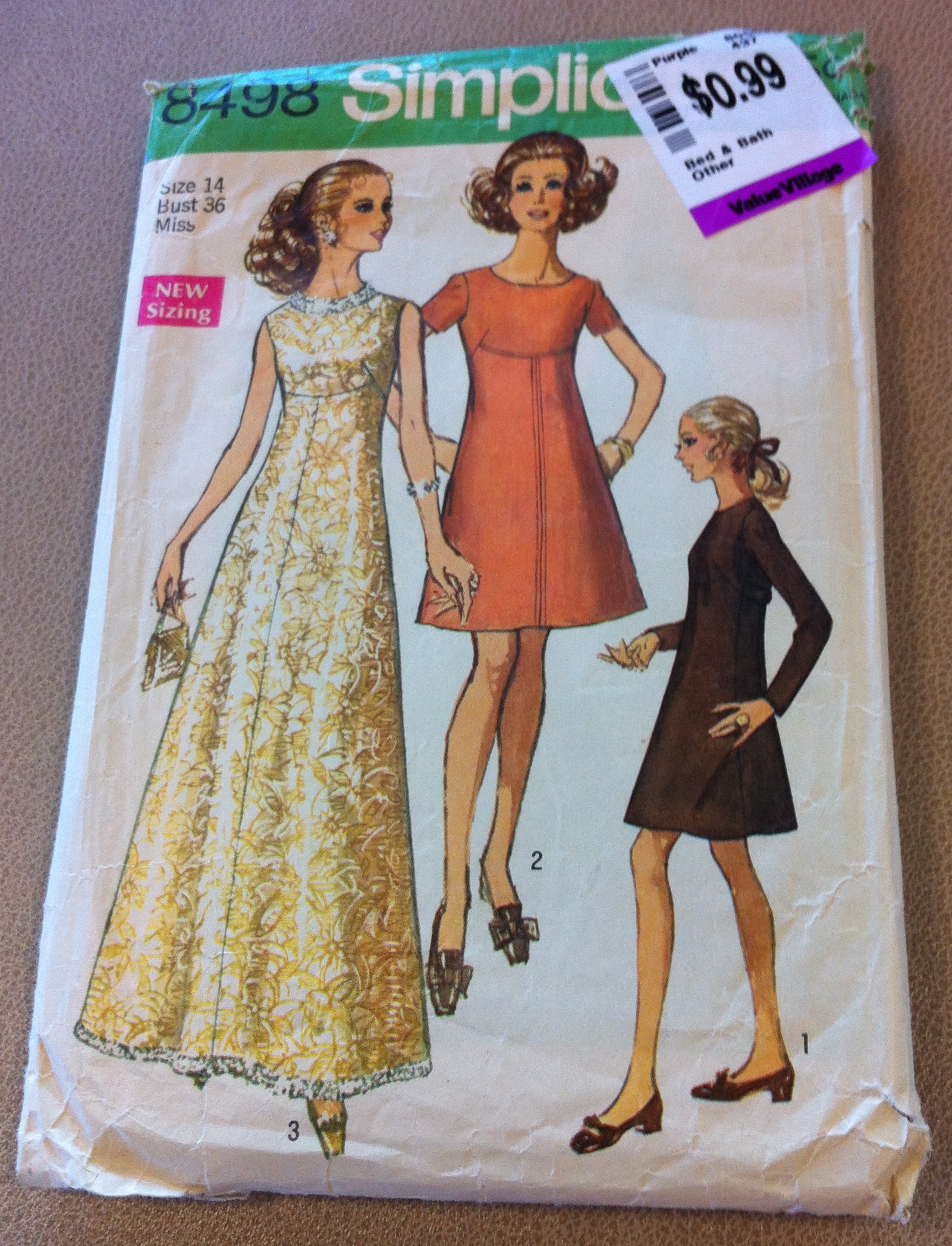
Simplicity 8498

Simplicity 8498

I confessed my sewing-pattern weakness to you a few weeks ago—well, only a few hours later, what did I espy in my Instagram feed, but Nettie of Sown Brooklyn showing off her own (rather more impressive) haul—including the very same pattern!

No sooner had I commented on this, then Vicki, our favorite sewing scientist, mentioned she had it, too! Well, obviously there was nothing to be done but move it to the top of all our queues, right? I could use a Christmas dress myself, and it’s about damn time I made something for ME!

In the quick and excited storm of emails that followed (I do love these impromptu projects!), Nettie dug up a stunning fact. Our mutual find had been reprinted as Simplicity 3833.

And, apparently, made up by at least half the blogosphere.

Nettie found a particularly awesome post comparing the origin and reprinted draft, too.

So maybe we’re a bit late to the game rather than being independently quirky and awesome. Ah, well.

Anyway, if you have Simplicity 8498 (or 3833) and fancy sewing up a Christmas dress along with us, please join in. This won’t be a real sewalong with coaching or crazy couture techniques or anything—but I think we can at least manage a round-up post pre-Xmas, maybe even have a bit of a virtual party at the end to show off everyone’s makes.

20121201-211731.jpg

Fabric of choice?

And some fabric may just have followed me home today… >_<

11 Comments

Filed under Sewing

A tiered skirt workflow

Tiered skirt

Before I get into the meat of this post (the construction of a basic tiered skirt), allow me to philosophize a wee bit. Y’know the best thing about being home? I have my village back. You’ve heard the saying “it takes a village to raise a child”? Well, maybe it doesn’t, but life is sure a lot better when you have one, and not just for the free babysitting. Case in point? My dance class. I bellydance with what just might be one of the best groups of ladies in the universe. I’ve been involved with the troupe for over half my life at this point, and many others have been there longer.

Dancing c. 2005, dodging a very small Syo.

It’s the kind of class where I could bring my kids when they were babies and everyone would hand them off during practice. Where I could show up for street-fair performances with toddlers in tow and never worry that someone wouldn’t watch them while I danced. Where I can talk to the instructor about paying my fees this term in sewing. But the coolest thing since coming back has been the way my kids interact with the troupe now they’re older. Syo, in particular, has decided she wants to dance this year. Not just the kids class. Every class (well, every class that I go to). Which means that most of the costumes I have to make so far are for her, but anyway. It’s so neat to see her following along with the adults, and also the moments in between where one teacher or another takes a few moments to show her something we didn’t do in class, or go over something a bit more slowly.

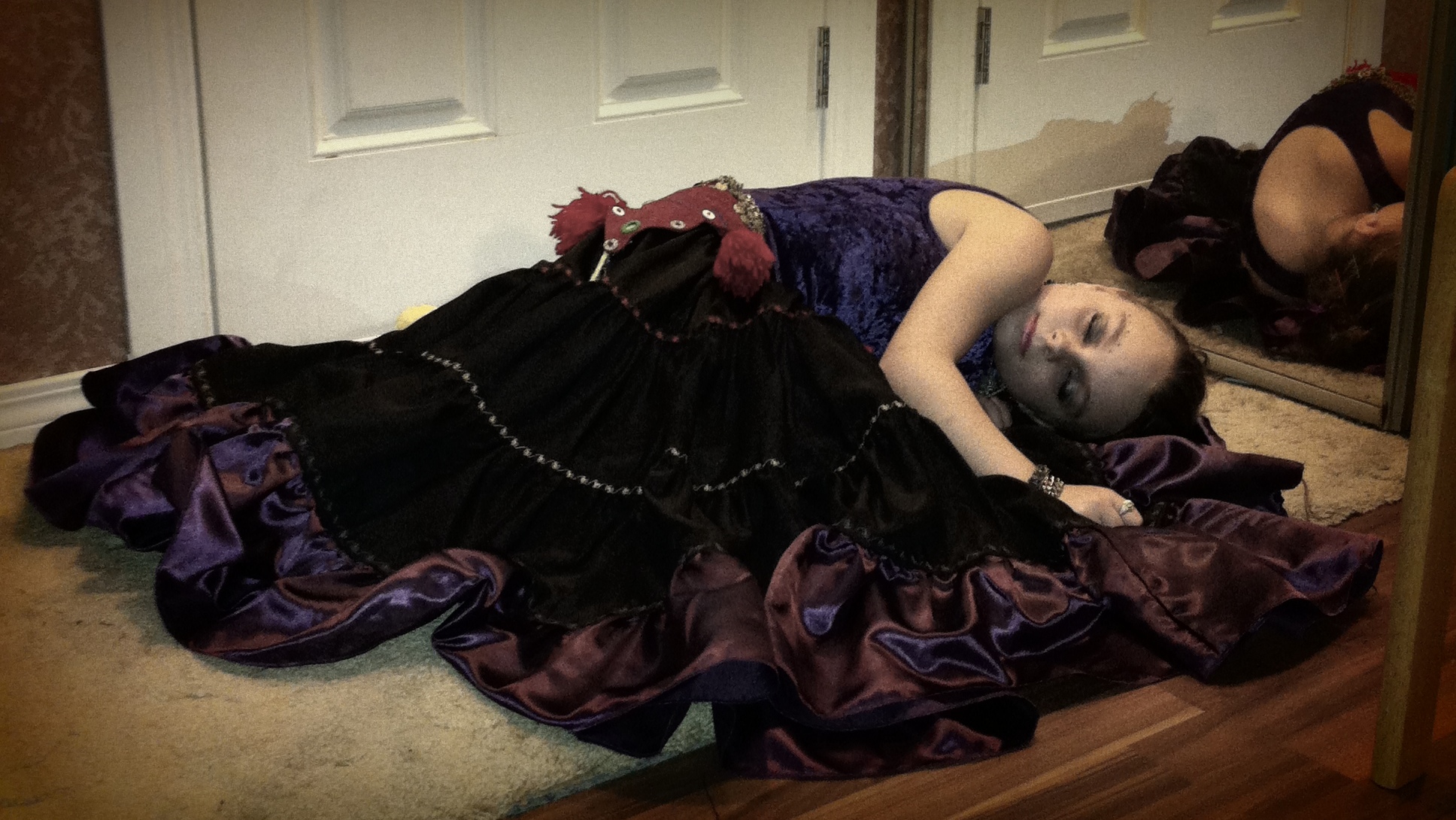
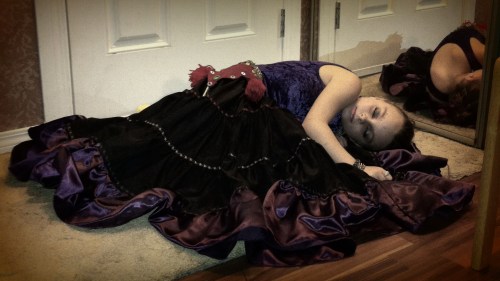
Which ties into this post only because one of the costume pieces I’ve been making for Syo is a tiered skirt for American Tribal Style Bellydance. And while I’m sure most of you don’t have use for a ridiculously full tiered skirt, well, it’s exactly the same idea as making a crinoline or a fluffy petticoat. The only differences really are a matter of proportion, fabric choice, and fullness.

Fluffy petticoat

Now, this is not a particularly original concept for a post, and I know there’s some lovely tutorials out there (feel free to link your fave in the comments!). I particularly like this one by Sugardale, of the petticoat variety, for the fine finish she gets using ribbon to cover the seams. Zena has a nice post or three on her particularly painstaking (and super-well-finished) method. But I’ve made enough of these, at this point, that I feel like I have at least something to contribute in terms of what works, for me. (And I will confess to being much more slapdash and imprecise than either Sugardale or Zena.) This falls into basically two categories:

I) workflow
II) gathering techniques.

I’m going to talk about gathering techniques separately, so today I’m going to go into my workflow.

1) Design Decisions

Tiered skirt in action

A typical tiered skirt is a layer-cake of gathered rectangles of fabric, smallest at the top. The most common gathering ratio is 2:1—that is, each tier is twice as much fabric gathered on to the tier above it. There’s nothing sacred about this ratio, but it’s a handy starting place. How full (or poufy) your skirt is will be determined by several factors: 1) gathering ratio, 2) number of tiers, 3) fabric. I tend to cut (or rip, for preference) my tiers across the width of the fabric, so I tend to measure my fullness in terms of fabric widths. (Ideally 60″/150 cm)

So, how long do you want your skirt to be?
–A typical Tribal skirt goes from hip to floor. A typical petticoat, maybe from waist to knee. I’m told petticoats should be about 1″ shorter than the skirt they go with, if that’s what you’re trying for. Measure this distance on yourself.

A long, long time ago…

How many tiers?
A minimal tiered skirt has three tiers (two doesn’t work. I tried. It looks like a dumpy mermaid skirt). Personally, being a fan of excess, I like four or five or, y’know, nine. OK, 9 was maybe overkill. (Obviously: number of tiers interacts with your gathering ratio to create fullness: eg. at a 2:1 ratio, if your top tier is two widths and you have three tiers, you’ll have eight widths on the bottom tier. If you have four tiers, the same ratios will give you a bottom tier with 16 widths, unless you reduce the gathering ratio.

For Syo’s skirt, I picked four tiers. I planned for the top tier to be one fabric width (60″/150cm in this case), next tier down two fabric widths, ending up with eight at the bottom tier.

Divide your skirt length by the number of tiers

For Syo, this was: 28″/4—my tiers for Syo’s skirt needed to be 7″ high. Add width for two seam allowances to each tier—for simplicity’s sake, I’ll go with 1/2″ seam allowances, so I add 1″ to each tier. So I’m going to cut all my tiers 8″ high.)

Advanced Tip #1: Some people are particular about where the tiers fall on their body—there’s no rule they all have to be the same widths. It just makes the calculations a bit more complicated. Similarly if you want to allow for a waistband casing on the top tier, or a wider or narrower hem on the bottom tier.)

This skirt has seven or eight tiers and thirty-two fabric widths along the bottom tier. This is overkill.

How full at the hips?
My first few skirts I made as narrow at the top as I could. I’ve since decided this isn’t actually the best look, especially if your tiers are tall (or, like me, your hips need all the help they can get). For Syo here, I used one fabric width for the top tier; I’d probably do this for myself if I made another skirt, at least if the fabric was 60″ wide. If you’re quite large, one and a half widths or even two would be good.

Advanced Tip #2: If you’re concerned with bulk at the hips, you could make your top tier circular or semi-circular. You will have to correct for some bias stretching, but this is a really nice look. This also uses a bit more fabric.

Full Skirt

How full at the hem?

A “typical” ATS tiered skirt is sometimes called a ten-yard skirt—it has ten yards of fullness at the hem. A petticoat could have much less, a crinoline much more. I actually prefer my ATS skirts much more full, in the 20+ yard range. Note that this is just the length of the bottom tier, not how many yards of fabric are required, although skirts like these are still fabric pigs.

Anyway, for Syo’s skirt, I didn’t want to go too overboard (as I have in the past for myself), but I also didn’t want to skimp. I decided to stick with my default gathering-ratio to determine the number of tiers at the hem:

2:1 gathering ratio, 4 tiers

1 width
2 widths
4 widths
8 widths

Since my fabric was 60″/150 cm wide, this will give me a final hem of 13.3 yards/12 metres. Just over my “bare minimum” of ten yards.

Advanced tip #3: depending on the fabric, it can be just as easy to construct your skirt using strips cut lengthwise from your fabric. I find it easier to do the calculations (especially determining how much fabric I need) using widths, but on the other hand there’s less joining together of panels of fabric if you use one or two long lengths rather than eight or ten or twenty short ones.

A very minimal tiered skirt

So, how many fabric widths is that?

8+4+2+1=15.

I will need to be able to rip/cut fifteen strips from my fabric length.

Now, how much fabric do I need?
15 widths x 8″ high = 120″ = 10′ = ~3m. (Ooo, look what I did, switching to metric like that. I wish I had the self-discipline to do it all in metric. I think Imperial is kind of like a drug… awkward and bad for you, but you keep coming back to it…)

I would, however, recommend buying a bit more fabric than strictly necessary. At least one extra tier’s worth. Sometimes, not everything works out according to the math. You may also want to add a waistband casing on the top.

Construction
There are many ways you could go about constructing a skirt like this—mine is what works for me psychologially.

1) Cut fabric
First, I cut or rip my fabric into panels (I’ll keep calling them widths) of the right height. If I can at all possibly rip the fabric, I will, but for this project I was using satin (oh, how I hate satin) and I had to cut.

For this project, I was using two different fabrics—I cut the eight widths for the bottom tier from the purple satin and the remaining seven widths from the black satin.

I always start with the bottom tier—it’s the most daunting, by far, and once it’s complete the skirt is over half done!

2) join panels together.
Join enough panels to make your bottom tier. For troubleshooting reasons, I usually don’t do all the tiers at once.

Finish the seams as you go, using your preferred method (mine is to use the selvedges so I don’t need to finish them. 😉 )

NOTE: I do all the construction for a tiered skirt flat—I will sew the single vertical seam turning it into a “tube” (cone?) almost dead last.

3) hem bottom edge.
I use a rolled hem foot on a regular sewing machine; if your serger does a fancy, easy rolled hem, that would work fine, too. Or, of course, lace or ribbon if you’re making a petticoat. This is a great chance to practice your rolled-hem technique, though, as a) a perfectly straight edge is the easiest to hem, and b) over this many feet of hem, you really won’t care about the odd booboo later.

4) Gather upper edge of bottom tier.
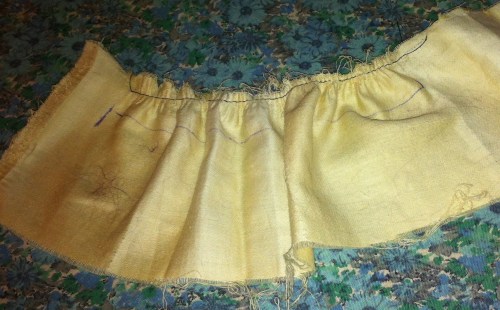
I use a ruffler attachment for this stage. I’ll talk more about the particulars of the different gathering techniques in the future. If you don’t have a ruffler foot, I’d recommend using a zigzag casing gathering technique, which I’ll also talk about next post.
Testing the gathering ratio.

5) Measure gathered length, and make next tier up accordingly.
This only really applies if you’re using a ruffler foot, which produces a gathered length of a fairly fixed ratio. Otherwise just make up your next tier, and arrange the gathers on it.

6) Attach gathered bottom tier to next tier up.
On a ruffler foot, it is actually possible to do steps 4 and 6 together. I don’t usually do this, mostly because I’m chickenshit. Also I feel more secure having two rows of stitching in place. Finish the seam allowance using your preferred method.

Fancy topstitching

Advanced tip: I really like a bit of topstitching to hold my seam allowance up… it smooths things out and tidies the inside. In this case I got to play with embroidery stitches on the fancy machine, so WOOT!

7) Repeat steps 4-6 until all tiers are attached.

8) Sew vertical seam along whole length of skirt. Finish as desired.

9) add elastic/drawstring casing to top edge of skirt.

10) Wear, and sweep them off their feet! 🙂

Ooo lala!

Troubleshooting
I mentioned above not making your next tier up until the lower one has been gathered. This applies if you’re using a ruffling attachment, or using a differential feed on your serger. Although the ratio of gathering it outputs is adjustable and you can (and should) do some tests to make sure your ratio is roughly correct before you start, often (always) there is a slight discrepancy between your calculated gathered length and your actual gathered length. This isn’t the end of the world, but it does require a bit of finessing. I usually make my next tier up to match my actual length, which can involve adding a bit more fabric or shortening the tier by a little bit. A few inches one way or another is NOT going to affect the final look of your project. (Although ask me about the time what I thought was a 2:1 ratio turned out to be more like a 4:1 ratio…)

In this particular case, it turned out I only had enough of the purple satin to make seven panels, not the eight I had planned for. I used a slightly lower gathering ratio… and really no one will ever notice a difference.

The other thing that can be a bit of a wild-card is length, partly because of some simplifications I made in the calculations (not accounting for hem depth or added width for an elastic casing on the top tier), but mostly, in my experience, having to do with how much a fabric stretches under the weight of all those tiers, or shortens (visually) as it poofs out, in the crinoline variety. The easiest way to adjust the length of a tiered skirt is on the top tier, by removing (pretty obvious) or adding length—usually just adding a casting or waistband to the top is enough for the kind of adjustments I’m talking about.

And finally, don’t sweat the small stuff. Tiered skirts of any variety are exercises in excess—there is a lot of fabric involved, a lot of hems, a lot of poof. Small flaws in your hemming or slightly uneven gathering will not be noticeable.
Whew!

Whew! That’s a lot of post. And a lot of memories. Not exactly a tutorial… but that’s how I do it.
17 Comments

Filed under Sewing

Veni, Vidi, Vici*

20121123-233441.jpg

I win.

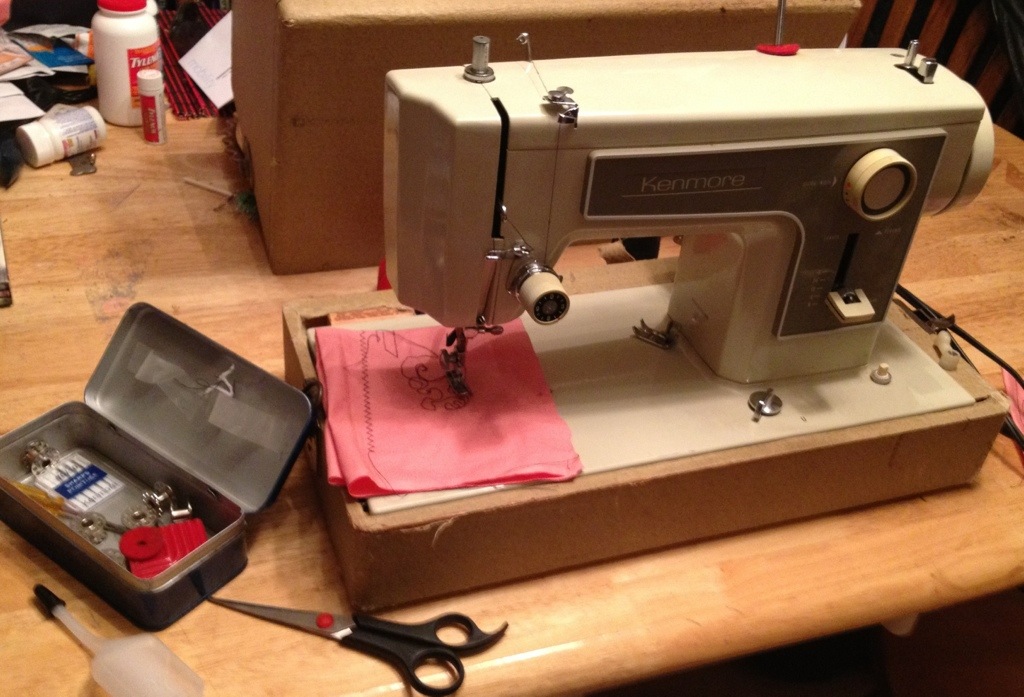
This machine, an elderly Kenmore belonging to my Crafty sister-in-law, has been my nemesis for a while. OK, about two weeks. Crafty assured me that last time it was used (some years ago, admittedly) it ran just fine. Well, it ran—stiffly, as one might imagine—but it would not form a stitch for me to save my life. I messed with the needle orientation, the threading, the tension. Nothing seemed to work. It was like the bobbin thread was being pulled up at the wrong time to make a stitch. Crafty was, not, as you might expect, thrilled at the prospect of a $100 tune-up for a machine in that “old enough to be crusty but not old enough to be cool and vintage” age bracket.

A week or two ago, as I may have mentioned, Crafty and I found ourselves at loose ends in the mall whilst Crafty’s daughter (my fifteen-year-old niece) got her hair done. Neither of us are really mall people, so once we’d exhausted the one small bookstore, we were pretty bored. And it was Remembrance Day Sunday, so nothing but the mall was open. (A pity since there’s three or four little fabric and sewing-related shops within a few blocks radius of the downtown mall) But we did manage to find the tiny remnant of a sewing section in Sears (home, of course, of Kenmore,) and Crafty took the opportunity to pick up a few more bobbins, sewing machine oil, and, most importantly, needles. Well, finally tonight we had a chance to sit down and see if any of those things were the deciding factor. We applied oil (liberally. Stupid oil bottles with the cut-off tip that it’s almost impossible to cut off small enough.) We changed out the needle. I wound a new bobbin, and threaded her up just exactly like my Featherweight.

20121123-234324.jpg

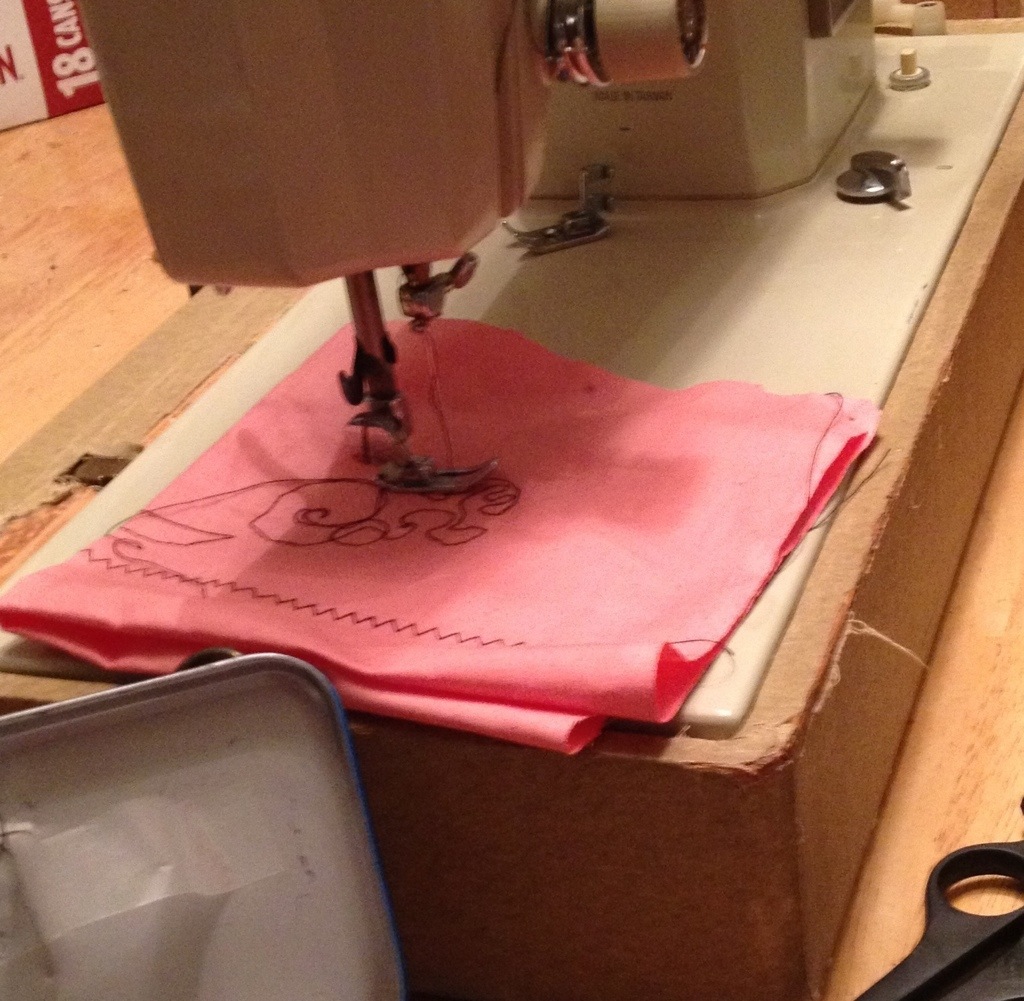
And she sewed. She even (since I thought Crafty might enjoy that sort of thing) stitched free-motion with the feed dogs dropped.

BAHAHAHAHA! TAKE THAT, SEWING DEMONS! In the name of all the sewing gods, I banish you! BAHAHAHAHA!

stupid needle.

… now if only I can get the bloody Piedmont re-wired…

*Also, am I the only one who learnt all my Roman history from reading Asterix and Obelix comic books?

12 Comments

Filed under Sewing

Hallowe’en Roundup

20121118-215412.jpg

Actual Hallowe’en photo

Okay, why is it so hard to get good Hallowe’en photos? every year I vow that I will, and every year I end up with a couple of fuzzy shots of kids running away to the next house while trick-or-treating. >_<

20121118-215506.jpg

The best actual Hallowe’en picture.

Anyway, I’d say the Steampunk costumes were a success, at least as costumes. As costumes for Hallowe’en in Saskatchewan… not so much. I think the last several years in balmy southern Alberta kind of messed with my head in the Hallowe’en-costume-planning department. Note To Tanit: Saskatchewan Hallowe’en costumes should be: showing NO skin, ideally can cover a snow suit. Scarves are a bonus.

It took me the better part of a month to work up the energy to wrangle the girls back into costume (and makeup), and at this point I’m really too tired of all of it to do much introspection. Which is too bad, because there’s probably a fair bit left to say, if only about the jackets.

20121118-215203.jpg

Yes, so late the Christmas tree is already up.
(Note—I didn’t put the tree up.)

OK, I know you pretty much saw that one already. Anyway, prepare for pretty much a photo essay, with minimal commentary.

20121118-215215.jpg

Tyo, giving me crap for taking the photos so late.

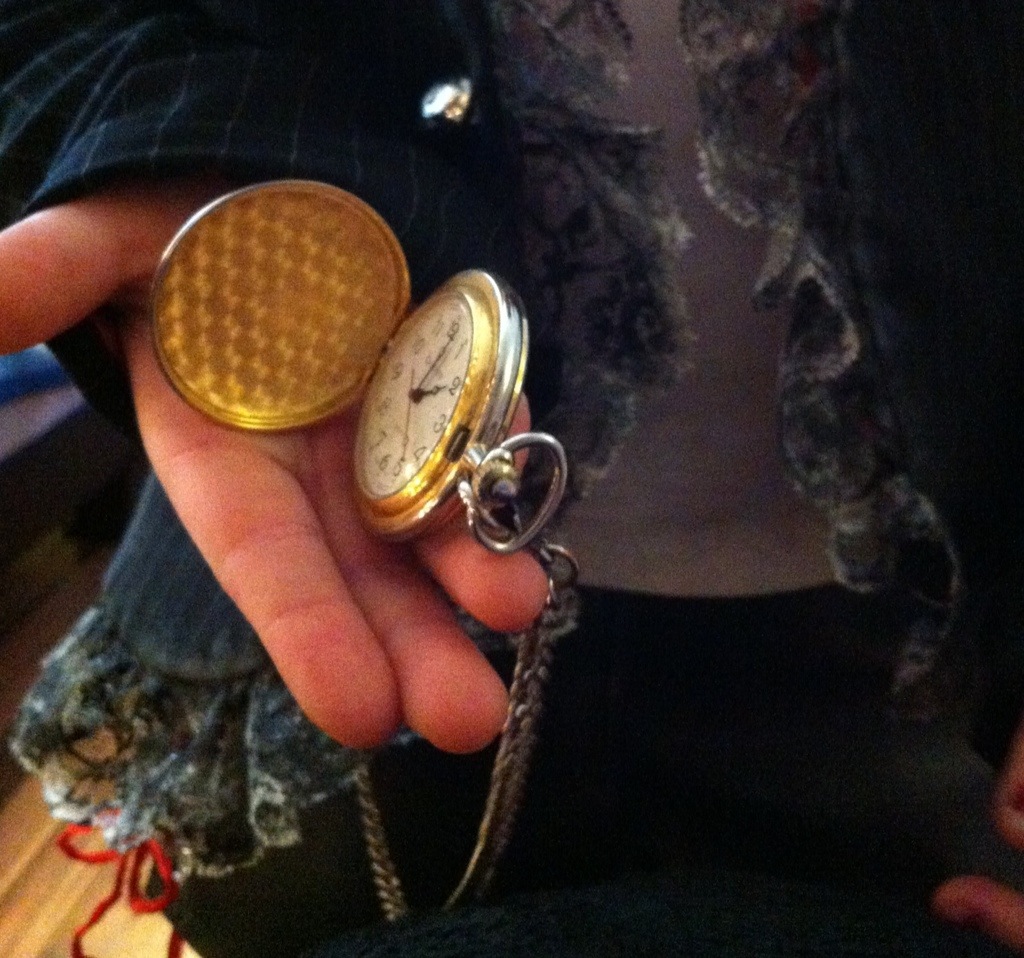
Pocket watches were an important elements of the costumes.

20121118-215225.jpg

A long-awaited closeup of Syo’s hat

I must confess, I think Syo’s hat with the painted holly berries actually crosses the seasons nicely.

20121118-215250.jpg

Syo’s pocketwatch. All pocketwatches courtesy of my mother. (Without whom these costumes really wouldn’t have happened, I think.)

The tailcoats were adapted from the much-maligned McCall’s 5312.  Originally Syo didn’t want one, but it turned out the size 10 was too small for Tyo, and Syo consented to wear it (thankfully, as she would’ve been even colder than she was already without it). She’s been wearing it at least weekly since, so I think that’s a win.

20121118-215237.jpg

Tailcoat and monocle.

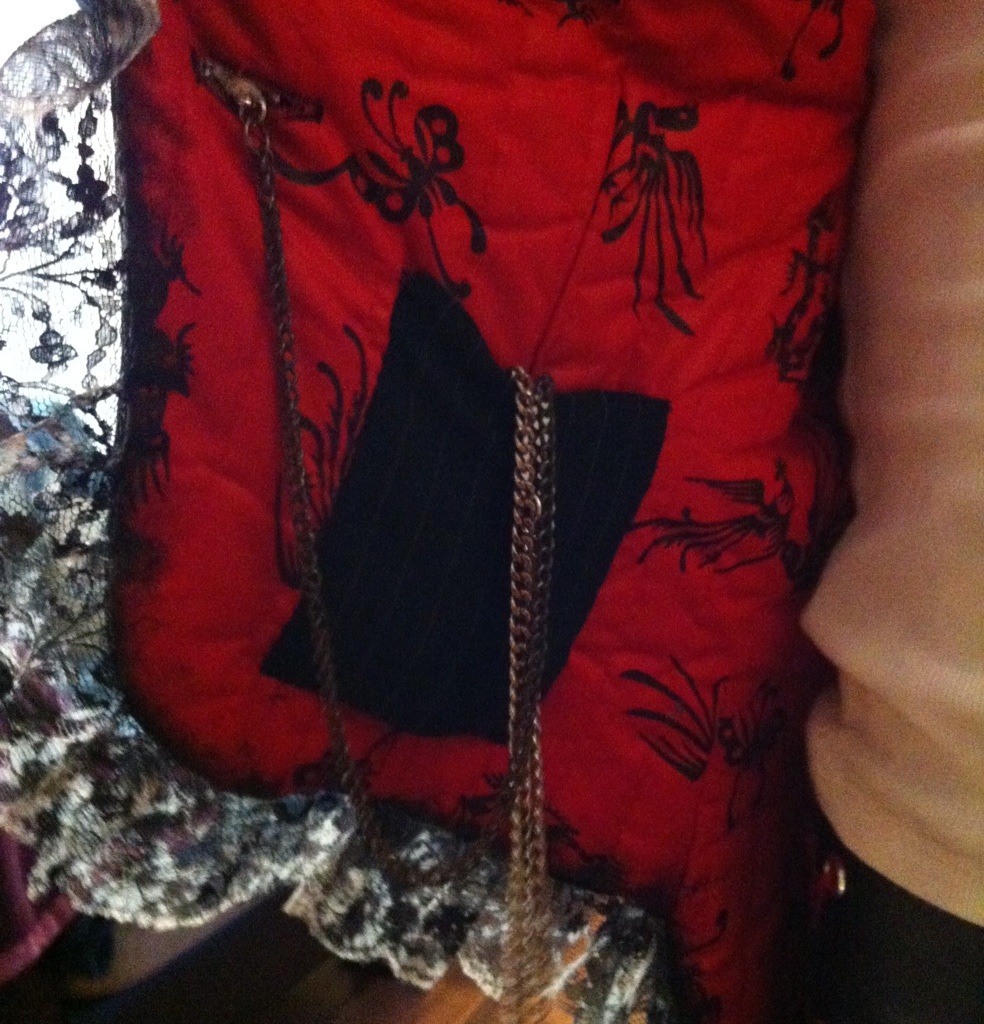
Syo requested an internal pocket for her pocketwatch. Tyo didn’t, but I should’ve included one anyway. Oops.

20121118-215305.jpg

Internal pocketwatch pocket.

Syo’s monocle actually turned out really cool (and had an actual magnifying lens, too). It’s made from an old earring and some kind of jeweller’s loupe. Unfortunately it spent the entire actual Hallowe’en tucked in a pocket with the pocketwatch.

20121118-215315.jpg

Syo with monocle

I had a lot of fun painting the jackets with black, brown, and silver. Why? Well, mostly because. Also, it was fun. I lined the jackets with this fun printed quilted lining fabric I picked up at Value Village on a whim sometime last spring—it was one of those things I really wasn’t sure I should ever have bought, since it’s right on the border between awesome (a cool print) and horrible (quilted lining is one of those things I generally loathe). However, it really came into its own here, I think—giving body to the  wimpy suiting fabric I was using for the shells, and adding much-needed warmth. Seriously, I can’t believe how long my kids wore these outside. It was -7C, -14C with the wind chill, and we were out for almost three hours, with only a couple of warm-up stops.

20121118-215329.jpg

Jackets. Also, I want to eat your brains. But your hat first.

My mom offloaded generously gave us a bag of old stenciling supplies a week or two before Hallowe’en, including a lovely, delicate rose stencil. I couldn’t resist adding it to the coats in a couple of places. I just used the same acrylic paint I used on the rest of the coats. I don’t particularly expect a lot from this down the road, but it served the purpose at the time.

20121118-215542.jpg

Painted jacket: ruffle trim and stenciled rose.

I think that’s about enough. I added length to the sleeves of the coats, and the tails, of course. I think I didn’t get the button positioning quite right, as the lapels (which I interfaced) rolled nicely but sat better before I put the buttons on.

And now, on to more recent things. I have a backlog building up, as those (few) of you following on twitter or instagram probably know already…

Of course, none of it’s been for me. *pout*

14 Comments

Filed under Sewing

Hallowe’en Spotlight: High Waisted Shorts

I know. This post (and the next, where I will finish up the whole Hallowe’en costume craziness) are late. Late late late. Late enough that some organized person (not me) has the freakin’ Christmas tree up. This is the post where I tell you about one more bit of Tyo’s Hallowe’en costume: her high-waisted shorts.

20121118-215028.jpg

Way back when, when Hallowe’en was just a misty possibility on the horizon, I doodled a costume sketch for Tyo. It included, as a bit of whimsy, a feature completely and utterly alien to children of her generation—high waisted shorts.

As an avid adopter of the low rise myself, I know for a fact Tyo’s never worn anything (pants, shorts, skirts) as high as even her bellybutton, ever, in her life. But there I was, offering to make Tyo her very first pair of high-waisted anything, ever.

Despite my doodling, I was hesitant. They won’t open like jeans you’re used to, I pointed out.

They will feel different.

20121118-215038.jpg

She assured me it would be fine.

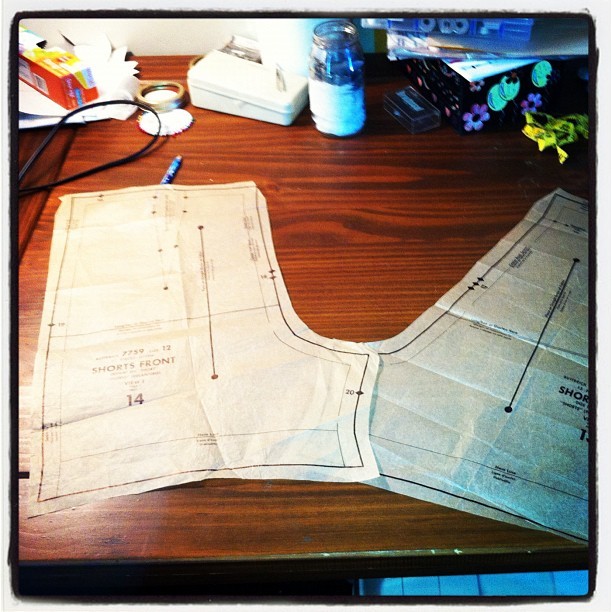
I went through a lot of different thought processes—even started to draft out a pattern using Pepin. Then, when I found Butterick 7759 in a vintage size 12 (33″ hips, within an inch of Tyo’s these days), it seemed like fate.

Butterick 7759

Well, I can’t say I’d call it fate. I’m not really super-duper-enthused with Butterick 7759. Although it clearly is supposed to rise about an inch above the waist, there’s no flare-out above the waist to accomodate what (I would think) most people’s bodies do. But my biggest quibble is the shaping of the crotch—back and front are almost identical, and there’s not a whole lot of “space” created. After comparing with the fit of McCall’s 5312 (Yes, I actually used that pattern as a fit comparison!?!), I added a crotch length extension. I considered adding my usual rear rise wedge as well, but figured there would be plenty of height in the rise anyway, since the pattern was probably drafted for someone rather taller than Tyo (who hasn’t cracked five feet yet, although she’s getting perilously close.)

Pattern pieces

So, aside from my small pattern mod, and adding the points at the front, I sewed them up as is except for the back darts. In hindsight I might’ve skipped the front darts and saved myself some headaches—they make the front of the shorts a bit poofy, which Tyo was not really a fan of.

20121118-215051.jpg

I assume there actually is a person out there with a figure suited to front darts. I just haven’t met them yet. Or maybe that’s how pants/shorts like this are supposed to fit, all poofy in front? How the hell would I know—I haven’t worn anything but stretch denim voluntarily since I discovered the stuff.

This is an actual photo taken Hallowe’en morning before school. Shorts. With snow pants.

When I first started fitting the shorts, Tyo was suddenly very sceptical of the high-waisted fit, and I was very close to tearing her head off. Fortunately for her (and for my continued jail-free existence), once I had the zipper in and they actually stayed up, she really, really liked it. The only hitch came with me adding in my own (made up, half-ass) facing. I had incorporated some above-waist flare when I made the custom-fit back darts, but when I was measuring the facing against the shorts themselves, that flare kind of folded itself up. So the facing rectangle wound up slightly shorter than the shorts had been. It eased in all right and doesn’t really show, but the waist/rib section is a bit more snug. Most of the time she wore it, the zipper was down about one or two inches. Which actually looks pretty cute, but fit, it is not.
20121118-215104.jpg

All in all? I don’t know if she’s a high-waisted convert (although my 15 year old niece was asking about shorts “to her waist, to tuck things into,” so you know the times they are a-changin’) but it was certainly an interesting exercise outside both our comfort zones. And the results were pretty darn cute. Even if I do still have a long way to go in fitting what we’ve affectionately dubbed the Gigi booty. (After the paternal grandmother to whom we can trace this particular figure in my husband’s family)

Also, anyone remember when Tyo looked like this? What the heck happened to my baby?

29 Comments

Filed under Sewing

I am not stone.

20121117-211440.jpg

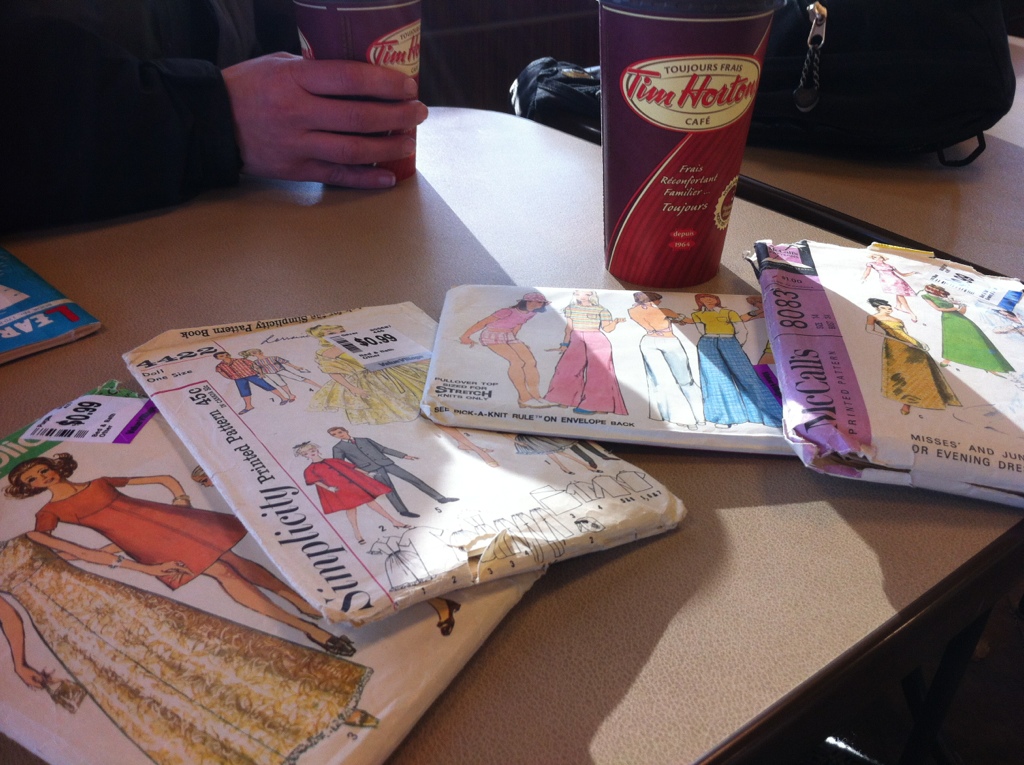
I’ve been so good. I hadn’t bought a pattern in nearly two months. And today, I totally blew it. All adorable, none actually necessary. And, Simplicity 4422 is a Barbie wardrobe pattern. My kids don’t play with Barbies, and while I cherish my remaining dolls, I have no intention of adding to their wardrobe. But how could I leave it? >_<

21 Comments

November 17, 2012 · 8:21 pm

Thank you!!!!

20121115-111008.jpg

Thanks, Lady Katza!!! Your (super speedy) package totally made my week. 🙂

3 Comments

November 15, 2012 · 10:11 am

Enablers Everywhere

Everywhere, I tell you. No sooner had I walked in to my mom’s this past weekend for our near-weekly dinner, then what did I espy, but a cream-and-teal, alligator-texture, sewing machine case. Oh, Mother.

What’s inside?

Well, it turns out the culprit this time is less my mother than my mother’s boyfriend. This does not actually make it any better, but the machine is going to continue to live at their house. With my Improved Seamstress treadle and the Army Machine and my mom’s Pfaff 360 and Featherweight. Which is not as pretty as my Featherweight, but has all its attachments. Yes, that’s five machines (only one of which isn’t a straight stitch), in the house of two people who “don’t sew.”

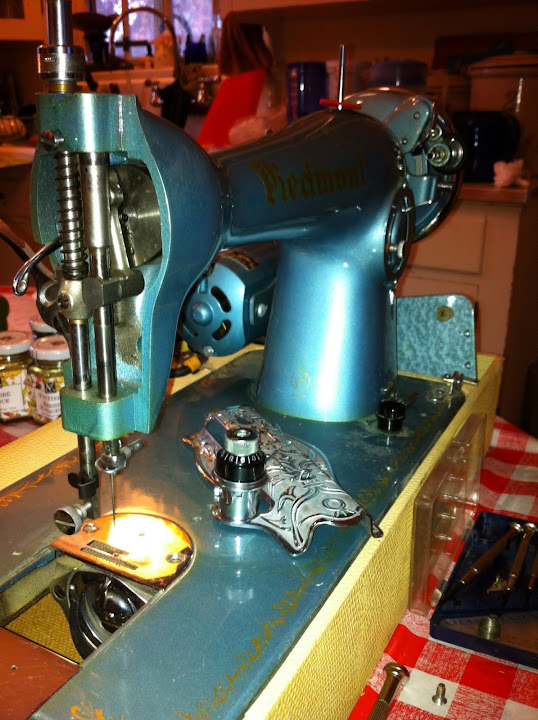
Piedmont

When I opened the case, my eyes were greeted by this gorgeous teal “Piedmont” machine. So pretty, very clean, in lovely condition. Apparently it has been languishing at my mom’s boyfriend’s favourite pawnshop for some time now, and finally he couldn’t bear to leave it there any longer. Thank you, MBF. Except. No attachments. Boo. I like attachments. (Also, I realized when I wanted to hem something last weekend, all the hemmer attachments that are wider than a rolled hem are at my mom’s. That’s like, three different sets. All there. None at my MIL’s or Stylish’s house. Which are the ones close at hand.)

Wiring. Eek.

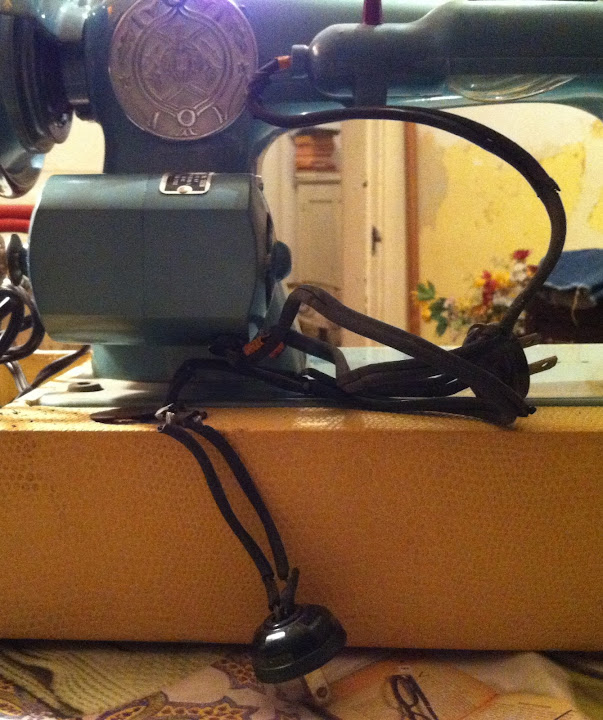
And, even worse than the lack of attachments, the belt is missing and the wiring needs some serious work. The belt is not hard to replace (Sew Classic, for example) but I’m a bit freaked about the wiring. The wiring to the wall and the pedal actually appears to have been replaced previously—it’s much newer, undamaged, and the plug types are more modern-looking. But the wiring running from the weird plug-thing in the case to both the motor and the light is totally shot. Beyond scary. On the up-side, my mom has re-wired stuff before, and my father-in-law knows his way around a motor, probably blindfolded, and has promised me he has my back.

Cleaning. Not that it needed much.

The machine is marked “Piedmont”, which internet scuttlebutt suggests was a badge of the Hudson’s Bay Company (another Great Canadian Department Store) for generic Japanese-made machines of the post-war period. (“Badge” is old-sewing-machine-collectorese for a brand name put on a machine for sale by a particular vendor. Like “Improved Seamstress” was the badge Eaton’s Department Store put on machines manufactured by the National Sewing Machine Company. OK, maybe that’s self evident, but it took me a bit to work it out.) It does look to be a clone of a Singer 15 something, though, not that I know anything about Singers.

I’m reasonably comfortable asserting that it was manufactured somewhere between 1945 and 1960 (the 60s machines start looking modern. Less firmly, I’m thinking probably towards the later part of the fifties, since the colour and plastic knob for the feed drop are a bit “newer” but the style of the overall machine is still very old school. The serial # is C788793, although the consensus on the Yahoo Japanese sewing machine group and other places about these machines seems to be: “You’ll never find out who exactly made it, it’s somewhere in Japan and sometime after WWII. And NO, it wasn’t made by Singer.” There was a helpful generic manual, though, that should do the trick.

Bobbin case

Aside from the wiring (as if that’s not the hugest aside in the world), it’s in lovely shape. The decals are pretty much unworn, there’s scarcely a scratch in the finish. It moved very, very stiffly when I first touched it, but after oiling every spot I could think of, plus a couple of hours to sit while we ate dinner, it was moving nice and freely. It had one bobbin in the bobbin case and two more in the bottom, but on inspection the one in the case itself was not quite the right size. I wound one of the other ones on my mom’s Pfaff (also not the right size, but it worked for bobbin-winding, anyway) and by dint of laborious hand-wheeling got a perfectly lovely, balanced stitch. The only thing I wasn’t able to do (aside from wriggle my nose to make the wiring magically repair itself) was to get the needle plate off; one of the screws came out perfectly, but the other is stuck. I gooped a lot of oil on it and will try again next time. I brushed as much lint off from underneath as I could, and it doesn’t seem to have any problems moving, but I’d still like to be able to clean out under there.  And the stitch-length lever has this little adjuster knob beside it that sets the maximum length you can move the lever to in either direction.

Which is to say, all in all it’s an adorable little machine, assuming the whole wiring thing can be remedied. Because, y’know, I needed another straight stitch vintage sewing machine.

But, I mean, c’mon. TEAL.

22 Comments

Filed under Sewing