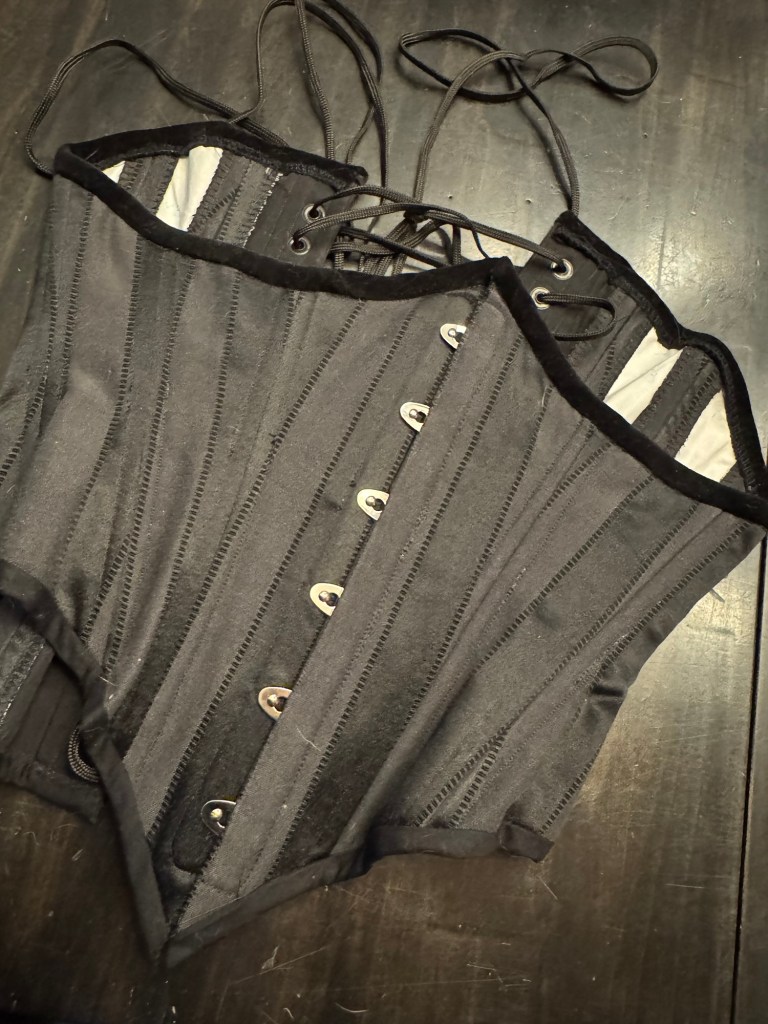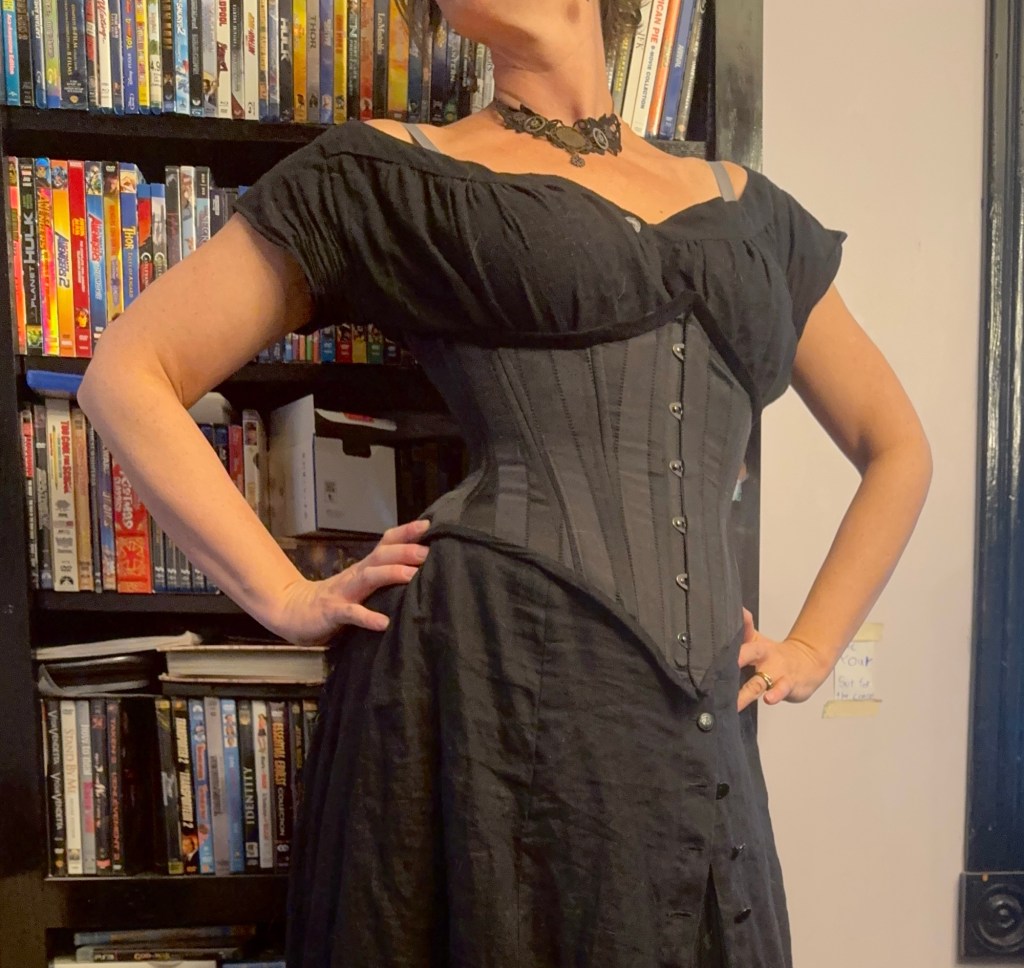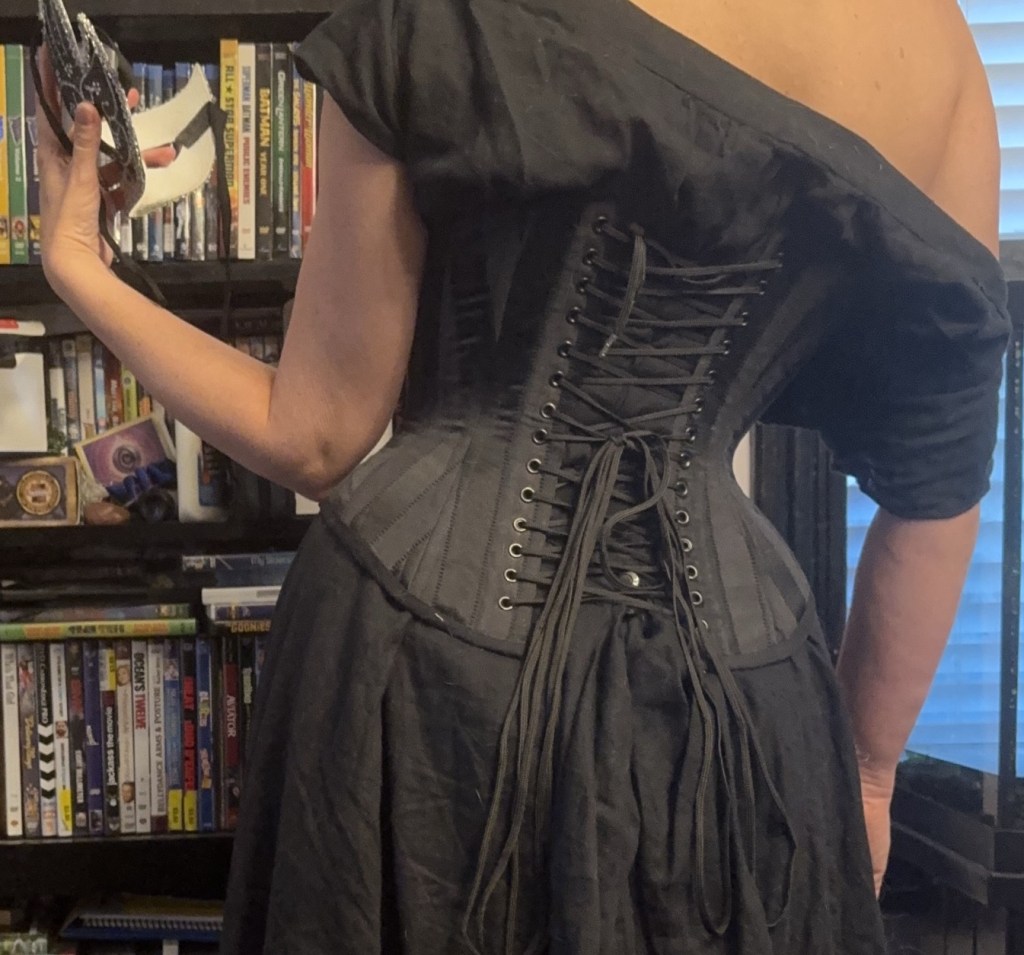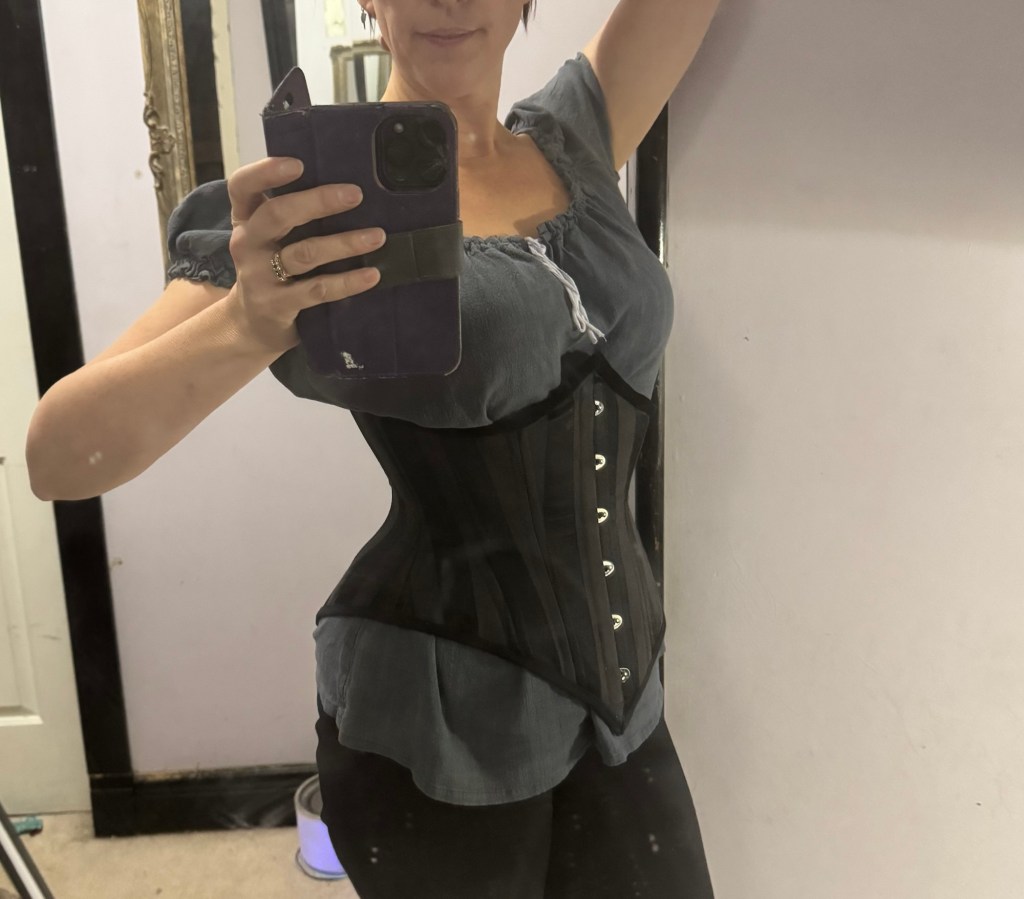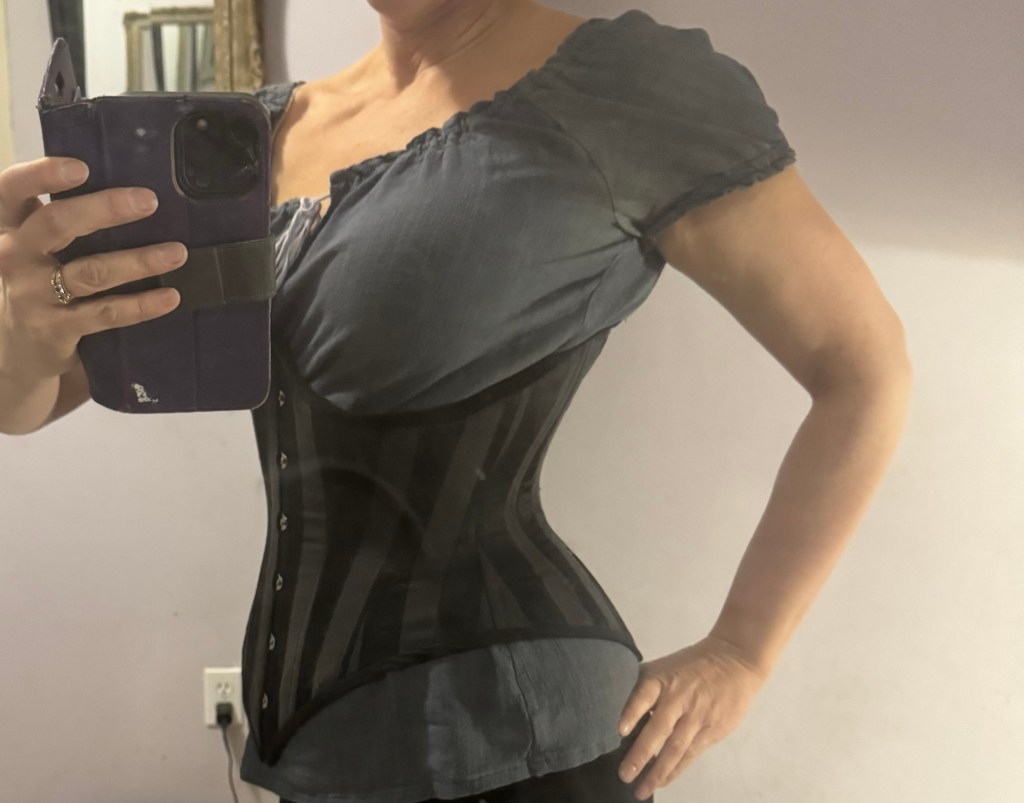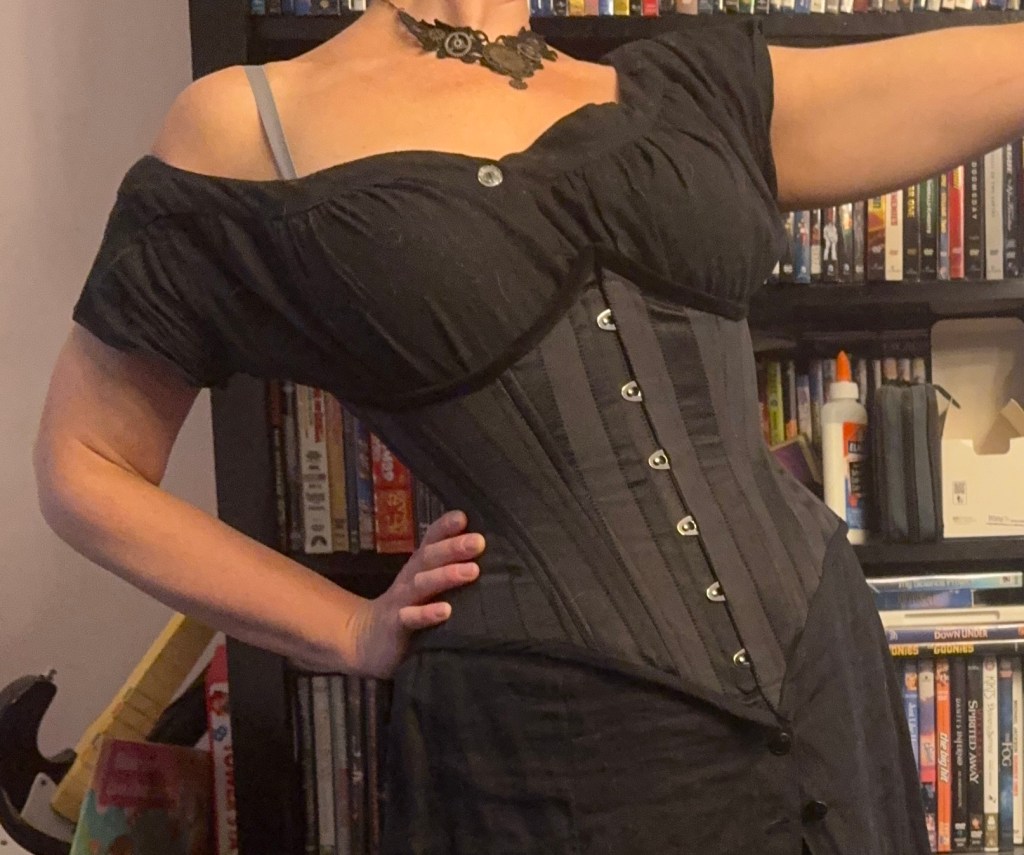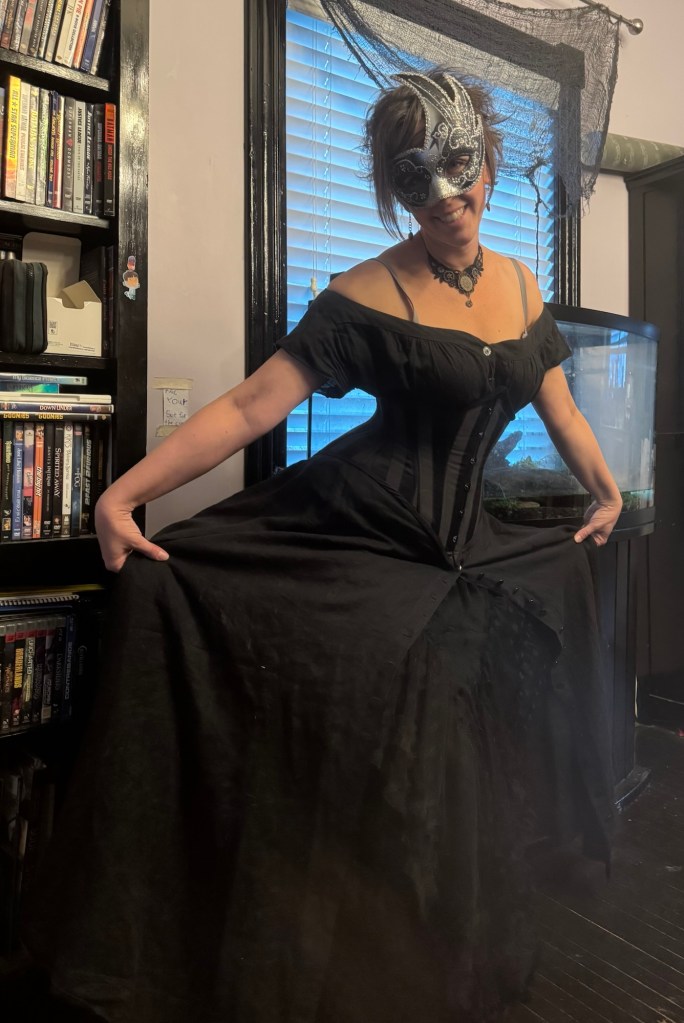
There were a few things that prompted this. One is that I’ve wanted a black underbust corset for, basically, ever. Well, technically I have one. Two, even, if you count this little Swiss waist, which is perhaps more of a boned belt. And I do wear the first one quite a bit, but a) it’s very sequiny and 2) it really, really doesn’t have enough hip spring (and never did).
And I had had a corset in mind for this stripey upholstery brocade ever since I snagged a remnant of it back when I worked at Fabricland.
So this is basically an adaptation of my white underbust corset from not-quite-two-years-ago. Except that that one is currently a wee bit big on me, (fluctuating bodies are very annoying, by the way) so I shaved down the pattern by about 1/4” per piece.
Then panicked that that was a bit too much and sewed with slightly skimpy seam allowances. But it seems to have worked out all right as I have a comfy 3”-ish lacing gap fairly evenly down the back. So I should be ok if it stretches a bit, or if I get bigger again this winter.
I have finally gotten the hip shaping on this pattern just about perfect, I think, for my body at least. I had to tweak one side a tiny bit but I think that had more to do with imprecise sewing. I find I have more luck with corset fitting trying on the final version partly boned than I ever do fitting mockups.
I tried, roughly, to line up the stripes so that they met and diverged in pleasing ways, and were roughly symmetrical, though I did end up opposite on left and right sides.
I underlined the upholstery fabric with ticking, for a lightweight strength layer, and then added a whole nother layer of black broadcloth lining in the centre front and back panels, so the white ticking wouldn’t peek through. So it is a fairly heavy beast, definitely an outerwear as opposed to underwear corset. Making the holes for the grommets was a little brutal. Every once in a while I think about investing in a grommet press, but the part that drives me nuts is always making the holes, not hammering the grommets…
The busk is an old one salvaged from an early, non-wearable corset attempt, with a gunmetal finish, though that doesn’t really show in the pictures. I didn’t have any grommets to match so I used black ones, which I think were left over from the first time I used this busk, actually. I also used up almost all the boning tips I have in stash, so no more corsets until I can manage to order some more. Well, unless I just use plastic boning.
I added a waist stay, though the twill tape I used isn’t as aggressively stable as the grosgrain ribbon I prefer to use. It matched though.
I cut the hip higher on this version, aiming for a sharp point in the front. Perhaps I should’ve made the back sharper as well, but i find the lacing gap reduces this effect anyway so I didn’t bother.
I used a lightweight black (homemade) bias tape to bind the bottom, and some bias velveteen to bind the top, for a luxurious line. Not sure that I totally love it, as it adds more bulk at the top, but I didn’t have enough of the bottom tape for the whole corset. It is pretty and luxurious, though.
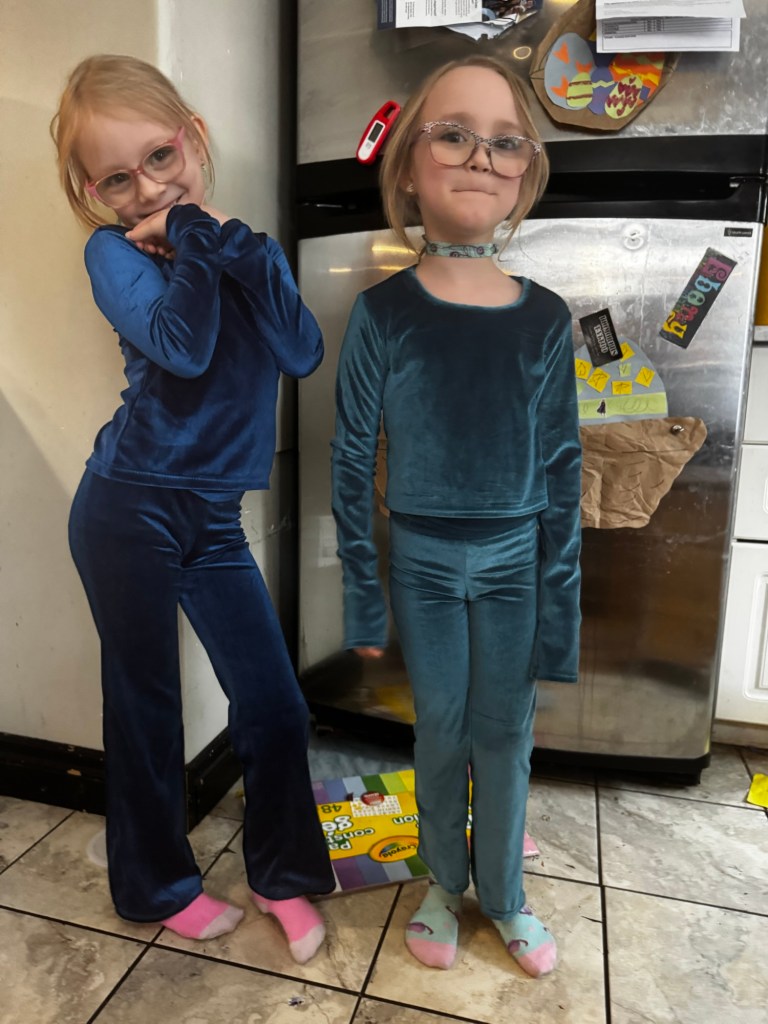
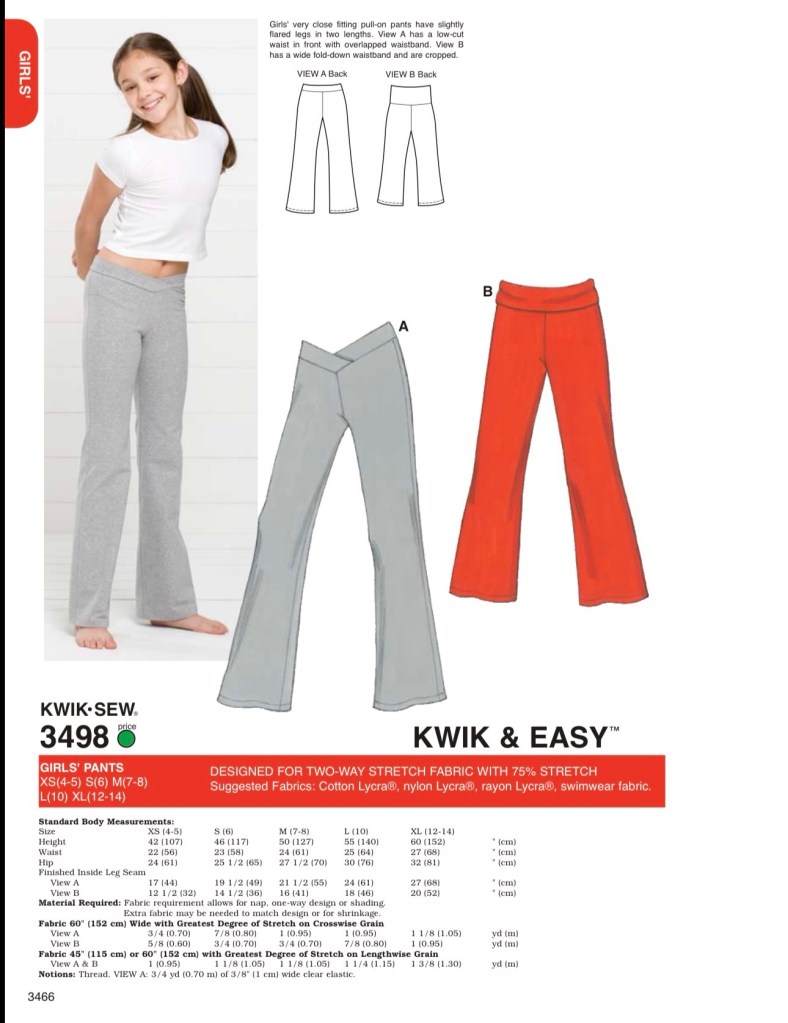
And that’s pretty much it. Quite happy with how it turned out. A very fun addition to the wardrobe. But now it’s time to get back to sewing leggings for the twins’ endlessly lengthening legs.
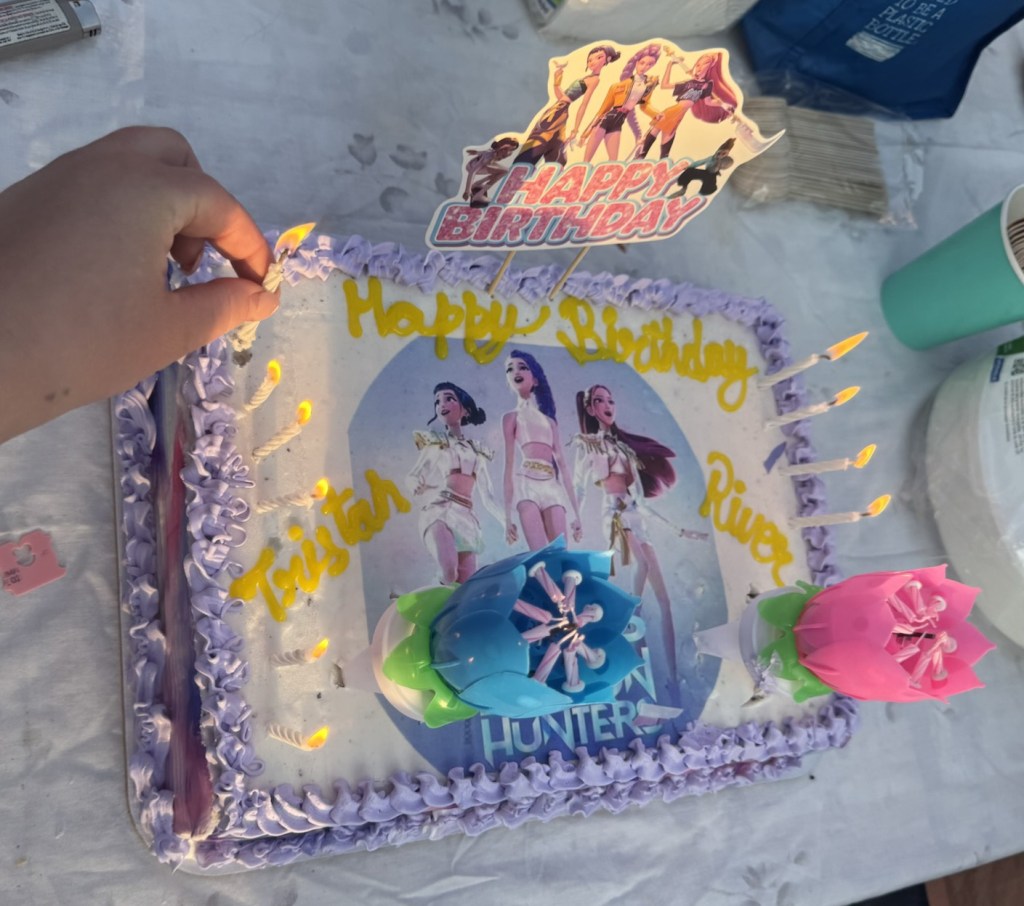
K-Pop Demon Hunters hit our family’s world last summer like a smoke bomb, pleasantly distracting from the many anxieties of reality in 2025. And, remarkably, it even diverted the twins from their unshakable devotion to the Frozen franchise.
All of a sudden I was ordering birthday decorations online and playing “This is what it sounds like” and “Free” at bedtime. And the twins conned Tyo into dying their hair pink and purple for the first day of Grade 1 this fall.
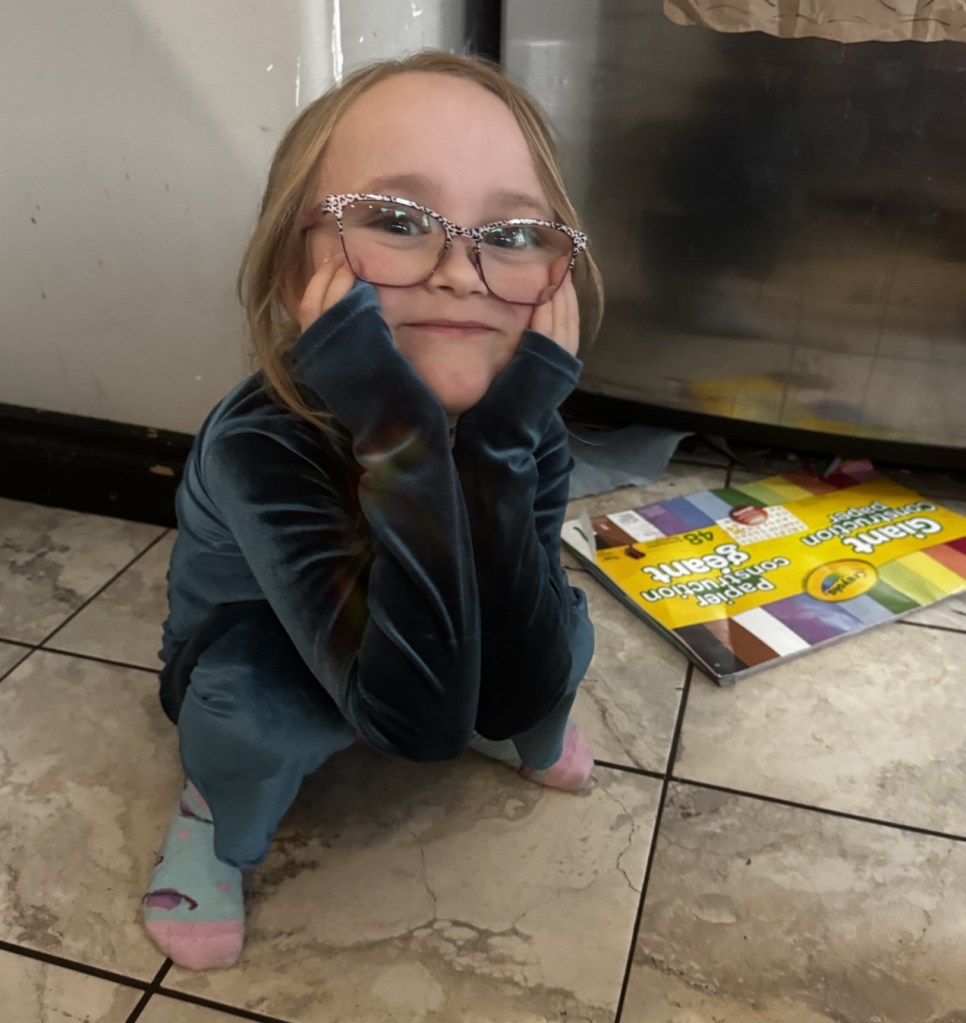
Yes, River wore Rumi’s patterns for the first day of school.
And, inevitably, planning Hallowe’en costumes.
Very quickly the twins sorted out who they identified most with—Rumi and Mira. And River, in particular, has the soul of a true cosplayer—an obsessive attention to detail. She wants her costume to be as screen accurate as we can make it. This is a bit unfortunate since, y’know, we live in Canada (not one of the warm parts), and Hallowe’en is unfortunately at the end of October.
The forecast as of one week before Hallowe’en (actual temperatures on the day of were a high of 3C and a low of -1C)
Even with the modifications we have carefully negotiated, they’re going to be freezing.
I really have a love-hate relationship with Hallowe’en costumes. On the one hand they’re wildly fun and challenging. On the other hand they’re a buttload of work for a one-day payoff and time I could be spending making things that are a lot more practical.
But on the third hand Syo (who is now 22) has actually been wearing elements of the Pride and Prejudice and Zombies costume I made her in 2016, so I guess they aren’t always a waste of effort. And I’ve gone six years without making the twins an elaborate one (just the cute little bat capes when they were two. Oh and the mushroom princess capes, too. But even that was three years ago), so perhaps they’re due.
The first struggle was deciding which of the various outfits featured in the movie they wanted. But at a certain point I noticed they were using their black faux-leather motorcycle-style jackets when playing “K-pop concert”, so I told them I could make the rest of the costume if those could be the jackets. They (especially River) were not super keen since they’re not, y’know, cropped and covered in sequins, but in the end they acquiesced. So we were settled on the Golden costumes. Arguably the most iconic of their looks, so it worked out, except for the part where there are SO MANY DETAILS.
The Base Costumes
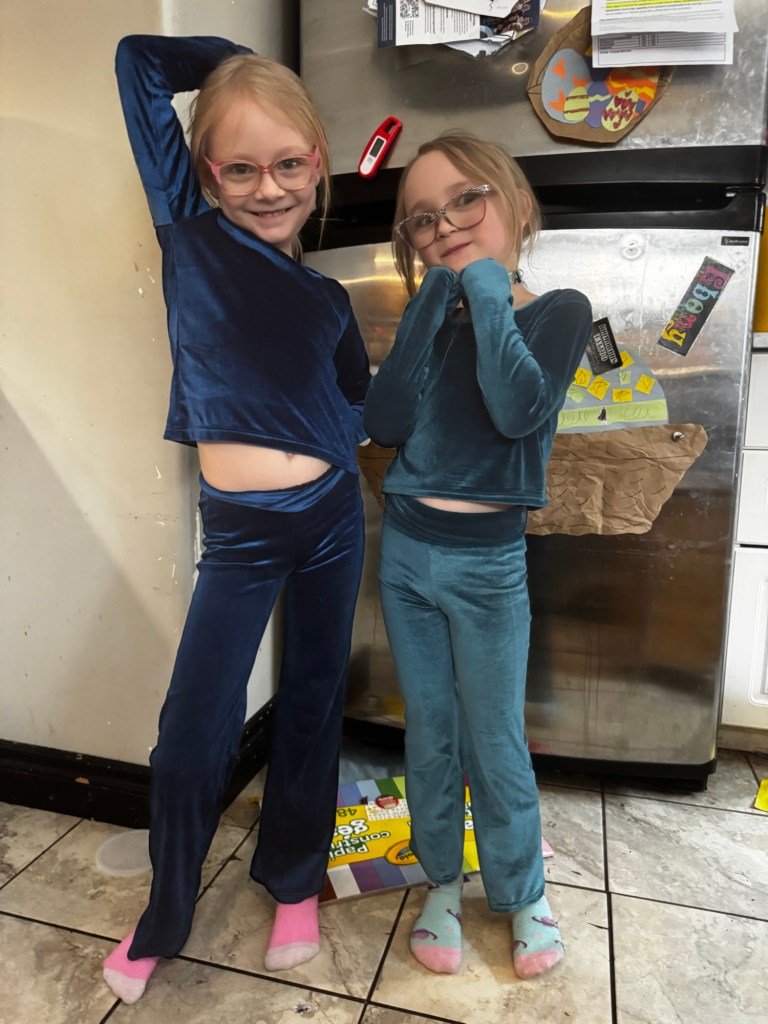
For the rest of the costume bases I turned to old, reliable Jalie patterns. Not least because I already had leotard (Jalie 3349) and leggings (Jalie 2920) patterns traced out in the twins’ size. I also traced out a little pair of Clara shorts (Jalie 3887) as the base for Rumi’s shorts and the shorts under Mira’s skirt.
I dug through the stash (deeper than I have in a long time) to locate appropriate, faintly glittery black and white spandex, and vaguely-skin-tone-adjacent cotton Lycra. The twins were not super happy that neither the black spandex nor the black pleather jackets were sequin-encrusted, but they survived.
I also used Sculpey for the first time ever, as well as strategic amounts of wire, to create some of the “hard” embellishments. I am not much of a sculptor, and it shows, but it was fun to try something new. The experiments with hot glue were a little less successful, but we’ll get to that.
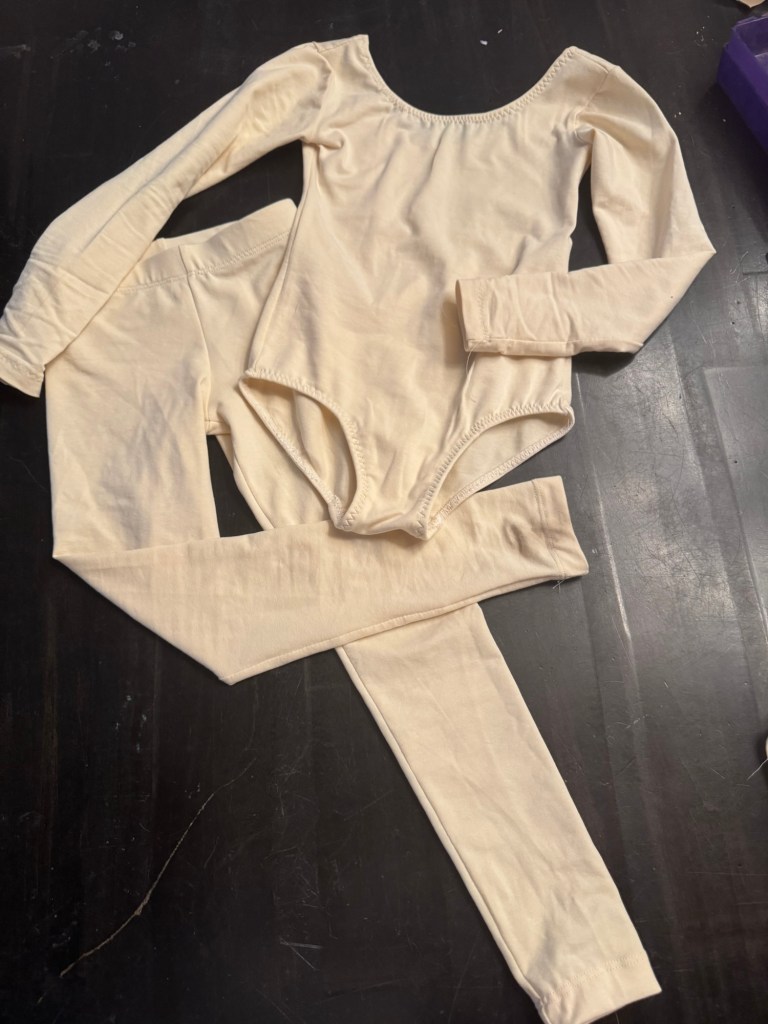
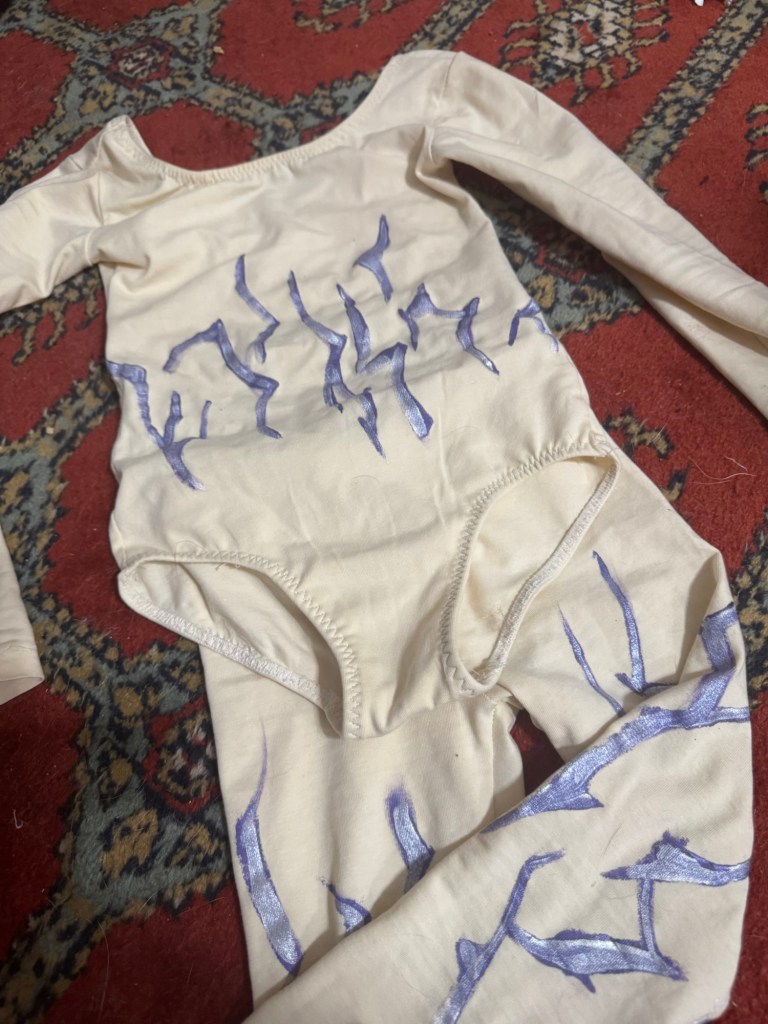
From the cotton-Lycra I made a plain leotard for Rumi and leggings for both of them. I assured River that we could paint patterns on hers, since she was quite unhappy about how not-actually-the-colour-of-her-skin it was. We almost got those done.
For Rumi, I took the leotard body pattern as a base and modified it to have a cut-on turtleneck and front zipper. However, I made it fairly wide since some kids (cough Syo cough) are sensitive to the tight sensation around their necks and I didn’t know how River would react. Turns out River is much more sensitive to screen accuracy, so she’s not very happy with how that fits. I hand-sewed the gold elastic cord around the edges. A zigzag on the machine might have worked just as well, but hindsight, y’know.
For the shorts, I appliquéd some black stripes along the side and used some pre-cut black binding to make piping along the yoke (I should only have done it between the yoke and shorts portion, not along the top, however.)
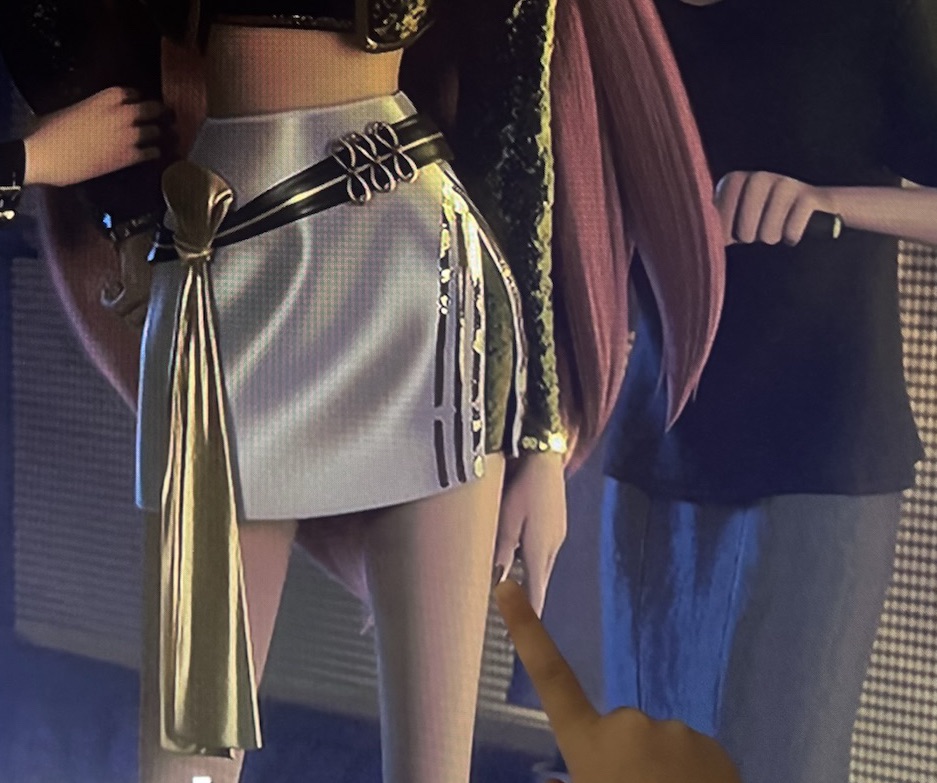
For Mira, I modified the leotard pattern to have the top half black, like Mira’s top, and made up a skirt pattern. It wound up being too small and not flared enough, so I ended up adding a flared panel on the non-slit side. The hardest part was getting a good angle for the open slit on the one side. (Considering that Mira’s hip has a very different angle from Tris’s.) For the black stripes I fused Steam-a-Seam to some of the black spandex and cut strips to width, then fused them in place. You can’t see them in the picture above, but I built in black shorts underneath the skirt.
I zig-zagged down various bits of gold elastic (man, that random dollar store purchase back in the summer really punched above its weight class in this project) to make some of the designs on the front of Mira’s top. I didn’t succeed in finding or making a trim that would give that leaf-effect, so I just stitched down some strips of gold stretch vinyl.
Mira’s belt
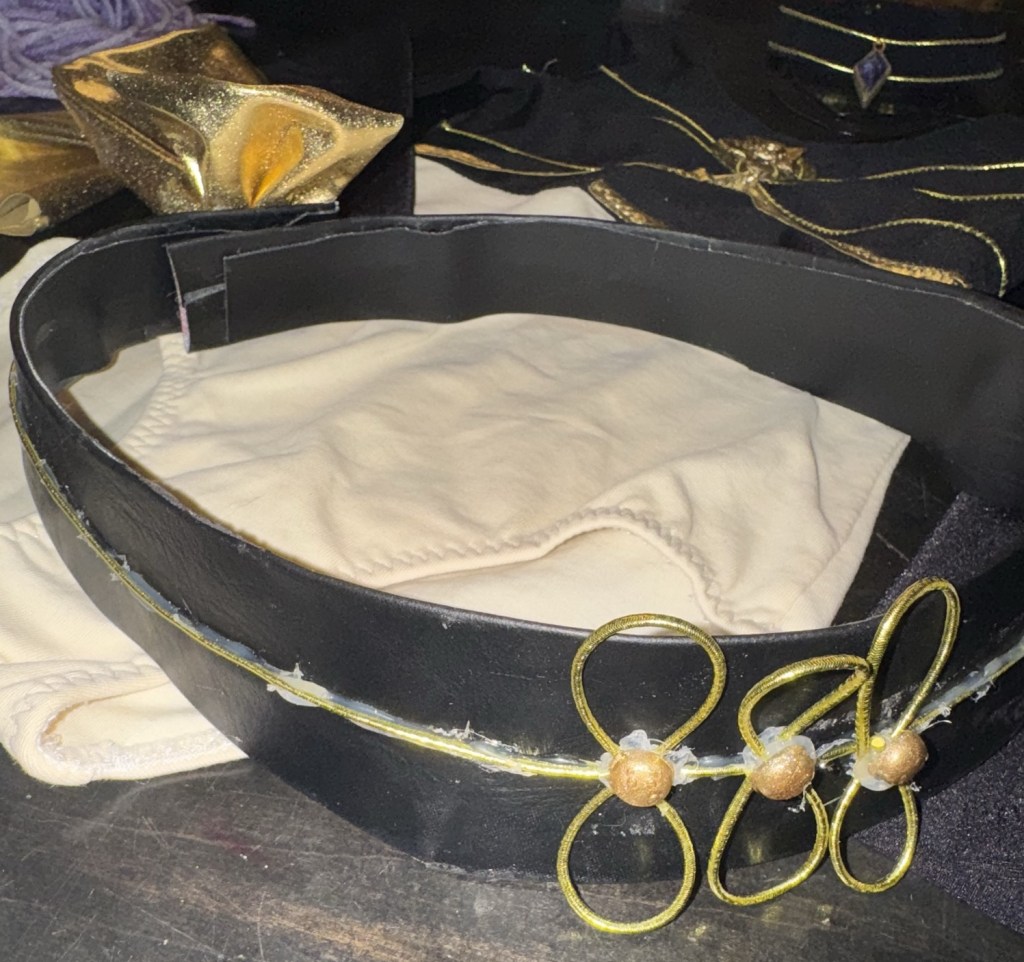
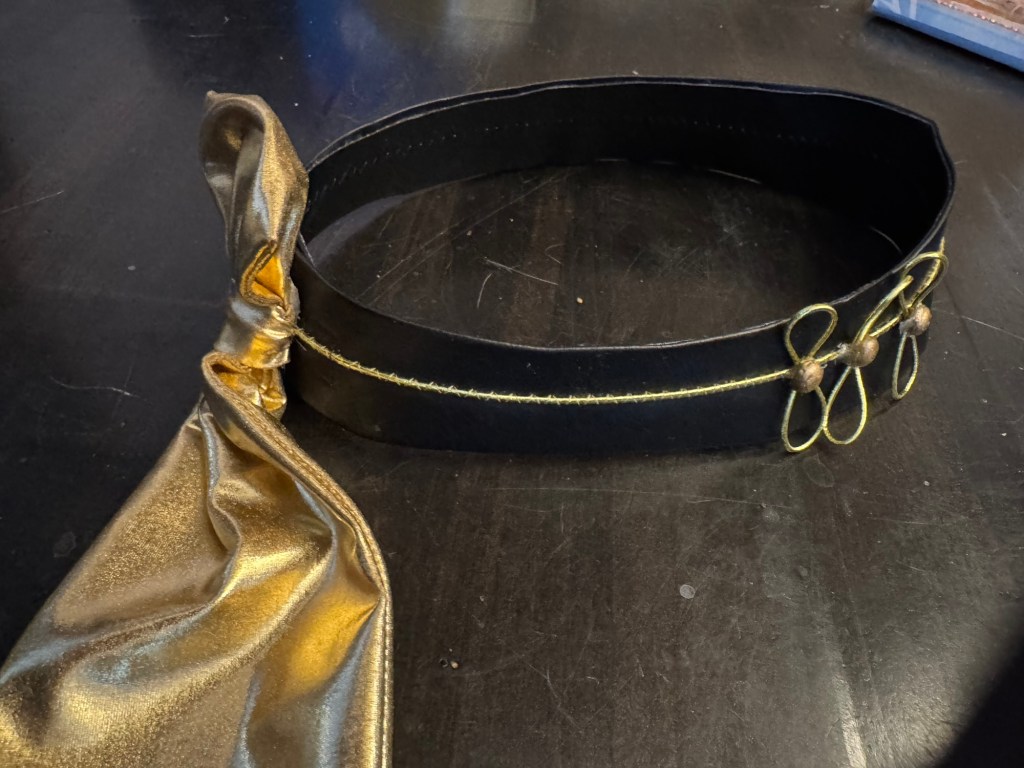
I had a bunch of scraps of heavy-duty black vinyl that came in handy quite a bit. One was for Mira’s very structural belt. I (we) struggled quite a bit with this piece. I didn’t really want to stitch through the heavy vinyl at the edges to sew down the belt and it wasn’t possible to sew it inside out and turn it. I opted to glue down the folded edges on the inside, and then glue down a slightly narrower inner layer to cover that. However, the glue I had wasn’t the tacky kind that would actually hold while it was wet, so just getting the basic belt into shape took several days of gluing, weighting, and regluing bits that didn’t turn out right.
That gold elastic was perfect again for making the gold stripe and little loopies, but for the first round I asked Tyo to just hot-glue it on since I wasn’t sure about sewing through that many layers of vinyl and glue. This worked, give or take some gloopies Tyo was not at all happy about, but wound up peeling off almost perfectly while Tris was wearing the belt at school, so I had to madly throw my size 18 denim needle onto the machine and redo the gold cording with a zigzag to stitch it down. Had to restitch the Velcro closure too, and the funny gold swag piece at the bottom point.
Minimal hot glue. Much cleaner look.
In the end I prefer the look and it’s much sturdier, but note to self. Hot glue and vinyl are not a good combo.
Rumi’s belt
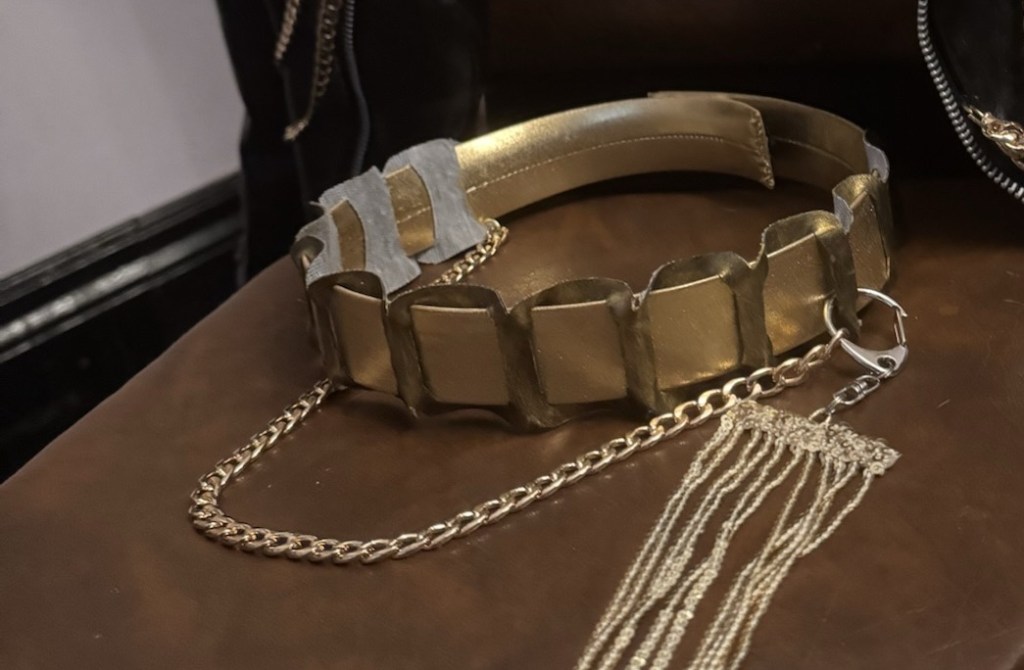
I had a hard time figuring out how exactly Rumi’s belt should come together, and then how to best represent that with the materials I had at hand. It looks like a softer strap is woven through some kind of rectangular metallic links along the front part. After a few not-so-effective experiments, I settled on making the belt itself by covering some vintage belt strapping I had in stash with the light gold stretch vinyl, and then making the “links” part out of my heavy black vinyl and painting that gold.
It’s not perfect but I think the impression is close? Add in some chain and the little waist bobble made from a bit of keychain, wire, and some of the gold sequin fringe I got for Mira’s epaulettes. (Which is far too long but we ran out of time to shorten it.)
Mira’s necklace
Unlike many elements of this costume that took for-freaking-ever to come together, Mira’s cute choker necklace was quite quick and satisfying at the end of the last day I had for making. Well, except for the diamond bauble that I made with sculpey and wire several days earlier and painted.
I used more of the black spandex, sewn into a tube and turned, and then zig-zagged down the elastic. For whatever reason the fabric wound up more stretched out on one side than the other, giving it a nice curve that is perfect for fitting around a neck. I added a little Velcro closure, tacked on the bauble and the little swags (more elastic cord)… and it was just about an inch too small. So, I added a little extension of Velcro at the back, which ended up being kind of scratchy and I’ll have to do something better in the future, but I’m still calling it a win.
Mira’s epaulettes
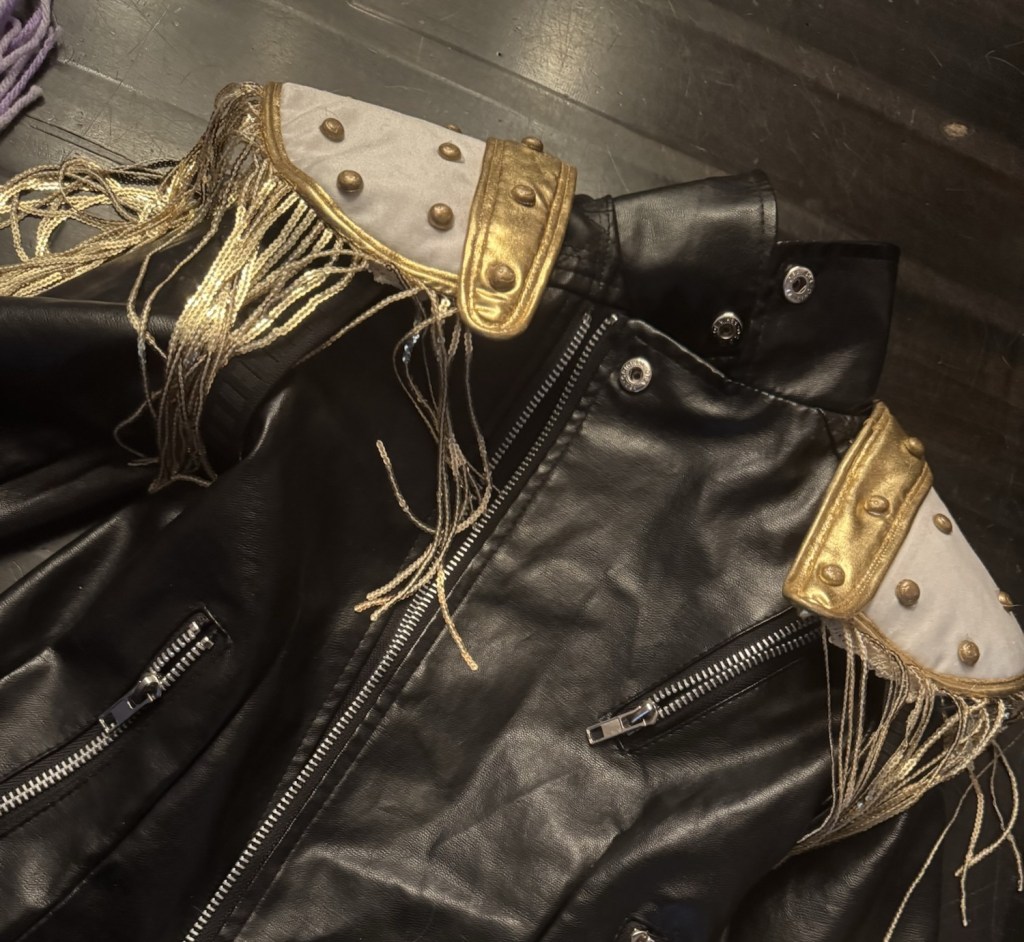
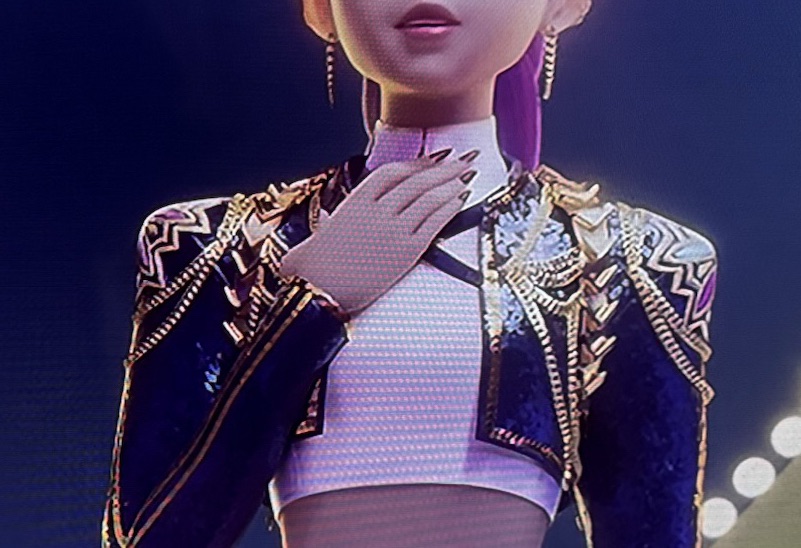
A big part of the look for both these costumes is the shoulder gear. I was initially tempted to venture into the world of foam for these, but that would’ve involved even more experimentation, so I settled for sewn versions. For Mira’s I layered the same white spandex over some scrap white bedsheet for the outer part (or the gold vinyl for the inner part), and quilted together layers of black liner, batting, and hair canvas for rigidity. This worked well enough, and the gold stretch vinyl was perfect for binding the curved edges. We found the sequin fringe at Michael’s, of all places, and while I originally meant to cut it up to make individual little tassels as per screen accuracy, that just wasn’t quite happening, so it got sewn on as is. .
My one regret (just a bit) is the dome studs. I really would’ve liked actual studs, or even buttons to sew on, but I didn’t have any in stash and didn’t manage to acquire them in the extremely limited time I had for acquiring supplies. So I wound up sculpting half-domes from Sculpey (using a play-dough mold, so they actually have little smiley faces on them), and Tyo spray-painted them for me, and hot-glued them in place. Which has worked so far, anyway.
To hold the epaulettes in place, I used non-roll elastic to make straps under the arms and connecting the two epaulettes across the back. Then just tacked the epaulettes in place at the shoulders of the jacket. 🧥
Rumi’s shoulder pieces
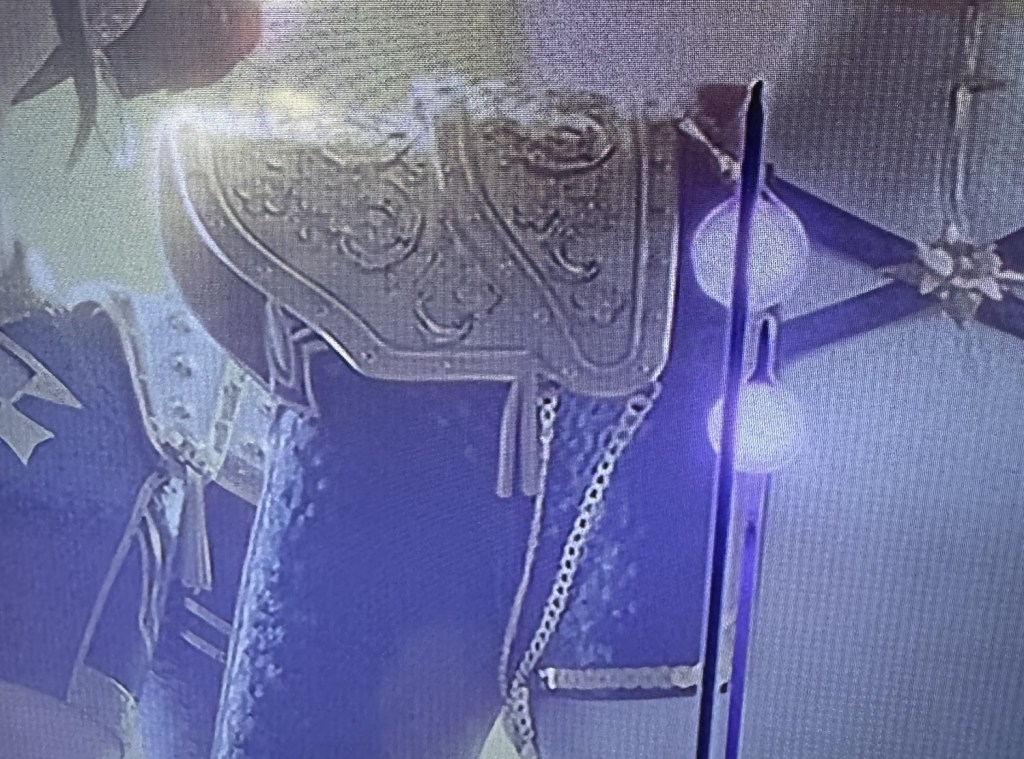
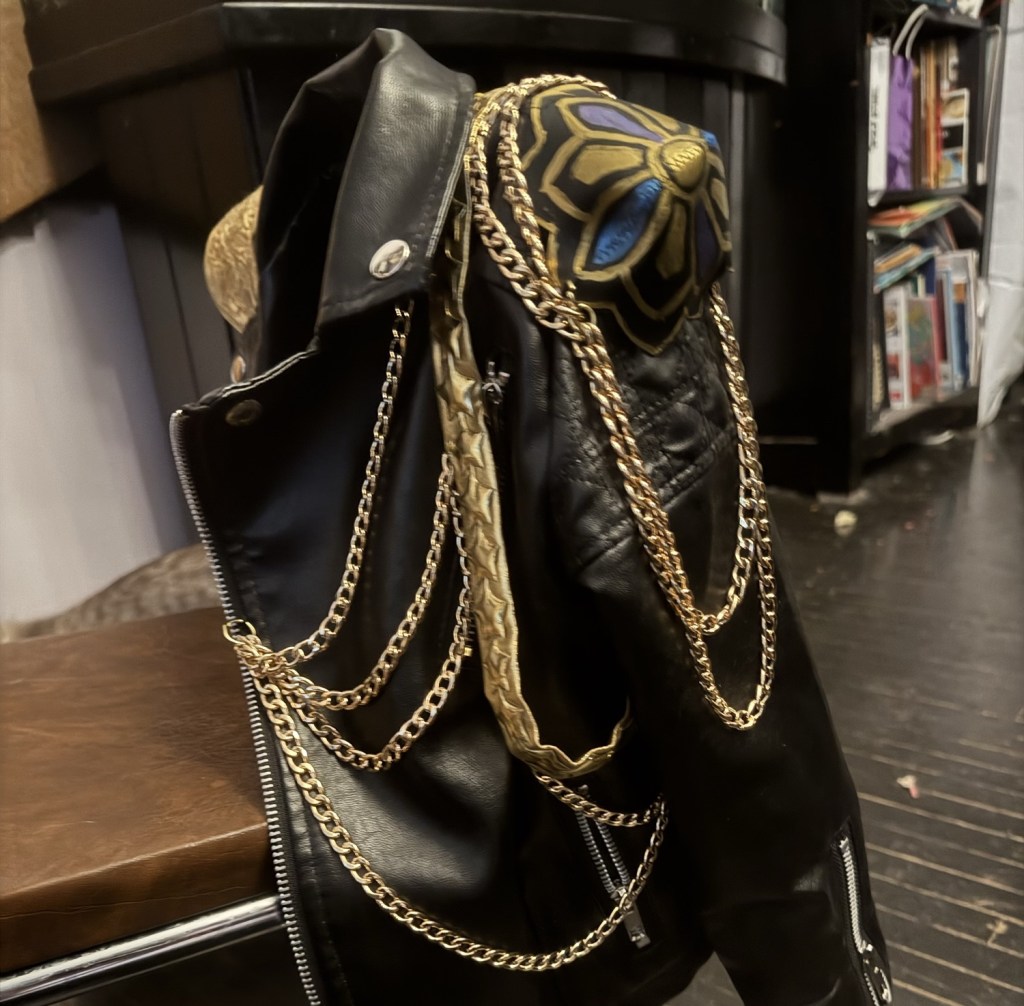
Ok, so I won’t lie, I’m pretty freaking chuffed about what I pulled off here. Rumi’s shoulder pieces consist of a pauldron on the one side, and a tangle of chains on the other, as well as a flowered decoration at the shoulder point that in the movie seems to be part of the jacket itself.
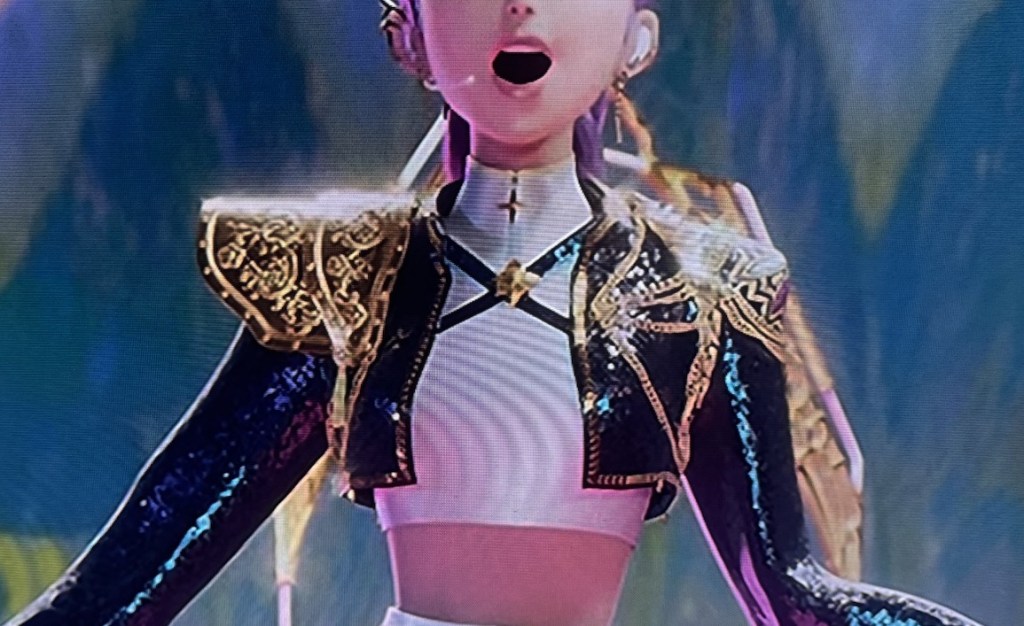
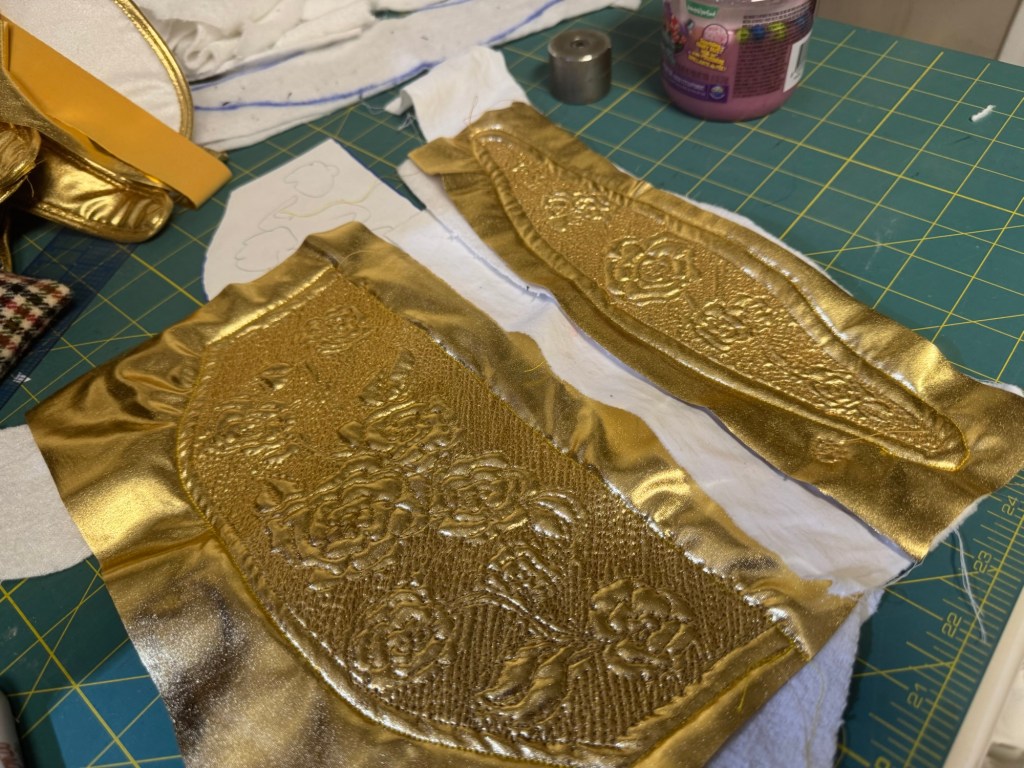
I started with the pauldron, drawing on my experience from Mira’s. Instead of a cloth lining and hair canvas, I used more of that heavy black vinyl which gave a nice amount of shape and support. I struggled quite a bit with the best way to do the design on the outside. I was considering painting, and appliqué. I couldn’t get a great handle on the nature of the design itself (I actually didn’t find the screenshot above until after it was done) so I spent a fair bit of time trying to figure out what to do.
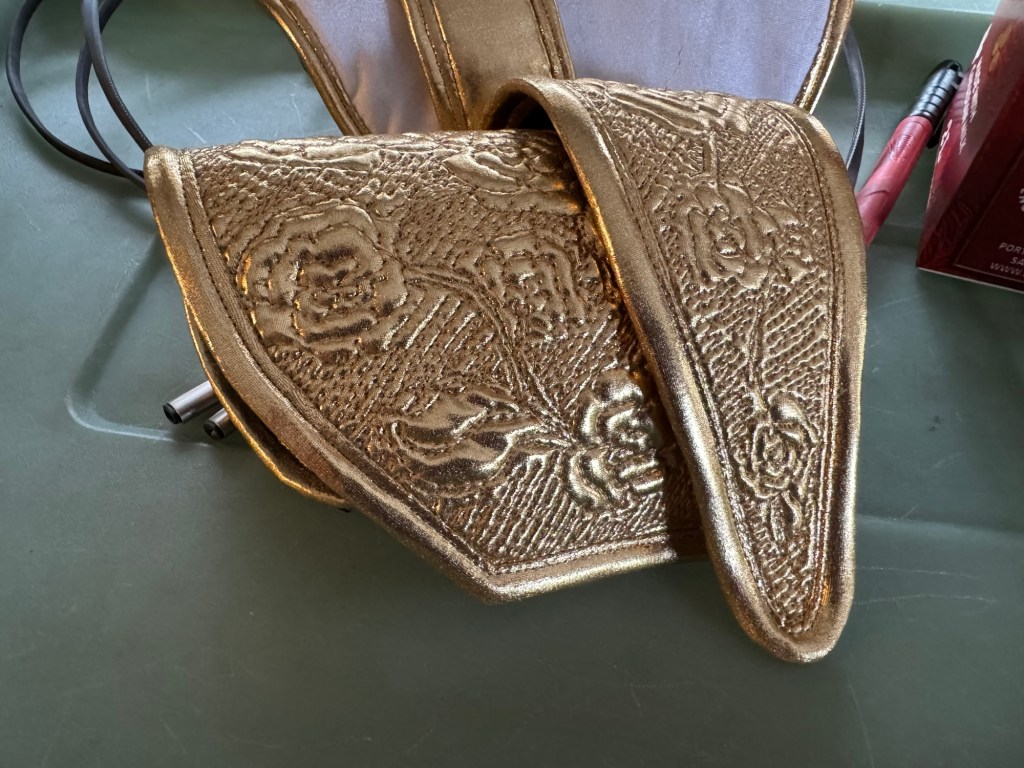
And then, in a flash of inspiration, I realized I could get a similar impression, if not complete accuracy, if I used the same kind of free-motion quilting motifs I used years ago to make my quilted skirt. I’m not a good free-motion-quilter, but that one pattern I can do. I layered up my gold vinyl, some scrap fleece for batting, and a bit of scrap bedsheet for the bottom layer, and started quilting. And I love the result so much I really want to make something similar for myself. Quilted gold corset?
For the other side, I started with the shoulder flower.
I made it using more of that heavy black vinyl, playing around with two pieces until I got them to meet at something like the right angle. I had originally hoped to bind the edge with the gold vinyl but that was not going to happen, so the whole thing is painted. The wide gold strap is a tube of the gold vinyl with a puffy gold star trim glued on. (Which is not screen accurate and yes River was not happy about that.).
It took a fair bit of playing around and looking at various pictures to figure out how to connect and anchor all the chains and I wouldn’t swear that it’s perfect, but in the end I think it worked well enough. I think I used about 4 yards of chain on the jacket alone, and it’s not a light chain.
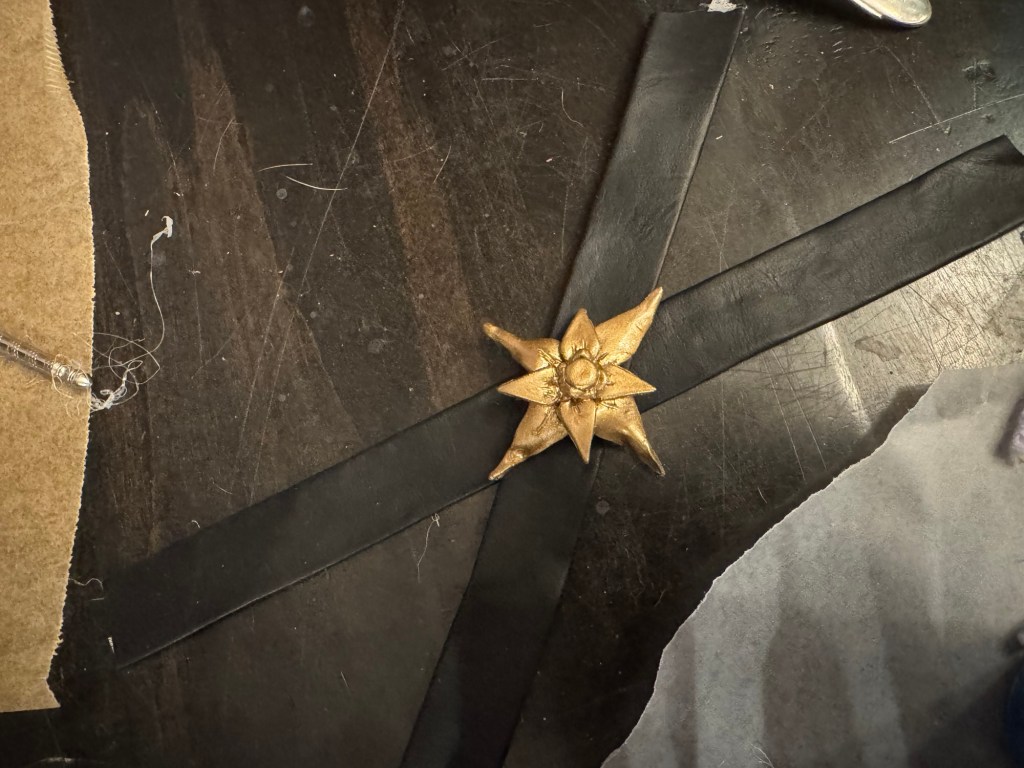
I also sculpted the central flower ornament on the little cross straps that close Rumi’s jacket. We just pinned these in, and they aren’t terribly visible since the jackets we used have a lot more front coverage than the originals, but it’s my favourite of my various sculpting attempts on this project so I wanted to show it off.
The Hair
We already did pink and purple hair dye for the twins’ birthday back in the summer, so redoing that for their school day versions of the costumes was a no-brainer, but it obviously wasn’t going to fly for the night of.
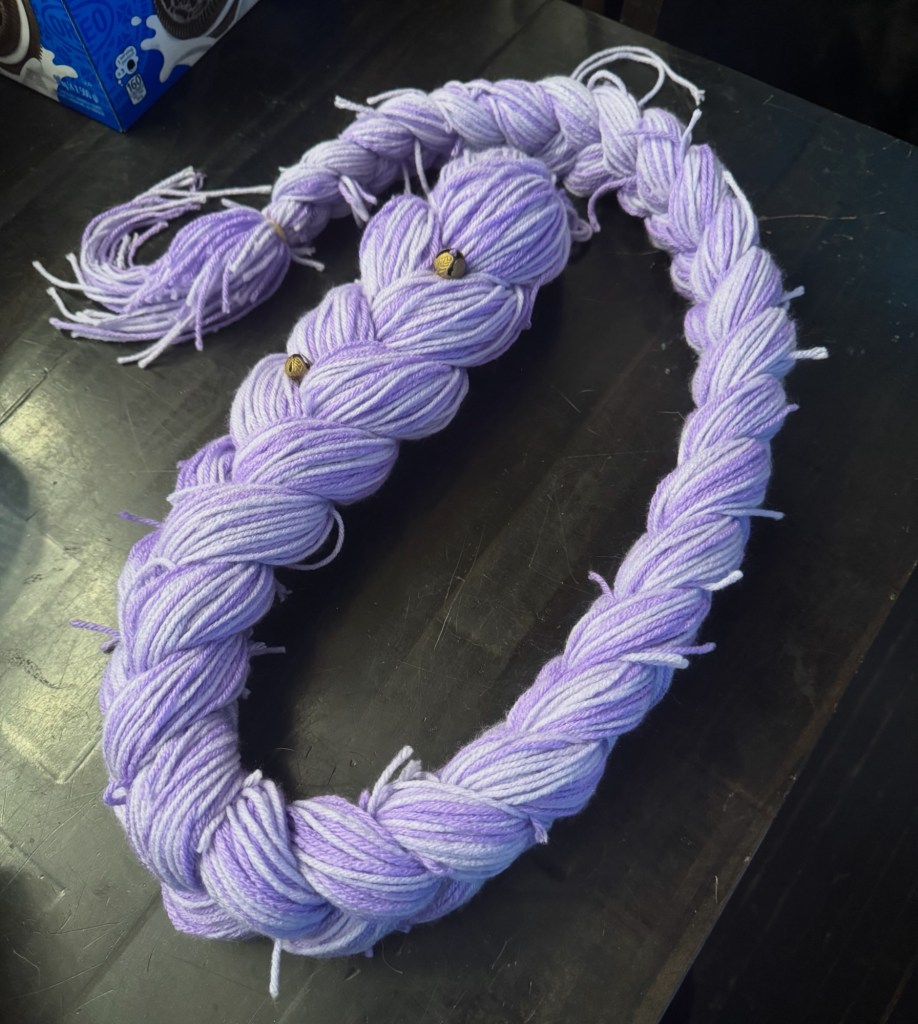
Initially I THOUGHT it would be a good idea to use yarn for Rumi’s prodigious braid. I thought it would be lighter, and easier to get the required bulk, and I could also buy it at Michael’s on the same supply run where I bought the sequin trim, gold wire, and Sculpey.
Most of the Rumi costumes I’ve seen have used “dragon braids” to make this braid, but that’s not really what is depicted in the movie. It is, however, a good way to get a fat fluffy braid with minimal weight, and I maybe should’ve followed the herd in that respect. But, again, hindsight.
After purchasing two shades of purple yarn, we measured off a giant hank a bit more than twice the finished length needed to make it to River’s ankles. And, once I got it braided up it was both a bit too fat and too short, and didn’t taper nicely along its lengths. Various attempts to splice in more length followed but in the end I just needed to undo the braid, move my “fold point” closer to one end, and wiggle various strands back and forth so that the lengths of the various ends were more staggered. The result is much longer and has a lovely taper, and is actually about 6” too long. I thought we might trim that off but we never quite did.
I sewed some pretty gold bells I had in stash into it for decoration, although the little wire medallions I used on Rumi’s shorts might have been more accurate, and they should be on the sides of the braid, not the places where the strands cross. But River was happy so I was not going to mess with that.
Application was… a thing.
River’s hair is very fine and thin still. Tyo attempted to help it sit more securely by adding a headband, but it didn’t really do much. In the end it was just a matter of about 80 million bobby pins, and then pinning the braid to the collar of the jacket to support the weight of the braid so it wasn’t all on her head. And, it worked, aside from dragging on the ground.
I was initially hopeful that we could forego a hairpiece for Mira, but if River got the full braid, Tris wanted proper Mira hair, too. Mira’s hair isn’t quite as insanely long as Rumi’s, but it is mostly down, which made the yarn-hairpiece thing trickier. A purchased wig would probably have been the way to go, but, well, we were doing yarn so we did yarn.
This one really got away from me. Initially I was thinking simple—the top ponies attached to a headband, and a fall of yarn behind. Of course, falls like that always end up slipping and showing lots of hair underneath. So then I started making a net by tying strands of yarn together to create a rudimentary wig. And I did do the little top ponies but they don’t really stand up in the limp yarn, so you can’t really see them.
But the effect was good, and most importantly Tris was happy, so maybe we’ll call it a win?
Also, you can see in the last pic Rumi’s microphone, which I sculpted kind of last minute as I had told the twins we didn’t have time for them. So that was a fun surprise to pull out right at the end, even though I hadn’t really thought through how to attach my little gold wires with blobs on the end to hold them in place. They were a bit floppy, but had the right look at least, and I think they really sold the costumes as performers for those adults who had no idea who they were.
The whole project was an almost even mix of interesting challenge and brutal judgment from six-year-olds who have studied every frame of the movie minutely and have no concept of what may or may not be possible with limited resources and time. On the other hand, they weren’t judgmental about my dodgy sculpting (except for the smiley faces on the gold studs, anyway). And in the end they were over the moon, so I guess I’ll take it.
I’ll have to keep my eyes open for some inexpensive black sequin fabric, though. I have a feeling we’ll be needing to size these up at some point.
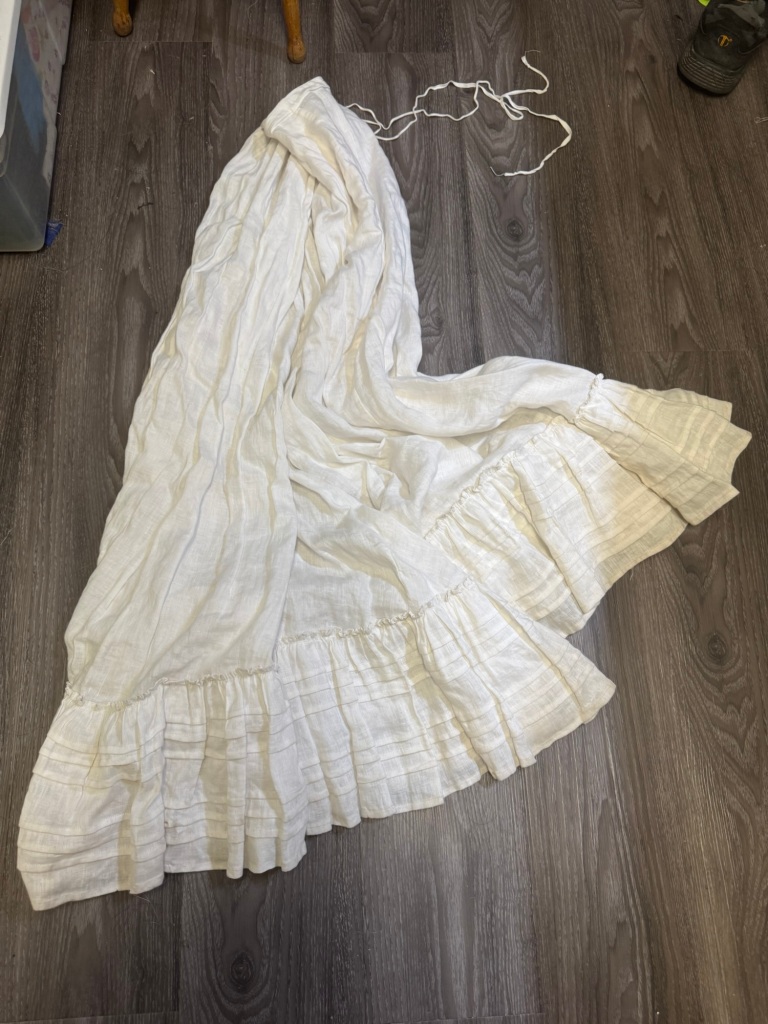
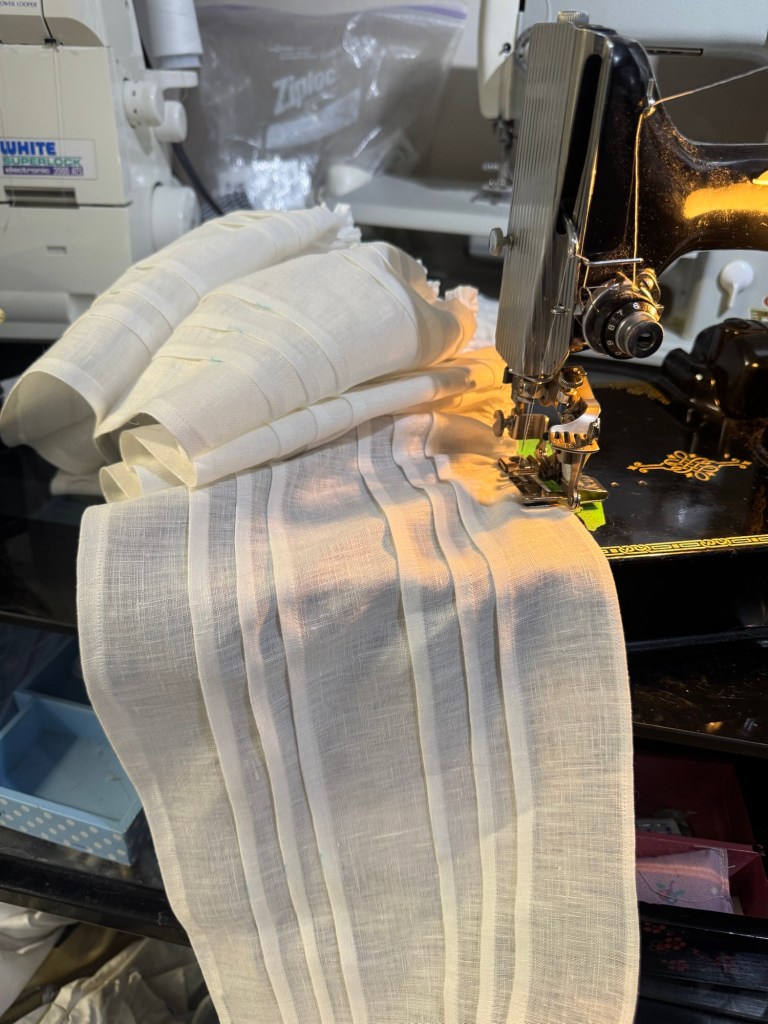
Back in January, I cut out a white linen petticoat. I’ve needed another white petticoat for a while; the two I have already are made for bustle style skirts and far too long in the back to wear with my more “everyday” walking skirts. And the black one I have is not always quite what you want.
And yes, that does say everything about how out in the weeds my style has gotten in the last couple of years. Sorry not sorry.
The base pattern was the Scroop Fantail Skirt. I didn’t have nearly as much linen as I thought (put a pin in that) so I wound up having to piece a little bit, but it wouldn’t really show under the final ruffle I wanted, right?
I was pretty sure I had another piece of the same linen, Pure Linen Envy featherlight white, but when I went looking for it, it was nowhere to be found. I looked everywhere I could think of, and found any number of other white fabrics I had forgotten about… but no featherlight linen.
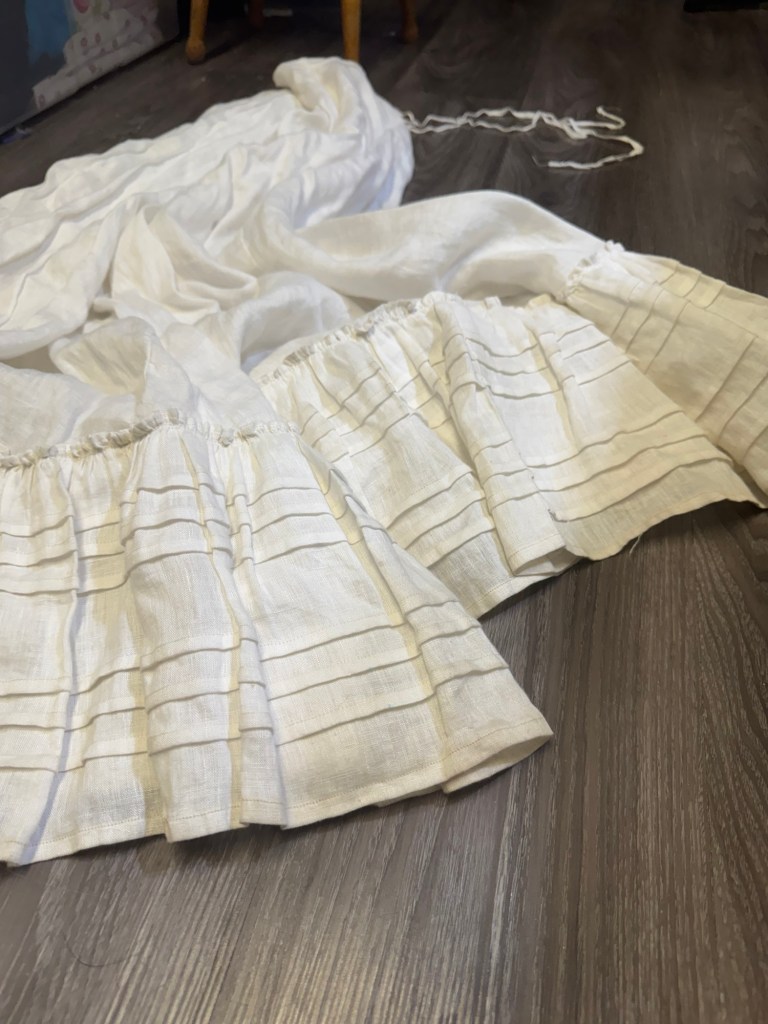
Luckily for me, one of my fellow Victorian stitchers came to my rescue, and sold me three metres of the stuff she had purchased at some point in the past. I got busy building my ruffle. I used up a solid 2m of the fabric. I thought I had calculated enough height of the ruffle to end up at 10”, but I did not allow sufficient hem turn up on both edges, I guess, as it wound up more like 8”. Still tolerable, but not as luxe as I had hoped for. It still took forever. At least the upside of it being ruffled is it makes it hard to see the unevenness of the pintucks.
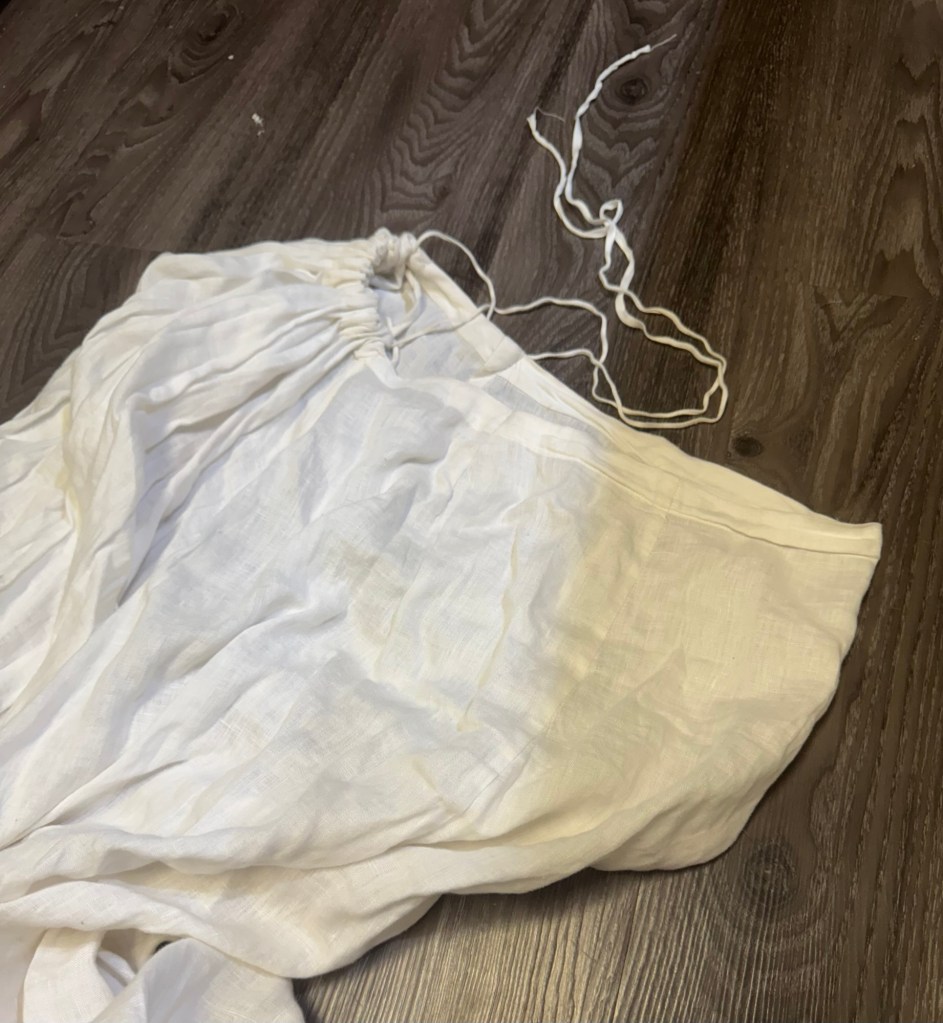
Other than the ruffle, I made a couple of other minor changes: I added some darts at the sides of the waistline, since I find the waist-to-hip ratio in my Fantail skirt isn’t quite big enough. This kind of a dart is a period feature, as seen in my 1900s skirt, too, so it’s legit (for whatever that’s worth). Instead of the lovely pleats at the back I went for a gathered drawstring, which I really like for petticoats.
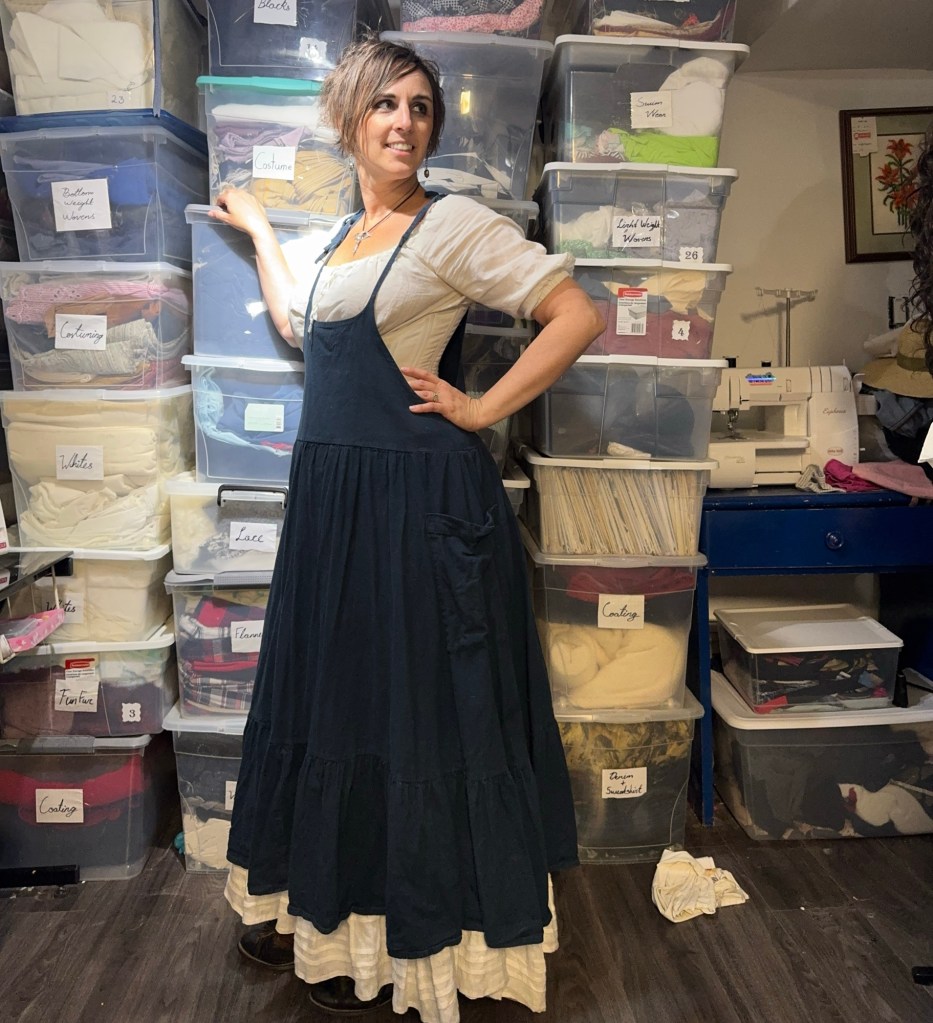
I used a topstitched bias facing to finish the waist instead of a full waistband. This is exactly how I finished my black petticoat, and I find it works well. I finally finished it in May, about four months ago, and it instantly became one of the single most worn items in my (admittedly unusual) wardrobe. However, since it’s underneath, I don’t get many pictures of it.
So, all else being equal, I am over the moon with it. I wouldn’t mind adding a wee bit of lace if I can find one I like with the linen (somehow adding cotton eyelet lace to a linen didn’t seem right, and I don’t have any cluny lace that seemed suitable. And next time I do a ruffle like this, I’ll definitely add a couple more inches of height (starting with a 14” strip instead of a 12”, I guess). Which I could definitely do because literally days after finishing the ruffle part I found my great big chunk of featherlight white linen. D’oh!
But all in all it is a great success, and has quickly become a workhorse in my wardrobe, even if it isn’t the most visible bit.
(Wrinkled because yes it took me months to take this photo)
Though really, I’d be happy to wear it as an outer layer, too, if it weren’t so transparent.
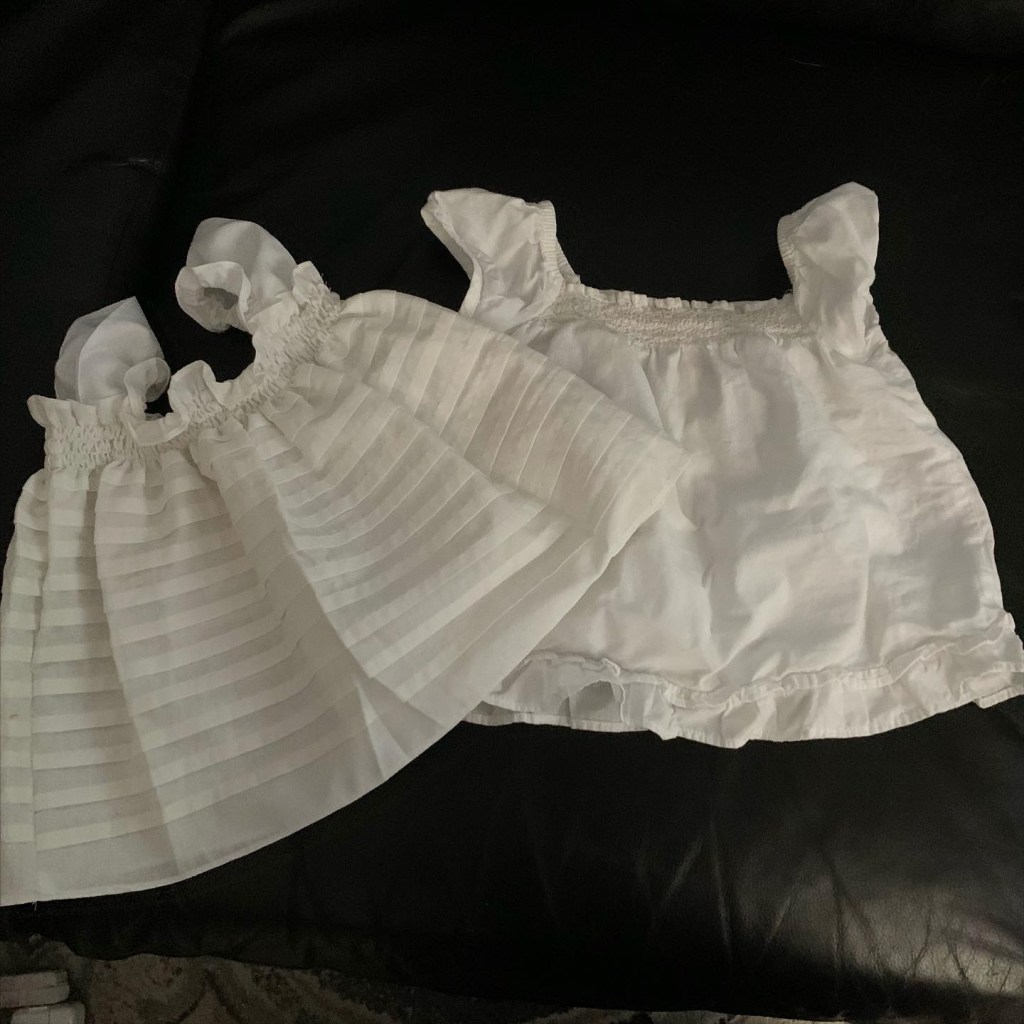
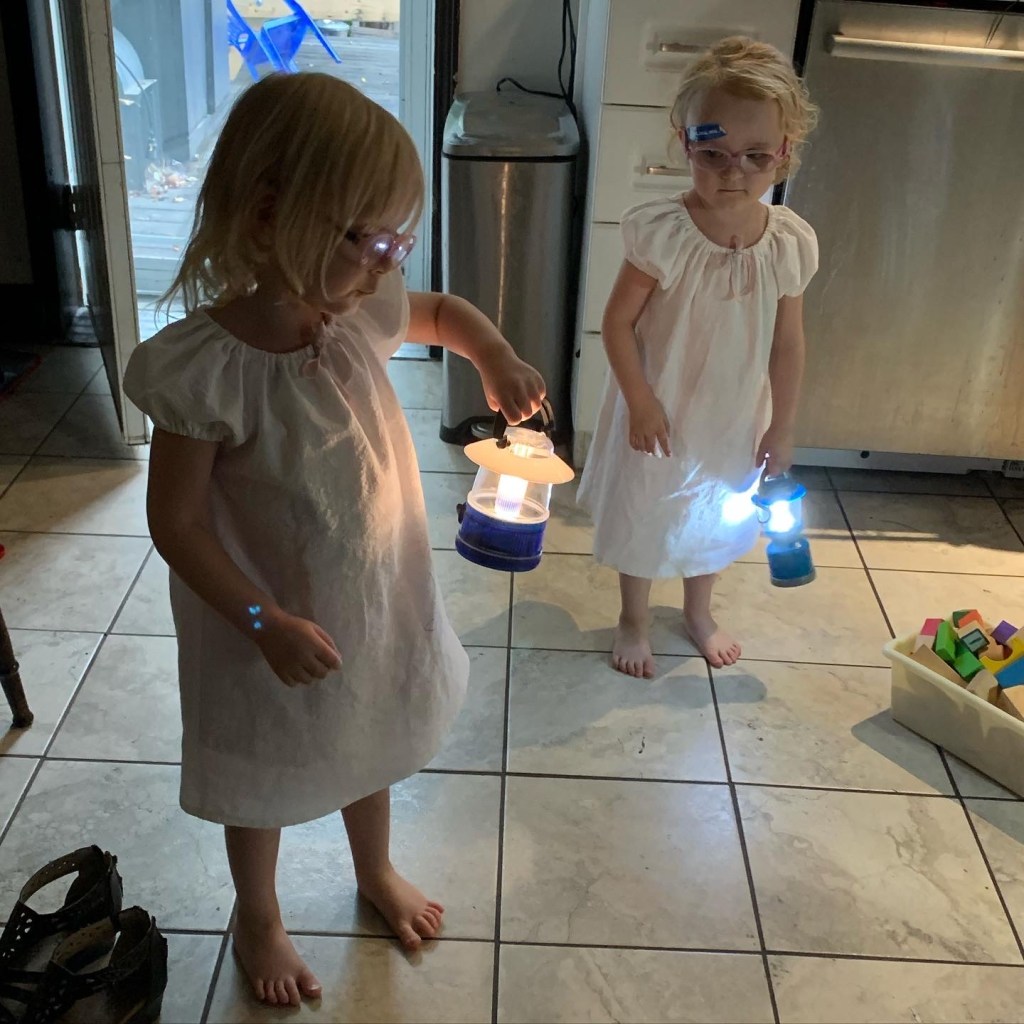
I have a long history of putting my kids in impractically white dresses (and other outfits).
It started with the older girls, but for brevity I’ll stick with the twins.
Apparently I have an unhealthy relationship with the laundry.
This isn’t even all of them.
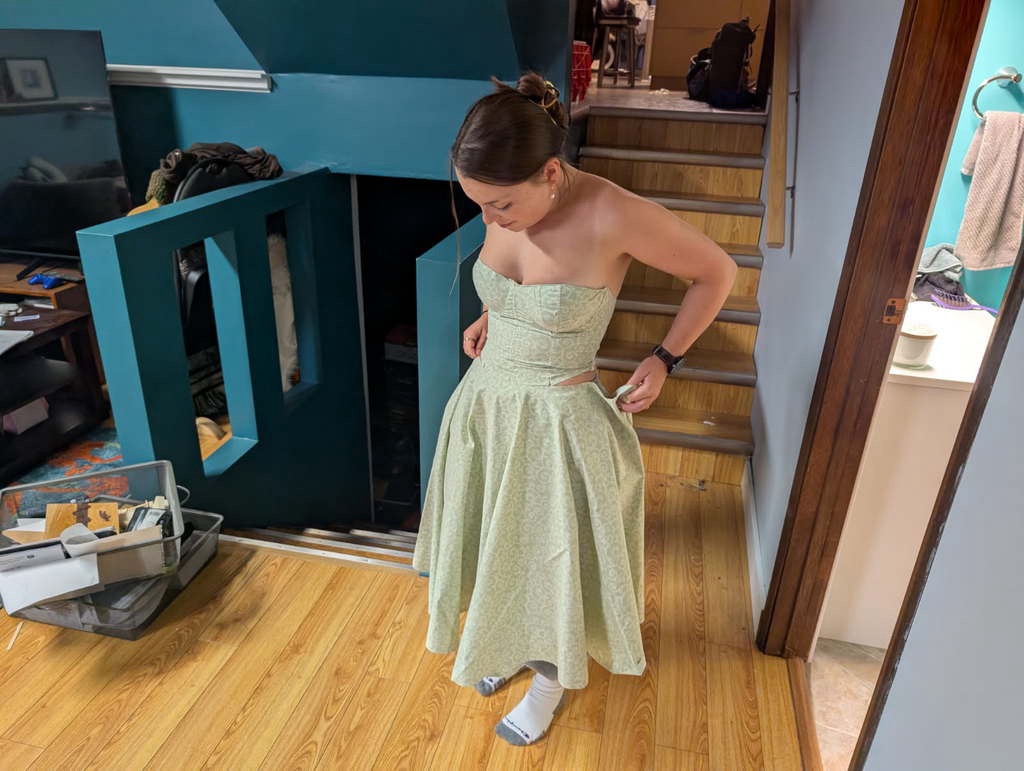
Anyway, back when I made this dress, I had a wee bit of amazing border-lace fabric left over. I made it into a a little shirred-top sundress thinking it might fit my youngest niece, who was a very petite 13 at the time, but I neglected to add a lining, so the skirt portion was quite see-through, and the sizing was a bit optimistic, and it just never made it to her.
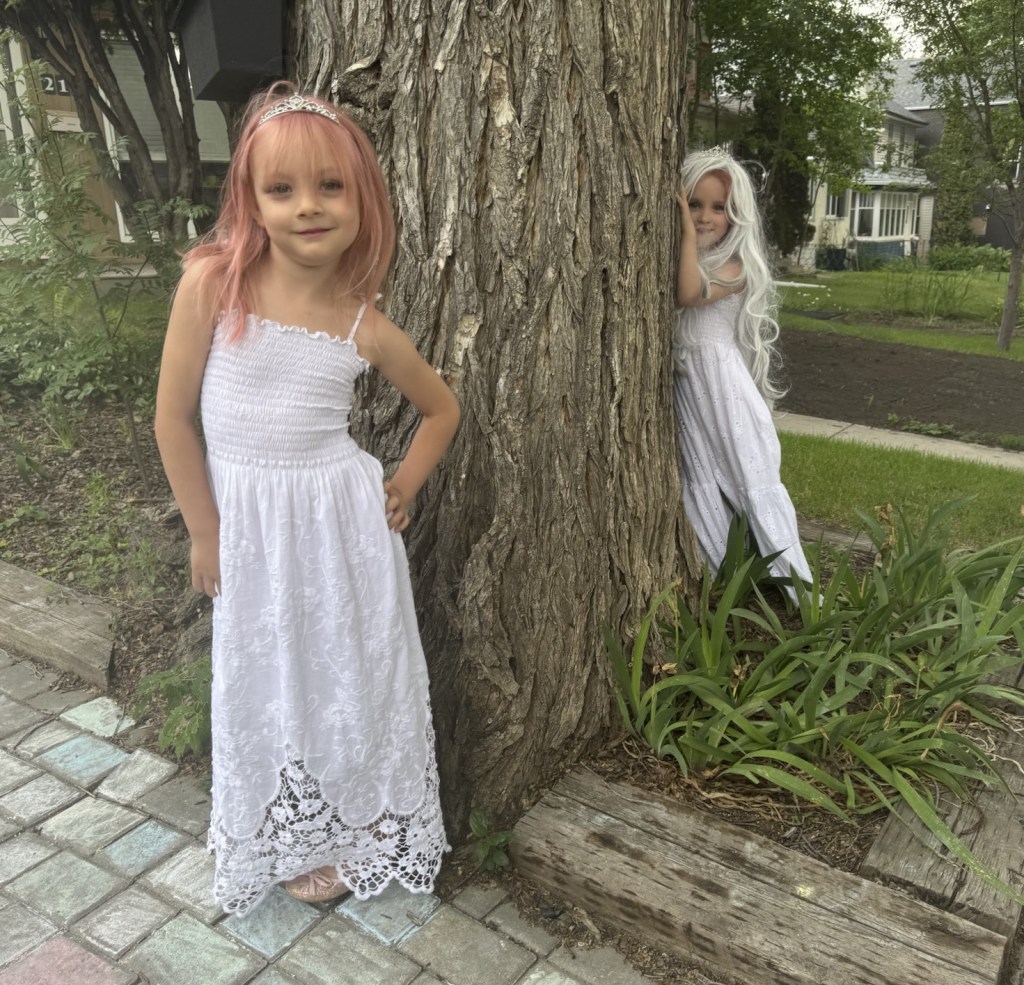
(Oh yeah, the twins got pink hair for the last week of school.)
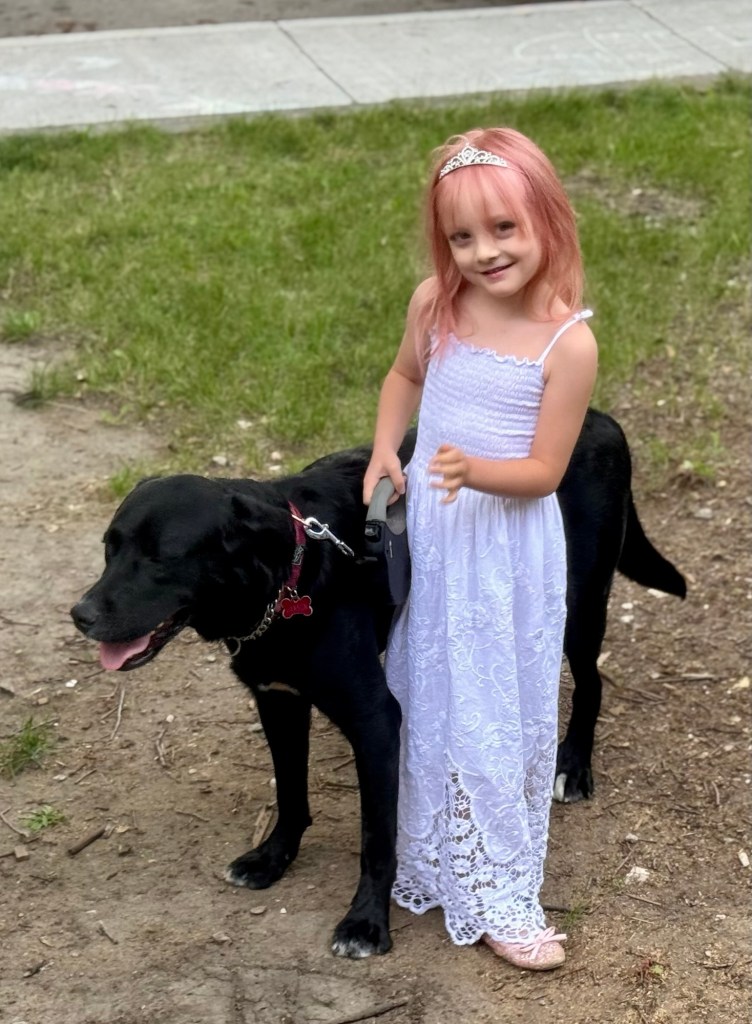
Well, after a bout of housecleaning a little while ago, the twins found it. And, by some miracle, it actually fits Tris (who is at this point substantially taller than River), much to River’s dismay. So obviously I needed to make something similar for River.
Anyway, rather than do the rational thing and look for something suitable in stash, I found myself at Fabricland over a long weekend sale and succumbed to the lure of a whole new piece of border embroidered fabric. (Among other sins that will be spilled here eventually, I imagine.)
And I set about making another shirred dress.
The first dress had been made from a scrap, with very limited fabric. I only bought a metre and a half of the new fabric, but it had the border embroidery on both edges. So I cut off both of them to make a wide, extra-full ruffle for the bottom of the skirt. I also added a waist seam, thinking I would need to gather the skirt onto a smaller bodice piece… which I didn’t end up doing, so the seam is basically useless, but I should have done since the bodice ended up too big and I had to make a big pleat in the back… anyway.
Alas, I didn’t take any construction photos, as the process was very quick and also frequently interrupted. Once I had the outer dress constructed as a series of tiers, I sewed the lining to the top, flipped it to the inside, and started off the shirring with a row of regular stitching over stretched clear elastic to give the top a bit more stability.
I used my ruffler foot to gather the bottom tier. I once again experimented with using my coverstitch machine to do the shirring as a chain stitch, as I’ve seen this on many RTW shirred sundresses. As with the last time, it worked well when I wasn’t having odd issues with the elastic thread breaking. It is a nice technique because you don’t have to hand-wind the elastic onto a bobbin, and it’s easier to adjust the looper tension on the coverstitch than the bobbin tension on my machine. But it does use up significantly more elastic per shirred inch, and even though I had two spools of elastic thread, between the shirring and everything I lost to the initial testing and thread-breaking issues, I wound up running out before even this very short bodice was finished.
The breaking issues, this time at least, seemed to have more to do with my top thread getting tangled around the spool I was using, and then cutting through the elastic looper thread, rather than the elastic thread breaking spontaneously. Once I got the upper thread tangling sorted, I didn’t have any more issues, though I did try to keep my stitching pace measured. I was even able to tie on the thread of my second spool with a small knot and just keep going without a hitch, which was lovely. I still ran out about an inch and a half short of the waist seam, which was frustrating.
Then I remembered I had a bobbin wound with elastic (presumably left over from when I sewed up the first little dress since I haven’t done any other shirring since then). So I did the last several rows of shirring using that elastic. The tension isn’t identical but after a bit of steaming the difference isn’t noticeable, and not at all once the fabric is stretched.
Once I had the shirring done, I serged the edges, hemmed the lining side, and sewed up the back seam of the dress. Then I had to take a 2” chunk (so about 4” of shirring, probably at least twice that of actual flat fabric) out to make the bodice smaller. I left the skirt, so there’s a weird pleat at the bottom of the bodice in the back, but again with all the gathering it isn’t noticeable. I had just enough scraps of the fabric left to make little tie straps, although it’s such a soft, mushy fabric it did not work at all putting them through my bias binding folder, and I really didn’t want to fuss with stitching and turning them. Anyway they’re fine.
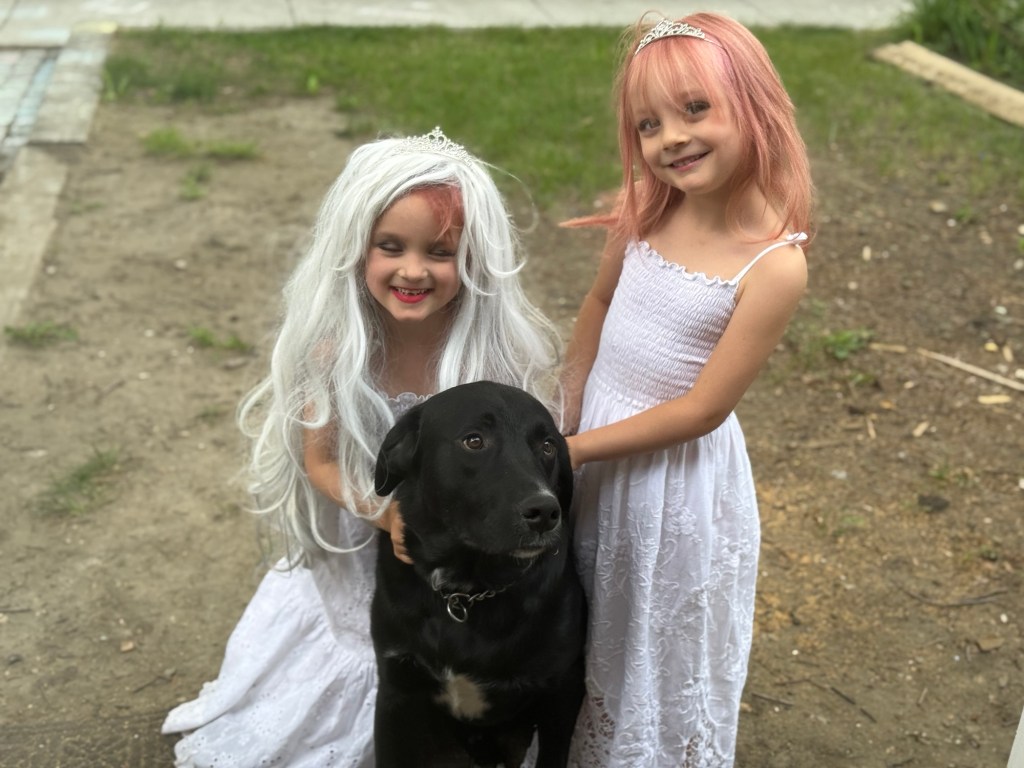
I will add that throughout this whole process, River was highly unenthusiastic and repeatedly told me that she would NOT wear the dress, and wanted the original one (which is too long for her, but then this one is pretty long too, I guess). The dress was “too fat,” which I guess meant full-skirted and ruffly? So when I first finished it, she wouldn’t even try it on. Fortunately, Tris is much more accommodating, and was happy to swap dresses. Unfortunately, once River saw it on Tris she came around and wanted it back, which led to a whole other round of bickering, and I finally told them that both dresses belonged to both of them and they had to share.
I did find a few moments, right before we took the pictures for this post, to add a very quick lining to the older dress. It meant I had to add a visible line of stitching in around the bottom row of the shirring, but again it’s not really noticeable at any distance and makes the dress so much more wearable.
And then we all threw on our dresses and had the quickest front yard photo shoot you could imagine. The twins insisted I join in the tiara wearing, by the way. And we won’t discuss how many times I’ve had to spot-wash catsup and chocolate milk out of the dresses this week, either. It’s sundress season, and we’re going to enjoy it!
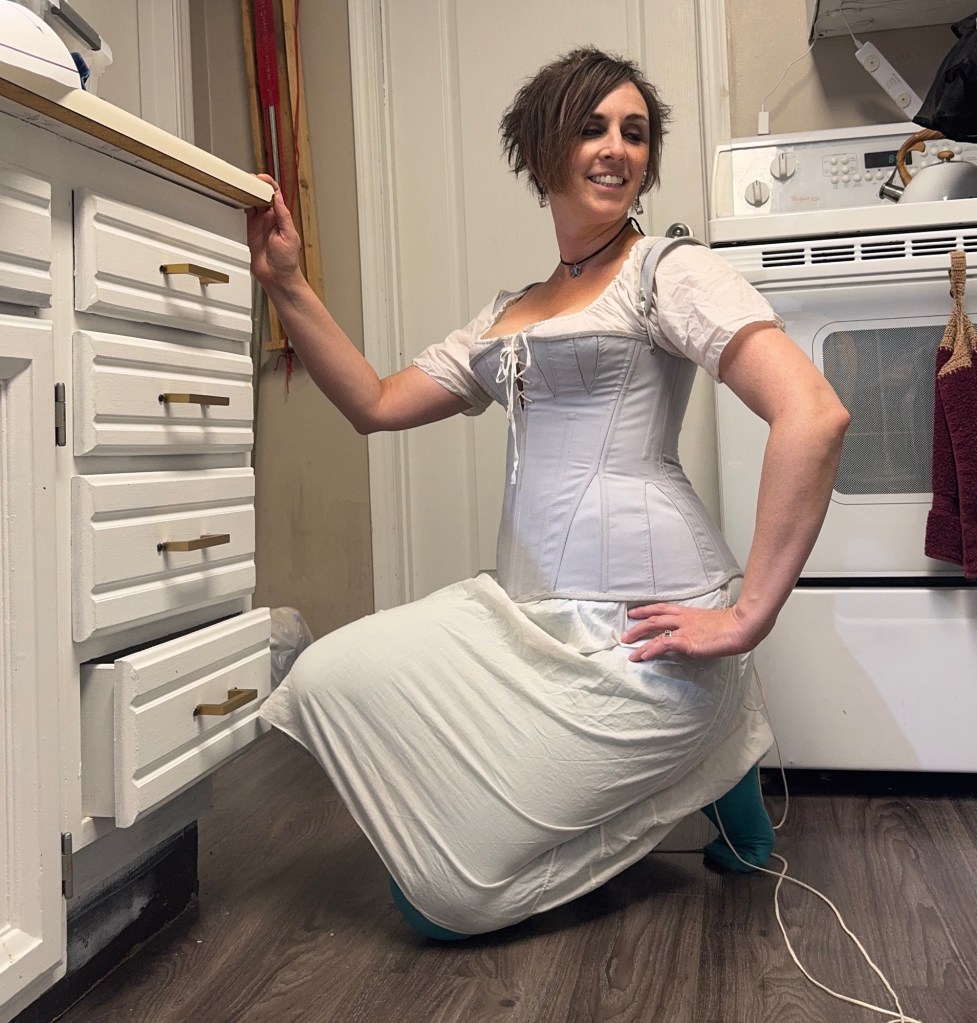
Back in the winter, I got inspired to try and update my long-neglected Regency period wear. In particular, certain world events have had a lot of us Canucks thinking about the War of 1812 a lot more than we ever had before… which got my little historical sewing group planning an 1812 picnic on August 24. First off, I wanted to make a new set of regency stays, since my old ones aren’t fitting quite how they used to. And I’ve always wanted a set of long stays, anyway.
I actually mostly finished these back in April, but I wasn’t quite satisfied with the fit. Recently, I finally made some tweaks that I think have saved them.
It’s the Redthreaded pattern, but my copy is from back in the day when they only came in single size, which is no longer the size I am. So I had added some width, but apparently I overdid it because it was lacing closed and not really doing what it needed to. This period of corset was aimed less at waist reduction and more at bust lifting (with a side of keeping a flatter tummy to look a little less pregnant in the high-waisted gowns), but at least at my age I need the underbust area to fit snugly, like a bra band, to get the proper support/lift. So, since I couldn’t quite bring myself to redo the binding, I just took a half-inch tuck right beside one of the boning channels at each side seam, all the way from top to bottom, so that my stitching was right on the seam line. The tuck is hidden on the inside and hopefully the tuck won’t be too irritating during periods of longer wear; I didn’t notice it at all while trying it on.
But let’s back up a bit. While sewing, I had a lot of regrets about my decisions with this project.
First, the materials. Corsets of this period are usually made of a double layer of cotton sateen (ticking would work in a pinch) with quilting, embroidery, and cording supplying a lot of the support. I could not for the life of me find my original digital pattern and instructions, so I was kinda winging it, just modifying my old printed version, and somehow I settled on single layer construction (so no cording or quilting) using the last of the grey coutil from Farthingales I used for this Edwardian corset. This stuff is beautiful and the finished corsets are great, but it’s stiff as cardboard, hard to sew even on a machine, and not even remotely accurate to the period in this case. I mean, my historical accuracy is never super high, but what was I thinking?
I didn’t have a lot of the coutil left, either, so when laying out my pattern it became obvious I would have to add a front seam. However, I seized on this opportunity to add some lacing in the upper front, similar to these transitional stays at the V&A:
Or the ones included in the Scroop Augusta Stays pattern. This detail really makes no sense in a pattern with bust gussets, at least for someone like me who has no space between their breasts, but I do think it’s a cute detail and I don’t really regret going for it.
Hand eyelets on the front. Not on the back however.
I did a LOT of hand stitching on these, and I regretted just about every moment of it, because this coutil is so dense and hard to stitch. I inserted the bust gussets by hand, including turning and stitching down the seam allowances on the inside. I love the look, but the process nearly killed me.
Detail of the V&A gusseted corset
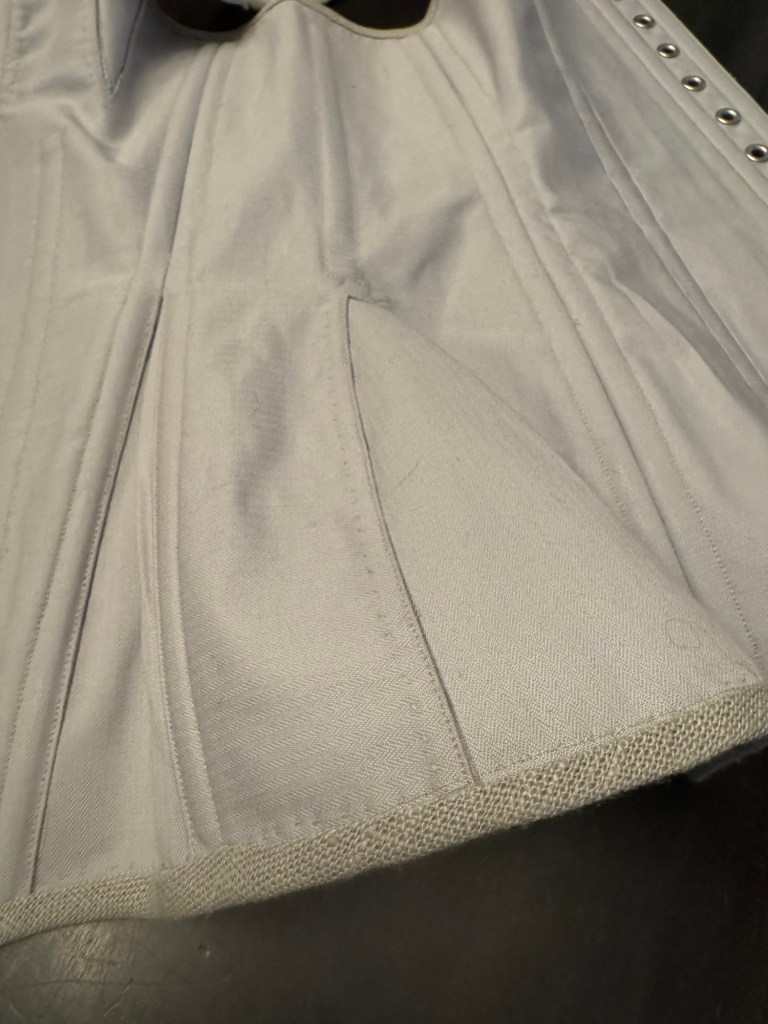
I used a different technique for inserting the hip gussets, based on looking at some 1830s corsets on the V&A website. See how the point of the gusset is actually square, covered in a satin stitch? You get this if you cut your slit as a T, and the edges you fold under are the same width all along instead of tapering to nothing at the point. It was so much easier than trying to taper the seam allowances to a V point, especially when sewing by machine! I do still have to go back and do the satin stitch across, though.
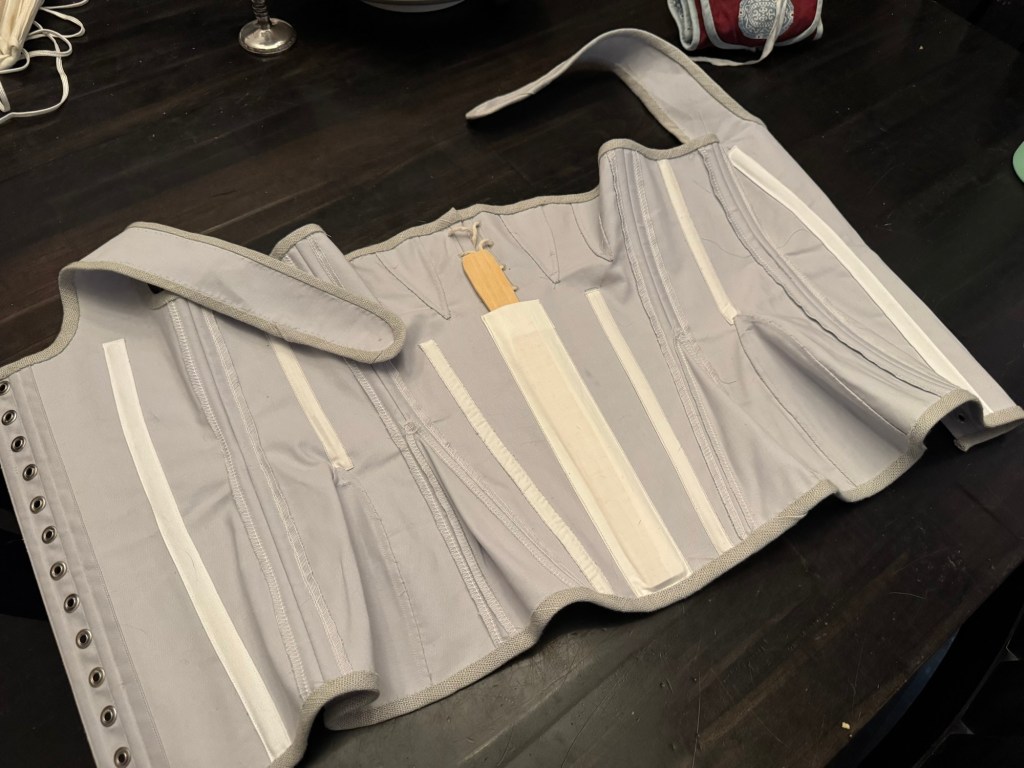
The boning is a mix of spring steel, spiral steel, and a bit of plastic imitation baleen when I got lazy. I also added a pocket for a wooden busk in the front (aka a paint stir stick) although I had to make it a bit shorter due to the presence of the split section at the upper CF.
The binding is a coarse linen(?) type bias binding I originally made for this corset a billion years ago.
It’s been kicking around my overflowing bias tape box ever since. I really should go back and revamp that corset, actually….
The hip spring isn’t quite adequate (hence the flare out of the lacing gap at the bottom)—I should have tested that more closely, and enlarged the hip gussets as necessary. But for the moment I’m going to live with it. I also spiral-laced it, which is period appropriate but a pain to tighten up and I have no idea how to tie it off efficiently. More research needed. If you know the secret, please let me know!
But anyway, it’s done (however imperfectly), and I am excited to start work on my 1812 military-inspired riding habit….
At some point in the last year (November of 2024 but I had to scroll back in my camera roll to co firm that because it feels like it’s always been there) I made a black linen version of the Wearing History 1900 skirt. My only change from my first go at the pattern was to make it button down the front, a not particularly historical detail that I enjoy because it gives me an optional slit and also lets a ruffled petticoat peek out.
It has become a workhorse in my wardrobe because it’s versatile and more basic than a lot of my skirts, which means I don’t try as hard to space out the wearing as I do with a lot of my more, um, striking makes.
Aside from the buttons up the front, I hemmed it with a bit of a sweep in the back, then realized that was really stupid for a skirt I wanted to wear on the regular, so I added a little button and loop to bustle it up just a couple of inches.
Just enough details to make it feel fun and fancy without being too much for regular use.
But, because it’s black, it’s basically impossible to get any good shots of the details without blowing everything out so the wrinkles and stray cat hairs make it look terrible.
Nonetheless, it’s been a workhorse over the winter (with the appropriate petticoats), and I’m hoping it will transition well to breezy linen summer wear.
Black blob.
And yes, it has a pocket, although as usual I wish it were a bit bigger. (And in case you’re wondering how often I wear it, all the actual modeled photos in this post are just the times I’ve worn it this month during Me Made May.)
Comments Off on Black, basic, impossible to photograph
After my precious linen Christmas blouse, I had a small but non-zero amount of fabric left. Not enough for another garment… but far too much to consign to the scraps bin. It was, however, just enough to make a generous amount of bias tape. And, I realized, it coordinated very well with the fabric I used for this skirt last winter.
Without thinking about it too much, I cut out a simple Swiss waist using my French Meadows draft as a starting place. My pink linen became the binding, as well as some rouleau for decoration. It might have taken forever, except that I wound up spending five or six hours with Syo in the ER after a medical scare that turned out to be probably nothing. Which was grueling, but I got a lot of hand-stitching done, so I was probably less frustrated at the end of the night than she was.
So that was fun. Although I kind of wish the shape was a bit more, well, shapely. But that’s what I get for only wanting a three piece pattern.
I liked the rouleau technique enough that I decided to apply it to the skirt, loosely inspired by trimmings I’ve seen in catalogue pictures.
Again, it took some time but not nearly as much as I would’ve thought. I’ve actually thought about doing something like this ever since I first finished the skirt, though I was thinking more black or darker purple. But in the end I really like the subtlety of the pink-on-purple, although it is a bit hard to photograph.
The result is almost a capsule wardrobe, which I’m enjoying very much. I still have some scraps of the light purple fabric, maybe enough for a little vest even…
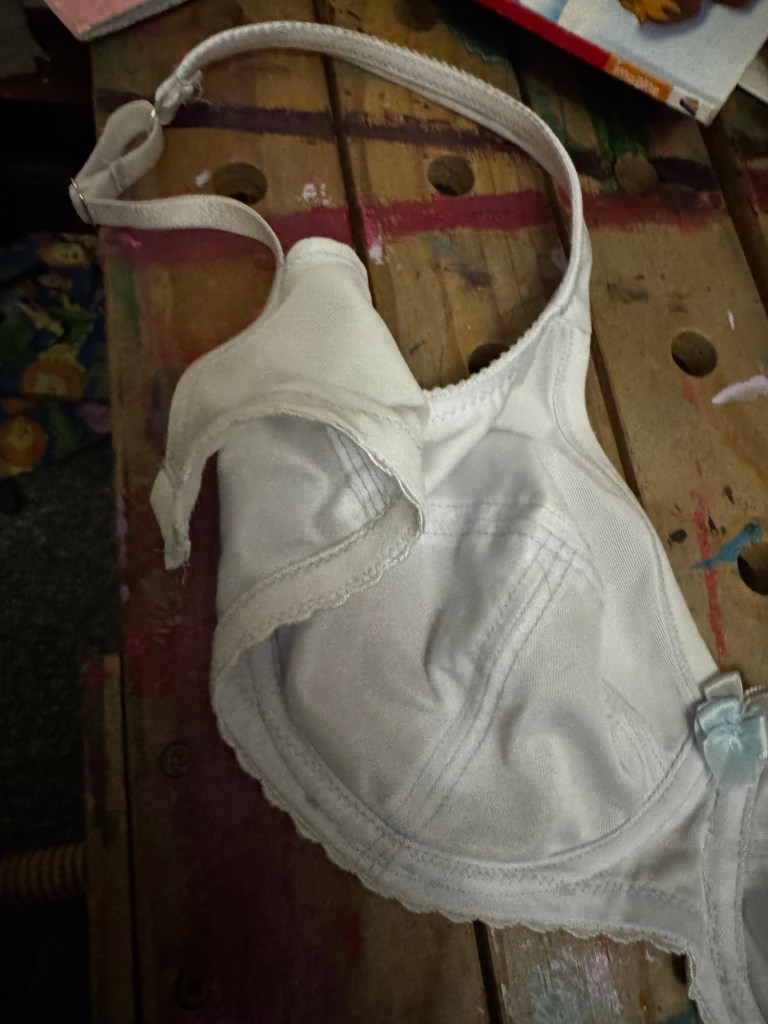
Syo gave me some very lovely pink linen for Christmas, brought back from her trip to Australia this past fall. Only two metres, she apologized, because it was very expensive. I was, understandably, thrilled. I prewashed the fabric that very day.
But then I needed to pick a pattern as special as the fabric itself. After some faffing around, I managed to find Butterick 6206, an old pattern of my mom’s. It has the significance to me, though, of being the first commercial pattern I ever sewed with, back in 1998 or 1999, when I was about 18, and wanted a white outfit to wear clubbing at the local goth night. I made it from an old, sheer curtain, and into a crop top, and I was thoroughly delighted with myself except for one thing—I didn’t know to lengthen the sleeves. So they were always annoyingly just a little too short.
Anyway, this felt like a good time and place to revisit this pattern, with a couple of adjustments.
I added 2” to the sleeve length, just at the hem, since exaggerating that gorgeous bishop sleeve shape didn’t seem like a bad plan at all. And then when cutting the body pieces I scootched them in from the fold by about an inch each, for a total of 4” extra ease at the bust, which seemed about right for my current measurements. I don’t know if I strictly needed it for the bust but I definitely did at the hip. I also raised under the arms my usual 1/2”.
This was a great beginner pattern for me when I was a teenager because it really is as easy as it says it is, but revisiting it I also appreciated there is some really sophisticated drafting going on. The sleeve shape is lovely, and the neckline has some really subtle shaping as well. Much more subtle than the (similar era) Kwik Sew pattern I made recently.
I added a little slit at the front, since I liked how that had worked on the Kwik Sew pattern, and it makes it easy to finish the neckline with a drawstring, which I like.
And then I went a little crazy, and decided this (very simple) special pattern and special fabric needed entirely hand-finishing. I hand-felled all the seams. And then I decided I wanted a ruffle along the edge, so after I hand-hemmed the whole thing I went back over the neckline and sleeve hems and added another round of chainstitching. I should honestly have added two, one on each side of the elastic, as I’m really not sure how well my basic hemming will hold up when functioning as a casing, but this was already a two week project and we’ll cross that bridge when we come to it.
The chainstitching took by far the longest, although it seemed to go faster than the last time I attempted it, when it made me question my sanity. And you barely see it when it is all gathered up, although I like to think it adds a certain dimension and complexity to the simple design.
The only thing I’m not completely satisfied with is the drawstring I used, which is a piece of white cotton stay tape. Next time I have some avocado skins around I will try and dye it…
Then, because I was so happy with the pattern, I made it again.
Last summer, I attended a local sewist’s garden party, which included a fabric swap. I got this lovely piece of textured linen-rayon blend. It was, however, a very trendy chartreuse colour that I knew I would never wear. So I eventually managed to pick up some fabric dye and over-dye it with indigo blue. The result is a fairly dark, muted navy, still not one of my core colours but a lot closer than it had been before. However, there was only a metre of the fabric, and I was a bit stumped as to what to make, especially as I wasn’t in the mood for a tank top.
But when I had the Butterick 6206 pattern out, I realized that if I used the short sleeve pattern piece, I could just squeeze out the shirt, less about an inch of length, if I added a centre-front seam. I wasn’t able to add as much width to this version, but the fabric has a lot of give so I wasn’t too worried. And the CF seam made adding the little slit I like super easy.
This shirt was as quick and modern in its construction as the first one was painstaking. Overlocking and machine hems throughout. As a result it only took an afternoon to construct.
I do need to find a darker drawstring, though. Definitely not a fan of the white for this shirt.
Anyway, I think both of these will fit nicely into my existing wardrobe, drifting ever further in the whimsical direction as it is.
I got this fabric from a local sewing friend who’s been in a low-key destash mode over the last couple of years. It’s a gorgeous textured linen/cotton. I originally wanted a dress but the 2.5m length was a bit minimal for the long, flowing thing I was imagining. So then I decided to opt for a skirt… But to minimize cutting into the fabric in case I change my mind later, I went with a skirt style lightly inspired by eighteenth-century petticoats—two rectangular lengths pleated to a waistband.
Now, this is frankly an ageless method of skirt construction, and it’s one I have a fraught history with. I don’t usually like how gathered rectangles look on my body, above or below the waist. It worked ok for this dress here, but it’s generally not my favourite. I’ve attempted to rework this dress for post-maternity wear and I kinda hate it.
But, wearing over a corset lets me get away with some clothing shapes I haven’t usually been comfortable with, so I decided to give it a try in this case. With pleats, not gathers.
I left a flat space (maybe too wide) along the middle of the front, and then my pleats are closer together in the front, a bit more spaced out in the back.
The most common method of making 18th-century style petticoats seems to be leaving slits at the sides and putting separate ties on front and back. This works great and is highly adjustable, but I wasn’t too sure I wanted slits at the highly visible sides since I’m not likely to actually wear it with 18th century upper garments that often cover that area. So really this is more of a Victorian take on the idea, which I’m sure existed and I could probably find references and directions for if I dug.
Anyway, I decided to make a slit closure at the centre back, using the same slit in a pleat method I used on my flannel petticoat, though I didn’t do a good job of illustrating it in that post either. Basically you cut the slit; make a narrow hem (tapering to nothing at the end of the slit) for the underlay side, and fold in a big pleat to make the wide overlap side.
Stitch along the edge of the pleat that formed the overlap, and stitch across the pleat at the bottom of the slit portion to secure it in place, so above this line there is placket, and below it is pleat. Clear as mud? Thought so.
And that was the most complicated portion of the construction.
I got these gorgeous heavy-duty hook and eyes from Farthingales and they’re too pretty to hide inside.
Except…I knew I was pleating it a bit loose for my corseted waist. I kind of wanted to keep my options open for wearing without corsets (even though, as previously mentioned, I’m not likely to like this skirt shape on my body without a corset). But it’s a bit too too loose. So when actually worn the too-big overlap creates a fairly weird spot where the upper placket pulls awkwardly across several other pleats. On the other hand, it’s in the back so I can’t see it and pleats are always shifting around when you move anyway.
I definitely still prefer the flared look of a gored skirt, and I think undergarments—corset and gored petticoats—are going to be key to the wearability of this skirt, giving it the illusion of more volume at the bottom. Also, I need to go in and add real pocket. (I added one about a week later. ) But I’ll have to find a coordinating fabric for that because this was an absolutely zero-waste project, which is basically unheard of for me. Oh wait I lied…. There was a short piece of the narrow rectangle I used for the waistband left over. (Edit: I used that leftover rectangular bit to make matching pocket facings on my quilting-cotton pocket, it is now fully zero waste.)
But I am excited to have a red skirt. Considering red is what I usually call my favourite colour, I don’t wear it much. So I’m pretty happy to change that a bit. And it’s definitely the season.
The first corset I ever made, back in 2015, has always been one of my favourites.
But, it’s also never really been wearable. Partly the fit wasn’t great, but the biggest glitch was my failure to properly bone the outer edge of the back lacing, which made it impossible to lace very tightly; it was also a bit big, though entering my 40s has fixed that problem for me. And as my bust has, ah, improved over the last few years, the upper edge went from not-quite-mid-bust to awkwardly low. There was nothing like enough hip or bust spring, either. So it’s been sadly awaiting a makeover for quite a long time.
I’m a bit between projects right now and a little too burnt out to tackle anything big, so I made myself start mindlessly seam ripping.
Fortunately I had the rest of the fabric still in stash, since I needed to add gussets to the hip and cut new binding for the top and bottom, as well as adding a casing to the lacing edge.
Lace flowers.
Removing the binding took the longest (well, except for adding the binding back on). I had to take off the lace along the top as well, and removed one of the carefully scatter of artful lace flowers that were pretty much my favourite feature of the corset, and I should probably reposition more of them, but we’ll see if that happens.
That being said, it really didn’t take nearly as much time as I thought it might. The original corset was layered over a white denim, but for the new additions I layered the fashion fabric over some bits of ticking, which is much more corset-appropriate. It’s a little thinner but this isn’t a big problem for the gussets.
Can you see where I added the hip gussets in?
Once I had the binding off I seam-ripped the bottom half of the side seam, drafted up a gusset shape to fill in that space, and marked where I thought the under bust curve should go. (I also ripped WAY up one side trying it on to get an idea of how big the hip gussets should be, and had to hand-stitch it back together, which worked surprisingly well. Here’s hoping if it works for 18th century stays it’ll work for me.
The result is a much curvier underbust corset—maybe not as historical, but it wasn’t really good at that anyway.
I think it’ll be much more useful as a cute outerwear piece than it was before.