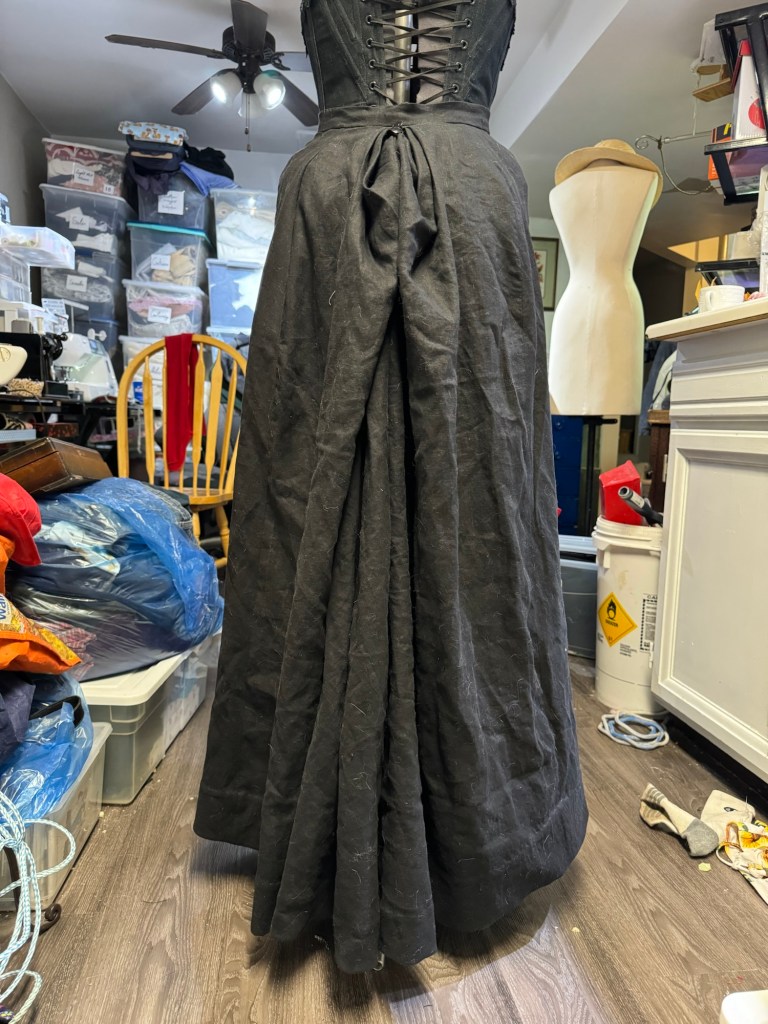
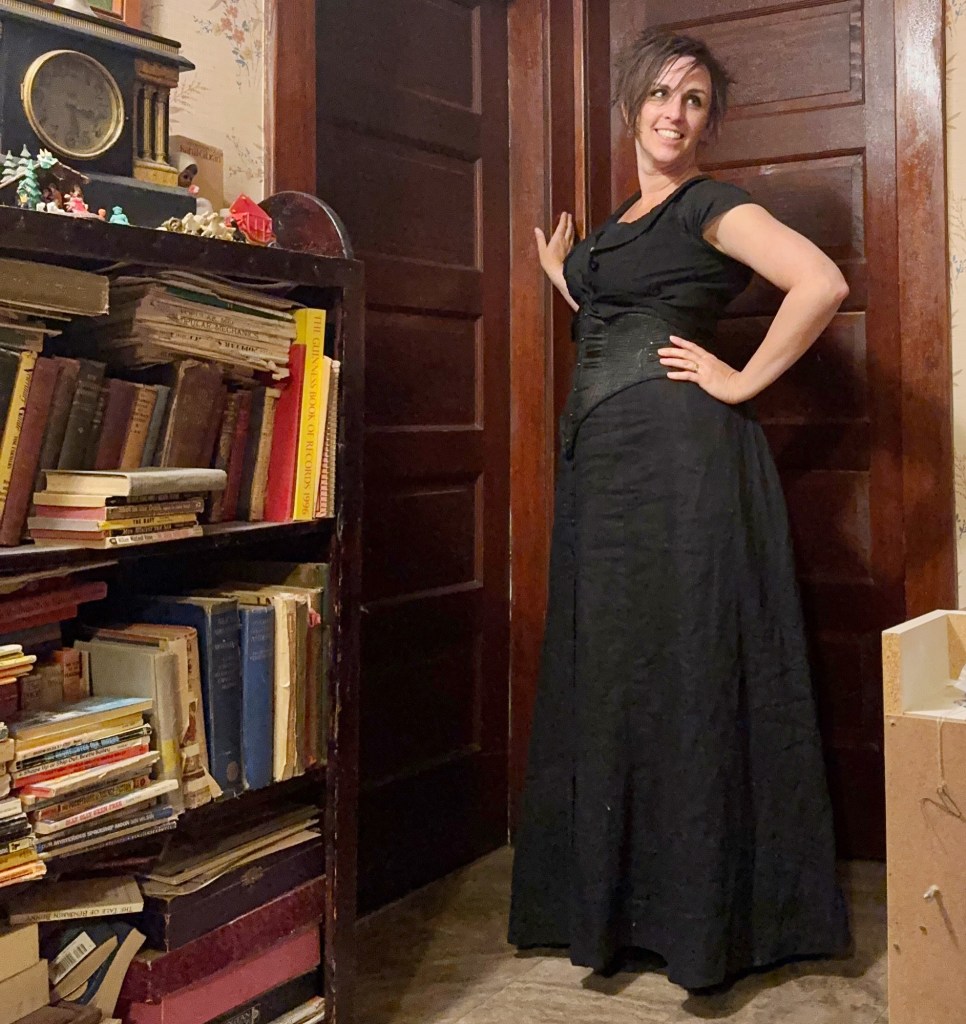
At some point in the last year (November of 2024 but I had to scroll back in my camera roll to co firm that because it feels like it’s always been there) I made a black linen version of the Wearing History 1900 skirt. My only change from my first go at the pattern was to make it button down the front, a not particularly historical detail that I enjoy because it gives me an optional slit and also lets a ruffled petticoat peek out.
It has become a workhorse in my wardrobe because it’s versatile and more basic than a lot of my skirts, which means I don’t try as hard to space out the wearing as I do with a lot of my more, um, striking makes.
Aside from the buttons up the front, I hemmed it with a bit of a sweep in the back, then realized that was really stupid for a skirt I wanted to wear on the regular, so I added a little button and loop to bustle it up just a couple of inches.
Just enough details to make it feel fun and fancy without being too much for regular use.
But, because it’s black, it’s basically impossible to get any good shots of the details without blowing everything out so the wrinkles and stray cat hairs make it look terrible.
Nonetheless, it’s been a workhorse over the winter (with the appropriate petticoats), and I’m hoping it will transition well to breezy linen summer wear.
Black blob.
And yes, it has a pocket, although as usual I wish it were a bit bigger. (And in case you’re wondering how often I wear it, all the actual modeled photos in this post are just the times I’ve worn it this month during Me Made May.)
Comments Off on Black, basic, impossible to photograph
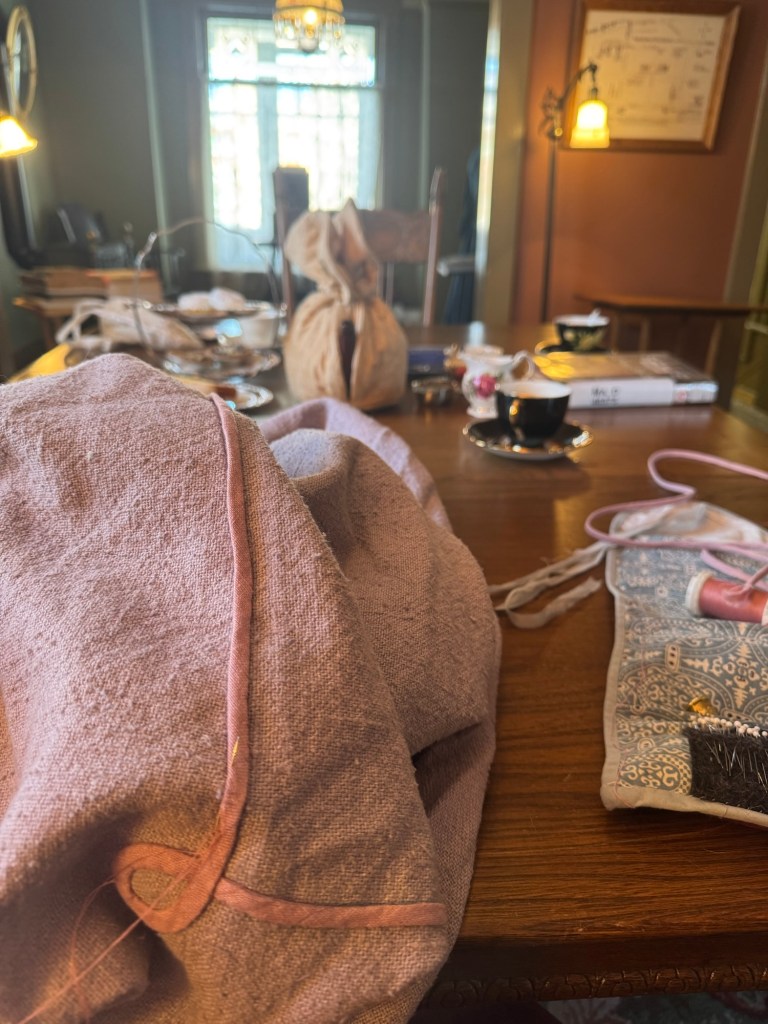
After my precious linen Christmas blouse, I had a small but non-zero amount of fabric left. Not enough for another garment… but far too much to consign to the scraps bin. It was, however, just enough to make a generous amount of bias tape. And, I realized, it coordinated very well with the fabric I used for this skirt last winter.
Without thinking about it too much, I cut out a simple Swiss waist using my French Meadows draft as a starting place. My pink linen became the binding, as well as some rouleau for decoration. It might have taken forever, except that I wound up spending five or six hours with Syo in the ER after a medical scare that turned out to be probably nothing. Which was grueling, but I got a lot of hand-stitching done, so I was probably less frustrated at the end of the night than she was.
So that was fun. Although I kind of wish the shape was a bit more, well, shapely. But that’s what I get for only wanting a three piece pattern.
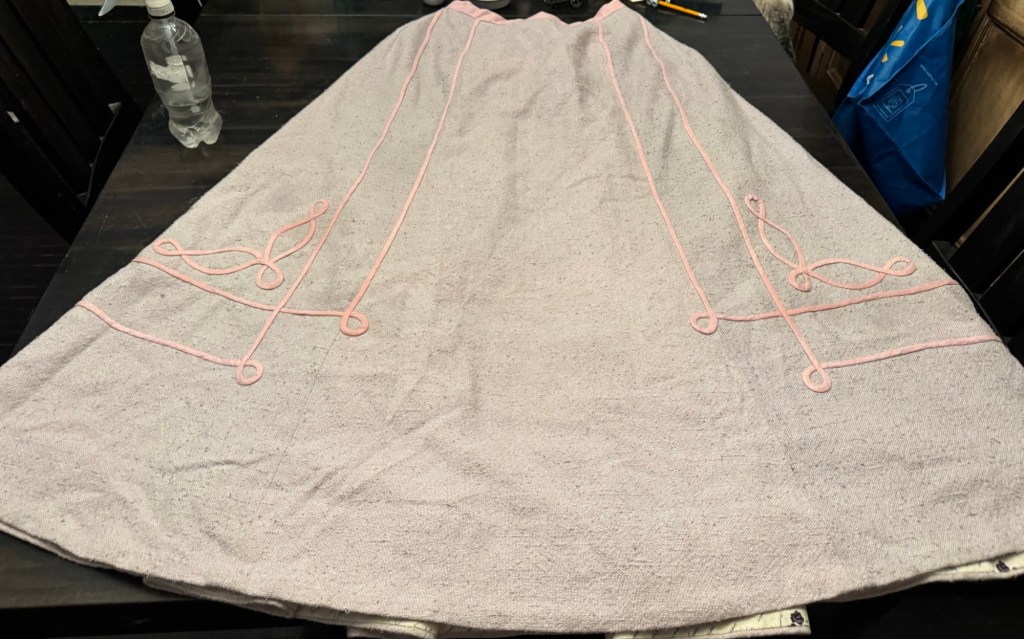
I liked the rouleau technique enough that I decided to apply it to the skirt, loosely inspired by trimmings I’ve seen in catalogue pictures.
Again, it took some time but not nearly as much as I would’ve thought. I’ve actually thought about doing something like this ever since I first finished the skirt, though I was thinking more black or darker purple. But in the end I really like the subtlety of the pink-on-purple, although it is a bit hard to photograph.
The result is almost a capsule wardrobe, which I’m enjoying very much. I still have some scraps of the light purple fabric, maybe enough for a little vest even…
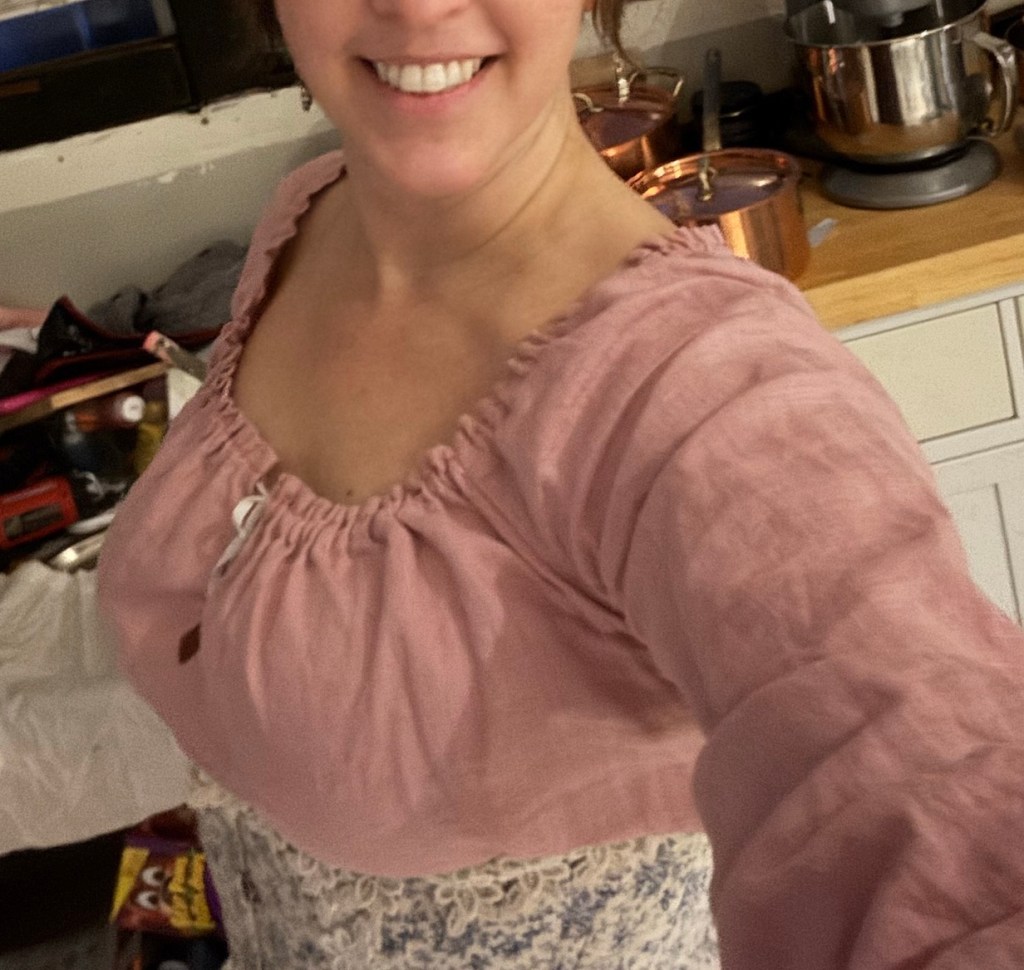
Syo gave me some very lovely pink linen for Christmas, brought back from her trip to Australia this past fall. Only two metres, she apologized, because it was very expensive. I was, understandably, thrilled. I prewashed the fabric that very day.
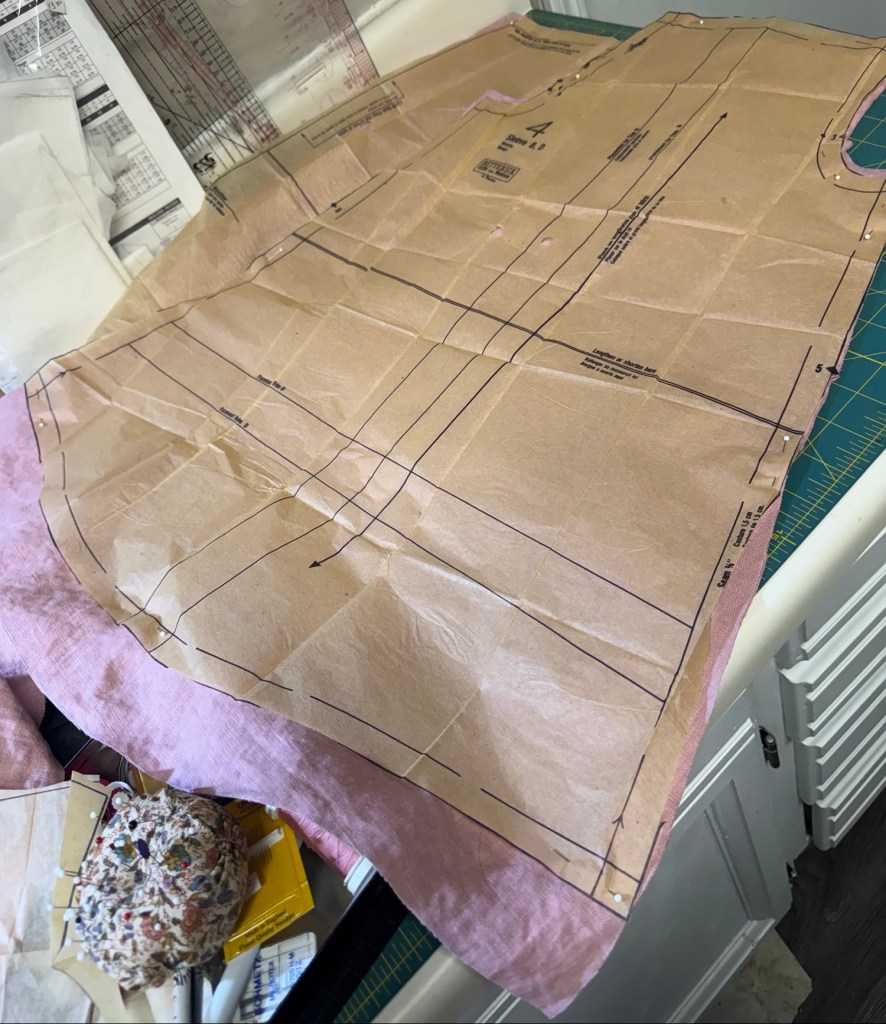
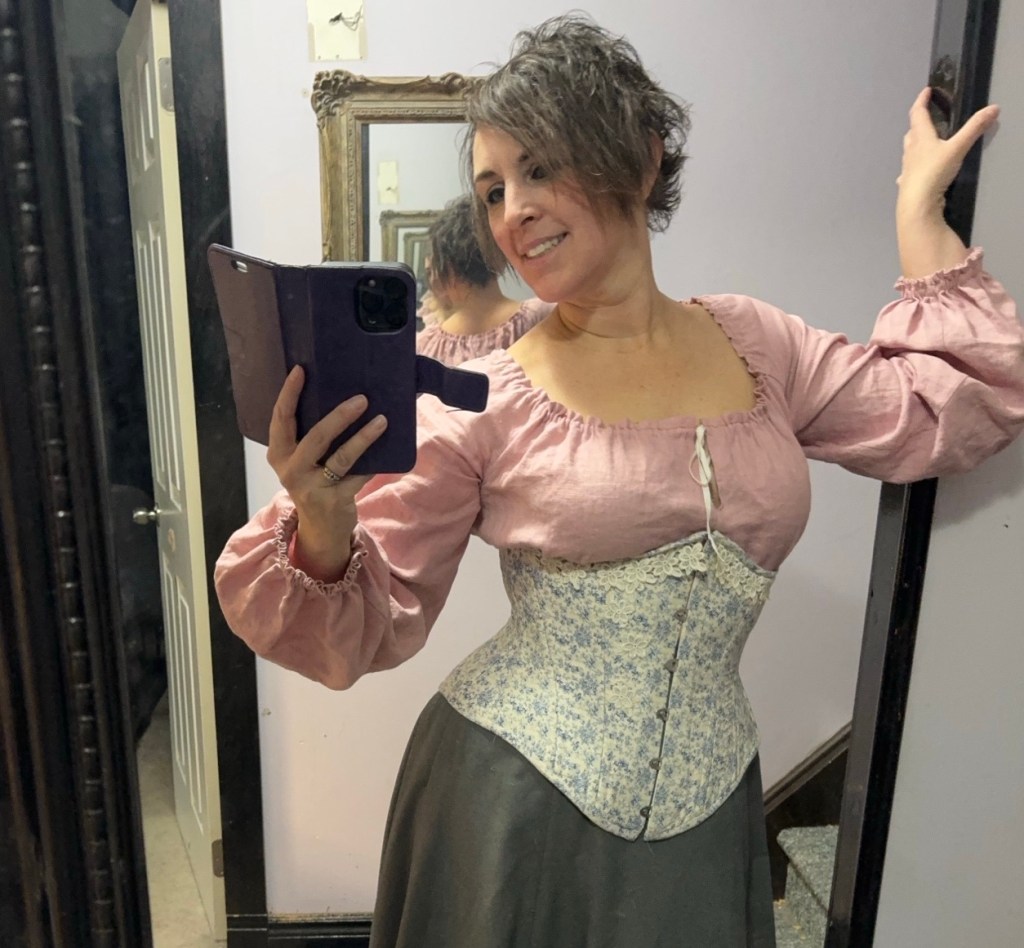
But then I needed to pick a pattern as special as the fabric itself. After some faffing around, I managed to find Butterick 6206, an old pattern of my mom’s. It has the significance to me, though, of being the first commercial pattern I ever sewed with, back in 1998 or 1999, when I was about 18, and wanted a white outfit to wear clubbing at the local goth night. I made it from an old, sheer curtain, and into a crop top, and I was thoroughly delighted with myself except for one thing—I didn’t know to lengthen the sleeves. So they were always annoyingly just a little too short.
Anyway, this felt like a good time and place to revisit this pattern, with a couple of adjustments.
I added 2” to the sleeve length, just at the hem, since exaggerating that gorgeous bishop sleeve shape didn’t seem like a bad plan at all. And then when cutting the body pieces I scootched them in from the fold by about an inch each, for a total of 4” extra ease at the bust, which seemed about right for my current measurements. I don’t know if I strictly needed it for the bust but I definitely did at the hip. I also raised under the arms my usual 1/2”.
This was a great beginner pattern for me when I was a teenager because it really is as easy as it says it is, but revisiting it I also appreciated there is some really sophisticated drafting going on. The sleeve shape is lovely, and the neckline has some really subtle shaping as well. Much more subtle than the (similar era) Kwik Sew pattern I made recently.
I added a little slit at the front, since I liked how that had worked on the Kwik Sew pattern, and it makes it easy to finish the neckline with a drawstring, which I like.
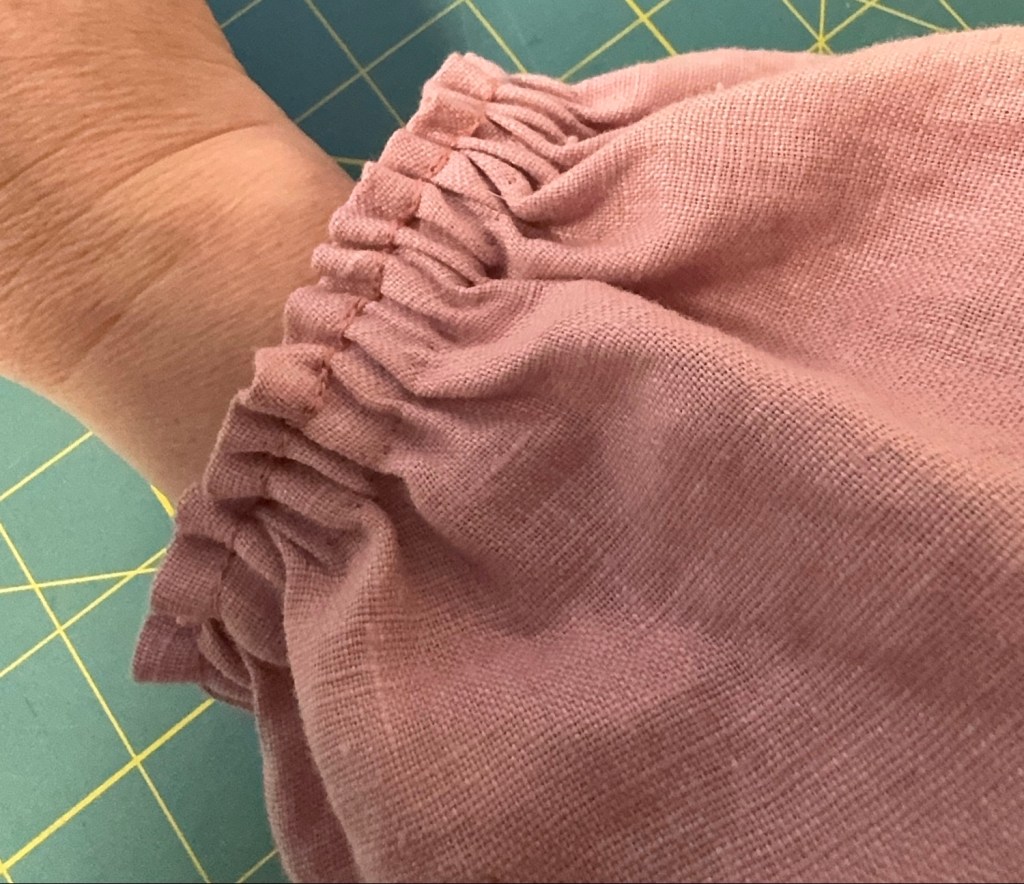
And then I went a little crazy, and decided this (very simple) special pattern and special fabric needed entirely hand-finishing. I hand-felled all the seams. And then I decided I wanted a ruffle along the edge, so after I hand-hemmed the whole thing I went back over the neckline and sleeve hems and added another round of chainstitching. I should honestly have added two, one on each side of the elastic, as I’m really not sure how well my basic hemming will hold up when functioning as a casing, but this was already a two week project and we’ll cross that bridge when we come to it.
The chainstitching took by far the longest, although it seemed to go faster than the last time I attempted it, when it made me question my sanity. And you barely see it when it is all gathered up, although I like to think it adds a certain dimension and complexity to the simple design.
The only thing I’m not completely satisfied with is the drawstring I used, which is a piece of white cotton stay tape. Next time I have some avocado skins around I will try and dye it…
Then, because I was so happy with the pattern, I made it again.
Last summer, I attended a local sewist’s garden party, which included a fabric swap. I got this lovely piece of textured linen-rayon blend. It was, however, a very trendy chartreuse colour that I knew I would never wear. So I eventually managed to pick up some fabric dye and over-dye it with indigo blue. The result is a fairly dark, muted navy, still not one of my core colours but a lot closer than it had been before. However, there was only a metre of the fabric, and I was a bit stumped as to what to make, especially as I wasn’t in the mood for a tank top.
But when I had the Butterick 6206 pattern out, I realized that if I used the short sleeve pattern piece, I could just squeeze out the shirt, less about an inch of length, if I added a centre-front seam. I wasn’t able to add as much width to this version, but the fabric has a lot of give so I wasn’t too worried. And the CF seam made adding the little slit I like super easy.
This shirt was as quick and modern in its construction as the first one was painstaking. Overlocking and machine hems throughout. As a result it only took an afternoon to construct.
I do need to find a darker drawstring, though. Definitely not a fan of the white for this shirt.
Anyway, I think both of these will fit nicely into my existing wardrobe, drifting ever further in the whimsical direction as it is.
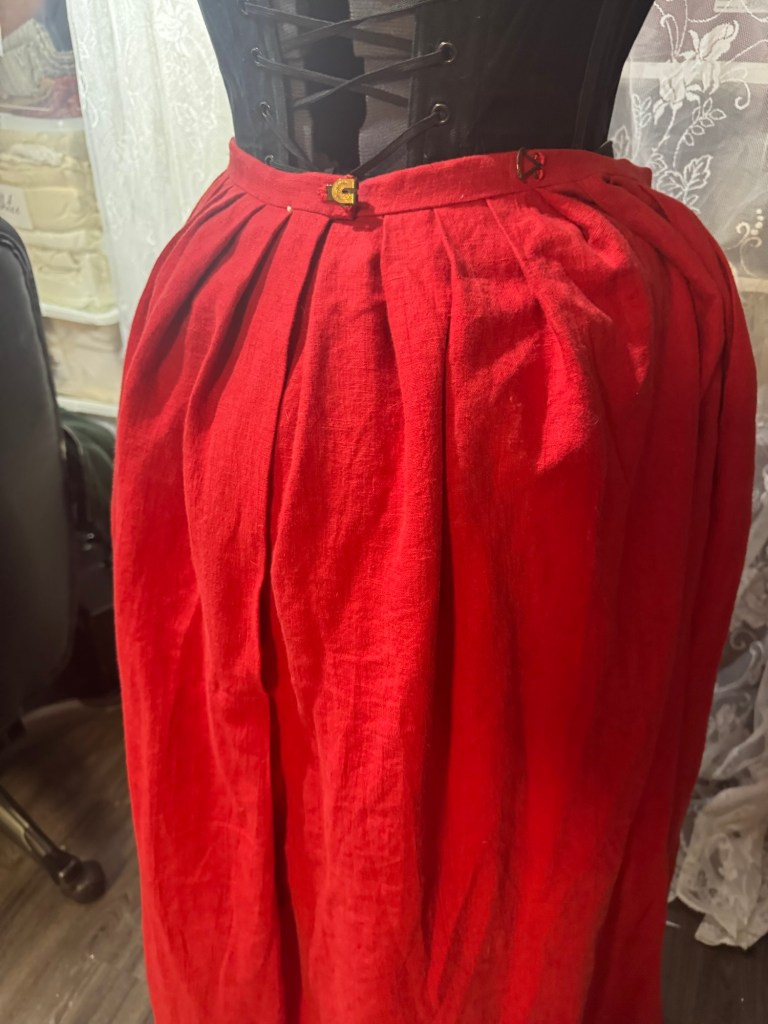
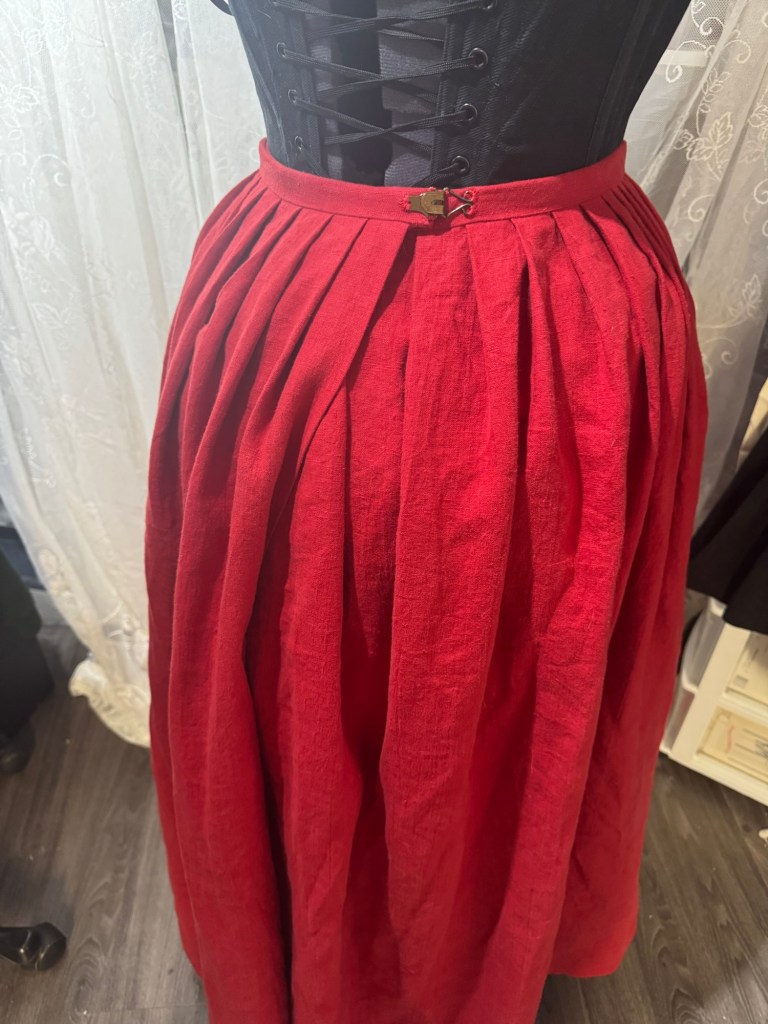
I got this fabric from a local sewing friend who’s been in a low-key destash mode over the last couple of years. It’s a gorgeous textured linen/cotton. I originally wanted a dress but the 2.5m length was a bit minimal for the long, flowing thing I was imagining. So then I decided to opt for a skirt… But to minimize cutting into the fabric in case I change my mind later, I went with a skirt style lightly inspired by eighteenth-century petticoats—two rectangular lengths pleated to a waistband.
Now, this is frankly an ageless method of skirt construction, and it’s one I have a fraught history with. I don’t usually like how gathered rectangles look on my body, above or below the waist. It worked ok for this dress here, but it’s generally not my favourite. I’ve attempted to rework this dress for post-maternity wear and I kinda hate it.
But, wearing over a corset lets me get away with some clothing shapes I haven’t usually been comfortable with, so I decided to give it a try in this case. With pleats, not gathers.
I left a flat space (maybe too wide) along the middle of the front, and then my pleats are closer together in the front, a bit more spaced out in the back.
The most common method of making 18th-century style petticoats seems to be leaving slits at the sides and putting separate ties on front and back. This works great and is highly adjustable, but I wasn’t too sure I wanted slits at the highly visible sides since I’m not likely to actually wear it with 18th century upper garments that often cover that area. So really this is more of a Victorian take on the idea, which I’m sure existed and I could probably find references and directions for if I dug.
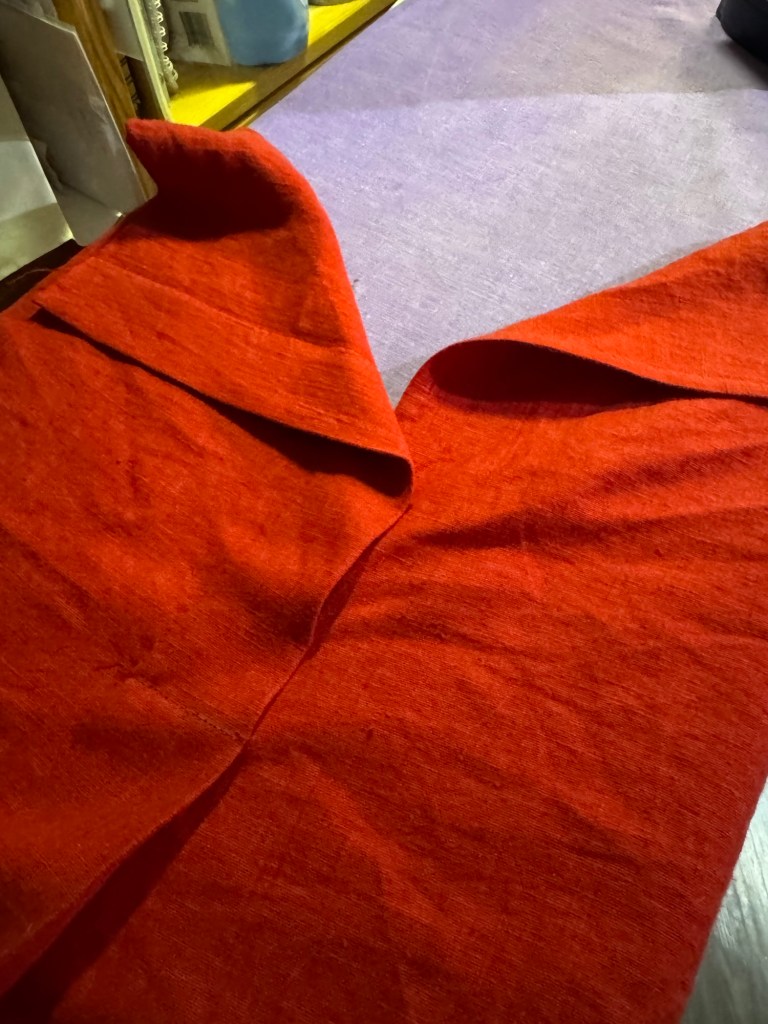
Anyway, I decided to make a slit closure at the centre back, using the same slit in a pleat method I used on my flannel petticoat, though I didn’t do a good job of illustrating it in that post either. Basically you cut the slit; make a narrow hem (tapering to nothing at the end of the slit) for the underlay side, and fold in a big pleat to make the wide overlap side.
Stitch along the edge of the pleat that formed the overlap, and stitch across the pleat at the bottom of the slit portion to secure it in place, so above this line there is placket, and below it is pleat. Clear as mud? Thought so.
And that was the most complicated portion of the construction.
I got these gorgeous heavy-duty hook and eyes from Farthingales and they’re too pretty to hide inside.
Except…I knew I was pleating it a bit loose for my corseted waist. I kind of wanted to keep my options open for wearing without corsets (even though, as previously mentioned, I’m not likely to like this skirt shape on my body without a corset). But it’s a bit too too loose. So when actually worn the too-big overlap creates a fairly weird spot where the upper placket pulls awkwardly across several other pleats. On the other hand, it’s in the back so I can’t see it and pleats are always shifting around when you move anyway.
I definitely still prefer the flared look of a gored skirt, and I think undergarments—corset and gored petticoats—are going to be key to the wearability of this skirt, giving it the illusion of more volume at the bottom. Also, I need to go in and add real pocket. (I added one about a week later. ) But I’ll have to find a coordinating fabric for that because this was an absolutely zero-waste project, which is basically unheard of for me. Oh wait I lied…. There was a short piece of the narrow rectangle I used for the waistband left over. (Edit: I used that leftover rectangular bit to make matching pocket facings on my quilting-cotton pocket, it is now fully zero waste.)
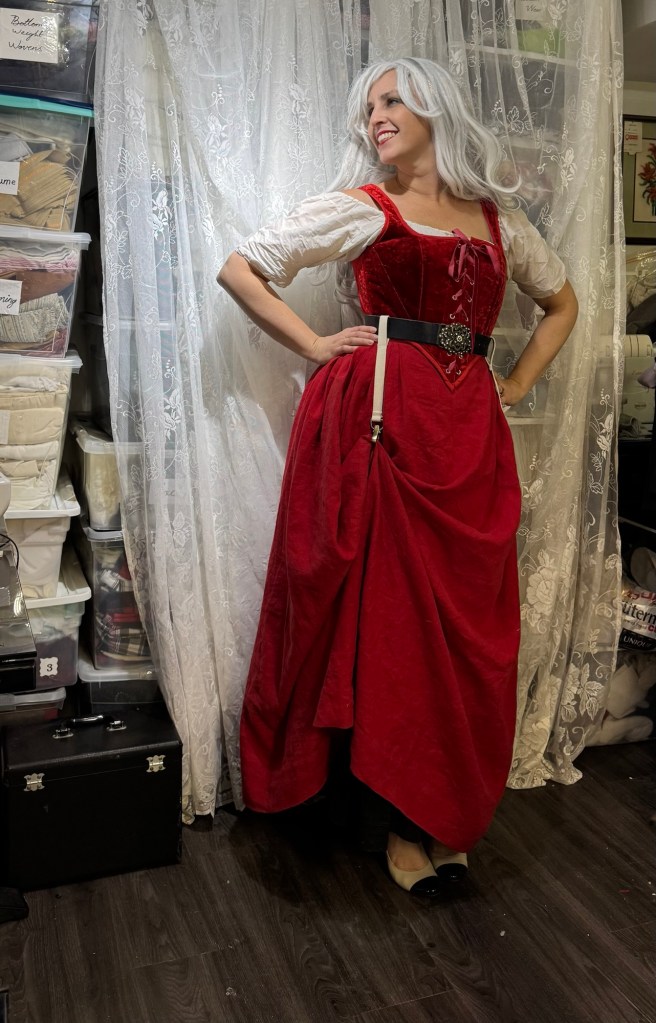
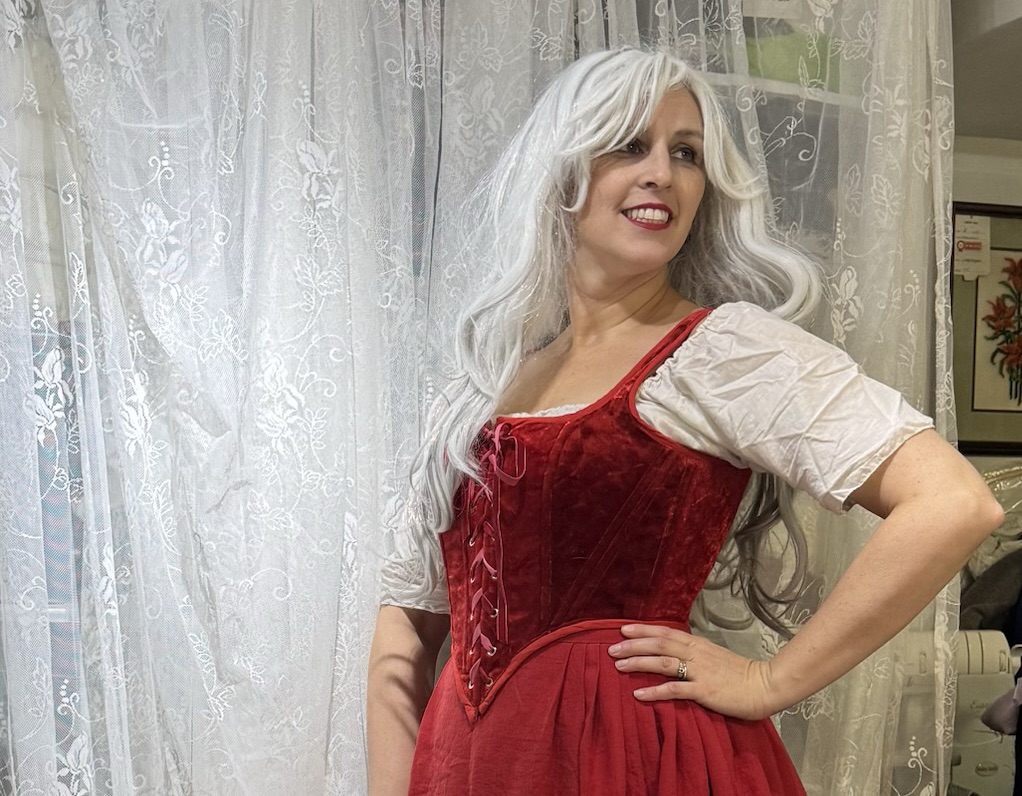
But I am excited to have a red skirt. Considering red is what I usually call my favourite colour, I don’t wear it much. So I’m pretty happy to change that a bit. And it’s definitely the season.
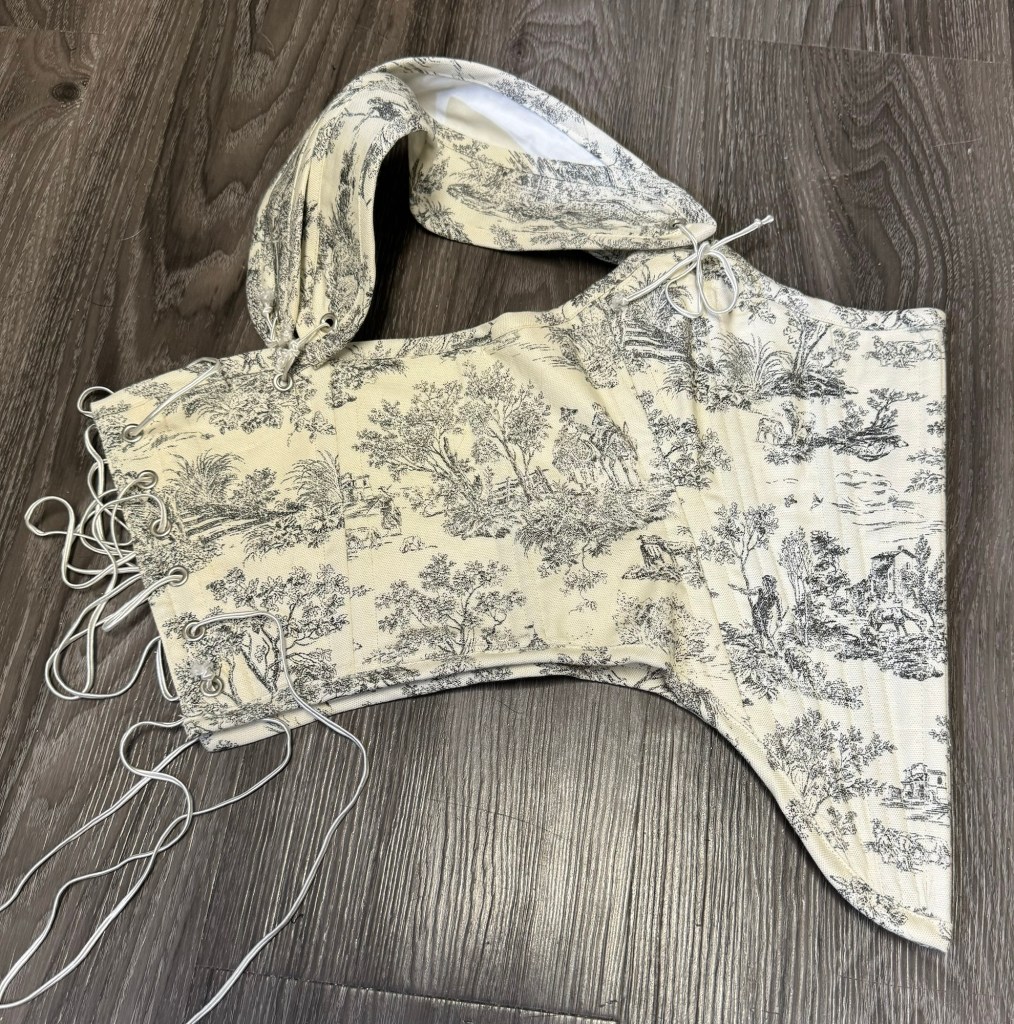
The first corset I ever made, back in 2015, has always been one of my favourites.
But, it’s also never really been wearable. Partly the fit wasn’t great, but the biggest glitch was my failure to properly bone the outer edge of the back lacing, which made it impossible to lace very tightly; it was also a bit big, though entering my 40s has fixed that problem for me. And as my bust has, ah, improved over the last few years, the upper edge went from not-quite-mid-bust to awkwardly low. There was nothing like enough hip or bust spring, either. So it’s been sadly awaiting a makeover for quite a long time.
I’m a bit between projects right now and a little too burnt out to tackle anything big, so I made myself start mindlessly seam ripping.
Fortunately I had the rest of the fabric still in stash, since I needed to add gussets to the hip and cut new binding for the top and bottom, as well as adding a casing to the lacing edge.
Lace flowers.
Removing the binding took the longest (well, except for adding the binding back on). I had to take off the lace along the top as well, and removed one of the carefully scatter of artful lace flowers that were pretty much my favourite feature of the corset, and I should probably reposition more of them, but we’ll see if that happens.
That being said, it really didn’t take nearly as much time as I thought it might. The original corset was layered over a white denim, but for the new additions I layered the fashion fabric over some bits of ticking, which is much more corset-appropriate. It’s a little thinner but this isn’t a big problem for the gussets.
Can you see where I added the hip gussets in?
Once I had the binding off I seam-ripped the bottom half of the side seam, drafted up a gusset shape to fill in that space, and marked where I thought the under bust curve should go. (I also ripped WAY up one side trying it on to get an idea of how big the hip gussets should be, and had to hand-stitch it back together, which worked surprisingly well. Here’s hoping if it works for 18th century stays it’ll work for me.
The result is a much curvier underbust corset—maybe not as historical, but it wasn’t really good at that anyway.
I think it’ll be much more useful as a cute outerwear piece than it was before.
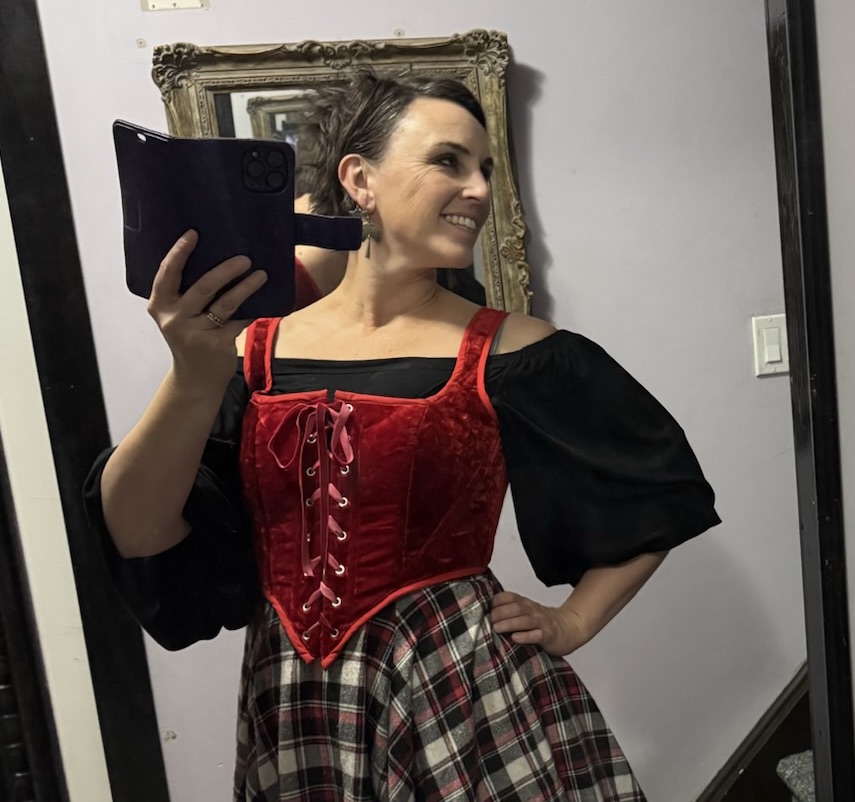
A friend mentioned this pattern (off Etsy) and it was cheap and had that cottagecore/hobbit/dirndl look I’m all excited about these days, so I jumped on it.
And… it’s ok.
The sizing I would say was true. I was between two sizes and went with the larger, and I think it is a bit large, in that I might like to have a bit of lacing gap in the front, and it laces closed quite easily right now. Other than that I made only minor tweaks, shortening the shoulder straps and reducing their angle, and trimming a bit off the bottom of the back for my swayback; all typical for me.
The pattern has fairly detailed instructions for assembling the PDF if you printed at home… but no actual instructions for the sewing (on looking back at the Etsy listing now I see it mentions a video for sewing instructions. Where that video is I’m still not sure….) Now, it’s not a hard sew, but I’m always interested in the construction choices patternmakers suggest, for corset-type garments in particular. So I guess I should hunt down that video.
The fabric I picked was scraps of some kind of crushed red velvet upholstery fabric that’s been lurking in stash for aeons, I think a hand-me-down from someone else’s stash. I picked it because I wasn’t too attached if the project didn’t work out, and part of it was already blockfused to interfacing. (Other parts of the scraps are not… I suspect this fabric has its own fascinating story as the interfacing looks like it was applied industrially)
At any rate it made for a quick and easy way to test the pattern out. I allowed for some extra seam allowance in case of fitting issues but didn’t end up using it except for adding boning to the seams. The 1cm seam allowances the pattern comes with aren’t wide enough to put the boning in using the seam allowances, it’s designed to have boning channels added or have the channels stitched between two strength layers. (Not sure which because I didn’t see the instruction video)
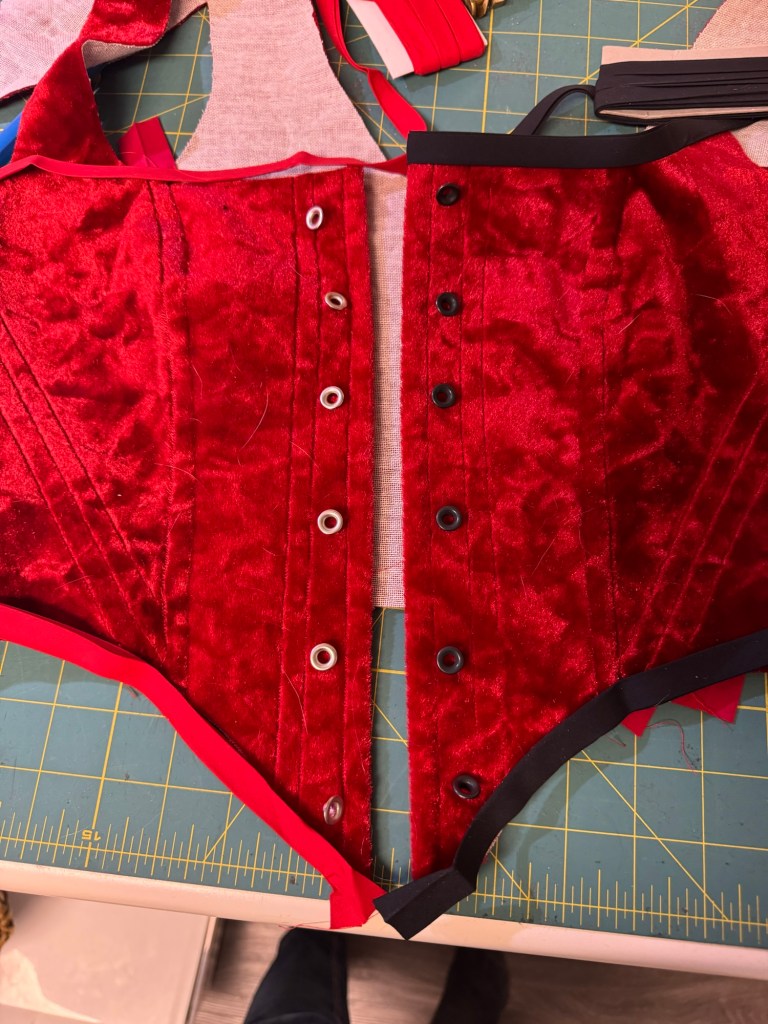
I spent some time agonizing over the finishing, neutral silver grommets with red binding or vampiric black grommets and binding. In the end I went the neutral route, hoping for a more flexible garment, although it feels perhaps just a little Mrs Claus. It still pairs nicely with black so I’m mostly content though.
River was very helpful with the grommets.
Construction-wise I did a terrible, half-ass job with the binding, which may have coloured my original impressions of the product. I didn’t want to use the velvet for a self-binding as it’s quite thick, and since this was mostly a quick tester I went with commercial bias tape. The colour match is good but the material itself just didn’t spark joy and I did my second pass attaching it by machine which led to a fair bit of rippling. But it’s bothering me less as I get a bit more distance from it, though I might fix the ends at some point, especially at the front bottom where the angle isn’t at all right.
I might tweak a couple of things if I did it again, like lower the neckline a bit, maybe tweak the curve in the back to be a little wider, and maybe play with the princess seam curve at the bust. And take it in a wee bit. But, all in all, not a bad addition to the more frivolous side of my wardrobe.
She already had a costume, mind you. We’ve gotten into the habit of getting them some fancy storebought costume dresses for their birthday. This year was “winter fairy princesses”… velvet, long sleeves, hoop skirt. Tiny wings that Velcro on the back.
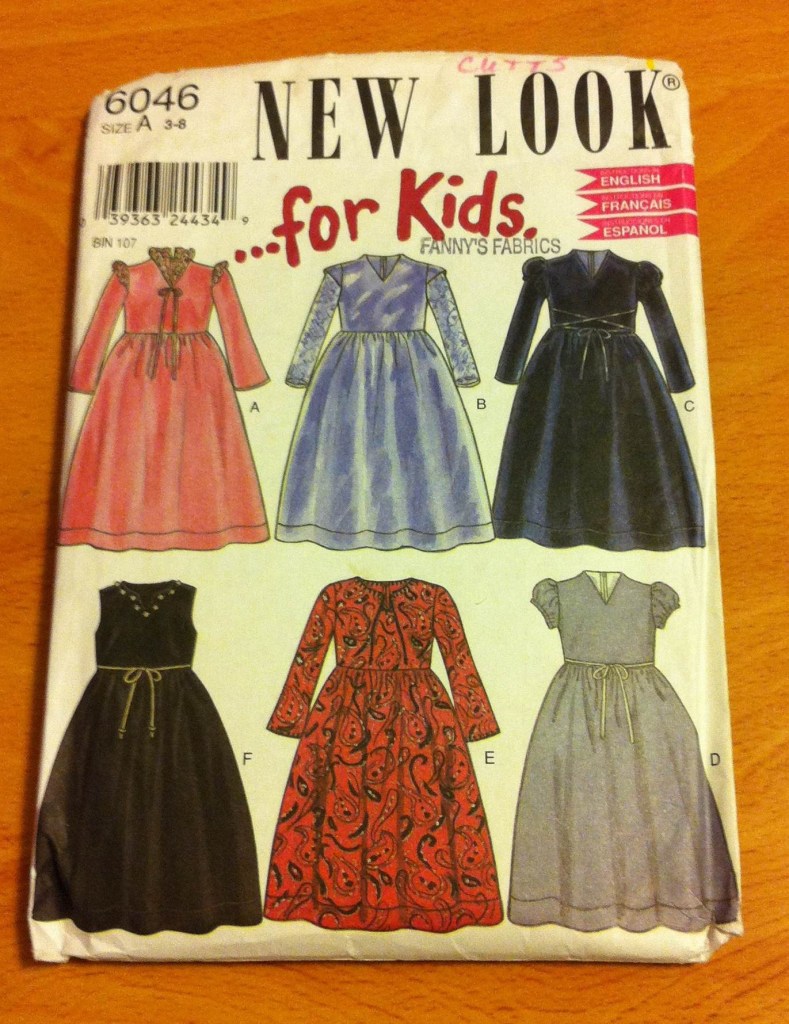
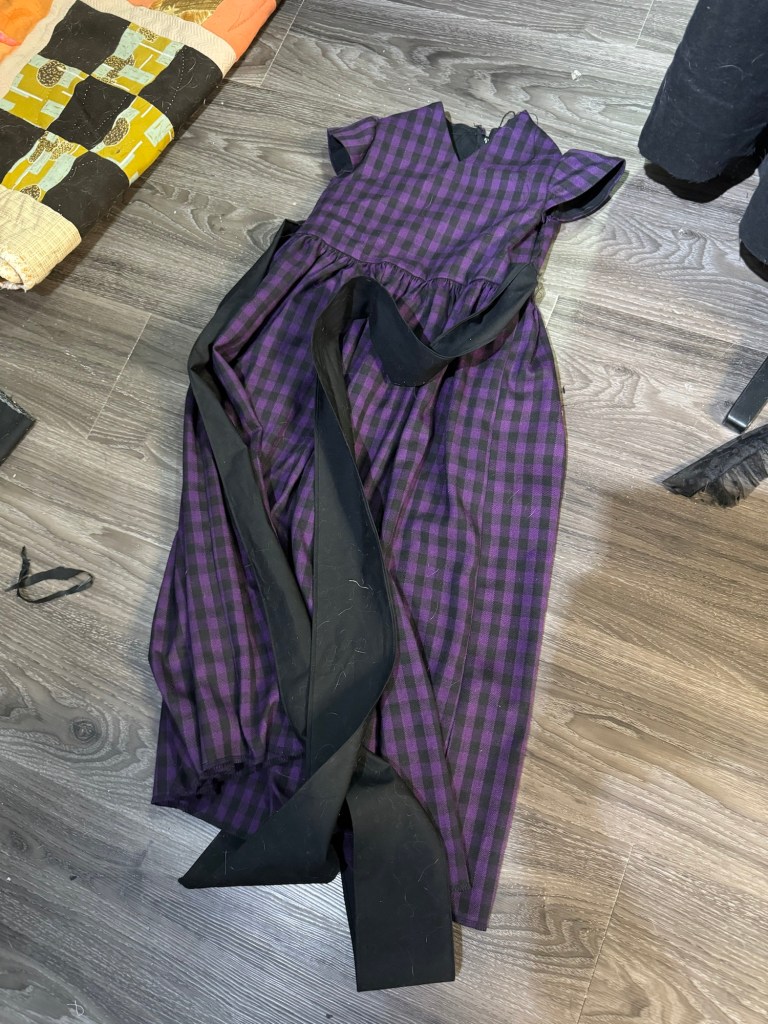
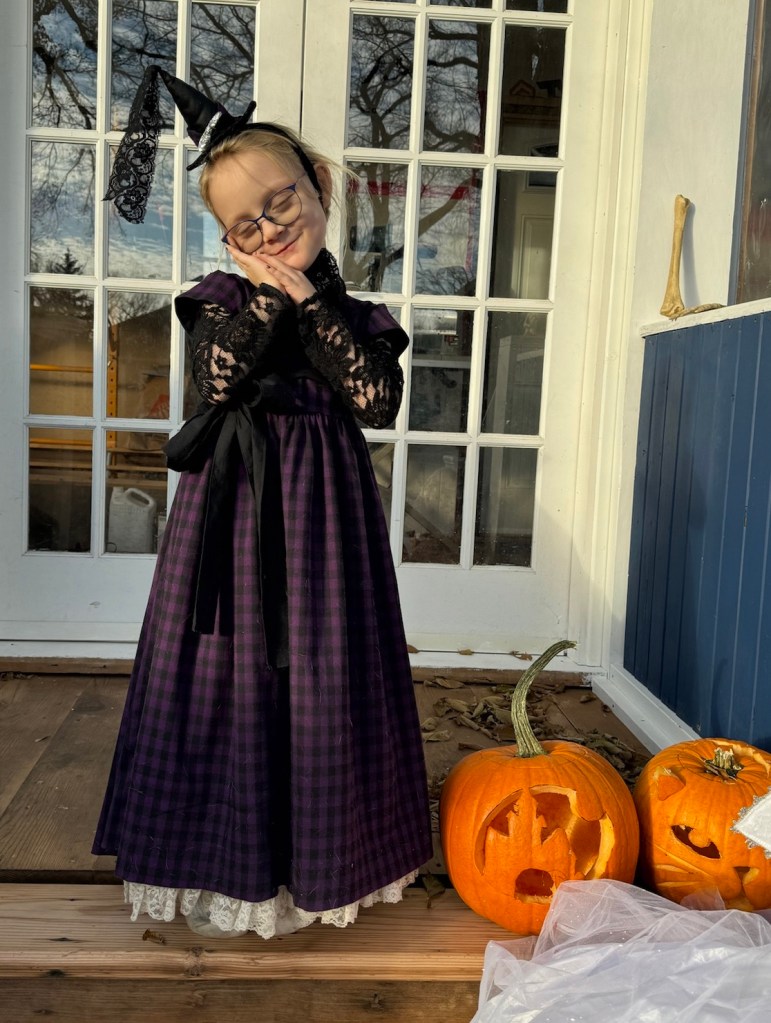
But, sometime in September, she got it into her head that she needed a Hallowe’en dress, and with some bargaining we settled on this Kwik Sew pattern (a hand me down from a friend of my mom’s—thank you Evelyn!), and a purple and black plaid that I think I originally wanted to make pants out of. Or maybe that was a different fabric. It’s a little hazy (which I guess is inevitable given the size of my stash but I always feel like I remember every single piece of it… until suddenly I don’t). In particular, she wanted view B, and my cautions that our fabrics would be a little different didn’t quite seem to sink in.
Waiting for sleeves
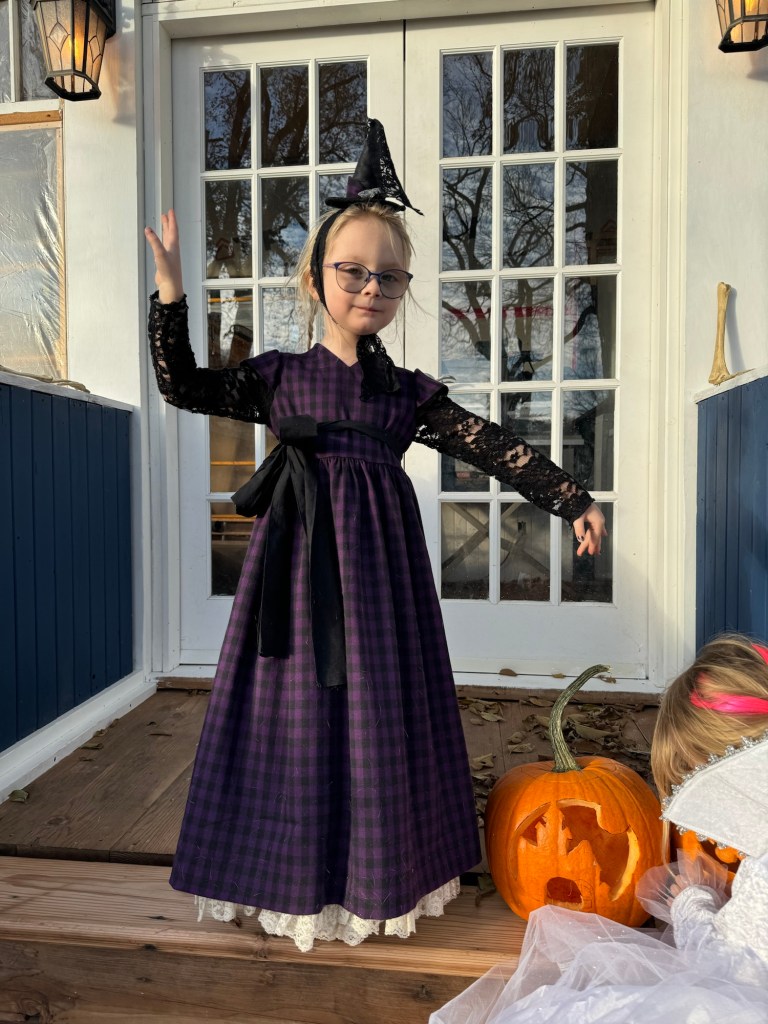
And black lace sleeves. I didn’t get much for construction pics. I used the size 4, roughly, but tried to add length to the sleeves and skirt. The amount of the plaid fabric was very limited, so the skirt is probably a little less full than intended. I’m glad I added the sash ties as otherwise the bodice would be really wide and blocky. I sewed the sleeves with some massive seam allowances to narrow them down, also.
The bodice is lined with black broadcloth, the same fabric I made the ties from. Except I really only used the lining to finish the neckline, which is that unusual standing slit shape, and then the other seams are serged and exposed. I could’ve done a little better with the lapped zipper, but also it’s been an eternity since I did any kind of zipper so I’m just happy I (mostly) remembered how.
The skirt was pretty limp on its own. I’ve been meaning to cannibalize the hoops from their costume dresses to make a nicer hoop that could be worn with multiple dresses, but haven’t gotten there yet. So I grabbed my old, and sadly compressed, fluffy ruffly petticoat, tightened up the waistband elastic, and it’s the perfect length for a five year old. Well, maybe a smidge long.
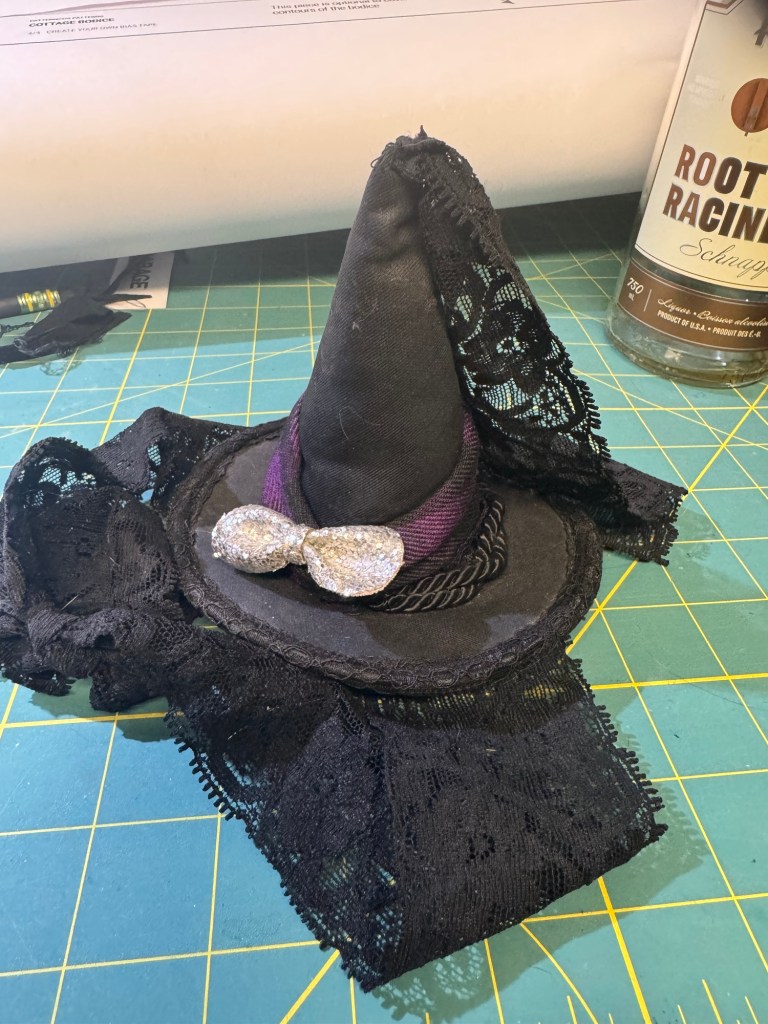
To really sell the witch look I added a scrap of the purple fabric to the teeny witch hat I made for my Hallowe’en outfit a decade or so ago, and the real miracle here is that I could actually find the little hat. Tris would probably have preferred a full size witch hat, but considering how little time I’ve had to sew this fall, and the dress itself was finished at 10:30 at night the day before Hallowe’en (despite being started in September) that was not going to happen.
I do think it turned out pretty cute, though, and she wore it all day at school (since I wouldn’t let them wear their hooped dresses to school.)
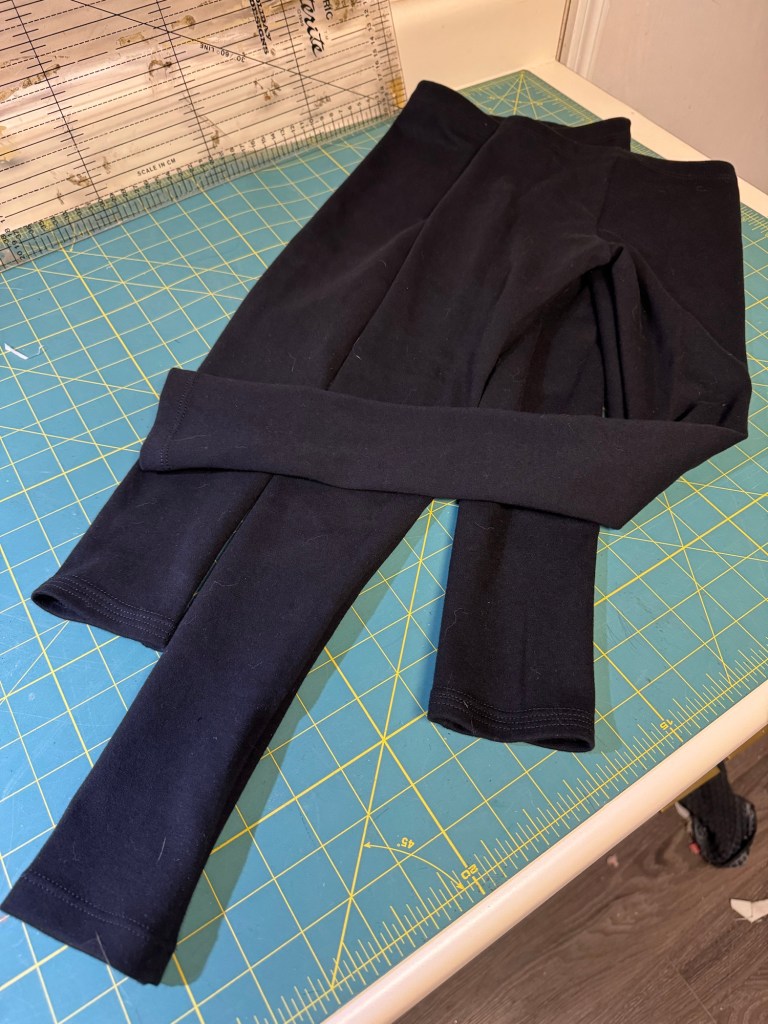
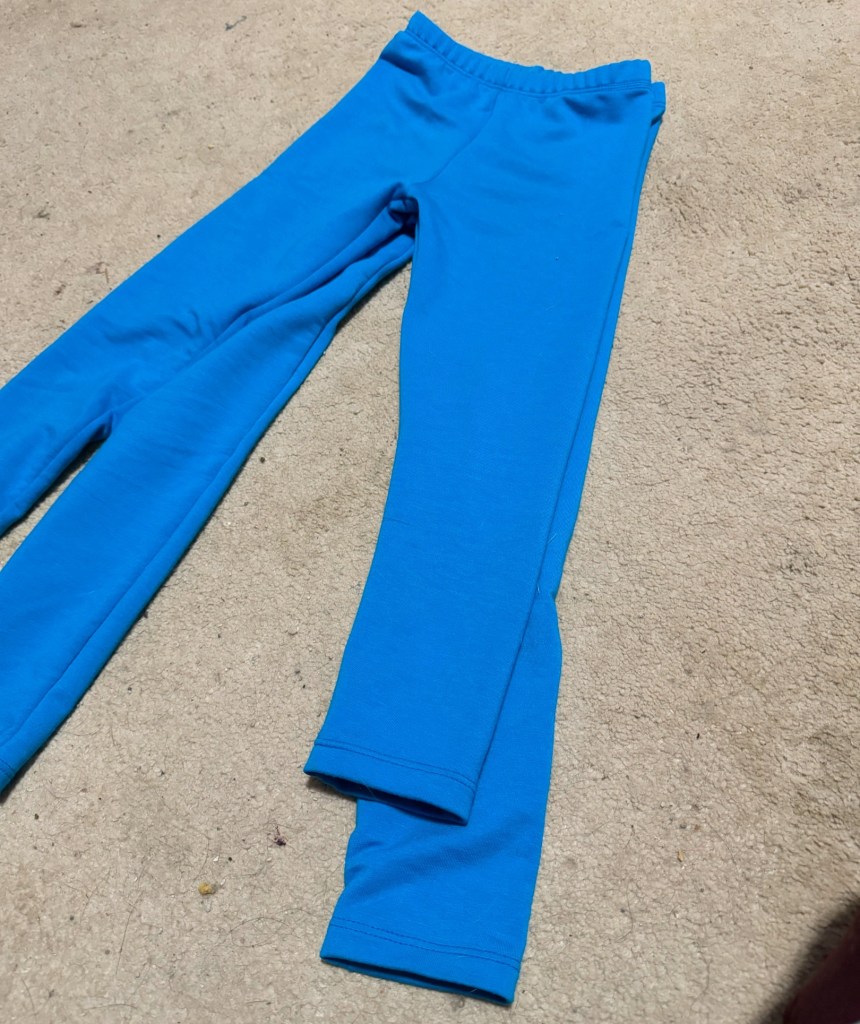
Other than that I’ve been making them leggings. Tris is apparently all leg, so the storebought ones aren’t really cutting it, at least not for keeping ankles warm. These were all made with my old standby, Jalie 2920, with a substantial amount of extra length added.
While making leggings is a bit underwhelming in terms of creativity, they remain pretty much the only thing it’s faster to sew than to shop for, and getting to choose nice beefy fabrics (the black are some kind of heavy cotton interlock and the blue are a super-stretchy French terry) and knowing they’ll reach the twins’ ankles is more than worth it.
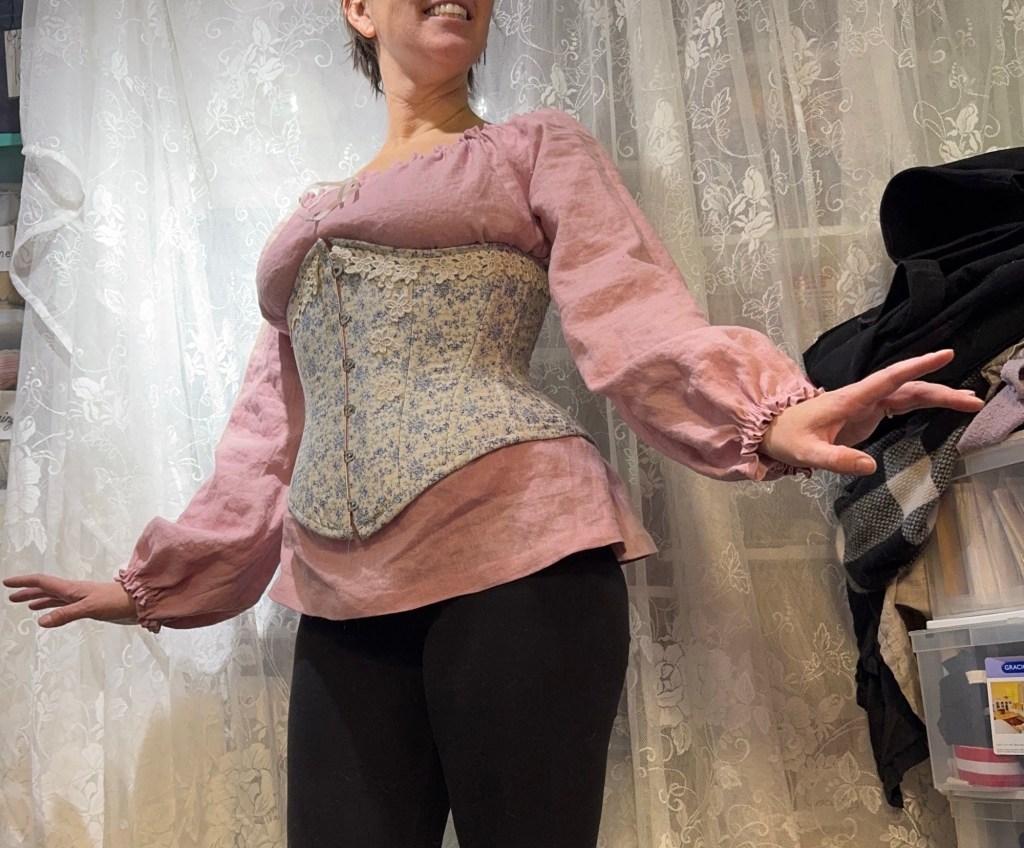
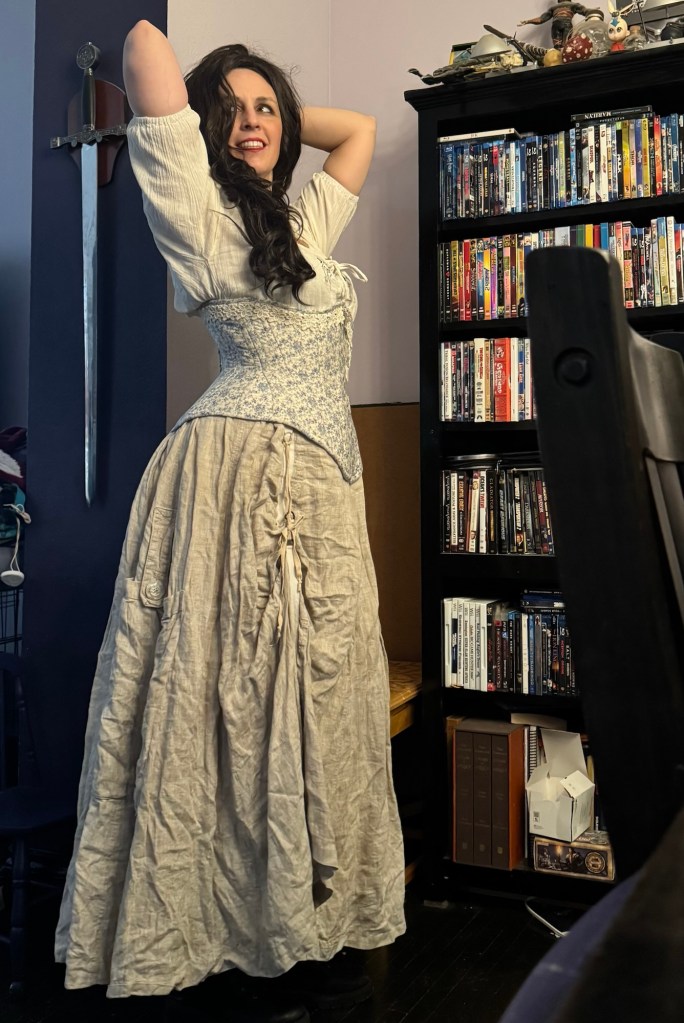
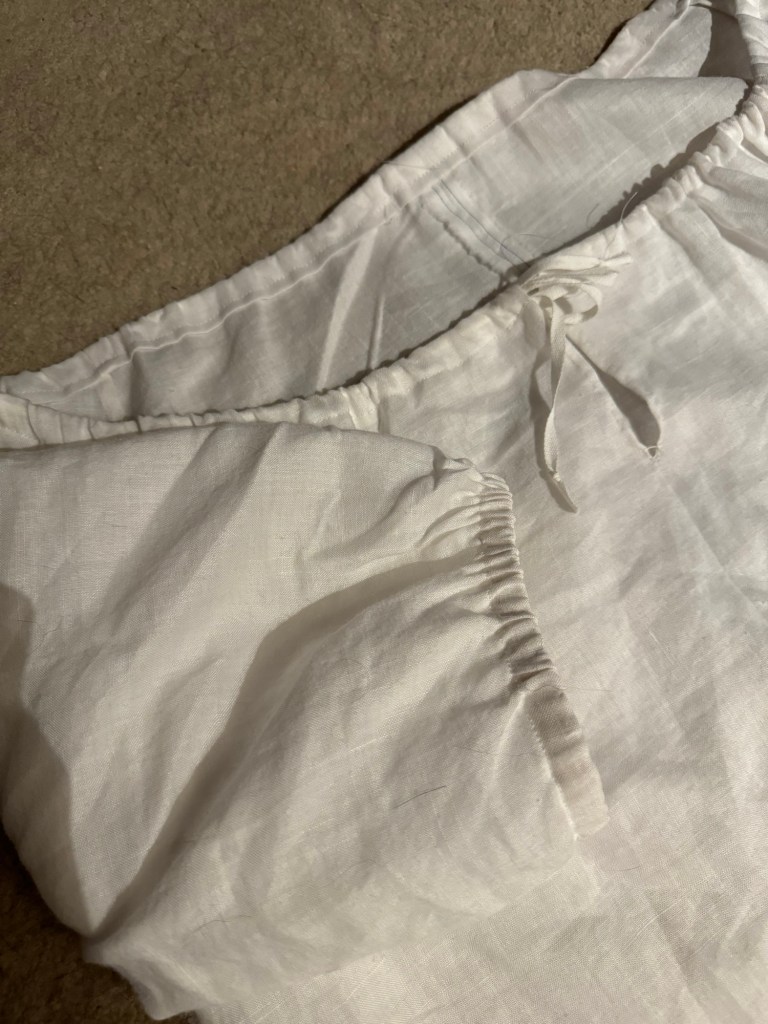
The first commercial pattern I ever sewed, the first thing I sewed for myself, in fact, was a peasant blouse. I’ve made the occasional one since then, usually for costume purposes, but none are in my wardrobe currently. But as soon as I made my corset-stays, I knew that was what I wanted to go under them; most of my other shirt necklines just weren’t quite right. So I dug out my stash of lightweight white linen, found a chunk left over from some other project (it actually might be the ramie left over from my Fiona dress, but visually it’s indistinguishable from the mass of featherlight linen I have hoarded over the years, just maybe not quite as soft in feel), and went to it.
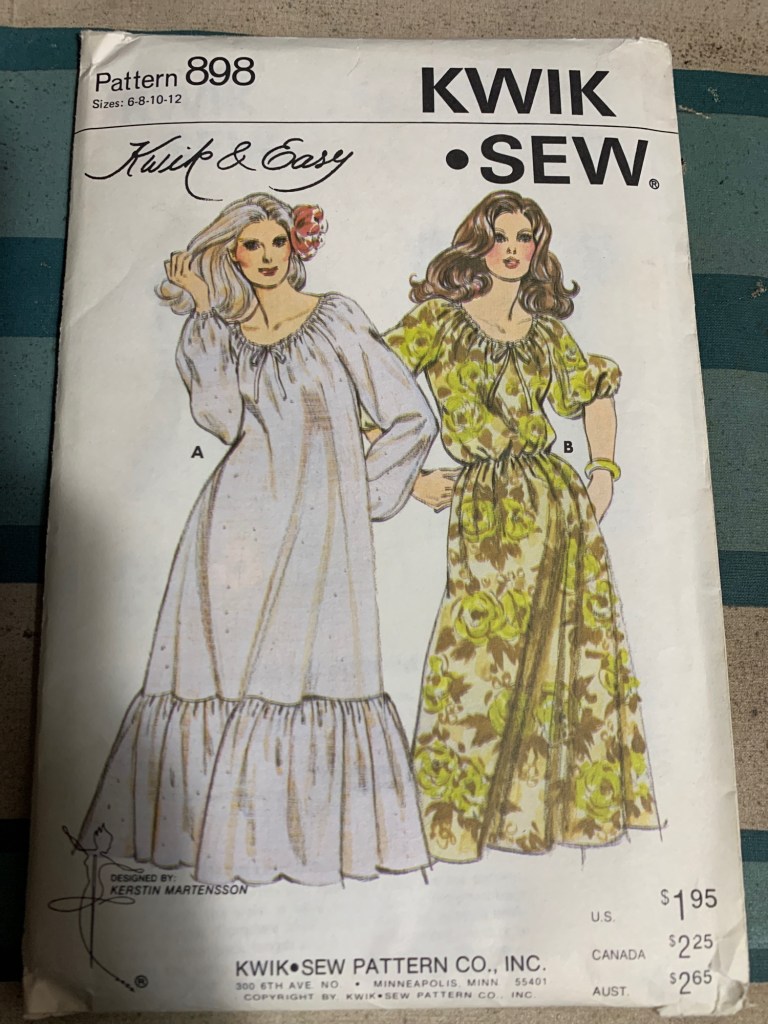
The pattern I selected was the vintage Kwik Sew 898. Now, you will observe from the illustration that a) this is a dress, and 2) the illustration looks far more voluminous than my final result. The envelope I have only goes up to a size 12 (which I am larger than), but when I opened it up it turns out it was also cut, to a size 8 (which is not only smaller than my current size by about 10”, but is smaller than I’ve ever been as an adult.) So obviously some on-the-fly grading was in order.
However, I had pretty much decided I was only going to sacrifice the one remnant (not much over a metre) of fabric to this project, at least until the pattern was tested and I knew if I liked it. So, without thinking to hard about it, I cut the sleeves as is from the irregular “had another project cut out of it” end, and then fitted the front and back body pieces onto the remainder, opting for a back seam to minimize any fabric waste. I “graded” the body simply by putting the pieces as far from the edges of the folded fabric as I could, which probably got me an extra 4” or 5” over the width of the whole project. Enough that it’s not skin tight, at least, but not the full 10” I’m lacking. So the lack of volume probably has more to do with inadequate grading. Oh, I did raise the underarm seam about two cm, but that’s pretty much a habit for me.
Once the cutting was done, the construction was simple, although it didn’t get accomplished quickly as I didn’t have much time. I French seamed the seams, and overlocked and then folded over the sleeve hems.
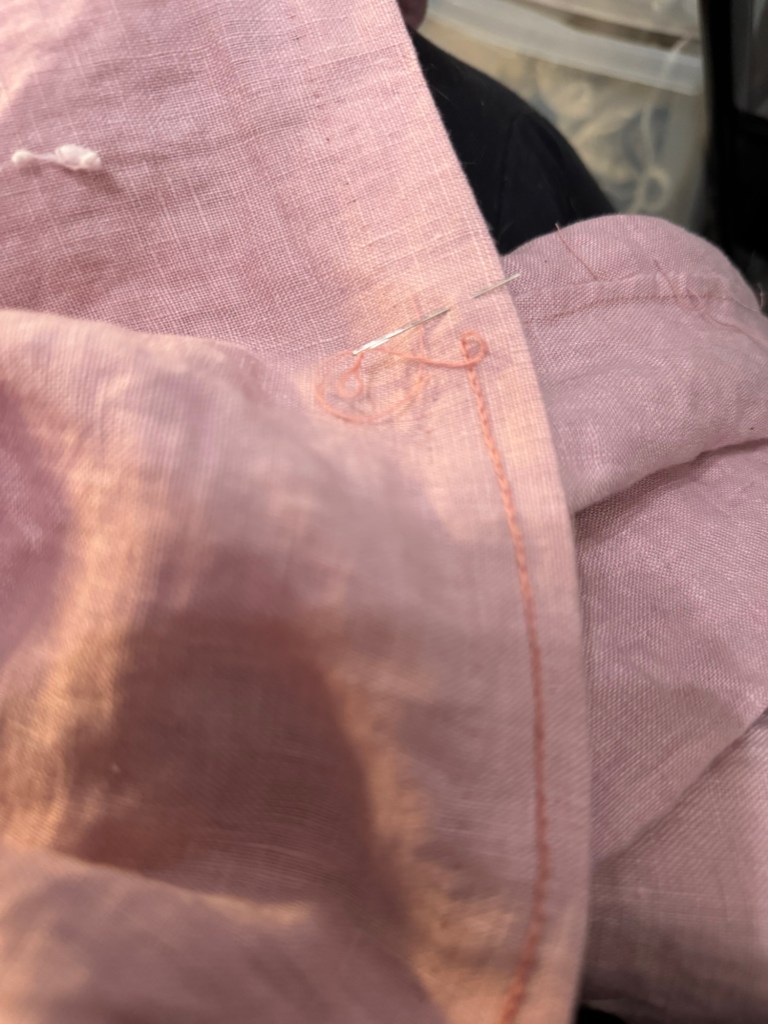
My main departure from the pattern was adding a short slit to the front, which I hand-finished, including adding that little thread-bar near the bottom that you see in 18th century shirts. This let me avoid adding eyelets or buttonholes to the neckline channel to let my drawstring (my favourite 1/4” stay tape) through. I also folded the neckline down rather further than the 1cm the pattern suggested, to create a more open neckline.
I added elastic to the ends of the sleeves, and that, pretty much, is that.
The total shirt length I ended up with, dictated purely by the length of fabric I had, actually comes to about my knees, almost a chemise length. I have toyed with the idea of adding some gathered tiers to the bottom to create a built-in petticoat effect, but I feel like I might just be better off making a separate linen petticoat/skirt (something that has been on my mental list all summer, in fact). Either way, I have to work up the stamina to tackle gathered tiers.
But in the meantime, this was a fun quick little project, and I think the result will actually fit quite nicely into my wardrobe.
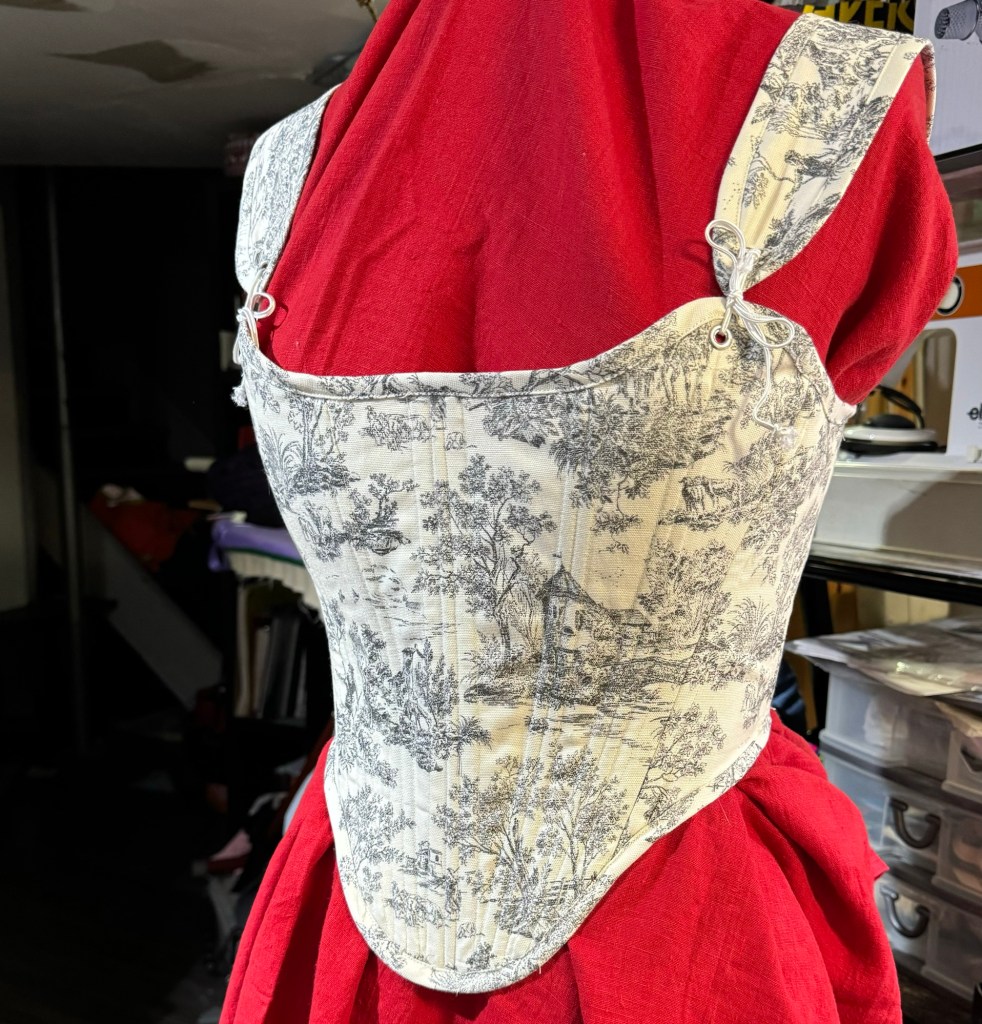
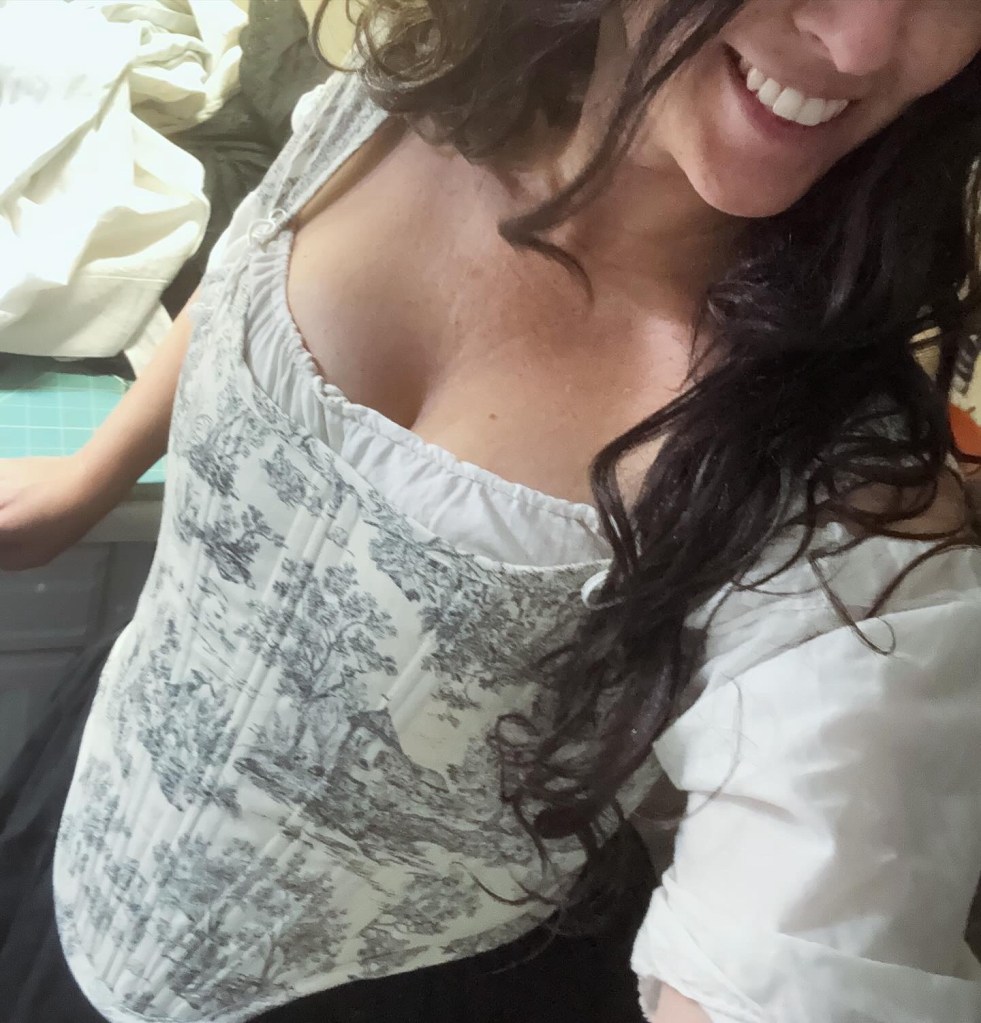
For the last year or so an urge has been building. To make… not exactly a corset, not exactly stays, but a boned, fantasy bodice. A little mediaeval tavern wench, a little bit Ren Faire… and, let’s face it, a lot cottagecore.
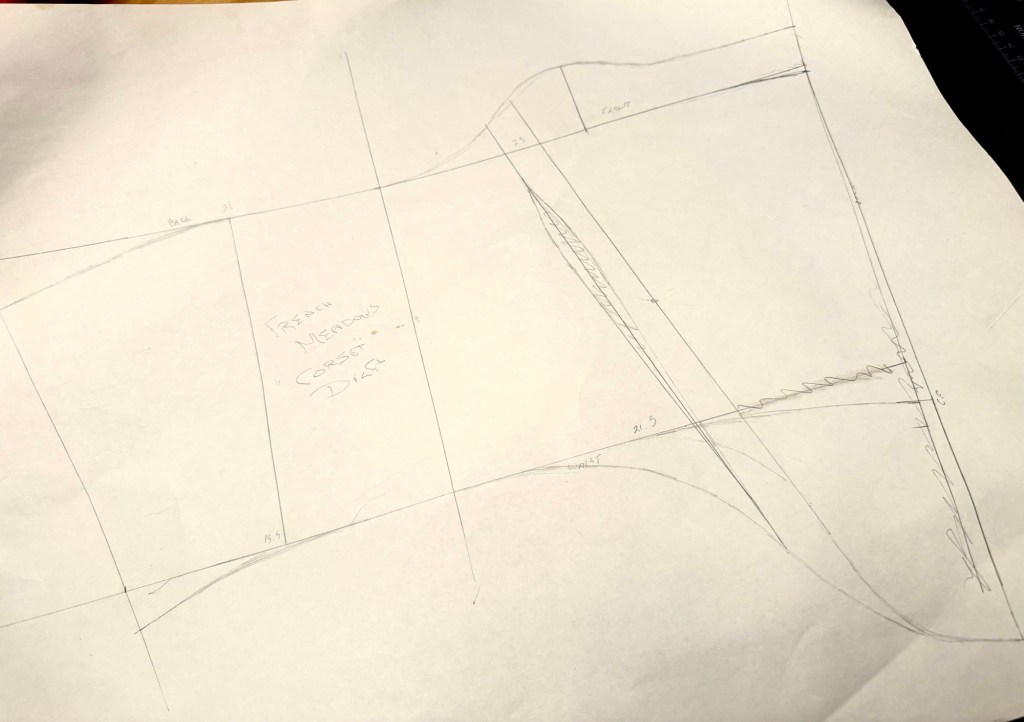
I couldn’t quite settle on a plan, however. What pattern? How historical do I want to be? I have Butterick B4254, the 18th century view of which I haven’t made. I have the Scroop Augusta Stays, which the internet at large seems to agree is an excellent pattern. But what I really wanted was something a little more romantic and whimsical. Outer wear, not underwear. Something a lot like the creations of French Meadows, whose Instagram posts help keep my feed suitably aspirational.
I have to say, her method (based apparently on instructions in Janet Arnold’s Patterns of Fashion 5, not one of the two volumes I own), worked pretty well. There’s a fair bit of art mixed in with the math of it all, but I can’t say I mind it. The draft itself just produces a kind of flared curve, which you then add details such as the front V, nubs for strap attachment, and other seams as desired.
Once I had it drafted out (which took a while since I have been so time-poor this summer), I decided to dive right in. I made extra-wide seam allowances and just went for it, figuring I could tweak the other features as I went.
As it turned out, my tweaks were quite minor: I added a bit more shaping to the side/bust seam, and I took in the side/back seam by about 1/4” on each side. When I make it again, I think I would narrow the front piece (and widen the side correspondingly) so that the seam is closer to a princess seam so I could add the shaping right there. It’s not historical but I do like the look for a fantasy piece like this. And I might add a bit of a swayback adjustment (raising the bottom of the center back), something French Meadows mentioned as an option but which I didn’t try.
But all in all, considering how arbitrarily I added my style elements, I’m pretty darn happy with it. The nubs where the straps tie on are in a good place and the front V only needed very minor reshaping. I had initially raised the front about 1” above the bust line but I did drop it down a bit between the strap tie nubs.
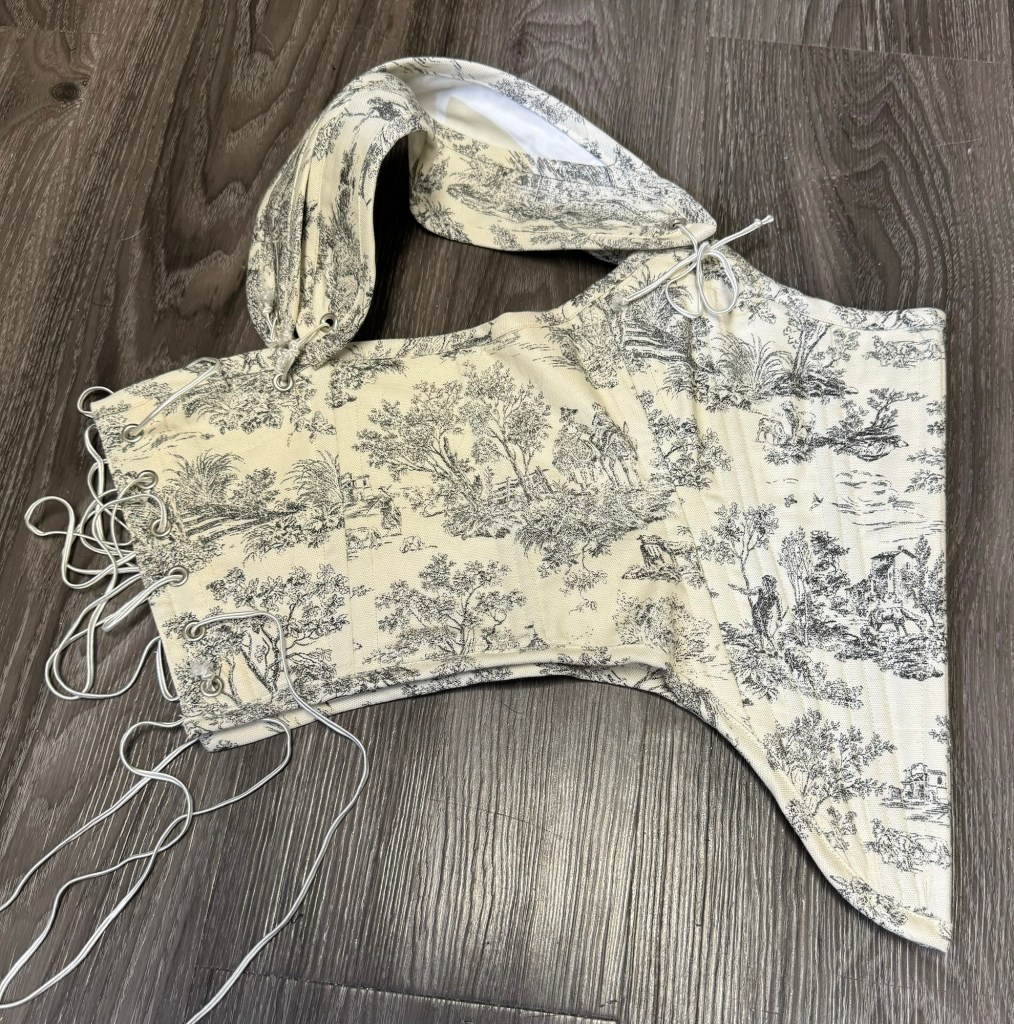
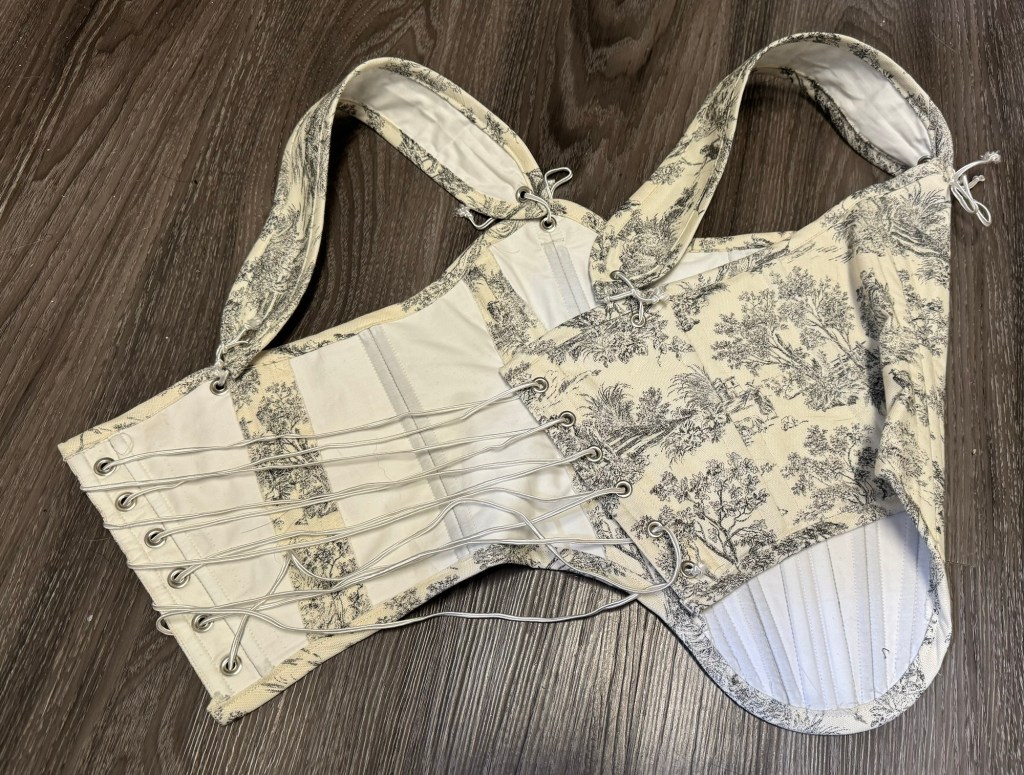
In terms of construction, I wanted to make something cute but not too precious. I opted for this toile de jouy print upholstery fabric (I thought it was cotton but it’s pretty soft and slippery and frays pretty badly… I should maybe do a burn test), with two layers of ticking as a backing. Ticking is nice for lightweight corsets and mockups as it doesn’t stretch, and two layers meant I could sandwich bones between the layers and add more channels on the fly as needed. (Turns out I needed an extra set of bones in the front). I used the same fabric for the bias binding, which I just attached in a single machine pass, rather than attaching the front by machine and finishing the back by hand. Again, for this fantasy piece the topstitching doesn’t bother me. And I managed to catch the back almost everywhere, which is always nice.
I did manage a decent mitered corner on binding on the front of the straps, so that turned out well.
I did initially play around with a wooden busk (aka ruler) for the front, but it seemed bulky so in the end for this non-historical piece I went with some of my heavier 6 mm spring steel boning for the front, which keeps it nicely flat, and spiral steels for the rest (except around the lacing, which is also spring steel, as usual).
I would like to swap out the soutache currently serving as strap ties and the back lacing, as it’s a little too slippery to hold how I would like. And I should make some slightly shorter versions of the straps so Syo and Tyo can wear as desired.
I am faced with a conundrum, however. For basically the first time in my life, I’m wanting skirts that are either gathered or pleated at the waist, as that seems to be the style that goes best with this kind of bodice. Mind blown. It’s not a style that works at all with my uncorseted body.
Oh, and I had to make it its own blouse to go underneath, but I’ll give that its own post.
My Victorian Sewing Circle group put on a “Victorian chores” day back in July, so I needed some Victorian work clothes.
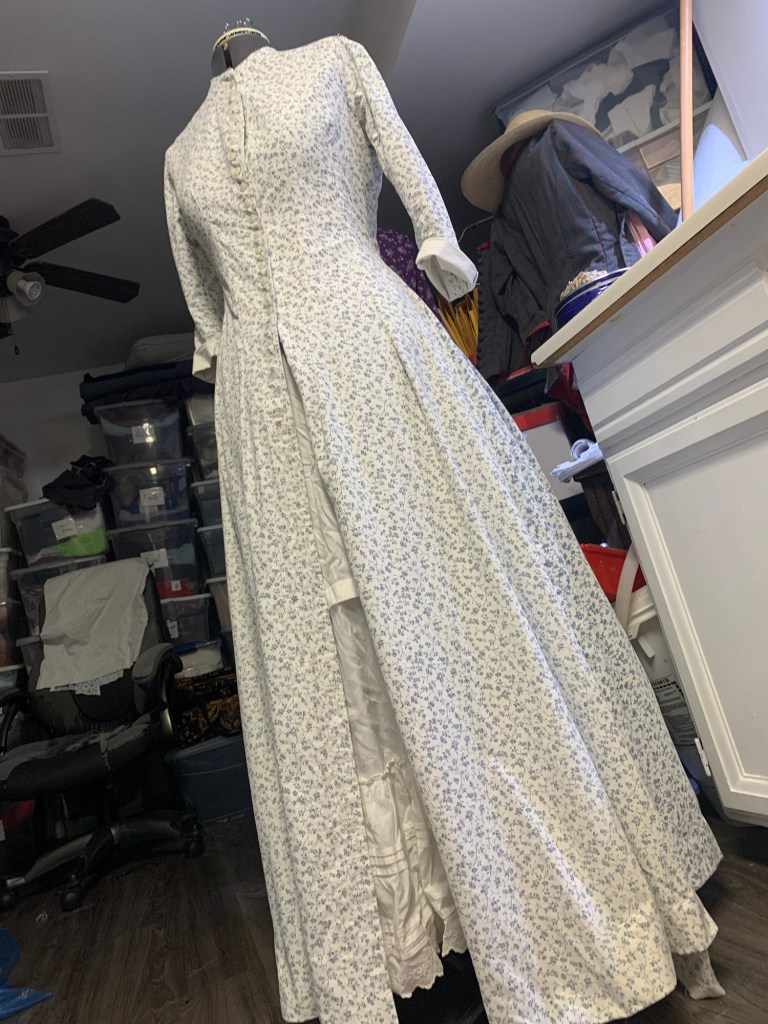
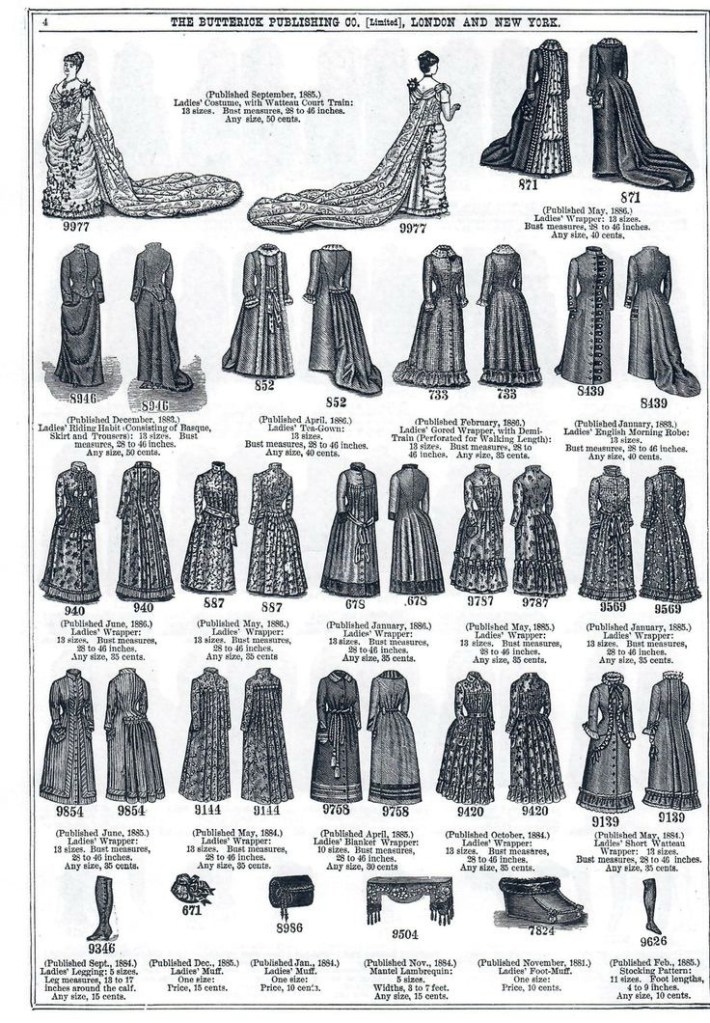
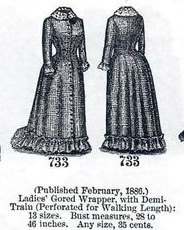
I could’ve gone with the Folkwear Prairie Dress of course, or even the pattern I worked out for the tea gown’s undergown, but instead I decided I needed a “Ladies gored wrapper”… something along the lines of #733 in this Butterick pattern catalogue page.
Ok, a kind of pared down version, anyway. I have a few scraps left that I could maybe turn into ruffles if I get ambitious.
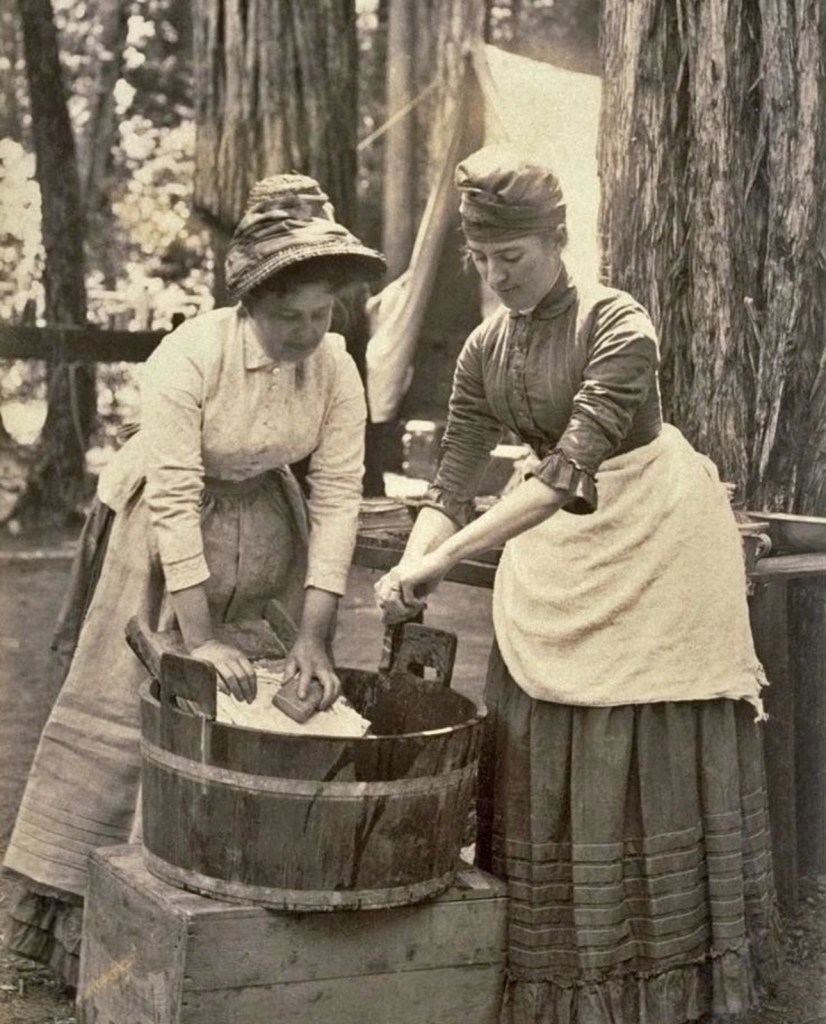
So, a work dress but not a complete sack. I’m inspired by this image, though again I can’t find a very good source:
(Though, I don’t think either woman is actually wearing a wrapper)
(But what is a wrapper, you ask? Well, aside from the things labeled “wrappers” in the advertisement above, this article has a quick section on them. Basically, it’s a one-piece dress, front fastening, looser than a going out dress and often adjustable. Key for my purposes, they are intended for wearing during breakfast and morning chores. They could also, probably not coincidentally, be worn easily while pregnant, although not so much the style I went with.)
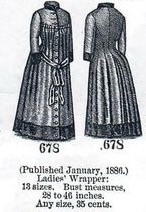
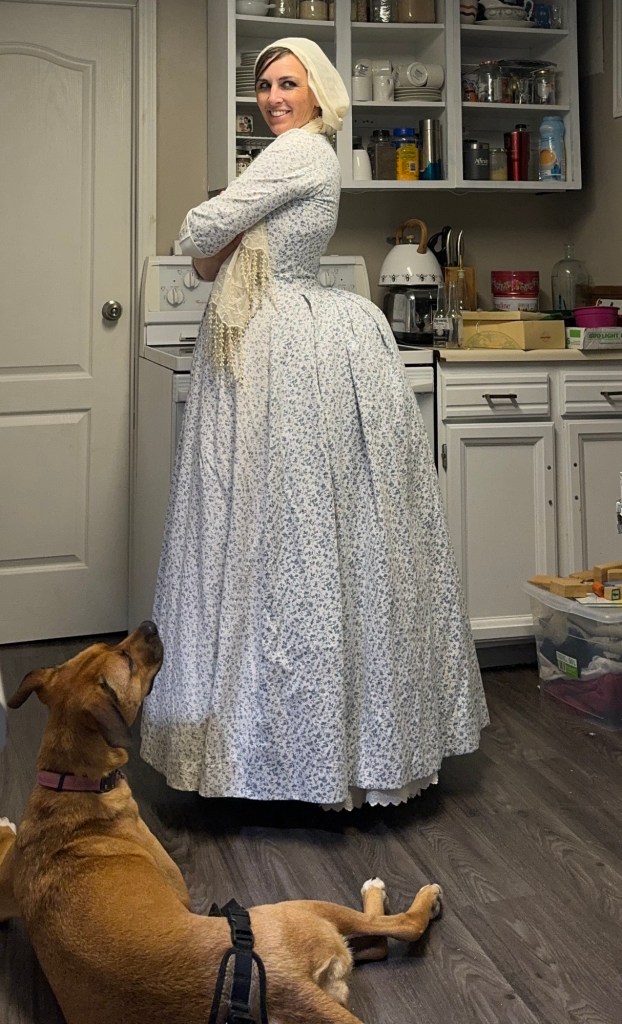
For my pattern I used my same Truly Victorian bodice, but extended into a skirt like I did for the Elven tea gown. I used the diagram above (both pictures are off Pinterest with no particularly helpful source) as inspiration, except looking back I only used it for the front piece, for the back I basically used the tails of my pattern but extended into a full skirt length. (Like #678 in the page above).
The outer fabric is a cotton Tyo found me a couple of years ago (I think at a thrift store). It came in the form of two panels (bedsheets? Table cloths?) someone had made from regular, probably quilting, cotton, by seaming two widths of narrower cloth together. There was some pretty marked wear on portions of the panels, and while it’s a pretty print and colour and old-fashioned-looking enough to be plausible (at least to me) I wasn’t sure how I would be able to use it for a “real” dress. But for a costume of a work dress it’s pretty much perfect, even if the worn patches don’t really line up with the kind of wear you’d get from being a work garment.
I realized 0.5 seconds after I cut it all out that I could’ve just as easily had the back pleat come all the way up on the outside and had a wateau back like several other dresses on the Butterick page… but anyway. I didn’t. Which probably makes it a better work dress, but a little less fun.
For my lining I used some old (and very, very worn) bedsheets that were really fit only for making muslins and then rags. There was a lot of piecing involved there due to tears and holes in the sheets, and I imagine this will be an ongoing issue in the life of the dress, or would be if it were an actual work dress instead of an impression of a work dress.
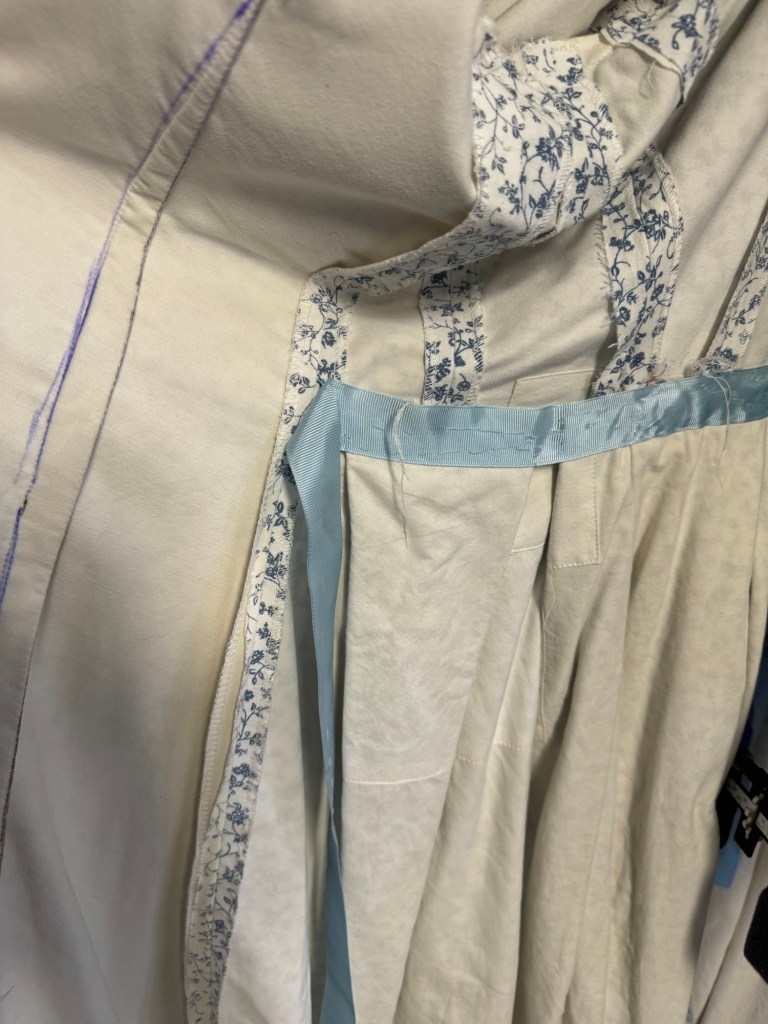
I was under a real time crunch making this dress so a lot of things I would normally finish by hand I did by machine, including the blind hem and the front facings, which I topstitched down. It isn’t noticeable on the busy print, fortunately.
I even attached the buttons by machine, something I almost never do. I spaced the buttons pretty closely, which is period but I feel like I could’ve gotten away with just slightly further apart. I put on 24 buttons just between neck and hips (and then decided I would just wear my apron so the skirt could stay buttonless for now. Apparently leaving your wrapper skirt unbuttoned to show a bit of fancy petticoat was also a Look, although maybe not a work dress look.)
Unlike my other Victorian dresses, there is no boning in the seams, as this kind of dress needed to be washable. I did add a waist stay, as much to cover the raw insides of the skirt pleats as anything.
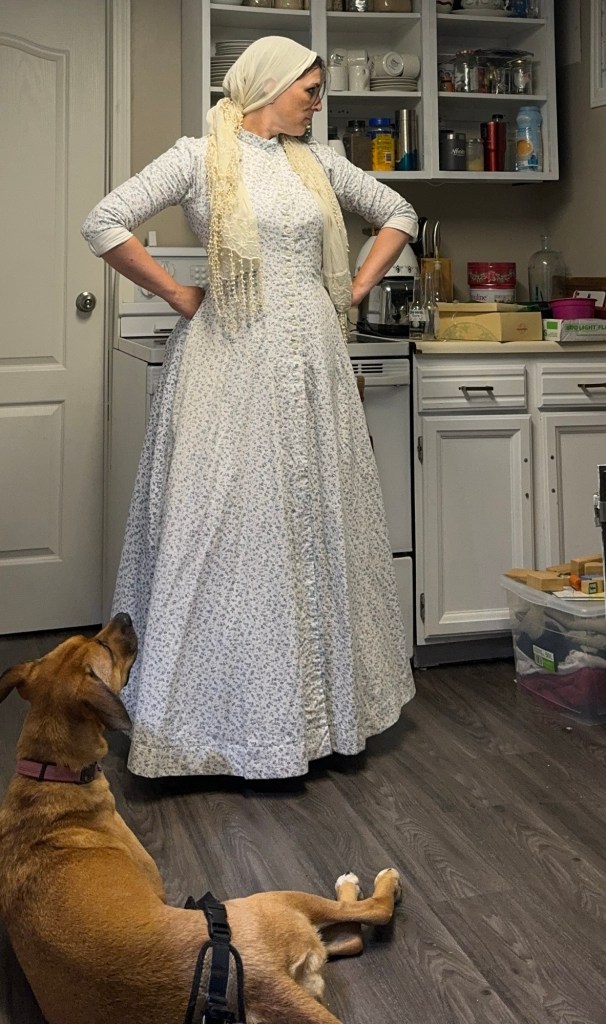
The dress as a whole does fit (snugly) without a corset, but I vastly prefer the look with corset. I also hemmed it to go over the bustle, since I mostly favour 1880s looks. Or I thought I hemmed it for a bustle, it looks like it curves up a bit in the back in these pics. While wearing a wrapper over all the undergarments you would need later in the day was apparently correct, I do rather wonder if a woman on laundry day would’ve bothered.
Other casualties of the hurry: I need to readjust the gathers at the tops of the sleeves. They are concentrated a little too far back which is creating some pulling. Also I didn’t have time to put in a pocket (unforgivable in a work dress), and the sleeves aren’t even hemmed, just rolled up. There is a moderate-sized rectangle of fabric left that I would like to turn into a little ruffle, for the bottom of the skirt if possible but the sleeves if not. (And yes, you’re reading this no earlier than September, so obviously some time has passed since I finished the dress. And have I gone back and fixed these niggles? Of course not!)
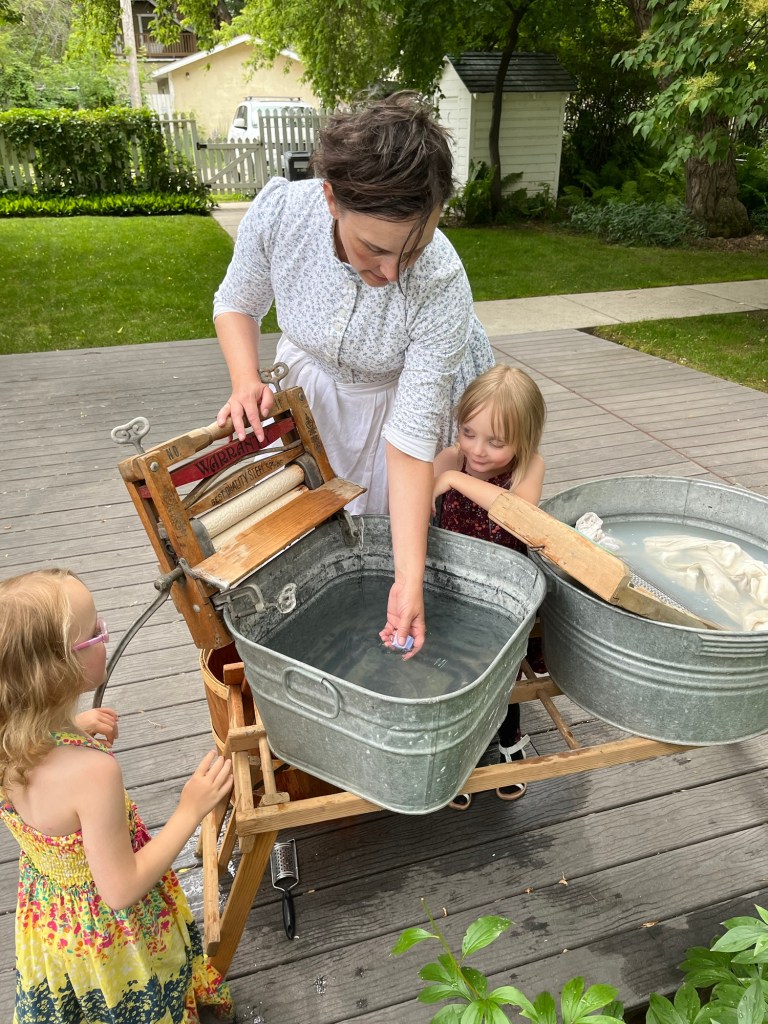
Laundry day itself was fairly successful, at least in that most of the stuff came out cleaner than it went in. It was the first laundry day done at the Marr Residence in ten or more years, I think, and there was a lot of cleaning of the washtubs and other equipment before it could be used to clean clothing. The mangle has a bit of rust in the mechanism that kept dripping reddish water across the rollers, so we had to be sure that was wiped away before running clothes through.
Adding bluing, sewn into a cloth, to the rinse.
The twins had the most fun, running a couple of rags through the mangle endlessly, as well as grating soap and scrubbing on the wash board. Several years of dirt got washed out of my petticoats, particularly the flannel one that I’ve been wearing in real life the last couple of winters. I also did a bit of starching, including testing out a “coffee starch” on my black petticoat, although I didn’t get as far as ironing any of it.
So all in all a successful day, and a nice addition to my 1880s wardrobe. Now I just need a work bonnet.


































 Tanit-Isis Sews