Tag Archives: in progress

A sneaky peak

at the progress from the weekend.

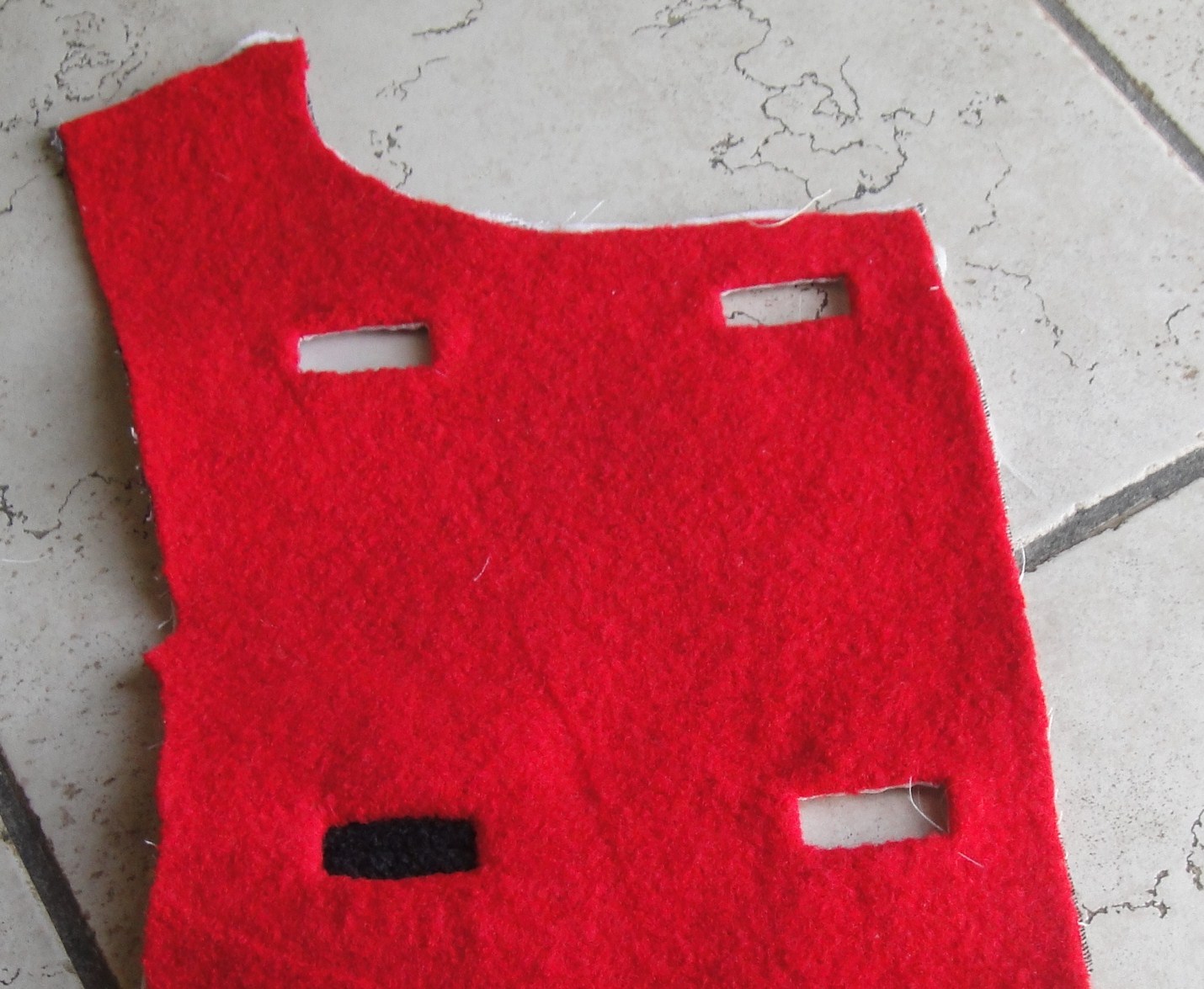
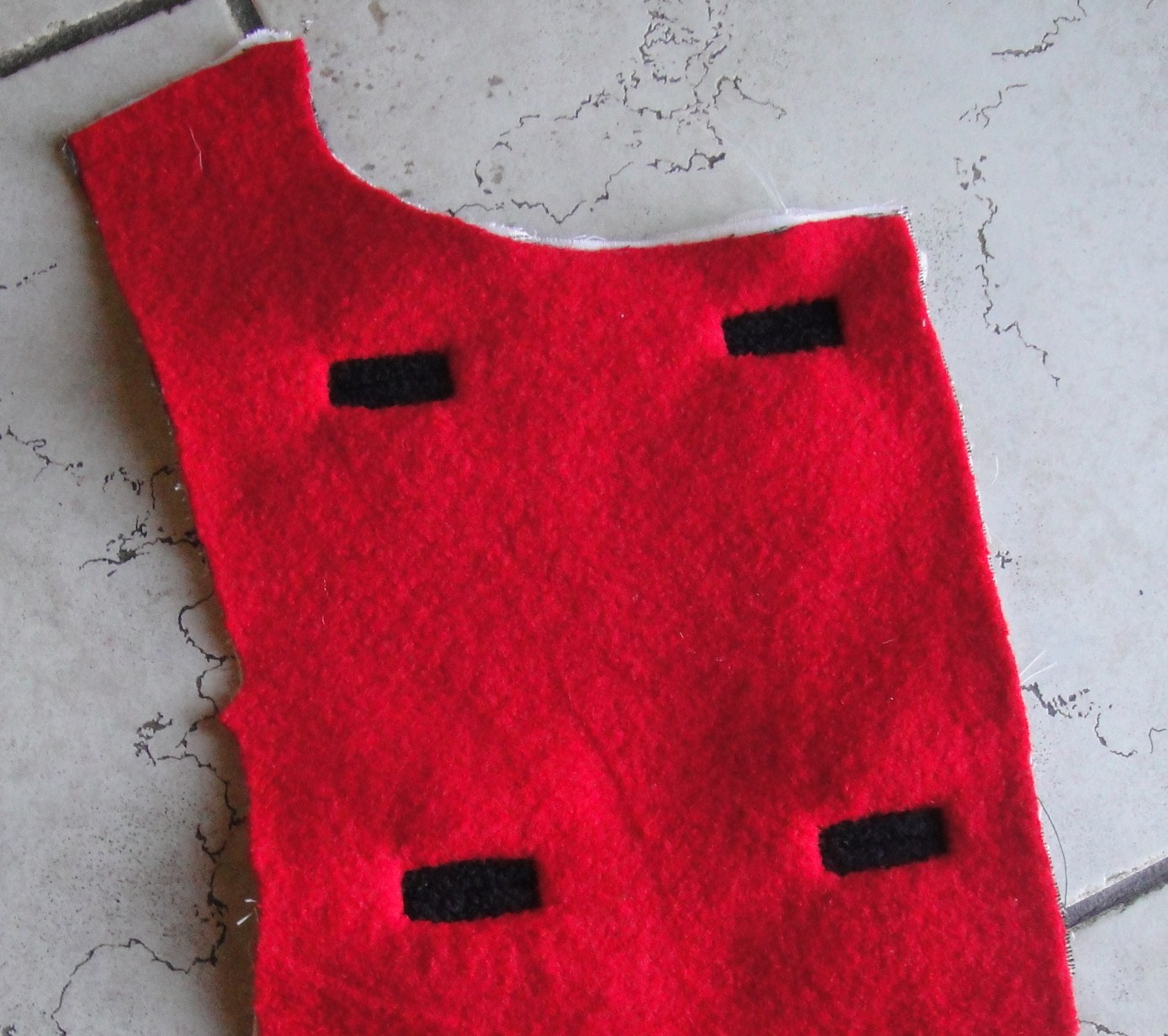
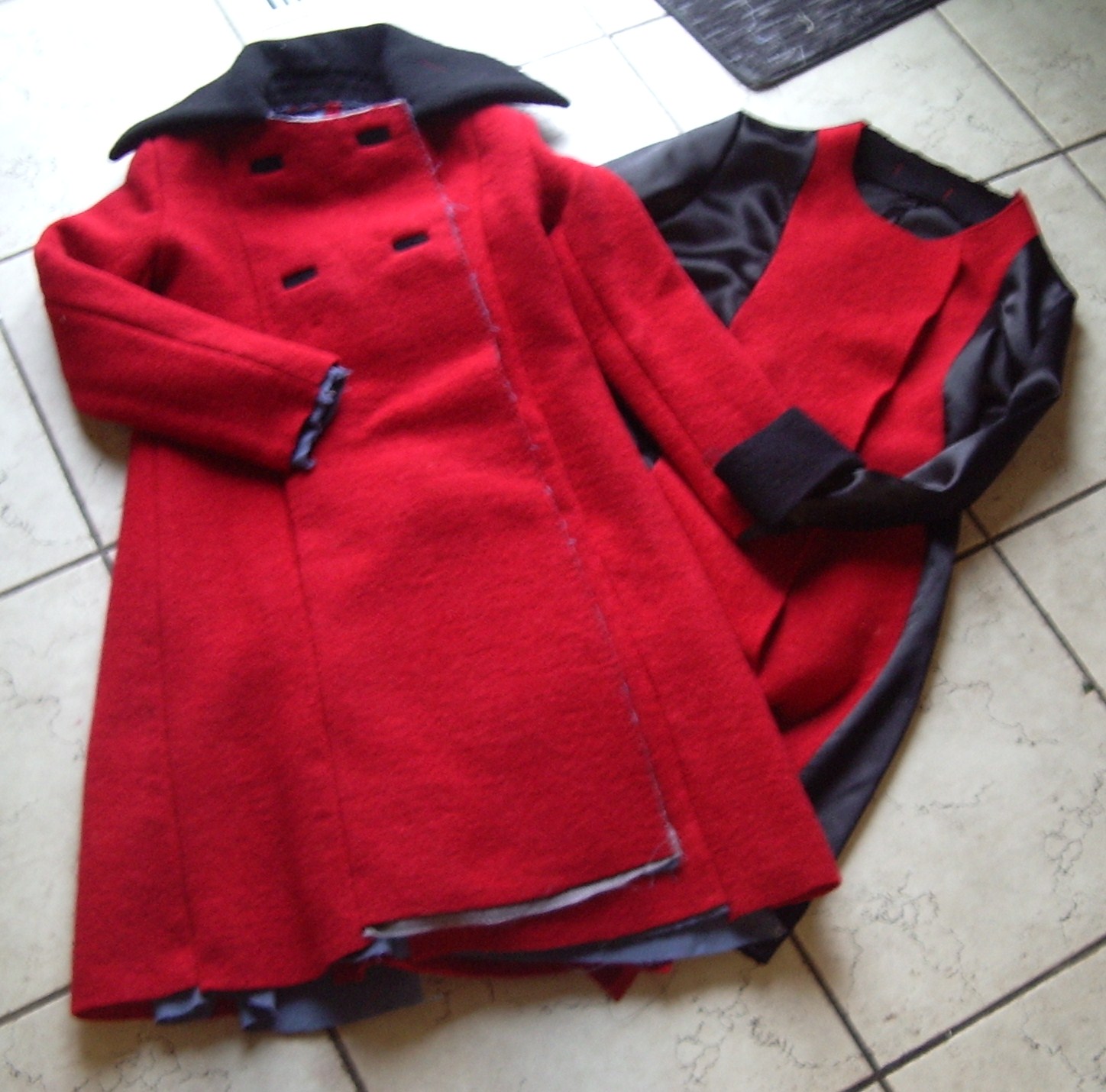
Coat, left; lining, right

The sleeves are attached (and still dangerously narrow 😦 ); the lining and facing is sewn (this is the first time I’ve done a lining with a facing at the back of the neck. It was not particularly difficult. I drafted fold-over cuffs for the end of the sleeve… we’ll see how those go on; I used the same idea as the ones for Syo’s coat.

I did some thing to the roll of the collar that I will describe as pad-stitching’s bastard cousin, which did succeed in giving it some shape (at least so far), and only shows a little.

Tyo picked out some silver metal buttons. They’re lovely, although silver buttons really wasn’t what I was envisioning for this coat. She likes them, though.

Label!

But most importantly, I remembered to sew the label to the neck facing already, so I don’t have to hand-stitch it on at the end! 🙂

10 Comments

Filed under Sewing

It seemed like a good idea at the time, or, an assortment of idiosyncratic construction decisions


Catchstitched interlining

I guess I really am a sucker for hand-sewing. If only because I catch much less flack from the family if I’m hand-sewing in the living-room with the rest of them all evening, instead of lurking in the kitchen with my sewing machine.


Warning: what follows is not a description of how one SHOULD make a coat. I am not particularly convinced that all (any) of the construction details I am about to report actually improve the resulting coat in any way, and several of them may have serious unforeseen drawbacks. I accept this. 😉

Friday I got the rest of the coat—lining and interlining—cut out. Hooray! I could not find any more of my space suit interlining at the fabric store, so I had to settle for some (much cheaper) non-foil-backed stuff. I had just enough left from making my coat to cut the two back pieces from the foil-backed stuff, which I figure should be fine since the fronts are double-breasted anyway.

I trimmed the seam-allowances from the interlining. Then, for reasons I am no longer totally clear on, I decided

Underlining

that rather than floating free between shell and lining, it should be sandwiched between shell and interlining. I promptly proceeded to catchstitch the back pieces in place, so they wouldn’t shift despite not being caught in the seams.

Then I said “bugger that,” and skipped the catch-stitching step for the front and side-front pieces. My occasional inability to keep the interlining out of the seams should hold them in place, not like they have anywhere to go.

This fabric is a dream to sew with. It’s squishy, easy to ease, and you can catch stitches on the underside beautifully without worry of them showing on the right side of the fabric. Mmm. I also love my flannel underlining.

1cm seam-allowances may be awesome on jeans, but they’re tricky on a coat. Allowing for turn of cloth, once you go to press the seam open, there’s very little allowance at all. I proceeded to stitch all the seam-allowances open after pressing (hence the marathon of hand-stitching and why my fingers are still sore.)

BUT, LOOK!!!

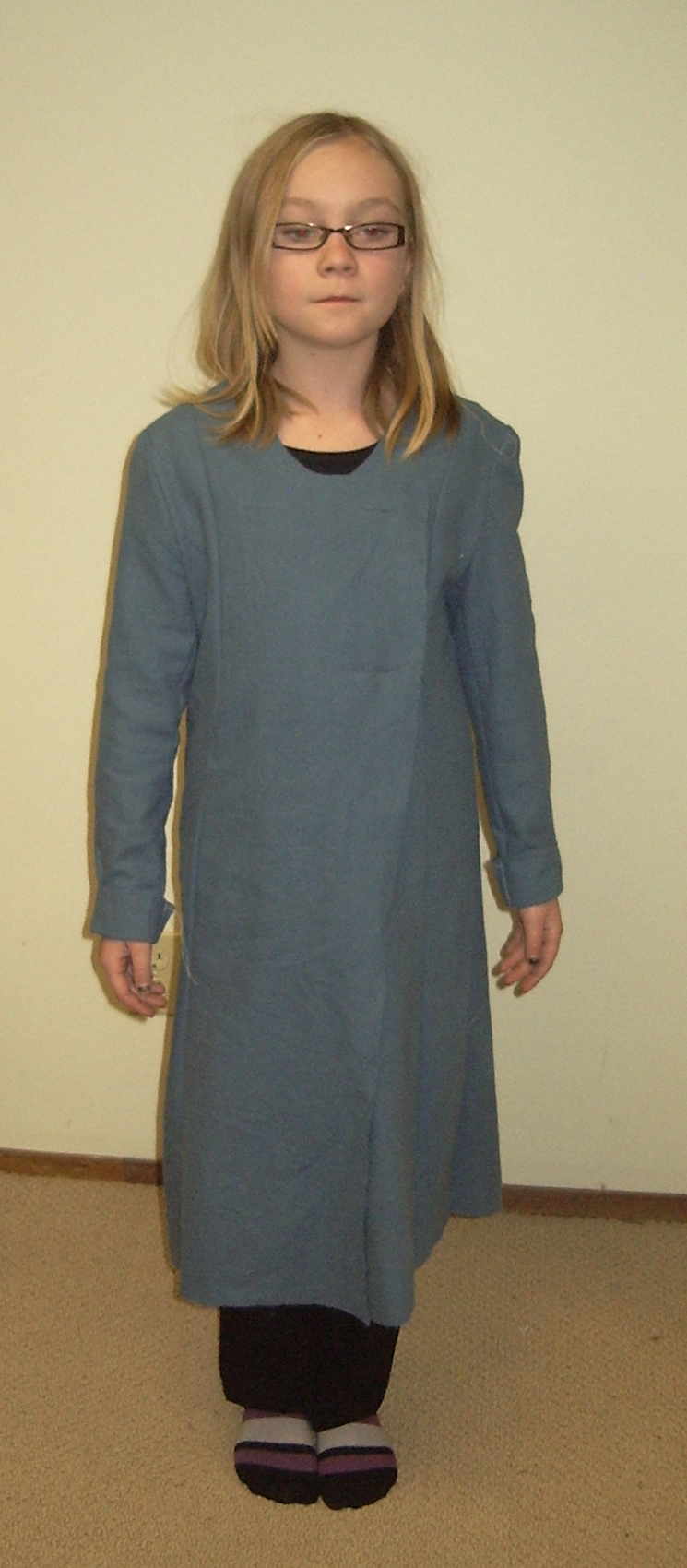
Tyo refused to brush her hair for the photos, hence her headless state. Also she was making faces.

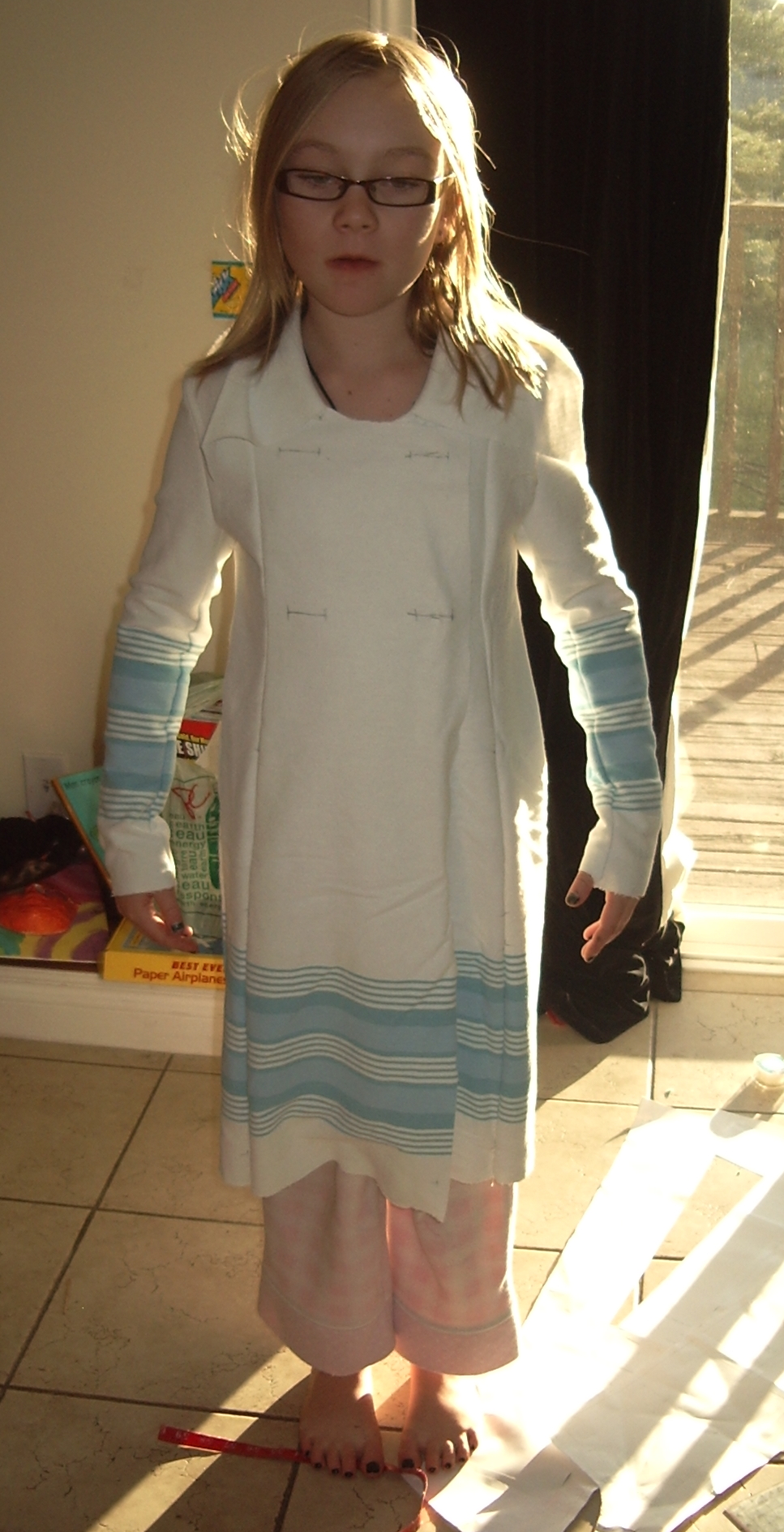
OMG, is that a coat?

She has POCKETS!

Well, almost.

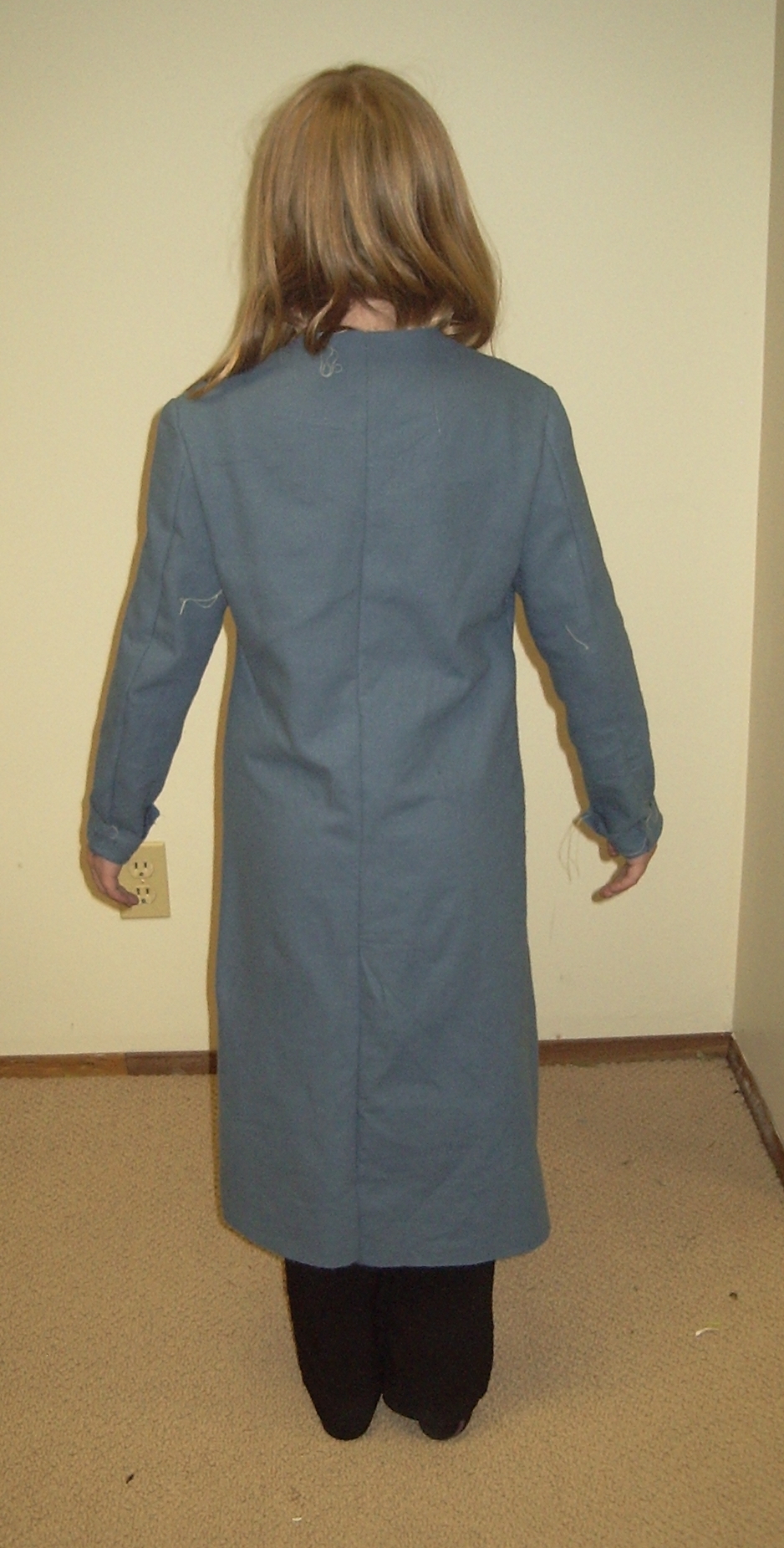
Yay, smooth back!

For interest’s sake, I re-took Tyo’s measurements (rather than relying on my last set from oh, back in the summer) and compared them to the m-sewing sizing charts. The results may highlight some of the fitting issues we had.

Hips: 81 cm. Her hips are a size 12.

Waist: 58. Her waist is a size 8.

Bust: 63 cm. Her chest is, ah, a size 6.

The coat I made is about a size 11, for measurements bust: 73cm, waist: 63cm, hip: 79cm.  I still think the coat is cut a bit snug for my liking (I added significantly more than 2cm to the ease in the hips), but the disproportion between shoulders and hips is all Tyo.  If Sewaholic Patterns ever puts out a children’s line, Tyo can be their first customer.

Next: assemble sleeves, sew lining, decide whether to add another layer of interlining (this time where the interlining *actually* belongs) as the non-foil stuff is kinda thin, and try to avoid doing any more hand-stitching until at least tonight.

PS. This post would’ve been up Saturday morning, but my camera cable evaporated sometime Friday evening. Despite a thorough house-clean Saturday (my Dad was in town and came to dinner), it has not resurfaced. However, fortunately for me, the card reader decided to read the camera memory stick today—Sony uses an odd format and 90% of the time the computer doesn’t recognize it… but once in a while it does. So, you get a post! Yay for random computer cooperation!


7 Comments

Filed under Sewing

Poppies

Red and black, two of my favourite colours. Speaking of which, the buttonholes have been bound.

Buttonholes on the coat. Poking the "organza" squares through.

Then, I tack them down (after judicious ironing) in the back.

Buttonhole frames tacked open

Gertie suggests using silk organza that matches your fashion fabric. I have no organza (as far as I know), and I’ve never sewed with silk in my life. I also didn’t have anything light and crisp in red. So I used this off-white (chiffon? I really suck at the names for these floaty fabrics, as I tend to avoid them like the plague. But I salvaged a crapload of this stuff after a wedding last summer. It’s gone to make the sheer JJ, and the rest will someday become a tiered petticoat.) I suspect silk organza would be a lot stronger, and maybe a more firm weave?

Don't they look nice from the front?

You can see a tiny bit of the chiffon from the front. I made extra sure when sewing on the strips that none of this showed through.

The basted strips in position

As you can see, my strips are kinda massive. (They’re also interfaced, and I added an extra layer of white interfacing to the inside of the front mostly so I could see my markings better.) I am debating whether to trim them down or leave them that way—if anyone has strong opinions I’d love to hear them.

And stitched in place by hand.

Don’t they look lovely? I will leave them basted for now (at least until we go buy buttons). Now all I have to do is get the facings to line up. Oh, and did you notice my lovely iron-mark on the front of the fabric? *headdesk* Mostly I remember not to do this. Mostly.

Anyway, back to the poppies. Are we all marking Remembrance Day today? I am lucky enough not to have any family members involved with wars of any kinds (even my grandfathers sat out WWII). I’m also not organized enough to get to any of the various ceremonies they have around. So consider this my little moment of silence.


In Flanders Fields

By: Lieutenant Colonel John McCrae, MD (1872-1918), Canadian Army

In Flanders Fields the poppies blow
Between the crosses row on row,
That mark our place; and in the sky
The larks, still bravely singing, fly
Scarce heard amid the guns below.
We are the Dead. Short days ago
We lived, felt dawn, saw sunset glow,
Loved and were loved, and now we lie,
In Flanders fields.
Take up our quarrel with the foe:
To you from failing hands we throw
The torch; be yours to hold it high.
If ye break faith with us who die
We shall not sleep, though poppies grow
In Flanders fields.

Lest we forget.

14 Comments

Filed under Sewing

How many ways to bind a buttonhole?

Tyo’s coat is going to have bound buttonholes. There’s only four, surely I can manage that, right? I know the Lady Grey was supposed to be my gentle entry into the world of bound buttonholes, but, frankly, Tyo needs a winter coat more than I need a gorgeous-but-semi-practical-between-seasons jacket right now.

The plan was to make the lips of the buttonholes out of the lining fabric (a sturdy flannel-backed satin) rather than out of the bulky, soft, and flexible fashion fabric. This plan lasted until I actually did some trials, of which I’ll be speaking of shortly. But first… there remains the issue of METHOD.

There is a plethora of bound-buttonhole tutorials out there; I will list only a few

  • Gertie’s
  • Sherry’s
  • Two on Burdastyle, this one which is most like the one in my Reader’s Digest Complete Guide to Sewing, and this one, which is more like (but not exactly like) Sherry’s.
  • Patty the Snug Bug recently reviewed Gertie’s technique and another one from her own sewing books, which is basically the same idea I used for my single welt pockets, but with a welt on each side.
  • No doubt there’s any number of other ones—that’s just what I remember seeing off the top of my head. If you have a favourite (or one of your own), please chime in! 🙂

A lot of VERY bad bound buttonholes

So, this afternoon, I sat down and experimented.

Now, as we all know, bound buttonholes, like welt pockets, are all about precision. Precision is one of those things I, ah, struggle with in sewing. I’m getting better, mind you—my cut pieces of fabric now almost always resemble the pattern they were cut with, I’m much better about getting my grain right, and I press as I sew quite religiously (which gets me a lot of exercise since I sew in the kitchen and press in the basement).

So you will not be entirely surprised to see that exhibit A, to the left, is, well, less than impressive. In part, the satin just wasn’t really working for me—it highlights the flaws, as it were, a little too crisply. (The satin for the final ones would have been the same fabric in black, but I have a ton of scraps left over from my winter coat lining, so I was using some of those. I did manage to achieve passable results with Sherry’s method, but still not to the point where I would be willing to put it in a finished garment (top centre in red wool, bottom left in silver satin). The slippery, fray-y nature of the satin didn’t help, either. Similarly with Gertie’s method. None of the others are even worth talking about (for this fabric and my current skills ;)… there are many sewists out there far more talented and precise than I!)

I had a bit more luck with using the fashion-fabric itself for the lips. It’s a bit more forgiving of my flaws. I was worried that it would be REALLY BULKY. It is. But, it looks softer. However, Sherry’s method is extra-bulky,  so it didn’t work so well with this method, either (centre top… which still looks better than any of the satin-bound ones, I suppose)). Gertie’s, however, did… with the caveat that it’s almost entirely hand-sewn. Only the initial rectangle was sewn by machine (bottom right two buttonholes, one in red, one in black).

This is pretty much par for the course for me. Precision=hand-sewing. I don’t really mind hand-sewing, fortunately (after hand-beading bellydance accessories, anything else is a piece of cake). Still, it would be nice someday to be able to be precise and speedy. Like, say, Sherry ;).

Ah, well. I showed Tyo the buttonholes and she likes the black contrast lips, so I expect we’ll go that route.

7 Comments

Filed under Sewing

Almost progress.

Holy off-grain fabric, Batman.

Left margin is folded on-grain.

Very glad I took the time to thread-trace along a rib. Presumably this stuff was knit in the round and then sliced. I really wish they’d just leave it in the round. So many more options that way.

Thread-tracing along a rib of the knit to find the grain.

I also took the lining pieces and compared them to the shell pattern pieces to see which adjustments I needed to make to them. The coat body lining was pretty easy, but the sleeves were weird. I have always been under the impression that lining pieces should be, if anything, a tiny bit smaller around than the shell pieces, since they go inside—turn of cloth and all that. With the exception of the back pleat, I know. Well, the sleeve lining pieces were wider. Or at least, they were until I added the 1 cm width to each sleeve piece. Now they’re pretty much (I would say) bang on. Am I missing something? Are they just oddly drafted?

And here’s another question for those of you who actually know what you’re doing! The under-collar (separate pattern piece) is drafted to be cut in two pieces, with a seam down the middle. Now, it was my understanding that you do that when cutting the under-collar on the bias (the grain-line shown is straight). So I was thinking about cutting it on the bias anyway. But then I remembered that my fabric is a knit, which doesn’t need bias to stretch/drape nicely. So maybe it doesn’t matter. So—can anyone enlighten me on exactly WHY one cuts the undercollar on the bias, and whether one would bother in a knit, and if one didn’t bother, would there be any point to cutting the under-collar in two pieces, or should I just cut it on the fold?

Tomorrow: Cutting, interfacing, and how much couture does one kids’ coat need?

12 Comments

Filed under Sewing

I can’t believe…

I made three muslins for a kid’s coat.

However, I do believe we have achieved “fit.” Maybe not perfect fit, but enough for a growing child who will be handing it along to someone else (likely several someones if it holds up) in a few years anyway.

Both the side seams and the centre-back seam have been flared out from waist down to give more ease; I also added an extension on the CB for a vent; hopefully the Cupcake Goddess’s instructions on sewing a vent in a pencil skirt will be applicable to a vent in a coat. I added 2 cm ease (one to each sleeve piece) to the sleeves to give a bit more room there, as they still seemed really slim. I made a small narrow-shoulder adjustment (1 cm narrower). I will still add in a shoulder-pad, but they do look surprisingly better this way. Now I need to go and make the same adjustments to the lining pieces (sigh).

In other news, Syo is prancing around in Muslin #1 (the smaller size), which fits her remarkably well (although I still think the sleeves are far too narrow for a coat).

Tyo’s about to head off to “Outdoor School” (aka camping in November… what are these people thinking?) for three days. Who knows… maybe she’ll get back to a nearly-completed coat.

Or, y’know, not. The kids do have both Thursday and Friday off school for Remembrance day, so I may save it for then.

2 Comments

Filed under Sewing

A Coat for Tyo—Muslin #2

On Tuesday when I tried to print out the pattern in a larger size (140 instead of 134 height), my printer was out of ink.

Thursday night, despite me doing ABSOLUTELY NOTHING to fix this, it was willing to print.

Muslin #2 Front

So I pieced together the pattern (again) and compared it to the smaller version. The length of the sleeves on the larger pattern was just slightly longer than the length of the sleeves on the smaller after I had lengthened them to fit. Perfect. The width of the back piece was almost the same as the width of my alterations to the back piece. Good so far.

Muslin #2---Side

The shoulder was a whole cm longer. Ah, well.

So, here it is. Much better all around, except for those pesky shoulders.

It’s still catching the slightest bit on her bottom, so I think I will still do a small swayback adjustment. I’m thinking I’ll add a rear vent, too, just to make it a bit more practical for an active child. I’m also going to add 1 cm  to the undersleeve (and maybe flatten the sleeve-cap a tiny bit to compensate?) just to get a bit more ease there. The width they are now would be fine for a jacket, might be still a bit snug over sweaters, once all the layers are in place.

What do you think of those shoulders? If it were just for her alone, I would definitely alter them, but this coat will probably be handed down eventually to Syo, who is built much more like me, i.e. with broad shoulders and a narrow, compact bottom. And they are designed for a shoulder pad, too, although I wouldn’t want a large one. Anyone have a favourite narrow-shoulder adjustment tutorial out there?

Muslin #2---Rear view

On the fabric front, I washed the red fabric. It shrank. No big surprises there. I will wash the black, too. The downside of this fabric is a peculiar strong, plasticky odour (possibly the reason it was on sale). The store assured me several times that this will go away when the fabric is dry-cleaned. I hate dry-cleaning, so I just washed and dried it. I figured it couldn’t hurt a semi-felted fabric too much. Aside from the shrinking, it seems fine. The smell, though fainter, is still there. After several days of lying spread out in the basement, it seems hardly noticeable… I’ve now folded it up and we’ll see if the smell comes back. If I do need to dry-clean it to get rid of the smell, well, that’ll be another thing to wait on money for :P.

Syo's purse

In other news, Syo cut out and sewed a little purse for herself tonight. I did nothing but tie off a few knots (she even threaded the needle herself.) Meanwhile, Tyo is plotting making cloth dolls for her cousins. The basement is currently strewn with an assortment of doll-pattern-pieces. Also, I’d just like to point out that those purple striped socks Tyo is wearing, are mine. *grumblegrumblegrump* She’s starting to steal my shirts, too. The end is nigh, people, the end is nigh.

16 Comments

Filed under Sewing

Dear Tyo, I foresee…

… a lifetime of narrow-shoulder, wide-hip alterations. You’d better learn to sew.

Girls' Coat muslin I

I may have mentioned before that my sweet little Tyo has the build of all the women in her Dad’s family (and diametrically opposed to the women in mine, I’ll add): she is an incipient pear. Narrow shoulders and BOOTY. This has been apparent since she was, oh, two, but it’s only getting worse as the years go by. Let’s just say I could picture rap videos in her future. And a lot of quality time with the shotgun in her Dad’s.

So, I have to say, the muslin for the coat went together like a dream. The pattern is (surprisingly?) sophisticated, with separate lining pieces for everything. The overall shape looks good, all the seams (that I tested) match up beautifully; the sleeve-cap is drafted with a beautifully small amount of ease, just enough to curve it nicely without giving it any tendency at all to pucker (admittedly, the wonderful old flannel sheet I was using for the muslin was a dream to sew, too, so that didn’t hurt)

Side view

And, as you can see, it’s just a wee bit too small. Everywhere except in the shoulders, which are perfect. (The sleeves are long enough only because I lengthened those pattern pieces BEFORE cutting it out, as I could see they were going to be too short. Unfortunately paper-printout doesn’t lend itself to tissue fitting.)

Now, I can’t be 100% sure this is a problem with the original sizing, as it’s entirely possible my crude efforts at tiling let to some re-sizing of the printout and there’s no handy-dandy scale square to allow me to be sure (actually, according to the tiling program my printout is .01 feet smaller… which I didn’t think could throw it off by this amount, but anyway). But the fact remains that there is definitely not enough ease in the pattern AS I PRINTED IT OUT. Well, there would be if it were a dress. For a coat… not so much.

If it were just the skirt pieces that were the problem, I would just spread them. In fact, before I got the sleeves on, when

Rear view... split to let the side-seams hang straight. >_<

she first tried on the body and it became obvious that the skirt of the jacket didn’t have enough ease for her lovely bottom, I was all set to slash and spread the skirt of the back pieces, just enough to give her a couple of extra inches in the derriere region. But with the sleeves in place, it became evident that some extra ease was required there, as well.

So I’m torn, folks. What’s the best way to proceed? Re-print in a larger size? Slash-and-spread to widen sleeves, armscye, and the lower part of the coat, preserving the fit in the shoulder?

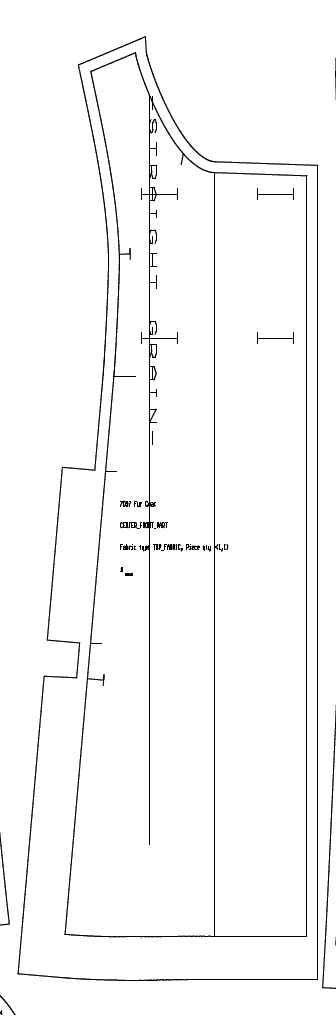
There’s only one part of the pattern that has confused me a little. Along the front princess seam there are two

Front pattern piece: princess seam with ?vent

expansions (places where the seam allowance goes from about 1 cm to 4 cm. The top one is for the placement of the pocket, but below that the seam allowance returns to normal for about an inch, and then widens again I’m not sure what’s meant to go there, as it doesn’t appear to be any different from the rest of the seam on the illustration (or the limited instructions available on m-sewing.)

It does resemble nothing so much as a vent or pleat, though I’ve never seen one in this precise location on a coat. What do you think? Ignore? Make as a vent or pleat? I should add that the lining doesn’t have an opening here and the seam between the CF facing and the lining does not coincide with this princess seam, either. So maybe that eliminates the vent option but still allows the pleat? I dunno. Anyway, if anyone has any suggestions or revelations, I’d love to hear them. Or I can just ignore it ;).

Probably I should go up a size, right? Bigger is always better with kids. (D’oh!)

7 Comments

Filed under Sewing

Picky zippy

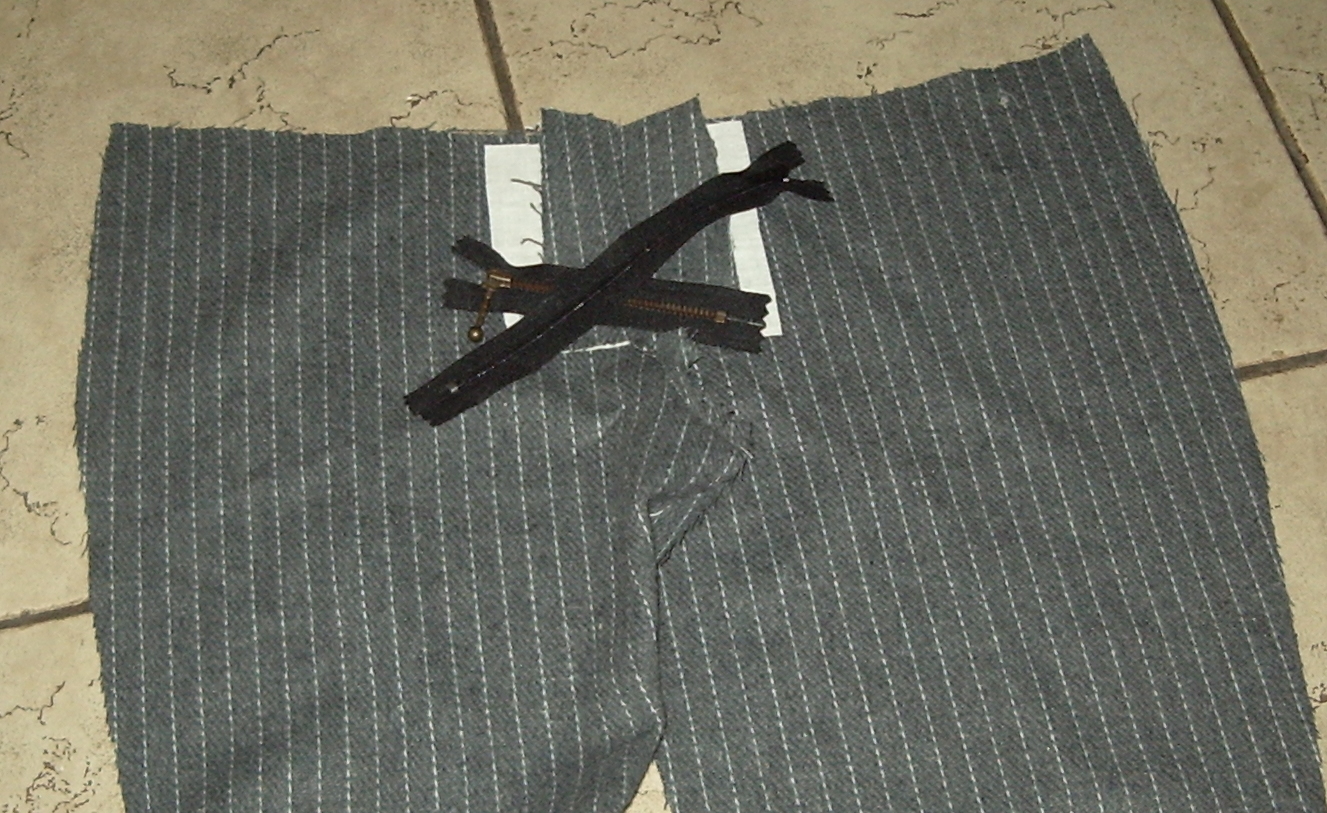
Inadequate zipperosity.

I don’t have a nice grey metal zipper. Why do I give a flying fig about the colour of the zipper in these pants? I don’t know, but I want one that’s metal, either grey or black, and I don’t have one. The one metal zip I do have kicking around was purchased for my Jalie jeans and isn’t quite long enough. Grr. If I had thought about this I could’ve popped by the Sewing World by the train station on my way home from work today, because while they don’t have much that’s of use to me, they do have zippers (and needles… I need a new twin needle, too… my old one finally died, though it lasted much longer than any of its predecessors.)

While I’m wishing, I’d like some pinking shears too.

Anyway, as you can see, I have not made significant progress on the pants.

7 Comments

Filed under Sewing

Welt!

Pocket, that is. Although, a raised, stinging mark on the flesh might not be too far off, either.

Yesterday, I took the plunge and cut another set of Ellen pants from my grey pinstripe wool. There’s actually quite a bit of this fabric—the pants only used about half—so doubtless there’s a blazer in my future.

The pattern comes with instructions to line the front piece to the knee (underline, actually, if you read the instructions). I did want to line, as I’m a bit hesitant about having wool trousers to begin with, never mind against my legs. So I cut out lining pieces front and back out of some of the leftover lining from my coat. Yes, these are going to be winter trousers. (Somehow the term “trousers” seems much more natural when I’m not talking about casual attire.) If any of you have any advice for how to line trousers with a fly, I’d love to hear it. My usual tutorial for installing a fly is Debbie Cook’s, but that, of course, doesn’t involve any kind of lining, and the only advice I could find in my Reader’s Digest Complete Guide to Sewing (my one and only sewing tome) was to construct separately and slipstitch around the zipper; nor did a quick google yield anything more specific. Maybe I’m over-thinking it, but I have this sinking feeling that I’m going to end up with a bulky mess right at the front of my otherwise-sleek trousers.

Someday I should really invest in a good book on tailoring. And in pinking shears.
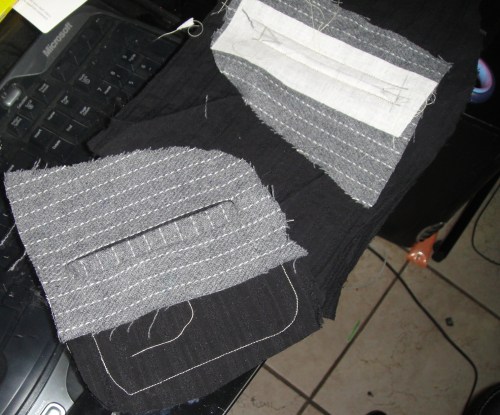
Welt pockets---testing, testing, 1...2...

Anyway, I decided I wanted welt pockets on the rear. Now, I have always thoroughly avoided welt-anything to date (including the related technique, bound buttonholes). Not out of dislike, but out of pure chicken-shit-edness. There are any number of excellent tutorials on making welt pockets out there, which I have read over at various times. My tome has a description as well. Most recently, Gigi went over the process briefly, so that was the one I turned to, though it’s not particularly in-depth. Two admonitions stuck out in my mind: practice and precision.

Neither are my forte. Especially when it comes to sewing.

Nevertheless, I dutifully sorted through my scraps and started ironing and interfacing etc. After the first test welt, I decided to interface future welts. It looks fine, but it feels more sturdy with the interfacing, a little less likely to sag and expose the pocket lining.

Note: this is not intended to be a tutorial. I pretty much still suck at this. This is mostly intended to remind me of what I did (and maybe what not to do next time).

Drawing the future-welt box on the interfacing on the wrong side of the fabric was easy. Figuring out the relationship between the box-size and the welt (especially depth) took a little more mental gymnastics. I eventually settled on a welt that was 2cm wide (including a .5 cm seam allowance) and a box that was 7mm on either side of the line (the line being about 1mm wide, it all added up to 1.5 cm, the same width as my welt. Oh, good!

Welt pinned in place on right side of fabric, pointing down.

Next, how do you orient this? The whole thing gets flipped through and around, which is quite dizzying to my little, spatially-challenged brain. So, to start, your folded welt goes on the outside, pointing DOWN away from where the pocket will be. Its seam line goes along the bottom edge of the box, the raw bottom edge of the welt (currently pointing up) goes roughly along the middle of the welt. Well, technically 2mm off, in my example, but what’s a mm or 2 between friends?

(And dear lord, imperial people, I can understand inches in the macro range—I use them myself, to my shame—but how on earth do you wrap your minds around measurements like “5/32” of an inch? Mind-boggling! Give me my millimetres any day.)

I pushed pins through the fabric to locate the corners of my box on the right side, pinned the welt in place, and then basted it in for my sanity’s sake. Next the pocket lining goes on TOP of this (yes, on the right side of the fabric!) I used a single piece for my samples but two pieces sewn together for my actual pants. The single piece was a better idea. Probably there’s a different way to do it if you’re going to use two pieces, but what ever. Position the pocket lining over the welt on the right side of the fabric, facing down. I got this right the first time (unlike the welt…I had to rip off my first one)

Stitch around your box from the wrong side, so you can see your lines. Be achingly, brutally, precise.

Did I mention that I am lacking in precision?

People suggest counting your stitches along the short sides. I tried. Usually it took 7, sometimes 6, once only 5. This had less to do with my boxes being uneven than me not letting the fabric feed through evenly.

Blurry pictures of cutting through the welt.

Then… you cut. I love my little dissection scissors as they’re sharp, pointed, and tiny, but I think I need a new pair to keep dedicated for sewing. My husband has been using these to trim his hair and they’re not as sharp as they used to be :P.

The trick is to clip right into the corners, without clipping through your stitches. I did pretty well on the practice welts, actually, but not quite as well on the real thing; I blame it partly on my heavier lining fabric, and partly on being nervous about clipping my stitches.
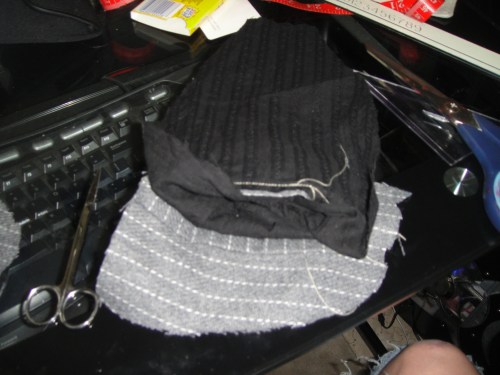
Tucking everything through.

Once your box is snipped open (cut on an angle into the corners, making little triangles at each short end), you flip the whole shebang—that prolapse of pocketing and weltishness blighting the right side of your fabric—through to the inside, where it properly belongs. The edges of the welt itself show, which flummoxed me a bit when I first did it. For the next one I trimmed the edges on an angle (as you can see in the image above of the welt pinned in place), which seemed to make for less bulk at the bottom corners when flipping through. I have not seen this in other tutorials, and it may very well be a bad idea in the long run).
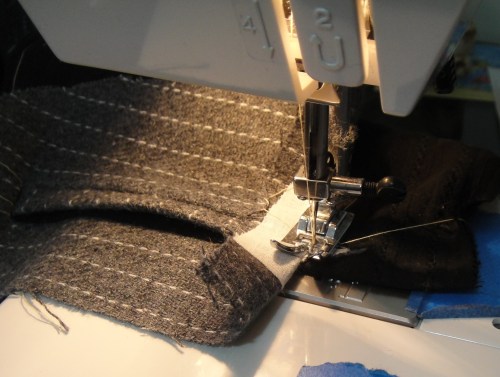
Sewing the "little triangles" down to the pocketing after pushing everything through.

Once you have it tucked through, you iron everything in place; Tug on those little side triangles and then stitch them down. This is supposed to make sure the welt lies flat and the hole’s edges are nice and rectangular. Sewing it down wasn’t actually as tricky as I had feared (I’m still scared of the button-hole-sized equivalent, though)

Stitch around the edges of your pocket bag, and voila! You have a welt pocket!

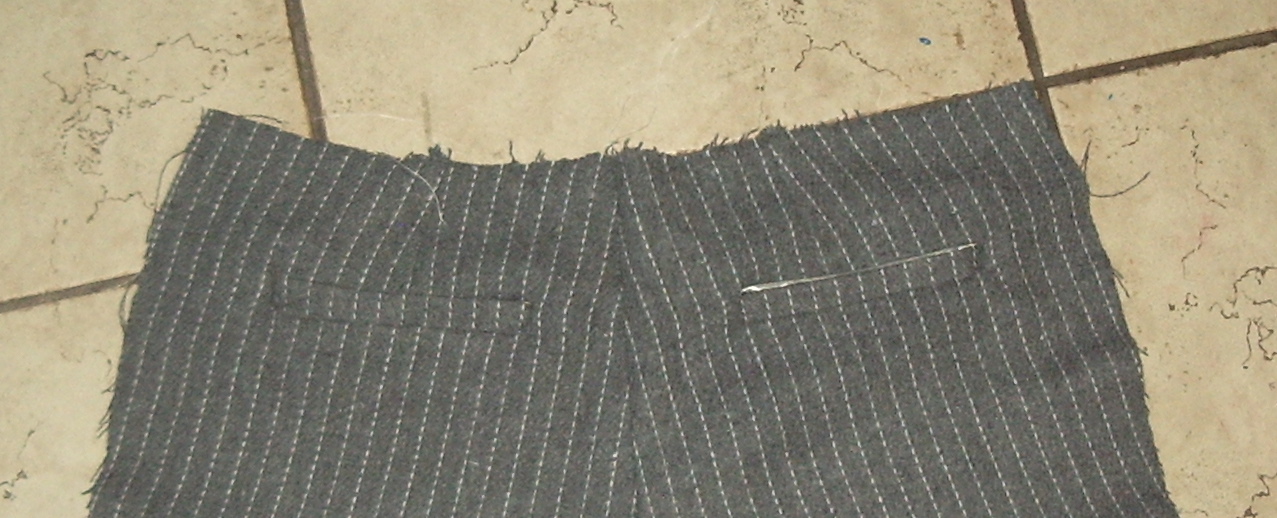
The real thing. Not... so perfect.

Well, in theory. I still have some issues getting the welt perfectly flat at the corners, not having it gaping, and other niceties. Precision, precision. I actually did slightly better on my second practice welt than on the pants themselves. /sigh. That being said, I think I’m more irritated with my inability to match the stripes properly (I tried! I REALLY DID!) than with the welts themselves. I may end up putting a small button in to keep them from sagging, as the shiny silver lining REALLY shows.

Also, it’s snowing again. Although seeing as it’s the end of October, I need to stop whining about that. At least it’s not sticking yet. 🙂

10 Comments

Filed under Sewing