Back in the Saddle (?)

I sewed!

Sewing!

It took a lot, both in terms of re-organizing (the box with my main sewing machine conveniently wound up at the very bottom of the middle of the massive pile of stuff we have in storage right now) and personal patience. This having the sewing room in someone else’s house bites bigtime. Not least because every time I go over to try and tackle things, I feel like I’m being rude for heading down to work rather than upstairs to visit. Going to have to work on that.

There was the predictable myriad of small, unanticipated hiccoughs, from not having my good pins or my seam-ripper, to discovering that my mother-in-law, who is currently allowing me to occupy a corner of her basement with my sewing stuff, doesn’t have an ironing board. I had assumed everyone with a “real household” would have one. I mean, she has a rice steamer, people. She said, “I don’t iron.” I said, “I don’t bake. But I still have cookie sheets.” That may not have been my most diplomatic moment as a daughter-in-law. >_< So I also need to dig my ironing board and iron out of storage.

Former T-shirt

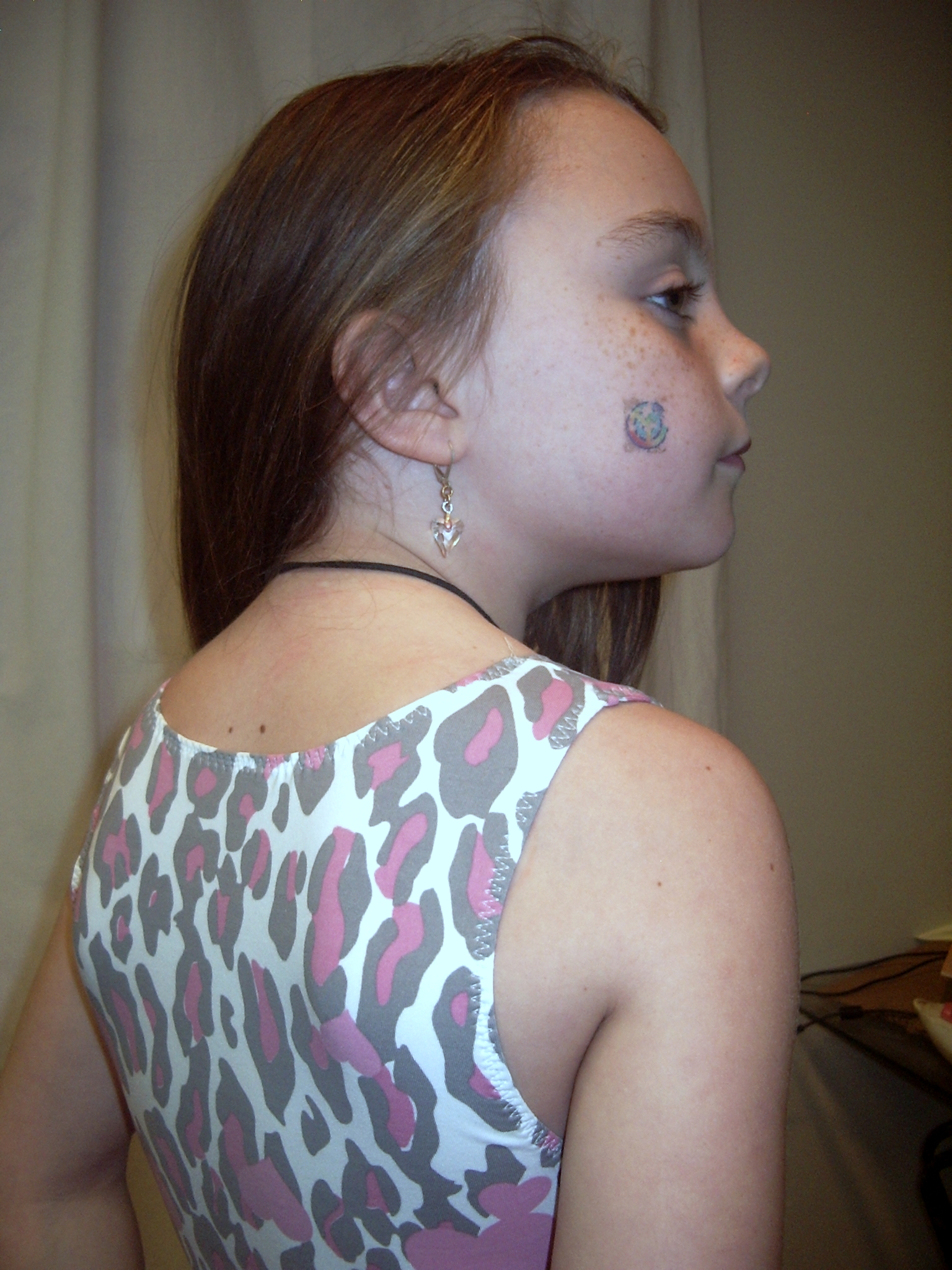
Anyway, I did eventually settle on the quickest of projects, a T-shirt refashion. Why didn’t I get a damn before picture? /headdesk. This black tee has been kicking around the bottom of my wardrobe for roughly a decade at this point, one of those shapeless “unisex” T-shirts that I can never actually bring myself to wear, courtesy of my student club days. The pattern is an old one, dating from one of my first knit projects, but is presumably roughly comparable to Zoe’s vest pattern. I used the same fold-over elastic that gave me such fits with Tyo’s tank top back in the spring, and I’m happy to say that with a good deal more care and attention to the stitches (and practice samples!), helped along by this more stable fabric, I was able to attach it more or less adequately. Because this particular fold-over elastic doesn’t fold on its own, I stitched it on in two passes, using a three-step zig-zag and being careful not to let my stitches reach the midline groove, where they basically shred the fabric of the elastic.

The T-shirt knit is not as stretchy as the last fabric I used this pattern for, so the top is quite snug, giving a bit of a flattening uniboob thing. But it’s comfy, and infinitely more wearable than it was before. And nice and long.

Strappy fun.

I decided to bring both straps to the centre back, partly because it looks cool, largely because it meant that I could just stitch them in place without worrying about where the straps should be positioned. They are a little long, but I didn’t have time to re-adjust before I had to round up children (my own and nieces) for home-made pizza at Uncle’s house. The pain of having family around, I tell you.

Oh, and for the really geeky among you, the logo says “Miocene Park” and the skeleton is that of an entelodont.

Is this the beginning of big things? I really don’t know. I have hopes (I have coats on the brain, frankly), but we’ll see. Also, I got eight (possibly nine) patterns at the local Mennonite thrift today. They’re usually 50¢ there, but the guy only charged me $2 for the bunch. Yay. I think I need to sew more, if only so I’ll buy fewer patterns…

29 Comments

Filed under Sewing

Fantasy Sewing: McCall’s 8858

McCall’s 8858

All right, while I remain in sewing limbo, let’s fantasize a bit more.

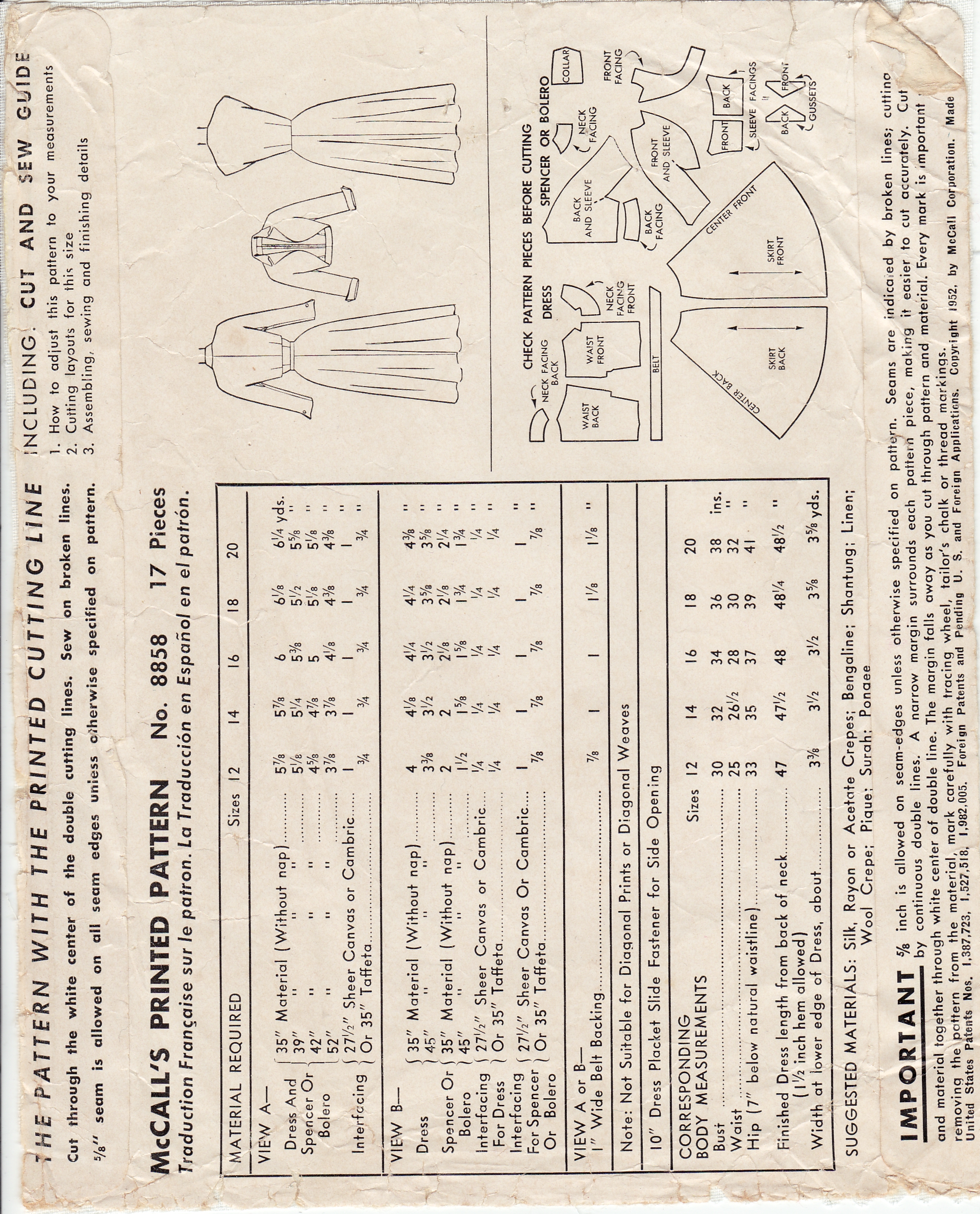
This is McCall’s 8858, which I got from the thrift store in my hometown (now once again my home), back in the spring. It’s © 1952, and is just my size.

I mean, exactly my size. Bust, waist (well, on a good day, anyway), and hips. I am trying to figure out how companies, in an era that championed the wasp waist and idealized the hourglass figure, where women still wore girdles as a matter of course (or at least, my grandmothers did), put out patterns that match my own rectangular measurements. I’m pretty sure that I do not have a “vintage figure.”

Now, when I bought it, the envelope to this pattern was totally trashed. Well, still is, really. I took the front and back (since they were already completely separated) and ironed them on to some cotton iron-on interfacing I had around. Is interfacing archival? If not, well, I doubt it’s worse than what they’ve been through already. At least those shredding edges are reinforced.

While I was messing around, I sorted through the pattern. By some miracle of the Sewing Gods, it’s all there. Every little facing, as far as I can tell. Furthermore, it had been folded in the most awesome way imaginable—skirt pieces together, bodice pieces together, bolero pieces together. How cool is that? Whoever last used this pattern is obviously a far more meticulous lady than I.

McCall’s 8858 envelope back

Here, since I was in the mood for scanning things, is the back of the envelope. Ok, so there’s one measurement I’m pretty sure won’t fit, which is back length. It’s not listed, but I presume it’s on the order of 16″ or up, as it usually is, and my back length (nape of neck to waist) is 15 at best. Also the hip measurement indicates it’s at 7″ below waistline, and my full hip is more like 10″ below my waist.

Now when I make this (and I will make this, although I make no promises as to timeline), I will need to figure out how to petite and square shoulder a kimono sleeve. I’m not too concerned about the dress itself, but the bolero is a little more scary. And I really like the bolero.

Some other observations about the pattern:

It calls for the skirt to be cut with the grain paralleling the side seam. Interestingly, this is something that my 50s sewing manual cautions against; I’d never actually seen a pattern call for it before. Most everything else I’ve read on pattern-drafting and selecting grain suggests you should put the straight of grain midway between the two angled edges, unless you’re going to put one side on the fold, anyway.

In classic 50s style, it also calls for a self-fabric belt. I’ve never made one, as I generally don’t find that I “cinch” well. I feel like it always creates a certain blousing effect that just never seems to work for me. Of course, there is also the question of whether this should become part of Project Drop-Waist, but I think I may just possibly be able to pull off a waist seam as long as the skirt is un-gathered and sleek, as it is here.

I’m excited about the bolero, in particular. I’ve noticed (now that I have a small plethora of full-skirted dresses) that the style of jackets they work with are pretty limited. It has to be either a huge opera-style coat that can completely cover the skirt, or a petite, cropped bolero that doesn’t impinge on the skirt. I guess in theory something like my Lady Grey coat should work, but in practice I find I only like it with skinny bottoms. My empire-waist jacket is a complete fail, and the situations where it’s cold enough for my winter coat, but warm enough that I might wear one of my full-skirted dresses are very, very limited.

As far as I can tell, the only difference between View A and View B is that the bolero is made out of a different fabric in View B. Hmm.

The skirt will be a half-circle when all is said and done.

Of course, no Fantasy Sewing interlude is complete without musing on fabric. The problem is, I don’t think I have any lengths in stash that would be adequate for a dress like this—most of what I have is in 2m lengths. And I am not buying fabric right now, having just been traumatized by how many freakin’ boxes it actually filled.

It would be fun to make up even just the bolero, though. I have some black poly twill that would work (actually, I have a crap-ton of that, probably enough for the whole dress, but I have no desire to have a whole 50s dress in black poly twill suiting.) This is when I begin to wish that I’d catalogued my fabric stash more thoroughly… Not only do I no longer have everything on a shelf to paw through, I don’t even know which box most of it is in (I did label my boxes things like “Coating” and “light weight fabrics & interfacing”, but what exactly is where is pretty unclear.

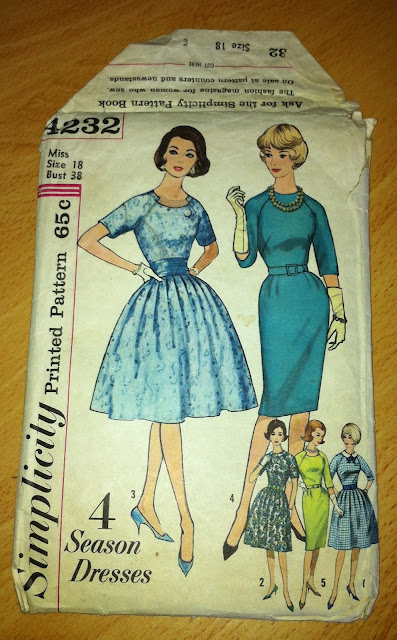
Simplicity 4232

While I’m rambling, I might as well add that a little more recently I stumbled upon this sixties pattern with a very similar neckline, although this one has raglan sleeves rather than kimono, and your choice of full pleated or wiggle skirt. It’s quite adorable too, although the size is rather further from mine. Also, I love the cummerbund-style belt in the left view. I wish I looked good in those…

15 Comments

Filed under Sewing

Thirty-Two

Last year at this time I managed to pull together a pattern to share. This year, what with moving, I fear that’s been the last thing on my mind. And, frankly, with a lot of the big changes in my life recently I could pretty easily be pretty whiny and down on this birthday. Which wouldn’t be very fun for anyone, least of all me. So let’s focus on the good things.

I have (often) happy, (generally) healthy kids, who despite their loud protests are settling in to their new lives just fine.

I have a man whom I love and who loves me back, and we’ve managed to make our way together for more good years than any of our parents had. Even if he did go and beat Darksiders II last week while I was busy.

I have loving and supporting family on all sides. (Even better now that they’re no longer hundreds of kilometres away.)

I have a head full of ideas, interests, and dreams, even if I can’t quite manage to figure out how to make any of them particularly practical.

And, not to be too maudlin, but I have your support as readers. It’s really, really awesome.

Oh, and Osiris took me across town on the motorcycle to pick up my birthday present:

20120908-002639.jpg

😀

41 Comments

Filed under Sewing

Fantasy sewing: Underwear

I still don’t have a sewing room (although there have been some signs of progress). It’s been an all-day-every-day job getting things even as close to “settled” as they are (it took me two weeks to find my eyeliner). The fact that half of our stuff is remaining in storage at least for the short term is not helping, either. But when I DO get it set up, what will I make? The season for the adorable sundresses I had been banging out has emphatically passed, and while there’s several fall-ish dresses I’ve had in mind, the lack of a closet I’m currently dealing with is making any clothing that needs to be hung distinctly less appealing than it was before. I could, of course, make a sweater or bunnyhug, but that would be like practical and stuff. I’ve bought a fair few thrift store patterns recently, in a ridiculous and counterproductive attempt to soothe the creative itch, but I’m not sure that any of them are absolutely screaming to be made. And I’m not quite willing to dive into the list of coats for winter without a bit of a warmup.

One thing that has been on my mind is the perennial, elusive, underwear. Underwear is kind of my unicorn—attempted several times, but always elusive, usually due to sloppiness on my part. There’s the failed, self-drafted pair I blogged here. Before that, there was a pair from this pattern:

Lekala Panties:

Lekala panties—tried but failed.

Which didn’t work out either technically—wonky construction—or fit-wise (the rise was way too high). I’ve tried and failed at least one more time in the past, I think with this Burdastyle pattern:

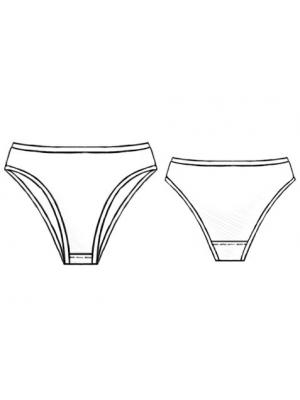
Bikini style underwear

Bikini-style underwear

 Which was similarly disastrous, although I don’t remember exactly why. The odds are it was me, though, rather than the pattern.
Beyond these free patterns (I downloaded the Lekala one back when they had a free demo size that just happened to be more-or-less mine), I have a few possibilities in stash—I’m pretty sure that the differences between panties and bikini bottoms are in fabric and finishing rather than cut, so I’m including them here.

In the retro category  is this one:

Simplicity 9933

However, only the one-piece is designated “designed for knit fabrics only” which makes me rather scared of the two-piece bottoms.

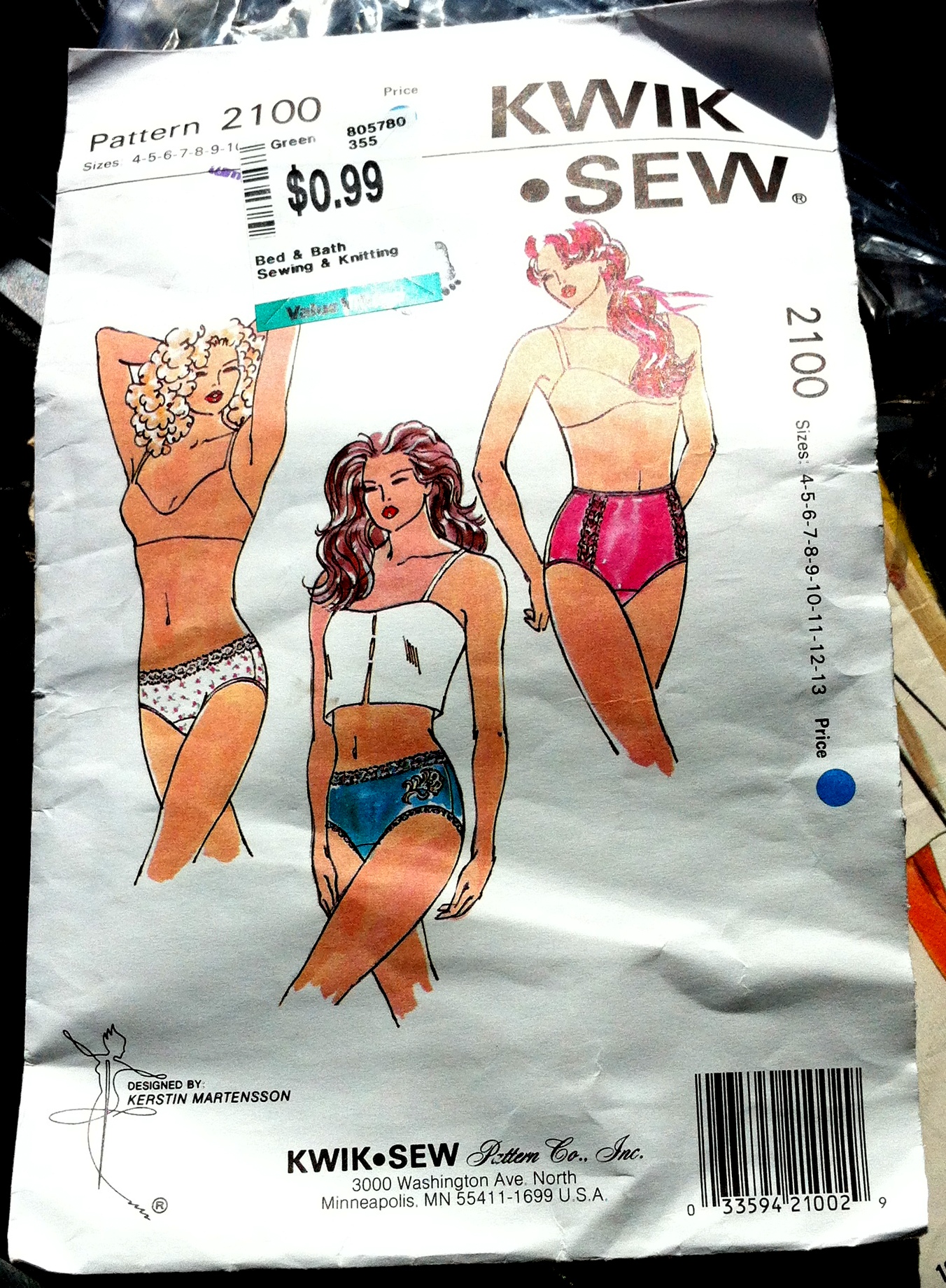
Kwik Sew 2100

Most recently, I found this Kwik Sew pattern. It has the advantage of several reviews on Pattern Review, although they’re not overly positive in terms of fit and sizing. (I’m a bit confused how you can rate a pattern “highly recommended” and then write that you had to go down two sizes and reduce the width of the crotch panel by an inch.)

McCall’s 4471

Possibly the best candidate would be this McCall’s pattern. There are several helpful reviews, and it’s the general bikini shape that is kind of my fall-back.

Of course, there’s no shortage of other underwear patterns, too. Aside from the old staple of tracing your favourite pair (I’m still not convinced my problem was the self-made pattern), there are several free options available:

Cheeky panties? (click for source)

This cheeky panties one is cute, though I think the finishing leaves a bit to be desired. I go back and forth on the whole cheeky panties thing. Same with the lace tanga panties. Sew You Said is in the midst of a series on drafting your own, as well.

If you want to pay for a pattern, a couple I’ve seen recommended are:

Jalie 2568

Jalie’s underwear pattern (does anyone ever say not-good things about Jalie?)

And several of the Kwik Sew lingerie patterns.

And I’ll throw in a link to the Ohhh, Lulu patterns for thoroughness, though I think I’ll be wearing high-waisted panties about three days after hell freezes over. No offense to everyone who loves them… just not my thing. And I’m so over thongs.

Oh, and there’s probably something that would work in the Merkwaerdigh line, which I also generally hear good things about, although more about the bras.

Which is not to say that I’m totally convinced that underwear is my next-up in things to make (and if I do it would probably be from one of the patterns I already have). But feel free to throw in your favourite pattern, and any technique tutorials you find super-helpful. Because apparently in this department I need all the help I can get. 🙂

26 Comments

Filed under Sewing

Homemade legitimacy

Immitating Storebought

Hmm, that is a fairly hefty title. I am somehow dubious that I will be able to live up to it. Anyway, here’s some thoughts on something(s) I ponder fairly regularly. Specifically, the “legitimacy” of homemade clothing.

But first, what do I mean by “legitimacy”? Fairly simply, I mean what’s considered (in a given society) normal, proper, acceptable—legitimate. Legitimacy can apply to anything, from the proper way to brew a cup of tea to what makes a legitimate government, but, this being a sewing blog, I’m going to talk about how this idea applies to clothing. Especially the clothing we make ourselves.

It’s no secret that, sometime in the last fifty to sixty years, “homemade” became a bit of a stigma, at least as it applies to clothing. (Homemade dinner, on the other hand, still seems to be a major goal in cooking, and plenty of thoroughly commercial food products are advertised as “home style”. Obviously they’re not eating my homemade cooking.) I’m not a social historian, so I can’t really offer any proof of why “homemade” became “Becky Home-Ecky”. I’m going to speculate anyway, though. 😉

I suspect that clothing made by others for you has always been desirable—in the bulk of history, when clothing was all hand-stitched, there were still garment-producing professionals, and I’m pretty sure the fancy gowns and suits of yesteryear we admire were all made by people who specialized in their craft. Which is not to say there wasn’t plenty of stitching excellence in the home, but I suspect the yen for someone else to do that damned work was always there.

Although clothing production seems, from what I can tell, to have lagged somewhat behind a lot of other areas in industrialization, by the middle of the last century, it was thoroughly industrialized. And, like all industrialized processes, there were subtle differences in the product as compared to the home-made version. A de-emphasis (frankly, complete avoidance) of hand stitching. Different patterns of construction—setting sleeves before sewing the side-seams, for example—that facilitate sewing at the expense of individualized fitting. And, of course, specialized stitches from specialized machines, which a manufacturer can afford to invest in, but which would not become practical for home-stitchers for decades (if ever. What percentage of us have coverstitch machines?). And one of the biggest things this created, I think, was a feeling that our home-made garments don’t always (or ever?) measure up. Our home-mades feel illegitimate.
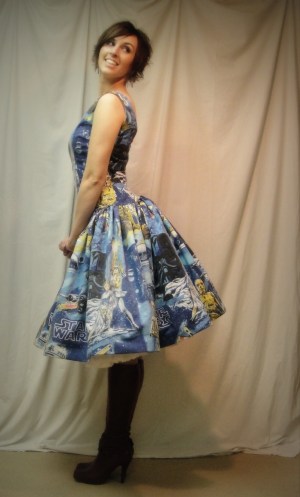
Not immitating storebought.

Now, there may have been some intentional work on the part of clothing manufacturers to undermine the appeal of home-stitched goods, and there may have been some anti-domestic backlash rejecting sewing along with the traditional, limited notions of femininity that it went with, and there may even have been a decline in the quality of home-sewing due to its lesser importance, but frankly, even if there hadn’t been, I think the delegitimizing of home sewing would’ve happened regardless. As soon as different methods were adopted in the factories, there was a difference in the product—a difference between home-stitched and storebought. And, frankly, as humans we have a very hard time seeing “different” and not judging “better or worse.” As soon as manufactured clothing became equivalent in quality, cost, and fit (or at least, enough years had gone by for people to forget what custom fit actually looks like), the fact that it was easier than making your own would increase its popularity, normalize it, legitimize it, and home-stitched clothing becomes different and thus bad, illegitimate. It may not have happened the first generation, but I know so many people who talk about hating the home-made clothes their mom or grandma made them. I felt the same way when I got home-made underwear for Christmas as a child. And it wasn’t because there was anything wrong with the underwear. They just weren’t “normal.” And therefore they were bad. (And I didn’t grow up in a home or even a school where brand was a big thing, so it wasn’t about branding.) Even though I started sewing as a child, and made costume-type garments in my teens and twenties, I never really considered trying to make everyday garments. The look, the details, wouldn’t be right. (And “right,” of course, is how storebought looks.) Even without ever hearing the term, I had no interest in making something “Becky Home-Ecky.” It’s worth admitting that what prompted my plunge into garment sewing was the decision to make a classic, tailored winter coat—something that I felt I could make look “right” with the home-sewing tools I had at my disposal, since the seams are all enclosed and the look itself dates back to a time before mass-manufactured clothing.
Triple-stitch zig-zag finish—This looks “wrong” (homemade, unprofessional) to a lot of people, yet it functions just as well as a coverstitched edge. Is it really aesthetically inferior, or are we just not used to it?

Storebought clothing, and the techniques that went with it, had become the standard, and anything different became wrong. I wasn’t around to observe this directly, but at a guess I’d peg this transition sometime in the early 70s, though it certainly started earlier. In my family, my grandmother sewed for her children in the 50s, but had given it up by the 60s. Possibly that’s because she had more children to manage, or boys weren’t as fun to sew for as girls, but I think the fact that storebought clothing was becoming increasingly affordable was probably a big factor. But I don’t get a sense that my mother ever thought of her home-made clothes as inferior, at least as a child.
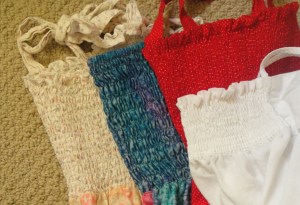
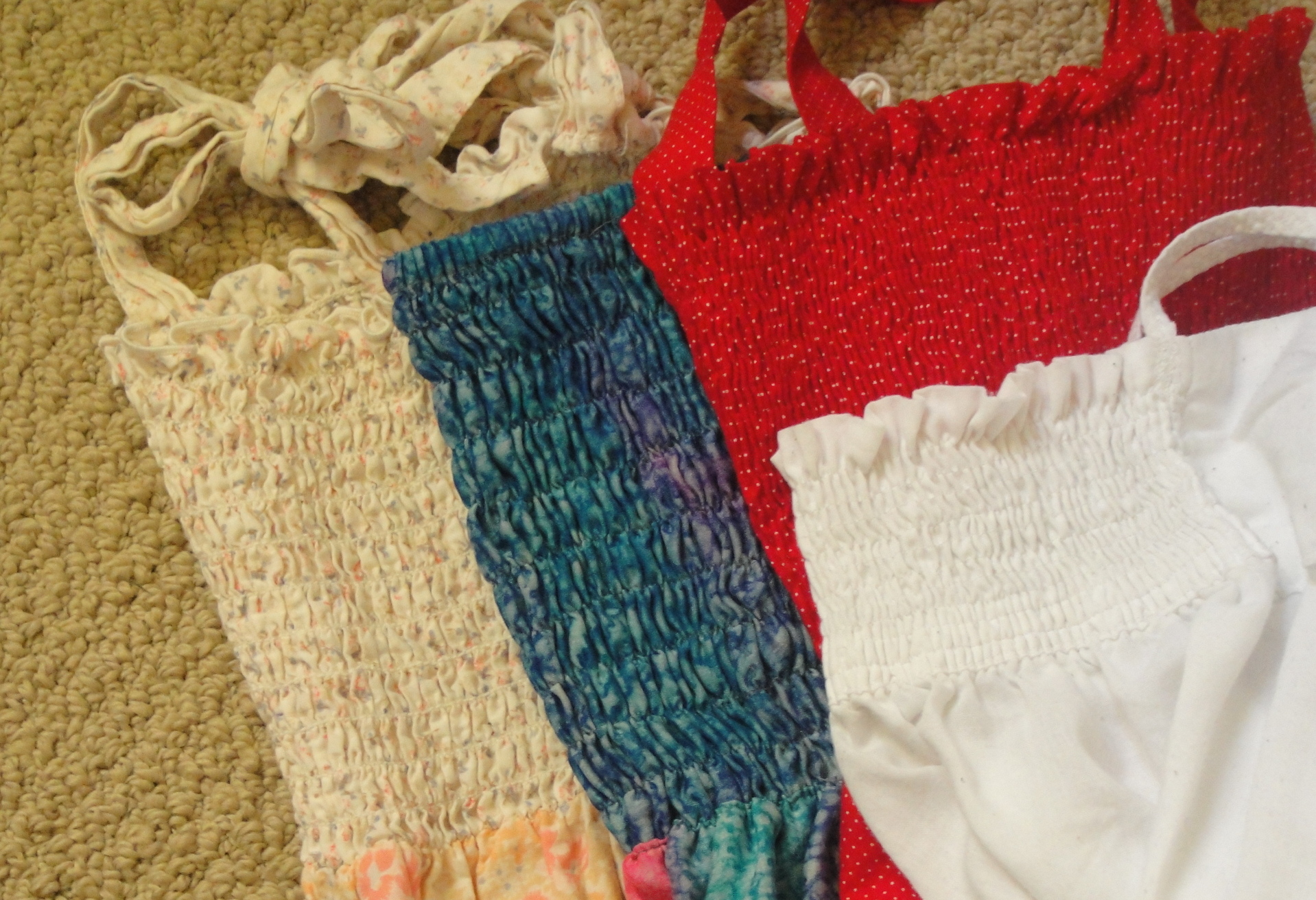
Shirring—mainstream, independently manufactured, and home-stitched. The exteriors look similar, although my home-stitched versions have closer lines of stitching (two on the right). The mass-produced garment (left) uses a different stitch, which resembles a chain on the inside.

How, then, do we deal with the fact that, in this day and age, the things we sew will always be seen, to some extent, as attempts to imitate something else—storebought, mass-produced, clothing?

The modern home garment sewing crew (or at least the blogging portion of it, which is really all I can speak for) tackles this problem in two main ways, I think. The first method is technical: striving to emulate storebought clothing more closely, by using “industrial” construction techniques, and by mimicking, to the best of our ability, the stitches and fabrics (and styles) used by the industry, and by investing in sergers and even coverstitch machines, that can achieve some of the specialized techniques of the manufacturer. The other is psychological—recognizing the reasons for the differences between the clothes we make and the ones we buy, assessing their importance (do you really care if your seam is serged once your clothes are on?), and trying to accept, to varying degrees, that different doesn’t always mean worse (Do my jeans have to have that particular wash to be “real” jeans?). The Me-Made-Month challenges are a prime example of of this approach, and it’s probably the biggest single contribution of the sewing blog community (aside from the whole, y’know, community thing.)—helping us think about our home-made clothes, not just as imitations of something from a store, but as a genre in their own right.

And again, different is not the same as wrong—both of these approaches are great, when used appropriately. Like, by all means serge your T-shirt if you have a serger. It’s fast and tidy, which is why the manufacturers do it, too. But don’t necessarily let the lack of a serger keep you from ever attempting a tee. Accept the little quirks and booboos of your home-stitched garments—but don’t stop striving to improve on your next make. Use excellence as your standard—but don’t accept “storebought” as the standard of excellence without thought.

One weakness of the “imitation” approach is that it can limit our creativity. I’ll cite an example from one of my favourite things to make—jeans. One of the standard features of traditional jeans is a flat-felled inseam. Now, a flat-felled inseam is certainly not beyond a home stitcher for any technological reason—anything but—but a pure “imitation” mentality limits us to using only that technique—when, if you start looking at storebought “jeans”, you’ll find that while it’s common, it’s by no means universal. Designers of manufactured jeans have no need to legitimize themselves by sticking to traditional, “proper” features—but if we take a strict “imitation” mindset as home-stitchers, on the other hand, we will limit ourselves to only doing things the traditional way. We will lose one of the greatest strengths of home sewing—our ability to be creative and individual.

“Acceptance” has its weaknesses, too, of course. I can accept my wonky hems, my unfinished seams, and my not-quite-right tees all I want, and wear them proudly—but if I use this as an excuse for lazy work, well, that’s just being sloppy, and it will show and contribute to the impression others have of home-sewing as second-class sewing. Not to mention I won’t get any better at what I’m trying to do.

Where we draw these lines will vary between stitchers (some of us are all about being on-trend and having our stuff be indistinguishable from what could be bought at a store; others are all about creating a vintage or couture look that celebrates the hand-made) and over time for individual stitchers, and I don’t think there’s any right or wrong answers. Except, maybe, the answer that would be blindly accepting mass-produced clothing as the only legitimate form. But I doubt anyone who thinks that is reading a sewing blog ;).

I’m really curious to hear where you all are—where you draw these lines, and what’s most important to you. How do you legitimize your sewing, to yourself and to others? Or do you even try?

*
84 Comments

Filed under Sewing

Carol Evans’ Wardrobe

20120831-081245.jpg

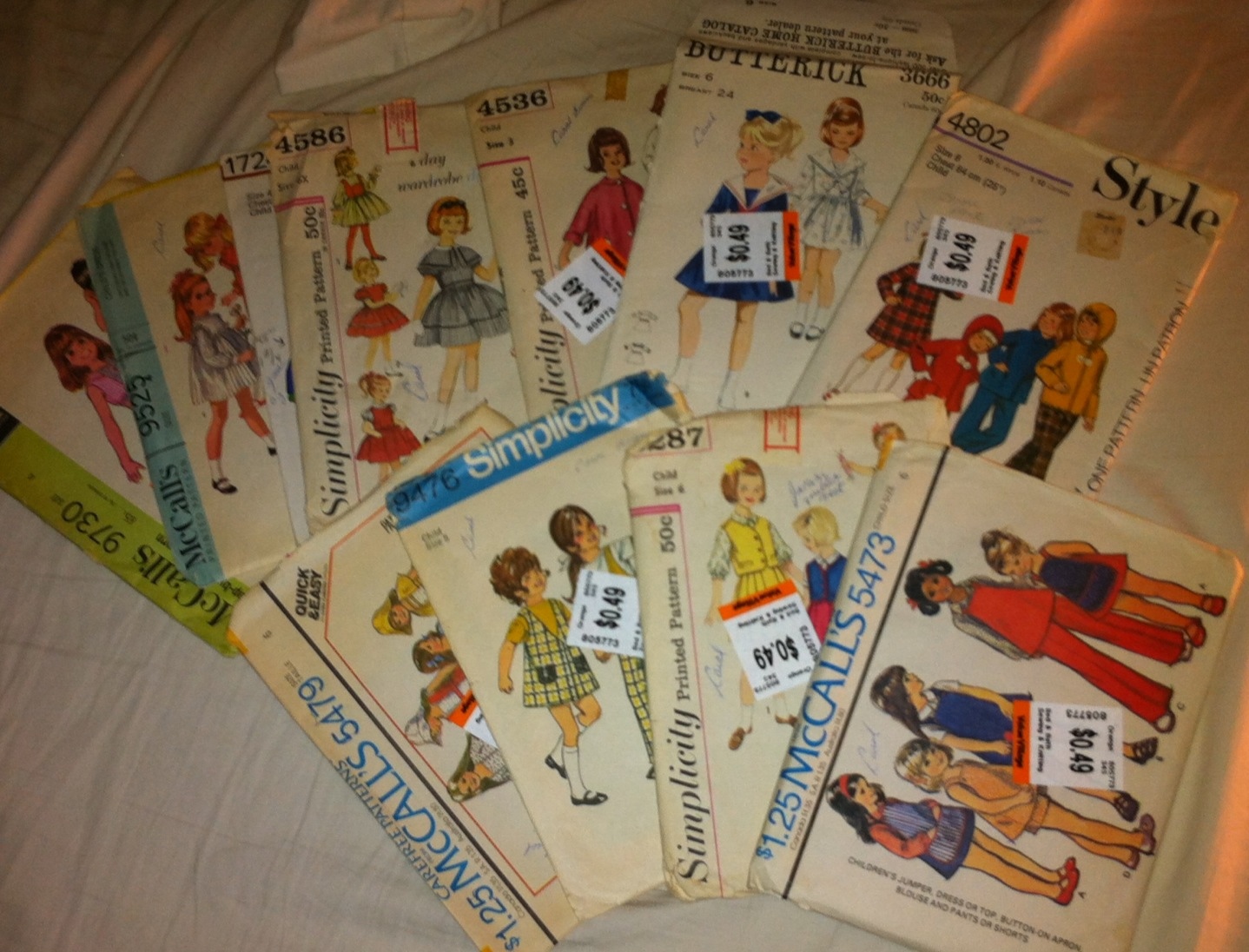
Moving stress + running errands our last day in Cow Town + 50% off sale at Value Village facilitated a bit of a splurge on vintage children’s patterns, I fear. How can you resist a bit of retail therapy for a quarter apiece?

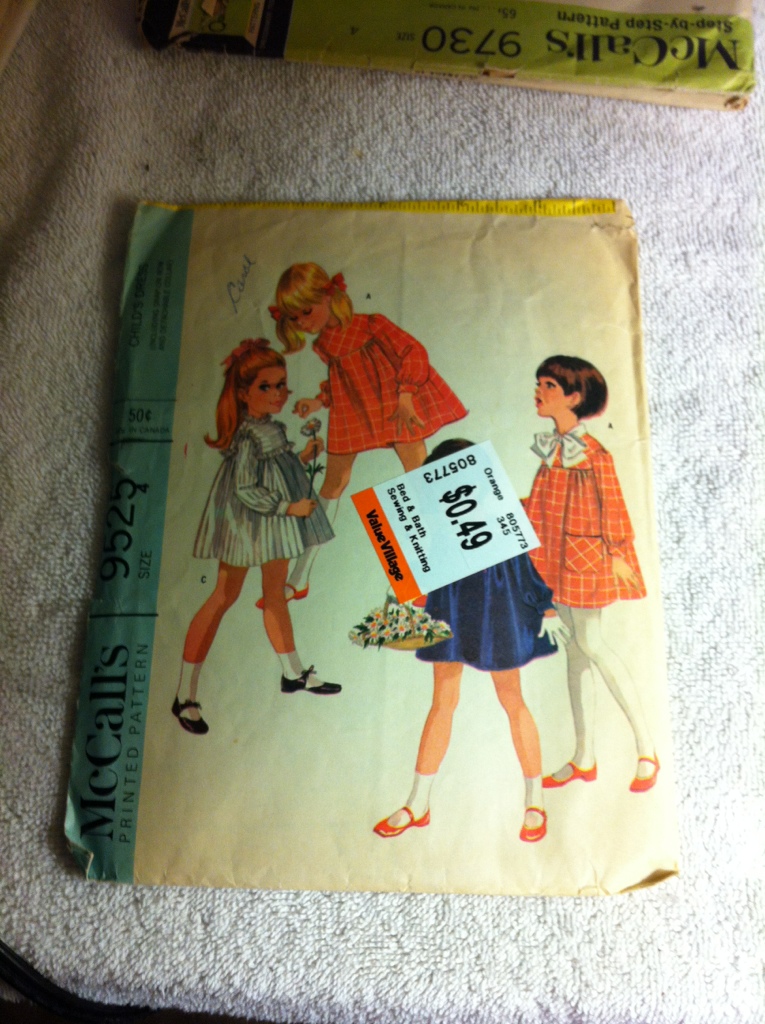
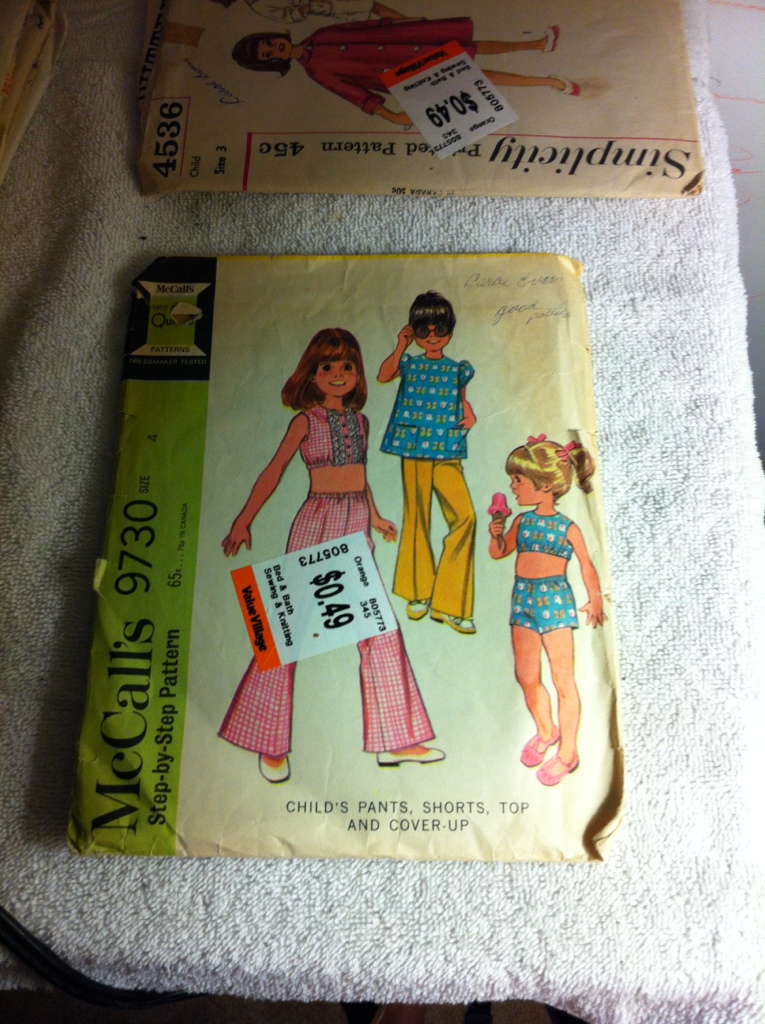
The patterns range in size from 4 to 6X, and all seem to have been intended for wear by a girl named Carol Evans, who I presume was a vampire trapped eternally in a child’s body, since the patterns range in vintage from 50s through 70s. Or they might have been collected more recently by a mom-stitcher with a thing for vintage patterns, not unlike myself. But really, I think it’s the vampire thing.

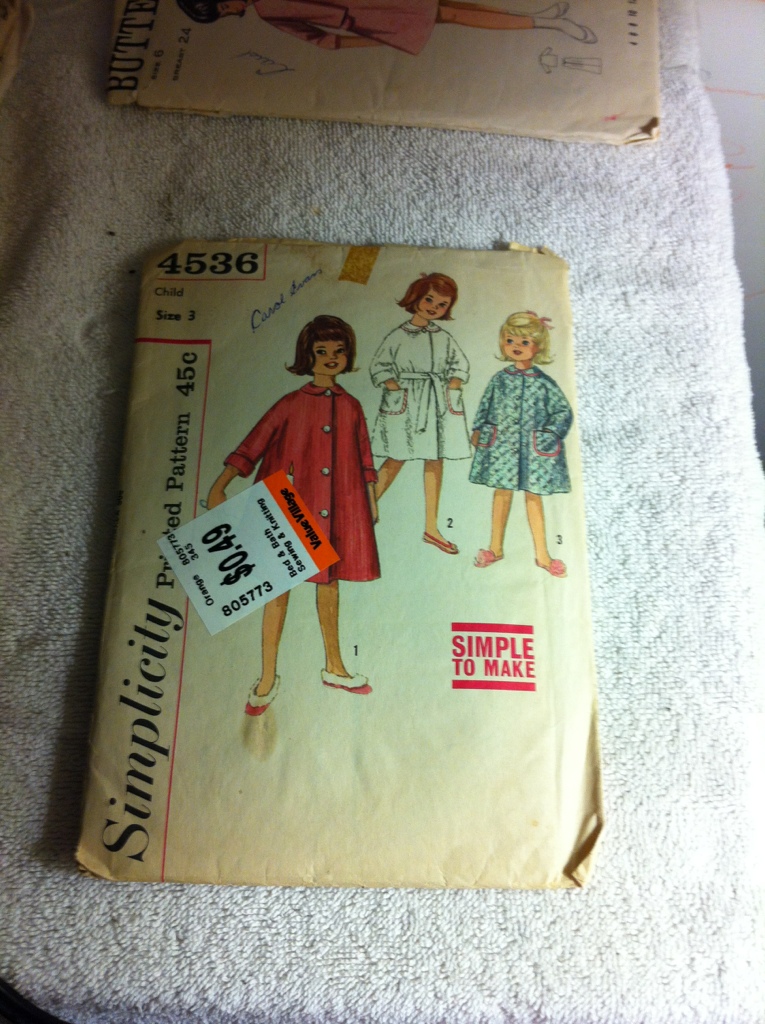
20120831-081445.jpg

This fifties housecoat just may be the child’s version of this pattern, which Peter and Cathy rehabilitated so stunningly into an “Opera Coat.” I’m going to assume that our little vampire was at least as capable of turning something so drab and basic into something luxe and glamorous as Cathy is.

20120831-081331.jpg

This might just be the quintessential fifties little girl dress. According to this website, it’s from 1954, as is the preceding housecoat. Also, I love the little capelet. Every vampire (child) needs a capelet. Not to mention plenty of variations on a dress, for when she gets blood on it. Also, those of you who did time in Vampire: The Masquerade, dig the black satin version with the rose.

20120831-081430.jpg

Something about the white version of this sweet little sailor dress just makes me squee. Presumably this had a similar effect on Carol Evans. Or possibly she ran away to sea to hide her lack of aging. You have to keep moving when you’re a vampire child.

20120831-081344.jpg

Doesn’t this one looked sophisticated? I want to say very Jackie O, but I wasn’t around back then to observe and haven’t really researched, so you can correct me if necessary. Or maybe it’s Chanel. Doesn’t that little jacket need to be made of boucle, with a quilted lining and chain in the hem? Poor Carol has been size six for at least a decade, after all—she has to be feeling more grown-up inside than out. This is just the dress for when she wants to look like a miniature (and very chic) adult

20120831-081403.jpg

20120831-081412.jpg

These two McCall’s patterns fascinate me, not so much for their contents as their style. I had instantly pegged the dress as sixties (based on the illustration style, the dress itself is such a classic I think with minor hem-length variations it would look at home in any decade since 1900. Possibly 1850.) The pants wardrobe, on the other hand, I had pegged as classic 70s. The fashions, the art, the bell-bottoms, the gingham. Then I checked the dates on both patterns. The 60s one is indeed earlier—1968. But the “70s” pattern is 1969. I kind of feel like I’ve captured the cusp of a decade in pattern form—a snapshot of the transition from one style regime to another. Especially since both are by the same company. As for Carol, well, they both obviously cater to her need to appear childlike and innocent to manipulate the adult humans around her. Can’t have anyone suspecting, after all.

The patterns go on (It appears later in the 70s Carol headed somewhere chilly and needed some serious winter gear) but I think I’ll leave it at that. Speculation on the life of Carol the vampire child welcome in the comments! 😉

16 Comments

Filed under Sewing

Moving Home

I imagine all of you who’ve been reading this week have realized we’re in the throes of moving.

In particular, we are Moving Home. After five years in the Big City (or the Western Canadian equivalent, anyway, which my American co-workers assure me isn’t anything like actually big), we’re moving back to our hometown, which thinks it’s a big city only because there’s no comparison within easy driving distance.

As with any such move, I’m a little torn. Part of me is excited to be back around the friends and family I’ve missed so much. Part of me feels like we’re admitting failure, running back to the small and familiar. Part of me is sad because I know it won’t be the same, regardless.

But on the sewing front, despite the intense tragedy of losing my in-home sewing room (current plan is to set up at my mother-in-law’s house, a few blocks away), I’m actually pretty excited. About (I know!) sewing for other people.

Aside from my the assortment of nieces, I am excited about sewing for my sisters-in-law and my mother.

My stylish sister-in-law is close to my size, but she’s a classic pear shape, very different from mine. We’ve been stealing each others’ clothes since we were teenagers (yes, I was still a teenager when I met her…) , with varying degrees of success. And she’s kept my children for a full month every summer for the last five years, with little or no recompense, so a bit of sewing is the least of what I owe her. Also, I’m pretty sure her figure is more-or-less what Tyo is going to end up with in a few years, so hopefully I can get ahead of the curve there. 😉

My crafty sister-in-law is a little bigger than us, and curvy, with a classic hourglass shape. She’s the only person I’ve ever measured who actually has bust, waist, and hips in the same size by the pattern envelopes, although probably she needs a smaller size in the shoulders. She’s also one of those people who never wants to spend the time and money on herself to look as good as she could—she wears oversize clothes, whatever she can pick up cheap. I’d like to help her feel as beautiful as she actually is, although how receptive she’ll be remains to be seen.

And then there’s my mother. The woman who taught me to sew. The woman who sewed the Grad Dress. The woman I learned style from, even if my style has never been on the same planet as hers. And one of the biggest crimps in my mom’s style over the years has been fit—she has the same short waist, long limbs, and square shoulders that I have,  plus a full bust—so I’m excited to get her at least a few items that actually fit, both her body and her style.

Then there’s my (almost) fifteen-year-old niece (daughter of Crafty, for those attempting to keep track). Not sure if I want to sew for her or not. I mean, I’d love to if she wanted to. (I’d love even more if we could sew together and it could be that rarest of things, adult-teenage bonding time) But it would have to be very niece-led. I have zero interest in creating something for a teenager they’re not going to wear.  And of course there’s my little nieces, who are enjoying their new dresses.

Don’t worry—I promise I’ll extract blog-modeling promises before embarking on any of this non-selfish sewing.


But first I need to get that sewing room set up!

26 Comments

Filed under Sewing

On the road.

20120828-171217.jpg

21 Comments

August 28, 2012 · 5:12 pm

The New Dressmaker: Altering Yoke and Drawers

I confess, I haven’t really had time to read this chapter over. I wasn’t even aware that drawers required fitting other than the most basic does-this-go-around-me kind. Do they cover trouser fit for men and boys? Does yoke mean the yoke of a skirt, or any kind of yoke or something completely different? You’ll have to read to find out!

1 Comment

Filed under Sewing

Prezzies! (4)

20120827-070617.jpg

Thank you, Meadowsweet Child! I can’t wait to try some of these out. Except that everything I own is in a box right now, so I have to wait. Also, packing vintage sewing machines with the old cases totally beats packing modern, caseless machines, but moving them is still the pits. 🙂

1 Comment

August 27, 2012 · 7:10 am