Tag Archives: too much talk

Enablers Everywhere

Everywhere, I tell you. No sooner had I walked in to my mom’s this past weekend for our near-weekly dinner, then what did I espy, but a cream-and-teal, alligator-texture, sewing machine case. Oh, Mother.

What’s inside?

Well, it turns out the culprit this time is less my mother than my mother’s boyfriend. This does not actually make it any better, but the machine is going to continue to live at their house. With my Improved Seamstress treadle and the Army Machine and my mom’s Pfaff 360 and Featherweight. Which is not as pretty as my Featherweight, but has all its attachments. Yes, that’s five machines (only one of which isn’t a straight stitch), in the house of two people who “don’t sew.”

Piedmont

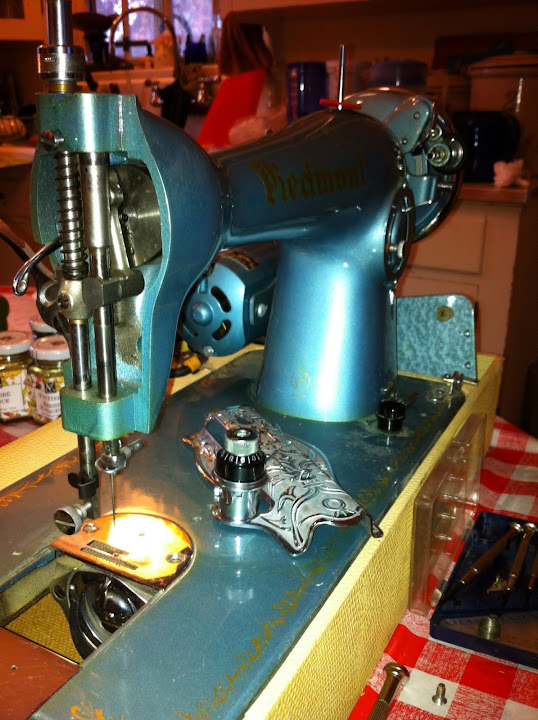
When I opened the case, my eyes were greeted by this gorgeous teal “Piedmont” machine. So pretty, very clean, in lovely condition. Apparently it has been languishing at my mom’s boyfriend’s favourite pawnshop for some time now, and finally he couldn’t bear to leave it there any longer. Thank you, MBF. Except. No attachments. Boo. I like attachments. (Also, I realized when I wanted to hem something last weekend, all the hemmer attachments that are wider than a rolled hem are at my mom’s. That’s like, three different sets. All there. None at my MIL’s or Stylish’s house. Which are the ones close at hand.)

Wiring. Eek.

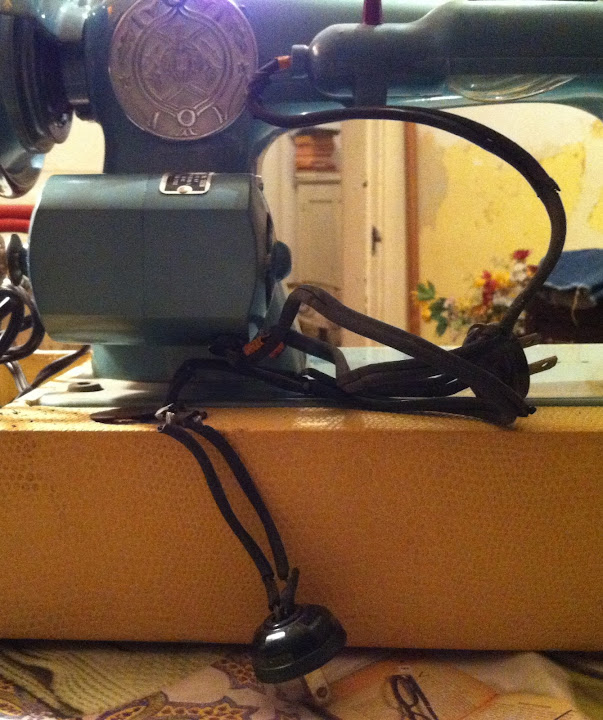
And, even worse than the lack of attachments, the belt is missing and the wiring needs some serious work. The belt is not hard to replace (Sew Classic, for example) but I’m a bit freaked about the wiring. The wiring to the wall and the pedal actually appears to have been replaced previously—it’s much newer, undamaged, and the plug types are more modern-looking. But the wiring running from the weird plug-thing in the case to both the motor and the light is totally shot. Beyond scary. On the up-side, my mom has re-wired stuff before, and my father-in-law knows his way around a motor, probably blindfolded, and has promised me he has my back.

Cleaning. Not that it needed much.

The machine is marked “Piedmont”, which internet scuttlebutt suggests was a badge of the Hudson’s Bay Company (another Great Canadian Department Store) for generic Japanese-made machines of the post-war period. (“Badge” is old-sewing-machine-collectorese for a brand name put on a machine for sale by a particular vendor. Like “Improved Seamstress” was the badge Eaton’s Department Store put on machines manufactured by the National Sewing Machine Company. OK, maybe that’s self evident, but it took me a bit to work it out.) It does look to be a clone of a Singer 15 something, though, not that I know anything about Singers.

I’m reasonably comfortable asserting that it was manufactured somewhere between 1945 and 1960 (the 60s machines start looking modern. Less firmly, I’m thinking probably towards the later part of the fifties, since the colour and plastic knob for the feed drop are a bit “newer” but the style of the overall machine is still very old school. The serial # is C788793, although the consensus on the Yahoo Japanese sewing machine group and other places about these machines seems to be: “You’ll never find out who exactly made it, it’s somewhere in Japan and sometime after WWII. And NO, it wasn’t made by Singer.” There was a helpful generic manual, though, that should do the trick.

Bobbin case

Aside from the wiring (as if that’s not the hugest aside in the world), it’s in lovely shape. The decals are pretty much unworn, there’s scarcely a scratch in the finish. It moved very, very stiffly when I first touched it, but after oiling every spot I could think of, plus a couple of hours to sit while we ate dinner, it was moving nice and freely. It had one bobbin in the bobbin case and two more in the bottom, but on inspection the one in the case itself was not quite the right size. I wound one of the other ones on my mom’s Pfaff (also not the right size, but it worked for bobbin-winding, anyway) and by dint of laborious hand-wheeling got a perfectly lovely, balanced stitch. The only thing I wasn’t able to do (aside from wriggle my nose to make the wiring magically repair itself) was to get the needle plate off; one of the screws came out perfectly, but the other is stuck. I gooped a lot of oil on it and will try again next time. I brushed as much lint off from underneath as I could, and it doesn’t seem to have any problems moving, but I’d still like to be able to clean out under there.  And the stitch-length lever has this little adjuster knob beside it that sets the maximum length you can move the lever to in either direction.

Which is to say, all in all it’s an adorable little machine, assuming the whole wiring thing can be remedied. Because, y’know, I needed another straight stitch vintage sewing machine.

But, I mean, c’mon. TEAL.

22 Comments

Filed under Sewing

Sphinxology

20121103-102135.jpg

I was going to come up with some clever riddle about sewing machines, but then I decided I’d rather just get this post out.

This is the treadle machine belonging to my husband’s family. As with a lot of heirlooms, it’s a bit tricky to say who it actually belongs to, but it currently resides with my Stylish sister-in-law, serving as a table for her Janome, which I’m happy to report is sewing just fine the vast majority of the time.

20121103-101935.jpg

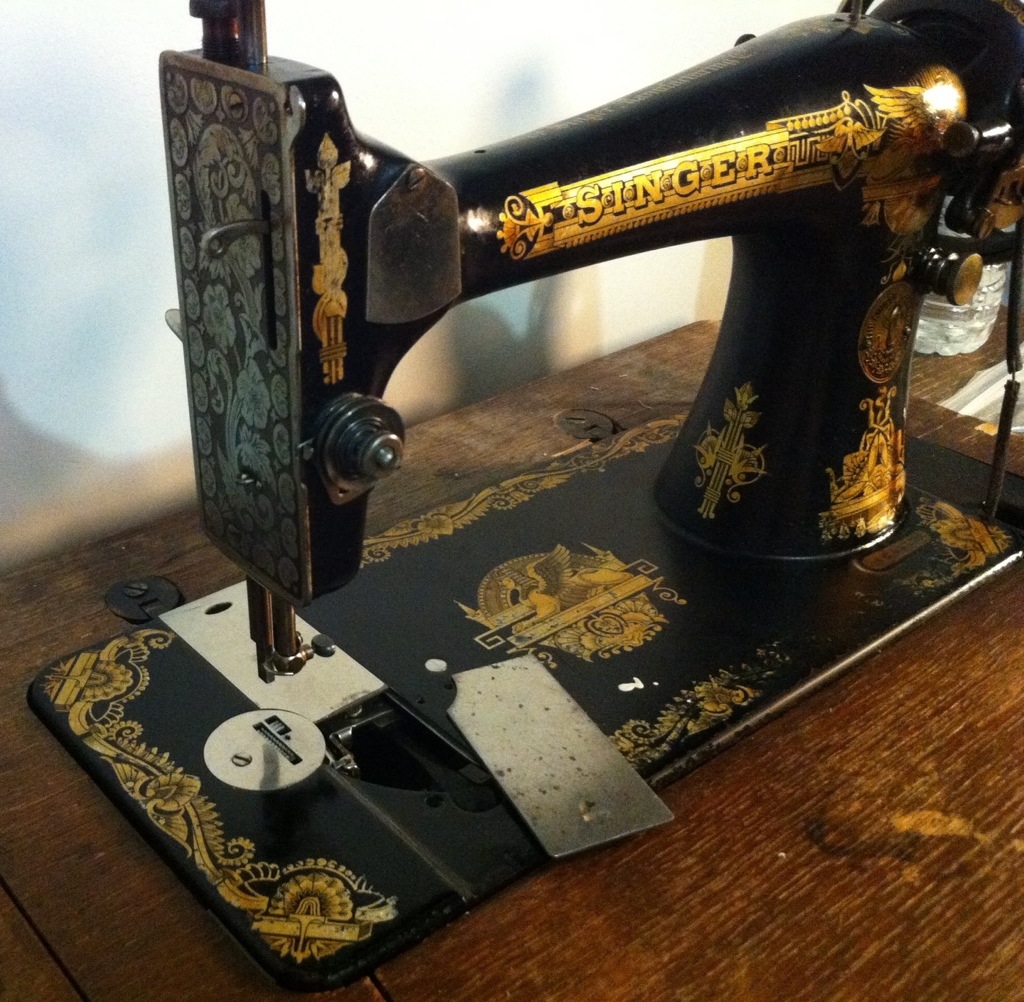
The machine is a Singer, I think a 127, with handsome if slightly worn Sphinx decals. It
was last used by Papa, Stylish and my husband’s great-grandfather, who, I am told, used it to stitch harness and tarps and other manly things. Before that, Nana (my husband’s grandmother) says it belonged to her mother, Papa’s wife, although I don’t get the impression she was a serious seamstress (Papa outlived her by a good forty years, hence the horizontal transfer of “ownership”). Nana seems to think it was likely a wedding present, as its manufacture date, 1924, is pretty close to the time of Papa and Kokum’s marriage. (For those hoping to date your own Singer machine, you can look up the serial number either on the Singer website or the ISMACS one.

The machine lives in a rather plain but sturdy six (seven?) drawer cabinet. The cabinet is a bit beaten up, with veneer lifting on the top and the odd splash of pain over the surface. While the drawers contained many treasures, including plenty of thread, vintage zippers, and what I think is the never-used rolled-hem plate to my serger, it did not contain any accessories or feet for the Singer.

20121103-102105.jpg

The single most obvious problem, when I first opened up the machine, was that it was missing a presser foot. It’s amazing how sad and deformed it seems, just lacking that one little detail. However, my sadness was swiftly relieved when I realized it took just a basic low-shank foot—much easier to find than a replacement for one of those top-clamping types.

20121103-102120.jpg

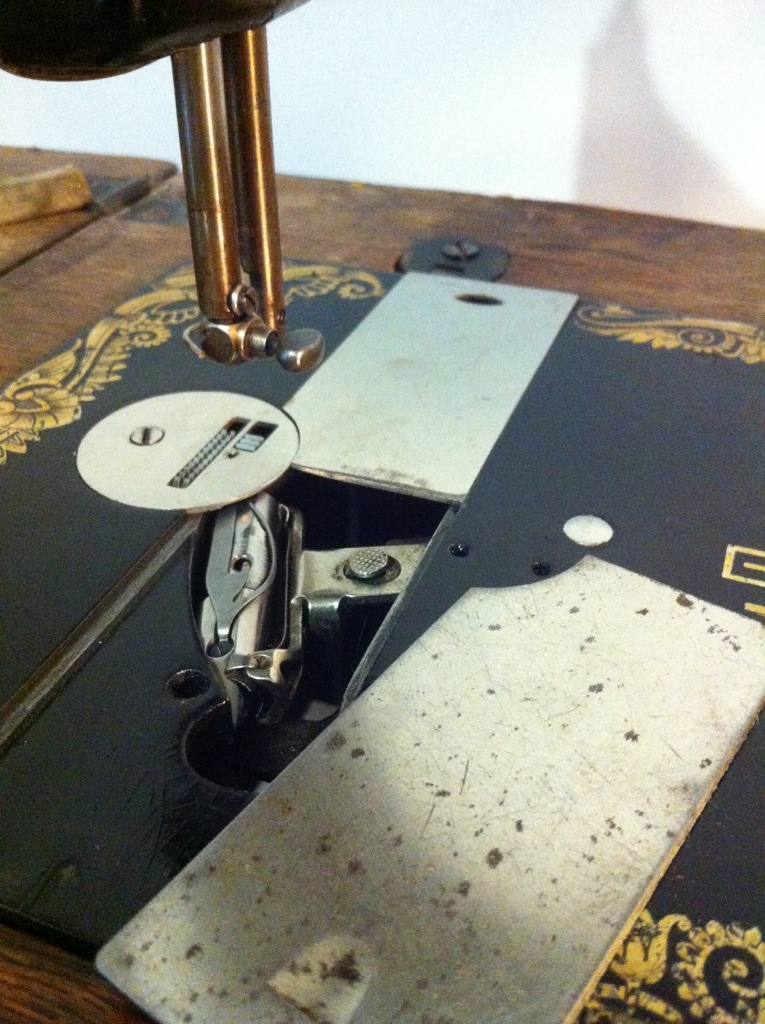
On first opening, the machine moved (YAY! I don’t think I quite have the chops to tackle a truly seized machine.), but various bits (like the slide cover plates that hide the shuttle and the stitch-length screw) were seized. Although the running was pretty rough at the beginning, once I had dribbled oil in all the oil holes and on everything else I could see that moved, top and bottom, it was running just fine, except that I still couldn’t get the slide plates open to get at the shuttle. It was at this point that my principles went out the window and I grabbed the WD-40. Internet Opinions are split on the evils of WD-40 for restoring old sewing machines, but the most measured ones I found seemed to be that it’s OK for a solvent as long as you remember it’s not a good long-term lubricant. So I’ve mostly tried to wipe it off once I got the bit working, and added sewing machine oil. Perfect? Probably not, but also not the first time I’ve angered the Sewing Gods (it seems to me that the Great Elder Treadling Gods may be more wrathful than the Younger Electric Sewing Gods, but I’m just going to hope that lack of worship for the last few decades has diminished their power to smite me.)

20121103-101921.jpg

Anyway, injudicious application of WD-40 and judicious application of a mallet and wood dowel (AKA unsharpened pencil crayon) eventually got all the bits off that should come off (needle plate and the front and back slide plates). Unfortunately, the slide plates are really, really tight even after being wiped down; I tried to scrape along the grooves they fit into and clean out any gunk, and I oiled them, and I’m still afraid to put the front slide plate back in lest I end up unable to get it out without pulling out the hammer again. While things like the needle plate and the front plate on the left of the machine only really need to come off for cleaning (and there was really not that much crud behind either), the slide plates are how you get at the shuttle, which holds the bobbin, so really needs to be readily accessible. I’m not sure what to do about that—there’s no rust and doesn’t seem to be much gunk. For those of you as new to treadles as I am, this machine (like my Eaton’s Seamstress, actually) has what’s called a vibrating shuttle. Rather than a short, fat bobbin and casing that goes around like a wheel (OK, I know that’s a simplification), this is a long, thin bobbin and casing that goes back and forth. I’m assuming the rotary version is an improvement, although these vibrating shuttle models were still being made as late as the 50s.

Anyway, after waiting three days to get at the shuttle, of course, I discovered that there was no bobbin within the shuttle at all. Curses! Now, this was not as simple as swapping in a foot from one of my other machines.

Fortunately, a quick nose around Sew Classic revealed a stock of new VS bobbins for Singer models including 127. Woot woot! This is the upside of old Singer machines—you can actually find the bits for them. So, as we speak, this order is hopefully winging its way towards us… and then I get to find out if I can actually make it sew or not. I’ve been watching youtube videos on treadling and how to wind vibrating shuttle bobbins… so here’s hoping. 🙂

21 Comments

Filed under Sewing

Maximal procrastination

The Blazer of Awesome

I am (as my husband will assure you), one of the world’s champion procrastinators. It’s a major handicap, actually. But this jacket fix represents a level of procrastination rarely met even by me.

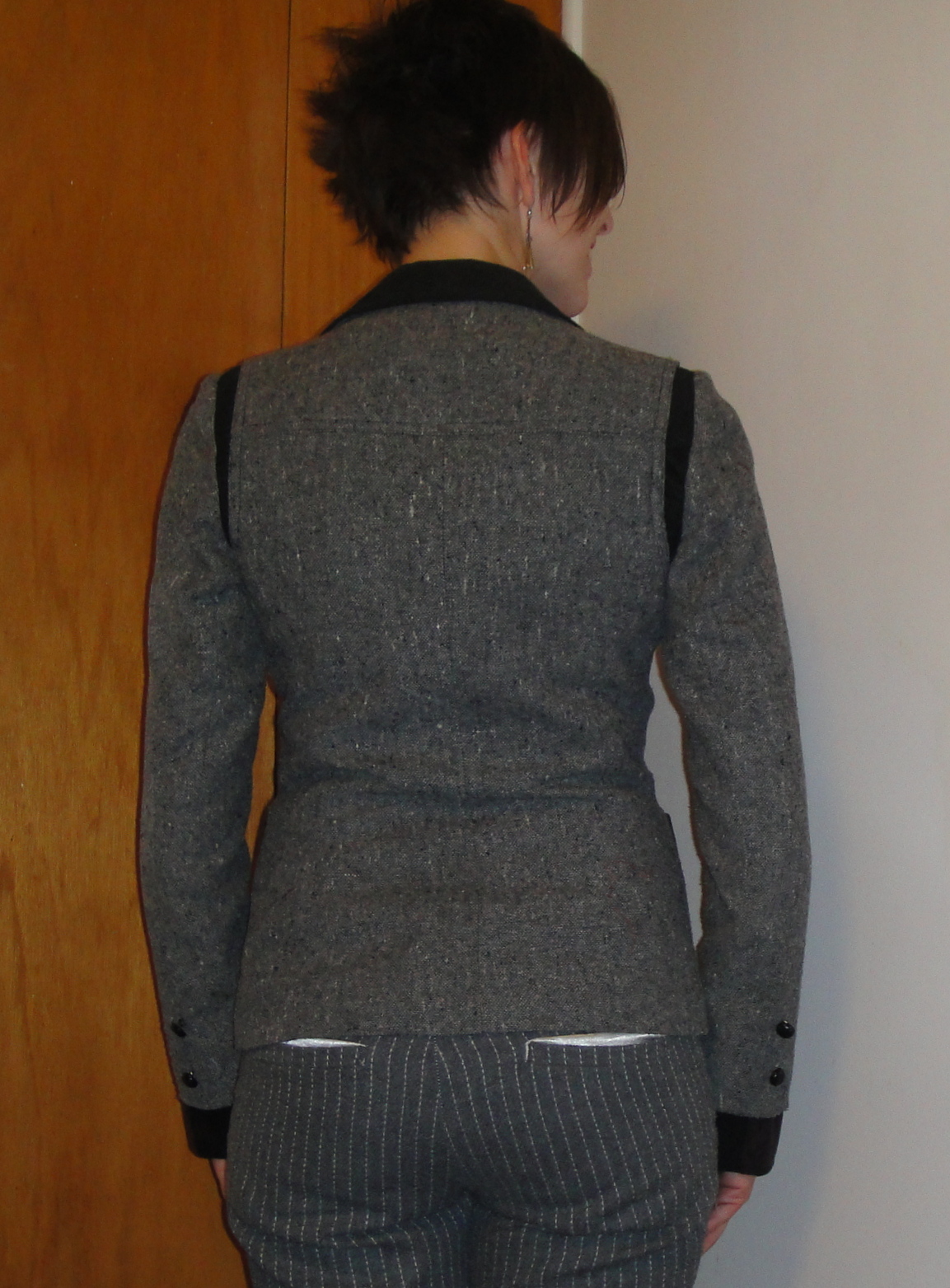
I got this little grey blazer in high school, ladies and gents, which was kind of a while back not that long ago after all, from my old standby Value Village. The fit was, and is, astounding—perfect shoulders, perfect waist length (no swayback issues!)… Great.

Except. The more I wore it, the more creepingly aware I became of the one, glaring, unforgivable flaw.

You guessed it. The sleeves are too short. (I need some kind of “ba-dum-dum” sound effect every time I say that. 😛 Or maybe a laugh-track.)

Back—OK, maybe not quite as perfect as I thought (or it used to be 😉 ). Still pretty damn good.

Not too long after graduation, the frequency of its appearance in my regular wardrobe rotation dropped dramatically. I am really not fond of the cold wrists >_<. But still I couldn’t give up on it entirely. Everything else was too perfect. So it hung in the back of the closet, making me sigh with occasional wistfulness.

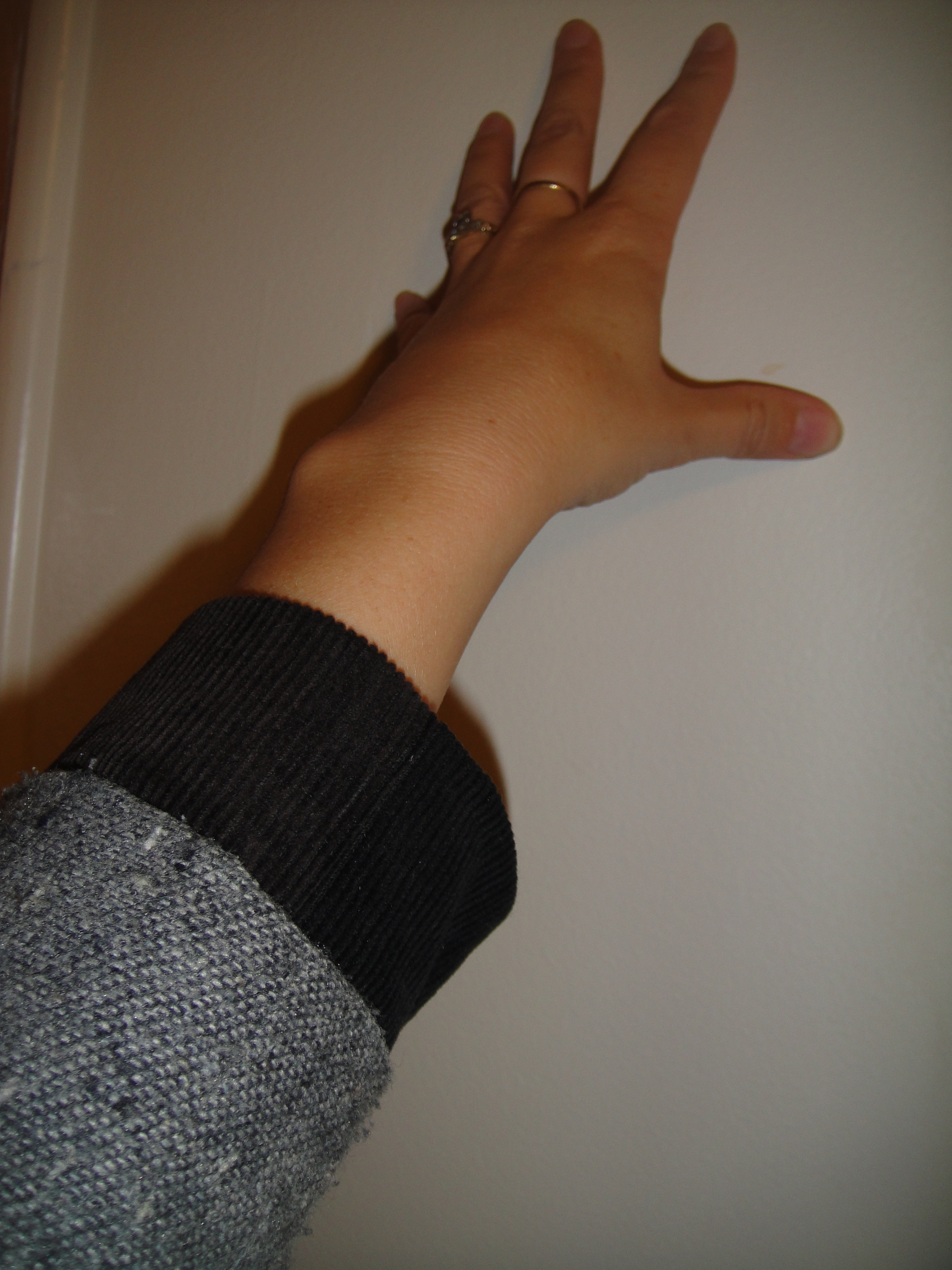
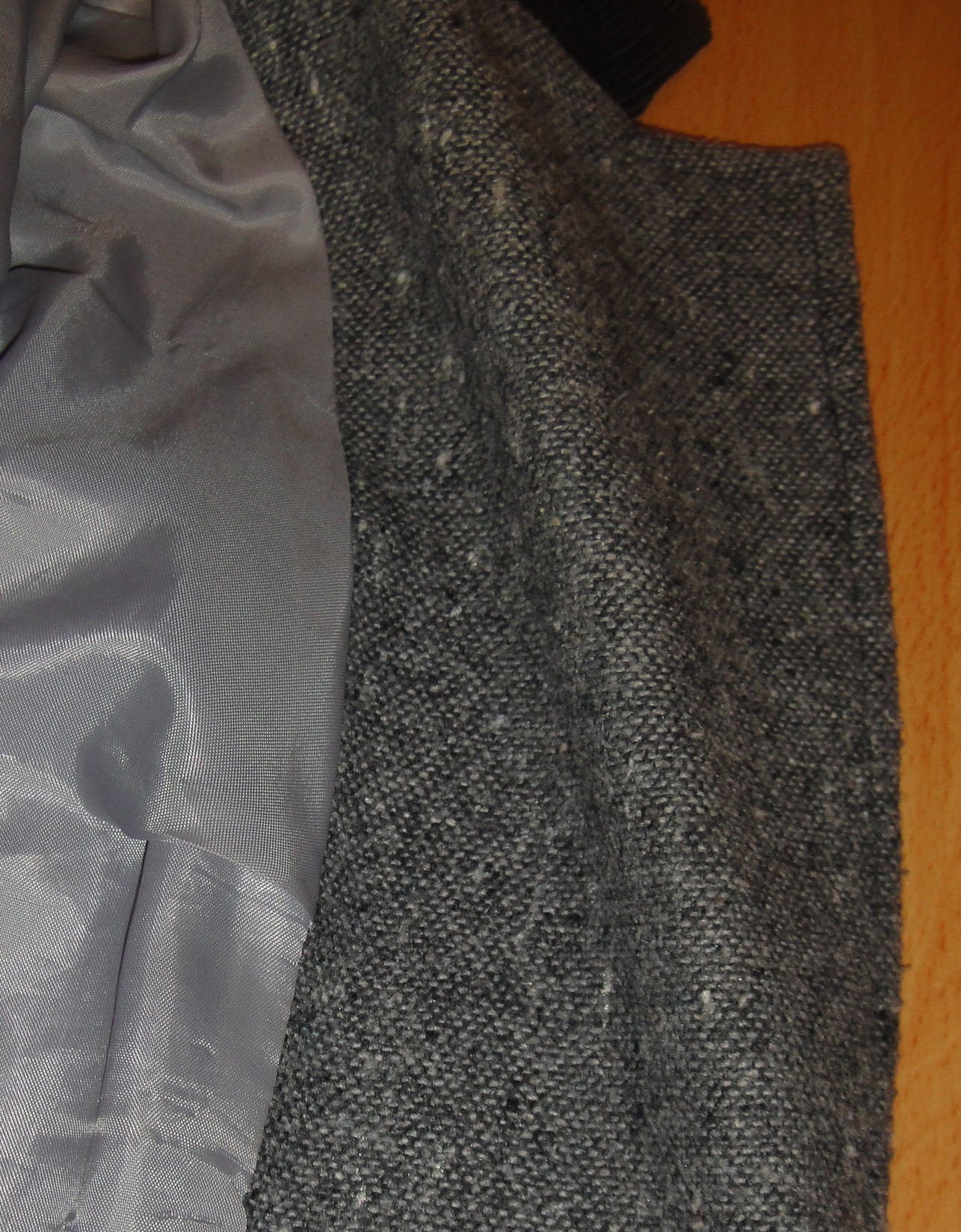
About four years ago, I found a black corduroy curtain abandoned in the lobby of our apartment complex (these occasional windfalls are the only thing I miss about apartment living. Well, that and the endless hot water.) I bundled it home, and soon realized that the wale width and texture was a perfect match for the details on my poor jacket. And since the jacket had plenty of other black cord details, why not cuffs as well?

Nonetheless, four years passed. The corduroy curtain served many purposes, most of them involving taking up space in my closets, but never became part of a blazer.

Cuff closeup. Photographing black corduroy is rather akin to photographing dark matter, I’m thinking.

Well, finally today the prospect of a quasi-job-interview prodded me to haul out something approaching office attire—the businesswoman suit. By some miracle (probably as a way of displacing some intense anxiety), I motivated myself to find the curtain, locate the portion where the fading of the blacks matched best, and cut out two plain cord rectangles. I interfaced them with Armoweft, stitched into tubes and folded them in half, and tacked the resulting tubes inside the ends of the sleeves. Voila, stupid simple cuffs. Total time, probably about 30 minutes, plus time to dig out the fabric from the garage.

Because I enjoy a bit of a tailoring dissection, here’s some closeups on the jacket itself. Fortunately, the lining is loose, not bagged, so I could flip it up and gawk at the insides.

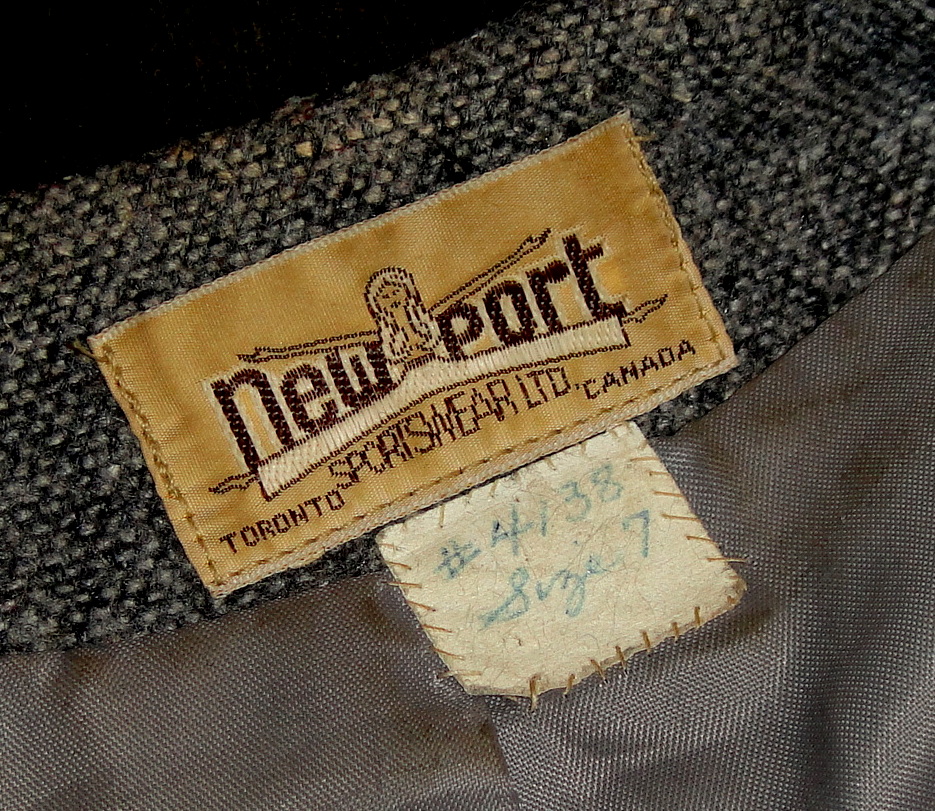
Label

The label is “Newport Sportswear Ltd” from Toronto, Canada. The jacket is #4138, and a size 7, according to the hand-written label. Google did not give me much (any) info about this brand, aside from some Etsy listings for vintage clothes. I had never really thought about the vintage of this jacket, but it’s certainly not a typical fit for the 80s or the 90s (remembering I got it in the latter part of the 90s). The rather flexible lady certainly has the hair to be 70s.

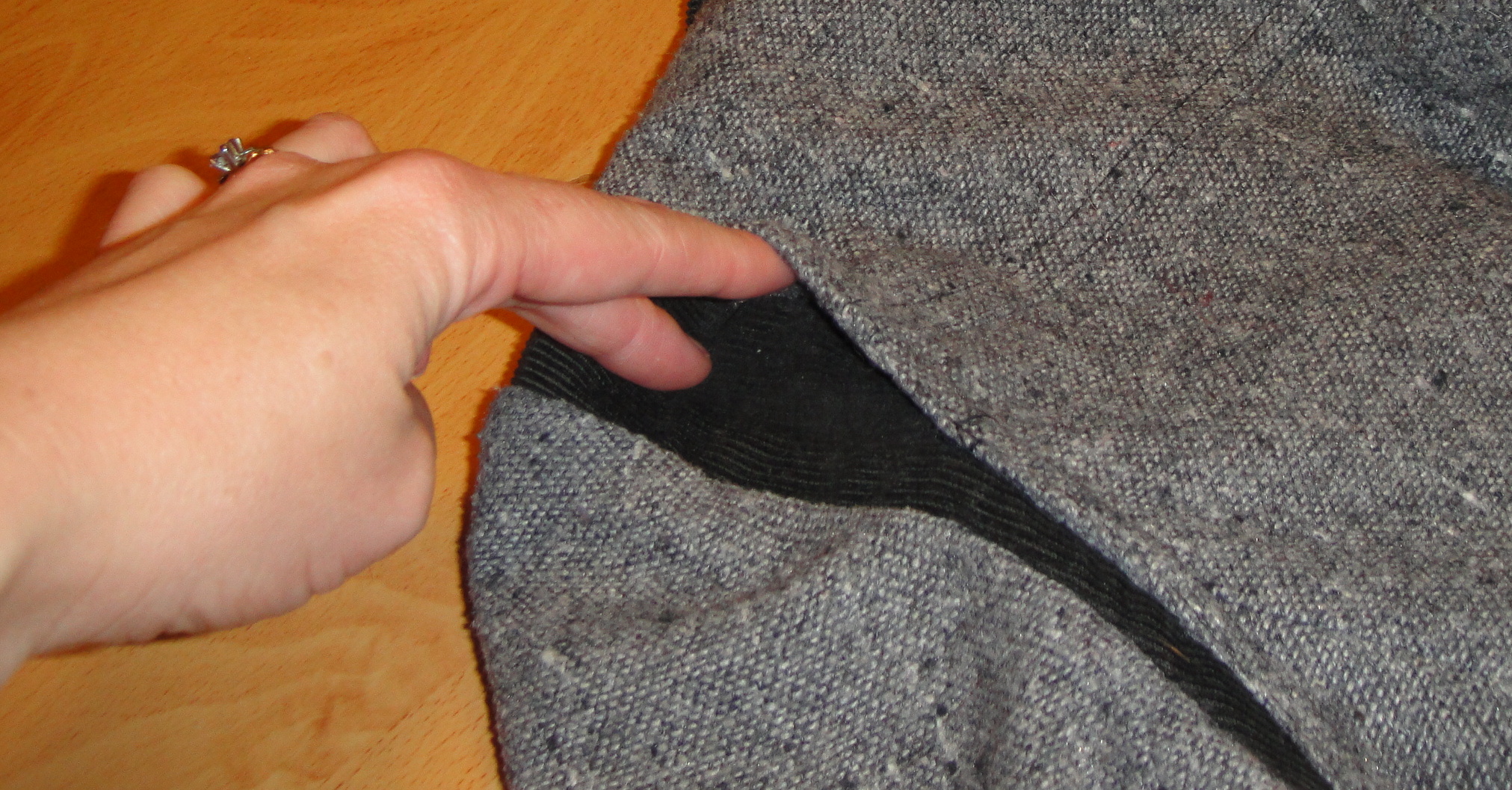
Corduroy insert, with fold

My favourite feature by far is this little corduroy insert on the back shoulder, which greatly increases the range of motion, otherwise the blazer would be way tight. According to Allison of A Fabric Fixation, this kind of feature is called a bi-swing back. (My motorcycle jacket has one as well, which makes sense.)

Bi-swing inset, interior view

This is what it looks like from the inside—it forms a little folded pocket or pleat. The shape is a bit more complex than it looks on the surface!

Lapel fold and pleat in lining at bust. (Sherry had us ease this in.)

Other little details? Well, the “tailoring” and construction is virtually identical to what Sherry went over in her RTW sewalong, which is to say it’s distinctly tailored but not heavily or intricately so. If this IS a 70s jacket, it’s also a testament to the powers of early fusibles, because everything’s still perfectly in its place.

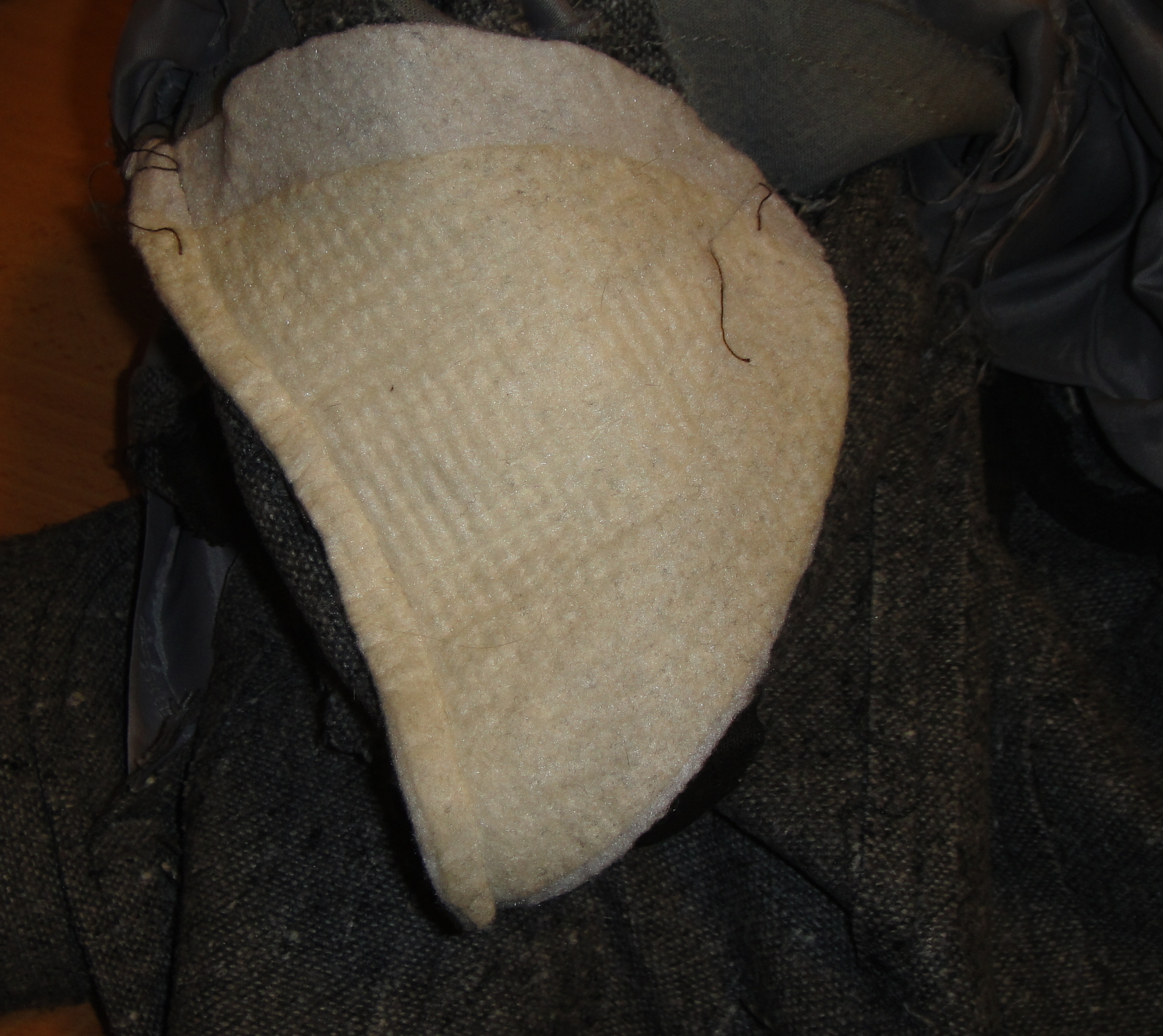
Shoulder pad

The shoulder pad is very thin, two layers of felt, but it does the job. I had taken some photos of the buttonholes (machine) and collar interior, but really they didn’t turn out terribly informative, so I’ll spare you them, and just repeat how much I love this jacket.

Especially now that, fourteen or fifteen years into owning it, the sleeves are finally long enough. And it doesn’t even look funny!

(OK, I don’t think it looks funny, so if you do, you can suck it. It’s my blazer, not yours. And I’m going to wear the snot out of it, now.)

18 Comments

Filed under Sewing

My first pattern

20121021-081026.jpg

Butterick 6206

Long and long ago (I’m guessing I was about sixteen), I found this pattern kicking around the house. It was, presumably, my mother’s, and I was (just barely) able to look past the 70s styling to the romance of a sweet peasant blouse.

Being me at sixteen, I turned it into a crop top and made it sheer. Subtle, I was not.

The only thing I didn’t do was lengthen the sleeves. My congenital arm-length abnormality hadn’t really sunk in yet, so it didn’t even occur to me that the pattern drafter wouldn’t magically know that my family has ape arms*.

20121021-081015.jpg

Pattern pieces

I’m pretty sure I had some help from my mother, if only of the “this is a grain line—you know what grain is, right? Yes, that bit goes on the fold” variety. I had been sewing (Barbie clothes) for years at this point, but this was probably my first commercial pattern. I know I did no seam finishing, but it wasn’t a ravelly fabric. Not that that would’ve made a difference.

It was not a terribly practical garment, but it looked pretty much how I had hoped and served whatever costumey goal I had in mind. So when I found the pattern the other day while digging around my mom’s sewing stuff (she has a surprisingly large stash for someone who “doesn’t sew”) I had to throw it up here, for old time’s sake.

In hind-sight, this was actually a pretty damn good choice for a beginner project. Not that I thought of that.


*This is the spot where I stop and point out that humans are apes because you can’t construct a natural group that includes all apes but excludes humans. For the same reason, although much further removed in time, birds are also dinosaurs. Dontcha love cladistics? 😀

20 Comments

Filed under Sewing

A denim debate.

So, I’m pretty much due for a new pair of jeans. It’s been over a year, believe it or not, since I last made myself a pair, and not because I’ve stopped wearing my me-made jeans or anything. But apparently when you have more than two or three pairs in rotation, jeans last a lot longer. Who knew. But there’s some red denim in stash that’s getting louder and louder…

Anyway, as my me-made jeans age and acquire that broken-in appearance that’s so much a part of the jeans look (to the point where we pay hundreds of dollars for a good worn finish), I’ve noticed one subtle, yet nagging difference between my me-mades and storebought jeans.

It’s the ripple.

The Ripple

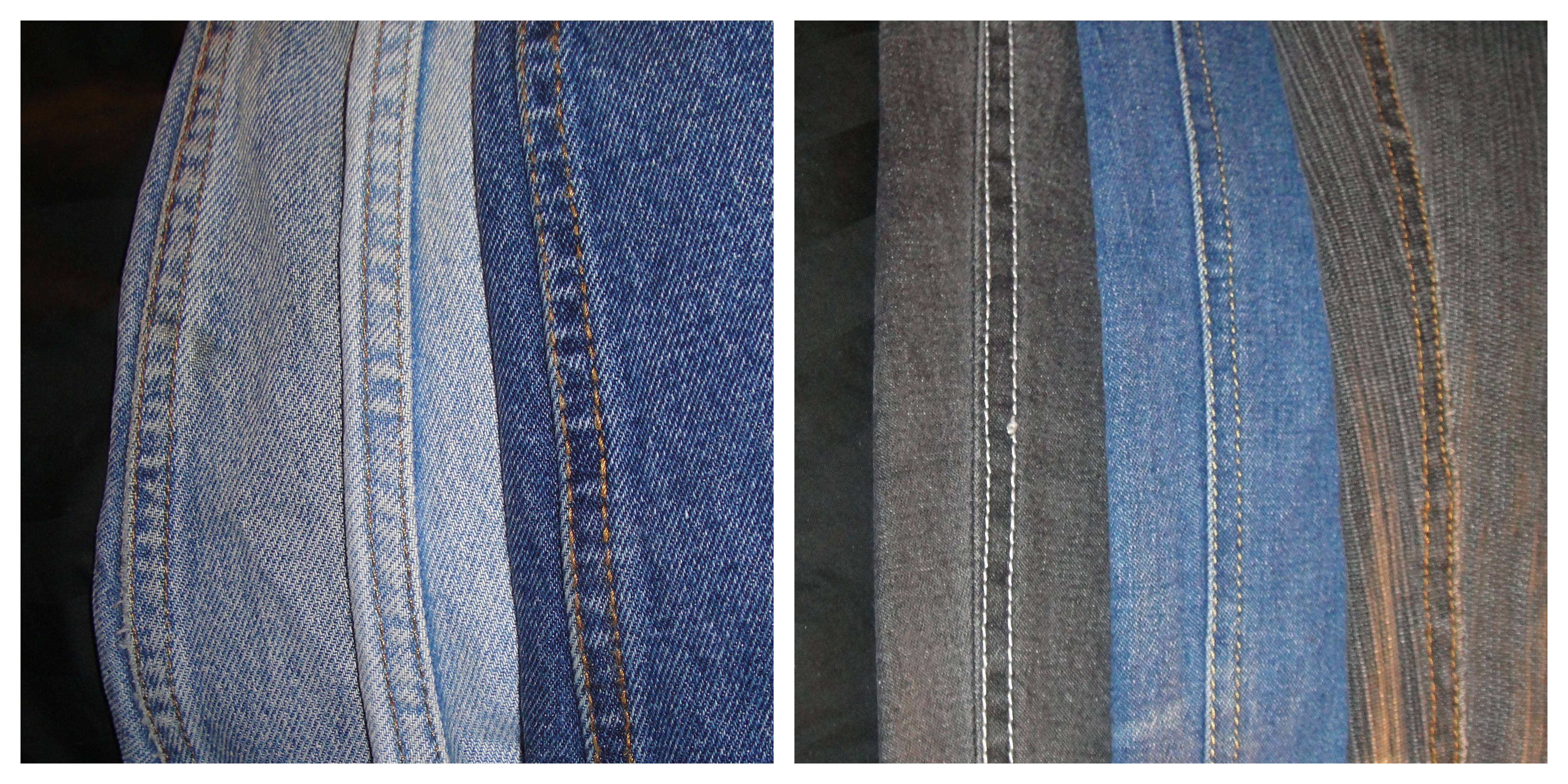
You know what I mean. The way the fabric between the two lines of topstitching makes this little repeating wave, which wears into bands of light and dark. It also happens along the non-topstitched edge of the outseam, wherever the seam allowance habitually falls.

Left: storebought; right: me-made

And it doesn’t happen, (or barely, barely happens) even after years of wear, on my me-made jeans. Now my first thought, of course, was “what sophisticated little wear-roller are they running along all the seams in their big jeans factories?!?” Then, of course, my brain kicked in—this feature is far too universal (especially on my husband’s sturdy work-wear, no-fancy-finish jeans) to not be inherent in something about the jeans-making process.

And then it hit me. (Hush, I can be slow if I want to.)

Shrinking. Because, like a good little sewist, I pre-shrink my fabric and then construct my pants, whereas commercial jeans, from what I understand, are shrunk after construction. (Can you imagine trying to launder huge industrial rolls of denim?) So that characteristic ripple is probably the result of post-stitching shrinkage. Which is why my jeans have comparatively little ripple (and if I was really good and pre-washed my denim multiple times, as is often recommended, they probably wouldn’t have any ripple at all), and even brand-new dark-washes from the store, like the ones above on the right in the left picture above (how’s that for confusing), have a well-developed ripple.

Now, I’m not so concerned about this for the red jeans, but in general it’s bugging me. And it’s bugging me more the more I think about it. It’s one of those legitimacy issues. Jeans are supposed to have it. If my jeans don’t, they’re not “real jeans”. Which, yes, is all in my head. But it’s still one of those things, y’know.

So yeah, I’m seriously considering, when I run through my current set of denims (most of which have been pre-washed already), trying to enlarge my pattern so I can shrink my jeans after construction.

Bad idea? Probably. Even with doing test-swatches. I mean, from what I understand it took jeans companies ages to figure out how to wash their jeans and still get consistent sizing, which is why, at least in North America, they didn’t usually sell pre-washed jeans until the 80s (or sometime thereabouts.) My mom talks about how you always bought so many inches larger in the waist and longer in the leg than you needed, and just hoped that it would work out when it came out of the wash.

But I want the ripple, dammit. And I don’t want to have to sit there and sandpaper each individual fold by hand. 😉

So what do you think? Is the ripple worth it?

74 Comments

Filed under Sewing

Brung Low

I have had the blerg. That is, the the-kids-have-been-back-at-school-just-long-enough-to-incubate-new-strains-of-plague annual fall cold. Blerg.

On the up-side, I have an excuse to do nothing but hunker down, drink tea, and catch up on some of the blog-reading I’ve missed over the last three weeks. And think about my fantasy sewing in a bit more focused way. On the minus side, I haven’t been coherent enough to do anything useful, never mind anything fun.

The kids have decided, and we (most especially Osiris) have agreed, to being a Steampunk family for Hallowe’en. I’m all kinds of conflicted over this.

I really sort of loathe Hallowe’en costumes. I mean, I love a really cool costume. love love love. But. There are few things I hate more than making something that will only be worn once. If we could have Steampunk Club every week, I’d be all over the costuming. But for once a year? Erk. On the other hand, the idea of shelling out money (of which we have very little right now) for the godawful atrocities that pass for storebought costumes fills me with shame and horror.

So, sewing costumes it is. /sigh.

Osiris will be easy. In fact, all he really needs is some goggles (please nominate your favourite goggle tutorial 😉 ) and maybe some other accessories—everything else he pretty much already has, although if I were motivated to finish his frock coat I’m sure he’d happily wear that.

ZOMG I bought a brand-new pattern.

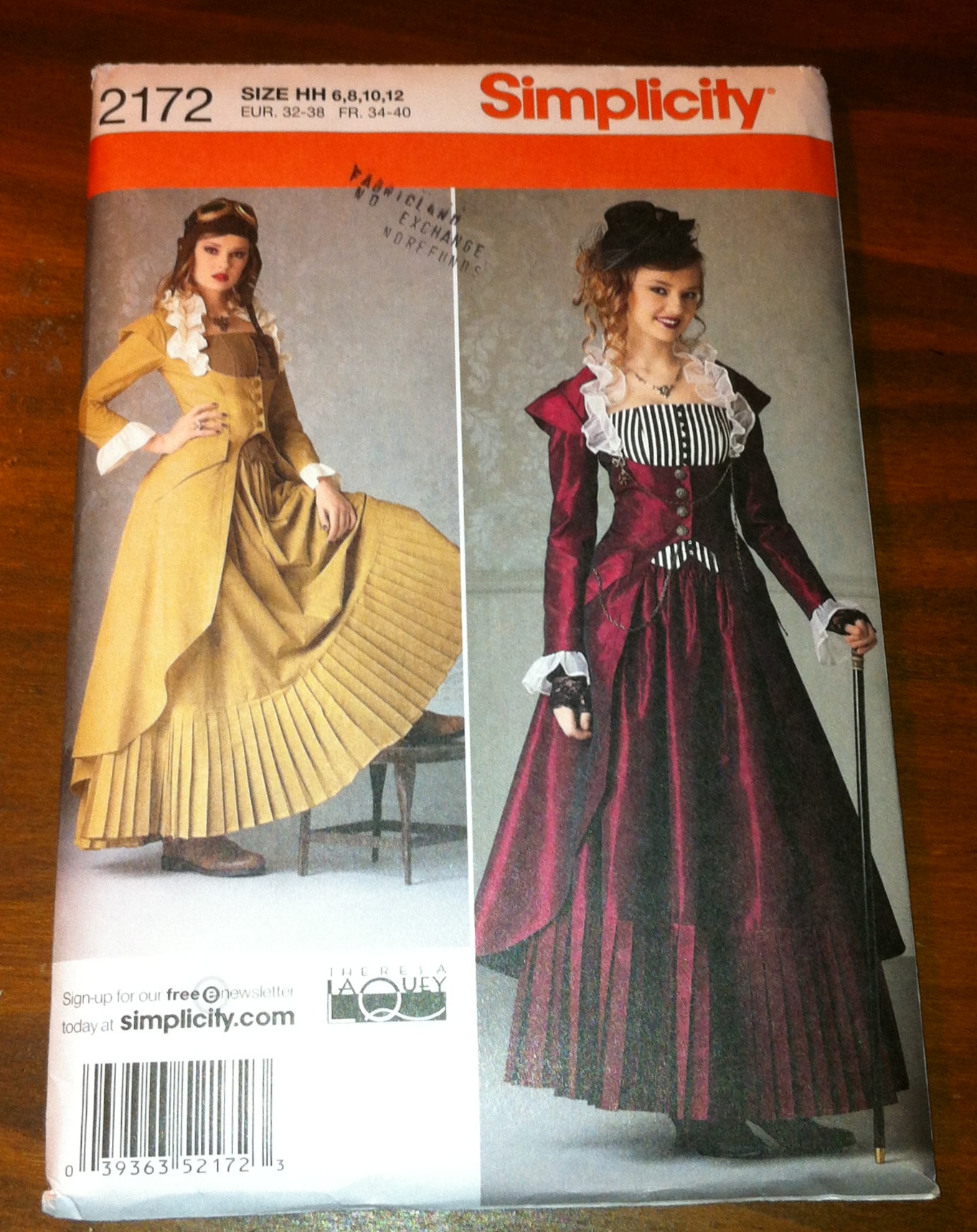
I’m less clear for myself, although I did pick up this Simplicity pattern at the $2 sale last weekend. I love the coat, although my deep suspicion of costume patterns makes me assume that it will be poorly-drafted and lacking sufficient internal structure to look right. I should probably at least read some reviews before I come to that conclusion, though. There was another pattern with a bustled overskirt thing that I also like, but it was featured in the Fabricland flyer and so long sold out by the time I got there. /sigh. Of course it’s the sort of thing I can figure out on my own, but for two dollars, not having to make it up might’ve been worth it. And I have (or rather my mother has) a perfect hat already.) Although my make-life-harder reflex is yammering something about “Steampunk Seamstress” that involves an antique-sewing-machine-looking-backpack…

Sketchies—Tyo’s costume.

Which brings us to the kids. We spent some time sketching on the weekend, although this was a bit frustrating since every time one girl came up with a good idea the other decided she wanted it, too—but they don’t at all want the same costume. >_<

Anyway, Tyo seems to have settled on some high-waisted shorts (over stripey stockings and the boots that started this whole thing) with braces, a corset/bodice thing, and a jacket with short coat-tails. After some wibbling and sorting through my patterns, I decided to try drafting the shorts based on Pepin’s instructions from Modern Pattern Design (1942). I drafted it on Inkscape, which isn’t perfect but is decent for computer drafting. This wasn’t too hard, at least when tackled in twenty-minute stretches as I zoned in and out of blergishness (this was one of those colds where it’s too uncomfortable to sleep, or really do much of anything, for very long), but I have yet to print the pattern and try drafting it, so I won’t declare any kind of victory yet. I have a feeling the hip curve is going to be off and the rear-dart-shaping is going to require work (and probably a swayback adjustment). On the other hand, they have the longer-back/shorter front crotch length like the Burda pants-draft, which seems to be a generally good feature.

Syo is all about the lacing. She wants lacing on her shorts (not high-waisted, though, preferably leather) and lace-up arm covers. This doesn’t strike me as overly Steampunk, but I imagine we can manage. She wants a corset but she’s not going to get one. Maybe a corset-seamed bodice. I’m hoping I can talk her into a cute little vest. They both want tiny top-hats… we’ll see.

Of course, with Steampunk a lot comes down to the accessories. Vaguely Victorian clothing, I can come up with fairly easily (although the number of individual pieces is slightly terrifying at the moment, considering I’ve scarcely stitched in a month). Accessories will require more work. Obviously, some googling is in order. Or, y’know, if any of you care to share your favourite steampunk costume or accessory or tutorial, I’d love to check them out! 😉

Also, it appears there will be corsets. (or things having a generally corset-like appearance) For Tyo certainly, and quite possibly for me. I have plenty of patterns, although not in Tyo’s size. Which brings on the debate—grade or draft? I’ve never made a corset before, but having read obsessively about them for several years I’m reasonably comfortable with the basic ideas, at least for costume purposes. But I’m pretty sure that the patterns I have, which are all Misses-size, are not going to be anything like the right proportions, even if I graded down to her size (which is about a Misses’ size 4). Decisions, decisions.

Obviously I need to sign myself up for Peter’s Hallowe’en Sewalong, stat.

34 Comments

Filed under Sewing

Fantasy Sewing: McCall’s 8858

McCall’s 8858

All right, while I remain in sewing limbo, let’s fantasize a bit more.

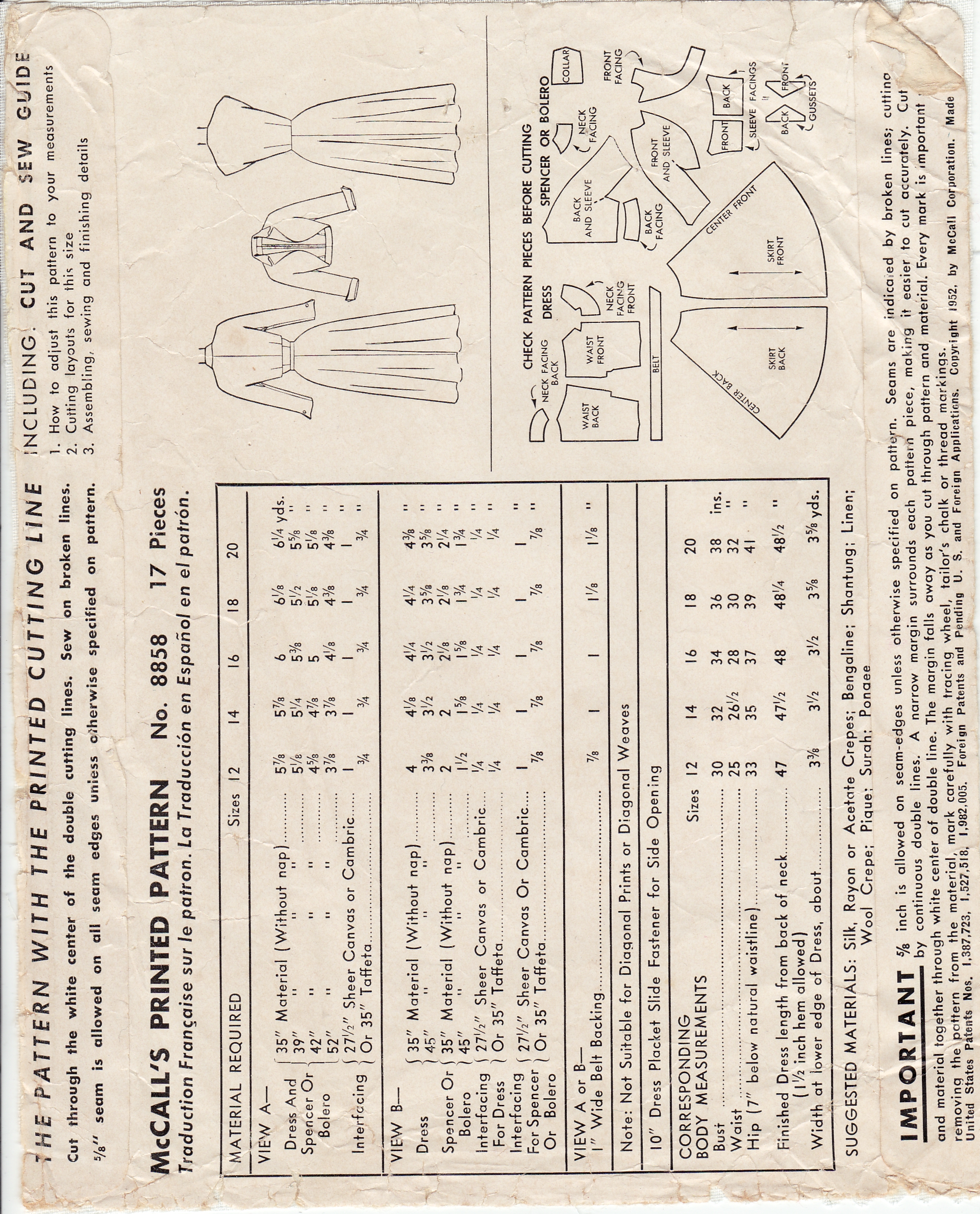
This is McCall’s 8858, which I got from the thrift store in my hometown (now once again my home), back in the spring. It’s © 1952, and is just my size.

I mean, exactly my size. Bust, waist (well, on a good day, anyway), and hips. I am trying to figure out how companies, in an era that championed the wasp waist and idealized the hourglass figure, where women still wore girdles as a matter of course (or at least, my grandmothers did), put out patterns that match my own rectangular measurements. I’m pretty sure that I do not have a “vintage figure.”

Now, when I bought it, the envelope to this pattern was totally trashed. Well, still is, really. I took the front and back (since they were already completely separated) and ironed them on to some cotton iron-on interfacing I had around. Is interfacing archival? If not, well, I doubt it’s worse than what they’ve been through already. At least those shredding edges are reinforced.

While I was messing around, I sorted through the pattern. By some miracle of the Sewing Gods, it’s all there. Every little facing, as far as I can tell. Furthermore, it had been folded in the most awesome way imaginable—skirt pieces together, bodice pieces together, bolero pieces together. How cool is that? Whoever last used this pattern is obviously a far more meticulous lady than I.

McCall’s 8858 envelope back

Here, since I was in the mood for scanning things, is the back of the envelope. Ok, so there’s one measurement I’m pretty sure won’t fit, which is back length. It’s not listed, but I presume it’s on the order of 16″ or up, as it usually is, and my back length (nape of neck to waist) is 15 at best. Also the hip measurement indicates it’s at 7″ below waistline, and my full hip is more like 10″ below my waist.

Now when I make this (and I will make this, although I make no promises as to timeline), I will need to figure out how to petite and square shoulder a kimono sleeve. I’m not too concerned about the dress itself, but the bolero is a little more scary. And I really like the bolero.

Some other observations about the pattern:

It calls for the skirt to be cut with the grain paralleling the side seam. Interestingly, this is something that my 50s sewing manual cautions against; I’d never actually seen a pattern call for it before. Most everything else I’ve read on pattern-drafting and selecting grain suggests you should put the straight of grain midway between the two angled edges, unless you’re going to put one side on the fold, anyway.

In classic 50s style, it also calls for a self-fabric belt. I’ve never made one, as I generally don’t find that I “cinch” well. I feel like it always creates a certain blousing effect that just never seems to work for me. Of course, there is also the question of whether this should become part of Project Drop-Waist, but I think I may just possibly be able to pull off a waist seam as long as the skirt is un-gathered and sleek, as it is here.

I’m excited about the bolero, in particular. I’ve noticed (now that I have a small plethora of full-skirted dresses) that the style of jackets they work with are pretty limited. It has to be either a huge opera-style coat that can completely cover the skirt, or a petite, cropped bolero that doesn’t impinge on the skirt. I guess in theory something like my Lady Grey coat should work, but in practice I find I only like it with skinny bottoms. My empire-waist jacket is a complete fail, and the situations where it’s cold enough for my winter coat, but warm enough that I might wear one of my full-skirted dresses are very, very limited.

As far as I can tell, the only difference between View A and View B is that the bolero is made out of a different fabric in View B. Hmm.

The skirt will be a half-circle when all is said and done.

Of course, no Fantasy Sewing interlude is complete without musing on fabric. The problem is, I don’t think I have any lengths in stash that would be adequate for a dress like this—most of what I have is in 2m lengths. And I am not buying fabric right now, having just been traumatized by how many freakin’ boxes it actually filled.

It would be fun to make up even just the bolero, though. I have some black poly twill that would work (actually, I have a crap-ton of that, probably enough for the whole dress, but I have no desire to have a whole 50s dress in black poly twill suiting.) This is when I begin to wish that I’d catalogued my fabric stash more thoroughly… Not only do I no longer have everything on a shelf to paw through, I don’t even know which box most of it is in (I did label my boxes things like “Coating” and “light weight fabrics & interfacing”, but what exactly is where is pretty unclear.

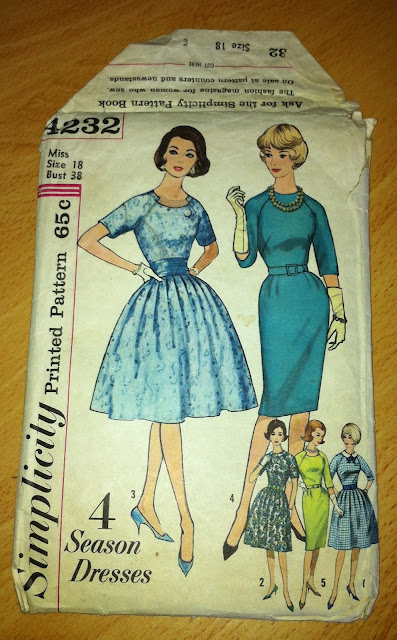
Simplicity 4232

While I’m rambling, I might as well add that a little more recently I stumbled upon this sixties pattern with a very similar neckline, although this one has raglan sleeves rather than kimono, and your choice of full pleated or wiggle skirt. It’s quite adorable too, although the size is rather further from mine. Also, I love the cummerbund-style belt in the left view. I wish I looked good in those…

15 Comments

Filed under Sewing

Thirty-Two

Last year at this time I managed to pull together a pattern to share. This year, what with moving, I fear that’s been the last thing on my mind. And, frankly, with a lot of the big changes in my life recently I could pretty easily be pretty whiny and down on this birthday. Which wouldn’t be very fun for anyone, least of all me. So let’s focus on the good things.

I have (often) happy, (generally) healthy kids, who despite their loud protests are settling in to their new lives just fine.

I have a man whom I love and who loves me back, and we’ve managed to make our way together for more good years than any of our parents had. Even if he did go and beat Darksiders II last week while I was busy.

I have loving and supporting family on all sides. (Even better now that they’re no longer hundreds of kilometres away.)

I have a head full of ideas, interests, and dreams, even if I can’t quite manage to figure out how to make any of them particularly practical.

And, not to be too maudlin, but I have your support as readers. It’s really, really awesome.

Oh, and Osiris took me across town on the motorcycle to pick up my birthday present:

20120908-002639.jpg

😀

41 Comments

Filed under Sewing

Fantasy sewing: Underwear

I still don’t have a sewing room (although there have been some signs of progress). It’s been an all-day-every-day job getting things even as close to “settled” as they are (it took me two weeks to find my eyeliner). The fact that half of our stuff is remaining in storage at least for the short term is not helping, either. But when I DO get it set up, what will I make? The season for the adorable sundresses I had been banging out has emphatically passed, and while there’s several fall-ish dresses I’ve had in mind, the lack of a closet I’m currently dealing with is making any clothing that needs to be hung distinctly less appealing than it was before. I could, of course, make a sweater or bunnyhug, but that would be like practical and stuff. I’ve bought a fair few thrift store patterns recently, in a ridiculous and counterproductive attempt to soothe the creative itch, but I’m not sure that any of them are absolutely screaming to be made. And I’m not quite willing to dive into the list of coats for winter without a bit of a warmup.

One thing that has been on my mind is the perennial, elusive, underwear. Underwear is kind of my unicorn—attempted several times, but always elusive, usually due to sloppiness on my part. There’s the failed, self-drafted pair I blogged here. Before that, there was a pair from this pattern:

Lekala Panties:

Lekala panties—tried but failed.

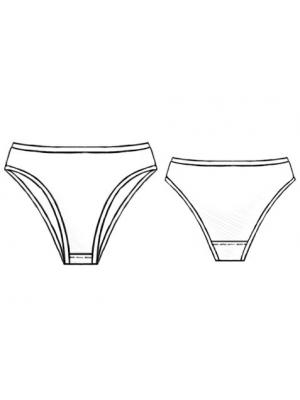
Which didn’t work out either technically—wonky construction—or fit-wise (the rise was way too high). I’ve tried and failed at least one more time in the past, I think with this Burdastyle pattern:

Bikini style underwear

Bikini-style underwear

 Which was similarly disastrous, although I don’t remember exactly why. The odds are it was me, though, rather than the pattern.
Beyond these free patterns (I downloaded the Lekala one back when they had a free demo size that just happened to be more-or-less mine), I have a few possibilities in stash—I’m pretty sure that the differences between panties and bikini bottoms are in fabric and finishing rather than cut, so I’m including them here.

In the retro category  is this one:

Simplicity 9933

However, only the one-piece is designated “designed for knit fabrics only” which makes me rather scared of the two-piece bottoms.

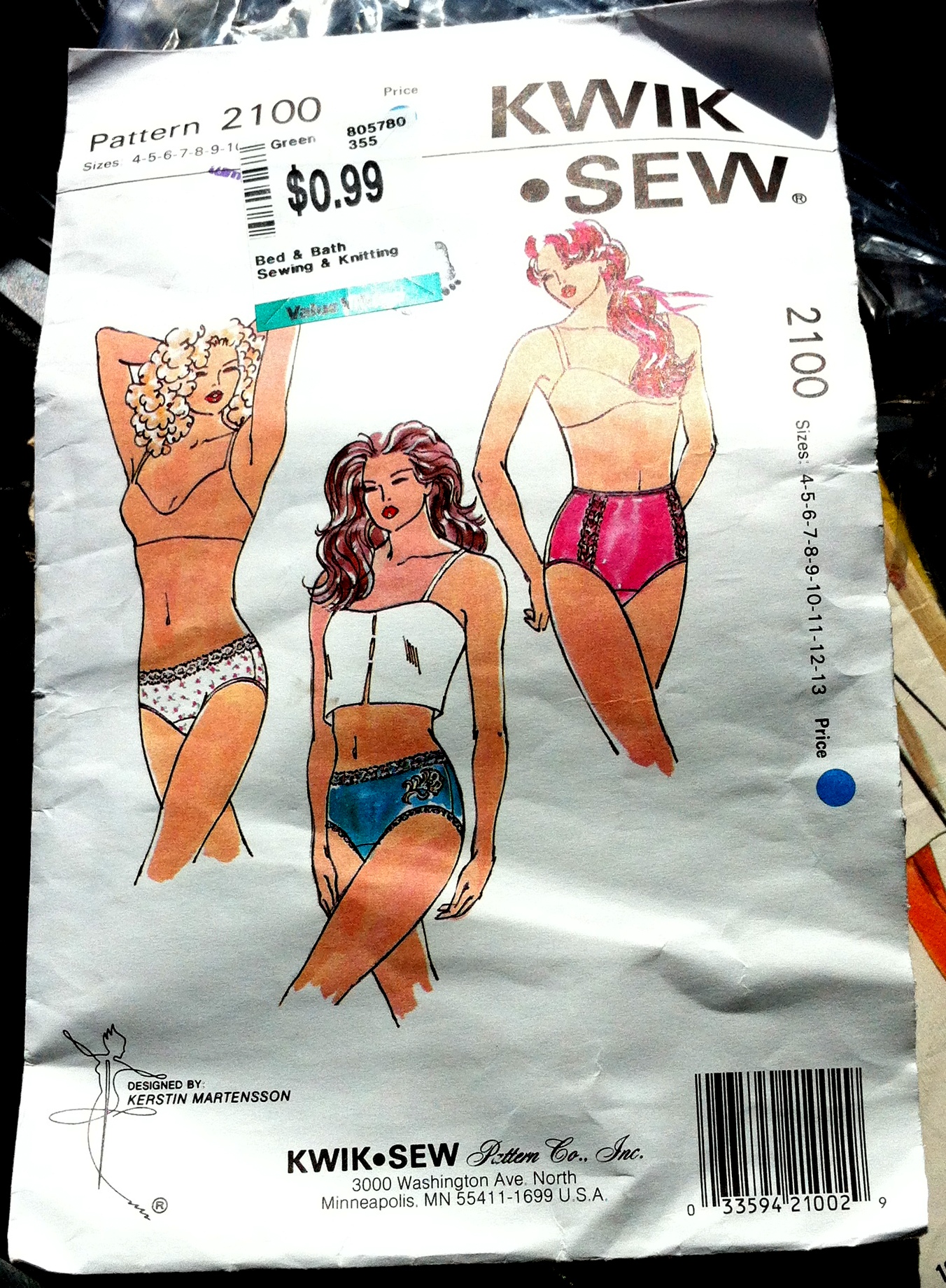
Kwik Sew 2100

Most recently, I found this Kwik Sew pattern. It has the advantage of several reviews on Pattern Review, although they’re not overly positive in terms of fit and sizing. (I’m a bit confused how you can rate a pattern “highly recommended” and then write that you had to go down two sizes and reduce the width of the crotch panel by an inch.)

McCall’s 4471

Possibly the best candidate would be this McCall’s pattern. There are several helpful reviews, and it’s the general bikini shape that is kind of my fall-back.

Of course, there’s no shortage of other underwear patterns, too. Aside from the old staple of tracing your favourite pair (I’m still not convinced my problem was the self-made pattern), there are several free options available:

Cheeky panties? (click for source)

This cheeky panties one is cute, though I think the finishing leaves a bit to be desired. I go back and forth on the whole cheeky panties thing. Same with the lace tanga panties. Sew You Said is in the midst of a series on drafting your own, as well.

If you want to pay for a pattern, a couple I’ve seen recommended are:

Jalie 2568

Jalie’s underwear pattern (does anyone ever say not-good things about Jalie?)

And several of the Kwik Sew lingerie patterns.

And I’ll throw in a link to the Ohhh, Lulu patterns for thoroughness, though I think I’ll be wearing high-waisted panties about three days after hell freezes over. No offense to everyone who loves them… just not my thing. And I’m so over thongs.

Oh, and there’s probably something that would work in the Merkwaerdigh line, which I also generally hear good things about, although more about the bras.

Which is not to say that I’m totally convinced that underwear is my next-up in things to make (and if I do it would probably be from one of the patterns I already have). But feel free to throw in your favourite pattern, and any technique tutorials you find super-helpful. Because apparently in this department I need all the help I can get. 🙂

26 Comments

Filed under Sewing

Homemade legitimacy

Immitating Storebought

Hmm, that is a fairly hefty title. I am somehow dubious that I will be able to live up to it. Anyway, here’s some thoughts on something(s) I ponder fairly regularly. Specifically, the “legitimacy” of homemade clothing.

But first, what do I mean by “legitimacy”? Fairly simply, I mean what’s considered (in a given society) normal, proper, acceptable—legitimate. Legitimacy can apply to anything, from the proper way to brew a cup of tea to what makes a legitimate government, but, this being a sewing blog, I’m going to talk about how this idea applies to clothing. Especially the clothing we make ourselves.

It’s no secret that, sometime in the last fifty to sixty years, “homemade” became a bit of a stigma, at least as it applies to clothing. (Homemade dinner, on the other hand, still seems to be a major goal in cooking, and plenty of thoroughly commercial food products are advertised as “home style”. Obviously they’re not eating my homemade cooking.) I’m not a social historian, so I can’t really offer any proof of why “homemade” became “Becky Home-Ecky”. I’m going to speculate anyway, though. 😉

I suspect that clothing made by others for you has always been desirable—in the bulk of history, when clothing was all hand-stitched, there were still garment-producing professionals, and I’m pretty sure the fancy gowns and suits of yesteryear we admire were all made by people who specialized in their craft. Which is not to say there wasn’t plenty of stitching excellence in the home, but I suspect the yen for someone else to do that damned work was always there.

Although clothing production seems, from what I can tell, to have lagged somewhat behind a lot of other areas in industrialization, by the middle of the last century, it was thoroughly industrialized. And, like all industrialized processes, there were subtle differences in the product as compared to the home-made version. A de-emphasis (frankly, complete avoidance) of hand stitching. Different patterns of construction—setting sleeves before sewing the side-seams, for example—that facilitate sewing at the expense of individualized fitting. And, of course, specialized stitches from specialized machines, which a manufacturer can afford to invest in, but which would not become practical for home-stitchers for decades (if ever. What percentage of us have coverstitch machines?). And one of the biggest things this created, I think, was a feeling that our home-made garments don’t always (or ever?) measure up. Our home-mades feel illegitimate.
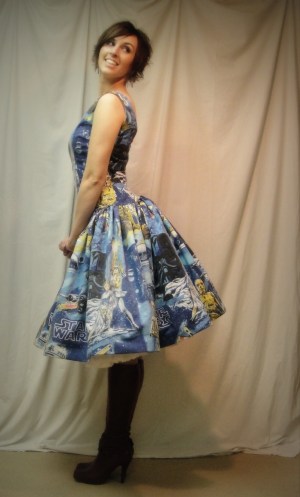
Not immitating storebought.

Now, there may have been some intentional work on the part of clothing manufacturers to undermine the appeal of home-stitched goods, and there may have been some anti-domestic backlash rejecting sewing along with the traditional, limited notions of femininity that it went with, and there may even have been a decline in the quality of home-sewing due to its lesser importance, but frankly, even if there hadn’t been, I think the delegitimizing of home sewing would’ve happened regardless. As soon as different methods were adopted in the factories, there was a difference in the product—a difference between home-stitched and storebought. And, frankly, as humans we have a very hard time seeing “different” and not judging “better or worse.” As soon as manufactured clothing became equivalent in quality, cost, and fit (or at least, enough years had gone by for people to forget what custom fit actually looks like), the fact that it was easier than making your own would increase its popularity, normalize it, legitimize it, and home-stitched clothing becomes different and thus bad, illegitimate. It may not have happened the first generation, but I know so many people who talk about hating the home-made clothes their mom or grandma made them. I felt the same way when I got home-made underwear for Christmas as a child. And it wasn’t because there was anything wrong with the underwear. They just weren’t “normal.” And therefore they were bad. (And I didn’t grow up in a home or even a school where brand was a big thing, so it wasn’t about branding.) Even though I started sewing as a child, and made costume-type garments in my teens and twenties, I never really considered trying to make everyday garments. The look, the details, wouldn’t be right. (And “right,” of course, is how storebought looks.) Even without ever hearing the term, I had no interest in making something “Becky Home-Ecky.” It’s worth admitting that what prompted my plunge into garment sewing was the decision to make a classic, tailored winter coat—something that I felt I could make look “right” with the home-sewing tools I had at my disposal, since the seams are all enclosed and the look itself dates back to a time before mass-manufactured clothing.
Triple-stitch zig-zag finish—This looks “wrong” (homemade, unprofessional) to a lot of people, yet it functions just as well as a coverstitched edge. Is it really aesthetically inferior, or are we just not used to it?

Storebought clothing, and the techniques that went with it, had become the standard, and anything different became wrong. I wasn’t around to observe this directly, but at a guess I’d peg this transition sometime in the early 70s, though it certainly started earlier. In my family, my grandmother sewed for her children in the 50s, but had given it up by the 60s. Possibly that’s because she had more children to manage, or boys weren’t as fun to sew for as girls, but I think the fact that storebought clothing was becoming increasingly affordable was probably a big factor. But I don’t get a sense that my mother ever thought of her home-made clothes as inferior, at least as a child.
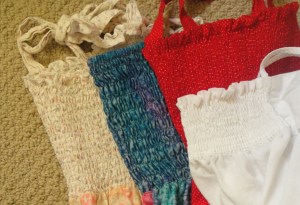
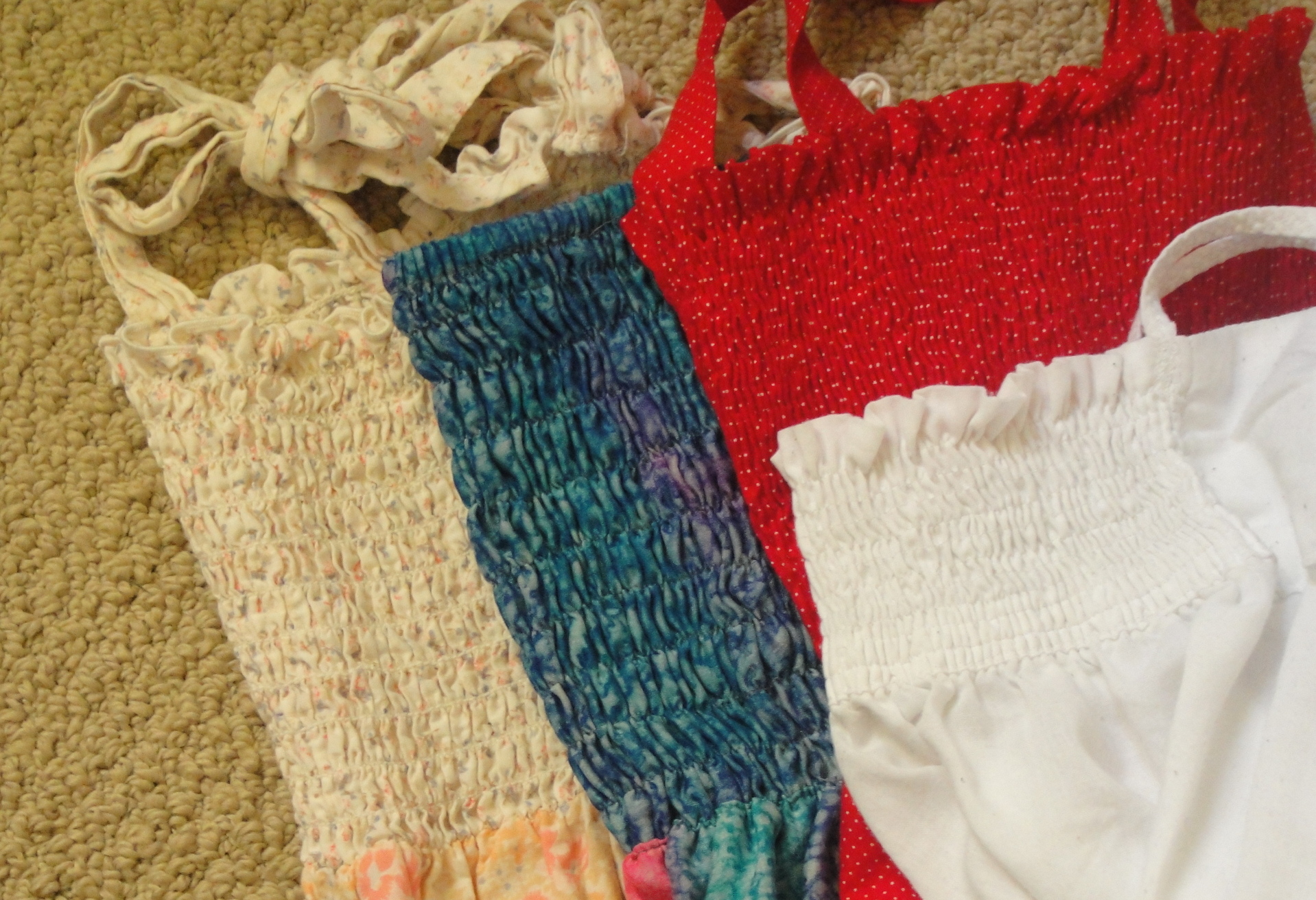
Shirring—mainstream, independently manufactured, and home-stitched. The exteriors look similar, although my home-stitched versions have closer lines of stitching (two on the right). The mass-produced garment (left) uses a different stitch, which resembles a chain on the inside.

How, then, do we deal with the fact that, in this day and age, the things we sew will always be seen, to some extent, as attempts to imitate something else—storebought, mass-produced, clothing?

The modern home garment sewing crew (or at least the blogging portion of it, which is really all I can speak for) tackles this problem in two main ways, I think. The first method is technical: striving to emulate storebought clothing more closely, by using “industrial” construction techniques, and by mimicking, to the best of our ability, the stitches and fabrics (and styles) used by the industry, and by investing in sergers and even coverstitch machines, that can achieve some of the specialized techniques of the manufacturer. The other is psychological—recognizing the reasons for the differences between the clothes we make and the ones we buy, assessing their importance (do you really care if your seam is serged once your clothes are on?), and trying to accept, to varying degrees, that different doesn’t always mean worse (Do my jeans have to have that particular wash to be “real” jeans?). The Me-Made-Month challenges are a prime example of of this approach, and it’s probably the biggest single contribution of the sewing blog community (aside from the whole, y’know, community thing.)—helping us think about our home-made clothes, not just as imitations of something from a store, but as a genre in their own right.

And again, different is not the same as wrong—both of these approaches are great, when used appropriately. Like, by all means serge your T-shirt if you have a serger. It’s fast and tidy, which is why the manufacturers do it, too. But don’t necessarily let the lack of a serger keep you from ever attempting a tee. Accept the little quirks and booboos of your home-stitched garments—but don’t stop striving to improve on your next make. Use excellence as your standard—but don’t accept “storebought” as the standard of excellence without thought.

One weakness of the “imitation” approach is that it can limit our creativity. I’ll cite an example from one of my favourite things to make—jeans. One of the standard features of traditional jeans is a flat-felled inseam. Now, a flat-felled inseam is certainly not beyond a home stitcher for any technological reason—anything but—but a pure “imitation” mentality limits us to using only that technique—when, if you start looking at storebought “jeans”, you’ll find that while it’s common, it’s by no means universal. Designers of manufactured jeans have no need to legitimize themselves by sticking to traditional, “proper” features—but if we take a strict “imitation” mindset as home-stitchers, on the other hand, we will limit ourselves to only doing things the traditional way. We will lose one of the greatest strengths of home sewing—our ability to be creative and individual.

“Acceptance” has its weaknesses, too, of course. I can accept my wonky hems, my unfinished seams, and my not-quite-right tees all I want, and wear them proudly—but if I use this as an excuse for lazy work, well, that’s just being sloppy, and it will show and contribute to the impression others have of home-sewing as second-class sewing. Not to mention I won’t get any better at what I’m trying to do.

Where we draw these lines will vary between stitchers (some of us are all about being on-trend and having our stuff be indistinguishable from what could be bought at a store; others are all about creating a vintage or couture look that celebrates the hand-made) and over time for individual stitchers, and I don’t think there’s any right or wrong answers. Except, maybe, the answer that would be blindly accepting mass-produced clothing as the only legitimate form. But I doubt anyone who thinks that is reading a sewing blog ;).

I’m really curious to hear where you all are—where you draw these lines, and what’s most important to you. How do you legitimize your sewing, to yourself and to others? Or do you even try?

*
84 Comments

Filed under Sewing