Tag Archives: jeans

Yawn…

Jeans

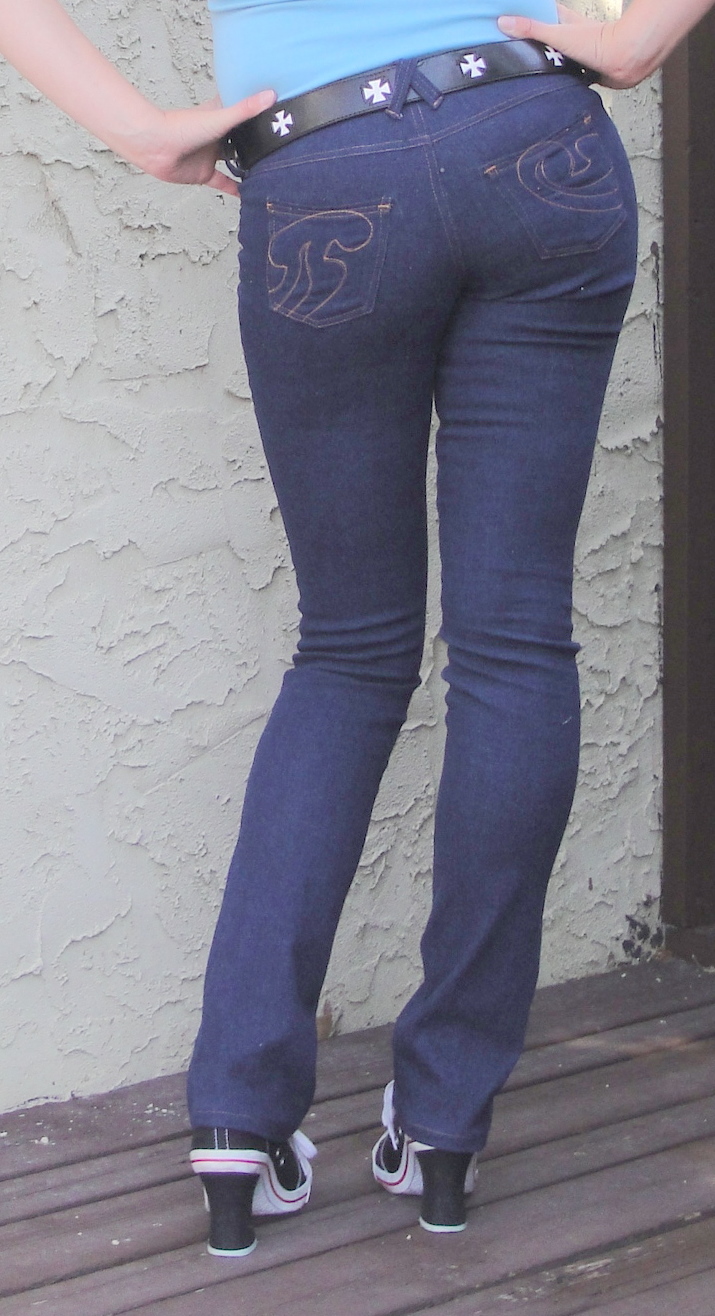
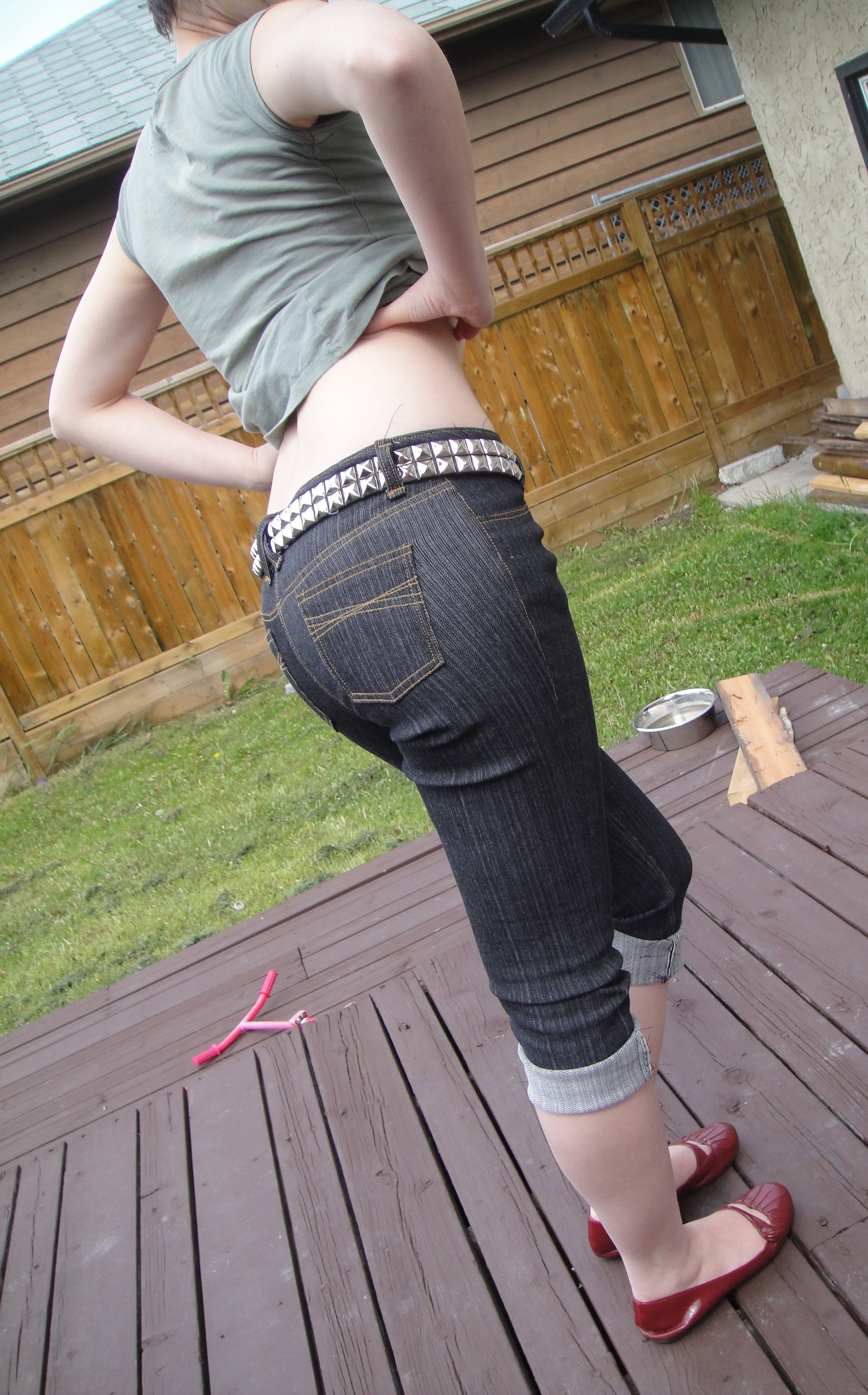
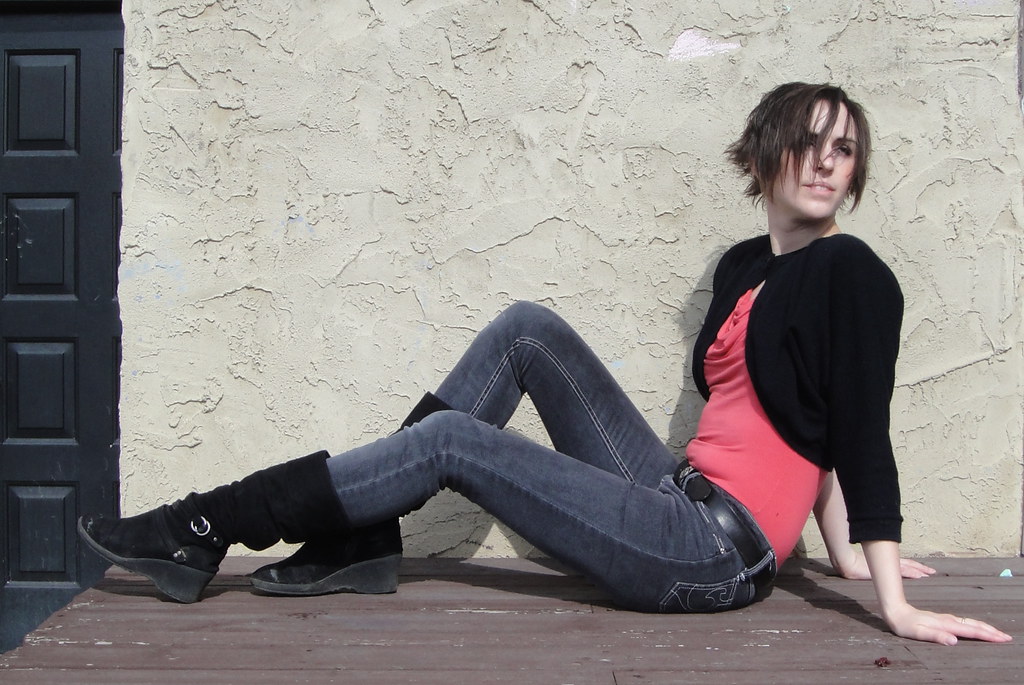
Jeans are done.

They’re fine.

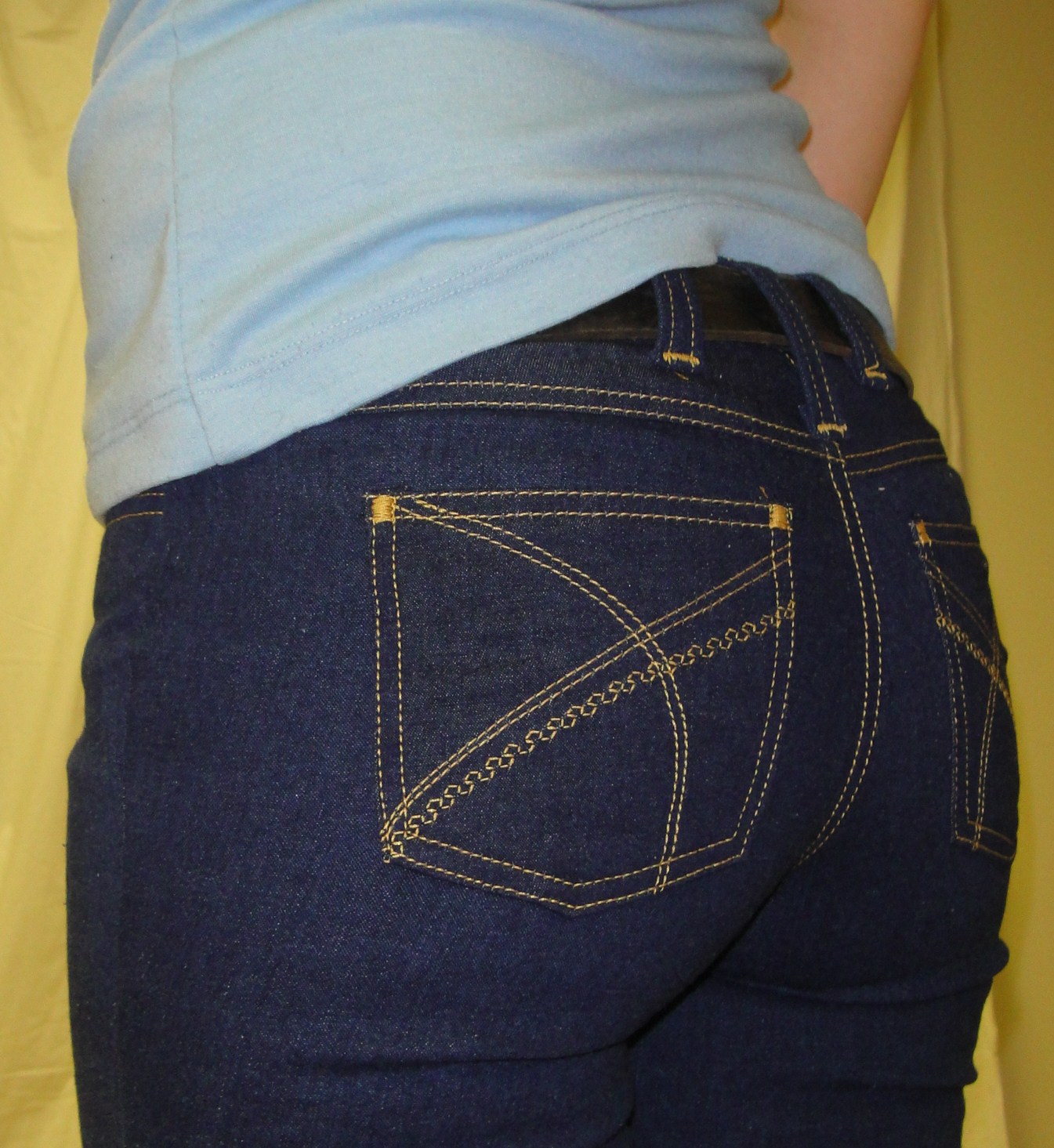
The Back

Buttonhole FAIL.

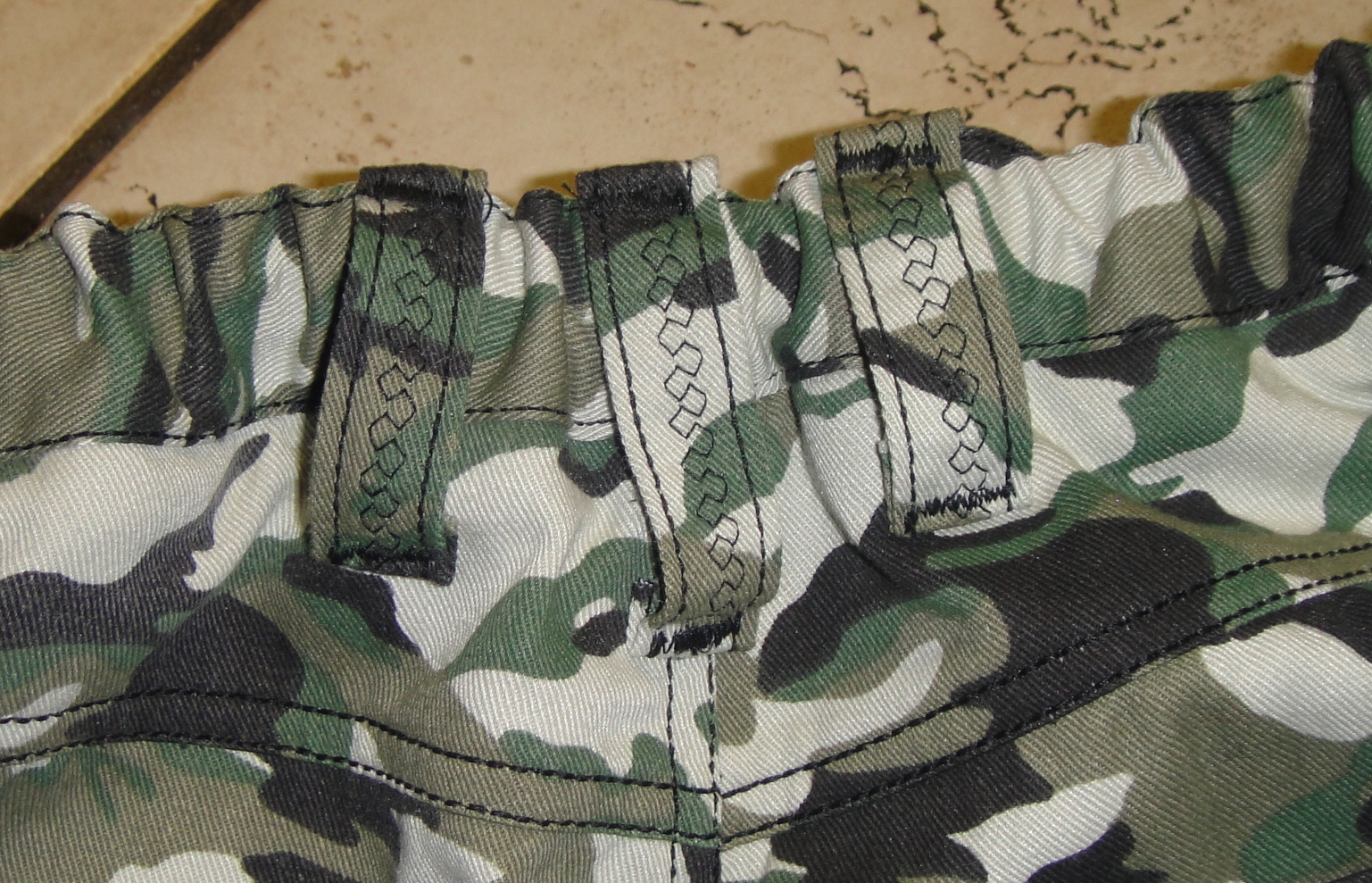
There was the requisite “OMFG how the HECK are these ever going to fit?” moment. There was the usual buttonhole drama (Featherweight and vintage buttonholer were not up to the task, although they might have done better had I remembered to put the presser foot down). There was the “crap, I think I cut these belt-loops too short” moment, followed by the “Wow, those belt-loops are way too big” moment.

Side view

There’s always a bit of drama involved in attaching the waistband on stretch denim jeans. OK, there’s always a bit of drama when I do it, anyway. This is because the jeans denim stretches, the heavily-interfaced waistband doesn’t, and how the HECK is this supposed to work? (Incidentally, if you look at low-rise RTW stretch jeans, often the main jeans denim is stretched to fit the waistband. This looks funny and square on the hanger, but just fine once they’re on the body). One of these days I’ll finish killing one of my precious pairs of Buffalo Jeans and autopsy the waistband to find out what, if anything, they put in there, because it sure works better than anything I’ve tried so far.

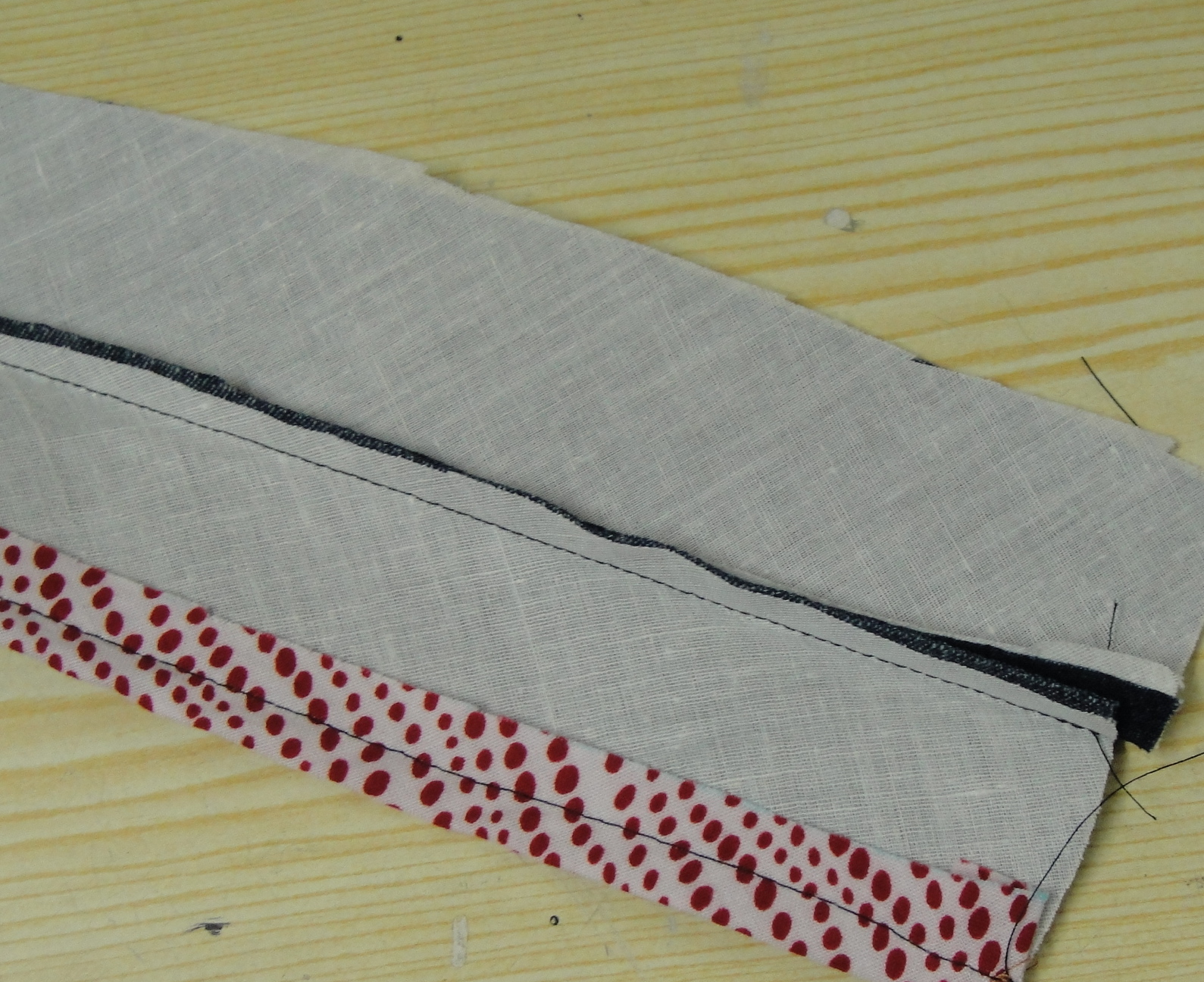
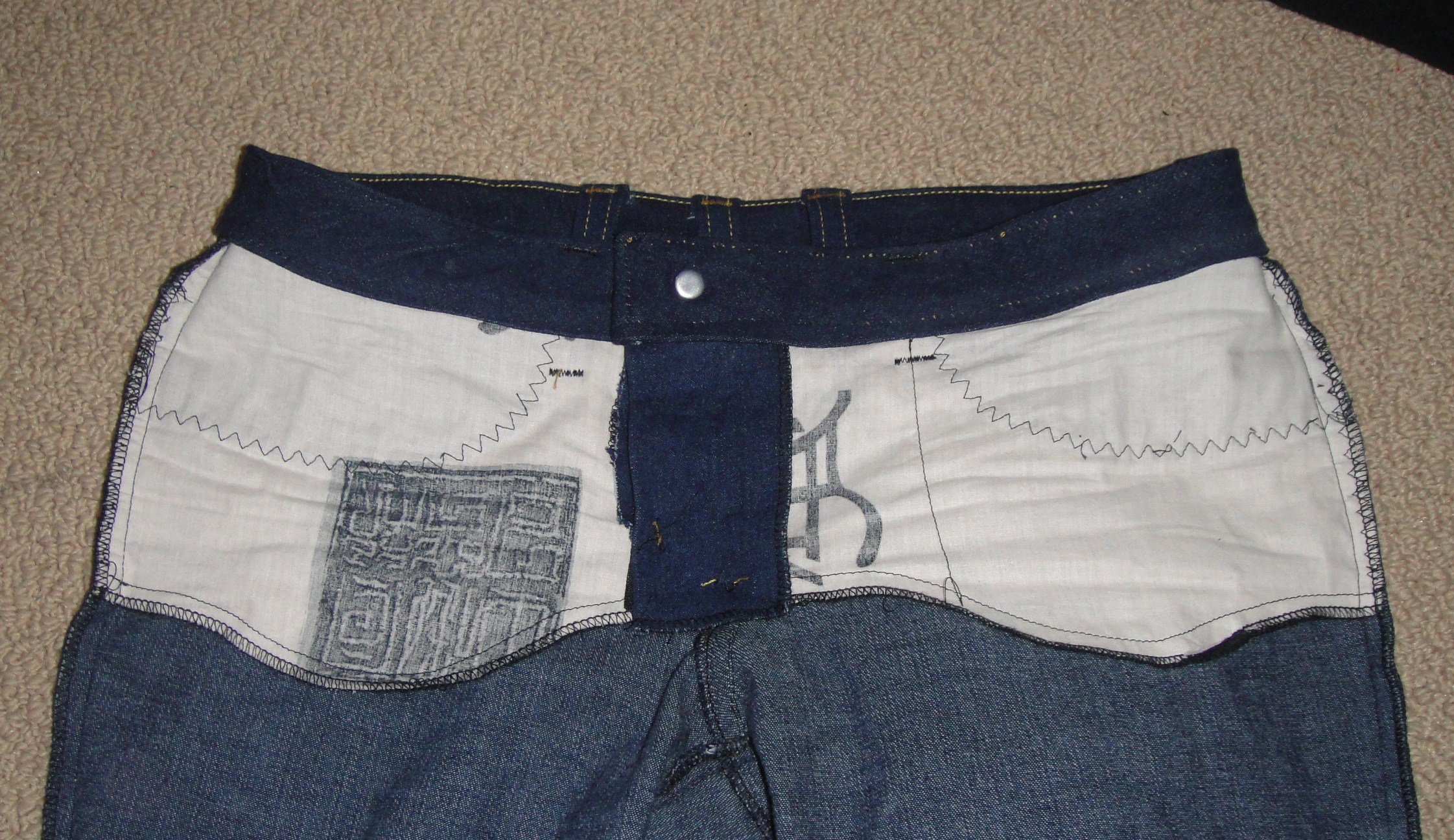
Waistband, opened up to show interfacing, before being attached.

Sometimes I sew waistband and jeans together flat. Sometimes I stretch the jeans denim just a little bit. I did that today, and it worked out. Sewing them together flat works better if you haven’t interfaced the waistband as much as I did  this time (but then you end up with a flabby waistband). Observations of my favourite RTW pairs suggest that when the regular denim stretches 50%, the waistband stretches only about 10%. Possibly dark and necromantic powers are involved.

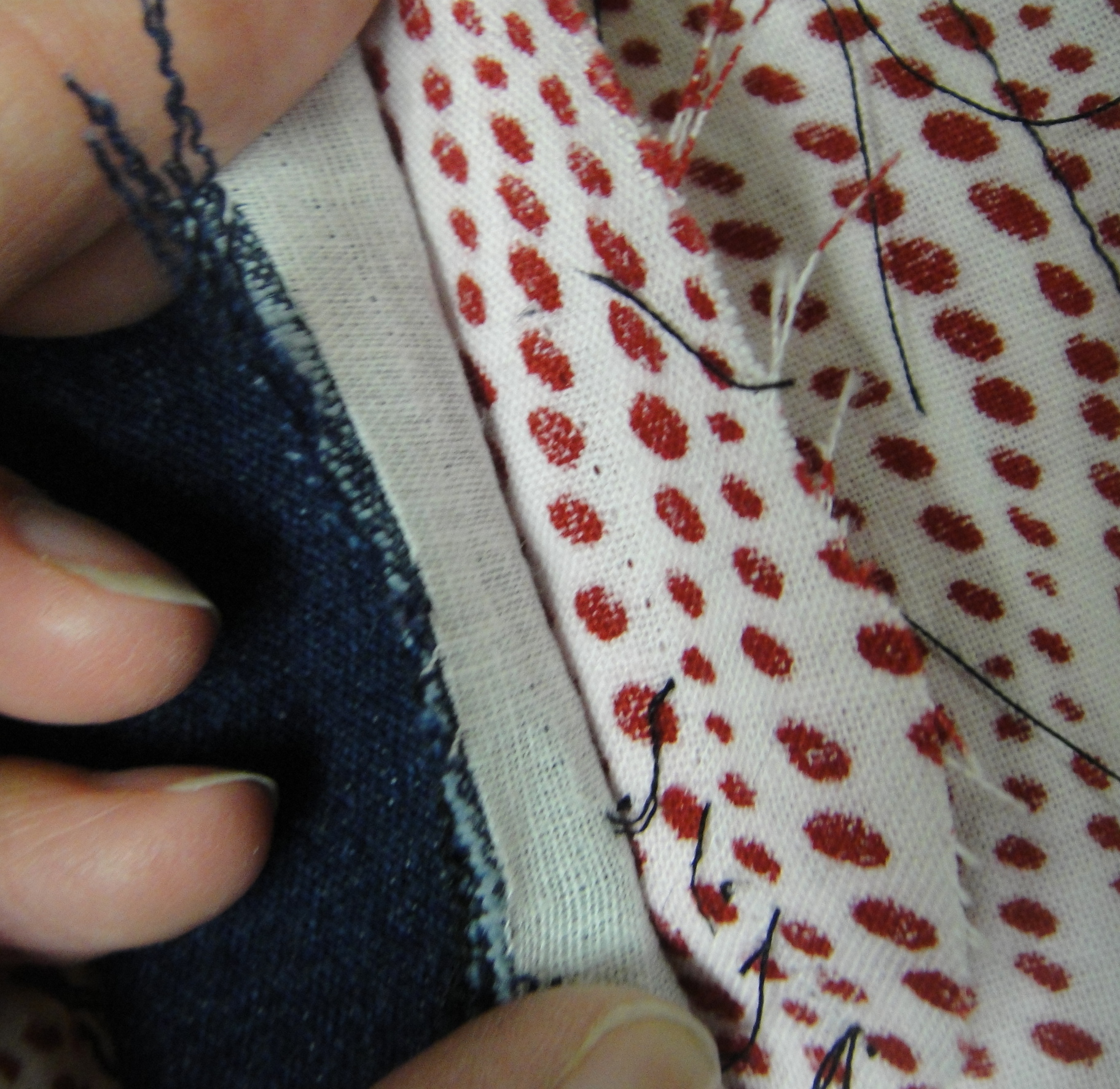
Waistband with bound edge, before being attached

I used the bind-the-inside-waistband method this time. It’s simple and much less futzy than slip-stitching down the inside or, worst, trying to topstitch it in place from the outside.

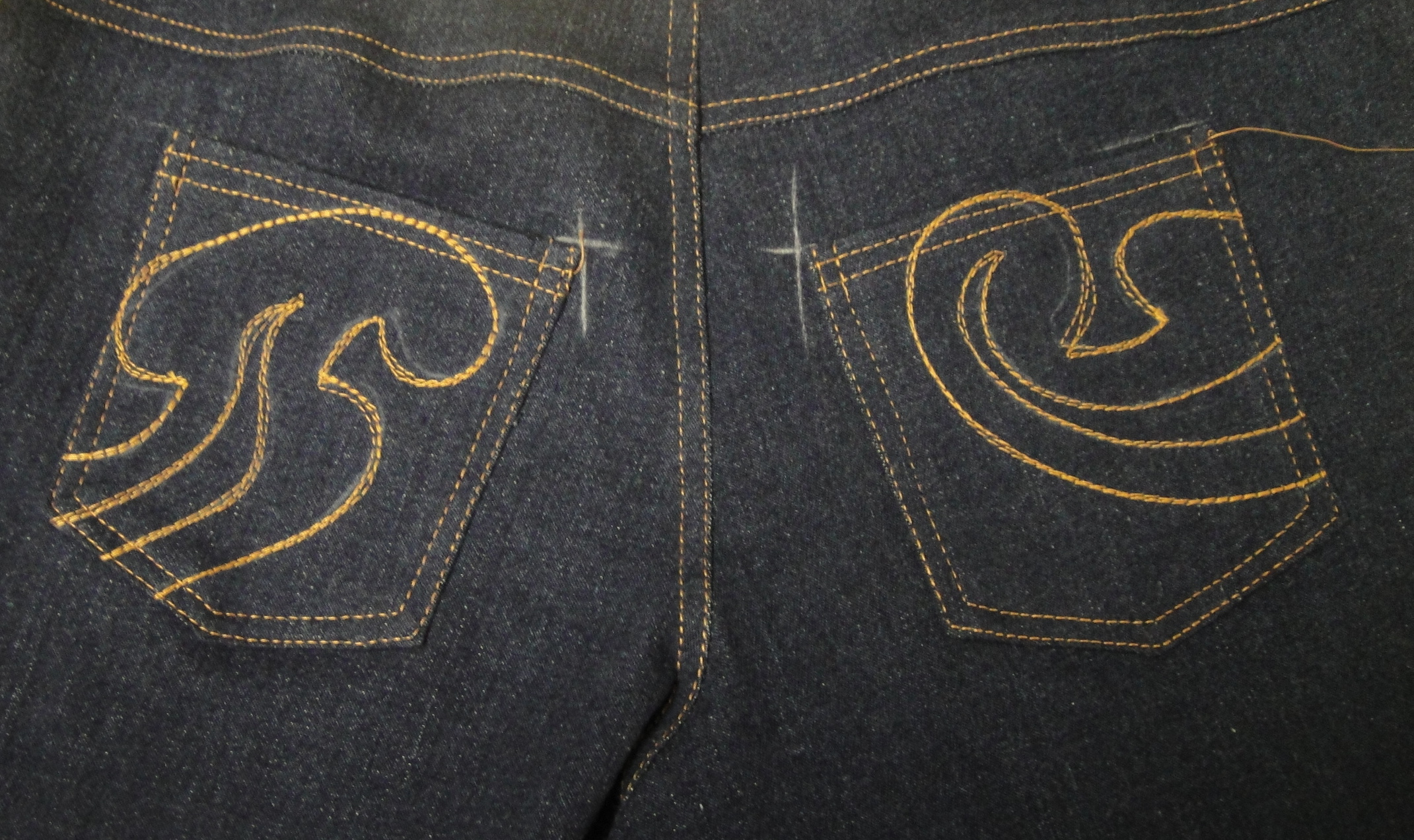
Pocket and back belt-loop

Although I loved using the Featherweight for my topstitching, I’m thinking with thread like this (which my Janome didn’t object to… probably helps that she’s freshly serviced, though) I should use a stretch stitch from the Janome for the pocket embroidery. I keep hearing threads go “snap” back there, plus I think it would make a smoother silhouette if the stitches were stretchier.

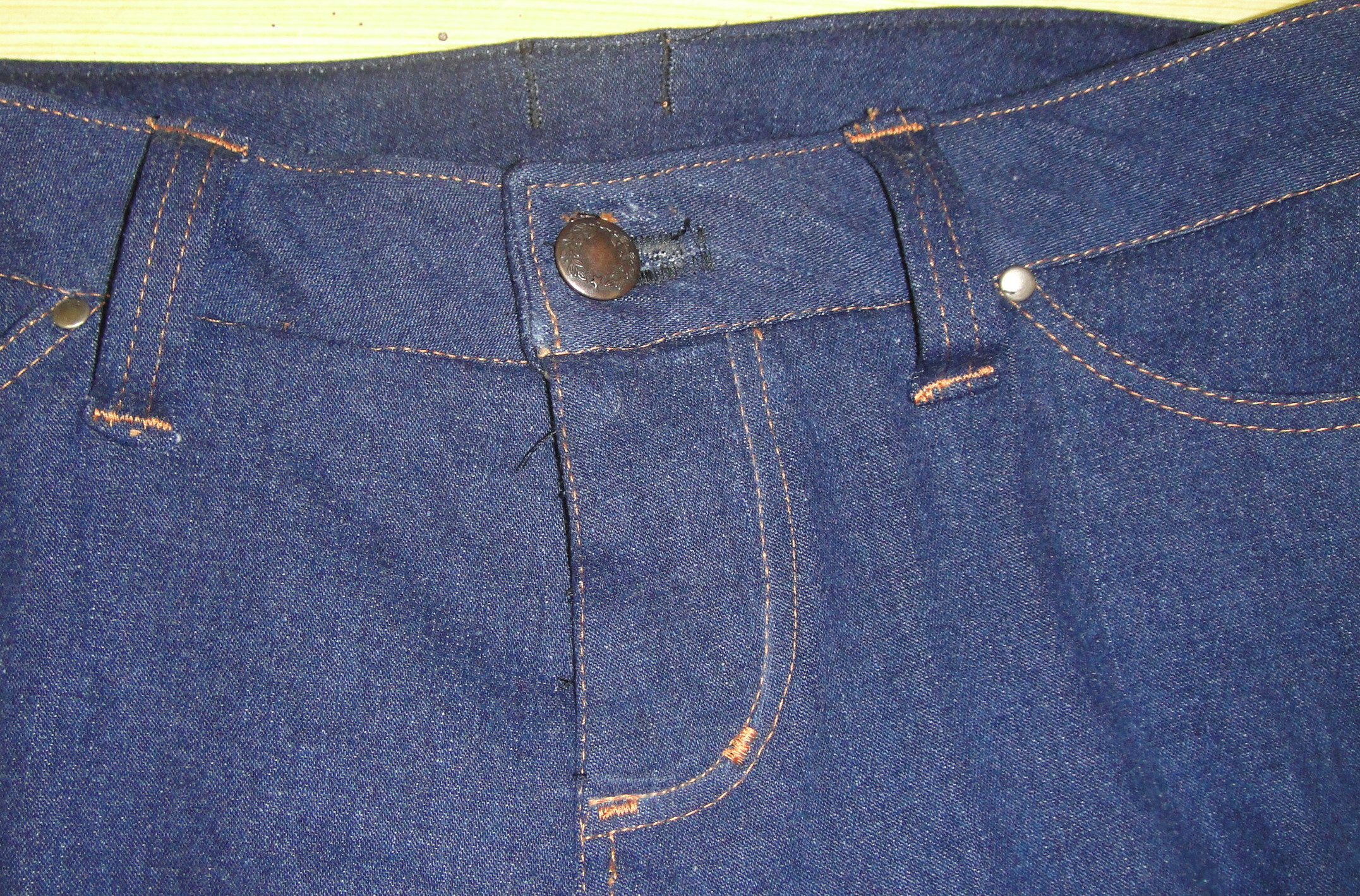
The finished front: button, bar-tack, belt loops, and rivets.

I think I actually managed to put the button in the right place so the fly doesn’t try to gape open. I actually saw a gizmo a little while back being sold (I think in a gas-station) that would extend your jeans waistband—basically a loop that buttons to your buttonhole—and, having been pondering flies that lie smooth and zippers staying up, stared at it in amazement. It would never work. The fly would have to stay open.

Well, I know some people do this when they’re pregnant (hair elastics work well, I’m told… I was not that ingenious and just wore overalls). This requires a long top to cover it, though. The gizmo made no mention of the long top. Maybe it was assumed.

Now, the four-million-dollar question: should I try my hand at distressing them? I’m getting a little bored of plain dark-wash, but on the other hand am I brave enough to take bleach and sandpaper and pumice to my brand new jeans?

In other news…

I got a birthday present! Heather of Sewing on Pins made up my birthday pattern as a top! Yay, happy dance. (And she didn’t hate it, even though she thought she would! Yay!) (Incidentally, while I naturally want you all to go make up a version RIGHT NOW, when it’s not your style/season/you have something better to do you don’t actually have to.)

Anyway, have a hedgehog! And a great week. 🙂

Superfluous hedgehog.

23 Comments

Filed under Sewing

Fly Fronts

Fly Front

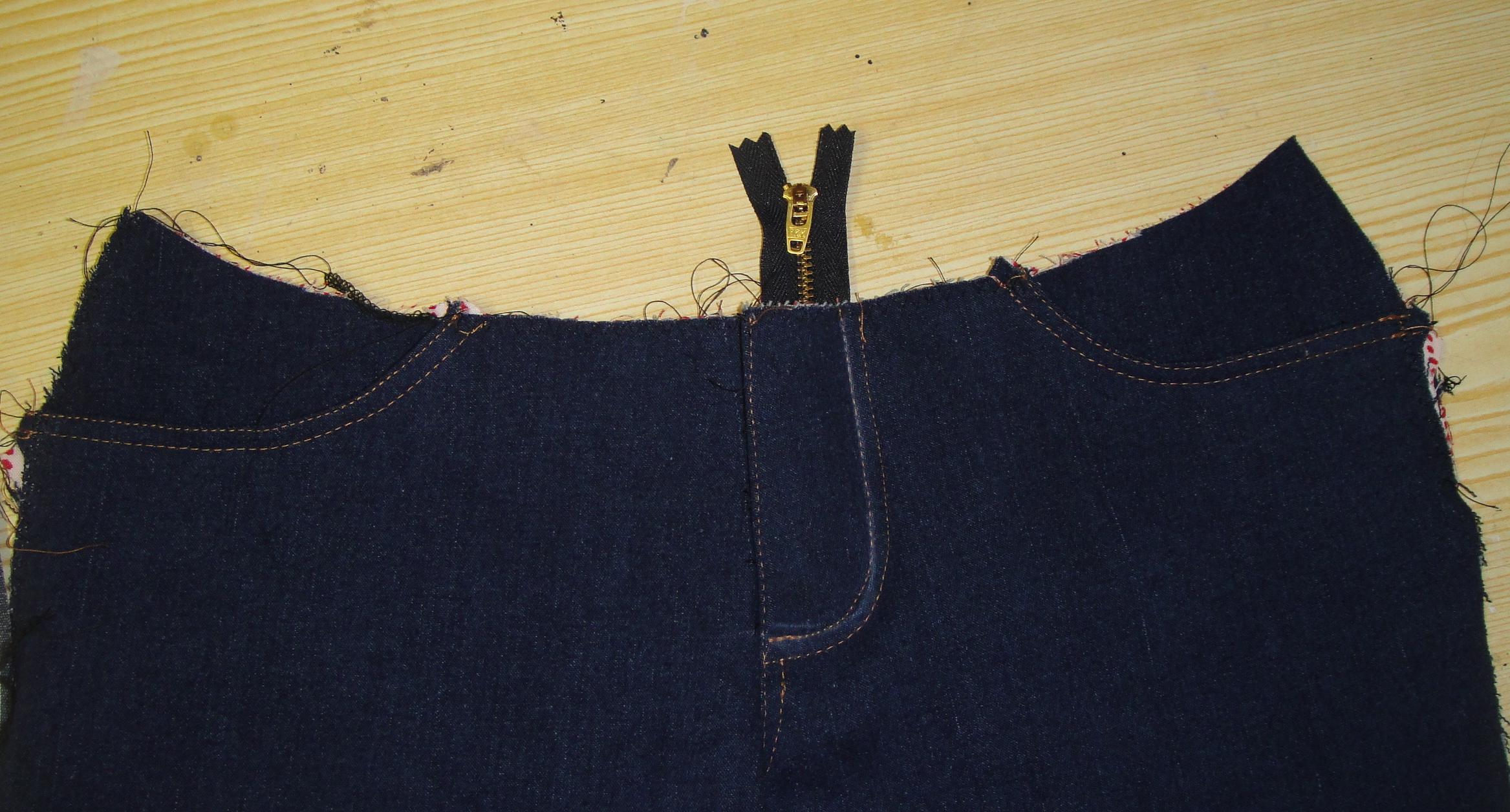
As I’m working on one, I thought I’d muse a bit on fly fronts.

I am not an expert, mind you. Not by a million miles, and this is not a tutorial. So long as I follow a tutorial closely, I don’t find them horrifically traumatic to put in, but how well they turn out, that varies dramatically.

First off (once again) I’ll link to my two favourite tutorials. I mostly use Debbie Cook’s because I have a hard time following video tutorials. But for those of you who like to see it in action,  Sandra Betzina has a gread video on the Threads website. It’s pretty much the same technique both times, except Debbie uses double-sided tape to hold the zipper down instead of pins.

Anyway, here are some thoughts. Insightfulness, organization, and usefulness are not guaranteed.

Cut-on vs. stitched on fly facing

This is the part of the fly that folds back to the inside to make that nice little flap that hides the ziper. The flies I’ve used in patterns all have a cut-on fly-facing. The ones in my ready-to-wear jeans all have a stitched-on fly facing. I don’t know if this reflects cutting economy (not sure how, but who knows) or if the added reinforcement of the seam is really so important that RTW feels the need to include it. It does reinforce the edge of the fly-front. I think you’d have to do the construction slightly differently, though, as I don’t think you’d baste the front seam all the way to the top before installing the zipper. On the other hand, you’d only need to add the fly facing to the overlap side, which would make it (possibly) less confusing about which side is which.

Pockets, including extensions into the fly.

Interfacing/reinforcement.

I have varied a lot on the amount of interfacing I put into my flies (and how I put it in) and come to the conclusion that, at least in my opinion, more is better. Maybe if I can find some really nice beefy stretch denim it won’t matter so much, but most of the stuff I can get my hands on is fairly thin and wimpy.

Layers of interfacing: fusible and pocket-lining.

I generally interface my flies two ways: iron-on interfacing in the fly-facing area, and with fabric from the pocket extensions. Often in the same pairs of pants. I’ve tried omitting one or the other, but so far I’ve usually been happiest when I included both.

The iron-on interfacing is pretty obvious: it’s a piece cut to the same shape as the fly facing extension, plus a little bit, and fused in place. I generally do it on both sides, although I could probably do it just on the overlap side. I’ve used a variety of interfacings (woven fusible, knit fusible, Armoweft), but been happiest with a sturdy, medium-weight woven fusible; it looks like muslin with a fusible side, if you ask me. Once this is fused on, continue construction as normal.

When I was first researching making jeans, I came across the concept of pocket-extensions. Basically you re-draw you pocketing pieces so that they extend all the way to the front fly-extension. They provide sew-in interfacing to the fly and a non-stretch tummy support if that’s your thing. (My jeans run below my tummy, so I don’t really benefit from that aspect. I do like the interfacing-aspect, though.)

Extra-long zipper

A lot of people recommend using a somewhat longer zipper so you can stitch on the fly without worrying about stitching around the pull. I like this because I hate stitching around the pull (I am not a zipper queen), but also because the shortest jeans zippers I can find are about 8 cm long and as you can see from the top photo, in the rise I use the zipper opening is about 6 cm long, tops.

Yes, this is about the same as in my RTW jeans.

When applying the waistband, you use needle-nose pliers to take the teeth off where you’re stitching, and trim the zipper tape to fit. You do lose the little top-stops this way. This isn’t a problem except that if you  remove too many teeth and have a gap between the last tooth and your waistband, it is possible to pull the zipper-pull right off the top. This was the fate of these jeans. (It didn’t help that I had positioned the button wrong so they didn’t zip up easily.)
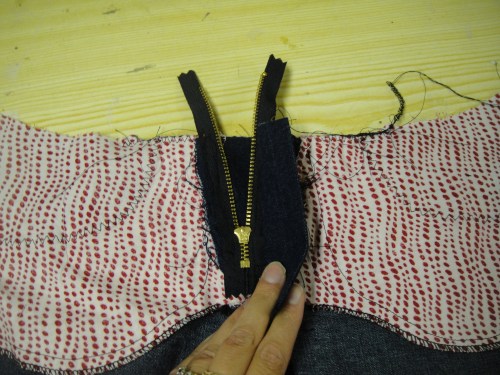
Folding back the fly shield

Fly Shield

This is a weird and mysterious rectangle of fabric you stitch to the under-lapping side of the fly, behind the zipper. It keeps zipper from catching undies/flesh/whatever, and gives the under-lapping part of the waistband something to attach to. I never even realized it wasn’t an integral part of my usual jeans until I was making a pair and actually took a good look at the fly construction. Who knew? Anyway, I always find this piece a bit suprising—oh, yeah, I almost forgot that! Now how do I put it on straight again?

Fortunately, no one will see it. The only external evidence of it is the little zig-zag bar tacks that adorn the bottom part of the fly curve in most jeans. They keep the bottom of the fly shield more-or-less in place and reinforce the bottom of the zipper.

Pockets!

Topstitching and Pockets

I just gave in and made a cardboard template to trace around for my fly-topstitching shape. The Jalie pattern comes with a piece, but I can never find it and usually end up free-handing the shape. Which can end up a little wonky.

Bar-Tacks on a jeans fly (and on the belt-loops, for that matter) (you can see this is one of the less-interfaced flies)

I’ve been doing the topstitching in my Featherweight, which means I can keep the Janome threaded for regular seams (which speeds things up considerably), but it does mean that it’s a little harder to do bar-tacks (those short bars of zig-zags that reinforce the pockets and help hold the fly shield in place under the fly. I guess I’ll do them at the end when I put the belt-loops on.

I am a little worried about this cotton topstitching thread’s longevity. I broke  it about fifty times while topstitching these back pockets (more shapes courtesy of my itty-bitty French Curve set). To make the design a little heavier, I stitched over it three times. I’m totally going for a bit of a free-hand, sketchy kind of look with the stitching. Totally. Not because I suck at free-motion embroidery or anything. (It’s a little better on the Featherweight, which is much happier to go slow than my Janome, but I still suck. One of these days I need to get one of those little round darning/embroidery feet to see if that helps.)

OK, I know this mostly has nothing to do with the fly front. Oops.

I need to start sketching out pocket ideas when I’m NOT in mid-construction. There are a bazillion and one cool things you can do with jeans pockets, and I never can think of any when I’m in the middle of making a pair and realize: oh, yeah, I need something cool and unique for the pockets. I managed with my cream capris, but that’s about it. Also, I need to start photographing my kids’ jeans pockets. They have some nifty, nifty pockets.

I like my pockets smallish on the theory that they make my butt look bigger by comparison. I also like them highlydecorated; according to the fashion magazines I don’t read, this is also better for those of us who are under-endowed in the derriere department. They could probably be a bit bigger than this, though, and still look fine. Thoughts for the future.

Can I just have my jeans now? I feel like it’s taking forever. I could’ve finished them yesterday, perhaps, except that we were out (are you bored of hearing this yet?) at the creek. Today is supposed to be cold and rainy, so there may be sewing hope, but I also have a house to clean.
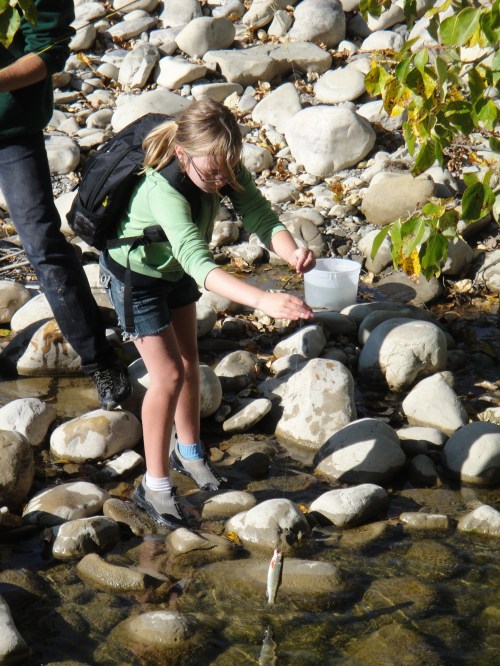
Tyo, Fishing Queen

15 Comments

Filed under Sewing

Jalie 2908 version 67 80 342 897 893 (and other projects)

Does there reach a point where you’ve made up the same pattern so many times it’s not worth reblogging? I hope not.

Just another set of Jalie Jeans

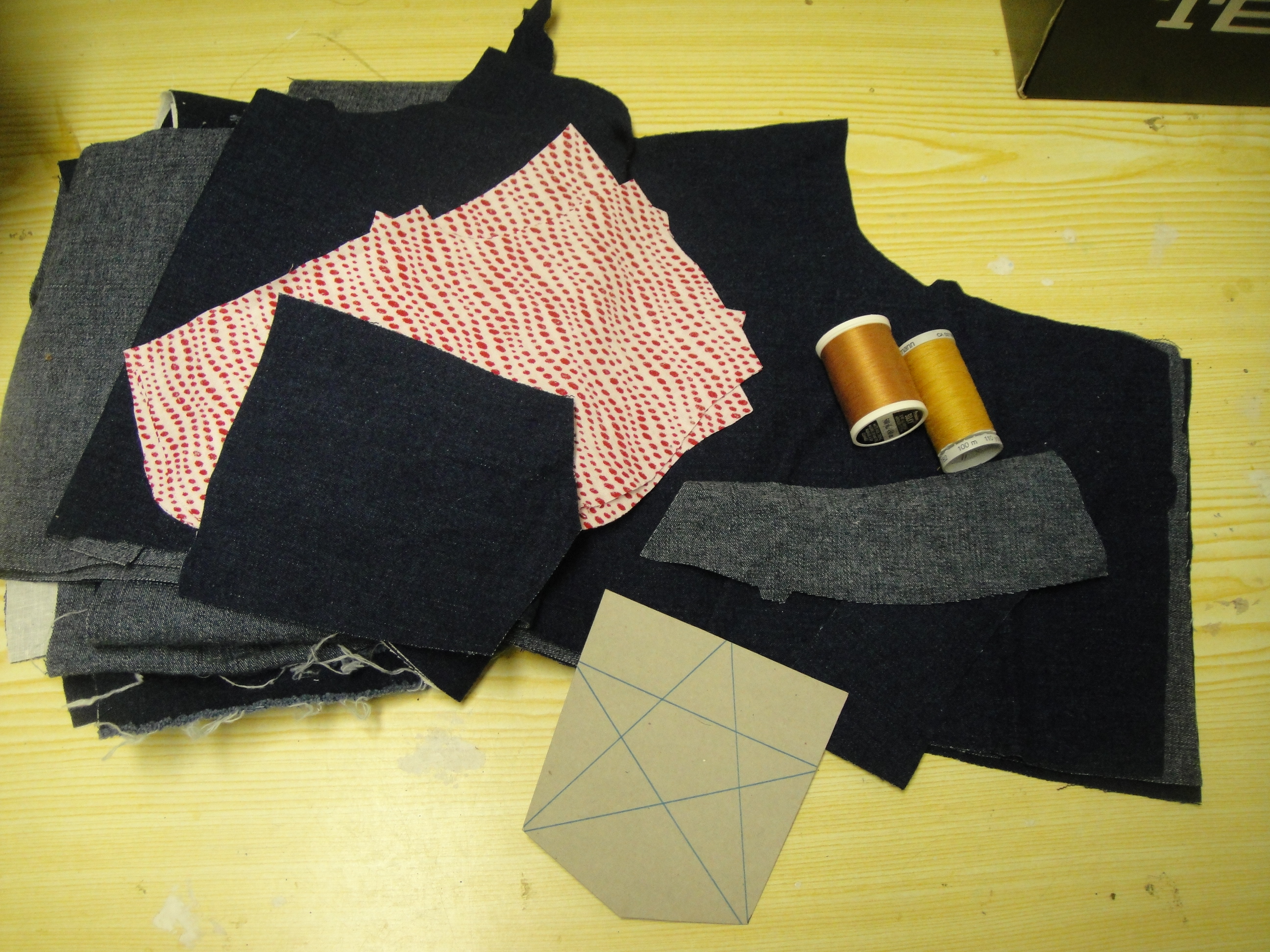
Anyway, on the weekend between tromping up and down the creek, I managed to cut out my next set of jeans. I would’ve started stitching them up, too, but I discovered unexpectedly that I was out of topstitching thread. How is this possible? Probably I’ve just mislaid it somewhere. So I had to wait until I could pop by a sewing store. Fortunately (or not) Sewing World, the peddler of fabric scissors crack, is right by the train station on my way home from work. They sell a LOT of thread. Much of it aimed at embroidery machines, but anyway. I was able to pick up a couple of spools—my usual Gutterman jeans thread, and some cotton topstitching-type-thread in a somewhat darker gold. I really like the colour, but I’m a bit hesitant about the cotton thread’s strength. I’ve had issues of thread-failure on my self-stitched jeans before, not in the topstitching thread, but in the regular threads. But all the previous topstitching threads I’ve used have been polyester. Hmm. Probably I’ll try it anyway, but now if it craps out after six months I’ll be able to tell myself “I told you so.”
For all the good that will do.

Tyo's Nightgown
The kids have also picked out their next projects. Tyo wants a nightgown to replace some of the ones she’s outgrown the last little while. The plan is to use Kwik Sew 2893, a raglan-sleeved tee (and another thrift-store find), and extend it to nightgown length. Maybe add some shaping to the bottom, like on view C there. This is some fabric she picked out for making her teddy bear (did I ever blog her teddybear? We stuffed it with rice so you can throw it in the microwave and use it as a heating pad). Let’s just say that I have no qualms about letting her do whatever she wants with it, as long as it gets it out of my stash. 😉

Syo just wants  a quick sundress of the shirr-the-top-of-the-rectangle variety, out of the leftover fabric from my niece’s Mini-me (or is that Minnie-me?) dress. I think there’s enough. Of course, sundress season is largely if not completely past, but when has that ever stopped me? (Plus she’d probably wear it, happily, over T-shirt and jeans, to school all winter).

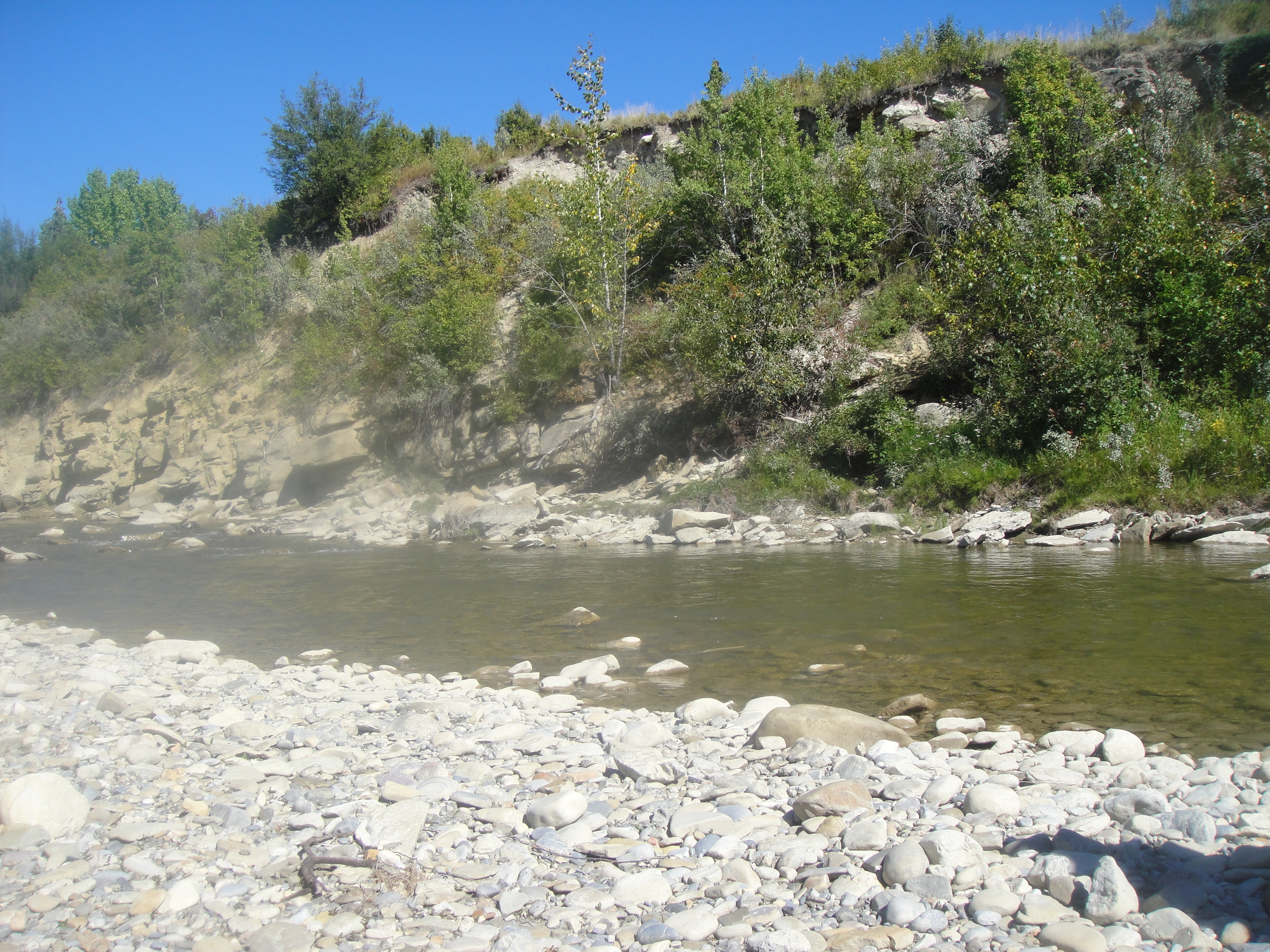
I keep talking (whining) about all the time we’re spending at the creek. I shouldn’t complain, it beats sitting around the house in front of the TV, which is what the rest of the family does the majority of the time (I, on the other hand, am far more virtuous and sit in front of the sewing machine, or the computer.) And it’s a good excuse not to get any housework done, at all. But it really cuts into the sewing time. Anyway, I suspect last weekend was the last of the creek-walking—the water gets VERY COLD VERY QUICKLY this close to the mountains, so I thought I’d share some pictures. Just because I can.

The Creek

Building with Rocks

Yay! Rocks!

Yay, fish!

You may now return to your regularly scheduled sewing blogs. I’ll get to that soon, I promise.

16 Comments

Filed under Sewing

One year of jeans

Unsewing 😦

Since the picture above  constitutes the grand total of my (un)sewing the last couple of days, I thought I’d talk about jeans.

First me-made jeans for me, ever.

I just checked back and realized it’s been over a year since I made my first pair of jeans for myself! Wow. Where did that time go?  Geez, I was so darned proud of that first pair. Funny considering I really hate wearing them now, although more because of the fabric, which I never did like, than anything else.

Anyway, inspired by Carolyn’s autopsy of her recently-deceased black jeans, I thought I’d muse self-indulgently a bit over one of my favourite things to stitch up.

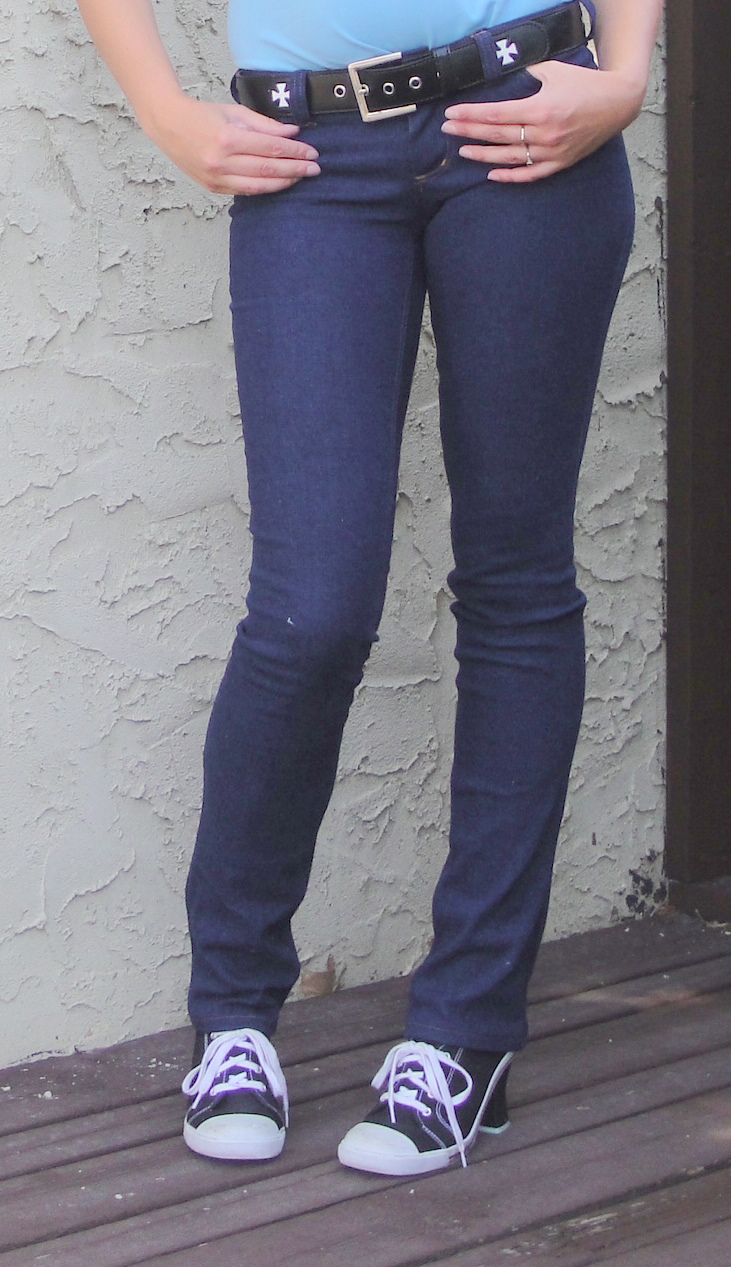
Depending on how you count it, I’ve now made seven or eight pairs of jeans for myself. Nine if you count the Lekala sailor shorts. These fall into two categories, stretch and non-stretch. Since I made my first pair of non-stretch jeans not that long ago, I can’t really comment on quality, so today I’ll just be talking about my stretch jeans, all of which are based on the infamous Jalie 2908 pattern. You can find all the Jalie jeans posts here, or all the jeans posts ever here.

I picked this pattern because it was highly recommended on PatternReview.com for something approaching the kind of jeans I like to wear, which are low-rise, tight-fitting stretch denim. The Jalie pattern is mid-rise, close fitting, stretch flares. From my reading, I was pretty sure that I would be making several stylistic modifications, and probably a couple of fit ones as well. For style, I would be lowering the rise and reducing the leg-flare to a straight-below-the-knee style (something I’d found in a single RTW pair back in 2004 or so and been looking for ever since that one beloved pair went to the great closet in the sky), and probably going down a size as, based on the models in the photo, I thought the jeans as pictured were a little loose for stretch denim (your mileage may vary.) For fit, I expected to dart the yoke and add, oh, 5″ of length to the leg or so.

Procedure for putting dart in yoke pattern piece. A small amount of additional width can be trimmed at the centre back (step 4) if necessary; alternatively, two darts could be used to spread the amount removed over a more gentle curve.

At the time I was a bit perplexed by why the Jalie jeans were drafted with such a flat butt. It seemed like pretty much everyone needed to modify the yoke, and the lady behind Jalie even has a tutorial out there on how to do the fix, both during construction and on the pattern for your next pair. Then I watched (well, over the phone) my mom try to make flat-seat adjustments on some pants she made back in the winter.

Best pair ever.

WAY harder than just taking a little dart out of the yoke. So. Yoke-dart for the win.

Anyway.

Jeans are actually not terribly difficult to make. Denim, even stretch denim, is a lovely fabric to work with, sturdy and well behaved. Where you run into trouble is:

  1. bulk
  2. topstitching.
  3. fly
So, let’s start with 1.

Bulk:

Denim is thick. Good denim is thicker. In a few places, like where the yokes meed the centre-back seam, you’ll be stitching through up to eight layers (more if you’re doing proper felled seams). If you’re lucky enough to have a chew-through-nails-clunk-over-everything vintage or industrial machine, you’re probably good to go. If, like me (up until a week ago) you don’t, you will probably need to resort to a few tricks.
  1. Clapper/point presser and hammer

    The clapper. This is one of those unfinished blocks of smooth wood, often topped with a point presser. You iron your seam, get it good and steams up, and then press and hold this on top until it cools down. It’s amazing how much more this flattens out fabric than ironing alone—I know I was always pressing the iron on longer than I should and then scorching my fingers trying to push things down after taking the iron off. Trust me, the clapper is better.

  2. A hammer. Yes, you heard me. Technically this is best done with a rubber mallet, as a metal hammer has a tendency to break some of the fibres around the edges. A sharp-edged rock-hammer even more. Although probably most of you don’t have rock-hammers lying around, so you won’t run into this problem. Anyway, hammering a bulky seam also flattens it, even more dramatically than the clapepr, just be careful you don’t put holes in your fabric. Especially if it’s a thin denim. [Rock-hammer pic]
  3. Handwheel. Most of the thick spots in jeans are going over seams, and don’t last very long. A lot of places where the machine motor jams up and just won’t go through all the layers, you can carefully handwheel a stitch or two to get it started, or even get you past the trouple spot completely.

Jalie 2908 made skinny

Topstitching:

Presumably my topstitching woes are over now that I have the Featherweight, but topstitching on my modern Janome was certainly an adventure. There are several options I’ve used at different times. Generally the advice is to use regular thread in the bobbin, regardless of what you’re doing with the top thread. Topstitching generally looks better with a slightly longer stitch; I usually use 3mm for mine. Backstitching on topstitching can look messy, and many people recommend pulling the ends to the inside and knotting afterwards. I’ve experimented with both ways and came to the conclusion that the messy backstitch is, for me, more secure, usually not noticeable, and certainly not any more unsightly than some of my other topstitch booboos. Your mileage may vary.
    1. Two threads through the needle. If you can rig your machine to hold two spools, then hold the threads together and thread the machine as usual. This gives the top side of the stitch more oomph, plus you can use any regular thread, which gives you an extra-wide colour range to choose from.
    2. Triple stitch. Sometimes called (at least by me) a “stretch straight stitch”, this is where your machine takes two stitches forward, then one stitch back all the way along. The symbol on my Janome looks like this: ||| Basically, it ends up stitching each stitch twice, looking (ideally) just like #1. The down-side is that sometimes the forward and back stitches don’t line up perfectly, and if you don’t turn corners (say, on the pockets) just after the 1st forward stitch, it will take a stitch back after and make your corner look messy. The up-sides are: like #1 you have every colour imaginable to choose from; the top and the bottom look the same; and for stretch denim, this stitch has a bit of stretch to it.
    3. Heavy duty thread (including Coats & Clark Heavy Duty, buttonhole thread, and Guterman Jeans or upholstery thread). This heavier thread has a more striking appearance than regular-stitched regular thread, and looks more like “regular” jeans topstitching. You will probably need to turn up the tension a bit (do some tests) but my Janome handles this kind of thread quite well.
    4. Topstitching thread.

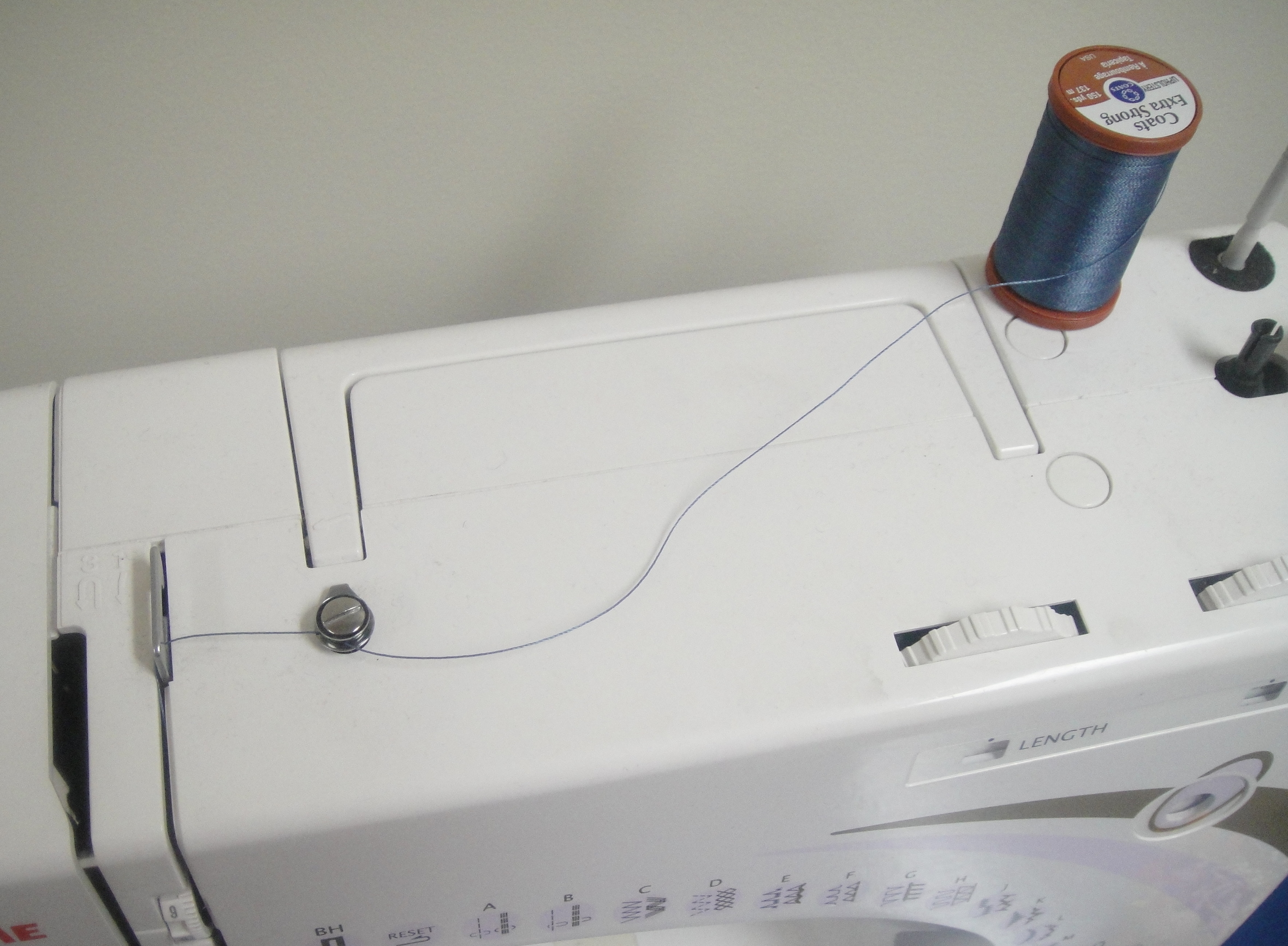
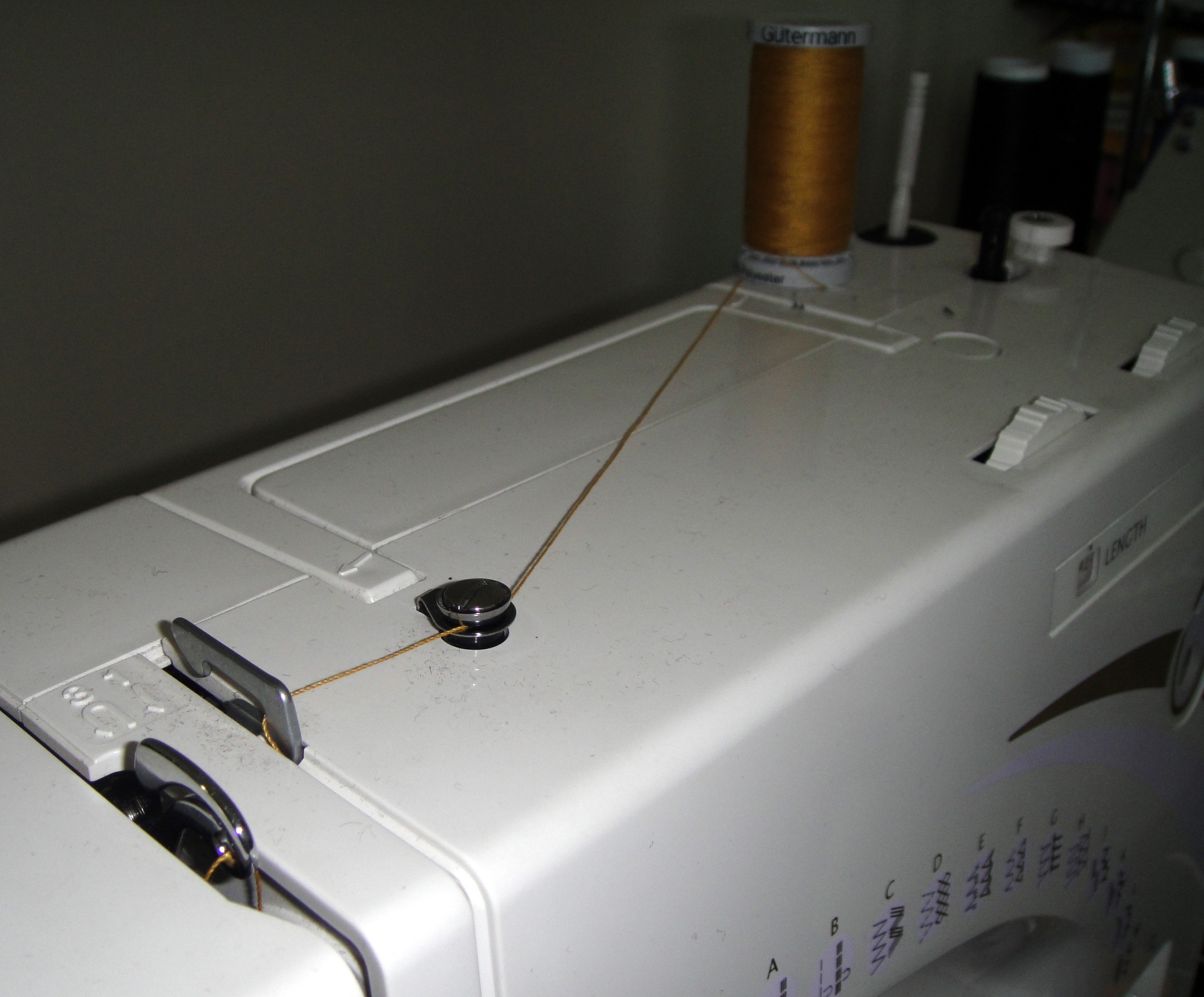
      Thread setup for dealing with mega topstitching thread: wrap around the little round bobbin-winding doohickey before threading as usual. Actual Guterman Topstitching thread not shown.

      By this I’m referring to the Guterman Tops-titching thread, which is the thickest of the threads I’ve found. It’s also a bit “fluffier” than, the heavy-duty threads above. But it comes in a wide range of colours and looks really striking. My Janome has major problems with this thread, which basically come down to the tension. The highest tension setting on my machine is too low. Possibly I could adjust the bobbin tension to compensate, but when stitching jeans on a single machine you’re re-threading just about every other seam. I wouldn’t want to add constant bobbin-adjusting to that procedure. Eventually, I came up with a sneaky tension fix where I wrap the thread once around the bobbin-feeder, which has its own little tension disk, before threading as normal. This increased the tension significantly, to the point where I could actually keep the regular tension pretty close to its normal setting. The other problem I have with this thread is it often gets snarled in the bobbin in the first couple of stitches. I found it was possible to keep this from happening by holding on (firmly!) to the tail of the thread when starting the seam.

Topstitching feet: 1) 1/4" edge-stitcher; 2) rolled-hem foot; 3) blind-hem foot

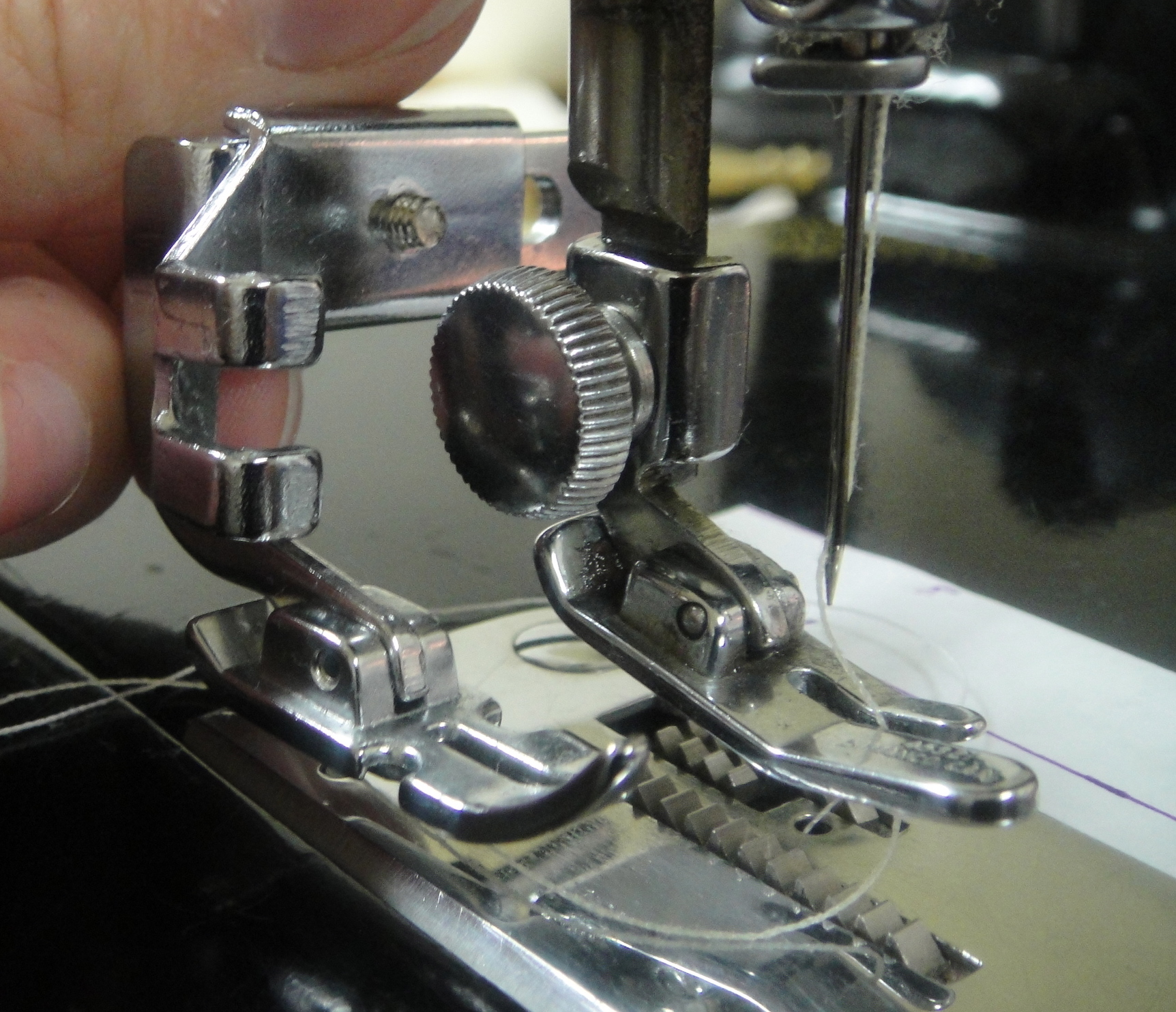
Topstitching foot. There are a lot of different sewing-machine feet that will work for topstitching, but your standard zig-zag foot is not the

Straight stitch foot (on Featherweight) and adjustable zipper foot. Both have open toes and can work well for topstitching.

best. Basically you want something with an open toe, so you can see precisely where the needle is on your fabric, and edges you can line up to get a consistent width. I don’t recommend trying to twin-needle denim, although I did hem some jeans this way early on—you’re liable to break at least one needle, at which point it gets very expensive very fast. My favourite topstitching foot is an actual edge-stitching foot with a handy keel (mine cost five or six bucks), but an ordinary straight-stitch foot like the kind that my Featherweight has also works really well. A blind-hemming foot works well in theory, but my particular foot the movable keel has a tendency to wander along its screw over long seams, which is less than useful, and it’s hard to re-set it to a precise width. My rolled-hem foot actually worked surprisingly well—just ignore the little scroll part and it’s got sides the right width and some handy grooves in the bottom. This was my favourite until I got the edge-stitch foot.

Fly:

I don’t have a HUGE number of tips on stitching up the fly.
  1. Find the tutorial that works for you. I have good luck with Debbie Cook’s; if you’re a video person (I’m not), Sandra Betzina’s video on the Threads website also comes highly recommended.
  2. Keep a RTW pair on hand for reference. This makes it much easier to keep track of which side to topstitch and stuff like that.
  3. Interface the fly, either with something fusible or with fabric from a front pocket extension. It will be a much happier fly later on if it’s a little more substantial.
  4. TRUST THE FLY. This is one I’ve only recently come around to. After you’ve got your fly constructed and your waistband on, it’s very tempting to try and tweak your fit that last little bit by moving the button one way or the other. Don’t. The button needs to sit so its shank is just at the end of your buttonhole. If you try to mess with this, you will end up with a gaping fly.
My own jeans have ranged from barely wearable to being far and away my favourite pair. I wish I could say there was a consistent improvement in this, or that I’d made the absolute perfect jeans even ones. I haven’t.  But I have had a lot of fun, and gotten some very wearable jeans for a lot less than I would pay at the store. There’s a lot of things RTW jeans have that I can’t imitate—fabrics I can’t find, embroidery I can’t do. My next step will be hunting down some really quality buttons and rivets, as the ones I can get locally are slightly sub-par, or at least, not quite right for jeans. I haven’t even tried my hand at distressing any of my me-made jeans, although I won’t totally rule it out in the future. But there’s plenty of other neat touches I can add, and thinking of what little detail will make that next pair special is one of my favourite things about making jeans. If you can pick up a pair at Walmart and are good to go, then making your own jeans probably won’t be your thing. But if, like me, you’re picky, hard to fit, or get stressed out trying to find that perfect style, making your own can be both fun and money-saving. I’m one of those people who regularly spends over $100 on new jeans, and I can’t reliably find any at the thrift store that are long enough and haven’t been worn to ribbons. Even paying full-price for quality denim, I can cut that price in half, and be just as happy—or happier—with the final product.
Damn. Now I want to make some more jeans.

Jeans!

31 Comments

Filed under Sewing

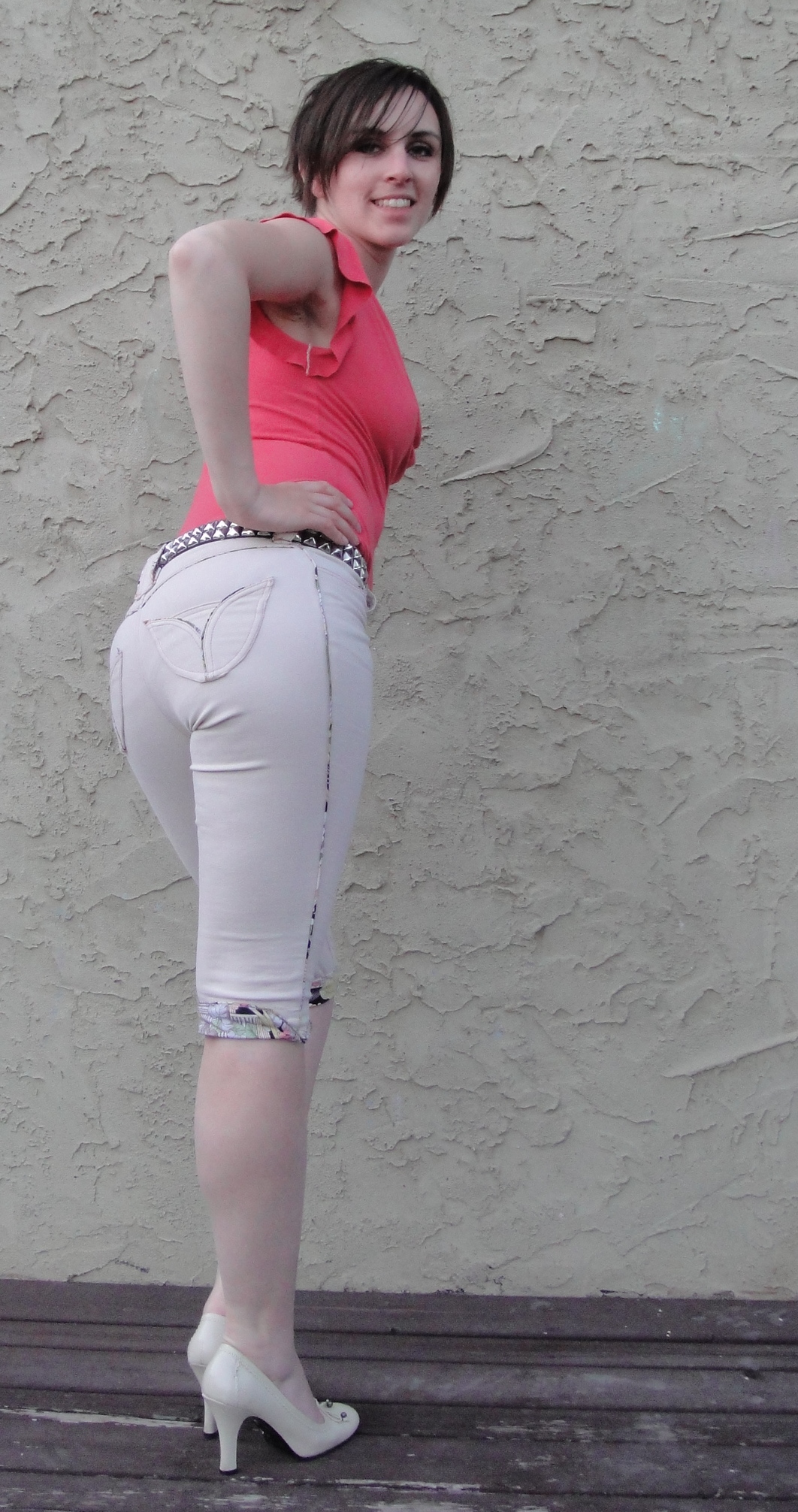
Cream Spice Capris

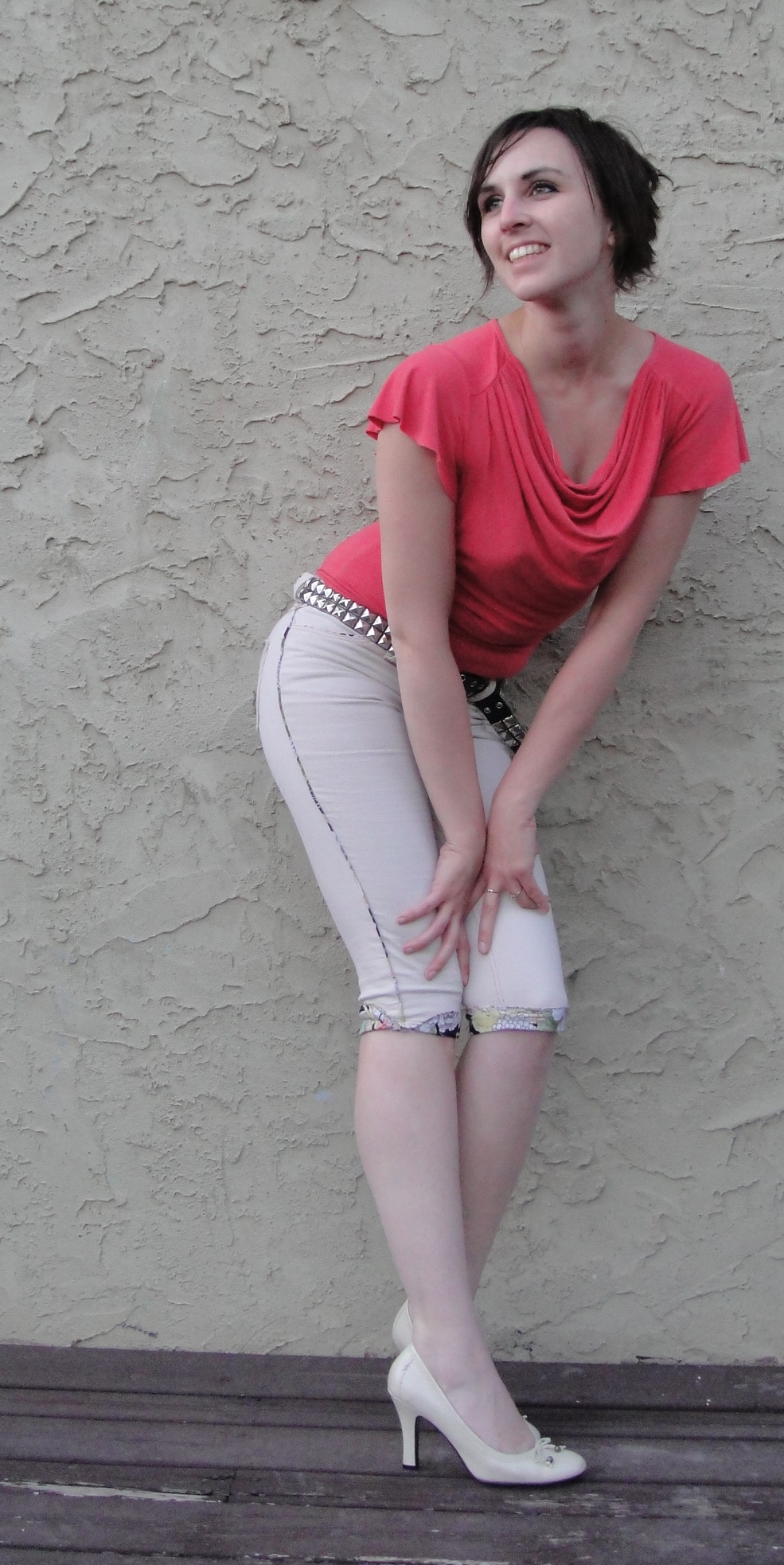
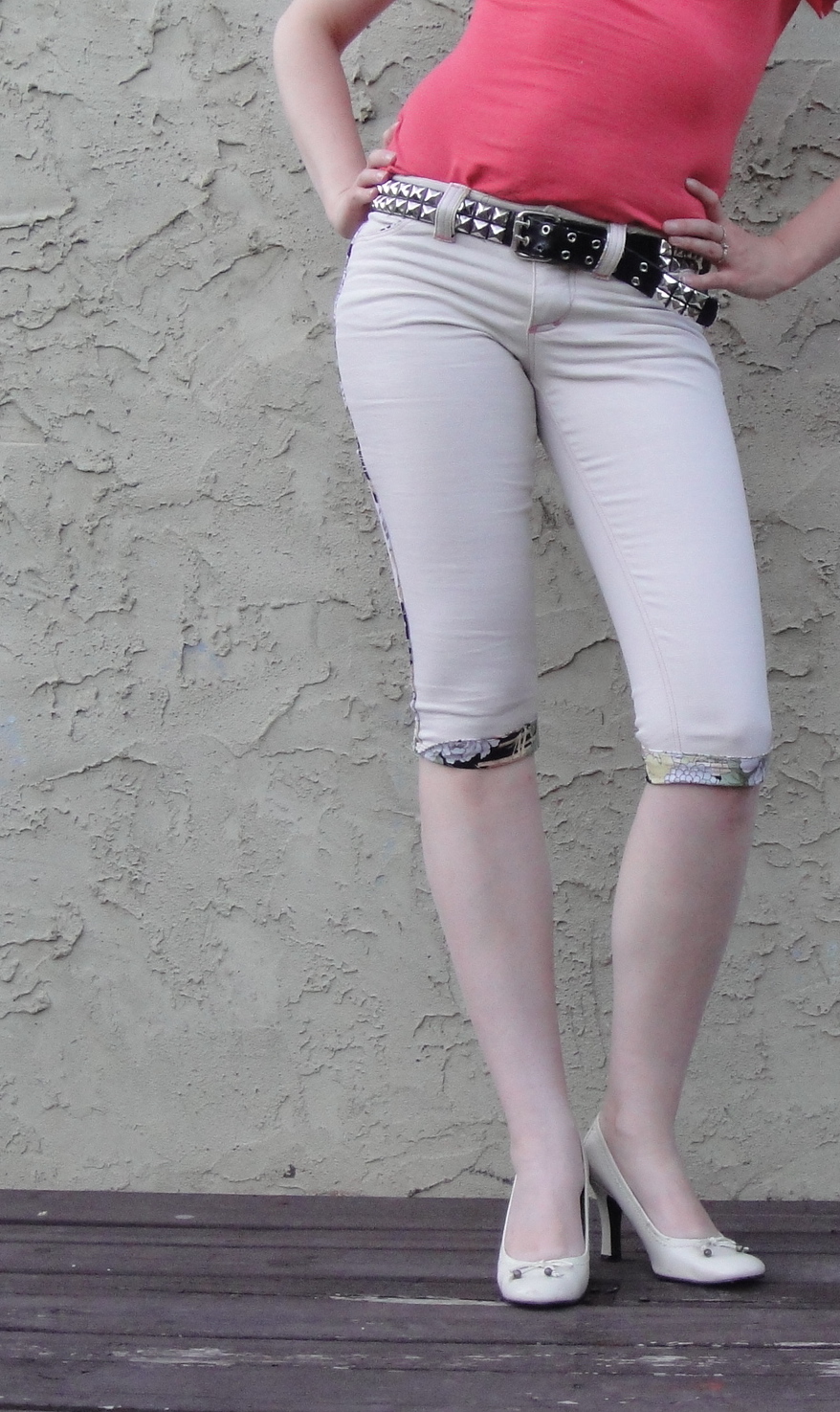
Cream Capris

I love that I was able to take these photos at 10:00 pm at night, outside, without a flash. Now if that doesn’t scream summer, what does? (This is where someone who’s from the real “up north” chimes in with a comment about the midnight sun. /envy.)

Superfluous shot

So, the capris are done. And they are fun, although as usual there are a couple of issues (beyond my indifferent topstitching). The biggest one is simply the fabric—although a lovely and stretchy cream denim colour, and heavier than some of the jeans I’ve made, the fabric is a bit thin for jeans. Meaning while it stretches nicely to fit, it, ah, hugs all the lumps and bumps rather than smoothing them. When you add portions like the pocket and the rear yoke, that don’t stretch nearly as much, it also creates a few lumps and bumps that wouldn’t be there all on their own. Tucking in tops CAREFULLY and choosing the right pair of underwear are also going to be important (VPL in jeans, who knew?)

Other than that and the Featherweight Tragedy, I’m pretty happy. The piping is nice, the wonky topstitching is fading from memory (fortunately it’s on the butt where I don’t need to look at it), and I finally remembered to make my belt-loops wide enough for all my belts (although it’s the narrow one I’m wearing in the photos).

Rear View

If I were to do it again I would place the pockets higher or make them a little taller. The dip between the petals in the top eats up a surprising amount of space, both visually and practically.

Front view

I like it with the cuffs turned up. Although, the non-stretch lining of the cuffs doesn’t interact especially well with the stretch denim when putting these on. we’ll see how that goes.

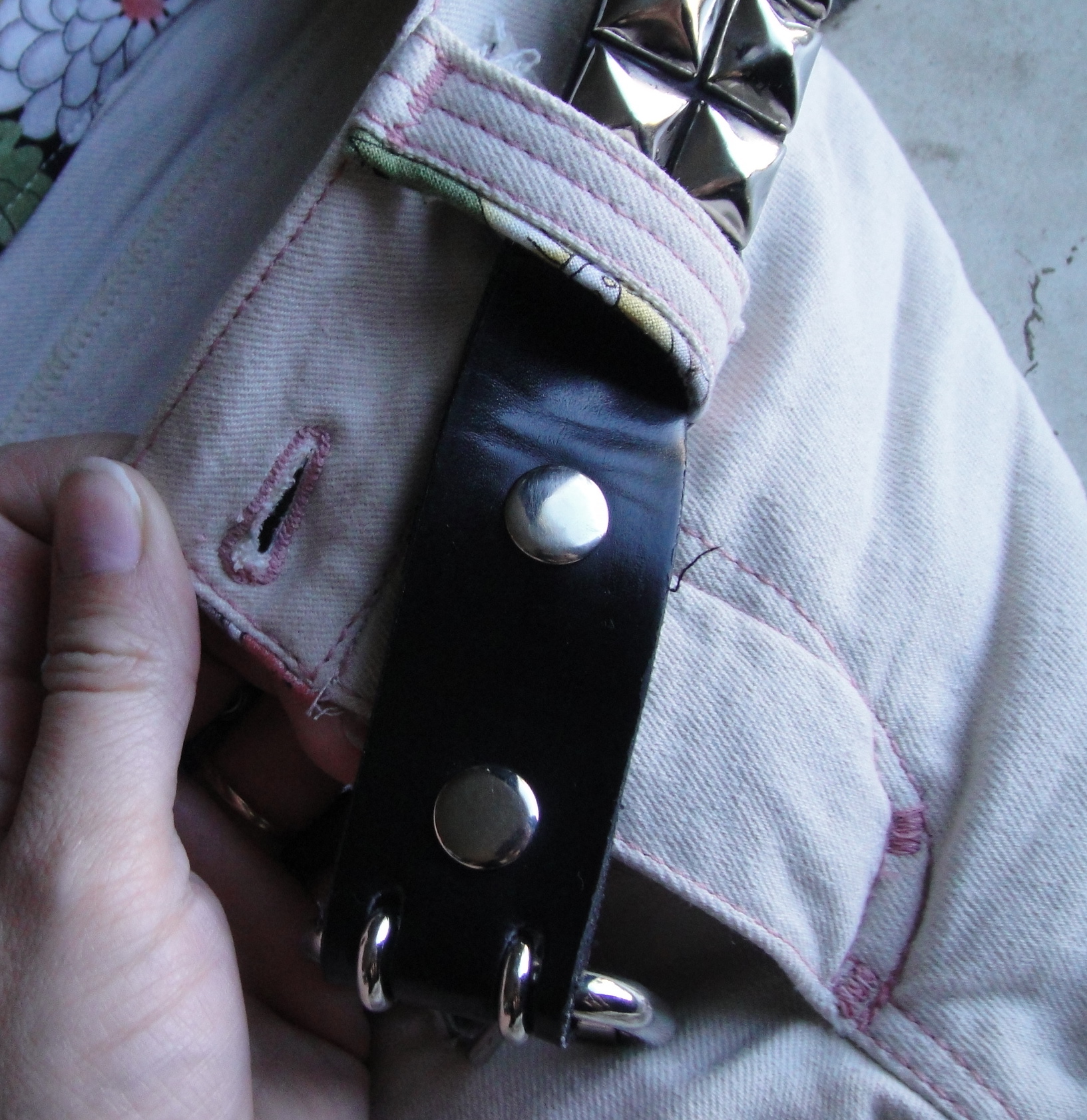
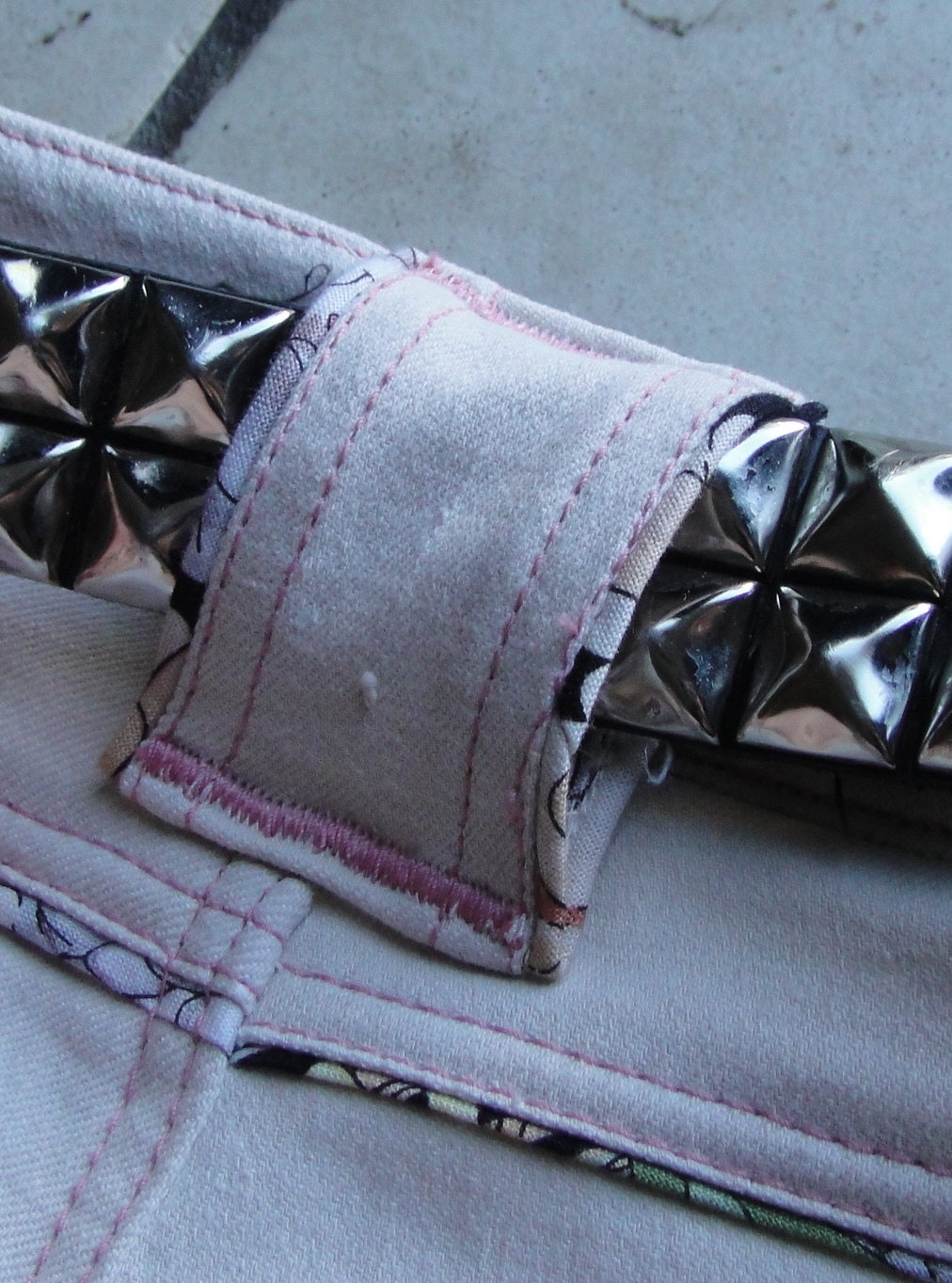
Centre-Back belt loop

I put a lot of strain on my belt loops, especially at the centre back, so I like to elaborate them in some way. Often I use three instead of just one at the CB. This time, I made one giant one with piping on both sides. I just piped both edges and topstitched to keep the bias on the inside. Super easy, and a nice finish to boot.

Belt-loop and button

For the other belt-loops, I wanted them more narrow, so I put piping on only one side and just folded the other side under and topstitched.

Vintage buttonholer buttonhole!

This is the first truly successful jeans buttonhole I’ve done—made with the vintage buttonholer and one of my new templates, the short keyhole. It’s the perfect size for the jeans buttons I have (which are admittedly a little wimpy. One of these days I’ll order some genuine good all-metal ones. /sigh.) I will note I find it quite odd that when sewing straight lines on the Janome with heavier thread, I have to turn the tension way up (and often do some other jiggery pokery) but then when zig-zagging I have to turn the tension way down.

You can just about see my neat feature on the fly where I had the two lines of topstitching criss-cross halfway down. This has nothing to do with the fact that my zipper was placed a little too far out from the centre front and couldn’t make the stitch line right where I wanted. Nothing at all… (I find it interesting that some people, who are following the exact same tutorials I do for fly zipper insertion, find that their zipper is still too close to the CF line and tends to gape. I have the opposite problem, with my zippers ending up tucked too far under the fly and often interfering with my ideal topstitching line (the Jalie pattern doesn’t leave you much room for error in this, either, as there’s not a huge fly extension).

Fun pants!

This pink thread is Coats & Clack Heavy Duty XP Dual Duty, or something like that, not the super-fat Guterman topstitching thread. Janome actually likes it fairly well, meaning all I have to do it turn the tension way up, not some of the other finnicky workarounds I’ve come up with for the topstitching thread. But for some reason it all goes whack when zig-zagging—whether with the buttonholer (in which the machine is still set on straight) or the zig-zag stitch. Featherweight handled either flawlessly, although she needed a bit of a tension boost too.

Featherweight afficionados, I have a question: I have generally been advised to use regular thread in the bobbin with my topstitching thread up top. Despite the annoyance of winding extra bobbins, there are times when it would be nice to have topstitching thread on both sides (turn up cuffs, come to the front of the class). Also I can’t help but think it might be sturdier (I have had a fair bit of topstitching failure on some of my earlier jeans where the bottom thread has broken). Can the Featherweight handle this? Any particular pros and cons?

My favourite feature is the piping, I think. I may have to add that to more jeans in the future. But then, piping is kinda addictive at the best of times…

Other things to try in the future:

  • change up the front pockets. The Jalie pocket line manages to be both distinctive and boring. I love the double pockets on Patty’s pair (pattythesnugbug.com is transitioning platforms while I write this so I can’t do a direct link, but looks up her pants posts, she has lots of great musing on fitting and styling)
  • something with lots of rivets. Lots and lots of rivets. I love hardware as much as the next crypto-Goth.
  • distressing. I generally like my jeans fairly crisp and dark wash (obviously these are not dark, but you know what I mean). I lost my taste for buying pre-worn-looking denim right around the time I had to start paying for my own clothing. When you have a $90/pair jeans habit and are on welfare home with a small baby*, you need your jeans to LAST, because you’re probably not getting another pair for a long time. That being said, since I’m making my own, it would be ok to have some more casual pairs with a more RTW look. Just no pre-made holes and paint splatters, please.
  • I have had fun messing with the back pockets on these last few pairs, too. It’s the little details that really make (and distinguish) jeans.
  • draft and make a pair for my husband. Yes, I’m a sucker for punishment. I’m also seriously considering using a women’s draft for him (don’t tell him) as he really fits the women’s measurements considerably better than I do (don’t tell him that either). Boy got back. Which is where Tyo gets it, of course.
*This situation lasted precisely one year. I am profoundly grateful for the social safety net, even gutted as it was after the 90s, as my hubby and I would not have been able to make it through the transition from goofy teenagers to responsible parents without this government aid.** And I would rather shoot myself in the foot than go on welfare again. It SUCKED.
**and considerable support from both our families. I don’t once regret having my children when I did (especially as my field, like most academic ones, doesn’t really put you in a good position to have a family often until your late thirties), but it was HARD. I suspect it’s always hard, but I know we couldn’t have done it—certainly not nearly as well—without our extended families. So on the off chance of any of them reading this

34 Comments

Filed under Sewing

Tulips and Tears

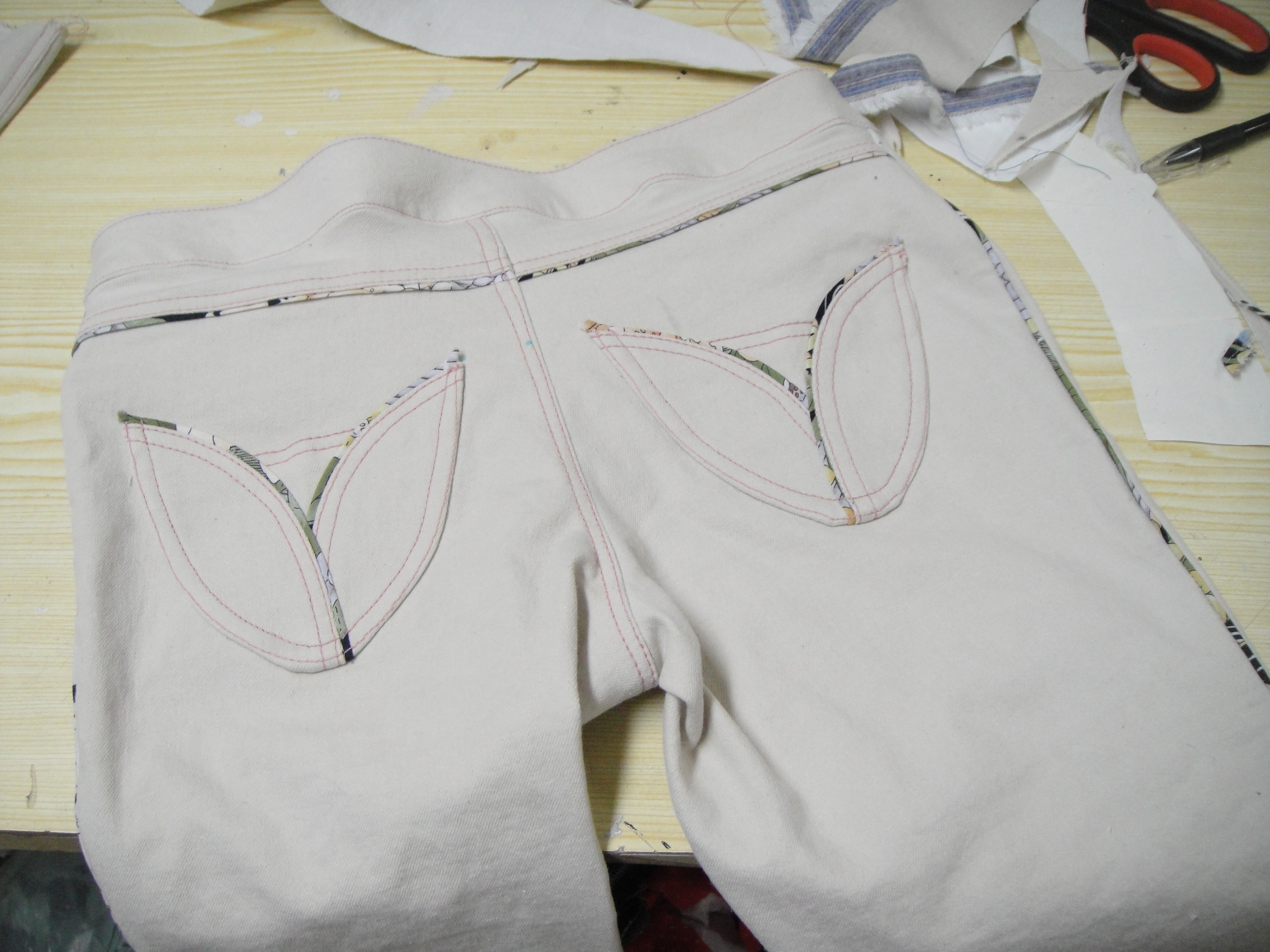
Tulip Pockets

When I could finally pull myself away from stitching random scraps on my new Featherweight, I settled down to start work on my cream capris. Same old pattern (Jalie 2908), hopefully a few new details.  I was SO excited to be able to thread the Featherweight up with topstitching thread and a) not have to re-thread every other seam and b) not have to jolly my Janome along (she will sew topstitching thread… with some careful finagling).

These pants are inspired by a couple of pairs of my kids’ jeans (kids’ jeans get the best little touches!), with piping and what, for lack of a better term, I’ll call tulip pockets. Using some of my japonesque-print fabric for the piping and pocket lining.

While I maintain that the idea is sound, the execution could use a little tweaking. In particular there’s three layers of denim and four layers of cotton at the bottom of the pockets, making folding and topstitching a little, ah, haphazard. I may have to go back and redo some of the topstitching. Bleh. That’s what I get for trying to cram everything in to an evening.

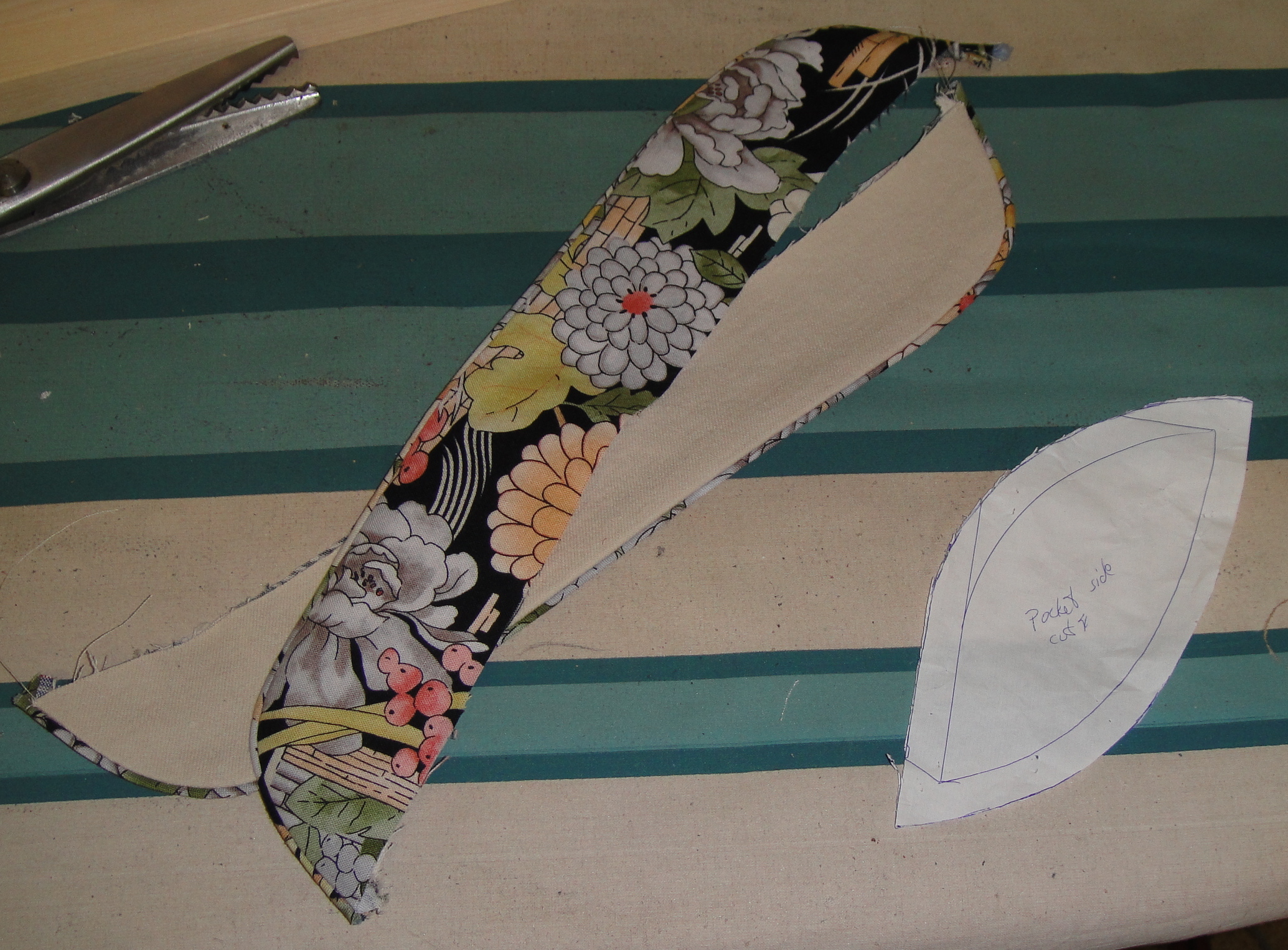
Three pocket pieces

Anyway, aside from the piping, I used three pieces for the pockets—well, two pattern pieces. The overall shape is based on the shield-shaped pocket I used in the bellbottoms; I traced it off, drew in the curve to make a half-piece, and used a slightly shortened version of the original piece for the backing. I was originally going to just overlap the two “petal” pieces and topstitch them together, as in the inspiration pants, but unlike my children I tend to actually stick stuff in my back pockets, and I wanted to make sure it would stay there, so I added the third piece (rightmost in the photo). Really I should just have used a tiny triangle to fill in the top of the tulip a bit, but the full backing piece was really nice for getting the overlap of the tulips (sorta) symmetrical. I say sorta because I think I inverted two of the pieces by accident when I was piping so the curves aren’t identical. Fortunately, I was able to make the two slightly asymmetrical pockets mirror each other, so it worked out.

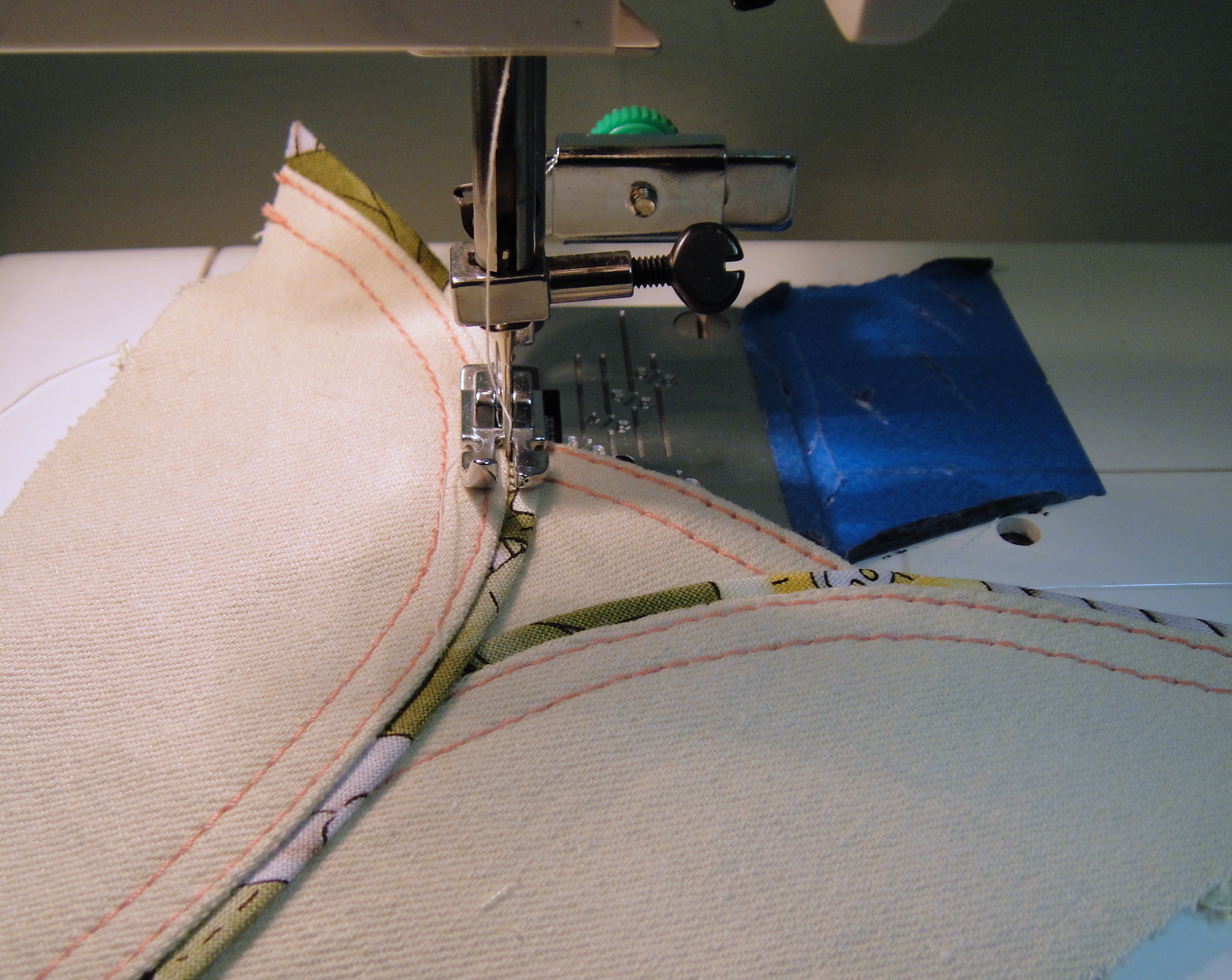
Stitch in the ditch

I stitched in the ditch at the edge of the piping to attach the various pocket pieces together, using washable glue-stick to hold things in place. I used the adjustable zipper-foot on my Janome set up as a straight-stitch foot (with the needle going down the middle), so I could see the “ditch” to stitch in it. This helps a lot. Although the feed-dogs on the Janome are definitely not well-positioned for use with a foot this narrow when it’s centred.

Swapping machines during the same project is a new experience to me (the serger doesn’t count, that’s an entirely different beast). The Featherweight is so slow (actually a good thing, especially for topstitching!) and quiet, the Janome is much louder and sews much faster. Also it’s taking some adjusting to remember which hand to use to raise the presser foot. As a lefty, I loved the back position of the presser-foot lever on the Grand Old Dame, and it took quite a while when I got the Janome to get used to lifting the presser foot with my right hand, as the lever is tucked on the inside under the harp. Now, of course, it feels weird to use my left again. You can of course reach under the harp and lift the back lever with your right, but my battered inner lefty is determined not to give in to the right-dominated world in this one small thing (I already use scissors and a computer mouse with my right hand, dammit)

Cuffs

I also made little cuffs for the bottom of the jeans, lined with the japonesque fabric, and hopefully they will look cute turned up or down. I picked the pink topstitching thread as it matched some of the pink in the print, but I’m wondering now (of course, too late) if the somewhat darker blue I was also considering would’ve been better (to make the piping seem a little less stark.)

You can see in the very first photo that I piped the outer seam on the leg. This took some deep breathing on my part, as that’s the place I like to twiddle with the fit, which varies from pair to pair based on the stretch of the fabric. With piping, there is no fit twiddling. But it seems to have worked out, anyway.

My poor baby!

Readers, I have sinned. It has been… two days since my last confession, I guess. Tragedy struck while I was topstitching the fly with the Featherweight. I very carefully marked my curve so I would miss the bottom of the zipper underneath. In my (not undeserved) paranoia, I even hand-cranked through that area. Then, being safely past the bottom of the zip, I went to finish the last inch of the topstitching and—I broke the needle. My guess is I was pulling on the fabric and pulled it off centre with the needle in it, hitting the edge of the needle plate instead of its nice little hole. And after I replaced the needle, it wouldn’t stitch! Or, it’ll stitch once or twice, and then skip five, and then catch one… and… and…

I have a feeling I’m going to be stalking the Featherweight forums this weekend.

Forgive me, Sewing Gods! I have damaged my beautiful, new, vintage machine.

In penance, I shall do five pieces of mending and one full unselfish garment.

I guess that’s one upside of new machines. I wouldn’t be nearly so distressed if I had screwed up my Janome. Of course, I’ve broken probably a dozen needles in her in the exact same way. She puts up with my crap marvelously. Obviously I need to be a little more careful of the Featherweight. She is even older than my mother, after all.

And to make things worse, I have to finish the pants ALL on the Janome.

I’m going to go cry now. And put some belt-loops on the capris.

But mostly cry.

34 Comments

Filed under Sewing

The Bell-bottoms

Vintage wranglers (with accessories)

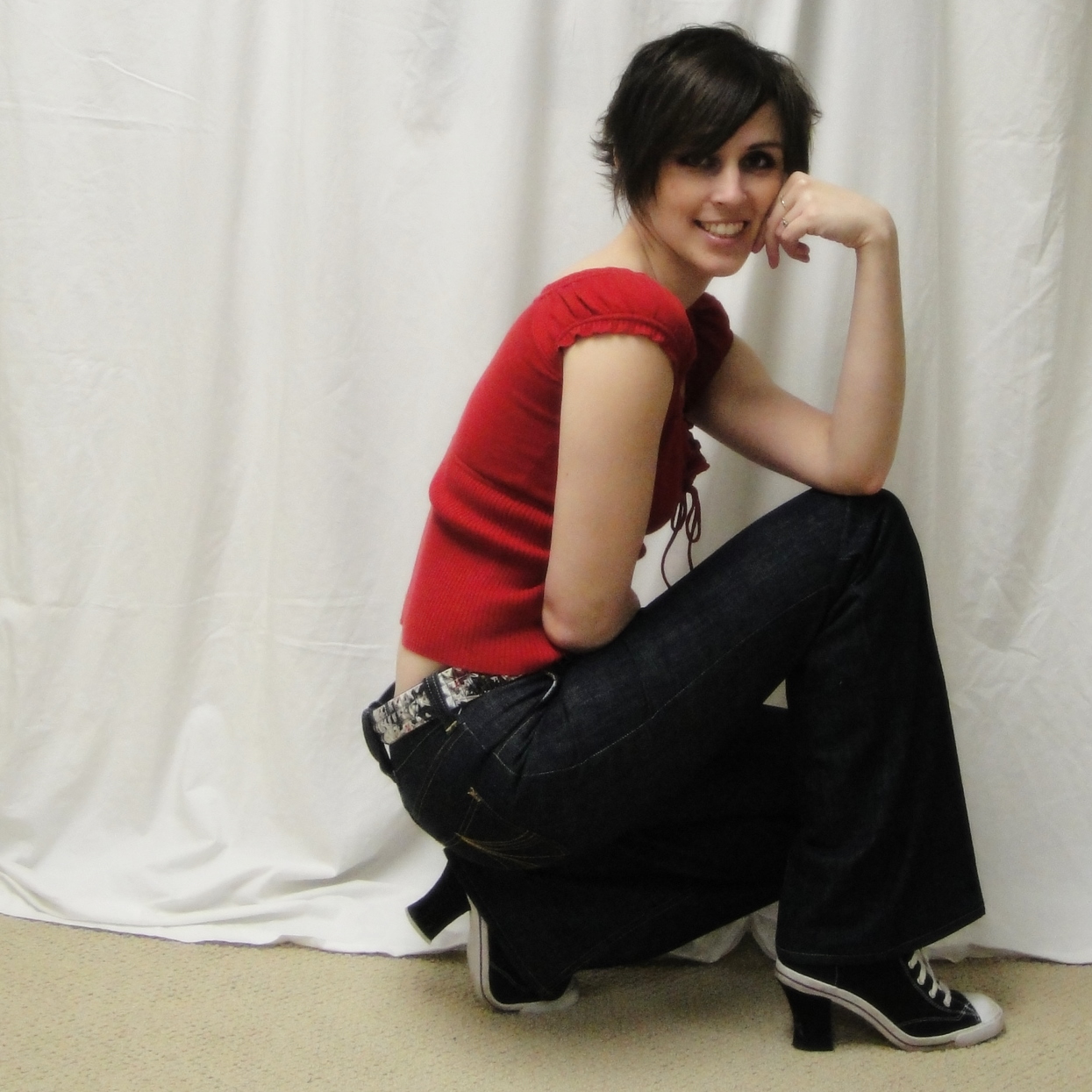
In about 1997, I stumbled upon two pairs of bell-bottom Wranglers, presumably vintage but more or less pristine, at a garage sale. They were a little big, but at least that meant they sat a bit low on my hips. In those days, stretch denim and low-rise pants had not yet penetrated to my little backwater… I was still wearing my Levi 501s and trying to figure out why anything that fit at the waist had huge flaps at the hips.  At seventeen you don’t really have a clear sense of your body… all I knew was that the look I was seeing wasn’t quite right. I was also still wrestling with my 80s-bred distaste for any pants that flared at all. The wranglers hung off my hips at the perfect level, though, and if they didn’t hug or skim anything, well, as long as I could show off my tummy, at that point I didn’t much care. I wore them with boho shirts and a metal-link belt that had belonged to my mother in the 70s, if not the 60s. I didn’t realize it at the time, but I would be wearing bell-bottoms more-or-less exclusively for the next decade.

Ellen Bellbottom Jeans

Although I was never a serious devotee of the flare (I don’t have the hips for wide ones), I was a late adopter of the skinny jean, as well—I got my first only a little over a year ago.  But I haven’t had non-stretch, old-school flares since I ousted those Wranglers, round about the birth of my first child.

Then, Joy’s Bellbottom Challenge cropped up and, coincidentally, I wound up with two metres of absolutely gorgeous dark-indigo non-stretch denim. Obviously the two would have to combine into some seriously retro bellbottoms.

Not, however, as huge and sloppy as my old wranglers, however. So, I went to my handy-dandy Ellen pants pattern, which is my only non-stretch pants pattern (that I know fits, anyway…), traced it off, made the adaptations for jeans (back yoke, front pockets), brainstormed a couple of different ideas for the closure and the pockets, and got to work. Ellen is a great pattern for mods like this because it’s completely free of style details if you leave off the pockets.

I opted to have the legs flare from about mid-thigh. I probably could’ve gone a bit lower, but I wanted, for whatever reason, more of a wide-legged look than a hip-hugger look. I added what seemed like it would be a modest, but definite, flare.

Front lace-up fly

I decided, for no particular reason, to make a corset-closing front rather than a traditional fly… I had a pair like this shortly after Tyo was born, and I always loved the feature (I have a bit of a weakness for things that lace up.). I haven’t decided whether to add grommets to the waistband itself, or buttons with a tab stretching between them. We’ll see. Although inserting grommets is always a little nerve-wracking, this was still simpler than a fly, for those of you who are chicken of flies and not afraid to look a little out there ;).

Bound waistband interior and flat-felled seams

Bound waistband interior and flat-felled seams

I did my new favourite waistband-finishing technique, binding the inside with bias tape (this time the blue satin left over from my springy coat facing), and, since the Ellen has 1.5 cm seam allowances rather than the 1cm of the Jalie pattern, I decided to try my hand at (ulp) felled seams.

They were… ok. Definitely not perfect. In particular, although my yoke seams lined up at the seam-line, the way the seam-allowances interact in a flat-felled seam means that after they were folded over, the yokes look offset. Boo. On the up-side each seam is only stitched twice, instead of three times, and there’s less swapping back and forth of threads. The trimming and pressing takes a lot longer, though, and I think I get more even topstitching with the “cheater” method. Hmm. We’ll see. A big part of me is still convinced I’m not making proper jeans if they don’t have felled seams. Hmm.

Bellbottoms

Bell-bottoms: back

I hemmed them LONG. If they don’t shrink up in length, I may have to shorten them. That’s ok. I’ve been traumatized by too many too-short pants over the years to mind a bit of extra length. And it’s fun to put on heels and still have only my toes peek out.

So... much... leg...

Click through to the full-size rear photo to get a better view of my back pockets… I made them shield-shaped to echo the corset-fly.
My hubby, a diehard child of the 80s, has already expressed his dislike of them. I explained that I think I’m allowed to own one pair of jeans that he doesn’t like. He countered that he doesn’t own any jeans that I don’t like. I pointed out that’s only because he won’t go shopping without me. I think this means I win, don’t you?

It really doesn’t show in the pictures, but I also did one vintage thing that I’ve never before attempted on jeans.

I pressed creases front and back in them. I think they look very smart.

Now all I need is a 70s blouse to go with them… 😀

(I think I’ll have to do a 70s week in Me-Made June, what do you think?)

51 Comments

Filed under Sewing

Capri-cious Camo

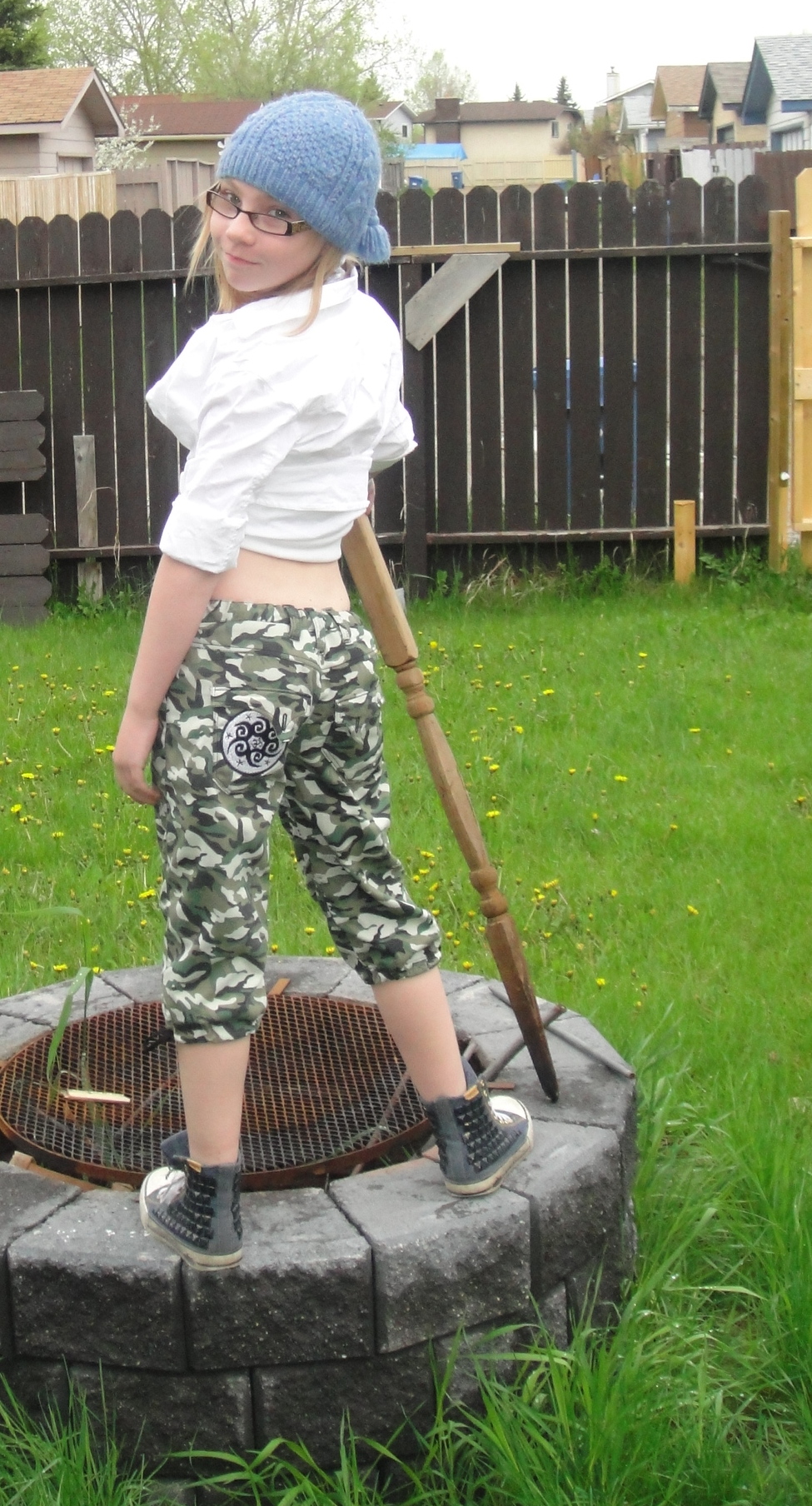
The Capri Girl

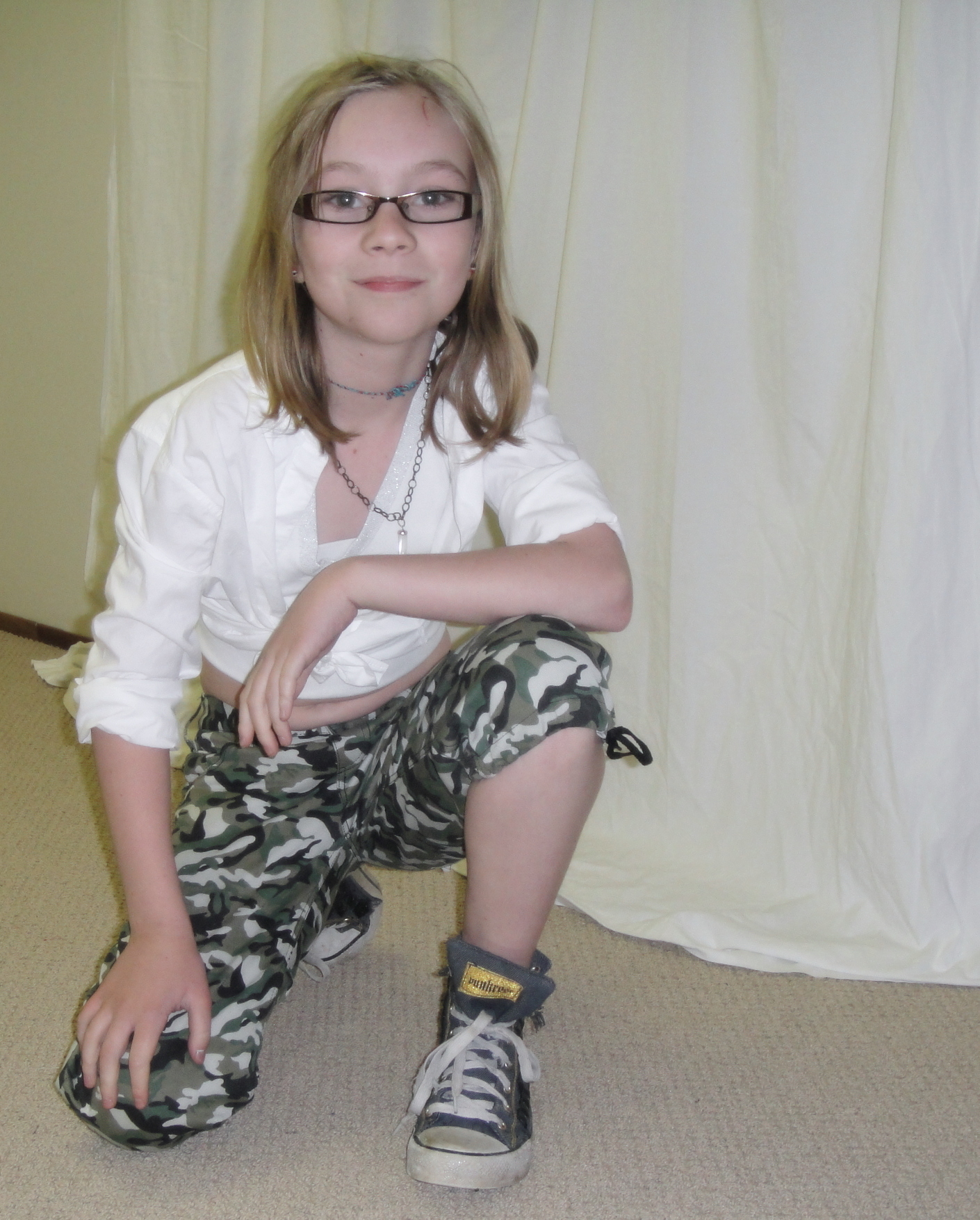
Tyo’s camo capris are finished. It’s been rainy so I’ve been carless* and hence unable to make it to the fabric store for the finishing touches (buttonhole elastic for the waistband and twill-tape for the leg drawstrings), so I had to improvise. I found the missing black thread under the couch, bought shoelaces at the grocery store for the drawstrings, and liberated the buttonhole elastic from the fishtank, where it has been holding down our improvised fish-tank-cover** for the last several months.

I must say, these were really fun to make. The fabric was cooperative, and just the right weight—heavy enough to feel sturdy, without being so bulky as to give my machine fits.

The pattern, as I mentioned before, is from a 2009 Patrones children’s issue. It features five pocket styling (I made six by putting a change pocket on each side… oops!), funky-shaped rear pockets with nifty-shaped flaps, and a waistband designed for buttonhole elastic.

Elastic back waistband

Now, adding buttonhole elastic to a kids’ waistband is easy as pie, but it’s kinda nice to have it marked on the pieces so I don’t forget, since you have to work the buttonholes and ideally attach the buttons before putting the waistband on.

Look, ma! Rivets!

I used my triple-stitch (aka straight stretch stitch) for the topstitching. This is nice because it doesn’t upset my machine the way topstitching thread often does, but it can be a little feisty and you have to pay attention to where you are in the three-stitch cycle when turning corners. It worked quite well on this fabric, though. If you click through to the full size photo, you will also see that in addition to double-topstitching the inseam, I did a single row of topstitching along the outseam! This is much trickier, as you have to do it once the pantlegs are already tubes, and involves sewing down the inside of the inside-out leg, bunching the fabric up around the needle as you go. Slow and fiddly, but I figured these were short and loose enough that I had better try it here, as I might not ever try it again. 😉

Interior waistband finish

Another touch I tried is a bit of a cheater finish—I used some of the bias left over from my 70s jacket to bind the inside of the waistband. I feel justified in this finish because I recently got a pair of (thrifted) RTW jeans that have the same finish. It makes for a super-easy waistband; you just topstitch from the right side, not worrying about catching the underside at all because there’s plenty to catch. Also this is the same fabric I used for the pocket-lining and the underside of the flaps.

Of course, it's all about the shoes.

I cut a Patrones size 10, the smallest the pattern came in. According to her measurements Tyo is a Patrones size 8 on the bottom and six on the top, but with the wonders of  buttonhole elastic, they fit fine. The pattern is cut very wide and flat on the backside, relying on the elastic for any fitting. I took it in a couple of cm at the CB seam, to give Tyo a bit of extra shaping in this area.  My only complaint is that the rise is quite low. Really low, for a kids’ pattern. Especially considering Tyo, ah, needs a bit more coverage in the rear. If I make this again, I’ll add a generous wedge to the CB.

Back pocket with patch

Although I made buttonholes in the rear pocket flaps, I haven’t cut them or attached buttons. We’ll see if I bother or not. I did decorate one rear pocket with an embroidered patch Tyo had purchased at a street fair last summer. It was originally intended for her jean-jacket, but since that’s still sporting its punk/zombie patches from last Hallowe’en, we decided to use it here. I like contrast of camo fabric with hippie/Buddhist patch.

Have I ever mentioned my daughter is way cooler than I ever was?

I can’t wait until these have been washed about a dozen times and get that worn-in-faded-camo look. In fact, I like them so much I might have to think about making myself some. I haven’t worn camo regularly since my feminazi/survivalist-lookalike phase back in Uni.

Tyo's Toque

Also you may have noticed one other hand-made item in these photos. The blue tasseled toque Tyo is wearing was knitted by my mother, for me, when I was about kneehigh to a grasshopper. Isn’t it cute? It has a matching sweater somewhere, too, although that was only finished in time for my little brother to wear it.

All righty, I think that’s more than enough sewing for the house apes (thanks, Katie, for that one!). Time for something for me!

*Our second vehicle is a motorcycle. This is not nearly as practical as a second car (especially in our climate) but is definitely WAY more fun. Except when it rains.

** Instituted after the tragic leap of the much lamented One-Eyed Jack. (scroll down)

18 Comments

Filed under Sewing

Unintended stitching

I didn’t plan on spending this weekend sewing for my children. But no sooner had I finished Syo’s stretchy outfit (yes, there’s a shirt to go with the bike shorts, but frankly it didn’t work out so well and I haven’t even bothered hemming it. Which isn’t stopping her from wearing it, but anyway.) then Tyo had to assert her requirements.

Denim

You see, the other week Tyo and I found ourselves on the far side of town, in proximity to Fabric Depot, a large independent fabric store I hadn’t yet had the occasion to check out. So we did. Their website boasts that they are one of the largest single fabric stores in North America. Which may be true. I had high hopes of finding some good-quality stretch denim, having largely given up on my local Fabricland for this.

Initial impressions were quite promising. A whole room of zippers. Another of lace and elastics. Beaded and sequined panels and appliques to outfit a thousand bellydancers.  An entire upstairs devoted to home-dec fabrics—not what I was looking for, of course, but impressive and some very attractive.

Downstairs again, a series of crowded warehouse-type rooms, fabric bolts stacked on shelves all the way to the fifteen-foot ceilings, often wrapped in plastic to protect them from dust. And there were truly gorgeous fabrics in there, too. The problem was finding them.

There seemed to be, again, a lot of home-dec. A fair selection of swimwear/dancewear lycra knits. I don’t even kinow what else, really. Not only was the seleciton overwhelming, the layout wasn’t condusive to finding anything. Eventually I had to ask to be directed to the denim section.

It was a single shelf on a single unit. The denim range, though small, was gorgeous—a lot of lovely finishes and weights—but none of it was stretch. Not one bolt.

Tyo's pants---centre

My fantasies of sturdy denim in an interesting wash (or even RED!) with just the right amount of lycra came crashing down around my ears. However, the price was right, and we were on the far end of town, so I selected a lovely indigo wash with great texture (and a soft enough weave that there’s a hint of stretch) and Tyo picked out a metre of camo print.

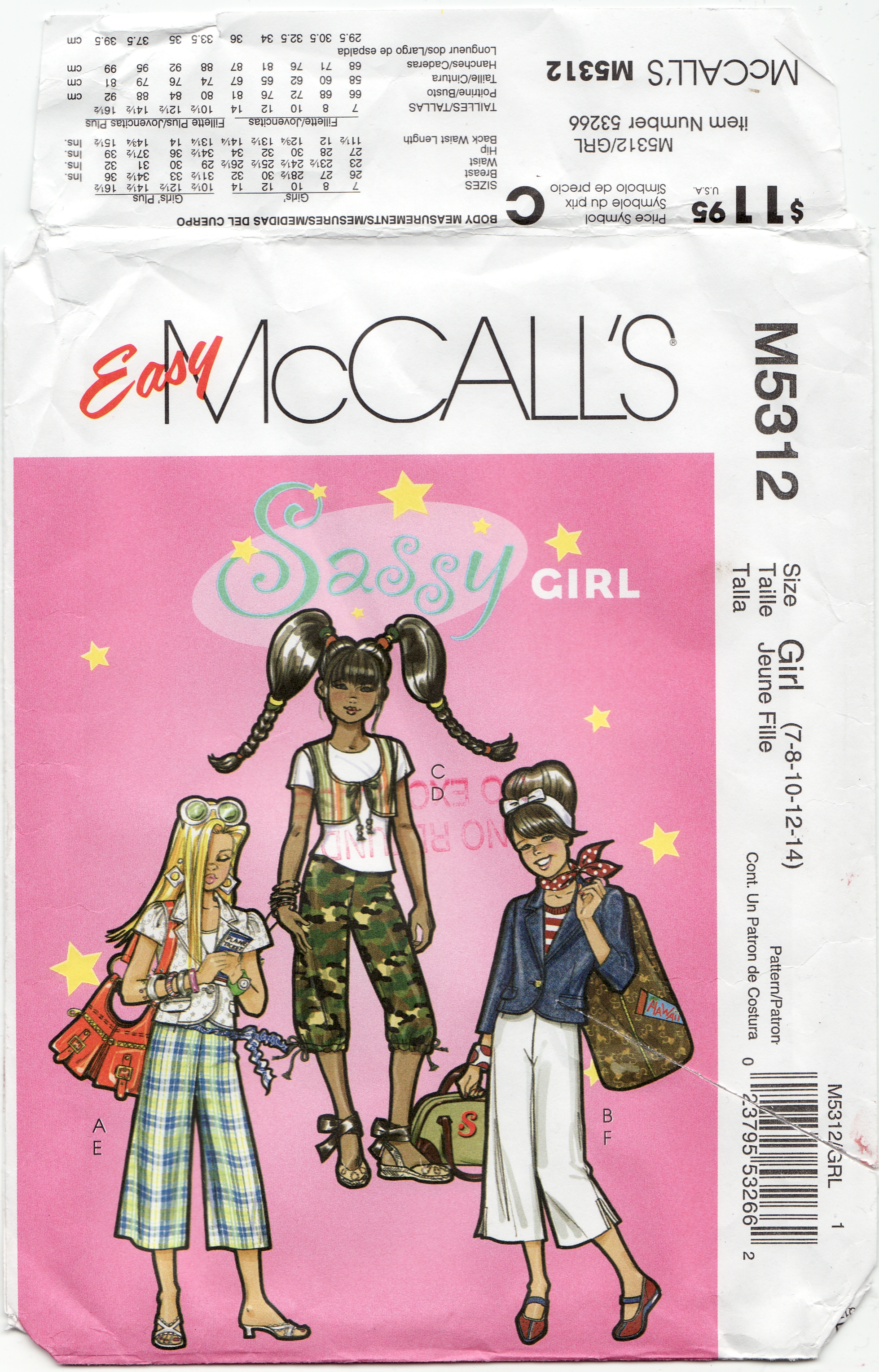
Of course, Tyo could think of nothing for her camo but the centre pants from this pattern—draw-string-bottom capris. She was terribly excited until she realized that the pattern lacks the other attributes necessary of camo pants—waistband, belt-flaps, POCKETS.

So, we went back to our mainstay of kids’ patterns, that gorgeous Patrones Niños I got from Her Selfishnesslong and long ago. It has any number of jeans patterns, including a varietyof capris, including drawstring capris. However, the ones Tyo

Tyo's eventual pattern selection

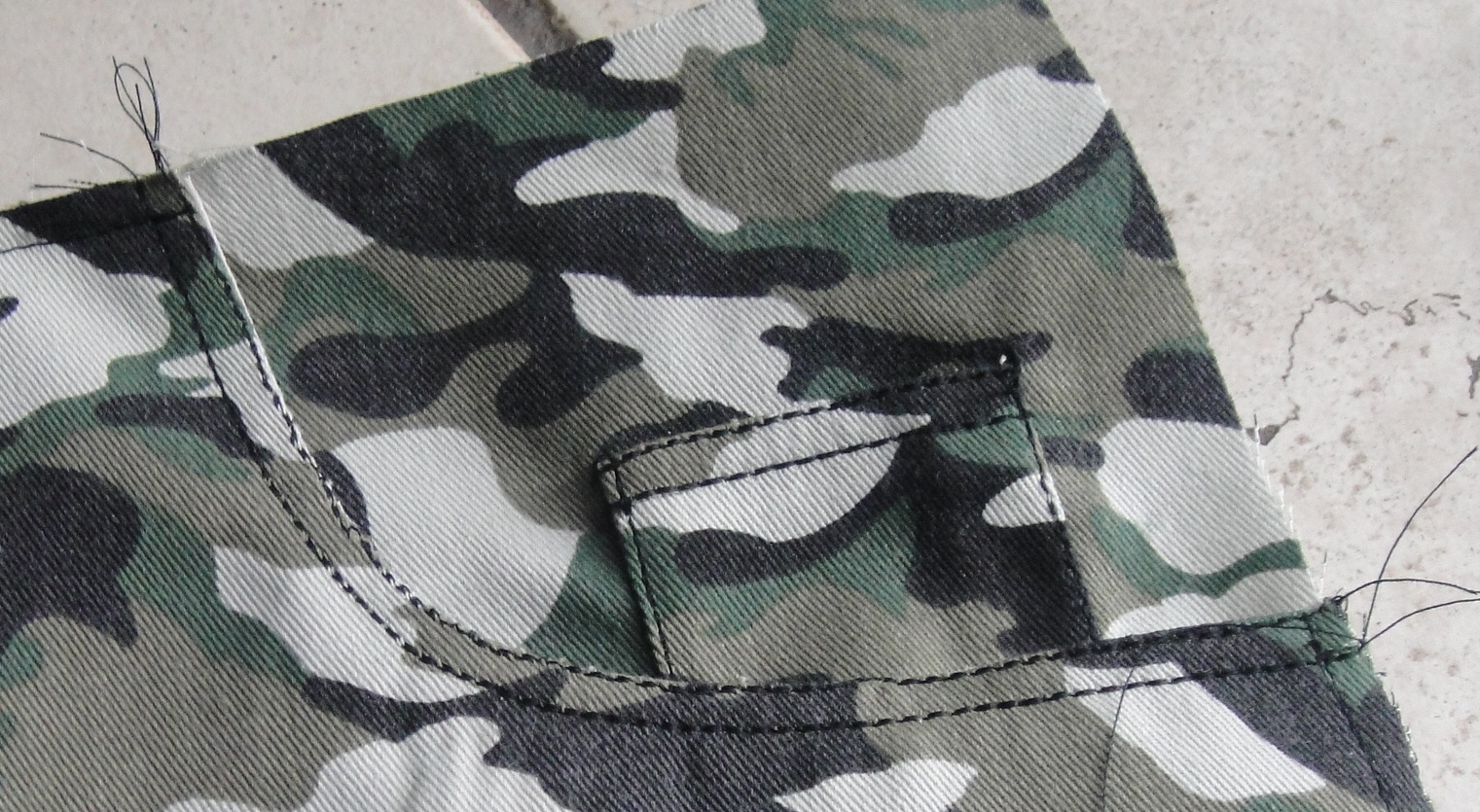
eventually settled on (perhaps without too much thought, but anyway) were this pair. Which you can see almost nothing of except that they  have a loose, below-the-knee leg. The line drawing reveals slightly more (although it’s not actually accurate about the change pocket, if you look closely at the photograph…), including some nifty back pockets.

Line drawing

With terrifying, tightly-curved flaps.

Ulp.

Camo pockets

Anyway, we spent yesterday evening tracing the pattern (I remembered to add seam allowances this time!) and cutting it out. I even managed to track down a zipper of the kind I use for jeans—I thought I was out. We debated the merits of topstitching and settled on black. And this morning, I started merrily stitching away.

And now I’m out of black thread.

Back pockets, with flap

Somewhere in this house, I’m quite certain, is a massive jumbo spool of black thread. But can I find it? There’s plenty of serger thread, but I’ve been suffering catastrophic failure on the jeans I made last summer that I used it on, so I am reluctant to use it for regular stitching. And, of course, it’s May Long (aka Victoria Day) so nothing is open, plus it’s pouring. Which may not deter those of you from soggier climates, but I don’t even own an umbrella, much less a rain-coat.

So instead I’m blogging half-done kids’ jeans, and debating what I should do with my gorgeous non-stretch denim.

I’m thinking bell-bottoms.

14 Comments

Filed under Sewing

To Do, To Don’t, and What do I know?

The latest jeans

So after my great Skinny Cargoes affair, Claire of Sew Incidentally asked if I would consider putting together a do’s and don’ts post for jeans. Since I’m such a master at them, and all that.

Erm.

So, aside from the fact that she must be confusing me with some other blogger, I thought I’d give it a shot. Especially as I decided to crank out one last pair of denim to get me through Me-Made March.

Now, it didn’t take me long after deciding to “take my sewing to the next level” last spring, to decide that I wanted to tackle jeans. Yeah, I’d successfully managed to make my first blouse, what horrors could denim possibly hold?

This was spurred on by a number of factors. The biggest one was probably stumbling on the Jeans sewalong thread and summary thread on Pattern Review. I read literally every post of that 85-page thread. The idea of making my own jeans really appealed to me. First of all, I live in my jeans. Second of all, I’m picky about my jeans and how they fit. Third of all, I have pretty darn long legs. All of those factors combined means that I have spent a LOT of money over the years on jeans. Buffalo. Guess. Rarely under $100 for a pair. You get the idea. And always with that terror—will the fit I like go out of style? Will they be long enough? Even if they seem to fit when I try them on, will I wear them for a day and realize that they’re too short and too loose? Will I tear through the “artfully worn” knee within the first half-hour of putting them on (that pair was Guess, I returned them)? Speaking of which, when is that pre-tattered look going to go out of style? It was in style when I was in high-school (mid nineties). It was in style five years ago when the hubby and I went to NYC (and shopped at Gap. I know, we should be shot.) And it was EVERYWHERE last time I was tying to buy commercial jeans, which was one year ago. I haven’t really looked since, maybe it’s gone away?

Despite the wonky stitching on the pockets (I suck at free-motion embroidery), these are probably still my favourite self-made jeans.

Now, I have a very clear list of things I’m looking for in my jeans. As far as I’m concerned, stretch-denim is the greatest invention of the 20th century (ok, after the birth-control pill). I like them low-rise, with a very fitted leg. I’m flexible on the degree of flare, although for preference I’ll go with what I tend to call a “stovepipe” leg, which is fitted in the thigh but absolutely straight below the knee; I’ve only ever once found this style in RTW.

If your list is different (as it doubtless is—few people are as fond of I am of the low rise, for perfectly good reason), some of my methods won’t apply, especially if you’re not looking for snug-fitted stretch-denim. (What, not everyone wants their jeans to look like they were sprayed on?!?) But I do hope you’ll be able to glean some nuggets from the dross, or at least be encouraged to tackle your own.

Incidentally, based on the PR thread, I used the Jalie 2908 pattern, with an assortment of modifications to make it suit my taste that are mostly detailed here. I like this pattern, but then I’ve only ever sewn two pants patterns, the Jalie one and the Burdastyle Ellen pant. Both were pretty painless, doubtless due to my minimal curvatures in this area. So I wouldn’t consider my endorsement to be the be-all-end-all in this area.

Anyway, without further ado,

DO:

  1. pay attention to the % stretch, not the % lycra; expect to resize slightly depending on the individual stretch of your fabric.
  2. buy enough fabric for two pairs of jeans—the first one can be a hopefully-wearable muslin, and you’ll know what to expect from the remaining fabric stretch-wise.
  3. wash and dry your fabric on hot at least once; then let it sit or hang (“relax”) for at least a day or two, as the heat can bunch up the lycra fibres, creating fabric that will stretch too much after wearing.
  4. My foot for topstitching. Not necessarily the best, just the best from my limited selection.

  5. do figure out which sewing-machine foot works best for topstitching. A lot of people prefer a straight-stitch foot as the sides are narrower and you can see right up to the needle. I don’t have one, but I find my rolled hem foot (of all things) works the best. An edgestitch or possibly even blind-hem foot are also good options.
  6. play around with your topstitching options. There’s jeans

    I wrap my topstitching thread around the bobbin-winding doohicky to increase the tension (AKA cheat)

    thread, topstitching thread (really heavy), upholstry thread, or even regular thread in a stretch straight stitch (triple stitch) if your machine does it. You will probably need to raise your top tension if you’re topstitching with a heavy thread, and may even need to cheat.
  7. be prepared to baby your machine over the thick parts (at least if you, like me, have a wussy modern machine. Sometimes I need to just turn the hand-wheel for several stitches. Or hammer the crap out of the seams (preferably with a rubber mallet. I use a regular hammer or even my rock hammer and if I’m not careful the edges will cut the fabric)
  8. construct the front first, then the back. Have another pair of jeans around for reference. Attach the pockets after sewing the two sides of the back together, and centre them relative to the topstitching, rather than the true CB.
  9. If you’re doing anything other than the simplest of pocket-embroidery, you will want to stabilize the pockets, either with wash-away or tear-away stabilizer or even interfacing. I recommend the removable stabilizer, though; permanent interfacing interferes with the pocket’s ability to stretch and causes butt-flattening. (Ask me how I know 😉 ). Use a cardboard template to press your pockets’ seam-allowance under. Speaking of pockets, I use a size-K pocket on my size-Q pants. My derriere is compact, and I don’t like the bottom of the pockets to go below my actual bottom. YMMV.
  10. Look up your favourite fly-insertion method EVERY SINGLE TIME. My

    What passes for a successful fly around here.

    favourite is Debbie Cook’s; a lot of other people recommend Sandra Betzina’s video. (I have a hard time following video instructions, for some reason.) Also take a long, hard look at some RTW flies while you’re doing it. It will help. Oh, and interface the fly, too. (The fly isn’t actually hard. It’s just really easy to do the wrong way around, which is mildly annoying. The topstitching is a bit tricky, too, but you can manage.)

  11. once you have your jeans stitched up the side, before applying the waistband, do put them on and wear them around the house a bit (preferably for a few hours). This will give you an impression of how much the denim will relax with wear. You may also want to do a trial wash (serge the top edge first) at this stage, as washing and drying are another wild-card for stretch fit.

DON’T:

  1. be afraid. You can totally do this. Denim is heavy, but lovely to sew.
  2. use a pattern or fabric you don’t like. Remember that *perfect* pair of jeans you’ve been mourning since the day went to that great warehouse in the sky? Those are the ones you’re trying to re-create. You won’t, of course, but with any luck you’ll make it into the right ballpark.
  3. cut your waistband on the bias. I use a contour waistband on mine, stabilized with a light-weight interfacing. If I had to go with a straight waistband, I’d cut it on the lengthwise grain, to reduce stretch. My RTW jeans often have about 50% stretch in the fabric, but only about 10% stretch in the waistband (how do they do it?)
  4. sew over the bottom of the zipper when you’re topstitching your fly. Instant recipe for broken needles flying into eyes.
  5. add or remove length at the hem. Unless your jeans are drafted perfectly straight, there’s shaping between hip and knee, and knee and ankle; you need to measure your length to the knee and add (or remove) both above and below to keep the proportions right.
  6. add a wedge to the side back rather than the centre back because you weren’t paying attention. (yes, I did this once.)
  7. if you’re making skinnies, don’t narrow the leg so much you can’t get your foot through (unless you’re adding zippers!)
  8. freak out about wrinkles below your butt. These are not trousers that are supposed to fall straight down from the widest point. There will be wrinkles.
  9. try to finesse the slightly-too-tight waistband fit by putting your button too far over. You’ll just end up with a gapy fly.
  10. feel self-conscious about your wonky-topstitching, or those almost-invisible darts in the yoke. No one is looking. Seriously, they aren’t.

I extend my pocket-linings all the way to the front fly. This interfaces the fly while stabilizing (i.e. slimming) the front, and is super-easy to draft.

I have to admit I feel a bit bad about these lists. They’re tailored so specifically to my “jeans ideal”, which I know is not everyone’s cup of tea. I don’t have much to say about fitting—other than curving the back yoke and taking in the outseams a little bit, and of course the inevitable length adjustment, I haven’t done any (stretch-denim is fairly forgiving). Certainly no messing around with crotch-curves as the intrepid Patty does on a regular basis these days. While I’ve made a crapload of adjustments to the pattern, the majority have been for style or personal preference (pocket linings that reach all the way to the fly to interface it, contour waistband, smaller pockets, etc.)

Coming up with the top 10 was hard (as you can see since so many of them are actually two or three suggestions!). There’s lots of other little points that I could’ve thrown in there.  I didn’t even mention the buttonhole, which has been my waterloo. Mostly, I resort to doing them by hand—not too bad since there’s only one—but on this most recent pair I eased up on the waistband interfacing and was able to work it by machine. My machine can’t do a nice keyhole shape, sadly, but no one else is going to notice anyway.

New skinnies---rear

And I still haven’t really showed you photos of the new pair! So I’ll be quick: this is my first “truly skinny” pair of jeans (the other ones all have stovepipe legs). I made them to replace this pair of RTW jeans that are beginning to bite the dust, and are verboten this month anyway. As you can see (You might have to click through to the full-size photo), I included the same cute little top-stitched dart on the lower leg as in Syo’s pair.

As I doodled out my pocket detail, I

A subtly naughty pocket

realized I’d created an homage to Mary-Nanna’s white knicker jeans (and Steph’s tribute… and of course this alleged Japanese fashion trend which I’m happy to learn is indeed a hoax. I thought it was a bit fishy when I first saw the pictures a few years back, but you never can tell with the Japanese. 😉 ) Mine is a bit subtle, but those of you in the know… well, now you know! ;). If I ever find some white stretch denim, I promise I’ll do full out undies-pockets. The nice thing about making my own skinnies is I can keep the calf-width where I like it and just narrow below; so many skinnies are made for those toothpick-legged adolescents with no calves.

New skinnies, front view

Beyond that there’s not too much to say about them. I used much the same procedure to narrow the bottoms as I did with the skinny cargoes (except I only had two seams to work with, not four). I kept the full length this time, to get that “legwarmer” bunchy look around the ankle that I crave so badly (yes, I like my pants and my sleeves to look extra long. It’s such a rarity for me). Since there’s no zippers in this pair, I had better hope they don’t shrink at all in the wash or I may not get my feet through them next time ;).

So, this is officially my first pair of truly skinny (self-made) jeans… and I hear that apparently the bootleg cut is coming back. If it ever actually left. /sigh. I’m so non-trendy. Oh, wait. That’s a good thing.

I still think I like the stovepipe leg the best, though…

Oh, and this would be my first outfit for Me-Made March. Not terribly innovative, I know, but it’s far too cold out right now for the frillies and the pretties. Hopefully that will change over the course of the month…

34 Comments

Filed under Sewing