Tag Archives: For Tyo

How many ways to bind a buttonhole?

Tyo’s coat is going to have bound buttonholes. There’s only four, surely I can manage that, right? I know the Lady Grey was supposed to be my gentle entry into the world of bound buttonholes, but, frankly, Tyo needs a winter coat more than I need a gorgeous-but-semi-practical-between-seasons jacket right now.

The plan was to make the lips of the buttonholes out of the lining fabric (a sturdy flannel-backed satin) rather than out of the bulky, soft, and flexible fashion fabric. This plan lasted until I actually did some trials, of which I’ll be speaking of shortly. But first… there remains the issue of METHOD.

There is a plethora of bound-buttonhole tutorials out there; I will list only a few

  • Gertie’s
  • Sherry’s
  • Two on Burdastyle, this one which is most like the one in my Reader’s Digest Complete Guide to Sewing, and this one, which is more like (but not exactly like) Sherry’s.
  • Patty the Snug Bug recently reviewed Gertie’s technique and another one from her own sewing books, which is basically the same idea I used for my single welt pockets, but with a welt on each side.
  • No doubt there’s any number of other ones—that’s just what I remember seeing off the top of my head. If you have a favourite (or one of your own), please chime in! 🙂

A lot of VERY bad bound buttonholes

So, this afternoon, I sat down and experimented.

Now, as we all know, bound buttonholes, like welt pockets, are all about precision. Precision is one of those things I, ah, struggle with in sewing. I’m getting better, mind you—my cut pieces of fabric now almost always resemble the pattern they were cut with, I’m much better about getting my grain right, and I press as I sew quite religiously (which gets me a lot of exercise since I sew in the kitchen and press in the basement).

So you will not be entirely surprised to see that exhibit A, to the left, is, well, less than impressive. In part, the satin just wasn’t really working for me—it highlights the flaws, as it were, a little too crisply. (The satin for the final ones would have been the same fabric in black, but I have a ton of scraps left over from my winter coat lining, so I was using some of those. I did manage to achieve passable results with Sherry’s method, but still not to the point where I would be willing to put it in a finished garment (top centre in red wool, bottom left in silver satin). The slippery, fray-y nature of the satin didn’t help, either. Similarly with Gertie’s method. None of the others are even worth talking about (for this fabric and my current skills ;)… there are many sewists out there far more talented and precise than I!)

I had a bit more luck with using the fashion-fabric itself for the lips. It’s a bit more forgiving of my flaws. I was worried that it would be REALLY BULKY. It is. But, it looks softer. However, Sherry’s method is extra-bulky,  so it didn’t work so well with this method, either (centre top… which still looks better than any of the satin-bound ones, I suppose)). Gertie’s, however, did… with the caveat that it’s almost entirely hand-sewn. Only the initial rectangle was sewn by machine (bottom right two buttonholes, one in red, one in black).

This is pretty much par for the course for me. Precision=hand-sewing. I don’t really mind hand-sewing, fortunately (after hand-beading bellydance accessories, anything else is a piece of cake). Still, it would be nice someday to be able to be precise and speedy. Like, say, Sherry ;).

Ah, well. I showed Tyo the buttonholes and she likes the black contrast lips, so I expect we’ll go that route.

7 Comments

Filed under Sewing

Almost progress.

Holy off-grain fabric, Batman.

Left margin is folded on-grain.

Very glad I took the time to thread-trace along a rib. Presumably this stuff was knit in the round and then sliced. I really wish they’d just leave it in the round. So many more options that way.

Thread-tracing along a rib of the knit to find the grain.

I also took the lining pieces and compared them to the shell pattern pieces to see which adjustments I needed to make to them. The coat body lining was pretty easy, but the sleeves were weird. I have always been under the impression that lining pieces should be, if anything, a tiny bit smaller around than the shell pieces, since they go inside—turn of cloth and all that. With the exception of the back pleat, I know. Well, the sleeve lining pieces were wider. Or at least, they were until I added the 1 cm width to each sleeve piece. Now they’re pretty much (I would say) bang on. Am I missing something? Are they just oddly drafted?

And here’s another question for those of you who actually know what you’re doing! The under-collar (separate pattern piece) is drafted to be cut in two pieces, with a seam down the middle. Now, it was my understanding that you do that when cutting the under-collar on the bias (the grain-line shown is straight). So I was thinking about cutting it on the bias anyway. But then I remembered that my fabric is a knit, which doesn’t need bias to stretch/drape nicely. So maybe it doesn’t matter. So—can anyone enlighten me on exactly WHY one cuts the undercollar on the bias, and whether one would bother in a knit, and if one didn’t bother, would there be any point to cutting the under-collar in two pieces, or should I just cut it on the fold?

Tomorrow: Cutting, interfacing, and how much couture does one kids’ coat need?

12 Comments

Filed under Sewing

I can’t believe…

I made three muslins for a kid’s coat.

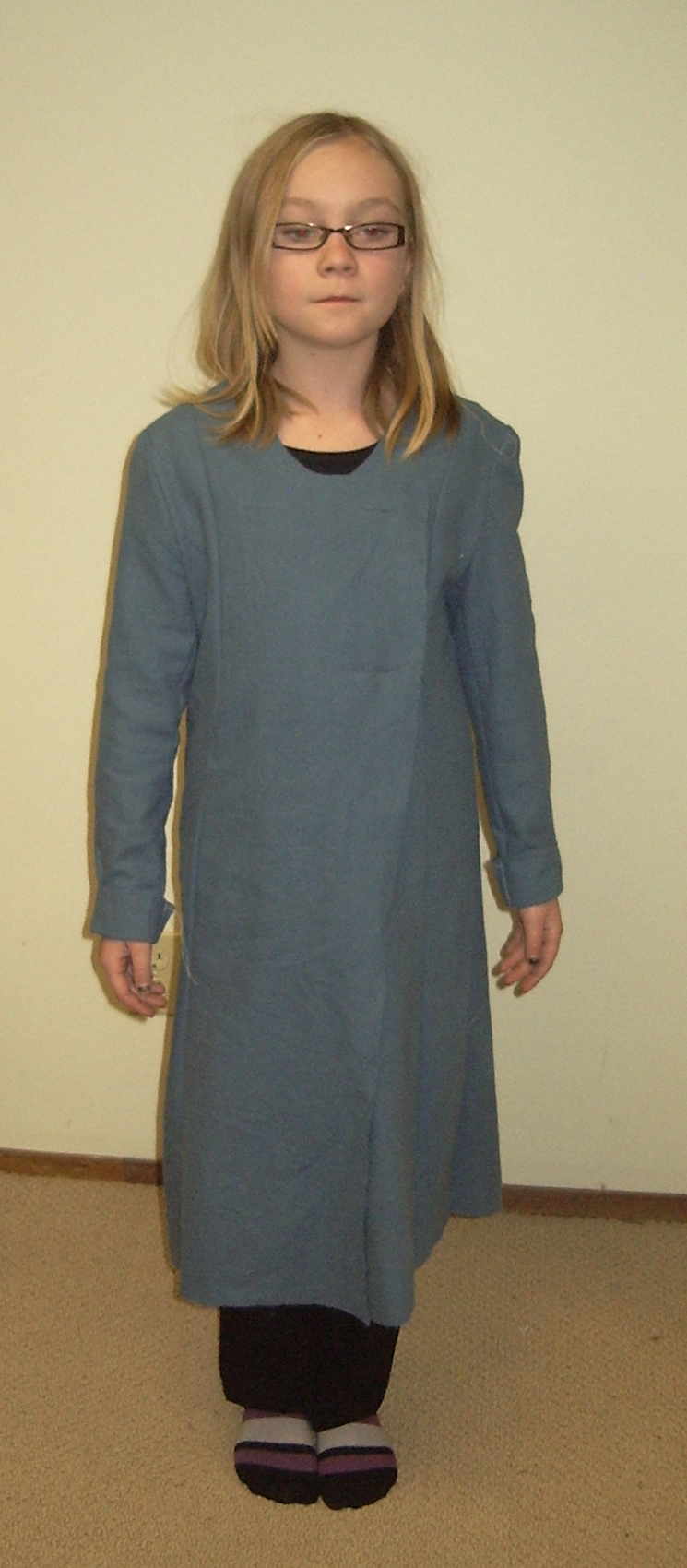
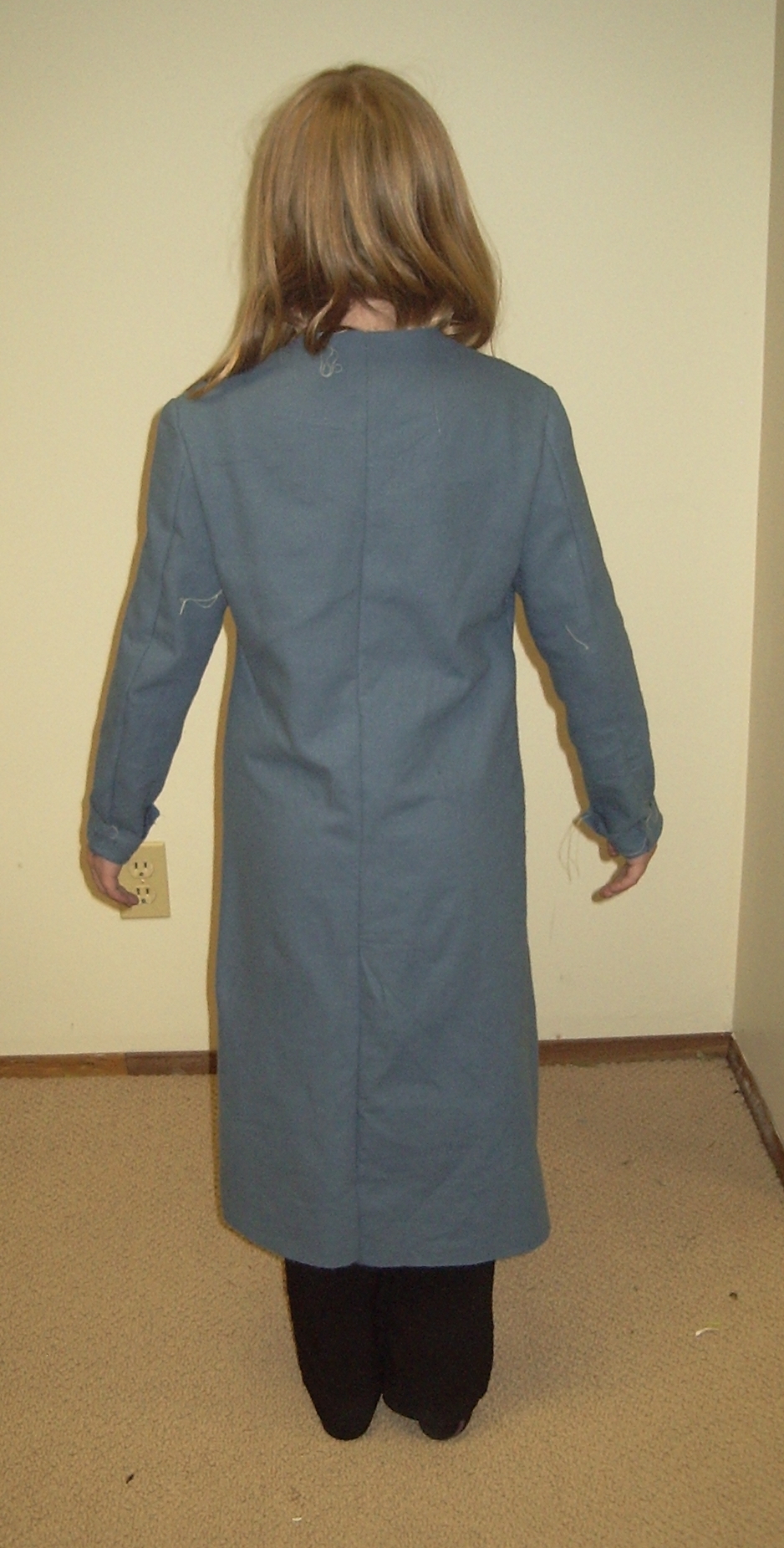
However, I do believe we have achieved “fit.” Maybe not perfect fit, but enough for a growing child who will be handing it along to someone else (likely several someones if it holds up) in a few years anyway.

Both the side seams and the centre-back seam have been flared out from waist down to give more ease; I also added an extension on the CB for a vent; hopefully the Cupcake Goddess’s instructions on sewing a vent in a pencil skirt will be applicable to a vent in a coat. I added 2 cm ease (one to each sleeve piece) to the sleeves to give a bit more room there, as they still seemed really slim. I made a small narrow-shoulder adjustment (1 cm narrower). I will still add in a shoulder-pad, but they do look surprisingly better this way. Now I need to go and make the same adjustments to the lining pieces (sigh).

In other news, Syo is prancing around in Muslin #1 (the smaller size), which fits her remarkably well (although I still think the sleeves are far too narrow for a coat).

Tyo’s about to head off to “Outdoor School” (aka camping in November… what are these people thinking?) for three days. Who knows… maybe she’ll get back to a nearly-completed coat.

Or, y’know, not. The kids do have both Thursday and Friday off school for Remembrance day, so I may save it for then.

2 Comments

Filed under Sewing

A Coat for Tyo—Muslin #2

On Tuesday when I tried to print out the pattern in a larger size (140 instead of 134 height), my printer was out of ink.

Thursday night, despite me doing ABSOLUTELY NOTHING to fix this, it was willing to print.

Muslin #2 Front

So I pieced together the pattern (again) and compared it to the smaller version. The length of the sleeves on the larger pattern was just slightly longer than the length of the sleeves on the smaller after I had lengthened them to fit. Perfect. The width of the back piece was almost the same as the width of my alterations to the back piece. Good so far.

Muslin #2---Side

The shoulder was a whole cm longer. Ah, well.

So, here it is. Much better all around, except for those pesky shoulders.

It’s still catching the slightest bit on her bottom, so I think I will still do a small swayback adjustment. I’m thinking I’ll add a rear vent, too, just to make it a bit more practical for an active child. I’m also going to add 1 cm  to the undersleeve (and maybe flatten the sleeve-cap a tiny bit to compensate?) just to get a bit more ease there. The width they are now would be fine for a jacket, might be still a bit snug over sweaters, once all the layers are in place.

What do you think of those shoulders? If it were just for her alone, I would definitely alter them, but this coat will probably be handed down eventually to Syo, who is built much more like me, i.e. with broad shoulders and a narrow, compact bottom. And they are designed for a shoulder pad, too, although I wouldn’t want a large one. Anyone have a favourite narrow-shoulder adjustment tutorial out there?

Muslin #2---Rear view

On the fabric front, I washed the red fabric. It shrank. No big surprises there. I will wash the black, too. The downside of this fabric is a peculiar strong, plasticky odour (possibly the reason it was on sale). The store assured me several times that this will go away when the fabric is dry-cleaned. I hate dry-cleaning, so I just washed and dried it. I figured it couldn’t hurt a semi-felted fabric too much. Aside from the shrinking, it seems fine. The smell, though fainter, is still there. After several days of lying spread out in the basement, it seems hardly noticeable… I’ve now folded it up and we’ll see if the smell comes back. If I do need to dry-clean it to get rid of the smell, well, that’ll be another thing to wait on money for :P.

Syo's purse

In other news, Syo cut out and sewed a little purse for herself tonight. I did nothing but tie off a few knots (she even threaded the needle herself.) Meanwhile, Tyo is plotting making cloth dolls for her cousins. The basement is currently strewn with an assortment of doll-pattern-pieces. Also, I’d just like to point out that those purple striped socks Tyo is wearing, are mine. *grumblegrumblegrump* She’s starting to steal my shirts, too. The end is nigh, people, the end is nigh.

16 Comments

Filed under Sewing

Dear Tyo, I foresee…

… a lifetime of narrow-shoulder, wide-hip alterations. You’d better learn to sew.

Girls' Coat muslin I

I may have mentioned before that my sweet little Tyo has the build of all the women in her Dad’s family (and diametrically opposed to the women in mine, I’ll add): she is an incipient pear. Narrow shoulders and BOOTY. This has been apparent since she was, oh, two, but it’s only getting worse as the years go by. Let’s just say I could picture rap videos in her future. And a lot of quality time with the shotgun in her Dad’s.

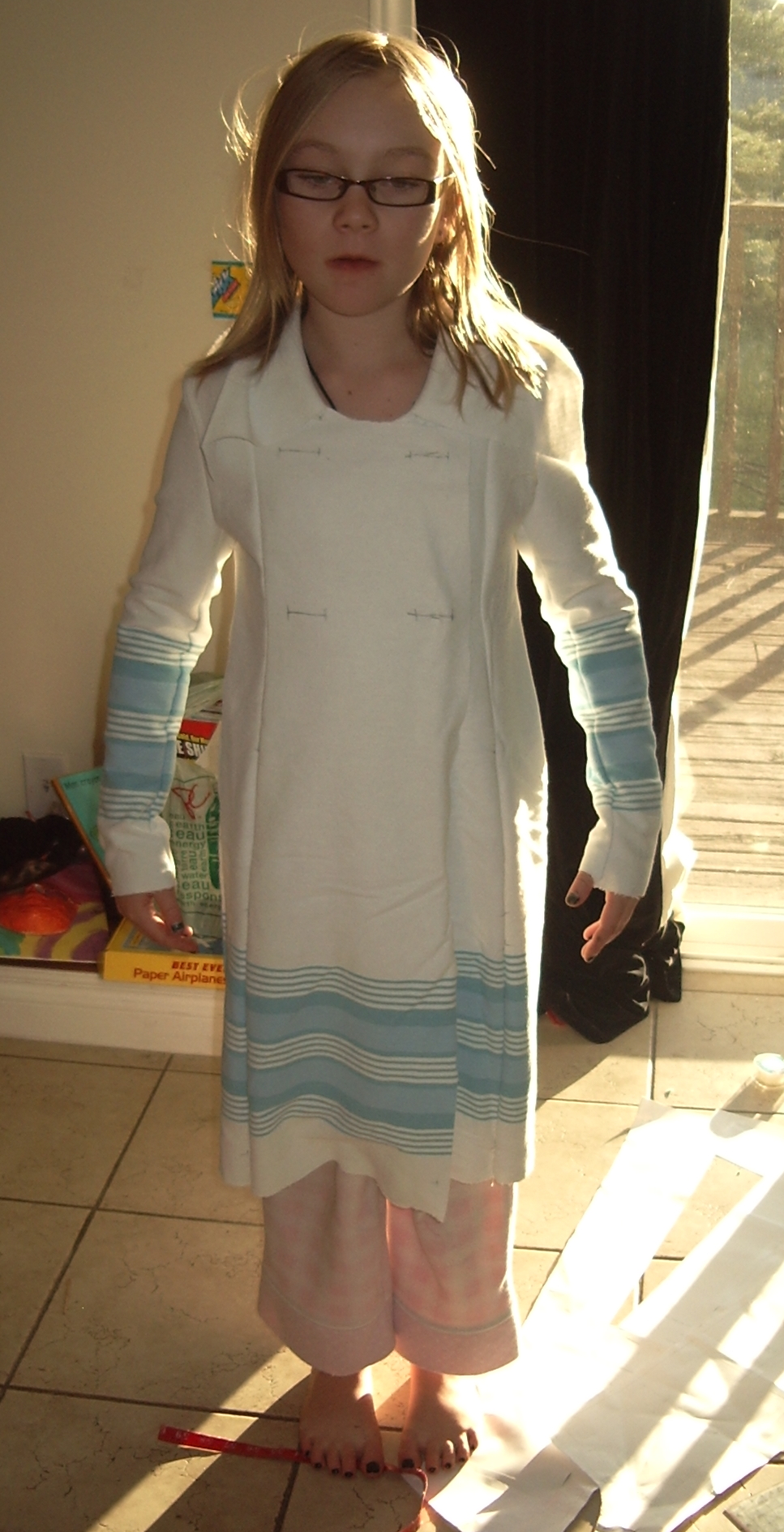
So, I have to say, the muslin for the coat went together like a dream. The pattern is (surprisingly?) sophisticated, with separate lining pieces for everything. The overall shape looks good, all the seams (that I tested) match up beautifully; the sleeve-cap is drafted with a beautifully small amount of ease, just enough to curve it nicely without giving it any tendency at all to pucker (admittedly, the wonderful old flannel sheet I was using for the muslin was a dream to sew, too, so that didn’t hurt)

Side view

And, as you can see, it’s just a wee bit too small. Everywhere except in the shoulders, which are perfect. (The sleeves are long enough only because I lengthened those pattern pieces BEFORE cutting it out, as I could see they were going to be too short. Unfortunately paper-printout doesn’t lend itself to tissue fitting.)

Now, I can’t be 100% sure this is a problem with the original sizing, as it’s entirely possible my crude efforts at tiling let to some re-sizing of the printout and there’s no handy-dandy scale square to allow me to be sure (actually, according to the tiling program my printout is .01 feet smaller… which I didn’t think could throw it off by this amount, but anyway). But the fact remains that there is definitely not enough ease in the pattern AS I PRINTED IT OUT. Well, there would be if it were a dress. For a coat… not so much.

If it were just the skirt pieces that were the problem, I would just spread them. In fact, before I got the sleeves on, when

Rear view... split to let the side-seams hang straight. >_<

she first tried on the body and it became obvious that the skirt of the jacket didn’t have enough ease for her lovely bottom, I was all set to slash and spread the skirt of the back pieces, just enough to give her a couple of extra inches in the derriere region. But with the sleeves in place, it became evident that some extra ease was required there, as well.

So I’m torn, folks. What’s the best way to proceed? Re-print in a larger size? Slash-and-spread to widen sleeves, armscye, and the lower part of the coat, preserving the fit in the shoulder?

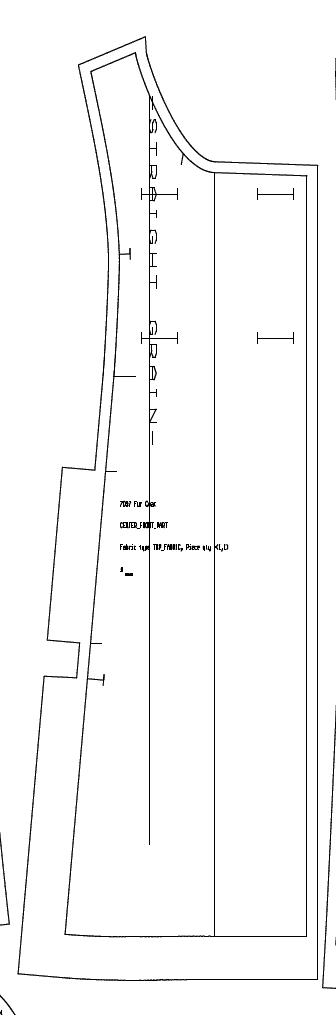
There’s only one part of the pattern that has confused me a little. Along the front princess seam there are two

Front pattern piece: princess seam with ?vent

expansions (places where the seam allowance goes from about 1 cm to 4 cm. The top one is for the placement of the pocket, but below that the seam allowance returns to normal for about an inch, and then widens again I’m not sure what’s meant to go there, as it doesn’t appear to be any different from the rest of the seam on the illustration (or the limited instructions available on m-sewing.)

It does resemble nothing so much as a vent or pleat, though I’ve never seen one in this precise location on a coat. What do you think? Ignore? Make as a vent or pleat? I should add that the lining doesn’t have an opening here and the seam between the CF facing and the lining does not coincide with this princess seam, either. So maybe that eliminates the vent option but still allows the pleat? I dunno. Anyway, if anyone has any suggestions or revelations, I’d love to hear them. Or I can just ignore it ;).

Probably I should go up a size, right? Bigger is always better with kids. (D’oh!)

7 Comments

Filed under Sewing

A coat for Tyo?

So I may have mentioned already that I bought some (other) fabric last week. In fact, it was a bit of a binge-week, fabricwise (gotta love payday), but this is the EXPENSIVE fabric. Not the random metres snagged at the thrift-store, but real, honest-to-goodness expensive bought fabric.

Boiled "wool" camry

As a self-justification (can you tell how guilty I’m feeling about this?) I had a 50% off coupon for Fabricland (up to 5m of fabric) that expired at the end of October. My plan was to finally splurge on some wool melton ($16.50/m sounds much more palatable than $33/m, yes?). Red and a little bit of black. But there was this other fabric, a “boiled wool camry” (all “wools” at Fabricland, incuding the melton, are, in fact, wool blends, as far as I can tell). Its basic price was a little cheaper ($24/m), and it had a really interesting texture to the surface that the melton lacks. It had caught my eye before. It’s also a knit, which is interesting; it has a little give but isn’t what I would call stretchy.

And, this past week, it was on sale for $10/m.

That’s more than %50 off.

So I bought it instead. My precious 50%-off coupon will, it appears, expire, unused. 5m of red wool, 1 of black. The idea was to create something similar to my long-destroyed HBC blanket coat, with pieced-in or applique’d stripes, either for my long-neglected Lady Grey or even a rehash of my Winter Coat pattern (with the standard collar and lapel this time)

But…

But…

I’ve mentioned before that Tyo is in need of a new winter coat this year. And I’ve toyed with the idea of making one (provided I could throw it together quickly enough. But I didn’t think I had a good pattern handy, and am still worried  about whether my construciton techniques will be warm enough to get me through the winter.

Probably I should’ve spent that $60 on a coat for Tyo. Hence the guilt.

Girls' double-breasted coat

Then, yesterday, I stumbled again across this pattern. Cute, no? I originally downloaded it in September off the Lekala website when they were offering free downloads (in limited sizes); it came in a kid’s size 120, a bit small for Tyo.

But, many of the Lekala patterns are available, albeit in limited/fixed sizes, from M-sewing.com. So it occurred to me to check over there.

Now, I have to admit I’m pretty suspicious of these pattern companies. The few reviews of Lekala patterns have agreed that the instructions are useless and some of the measurements perhaps dodgy. More, I just don’t GET it. I don’t know where they come from, why a Russian site and an English-language one are offering the same patterns (albeit with a different sizing system), one for free and one charging. I guess basically, I don’t know where the money is, so I’m wary.

That being said, there are some pretty cute patterns on the sites, and I’m pretty sure I can throw a coat together without instructions at this point. I showed this one to Tyo and she said she loved it. Especially if it were in red. With, say, a black collar.

So I was able to download the coat off the m-sewing site in child’s size 134, which is Tyo’s

M-sewing pattern image

Burda/Ottobre size, and the measurements SEEM compatible (I should probably measure her again, however, to be sure). The other problem with the m-sewing (but not the Lekala) downloads is that the PDF isn’t tiled for printing at home. Apparently newer versions of Adobe Acrobat will tile it for you, but my archaic version won’t, and the built-in tiling software in my printer is limited to set sizes. I could print it at a copy-shop, but that would require spending actual money (as opposed to money on ink and paper, which doesn’t for some reason count), which I’m disinclined to do on a pattern I don’t trust. So I spent some time messing around with some equally archaic software, “poster printer“, and have what I HOPE is a reasonably-close printout.

Next step, of course, will be muslining. I figure whatever fabric I use for my muslin I’ll re-use for underlining, thus alleviating a) waste, and b) warmth worries. Unless of course it’s a total wadder, in which case, well, I get to use my red fabric for ME. Although with 5m of the red I really should have enough for a coat for Tyo AND one for me, even if I can’t use the Lady Grey pattern.

Of course one other big question remains: will I have time to get this done in November?

12 Comments

Filed under Sewing

Photodump

The kids’ jean jackets are done! In all their pain-in-the-butt imperfect glory. Be amazed. Be awed. Rejoice (with me) that my fingers survived all that snap-setting.

1 Comment

Filed under Sewing

Jalie jeans, test type

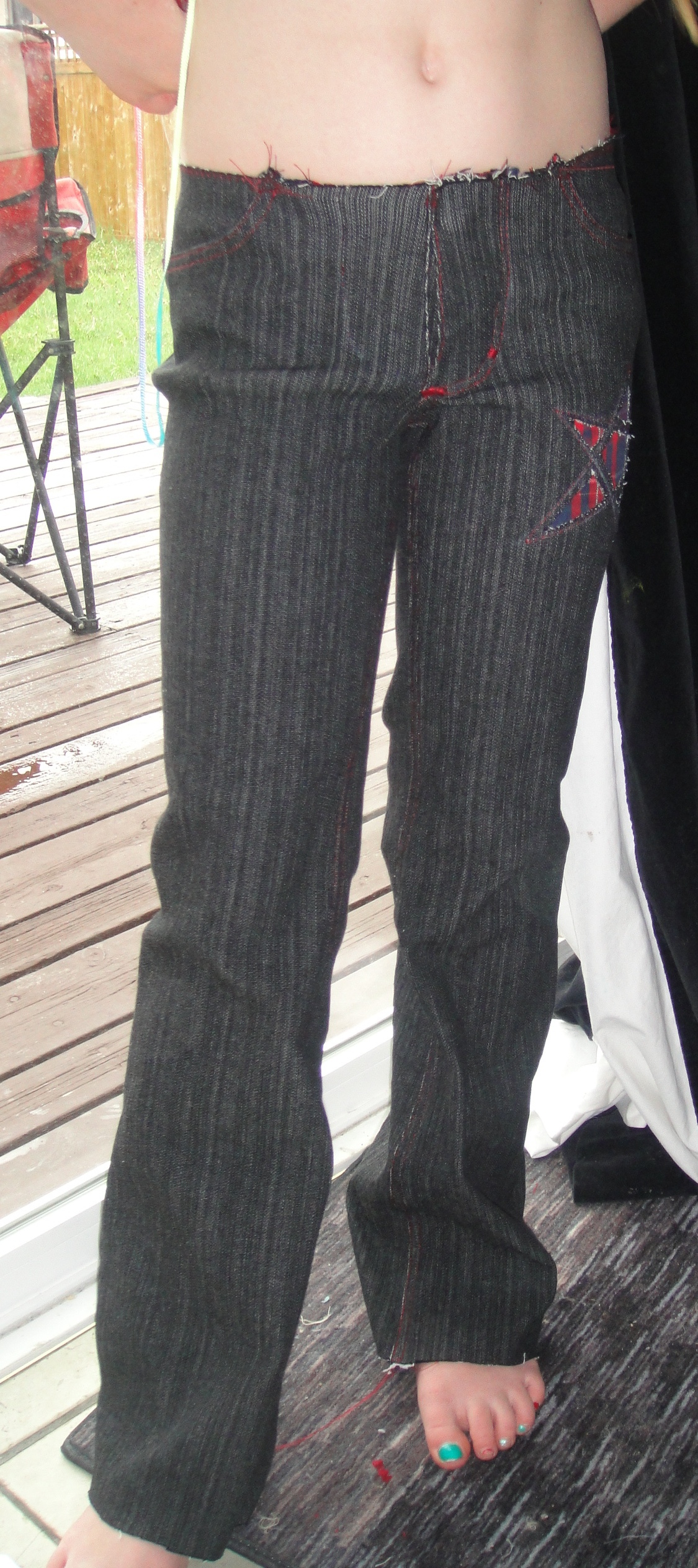
Kid's jeans (first try on)

So, I took the plunge. Well, in miniature. Just putting the finishing touches on a trial pair of jeans… for my daughter. A little torn—on the one hand, they’re very cute, but on the other hand, there’s enough booboos in the construction and fitting issues that I’m a little dissatisfied—more with myself than with the pattern, however. Oh, and the plaid flannel in the cut-outs is the same fabric as the pocket lining, and was a pair of my hubby’s pyjama pants long, long ago. So glad I kept those scraps!

On the plus side:

  • they fit! Like stretch jeans should… which may actually be a little snug.
  • I LOVE the pocket design/yoke and front leg detail. We were inspired by a pair of jeans belonging to my younger daughter, and I think it’s so super cute. I am excited to see how it looks once it’s washed and frayed. The cut-outs on the front leg and the back yoke are both backed with another layer of denim behind the flannel, for strength. The pocket just has the flannel.
  • The red topstitching is super nice, even though it doesn’t show quite as much as I might like. I used the triple stitch with regular thread, and I really liked it for topstitching because it is SLOW…

    Are these not the coolest pockets EVER, I ask you?

    much less chance for me to mess up, especially along short lengths. All in all the topstitching, though not perfect, is a LOT better than my last attempt. My “edgestiching” blind-hemmer foot definitely shows its limitations along longer seams, although that may be as much shoddy construction of the foot (the screw that adjusts the front extension is really loose, so it jiggles out slowly as you go along… this is just as much a problem for blind hems as for edgestitching).

  • I also didn’t have any trouble catching the 1 cm seam allowances in my second row of topstitching; some people had complained about this in their pattern reviews.
  • I added the perfect amount of length to the leg (1″) (at least as long as they don’t shrink in the wash any more)… they should be perfect once hemmed as is.
  • I put buttons and buttonholes on the inside waistband to thread and adjustable buttonhole elastic through the back (a fave feature of mine for most kids’ pants these days). However, my gaposis-fixes were such that I don’t think she’ll actually need it.
  • hammering REALLY helped with a few of the ultra-thick areas. I am impressed.
  • I almost got the fly right on the first tr. Almost.

Negatives:

  • The instructions say to attach the back pockets before you sew up the centre back seam. Despite marking very carefully and gluing the pockets in place so they didn’t shift around, they’re still not even. Next time I will definitely put them on AFTER the centre-back seam is stitched (which is the next step anyway so it’s not like it’s a big rearrangement.
  • the yoke definitely needed adjusting for back gaposis. Now, my nine-year-old definitely has a booty for her age (to her father’s dismay), but on the other hand proportionately I doubt hers is any worse than mine, so I will definitely curve my yoke in a bit before I cut it.
  • I adjusted the yoke at the sides (since the centre back, which would’ve been better, was already topstitched and I didn’t want to take tucks due to the cut-out peekaboo layers at the yoke), which left a bit of a pointy stop at the top side.
  • the waistband kinda sucks. This is for various reasions:

    Kid's jeans: front (finished except for belt loops, hemming)

  • 1) I cut it on the straight grain, non-stretch direction, rather than on the bias or the stretch grain. This is because I like pants that stay up… but I should’ve added to the length because it was a little short.

    Kid's jeans: back (finished except for belt loops and hemming)

  • 2) I didn’t interface it. This might’ve been fine with a heavy-duty denim, but this denim is so light and stretchy, it’s just floppy. My bad. I got lazy and impatient (and forgot).
  • 3) I angled it in at the centre-back seam to further reduce gaposis, which was successful but left it with that little divet at the back. I am definitely excited to try my contoured waistband. Thoroughly interfaced.
  • the jeans button is a little off of where it needs to be; I centred it on the buttonhole, but its post of course needs to go at the END of the buttonhole. And of course since it’s fairly soft and floppy, this makes the whole fly (which IS interfaced, by the way) pull a little wonky. I suspect the solution will be to stitch the end of the buttonhole closed a bit. And next time, position the butotn AFTER cutting the buttonhole. I think for mine, I will hand-stitch the buttonhole so I can do a keyhole, but for these I just did the lone buttonhole setting on my machine. (and it says it all about how thin the denim is that I even COULD do the buttonhole on my machine, which doesn’t like to do buttonholes on thick fabrics at all.)

(sorry about the colour in the last two pics… the camera didn’t like having the black couch in the background. Also the jeans are  rather rumpled in the last couple of shots because she won’t take them off long enough for me to hem and put belt loops on.)

8 Comments

Filed under Sewing

An oldie… Kids’ choli

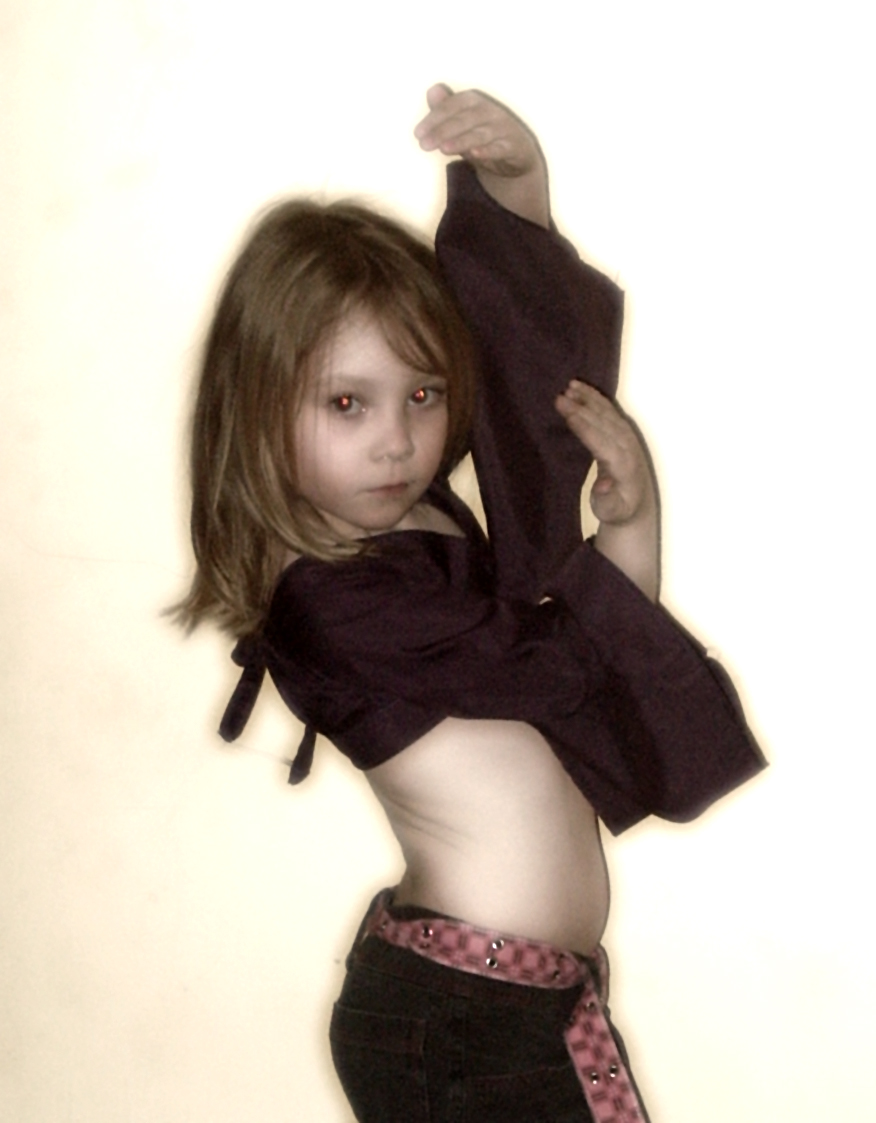
My daughter showing off

This is a dance shirt I made three or four years ago now for my older daughter. The idea is loosely based on an Indian choli, a kind of cropped, sometimes backless blouse worn with skirt or sari or whatever (depending on the region). They’re popular in tribal bellydance, and a little more modest than the traditional bellydance bra top. I have about a zillion of my own, made to various patterns, which maybe I will talk about at some point, but this one seemed like it would make for a nice quick post.

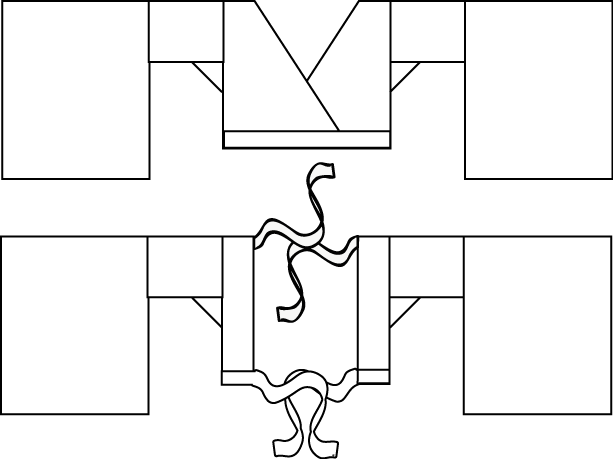
I drafted the pattern for this shirt based on her measurements; kids’ patterns are SO nice to draft because you don’t have to worry about bust shaping. There’s a theme or principal in “folk” clothing where you try to be as economical with the fabric as possible—most pieces will be rectangles, triangles, or trapezoids. This makes sense if you have to spin and weave your own fabric—you don’t want to waste ANY of it. It comes at the

a choli (a kind of backless top popular in bellydance) designed by my daughter

expense of fit, of course… but that’s the nature of the beast. The other upside, however, is it makes the patterns dead easy to draft. My daughter chose the kimono-inspired sleeves for this shirt (and made up her own pose). Since you can’t see it too well in the photo, here’s a rough technical drawing of the shirt: as you can see, nary a curve in sight. The triangles under the arms are actually square gussets.

1 Comment

Filed under Sewing

Coats for little girls… (Part I)

The fabric for the girls' coats

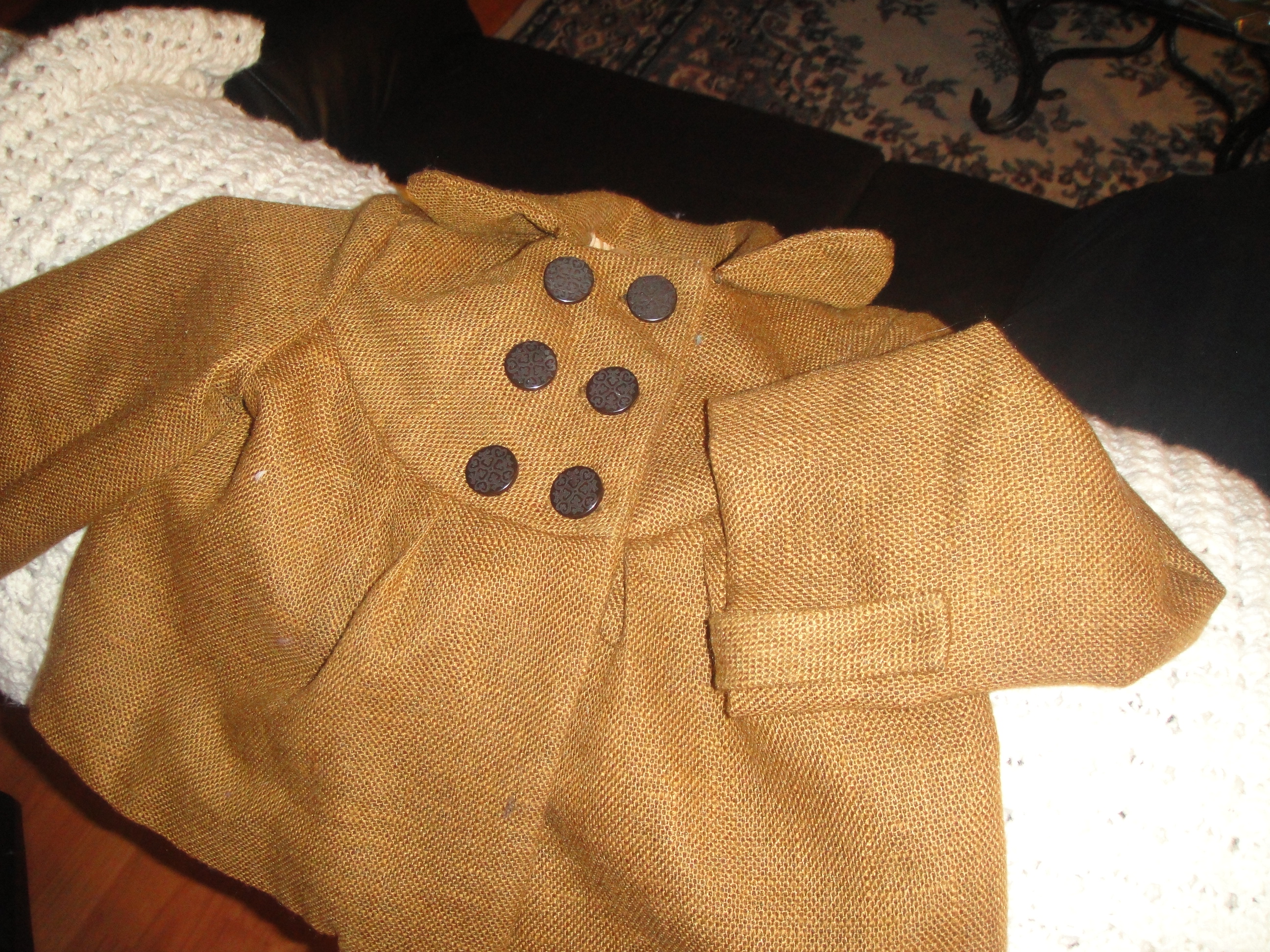
A year or so ago I received a gift-hamper that contained, among other things, some old curtains, a sort of ugly, coarse-woven, earth-tone fabric. They reminded me of burlap, though I think the fibre is actually wool (they didn’t melt when ironed on “wool” setting, anyway, and they feel rather scratchy to be cotton). “Oh,” thought I, “Fabric!” and proceeded to pick out all the hems.

I then spent a couple of months trying to come up with what on earth to do with this potentially hideous fabric. It was badly sun-bleached on one side, but the former inside was pretty much good. What to do?

And then it dawned on me: coats for my daughters.  This heavy, ugly fabric would be great in cute little retro jackets.

Unfortunately this revelation occurred right before I had to start studying intensively for my candidacy exams. Finally, just after Christmas, I actually got out to a fabric store; I bought a ton of lining, thread, some buttons, and the pattern for Simplicity 2876. An hour or so later I scored McCall’s 3374 at Value Village—so now I had everything I needed to start.

My older daughter chose the Simplicity, and wanted a short version (fortunately as it turned out, or I would’ve run out of fabric for the younger one’s). I actually whipped it up in the space of a couple of weeks, which is record speed for me. It was (I may have mentioned this before) my very first lined jacket; I also underlined the old curtain fabric. I did wind up hand-finishing the lining at the cuff and hem, as it seemed simpler than trying to figure out the instructions for finishing the sleeve lining. It worked out quite nicely, I thought, anyway. Now the weather just has to improve enough for her to wear it.

Firsts:

  • lining
  • underlining
  • buttonholes
  • iron-on interfacing
  • collar

Problems:

  • I suck at tight curves (like collars)
  • I also suck at buttonholes (and my automatic buttonholer foot wouldn’t work… the coat fabric was too thick.
  • pattern only mentioned six buttons (for the front); this particular sleeve variation should really have two more smaller ones for the tabs.

All in all, pretty happy 🙂

6 Comments

Filed under Uncategorized