Category Archives: Sewing

The Mini Minnie Dress

Fyon's Mini Minnie Dress

I firmly maintain that Minnie Mouse has no monopoly on red with white polkadots, any more than Miss Piggie has a monopoly on pink. Nonetheless, this is the thing I have heard second-most-often about this dress, in either of its iterations. Sheesh. Fortunately, the most-often-heard thing has been random, awesome compliments. And despite being first on the list to make the Minnie Mouse crack, my ever-sweet husband has also requested specifically that I wear my version several times, so it must be a winner. Sigh.

This is the version created for my four-year-old niece, who requested it last month, with much batting of eyelashes and many applications of  “Auntie, I love you!” Let’s just say that as long as the cute holds out, she should do well in life. You may have to click through to the full size version to see the polkadots on this one. They are small, but I promise you they are there.

Young Image Summer 2011 patterns

The pattern I used as a base is Y1109 from the Young Image Magazine Summer 2011 issue (third down on the left in the image above). You can browse through the whole magazine here, but it won’t let me link to a specific page; there’s a good view of the dress on p. 19. It had the right general lines, in particular the centre-front bodice panel.

I made the size 104, the smallest for this pattern; my niece is 106 cm tall, although her bust and hips were a little narrower than the 104 called for. Still, I’m glad I used the 104 rather than a smaller size (had one been available)—the amount of ease is fine but definitely not excessive.

Naturally I couldn’t just make it up as is. So this is not really a fair review of the pattern or the magazine, although I did use all of the pattern pieces provided. The instructions are, well, distinctly translated, and in so many languages it can be a bit tricky to figure out where the information you want is; it’s mostly segregated by language, but not entirely. Also, the pattern pages are only marked in two languages, neither of them English (my guess is Dutch and German, but I confess I didn’t actually pay attention), so be prepared to do some translating. That being said, they’re not nearly so over-crowded as Burda pages and each pattern has its own colour, so that part was not bad at all.
Dress back

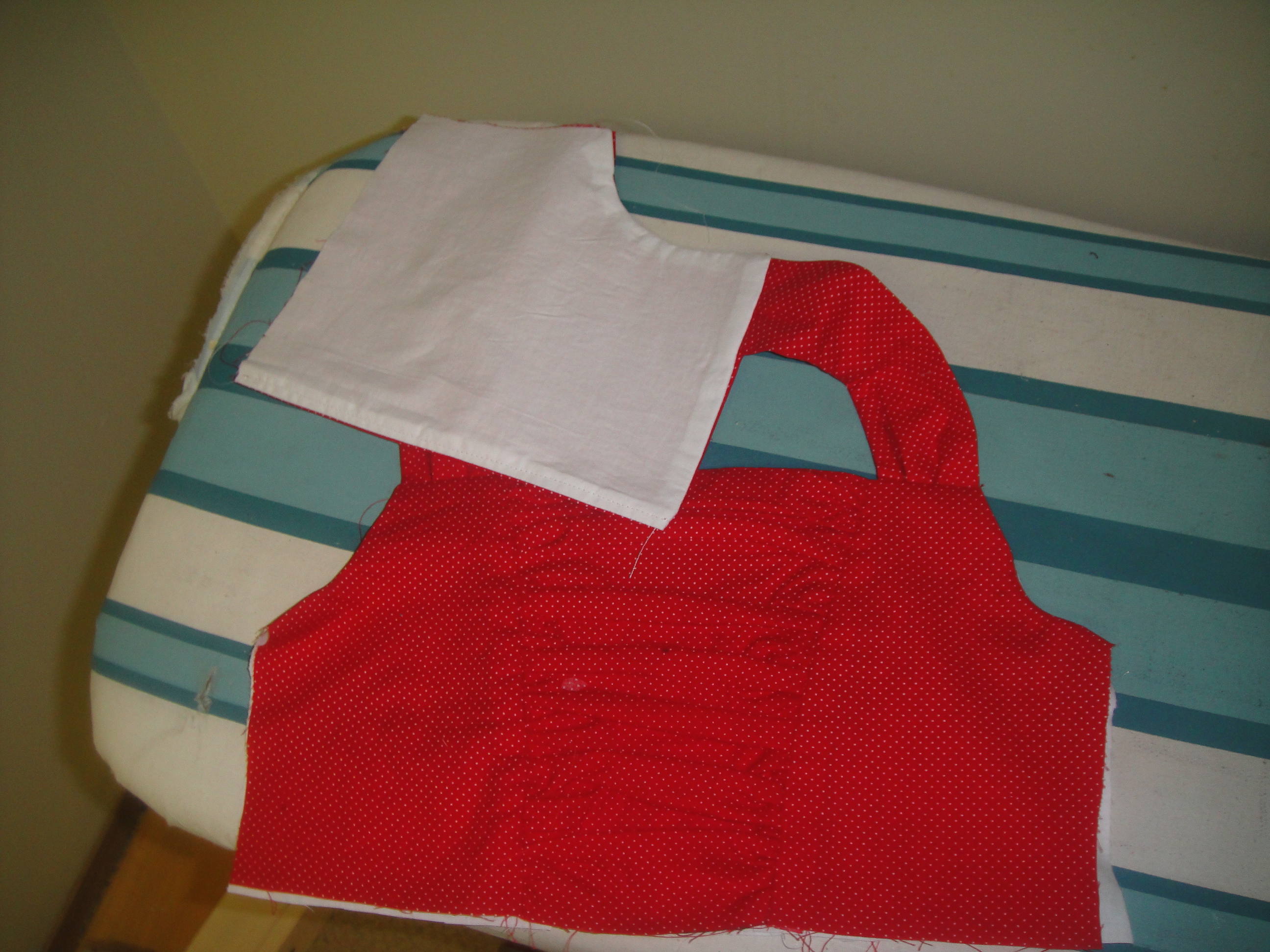
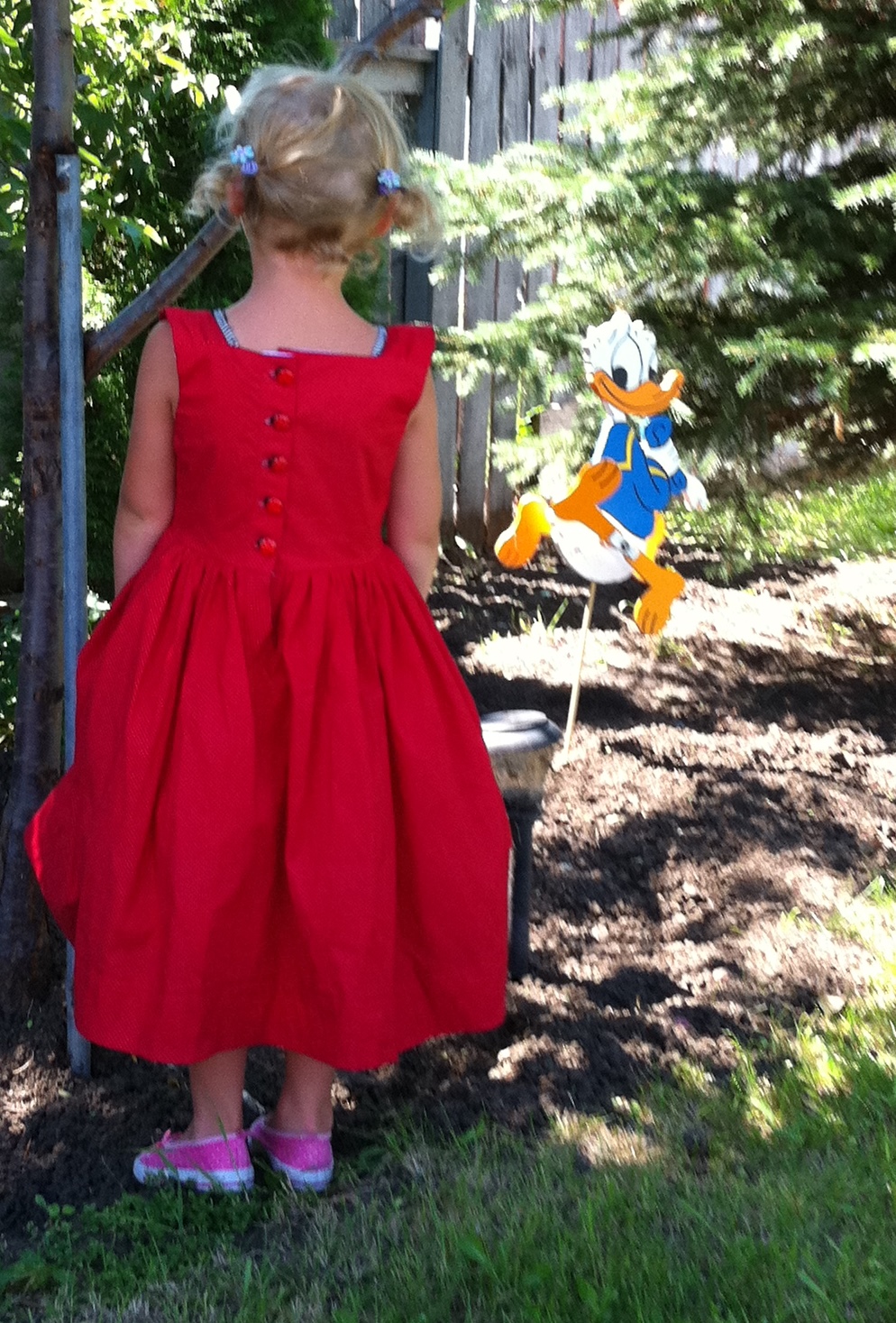
The pattern calls for a rear zipper in the bodice (not extending into the skirt as far as I can tell), but I opted for buttons, instead. You do have to add seam allowances. They may tell you that somewhere, but if so I didn’t find it. I just figured that all the European pattern magazines (maybe European patterns in general?) don’t have seam allowances, and an examination of the size/shape of the pieces will confirm that.  If I’d been less pressed for time I would’ve read up a bit more on how much to add for a centre button placket, but I was in a hurry, so I winged it. It’s not exactly ideal. I should probably have drafted facings or used a self-lining (which I think is what the pattern calls for), but I didn’t. And I’m balls at understitching, so my white cotton lining peeks out a fair bit. Ah, well. I also put the straps on the wrong side, I’m pretty sure they are supposed to angle with the shoulders, not puff up the way they do, but they look cute anyway.

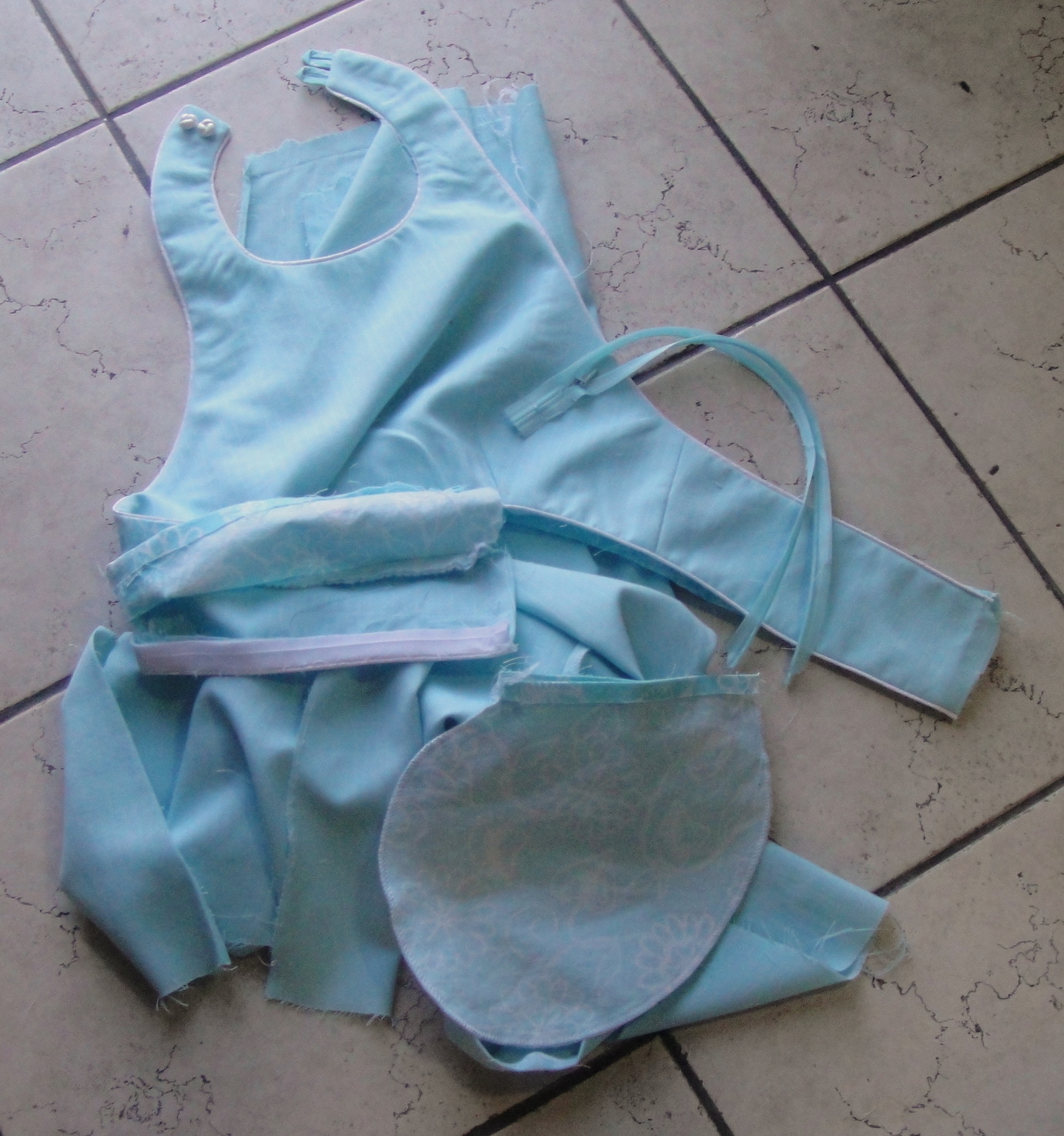
Underskirt for dress for niece.

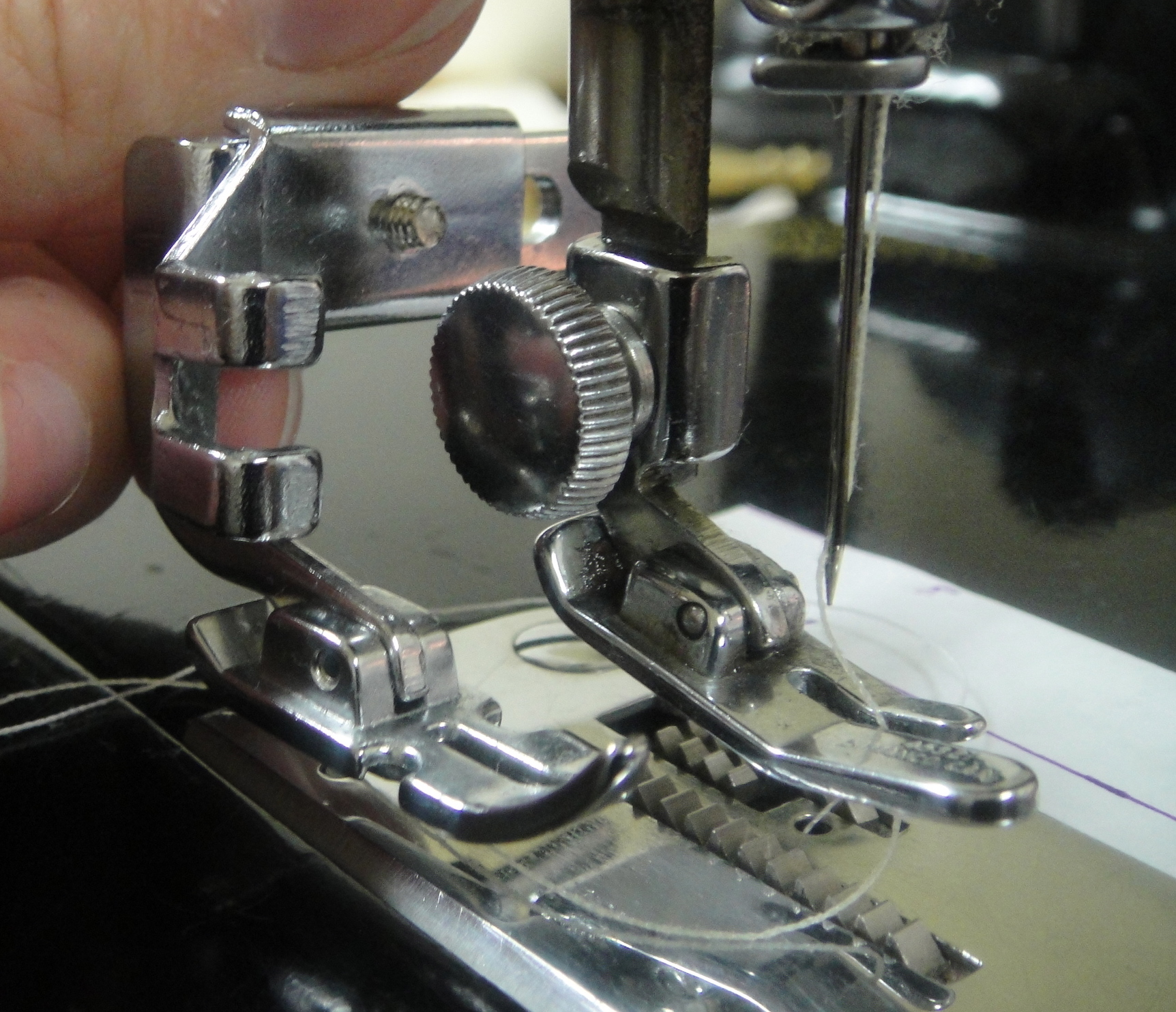
The skirt in the pattern has a slightly-gathered, shaped upper portion and a ruffled lower portion. In the photo (page nineteen of the magazine, again, but I can’t do a direct link and I don’t have the physical magazine with me to photograph), the dress has quite a deep ruffle on the lower part of the skirt; it looks much shorter on the technical illustration, which I found rather confusing. There’s no pattern piece for this, which is fine as it’s just a rectangle, but I couldn’t find the information on how deep it should be, either, just how wide it should be at the different sizes. My original dress had a simple dirndl skirt, so I did that for my niece’s version, too, but I used the pattern-piece provided, plus a lower ruffle tier, for the underskirt. I was winging it for the length at that point—I did a quick comparison with some dresses from Tyo’s closet that I thought were in the right ballpark length—overshot, and wound up hacking about four inches off the top of the underskirt. Ah, well. It all gathers to the waist, anyway ;). For extra flouff, I gathered some tulle onto the underskirt. I should’ve used more. I also couldn’t use my favourite gathering technique, the zig-zag over a supplementary thread, as my zig-zagger was frozen at this point (she’s in the shop as we speak), so that was a wee bit annoying. Yes, I used the gathering foot, but getting the precise length was not happening so I wound up hand-basting and gathering it that way anyway. *headdesk*.

Dress

Instead of little ruffles on the centre front panel, I made an altered, double-length version of the CF piece to create the ruching. Gather it to the side-front pieces, construct bodice as usual.

Buttons closeup

I was a little concerned about the button-placket not extending into the skirt. After all, even on rectangular little children, you want to be able to open it a little below the waist, right? So after some cogitation, I decided to add in an extra-wide continuous lap placket at the centre back to finish off the button placket. Of course, for these to work properly you really have to fold the outer edge of the placket to the inside, which I completely forgot to do. So it’s a bit wonky in that area. Fortunately it’s pretty much hidden in the gathers, anyway. And cute ladybug buttons make up for all manner of flaws.

I have been having some fun being the sewing fairy, I must admit. I have been refusing to sew for my adult relations (well, unless they come to visit me for fittings, which, considering we live 600 km away, is a bit of a deterrent), but this summer I dared to hand down a couple of pieces. My stylish sister-in-law had greatly admired this sundress last year when I wore it, and after thinking about it, I decided to give it to her. I still like it a lot, but it feels like a lounging-by-the-lake (or in the back yard) kind of dress, something she does a lot more of than I (which is not to say she is lazy, quite the opposite, but she is currently at home with small children in a house with no AC, rather than spending her days in an overly-cooled lab like I do). Rather more recently, I made a tunic cloning a RTW one that I absolutely love. I liked the clone, too, but it was a bit too short through the body. So with some trepidation, I handed it over to my going-on-fourteen-year-old-niece. I am absolutely terrified of trying to sew something for anyone in this age-set without their direct input, but figured it had a better chance of working for her than for me and was reasonably stylish reasonably recently, and she steals lots of clothes from my stylish sister-in-law (I should perhaps clarify that my stylish sister-in-law is the mother of the four-year-old who received the Minnie dress, but NOT of the fourteen-year-old), who I feel pretty comfortable about guessing styles for. Anyway, she claims she likes it and as she’s only 5′ 1″, the length issue is rather less on her. So we’ll see. I still need to make the longer version…
Oona, this one's for you

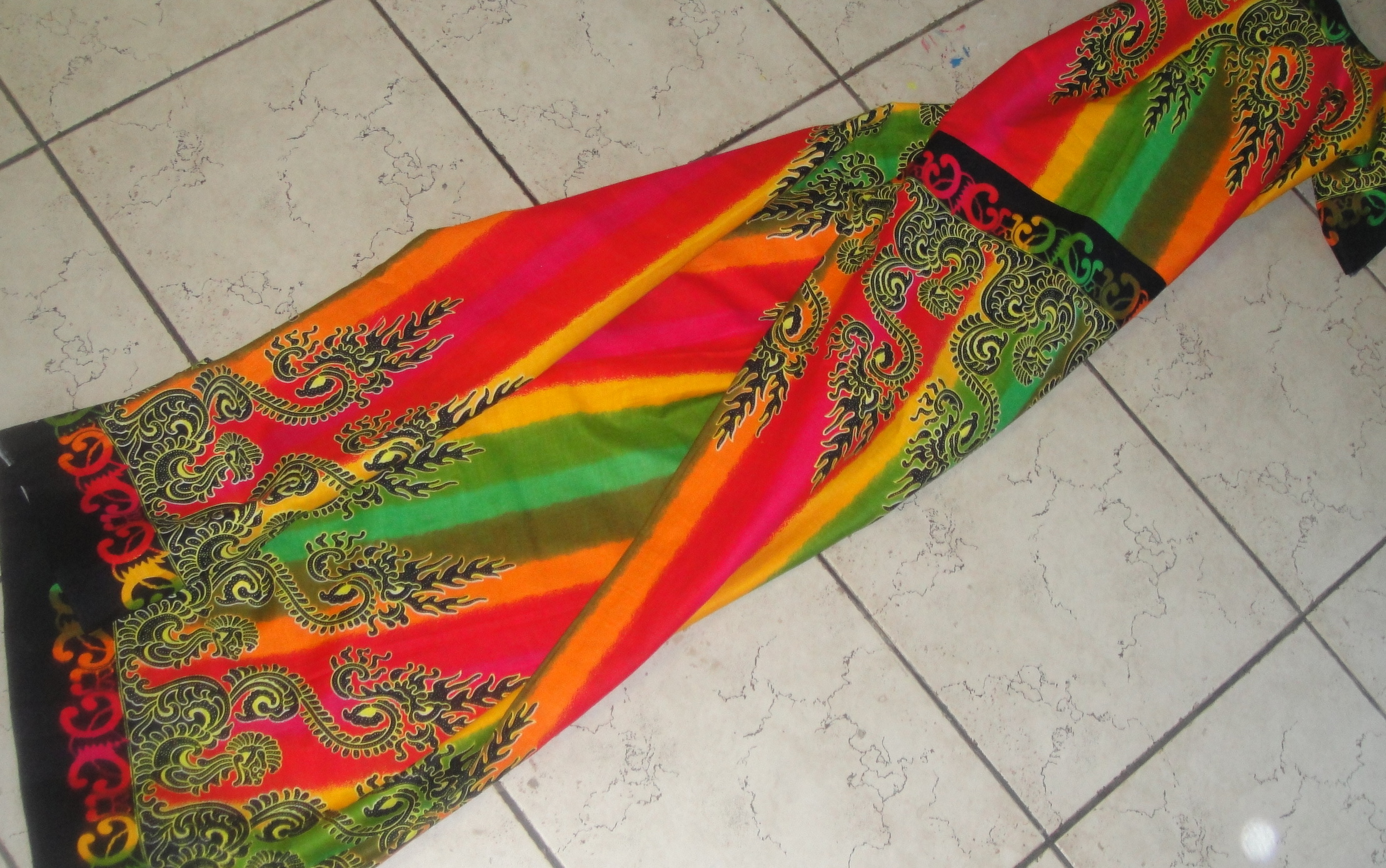
Before I left on vacation, I did bring home one more piece of thrift store fabric: this crazy border-print. There’s only about a metre, but it’s very wide. Whatever it gets made into will obviously be dedicated to Oona of the Carnival Stash.

Whew! I must now return to hanging out with my in-laws, soaking up the sun, and wrangling somewhat obscene numbers of small children. Gotta love vacation…

21 Comments

Filed under Sewing

Madly off in all directions

The Scissors Family

The crunch is here and as usual I’m not ready.  Precious minutes are trickling away when I could be Accomplishing Things. So, I’ll keep this brief.

Sewing World called and the psycho-god scissors were in (pictured bottom right). My willpower shredded under their seductive snipping, and they came home with me. Cutting with them is almost like… hmm, maybe I won’t go there. Let’s just say cutting may no longer be my least favourite part of sewing. The blades are very short, something on the packaging it touting equal length for blade and handle as being important for some reason. Oookay, if you say so. All I know is they cut like… mmmm…. ok, just give me a moment (fans self). The most comfy for the hands are still the old blue ones, though.

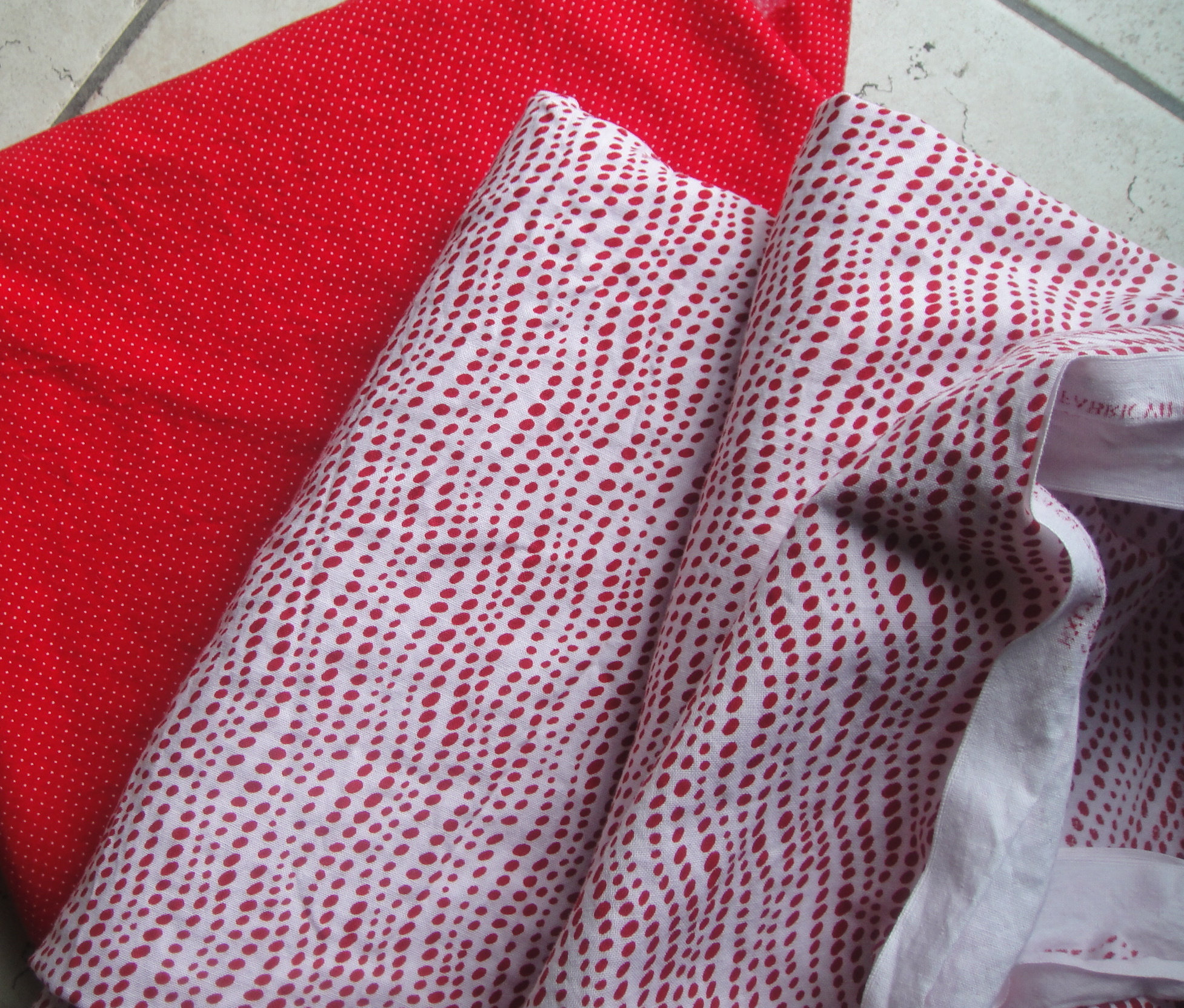
Fabric: for niece's dress (left) and my Lonsdale (right). Yes, a print!

I bought fabric.

I started a dress.

It’s neither Lonsdale nor for me. *headdesk*

Dress in progress. Not for me. Obviously.

Underskirt for dress for niece.

It’s for my four-year-old niece, who very cleverly spent most of the two days I was down there at the end of June telling me how much she loves me, and also how much she loves the red sundress and wants one just like it. Sometimes not even in the same sentence. It’s based off a pattern from the Young Image magazine (I added the front ruching), but as usual I’m off in my own little universe so the finished product will be “inspired by” at best. Also, can you spot my goof in the picture?

I’ve made a bit more progress on the coat, then got stalled because I needed more trim. Because 4m of three different kinds of trim was obviously not enough, and I’m a complete idiot for thinking under any circumstances that it would be.

And, I’m going to feel really guilty that I have a home-made present for my niece and not for my daughter whose birthday is on Sunday.

*headdesk*

And I really want to start my Lonsdale…

13 Comments

Filed under Sewing

Slow and steady…

Blinded by the lining

Progress has been made on Serena’s coat. In fact, if I hadn’t kinda-sorta said that I would have it done by the end of the week, I’d be extremely pleased with myself. As it is, I’m still half-ass panicked. The coat construction itself isn’t the issue, it’s the embellishment which eats up time, both physically in terms of stitching it on and mentally in terms of thinking about designs—how much? How intricate? How many different materials? At the moment I’m trying to constrain myself to gold-twist piping and lots of flat upholstery braid, but it’s hard. Give me a few months of this and my latent bellydancer would bling this coat out to the nines.

Which is why I should’ve done the basic work back in the spring and then spent the summer in leisurely construction/embelishment, but anyway. That ship has sailed.

Muslin #2 (with collar)

After the fitting I basically made up a whole ‘nother muslin. If I thought I could’ve hunted Serena down for a last fitting I would’ve, but she was out of town, so I tried it on my dummy, really liked the adjustment over the rear (I added 2cm to each side of the rear princess seam below the waist) , decided that the sleeves still needed more poof, and started cutting.

And fusing.

Happy fusing fun.

Lots and lots of fusing. I don’t think I’ll ever be able to thank Sherry enough for introducing me to the concept of fuse-tape. I lurve this stuff. Anywhere you might use stay-stitching.

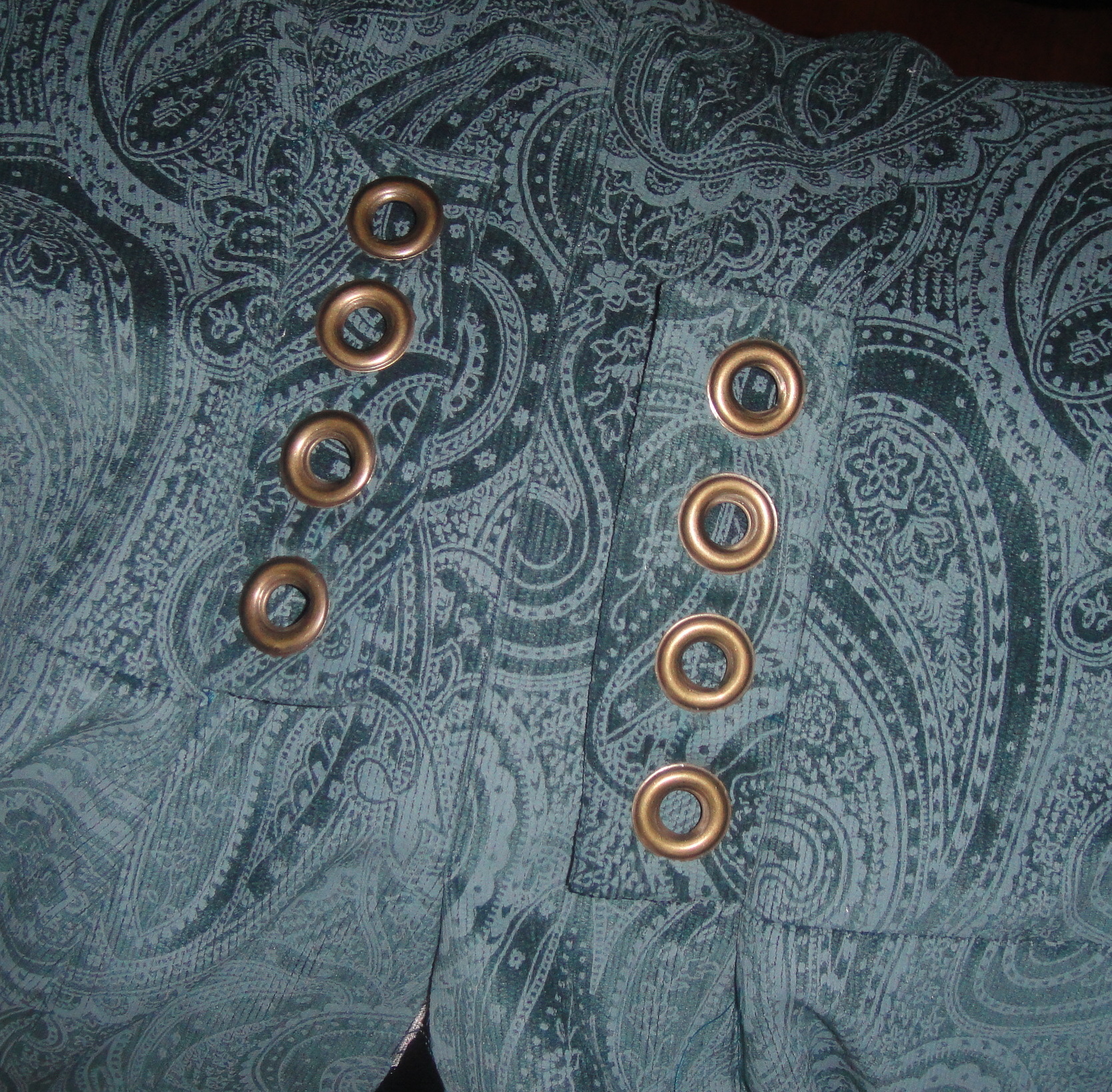
Ready for ripping /sigh. At least the grommets aren't terrible.

Anyway, at this point I have the lining basically constructed, the shell lagging slightly because I had to run out to get grommets for the lacing and now I need to do some ripping (even with the heck fused out of it, stretch corduroy is still prone to creeping; I should’ve marked better).

Oh, and I made the collar.

The collar was rather scary. It needs to stand up, so lots of interfacing was required. Pepin has instructions for drafting a stand-up Elizabethan-type collar in Modern Pattern Design, but they’re a bit confusing (In particular, she advocates spreading 1/4″ per slash while only illustrating four slashes. This is not enough.) Still, it got me on the right track, and a series of paper tracings later I had a workable pattern. Fortunately for me, it was actually perfectly possible to pin the paper pattern in place on the dummy and get an idea of what I needed to tweak next.

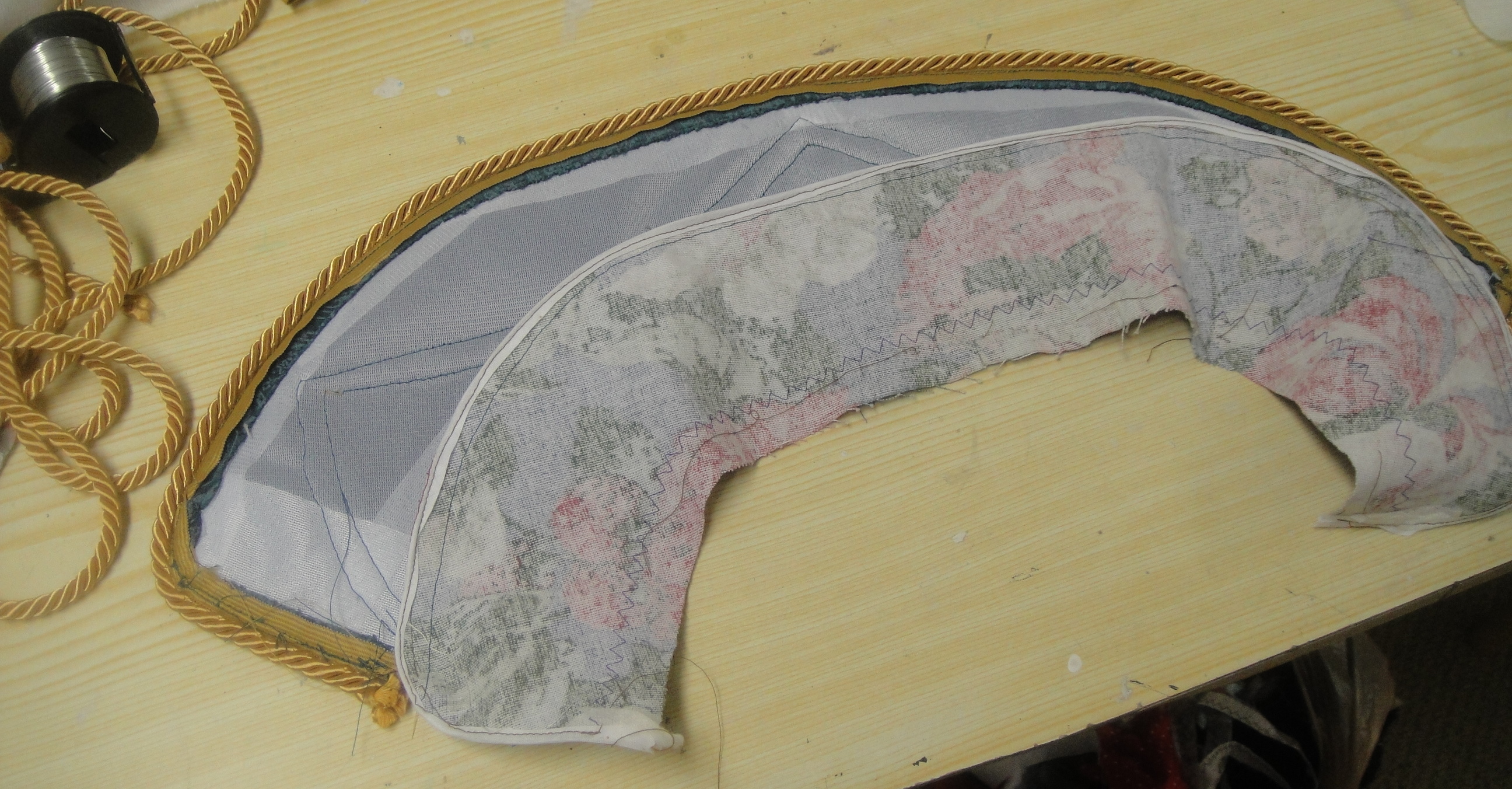
Collar innards

Stitching wire into casing

I also wanted the edges of the collar to be wired, for stability and moldability—who knows if it’ll look best straight up, or with the corners rolled back, or whatever. So I hunted around and found some medium-weight wire in the old jewelry/beading box, a half-package of quarter-inch bias tape (one of those thrift store finds that you’re never quite sure how you’re going to use as it was rather grubby), and set to work stitching the wire into a casing around the trimmed-down edge of my interfacing piece (which consisted of the “muslin” drapery fabric collar plus some hair canvas). It’s not at all pretty, but it’s attached and now the collar’s constructed everything should be pretty much held in place anyway. I folded the ends of the wire back on themselves and encased them in little fusible-interfacing booties, so hopefully there’s no danger of that working through the fabric.

Collar exterior

Then I hand-stitched my wired interfacing piece to the collar outside, which was already piped and embellished. Once it was in place I topstitched along some of the embellishment again, just to hold it in place extra well. Overkill? Possibly. To finish it off I slip-stitched the lining fabric to the inside. For this jacket, I am using interfaced lining fabric in place of facings, as the lining is as much for show as the shell fabric, especially in areas like the collar and tails.

No other great insightful comments at the moment. Halfway through Saturday my Janome machine grew crankier and crankier and eventually stopped turning. The engine whirs, but nothing goes around. This sometimes happens when thread is jammed in the bobbin, but there is no thread, and even un-threading the machine completely does nothing. I can still force it to stitch with the hand-wheel, but it’s difficult and doesn’t feel like something I should be doing a whole lot of. I’m thinking a visit to the sewing doctor is in order, /sigh.

Most of what I’ll be doing this week can be done on the straight-stitcher, but of course now it’s not working I keep coming up with things I need a zig-zag for.

13 Comments

Filed under Sewing

Fortunately, unfortunately

New Fabric Scissors!

Fortunately, I got some fun new sewing stuff in the mail this week. I was especially excited to try out the Seam-Gauge Guide.

Unfortunately, when I went to try it, my fabric scissors were nowhere to be found.

Fortunately, this motivated me to clean up my sewing room.

Unfortunately, I STILL couldn’t find them.

Fortunately, I’d been thinking of getting another pair anyway, since my old ones no longer cut to the very tip, which makes notching difficult.

Unfortunately, there’s not a lot of time in my week-days lately to trot off to the fabric store.

Fortunately, there’s a shop called Sewing World on my walk from work to the train. They sell sewing machines, sewing gizmos, and notions, albeit with a bit of a focus on the quilter.

Unfortunately they’re usually closed by the time I leave work.

Fortunately, one morning this week I managed to get in early enough to stop on my way too work.

Unfortunately they have about eighty bazillion different sizes, styles, and price-points of scissors to choose from.

Fortunately, the lady working was willing to pull out about a dozen, mostly Ginghers, and provide fabric samples for me to snip up.

Unfortunately, the best-quality Ginghers have metal handles. This makes them very pretty and sturdy, but sets off some nerve damage in my thumb.

Fortunately, she pulled out another kind that cut even better than the Ginghers.

Unfortunately, they were really large. This wasn’t a problem for the blade length so much as that my fingers flopped around in the handle. Maybe they’re men’s fabric scissors.

Fortunately, the lady promptly called up her supplier and ordered in a couple of pairs of the same kind in a smaller model.

Unfortunately, they won’t be in until next week at the earliest and I need scissors right away. However, I didn’t want to buy an expensive pair when there was a pretty good chance I’d be coming back for the freakin’ sweet crazy ones in a week or two.

Fortunately, there were some “Featherweight” Ginghers, which while not as awesome as the regular Ginghers, were still pretty sweet, and most importantly, have a plastic handle and are much cheaper. So I have new fabric scissors!

Unfortunately, the plastic extends along the blades, making an odd lump, so that even though the seam allowance gauges still stick, they angle downward too sharply to really work, plus the magnetism isn’t quite as strong so it would get knocked off easily.

Fortunately, I might even have time to come to my senses about the price of those godlike scissors by the time they’re in stock.

Although I wouldn’t bet on it.

And in the meantime, I have new scissors anyway! And they snip! So my notches will (hopefully) no longer resemble irregular blobs somewhere in the general vicinity of where they’re marked on the pattern. Hooray!

PS: writing in that “fortunately, unfortunately” format is kinda addictive. I find my thoughts now composing everything as a series of fortunate and unfortunate happenings.

28 Comments

Filed under Sewing

Fitting Serena

Tailocat---Fabric and sketch

Continue reading

22 Comments

Filed under Sewing

Something small

Lace panel from thrift store

In between unpicking the skirt from the halter sundress and procrastinating, I did actually (almost) finish one rather small piece. You may (or may not) recall a large piece (several metres) of starched white cotton I found at the thrift store back in June. It was the kind of lovely, plain, basic fabric you rarely find at the thrift store, so I would’ve picked it up just for that, but one end had also been worked with the most amazing panel of handmade lace I’ve ever seen.

Now, admittedly I don’t know much about lace-making. I have no idea what techniques are employed, except that it looks to have been done by hand, with gorgeous patience and precision. I assume this is some kind of heirloom stitching taken to an astounding extreme. It’s one of those pieces that makes you wonder about the person who had the fabric before you, though. What kind of piece was this worked for? Was it meant to be the yoke of a shirt? Part of a Christening gown or something? Why would someone put all that work into making the lace, and then never make the final garment? (The shape and positioning on the fabric suggests garment to me, but I suppose I don’t really know even that).

Anyway, obviously it needed to become something that would showcase the beautiful lace. After some hemming and hawing, I made my decision, and cut out a second version of my sundress bodice, with the lace in the centre front panel. I toyed with the idea of putting a coloured fabric behind, to show through at the lace, but the white cotton was too sheer to hide it, so I just lined with another layer of the same fabric.

The top. Unfortunately this was the only shot where the light didn't totally wash out the lace.

It still needs straps. I had some cut out and pressed and ready to go, but somewhere between bringing it upstairs to do the handstitching I mislaid them. It actually stays up remarkably well, with that large shirred back, but I’ll feel much happier with straps anyway. I used the facing piece to make the little “collar” top, which I really love, although since I forgot to add a seam-allowance to the CF, it wound up not reaching quite to the side-seams. I hand-stitched the bottom of the bodice front together for a nice finish that doesn’t show on the front. I maybe should’ve put some interfacing strips along the V-point in the front, as it’s a bit wavy and floppy, but it’s not awful.

It looks good with shorts, but wouldn’t it be perfect with a full, puffy skirt? 🙂

25 Comments

Filed under Sewing

Sometimes you just have to walk away.

Hmm

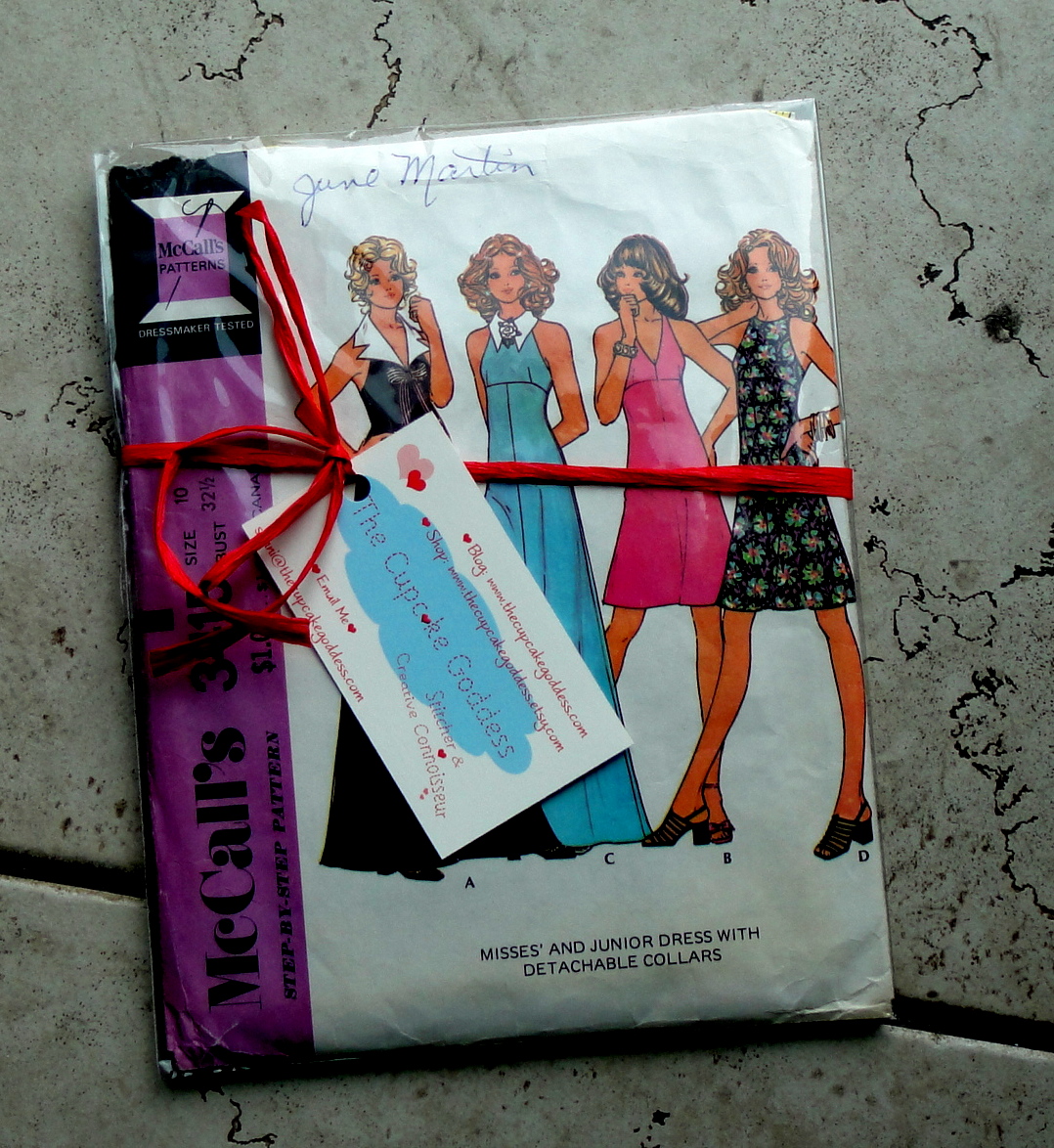
McCall's 3415

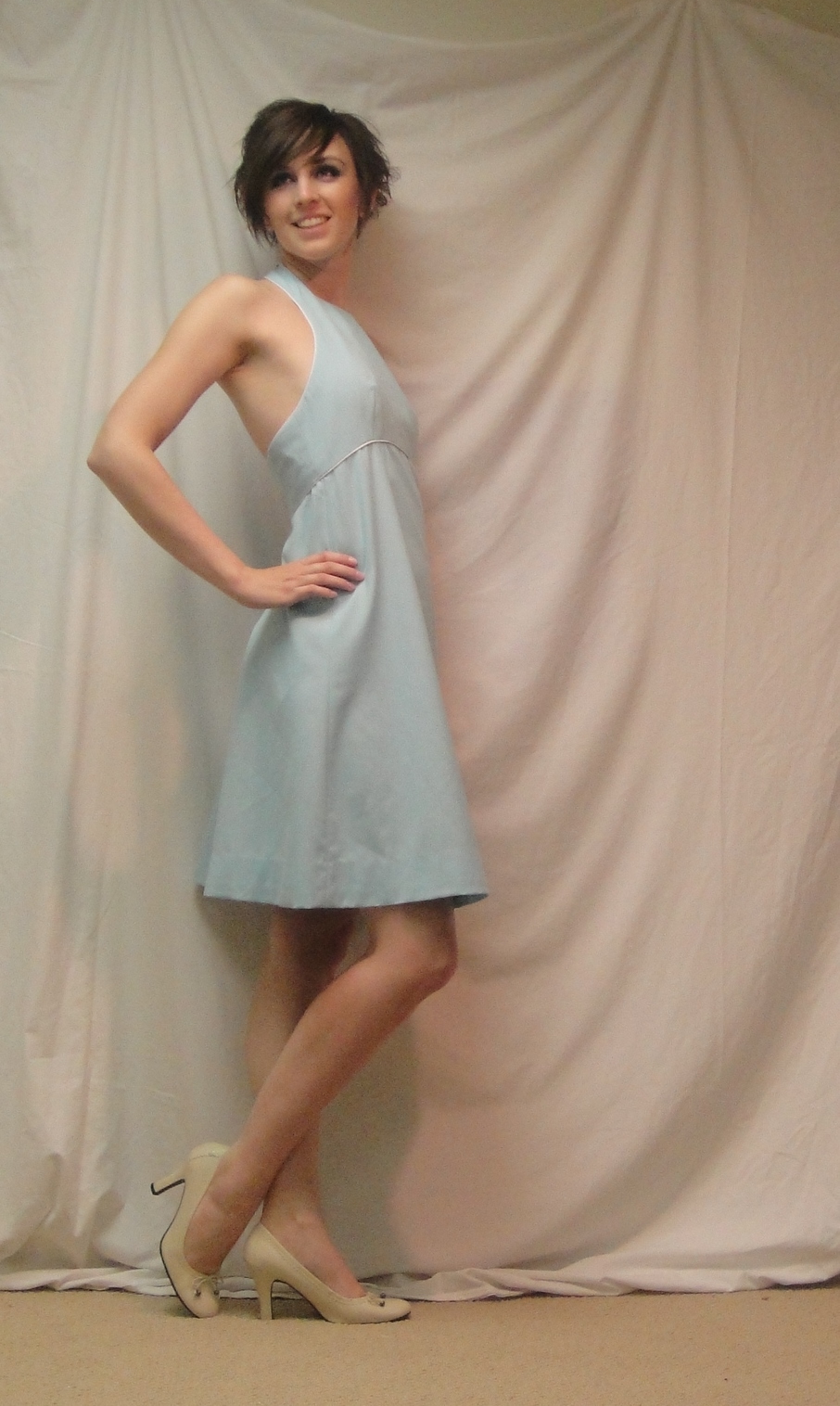
I have a feeling this dress is going to spend a little while in the Magic Closet.* You know when you reach that point when you’ve unpicked a seam so many times the whole thing just starts to look mashed and no matter how well you re-stitch it it’s still going to be a bit wonky? Yeah. I’m there.

That being said, I think once I’ve had a little bit of space I’ll quite like this dress. We just need a bit of time.

Front view

So, after all y’all’s** sage advice last week, I put on my big girl panties and unpicked the skirt (yes, removing zipper in the process), and made Alterations.

Specifically, I lopped 15 cm (about 6″) off the top, re-cutting using the top of the pattern but blending out to a wider width quite quickly (maybe a little too quickly…). In my paranoia over having enough ease I actually made the skirt a bit wider even at the top, electing to ease that in.

Side view

This fabric doesn’t ease so well, did I mention? Well, I mean, it does—there’s no pleats in the seam—but it sure shows the puckers. Not even going to go into how many times it took me to get the zipper straight and smooth and matching up, either. On the up side, I did get it smooth and relatively straight (and relatively invisible!) eventually, so I shan’t whine too much. And I did a slightly better job stitching on the bodice lining on the inside this time, although with all the grading and clipping and fraying from being unpicked so many times it still doesn’t look peachy. But I think I have the theory down, anyway.

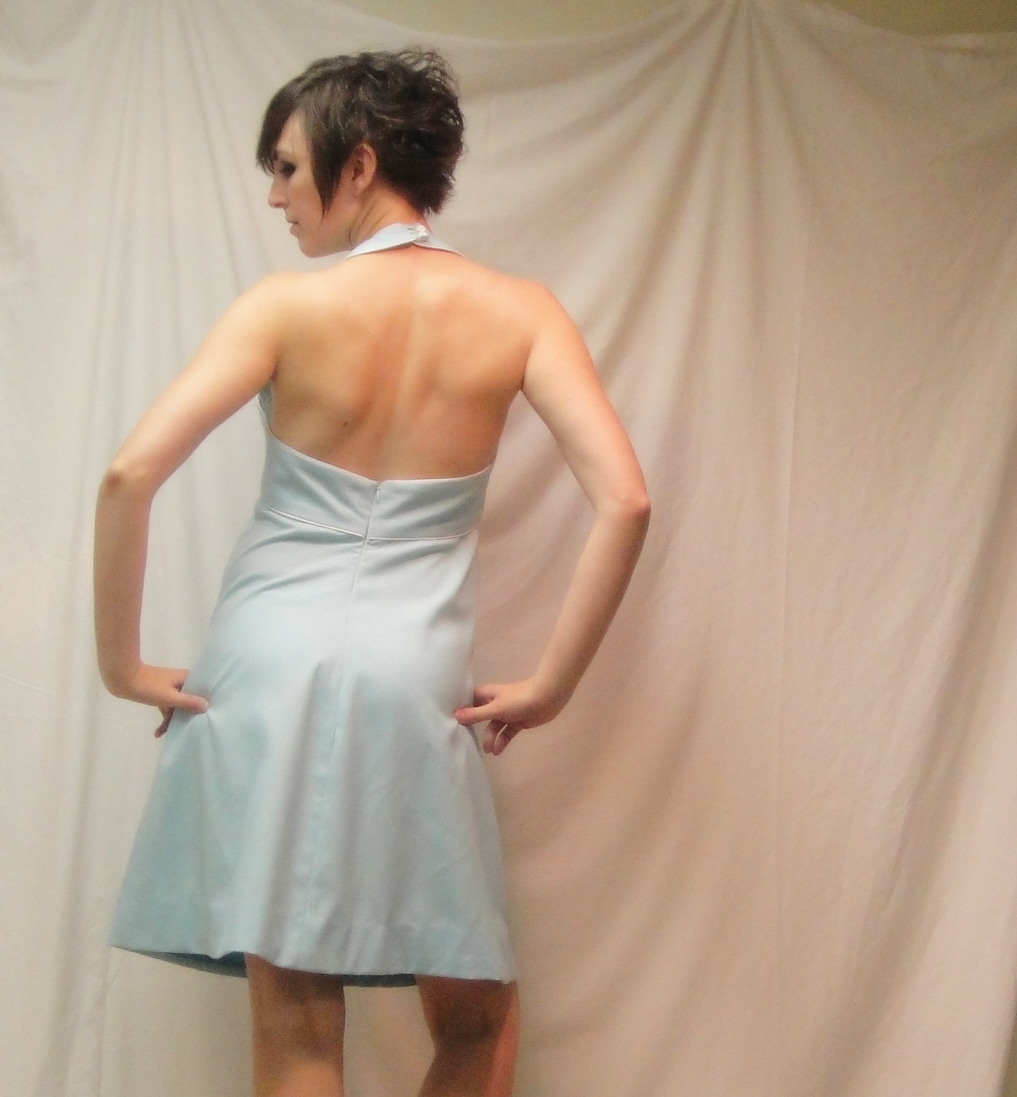
Back view

There are still some issues with how the back hangs—I think somewhere in my alterations the grain got a bit skewed—but at least it’s not straining over my hips and making my belly look like a stuffed sausage anymore. (It actually looks way better in this pic than when I’m just standing straight.  I miss the pockets, though. I wonder how much more work it would be to put them back in, now there’s enough ease for them… (walk away, Tanit, walk away…)

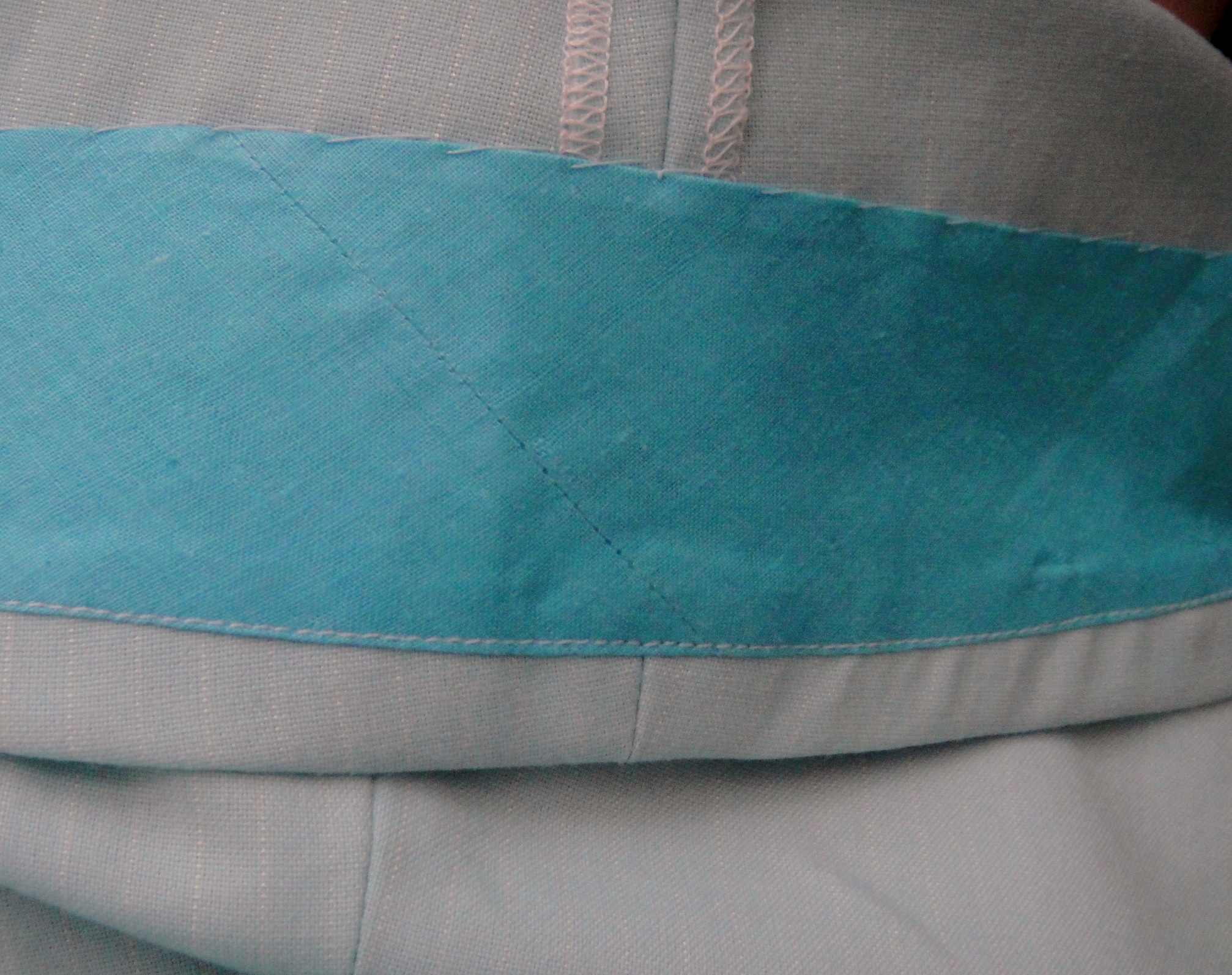
Hem facing

Having removed six inches in length, I didn’t really want to lose much more in the hem, so I put back the hem lace I’d been planning to use and dug out a package of teal hem-tape from one of my thrift-store scores that’s probably been in its package since about the time this pattern was new. I actually really like using a bias facing in curved hems like this. It works a bit better if you “circle” it first—iron it while stretching it into a curve.

Hem facing

Plus after thirty-odd years in the package it really needed to be ironed. Fortunately the skirt is quite narrow, as it was only a 1.85m package, and I had to discard about eight inches at one end where the tape that held the end in place all those years had turned yellow and marked up the fabric. I had just enough. The hem facing is a fair bit darker than the rest of the dress, but I think it’s a fun flash of colour. And it gives me the feel of a full, yummy 2.5″ hem without losing more than about 2 cm in length.

Having said all that, I have to admit something.

Halter styles are something I have a problem with. Meaning, I like them. I love the exposed back, I love how they look on other people and on pattern illustrations. But somehow when I see them on myself, I always feel line-backer-ish. Like they just emphasize the breadth of my shoulders. I keep making them because I really like the idea. And I keep thinking that next time, it’ll look “right.” There probably should be a name for this kind of stylistic insanity. On the other hand, I am actually liking the photos a lot better than I like the reflection in the mirror, so perhaps its one of those things where my brain exaggerates what I’m seeing beyond all reason.

Anyway, I’m hoping that some time in the Magic Closet will help me forget about most of my issues with the dress. Although the halter one’s probably there to stay. Next up: jackets in summertime. Unless the Lonsdale pattern arrives, anyway ;).

*You know. Where self-made pieces go to wait out the period while you forget all the stupid mistakes and messes you made.

**I don’t actually talk like this, but it sure is fun to write sometimes. Also my town is infected with cowboys at the moment, so it would be surprising if I didn’t have at least a few symptoms.

34 Comments

Filed under Sewing

All I need now is the Lonsdale…

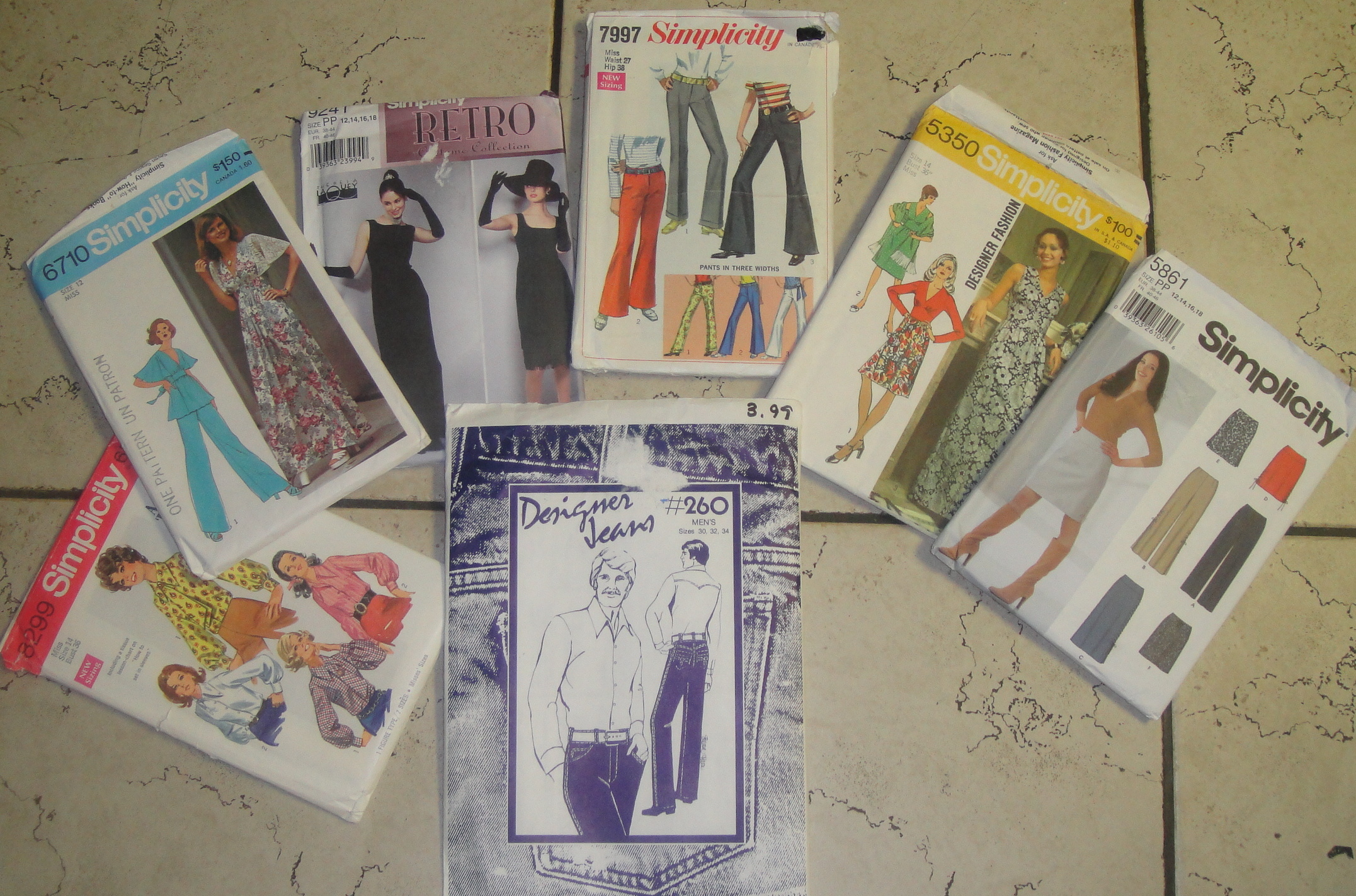
Patterns! Thank you, ElleC!

It was a good week, mail-wise, if not sewing-wise*. Several really awesome things came through, but I’ll stick to the sewing-related ones.

Very sweet (and tragically blogless) commentor ElleC send me a delightful package of her own Value Village pattern finds. More 70s Simplicity than you can shake a stick at (including more maxi-dreses!)! And that retro black-dress pattern is the Simplicity take on the Audrey Hepburn dress Her Selfishness copied, lo these many moons ago (It might be fun to compare Selfish’s pattern to the Simplicity one, someday when I’m in an LBD mood…). But I’m especially, super-duper, stoked about the men’s “Designer Jeans” pattern front and centre. Copyright 1981, from a design house I’d never heard of in Edmonton, Alberta, it looks guaranteed to be pure cowboy. The legs are straight, not flared (I checked carefully 😉 ), although I have a feeling they’re not very roomy. Good for me, less good for my hubster. There’s also two versions of the instructions, both of which are really nice, although I still haven’t managed to figure out what the seam allowance is. Sadly, the man has informed me that he wants the jacket I promised him more than anything else. He doesn’t seem to grasp that my jacket motivation now that real summer is here is somewhere below zero. Blergh.

Building Patterns

Equally thrilling, this pattern-drafting book arrived. I actually won it back in May after commenting on a giveaway/article on Burdastyle.com, but it probably got shipped out right around the time the postal strike got serious. Anyway, it’s here, now, and came with a cute little note from the author herself, and it looks like fun although I haven’t had a real chance to dig into it. It’s definitely text-book weight, anyway!

All I’m waiting on now is for my Lonsdale Dress pattern to arrive! Tasia shipped them out last weekend, so hopefully sometime next week…

Anyway. I am trying to spend my weekend sewing, rather than blogging (so I might actually have something worth blogging about later), so I’ll leave you with that.


*this not getting home from work until 6:30 thing really chokes my mojo. Bleh.

14 Comments

Filed under Sewing

One year of jeans

Unsewing 😦

Since the picture above  constitutes the grand total of my (un)sewing the last couple of days, I thought I’d talk about jeans.

First me-made jeans for me, ever.

I just checked back and realized it’s been over a year since I made my first pair of jeans for myself! Wow. Where did that time go?  Geez, I was so darned proud of that first pair. Funny considering I really hate wearing them now, although more because of the fabric, which I never did like, than anything else.

Anyway, inspired by Carolyn’s autopsy of her recently-deceased black jeans, I thought I’d muse self-indulgently a bit over one of my favourite things to stitch up.

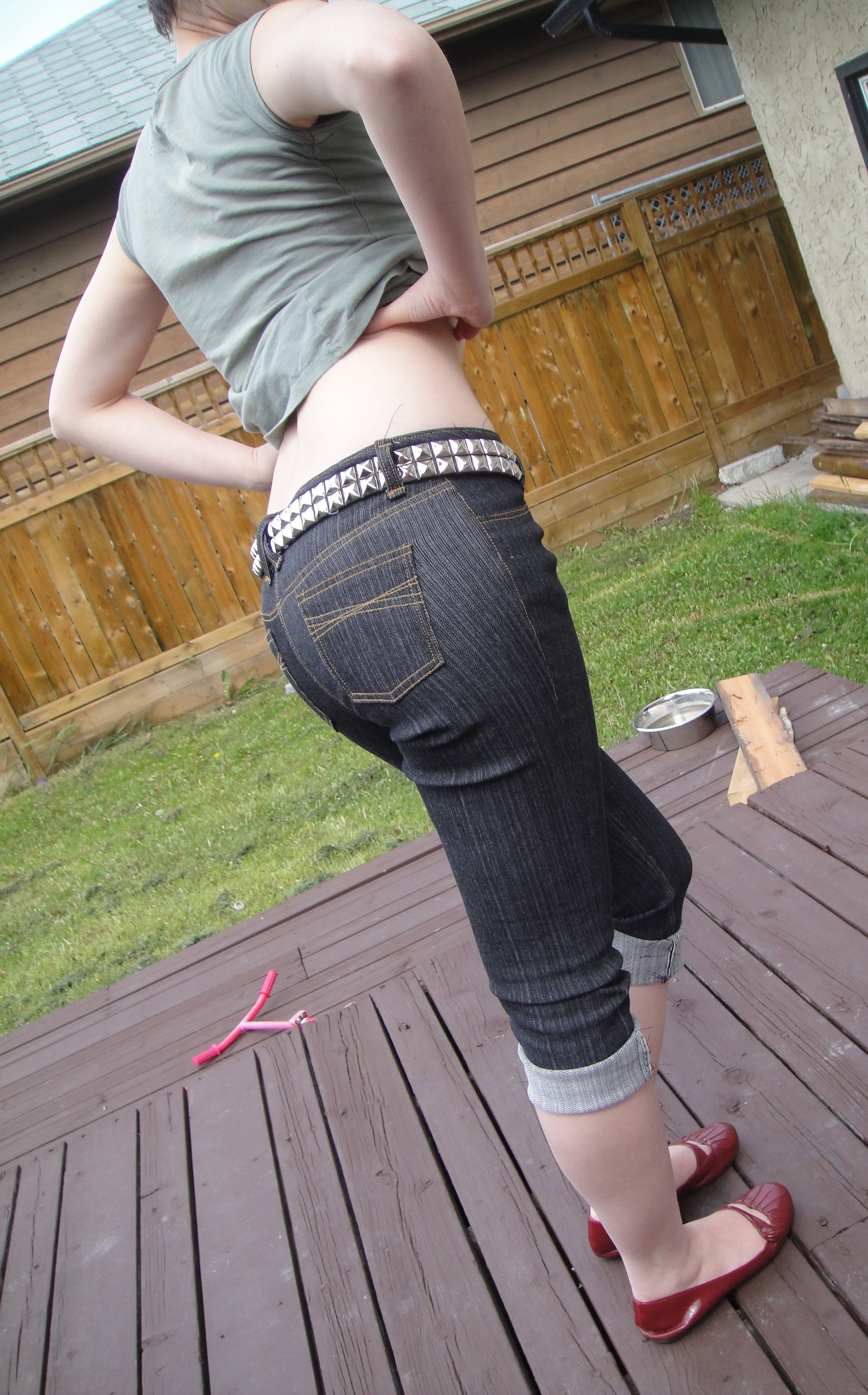
Depending on how you count it, I’ve now made seven or eight pairs of jeans for myself. Nine if you count the Lekala sailor shorts. These fall into two categories, stretch and non-stretch. Since I made my first pair of non-stretch jeans not that long ago, I can’t really comment on quality, so today I’ll just be talking about my stretch jeans, all of which are based on the infamous Jalie 2908 pattern. You can find all the Jalie jeans posts here, or all the jeans posts ever here.

I picked this pattern because it was highly recommended on PatternReview.com for something approaching the kind of jeans I like to wear, which are low-rise, tight-fitting stretch denim. The Jalie pattern is mid-rise, close fitting, stretch flares. From my reading, I was pretty sure that I would be making several stylistic modifications, and probably a couple of fit ones as well. For style, I would be lowering the rise and reducing the leg-flare to a straight-below-the-knee style (something I’d found in a single RTW pair back in 2004 or so and been looking for ever since that one beloved pair went to the great closet in the sky), and probably going down a size as, based on the models in the photo, I thought the jeans as pictured were a little loose for stretch denim (your mileage may vary.) For fit, I expected to dart the yoke and add, oh, 5″ of length to the leg or so.

Procedure for putting dart in yoke pattern piece. A small amount of additional width can be trimmed at the centre back (step 4) if necessary; alternatively, two darts could be used to spread the amount removed over a more gentle curve.

At the time I was a bit perplexed by why the Jalie jeans were drafted with such a flat butt. It seemed like pretty much everyone needed to modify the yoke, and the lady behind Jalie even has a tutorial out there on how to do the fix, both during construction and on the pattern for your next pair. Then I watched (well, over the phone) my mom try to make flat-seat adjustments on some pants she made back in the winter.

Best pair ever.

WAY harder than just taking a little dart out of the yoke. So. Yoke-dart for the win.

Anyway.

Jeans are actually not terribly difficult to make. Denim, even stretch denim, is a lovely fabric to work with, sturdy and well behaved. Where you run into trouble is:

  1. bulk
  2. topstitching.
  3. fly
So, let’s start with 1.

Bulk:

Denim is thick. Good denim is thicker. In a few places, like where the yokes meed the centre-back seam, you’ll be stitching through up to eight layers (more if you’re doing proper felled seams). If you’re lucky enough to have a chew-through-nails-clunk-over-everything vintage or industrial machine, you’re probably good to go. If, like me (up until a week ago) you don’t, you will probably need to resort to a few tricks.
  1. Clapper/point presser and hammer

    The clapper. This is one of those unfinished blocks of smooth wood, often topped with a point presser. You iron your seam, get it good and steams up, and then press and hold this on top until it cools down. It’s amazing how much more this flattens out fabric than ironing alone—I know I was always pressing the iron on longer than I should and then scorching my fingers trying to push things down after taking the iron off. Trust me, the clapper is better.

  2. A hammer. Yes, you heard me. Technically this is best done with a rubber mallet, as a metal hammer has a tendency to break some of the fibres around the edges. A sharp-edged rock-hammer even more. Although probably most of you don’t have rock-hammers lying around, so you won’t run into this problem. Anyway, hammering a bulky seam also flattens it, even more dramatically than the clapepr, just be careful you don’t put holes in your fabric. Especially if it’s a thin denim. [Rock-hammer pic]
  3. Handwheel. Most of the thick spots in jeans are going over seams, and don’t last very long. A lot of places where the machine motor jams up and just won’t go through all the layers, you can carefully handwheel a stitch or two to get it started, or even get you past the trouple spot completely.

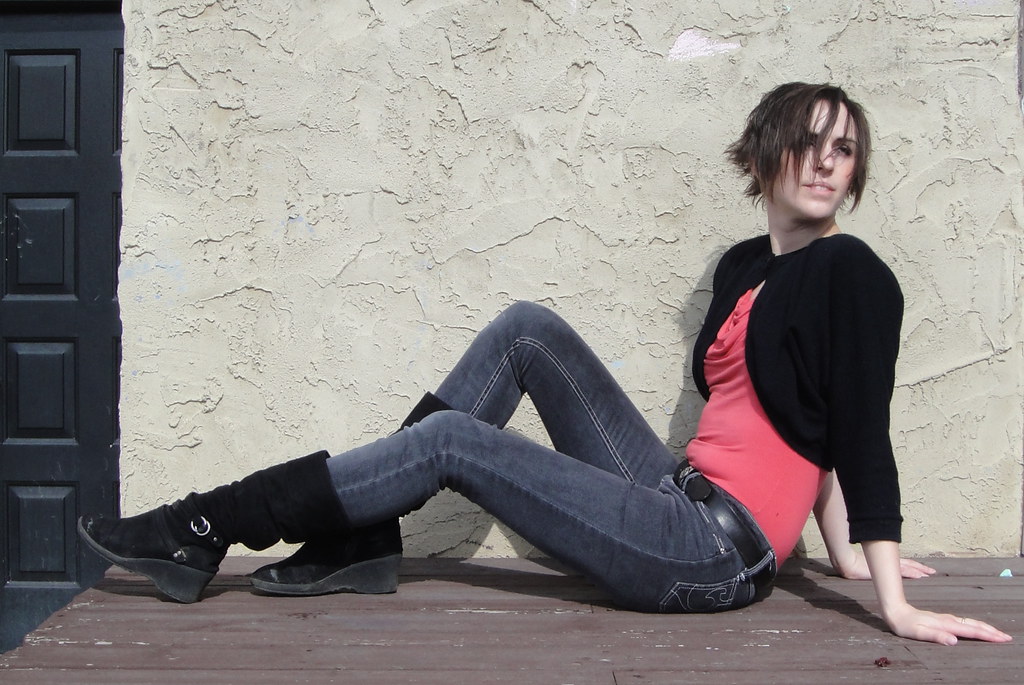
Jalie 2908 made skinny

Topstitching:

Presumably my topstitching woes are over now that I have the Featherweight, but topstitching on my modern Janome was certainly an adventure. There are several options I’ve used at different times. Generally the advice is to use regular thread in the bobbin, regardless of what you’re doing with the top thread. Topstitching generally looks better with a slightly longer stitch; I usually use 3mm for mine. Backstitching on topstitching can look messy, and many people recommend pulling the ends to the inside and knotting afterwards. I’ve experimented with both ways and came to the conclusion that the messy backstitch is, for me, more secure, usually not noticeable, and certainly not any more unsightly than some of my other topstitch booboos. Your mileage may vary.
    1. Two threads through the needle. If you can rig your machine to hold two spools, then hold the threads together and thread the machine as usual. This gives the top side of the stitch more oomph, plus you can use any regular thread, which gives you an extra-wide colour range to choose from.
    2. Triple stitch. Sometimes called (at least by me) a “stretch straight stitch”, this is where your machine takes two stitches forward, then one stitch back all the way along. The symbol on my Janome looks like this: ||| Basically, it ends up stitching each stitch twice, looking (ideally) just like #1. The down-side is that sometimes the forward and back stitches don’t line up perfectly, and if you don’t turn corners (say, on the pockets) just after the 1st forward stitch, it will take a stitch back after and make your corner look messy. The up-sides are: like #1 you have every colour imaginable to choose from; the top and the bottom look the same; and for stretch denim, this stitch has a bit of stretch to it.
    3. Heavy duty thread (including Coats & Clark Heavy Duty, buttonhole thread, and Guterman Jeans or upholstery thread). This heavier thread has a more striking appearance than regular-stitched regular thread, and looks more like “regular” jeans topstitching. You will probably need to turn up the tension a bit (do some tests) but my Janome handles this kind of thread quite well.
    4. Topstitching thread.

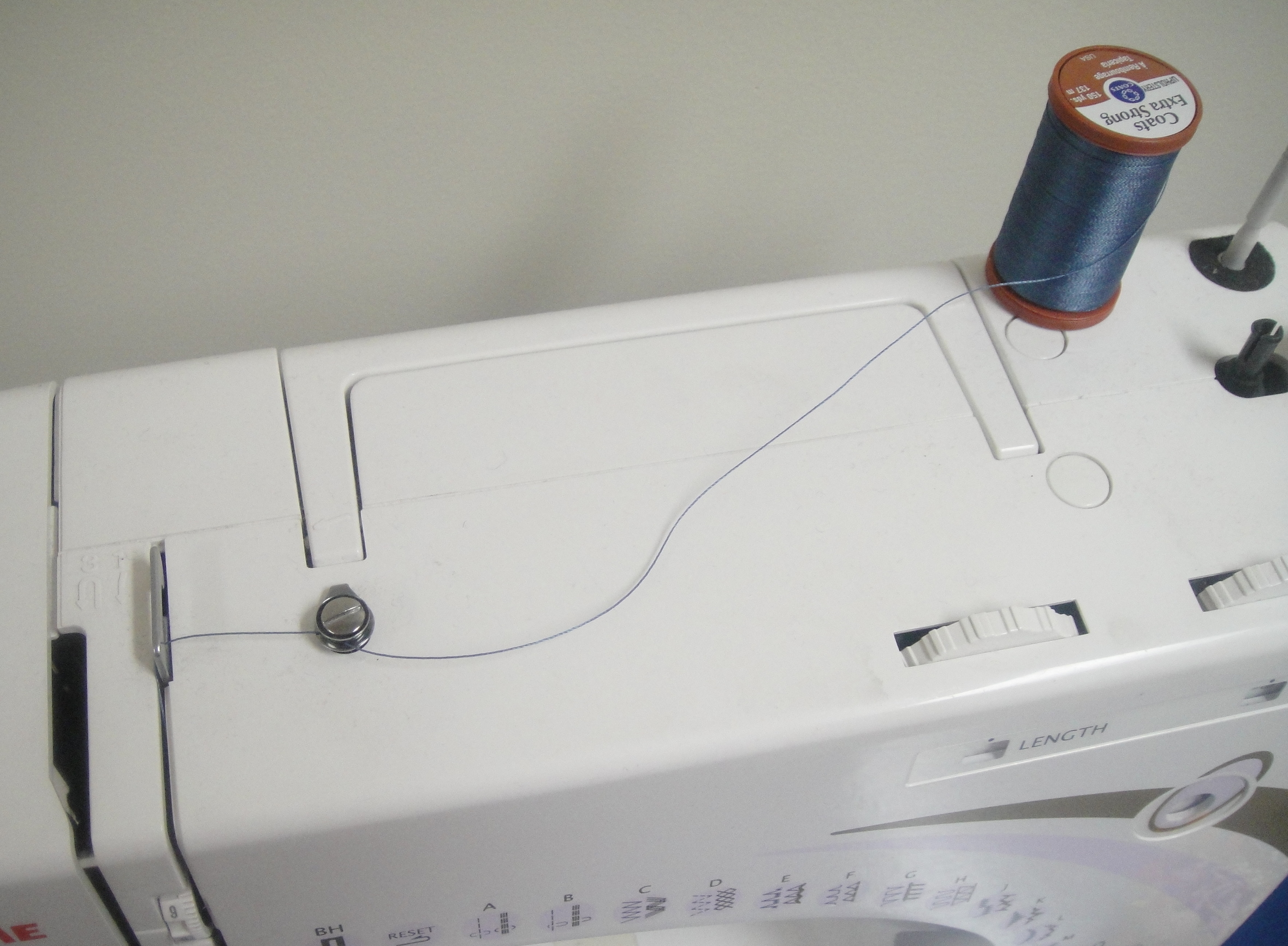
      Thread setup for dealing with mega topstitching thread: wrap around the little round bobbin-winding doohickey before threading as usual. Actual Guterman Topstitching thread not shown.

      By this I’m referring to the Guterman Tops-titching thread, which is the thickest of the threads I’ve found. It’s also a bit “fluffier” than, the heavy-duty threads above. But it comes in a wide range of colours and looks really striking. My Janome has major problems with this thread, which basically come down to the tension. The highest tension setting on my machine is too low. Possibly I could adjust the bobbin tension to compensate, but when stitching jeans on a single machine you’re re-threading just about every other seam. I wouldn’t want to add constant bobbin-adjusting to that procedure. Eventually, I came up with a sneaky tension fix where I wrap the thread once around the bobbin-feeder, which has its own little tension disk, before threading as normal. This increased the tension significantly, to the point where I could actually keep the regular tension pretty close to its normal setting. The other problem I have with this thread is it often gets snarled in the bobbin in the first couple of stitches. I found it was possible to keep this from happening by holding on (firmly!) to the tail of the thread when starting the seam.

Topstitching feet: 1) 1/4" edge-stitcher; 2) rolled-hem foot; 3) blind-hem foot

Topstitching foot. There are a lot of different sewing-machine feet that will work for topstitching, but your standard zig-zag foot is not the

Straight stitch foot (on Featherweight) and adjustable zipper foot. Both have open toes and can work well for topstitching.

best. Basically you want something with an open toe, so you can see precisely where the needle is on your fabric, and edges you can line up to get a consistent width. I don’t recommend trying to twin-needle denim, although I did hem some jeans this way early on—you’re liable to break at least one needle, at which point it gets very expensive very fast. My favourite topstitching foot is an actual edge-stitching foot with a handy keel (mine cost five or six bucks), but an ordinary straight-stitch foot like the kind that my Featherweight has also works really well. A blind-hemming foot works well in theory, but my particular foot the movable keel has a tendency to wander along its screw over long seams, which is less than useful, and it’s hard to re-set it to a precise width. My rolled-hem foot actually worked surprisingly well—just ignore the little scroll part and it’s got sides the right width and some handy grooves in the bottom. This was my favourite until I got the edge-stitch foot.

Fly:

I don’t have a HUGE number of tips on stitching up the fly.
  1. Find the tutorial that works for you. I have good luck with Debbie Cook’s; if you’re a video person (I’m not), Sandra Betzina’s video on the Threads website also comes highly recommended.
  2. Keep a RTW pair on hand for reference. This makes it much easier to keep track of which side to topstitch and stuff like that.
  3. Interface the fly, either with something fusible or with fabric from a front pocket extension. It will be a much happier fly later on if it’s a little more substantial.
  4. TRUST THE FLY. This is one I’ve only recently come around to. After you’ve got your fly constructed and your waistband on, it’s very tempting to try and tweak your fit that last little bit by moving the button one way or the other. Don’t. The button needs to sit so its shank is just at the end of your buttonhole. If you try to mess with this, you will end up with a gaping fly.
My own jeans have ranged from barely wearable to being far and away my favourite pair. I wish I could say there was a consistent improvement in this, or that I’d made the absolute perfect jeans even ones. I haven’t.  But I have had a lot of fun, and gotten some very wearable jeans for a lot less than I would pay at the store. There’s a lot of things RTW jeans have that I can’t imitate—fabrics I can’t find, embroidery I can’t do. My next step will be hunting down some really quality buttons and rivets, as the ones I can get locally are slightly sub-par, or at least, not quite right for jeans. I haven’t even tried my hand at distressing any of my me-made jeans, although I won’t totally rule it out in the future. But there’s plenty of other neat touches I can add, and thinking of what little detail will make that next pair special is one of my favourite things about making jeans. If you can pick up a pair at Walmart and are good to go, then making your own jeans probably won’t be your thing. But if, like me, you’re picky, hard to fit, or get stressed out trying to find that perfect style, making your own can be both fun and money-saving. I’m one of those people who regularly spends over $100 on new jeans, and I can’t reliably find any at the thrift store that are long enough and haven’t been worn to ribbons. Even paying full-price for quality denim, I can cut that price in half, and be just as happy—or happier—with the final product.
Damn. Now I want to make some more jeans.

Jeans!

31 Comments

Filed under Sewing

I want to work for Colette Patterns

If I can draw this…

Colette patterns is looking for a technical illustrator to do contract work. I want this job. If I can illustrate Carboniferous lizard pancakes, I can totally illustrate sewing instructions, right?

Of course, they’re looking for someone experienced. Y’know, someone who’s an expert with Illustrator and InDesign. I’m almost passable with Illustrator. I’ve never even looked at InDesign (although now I’m curious). The extent of my experience readying illustrations for print is making sure my DPI is within the journal’s recommended range.

Who prides themselves on meeting deadlines. Um, well, as long as I don’t put my supervisor as a reference…

Who answers email quickly. Um. See above.

Can easily translate complex sewing tasks into clear visual instructions. Hmm. I’d like to be such a person. I haven’t tried yet. Although having tried to write up instructions for a couple of patterns at this point, I gotta say, that’s the hardest part. And not nearly as fun as drafting up the pattern itself.

And there’s that whole thesis thing I’m supposed to be working on. Y’know, that little detail.

So basically, they’re not actually looking for me, and I couldn’t really jump on it if they were. /Sigh.

But if that description is you, go for it, and know that at least one person out there will be green with envy…

26 Comments

Filed under Sewing