Category Archives: Sewing

Splurge

Not so vintage...

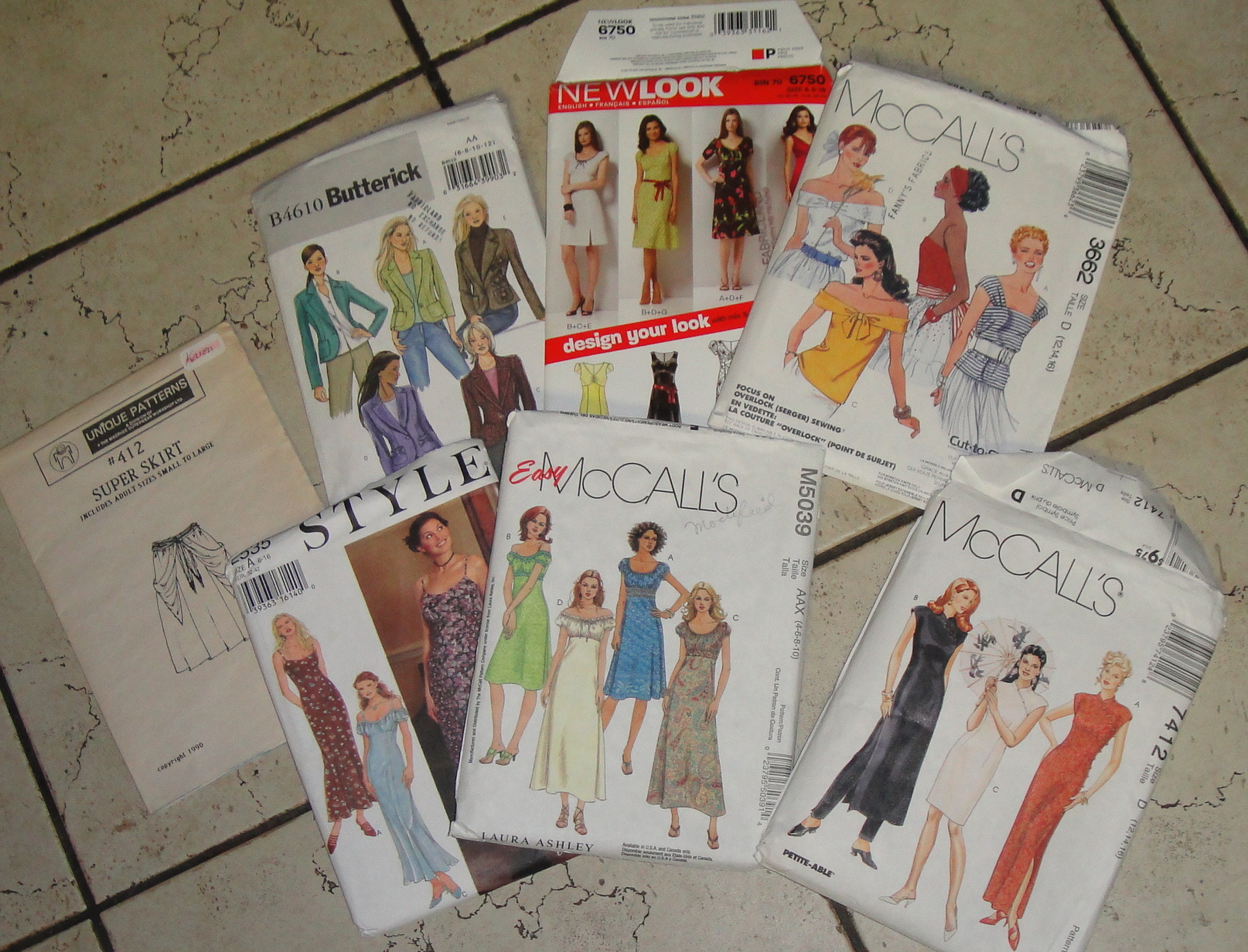
While visiting my mom post-Xmas we traipsed down to the trusty local Mennonite thrift shop. I just happened to be wearing the dress from Simplicity 6023 , made from fabric purchased at this same store during my last visit.

I was good about the fabrics—there was nothing screamingly spectacular. It helped that it was New Year’s Eve and they were closing early so I only had half an hour; just time enough for a good rummage through the chest of patterns.

I was not so good about the patterns.

Moreso vintage

I must now pause at this moment to say a sincere thank you to Darlene Ratzlaff (or her heirs), as nine or so of the sixteen patterns I nabbed bear her name (click through to see the full size). Whether or not she is any relation to my high school drama teacher of the same surname, she had good taste in patterns (and was close to my size). The Ratzlaff Collection all date from the latest 60s to mid 70s. I think my fave is the Style 3060 with the Wednesday Addams look in the middle.
Jalie Potpourri

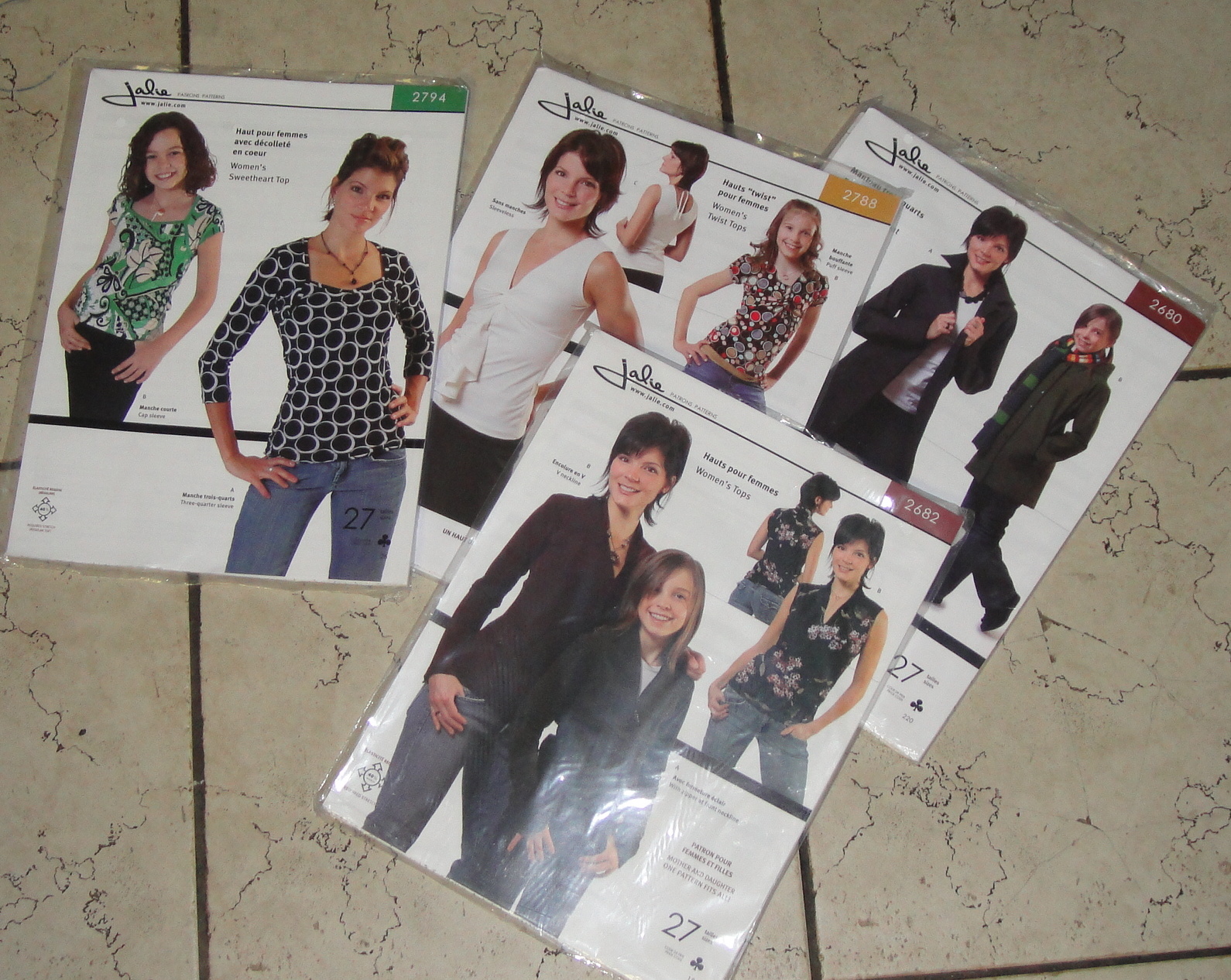
My mom, (who, as I have mentioned before, is a bit of an enabler) had some other goodies to contribute: she was gracious enough to lend me several Jalie patterns: the famous twist-neck and sweetheart-neckline patterns, a really cute jacket, and the slit-neck sweatery thing. I really like the jacket pattern. Because, y’know, I need another jacket project…
Patternmaking in 1908

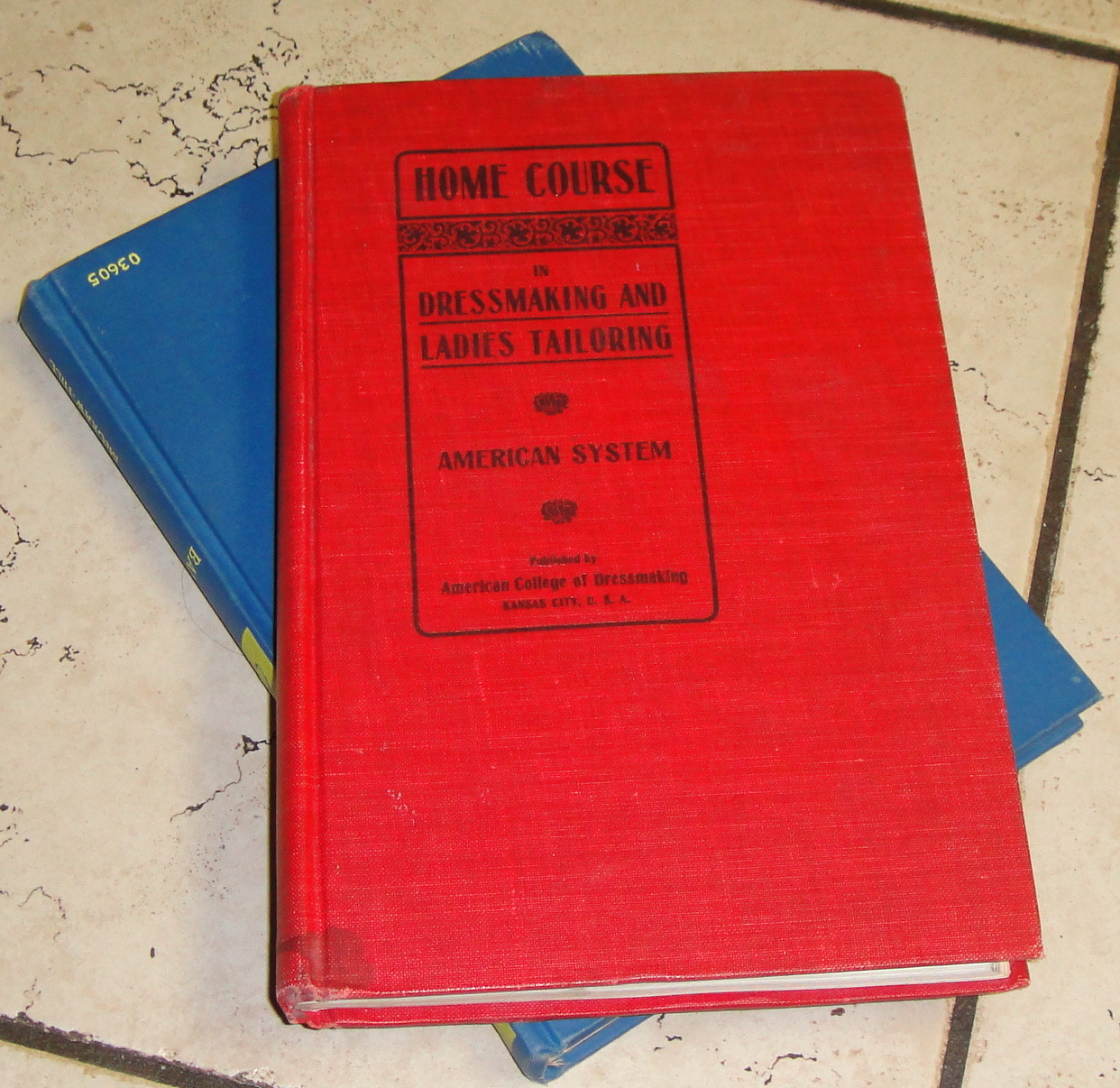
She had also acquired several vintage sewing books which I have absconded with, and which we shall have to discuss more as I have the leisure to peruse them adequately (how’s that for some excessive verbiage?). The niftiest, perhaps, is a 1908 book on pattern drafting. Sadly the curves and rulers that originally accompanied it (kit price $5) have long since wandered away. Still, pretty neat. I am really curious to find out how it compares with the “Modern block” method of Harriet Pepin and all the more recent pattern-drafting books I’ve read. Unlike some of the other early 1900s sewing books I’ve found online, this one has illustrations, which means I may actually have some idea what they’re talking about.

Butterick Sewing

There’s also a Butterick sewing book, of 50s vintage, which I shall have to compare and contrast with the 70s Simplicity one I nabbed a while back. /sigh. I’m so behind on my sewing-related reading. Someday, over the thesis…
Tailoring

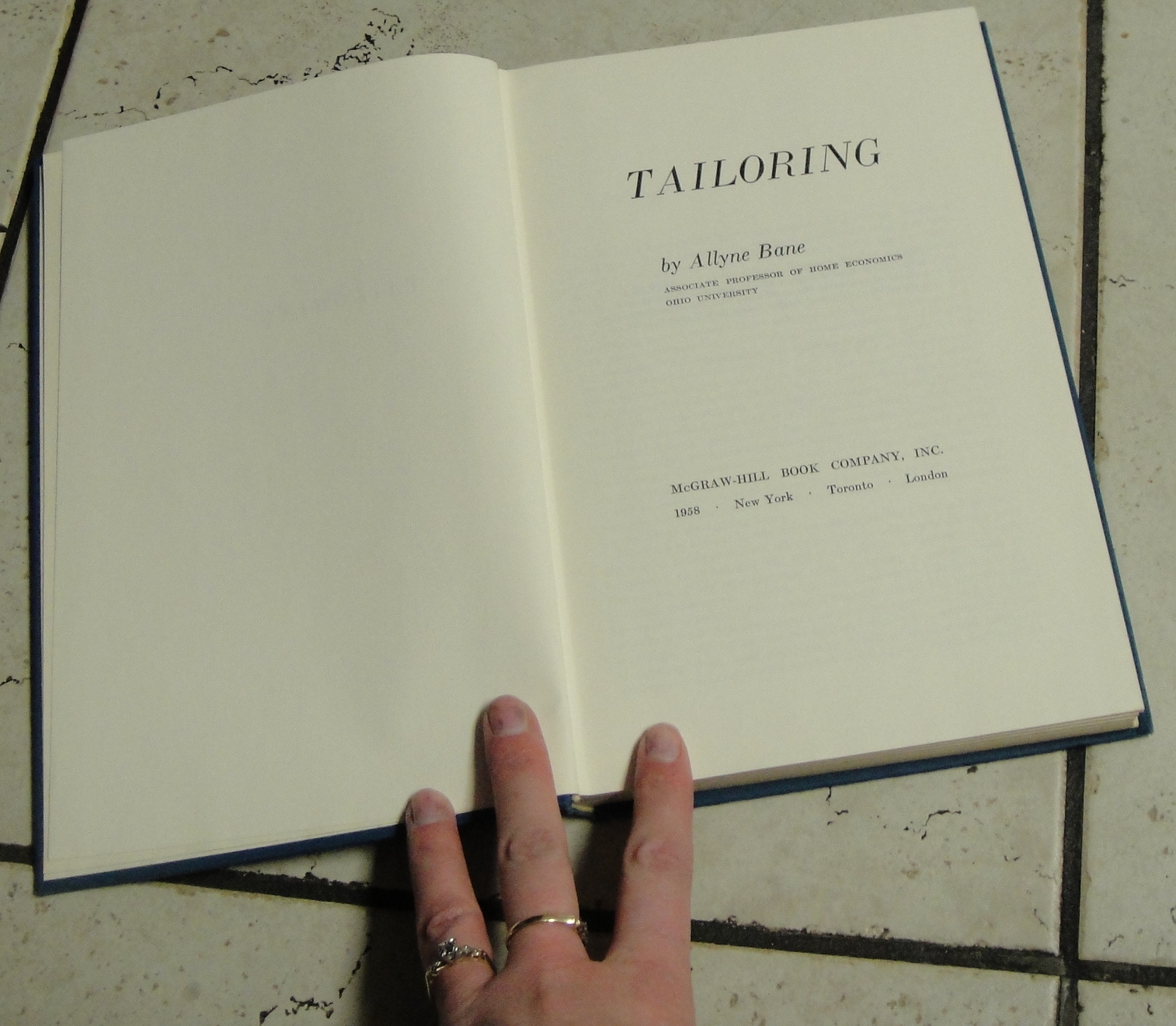
My favourite, though, is the blue-covered book simply titled “Tailoring”. It claims to want to be “an advanced tailoring text that even a beginner can use”, and from my reading of the first few chapters it’s doing a pretty good job. It’s got a REALLY comprehensive section on pattern measurement and ease calculations, too, including a chart I will have to scan and upload…

Oh, and I suppose I should be doing some kind of New Year wrap up/retrospective, but I don’t really feel like it. Maybe if I’m bored later this week, or sometime in the next month when I have nothing actually sewn. I’d rather spend what precious free time I have actually sewing, though. Speaking of which, coming soon: machine darning! (It may be a sign of sewing withdrawal that this was actually really, really fun.)
24 Comments

Filed under Sewing

Dwarf hoodie

Half a hoodie

Although finished as part of my Christmas procrastination, this little sweater for Syo has the best origins: I cut it out immediately after I finished Tyo’s robe, to use up the irregular quarter-metre of fabric I had left.

Simplicity 3714

The pattern is Simplicity 3714, a Hannah Montana pattern. Unlike the last few kids’ patterns I’ve been annoyed with, this one seems fairly full-featured. The instructions are decent as well. What was fun for me, though, was adding some nifty details.

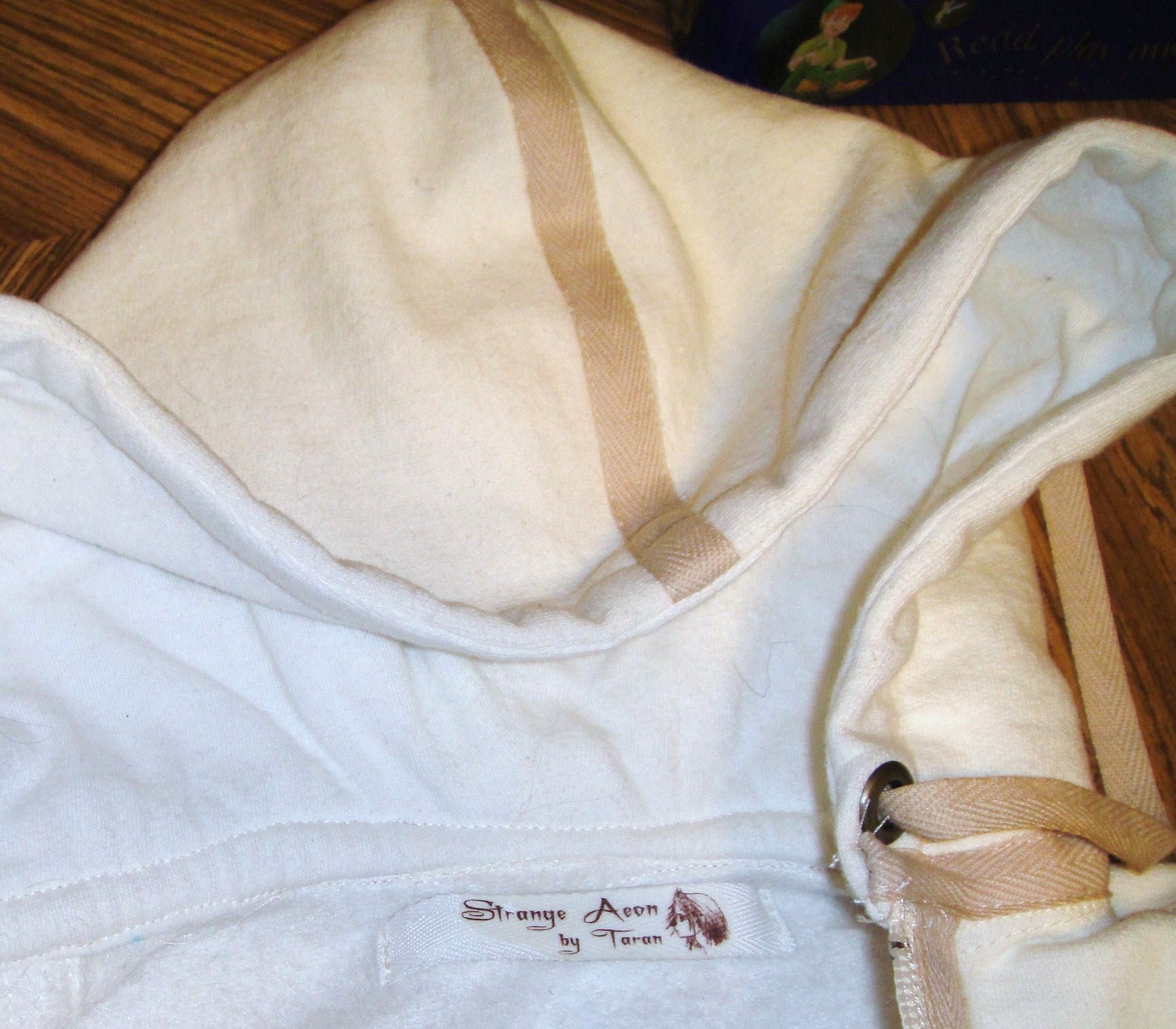
A couple of months ago, my MIL bought Tyo a bunnyhug*. It’s cream, gorgeous, and has some nifty features including (but not limited to) twill-taped seams, a lined hood, and eyelets for the ties. Unfortunately I don’t have photos of it (it’s really nice), but anyway, it definitely inspired me to try some of the details.

Syo’s Sweater

Unfortunately I didn’t have any cream twill-tape kicking around. So I took the white stuff I had on hand and dropped it in a pot of tea. It came out with this lovely tan colour… a bit different than I was going for but I thought it still looked nice (and it will probably fade a bit after a few washings.)

Hood closeup (with eyelet for drawstring)

Basically I stitched the main seams wrong-side together (so the seam-allowances showed on the outside, trimmed and pressed, and then topstitched the twill tape down overtop, so everything is neat both inside and out. The hood is lined with a plain jersey knit.

Fun view

I remembered (!) to interface the area where the hood eyelets were going to go with a knit fusible interfacing, hoping to avoid the tragedy of the eyelets popping out. This is a fairly sturdy sweatshirt knit, and I made the eyelet-holes as teeny as possible. They feel sturdy and stable at the moment, but we’ll see how they hold up.

Front details

The pattern suggested adding hot-fuse rhinestones to the front. I opted for studs. I may add more if I get ambitious.

Back view

I did the same kind of finish around the zipper, so the edges of the zipper tape and the fabric are completely enclosed behind the twill-tape. I’m not a super fan of this zipper, but the selection for 8″ separating zippers was pretty frigging limited.

Zipper finishing

I forgot to add the elastic at the waistband when I finished it, but fortunately was able to unpick the twill tape, cut a slit in the casing beneath it, insert the elastic, and then stitch the elastic in place and re-stitch the twill-tape, covering my booboo entirely. Yay.

Walk like a Syo

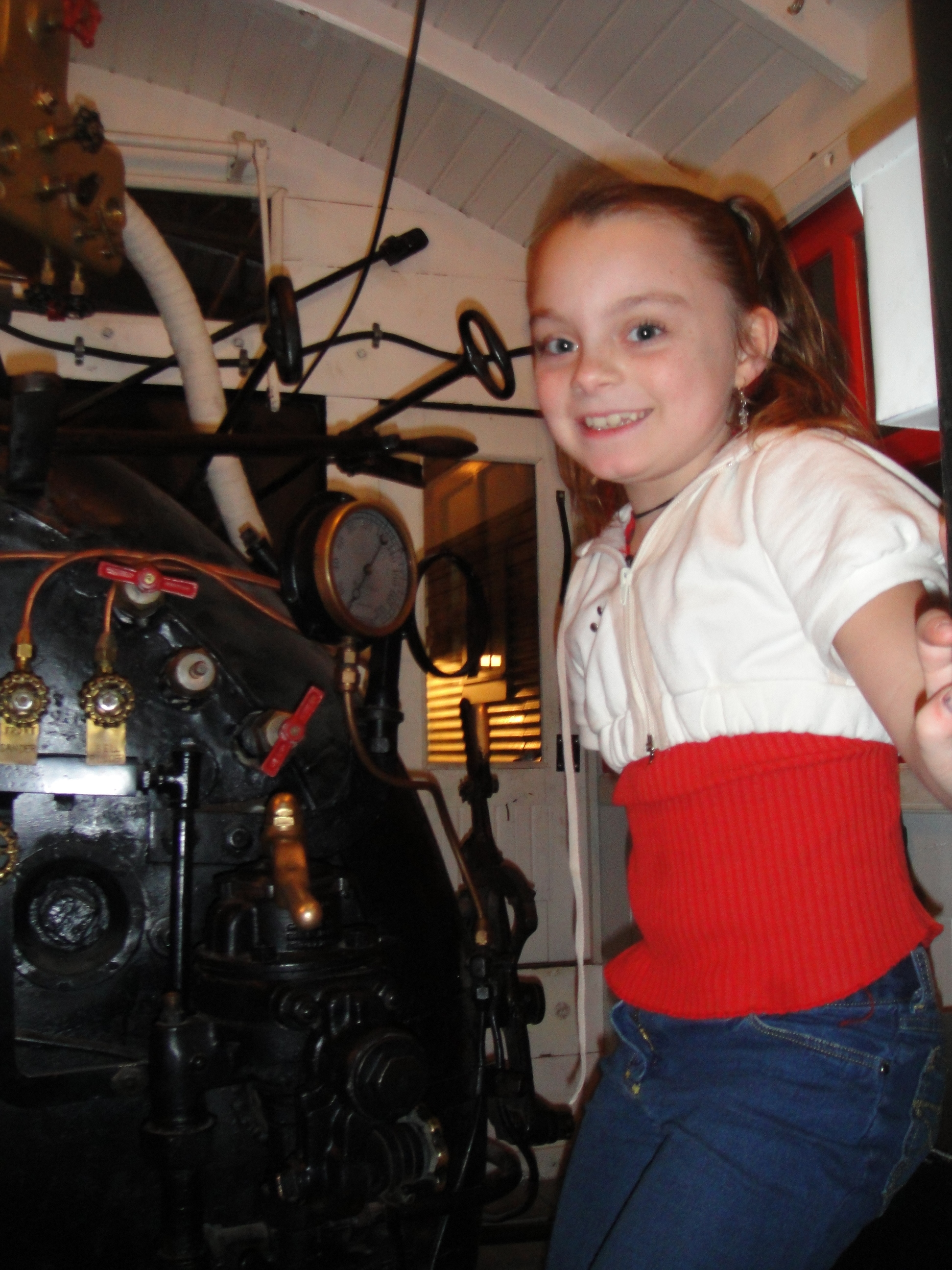
Syo is not super-duper thrilled with it, but I’m actuslly hoping it will be practical, as she is usually overheating and taking off her full-sized sweaters. She wore it pretty happily at the local history museum this afternoon. Maybe it will grow on her. I certainly think it’s pretty cool. But of course it’s not my opinion that matters. 😉

*hoodie.

18 Comments

Filed under Sewing

My mother is many things…

Not least of which is an enabler.

"New" Pfaff 360

Thank you, Mom. Merry Christmas.

This is a Pfaff 360. Some time in the 60s, it was a top of the line embroidery machine—that little colourful wheel thingy gives you the settings for the various stitches. My mom bought hers in the early 70s, second-hand, for about $250; this is still what a lot of them go for, from some quick googling. It’s the machine I learned on,  and measure every other machine against.

When I saw the case with the ribbon tied to the handle, I nearly had a heart attack, and had to open it up right away and check the attachments to make sure it wasn’t her machine. Fortunately, no. This is the machine a friend of my mom’s has been sitting on, but not actually using, for a while now.

This one has had a bit of a rougher life than my mom’s, I think. It’s a bit dinged up and the automatic threader is missing (not that I even knew it had one before Mom mentioned it.) The tension is giving me a bit of grief, although I think it’s just a little sticky and probably needs cleaning. I already messed around with some free motion satin-stitch embroidery and it sucked considerably less than I thought it would.

Every sewing machine feels a little different to “drive”, y’know? Some are zippy and light, some are sluggish, some are powerful. The Pfaff 360 isn’t as fast as my new Janome (or, for that matter, the old Army Machine, which when it’s going, goes like crazy), but it’s solid, powerful, and can chew through anything you can fit under the presser foot. And most importantly, it feels right.

The accessory box isn’t as extensive as my mom’s, (and in fact is missing some key pieces, like a zipper foot) but it does have a few that were missing from my collection—there’s a funny little keel that fits over the regular zigzag foot to work as a stitch-in-the-ditch foot and a buttonhole-measuring foot that had me thoroughly puzzled until Mom told me what it was. And it’s another low-shank machine, so the bits should be interchangeable with everyone else except the Army Machine.

Merry Christmas, everyone! I’m thoroughly overflowing with turkey, stuffing, and cranberry sauce, so I’m off to bed. Have a great night!

20 Comments

Filed under Sewing

The Turn

A White Day

I live in Canada. Winter is cold, and there’s a lot of dark. Sometimes the days are brilliant—shining, blue skies, the cold white eye of the sun, and everything glitters like the inside of a diamond. Often these are the days when the cold steals your breath, making you cough, where it knifes through your thighs as you walk, bores a hole between your eyes were even the warmest scarf can’t cover.

Then there are the white days, the prairies’ special trick, where the sky is white, the land is white, and the horizon becomes only a guess. Everything is a middling, dull-white shade. It does not glitter, just fades slowly into night.

Cold Coming In

The nights are long. You rise in darkness, running from blankets to robe to sweaters as quickly as possible. Often it’s dark again by the time you leave work. Entire work weeks can pass in darkness. Months pass without feeling the sun’s warmth on your cheeks.

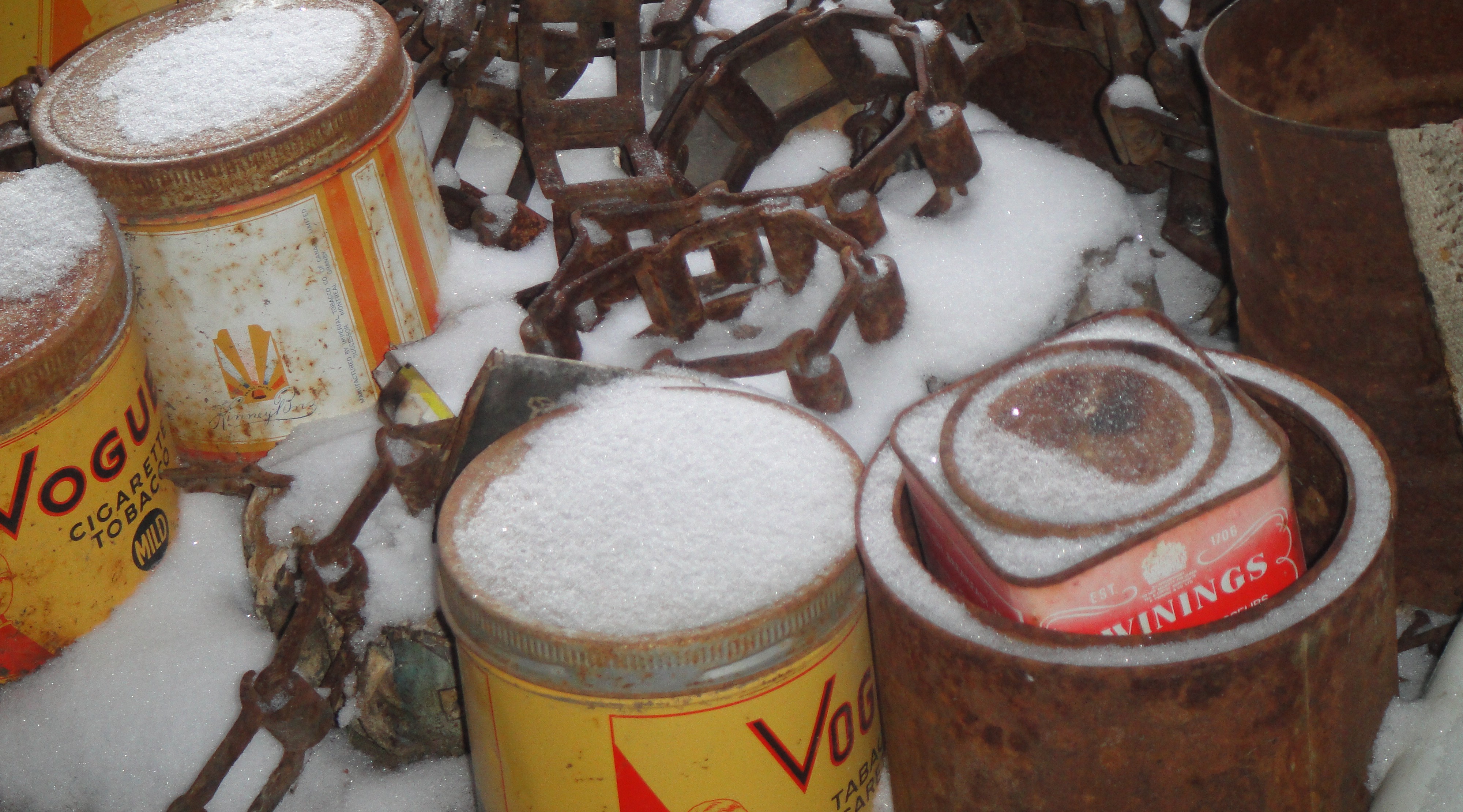
Vogue tobacco?

There are blizzards, confections of wind and snow to make you stare in awe. Cars creep hesitantly along the roads, snowflakes whirling like unsteady stars, hiding everything: the road’s edge, the lane markings, the oncoming traffic. You stock your car: blankets, candles, chocolate bars. The danger is not so much going off the road. It’s going off the road, too far from help, where you’ll sit in your idling car until the fuel runs out and then the cold seeps in, and you either wait for it or walk for it. That’s when people die. Blizzards are the moments when you bow your head and admit defeat; allow nature her supremacy, and stay home, preferably with a fire and hot chocolate, and tell the story of the farmer who lost his way in a blizzard going from house to barn, and how long it was before they found his frozen body.

Remains

I don’t love the cold. I don’t love winter. I don’t love the prison our houses become, the prison our clothes become, layers piled on layers, constricting and restrictive. I don’t do many of the fun things that make winter worthwhile up here—I don’t skate, play hockey, ski or snowboard.

But I do love the holidays. I love taking a few moments, here at the blackest end of the year, to enjoy the people around me. I love the convergence of roads that lets me see my relatives in wild, energetic bouts, all at once, rather than one or two at a time. I love the food, the lights, the decorations.

I love turkey with cranberry sauce.

Shot with tree.

And I love knowing that, after today, no matter how cold the weather or how majestic the storms, the days will be getting longer, and sooner or later the ground will soften, the snow will melt, and spring will be here.

Happy Solstice, everyone! I hope your holidays are full of family, friends, and togetherness—and if not, then I hope they’re at least filled with other things that make you happy.

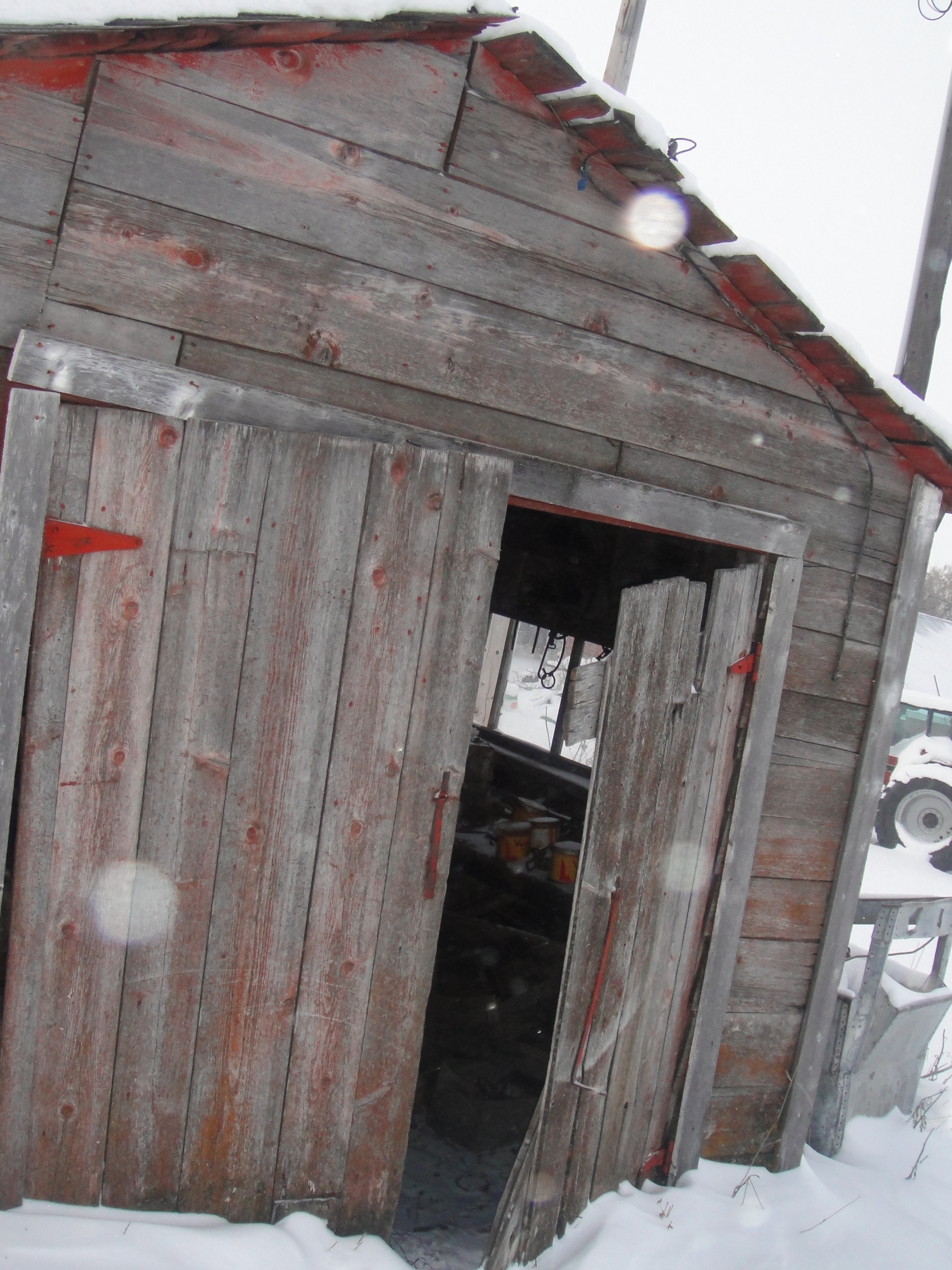
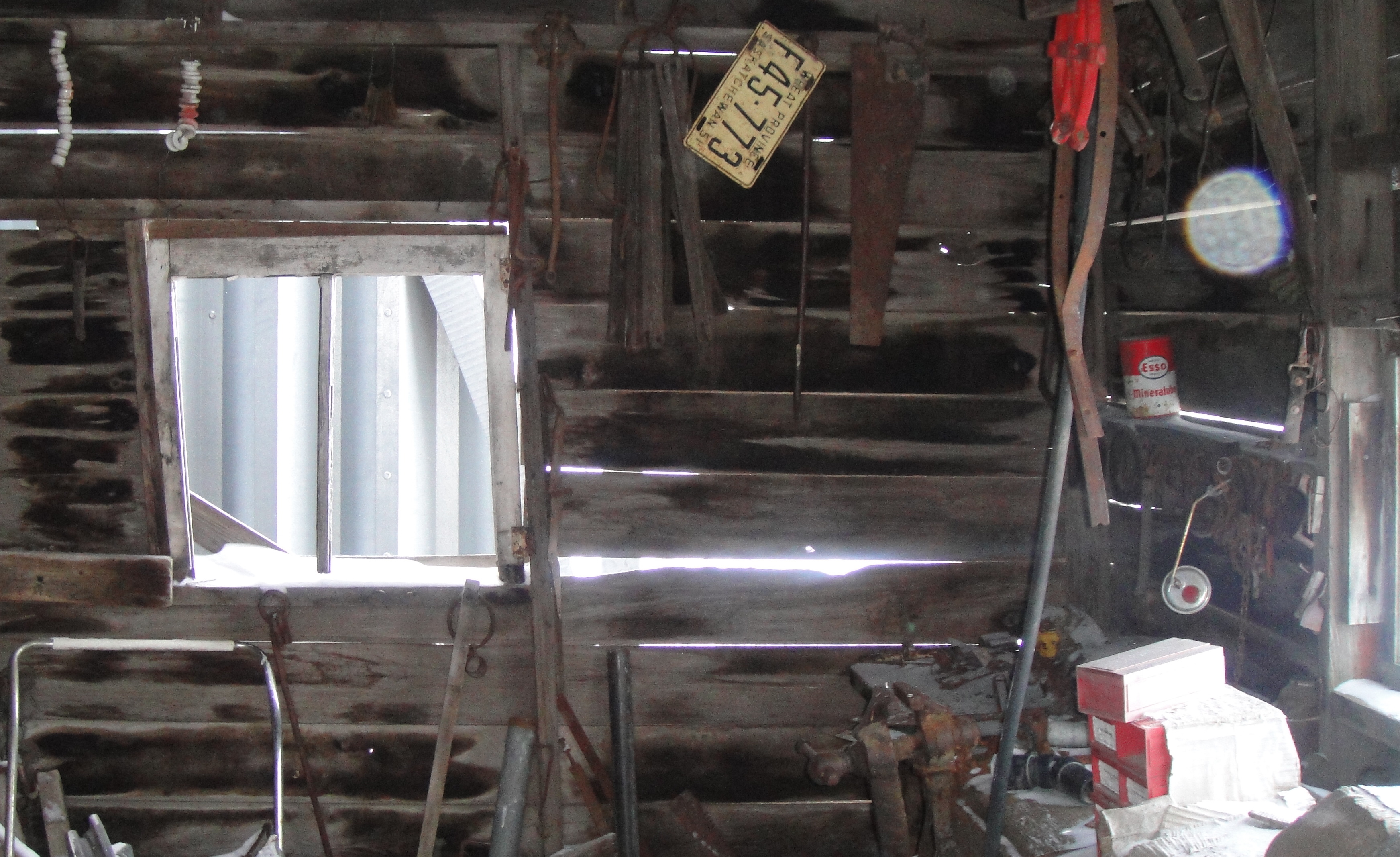
(photographs of an abandoned shack at my grandmother’s farm)

40 Comments

Filed under Sewing

Syo Sews

Syo sewed so well. Also she's wearing a shirt I made her.

While I’ve been dithering over the hubs’ coat, Syo seized the opportunity to sneak onto an unattended machine and whip up a little purse. Her being extremely proud of her creation, she asked me to blog about it. Me being putty in her cute little fingers, immediately snapped some photos and set to.

Look! It opens!

Look! Not only does it have a strap (thankfully using up the last of that trim!), but there’s even something approaching a seam-finish on the end of the fold-over flap!

Ok, so I may be a little bit exuberant. Here’s the thing. She sewed this on her own. The only thing she asked me was whether she could use the machine (yes, dear, just don’t sew through your fingers, k?). No hovering, no planning, no supervising every seam-allowance and pivot and backtack.

People, this is how I learnt to sew (when I was probably right around Syo’s age, maybe a smidge older). Grab fabric, think (or don’t), and go. Doesn’t work? Try again. Something you never thought of goes wrong? Oops, that was a learning experience!

I’m not knocking anyone who learnt to sew properly—it’s probably a much faster, more efficient way to learn. But it’s not how I learnt, and trying to teach my kids feels… forced. Weird. Stressful.

This wasn’t stressful. This was great.

Shot with tree.

In other news, I traced out the size F(2, but in length G/3) and size H(4) of the Jalie 2908 jeans, to make up for my nieces, possibly even for Christmas. I’m still in limbo over a shirt for my Dad… I have the fabric picked out, but the Negroni pattern I ordered at the beginning of the month (yes, I caved, finally) still hasn’t arrived. I have printed out a custom size (as far as I can figure going on my mom’s recollection of his measurements and some gentle prodding over the phone) of this pattern, but I’m a little worried that it’s going to fit like a tent, which is not really what I want to create. I’m planning a backup gift on that front, either way. On the subject of Mr. Isis (every time I type that I think I should just put “Osiris”)’s jacket, I did a second muslin, with a much fuller back and wider sleeves, after he very instructively flexed while wearing the first muslin and ripped the back seam open clear to the waist. We are having some issues over fit vs. freedom of motion; like many hard-to-fit people, he’s used to wearing knits or vastly oversized wovens. Anyway, the second muslin had a very curved back seam, a lot of ease rotated into the shoulders (basically I rotated some of the curve from the neck into a shoulder-dart, but I don’t plan on sewing the dart, just easing the fabric in), and has some big folds under the arm, all of which disappear completely when he crosses his arms. I tried to suggest (as I seem to recall reading somewhere) that a suit-jacket should lie smooth when the hands are clasped in front. He doesn’t consider this adequate. I think he’s on glue. The debate continues. Anyway, I think I can shave off a bit of the excess and get something that doesn’t look completely grotesque when he’s standing naturally.  Fitting muscles is weird. It’s almost like an FBA for the back, in an area that doesn’t happen to have any darts. (Boy has a drop of almost 12″ from chest to waist right now. That’s not only more than mine, that’s more than twice mine. The jerk.). At least widening the sleeves went well. I’d be tempted to try a larger size, but the shoulders fit beautifully.

Now if I could just find my roll of craft paper to make the rest of the pattern pieces… (I’m trying to save the wrapping paper for the presents…)

35 Comments

Filed under Sewing

The Procrastination Tee

Steph

I’m supposed to be sewing my husband’s christmas coat this weekend. It’s amazing what you can do when you’re procrastinating…

This is not, obviously, the Bird on a Wire fabric. Seeing as Spoonflower knits are like $27/m, I figured a wearable muslin was in order. This stripey stuff (formerly seen in the Where’s Waldo shirt) was like $3/m. That works.

Pattern: lengthened

I made only one change to Steph’s pattern (which I have to admit, after the Zoe coat fitting and the hack ‘n slash I’ve been doing on the Lekala pattern for my husband, was a BIG relief): I added a crapload of length to the bottom. Steph drafted for 3″ below the waist… 3″ below my waist is still an inch or two above my pants. Those of you who don’t wear your pants indecently low won’t have this issue. 😉 I also smoothed the curve of the back piece in the hip region—I have no idea if it’s better this way, I just liked the look.

So, fit? The shoulders fit. Perfectly. Like a dream. OMG. For the record, I did not once supply Steph with my shoulder measurement.

Back view

In fact, the fit of the whole thing is pretty fabulous. As promised, it’s snug through the bust with a teensy bit of ease in the midriff, just enough to not feel like a stuffed sausage, without feeling odd about the difference between the bust-ease and the waist-ease. Now, just for the record, I made the 35|| size, that’s 35″ bust, rectangular shape. Steph recommends it for those with 8″ or less difference between bust and waist.

Cool Cat

Also for the record, I myself have a 33″ bust and  a 5″ difference with my waist on a good day. /sigh. This is not a very stretchy fabric, but if you’re an actual 35″-bust you probably want to make sure you use a fabric with at least a modest amount of give. There’s a fairly significant amount of negative ease at the bust, which is actually the narrowest point on the pattern. Bonus for me, it meant I didn’t need to adjust the waist shaping for my short waist!

I think the only thing I’ll change next time is lowering the neck-scoop a little more. Like an inch or two. It’s a bit high for my taste, and maybe a bit higher than in the version Steph drafted for herself. My neck-binding is standing up a bit, but I think that has everything to do with the fabric not stretching enough to make a nice, flat binding.

All inall? Good job, Steph! And thank you :).

(Oh, and sorry for the hat, I had an afternoon shower and no way was I doing my hair again…)

Should you for some reason require more random photos of me goofing around in a stripey T-shirt, they can be found here. I tried to embed the slideshow, but WordPress does not seem to want to play nice with Picasa.

ETA: The pattern is, of course, the Bird on a Wire Tee by Steph of 3 Hours Past the Edge of the World. I’ve linked it before but obviously I should include it in the main post here!

30 Comments

Filed under Sewing

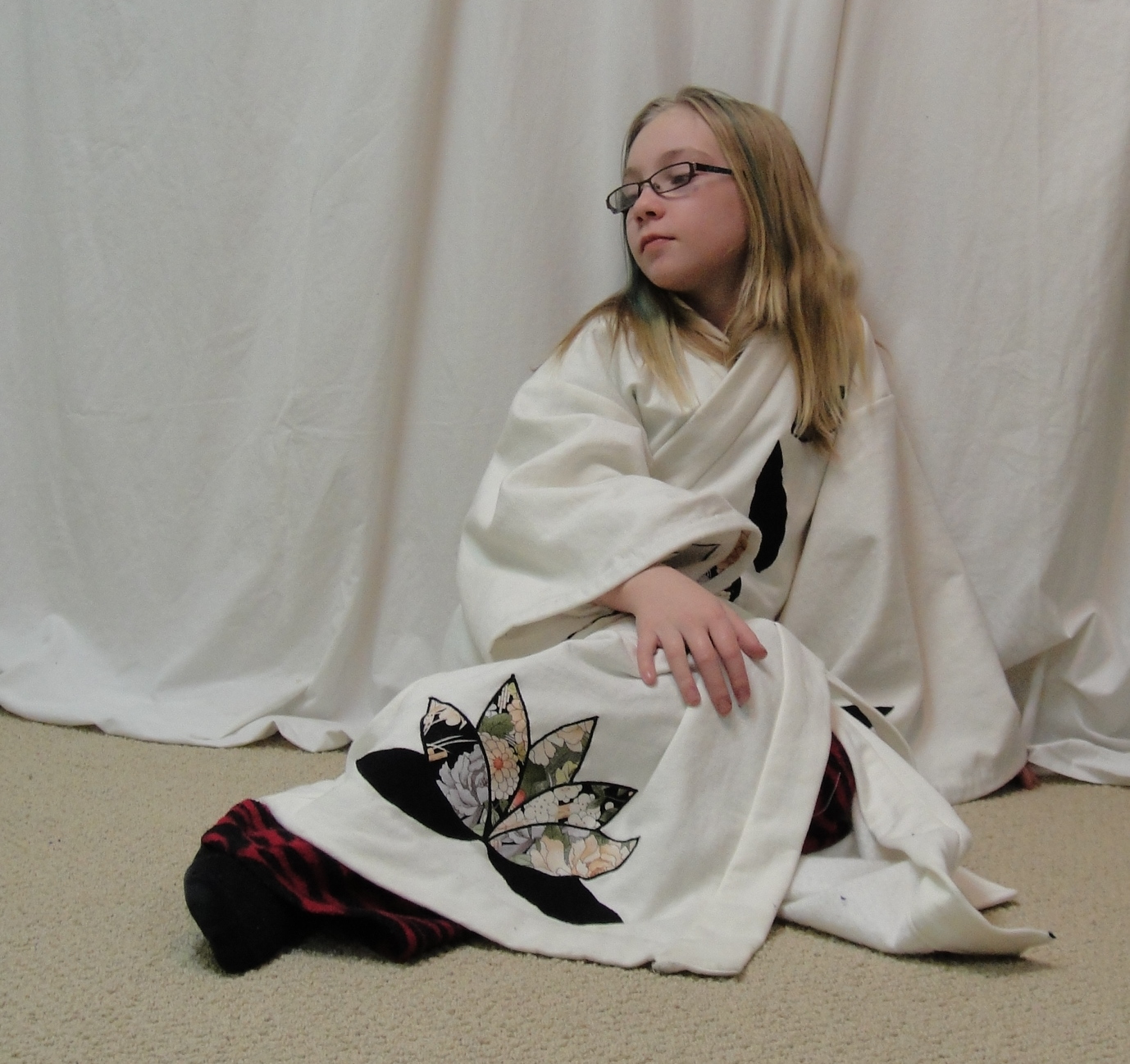
The Lotus Lady

So serene... so contemplative...

Perhaps “Lotus Lass” would be more apt, but it just doesn’t have the rhythm, y’know?

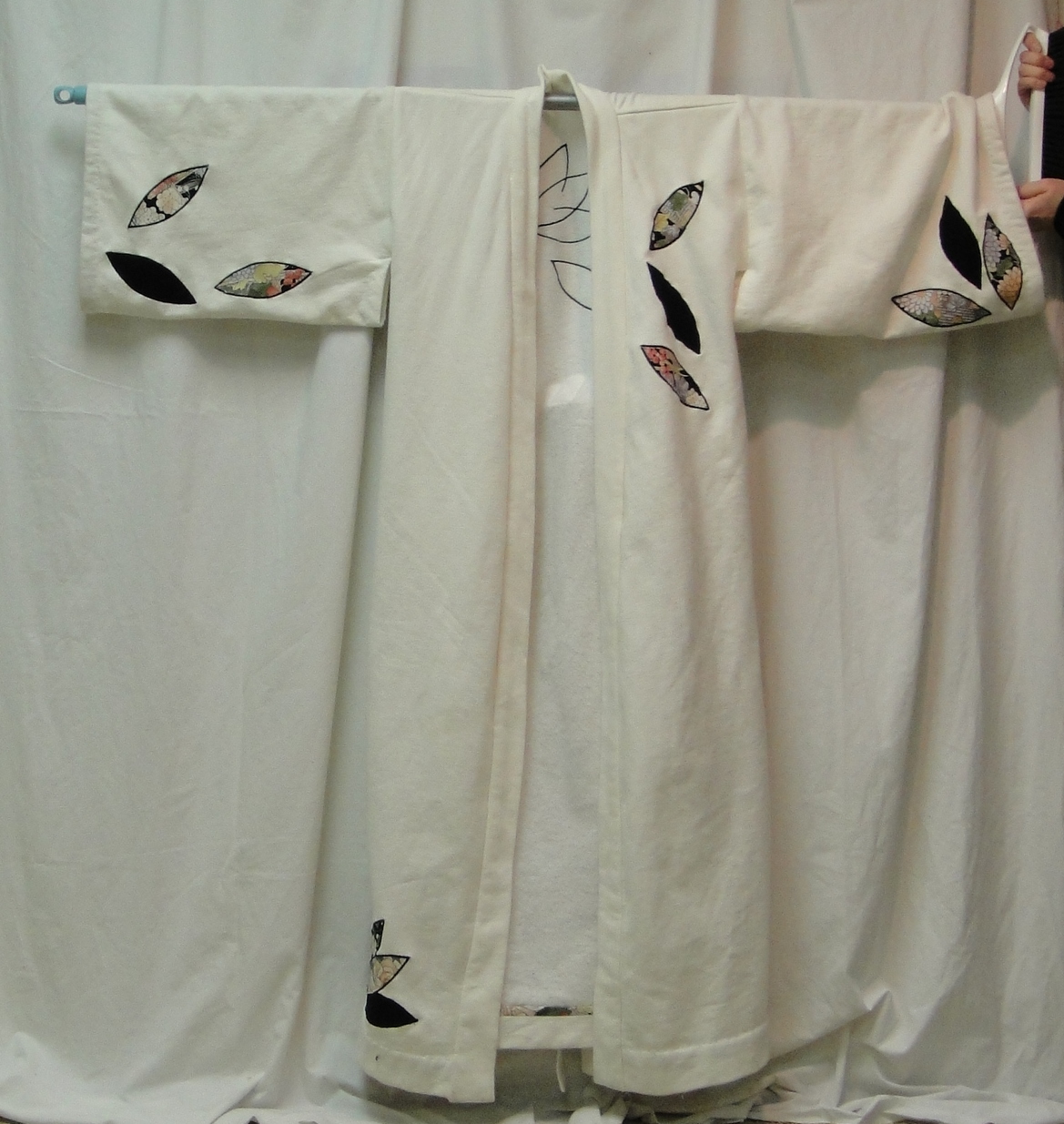
Kimono front. Pay no attention to the broom handle sticking out of the sleeve...

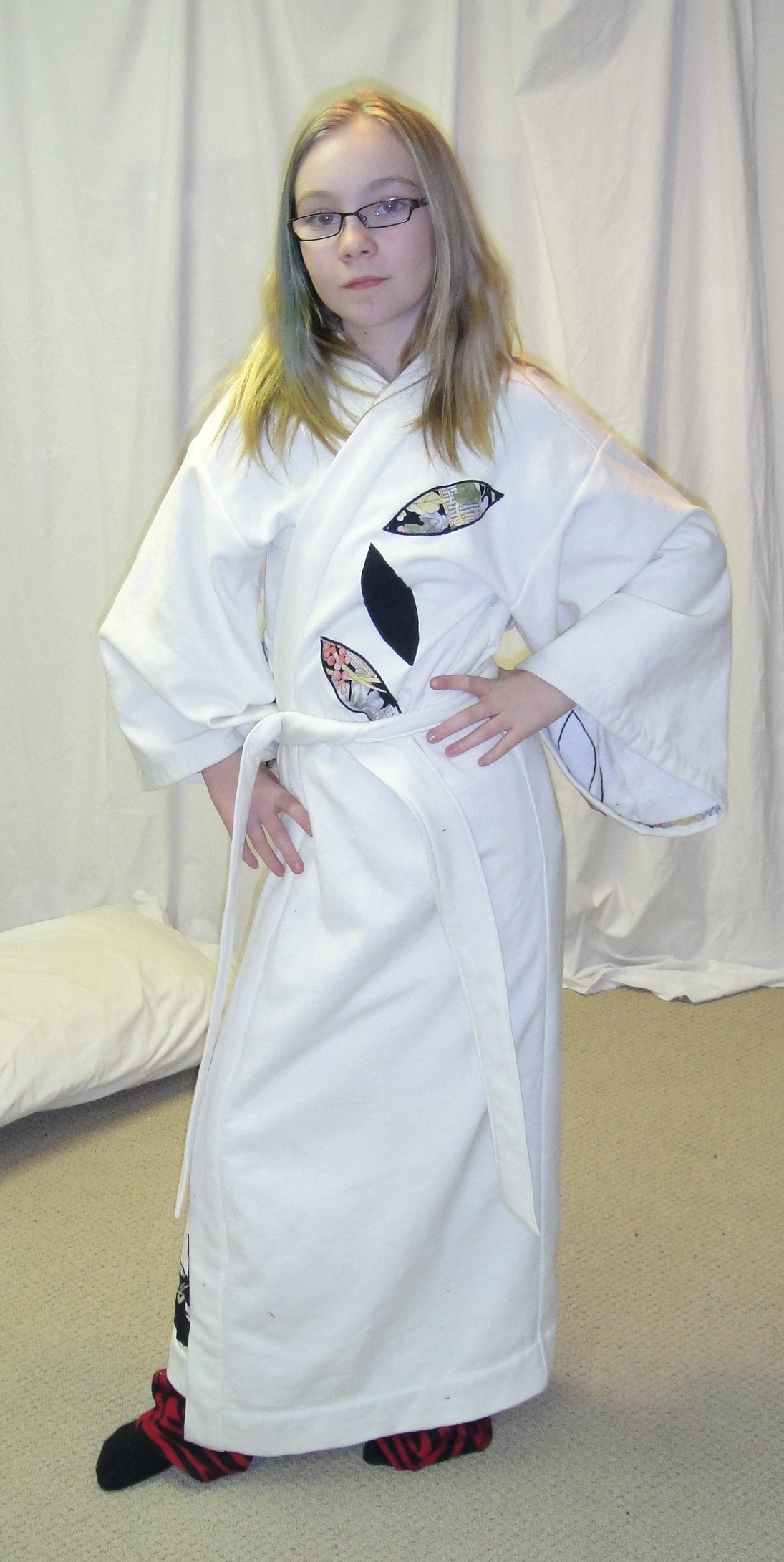
Tyo’s robe is finished and has been worn pretty much every day, so I’d say it’s a success. Although now she wants those loop-over-the-arms tie things that keep the kimono sleeves from dragging in everything, because, well, they drag in everything. Fortunately we’ve watched enough Miyazaki that she knows all about them.

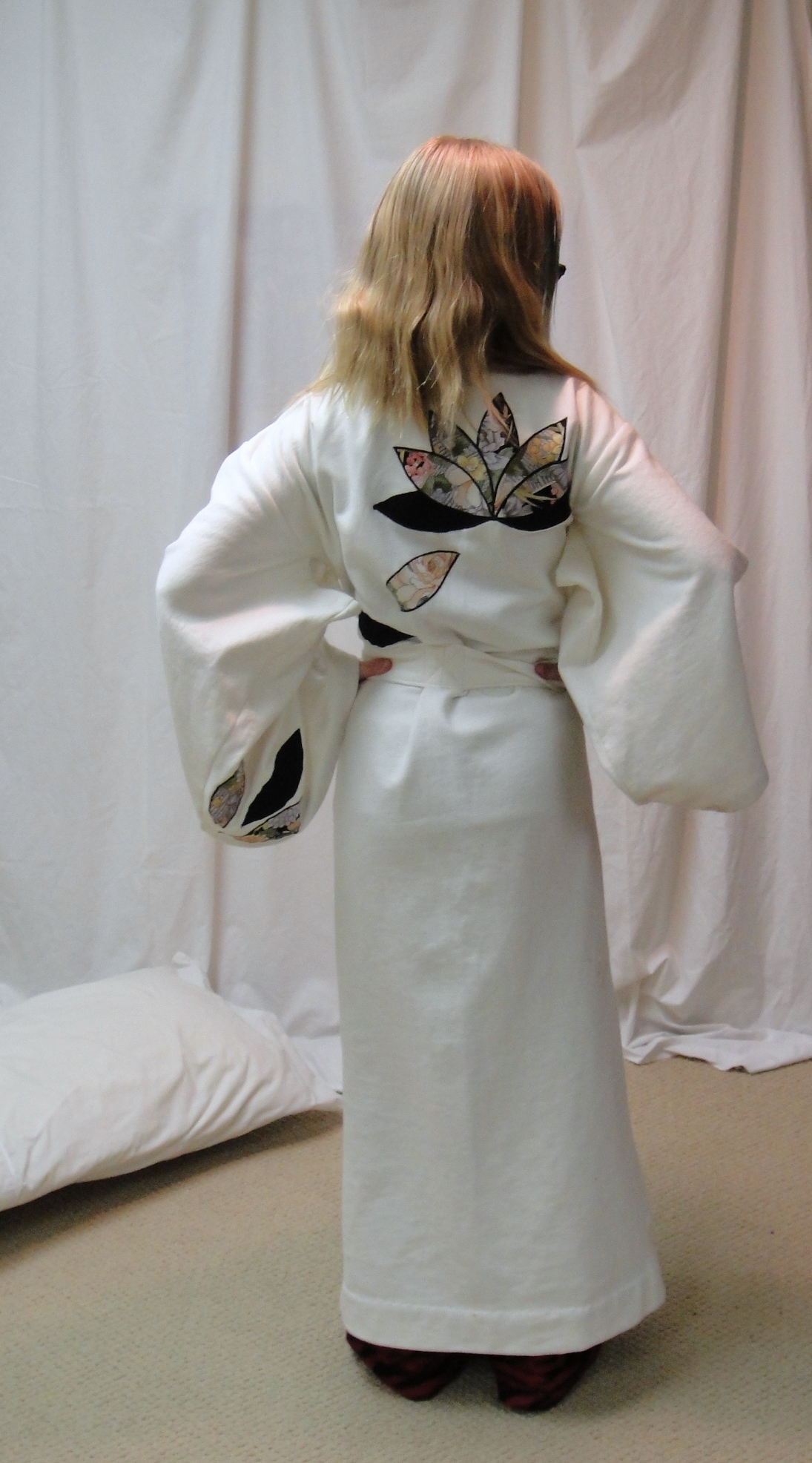
Kimono back.

It’s really long, which is what she wanted, but quite narrow. Not so much it doesn’t close, but it certainly doesn’t stay closed while walking. This is the downside of rectangular construction, I guess. Godets at the sideseam might’ve been effective (if not particularly kimono-accurate).

Hem lotus

I quite enjoyed laying out all the applique, which I did after cutting the fabric but before assembling anything. There are two full lotuses, one on the upper back, one at the hem on the front right side. The sleeves and the front left are decorated with individual petals.

Back view---worn

The belt is a simple sash. I opted to stitch it down with an X on the centre back, so she can’t lose it. (I could’ve added belt loops, but in my experience that’s never enough to keep a kid’s belt with their housecoat.) Most of the time it’s trailing along behind her elegantly, but at least it’s there if she decides she needs it.

Front, worn.

The other morning she came down for breakfast wearing her cream bunnyhug* under the robe, which threw me for a loop as I couldn’t figure out how she’d gotten a hood onto the robe.

All in all?

1) new technique learnt (applique)

2) new construction methods

3) used up stash fabric

4) garment is getting lots of use and love.

WIN.

Your robe fu is strong, but mine is stronger!*

*yes, I know Kung Fu is not Japanese. Hush.

34 Comments

Filed under Sewing

Steph made me a pattern!

Can't you see the shirt?

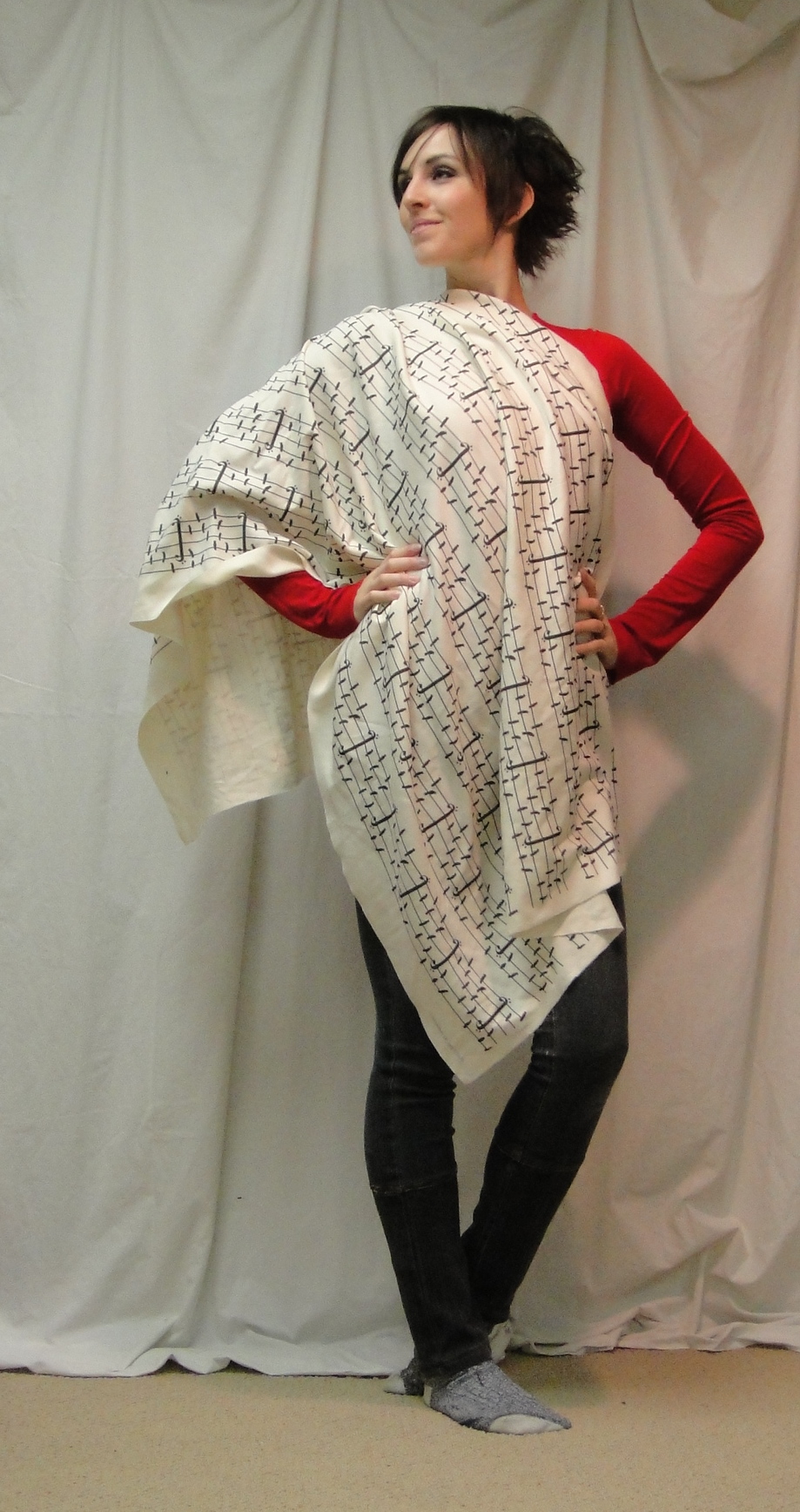
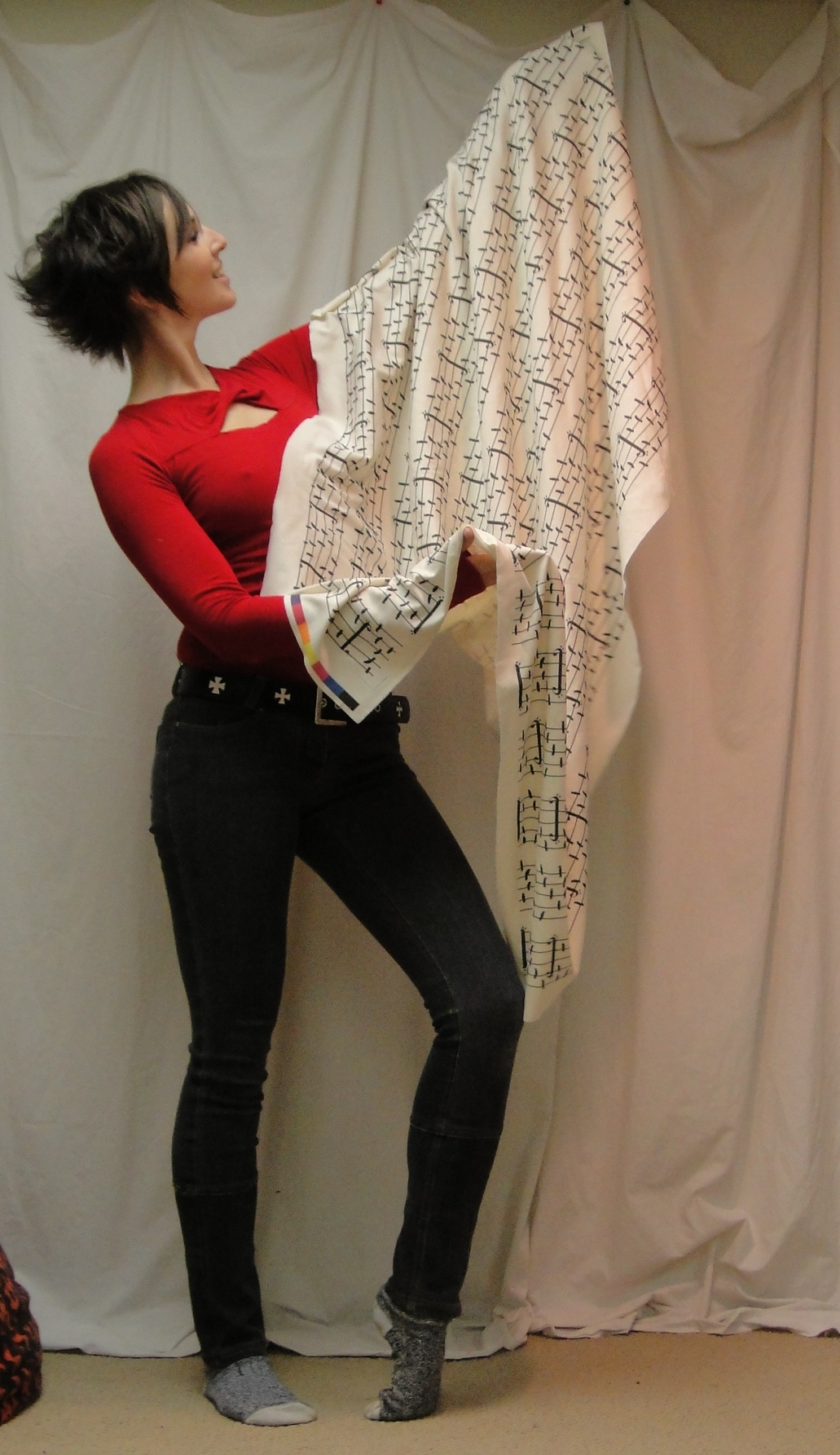
Steph, of 3 Hours Past the Edge of the World, made me a pattern for a super cute kimono-sleeve tee!

Well, I guess you guys can use it too. As long as you put it back when you’re done. And don’t go losing my instructions, either!

And just in time for Christmas, too.

Unfortunately for me, I’m so busy with all my other insane Christmas sewing (not to mention all the other insanities of life) that it’s not going to get stitched up in time for Christmas. Poo.

She even sent me some of her nifty Bird on a Wire fabric to bribe me encourage me to test the pattern out.

Hark the herald birdies sing...

Hush. I can be as goofy with my spanky fabric as I like. And I was going to crop out my fugly socks, but, y’know. Sometimes ya just gotta go with the goofiness.

9 Comments

Filed under Sewing

All Machines All the Time (Part 2)

Domestic. Army.

(I promise more sewing posts, fewer machine posts, in the future!)

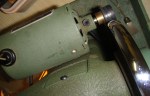
The Domestic Special—AKA the Army Machine

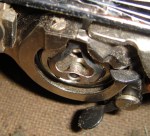
In breaking news, she sews! Yay! And my gawd, what a beautiful stitch it is, too. Nothing like the wannabe zig-zag of the White*. And fast. The only limit to the power is that the motor turns a rubber wheel which turns the flywheel, and this rubber wheel is old and hard and a bit worn down, so sometimes you need to give the flywheel a nudge to get it started. Presumably it’s possible to replace the little rubber wheel at some point. (Incidentally, the belt on my Featherweight slips similarly, so it should be adjusted or possibly replaced as well. Someday when I’m a little more secure about this vintage machine thing ;).)

Fortunately, she uses a standard needle, that goes in sideways, exactly the same as my Featherweight.

Except that the Featherweight threads right to left, and this one threads left to right. Which was a bit of a WTF moment, but we got past it.

In terms of functionality, it’s similar to the Featherweight. There’s a lever for the stitch-length/reverse, just like on the Featherweight (this one’s very stiff, though. I need to figure out if it’s possible to oil it.) The tension/threading apparatus is quite different, though—it has a lever, too, and there’s no disc to wrap it around. I figured it out, though! The system of threading is fairly sketchy—there’s a lot of places the thread is kinda left to do its own thing, and it rubs against the case of the machine in a number of places. On the other hand, the up-and-down-arm-part (the manual calls this the take-up) has a hole with a covered slot you can kind of floss the thread into, rather than just a plain hole like most vintage machines (of my acquaintance, which is admittedly limited). (My new Janome has kind of a slot in this as well, but the way the slot opens occasionally the thread slips out of it which can be a pain in the butt.)

I want to thank both Peter and Claire for suggestions of manuals and comparable machines. I actually tracked down a teensy bit of information about Domestic sewing machines here, and they have three different manuals. This is the one closest to my machine, although I think it’s a slightly newer (or perhaps just more expensive) version than mine as it has a tension dial rather than lever, and a slightly more advanced-looking stitch length mechanism. There’s no date on the manual, but the font looks sort of 50s to me (I know, so precise). I’m guessing late 40s or 50s for this machine—I’d be surprised if it was as late as 60s (but then, they were still making Featherweights through the 60s). Vintage aficionados care to weigh in?

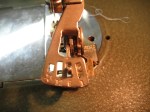
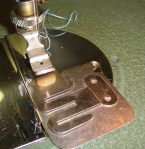
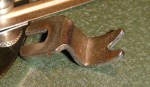
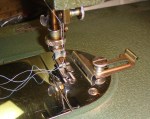
Also, just because I’m obsessive that way, here’s more photos (in no particular order) of the various feet and attachments than you can shake a stick at. Be afraid. Be very afraid. Fortunately, most of these are covered in the manual…

*Toodling around on the yahoo wefixit group led me to this post about sewing machine stitch formation, which basically advocates stitch acceptance. I still think something’s up with the White, though, as the stitch is WAY more zig-looking than my other machines, even with the straight-stitch needle plate in place. That being said, it does a mean zigzag, so I’m not really complaining.

34 Comments

Filed under Sewing

Kimonology

Making Kimono

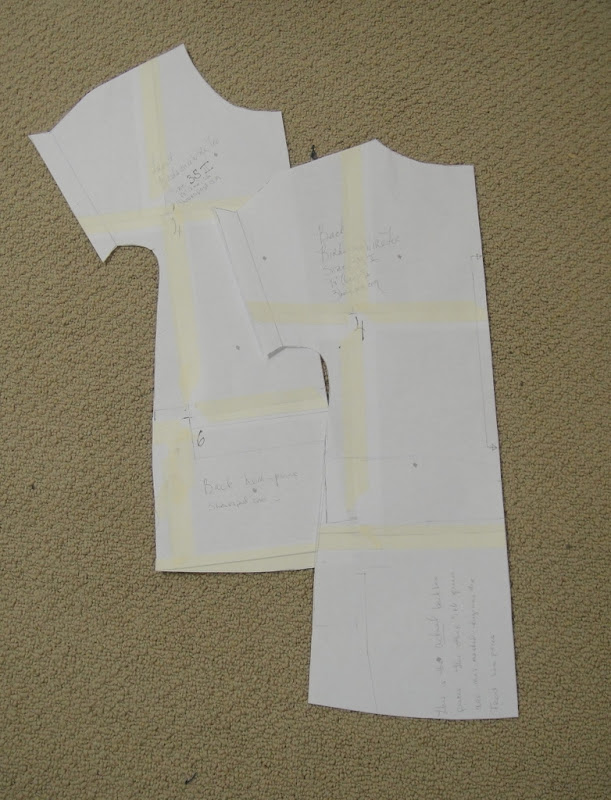
Tyo wants a new housecoat. Her old one, to be fair, no longer reached her knees and was past due to be handed down to Syo. I had her almost convinced that she could take mine and I would make myself one, but I wasn’t really feeling it (I have a vision of a Lady Grey Sweater-made-full-length insane housecoat, which would be awesome but will require like six bajillion metres of fabric.) And then she found Simplicity 7640, the “kimono” pattern in my box of kids patterns.

This particular pattern has been in the “stash” for a long while. Once upon a time, c. 1988, my mother-in-law used it to sew Karate Kid Hallowe’en costumes for my husband.

Of course, I can’t just whip up a costume-grade Simplicity pattern into a housecoat and leave it at that. That would be too easy. Not when I have “Making Kimono and Japanese Clothes” by Jenni Dobson on the shelf.

This is one of a slew of helpful books I acquired back when we lived in a condo with a communal garbage-house.  Aside from the big trash bins, people were always leaving stuff for others to take—furniture, curtains and, on one notable occasion, a really good selection of books. I wasn’t sewing much at that point, but how could I leave something like this behind? Aside from lots of information on traditional Japanese cloth, decoration styles, and clothing construction, there’s pattern-drafting instruction for a number of garments including kimono. (Incidentally, while the Simplicity pattern describes the blue and white version as a kimono, I suspect Ms. Dobson would disagree. The short, jacket-like garments in her book, though similarly constructed, have their own names.)

I dutifully pulled it out, ogling the gorgeous designs and weighing how much energy I was willing to put into a housecoat for my eleven-year-old. Sashiko? Not happening. Shibori? Ah, no. Applique? … now that might be about my speed. Depending on the applique. Not terribly traditional applique, either.

Which brings us to another book scored at the same time.

I'm scared. Are you?

It’s, um, a little dated. But covers a variety of basic applique techniques, even if the projects make me want to scrub my brain. The big one I hadn’t tried yet? Using a fusible web to stabilize and hold the appliques in place until they’re stitched down.

Apparently this is a big deal.

So I swung by Sewing World on my way home one day, and upon asking for fusible web was handed a metre of 18″-wide Steam-a-Seam Lite.

Yes, the same stuff I’ve been using lo these many moons in my knit hems. Apparently it’s the bomb for the applique. Who knew.

Tyo wanted a lotus.

Lotus Layout (asymmetry and odd numbers are common features of Japanese kimono decoration, according to Ms. Dobson)

Even better. You can make a lotus out of just a bunch of spindle-shapes, which is a shape that I actually CAN zig-zag around without beating my skull in.

So, in a fit of zeal, I set to work one weekend afternoon.

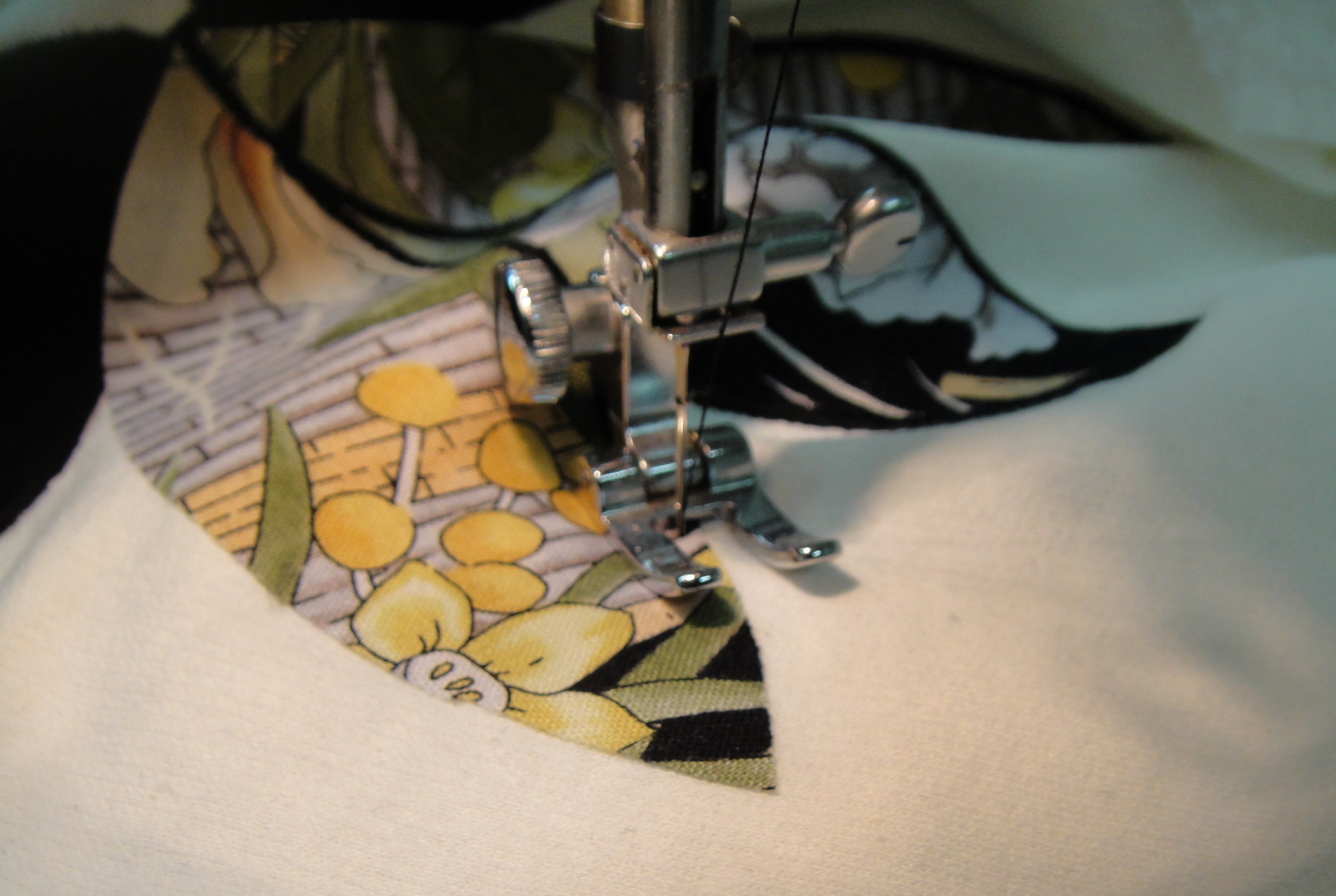
I have to say, I think the White has already paid for herself in just this one project. Dude. First off, the wide-mouth zig-zag foot is EXACTLY what Ann Boyce (and, no doubt, everyone else who does applique) recommends. Win. And there’s no way my light, plastic Janome could’ve kept up the constant, heavy, top-speed motion of doing that much zig-zagging. She would’ve shimmied across the table and un-threaded her bobbin at least once per leaf.

Open-toed zig-zag foot

The White may not straight-stitch well, but she can zigzag like a trooper. The stitches are even and smooth. The bobbin-threading messed up once during the entire marathon applique-session. One other time, the sheer amount of vibration rattled the fly-wheel just loose enough that the stitches started losing power. Other than that—perfect. Smooth, even feed. No complaining about the continual, high pace. The heavy metal machine stays where she’s put, not moving around under her own vibrations.

Just so the Janome’s feelings aren’t too hurt, it was really handy having a spare machine just to wind bobbins. The bobbin-winder system on the White is pretty much the same one as on the Featherweight… i.e. a little primitive. And you go through a lot of bobbins doing applique…

So using  a fusible web totally does the trick. Well, at least for these simple shapes. I still have doubts about my ability to make the stitch turn tighter curves, but for this shape it was easy.

The one other bit of technique I learned from Ann Boyce was about making narrow points. When approaching the point, you start cranking down your stitch width gradually (doing this while still guiding the fabric one-handed is a bit of a trick…) to almost nothing right at the tip. Then you pivot the fabric, start again, and gradually bring the stitch-width back up to full (whatever your full width is. I like 3.)

This is not the most super-easy technique. Sometimes I got it, sometimes (maybe more often) I didn’t. But it was worth a try, and when it did work it looks super nice. When it didn’t, I have clumps and loose threads showing at the points.

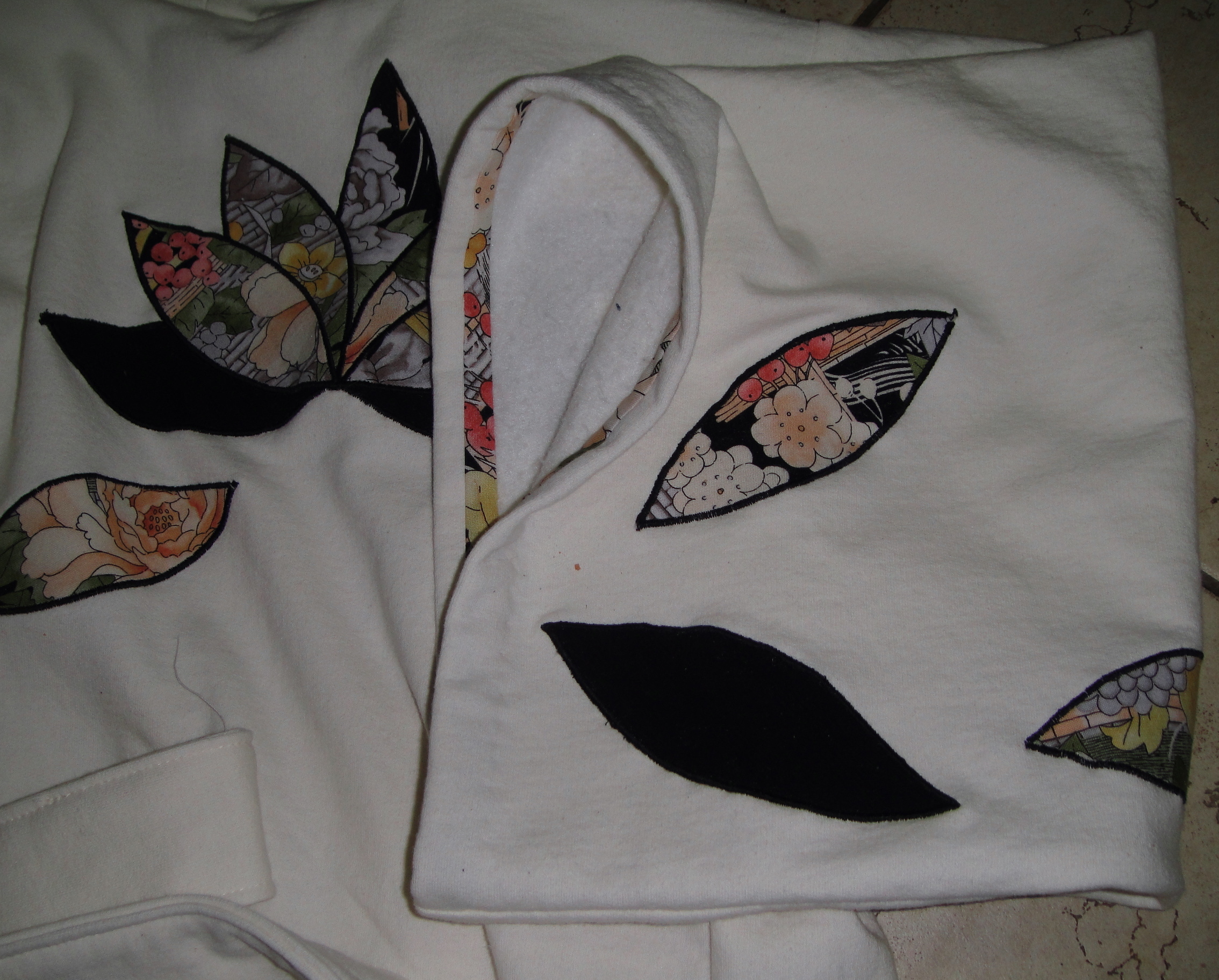
Appliques and hem binding.

Still, I’m pretty proud of myself. The print fabric is a Japanese-inspired quilting-cotton that was perfect for the design, plus some black shirting with a textural stripe that looks great in real life but doesn’t show at all in the photos. I wish I’d had enough of the print to bind all the internal seams, but I only did the hems.

I could go on about the instructions, the points of difference (and similarity) between the Simplicity costume pattern and the “traditional” kimono (as described by Ms. Dobson, anyway), and where I screwed up and where I completely abandoned ship. But I think this post is already long and rambling enough, so I’ll end it with a quick sum up:

  1. Random scrounged books finally come in useful. YAY!
  2. Good job, White! (Don’t worry, Janome, I still love you too.)
  3. Applique fusible web for the win!
I’ll get full, finished pictures in a few days when I can wrangle Tyo into modeling. She’s got a bad cold this weekend and is VERY happy to curl up in the half-finished robe as much as I’ll let her, but is understandably unwilling to have photos taken.

20 Comments

Filed under Sewing