Tag Archives: Scroop Patterns

Persis-tence

I fell hard for the Persis Corset by Scroop Patterns the first time I saw it, in the call for pattern testers back in the early summer. I put in my name to test (something I don’t think I’ve ever done before!) but sadly got declined. (In hindsight, I think I’m the same size as the original draft. So, um, probably they had that size tested already.)

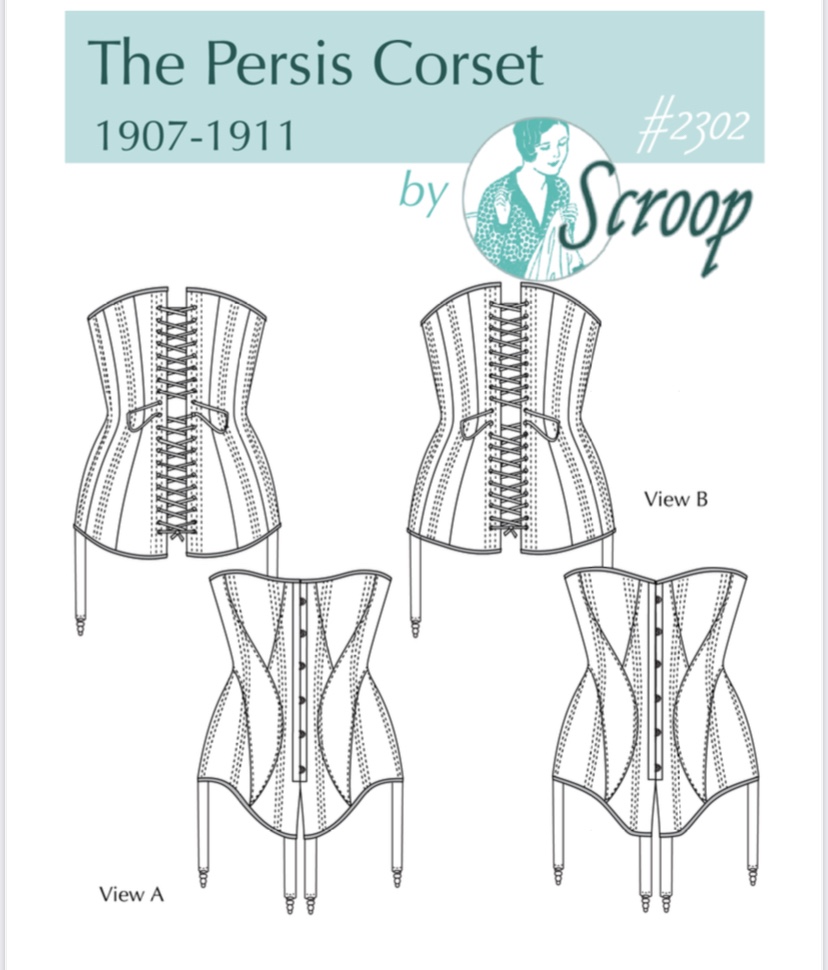
(Image from scrooppatterns.com)

Anyway, when it finally came out in about August I bought it most promptly, and ordered a metre of lovely grey coutil from Farthingales

And then I did about five other projects, but really, in the grand scheme of things, not too much procrastinating.

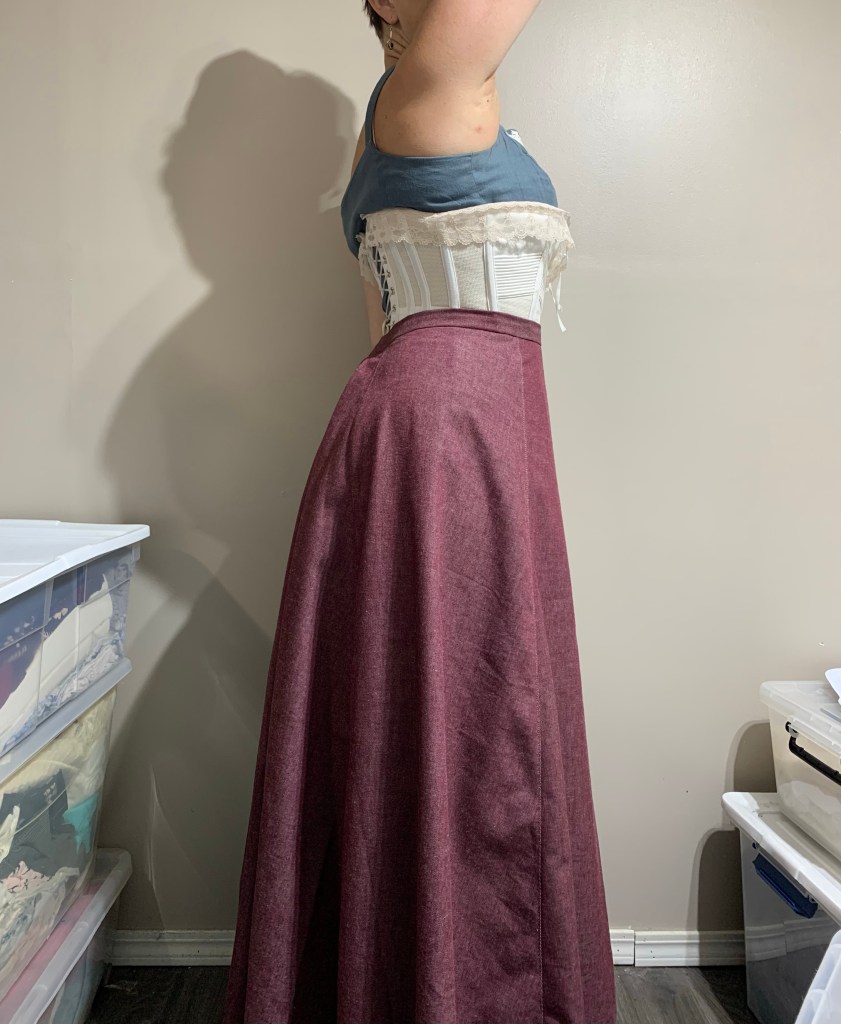
So, the Persis is designed to be an Edwardian kind of shape, accurate to about 1907-1911. The silhouette at this point was still quite curvy but beginning to tone down on the hips—no more padding or extra structure there. The longer shape helps create a smoother line over the hips. My black Princess Skirt is from much the same period and would benefit from a corset like this to go underneath, because my other corsets tend to leave a visible bump right where they end on the hip.

The pattern has a lot of good fitting information, which is really nice. It has two fit options for the hips, “Average” and “Slender”, and each has three options for the bust size. (And for those who get the pdf copy shop printed, each sheet is one complete pattern so if you’ve decided which hip version you want you needn’t print both, like I did). To my surprise the bust measurement instructions put me in the largest size of the bust gores, since I have more than 5” difference between my underbust and full bust.

However, I also do not have the slimmest of hips, despite them not being terribly visually wide. Based on my measurements, even with the “Average” hip version, my hips were a size up. So I made the size 36 for the bust and waist and graded up to the 38 for the hips.

I also decided to preemptively do a small swayback adjustment. I don’t always do this in corsets, but I find that if I don’t I have a tendency to slouch, and I’ll just be more comfortable overall if I do it.

And then, wildly, rashly, I decided to cut right into my coutil and just go for it.

Why would I do such a silly thing?

Well, on the one hand I trust Leimomi and her detailed sizing instructions. In particular, I wasn’t too worried about length; I’m a smidge short-waisted but corsets of this era are starting to edge towards the underbust so if it wound up too tall I could just trim it down and if it’s too short, we’ll just call that a design choice. Also, corset pieces are small so I figured if major changes were necessary I would just recut a couple of the side pieces. This corset also features both bust and hip gores, too, which can be fairly easily swapped out if needed. (Although I then went and promptly finished the reversed felled seams as per the pattern so, maybe not so easy.) Additionally, I don’t often find corset mock-ups super useful, as the fabric and boning never seems to behave quite the same.

Grommet chicken. No, there were not enough.

However, this decision to fit as I went played hell with the order of construction, which is designed to give a really nice finish with negligible ability to alter. So I was kinda winging it, which led to some maybe not ideal decisions. in particular, it wasn’t possible to nicely tuck the waist stay in behind the boning channels. I also inserted the busk first, as I tend to, but that made sewing the swooping curves if the front panel a little extra tricky. The cardboard-like texture of this coutil doesn’t help either. So I ended up with a pretty large jog at the hem. There may also have been a cutting error involved that I didn’t catch, since the unevenness is so symmetrical on both sides. I’m pretty sure it’s not a pattern error. My stitching is definitely not the best I’ve ever done, either, but I love the overall look enough that I’m refusing to dwell on it.

One more set of bones will support the bust, but I didn’t want to add that casing until I knew what the bust fit was doing.

The whole construction was delayed a fair bit as I got halfway through inserting the grommets and ran out (apparently this can still happen even when you order grommets by the gross, who knew.) I had to make an emergency corsetry order to Farthingales Corsetmaking Supplies. I had hoped to have the whole thing ready for hand finishing by my Victorian Sewing Circle in November, but as it played out the package with the grommets didn’t arrive until about an hour before Sewing Circle. Which was still a full day early, and on a Sunday no less, so no complaints, really. I raced to set the last ten grommets, threw everything I thought I would need to cut the bones and finish off the corset into my bag, ran off to Sewing Circle (a whole other fiasco involving a train and a parade)… and forgot several key items. But still, progress was made, and eventually I got it to a state where I could try it on.

The hips fit like a glove. The swayback adjustment—total success. Might even make it bigger if I made it again. Back lacing gap—perfectly even.
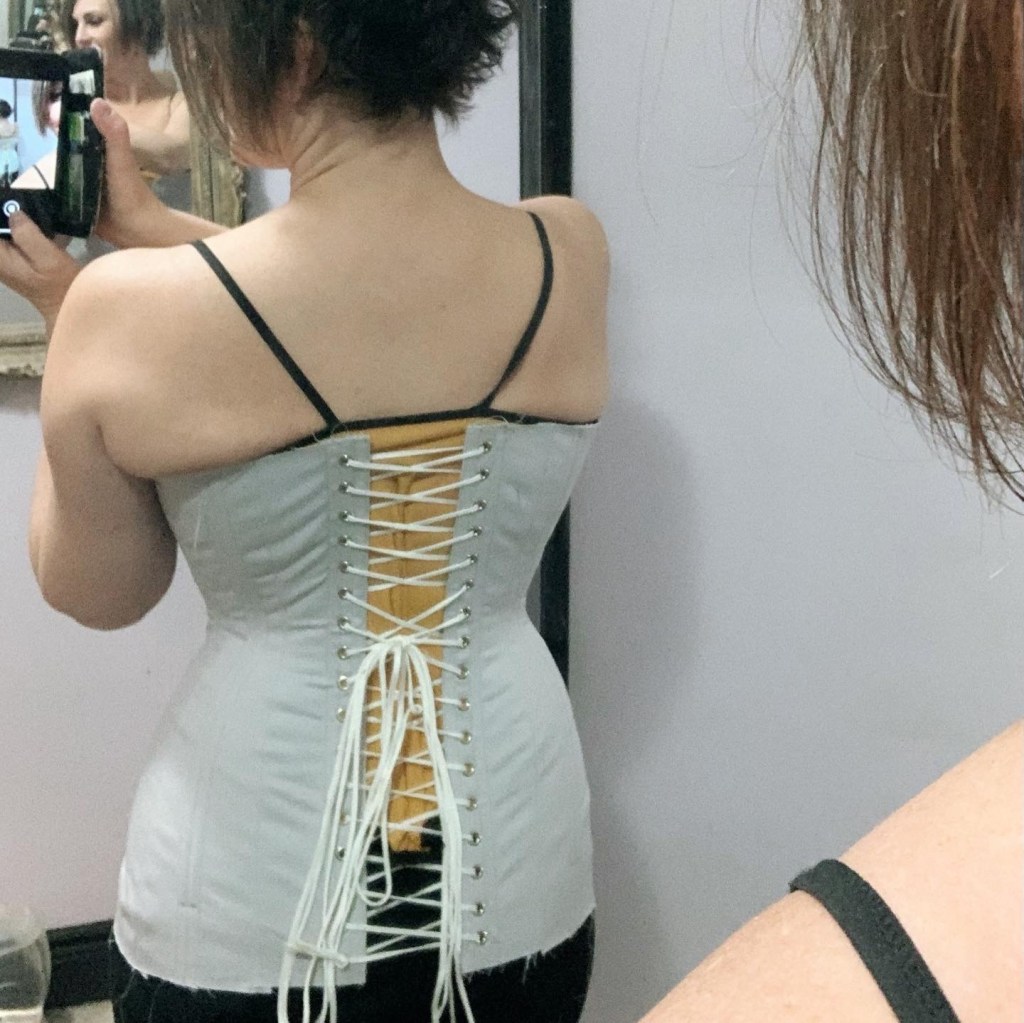
There was a little bit of extra room in the bust and maybe a bit too much height at the bust and under the arms.

So I unpicked one edge of the gusset (the one that wasn’t yet a flat-felled seam), trimmed off about 1/2” of width, tapering to nothing at the base of the gusset, and then went ahead with flat-felling all the seams.
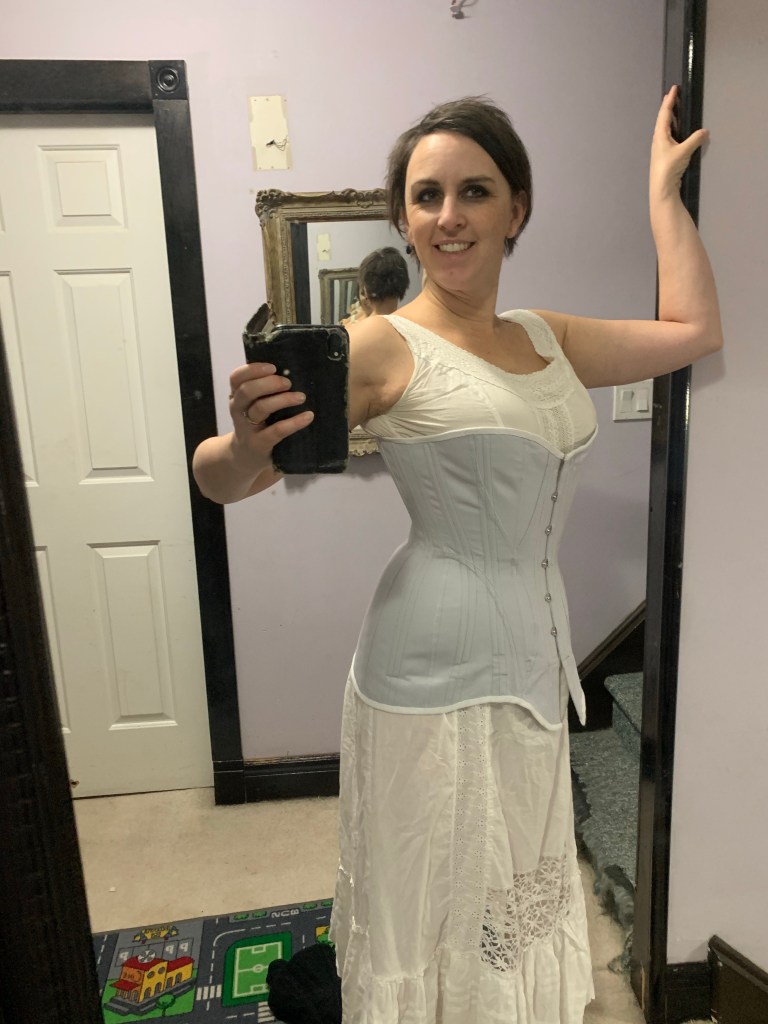
This corset calls for 1/4” plastic whalebone boning, and since I had to do a corset order anyway, I ordered some. It was my first time using the stuff, though a lot of online costumers seem to swear by it. And I will say, it was fantastically easy to cut to size and insert, especially nice when I decided at the last minute that the bones over the thigh area needed to stop an inch or so higher than they did. However, I think the bone to space ratio has to be a bit higher. The pattern includes instructions for increasing the boning in larger sizes, but the size I made still fell within the “base boning amount”. However, there was still some wrinkling over the bust, so I added another single bone there, and I kind of wish there was another row in the back and maybe the one side seam.

I found the busk I had ordered a little disappointingly floppy, so I wound up using a spring steel bone beside the busk, and another one would have been a good idea; the pattern calls for two in this area but I couldn’t for the life of me figure out how to fit them into the space designated on the pattern. This may have more to do with imprecision in my stitching than anything else mind you. My one complaint about the patterns is that the facings have very little wiggle room if your channels are even the slightest bit larger than the pattern calls for. In particular, if I made it again I would widen the front facing to include the two boning channels that are supposed to flank the bust. This would be much easier than trying to fit a separate boning channel into this small space.

Anyway, I did eventually get the waist stay inserted and the top and bottom edges bound with twill tape.
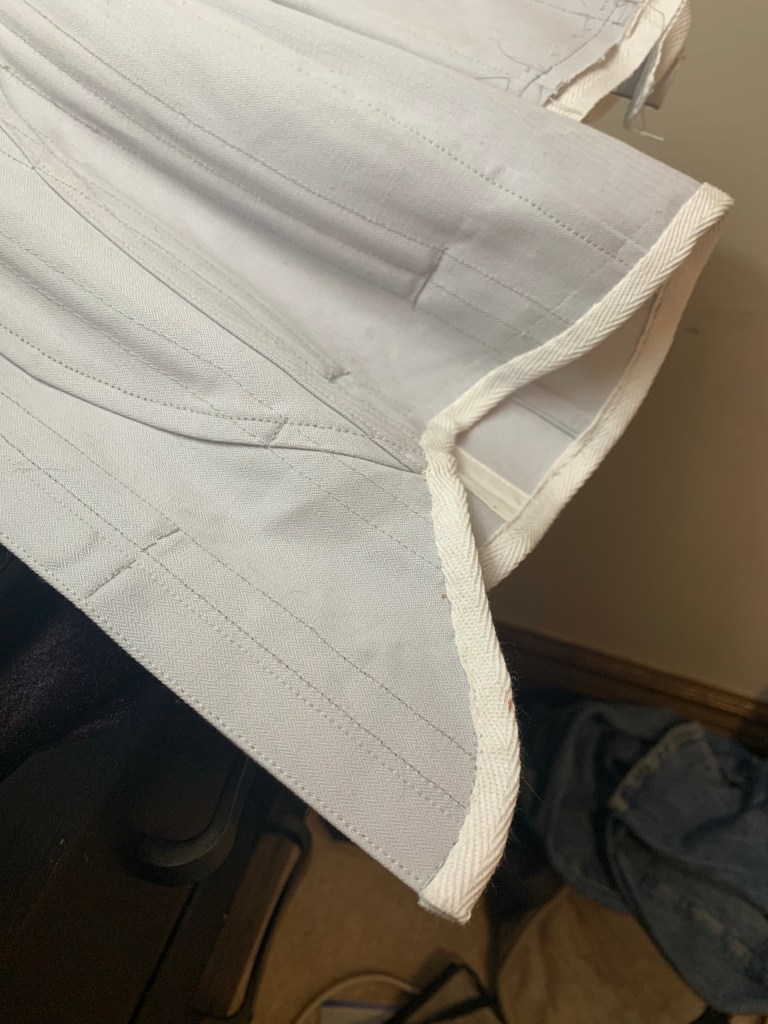
It’s a fantastically comfy body hug of a corset. The long line takes a long time to lace up, but does look great. I should probably add a hook and eye to hold the extension below the busk a little more closed.

I would have liked to add a drawstring to the bust but discovered at the last moment that I was down to about 10” of the 1/4” cotton stay tape I like to use for this. So I skipped it, and I think it’s fine in this case.
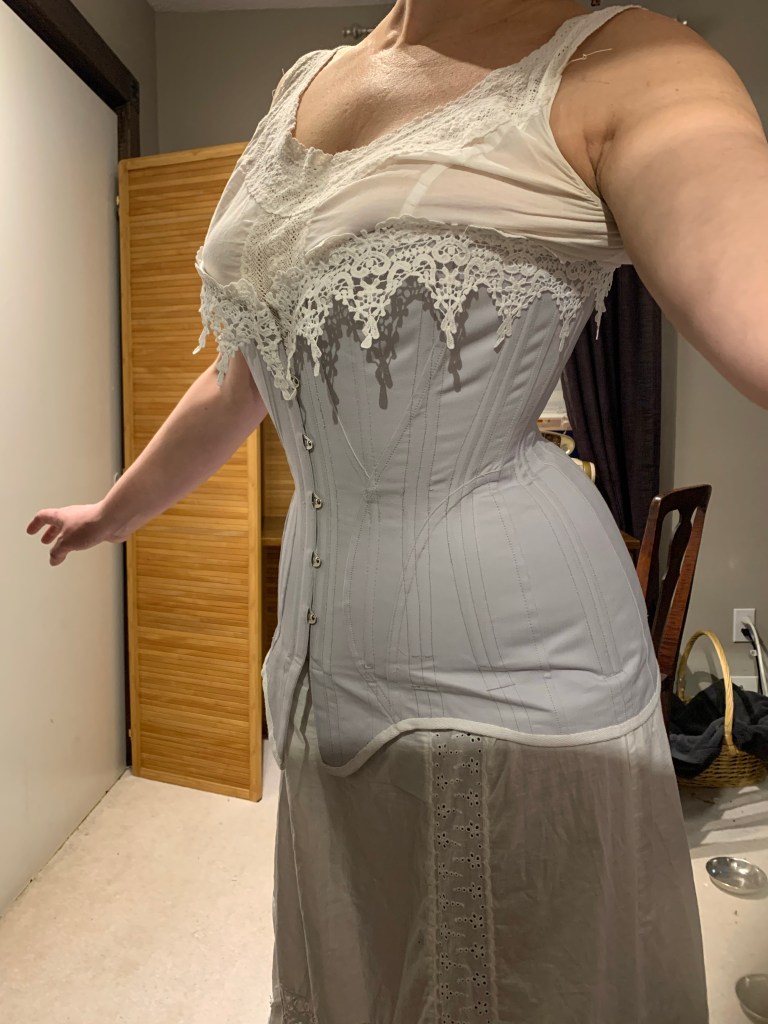
I waffled over the top lace for a WHILE before deciding to go for broke with the last bit of this heavy-duty scalloped lace. It took me a minute to get used to it
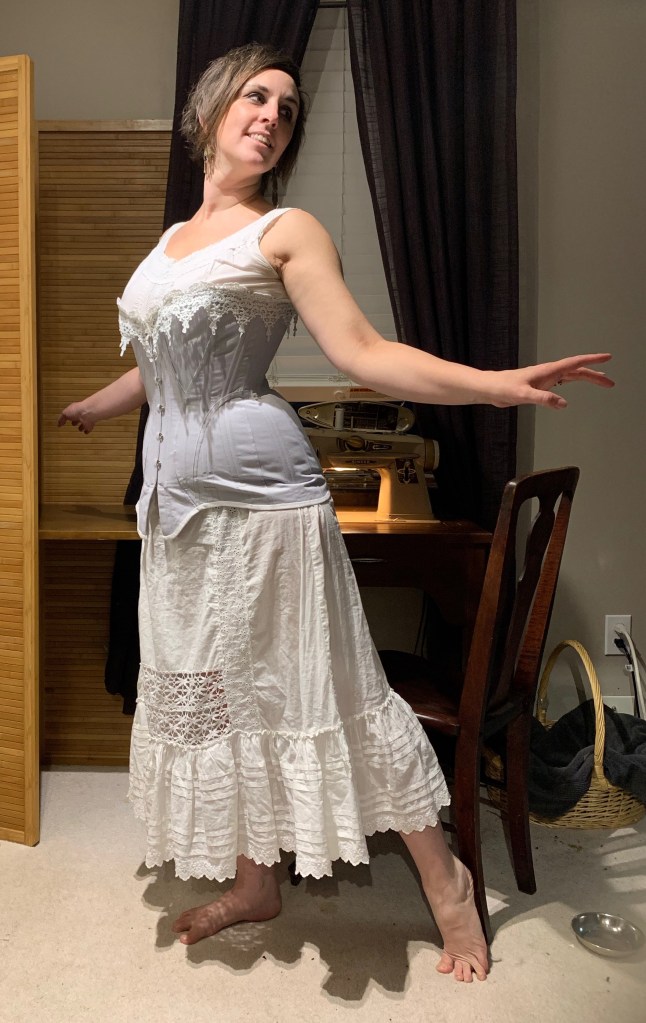
On the whole I think it’s a pretty fabulous pattern. The swoop of the seam on the front is unique and lovely; the fit is pretty much spot on. There is a LOT of information provided on fitting, which is nice. The construction as given makes for a gorgeous finish inside and out, even if I didn’t follow a lot of the methods since I wanted to fit as I went.

The worst part, in the end, is that now I have to wear clothes over it!
14 Comments

Filed under Sewing

Fantastical Fantail

I didn’t technically NEED to make the Scroop Patterns Fantail skirt.

I mean, let’s not get too deep into the definition of “need,” especially when discussing costuming.

The Fantail is an 1890s-1900s five gored skirt pattern. Which is also totally wearable as an everyday skirt… at least if, like me, you’ve strayed far down the garden path of “WTF is she wearing?”

So wearable, in fact, that I have several others almost exactly like it. The Edwardian Walking Skirt (Folkwear pattern) that my mom made back in the 80s or early 90s, for one. (And yes, i still have the tissue pattern she traced off the original she borrowed from the library.) The grey gored skirt I made a couple of years ago that I wore like crazy last winter, for another. And three or four more long, gored skirts of various iterations.

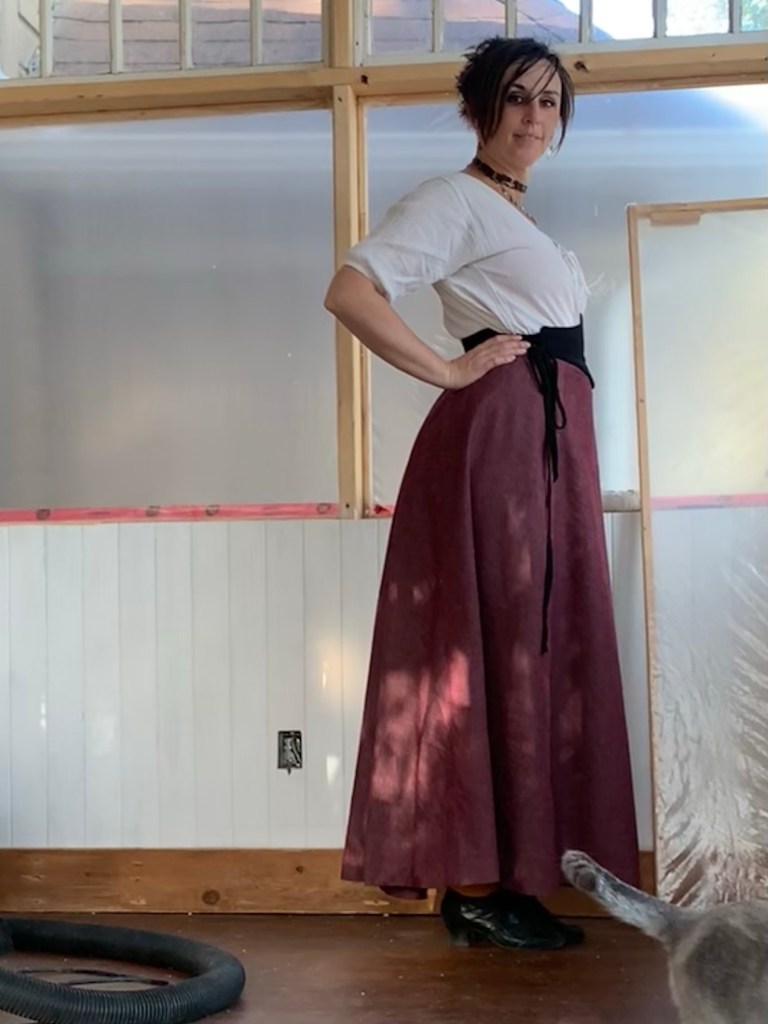
But it is also a skirt style I wore constantly last winter and, well, winter is coming. And I had purchased the Fantail back in the spring when Scroop had a big sale to raise money for some unexpected expenses. And then one of my Victorian Sewing buddies was destashing some this gorgeous twill “denim” (not really denim, it’s fairly loosely woven and very soft. But it does have a twill weave, and white threads in one direction.) And it just really needed to be this kind of skirt.

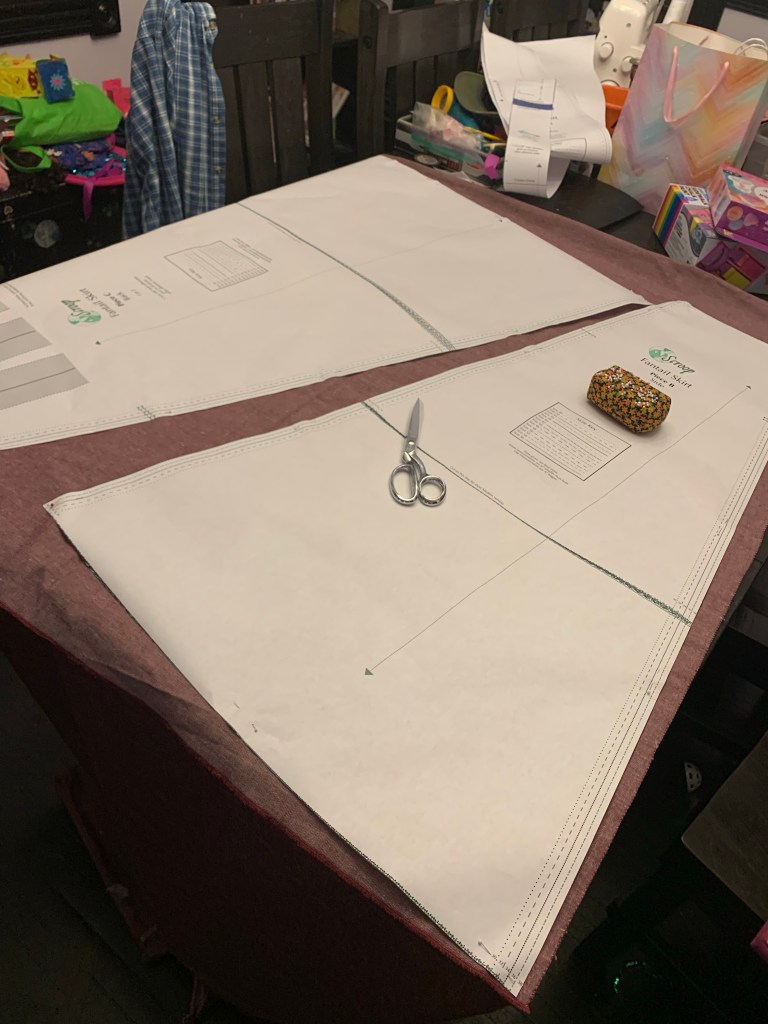
So, just before my birthday, I got the pattern printed out. I didn’t actually get to work on it for my birthday, but not too long after I started poking away at the project.

This kind of skirt is really, really simple, and it went together quite quickly. As per the instructions, I graded between my hip size and the waist size I wanted, and I’m glad I did as it meant I didn’t have to fuss with adjusting the perfect pleats to fit a different waist size

The fabric wasn’t overly wide, and I wanted to use it as efficiently as possible. This style of skirt straddles the evolution of grainlines from the gored skirts of the 1880s where it was standard to have one edge of the gore on the straight grain and one on the bias, to something closer to a modern, centred grainline, to allow the fabric to hang better. Maybe I should care more about the hang of my skirts, but as the pattern says, grainlines are suggestions. So I angled my side and back gores so that they fitted best on the un-folded fabric. No regrets so far. It’s not zero waste, but the amount of waste is minimal.

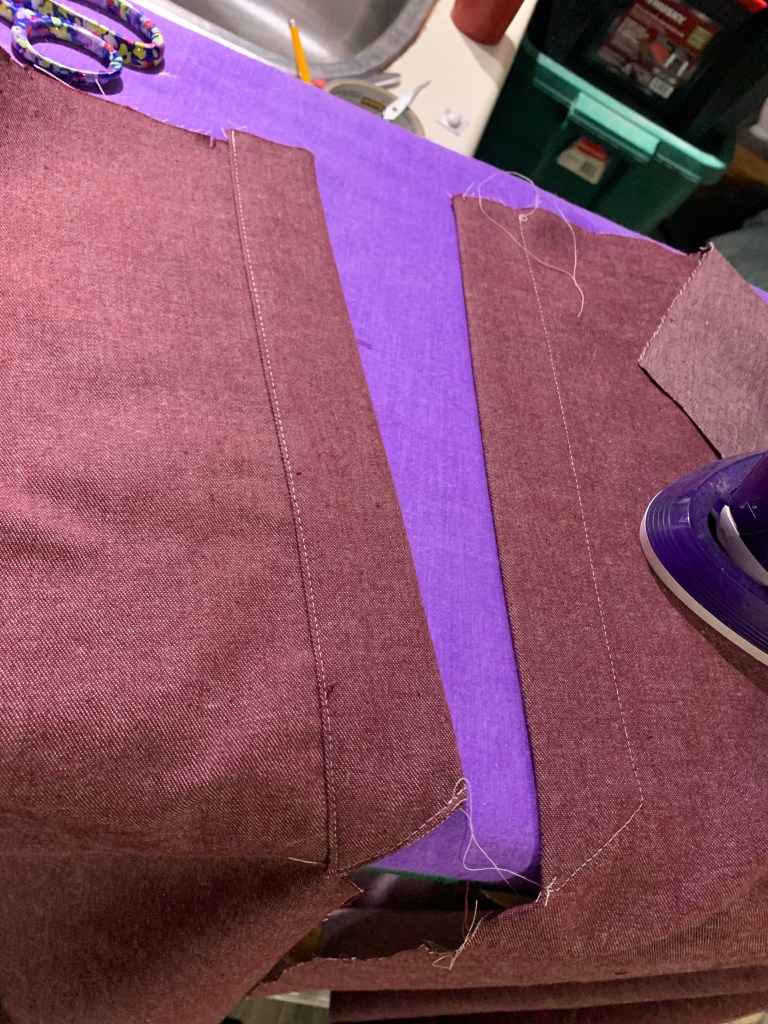
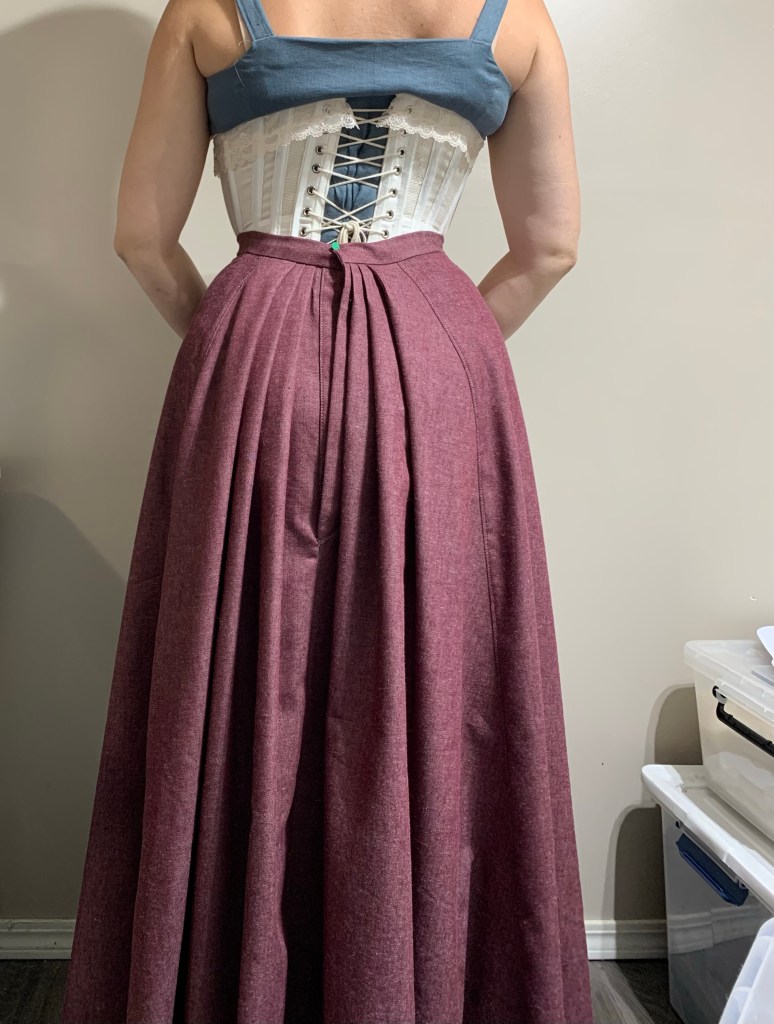
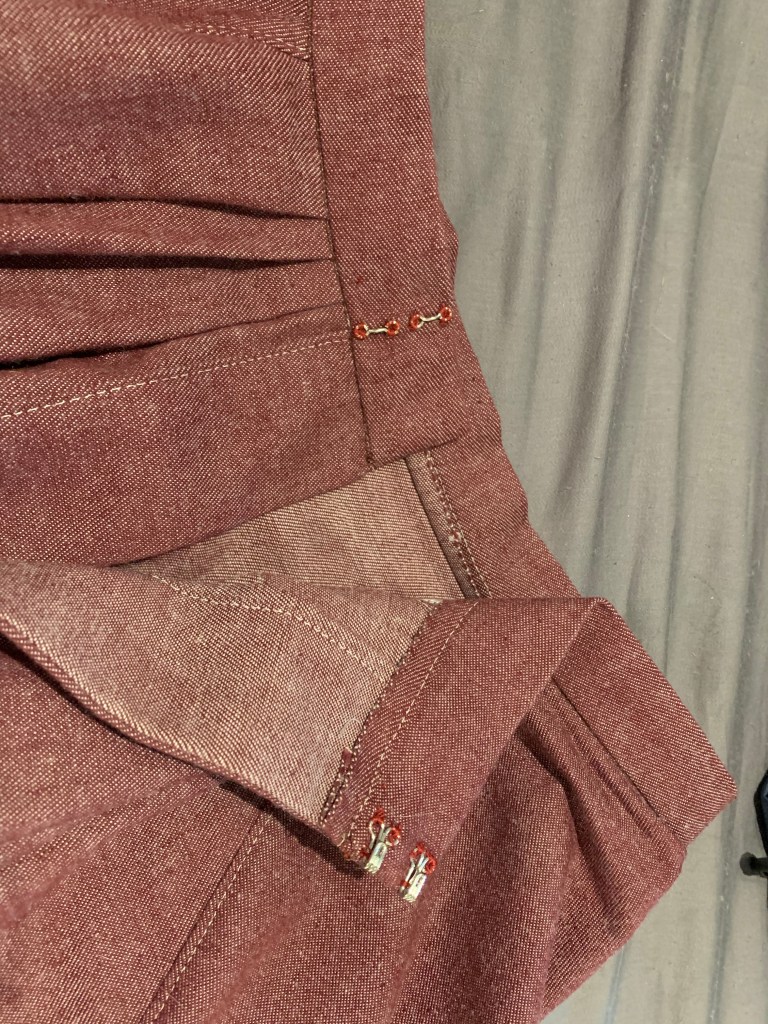
Back placket, two sides.

It took me a bit to figure out the instructions for the back placket, and I did manage to cut one of the facings wrong way round (though it’s on the inside so I didn’t bother to recut it). It isn’t hard, or even unclear, particularly, but everything is very side specific and there are some acronyms in the instructions that aren’t instantly comprehensible. Once I understood what they were getting at it was fine.

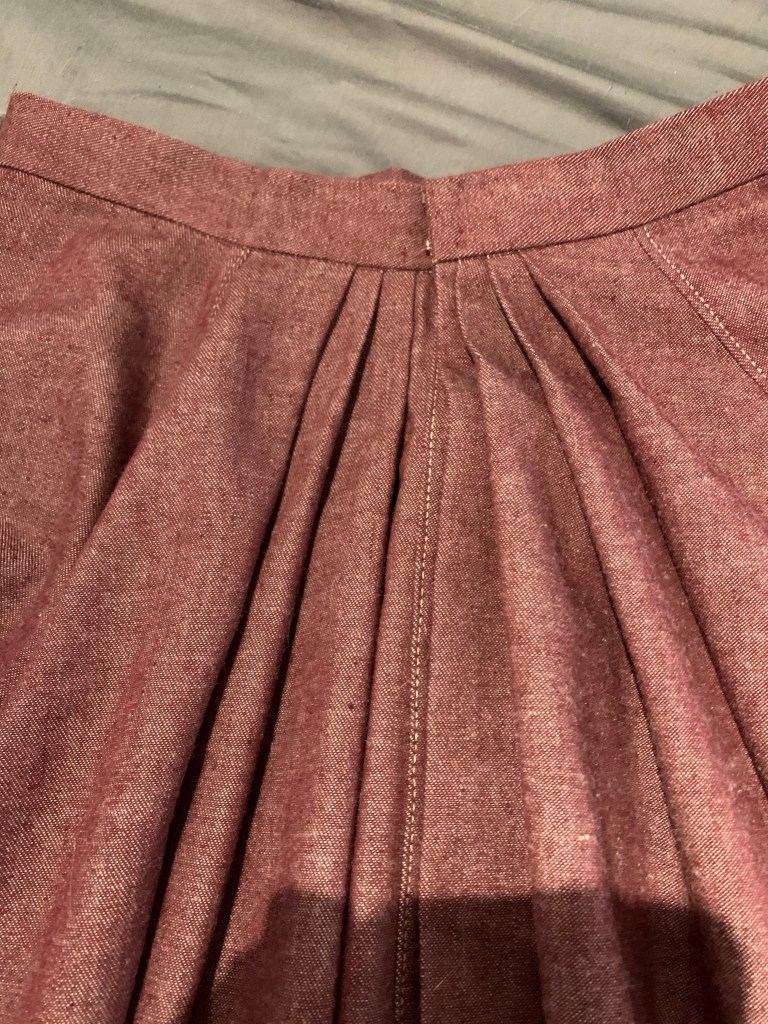
Other than that? Easy peasy. And those back pleats? To die for.

Pinned closed at not quite the right angle in this pic. Still gorgeous pleats.

I did use some very modern construction shortcuts: overlocked seams, machine blind-stitched hem, leaving the selvedge exposed on the inside of the waistband.

We were (are) in the process of moving the whole sewing room, so I didn’t have a lot of bandwidth for authentic detailing.

I also couldn’t find the heavy-duty hooks and bars I bought specifically so I would have them around next time I made a skirt like this, but hopefully these two traditional (and vintage) hook & eyes will do the job. I was waffling a bit about adding a touch of topstitching to the skirt, just as a nod to the denim look of the fabric, so when I realized that topstitching was an integral part of the placket, I just went with it, a little line along each vertical seam (except the centre back.)

To hem, I used my favourite trick (when I don’t feel the need to be historical) and cranked up the differential feed on the serger while finishing the bottom edge. This gathers in the lower edge for you, which makes folding up and easing in the hem super easy. Unfortunately (?) I was doing it on the new-to-me serger handed down from an amazing reader, and the differential feed on this machine is a lot more effective than the one on my old serger, so it wound up gathered in a bit too much, which took some massaging. But it made the machine-blind-stitched hem super easy!

One thing the pattern lacks is a pocket. I’m honestly not sure how common they were in this period, with the narrower skirts clinging over the hips, but there’s still room to tuck one under the pleats in the back, so I did. I used the same method I always do, which comes from an 1887 sewing manual—so potentially a bit dated for this skirt’s era but not unreasonable. I didn’t manage the tidiest insertion (particularly when trying to topstitch along that seam) but it’s tucked around back where I don’t have to look at it so it doesn’t bother me at all.

I did forget a couple of little touches I wanted, including the tape that is supposed to go from the top of the pocket to the waistband, and hanging loops under the waistband. So I will have to go back and add those.

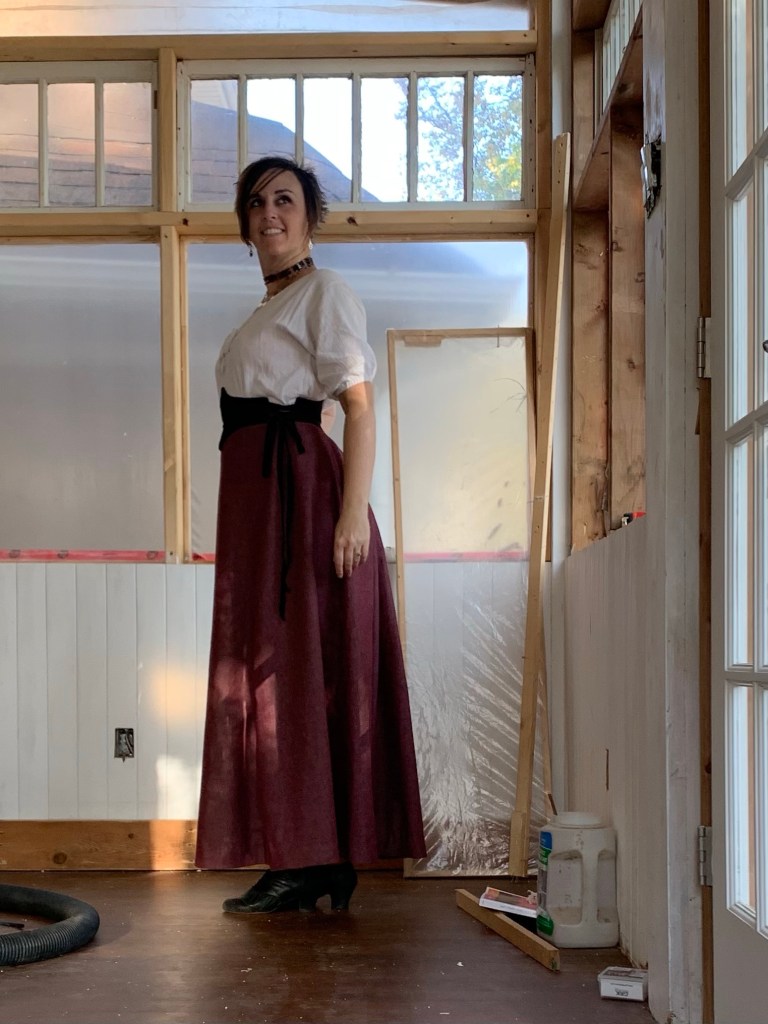
I serged off about 1/4” in length and then did a 2” hem, and I’d say the length is an excellent walking length for me, though I perhaps wouldn’t mind an extra inch if I were going for a more formal historical look.

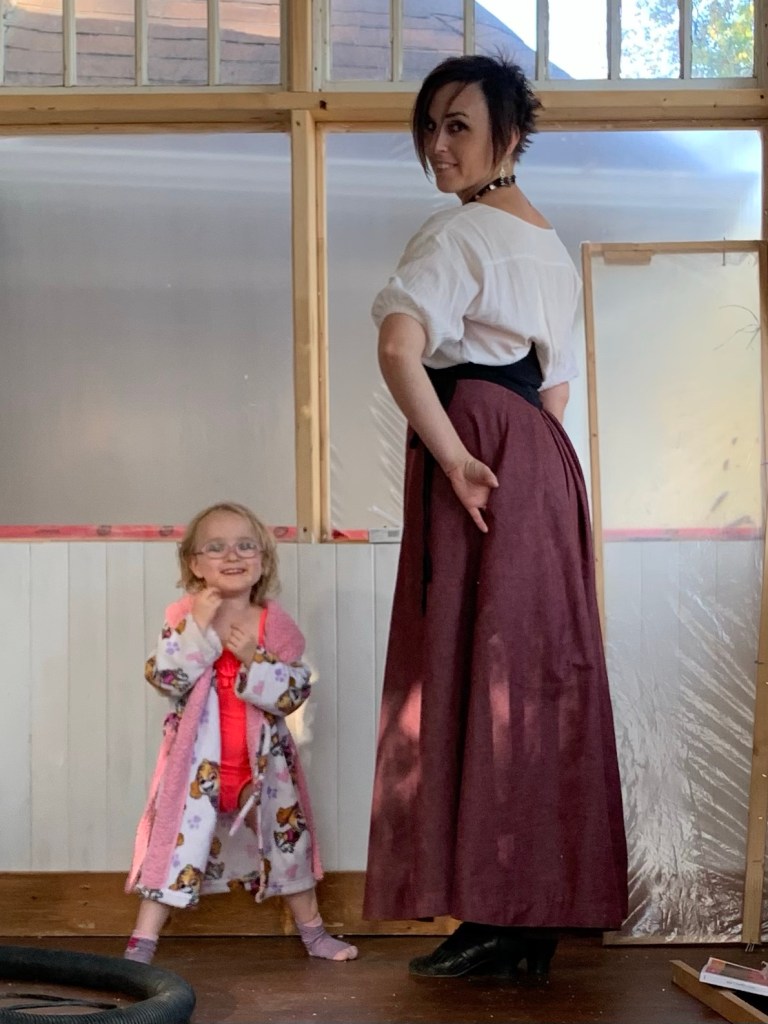
While I was intending this skirt to fit over a corset, it turns out I can also still wear it without, though it doesn’t lay quite so nice and smoothly over the hips. It does mean it’s another thing I can and will wear to work this winter, though, which has me thrilled to bits.

6 Comments

Filed under Sewing

A Robin in tulips

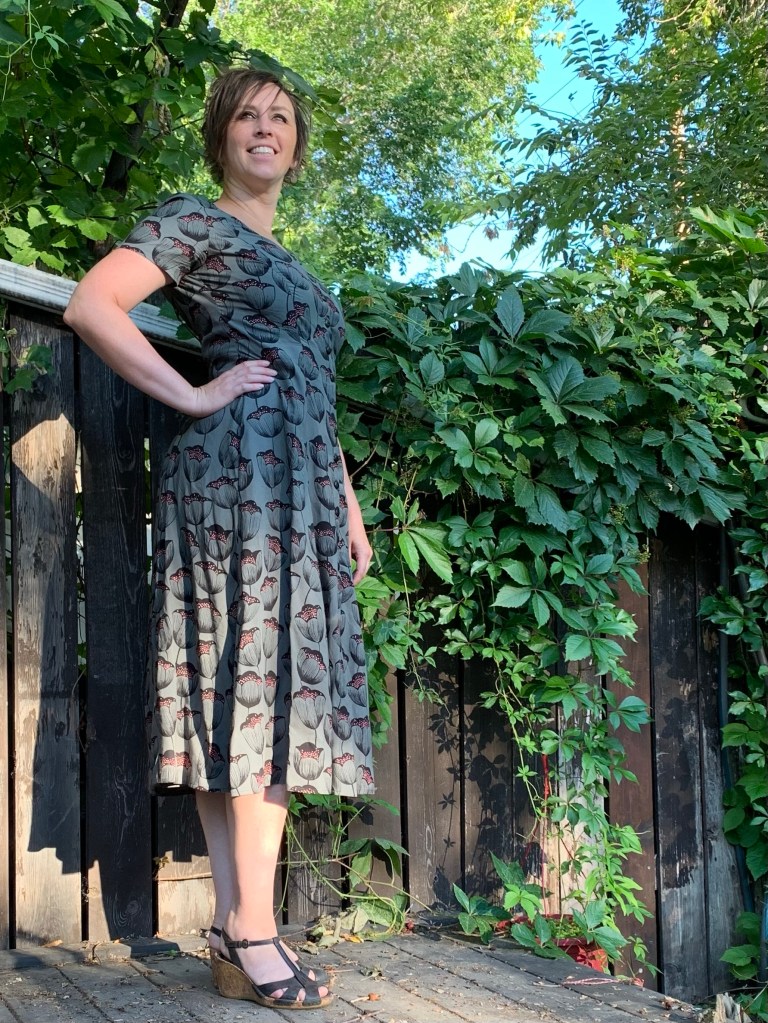
Perhaps you’ve noticed that my favourite dress style, probably of all time ever, is a long princess seam dress with a button front. This love easily goes back to my teen years in the 90s, but those early memories are marred by the fact that the store-bought versions of this dress never… quite… fit. Sewing has long been my chance to fix that, but somehow I hadn’t quite gotten around to the classic 90s version—a long, Princess seamed dress with simple short sleeves and a classic scoop neck, that buttons up the front, sewn in a soft, fluttering rayon.

Well, as soon as I saw the Scroop Patterns Robin dress come out, a couple of years ago, it was obviously the perfect example of this style. So I bought it. And then, well, life happened. I got it printed up ages ago. I had fabric picked out last summer. This spring, I picked out a different fabric, a Cotton + Steel rayon print called “Magic Tulips” that was a gift from a sewing friend.

Though if I run across the other fabric I wouldn’t rule out another.

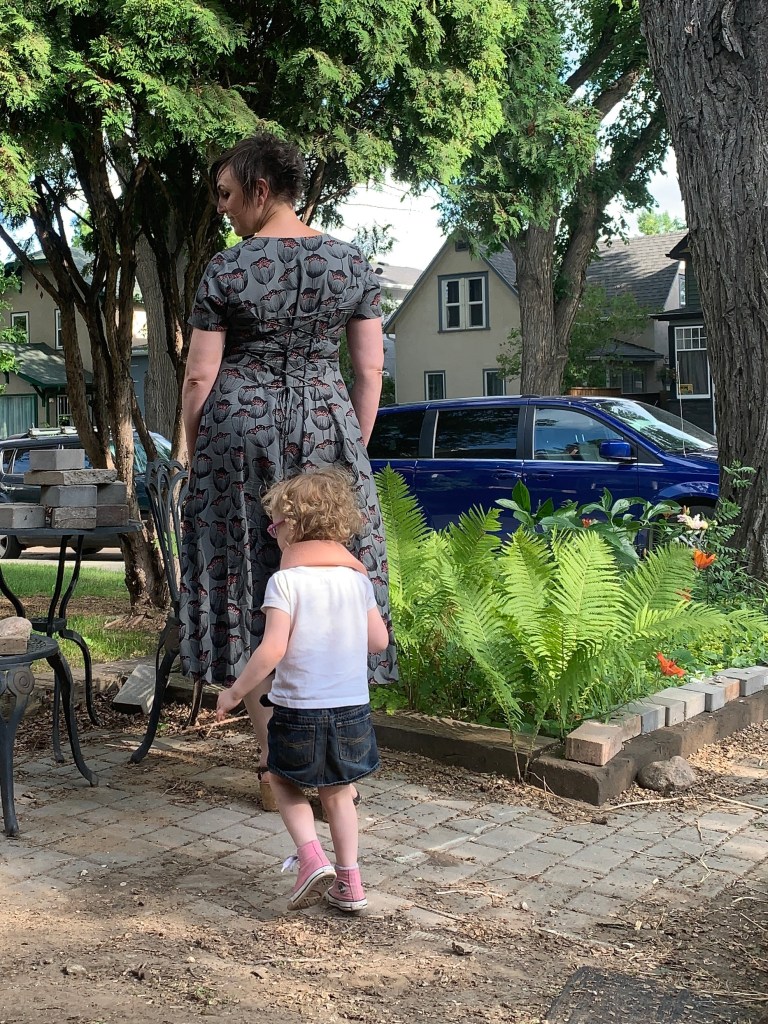
The pattern has three separate bust size options, and I thought the instructions for helping you choose the right one were really good—this is something I can struggle with sometimes, especially the last few years when my measurements are all over the place. I wound up going with the “mid size” option, and no complaints although I might shave a tiny bit off the fullness. That’s an easy fix though. I also went with the inseam pockets, which maybe aren’t ideal for a soft and drapey fabric like rayon, but I want pockets more than I mind a little bit of pulling, generally.

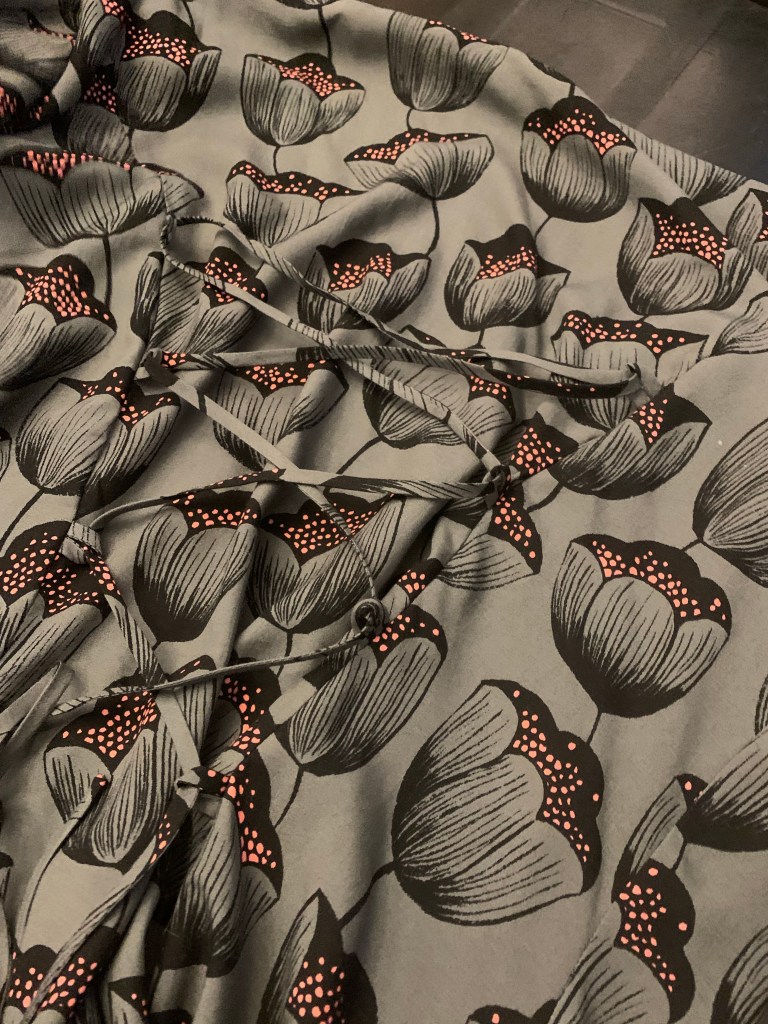
I complicated my construction unnecessarily by placing lacing loops in both the front and back princess seams, in an attempt to replicate a design feature from this original 90s pattern in my stash:

Note side-lacing just barely visible on view A.

Unfortunately, the combination of my short waist and very abrupt hip jut left only about 2” where the look actually worked, so that experiment did not really work out. I did leave the lacing in the back, with some rather painful fussing over where exactly they should go (my initial placement was much too low, which didn’t become obvious until after I had served the seams, and then there was the moment where I got confused and sewed them back into the exact same spots I had just ripped out… anyway.) It added hours to what should’ve been a more or less straightforward project, and really if I had just taken in the back a bit more it would’ve been fine without. But it is a fun detail, and hopefully will help to proof the dress against any modest size fluctuations in my future.

The only change I actually made to the pattern was a small swayback adjustment. I meant to also raise the underarm, but forgot—which probably shows how out of practice I am. I do regret that omission and will do it before the next time.

When I first tried it on, I did find that it flapped rather large, and after some experimenting pinching in princess seams decided I just needed to take in the side seams—a good 1” on each side at the waist, tapering to about 1/2” just under the arms.

This solved the fit issue, but then when I went to put in the first sleeve, I was really struggling with too much ease in the sleeve cap. The notches also didn’t line up even remotely, but since I did cut the dress out in squiggly rayon with the intermittent assistance of two almost-three-year-olds and several cats, I was honestly mostly surprised at how well most of it lined up.

It took me a distressing amount of time to realize that I had removed about 1” from the width of each armscye with my side-seam alteration. Once I altered the sleeves in the same way, the notches (mostly) lined up and everything slid into place.

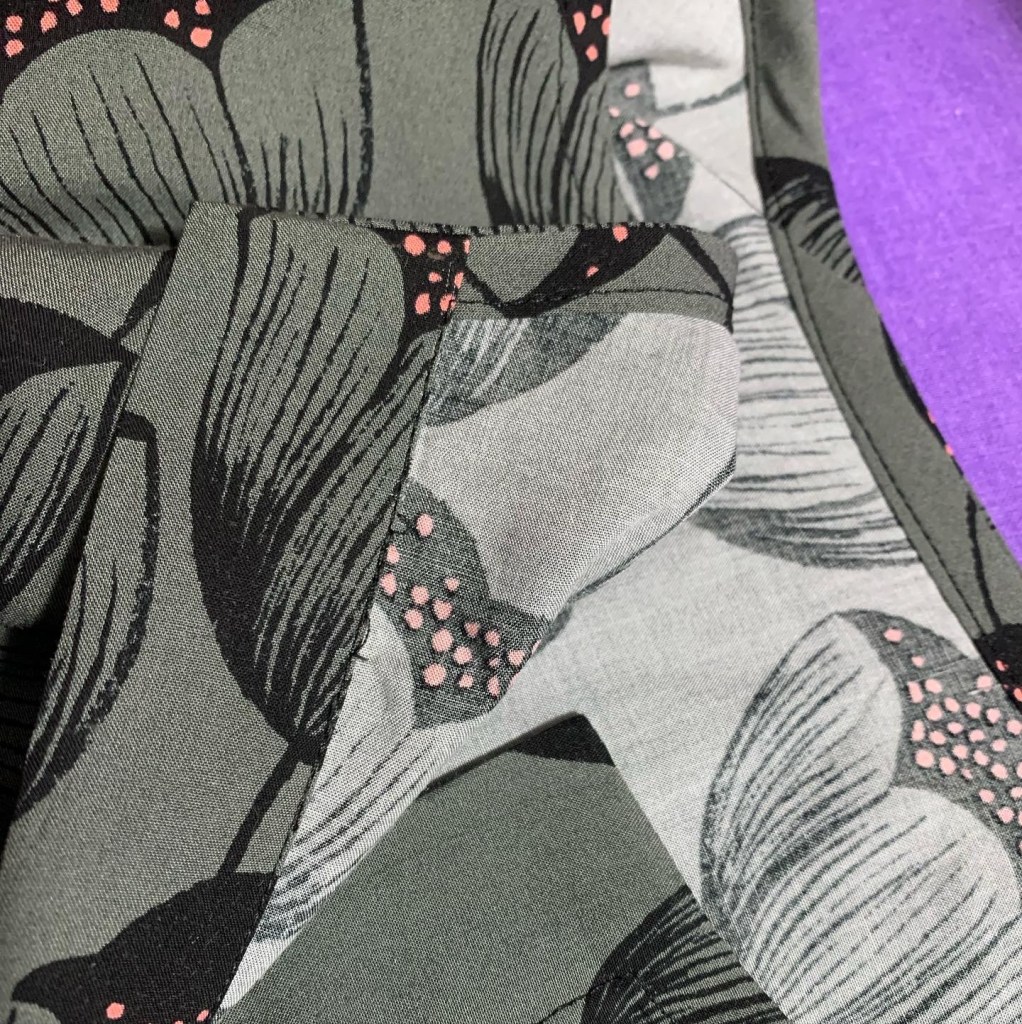
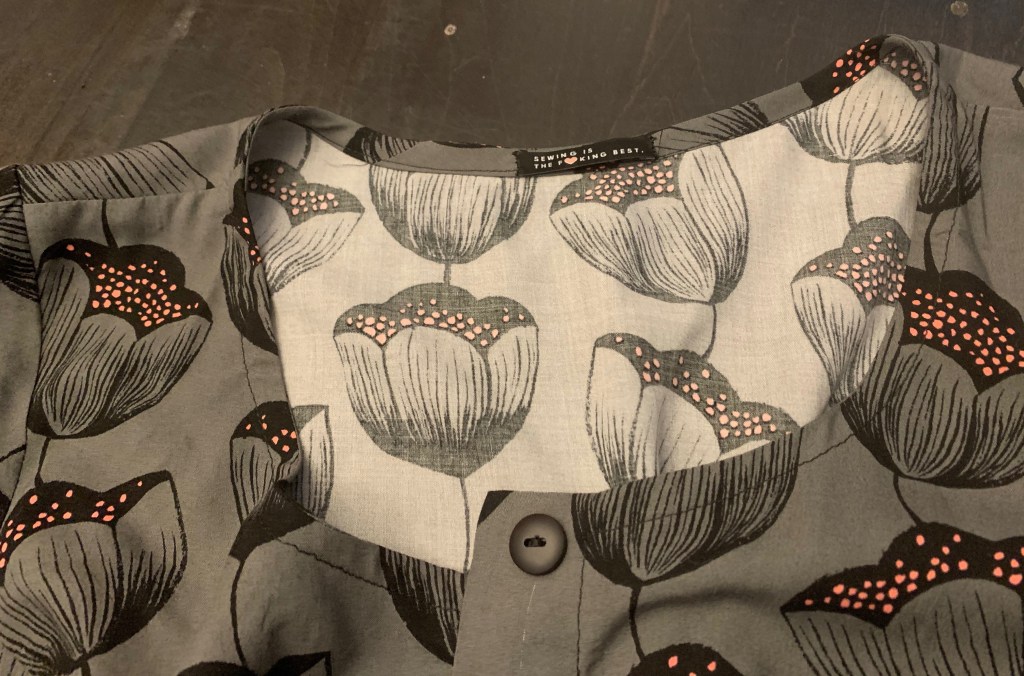
The button placket on the Robin dress is simply folded over, and the neckline is finished with bias tape. The pattern has you fold the placket back when stitching on the binding, so that the placket covers the end of the bias tape very neatly on the inside, and your topstitching of the neckline turns smoothly into the placket topstitching—a very tidy look and method, except that I had gone ahead and topstitched the placket down first. So I had to unpick several inches of that, and then it took a couple of tries to get the layering right, because, well, my sewing brain is out of practice. But I’m quite happy with the finish and the method in the end.

I went with the most plain and boring of black plastic buttons, again from stash. I think they are a good pairing with the print, letting it hold the spotlight. And, I am pretty sure they came from a giant mixed bag of buttons bought when I was first stocking up on sewing supplies in 2010 or so. So nice to use a bit of deep stash, even if they are not particularly interesting. I did kind of accidentally place my buttons holes horizontally (my default) rather than vertically as the pattern called for. To be honest I think I just prefer sewing them that way, and I’m more used to it so my rusty sewing brain defaulted to it. There are also a LOT of buttons, because I like them fairly closely spaced, for maximum support against gaping especially when I’m doing something silly like adding back lacing to a dress that’s already well fitting. I made sure there was a button placed at the full bust point, at the waist, and then filled in in between. I will say, for a tool I always thought was a luxury, I ALWAYS use my button-hole spacer and it makes this process so quick and simple.

I sewed the buttons on by machine, which made the process very quick, but my placement isn’t quite as good as if I had done it by hand, and there are a few ripples. However, I finished the hem after the buttons, so if I adjust the buttons I might have to redo part of the hem, so I’ll probably just live with it, honestly. Done is better than perfect.

For next time, I would definitely raise the underarm—it’s not bad but could be better; I’m not sure if my taste for a high underarm comes from personal preference or some quirk of my shoulder joint, but I like them high. I think the bodice as a whole could maybe be shortened slightly, even just 1/4”. I’ve been trying to do less of that in the last few years, as I tended to overdo it, but I also hate a too-long bodice. If I skipped the lacing in the back (which honestly was enough of a pain) I would perhaps take in a bit at the back princess seams, as there did seem to be a bit of extra fabric there.

It took what felt like forever to sew this, as if each little step was a battle. Not against the fabric, which was reasonably well-behaved for a rayon, but against everything else in my life right now. On the other hand, finishing felt like such a victory that I even used one of these precious gifted sewing labels on it. I’m so glad to get to finally wear it. I’d like to say I’d make another three, but at the rate of my current sewing that might take

2 Comments

Filed under Sewing