Tag Archives: Regency

Long Stays

Back in the winter, I got inspired to try and update my long-neglected Regency period wear. In particular, certain world events have had a lot of us Canucks thinking about the War of 1812 a lot more than we ever had before… which got my little historical sewing group planning an 1812 picnic on August 24. First off, I wanted to make a new set of regency stays, since my old ones aren’t fitting quite how they used to. And I’ve always wanted a set of long stays, anyway.

I actually mostly finished these back in April, but I wasn’t quite satisfied with the fit. Recently, I finally made some tweaks that I think have saved them.

It’s the Redthreaded pattern, but my copy is from back in the day when they only came in single size, which is no longer the size I am. So I had added some width, but apparently I overdid it because it was lacing closed and not really doing what it needed to. This period of corset was aimed less at waist reduction and more at bust lifting (with a side of keeping a flatter tummy to look a little less pregnant in the high-waisted gowns), but at least at my age I need the underbust area to fit snugly, like a bra band, to get the proper support/lift. So, since I couldn’t quite bring myself to redo the binding, I just took a half-inch tuck right beside one of the boning channels at each side seam, all the way from top to bottom, so that my stitching was right on the seam line. The tuck is hidden on the inside and hopefully the tuck won’t be too irritating during periods of longer wear; I didn’t notice it at all while trying it on.

But let’s back up a bit. While sewing, I had a lot of regrets about my decisions with this project.
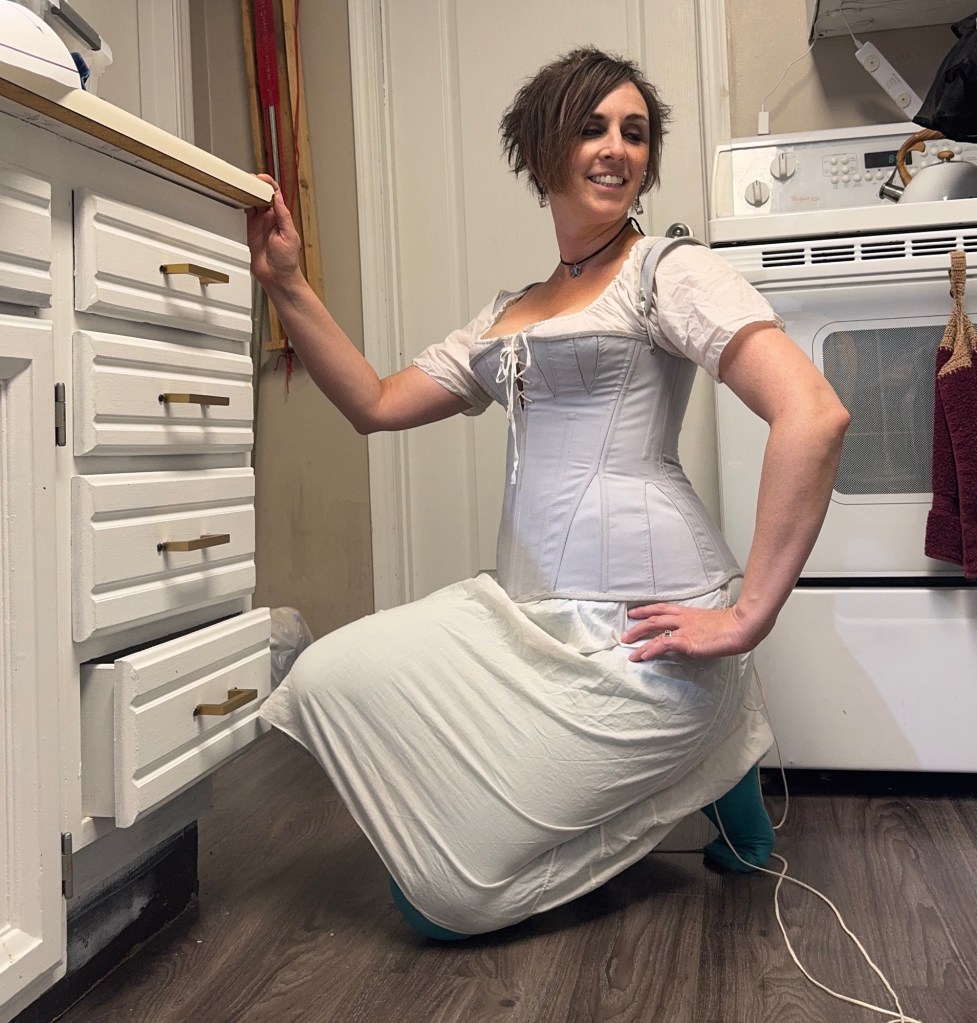
First, the materials. Corsets of this period are usually made of a double layer of cotton sateen (ticking would work in a pinch) with quilting, embroidery, and cording supplying a lot of the support. I could not for the life of me find my original digital pattern and instructions, so I was kinda winging it, just modifying my old printed version, and somehow I settled on single layer construction (so no cording or quilting) using the last of the grey coutil from Farthingales I used for this Edwardian corset. This stuff is beautiful and the finished corsets are great, but it’s stiff as cardboard, hard to sew even on a machine, and not even remotely accurate to the period in this case. I mean, my historical accuracy is never super high, but what was I thinking?

I didn’t have a lot of the coutil left, either, so when laying out my pattern it became obvious I would have to add a front seam. However, I seized on this opportunity to add some lacing in the upper front, similar to these transitional stays at the V&A:

Or the ones included in the Scroop Augusta Stays pattern. This detail really makes no sense in a pattern with bust gussets, at least for someone like me who has no space between their breasts, but I do think it’s a cute detail and I don’t really regret going for it.

Hand eyelets on the front. Not on the back however.

I did a LOT of hand stitching on these, and I regretted just about every moment of it, because this coutil is so dense and hard to stitch. I inserted the bust gussets by hand, including turning and stitching down the seam allowances on the inside. I love the look, but the process nearly killed me.

Detail of the V&A gusseted corset

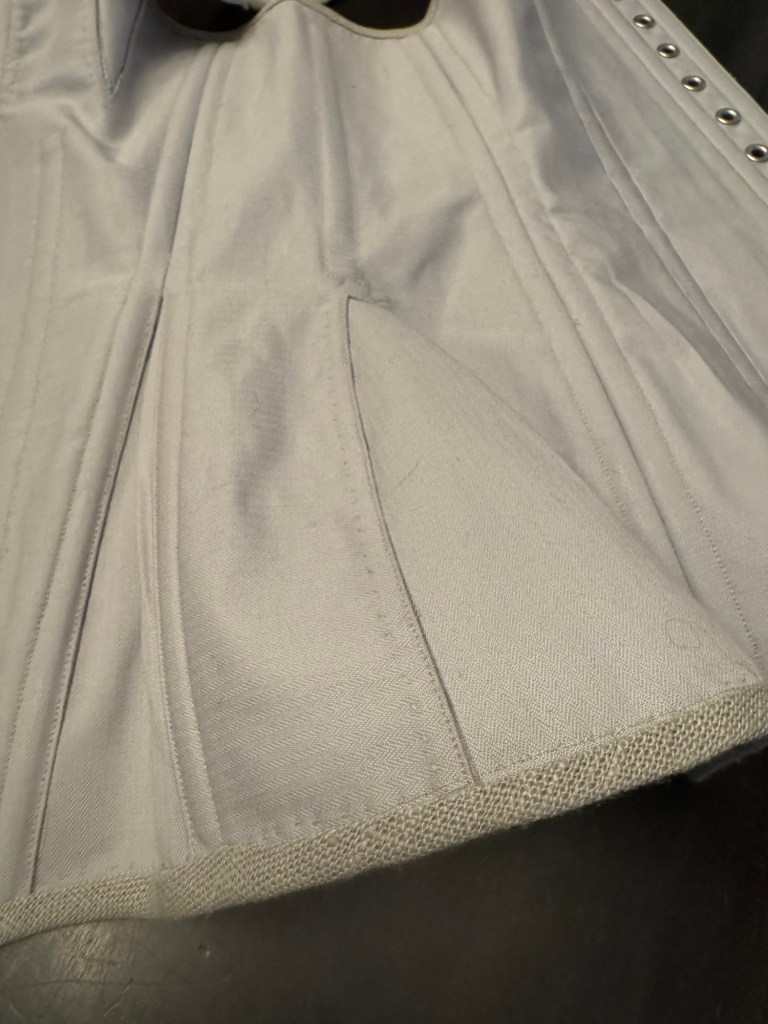
I used a different technique for inserting the hip gussets, based on looking at some 1830s corsets on the V&A website. See how the point of the gusset is actually square, covered in a satin stitch? You get this if you cut your slit as a T, and the edges you fold under are the same width all along instead of tapering to nothing at the point. It was so much easier than trying to taper the seam allowances to a V point, especially when sewing by machine! I do still have to go back and do the satin stitch across, though.
The boning is a mix of spring steel, spiral steel, and a bit of plastic imitation baleen when I got lazy. I also added a pocket for a wooden busk in the front (aka a paint stir stick) although I had to make it a bit shorter due to the presence of the split section at the upper CF.
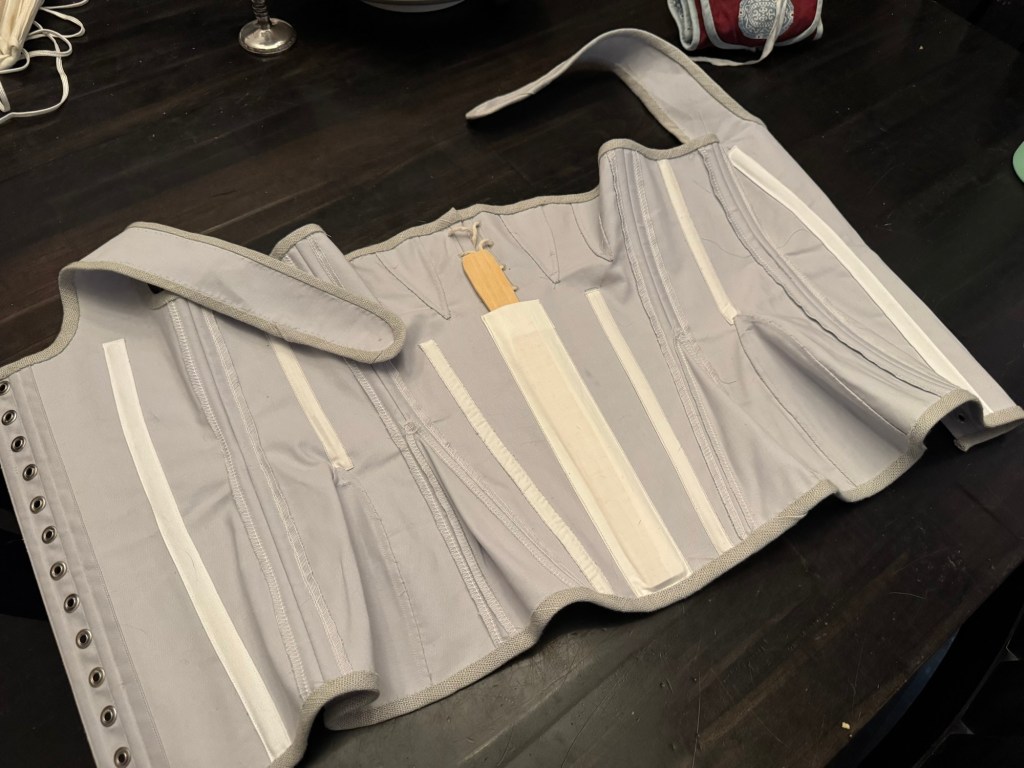
The binding is a coarse linen(?) type bias binding I originally made for this corset a billion years ago.
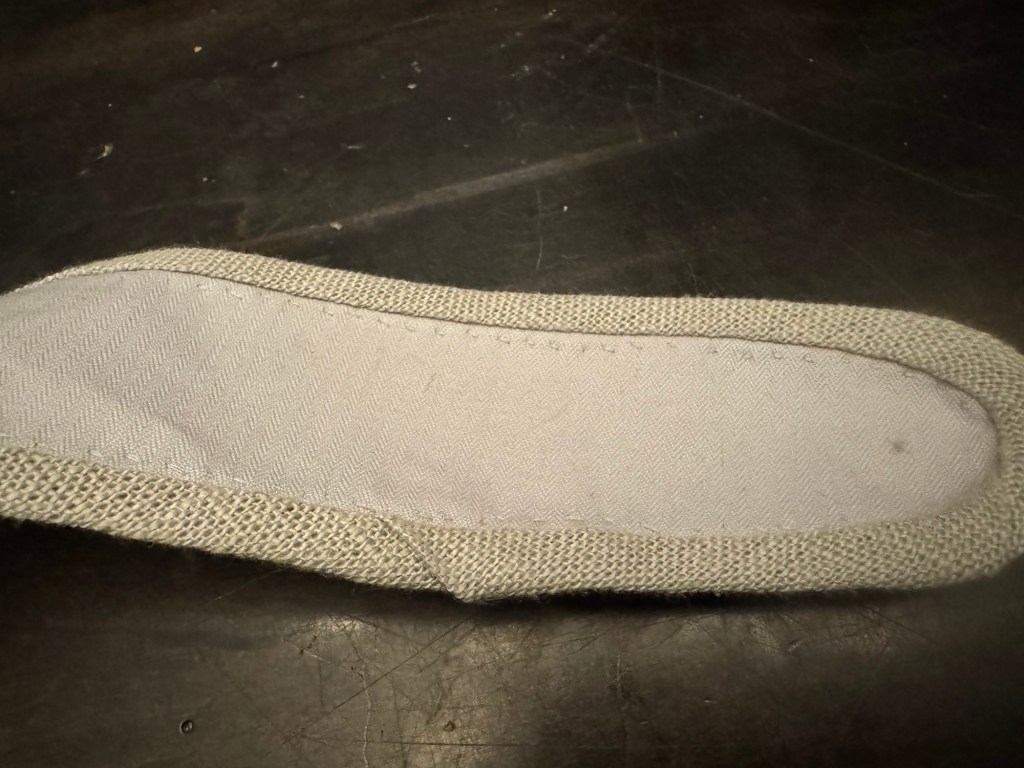
It’s been kicking around my overflowing bias tape box ever since. I really should go back and revamp that corset, actually….

The hip spring isn’t quite adequate (hence the flare out of the lacing gap at the bottom)—I should have tested that more closely, and enlarged the hip gussets as necessary. But for the moment I’m going to live with it. I also spiral-laced it, which is period appropriate but a pain to tighten up and I have no idea how to tie it off efficiently. More research needed. If you know the secret, please let me know!

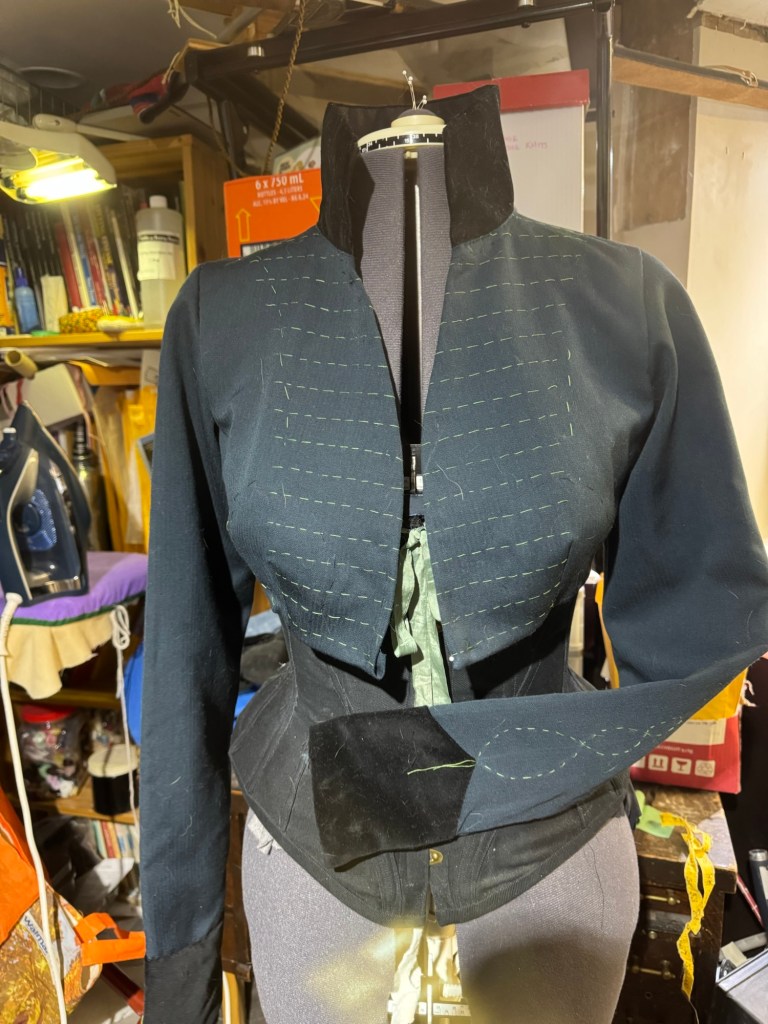
But anyway, it’s done (however imperfectly), and I am excited to start work on my 1812 military-inspired riding habit….

(Inspiration from these guys)

Just not sure if I will manage the red sash or not…
Comments Off on Long Stays

Filed under Sewing

Regency Underoos


Sense & Sensibility Patterns Regency chemise and short stays

 It occurs to me that I’m establishing a bit of a pattern here. I’ve made another set of historical underclothing. Hmm. If you go back and include the fairly-mediaeval bliaut I made way-pre-blog (hand-worked eyelets up each side, dude), that was basically an underdress as well… well, let’s just say I have yet to produce any historical outer wear of note. Hmm. Maybe I should give up and just go with “underwear across the ages”. 😉

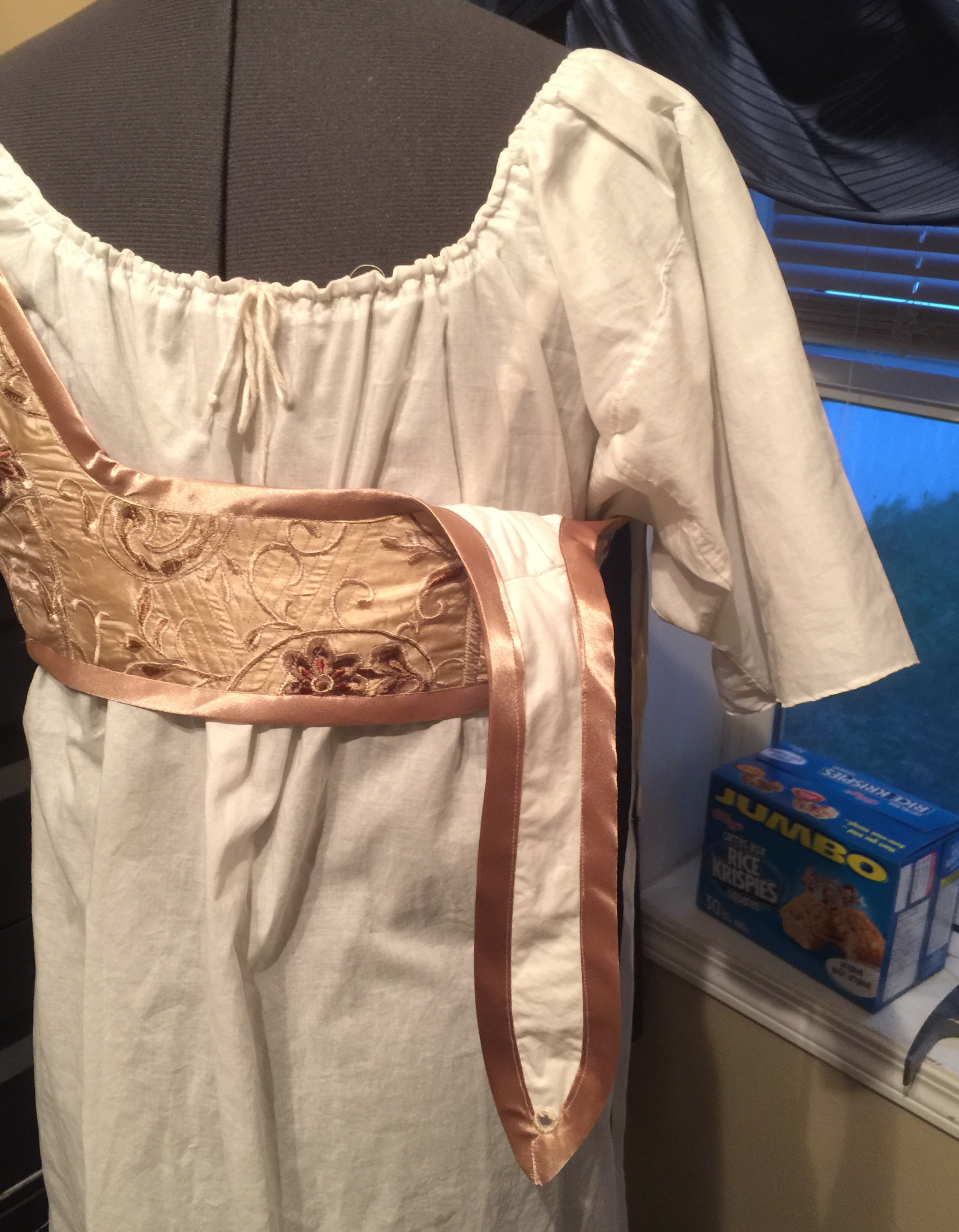
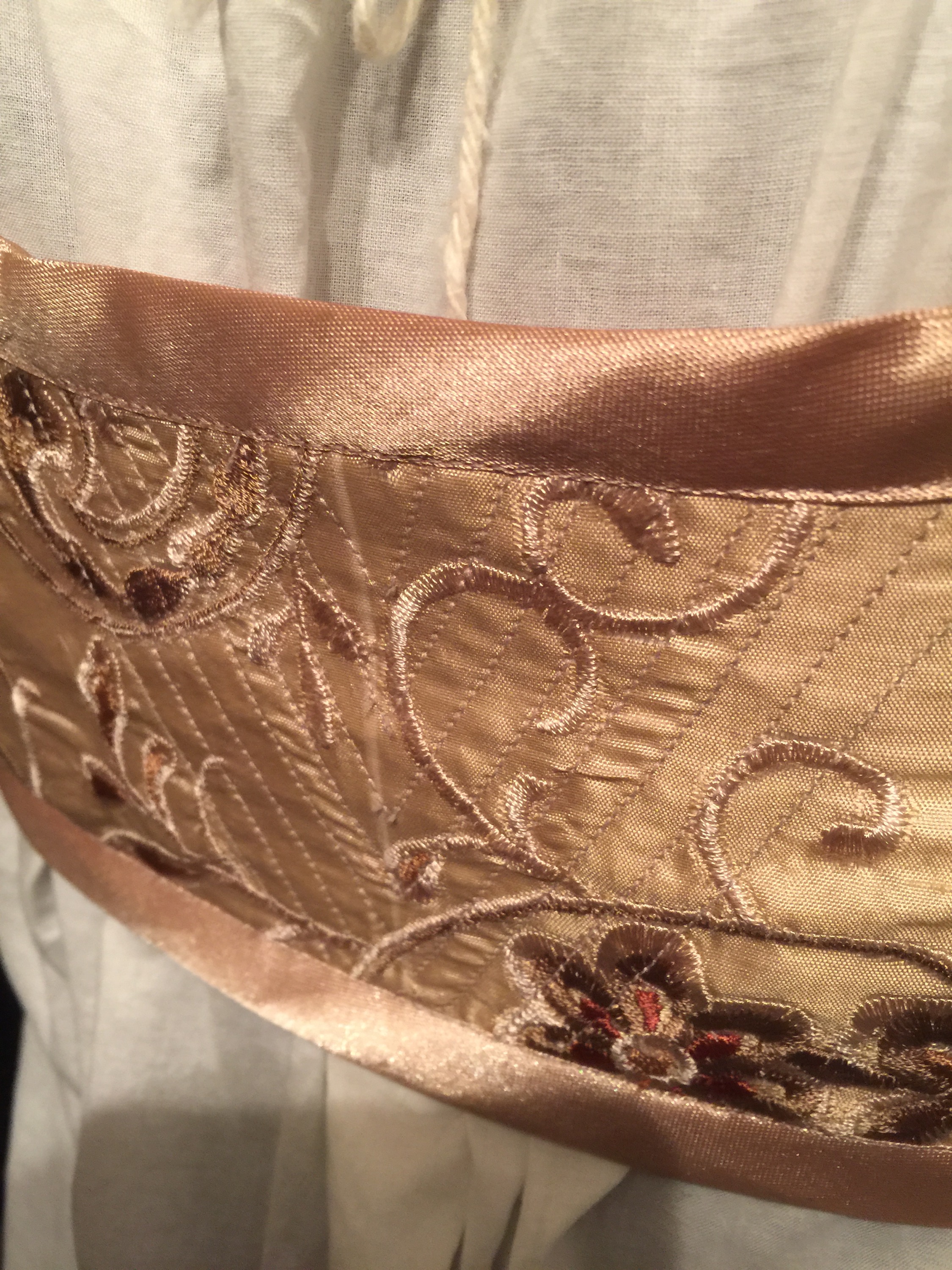
Regardless of what that says about my sewing inclinations (or maybe just my attention span), I have made another set: Regency underthings this time, perhaps aiming for a date around 1805, although frankly I’m trying to restrain my latent authenticity Nazi and don’t feel like researching ’til my brains ooze out my ears. But I kind of spent a bunch of time on vacation last month pinning Regency fashions, since they’re some of my favourite (and arguably considerably more translatable into a modern aesthetic than anything much before or after), and then I got it into my head that maybe it would be a fun Hallowe’en costume. One impulse purchase of the Sense & Sensibility Patterns Regency Chemise and Short-Stays pattern (PDF), some serious grumbling over the printing thereof (not pre-tiled, layout not at all paper-maximizing), and a very very small piece ofsome very scrumptious embroidered silk and, well…


Chemise

  I didn’t really follow the chemise pattern, partly because I only printed half of it, but mostly because I prefer a gored construction method, and I’m pretty sure it’s still historically accurate. I did copy the neckline, but otherwise I used the same two-gored construction I did for my Victorian chemise. In hind-sight, I wish I’d done the single, asymmetrical gore (more “old fashioned”) but I forgot at the time. Apparently I need to make another. Because I really need another historical chemise. >_< Add rectangular bits for sleeves and the last couple of square scraps for gussets.


Flat felling, be hand and machine

  I did all the long seams flat-felled on my machine, but I can’t quite wrap my head around flat felling the gussets by machine, and I never do a very good job of matching things up so my seam allowances were, ah, wonky… So I felled those seams by hand. Hand-sewing: for fixing fuckups. 😉

  I made hand-worked eyelets for the neckline drawstring to pass through. However, not being overly bright, I worked them in the BACK of the neckline. Oops. I’m not really happy with the neckline anyway (I did a fairly terrible job of applying the bias tape drawstring casing) and it seems a little high so when/if I get the time and inclination Imay redo it. 


Coffe, coffee everywhere. 😦

 The short-stays were more fun, and slightly less of a comedy of errors. Aside from the part where I dumped an entire cup of coffee on the pattern and fabric. We won’t speak further on that. At leas the silk is pretty coffee coloured to begin with. 


Ticking lining

 I used ticking for the lining and interlining, rather than coutil, mostly because a friend had recommended it as a locally-available alternative to  coutil, apparently very low-stretch due to the tight weave. Though I’m not sure this was the best project to test it out as the short stays are very lightly boned. The softness of the ticking wouldn’t be too much of a problem in a fully-boned corset, but might be an issue in something that has less boning than some of my bras. Though at least initially it seems to be working. I used the maximum amount of boning suggested (the instructions are pretty thorough in going over various options for boning and cording and even quilting. And there’s an online version with extra photos, too.)


Quilting

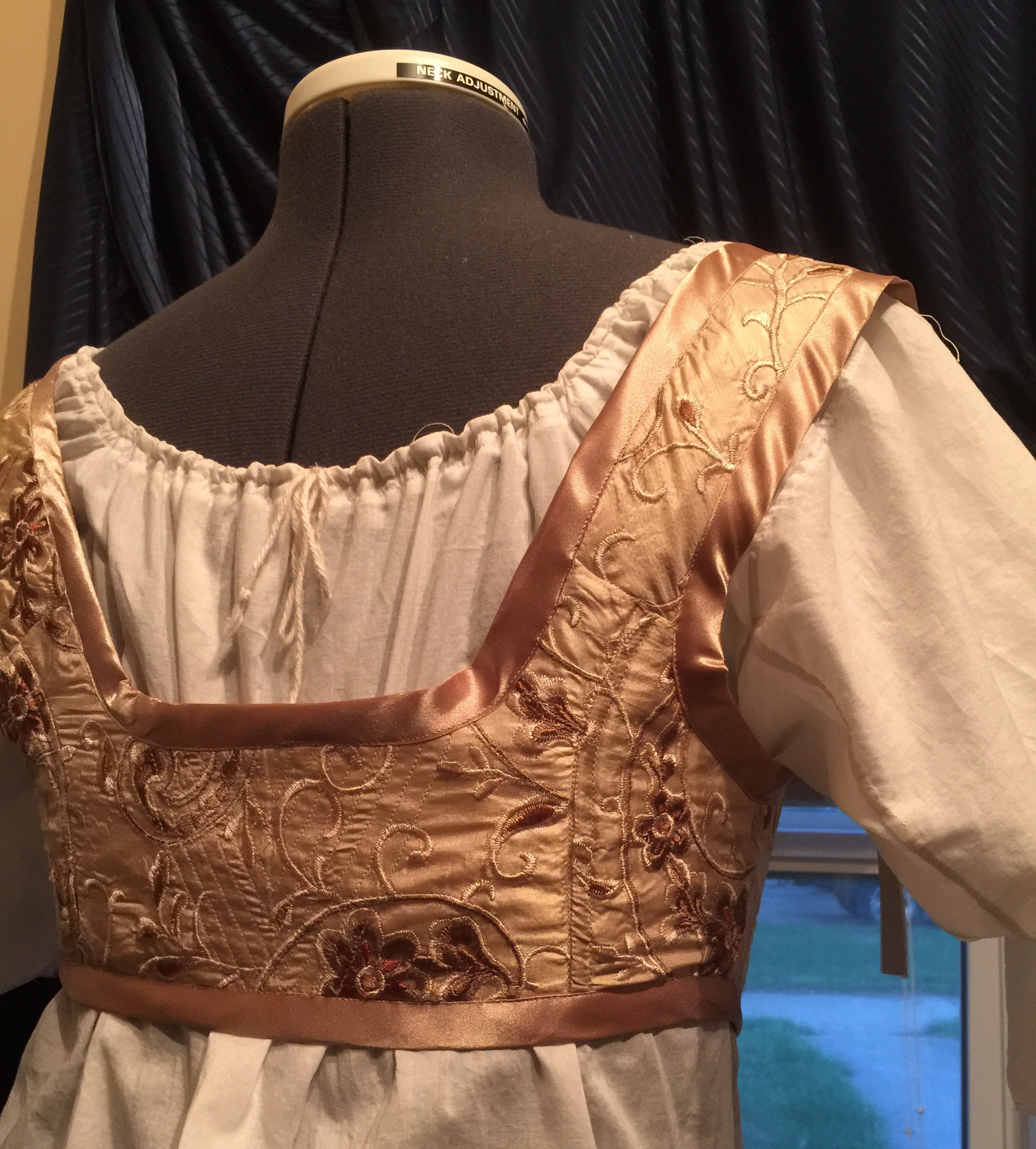
 Speaking of which, I added some quilting to the back, which is completely unboned, for a wee bit more support. It looks nice, anyway. 


Back view

 I wanted a coordinating silk in a solid to make my bias binding (the idea of trying to make a binding out of my embroidered silk was a bit horrifying) but there was naught to be had. So I threw authenticity out the window* and went with a very modern polyester satin bias trim, which was both fast and easy and a great colour. 


Front. My dressform does not squish as well as I do.

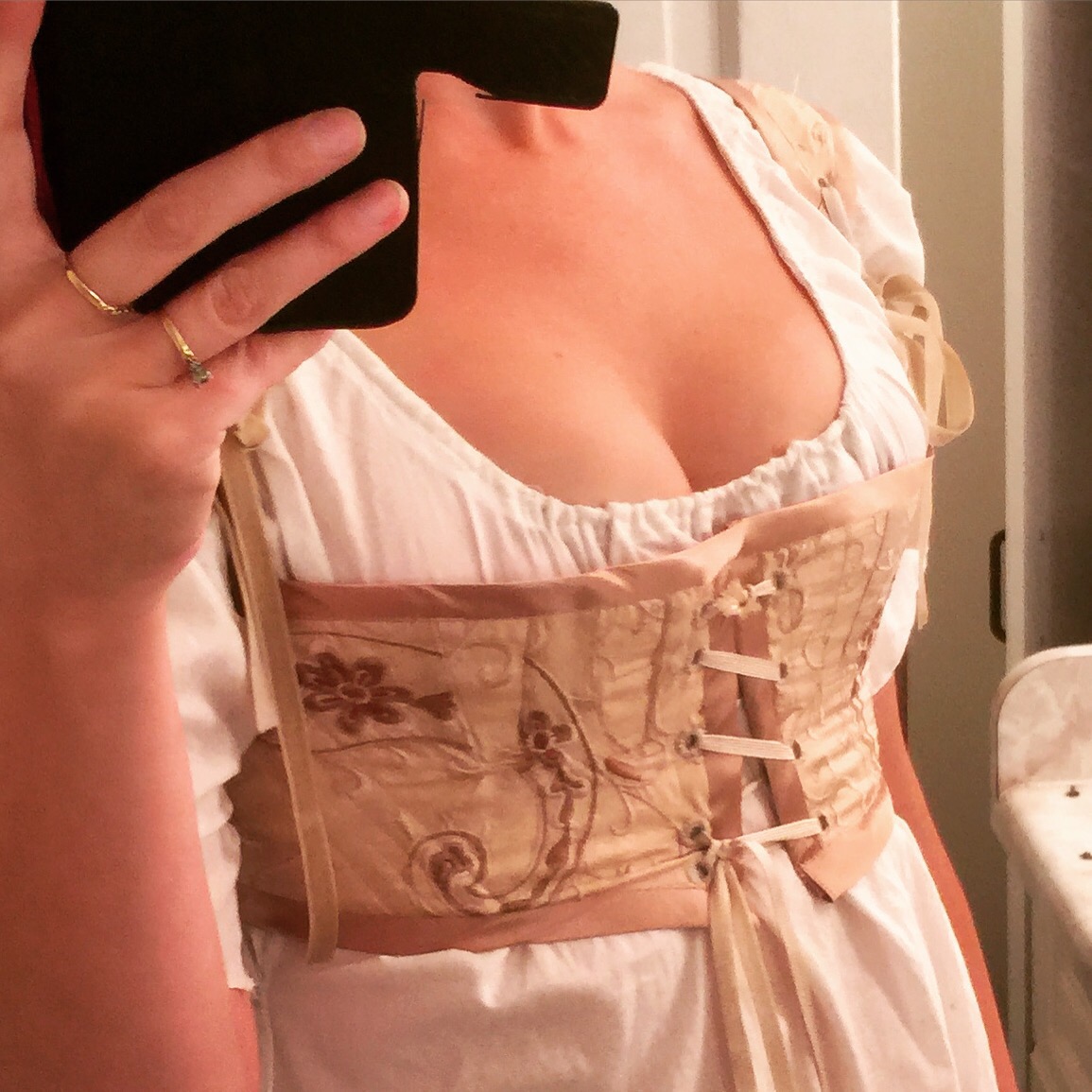
 I made my eyelets by hand, as per period (and not nearly as many as that damn mediaeval dress, as I reminded myself constantly) but reinforced with metal jump rings. Although I’m not sure how often this was actually done, (I did read about it, though, somewhere) it was fun to try out and the resulting eyelets are nicely circular and sturdy. 


Eyelet inside, with jump ring.

 After studying my Pinterest boards, I opted for spiral lacing. Regency seems to be pretty much right around when the switch from spiral to crisscrossing lacing happened, but more of the extant garments and images seemed to me (in a very unscientific survey) to be spiral-laced. (Or have holes spaced for spiral lacing even if their laces are currently cross-laced.) 

The bottom of the stays is designed to have a drawstring to hold them down. I left the channel open but haven’t tried to thread it—my rib cage  doesn’t exactly taper downwards, so I’m not convinced it would help with anything. 


On me. Hopefully I’ll have better pics eventually

 I cut a size 12 (same sizing as big 4 patterns, as far as I can tell, how nice), with the B-cup gussets. I optimistically auditioned the C-cup versions but, ah, no. I also cut down to a size 10 in circumference, though I didn’t mess with any of the vertical measurements. 


Shoulder tie.

 The only actual change I made to the pattern was to have the straps separate in the front and attach with ties. Not so much because I thought there was anything wrong with the pattern length but just in case, y’know. Plus I had this fabulous matching velvet ribbon. I think I set them a little further apart than the original pattern would call for—this isn’t inappropriate for the period but would probably be too wide for a lot of people (including my dress form.) They seem to stay fairy well on me, though—though I haven’t tested them under heavy movement yet. 


Lift and separate!

 
It was a pretty darn fun project, anyway, however ridiculously impractical. And quick.  And now I can think about a Regency gown for Hallowe’en.

Although first I’m gonna need another petticoat. 😉

*if there was anything left to throw out after I chose my embroidered silk; I haven’t been able to find anything in period even remotely as ornate as my silk. 

11 Comments

Filed under Sewing