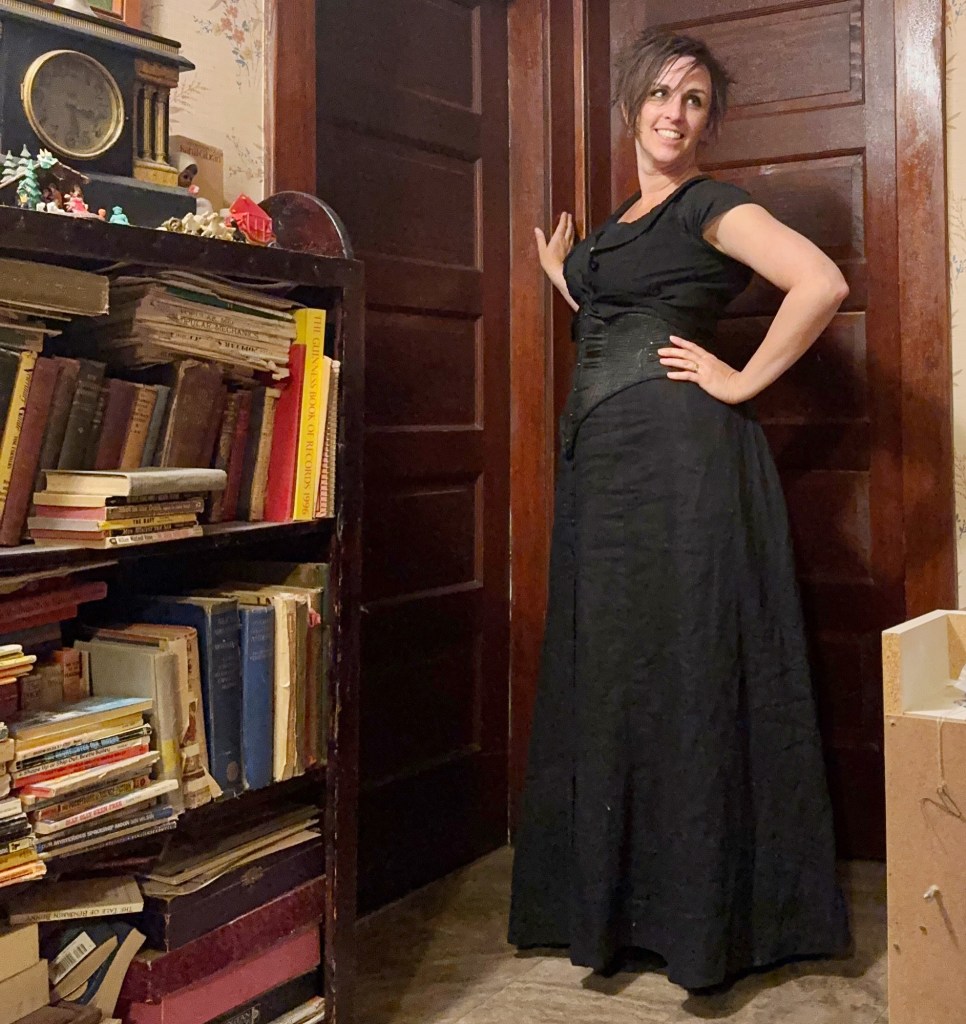
At some point in the last year (November of 2024 but I had to scroll back in my camera roll to co firm that because it feels like it’s always been there) I made a black linen version of the Wearing History 1900 skirt. My only change from my first go at the pattern was to make it button down the front, a not particularly historical detail that I enjoy because it gives me an optional slit and also lets a ruffled petticoat peek out.
It has become a workhorse in my wardrobe because it’s versatile and more basic than a lot of my skirts, which means I don’t try as hard to space out the wearing as I do with a lot of my more, um, striking makes.
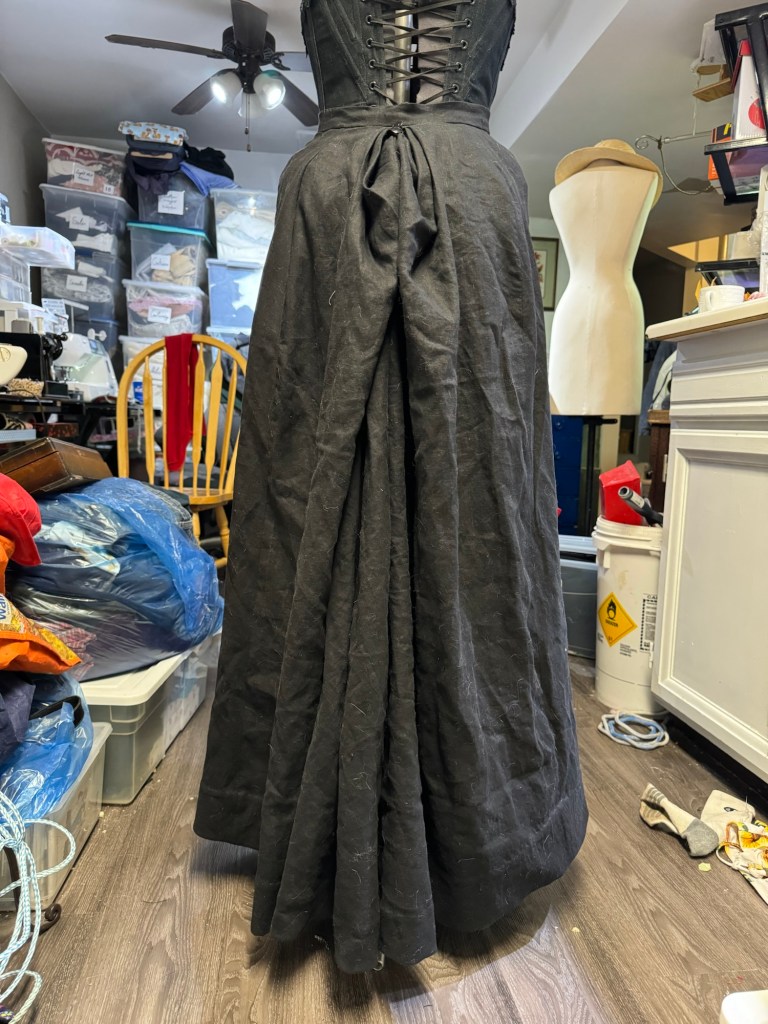
Aside from the buttons up the front, I hemmed it with a bit of a sweep in the back, then realized that was really stupid for a skirt I wanted to wear on the regular, so I added a little button and loop to bustle it up just a couple of inches.
Just enough details to make it feel fun and fancy without being too much for regular use.
But, because it’s black, it’s basically impossible to get any good shots of the details without blowing everything out so the wrinkles and stray cat hairs make it look terrible.
Nonetheless, it’s been a workhorse over the winter (with the appropriate petticoats), and I’m hoping it will transition well to breezy linen summer wear.
Black blob.
And yes, it has a pocket, although as usual I wish it were a bit bigger. (And in case you’re wondering how often I wear it, all the actual modeled photos in this post are just the times I’ve worn it this month during Me Made May.)
Comments Off on Black, basic, impossible to photograph
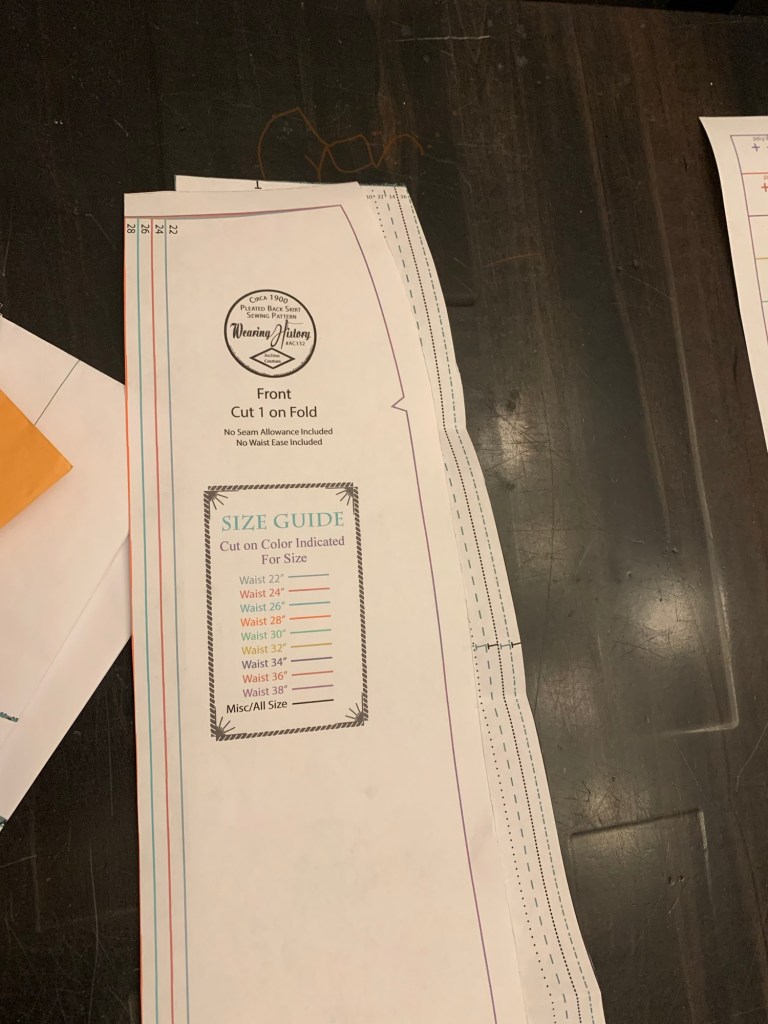
Not so very long ago Wearing History put out a new “Archive Collection” pattern based on a McCall’s original from around 1900. And, rather impulsively, I bought it.
Equally impulsively, I decided to get it printed in time for my little Christmas break. I didn’t get as much sewing done as I might have liked, after one of the twins brought home yet another virus just in time for Christmas, but I did eventually start on a tester version.
Now, this isn’t exactly a pattern I needed. In particular it’s very similar to the Scroop Fantail skirt I made in September. But I thought a detailed pattern comparison would be fun! So here goes.
See the more intense waist shaping on the Wearing History pattern.
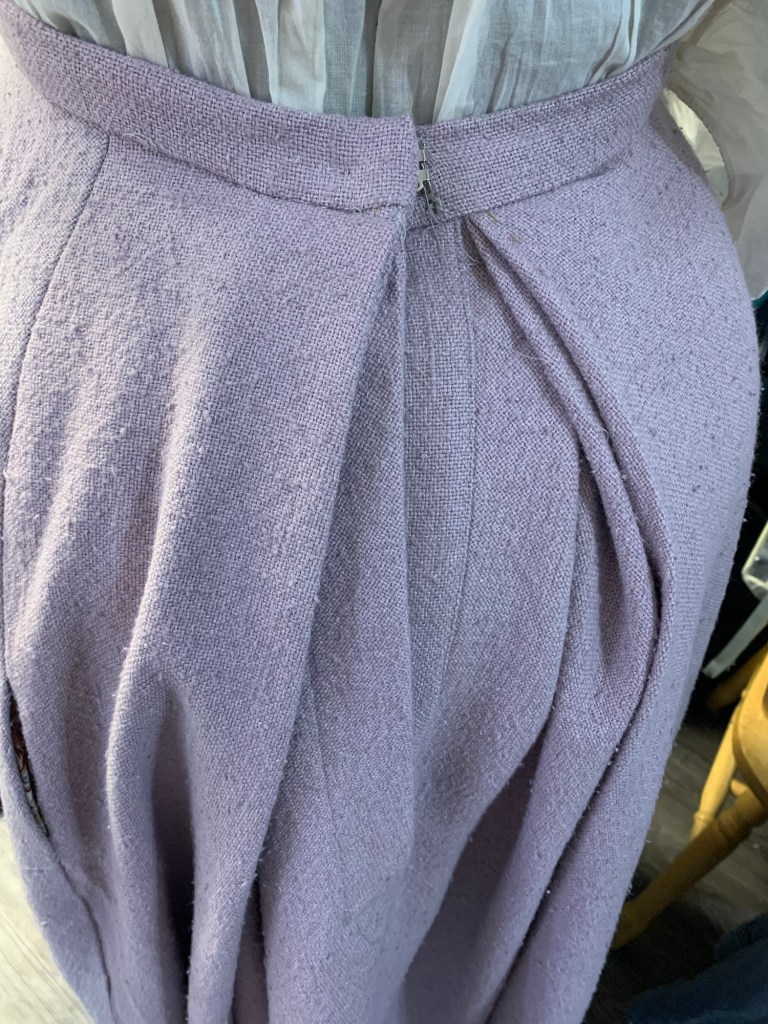
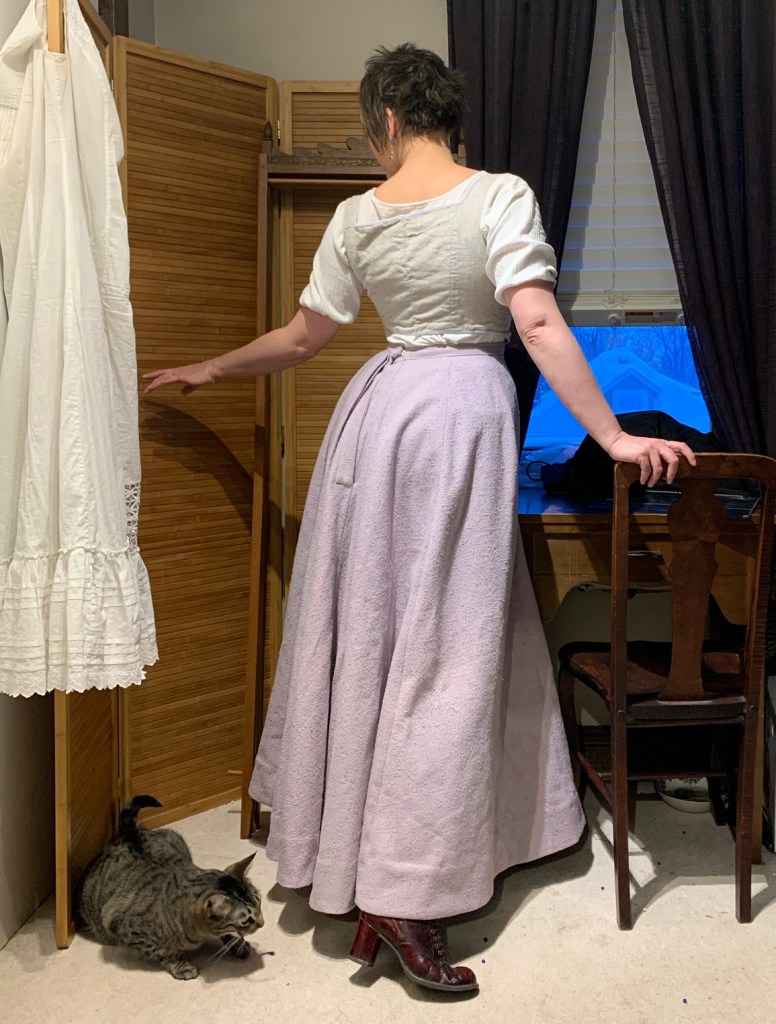
Both patterns are five-gore skirts with smooth fronts and added fullness in the back provided by pleats. Both have narrow straight waistbands and a centre back placket closure. The fullness in front and side panels is almost identical, although the Wearing History pattern is a little more full in the back panel, particularly towards the hem.
The Wearing History pattern differs mainly in three ways: the back placket is cut on, additional shaping for the waist comes from wide side darts, and the shaping of the flare, which is quite straight in the Fantail, and subtly fluted in the Wearing History pattern, narrower through the knees and then flaring slightly more below—though the difference is only a cm or two per pattern piece. There is a lot more shaping from waist to hip in the Wearing History skirt, something I had to increase in my Fantail by grading to a smaller size at the waist.
The grainlines of the patterns also differ, with the Fantail having a more modern style of grainline falling in the middle of the gore while the Wearing History original grainlines are the old fashioned type where they parallel one edge of the gore. However, the Fantail instructions also mention the variability of grainlines in the period, and when I made my version I used “old style” grainlines to get the pattern to fit on my limited yardage.
The side darts, incidentally, are features of my self-drafted 1880s skirts, based on period instructions. It’s neat to see the mix of older features and sharp new skirt shape in this pattern.
I’d rather the under placket didn’t show here, but that requires a larger waistband.
In my version of the Wearing History pattern, I decided to omit the cut on placket and do a sewn on one. This matches the directions I’ve usually read in period sewing manuals. And that whole back seam is on the bias so trying to keep a cut-on placket square just seemed like a nightmare. Instead I did the back placket basically exactly like the Fantail skirt, except for just making it rectangular instead of a fancy angle.
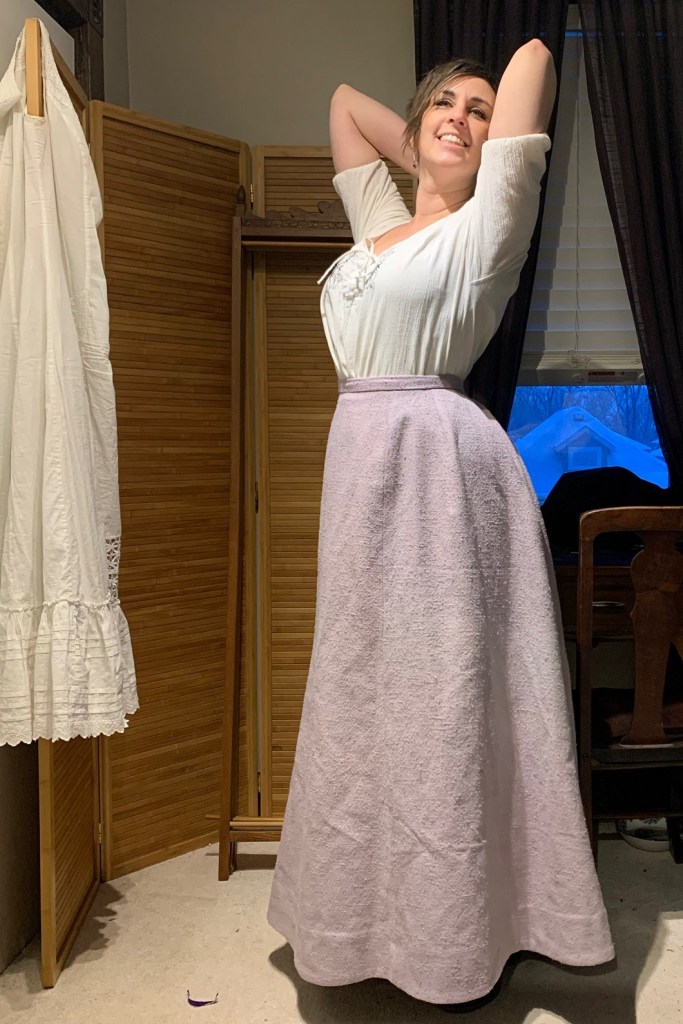
I tweaked the darts quite a bit to get a hip shape I liked, making them longer and a more sinuous shape. I also wound up making them deeper, at least partly because the waist was stretching out in my thick but weirdly soft fabric; I overshot a bit and currently it’s really too small so the back pleats aren’t lining up quite right. If I redo it, I might sub in a different fabric, like a thin cotton, for the waistband. This upholstery fabric is beefy and where all the pleats stack at the centre back my machine completely balked, although not before I had broken three or four needles trying.
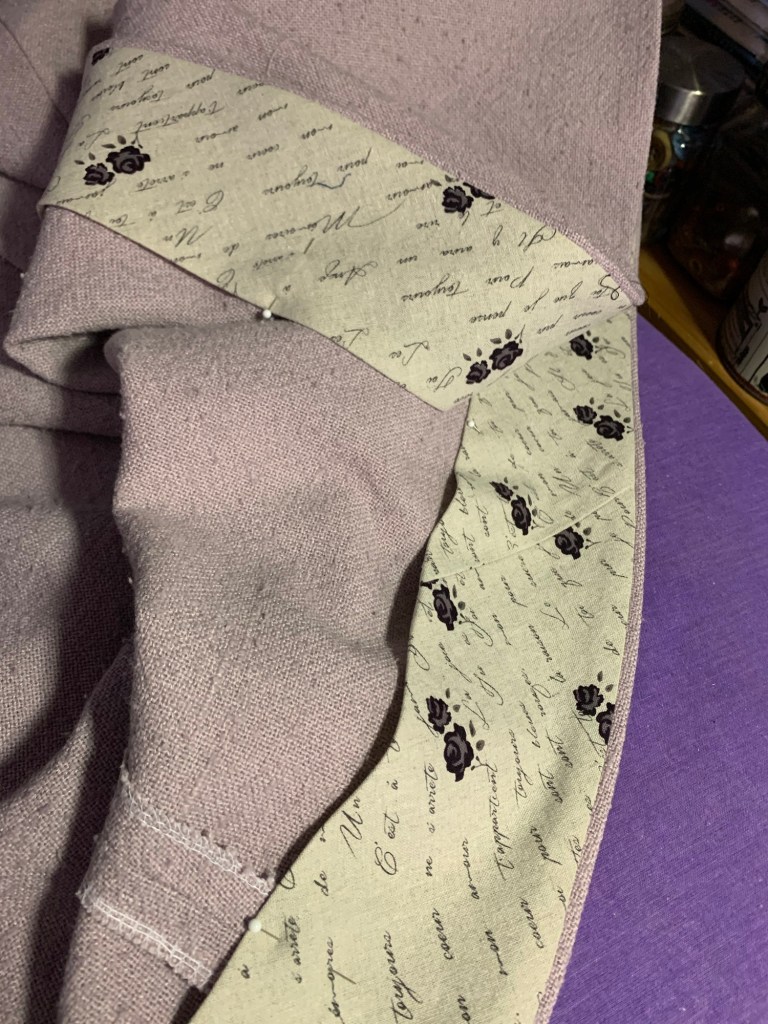
Speaking of the fabric, I almost forgot to mention my favourite feature of the whole skirt. Since the pattern has no seam or hem allowances, you add your own. However, when I was laying my fabric out, I had distinctly less than needed for the skirt, and I wound up basically not being able to add hem allowance.
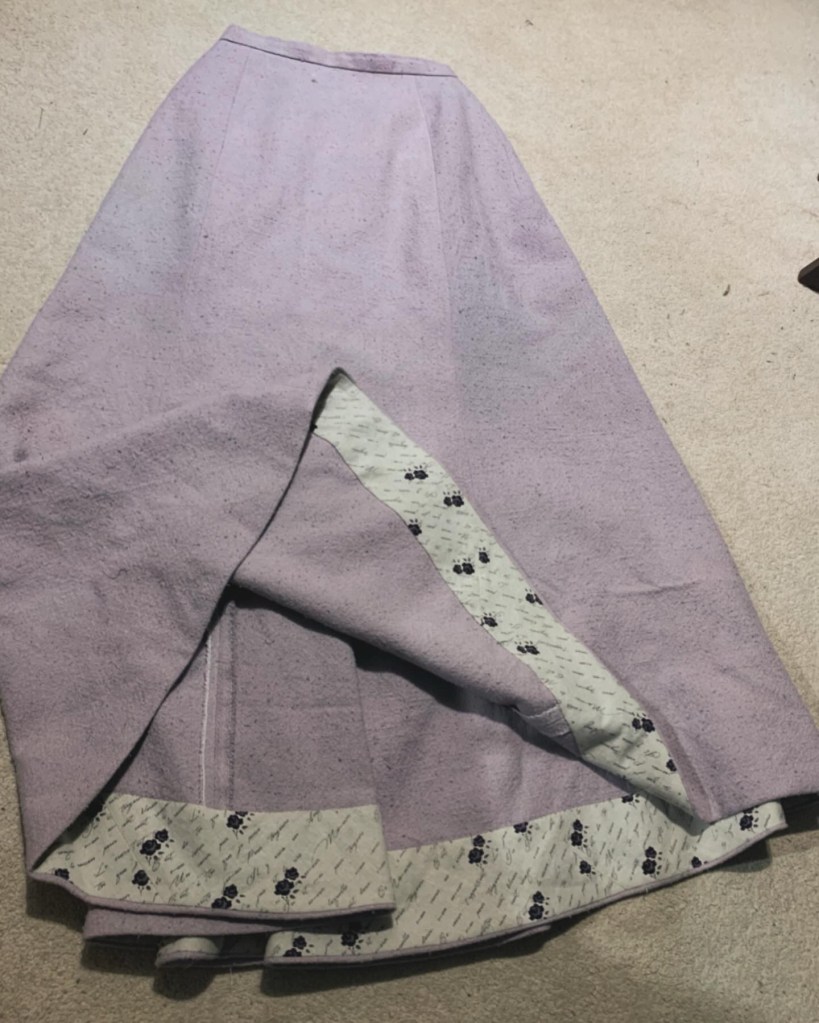
So, since I basically had no hem allowance, I decided to do a faced hem. This is a legit period way to do it, although mine is a pretty simple facing, and they often jazzed them up in period with additional layers of velveteen binding or stiffening or braid. I would have to double-check if bias was appropriate at this point in history; certainly a little earlier they were perfectly happy to cut their facings straight and just ease or pleat the top edge as necessary to have them fit. But I also serged all my seams here, I wasn’t in the mood to be too precious about historical accuracy.
I dove through scraps and eventually settled on the remnant from this dress (man that was a while ago!), a linen/cotton blend that is beefy but still a lot thinner than my main fabric. I evened my remnant into a nice rectangle, cut off the diagonal on one side and sewed it back on the other… then sewed it into the offset tube and cut a truly massive amount of 10-cm-wide continuous bias. So hopefully there’s another skirt worth of it. Probably it would’ve been faster to cut the strips flat with a rotary cutter and then sew them together, but anyway.
I’ll confess, I wasn’t super sure about the skirt when I first made it. The hefty fabric seemed too sculptural and stiff (despite actually being pretty soft). It sat on the dress form for weeks just waiting for that hem (probably a good idea since there was a lot of bias stretch to work out, but still). But this faced hem makes me love it! it’s such a nice finish. I love the facing fabric and how it makes the hem feel. I think a self-fabric hem in this fabric would just have been bulky.
Oh, and the skirt is drafted for a 41” front length (from the waist) which is pretty much perfect for me but probably a little long for many people. The pattern does actually include original instructions for lengthening or shortening at the hem, but if you want to maintain the fluted shape you should probably shorten by overlapping in two places, above and below the knee. In a perfect world, anyway.
I picked my size based on waist size, mainly out of curiosity as to whether I could make that crazy waist-hip variation work, even if it took padding. And I’m not sad I did, although a more rational way to fit the skirt would be to pick the size by your hip size and just adjust the waist. Those side darts give an immense amount of room to play with the fit, four or five inches, at least, and you can always pick a wider seam allowance if you’re worried about having to let out the waist or adjust the shaping there.
All in all, it was a fun exercise! I wouldn’t mind trying it again in a more appropriate fabric. Though I should really get back to the blouses for this kind of period…
Somewhere around a decade ago, when blogs were shiny and new, a dear online sewing friend sent me a gift of some fabrics she didn’t think she would get to use. It’s perhaps a little embarrassing to admit that I, also, went on to not use them for, y’know, a decade, but anyway. That coating is earmarked for the Next Coat when my grey coat wears out, which is on its way but not quite yet.
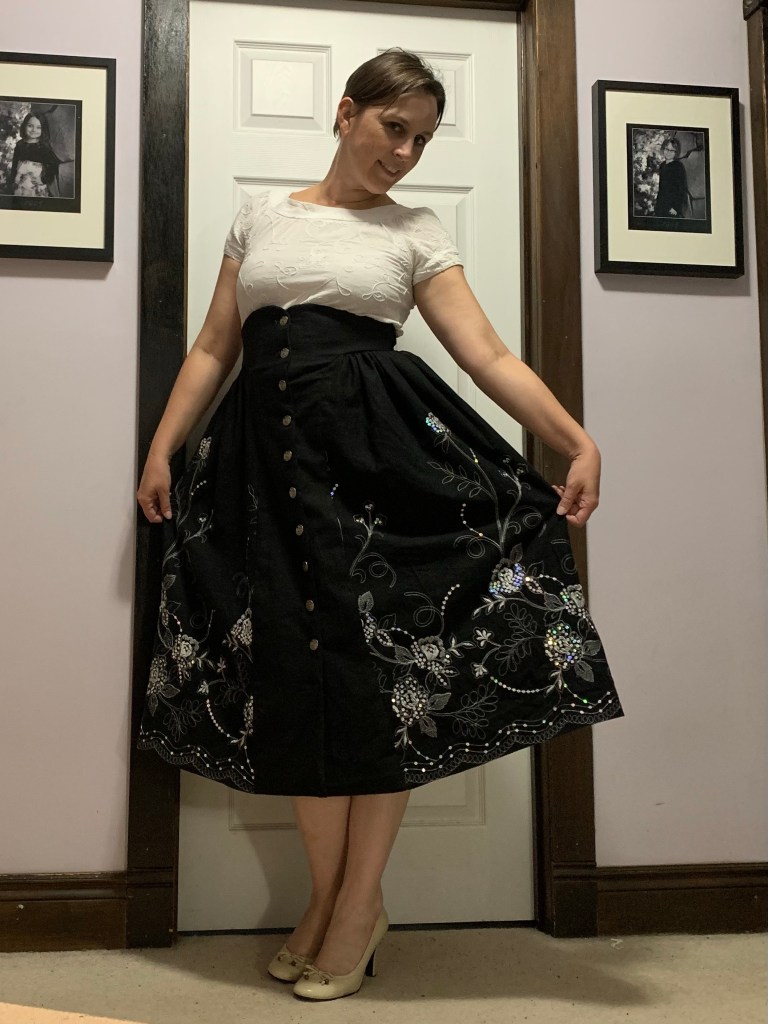
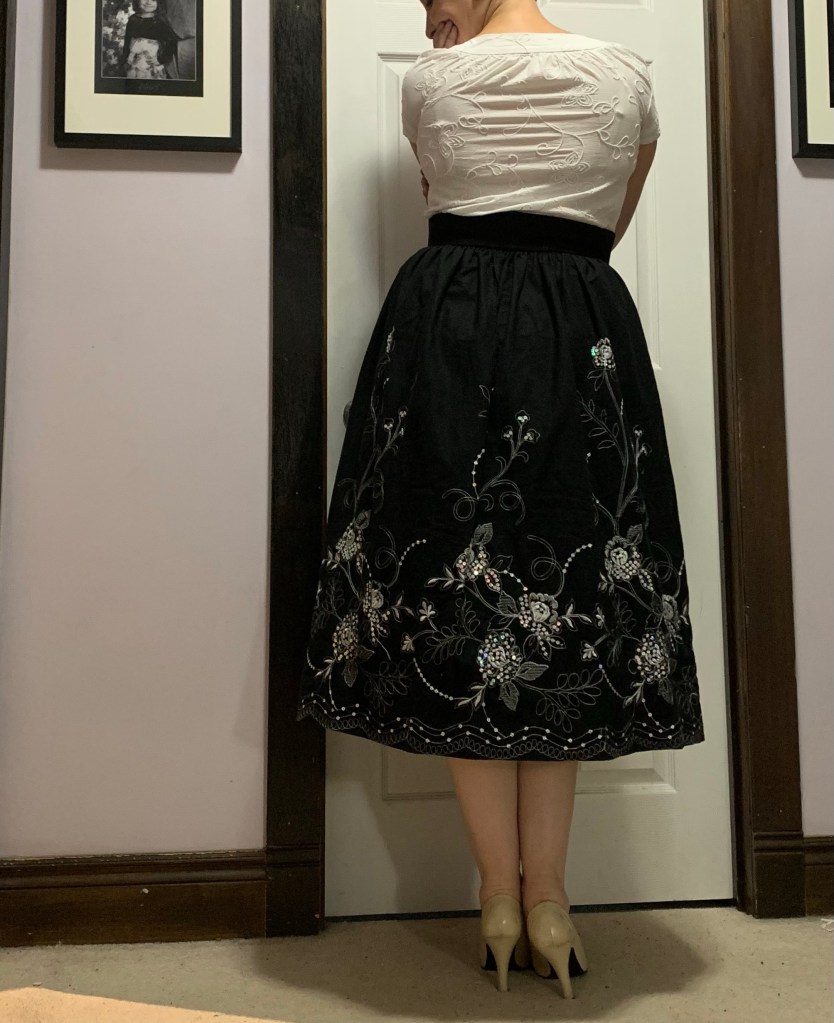
And then there was the glorious, sequined, black linen border embroidery. One of those fabrics relegated instantly to the “too good to cut” pile. I’ve fantasized about making it up many times over the years, but kept waiting on the perfect plan, or the perfect moment. Needless to say, such a moment did not arrive. It didn’t help that in addition to being exquisite, there was a scant two yards there. I don’t often think too much on the difference between a yard and my native mètre, but when you’re trying to eke a garment out of only 2, that extra 8” of fabric can make or break.
Anyway. Last spring, when the Leslie Skirt by Wearing History came out, I was blown away. I have a bit of a thing for front buttoning designs, and her sample in linen just ticked all of my boxes. Despite the skirt featuring that most dreaded of features in my wardrobe—waist gathering. But I instantly purchased the pattern, and started going through fabrics I had on hand (and more importantly, in sufficient quantity) to give it a go. And I thought of this long-languishing border embroidery.
But no. On further inspection of the pattern, the gathering was limited to a tiny section at the side of the front. The skirt as a whole is A-line (which is great for me in general), with a very curved hem. Completely unsuitable for a border embroidery. Not to mention, the part where there was only two yards, and the pattern calls for a minimum of 3 1/4.
But, my brain couldn’t leave well enough alone. Especially once another piece of linen-type fabric turned up, a remnant from a shirt I made my husband once, of an almost identical colour, weight, and weave. Enough there to make the waistband/buttoned front piece, preserving all the precious embroidery for the skirt itself. Surely two yards is enough circumference for a skirt hem? Surely?
So I dove in.
The pattern calls for interfacing in the waistband segment, but nothing down the front where the buttonholes are. This seems suspect to me, so I wound up adding strips of knit interfacing down my button bands, while I used a beefy twill fused to armoweft for the waistband interfacing, and added little plastic boning stays in several places to support the raised waistband. It’s possible I went overboard, but I regret nothing. (Except that some of the bones are a tiny bit too long.)
Should have at least one more button, but somehow my brain told me 5 cards x 2 buttons/card=12 buttons. Bad brain.
The waistband and front button panel were all cut according to the pattern, but to make the border embroidery work went pretty far off road. Basically I took the front edge of the skirt pattern, with the curve where it gathers into the waistband, and put that along the cut edges of my fabric, while I used the length of the centre back pattern to get the right “height” at the back fold, and drew a line connecting the two. I think it might be slightly longer in the back, which accommodates booty? Anyway, I cut this and just extended the gaaa an athers all the way around, gathering my fabric to fit. And while I would love it if I had, oh, an extra yard of fullness for that skirt, it’s pretty darn fine just as it is.
I had meant to finish the edge of the border embroidery nicely and trim it around the scallops, but I wound up just folding it under and hemming instead. I think the more structural nature of the folded edge works better with the weight of the front button placket anyway. Or something.
The pattern calls for quite a deep hem, which is great, but it also has the same amount of hem at the bottom of the button placket, which just seems odd. I didn’t trim the excess away, but it does make the bottom of the placket/front panel a bit odd and bulky. We’ll call that vintage pattern oddities.
Anyway! It’s a skirt! It worked! It’s a garment which does challenge me on a few levels. I don’t usually care for anything gathered at my waist, ever. The length is a bit odd, too, although that weird midi length seems to be popular of late. Most notably, it doesn’t have pockets, which may be an issue if I ever try to wear this to work.
I don’t regret overengineering the waistband, and would (will) do it again, as I’d still really like to try a true-to-pattern version of this skirt. The design does put a lot of stress on that second buttonhole, and I’m tempted to add a hook and bar to support the waist there, with the buttons just keeping things closed. You do definitely want to be aware of where you want the pattern to sit and make sure your size works, as you don’t have a lot of room to futz with the button positioning without changing the look of the overlap at the top of the shaped waistband. That being said, I did find it true to size. Also, if you’re shortwaisted like me, it will look a lot different than on the drawing where there appears to be about 4” between the top of the waistband and the bust—for me, there is no such space, and depending on the look you want you might want to adjust for that.
Anyway, it’s made, and fun, and I am so happy to have finally used that fabric!












 Tanit-Isis Sews