
The latest jeans
So after my great Skinny Cargoes affair, Claire of Sew Incidentally asked if I would consider putting together a do’s and don’ts post for jeans. Since I’m such a master at them, and all that.
Erm.
So, aside from the fact that she must be confusing me with some other blogger, I thought I’d give it a shot. Especially as I decided to crank out one last pair of denim to get me through Me-Made March.
Now, it didn’t take me long after deciding to “take my sewing to the next level” last spring, to decide that I wanted to tackle jeans. Yeah, I’d successfully managed to make my first blouse, what horrors could denim possibly hold?
This was spurred on by a number of factors. The biggest one was probably stumbling on the Jeans sewalong thread and summary thread on Pattern Review. I read literally every post of that 85-page thread. The idea of making my own jeans really appealed to me. First of all, I live in my jeans. Second of all, I’m picky about my jeans and how they fit. Third of all, I have pretty darn long legs. All of those factors combined means that I have spent a LOT of money over the years on jeans. Buffalo. Guess. Rarely under $100 for a pair. You get the idea. And always with that terror—will the fit I like go out of style? Will they be long enough? Even if they seem to fit when I try them on, will I wear them for a day and realize that they’re too short and too loose? Will I tear through the “artfully worn” knee within the first half-hour of putting them on (that pair was Guess, I returned them)? Speaking of which, when is that pre-tattered look going to go out of style? It was in style when I was in high-school (mid nineties). It was in style five years ago when the hubby and I went to NYC (and shopped at Gap. I know, we should be shot.) And it was EVERYWHERE last time I was tying to buy commercial jeans, which was one year ago. I haven’t really looked since, maybe it’s gone away?
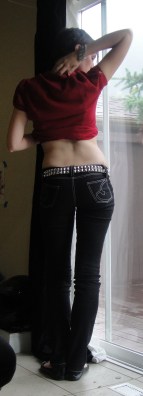
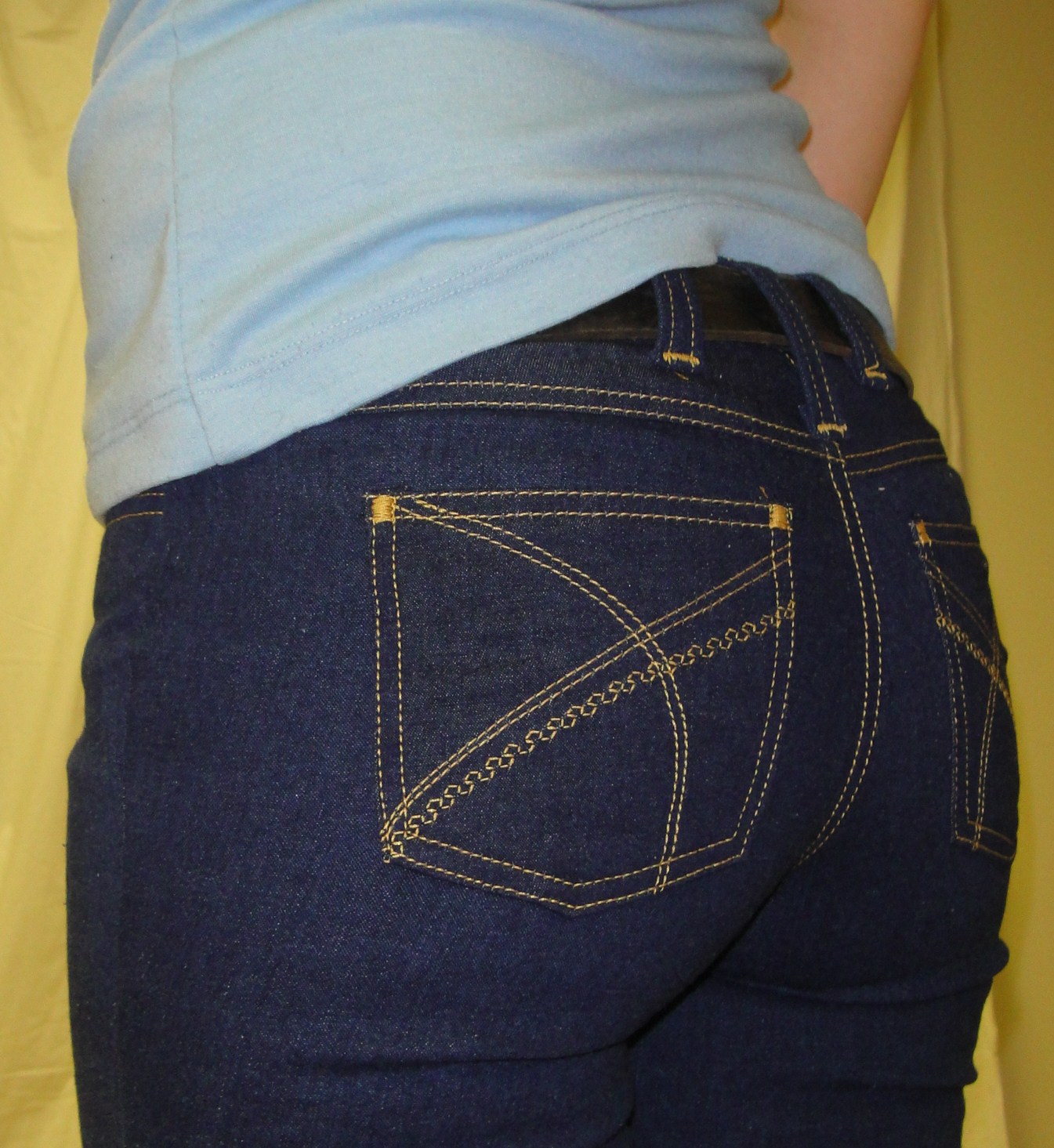
Despite the wonky stitching on the pockets (I suck at free-motion embroidery), these are probably still my favourite self-made jeans.
Now, I have a very clear list of things I’m looking for in my jeans. As far as I’m concerned, stretch-denim is the greatest invention of the 20th century (ok, after the birth-control pill). I like them low-rise, with a very fitted leg. I’m flexible on the degree of flare, although for preference I’ll go with what I tend to call a “stovepipe” leg, which is fitted in the thigh but absolutely straight below the knee; I’ve only ever once found this style in RTW.
If your list is different (as it doubtless is—few people are as fond of I am of the low rise, for perfectly good reason), some of my methods won’t apply, especially if you’re not looking for snug-fitted stretch-denim. (What, not everyone wants their jeans to look like they were sprayed on?!?) But I do hope you’ll be able to glean some nuggets from the dross, or at least be encouraged to tackle your own.
Incidentally, based on the PR thread, I used the Jalie 2908 pattern, with an assortment of modifications to make it suit my taste that are mostly detailed here. I like this pattern, but then I’ve only ever sewn two pants patterns, the Jalie one and the Burdastyle Ellen pant. Both were pretty painless, doubtless due to my minimal curvatures in this area. So I wouldn’t consider my endorsement to be the be-all-end-all in this area.
Anyway, without further ado,
DO:
- pay attention to the % stretch, not the % lycra; expect to resize slightly depending on the individual stretch of your fabric.
- buy enough fabric for two pairs of jeans—the first one can be a hopefully-wearable muslin, and you’ll know what to expect from the remaining fabric stretch-wise.
- wash and dry your fabric on hot at least once; then let it sit or hang (“relax”) for at least a day or two, as the heat can bunch up the lycra fibres, creating fabric that will stretch too much after wearing.

My foot for topstitching. Not necessarily the best, just the best from my limited selection.
- do figure out which sewing-machine foot works best for topstitching. A lot of people prefer a straight-stitch foot as the sides are narrower and you can see right up to the needle. I don’t have one, but I find my rolled hem foot (of all things) works the best. An edgestitch or possibly even blind-hem foot are also good options.
- play around with your topstitching options. There’s jeans

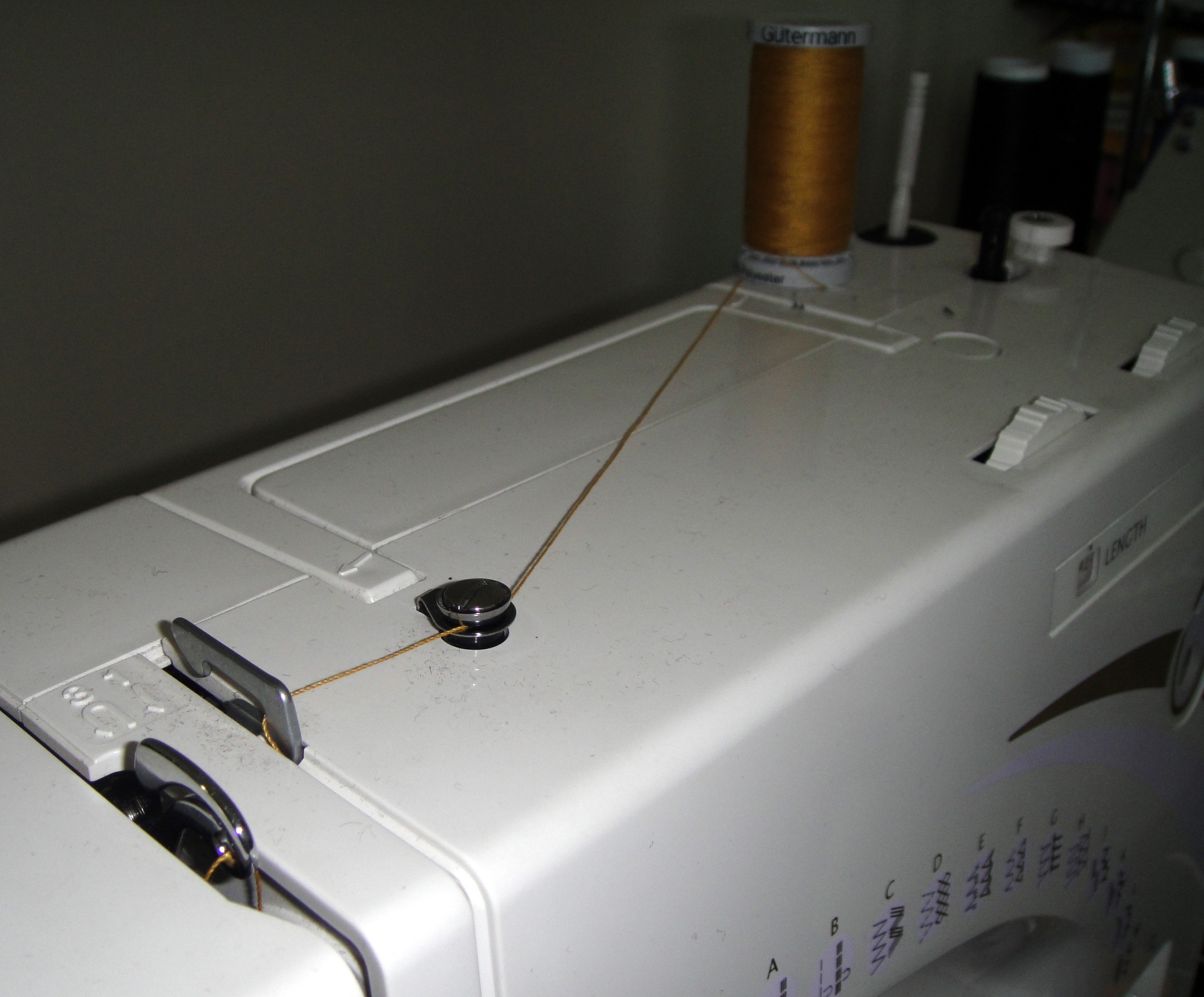
I wrap my topstitching thread around the bobbin-winding doohicky to increase the tension (AKA cheat)
- be prepared to baby your machine over the thick parts (at least if you, like me, have a wussy modern machine. Sometimes I need to just turn the hand-wheel for several stitches. Or hammer the crap out of the seams (preferably with a rubber mallet. I use a regular hammer or even my rock hammer and if I’m not careful the edges will cut the fabric)
- construct the front first, then the back. Have another pair of jeans around for reference. Attach the pockets after sewing the two sides of the back together, and centre them relative to the topstitching, rather than the true CB.
- If you’re doing anything other than the simplest of pocket-embroidery, you will want to stabilize the pockets, either with wash-away or tear-away stabilizer or even interfacing. I recommend the removable stabilizer, though; permanent interfacing interferes with the pocket’s ability to stretch and causes butt-flattening. (Ask me how I know 😉 ). Use a cardboard template to press your pockets’ seam-allowance under. Speaking of pockets, I use a size-K pocket on my size-Q pants. My derriere is compact, and I don’t like the bottom of the pockets to go below my actual bottom. YMMV.
- Look up your favourite fly-insertion method EVERY SINGLE TIME. My

What passes for a successful fly around here.
favourite is Debbie Cook’s; a lot of other people recommend Sandra Betzina’s video. (I have a hard time following video instructions, for some reason.) Also take a long, hard look at some RTW flies while you’re doing it. It will help. Oh, and interface the fly, too. (The fly isn’t actually hard. It’s just really easy to do the wrong way around, which is mildly annoying. The topstitching is a bit tricky, too, but you can manage.)
- once you have your jeans stitched up the side, before applying the waistband, do put them on and wear them around the house a bit (preferably for a few hours). This will give you an impression of how much the denim will relax with wear. You may also want to do a trial wash (serge the top edge first) at this stage, as washing and drying are another wild-card for stretch fit.
DON’T:
- be afraid. You can totally do this. Denim is heavy, but lovely to sew.
- use a pattern or fabric you don’t like. Remember that *perfect* pair of jeans you’ve been mourning since the day went to that great warehouse in the sky? Those are the ones you’re trying to re-create. You won’t, of course, but with any luck you’ll make it into the right ballpark.
- cut your waistband on the bias. I use a contour waistband on mine, stabilized with a light-weight interfacing. If I had to go with a straight waistband, I’d cut it on the lengthwise grain, to reduce stretch. My RTW jeans often have about 50% stretch in the fabric, but only about 10% stretch in the waistband (how do they do it?)
- sew over the bottom of the zipper when you’re topstitching your fly. Instant recipe for broken needles flying into eyes.
- add or remove length at the hem. Unless your jeans are drafted perfectly straight, there’s shaping between hip and knee, and knee and ankle; you need to measure your length to the knee and add (or remove) both above and below to keep the proportions right.
- add a wedge to the side back rather than the centre back because you weren’t paying attention. (yes, I did this once.)
- if you’re making skinnies, don’t narrow the leg so much you can’t get your foot through (unless you’re adding zippers!)
- freak out about wrinkles below your butt. These are not trousers that are supposed to fall straight down from the widest point. There will be wrinkles.
- try to finesse the slightly-too-tight waistband fit by putting your button too far over. You’ll just end up with a gapy fly.
- feel self-conscious about your wonky-topstitching, or those almost-invisible darts in the yoke. No one is looking. Seriously, they aren’t.

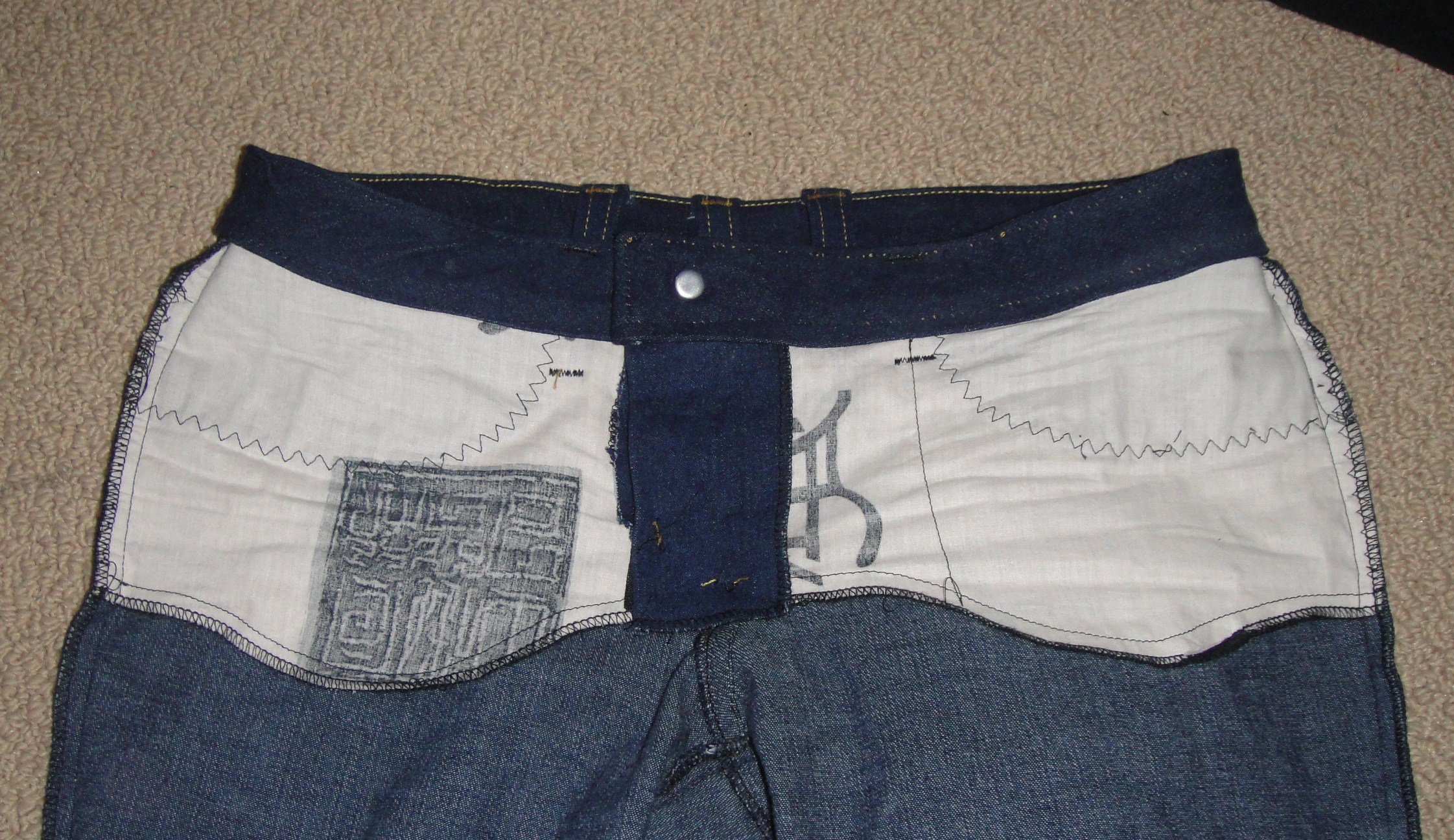
I extend my pocket-linings all the way to the front fly. This interfaces the fly while stabilizing (i.e. slimming) the front, and is super-easy to draft.
I have to admit I feel a bit bad about these lists. They’re tailored so specifically to my “jeans ideal”, which I know is not everyone’s cup of tea. I don’t have much to say about fitting—other than curving the back yoke and taking in the outseams a little bit, and of course the inevitable length adjustment, I haven’t done any (stretch-denim is fairly forgiving). Certainly no messing around with crotch-curves as the intrepid Patty does on a regular basis these days. While I’ve made a crapload of adjustments to the pattern, the majority have been for style or personal preference (pocket linings that reach all the way to the fly to interface it, contour waistband, smaller pockets, etc.)
Coming up with the top 10 was hard (as you can see since so many of them are actually two or three suggestions!). There’s lots of other little points that I could’ve thrown in there. I didn’t even mention the buttonhole, which has been my waterloo. Mostly, I resort to doing them by hand—not too bad since there’s only one—but on this most recent pair I eased up on the waistband interfacing and was able to work it by machine. My machine can’t do a nice keyhole shape, sadly, but no one else is going to notice anyway.
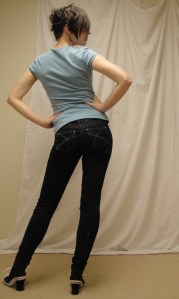
New skinnies---rear
And I still haven’t really showed you photos of the new pair! So I’ll be quick: this is my first “truly skinny” pair of jeans (the other ones all have stovepipe legs). I made them to replace this pair of RTW jeans that are beginning to bite the dust, and are verboten this month anyway. As you can see (You might have to click through to the full-size photo), I included the same cute little top-stitched dart on the lower leg as in Syo’s pair.
As I doodled out my pocket detail, I
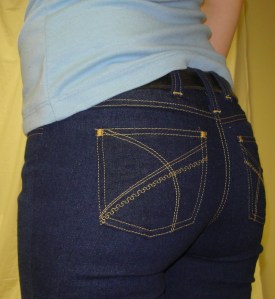
A subtly naughty pocket
realized I’d created an homage to Mary-Nanna’s white knicker jeans (and Steph’s tribute… and of course this alleged Japanese fashion trend which I’m happy to learn is indeed a hoax. I thought it was a bit fishy when I first saw the pictures a few years back, but you never can tell with the Japanese. 😉 ) Mine is a bit subtle, but those of you in the know… well, now you know! ;). If I ever find some white stretch denim, I promise I’ll do full out undies-pockets. The nice thing about making my own skinnies is I can keep the calf-width where I like it and just narrow below; so many skinnies are made for those toothpick-legged adolescents with no calves.

New skinnies, front view
Beyond that there’s not too much to say about them. I used much the same procedure to narrow the bottoms as I did with the skinny cargoes (except I only had two seams to work with, not four). I kept the full length this time, to get that “legwarmer” bunchy look around the ankle that I crave so badly (yes, I like my pants and my sleeves to look extra long. It’s such a rarity for me). Since there’s no zippers in this pair, I had better hope they don’t shrink at all in the wash or I may not get my feet through them next time ;).
So, this is officially my first pair of truly skinny (self-made) jeans… and I hear that apparently the bootleg cut is coming back. If it ever actually left. /sigh. I’m so non-trendy. Oh, wait. That’s a good thing.
I still think I like the stovepipe leg the best, though…
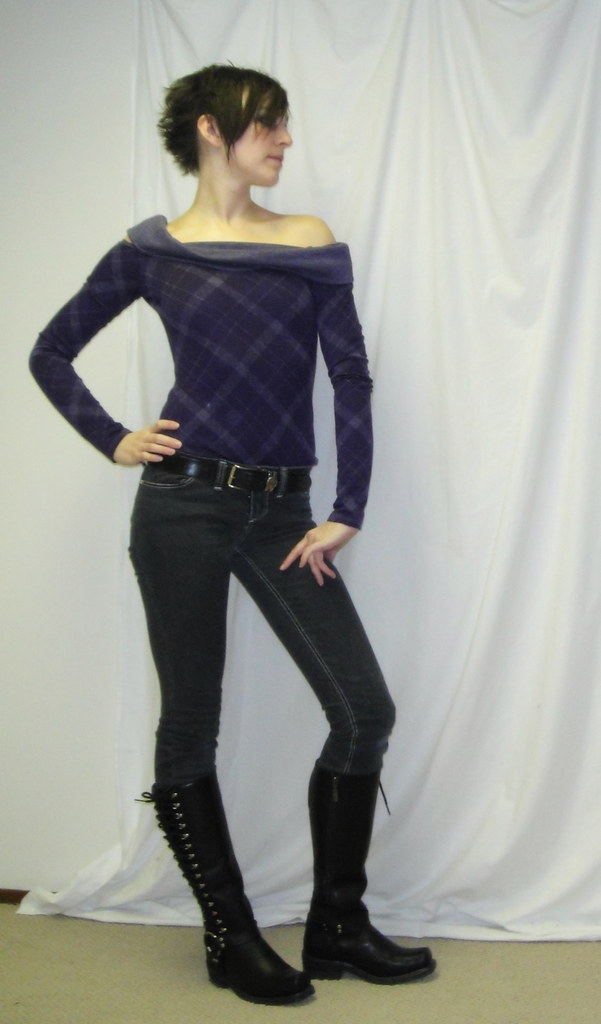
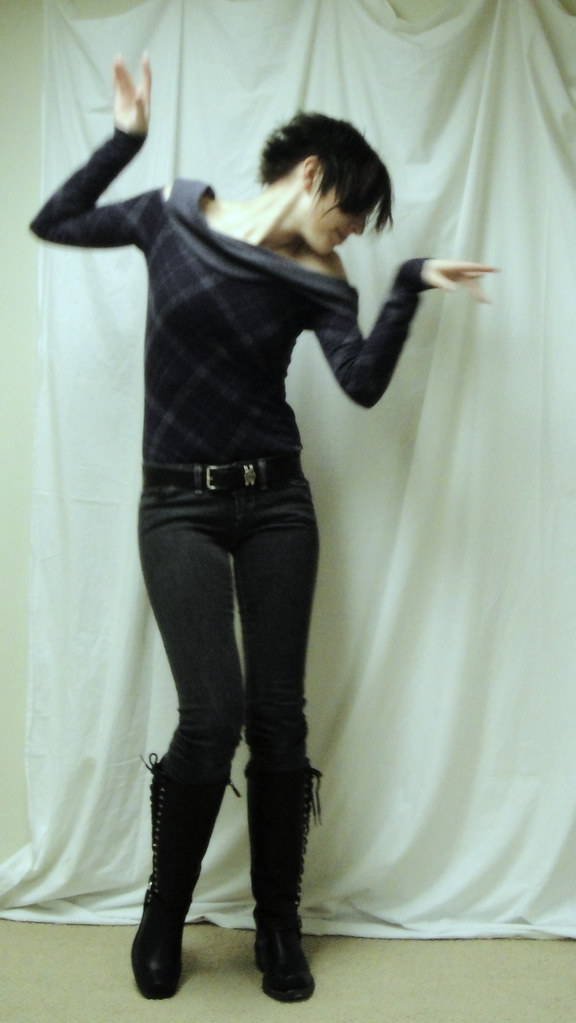
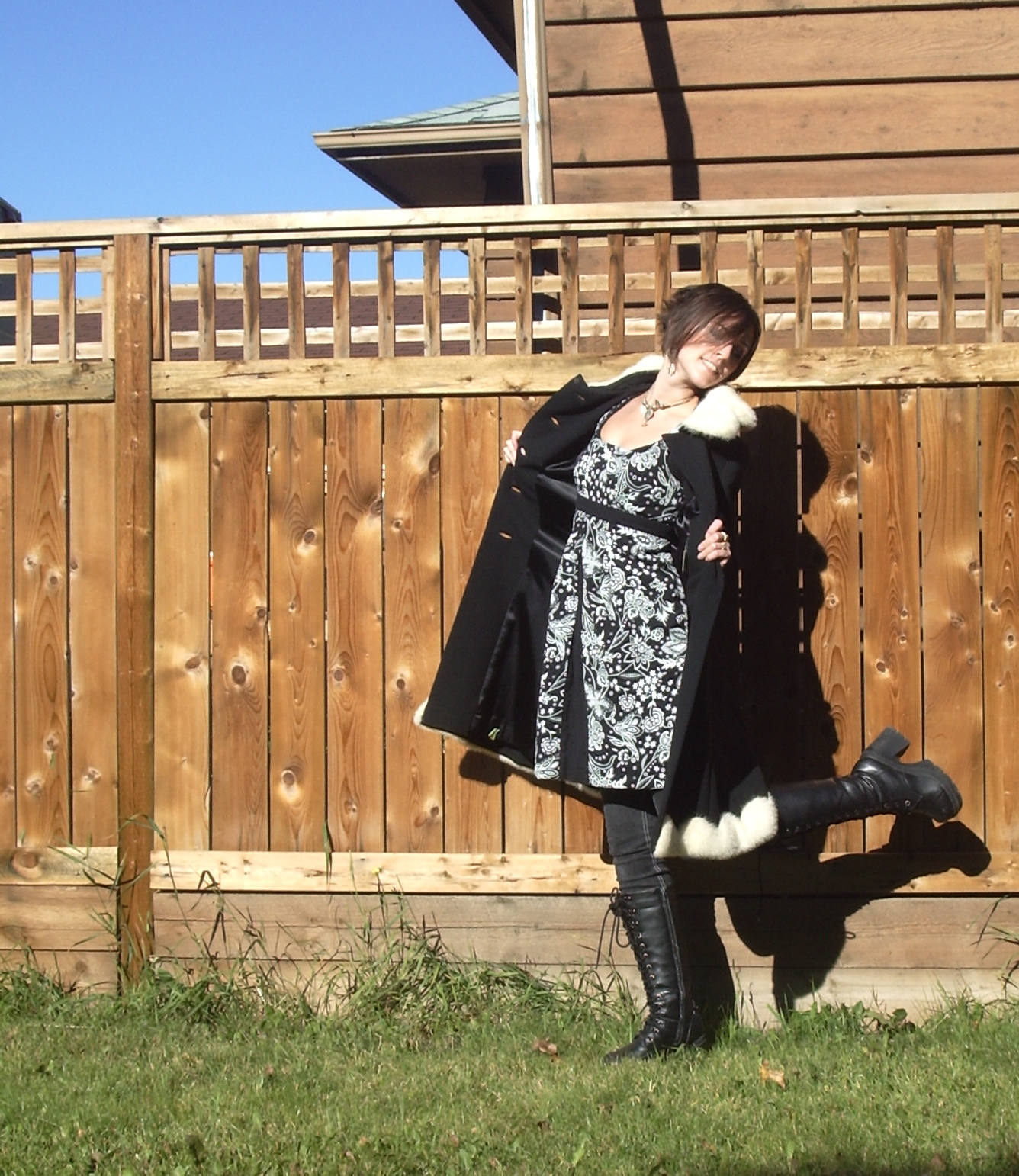
Oh, and this would be my first outfit for Me-Made March. Not terribly innovative, I know, but it’s far too cold out right now for the frillies and the pretties. Hopefully that will change over the course of the month…














 Tanit-Isis Sews