Monthly Archives: December 2024

(Historically inspired) Red Skirt

Don’t say Mrs. Claus

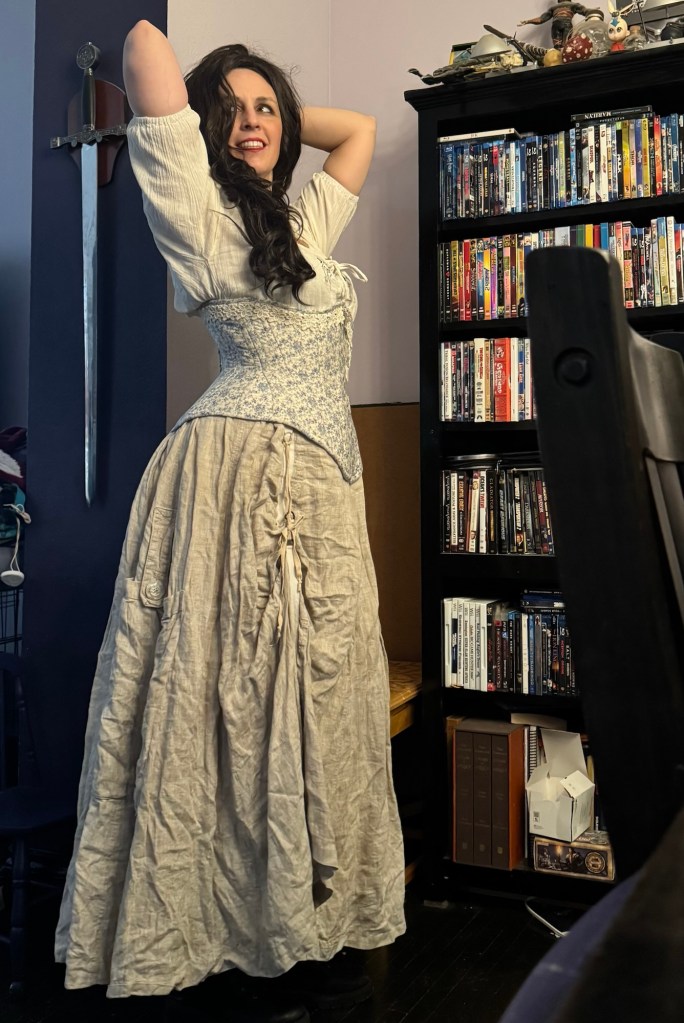
I got this fabric from a local sewing friend who’s been in a low-key destash mode over the last couple of years. It’s a gorgeous textured linen/cotton. I originally wanted a dress but the 2.5m length was a bit minimal for the long, flowing thing I was imagining. So then I decided to opt for a skirt… But to minimize cutting into the fabric in case I change my mind later, I went with a skirt style lightly inspired by eighteenth-century petticoats—two rectangular lengths pleated to a waistband.

Now, this is frankly an ageless method of skirt construction, and it’s one I have a fraught history with. I don’t usually like how gathered rectangles look on my body, above or below the waist. It worked ok for this dress here, but it’s generally not my favourite. I’ve attempted to rework this dress for post-maternity wear and I kinda hate it.

But, wearing over a corset lets me get away with some clothing shapes I haven’t usually been comfortable with, so I decided to give it a try in this case. With pleats, not gathers.

I left a flat space (maybe too wide) along the middle of the front, and then my pleats are closer together in the front, a bit more spaced out in the back.

The most common method of making 18th-century style petticoats seems to be leaving slits at the sides and putting separate ties on front and back. This works great and is highly adjustable, but I wasn’t too sure I wanted slits at the highly visible sides since I’m not likely to actually wear it with 18th century upper garments that often cover that area. So really this is more of a Victorian take on the idea, which I’m sure existed and I could probably find references and directions for if I dug.

Anyway, I decided to make a slit closure at the centre back, using the same slit in a pleat method I used on my flannel petticoat, though I didn’t do a good job of illustrating it in that post either. Basically you cut the slit; make a narrow hem (tapering to nothing at the end of the slit) for the underlay side, and fold in a big pleat to make the wide overlap side.
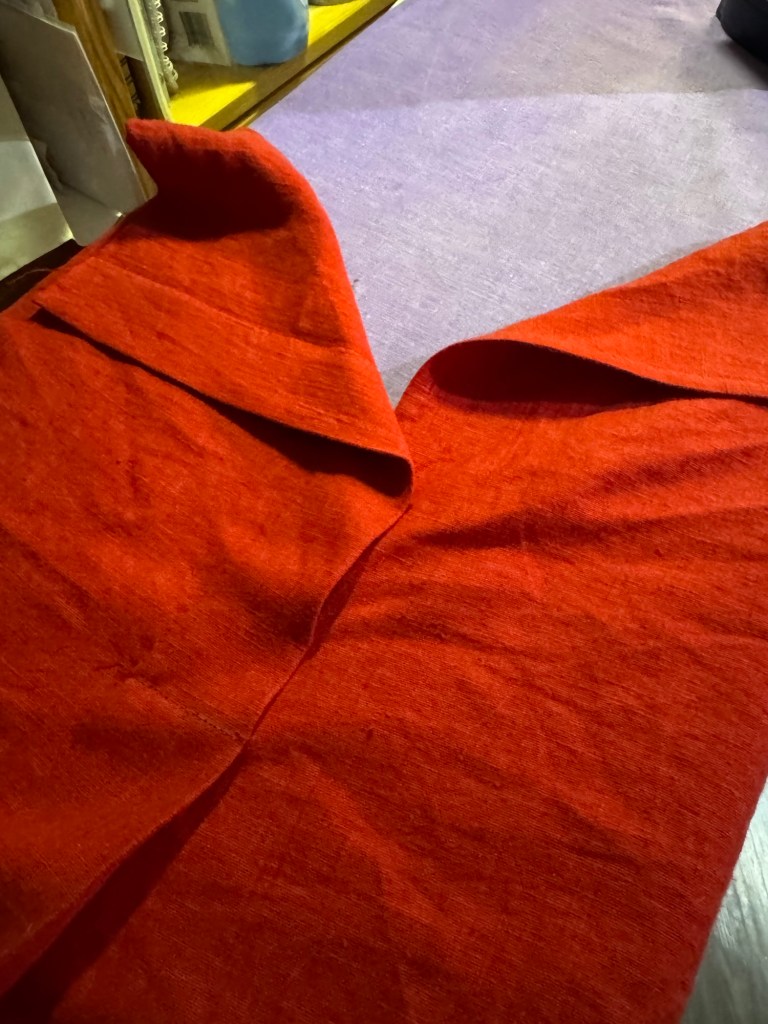
Stitch along the edge of the pleat that formed the overlap, and stitch across the pleat at the bottom of the slit portion to secure it in place, so above this line there is placket, and below it is pleat. Clear as mud? Thought so.
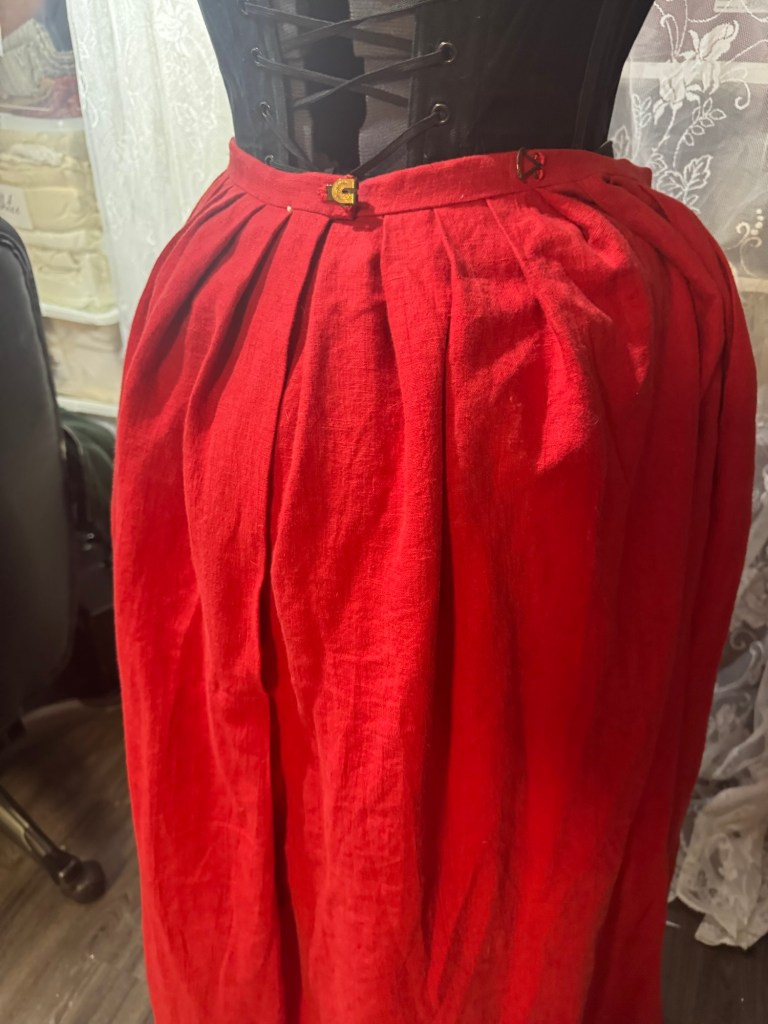
And that was the most complicated portion of the construction.
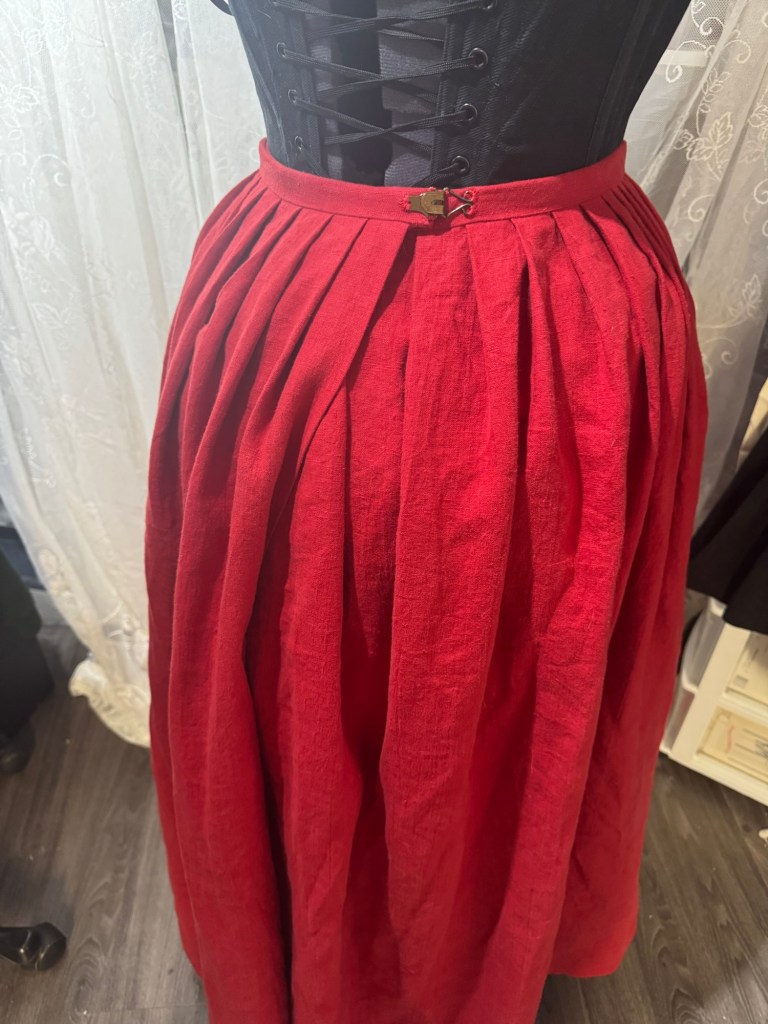
I got these gorgeous heavy-duty hook and eyes from Farthingales and they’re too pretty to hide inside.

Except…I knew I was pleating it a bit loose for my corseted waist. I kind of wanted to keep my options open for wearing without corsets (even though, as previously mentioned, I’m not likely to like this skirt shape on my body without a corset). But it’s a bit too too loose. So when actually worn the too-big overlap creates a fairly weird spot where the upper placket pulls awkwardly across several other pleats. On the other hand, it’s in the back so I can’t see it and pleats are always shifting around when you move anyway.

I definitely still prefer the flared look of a gored skirt, and I think undergarments—corset and gored petticoats—are going to be key to the wearability of this skirt, giving it the illusion of more volume at the bottom. Also, I need to go in and add real pocket. (I added one about a week later. ) But I’ll have to find a coordinating fabric for that because this was an absolutely zero-waste project, which is basically unheard of for me. Oh wait I lied…. There was a short piece of the narrow rectangle I used for the waistband left over. (Edit: I used that leftover rectangular bit to make matching pocket facings on my quilting-cotton pocket, it is now fully zero waste.)
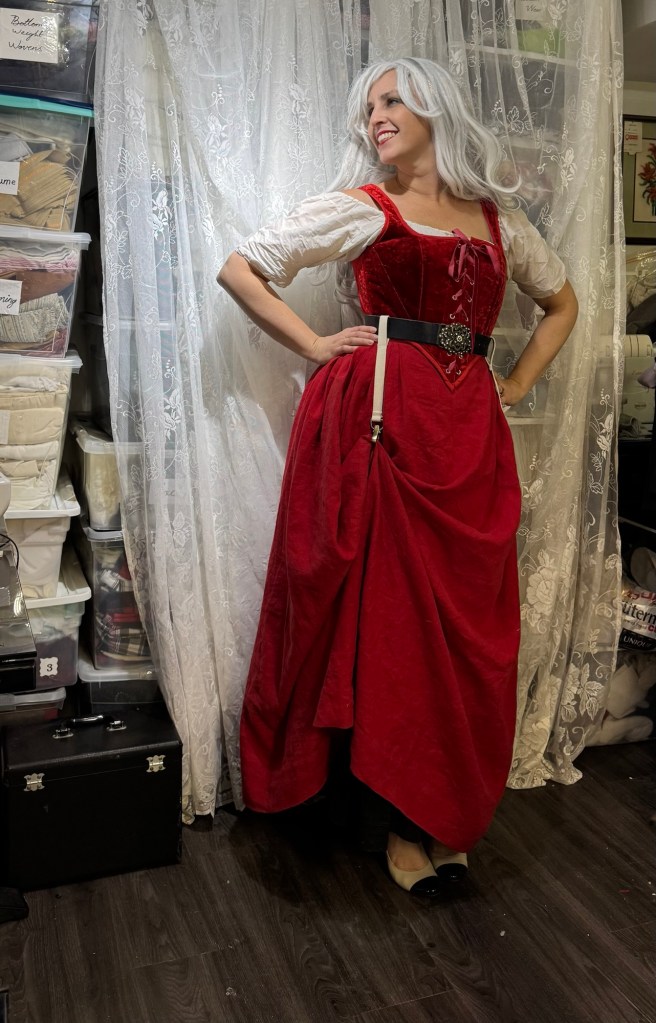
But I am excited to have a red skirt. Considering red is what I usually call my favourite colour, I don’t wear it much. So I’m pretty happy to change that a bit. And it’s definitely the season.

Now if only I had a red cape to go with it…

Comments Off on (Historically inspired) Red Skirt

Filed under Sewing

Corset remake

The first corset I ever made, back in 2015, has always been one of my favourites.

But, it’s also never really been wearable. Partly the fit wasn’t great, but the biggest glitch was my failure to properly bone the outer edge of the back lacing, which made it impossible to lace very tightly; it was also a bit big, though entering my 40s has fixed that problem for me. And as my bust has, ah, improved over the last few years, the upper edge went from not-quite-mid-bust to awkwardly low. There was nothing like enough hip or bust spring, either. So it’s been sadly awaiting a makeover for quite a long time.

I’m a bit between projects right now and a little too burnt out to tackle anything big, so I made myself start mindlessly seam ripping.

Fortunately I had the rest of the fabric still in stash, since I needed to add gussets to the hip and cut new binding for the top and bottom, as well as adding a casing to the lacing edge.

Lace flowers.

Removing the binding took the longest (well, except for adding the binding back on). I had to take off the lace along the top as well, and removed one of the carefully scatter of artful lace flowers that were pretty much my favourite feature of the corset, and I should probably reposition more of them, but we’ll see if that happens.

That being said, it really didn’t take nearly as much time as I thought it might. The original corset was layered over a white denim, but for the new additions I layered the fashion fabric over some bits of ticking, which is much more corset-appropriate. It’s a little thinner but this isn’t a big problem for the gussets.

Can you see where I added the hip gussets in?

Once I had the binding off I seam-ripped the bottom half of the side seam, drafted up a gusset shape to fill in that space, and marked where I thought the under bust curve should go. (I also ripped WAY up one side trying it on to get an idea of how big the hip gussets should be, and had to hand-stitch it back together, which worked surprisingly well. Here’s hoping if it works for 18th century stays it’ll work for me.

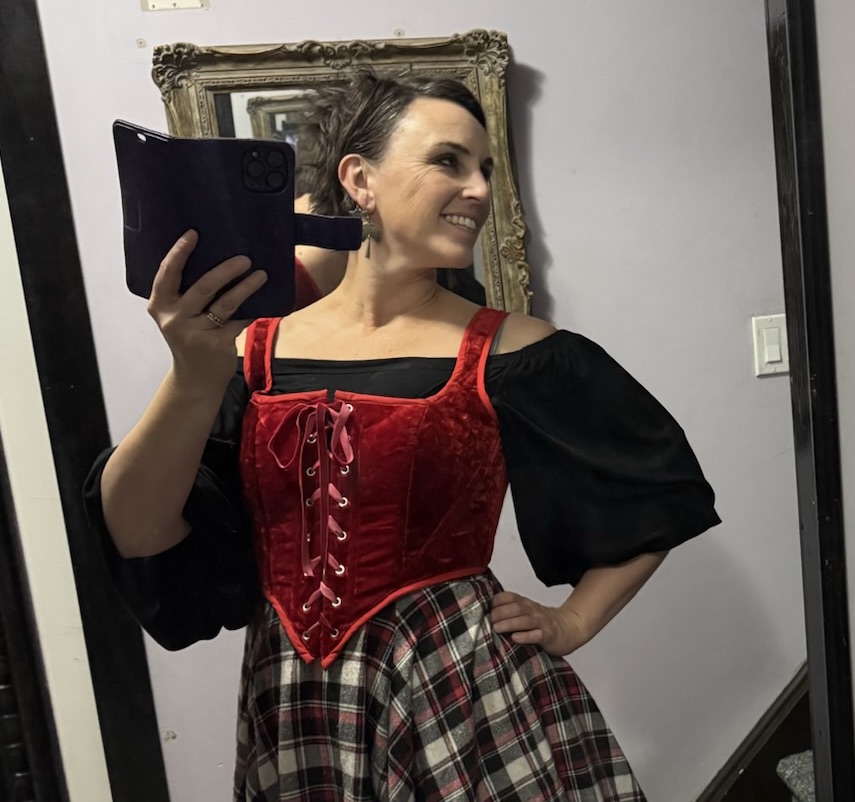
The result is a much curvier underbust corset—maybe not as historical, but it wasn’t really good at that anyway.

I think it’ll be much more useful as a cute outerwear piece than it was before.

And it was always a bit showy for underwear.

So yeah. Quick project. Very satisfying.

Comments Off on Corset remake

Filed under Sewing

Red velvet

This was a whim

A friend mentioned this pattern (off Etsy) and it was cheap and had that cottagecore/hobbit/dirndl look I’m all excited about these days, so I jumped on it.

And… it’s ok.

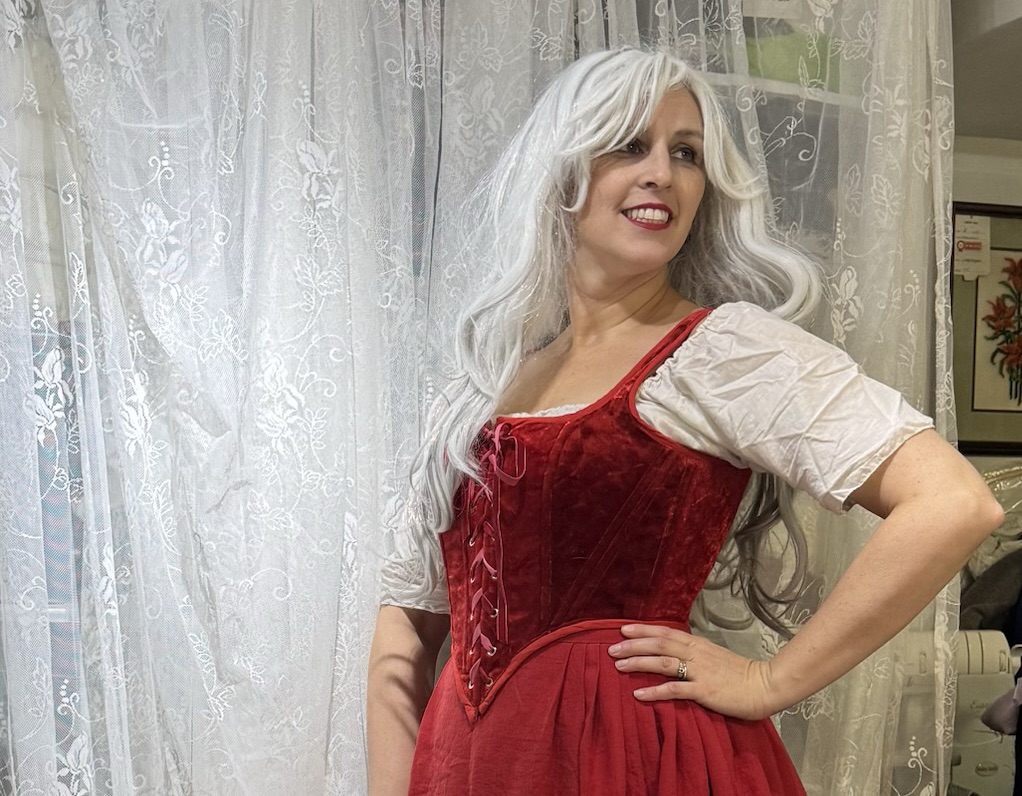
The sizing I would say was true. I was between two sizes and went with the larger, and I think it is a bit large, in that I might like to have a bit of lacing gap in the front, and it laces closed quite easily right now. Other than that I made only minor tweaks, shortening the shoulder straps and reducing their angle, and trimming a bit off the bottom of the back for my swayback; all typical for me.

The pattern has fairly detailed instructions for assembling the PDF if you printed at home… but no actual instructions for the sewing (on looking back at the Etsy listing now I see it mentions a video for sewing instructions. Where that video is I’m still not sure….) Now, it’s not a hard sew, but I’m always interested in the construction choices patternmakers suggest, for corset-type garments in particular. So I guess I should hunt down that video.

The fabric I picked was scraps of some kind of crushed red velvet upholstery fabric that’s been lurking in stash for aeons, I think a hand-me-down from someone else’s stash. I picked it because I wasn’t too attached if the project didn’t work out, and part of it was already blockfused to interfacing. (Other parts of the scraps are not… I suspect this fabric has its own fascinating story as the interfacing looks like it was applied industrially)

At any rate it made for a quick and easy way to test the pattern out. I allowed for some extra seam allowance in case of fitting issues but didn’t end up using it except for adding boning to the seams. The 1cm seam allowances the pattern comes with aren’t wide enough to put the boning in using the seam allowances, it’s designed to have boning channels added or have the channels stitched between two strength layers. (Not sure which because I didn’t see the instruction video)

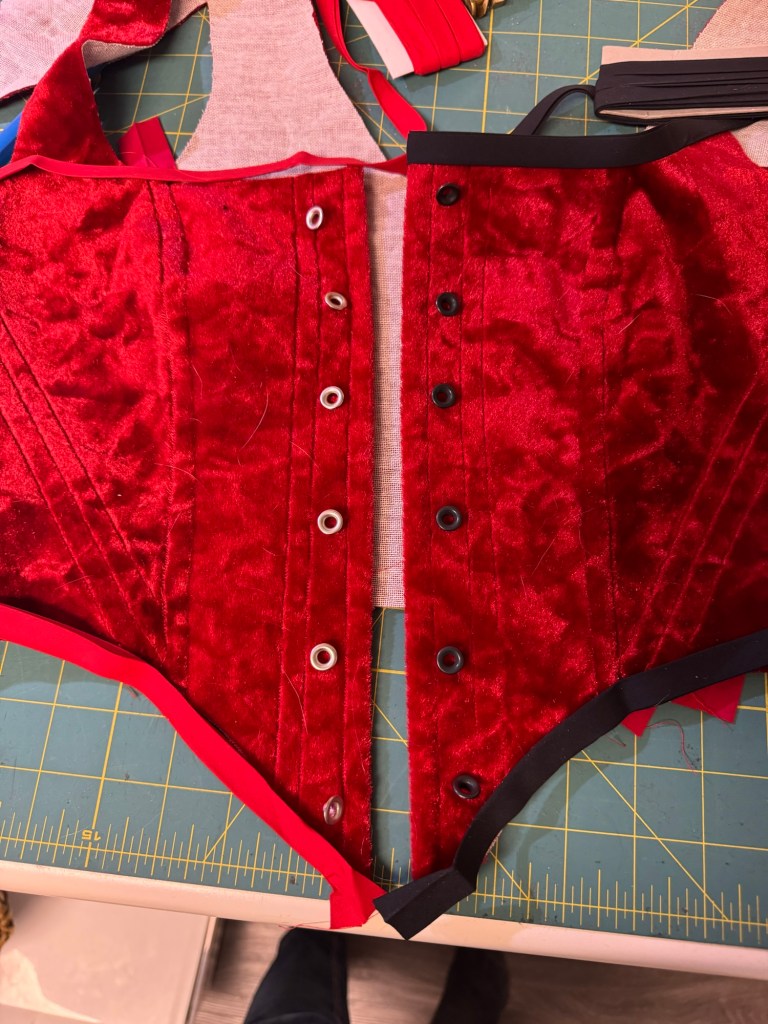
I spent some time agonizing over the finishing, neutral silver grommets with red binding or vampiric black grommets and binding. In the end I went the neutral route, hoping for a more flexible garment, although it feels perhaps just a little Mrs Claus. It still pairs nicely with black so I’m mostly content though.

River was very helpful with the grommets.

Construction-wise I did a terrible, half-ass job with the binding, which may have coloured my original impressions of the product. I didn’t want to use the velvet for a self-binding as it’s quite thick, and since this was mostly a quick tester I went with commercial bias tape. The colour match is good but the material itself just didn’t spark joy and I did my second pass attaching it by machine which led to a fair bit of rippling. But it’s bothering me less as I get a bit more distance from it, though I might fix the ends at some point, especially at the front bottom where the angle isn’t at all right.

I might tweak a couple of things if I did it again, like lower the neckline a bit, maybe tweak the curve in the back to be a little wider, and maybe play with the princess seam curve at the bust. And take it in a wee bit. But, all in all, not a bad addition to the more frivolous side of my wardrobe.

3 Comments

Filed under Sewing